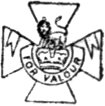
PRIVATE THOMAS WILLIAM HOLMES, 4TH CANADIAN MOUNTED RIFLES
Reading edition
Heavy rain had been falling on the Passchendaele country for two days before the 4th Canadian Mounted Rifles waded up to their positions in the front line, between Wallemolen and Bellevue. All the dykes and ditches of the low country were full and overflowing, and even in that short space of time ground that was firm and solid had become dangerous swamp. However, the men pushed on through the darkness, and the slipping and splashing, the long halts, the interminable discussions with somewhat vague guides, all came to an end at last, and at five o'clock on the morning of October 25th the regiment had arrived at its battered line. Through the day the weather cleared, the sun and wind considerably improved the ground, and the men were able to discern their objectives for the following day's attack—occasionally with mild misgiving, for there seemed entirely too much water about the low hills and copses they had to traverse.
The C.M.R. were on the extreme left of the Canadian Corps front, with the Hood Battalion of the Royal Naval Division on their left, and the 43rd Battalion on the right. Their objectives were Woodland Copse and Source Farm, and it was hoped to consolidate a strong line upon Wallemolen Ridge, all with a view to the establishment of a good jumping-off line for the capture of Passchendaele town itself. Though the clearing of the weather had greatly improved the ground, it also improved the visibility and the German artillery and riflemen made very effective shooting upon our hastily improvised communication lines. The persistent bombardment was very severe indeed, and while many gallant attempts were made to supply the soldiers in the front line with munitions, time after time the men of the carrying party were wiped out and the supplies dispersed by the incessant shells. Ammunition was plentiful, however, but the men went into action the following day with practically empty water-bottles.
Soon after five o'clock on the 26th the troops were assembled in the jumping-off positions, "C" and "D" Companies in advance of the front line, and "A" and "B" Companies in close support. As our barrage opened at twenty minutes to six, the heavy rain began again, making the ground very difficult and slippery as our fellows went forward. Heavy fighting occurred at once, a line of pill-boxes across the flanks of the low hills maintaining concentrated machine-gun fire, and all these small fortresses had to be stormed with the bayonet. But they did not take long to clear, and after a few minutes of close bayonet work our troops swept through and on to the stubborn resistance of the Wallemolen-Bellevue line. Here was a serious check. North-east of Wolf Copse a German pill-box was situated, its own strong defences supplemented by a machine-gun mounted close to the building on each side, and against their fire our men advanced, at times up to their waists in water. It was not possible to advance quickly, and man after man of our small attacking force went down into the mud. Reinforcements from "A" Company came up on the right, and a series of gallant attempts were made to rush the enemy's position, which was holding up our entire local advance. Each time our men failed to get home, and eventually they were forced to take whatever cover was possible some fifty yards from the pill-box. At this moment Private Holmes advanced alone.
Making his way forward, indifferent to the concentrated fire of the two guns, Holmes reached a point from which he could throw his bombs. Then, with marvellous coolness, he hurled his missiles, with such precision that he succeeded in knocking out each gun, one after the other, killing or wounding every man about them. But this result was not sufficient for him, and he returned to his comrades for more ammunition. Securing another bomb from a friend, once more Holmes ran forward alone, this time getting close to the pill-box itself. Landing his bomb within the entrance of the concrete fort, he caused such an explosion in the confined space that the unhappy survivors of the garrison crawled out and surrendered. One does not know how Private Holmes escaped the sweeping fire that was poured upon him, but there is no doubt that his gallant action saved a critical situation, and allowed our men to push forward and establish a strong line in advance of their intermediate objective. Here they held back counter-attack after counter-attack, subjected to intense bombardment and heavy machine-gun fire from the high ground on the right, until later in the day the gallant capture of Bellevue Spur by the 43rd and 52nd Battalions cleared the situation, and permitted the consolidation of a strong line.