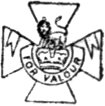
LIEUTENANT (ACTING CAPTAIN) CHRISTOPHER PATRICK JOHN O'KELLY, 52ND BATTALION
Reading edition
When the Canadians went up to take the ridges before Passchendaele the men of the 52nd Battalion were in support, and were not pleased with their minor share in the preliminary offensive. Their fears were not justified, however, for no battalion engaged played a larger or more gallant part in the attack.
The 9th Brigade attacked at "zero" hour with the 43rd and 58th Battalions, and at first reports were good, and the Canadians appeared to be making excellent progress up the difficult slopes of Bellevue Spur. But by 8.30 a.m. the news had changed, weary parties of survivors came straggling back in twos and threes to the jumping-off line, and the 52nd Battalion troops were aware that their services would be required in short order. Colonel Foster, the Commanding Officer, went forward to the front line and returned with news of a critical situation. On the right the 58th had encountered terrible machine-gun fire and had been unable to make any progress, while some forty men of Lieutenant Shankland's company of the 43rd had managed to fight their way to the crest of the spur, had roughly entrenched themselves, being able to advance no more, and were still holding out after four hours of steady fighting, under heavy close-range fire from pill-boxes on the ridge, and in constant danger of a flanking move by the enemy on either hand. Lieutenant O'Kelly, in charge of "A" Company, was ordered to move at once to their assistance, advancing on the left flank of the 43rd Battalion post upon the hill, and filling the gap between the 8th and 9th Brigades.
Drenched by the steady rain and pounded by the enemy's shells, the men of the 52nd were very bored indeed with inaction. They went forward strongly, penetrating the German barrage on the flank without losing very heavily, and making good progress up the low northern slope towards the crest of the spur, where their comrades of the 43rd were not only doing most effective shooting on their own account, but were preventing the Germans from paying very much attention to the manœuvres of the 52nd. The top of the hill was defended by numerous concrete machine-gun forts, and these fired spasmodically upon the advancing troops, causing a number of casualties but no delays. Lieutenant O'Kelly had brought his men up well, and sweeping over the brow, they caught the flank of the enemy advancing against the 43rd Battalion post, driving the Germans before them and shooting them down as they ran. For a moment it was a most successful rout, but then the fire from the pill-boxes grew heavier, and there ensued a series of gallant attacks upon the strong points before them. Our troops rushed pill-box after pill-box, small parties of men striving to win close to the walls of each fort, while sections to the rear bombarded every opening and loop-hole with bullets and rifle-grenades. This made it very difficult indeed for the Germans to take aim, and allowed the actual assailants an opportunity of gaining the dead ground close beneath the walls and hurling their bombs inside through any aperture. The effect of quite a small bomb upon the mass of men in the confined space of a pill-box is very terrible, and usually the treatment requires no second application before the surrender of the garrison. However, the reduction of these forts is a very costly business, and many a time the attacking section would be caught within the zone of fire of a machine-gun and practically wiped out, though on more than one occasion the attack was carried to a successful conclusion by two or three survivors, who would compel the garrison of thirty or forty men to surrender to them. Through all this fighting Lieutenant O'Kelly led his men with wonderful judgment, selecting the point and method of attack with cool precision, and never losing sight of his main object—to gain ground and consolidate the ridge. Finally his force was joined by "B" Company, and the two companies of the 52nd set out to advance their line. The buildings of Bellevue Farm proved excellent cover for the retiring Germans, and there was stubborn fighting about the ruined outhouses before our fellows got through. A clear half-mile of ground was captured and consolidated, our men reaching the Wallemolen-Bellevue Road and driving the enemy before them from the country west of it. For a time the hostile bombardment was vague and uncertain, though on occasion a barrage would be placed before our advancing men, the enemy's gunners appearing to be supremely indifferent to the scattered parties of their own troops who were still holding out bravely enough before the Canadians. But directly our new line was in process of formation the German shelling became intense. For an hour the countryside was hammered and pounded, and then the inevitable counter-attack developed at two points of our thinly-held line. However, O'Kelly's men felt that they had saved the situation, his pluck and initiative had pulled a victory from a defeat, and the men of the 52nd had no intention of giving up a foot of the ground they had won. So heavy a fire was developed upon the attacking enemy that the counter-attack was shrivelled and dispersed two hundred yards from our line. The shelling began again, but our position was strong and clear, and consolidation was continued, while during the night Lieutenant O'Kelly's men went forward again, and raided several strong points that might have hampered the advance of our men in the next phase of the offensive. The men of the 52nd Battalion have great reason to be pleased with themselves for that day's work, for they captured 9 officers and 275 men, no less than 21 machine-guns, and more important still, saved a very critical situation indeed.