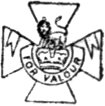
LIEUTENANT FREDERICK MAURICE WATSON HARVEY, LORD STRATHCONA'S HORSE.
Reading edition
The first Canadian cavalryman to win the Victoria Cross in this war is Lieutenant Harvey, of Lord Strathcona's Horse.
The Strathconas, raised for service in South Africa, and originally recruited largely from the Royal North-West Mounted Police, distinguished themselves in the Boer War and afterwards were established as a unit of the Canadian Permanent Militia. Along with the other regiments of our cavalry brigade they fought as infantry in the trenches throughout the autumn and winter of 1915-16. The brigade was then withdrawn from the line, rehorsed and embarked upon a long course of training and waiting.
March, 1917, found the Canadian Cavalry Brigade serving with the 15th Army Corps, north of Peronne on the Somme. At this time the brigade consisted of the Royal Canadian Dragoons, Lord Strathcona's Horse, the Fort Garry Horse, the Royal Canadian Horse Artillery, the Canadian Cavalry Machine-Gun Squadron and a field ambulance.
On the morning of March 24th the brigade received orders to form on a twelve-mile frontage, with Nurlu as its centre, and from there to advance beyond our infantry positions. By the evening of the same day the Royal Canadian Dragoons were in possession of several hostile positions, including the woods to the south-west of Lieramont; and during the night the Fort Garry Horse, on the left of the advance, took the villages of Ytres and Etricourt.
On the afternoon of the 25th Captain Sharpe, with his squadron of F.G.H., dislodged the Germans from the smaller of two woods that they held in strength. From this first wood he launched an attack upon the second and larger, in open order at the gallop, and drove the enemy through and out of that cover and into the shelter of a trench beyond. This was the first instance, in more than two years, of cavalry riding straight at a position held by rifles and machine-guns.
At six o'clock of the following day (March 26th) the Strathconas gained a wood south-east of Equancourt, where they dismounted, and from which they advanced upon and captured the village at the point of the bayonet. At the same time the Fort Garry Horse, attacking from the north, made their objectives in spite of heavy machine-gun fire. The admirable shooting of the R.C.H.A. had much to do with the success of the operation.
During the night, and early in the morning of the 27th, the R.C.D's occupied the villages of Longavesnes and Lieramont. They handed the defence of the former over to the infantry; but they remained in the latter and there repulsed a strong counter-attack.
High ground about the village of Guyencourt and Grebaussart Wood was the final objective of a series of attacks made by the Lord Strathcona's Horse and the Fort Garry Horse on the evening of the 27th. A heavy snow-storm delayed the initial stroke until 5.15; but then, the moment the air was clear enough for the leaders to see the way, a squadron of the Fort Garry Horse galloped forward to Hill 140 and there established two machine-guns in commanding positions. This squadron then pushed around the hill into Grebaussart Wood, Jean Copse and Chauffeurs Wood, and successfully posted three more machine-guns. Other squadrons of this regiment rode straight at the village of Saulcourt, and penetrated its outskirts. The Germans, retiring before them, were caught by our machine-gun fire.
The Strathconas, with Guyencourt in view, charged on to a ridge on the left front of that village, where they were confronted by machine-guns and strongly wired positions; so they swung to the right, rode at the north-west corner of the village and won to the partial shelter of its walls.
It was at this stage of the swift action that Lieutenant Harvey performed the conspicuous deed of valour that was recognized by the highest award. He commanded the leading troop of the charging Strathconas and rode well in front of his men. He was close to the edge of the village, when, by the failing light, he discovered a deadly menace to his command set fairly across his course—a wired trench containing a machine-gun and a strong garrison. He swung from his saddle and sprinted straight at the gun, firing his revolver as he ran. He reached the triple entanglement and hurdled it, shot the machine-gunner and jumped on to the gun.
The man at the gun must have lost his nerve and his wits in the face of that amazing, swift frontal assault; his hands must have fumbled, misguided by his flinching brain: we know that his gun jammed and that he died a violent death.
Thus the trench became ours, the Strathconas took Guyencourt, and Harvey won the Cross.