PRIVATE CECIL JOHN KINROSS, 49TH BATTALION
Reading edition
On October 28th, 1917, the 49th Canadian Infantry Battalion, under Lieutenant-Colonel R. H. Palmer, moved from Wieltje area and relieved three companies of the 116th Battalion in the front line south-east of Wolf Copse, on the left of the Gravenstafel-Bellevue Road, the P.P.C.L.I, relieving the remaining company on the right of the road. The strength of the Battalion consisted of twenty-one officers and 567 other ranks. The relief was a difficult business, the enemy very alert, and the bad weather and heavy going rendering the operation exceedingly arduous. However, by 1.50 a.m. on the 29th the relief was effected, and preparations for the morrow's offensive were immediately undertaken.
The 3rd and 4th Canadian Divisions were to continue the attack on the outlying defences of Passchendaele; to capture Vapour Farm, Vanity House, Meetcheele, Friesland, the high ground about Crest Farm, and other strong points; and to establish a line approximately from Goudberg Copse in the north to the railway line just south of Vienna Cottages in the south. Six battalions were to attack at zero hour, 5.50 a.m. on the 30th, the 5th Canadian Mounted Rifles, the 49th Battalion, P.P.C.L.I., 72nd, 78th, and 85th Battalions, in order from left to right.
The troops of the 49th Battalion had as their objective Furst Farm and the pill-boxes about and beyond, and the strong points to the north of Meetcheele. Late in the afternoon the barrage maps were received at Battalion Headquarters, and Colonel Palmer found it would be necessary to evacuate the front-line positions occupied by "A" and "D" Companies and establish a jumping-off line to the rear, as the conformation of the ground rendered the establishment of a really effective barrage a most delicate task. Of late the enemy had developed a mischievous habit of keeping very close indeed to our front line, making his way inside our barrage at the moment of its inception, and so being enabled to meet our attacking troops with a volume of fire quite unmitigated by the curtain of lead designed to eliminate such resistance.
About midnight October 29th-30th the troops moved to the assembly, the evacuation of the forward positions being postponed until the very last possible moment. The night was very clear, and as it was possible to discern almost any movement from a distance of two hundred yards it is probable that German patrols were aware of the gathering. At any rate, about 4.30 a.m. two green flares went up near Furst Farm, were repeated in a moment from the rear, and at once the hostile shelling became more local and intense. By a quarter past five assembly was complete, and at 5.48 a.m., two minutes before zero hour, our barrage opened on the right and the troops went forward.
The morning was clear and bright, a strong wind drying the ground somewhat during the night and making better foothold possible for the men; but such a hurricane of fire encountered the troops as they advanced that only slow progress was possible. "B" Company, on the right, lost most of its effective strength before crossing the Wallemolen-Bellevue Road. "B" and "C" Companies, forming the first wave, were met at once by intense rifle, machine-gun and artillery fire, and progressed in a series of rushes, going forward indomitably in spite of their heavy losses. The supporting waves, "A" and "D" Companies, fared little better, and it was painfully evident that the advance would be brought to an early conclusion through sheer lack of the men to force a passage. Considering the resistance, however, good progress was made, the men taking no heed of their losses and fighting every inch of the way. Near Furst Farm the first real check occurred, a well-mounted machine-gun covering our whole local advance and holding up the assailants, who took what cover the torn ground afforded, continuing to reply as well as might be expected to the heavy fire, until the situation was lightened by the heroic action of a private soldier.
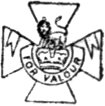
Private Kinross, completely indifferent to the bullets directed upon him, surveyed the whole position coolly and carefully, deciding upon a plan of action that pleased him thoroughly.
Returning for a moment to cover, he cleared himself of all unnecessary equipment and made his way by devious courses to a point as near as possible the vicious machine-gun. Arrived there, he rushed the position, against point-blank fire, alone and in broad daylight, killing the six men of the crew and finally destroying the gun. It is impossible to tell properly of such deeds, but the daring of it, and the complete success, so heartened our men that in their immediate advance our line was carried forward a full three hundred yards and two strong positions stormed without a halt. This brought our men to the intermediate objectives, where the line was cleared of the enemy, held and consolidated.
By this time the strength of the Battalion had decreased to four officers and 125 men, and no further advance was possible, incessant fighting being necessary to maintain the position already gained. Throughout the day and night the troops held on, several platoons of the Royal Canadian Regiment reinforcing the sadly depleted ranks of the 49th, and assisting in the defeat of three strong counter-attacks. By the evening of the 31st all our wounded had been removed from the forward area and the tired troops were relieved by the 42nd Battalion. In the fighting of October 30th the 49th Battalion gained more glory than German ground, yet a great deal of German ground was captured.