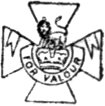
PRIVATE HARRY BROWN, 10TH BATTALION
Reading edition
Most men who have won the Victoria Cross have gained it by some act of violent, passionate valour. Private Harry Brown, Number 226353, of the 10th Battalion, won it by suppressing the impulse to violence. Whilst others on the same field of battle were earning the decoration in the impetuous fury of assault Harry Brown was earning it by the terrible, pitiless restraint which he imposed on his emotions. His was the supreme courage of self-control, the silent valour of abnegation.
The 10th Battalion took part in the attack on Hill 70, near Loos, which began on the 15th of August, 1917, and lasted for several days. Before midnight of the 14th the battalion was in position, and at 4.25 a.m. the attack began. The first German line was captured in face of fierce opposition, the fighting continuing intermittently throughout the day; but the position was held. During the night, attempts were made to consolidate the new line; but the 7th and the 8th Battalions were in difficulties and the 10th Battalion was ordered next morning to move to their assistance.
This second attack began at four o'clock on the afternoon of the 15th. Chalk Pit, the redoubt on the left of Hill 70, was assaulted by "A," "B" and "C" companies. "A" company encountered terrible enemy machine-gun fire when within two hundred yards of the pit and were forced to take cover in shell-holes for a time. After a short rest the position was captured in a rush, the waves of attackers, carried forward by the impetus of the advance, reaching a trench seventy-five yards beyond Chalk Pit. The German occupants were all either killed or captured.
The position was being consolidated when Sergeant J. Wennevold and a party of men of "C" company went out to reinforce a post to the right of the new battalion front in order to protect the flank from a counter-attack. Consolidation of that position was terrible work. To the men who tried to dig into the hard, chalky soil that attempt must always remain a nightmare. They could make little impression on the earth. In one part of the front the result of the previous night's labour was a trench scarcely two feet deep, blunted tools and aching hands and backs.
While the work was in progress the Germans poured a hurricane of fire from machine-guns and field-guns on the position. Men were killed and wounded faster than others could take their places. The crisis of that day and night of endurance and agony came at a quarter to five o'clock in the afternoon, when the Germans were seen massing for an attack on the right.
By this time every wire to headquarters was cut by the enemy artillery. If they were allowed to attack, the companies in the trench would be annihilated and the hard-earned position lost. The situation was desperate.
Only one chance of averting disaster remained.
A runner must get through with a message to our artillery asking them to smash the German attack. Private Harry Brown and another runner undertook to deliver the message. When they set out on their desperate mission a hostile barrage was raking the open behind the newly occupied ground, the enemy's intention being to prevent supports coming up. The messengers had to get through this curtain of fire, a curtain under which nearly every yard of ground was being churned into a mess or torn up savagely in tons and tossed on high as if by some unseen Brobdignagian hand.
They had gone but a little way on their adventurous journey when one was killed and Brown was left, the only link between his isolated battalion and its hope of succour. If he failed to get through his comrades would be wiped out to a man.
He continued to stumble along, sinking into new, smoking craters, now and then up to the waist, dragging himself out and crawling through the debris, lying still for short intervals till the shock of the explosions had passed. Flying missiles hit him and shattered an arm. He was bleeding and exhausted. He sat down, dazed and uncomprehendingly. But his will forced him to his feet again. He staggered onward towards the support lines, walking like a man in a dream, his brain in constant dark motion, his thoughts in a flux even as the ground on which he strove for a footing.
It was a pained, dreary thing, sore and weary, that kept doggedly crawling and staggering on through the intensity of the shrapnel and the high explosive. His strength ran from him with the blood from his mangled arm. His steps were automatic. The last part of the journey was the worst. It was his Via Dolorosa.
An officer standing in a dug-out in the support line was peering out at the devastation which the enemy artillery was spreading so prodigally. Shells rained on every side, the earth shuddered and shrank at every blow. But the telephone to headquarters was working.
A dark form crawled out of the ruin and stumbled towards the dug-out. It was a soldier—hatless, pale, dirty, haggard, one arm hanging limp and bloody by his side, his clothing torn and stained. He reached the steps of the dug-out, and seeing the officer, tried to descend. But his strength was gone, his limbs refused to act. He fell down the short stairway, spent—utterly spent and dying.
The officer lifted him gently and brought him into the dug-out and laid him down. Then Brown handed over his precious slip of paper.
"Important message," he whispered.
And Private Harry Brown lay back and drifted into unconsciousness. He died a few hours later in the dressing station.