Volume 7 / Part 1 — VI. Report upon the New or Rare Plants which flowered in the Garden of the Horticultural Society at Chiswick, between March, 1825, and March, 1826. Part 1. Tender Plants. By John Lindley, Esq. ◊ (continued 3)
Reading edition
On Tic Douloureux 346
Remarks on some Quadrupeds supposed by Naturalists to be extinct. By JOHN RANKING, Esq. 350
Description of a cheap and portable Instrument for enabling Young People to acquire a knowledge of the Stars, or determine their situation in the Heavens. By S. LEE, Esq. 371
CARUS’s Introduction to the Comparative Anatomy of Animals, reviewed 377
Comparative Value of the principal Varieties of Fuel, &c., by MARCUS BULL, reviewed ib.
DANIELL’s Meteorological Essays and Observations, reviewed ib.
Philosophical Transactions of the Royal Society for 1827, reviewed ib.
Practical Treatise on the use of the Blowpipe, by J. GRIFFIN, reviewed ib.
Circle of the Seasons, and Practical Key to the Calendar and Almanack, reviewed ib.
Conversations on the Animal Economy—reviewed ib.
Notice of a New Genus of Plants discovered in the Rocky Mountains of North America by Mr. DAVID DOUGLAS. By JOHN LINDLEY, Esq. 383
A Description of the Aurora Borealis seen in London on the Evening and Night of the 25th of September, 1827, with Critical Remarks, &c. By E. A. KENDALL, Esq., F.S.A. 385
Proceedings of the Royal Society 424
Proceedings of the Horticultural Society 425
ASTRONOMICAL AND NAUTICAL COLLECTIONS i. Ephemeris of the periodical Comet for its Return in 1828, computed with the consideration of a resisting Medium. By Professor ENCKE 428 ii. Elementary View of the undulatory Theory of Light. By Mr. FRESNELL 431 iii. Remarks on the action of Corpuscular Forces. In a letter to Mr. POISSON 448 iv. Calculations of Lunar Phenomena. By THOMAS HENDERSON, Esq. 450
MISCELLANEOUS INTELLIGENCE. I. MECHANICAL SCIENCE. 1 On the Adhesion of Screws 453 2 Improvement in Steam-engines ib. 3 Improved Clock 454 4 Method of dividing Glass by Friction ib. 5 Use of Soapstone in diminishing Friction 455 6 On peculiar Physical Repulsions ib. 7 On the Magnetic Effects of Metals in Motion 456 8 Duration of the Effects of Light upon the Eye 457 9 On the Measurement of the Intensity of Light ib. 10 On the apparent Decomposition of White Light by a Reflecting Body when in Motion 458 11 On the Barometer ib. 12 Easy method of reducing Barometrical Observations to a Standard Temperature ib. 13 Diamond Lenses 459 14 Sapphire Lenses for Single Microscopes ib. 15 On a Method of securing and Preserving the Rowing Pins in Boats 460 16 Cold Injection for Anatomical Preparation 461 II. CHEMICAL SCIENCE. 1 Extraordinary Experiments on Heat and Steam 461 2 On the Use of feeble Electric Currents, for effecting the Combination of numerous Bodies 462 3 Crystallization of Metallic Oxides 465 4 On Bromine ib. 5 Elementary Nature of Bromine ib. 6 Quantity of Bromine in Sea-Water 466 7 Sale of Bromine ib. 8 Preparation of Iodous Acid ib. 9 On a peculiar Nitric Acid, and Sulphate of Potash 467 10 On certain Properties of Sulphur 468 11 On the Fluidity of Sulphur and Phosphorus at common temperatures 469 12 Separation of Selenium from Sulphur 470 13 On a new Compound of Selenium and Oxygen—Selenic Acid 471 14 Preparation of Hyposulphuric Acid 473 15 Singular Habitude of Phosphoric Acid with Albumen 473 16 Economical Preparation of Deutoxide of Barium 474 17 Preparation of Aluminum—Chloride of Aluminum ib. 18 Mutual Action of Lime and Litharge 475 19 New Chloride of Manganese discovered ib. 20 Preparation of pure Oxide of Zinc 476 21 Deuto-Sulphuret of Cobalt ib. 22 Separation of Bismuth from Mercury by Potassium ib. 23 Sulphuret of Arsenic proportionate in Composition to Arsenic Acid ib. 24 New Double Chromates 477 25 Dobereiner’s finely divided Platina 477 26 New Metals 478 27 Analysis of Porcelain Pottery, &c. ib. 28 On the Composition of simple Alimentary Substances 480 29 Preparation of Sulphate of Quinia and Kinic Acid, without the use of Alcohol 482 30 Pure Narcotine prepared 483 31 Uncertain Nature of Jalapia ib. 32 Preparation of pure Mellitic Acid 33 On a New Acid existing in Iceland Moss 484 34 Remarks on the Preparation of M. Gautier’s Ferro-prussiate of Potash, as described in this Journal for July, 1827 ib. III. NATURAL HISTORY. 1 Squalls of Wind on the African Shores 486 2 Destruction of an Oak by Lightning 487 3 Description of a Meteoric Fire-Ball seen at New Haven ib. 4 Remarkable Meteoric Phenomenon 488 5 Aurora Borealis seen in the Day-time at Cannonmills 489 6 Aurora Borealis in Siberia ib. 7 On the Presence of Ammonia in Argillaceous Minerals ib. 8 Composition of Apatite 490 9 Burmese Petroleum Wells ib. 10 Direction of the Branches of Trees ib. 11 Effects of Light on Vegetation ib. 12 Organization and Reproduction of the Trufle 491 13 Alteration of Corn in a subterraneous Repository 492 14 Quick Method of putting Insects to Death 493 15 Destruction of Snails by common Salt ib. 16 Remarkable Hairy Man ib. 17 Application of Remedies by Absorption from the Surface i. 18 On the Strix Cunicularia, or Coquimbo Owl 494 19 Naturalization of Fish 496 20 Mode of keeping Apples ib. 21 On the Cultivation and Forcing of Sea Kale 497 Meteorological Table 500
TO OUR READERS AND CORRESPONDENTS.
The pages of this Journal are impartially open to all communications upon the subjects of Science, Scientific Literature, and the Arts: it is requested they may be forwarded to the Editor one month previous to the publication of each number.
We shall be happy to receive papers from Provincial Scientific Societies, and to publish them either on the part of the Society, or of their respective authors.
Papers deemed unfit for this publication, will be immediately returned to the source whence we received them, with our reasons for their return.
The letters signed B. and T. R. S. we have thought it prudent to suppress for the present.
Several books have reached us for notice in this Journal; but unless they are sent earlier in the Quarter, we cannot insure attention to them.
We have been favoured with communications from Mr. Swainson, Dr. Littledale, Mr. Rose, and E. Z., which we are obliged to postpone.
A letter from a “Member of the Zoological Society,” reached us too late for the purpose it was intended to answer. We fear we shall not agree with him in opinion, but perhaps his second communication may clear up the difference.
We presume that “A Mechanic” will find the information he requires in Mr. Farey’s account of the Steam Engine.
“An old Subscriber” is much in error—the proceedings he alludes to are copiously given in contemporary monthly publications; if therefore we followed his advice, our information would be stale. The motives he alludes to are out of the question.
We cannot give “A Vapourer” any authentic information respecting the Steam Carriage, nor do we hear that the Gas Engine has advanced.
ROYAL INSTITUTION OF GREAT BRITAIN, Albemarle Street, December 3, 1827.
A COURSE OF SIX ELEMENTARY LECTURES ON CHEMISTRY, adapted to a Juvenile Audience, will be delivered during the Christmas Recess, by MICHAEL FARADAY, F.R.S., Corr. Mem. Roy. Acad. Sciences, Paris; Director of the Laboratory, &c. &c.
The Lectures will commence at Three o’Clock.
Lecture I. Saturday, December 29. Substances generally—Solids, Fluids, Gases—Chemical affinity.
Lecture II. Tuesday, January 1, 1828. Atmospheric Air and its Gases.
Lecture III. Thursday, January 3. Water and its Elements.
Lecture IV. Saturday, January 5. Nitric Acid or Aquafortis—Ammonia or Volatile Alkali—Muriatic Acid or Spirit of Salt—Chlorine, &c.
Lecture V. Tuesday, January 8. Sulphur, Phosphorus, Carbon, and their Acids.
Lecture VI. Thursday, January 10. Metals and their Oxides—Earths, Fixed Alkalies and Salts, &c.
Non-Subscribers to the Institution are admitted to the above Course on payment of One Guinea each; Children, 10s. 6d.
The Weekly Evening Meetings of the Members of the Royal Institution will commence for the ensuing Season, on Friday the 25th of January, 1828, at half past Eight o’Clock, and will be continued on each succeeding Friday Evening, at the same hour, till further notice.
The Lectures will commence for the Season on Saturday the 2d of February, at Three o’Clock, by WM. THOS. BRANDE, Esq., F.R.S. Lond. and Edin., Prof. of Chemistry in the Royal Institution.
The Library of the Royal Institution is open for the use of the Members and Subscribers every day on which the House of the Institution is open; in Winter from Ten till Four, and from Seven till Ten in the Evening; and in Summer from Ten till Five, and from Seven till Ten in the Evening.
Mr. BRANDE and Mr. FARADAY will commence the Spring Course of their Chemical Lectures and Demonstrations, in the Laboratory of the Royal Institution, on Tuesday, the 12th of February, at Nine in the morning precisely. A Prospectus may be obtained at the Institution, or of the respective Lecturers.
In the Press, and nearly ready for publication,
A COLLECTION OF CHEMICAL TABLES, for the use of Practical Chemists and Students, in Illustration of the Theory of Definite Proportionals; in which are shewn the Equivalent Numbers of the Elementary Substances, with the Weights and Volumes in which they combine; together with the Composition of their most important Compounds, and the Authorities for their Analysis.
By WILLIAM THOMAS BRANDE.
THE
QUARTERLY JOURNAL
OF
SCIENCE, LITERATURE, AND ART.
OCT.–DEC. 1827.
On the Means generally used with the Intention of curing a Stoop.37 ◊
WHEN the chest and the head fall forward, the most common method of trying to correct the stoop is to put on some instrument by which the shoulders and the head are held back. To operate upon the shoulders, the common back-collar is applied, and to hold back the head, a riband is brought over the forehead and fastened to the collar.
While these instruments are kept on, the figure looks straight, though stiff and constrained; but the moment they are taken off, both the head and the shoulders fall more forward, than before their application. Many examples of the bad effect of artificially supporting the head might be offered. The following, although observed in the figure of a horse, is very demonstrative. When the rein (called the bearing-rein), by which the head of a carriage-horse is reared up, with the intention of giving him a showy figure, is loosened, the head immediately falls forward, and the neck, instead of preserving the fine arch that is so much admired, droops between the shoulders. Looking to this effect, we should at first be inclined to condemn the practice followed by horse-dealers, of reining up the head of a young horse in the stable, by means of the apparatus called a dumb-jockey. But on examining into this mode of fixing the head, it will be found to operate on a different principle from the bearing-rein. Instead of a [p238] simple bit, such as the horse in harness can lean his head upon, without suffering pain, a bit, calculated to tease and fret, is put into the young horse’s mouth. To relieve himself from the irritation produced by this, and which is increased by the constant pull of the elastic piece of iron to which the rein is fastened, he curls up his neck, and thus brings all the muscles of the back of the neck into strong action, instead of allowing their power to be superseded by the artificial support afforded by the bearing-rein to the horse in harness38.
Many different contrivances, but all acting nearly on the same principle as the bearing-rein, have been proposed as means for obliging a girl to keep her head erect.
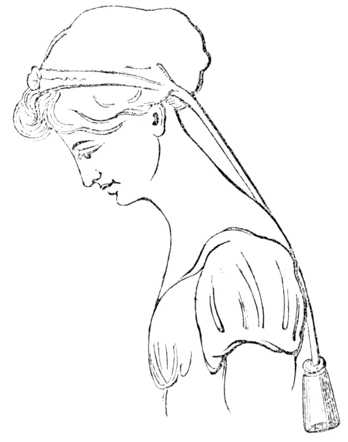
There is one mode which, to a person ignorant of anatomy, seems to be particularly well adapted for this purpose; but it is, in fact, more objectionable than the plan of tying the head back with a riband. A piece of lead, of some pounds weight, [p239] is slung over the back in such a way that it must be supported by a riband put around the head.
Although this contrivance prevents the head for a time from falling forwards, its bad effects may be demonstrated. When the weight is on, the muscles of the back of the spine are passive, while those on the fore-part of the neck are necessarily brought into action to prevent the head from being pulled too far back: this is easily proved; for if we put the fingers on the sternal portions of the sterno-cleido muscle, which, with the small muscles on the fore-part of the throat, pull the head forwards, we shall feel them tense and in action. The increased activity of the muscles on the fore part, and the passive condition of those of the back, may be further exemplified by raising the weight when the girl is not aware of our doing so; the head will then be immediately poked forwards.
We have many opportunities of observing the incorrectness of the principle on which all similar plans for the cure of a stoop have been founded. For instance, porters who carry burthens on the back, by the assistance of a band round the forehead, always stoop; while those who carry baskets before them suspended by a band round the back of the neck, are peculiarly erect. But the most remarkable example of the effect of the head being pulled back by a weight hung behind, is the condition of the women who carry salt in the streets of Edinburgh, for they may be recognised as much by their miserable Sardonic grin, which is caused by the constant excitement of the platysma myoides muscle, as by their stoop.
Very annoying and even distressing consequences may ensue from any system of treatment where a constant resistance to the muscles of the fore-part of the neck is kept up. A gentleman had for many years worn one of the collars invented by Mr. Chesher; after some time, the muscles of the back became so weak, as to be incapable of supporting the column, while those on the fore-part of the neck were so disproportionately increased in strength, by the constant resistance opposed to them by the strap passing from the suspending rod under the chin, that whenever the strap was loosened, the chin was forcibly drawn towards the chest. As the muscles of the back part of the neck did not offer any counteracting resistance, the [p240] windpipe was now pressed down, or almost doubled itself. As soon as this took place (and it was almost immediate on the attempt to sit up without the collar,) the patient was seized with such a sense of suffocation, as to be obliged to throw himself on his back. As he was able to breathe with ease as he lay on his back, his advisers were led to believe that it was the weight of the head which pressed down the windpipe. To counteract this pressure, various contrivances had been proposed to support the head. Indeed, the patient himself was so convinced, from what he had heard, that it was the weight of the head which pressed down the windpipe, and so alarmed had he become from the certainty of having a fit of suffocation when the head was left unsupported, that there was much difficulty in persuading him to believe that if the head could be made heavier, the sense of suffocation would be relieved. He was at length induced, although with great dread of the consequence, to allow about fourteen pounds of shot to be placed on the top of his head. He was very much alarmed, but it was highly gratifying to witness his surprise and pleasure in finding that, instead of his head being weighed down, he could support it, and could breathe with ease while in the upright posture. The following is the principle on which this plan was proposed:—the muscles of the back part of the neck had been brought into such a state, that their ordinary stimulus was not sufficient to excite them to the action necessary to counteract the efforts of those on the fore-part of the neck, which had been evidently increased in strength. The placing a weight on a certain spot on the head formed an additional stimulus to the muscles of the back part of the neck; a fact which the reader may prove by an experiment on himself.
By proceeding on this principle, by combining a variety of exercises, and by gradually diminishing the weight carried on the head, this gentleman was soon able to walk and sit in a state of great comfort, without being obliged to use any artificial support.
It is well known, that the neck-collars support almost the whole weight of the head and shoulders by the strap which passes under the chin. It must also have been observed, that the wearer very frequently pushes down the head against the [p241] chin strap. In this way, the muscles on the fore-part necessarily become stronger, while those of the back, being deprived of their natural stimulus to action, in consequence of the rod superseding their office, become diminished in power. Even were there no change in the degree of strength in the muscles on the fore-part, the head would naturally fall, if the support afforded by the chin strap were removed; but as these muscles are increased in power, while those of the back are diminished, the head must not only fall, but even be pulled down.
However, although the collars and the lead weight, as they are generally used, are not only inefficacious; but even hurtful, they may occasionally be useful in keeping the head in a certain position, after it has been brought to it by such exercises as tend to strengthen those muscles of the back which support the shoulders and head. But the opinions commonly entertained, as to the means of counteracting an habitual stoop, are so erroneous, that even the position of a tailor sitting on his shopboard is better than the plans generally recommended. This at first appears ridiculous; but the manner a tailor holds his body when he walks, proves that there is something in his habits which tends to the correction of a stoop; for he is quite a caricature of a strutting erect figure, especially in the way he bends in his loins and carries his head.
The peculiarity of the tailor’s gait proceeds, in a certain degree, from the bent position in which he sits: but this explanation is not at first satisfactory, since it may be observed that other tradesmen, who also stoop while at work, generally have their head inclined forwards, and have also a distinct and habitual bend in the neck; such, especially, is the condition of persons who sit at a table and stoop forwards, as watchmakers, engravers, &c. It is not difficult to explain the cause of the difference, and the inquiry will assist in directing us to the principles which we ought to recollect in our operations upon the spine.
In the sitting position of the tailor, the head hangs so low, and so complete an arch is formed between it and the pelvis, that the muscles of the spine are called into strong action to support the head; the necessary consequence of this is, that these muscles become even unnaturally strong, or at least so strong as to predominate over those by which the spine is [p242] pulled forward. But the bent position is not the only cause of increase in the strength of the muscles, for it depends also on the exercise given by frequently jerking the head backwards. In those who stoop from the middle of the body, as in writing or working at a table, the muscles of the spine are not called into action; for, while the head is in this position, it rests or is supported by the ligament of the neck. The ligament, being thus kept constantly on the stretch, becomes lengthened, instead of being made more contractile, as muscles would be; and hence the stoop is increased. When this is combined with the consequences of the want of muscular action, the deeper ligaments, which bind the upper vertebræ, gradually yield; if the operation of these causes continues for a certain time, the bones and cartilages themselves become altered in shape, and consequently an almost irremediable stoop is produced39.
This view derives confirmation, from what may be observed in the shape of the tailors in some parts of Germany, who, instead of having the erect figures of London tailors, are quite bent. On inquiring into the cause, we find that, instead of sitting as tailors do in this country, a hole is cut in the table, and a seat is placed within it; so that their position, while working, becomes nearly the same as that of persons who stoop while sitting at a table.
It may, perhaps, be objected, that labourers, and especially the vine-dressers in France, are remarkable for the complete arch which their body forms, although they bend while at work as much as the tailor does. This may also be explained; for in the labourer the bend is produced by the pelvis rolling on the head of the thigh bones, while in a person sitting as a tailor the pelvis continues nearly fixed, and the bend is in the vertebræ on the pelvis.
The erect figure of the Turk perhaps comes from the manner of sitting which is common among Eastern nations; but the heavy turban, and the spice box slung from the back of the neck, may account in a great measure for the fine figures of the Turkish Jews who frequent the streets of London. [p243]
We may even take the shoemaker as an example of the effect of a particular manner of sitting, and of frequently using the muscles of the shoulders. He is also a little in caricature, but he carries himself better than the tailor, and the cause is obvious. The tailor’s figure is very erect, but the right shoulder is generally a little higher or larger than the left, from the constant exercise given to the right arm, while the left rests upon the knee: this inequality of the shoulders is not observed in the shoemaker, because he not only uses both arms equally, but the muscles by which the scapulæ are supported, become so strong by the habit of jerking back his elbows while he works, that his shoulders always appear more braced back than those of any other class of persons: indeed, so characteristic are the figures of tailors and shoemakers, that they may be easily distinguished in a crowd.
These circumstances are mentioned, as they afford familiar examples of the principles on which we ought to proceed, in endeavouring to correct deformities; but it would be ridiculous to propose the position either of the tailor or of the shoemaker, as the best adapted to correct a stoop or falling forward of the shoulders.
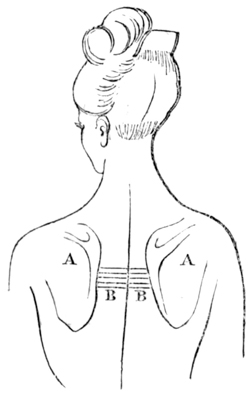
The preceding observations apply also to the contrivances usually employed to keep the shoulders back, and particularly to the question of the propriety of using the common back-collar. The effect which this instrument produces in ordinary cases may be easily comprehended by the following diagram.
[p244]
The part of the back formed by the ribs is not a flat, but rather a round surface; and as the shoulder-blades rest on this, they would fall forwards were they not prevented by the collar-bones; but as these bones are united to the breast-bone by a moveable joint, and as the weight of the arms operates principally on the anterior angles of the scapulæ, both the collar-bones and the shoulders would fall forwards, were it not for the action of several strong muscles which pass from the spine to the scapulæ. But these muscles may be destroyed by any contrivance which supersedes their use. For example, let A A be the shoulder-blades, and B B the muscles which support them. If the scapulæ be brought close to the spine by the straps of the collar, and kept constantly so, there can be no use for the muscles B B. They must consequently waste and become nearly useless, while those on the fore-part of the chest, being excited to resist the straps, will become increased in power; and hence, when the collar is taken off, not only will the shoulders fall forward as in a delicate person, but the muscles on the fore-part of the chest will predominate over those by which the scapulæ should be held back, and pull the shoulders forwards.
The spine and the ribs are occasionally bent so as to have some resemblance to the back of a spoon. In such cases, the shoulders not only appear high and round, but the lower angles of the scapulæ project in an extraordinary manner, because the upper and anterior angle is not only unsupported by the ribs, but is dragged forwards by the clavicles which are carried in the same direction with the sternum. When this is to a considerable extent, it constitutes the contracted chest or the chicken breast. This, in a slight degree, is common in London, and especially among young lads; it may be discovered by the coat having the appearance of being more worn opposite the lower angle of the scapula than at any other part. Such a condition of the chest can only be completely remedied by appropriate exercises; but a collar is here necessary for a time, to keep the bones in the improved condition into which they are brought by the exercises.
These arguments will probably appear sufficiently well founded to prove that a girl, under ordinary circumstances, [p245] cannot hold her head or shoulders back, unless the muscles by which they are naturally supported are in a proper condition. Various contrivances have been proposed to strengthen these muscles. Dumb bells, if managed in a particular manner, are good; skipping, when the arms are thrown backwards and over the head, is still better; the exercises, called Spanish exercises, performed with two long poles, are also useful, but to each of these there may be objections, as they all operate more or less on the spine or ribs, which, in case of a bad stoop, are generally affected.
The following anecdote will, perhaps, set the question of the propriety of wearing the back collar in a correct point of view. A surgeon was consulted by a gentleman, who is now one of our first tragedians, as to the best mode of correcting a stoop which he had acquired. The surgeon told him that neither stays nor straps would do him any essential good; and that the only method of succeeding was to recollect to keep his shoulders braced back by a voluntary effort. But the tragedian replied, that this he could not do, as his mind was otherwise occupied. The surgeon then told him that he could give him no further assistance. Shortly after this conversation, the actor ordered his tailor to make a coat of the finest kerseymere, so as to fit him very tightly, when his shoulders were thrown back. Whenever his shoulders fell forward he was reminded by a pinch under the arms, that his coat cost him six guineas, and that it was made of very fragile materials; being thus forced, for the sake of his fine coat, to keep his shoulders back, he soon cured himself of the stoop. The surgeon was much obliged to him for the hint, and afterwards, when consulted whether young ladies should wear shoulder straps, permitted them, on condition that they were made of fine muslin, or valuable silk, for tearing which there should be a forfeit.
An inquiry into the manner a girl should sit may appear trifling to those who have not been in the habit of seeing many cases of distortion of the spine, but it is intimately connected with the present subject, and is really of considerable importance. The question has been disputed; one party insisting that girls should always sit erect, while others are advocates for a lounging position. It is not difficult to show that both are [p246] wrong;—when a delicately formed girl is supposed to be sitting erect, she is generally sitting crooked: to a superficial observer she may appear quite straight; but any one who will sit on a music stool, and endeavour to keep his body in a perpendicular line for ten minutes, will be convinced that it is difficult for even a strong man to sit as long as a delicate girl is expected to do, without allowing the spine to sink to one side or to fall forwards.
The attempt to sit erect beyond a certain time is injurious, for although bending the spine occasionally is useful rather than hurtful, yet when it is done involuntarily, and when the bend is attempted to be concealed by an endeavour to keep the head straight, there is danger of the spine becoming twisted. Indeed, a double curve is generally the consequence; there is first a bend to one side, to give ease to the fatigued muscles; and then, to conceal this, there is a second curve that is necessarily accompanied by a slight twist in the vertical line of the whole column.
The proposal to allow children to sit in a crooked or lounging position seems to have been founded on the idea that all the muscles are more relaxed in this way than even when the child lies at full length on its back. This notion is certainly incorrect, and such a mode of sitting is injurious; for even were the muscles more relaxed by it, the bones and ligaments acquire such a shape as necessarily produces distortion.
It may naturally be asked how a girl should sit, since it would appear, that whether she is in an erect or stooping posture, she is equally in danger of becoming crooked. As sitting, in the manner generally recommended, affords little or no support to one who is weak, the safest answer would be, that a delicate girl should not sit for even more than five or ten minutes without having some support to her back, and when she is fatigued, that she should lie down or recline on a couch. But as it would be very annoying to a girl not to be allowed to sit up except for so short a time, and as a couch is not always at hand, we must endeavour to show how a delicate girl may remain in an upright posture, for a reasonable time without incurring any risk of becoming crooked. This leads to an inquiry into the merits of the chairs which are at present generally used by children. [p247]
Young ladies are often obliged, while at their music lessons, to sit upon those chairs, which have high backs, long legs, and small seats. These chairs are said to have been invented by a very eminent surgeon, and are intended, either to prevent distortion, by some supposed operation on the spine, or as the most effectual means of supporting the body. It is difficult to imagine how a chair of this description can effect the first purpose; and to discover how far it is calculated for the second, the reader should make the experiment on a chair of the same proportion to his figure, as the chair in question is to that of a little girl. He will find that if the seat or surface on which he rests is small in proportion to his body, the chest will, after a time, either fall forward or to one side, unless he exert himself to a degree that is very fatiguing. Indeed, if the seat be at the same time so high, that the feet do not rest fairly on the ground, but dangle under the chair, a forward position of the head is almost necessary to preserve the balance of the figure40.
The objections to such chairs have been met with the assertion, that girls feel remarkably comfortable in them. This is no argument in favour of their use, for it is not uncommon for a girl who has seven or eight pounds of iron strapped upon her body and next to her skin, to say the machine annoys her so little, that she does not care how long she wears it.
But whether this chair is agreeable or not, it is easy to show that it is not calculated to give much proper support to the body, and that it is almost impossible for a delicate girl to sit long in a natural or easy position upon it.
It may be allowed, that the chair which we consider the most comfortable, that is, the chair which affords the most support to the body, should, if made in proper proportions, be the best for a delicate girl. In such a chair, the seat should be scarcely higher than the knees (thus permitting the whole of the foot to rest on the floor), and of such a size, that on sitting back, the upper part of the calves nearly touch it. This form of seat is very different from that of the chair alluded to, the back of which is also equally objectionable, for, instead of being in [p248] some degree shaped to the natural curves of the spine, it is made nearly straight, and projects so as to push the head forwards. A delicate girl should always sit so as to rest against the back of the chair, and, if the lower part of her spine is weak, a small cushion will afford great relief. As it is quite a mistake to suppose that the shoulders, if raised in any other way than by the action of the muscles, or by the curvature of the spine and ribs, will continue high, there is no real objection to a girl who is delicate being supported by an arm-chair; for, by occasionally resting on the elbows, a considerable weight is taken off from that part of the spine which is the most likely to yield.
These observations refer only to the manner in which delicate girls, whose spines are still straight, should sit: when the spine is actually distorted, it will be necessary to use other means.
A Critique on the Aplanatic Object-Glasses, for diverging Rays, of Vincent Chevalier, ainé et fils. By C. R. Goring, M.D. ◊
THE curiosity of many will doubtless be excited, as to what our neighbours, the French, ever foremost in the pursuit of glory, both in arts and arms, have been doing in the affair of achromatic object-glasses for microscopes. With the highest satisfaction I find myself enabled to state, that Messieurs Chevalier, (ainé et fils,) No. 69, Quai de l’Horloge, Paris, have rivalled our own artists, in this branch of the manufacture of optical instruments.
Mr. J. Lister, actuated by a most laudable zeal for the prosecution and advancement of optical science, as it concerns microscopes, caused me to order for him one of Messrs. Chevalier’s instruments, in Mr. W. Tulley’s name; for, as Mr. L. wished that Messrs. C.’s pretensions should be fairly and thoroughly scrutinized, it was but fair that the latter gentlemen should be stimulated to do their utmost, by a consideration of the science of their customer. A critical examination of the object-glasses of this instrument (for making which every facility was afforded me by Mr. L.), forms the subject of the present paper. [p249]
I here, then, enter upon the discussion of the merits and demerits of the objectives of the said instrument41, these being much more perfected than those of another, of previous make, which I saw in the possession of Mr. Howship, of Great George-street, Hanover-square, to whom I received a letter of recommendation from Mr. Spilsbury, of Ball-Haye. To the signal politeness of these gentlemen, in furthering my views, I am greatly indebted.
Four object-glasses accompany Messrs. Chevaliers’ instruments (at least those marked perfectionnés,) usually rated at the following foci: 14 French lines, 10 ditto, 4 and 4: the two latter combine together at will, and give a focus of two lines.
14.) Focus about 1.42 of an English inch, clear aperture 0.31, original aperture as reduced by a stop, 0.10.
It is perfectly achromatic with its clear aperture, and may be used without a stop on most transparent objects; requires to be cut off to 0.23, to give the necessary distinctness for opaque ones.—(When I speak of the apertures which C.’s lenses will bear, I must be understood, here and elsewhere, only with regard to the middle of the field of view, or rather that part of it where the distinctness is greatest42, for double object-glasses give the central rays only correct, and confuse the oblique ones very much, for which reason, conjoined with the small apertures they admit of, they were abandoned by Mr. Tulley, for the triple construction, the true and regular form for the microscope.)—There is an excess of spherical aberration in convex lenses; neither are the glasses well ground, or centered, or duly adjusted. The concave of this object-glass is tarnished, and there are traces of seediness in the cement, which is, indeed, to be seen more or less in the whole of them.
10.) Focus about 0.91, clear aperture 0.23, original stop 0.09. [p250]
This object-glass is under corrected in point of colour, and wants to be made longer in the focus to be achromatic. The excess of uncorrected spherical aberration is in the convex lens; the glasses are not well ground, centered, or adjusted; the same appearance of tarnish as in 14; bears its clear aperture for the middle of the field on most transparent objects, but must be cut off to 0.2 for opaque ones.
Both of these object-glasses are ineffective upon test objects, from want of sufficient power and aperture.
4.) Focus about 0.43, clear aperture 0.23, original stop 0.09, perfectly achromatic. The uncorrected spherical aberration is in the concave; centering and grinding very fine, but in very bad adjustment; shows some transparent test-objects pretty well with its clear aperture, and, cut off to about 0.16, performs well on many opaque ones.
2.) Focus about 4.7, clear aperture 0.21, no stop, perfectly achromatic, surplus of spherical aberration in the concave as before; centering and grinding very fine; adjustment tolerable; in other respects very similar to 4. This object-glass being adjusted, does more singly on test-objects than any other, and carries an aperture of 0.16 well on opaque bodies, showing the lines on the diamond-beetle’s scales strong and well cut out.
Combination of 4 and 2—(quadruple.)
I am happy to be able to speak in terms of almost unqualified approbation of this composition. It, of course, surpasses the performance of any single triple-glass, on those test-objects which require extravagant angles of aperture. The field also is good all over; or at least would be, if the glasses were in adjustment, which is the only drawback upon it. The focus of the combination is only 0.26, yet it performs admirably on transparent test-objects with its naked aperture of 0.23, and is very fine on opaque ones with 0.16, and doubtless would carry 0.2, if the adjustment was duly carried into effect.
Messrs. C. have, I think, most assuredly here hit upon one of the very best compositions for the object-glass of a microscope; all the imperfections of double object-glasses, taken singly, are here done away, while their thinness and agglutination into one mass allows of their combining together almost as if they were simple plano-convex lenses, leaving moreover abundance of space for the illumination of opaque bodies. [p251]
I must here state, that Messrs. C.’s object-glasses are all stuck together, I believe, with fused gum-mastic, or, perhaps, with very thick mastic varnish. This practice seems, in theory, to be bad, most especially if the curves united together are not of the same radius; nevertheless, practically speaking, the process of soldering seems to me to do more good, by the obliteration of two surfaces, and by keeping the glasses immovably adjusted, than harm in any other way. I cannot, in fact, discover any very sensible difference in the optical performance of these small achromatics, whether stuck together or not. I fancy that they have a little more light and clearness when cemented, (as they certainly should have,) but cannot be very positive. I hold it as a maxim in practical optics, as in our common law, “de rebus non apparentibus et non existentibus eadem est ratio.”
I may observe, that Mr. Lister has combined that marked 10, with 4, and finds the performance proportional to that of 4 and 2.
It will be remarked that Messrs. C., from an apparent ignorance of the value of aperture; and perhaps impressed with the too common and prevalent idea, that, having once obtained distinctness and achromatism in their object-glasses, every thing else might be accomplished by a condensation of artificial light, have reduced their apertures to such a degree, as to render their instrument as ineffective upon test-objects as a common compound; for when the opening of an aplanatic glass is cut off to the same diameter as a common one, it shows nothing more, though it will certainly exhibit objects far more satisfactorily. Upon the apertures of microscopic lenses their effects entirely depend, as was remarked a long time ago by the great Huygens. An achromatic glass is more valuable than another, merely on account of the larger aperture it will bear, without causing aberration, and consequent indistinctness. Those who are in possession of Messrs. C.’s microscopes should get the stop behind the object-glasses turned out, and procure others to be used ad libitum, according to what the goodness of the object-glasses will permit.
I feel myself called upon, however, to state, that, since the completion of Mr. L.’s microscope, Messrs. C. have enlarged the [p252] apertures of their object-glasses to the requisite angle, and have moreover arrived at the true method of adjusting them, so that they are now free from those objections which applied to Mr. Lister’s, and are in all respects unexceptionably finished.
I know not if any dispute will ever arise hereafter, as to who is to be considered as the original maker of effective aplanatic object-glasses for microscopes43. It is of very little consequence in the present instance, for it so happens that Mr. Tulley and Messrs. Chevalier have been so totally unconnected with each other, and have worked upon such totally different principles, that it must be evident, on the most superficial consideration, that both are entitled to the honour; nevertheless I apprehend it can be proved that Mr. Tulley made an effective one before the Chevaliers, having completed his in March 1824. The date affixed by Chevalier to his first instrument is 182544.
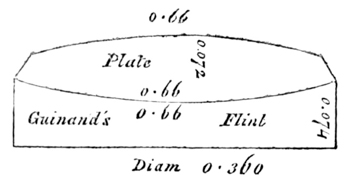
It requires moreover a stretch of complaisance, not to be expected on this side the Channel, to be enabled to admit that the best double object-glass is (taken singly) effective; or that, in consequence, Chevalier made an effective one until he had enlarged his apertures, and combined two together45, which combination is not to be met with in his primitive instruments. Mr. Lister, (to whom the public is mainly indebted for the present eclaircissement concerning Chevalier’s instrument,) has, by a peculiar method of his own discovery, measured the [p253] curves, thicknesses, and diameter, &c. of that marked 14, which I here give (unfortunately one of the least effective of the set,) however, in all probability, the rest are constructed on the same principle; the annexed drawing by Mr. L. will sufficiently explain itself. Nothing can surpass the beautiful simplicity of Chevalier’s, or rather Euler’s, curves, which, it will be observed, are all alike46. The production of deep achromatics must ever be a task of some difficulty, even to those who thoroughly understand their humours and punctilios; and unscientific artists will, I think, be much more likely to succeed on the French plan, than the English one. Two double object-glasses, by themselves, are very poor things; but, when combined, perform admirably, and will, I believe, (if the three curves are of equal radii,) be far more easily executed than one of the triple Tulleian construction. The dense flint-glass of Guenard, or Frauenhofer, however, will be an indispensable requisite, from the nature of the curvatures. A triple Tulleian object-glass, and a thin double one of Chevalier, (a composition first conceived and adopted by Mr. Lister,) form an excellent combination, and give a very vivid light, without softness, dulness, or nebulosity. This, I think, is the extreme number of glasses which ought to be tolerated. Let it never be forgotten, that a really good triple glass will bear an aperture quite sufficient for ninety-nine objects out of a hundred. I myself denounce the practice of combining glasses together, in all those cases where they are capable of doing their work alone. I shall always consider it as a clumsy, bungling, and unworkmanlike method of obtaining a short focus, combined [p254] with a large angle of aperture. If a man aims at perfection, and wishes to distinguish himself in this branch of optics, let it be done by working perfect triple glasses of 0.2 and 0.3 inch focus, with 0.1 and 0.15 of perfect aperture, like those of Mr. W. Tulley and Mr. Dollond, or deeper still, if he is able; and it is with the most cordial satisfaction that I am enabled to inform my readers, that Messrs. Chevalier (duly appreciating the regular triple construction as the true form for the microscope) have applied themselves diligently to the manufacture of this species of objective, from which they have already had excellent results. It is a fundamental principle, that all superfluous refractions and reflections are to be avoided in the construction of optical instruments. As a radical reformer of microscopes, I can tolerate no abuses in them, or show any quarter to their abettors. Messrs. Chevalier have also undertaken the manufacture of achromatic and catadioptric microscopes, after the fashion of those made by Professor Amici, of Modena, which were so much and so justly admired by the cognoscenti of this country.
It only remains for me to observe, that though two double-cemented object-glasses form the most perfect combination from the fewness of their surfaces, and consequent brightness of their image, yet a fusion between the Tulleian and Eulerian constructions seems to be the most convenient for general use; by this, of course, I mean a triple glass with a double one, to apply before it occasionally, à la Lister. Mr. Dollond and Messrs. C. have demonstrated that two object-glasses may be combined with the best effect, which are both good, and work well separately; but Mr. Tulley has constructed a double one, which, useless by itself, when applied over a triple one, (made to act singly,) corrects that excess of spherical aberration in the concave lens, (by its own excess in the convex,) which, when the aperture is large, is the eternal vice of all the best single and compound object-glasses for diverging rays which I ever saw. This is perhaps the ultimatum of improvement, though a quadruple one, on the same plan, might have the advantage in greater light and clearness, from its simplicity, and the paucity of its surfaces.
The quadruple or quintuple object-glasses are those which [p255] are best adapted for the solar microscope, for they give a full-sized field of view to this instrument, good to the edges, which no single object-glass will do, as I have had occasion to remark in my paper on Mr. Tulley’s aplanatics, unless converted into a compound, by means of eye-glasses, &c. This popular and highly amusing instrument will now receive the utmost reformation and improvement of which it is capable, and become truly scientific in its construction: hitherto it has been a mere toy, but one degree removed from a magic lantern.
I shall now allow Messrs. C. to say what they can for themselves, and to detail the various modifications which they have introduced into their instruments, since they executed Mr. Lister’s order, by giving a translation of a letter I have received from them on the subject, and shall conclude by expressing a hope that no national or illiberal feeling has entered into the composition of this critique, and that I have used my oil, vinegar, and pepper in correct proportions.
“Paris, Oct. 15.
“Sir,
“Accept our thanks for your extreme complaisance in offering to publish the results obtained by us in the construction of microscopes. Since the order executed for Mr. Lister, we have improved those instruments last completed, by greatly enlarging the diameter of the illuminating mirror, in order to obtain still greater light. The prism for opaque bodies is diminished about one half, and by a small modification in its mounting is rendered more serviceable: the diminution of the length of the body has enabled us to augment the magnifying powers by different eye-glasses, and the four double object-glasses placed in a better mounting can be used separately or in superposition, according to the pleasure of the observer, either to form quadruple objectives, or even to combine in a mass together. This last arrangement produces a great accession of magnifying power, without injuring the clearness of the image or arresting much light.
“You see, Sir, that we have the pleasure of coinciding perfectly in your opinions about improvements, for we adopt the quadruple object-glass as the best, and we give three changes [p256] of eye-pieces. The double motion given to the body of a microscope is, in our idea, the defect of all those hitherto constructed; for, as the optical part should remain perfectly centred with the mirror and the diaphragms, it is evident that the least derangement of it from this position must destroy the perfection of the image: the stage then only should move47 without affecting the diaphragms or the mirror, and in this we [p257] have well succeeded in the construction of the microscope of Sig. Amici. But all these arrangements much augment the price, and an observer ever so little practised will always find the object easily enough by means of his hands.
“The prices of our achromatic microscopes are as follows:—
“Achromatic microscope, like Mr. Lister’s—300 francs.
“The same, with the latest improvements, three eye-pieces, and camera lucida for drawing the magnified objects—400 francs.
“Amician Microscope, one horizontal achromatic, the stage giving all the motions to the object, with a micrometer screw, five eye-pieces, two camera lucidas, hand magnifier, frog trough, accessary apparatus, &c. One catadioptric microscope, mounted on the same stand, and adapting itself to the same apparatus; the two instruments inclosed in a mahogany case—1000 francs.
“We trust that the very moderate prices of these instruments, together with the care which we bestow on their construction, will procure us orders for them. Their superiority has been duly recognized by the jury of the Exhibition of the Products of Industry, which has been pleased to decree to us a silver medal.
“The Amician achromatic microscope is composed of a tube seven inches long, at the extremity of which is placed a prism, which reflects at a right angle the rays which come from the object-glass, composed (as in our microscopes executed since 1824) of four double object-glasses, which may be used separately, or two, three, or four at a time. The stand is a square bar, which has a rackwork, carrying a moveable stage, which, by means of adjusting screws ingeniously disposed, permits an object to traverse the field of view in every direction. This disposition gives the power of determining the real dimensions of objects submitted to observation by means of the micrometer screw, which is placed at the side, while the camera lucida affords the means of drawing their outline, and consequently of measuring the magnifying power.
“The rays proceeding from the object which have passed the object-glass, and have been rendered horizontal by the prism, are received by different eye-pieces disposed after the manner of [p258] Ramsden. Their power can be varied. Each instrument carries six, five of which can be attached at pleasure either to the catadioptric or the achromatic. The deepest belonging to the reflector is a single lens of half a French line focus, and the most powerful of the achromatic is a line and a half.
“Such, we think, are the details which you required: we wish that they may prove agreeable to you.
“We beg you to accept the assurance of the high consideration with which we are, Sir,
“Your very devoted Servants,
“VINCENT CHEVALIER, ainé et fils.”
“69, Quai de l’Horloge.”
On the Existence of Chlorine in the Native Black Oxide of Manganese. By John M’Mullen, Esq. ◊
IN the paper relating to this subject, which the editors of the Quarterly Journal of Science obligingly inserted in the forty-fourth number of that work, I described some experiments which I had made, to show that chlorine is uniformly evolved from the Native Black Oxide of Manganese by the action of sulphuric acid, under certain circumstances, which I endeavoured to detail with strict accuracy, so as to prevent any mistake or failure in the event of the experiment being repeated.
Upon this paper Mr. Richard Phillips has made some observations in the Philosophical Magazine and Annals of Philosophy for April last, to which I am desirous of briefly adverting. He says, “Mr. M’Mullen having observed, when sulphuric acid is added to peroxide of manganese, that chlorine is evolved, he conceived it might be derived from an admixture of muriate of manganese, iron, or copper; but having washed some of the peroxide of manganese with water, he did not find that any chloride of silver was precipitable from it; he, therefore, concluded that the peroxide in question contained no muriatic salt.” If Mr. Phillips will take the trouble to refer to my paper, he will find that this is by no means the statement which it contains. I observed that, in order to separate any soluble [p259] muriates which the oxide used might, in the first instance, have contained, “I washed it every day, for three weeks successively, using sometimes hot and sometimes cold water: at the end of that time, I tested the water, which was then decanted from the washed manganese, by the nitrate of silver, but without finding the slightest appearance of precipitated chloride. I then poured upon the manganese four times its weight of dilute sulphuric acid; allowed the mixture to stand for about four weeks, occasionally agitating it, and at the end of that time, found, when the dilute acid, now of a deep crimson colour, was removed from the subsident manganese, and the latter agitated, that the most decisive evidence of the presence of chlorine was exhibited in the vapour evolved from it.” I stated further, that I had “carefully preserved this particular mixture, and that after a lapse of more than twelve months, the residuary manganese, when the supernatant acid was removed, continued to evolve chlorine.”
In this experiment my object was effectually to purify the manganese used from any soluble muriate which might by possibility have been mixed with it: I did not, however, test the water first used in washing it, but merely that which was last removed from it.
Mr. Phillips proceeds to observe that he had prepared some observations, and at considerable length, to prove that the author of the above paper has been completely misled by “forced analogies” and “erroneous experiments;” but that it afterwards occurred to him, that it would be better to show, in a few words, the real source of the chlorine in question, the evolution of which from peroxide of manganese he had noticed some time previous to the publication of my papers. That with this view he had procured various specimens of the peroxide of manganese, (one of them in the crystallized state,) which were reduced to powder, and on the addition of sulphuric acid, chlorine was evolved from each. That he then washed separate portions of them with distilled water, and on the addition of nitrate of silver to the washings, chloride of silver was immediately precipitated: sulphuric acid being poured upon the washed peroxide, no chlorine whatever was evolved. That he further added sulphuric acid to an unwashed portion, and to one which had [p260] been washed, and referred both to a bystander, who immediately detected the odour of chlorine in the former, but not in the latter. He then proceeds to show that the specimens of manganese which he had made the subject of this experiment contained a portion of lime, and he infers that the black oxide of manganese consequently contains muriate of lime.
Mr. Phillips asserts that I have been misled by erroneous experiments. My reply is, that the experiment to which he refers, and which I have recapitulated, was carefully made, and is truly and faithfully detailed. In what, then, is it erroneous? It is not incompatible with that which he has produced as a refutation of it, inasmuch as he did not wait the result for which the perusal of my statement should have prepared him, and which he clearly should not have anticipated. He states that chlorine was not evolved from washed manganese at the instant when sulphuric acid was affused upon it. This is not a contradiction of my statement: I affirmed that, after washed manganese had been exposed to the action of sulphuric acid for a very considerable period, I distinctly observed the evolution of chlorine, and that for twelve months afterwards, under the circumstances detailed, this continued to be the case:—all this I deliberately re-assert. I have frequently met with specimens of manganese which, upon the first affusion of sulphuric acid, gave off chlorine; but in general, as far as my experience goes, this is not the case: were it of uniform occurrence, and that the mixture of sulphuric acid and oxide of manganese rendered chlorine evident to the smell, the fact could not have remained unnoticed till now.
The observations of Mr. Phillips, to which I now refer, did not come into my hands till about three weeks ago. It fortunately happened that I had still preserved the specimen of washed manganese upon which sulphuric acid had been affused, under the circumstances already recapitulated, and it occurred to me that this would afford occasion, as decisive as I could desire, to put the accuracy of my original experiment, and the conclusions drawn from it, to further proof. I am bound to premise that this specimen of manganese, after having been in the first washed and subjected to the action of sulphuric acid, as already mentioned, has ever since remained in [p261] the vessel in which the experiment was at first made, covered with dilute sulphuric acid,—a period of more than eighteen months; and it will scarcely be doubted that, in the course of that long interval, any muriate of lime which it might have originally contained must have been thoroughly decomposed. Upon removing the supernatant acid, the residuary manganese gave sensible evidence of the presence of chlorine; paper stained with the solution of indigo in sulphuric acid was readily bleached by it, &c. I now proceeded to wash the manganese in pure water, and continued to do so until the acid was no longer perceptible to the taste. I then washed it three times successively with distilled water, and after decanting off the fluid of the last washing as closely as possible, added pure sulphuric acid in considerable quantity, and stirred the mixture thoroughly, after it had cooled, with a glass rod. At this time no vapour of chlorine was evident either to the smell or to the usual tests. The mixture was then set aside, and allowed to stand undisturbed for ten days: at the end of that time, when the acid was poured off, and the subsident manganese agitated, the vapour of chlorine was as distinctly manifest as when it was first subjected to experiment more than a year and a half ago.
Dublin, June 11, 1827.
Modern Improvements of Horticulture. ◊
THAT gardening has always been one of the most natural, as well as the most useful occupations of mankind, is obvious: that it has advanced—been retarded—or flourished, according as general taste or wants, or peculiar political, moral, or local circumstances, were favourable or adverse, is also sufficiently evident from all historical testimony;—but in no age has it advanced with such rapid strides towards perfection as it has done within the last fifty years. To bring the modern improvements in array before the reader,—to estimate their advantages in a public and private point of view,—to look forward from our present elevated station to the probable results of continued, and extended application,—may be an amusing, if not an [p262] useful inquiry: it may tend to remove barriers which are only imaginary, and by freeing the thinking powers of practitioners from the trammels of custom, lead them forward into that expanse of operative freedom, where much remains for the exercise of the inquiring mind, and experimental hand, in exploring the yet untrodden field of practicability, and calling forth the still latent powers and susceptibilities of pregnant nature.
When we turn to the history of the first ages, we hear of a garden as soon as we hear of man; and though, from the paucity of description, we can only form ideas of such a place from the effusions of the poet, rather than from the detail of the historian, yet, in judging from what still appears of aboriginal scenery, we may conclude with Milton that a garden was a place,
“A happy rural seat of various views; Groves whose rich trees wept odorous gums and balm; Others whose fruit, burnished with golden rind, Hung amiable, and of delicious taste: Betwixt them lawns—or the flow’ry lap Of some irriguous valley spread her store.”—Par. Lost.
If such a place, it required care to rear the tender—to check the luxuriant—correct the irregular—to support the burdened—extirpate the noisome weed—and repulse the browsing animal. Such was the only occupation of the first gardeners: for in those highly-favoured spots, those natural paradises, (some of which still remain in India,) where the groves which formed the habitations also supplied the simple food of the inhabitants; where the cocoa-nut48, with its various liquors, abounded; [p263] where the date, the mango, tamarind, and lime dropped in profusion into the hand; where the melon tribe upon, and the nutritious yam beneath the surface of the bountiful soil, were all spontaneously supplied without care, and without toil:—in such circumstances, neither sagacity to contrive, nor ability to perform, were necessary, further than collecting and preserving those spontaneous gifts of nature.
But population increased; and when mankind became translocated to regions less favourable to vegetation, and where the spontaneous productions of the earth were insufficient for their subsistence, then the business of the planter and cultivator became a necessary occupation; and hence gardening would begin to assume a systematic form.
As improvements, and the times in which they took place, have descended together in continuous and collateral streams, the narration may be divided into three periods, viz.:—From the earliest ages to the beginning of the sixteenth century;—from the beginning of the sixteenth century to the end of the seventeenth;—and from that period to the present time.
We have already hinted at what were probably natural, or aboriginal gardens: the account is so far feasible from the fact, that such places and productions may be met with on the peninsula of India, at the present day: true it is, they cultivate rice, and some few inferior plants, where they have opportunity, and use them along with their wild fruits; but when they cannot procure these cultivated necessaries, (which sometimes happens,) they must rely on the natural productions. It is necessary to add, that some of the castes, from religious principle, abhor the use of almost any kind of animal food; and, therefore, vegetables are their sole support.
From Egyptian and Jewish history, we learn that gardens [p264] were an appendage of the palaces of their princes, and other great men, for personal solace and gratification; but how far the art was systematized, either in knowledge or practice, history is silent. Throughout the Assyrian, Babylonian, Persian, and Macedonian empires, we learn but little more than that ornamental gardening was carried to an extravagant height in their artificial formation; insomuch that one of the Babylonian princes built what were called “hanging gardens,” that is, a vast and lofty pyramidal structure on arches, arcades with terraces surmounted by other arcades, and carried up in gradations to a great height. The terraces being planted with the choicest trees, presented to the distant spectator a verdant hill of foliage in the midst of a large city, and lifted the sovereign proprietor far above the noise and intrusive notice of his vassals below; at the same time, yielding him all the sweets, seclusion, and quiet of the country, even in the purlieu of his palace! The idea of such an ornamented and elevated structure for a mighty sovereign was certainly sublime, and far surpassing all that has been yet done (though it has been suggested by Mr. Loudon) in the western world; and though only a monument of wealth and personal pride, prompted by conjugal regard, and entirely artificial, was certainly proper for the place where it stood, worthy of the prince who erected, and the extensive empire to which it belonged.
Throughout a long-following period, and up to the time of the Romans, we learn nothing particular respecting gardens, only, that among the Jews, they had gardens for herbs, vineyards, and even gardens for cucumbers: but as frequent allusions are made to them, it is probable that gardening had then become a distinct calling, as we find it was among the Romans, as soon as their extensive conquests were secured.
As the arts and arms of the Romans went together, no doubt a very wide circulation of all that was known of gardening in Italy, was transferred thence. Their writers on rural affairs preferred agri to horticulture; but their sound knowledge of the former shews no inconsiderable share of acquaintance with the principles of the latter; and as their practice, as well as the seeds of their products, would be introduced wherever the climate permitted, it is more than probable they [p265] laid the foundation of British gardening. The rules and examples left by them, were probably continued, with occasional accessions to the stock both of practice and production, throughout the Heptarchy, the domination of the Saxons, Danes, and Normans: but these troublous times were not favourable to the prosecution of the arts of peace; and it is not likely much advancement in the art took place until the Norman power was fully established; and even then their castellated mansions precluded any extensive adaptation of garden, from the necessity of forming the glacis, for the greater security of the baronial hall: and though it is probable that, at this time, not a dwelling, from the regal palace to the cottage, but had a garden of some size or other, yet the best practice was confined to the monasteries, and other religious corporations of those days, all over Christendom. Their education and leisure, their foreign intercourse, their interest in the tithes, and their love of superior vegetables and condiments, on the many days they were restricted from indulging in the consumption of animal food, all contributed to incline the monks to prosecute gardening on the most approved plans. Thus, Italy, Spain, and Germany became famous for their superior culinary vegetables, as France was for improved fruits; indeed, when war depopulated or devastated a country, and when the gardens of the château became a sacrifice to offensive or defensive operations, and when the potageries of the hamlets were trodden under foot and destroyed by a licentious soldiery, the gardens of the religious houses were often spared, and, consequently, many roots and fruits found there an asylum, which was denied them in less privileged places.
In looking over the lists of plants cultivated in those days, we find the names of a great majority of the common sorts now in use, as well culinary, as for the table or the press, with a great addition of physical plants, it being then a prevalent supposition that remedies for all the ailments of the human frame were existent in the vegetable kingdom, if they could be detected; the cultivation and gathering of simples, therefore, was a business which employed many heads and many hands: even the Corinthian pillars of the noble profession of physic were not entirely free from that malaria, which was generated in the fumes of the herbalist’s shop! [p266]
Ornamental gardening had hardly showed its graceful head; the little that had been done of this in England, was only in imitation of the Italian school, though without their accompaniments of splendid architecture, classical sculpture, and costly fountains. Such a style, in the near neighbourhood of a palace or mansion, is imposing and suitable, but the outskirts of such gardens, which should have been gradually blended with and into the free and beautiful forms of nature, were bounded and deformed by tortuous labyrinths, by complicated folds of nicely-clipped hedges, involving each other for no purpose than affording seclusion from the “licentious eye,” or a “maze to the intruding foot.”
It may be observed as somewhat unaccountable, the excellent taste of their landscape painters was never transferred from the canvass to their style of ornamental gardening. But so it was: the people who had all kinds of assistance from artists of the first order, and from classical and picturesque association within their own territory, long remained blind to what was so natural and so manifestly within their reach!
In useful and profitable gardening, the fine climate of Italy gave great facility for successful cultivation of a profusion of the finest fruits, and being an advanced post for the reception of all valuable plants from both Asia and Africa, it much sooner than other European countries possessed culinary vegetables in great variety, and of salad-herbs a numerous list.
From the commencement of the sixteenth century the improvements in gardening began to take the form of a system. The increasing splendour of the English court, during the reigns of the virgin queen and her father, and the princely establishments of some of her courtiers, called the art of gardening into notice and repute, and gave an impulse to the yet dormant powers of horticultural practicability. Continental artists were generally employed in laying out the greater works. The sum of their professional ability was chiefly geometrical, an exact knowledge of straight lines, squares, and curves; they could line out a polygonal basin to a hair’s breadth, and construct a many-tiered jet d’eau in the midst. Such, however, were the principal features admitted into, and which constituted the style of those days, and continued through that and the succeeding [p267] century. In the latter (the seventeenth), and during the domestic broils which then convulsed the kingdoms, gardening appears to have been, as to style, almost stationary. In the mean time, however, the Reformation had been silently working salutary effects, not only in the deliverance of men from a servile religious thraldom, but also from the dogmas of precedential custom, and by imbuing them with a spirit of independence with respect to others, gave, what was better, a self-dependence in exertion, whether of mind or action; and, after a few years of revolutionary excess, and abuse of this inestimable acquisition of mental freedom, at last, in 1688, settled down into that rational state of composure, which, with few interruptions, has happily remained to the present day.
Then it was that gardening, in all its branches, was patronised and encouraged. Tournefort in France, and Ray in England, enlightened the public by their description, enumeration, and classification of plants. Evelyn called attention to the usefulness and national value of forest trees; several authors developed the mysteries of kitchen-garden and orchard management; collections of exotic plants were made, and glass-cases built for their reception; floriculture received a share of the gardener’s attention; and in short, there seemed to be, about this time, a general movement by united exertion to gain what had been previously neglected, and complete what had been only feebly attempted.
The accession of William and Mary to the British throne very naturally introduced Dutch gardening and architecture. The old Italian and French styles received very little, if any, amendment. The avenue, the canal, the rectangular clumps and borders, the shelves and slopes, the terrace, with its stairs, were all maintained and extended, the whole surrounded by exactly-clipped hedges, and bedotted with fanciful and unnaturally cut trees. This expensive and ridiculous fashion had its admirers for a time, but at last fell into disrepute, not by a bull or anathema, but chiefly by the keen sarcasm of a Pope!
Kitchen-gardens were improved by additional brick-walls for the more delicate kinds of fruit, as vines, figs, peaches, nectarins, apricots, &c. Hot-beds were in general use, and, many hot-houses were erected for different kinds of the above [p268] as well as for the pine-apple. In those days our fruit-lists contained twenty sorts, of which there were many varieties. Of culinary vegetables there were, of roots eighteen, of shoots four, of leaves fourteen, of flowers three, of seeds three, of pods two, and of herbs for all purposes twenty-five.
From that period, the commencement of the eighteenth century, every succeeding year brought forth new objects of the gardener’s care, and improved operations for his imitation. The acquirements of natural science, radiating from such a character as Sir Hans Sloane, whose theories were imbibed and confirmed by the practical abilities of Philip Miller, were, at that time, like the orb of day bursting from behind a cloud! Scientific light and practical life were shed on all around, and the foundation was then laid, by their united means, on which has been raised almost all the varied structure of modern horticultural improvement. It would be impossible, as needless, to give the names of the authors, who, from this period, showed themselves in print on the subject of gardening, for, were the respective merits of their literary labours noticed, and the successive discoveries and advances chronicled, the amount would be voluminous indeed. But the following celebrated names cannot, in justice to their memories, be omitted. The great Linnæus was deservedly at the head of the botanical branch of gardening; Miller, with his satellites, Gordon, Lee, and Aiton were at that of practical botany, as well as of all the other parts of operative gardening; and, as a leading orchardist, Kennedy, and many others on miscellaneous subjects, produced respectable directories and kalendars.
The improvement of ornamental gardening kept pace with that of the more useful. Soon as the old style of rigid formality had been exposed, it was exploded; more refined principles of taste prevailed; its outlines became better defined; it was found that there are certain fixed principles in nature, on which the elements of true taste are naturally (not capriciously) founded; that delight and gratification to the eye, or mind, can only arise from the harmony and fitness of the combinations of art or design; that the sensations of beauty and sublimity can only be conveyed by congruous associations of parts to the whole; and that the incidents found in [p269] conjunction in nature, should be the objects of imitation of the gardener’s, as they had long been that of the painter’s art, with this exception, that in the immediate vicinity of the mansion as much of the old style should be retained as will harmonize with the necessary artificial façade of the architecture; but soon as departed from these creations of art, let then appear the varied flow of nature’s devious garb.
The art of painting had, in the best schools, proceeded on such principles, and the formation of real scenery was improved from what was so prominent in the fictitious. Some painters, even Claude Lorraine himself, have occasionally erred, from what may be called exuberance of design, in producing extreme effect, by introducing lights which never can be seen by day or night, at dawn or twilight; by trees which never existed, and by forms49 which had only an imaginary existence. Landscape gardeners, too, in the transition from the tame to the more natural style, have run into error, by imitating admirable incidents frequently seen in nature’s works, forgetting that their value springs entirely from their having happened by chance, but, as works of art, lose all their interest, and become insignificant.
We are now arrived on the confines of our own times, of which we will take a general view, and which will sufficiently show the accumulated assemblage of horticultural objects, productions, and knowledge; and which will also give, what was proposed, a comparative survey of the extent of our improvements.
And first, as to the highest department, Botany. Before the sexual system of Linnæus was fairly established, (though it spread far and wide by the literary labours of Hudson, Lee, Curtis, and several other able contemporary writers, both in England and on the continent,) defects were found in it, and not only as to the terms of distinction, but also to its bringing together, in the classification, plants which appeared, from their [p270] exterior habit and qualities, to have no natural affinity to each other. This Linnæus was aware of himself, and left some fragments of a natural arrangement, but which he did not live to complete. This, or the idea of it, however, was taken up by Jussieu, a French botanist, and completed as far, perhaps, as it can be; and though, in our present botanical publications, both systems are continued, yet it is likely that Jussieu’s simplified system will, in time, supersede the other, though the curious fact on which that of Linnæus was founded will never be forgotten, because of its practical use in the amelioration of fruits. Botanical publications, under the various names of Hortuses, Floras, Monographs, and of every country and district under the skies, and since the promulgation of Jussieu’s system, monographs, under the titles of Geraniaceæ, Cistineæ, &c., flow in periodical floods from the press, crowd the bookseller’s shelves, and thence find their way to every elegant drawing-room in the kingdom.
This additional call on the business of the press, as well as upon the talent of the artist, arises from the fashionable and refined bias of the public taste for this rational and delightful study. To extend botanical collections, and the desire to possess every vegetable beauty, pervaded the whole community: hence expeditions to distant lands by collectors; hence the extension and encouragement of nursery business; hence have sprung up chartered societies and associations for the encouragement of botany and gardening all over the realm; so that vegetable beauties and curiosities are now to be seen in British collections, from every region of the known world.
Neither has the occult subject of botanical physiology been neglected; many curious facts connected with the organisation, structure, functions, and qualities of plants, have been ascertained: but still there remains much for the employment of the naturalist’s mind on this difficult subject.
Landscape gardening is not so much “the rage” as it was twenty or thirty years ago: national circumstances, perhaps, may be the cause; but its principles are much better understood. The errors of Kent and Brown, and their followers, have been corrected by the works and writings of Repton, and the critiques of Knight and Price, whose theories have been [p271] carried into practice by Loudon and others; and nothing will prevent the universal adoption of their principles, but the difficulty of giving the foreground from home walks the extreme degree of ruggedness so much admired, and even indispensable to the painter. Fern, (unless we can introduce some uncommon foreign variety,) burdock, kexes, cannot be admitted into dressed ground; nor have we any plants in cultivation which would well answer the purpose; true, we have the rhubarb, one or two sorts of thistles, eryngiums, palma Christi, and gourds with their ample leaves: but these would only appear intruders, and misplaced: but much may be done by a judicious disposition of our common shrubs, so as to conceal the traces of the spade and line, and give all our combinations of land, wood, and water that flowing character, which is so true to nature, and so pleasing to the refined eye of taste.
Floriculture, which has been imported from France and Holland, is also intensely followed about London, as well as in our manufacturing provinces. Authors have creditably appeared in this line too; and our annual blows of flowers, both home-cultivated and imported, are at once rich and costly. Tulips, hyacinths, narcissuses, ranunculuses, and anemones, are the principal bed flowers: but roses, stocks, dahlias, chrysanthemums, and even poppies, are out of number. Flowering shrubs, both within and without doors, are eminently rich and various, and astonish as much by the splendour of their colours as by their elegant forms and number.
Orcharding has declined during the last fifty years: first, because of the gradual deterioration of the trees, and precariousness of the crops; next, from the improved way of agricultural labourers’ manner of living. This change renders the use of small cider and perry less necessary in a farm-house, causing an increased consumption of malt liquor; and this again, occasioning a greater demand for barley, at once pleases both the farmer and the Chancellor of the Exchequer. Thus the cultivation of orchard fruit (except cherries50) has greatly fallen off; and the decayed state of the old, and difficulty of [p272] raising new orchards, has given a check to such exertion, except in places at a distance from the metropolis, where orchards have suffered less from decay, and where the habits of the cider drinkers are more inveterate. Mr. Knight, the President of the Horticultural Society, has written copiously on this subject, and very properly considers the cultivation of orchard fruit as a national object; and by his example has done as much, nay, much more, than any other gentleman in the kingdom, to restore our orchards to what they used to be, and what they may be,—and it is hoped his excellent instructions will not be thrown away.
Kitchen-gardening, the most important and useful branch of the subject, next demands attention; and here we are gratified with a fine display of the efficacy of perseverance, the success of experience, and the triumphs of skill. In every month of the year, in spite of the winter’s frost or summer’s sun, our tables are supplied with wholesome and agreeable vegetables:—of roots we have fourteen sorts; of stems, shoots, and leaf-stalks, seven; of leaves, eight; of flowers, four: of culinary fruits we have sixteen; of seeds and pods, six; of condimental herbs we have twenty-nine; and of herbs and seeds for confections there are seven, besides various fruit: of roots, leaves, flowers, and fruit, for salads, there are in cultivation twenty-two kinds; and various sorts of plants for medicine and distillation.
Of table-fruit there are above twenty different species, and of these numberless varieties, extending to several hundreds, or even thousands, of various excellency and value.
A few tropical and foreign fruits, not included in the above, have been cultivated in tolerable perfection in Europe within these few years, viz. the Chinese loquat and litchee, the custard apple, mangosteen, and mango, &c.; and there is no doubt, if these fruits could be worked on some hardier kindred stock, and a suitable place formed for them in a stove, they might be cultivated with the same success as the anana.
In the forcing department of gardening, wonders have been accomplished. By this application of art, we appropriate to ourselves an almost perfect imitation of any of the warmer [p273] climates: heat, that powerful agent in the development of vegetation, we can have in any degree, by stoves, by fermenting substances, and from the steam of boiling water: light, a no less necessary agent in the maturation of fruits, we combine with the former, by glazed houses and frames.
The various expedients for obtaining the necessary degree of heat, are, first, the most simple method of a stove, with its flue passing through or round the floor of the house, and this for warming the air within; but in this case, as the roots of the plants do not sufficiently, it is supposed, receive the proper degree of heat, various fermenting substances, as recent stable-yard dung, tanners’ bark, oak and other leaves of trees, &c. are formed into beds, on which the compost of earth is placed, as in hot-bed frames, or in which the pots containing the plants are placed, or plunged, as in a hot-house. To obtain the same effect, borders within houses are formed for the roots, having an excavated heat-chamber beneath, supplied by simple stove flues, or from the fermenting substances above named, or from steam admitted for the purpose. This mode of supplying an equal degree of heat to the roots, as well as to the leaves and branches of a plant, is plausible, and cannot be far wrong, because it has been attended with success: but there is, perhaps, more attributed to it than it deserves, because the region or stratum of the soil, which is naturally occupied by roots, differs, in respect of temperature, much less over the whole surface of our globe, than is commonly imagined. The heat of the air in different latitudes ranges from several degrees below zero to 110 degrees of Fahrenheit’s scale; but the temperature of the earth eighteen inches below the surface, it is probable, does not vary more than ten or fifteen. In England spring water varies only two degrees, viz. from 42 degrees in summer to 40 degrees in winter; and the effects of our hardest frosts very rarely penetrate deeper than nine inches; but it is necessary to observe, that, in such cases, as well as in hotbeds, we force as well as defend; and probably, by such mode of applying heat and moisture, nutritious gases may be communicated, which may be no small advantage. Besides, the atmosphere of the house can (as is done) be impregnated with the same qualities and degrees of heat and humidity [p274] (a most necessary accompaniment51,) which may be generated below.
Light is a most potent agent in the maturation of vegetables: united with a moderate degree of cold, it is much more effectual in progressive vegetation, than the necessary degree of heat with darkness. Exposure to light is indispensable to plants: and, therefore, our glass cases are formed to admit as much as possible. Within these few years, the endeavour to gain an accession of light by reducing the dimensions of the wooden scantling of hot houses suggested the idea of metallic frames; and for the concentration of the sun’s rays, horizontal as well as vertical curvilinear roofs have been constructed. Lightness to the eye, durability, imperceptible expansion, and glazed with panes, cut like segments of circles, to facilitate the passing off of condensed water, with complete command of ventilation, are an assemblage of properties, always as desirable as necessary; and as they may be cast in the most elegant forms, and protected by paint, they add greatly to the ornament of the garden. Beautiful as these buildings are, some little disappointment has taken place respecting them: it has been experienced, that the intensity of the sun’s light, or heat, has been found detrimental to the tender inmates, and that shading is as necessary in bright, as light is in cloudy weather. Certain it is, that in the winter season, when light and heat are most desirable, no fear need be entertained from this circumstance; and it ought to be considered, that in our summer, we have at least, daily, four hours more sun than intertropical plants have at home: of course, they have less time for their evening’s repose, (which all plants more or less require); besides, it should be thought of, that all plants are not equally formed to sustain such a blaze of light; “some affect the sun and some the shade;” such as the pine-apple52, and orange, which require “a warm [p275] shade;” and perhaps all plants which present a large reflecting surface of foliage to the sun, are content with a smaller share of his direct rays. These observations attended to, sun-shades may be applied for occasional use, and with the plants at a proper distance from the glass, will certainly secure them from all the inconvenience of such buildings, while none of the advantages are lost.
The kitchen-garden range of buildings includes pine-stoves, vineries, houses for peaches, and nectarines, figs, and cherries, hot-walls, pits for succession pines, melons, cucumbers; besides store pits for roots, tender vegetables, salading, &c., as well as frames for many purposes of cultivation. Mushrooms are usually raised in sheds behind the houses. The hot-houses are also used for growing early culinary vegetables, and small fruits in pots.
[To be continued.]
Chemical Manipulation, being Instructions to Students in Chemistry, on the Methods of performing Experiments of Demonstration, or of Research, with accuracy and success By Michael Faraday, F.R.S., &c. ◊
WE will not positively assert that no one except Mr. Faraday could have written this book, but we are of opinion that there are very few chemists adequate to such a task, which has manifestly required a considerable share of practical skill, much deep and theoretical knowledge, and no small degree of patience and perseverance, more especially shown in the clearness of the details, and the perspicuous manner in which he has managed to describe prolix and difficult processes. The work moreover fills up a chasm in chemical literature, by embodying almost all that is important relating to chemical manipulation scattered through the writings of others; while the author’s extensive experience has enabled him to correct their faults, and to present the student and operator with many new and important facts and processes, by which the researches of the laboratory are most essentially facilitated.
Such is our general opinion of the treatise before us, and we are persuaded that those who are capable of appreciating its merits will agree in our decision; but it is not so easy to [p276] substantiate our judgment by quotations, in consequence of the general didactic character of the book, and the mutual dependence and connexion of its different parts. We shall attempt, however, to give the general reader an outline of its contents, and point out such parts to the chemist as we conceive particularly useful and worthy attention.
The importance of readiness and dexterity in the performance of experiments has been duly estimated for more than a century. The writings of Black, Cavendish, Priestley, and especially Scheele, as opposed to those of their predecessors, show that they had acquired considerable facility in attaining, by simple and economical means, those ends which had before consumed much time and much expense in their accomplishment: but it is only of late years that the refinements of manipulation have been carried towards perfection; and the researches carried on in the laboratory of the Royal Institution have been not a little conducive to this improvement: to no one, however, is this part of the science more indebted than to Dr. Wollaston, whose skill in what may be called microscopic chemistry is consummate, and who has a host of humble but industrious imitators. So essential, indeed, is the attainment of correct methods of manipulation to the progress of chemical science, that many entire trains of research are exclusively dependent upon it for success. It is true that it must always be subordinate to genius and invention; yet the person who could only devise, without knowing how to perform, would comparatively be able to lend little aid to the extension and usefulness of knowledge: and were it not an invidious task, we might be able to show that some of the greatest discoveries and improvements of the science have originated in dexterity of experiment, rather than in profundity of design. By tact, therefore, in manipulation, a considerable advantage is gained, independent of that resulting from an acquaintance with the principles of the science; and this is so considerable, that, of two persons of equal talent and information in other respects, he who is the best manipulator will soon be in advance of the other; the one will draw just inferences with accuracy and rapidity, while the other will be lost in doubt, and often led into error. Mr. Faraday has pointed out several other cases of prominent advantage, arising from skilful manipulation, especially when very small quantities of matter are to be operated upon, and where accurate conclusions are of more than ordinary importance, as in testing for arsenic and other poisons on judicial occasions. When the substance under examination is rare, [p277] as often happens, the facility of working with small quantities is also of much importance, as otherwise the opportunity of gaining information may be lost, or only retained at great expense. “There existed,” says our author, “in the British Museum a small fragment of a black stone, the source and history of which was unknown: it was unique, no other specimen being in the Museum, or known to be in existence; yet as it presented some peculiar characters, Mr. Hatchett was induced to examine it, and, working with a portion of the stone weighing not more than two hundred grains, he was enabled to discover in it a new metal, which he distinguished, by its various characters, from all those previously known, and which he named Columbium. Ekeberg afterwards discovered a metal, which he named Tantalium, conceiving it to have been observed and distinguished for the first time by himself; but Dr. Wollaston, who examined it, and compared it with columbium, was able to identify it with that metal, although he had not more than five grains of the stone from the British Museum upon which to make his experiments.”
In short, there can be but one opinion respecting the first-rate importance of expertness in manipulation, and neatness, dexterity, and efficacy of experimenting. These are the subjects to which the present volume is directed, and which will, therefore, form a valuable accompaniment to the more general and systematic works. They are discussed under the following general heads:—
The conveniences and requisites of a laboratory.
Chemical apparatus, and its uses.
The methods of performing chemical operations.
The facilities acquired by practice; and,
The causes which make experiments fail or succeed.
The description of a laboratory is followed by two long and well-written sections on the arts of weighing and measuring, in which the account of the methods of determining specific gravities, and of the general management of a delicate balance, are well deserving the student’s attentive perusal: indeed, there are no operations which are more frequently performed in a slovenly and careless manner, than those in which scales and weights are concerned; and we should advise the tyro to sit down with his balance and this book before him, and practise the manipulations which it explains.
The fourth section, on the sources and management of heat, is devoted to the construction and management of different kinds of furnaces, lamps, blowpipes, thermometers, and pyrometers, and abounds in useful hints, and in the details of [p278] practical information; and the same remark applies to the succeeding sections on comminution and solution—indeed, we were surprised at finding so much to be taught in regard to these very simple operations. The seventh, eighth, and ninth sections treat of distillation and sublimation, precipitation, and filtration. Here, and indeed throughout the work, the wood-cuts are particularly distinct and well executed. In the section on crystallization, the uses of that process are enumerated; and to this succeeds an account of evaporation. All these operations are extremely well investigated and described, both as to their principles and as to the most proper means of effecting them; a number of curious circumstances are pointed out, by which their results are influenced, and by which certainty and success may be insured.