Front matter (continued 2)
Reading edition
A fog is a cloud, simply; and it is notorious that a single [p048] cloud, and often of very small dimensions, will remain at rest in the atmosphere, or travel very many miles without the loss of its integrity; however we may imagine it assailed by the various meteorological causes of destruction, as well as by mechanical violence. This in itself proves the consistency with which a current of wind preserves the relative positions of its integral parts; because it is plain that a disturbance among these must disturb or destroy the cloud which, in reality, forms a portion of that current, as a gaseous body: and since that cloud is a mist, since it might have been the very evening mist embodying a malaria, and since it is its real vehicle and repository, it is plain that had it, or any individual cloud, contained such a portion of malaria, it must have had the power of transmitting that, and would actually have transported it to any distance to which itself might travel. Thus, it is evident, may a fog, generated in Holland, carry without difficulty to the limits of its range, or to the coast of England, that malaria which became entangled with it at its birth-place or in its passage; and thus, I have little doubt, is the fact of those agues explained, and this transportation to such distances established.
I cannot, at least, conceive any demonstration as to facts of this nature more convincing, nor anything wanting to the proof; while I may proceed to make some remarks on the east wind, and on fogs, simply, because they concern this question.
The proof that it is a malaria in the fog, and not the fog itself, which is the cause of disease, is evinced by the following fact; while it ought surely to be unnecessary to say, that if fog alone could produce such fever, water itself must be the poison: since a fog is a cloud, and its constituents, when pure, are only atmospheric air and water. No intermittents are ever produced on the western or northern shores by the sea fogs, and for the plain reason, that there is no land whence they arrive. The clouds of mountainous regions do not produce fevers, though these also are fogs; and what forms a most absolute proof of this is, that in Flanders, it is the fogs which come with a southwest wind, or the southerly winds themselves, which transport and propagate malaria and disease; while; as soon as the winds shift, and blow from the sea, the fevers [p049] disappear, though those particular winds are so charged with fog, as to darken the whole country for days: and it will be found an invariable rule all over the world, that when a fog is the apparent cause of disease, or when an east wind is such, it is because these have been generated in a land of marshes, or have traversed one; and that, under other circumstances, or where no pernicious land lies in the way, they are as innocent as any other fogs and winds, and that the hazard and the suffering will arise from those, be they whatever they may, which traverse pestilential lands.
But I must defer this particular and interesting subject to another occasion, lest I make this article too long; and proceed to examine some other circumstances connected with the transportation of malaria.
First, however, I must notice one fact as to this transportation from Holland, partly because it is a necessary fact in the history of malaria, and partly because it might be used as an argument against the view which I have just given. The east winds of autumn are not supposed to bring remittents, as those of spring bring agues, though I cannot assert that this is absolutely true. Being assumed, the solution is easy. If the winds of this nature in spring, are notedly moist, and thus vehicles of malaria, the case is exactly the reverse with the east winds of summer and autumn; or as the east wind may be the most moist of winds, so may it be the most dry; while it is a consequence of its extreme dryness, in fact, that it is always the very cause of our burning summers. This is the history of our last summers, and it is invariable, whether as it relates to seasons or single days; and it is plainly owing to its permitting the more ready transmission of the sun’s rays. That it is the very harmattan of Africa, it is almost unnecessary to say; and as dry wind is not a conductor of malaria, as that poison is in fact decomposed or destroyed in these circumstances, daily and invariably, it is easy to see why the remittents of Holland should not be transported, like its intermittents, though even this may possibly happen under particular circumstances.
To proceed; and to the next remarkable facts connected with the propagation of malaria.—The most singular of these is its limitation, or that yet unexplained property by which it is [p050] determined in a particular direction, or confined to a particular spot, while it is a piece of knowledge of some practical value. There is an appearance of incredibility about many of these facts, and, accordingly, they have not only been disbelieved but ridiculed, although nothing in the whole history of this substance is better established.
With respect to direction, in the first place, it is remarked in Italy, currently, that this poison will enter the lower stories of houses, particularly with open windows, when the next above escape; and hence, in many places, no one ventures to sleep on ground floors: and the truth of this was confirmed in the barracks at Jamaica by Dr. Hunter; as the cases of fever occurring among the men in the lower rooms much exceeded those which happened in the upper ones. But I am also informed, that in some places in Norfolk this peculiarity is reversed; or that there are houses where it is remarked that the ground-floors are safe, while no one can sleep in the upper stories without hazard.
That malaria may in some manner be attached to the soil is also well known by its effects, and especially in Italy. There it is remarked that it is extremely hazardous to cut down certain bushy plants which appear to entangle it, and that fevers are a frequent consequence of such carelessness. Thus, also, does fever seize on the labourers who may incautiously sit down on the ground, while they would escape in the erect posture; being thus, indeed, sometimes suddenly struck with apoplexy, which is one of the effects of this poison, or even with death.
It has similarly been observed that it is often retained in the shelter of drains, or in the ditches of fortifications; whence frequent fevers among the sentries on particular guards, when the other soldiers escape. And thus was it even proved at Malta, that it was transported from the sea-shore, and thus lodged in a dry ditch of the works at Valetta; all these facts being possibly to be explained, by supposing it possessed of a greater specific gravity than the atmosphere, or else attached to vapour thus weighty, exhibiting effects analogous to those which carbonic acid displays in the Solfatara.
But the circumstance most difficult of explanation is, that in Rome, and numerous places in Italy, and even where it is [p051] transported from a distance by the winds, not generated on the spot, it is found, perennially, and through the whole course of successive years, to occupy certain places, and to avoid, as constantly, others quite near, and, as far as the eye can judge, equally exposed, and in all respects similar. Thus, one side of a small garden, one side of a street, or one house, will be for ever exposed to disease, or uninhabitable, when, at a few feet or yards distant, the very same places are as constantly free of danger: and thus it was found at the village of Faro, in Sicily, that all the troops of our army quartered on one side of the single street which formed it, were affected by fevers, and suffered great mortality, while those on the other remained in health.
But the most remarkable case of this nature known to me, is a domestic one, and which rests on the testimony of thousands of persons, or of the whole country, however incredible it may appear. It is, that between Chatham and Brighton, including every town and single house, and Sittingbourne among the rest, the ague affects the left hand side of the turnpike road, or the northern side, and does not touch the right side, though the road itself forms the only line of separation.
We cannot as yet conjecture the cause of this very singular circumstance or property, at least in cases of this nature; though, under certain events of this kind, there are some facts in meteorology that may offer a solution. These are the notorious ones, that a hoar frost, or a dew, will sometimes be found most accurately limited, both vertically and horizontally, by a definite line; stopping, for example, at a particular hedge, and reaching to a certain altitude on a tree: but for the other cases, we must yet wait for a period of more accurate knowledge as to this singular substance.
There is now one circumstance of importance, relating to the destruction or decomposition of malaria, which must not be passed over, from the interest of the facts depending on it: this is, that its propagation is checked by the streets of a crowded town, and apparently owing to this very cause, decomposition. Thus it is observed, that the fever never appears in the Judaicum of Rome, and, similarly, that the crowded streets and the poor people escape, when the opulent houses and open [p052] streets are attacked; and hence the Villa Borghese, among many other palaces and opulent houses in Rome, has been abandoned, while such desertion, being limited exclusively to houses where the air is most open and free, naturally excites wonder: the cause, however, is now plain; and thus it now appears why it was that the Penitentiary in Westminster suffered formerly from dysentery, originating in this cause, when no such disease appeared among the neighbouring inhabitants.
And if this fact is of value as it may relate to the erection of open streets in any place of this nature, it is most important to point out what has been the continuous effect at Rome, as the ultimate consequences threaten to be extremely serious.
It appears that from cutting down some forests which many years ago occupied the declivities of the hills to the southward of Rome, the malaria was let in upon that city from the Pontine marshes; and, further, that the extirpation of a similar wood to the eastward had let in the same poison upon another quarter. Thus it has been found to enter the city through the Porta del Popolo, while, for many years past, it has been gradually extending its influence through the streets; leading annually and successively to the abandonment of many houses and palaces, and still annually increasing and extending its ravages; so as, at length, as I understand, to have even become sensible at the Vatican. And the lines which it follows are distinctly traced out by the inhabitants; while, as I have already said, it is only the houses of the opulent which suffer, further than as the abandonment of these may also influence the inferior ones in their neighbourhood.
Whatever the original cause may be, and however the direction, abstractedly, may be regulated by the winds and the forms of the streets, or by local and fixed circumstances, it is plain that the annual extension is the consequence of desertion, and that as the inhabitants retire from before it, it acquires the means of making a new step and a further progress; because thus they withdraw those fires and smoke, or whatever else it be, dependent on human crowds, which decomposes and destroys this substance. And hence it must follow, that as Rome shall become still further abandoned and depopulated, from want of industry, or from political feebleness [p053] added to this cause, the effects must be expected to increase in a sort of geometrical ratio; almost leading to the fear that the whole city itself may, in time, fall a victim to it, or become abandoned to the wolves and mosquitoes.
If I dare not inquire more minutely into the remaining circumstances connected with the propagation of malaria, lest I should extend this article to an inconvenient length, it is necessary now to offer some remarks on prevention, and especially as it relates to this circumstance—the propagation of the poison; since the rules for prevention, as far as this relates to production, may be deduced from what was said in a former paper on this subject, and relate chiefly to the drainage of lands, and to other practices, more or less obvious, which a little reflection will, without much difficulty, deduce from what was there said.
It is plain, in the first place, that as far as the winds are concerned, it is by opposing obstacles to their course that we must attempt to counteract or divert their influence; and that, in this case, it is through the use of trees alone that we possess any power. Thus reversely, as in the case just stated, the cutting down of trees and forests has often been a serious cause of diseases in certain countries, by admitting a malaria to particular spots; though it is easy to see that where any given spot suffers from malaria, through condensation or confinement, the clearing away of these would be the remedy, by attaining a free ventilation. To detail the particular modes in which remedies may be applied through this species of aid, is obviously unnecessary, and not easy, as it must depend on local circumstances, differing for each place; but I may remark, as an example in illustration of my meaning, that where, as in many of the narrow and prolonged valleys of Greece, the sea shore is a marsh, the remedy would be to plant a screen of trees beyond it, and thus to prevent the sea winds from passing into the interior. And thus did the ancient Romans compel the planting of trees on the shores of Latium, to check the current from the Pontine marshes; rendering groves sacred, under heavy penalties, and enacting other laws with the same intentions.
With respect to such temporary precautions in these cases [p054] as may concern armies in the field, or in camps, it is plain that they will depend on attention to the courses and seasons of the winds; while it would be abundantly easy to accumulate, from the histories of campaigns, the most fearful examples of mortality produced by neglect of these and similar precautions, and even down to almost the very date at which I am writing: and there can be no hesitation in saying, that an intimate and accurate knowledge of every thing which concerns the production and propagation of malaria, forms a most important branch in that information necessary to a soldier, and above all to the quarter-master-general’s department and the medical staff: while, did I dare to record but a very small portion of the mortality experienced, not only in our own armies, but in those of Europe at large, during even the last war, from ignorance or neglect on this subject, it would, I believe, be found that it almost equalled the mortality produced by the actual collision of war itself. Walcheren will not soon be forgotten; if we have ceased to think of our mortal Havannah expedition; and if a French army at Naples was diminished by twenty thousand men, out of twenty-four, in four days, from this cause; if Orloff lost nearly his entire army in Paros; if Hungary has more than once destroyed ten times the number of men by fever that it did by the sword,—these are but trifles in the mass of reasons for saying, that no subject can well be more important, and no knowledge much more necessary to the commander of an army.
Some other points relating to prevention may deserve a few words of notice, before I pass from this subject; if here, also, I must be brief. Not to repeat the cautions founded on what relates to the power of evening and morning, it has been asserted that the use of a gauze veil will prevent the effect of malaria; and it is not improbable that the air accumulated within that, may have the power of decomposing the poison: it is an opinion, at least, which is universal among the people in Malta, and very general in Spain and Portugal. It is also found that fires and smoke are useful, and especially on military service; the experiment having been tried on a very large scale by Napoleon before Mantua, and on a smaller one in Africa, with the most perfect success. With respect to [p055] personal precautions, it is universally recommended to use wine and a good diet, and especially never to leave the house in the evening in situations peculiarly insalubrious, without the previous use of wine or spirits; whence the universal practice of Holland in this respect. Thus, also, narcotics prevent its influence; whence the wide use of tobacco, of which the salutary effects appear to be most amply established.
As to the tropical countries, there is here also one important remark, which, from the great neglect of the fact, and its ruinous consequences, appear particularly to demand a statement in this place. It is the universal experience of the inhabitants, that the attack of malaria, or the production of fevers, is aided by the use of a full or animal diet; by the use of some particular articles of food, such as butter; by excess in eating, generally; and, above all, by eating in the heat of the day. This is not merely well known to the negroes, but the fact is distinctly stated to travellers, and the caution urged, however often it has been neglected, and especially by our own countrymen. Of this, in particular, Major Denham is a strong testimony; while he attributes his own exclusive preservation to his having rigidly followed the recommendations of the natives, which were always urged with the greatest earnestness. And if we examine the causes of death, in most cases, of our African travellers especially, I think there will be strong reasons for believing that their lives have often been sacrificed to this very negligence or obstinacy; while it is most evident that Niebuhr’s party, in particular, owed the loss of their lives to what may be safely called gluttony: and it is to be suspected that this will also explain the loss of Captain Tuckey’s party; while, with respect to nations, it has long been known that the English, the Dutch, and the northern voracious people in general, who habitually indulge themselves in the customs of their original country as tropical colonists, have always been greater sufferers from the effects of those climates than the French and the Spaniards, and apparently from this very difference. And there seems little doubt, generally, that the vegetable diet of Africa and Hindostan is the best security against the evil influence of those climates, and that the chief sufferings of our [p056] own colonists arise from transferring to those situations their ancient habits of full and free living.
As I must not prolong this subject much further, I shall now pass to a few remarks, but very brief ones, on the geography of malaria as it relates to those parts of the continent of Europe most frequented by English travellers; not daring to take room for actual and useful information on that head, but wishing to point out merely the importance of such geographical knowledge to those persons, on account of the hazards which they so universally incur from that ignorance or neglect, and of the great mass of suffering, and also of mortality, which has been the lot of persons who had resorted to those climates as travellers, or migrating residents, from various motives, and not unfrequently with views to health. How often health has been lost where it was sought, will be but too apparent to any one who has chanced to possess an extensive acquaintance of this nature.
Of Italy I can but afford to say generally, that except at a very few points where the Alps or Apennines reach the sea, the whole of its shores are pestilential, and often to such a degree as to lead to their entire desertion, more frequently to their abandonment in summer. And to avoid wet lands, or low lands, is not always a sufficient precaution; since the most pestilential parts of the maremma of Tuscany are dry, and since the annual mortality of Sienna from fevers, even without epidemics, is one in ten. In the north of Italy, the great plain is similarly insalubrious; though the more unhealthy district does not commence until we arrive at Mantua, extending thence to the sea. Of the Mediterranean islands, I can only afford room to say, that the same rule holds good as to the sea coasts, while the entire of Greece in the same circumstances is similarly unhealthy, and subject to autumnal fevers in as great a degree as the worst parts of Italy. The same is true of Spain and Portugal, and the same rule also will be a guide; namely, that malaria is to be expected in all the flat grounds, even when under cultivation, and at all the exits of rivers on the sea, even though no marshes should be present: and if I were desirous to name any tract of land in Spain peculiarly [p057] insalubrious, it would be the province of Valencia; while Carthagena is almost invariably fatal even to those who, as labourers, are compelled to resort to it for the needful work of its port, even during a few days.
Of France, little as it has hitherto been suspected by those who, associating the term malaria with Italy, have been accustomed to consider it as peculiar to that country, it would scarcely be untrue to say that it contains as large a portion of insalubrious territory as Italy itself, and produces fever and disease of as great severity and extent, not merely on its sea coasts, but over very extensive tracts in its interior. And this insalubrity may be conjectured, when there are entire districts in which the average of life does not exceed twenty, and in which the entire people are diseased from their births to their graves. Such tracts are found chiefly on the course of the Loire, and some other of the great rivers; and among them, Bresse in the Lyonnais, the plain of Forez, and Sologne in the Orleannais, are of the most notorious; while the coasts of Normandy, and the whole of low Britanny, are similarly subject to eternal intermittents, or to epidemic seasons of autumnal fevers, amounting to absolute pestilences. And how English families have suffered in this country from the incautious choice of residences in such places, will be easily ascertained by whoever shall be at the trouble of making the necessary inquiries.
But as I dare not pursue this extensive subject, I can only suggest to our countrymen the utility of making themselves acquainted with this matter, and with this dangerous geography, before encountering the hazards which await them; while to physicians I need still less name the necessity of that knowledge, since it is so often their duty to choose and recommend for their patients, and since no man can feel much at his ease who finds that he has sent into a land of malaria the patient who has already been suffering from its diseases, or that where he speculates on the cure of a consumption, that cure is attained through the death of the patient, at Avignon, or at Poitiers, or Nantes, or in some or other of the numerous places subject to this most fearful poison.
It remains only to give a brief enumeration of the diseases [p058] which are the produce of malaria, and of the general condition of the inhabitants in the countries subject to it. With respect to this latter, the most remarkable general fact is the contracted duration of life. In England, the average may, if not very accurately, and indeed considerably under the mark, be taken at 50; and when in Holland it is but 25, it follows that the half of human life is at once cut off by this destructive agent. In the parts of France to which I have alluded, it becomes as low as 22 and 20, and Condorcet, indeed, has calculated it as low as 18. With this, very few attain the age of 50; and in appearance and strength, this term is equivalent to 80 in ordinary climates; while 40 forms the general limit of extreme and rare old age. The period of age, indeed, commences after 20; and it is remarked, in particular, that the females become old in appearance immediately after 17, and have, even at 20, the aspect of old women. In many places, even the children are diseased from their birth; while the life which is dragged on by the whole population, is a life of perpetual disease, and most frequently of inveterate and incurable intermittents, or of a constant febrile state, with debility, affections of the stomach, dropsy, and far more than I need here enumerate.
While the countenances of the people in those countries are sallow or yellow, and often livid, they are frequently so emaciated as to appear like walking spectres, though the abdomen is generally enlarged, in consequence either of visceral affections or dropsy. With these, rickets, varices, hernia, and, in females, chlorosis, together with scorbutic diseases, ulcers, and so forth, are common; and it is even to be suspected that the cretinage may depend on this cause, since goitre is also one of the results of malaria, and since, in the Maremma of Tuscany, idiotism is a noted consequence of this pestilential influence.
The general mental condition is no less remarkable; since it consists in an universal apathy, recklessness, indolence, and melancholy, added to a fatalism which prevents them from even desiring to better their condition, or to avoid such portion of the evils around them as care and attention might diminish: and while it is asserted that even the moral character becomes [p059] similarly depraved, I prefer a reference to Montfalcon for a picture which it would not be very agreeable to transcribe.
As to the absolute or positive diseases, besides those which I have already named, I need scarcely say that remittent and intermittent fevers, under endless varieties and types, form the great mass; and next in order to them, may be placed dysentery and cholera, together with diarrhœa. To these I must also add, those painful diseases of the nerves, of which sciatica stands foremost, and the remainder of which may be ranked under the general term of neuralgia; and further, a considerable number of inflammatory diseases of a more or less remittent type, among which rheumatism under various forms is the most general, and the intermittent ophthalmia the most remarkable. Lastly, I must include the various paralytic affections; since apoplexy is one of the primary and direct consequences of malaria, as various paralytic affections are the produce of intermittent, or the consequences of the diseases of the nerves which are associated with it.
It is still a curious and interesting fact, that this poison affects, in an analogous manner, many different animals, and appears, in reality, to be the cause of all the noted endemics and remarkable epidemics which occur in the agricultural animals in particular. This has been noticed even by Livy: and in France and Italy it is equally familiar that the severe seasons of fever among the people are similarly seasons of epidemics to black-cattle and sheep, while the symptoms are as nearly the same as they could be in the circumstances, and the appearances on dissection also correspond. Thus also does it appear probable, that the rot in sheep is actually the produce of malaria, as is indeed the received opinion among French veterinarians; while Mr. Royston has observed that the animals of this class are subject to distinct intermittents.
And while it is not less familiar in the West Indies, and in Dominica particularly, that dogs suffer from a mortal fever in the same seasons and periods as the people, the epidemic always breaking out in them first, I have the most unexceptionable medical evidence of the occurrence of a regular and well-marked tertian in a dog; that evidence consisting in the concurring decision of many surgeons, by whom the case was [p060] frequently examined, during a very long period. But it is time to terminate a paper, which, if it is but a sketch of an important subject, will at least convey to those to whom malaria has not hitherto been an object of attention, a general notion of the leading particulars which appertain to its natural history.J. M.
Elements of Chemistry, including the recent Discoveries and Doctrines of the Science. By Edward Turner, M.D., F.R.S.E., &c., &c. Edinburgh, 1827. ◊
THIS is a closely-printed octavo of 700 pages, and presents us with something more original, clear, and accurate than we have lately met with in modern chemistry. It comprehends a perspicuous view of the present state of chemical science; and, as far as its limits admit, the theoretical parts are, with some exceptions, well and distinctly worked out; nor are the practical details of manipulation neglected, though they evidently occupy a secondary place in our author’s estimation. To the arrangement we must at once decidedly object—it is indeed evident that Dr. Turner has pitched upon Dr. Thomas Thomson as his magnus Apollo, and here and elsewhere the book is tainted accordingly.
This work is divided into four principal parts;—the first relates to what Dr. Turner, following his prototype, Dr. Thomson, calls imponderables, and a definition of them follows, which leads us to suggest the term inexpressibles, as equally appropriate. But, waiving this objection, the details relating to them are well and clearly given. Thus, after some prefatory remarks upon the subject of caloric or heat, (we prefer the latter term, and cannot allow its ambiguity,) its modes of communication are considered, first, as being conducted through bodies, and then as radiating through free space. In regard to the theories affecting the latter, our author wisely, as we think, prefers that of Prevost to that of Pictet. The effects of heat are next discussed, such as expansion, including an account of the thermometer, and of the relative capacities of bodies for heat; liquefaction, vaporisation, ebullition, evaporation, and the constitution of gases and lastly, the sources of heat are mentioned, but the details are referred to other parts of the work. [p061]
Light is next treated of, but we think too hastily, and too much in the abstract.
Now the subjects of heat and light are obviously of the utmost importance to the chemical philosopher, and they are very extensive, and intricate and difficult to treat of, inasmuch as the writer is necessarily upon the confines of chemical and mechanical philosophy, and should be expert in both. When, therefore, elementary works on chemistry are so written and arranged as to serve as text-books for lectures, and indexes of reference to more accurate information, we can make due allowance for brevity; but when the subject is intended to be formally and completely developed to the student, independent of other ocular and oral aids, much more extensive description and detailed explanation is required, than is to be found either in our author’s “Elements,” or in any other analogous condensation of chemistry. Dr. Henry understands the requisite mode of conveying information in these cases better than most writers; and when he takes pains, and speaks for himself, has the talent of being brief, and at the same time minute, deep, and clear. Dr. Ure, as his dictionary shows, is an eminent example of such a writer—he of course is neglected, where, as with our author, Dr. Thomson is in the ascendant; but the article caloric, in his dictionary, will at once explain and illustrate our meaning, and would furnish an admirable foundation for a detailed essay or treatise upon the subject. So extensive, indeed, are the precincts of chemistry now becoming, that either our systems must become very voluminous, or we must adopt the plan, which to us appears preferable, of distinct treatises upon different branches of the science. Thus, a separate work on heat and light; another on electricity and magnetism; another on attraction and the theory of combination; a fourth on the constitution and properties of the unmetallic elementary bodies; a fifth on the metals and their compounds; a sixth on vegetable, and a seventh on animal chemistry and physiology; an eighth on the chemistry of the arts; and lastly, a treatise on chemical manipulation in general, would include all that appears essentially requisite; and as no one is supposed to be equally well versed in all branches of the science, or in all details of the art, an opportunity of selection would thus be afforded, so that each writer might choose that particular department which he is most accurately acquainted with, or which has formed his favourite study. Mr. Faraday has already, as may be said, led the way in such a plan, by the publication of his Chemical [p062] Manipulation, a work hitherto exceedingly wanted in the laboratory, equally useful to the proficient and to the student, and eminently creditable to the industry and skill of the author, and to the school whence it emanates. We shall of course take an early opportunity of introducing this book in a more formal way to the attention of our chemical readers.
In looking over Dr. Turner’s first and second sections on caloric and light, in the Elements now before us, we find little but brevity to complain of;—there are, however, one or two trifling historical inaccuracies: thus, at page 14, the discovery of invisible heating rays is ascribed to Saussure and Pictet; but it is, in fact, of much more remote origin—it was well known to the Florentine academicians, and we may even trace the idea in Lucretius, (De Rerum Naturâ, lib, v. 1, 609.)
Forsitan et rosea Sol alte lampade lucens Possideat multum cæcis fervoribus ignem Circum se, nullo qui sit fulgore notatus, &c.
At page 31 we have an account of Wedgwood’s pyrometer, which is said to be “little employed at present, because its indications cannot be relied on;”—the fact is, that it is never used, and that we owe to Sir James Hall ample reasons for placing no confidence in it.
The subject of specific heat is clearly explained, and so are the phenomena of liquefaction and evaporation. In regard to the constitution of gases, the author remarks, that the experiments of Sir H. Davy and Mr. Faraday on the liquefaction of gaseous substances, appear to justify the opinion that gases are merely the vapours of extremely volatile liquids. Mr. Faraday has proved this in regard to several of the gases, and analogy leads us to apply it to the rest;—but what share Sir H. Davy had in the discovery, we know not; for Mr. Faraday actually condensed chlorine into a liquid before Sir H. had heard or thought about the matter. Light, and its phenomena as connected with chemistry, is superficially passed over in the second section, and the third brings us to the important article “Electricity.”
We are willing to admit that the subject of electricity is a very difficult one for the chemist to deal with—he must necessarily say much upon it, and is equally obliged to omit abstract details which are often necessary to its explanation, and yet too prolix and bulky for an elementary chemical work. So that it requires considerable acquaintance with the subject to give a perspicuous and yet concise abstract, [p063] such as may be useful to the student. Dr. Turner has not been very successful in effecting this desideratum, and has unnecessarily introduced two sections, the one on electricity, the other on galvanism. He also talks of the “science of galvanism,” which is in bad taste, and erroneously asserts that the energy of the pile is proportional to the degree of chemical action which takes place; a statement by no means correct, inasmuch as the energy of De Luc’s column is directly proportional to the number of alternations, and appears entirely independent of chemical action; and again, a series of 2000 plates, arranged in the usual Voltaic apparatus, when perfectly bright and clean, and the cells filled with distilled water only, give a much more powerful shock, and cause a greater divergence of the leaves of the electrometer than when the apparatus is charged with diluted acids. Here, those very singular phenomena, which electricians distinguish by the terms quantity and intensity, appear perfectly distinct; and between these our author does not sufficiently discriminate, but jumbles the whole under the term activity. In describing the chemical energies, too, of the pile, or its decomposing powers, the Doctor entirely overlooks the important and curious influence of water. He says that acids and salts are all decomposed, without exception, one of their elements appearing at one side of the battery, and the other at its opposite extremity; (i. e. we presume, at its positive and negative poles.) But the fact is, that, excepting where it merely acts as a source of heat, nothing is decomposable by electricity without the intervention of water; the hydrogen and oxygen of which respectively accompany the elements of the other compounds. Not an atom of potassium can be obtained unless the potassa be moistened; nor can any salt be decomposed except water be present. Sir Humphry says, it is required, to render the substance a conductor; but its operation is more recondite, and there is something mysterious and still unexplained in the uniform appearance of hydrogen and oxygen at the opposite poles, when far apart in water, and in all other cases of true polar electro-chemical decomposition. At page 86, the unfortunate protectors of ships’ bottoms are introduced—a subject about which the less is said the better;—and, as to electro-magnetism, it is merely mentioned as to its leading phenomena, in the space of three or four pages; nor is anything new suggested upon the “Theory of the Pile,” as it is called, which concludes the subject, and which is dismissed in the brief limit of a page and a half. [p064]
The second part of Dr. Turner’s work is said to comprise “Inorganic Chemistry,” and therefore embraces a very extensive field of inquiry. To the arrangement we have already objected; and many of the typographical and verbal errors that occur, have been noticed in a contemporary Journal, so that we shall chiefly attend to the details of the sections.
Under the head, “Affinity,” some of the leading facts and doctrines of chemical attraction are perspicuously set forth; but we could have wished that a variety of exploded opinions and erroneous notions had been altogether passed over, as they occupy space which might have been better employed, and can never prove of any other use to the student than to show him the errors and fallacies to which acute philosophers are sometimes liable. Of this kind, especially, are Berthollet’s notions upon the subject of affinity. The doctrine of definite proportion is, on the whole, well and clearly explained; but it would have been much better and clearer, had Dr. Turner confined himself to facts, and meddled less with opinions concerning their cause; he is moreover, in many respects, historically inaccurate. He ascribes much to Dalton that honestly belongs to Higgins;—is much too merciful to Berzelius and his CANONS; and lenient beyond all endurance to the plagiarisms of “Dr. Thomson’s admirable Treatise on the first Principles of Chemistry.”
In the third and following sections, the simple non-metallic substances are described in an order of arrangement which must be very perplexing to the student; otherwise the details are well given, except that here and there the line between theory and fact is not sufficiently marked. Thus we are told that “hydrogen is exactly 16 times lighter than oxygen, and therefore that 100 cubic inches must weigh 33.88816, or 2.118. Its specific gravity is consequently 0.0694, as stated some years ago by Dr. Prout.” Now this is a theoretical deduction, founded upon the specific gravity and constitution of ammonia, (and not upon the composition of water,) and probably correct as applied to pure hydrogen;—but if we weigh the gas, as usually obtained, even with the utmost caution, and of the utmost purity, we shall never procure it so light as here stated, notwithstanding all the learning and argument that our worthy friend, Dr. Thomas Thomson, has issued upon the subject in his various essays in the Annals, and in his magnum opus. We also object to the stress which is often laid upon the whims of individuals, and upon [p065] exploded opinions; instances of which will occur to the reader under the subject of the composition of nitrogen, and the constitution of the atmosphere. We further caution our author against admitting hints, allusions, and inuendos as to the possibility of future inventions and discoveries, as claims upon the merits of such discoveries, when they are actually made. Berzelius has talked a vast deal of nonsense about the composition of nitrogen; and should that discovery ever be made, he will doubtlessly assume the credit of having suggested the steps which led to it. Some foolish persons are apt to think that the Marquis of Worcester was the inventor of Watt’s steam-engine, because he said he had means of raising water by steam, in his Century of Inventions; and we have heard that an eminent chemist of the present day considers himself entitled to all the merit that may belong to Mr. Brunel’s carbonic acid engine, because he had previously stated the possibility of such an application of Mr. Faraday’s important discoveries. The fact is, that these are woeful days for science; all the good feeling and free communication that used to exist among its active cultivators in this country, has given way to petty jealousies and quibbling scandal; one person is exalted for the purpose of depreciating another; and those causes of disgust, which some years ago induced one of our most amiable and able men of science to quit the field, and even leave the country, are becoming daily more prevalent. Were it not an invidious task, we could easily explain and unfold the sources of all this mischief, and shall indeed feel it our duty so to do, should not matters in due time take a more favourable turn; but the task is at once serious and disagreeable, and we therefore postpone it, in the hope of more favourable events. We really believe that, had it not been for the scientific conversationes held during the last season at the houses of a few private gentlemen connected with the learned societies, and more especially the weekly meetings at the Royal Institution, which kept up a friendly intercourse among those who were willing to profit by it, that the whole scientific world would have been at loggerheads, and in that state of anarchy of which the evils may be learned by a short residence at a “northern seat of learning.”
The main object of this digression is to deprecate party in science; and we were led to it by observing, or thinking that we observe, something of such a tendency in the writer whose book is before us—we hope we are mistaken.
The next section comprises “the compounds of the simple [p066] non-metallic acidifiable combustibles with each other.” It includes the important subject of ammonia, of the varieties of carburetted hydrogen, sulphuretted and phosphuretted hydrogen, and cyanogen and its compounds. The metals are then treated of, and to these succeed their salts; and though the execution of this part of the work betrays some haste, it shows also considerable reading, and some originality: the general views are well and clearly sketched, but there are many points upon which we are entirely at variance with our author; and we more especially object to his account of the action of chlorides upon water, and to his notions concerning the “muriates of oxides,” a class of compounds of which, with one or two exceptions, we are disinclined to admit the existence. If common salt be a chloride of sodium, and experiment obliges us so to regard it, what is there in its aqueous solution that should lead us to consider it as containing a muriate of soda; what evidence of any new arrangement of elements? Dr. T. is certainly in mistake, when he says, “for all practical purposes, therefore, the solution of a metallic chloride in water may be viewed as the muriate of an oxide, and on this account I shall always regard it as such in the present treatise.” This inconsiderate dogma taints much of the reasoning upon the chlorides, &c., and is manifestly culled in the Thomsonian school, though we have indeed heard that a Professor at Edinburgh thus addresses his pupils upon the above subject: “The elaborate researches of the illustrious Davy have taught us that common salt is a binary compound of chlorine and sodium, a chloride, therefore, or a chloruret of sodium. But it is only chloride of sodium whilst quiescent in the salt-cellar; for no sooner does it come into contact with the salivary humidity of the fauces, than, by the play of affinities, which I have elsewhere explained, the sodium becomes soda, and the chlorine generates muriatic acid;—that, therefore, which upon the table is chloride of sodium, is muriate of soda in the mouth; and this again, when desiccated or deprived of humidity, retrogrades into its former state.”
Dr. Turner again falls into error, as we humbly conceive, in calling certain salts, such, for instance, as those of the peroxide of iron, sesquisalts, a term properly applied in those cases only where one proportional of a protoxide unites with one and a half of an acid, such for instance as the sesquicarbonate of soda, &c., but in the sesquisulphate of iron, one proportional of the peroxide contains 1.5 of oxygen, and [p067] necessarily, therefore, (according to Berzelius’ canon, if the Doctor pleases,) requires 1.5 of acid to convert it into a salt; just as the commonly constituted peroxides (containing two proportionals of oxygen) require two of acid. Dr. Thomson, with all his nomenclatural pretensions, has fallen into the same error.
The part of our author’s work which treats of the chemistry of organic bodies is, upon the whole, an unexceptionable and accurate epitome of that complicated branch of the science. It has its inaccuracies, but they apparently arise out of the difficulty of condensing into the space of a few pages, matter which, as we have elsewhere remarked, would require an ample volume for its extended and perspicuous details.
In our hasty account of this work, we have rather dwelt upon its defects than its merits, in the hope of seeing another and more extended edition, free from what we consider as serious obstacles to the success and usefulness of the present production. We hope that Dr. Turner will not feel offended at the freedom with which our remarks are offered. We are anxious that a writer of such good information should be induced to think for himself; at least, that he should accurately weigh the pretensions, and inquire into the originality of those views and researches upon which he bestows such unqualified and, in our opinion, undeserved praise, and to which he assents with a facility unbecoming one who evidently possesses the means of testing their merits.
Experiments on Audition. ◊ [Communicated by Mr. C. Wheatstone.]
THE recent valuable experiments of Savart23 and of Dr. Wollaston have added to our stock of information several important and hitherto unnoticed phenomena relating audition; but, notwithstanding the investigations of these distinguished experimentalists, and though the physiology of the ear has been an object of unceasing attention for many centuries, yet we are far from possessing a perfect knowledge of the functions of the various parts of this organ. The description of new facts illustrative of this subject cannot, therefore, be devoid of interest; [p068] and though I do not anticipate that the observations contained in this communication will lead to any important results, their novelty may claim for them some attention from the readers of your Journal.
§ 1.
If the hand be placed so as to cover the ear, or if the entrance of the meatus auditorius be closed by the finger without pressure, the perception of external sounds will be considerably diminished, but the sounds of the voice produced internally will be greatly augmented: the pronunciation of those vowels in which the cavity of the mouth is the most closed, as e ou, &c., produce the strongest effect; on articulating smartly the syllables te and kew, the sound will be painfully loud.
Placing the conducting stem of a sounding tuning-fork24 on any part of the head, when the ears are closed as above described, a similar augmentation of sound will be observed. When one ear remains open, the sound will always be referred to the closed ear, but when both ears are closed, the sound will appear louder in that ear the nearer to which it is produced. If, therefore, the tuning-fork be applied above the temporal bone near either ear, it will be apparently heard by that ear to which it is adjacent; but on removing the hand from this ear (although the fork remains in the same situation) the sound will appear to be referred immediately to the opposite ear.
In the case of the vocal articulations, the augmentation is accompanied by a reedy sound, occasioned by the strong agitations of the tympanum. When the air in the meatus is compressed against this membrane by pressing the hand close to the ear, or when the eustachian tube is exhausted by the means indicated by Dr. Wollaston, the reedy sound is no longer heard, and the augmentation is considerably diminished. The ringing [p069] noise which simultaneously accompanies a very intense sound, proceeds from the same cause, and may be prevented by the same means. This ringing may be produced by applying the stem of a sounding tuning-fork to the hand when covering the ear, or by whistling when a hearing trumpet is placed to the ear. As a proof that the resulting augmentation, which, when great, excites the vibrations of the tympanum, is owing to the reciprocation of the vibrations by the air contained within the closed cavity, it may be mentioned, that when the entrance of the meatus is closed by a fibrous substance, as wool, &c., no increase is obtained.
If the meatus and the concha of one ear be filled with water, the sounds above-mentioned will be referred to the cavity containing the water in the same way as when it contained air, and was closed by the hand; it will be indifferent whether any partition be interposed between the cavity and the external air; as the water is equally well insulated by a surface of air as by a solid body.
§ 2.
The preceding experiments have shown, that sounds immediately communicated to the closed meatus externus are very greatly augmented; and it is an obvious inference, that if external sounds can be communicated, so as to act on the cavity in a similar manner, they must receive a corresponding augmentation. The great intensity with which sound is transmitted by solid rods, at the same time that its diffusion is prevented, affords a ready means of effecting this purpose, and of constructing an instrument, which, from its rendering audible the weakest sounds, may with propriety be named a Microphone.
Procure two flat pieces of plated metal, each sufficiently large to cover the external ear, to the form also of which they may be adapted; on the outside of each plate directly opposite the meatus, rivet a rod of iron or brass wire about 16 inches in length, and one-eighth of an inch in diameter, and fasten the two rods together at their unfixed extremities, so as to meet in a single point. The rods must be so curved, that when the plates are applied to the ears, each rod may at one end be perpendicularly inserted into its corresponding plate, and at the other end may meet before the head in the plane of the mesial [p070] line. The spring of the rods will be sufficient to fix the plates to the ears, but for greater security ribands may be attached to each rod near its insertion in the plate, and be tied behind the head.
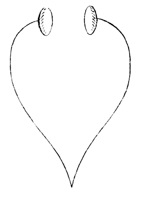
A more simple instrument may be constructed to be applied to one ear only, by inserting a straight rod perpendicularly into a similar plate to those described above.
The Microphone is calculated only for hearing sounds when it is in immediate contact with sonorous bodies; when they are diffused by their transmission through the air, this instrument will not afford the slightest assistance.
It is not my intention in this place to detail all the various experiments which may be made with this instrument, a few will suffice to enable the experimenter to vary them at his pleasure.
1. If a bell be rung in a vessel of water, and the point of the microphone be placed in the water at different distances from the bell, the differences of intensity will be very sensible. 2. If the point of the microphone be applied to the sides of a vessel containing a boiling liquid, or if it be placed in the liquid itself, the various sounds which are rendered may be heard very distinctly. 3. The instrument affords a means of ascertaining, with considerable accuracy, the points of a sonorous body at which the intensity of vibration is the greatest or least; thus, placing its point on different parts of the sounding board of a violin or guitar, whilst one of its strings is in vibration, the points of greatest and least vibration are easily distinguished. 4. If the stem of a sounding tuning-fork be brought in contact with any part of the microphone, and at the same time a musical sound be produced by the voice, the most uninitiated ear [p071] will be able to perceive the consonance or dissonance of the two sounds; the roughness of discords, and the beatings of imperfect consonances, are thereby rendered so extremely disagreeable, and form so evident a contrast to the agreeable harmony and smoothness of two perfectly consonant sounds, that it is impossible that they can be confounded.
§ 3.
Apply the broad sides of two sounding tuning-forks, both being unisons, to the same ear; on removing one fork to the opposite ear, allowing the other to remain, the sensation will be considerably augmented.
It is well known, that when two consonant sounds are heard together, a third sound results from the coincidences of their vibrations; and that this third sound, which is called the grave harmonic, is always equal to unity, when the two primitive sounds are represented by the lowest integral numbers. This being premised, select two tuning-forks, the sounds of which differ by any consonant interval excepting the octave; place the broad sides of their branches, while in vibration, close to one ear, in such a manner that they shall nearly touch at the acoustic axis, the resulting grave harmonic will then be strongly audible, combined with the two other sounds; place afterwards one fork to each ear, and the consonance will be heard much richer in volume, but no audible indications whatever of the third sound will be perceived.
§ 4.
Very acute sounds, such as the chirping of the gryllus campestris, &c., are rendered inaudible by exhausting the air from the Eustachian tube, and thereby producing a tension of the membrane of the tympanum; the different thicknesses or tensions of this membrane may therefore occasion that diversity of the limits of audibility, with regard to the acute sounds which Dr. Wollaston has pointed out as existing in different individuals; if so, it would be desirable to ascertain this limit in individuals in whom the tympanum is perforated, or destroyed.
§ 5.
When the auricula is brought forward, all acute sounds are rendered much more intense, but no sensible difference is [p072] perceived with regard to the grave sounds. The higher tones of glass staccados, or of an octave flute, the ticking of a watch, all kinds of sibilant sounds, &c. are thus greatly augmented: the experiment is easily tried, by whistling very shrill notes. A still greater augmentation of the acute sounds is obtained, by placing the hands formed into a concave behind the ears, and by bending downwards the upper part of the auricula, so as to obtain a more complete cavity.
§ 6.
I will conclude with the following observation: I had, in consequence of a cold, a very slight pain in my left ear; on sounding the regular notes of the piano-forte, C3 and C4 were much louder than the others, and the loudness was much increased, by placing the hand in the manner above described to the left ear. When it was pressed close, or when the Eustachian tube was closed, the intensities of all the notes were equalized. I attribute this affection to the diminished tension of the membrana tympani, which was again increased by the operation described.
On the Petromyzon Marinus. ◊
ON entering the harbour of Dublin a few weeks ago, we were becalmed off the Hill of Howth, and to pass the tedious time until a breeze sprung up, we found some lines on board, and began to fish from the quarter-deck. We caught a number of grey gurnet; but our attention was particularly attracted by a pull of uncommon force on one of the lines. Having rendered assistance to the person who held it, we were all astonished to see rise out of the water a large fish, with apparently a double body, which, after floundering on the surface of the water, we pulled on deck. On examining this phenomenon for a short time, we were again surprized to see it separate into two parts; and then found that there were two large fish taken up on the same hook, the head of one having been buried under the throat of the other, to which it had firmly attached itself. When separated by force, it wiggled about on the deck with extraordinary strength and agility, and again darted on its prey, to which [p073] it adhered so firmly, that it required very considerable exertion to detach it; for it suffered itself to be raised up by the tail, and shaken, still holding the other fish suspended from its jaws. When finally separated, it showed great ferocity, darting at every thing near it, and at last seizing the deck, which it held very fast, writhing with its tail and body as if in the act of tearing it to pieces. When detached, its teeth left a deep circular impression on the wood, the fibres of which were drawn into the cavity of its jaws, so as to be raised up in the form of a cone. I now directed, that it should be put into a bucket of sea water, in the hope of preserving it alive until we arrived in Dublin, but it died in a shorter time than could be expected, from the energy and activity it had displayed, long after the other fish was dead. We had handled it very roughly, and so perhaps had mortally hurt an animal otherwise very tenacious of life.
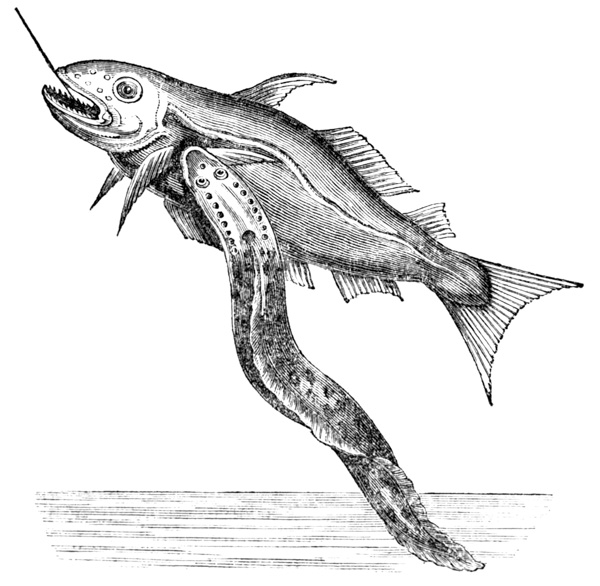
On examining the fishes, I found that which had taken the hook, was the gadus Polachius, or whiting Pollack. It was about two feet long, and it is probable its active enemy had fastened [p074] on it after it had been hooked; if before, it would indicate an extraordinary insensibility to pain in an animal that could attend to the calls of appetite, whilst another was preying on its vitals. The fish which had fastened on the pollack, was the petromyzon marinus, or sea lamprey. It was nearly three feet long, and resembled a large eel in shape. Its general colour was a dull brownish olive variegated with bluish blotches; the back darker, and the belly paler, inclining to yellow. The eyes were small, and the mouth large and oval; but when distended, circular. The inside of the jaws was deeply concave, and studded with circular rows of sharp triangular teeth, that issued from corresponding orange-coloured papular protuberances, which formed the gums; the tongue was short and crescent-shaped, furnished with a row of very small teeth round the edge. On the top of the head was a small orifice, or spout-hole, from whence it discharged the superfluous water taken at the mouth. But the circumstance that more particularly distinguished it, was that which gave rise to the vulgar error that it had sixteen eyes. On either side of the neck, commencing just below the real eyes, was a row of seven equidistant spiracles exactly resembling eyes; they are, however, holes lined with a red membrane, and all opening into the mouth, an apparatus to supply the place of gills, whose functions are to extract oxygen from the water, and so perform the office of lungs in aquatic animals. It had two dorsal fins, one on the lower part of the back, narrow, with a roundish outline; the other commencing where the first terminated. The spine was cartilaginous, without processes. The pericardium, containing a small heart, was a remarkably strong membrane, and the liver was as green as grass.
This fish is not uncommon in the North Seas, though it most abounds in the Mediterranean, where, from earliest times, it was esteemed a luxurious dish. Fish-ponds were purposely constructed to preserve it. On our coast, Pennant observes, that it is found most frequently at the mouth of the Severn, which river it sometimes ascends, where it is occasionally taken, firmly attached to a stone by its mouth, while its tail and body are waving freely to the current. Its adhesion at such times is so strong, that it may be lifted with a stone of twelve pounds weight appended to its mouth. This faculty is owing to its [p075] power of suction; while the circumstance of its circular jaws coming in close contact with the surface of the body excludes the external air within the cavity of the mouth, and so adheres like the hand placed on the cup of an air-pump. It is from this remarkable property, that its scientific name has been imposed25. Its vulgar name, lamprey, from lampetra, has a similar derivation. By the Romans it was named muræna. As this fish was well known and highly prized by the ancients, there is none that has been so frequently described and alluded to. Aristotle, Pliny, Tacitus, Columella, Ælian, Seneca, and Oppian, have mentioned its properties and habits, which correspond exactly with those I have described above. Pliny says, in the northern parts of France, and consequently contiguous to the British Isles, the lampreys have seven spots in the jaws, resembling the constellation of the plough, evidently the same as the eyes, which vulgar opinion assigns to the fish26. Their extreme voracity was such, that criminals were thrown among them to be devoured. Seneca relates, that Vedius Pollio, a Roman knight, ordered his servant, who had broken a crystal vase, to be thrown into a large pond of lampreys27; and Columella writes, that they were sometimes seized with a rabid fury, that resembled canine madness; in the access of which, they seized upon other fish, so that it was impossible to keep them in the same pond28; and to account for this extraordinary ferocity, Oppian and others assert, that the lamprey is impregnated by a serpent; the one issuing from the sea, and the other rushing down to the rocks, inflamed with madness, to consummate the impregnation; and adds, that the extraordinary intercourse was effected by the lamprey seizing the serpent’s head in its [p076] mouth29. This singular copulation was the reason why the Romans, who were immoderately fond of lampreys, did not wish to eat them, when impregnated by the supposed serpent. Horace, therefore, makes Nasidienus, among the blunders of his supper, serve it in that state30.
Lampreys were a favourite dish with our own early monarchs. Henry II. died by eating them to excess. The celebrated Pope also owed his death to a surfeit of them. Doctor Johnson remarks in his life of the poet, that he was in the habit of cooking them himself in a silver saucepan. The Corporation of Oxford still make up a periodical pye of this fish for the king, in compliance with ancient usage. But lampreys have lost their rank at corporation feasts, in consequence of the more delicious and wholesome turtle being introduced into modern cookery.
I have never noticed lampreys in the Dublin fish-market; and though they are frequently used in the South of Ireland, I do not know if they have ever been made an article of food in Dublin, or the north, where they are rarely met with.
C.
Observations upon the Motion of the Leaves of the Mimosa Pudica. ◊ [To the Editor of the Quarterly Journal of Science.]
Dear Sir,
TOWARDS the latter part of this summer, Mr. Gilbert Burnett and myself made several experiments with a view to ascertain the nature of the movements exhibited by the sensitive plant. We afterwards found that the greater part of the facts which we had observed, had been previously described by Mr. Lindsay [p077] and Dr. Dutrochet. Mr. Lindsay’s observations are to be met with in a MS. preserved in the library of the Royal Society, which is dated July 1790: this essay is alluded to by Dr. Smith in his “Introduction to Botany.” Dr. Dutrochet’s experiments were published in his “Recherches anatomiques et physiologiques sur la Structure intime des Animaux et des Végétaux,” which appeared in 1824. With the latter author the reputation of originality is likely to rest: not undeservedly, indeed, as there is no reason to suppose that his experiments were suggested by a knowledge of those performed by Lindsay. It is, however, an act of literary justice to secure to Mr. Lindsay the credit of undoubted priority in describing the phenomena which he noticed in common with Dutrochet. I have drawn up the following remarks partly for this purpose—partly to have an opportunity of mentioning some circumstances which escaped the observation of both experimentalists.
The leaves of the Mimosa Pudica consist either of one or two or three pairs of leaflets, and occasionally terminate by an odd one. Each leaflet bears from twenty to sixty subleaflets, which are disposed in pairs. The petiole or stalk of each leaf, at the extremity which is attached to the branch or stem of the peant, swells into an intumescence varying from three to five in length. A similar intumescence, of proportionate dimensions, is seen upon each subpetiole, where it is articulated with the petiole, and upon the base of the stalk of each subleaflet: the intumescence is the part in which motion takes place.
During the day-time the petioles are observed to have a direction upwards, or rather to form an acute angle with the upper part of the stem or branch, to which they are attached: the subpetioles are divergent: the subleaflets are spread out, so as to lie nearly in one plane. (Fig. 1.)
During the night the petioles are found to be depressed; the subpetioles to be drawn together, the subleaflets folded, the upper or solar surfaces of each pair being brought into contact. (Fig. 2.)
The leaves rise, the leaflets diverge, and open by throwing down their subleaflets, at daybreak: the opposite changes occur about sunset. The experiments that are to be described, are supposed to be performed in the day-time. [p078]
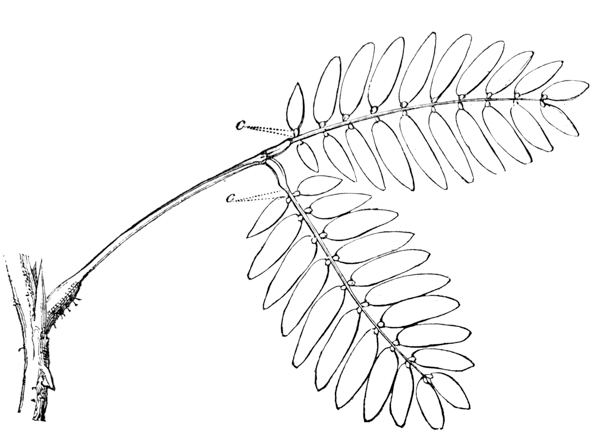
Fig. 1.
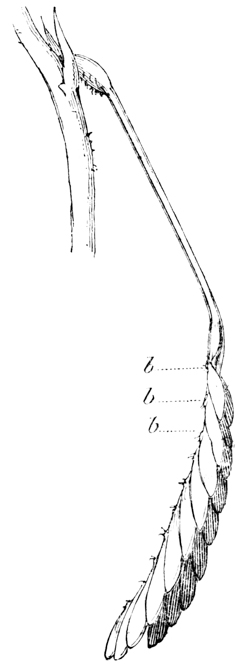
Fig. 2.
If a terminal subleaflet be pinched with forceps, or cut with scissors, it rises, together with its fellow; then the next pair rise; then the next; and so on in succession, till all the pairs of subleaflets upon the same subpetiole are folded. In a little time afterwards, the petiole is bent downwards at its intumescence; and in a few seconds more the remaining leaflets upon the same petiole fold their subleaflets in pairs, from the base towards the point of the leaflet.
If a subleaflet be burnt, instead of being cut or pinched, the phenomena above described occur more rapidly: and after they have taken place, the adjoining leaves upon the same branch are bent down in succession, their leaflets brought together, and their subleaflets folded. If the plant be very vigorous and lively, an impression [p079] made upon one leaf affects the rest in succession. It is well known that the stem, branches, flowers, and roots of the sensitive plant have no motion. But M. Desfontaines observed that, on touching the roots with sulphuric acid, the leaves become folded; and M. Dutrochet obtained a similar result on burning either the flower or the stem.
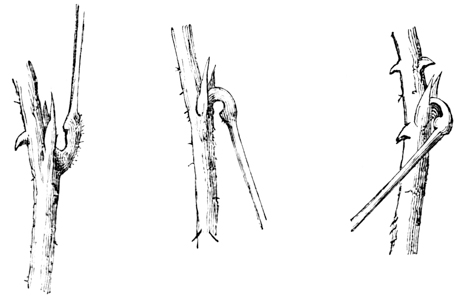
Fig. 3.
Fig. 4.
Fig. 5.
If the plant be shaken, all the leaves are simultaneously thrown down, and their leaflets folded. Mr. Lindsay attempted to elucidate the action of the intumescence in raising and depressing the petiole, in the following manner. He cut out a portion from the upper or solar surface of the intumescence; after which he found that the petiole, upon recovering, rose higher than before, (Fig. 3.) From another leaf he removed the inferior portion of the intumescence: he found, upon this injury, that the leaf declined more than before, and did not again rise, (Fig. 4.) He noticed that a thin slice, pared from either surface of the intumescence, has a like effect, but in a less degree than a deep excision: and he found that when similar experiments are made upon the intumescence of the subpetiole, there is no essential difference in the result.
Thus Mr. Lindsay discovered, that the force which raises the petiole exists in the lower part of the intumescence, and that which depresses it, in the upper. He seems to have considered that the temporary excess of force in either part is produced by an impulsion of the sap from the vessels of the yielding portion into those of the opposite portion. [p080]
Dr. Dutrochet viewed these phenomena in some respects more justly. He remarked, in addition to what Lindsay had observed, that if, instead of the upper and under surface, the lateral part of the intumescence be removed, the petiole becomes not raised or deflected, but inclined towards the side on which it is injured (Fig. 5); and that if longitudinal slices of the upper, or under, or lateral portions of the intumescence are immersed in water, these separate slices immediately become incurvated, that edge being concave which looks towards the axis of the intumescence. From these facts Dutrochet inferred that the texture of the intumescence possesses some modification of irritability; that, when excited, each length of the intumescence (to use a very imperfect expression) forcibly assumes an incurvated figure, like a curved spring returning from a state of temporary extension; that the petiole is raised, when the action of the lower part of the intumescence predominates; is depressed, when the upper portion acts with increased energy.
Mr. Burnett and myself had arrived at very similar conclusions respecting the agency of the intumescence, before we became acquainted with the inquiries of Lindsay and Dutrochet.
In Dutrochet’s able researches, a more exact analysis, however, was obtained of the functions of this part. He discovered that the cortex of the intumescence is the seat of its irritability: for upon wholly removing the bark, so as to expose the ligneous substance, the petiole was found to have been rendered motionless. Nevertheless, the intumescence, thus mutilated, remains capable of transmitting an impression made upon its leaflets to the leaves adjoining, Dutrochet further ascertained, that the ligneous substance alone is fitted to convey the peculiar stimulus, which spreads, from a point of the plant that has been irritated, to the adjoining leaves.
The experiments already mentioned appear to explain the mode in which the elevation and depression of the petiole, and the divergence and approximation of the subpetioles are produced. It is probable that the contrivance for folding and expanding the subleaflets is of a similar nature. Mr. Burnett and myself conjectured that each subleaflet is raised by the under part of the intumescence that exists at its base, and [p081] depressed by some action of the upper portion of the same intumescence. In trying the soundness of this hypothesis, we met with the following evidence in its favour:—
Mr. Lindsay had observed, that at the moment when the petiole is depressed, the under part of its intumescence assumes a deeper colour. But the under part of the intumescence of the petiole is the portion which is shortened during its depression, and which is overcome on this occasion by the superior force of the upper portion.
Now it is to be remarked that in the subleaflets the upper part of the little intumescence belonging to each corresponds, in one respect alluded to, with the lower portion of the intumescence of the petiole; it is the portion shortened when the leaf is folded. And we found, upon examination, that it likewise distinctly changes colour at the moment when the subleaflet rises, while the under surface of the intumescence of the subleaflet does not change its hue.
In pursuing this inquiry, another point of correspondence between the mechanism which depresses the petiole, and that which raises the subleaflets, was stated, which has yet additional interest.
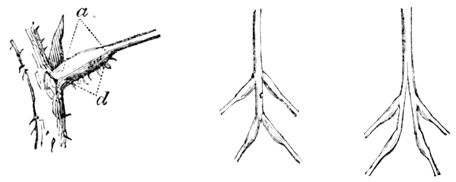
Fig. 6.
Fig. 7.
Fig. 8.
When the plant is not in its most lively state, the under surface of the intumescence of the subleaflet (b, Fig. 2,) and the upper surface of the intumescence of the petiole (a, Fig. 6,) may be pricked with a needle, without producing action. But if the opposite surfaces, those namely, which change colour and are shortened when the petiole is depressed and the subleaflets folded, are touched with the point of the needle these actions are instantaneously produced. Here the [p082] subleaflet is most delicately sensible; a slight touch with the point of a needle upon the upper surface of the intumescence of the subleaflet (c, Fig. 1,) causes the single subleaflet so stimulated to rise; and in this manner all the subleaflets upon one side of a leaflet may be raised, their fellows remaining expanded: if the touch be something sharper, the fellow subleaflet rises at the same time; if ruder still, the next pair of leaflets fold directly afterwards, and the irritation then proceeds entirely through the leaflet. But the most satisfactory and curious results are obtained on stimulating the extension surface of the intumescence of the petiole. The needle may be applied to every point upon the upper or solar half of the intumescence of the petiole (a, Fig. 6,) without producing any visible effect; but if the irritation be applied upon the under half, (d, Fig. 6,) either quite below or laterally, the petiole is immediately depressed. The transition is abrupt from the surface against which the needle may be made to prick, without exciting action, to one which, when the needle reaches it, causes the petiole to be instantaneously thrown down.
It appears, therefore, that each intumescence has a surface especially adapted to receive mechanical impressions; which surface is placed on the side of the intumescence opposite to that, by which the consequent motion is produced. A curious but vague analogy may be traced between these surfaces of the sensitive plant and the organs of sense in animals.
We painted with a thick layer of lamp-black in oil the intumescence of different petioles in different ways; the upper surface of one, the under surface of another, the side of a third. The experiment was followed by no sensible effect. After a few minutes the petioles, which had been thrown down by the operation, rose again in each case, and fell again as readily as before upon being stimulated afresh.
We tried what result would ensue upon slitting the intumescence of the petiole horizontally. The petiole, after this injury, did not recover its usual direction; the intumescence appeared to have wholly lost its properties; the leaf seemed to depress the petiole by its weight alone, yet the leaflets expanded, and exhibited their usual irritability, upon the depending stalk. The same effect, however, was observed, when the [p083] intumescence was divided by a longitudinal incision, made vertically instead of horizontally.
I have already mentioned that Dutrochet discovered that the ligneous fibre is the channel, along which an impression is conveyed from one part to another. Mr. Burnett and myself had made one or two experiments upon the course which the irritation follows when spreading from leaflet to leaflet, where several are placed upon the same petiole.
If the upper third of a petiole bearing four leaflets be divided longitudinally, the irritability of the leaflets remains for many days unimpaired; upon cutting with scissors one subleaflet after the plant has recovered itself, the irritation is observed to descend the wounded leaflet, and then to pass to that adjoining upon the same side of the petiole: afterwards the petiole falls, but there the effect stops; it does not extend to the two other leaflets; the direct route is cut through, and the irritation seems to find no circuitous way, as might have been expected, perhaps through the intumescence of the petiole back again to the leaflets, on its summit. If on a petiole, bearing four leaflets, a lateral incision be made, cutting the petiole half through it at a point between the two leaflets which are situated on one side, upon irritating either of the leaflets, between which the incision has been made, it folds its subleaflets; then the two opposite leaflets fold their subleaflets; and last of all, the leaflet next adjoining that first irritated, but isolated from it by the incision, becomes folded.
In the few remarks which I have thus put together, I have quoted Lindsay and Dutrochet only as far as their researches anticipated my own: I leave unnoticed many experiments, in several of which these authors are again found to have accidentally coincided. The experiments to which I allude do not, however, serve to illustrate the nature of the motion exhibited by the sensitive plant, to the examination of which subject alone my attention was, in the present instance, directed, in the expectation that it might throw light upon the obscure and interesting subject of muscular action.
I remain, my dear Sir, Your’s truly,
HERBERT MAYO.
19, George Street, Hanover Square,
August 29, 1827.
[p084]
Experiments on the Nature of Labarraque’s disinfecting Soda Liquid. By M. Faraday, F.R.S., Corr. Mem. R. Acad. Sciences, Paris, &c. &c. ◊
1. THE following experimental investigations relate to the nature of that medicinal preparation which M. Labarraque has lately introduced to the world, and named Chloride of oxide of Sodium. They were occasioned by the accounts which were given of this and other substances of similar power, to the members of the Royal Institution, at two of their Friday evening meetings31; the value of the preparation, the uncertainty of its nature, and the inaccuracy of its name, all urging the inquiry.
2. In the first instance the inquiry was directed to the nature of the action exerted by chlorine gas upon a solution of carbonate of soda, questions having arisen in the minds of many, whether it was or was not identical with the action exerted by the same gas on a solution of the caustic alkali, and whether carbonic acid was evolved during the operation or not. Chlorine gas was therefore carefully prepared, and after being washed was sent into a solution of carbonate of soda, in the proportions directed by M. Labarraque; i. e. 2800 grains of crystallized carbonate of soda were dissolved in 1.28 pints of water; and being put into a Woulfe’s apparatus, two-thirds of the chlorine evolved from a mixture of 967 grains of salt with 750 grains of oxide of manganese, when acted upon by 967 grains of oil of vitriol, previously diluted with 750 grains of water, were passed into it; the remaining third being partly dissolved in the washing water, and partly retained in the open space of the retort and washing vessel. The operation was conducted slowly, that as little muriatic acid as possible might be carried over into the alkali. The common air ejected from the bottle containing the solution was collected and examined; but from the beginning to the end of the operation not a particle of carbonic acid was disengaged from the solution, although the chlorine was readily absorbed. Ultimately a liquid of a very pale [p085] yellow colour was obtained, being the same as M. Labarraque’s soda liquor, and with which the investigations were made that will hereafter be described.
3. An experiment was then instituted, in which the effect of excess of chlorine, upon a solution of carbonate of soda of the same strength as the former, was rendered evident. The solution was put into two Woulfe’s bottles, the chlorine well washed and passed through, until ultimately it bubbled through both portions without absorption of any appreciable quantity. As soon as the common air was expelled, the absorption of the chlorine was so complete in the first bottle, that no air or gas of any kind passed into the second, a proof that carbonic acid was not liberated in that stage of the experiment. Continuing the introduction of the chlorine, the solution in the first bottle gradually became yellow, the gas not being yet visible by its colour in the atmosphere above the solution, although chlorine could be detected there by litmus paper. Up to this time no carbonic acid gas had been evolved; but the first alkaline solution soon acquired a brighter colour, and now carbonic acid gas began to separate from all parts of it, and passing over into the second bottle, carried a little chlorine with it. The soda solution in the first bottle still continued to absorb chlorine, whilst the evolution of carbonic acid increased, and the colour became heightened. After some time the evolution of carbonic acid diminished, smaller quantities of the chlorine were absorbed by the solution, and the rest passing into the atmosphere in the bottle, went from thence into the second vessel, and there caused the same series of changes and actions that had occurred in the first. The solution in the first bottle was now of a bright chlorine yellow colour, and the gas bubbled up through it as it would through saturated water.
4. When the chlorine had saturated the soda solution in the second bottle, and an excess of gas sufficient to fill several large jars had been passed through the whole apparatus, the latter was dismounted, the solutions put into bottles and distinguished as the saturated solutions of carbonated soda; they were of a bright greenish-yellow colour, and had an insupportable odour of chlorine.
5. The saturated solution (4) was then examined as to the [p086] change which had been occasioned by the action of the chlorine. It bleached powerfully, and apparently contained no carbonated alkali: but when a glass rod was dipped into it and dried in a warm current of air, the saline matter left, when applied to moistened turmeric paper, reddened it considerably at first, and then bleached it; and this piece of paper being dried and afterwards moistened upon the bleached part, gave indications of alkali to fresh turmeric paper.
6. A portion of the saturated solution (4) being warmed, instantly evolved chlorine gas, then assumed a dingy appearance, and ultimately became nearly colourless; after which it had an astringent and saline taste. Being evaporated to dryness at a very moderate temperature, it left a saline mass, consisting of much common salt, a considerable quantity of chlorate of soda, and a trace of carbonate of soda. This mixture had no bleaching powers. The dingy appearance, assumed in the first instance, was found to be occasioned by a little manganese which had passed over into the solutions, notwithstanding the care taken in evolving and washing the gas.
7. From these experiments it was evident that when chlorine was passed in excess into a solution of carbonate of soda (3), the carbonic acid was expelled, and the soda acted upon as if it were caustic, a mixture of chloride of sodium and chlorate of soda being produced; with the exception of the small portion of carbonate of soda which, it appears, may remain for some time in the solution in contact with the excess of chlorine at common temperatures, without undergoing this change. The quantities of chloride of sodium and chlorate of soda were not ascertained, no doubt being entertained that they were in the well-known proportions which occur when caustic soda is used.
8. The Labarraque’s soda liquor which had been prepared as described (2), was now examined relative to the part the chlorine played in it, or the change the alkali had undergone, and was soon found to be very different to that which has been described, as indeed the experiments I had seen made by Mr. Phillips32 led me to expect. The solution had but little odour of chlorine, its taste was at first sharp, saline, scarcely at [p087] all alkaline, but with a persisting astringent biting effect upon the tongue. When applied to turmeric paper, it first reddened and then bleached it.
9. A portion of the solution (2) being boiled, gave out no chlorine; it seemed but little changed by the operation, having the same peculiar taste, and nearly the same bleaching power as before. This is a sufficient proof that the chlorine, though in a state ready to bleach or disinfect, must not be considered as in the ordinary state of solution, either in water or a saline fluid; for ebullition will freely carry off the chlorine under the latter circumstances.
10. A portion evaporated on the sandbath rather hastily, gave a dry saline mass, quite unlike that left by the saturated solution already described (6); and which, when dissolved, had the same astringent taste as before, and bleached solution of indigo very powerfully: when compared with an equal portion of the unevaporated solution, which had been placed in the mean time in the dark, its bleaching power upon diluted sulphate of indigo was 30, that of the former being 76. Another portion, evaporated in a still more careful manner, gave a mass of damp crystals, which, when dissolved, had the taste, smell, and bleaching power of the original solution, with almost equal strength.
11. These experiments shewed sufficiently that the whole of the chlorine had not acted upon the carbonate of soda to produce chloride of sodium, and chlorate of soda; that much was in a peculiar state of solution or union which enabled it to withstand ebullition, and yet to act freely as a bleaching or disinfecting agent; and that probably little or none had combined with the sodium, or been converted into chloric acid. To put these ideas to the test, two equal portions of the Labarraque solution were taken; one was put into a large tube, closed at one extremity, diluted sulphuric acid was added till in excess, and then air blown through the mixture by a long small open tube, proceeding from the mouth, for the purpose of carrying off the chlorine; the contents of the tube were then heated nearly to the boiling point, air being continually passed through. In this way all the chlorine which had combined with the carbonated alkali without decomposing it, was set free by the sulphuric acid, and carried off by the current of air and vapour, whilst any which had acted chemically upon the alkali would, [p088] after the action of the sulphuric acid, be contained in solution as muriatic and chloric acids, and from the diluted state of the whole, would not be removed by the after-process, but remain to be rendered evident by tests. The other portion being diluted, had sulphuric acid added also in excess, but no attempt was made to remove the chlorine. Equal quantities of these two portions in the same state of dilution were then examined by nitrate of silver for the quantities of chlorine sensible in them, and it was found that the latter portion, or that which retained the whole of the chlorine thrown into it, contained above sixty times as much as the former.
12. Now although it may be supposed that in the former portion that part of the chlorine, which, in acting energetically, had produced chloric acid, could not be detected by the nitrate of silver, yet more than a sixth of the small portion which remains cannot be thus hidden; and even that quantity is diminished by the sulphuric acid present in excess, which tends to make the chlorine in the chlorate sensible to nitrate of silver: so that the experiment shews that nearly 59 parts out of 60 of the chlorine in M. Labarraque’s liquid are in a state of weak combination with the carbonated alkali, and may be separated by acids in its original condition; that this quantity is probably wholly available in the liquid when used as a bleaching or disinfecting agent; that little, if any, of the chlorine forms chloride of sodium and chlorate of soda with the alkali of the solution; and that the portion of chlorine used in preparing the substance which is brought into an inactive state, is almost insensible in quantity.
13. The peculiar nature of this compound or solution, with the results Mr. Phillips had shewn me (8), obtained by evaporation of a similar preparation to dryness, induced me to try the effects of slow evaporation, crystallization, heat, and air upon it. In the first place five equal portions of the solution prepared by myself were measured out: two were put into stoppered bottles, two were put into basins and covered over with bibulous paper, and one was put into a basin which was left open; all were set aside in an obscure place, and remained from July 16th to August 28th. Being then examined, the portions in the basins were found crystallized and dry; the crystals were large and flat, striated and imperfect, resembling those formed [p089] in a similar way from carbonate of soda. They were not small and acicular, were nearly alike in the three basins, and had effloresced only on a few minute points. A part of one portion, when dissolved, gave a solution, having an alkaline taste, without any of the pungency of Labarraque’s liquid; and which, when tested by turmeric paper, reddened, but did not bleach it.
14. One of these portions that had effloresced least was selected, and being dissolved, was compared in bleaching power upon diluted sulphate of indigo, with one of the portions of solution that had been preserved in bottles. The former had scarcely any visible effect, though sulphuric acid was added to assist the action; a single measure of the indigo liquor coloured the solution permanently blue, whereas seventy-seven such measures were bleached by the portion from the bottle. Hence the process of slow crystallization had either almost entirely expelled the chlorine, or else had caused it to react upon the alkali, and by entering into strong chemical combination as chloride and chlorate, had rendered it inert as a bleaching or disinfecting agent.
15. From the appearance of the crystals there was no reason to expect the latter effect; but to put the question to the proof, one of the evaporated portions, and one of the fluid portions contained in the bottles, were acted upon by sulphuric acid, heat, and a current of air, in the manner already described (11), to separate the chlorine that had not combined as chloride or chlorate. They were then compared with an equal portion of the solution, which retained all its chlorine, nitrate of silver being used as before: the quantity of chloride indicated for the latter portion was 60 parts; whilst that of the fluid portion deprived of as much free chlorine as could be, by sulphuric acid and blowing, was 6 parts; and for the evaporated and crystallized portion, similarly cleared of free chlorine, only 1.5 parts.
16. This result, as compared with the former experiment of a similar kind (11), shewed, that though reaction of the chlorine on the carbonate had taken place in the evaporated portion, it was only to a very slight extent, since the chlorine was almost as much separated from it by the process altogether, as it had been from the recent preparation by sulphuric acid, blowing, and heat. The experiment shewed also that there [p090] was a gradual reaction of the chlorine and alkali in the fluid preparation, proceeding to a greater extent than in the evaporated portion; for chlorine, equal to five parts, was found by the nitrate of silver to remain. Hence this preparation is one which deteriorates even in the small space of forty-three days. Whether the effect will proceed to any great extent, prolonged experiments only can shew.
17. From an experiment made upon larger quantities of the Labarraque liquor, it would appear that the force of crystallization alone is sufficient to exclude the chlorine. A quantity was put into an evaporating basin, and left covered over with paper from July 16th to August 28th. Being then examined, a few large crystals were found covered over with a dense solution; the whole had the innocuous odour of Labarraque’s fluid, and the fluid the usual acrid, biting taste. The crystals being separated, one of the largest and most perfect was chosen, and being well wiped on the exterior, and pressed between folds of bibulous paper, was rubbed down in water, so as to make a saturated solution. This had no astringent taste like that of Labarraque’s fluid, or the mother-liquor, but one purely alkaline; and when applied to turmeric paper, reddened, but did not bleach it. Equal portions of this saturated solution and of the mother-liquor were then compared in bleaching power, acid being added to the former to assist the effect: it was found, notwithstanding that portions of mother-liquor must have adhered to the crystal, that its solution had not 121 part the power of the mother-liquor. This, in conjunction with the other experiments, is a striking instance of the manner in which the carbonate of soda acts, as a simple substance, with the chlorine in the solution. The crystal itself had never been in contact with the air: but whether it should be considered as the excess of carbonate of soda only which crystallized; or whether it is essential to the formation of these crystals that chlorine should simultaneously be given off into the air; or what would take place, if the water were abstracted without the evolution of chlorine, I have not determined.
18. Notwithstanding the perfect manner in which the chlorine may be thus separated by crystallization and slow evaporation to dryness, yet it is certain that by quick evaporation a [p091] substance apparently quite dry may be obtained, which yet possesses strong bleaching power. In one experiment, where, of two equal portions, one had been evaporated in the course of twenty-four hours to dryness upon the warm part of a sandbath, when compared with the former, it had not lost more than one-third of its bleaching power.