Front matter
Reading edition
THE
QUARTERLY JOURNAL
OF
SCIENCE,
LITERATURE, AND ART.

JULY TO DECEMBER, 1827.
LONDON:
HENRY COLBURN, NEW BURLINGTON-STREET.
MDCCCXXVII.
CONTENTS. ◊ July–Oct. 1827.
On the Beauties contained in the Ovals and in the elliptic Curves, both simple and combined, generated from the same Figure or Disk. By R. R. REINAGLE, Esq., R.A. 1
On the Art of forming Diamonds into Single Lenses for Microscopes. By Mr. A. PRITCHARD. 15
Analysis of a newly-discovered Spring, at Stanley, near Wakefield. By Mr. WILLIAM WEST. 21
Observations on the State of Naval Construction in this Country. 25
On Malaria. No. II. By Dr. MAC CULLOCH, M.D., F.R.S., &c. 39
Dr. TURNER’s Elements of Chemistry, reviewed 60
Experiments on Audition. Communicated by Mr. C. WHEATSTONE. 67
On the Petromyzon Marinus 72
Observations upon the Motion of the Leaves of the Sensitive Plant 76
Experiments on the Nature of LABARRAQUES’ Disinfecting Soda Liquid. By M. FARADAY, F.R.S., Cor. Mem. Roy. Acad. Sci. Paris, &c. 84
Hieroglyphical Fragments, with some Remarks on English Grammar. In a Letter to Baron William Von HUMBOLDT. By a Correspondent 92
Dr. MAC CULLOCH’s ‘Malaria; an Essay on the Production and Propagation of this Poison,’ reviewed 100
Account of a New Genus of Plants, called Reevesia. By J. LINDLEY, Esq., F.L.S., &c. &c. 109
ASTRONOMICA AND NAUTICAL COLLECTIONS. i. FRESNEL on the Undulatory Theory of Light 113 ii. Rule for the Correction of a Lunar Observation. By Mr. W. WISEMAN, of Hull 135
‘De l’Influence des Agens Physiques sur la Vie. Par W. F. EDWARDS, D.M.’ &c., reviewed 137
Account of Professor CARLINI’s Pendulum Experiments on Mont Cenis 153
Analysis of ‘Transactions of the Horticultural Society. Vol. vii. Part I.’ 159
On the Recent Elucidations of Early Egyptian History 176
Proceedings of the Horticultural Society. 190
MISCELLANEOUS INTELLIGENCE. I. MECHANICAL SCIENCE. 1 On the Combined Action of a Current of Air, and the Pressure of the Atmosphere 193 2 Considerations relative to Capillary Action 194 3 Novel Use of the Plough 197 4 Discovery of Rocks under the Surface of the Sea 198 5 Paper to resist Humidity ib. 6 Professor Amici’s Microscopes ib. II. CHEMICAL SCIENCE. 1 On the Specific Heat of Gases 200 2 On the Incandescence & Light of Lime 201 3 Evolution of Heat during the Compression of Water ib. 4 On Electrical Excitation ib. 5 Magnetic Repulsion 202 6 Diminished Solubility of Substances by Heat ib. 7 Composition of Cyanic Acid 203 8 Iodous Acid 204 9 Manganesic Acid ib. 10 Heavy Muriatic Ether, and Chloric Ether ib. 11 Test for the Presence of Nitric Acid 205 12 Peculiar Formation of Nitre ib. 13 Experiments on Fluoric Acid and Fluates ib. 14 Crystallization of Phosphorus 206 15 Solution of Phosphorus in Oils ib. 16 On the Inflammation of Powder, when struck by Brass 207 17 Cementation of Iron by Cast Iron ib. 18 On the Preparation of Ferro-prussiate of Potash ib. 19 Sulphocyanide of Potassium in Saliva 208 20 Decomposition of Sulphate of Copper, by Tartaric Acid ib. 21 Separation of Arsenic from Nickel, or Cobalt 209 22 Chemical Researches into Certain Ancient Substances 209 23 Compounds of Gold 210 24 On the Bitter Substance produced by the Actions of Nitric Acid on Indigo, Silk, and Aloes ib. 25 On the Existence of Crystals of Oxalate of Lime in Plants 214 26 Fallacy of Infusion of Litmus as a Test ib. 27 Tests for the Natural Colouring Matter of Wine 215 28 Test of the Presence of Opium ib. 29 Denarcotized Laudanum ib. 30 Extraction of Morphia from Dry Poppy Heads 216 31 Preparation of Morphia ib. 32 Easy Method of Obtaining Meconic Acid 217 33 On a New Vegetable Acid ib. 34 Altheine, a New Vegetable Principle ib. 35 Rheine, a New Substance from Rhubarb 218 36 On Dragon’s Blood, and a New Substance which it contains ib. 37 Purification of Madder 219 38 On Indigo, and Indigogene 220 39 On the Mutual Action of Ethers, and other Substances 221 40 Faraday’s Chemical Manipulation ib. III. NATURAL HISTORY. 1 On the Supposed Influence of the Moon 222 2 Luminous Appearances in the Atmosphere ib. 3 On the Determination of the Mean Temperature of the Air 223 4 Indelible Writing ib. 5 Peculiar Crystals of Quartz ib. 6 Native Iron not Meteoric 224 7 Native Argentiferous Gold 225 8 Prothéeïte, a New Mineral 226 9 Volcanic Bisulphuret of Copper ib. 10 Fall of the Lake Souwando, in Russia 227 11 Vegetable Torpor in the Root of the Black Mulberry Tree 228 12 Method of increasing the Odour of Roses ib. 13 Pine Apples ib. 14 Mode of Condensing Vegetable Substances for Ship’s Provisions 229 15 Rewards for the Discovery of Quinia, and for Lithotrity ib. 16 Upon the Gaseous Exhalations of the Skin 230 17 Effects of Galvanism in Cases of Asphyxia by submersion ib. 18 Recovery from Drowning 231 19 Preservation of Cantharides ib. 20 Chloride of Lime in cases of Burns ib. 21 Cure of Nasal Polypi 232 22 Bite of the Viper ib. 23 Experiments on the Poison of the Viper ib. 24 Destruction of Moles ib. 25 On growing Salad Herbs at Sea 233 26 Chinese Method of Fattening Fish 234 Meteorological Diary for the Months of June, July, and August, 1827 236
TO OUR READERS AND CORRESPONDENTS.
The drawings, illustrating the construction of a Blow-pipe, are not sufficiently accurate to enable us to publish them. Our Correspondent will observe that we have noticed another part of his letter.
We regret that we are unable to offer our Correspondent, upon the subject of Gas Works, any precise information. There can be no doubt that an atmosphere tainted by coal gas is injurious to animal and vegetable life, but much will depend upon the extent of the contamination, and other causes, of which our limits prevent mention. To say nothing of danger from fire and from explosion, it has always been matter of surprise to us that gas-works are tolerated by the government in close and confined situations—that the Thames is suffered still to be polluted with their offal, and that they are sometimes placed close by the road side, (as at Brentford,) to the nuisance of every one who passes. These matters want looking into.
Q. will find an answer to his question, in the “Gazette of Health” for last July.
F. R. S. must remain unanswered till after St. Andrew’s Day.
Dr. Heinecken’s paper is disposed of as he desired.
Mr. BRANDE and Mr. FARADAY will commence their Lectures and Demonstrations in Theoretical and Practical Chemistry, in the Laboratory of the Royal Institution, on Tuesday, the 9th of October, at Nine in the Morning precisely. Further particulars, and a Prospectus, may be obtained at the Royal Institution, 21, Albemarle-street, or by application to the Lecturers.
In the Press—A COLLECTION OF CHEMICAL TABLES, for the use of Students, in Illustration of the Theory of Definite Proportionals, in which are shewn the Equivalent Numbers of the Elementary Substances, with the Weights and Volumes in which they combine, together with the Composition of their most important Compounds, and the Authorities for their Analysis. By WILLIAM THOMAS BRANDE.
THE
QUARTERLY JOURNAL
OF
SCIENCE, LITERATURE, AND ART.
JULY–OCT. 1827.
On the Beauties contained in the Oval, and in the Elliptic Curves, both simple and combined, generated from the same Figure or Disk. By R. R. Reinagle, Esq., R.A. ◊ Being the subject of a Discourse delivered at the Royal Institution of Great Britain.
AFTER an apposite discourse to introduce the subject, the first course taken, was to demonstrate the advantages of understanding the right use of geometrical terms in our descriptions of the varieties of shape, both in nature and art.
Every thing deserving the title of beautiful, and every grand object, assume an outline of definite character: these are to be found in the different classes of geometrical figures; the former in undulating lines of elliptic curves, and grandeur in angular dispositions of figure. All motion assumes a curved direction1. The primary and leading object of the discourse was to prove the fact of original beauty: and that a curved line was beautiful in an abstract point of view, free from all associations. For this purpose there were designed many diagrams on large black painted boards. [p002]
The explanation commenced with six or more parallel lines at equal distances, and equal length, in an horizontal position to the eye of the audience, Fig. 1; and another set of the same number of lines drawn perpendicular, Fig. 2: these were demonstrated to possess not the slightest character or principle of beauty in them, either as separate lines, or collectively, however many.
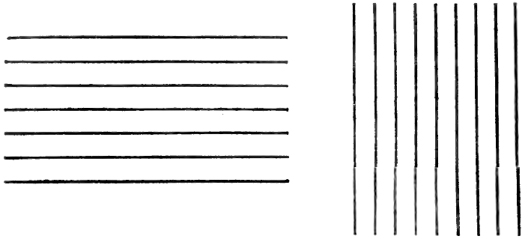
Fig. 1.
Fig. 2.
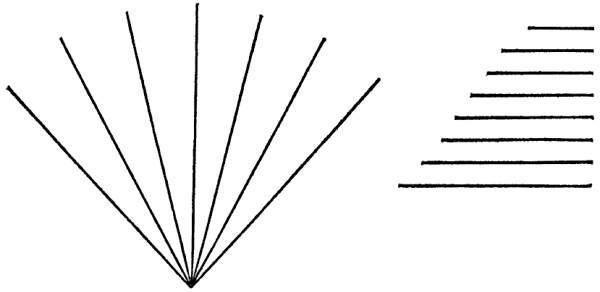
Fig. 3.
Fig. 4.
The next diagram consisted of six or more radiating lines from a centre, Fig. 3, and a corresponding number in an horizontal direction, but of unequal quantities; they diminished like a flight of steps, Fig. 4. It was then shown that the first means of combining the six or more lines, which had been first drawn, so as to please the eye, without creating any geometrical figure, was the radiating principle. Our eye not only can tolerate that union of lines, but receive the impression as pleasing in character; while all lines parallel to each other, being right [p003] lines, and viewed as a flight of steps, or pile of planks, opposite the observer, are disagreeable. Upon the former principle it is, that the rays of the sun, and rays of light generally, are so attractive and beautiful. It is from this circumstance that right lines drawn in an inclined position to the plane of the picture, derive an interest from the angles engendered through the imagination.
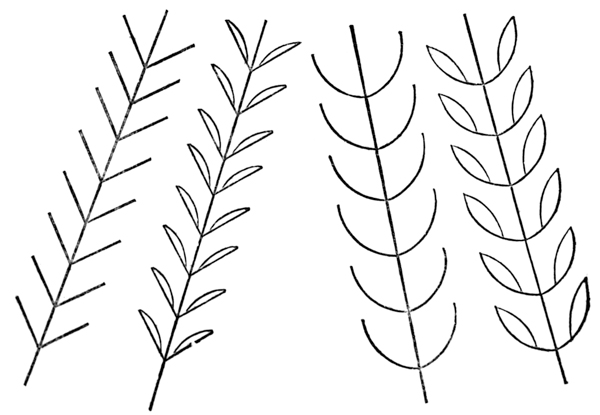
Fig. 5.
Fig. 6.
Fig. 7.
Fig. 8.
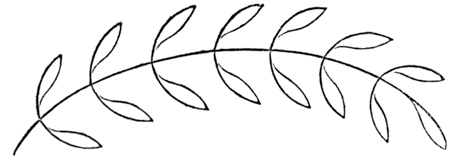
To follow up the principle by regular steps, and to open a clear view of the laws of beauty in lines, there were traced some inclined right lines (Fig. 5), with a regular set of right angles upon it, like the stems of leaves on each side. This exhibited no sort of beauty, nor any other advantage than mere combinations of formal angles. The next diagram (Fig. 6) was an inclined line as before, with similar angular projecting stems, to which were added elliptic curves on the upper side of each branch, that produced the form of a leaf. Fig. 7 was another inclined line, having oval curves upon it. Both these were shown to possess principles approaching to beauty, by progressive advances in combination and original structure. Fig. 8 was an inclined line with the oval curves upon it; to which a similar addition of elliptic curves were adjoined to the stems, [p004] as in Fig. 6. This addition made a new advance towards beauty. Fig. 9 commenced a more perfect principle of beauty, having an elliptic stem with oval branches rising from it, as in the others. If to this, the principle of gradation had been given, the eye would prefer it; I mean, by a scale of increase from the top to the bottom of the projecting stems: and if there had been superadded the external contour of a lengthened egg, like the form of a sage leaf, we should, step by step, advance into the region of beautiful character of exterior shape. Fig. 10 is a retrograde, showing how uncongenial angular forms are to curved lines, when producing ornament; at least how little our eye can bear the angular projections from the elliptic or oval turned stem. Fig. 11 was a curve of exactly the same disk, with the same oval stems, to which a small serpentine addition was made, expressing a leaf. Of all the last seven diagrams, this abounded with the greatest portion of beautiful lines, and is indisputably the most agreeable and beautiful. Combinations are like numericals; many of these forms, placed together with judgment and discretion, will attract us from the larger proportion of beauty that meets the eye at once, like a head of beautiful hair: one hair, however gracefully bent, cannot impress us like an entire lock of the hair; nor will this [p005] curl charm us as the whole will on the human head. We owe to construction and combination all our pleasurable feelings of beauty: no person is allured by a single feature of any species of objects: but a thousand, or a million, arouses our anxious notice. Thus, the last diagram of the elliptic stem and the foliage upon it, exhibited, by the continuity of curved lines, the greatest approach to beauty, of all the figures presented to the notice of the audience.
Fig. 9.
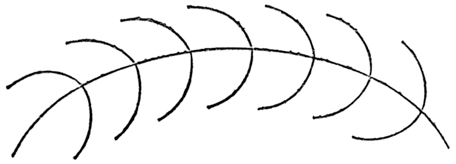
Fig. 10.
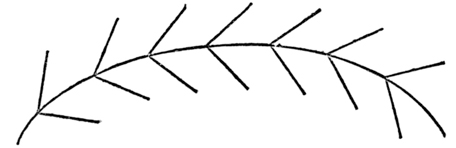
Fig. 11.
These preliminary designs opened the way for richer combinations; but the subject affording such an immense field of variety, I confined myself to the narrowest limits, and to one oval disk of seven inches transverse diameter, from which seven different designs were shown on paper. The first had a variety of serpentine lines placed at random, all produced by the disk of the oval just named, and the confluent lines of two such, placed side by side, or end to end, Fig. 12; which oval disk was put upon the lines to prove the construction. These lines, without expressing or forming any sort of figure, exhibit a set of elegant curves, of varied quantities of convex and concave, with which our eye will be more pleased than any set of right lines similarly distributed, as in Fig. 13, which follows. [p006]
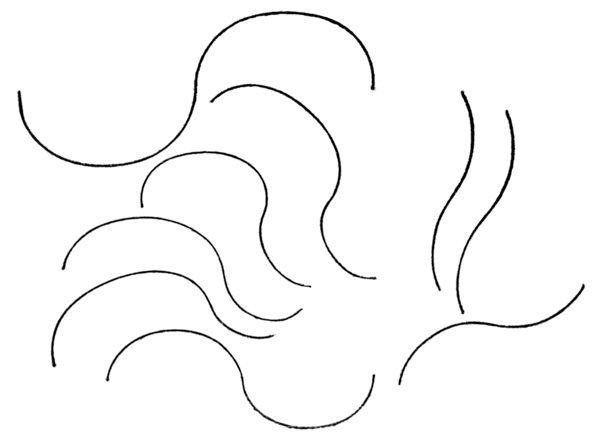
Fig. 12.
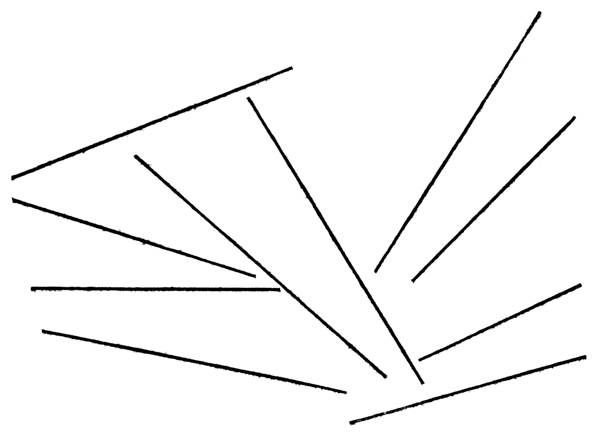
Fig. 13.
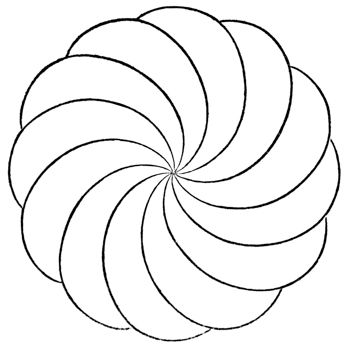
Fig. 14.
Two other diagrams were placed before the company, each a circle of 12 ovals, from the same disk, revolved upon an axis, resting upon one end of the transverse diameter, (the length-ways of the oval,) which figure in the skeleton was a duodecagon. Fig. 14 is one of the diagrams; the ovals folding regularly over each other. By suppressing the continuity of the oval disk, where the lines would traverse, a very pleasing figure [p007] is created. It may be easily converted into foliage, and can be amazingly varied in principle, by having fewer ovals, and making them revolve upon an arm or continuation of a line from the transverse diameter. Fig. 15 is the same diagram, with all the oval lines described, which forms a figure of elegant intricacy; each member, or curvilinear subdivision, assumes a most agreeable shape: the whole, at the first sight, does not carry the evidence of being generated from the same disk. These agreeable figures may be varied to an extraordinary extent: the two that were presented were mere examples of some of the numerous changes that any given oval disk may create.
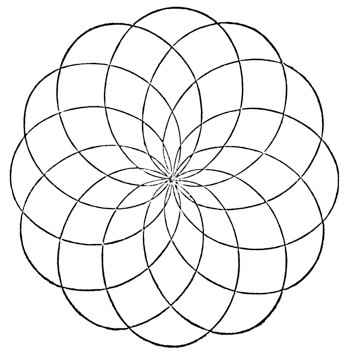
Fig. 15.
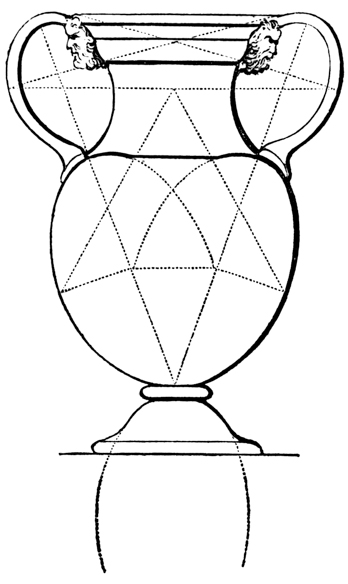
Fig. 16.
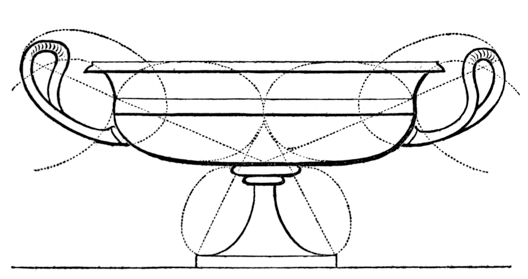
Fig. 17.
The objects next presented, were three vases of very dissimilar appearance, all produced from the same diagram of the oval; each in a separate drawing. The first was like a Greek vase with handles; its character established by employing certain proportions of quantities, in seven parts. The body has four parts, the foot or pedestal one; the neck two. The handles were regulated in the position and projection by lines drawn from the bottom of the vase, through the ovals which compose the outline of the two sides; and passing through the transverse diameter. These handles were made from an oval that was the length of half the line of the transverse diameter, Fig. 16. The skeleton of angles that [p008] govern the shape of this vase, is a very pretty figure of itself. The form does not proceed from any caprice of irregularity, but is consistent with rational organization, and symmetrical proportions. The figure of the plate sufficiently describes the mode of making the diagram without entering into the detail. Fig. 17 represents a tazza with handles: the same disk is apparent, by the dotted lines that made the first vase. The ovals [p009] are placed right and left of a central perpendicular line, dividing the cup in two parts; the transverse diameters meet in one line parallel to the base of the tazza; a dotted outline expresses the angular position of the handles: the concave lip of the tazza is made by the same oval disk, whose transverse diameter leads to the under line of the folding edge of the cup. The leg of the tazza is produced by the same small disk that served for the handles of the first vase. The body of the vase and the leg form two equal parts; the whole upper extent ought to be seven parts, so that it is seven and two2; the width of the base of the leg measures two parts, and the altitude three, of the seven parts. These proportions cannot produce any other than agreeable appearances, apply them as we may.
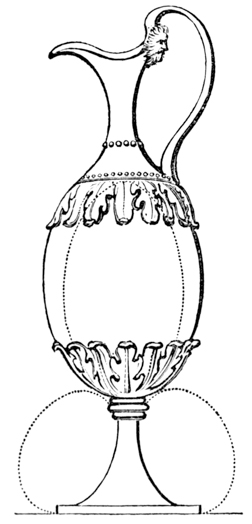
Fig. 18.
The third vase, exhibited an Hebe cup, with a handle, which presented a totally different appearance in form to the two previous ones. It was proportioned by similar principles: the larger disk made the body, inclined right and left upon the end of the oval. The neck and the leg were both made from the smaller oval disk; the dotted lines to the ovals of the leg sufficiently show the fact. The handle and concave lip of the cup were made by an application of the same disk. The altitude contained four parts. The body two parts, the leg one part, and the neck one other part; the handle rises one-eighth above: every portion of this figure is created by the two disks previously named. The foliage rises from below and descends from above, one-fourth of the whole height of the body [p010] to the commencement of the concavity of the neck, where the beading runs round.
I remarked, that by adhering to regular proportional quantities of 1 and 2, 3 and 5, 2 and 5, 7 and 5, 7 and 2, &c., and using elliptic disks or curves, very great beauties are derived.
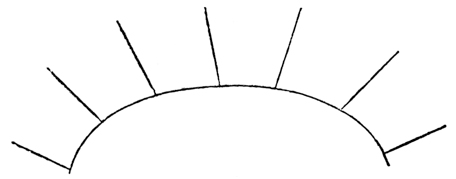
Fig. 19.
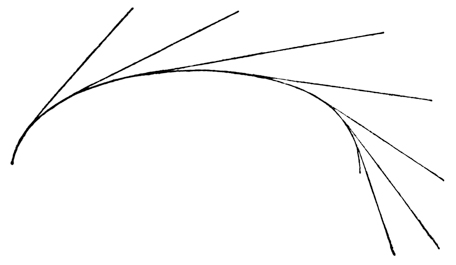
Fig. 20.
A skeleton of the tazza in angles was drawn on a black painted board, together with oval disks placed upon those lines, which clearly demonstrated the whole system of the construction. The explanation of these various diagrams necessarily involved a circumstantial description of each created figure, which were thoroughly analysed. Quantity and variety were particularly dwelt upon, as absolutely necessary to the production of perfect beauty; equalities being unfriendly to that symmetry which accords with nature. Some other diagrams were drawn, to show the inelegant appearance of radiating lines from the concave or convex half of an oval or an ellipse, Fig. 19: but by drawing another convex half of an oval, and placing those lines as tangents, greater beauty was formed by the alternate changes and varieties of inclination of each tangent, Fig. 20. This was capable of an immediate adaptation to elegant vegetation; [p011] a few convex and concave elliptic curves added to each tangent, produced an ear of barley, or an ear of rye, the elegant construction of which, is rarely noticed in our remarks on nature, Fig. 21.
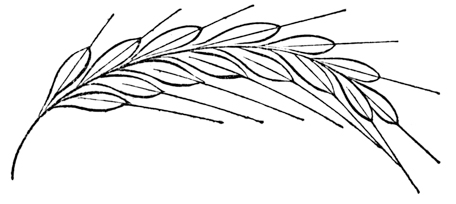
Fig. 21.
The discussion on these various designs being concluded, some important compositions of three great and renowned painters were produced, to corroborate what had been advanced in support of the native beauty of the oval and ellipse. Raphael’s grand composition of the dispute on the Sacrament is in three grand oval curves.
The Doctors of the Church on the ground plan are ranged in an oval convex line; and the heavenly Choirs engage two concave oval shapes of the same proportion, but of unequal quantities. This is also a proof of a composition of parts, bearing two to one.
The facility of expressing such a composition, by being geometrical, is extremely easy.
The second illustration was the Aurora, by Guido, of the Aldobrandini palace. This was pointed out to depend upon an oval curve, and continued curvilinear details: the striking beauty of this fine composition is owing to its great and simple elliptic curve, which includes the whole group; the attendant hours have the principle of radiating to a centre of the oval: thus harmonizing and uniting forms congenial both to principle and nature.
The third grand composition was by Rubens, the Coronation ceremony of Mary de Medicis, one of the grand Luxemburg pictures.
This very fine composition is contained in an oval concave [p012] curve, and the figures in several points radiate to a centre. Some of the group pass the great leading line, but only to the degree and with the licence that a genius can effect, which destroys the too great, and the too palpable construction of the composition. The allegorical figures of Fame and Genius hovering over the royal personage, establish a centre to the oval, which prevents a void that would have been weak in the composition.
Three designs were next produced from Etruscan vases, to carry the evidence further, and to show the original source of the demonstrations of beauty in Grecian art. One was a charioteer driving a pair of magnificent horses of the highest spirit, Fig. 22. The composition is elliptic, and serpentine within.
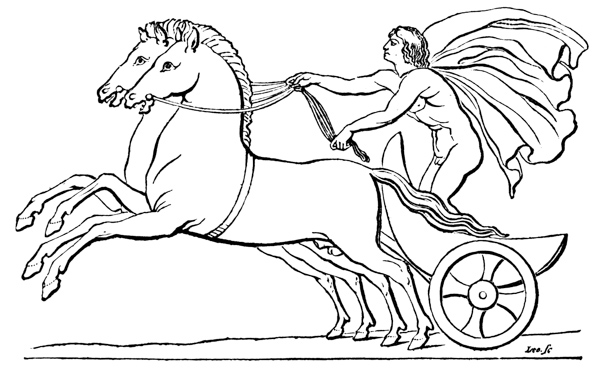
Fig. 22.
The youthful conductor of the steeds is in a crescent or boat-shaped car, and his form is elegantly bent to meet the action and motion; his mantle flows behind in curved and serpentine folds, expressing the wind occasioned by the velocity of action. A more graceful or beautiful group and composition cannot be imagined.
The next design was a female in an elegant and very gentle serpentine action of the figure. Every portion of the outlines was elegant, from the varied succession of convexity and concavity; not a single angle could be traced throughout the whole [p013] of this beautiful creature. She held in her left arm a very handsome oval vase; and in the other a sort of scarf with ribands, all serpentine in form. By her side is placed a young man selected from another Etruscan design.
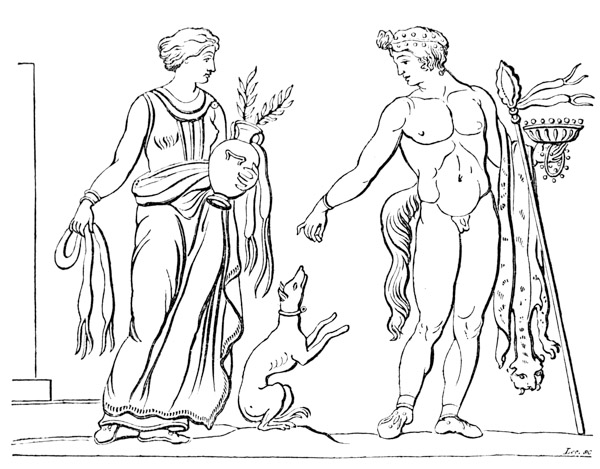
Fig. 23.
The line of this figure was the outline of an ellipse; it is perfection in every respect; and the grace was shown to depend upon gentle curved lines of convex and concave, alternately blended, and confluent. The motion of ships at sea is described in gentle elliptic curves; the wings and plumage of birds assume the oval and elliptic curves; all the fibres of their feathers have that form; some flattened, others more rounded: the pine-apple and numberless fruits have all an oval character of outline.
Many take the character of eggs, pointed at one end, and large and blunt at the other extremity. The leaves of trees [p014] have the oval shape more than any other; the bend of the branches, and the whole external form of many trees is oval.
There is no form of created things which may not be found to correspond in all its dependent shapes to ovals and ellipses of various disks, even objects which at first sight seem to contradict the possibility of meeting this system.
The lecture was closed by some extracts and quotations from Lomazzo, Dryden, Hogarth, Du Fresnoy, and the Abbé du Bos; the tendency of which was to show that lines had been mentioned, and had been written upon without any explanation given that could lead to certain conclusions. That all these authors attributed to supreme genius alone, and something of the divinely inspired character in artists, the power to produce those indescribable lines that affect the human eye so strongly. These lines I described as belonging to the oval and the ellipsis, and the confluent lines by conjunction and combination; that these indescribable lines, which from Plato to Dryden had never been detected or obtained a name; that puzzled all equally alike, are those alone I attempted, and I believe proved in this lecture, to be the elliptic combinations.
I stated that the great Greek artists confined themselves to certain rules and principles of unerring consequences in the production of beauty, grace, or grandeur in their figures; that all their compositions depended upon the same species of rule and order. I pointed out, that fashion is in all countries the destroyer of taste, that it unfits the mind for fixed principles; that where it dominates, there taste will be always fluttering and never settle, nor have a sure dominion. The Greeks, having no such vile tormentor to divert them from a pure course in their progress, arrived at the summit of perfection in every scientific pursuit, by following sure principles as their guides, and by never abandoning a path traced by nature, and matured by the most sublime philosophy.
[p015]
On the Art of forming Diamonds into single Lenses for Microscopes.—By Mr. A. Pritchard. ◊ [Communicated by Dr. GORING.]
OF the various improvements in Microscopes originated by Dr. Goring, that which he conceives to be the most important is the construction of single magnifiers from adamant. The details relative to this novel class of instruments, I have been induced to lay before the public. Single microscopes naturally aplanatic, or at least sufficiently so for practical purposes, possess an incontestable superiority over all others, and must be recognised by the scientific as verging towards the ultimatum of improvement in magnifying glasses. The advantages obtained by the most improved compound engiscopes over single microscopes resolve themselves into the attainment of vision without aberration with considerable angles of aperture; but against this must be set the never-to-be-forgotten fact, that they only show us a picture of an object instead of nature itself; now a Diamond Lens shows us our real object without any sensible aberration like that produced by glass lenses; and we are entitled, I think, to expect new discoveries in miscrosopic science, even at this late period, from very deep single lenses of adamant3. I shall not fatigue my [p016] readers by describing the difficulties which were encountered in the prosecution of the design of making diamond lenses. Nature does not seem to permit us to produce any thing of surpassing excellence without proportional effort, and I shall simply say, that in its infancy the project of grinding and polishing the refractory substance of Adamant was far more hopeless than that of making achromatic glass lenses of 0.2 of an inch focus. I conceive it just to state that Messrs. Rundell and Bridge, of Ludgate-hill, had, at the time of the commencement of my labours, many Dutch diamond cutters at work, and that the foreman, Mr. Levi, with all his men, assured me, that it was impossible to work diamonds into spherical curves; the same opinion was also expressed by several others who were considered of standard authority in such matters.
Notwithstanding this discouragement, in the summer of the year 1824, I was instigated by Dr. Goring (at his expense) to undertake the task of working a diamond lens: (being then under the tuition of Mr. C. Varley, who was however at that time absent.) For this purpose, Dr. G. forwarded to me a brilliant diamond, which, contrary to the expectation of many, was at length ground into a spherical [p017] figure, and examined by Mr. Levi, who expressed great astonishment at it, and added that he was not acquainted with any means by which that figure could have been effected: unfortunately this stone was irrecoverably lost. Mr. Varley having returned from the country, becoming now thoroughly heated with the project, permitted me to complete another diamond, which had been presented to me by Dr. G.: this is a plano-convex of about the 120th of an inch focus: it was not thought advisable to polish it more than sufficed to enable us to see objects through it, because several flaws, before invisible, made their appearance in the process of polishing. In spite of all its imperfections, it plainly convinced us of the superiority which a perfect diamond lens would possess by its style of performance, both as a single magnifier and as the object lens of a compound microscope. After the completion of my articles with Mr. V., being entirely under my own command, I devoted some time to the formation of a perfect diamond lens, and have at length succeeded in completing a double convex of equal radii of about 125th of an inch focus, bearing an aperture of 130th of an inch with distinctness on opaque objects, and its entire diameter on transparent ones; it was finished at the conclusion of last year. The date of its final completion has by many been considered a remarkable epoch in the history of the microscope, being the first perfect one ever made or thought of in any part of the world4. I think it sufficient to say of this adamantine lens that it gives vision with a trifling chromatic aberration, but in other respects exceedingly like that of Dr. G.’s Amician reflector, but without its darkness: for it is quite evident that its light must be superior to that of any compound microscope whatever, acting with the same power and the same angle of aperture. The advantage of seeing an object without aberration by [p018] the interposition of but a single magnifier, instead of looking at a picture of it (however perfect) with an eye-glass, must surely be duly appreciated by every person endowed with ordinary reason. It requires little knowledge of optics to be convinced that the simple unadulterated view of an object must enable us to look farther into its real texture, than we can see by any artificial arrangement whatever; it is like seeing an action performed instead of a scenic representation of it, or being informed of its occurrence by the most indisputable and accurate testimony.
Previous to grinding a diamond into a spherical figure, it is absolutely necessary that it should be ground flat, and parallel on both sides (if not a Laske or plate diamond), so that we may be enabled to see through it, and try it as opticians try a piece of flint glass: without this preparatory step, it will be extremely dangerous to commence the process of grinding, for many diamonds give a double, or even a species of triple refraction, forming two or three images of an object; this polarization of the light, arising from the primitive form of the crystal, of course totally unfits them for making lenses5. I need not observe, that it must be chosen of the finest water, and free from all visible flaws when examined by a deep magnifier. It was extremely fortunate for diamond lenses that the first made was free from the defect of double vision, otherwise diamonds en masse might at once have been abandoned as unfit for optical purposes. The cause why some stones give single vision, and others several peculiar refractions, may also arise from different degrees of density or hardness occurring in the same stone. Diamond-cutters are in the habit of designating stones male and female, sometimes a he and she (as they have it) are united in the same gem,—their he means merely a hard stone, and their she a soft one. When a diamond which will give several refractions is ground into a spherical figure and partially polished, it is seen by the microscope to exhibit a [p019] peculiar appearance of an aggregation of minute shivery cristallized flaws, sometimes radiated and sometimes in one direction, which can never be polished out: I believe I could disstinguish with certainty a bad lens from a good one by this phenomenon without looking through it6. Precious stones, from their crystalized texture, are liable to the same defects for optical purposes as diamonds.
Having ascertained the goodness of a stone it must next be prepared for grinding; it will in many cases be advisable to make diamond lenses plano-convex, both because this figure gives a very low aberration, and because it saves the trouble of grinding one side of the stone. It must never be forgotten, that it may be possible to neutralize the naturally low spherical aberration of a diamond lens by giving it an improper figure, or by the injudicious position of its sides in relation to the radiant. When the lens is to be plano-convex, cause the flat side to be polished as truly plane as possible, without ribs or scratches; for this purpose the diamond should be so set as to possess the capability of being turned round, that the proper direction with respect to the laminæ may be obtained: when the flat side is completed, let the other side be worked against another diamond, so as to be brought into a spherical figure by the abrasion of its surface. When this is accomplished, a concave tool of cast iron must be formed of the required curve in a lathe, having a small mandril of about 210ths of an inch in diameter, and a velocity of about 60 revolutions per second! The diamond must now be fixed by a strong hard cement (made of equal parts of the best shell lac and pumice-stone powder, carefully melted together without burning) to a short handle, and held by the fingers against the concave tool while revolving. This tool must be paved by diamond powder, hammered into it by an hardened steel convex punch: when the lens is uniformly ground all over, very fine sifted diamond-dust carefully washed in oil must be applied to another iron concave tool (I may here remark, that of all the metals which I have used for this purpose soft cast iron is decidedly to be preferred): this tool must [p020] be supplied with the finest washed powder till the lens is completely polished. During the process of grinding, the stone should be examined by a magnifying lens, to ascertain whether the figure is truly spherical; for it sometimes will occur that the edges are ground quicker than the centre, and hence it will assume the form of a colloid, and thus be rendered unfit for microscopic purposes.
The spherical aberration of a diamond lens is extremely small, and when compared with that of a glass lens the difference is rendered strikingly apparent. This diminution of error in the diamond arises from the enormous refractive power possessed by this brilliant substance, and the consequent increase of amplification, with very shallow curves. The longitudinal aberration of a plano-convex diamond lens is only 0.955; while that of a glass one of the same figure is 1.166; both numbers being enumerated in terms of their thickness, and their convex surfaces exposed to parallel rays. But the indistinctness produced by lenses, arises chiefly from every mathematical point on the surface of an object being spread out into a small circle; these circles, intermixing with each other, occasion a confused view of the object. Now this error must necessarily be in the ratio of the areas of these small circles, which being respectively as the squares of their diameters, the lateral error produced by a diamond lens will be 0.912; while that of a glass lens of like curvature is 2.775; but the magnifying power of the diamond lens will be to that of the glass as 8 to 3, their curves being similar; (or, in other words, the superficial amplification of an object; with the perfect diamond lens before mentioned, is 22500 times, while a similar magnifier, made of glass, amplifies only 3136 times, reckoning 6 inches as the standard of distinct vision:) thus the diamond will enable us to gain more power than it is possible to procure by lenses of glass, for the focal distance of the smallest glass lens which can be well made is about the 180th of an inch, while that of a diamond, worked in the same tools, would be only the 1200 of an inch.
If we wish to compare the aberrations of the two lenses when of equal power, the curvature of the glass must be increased; and as it is well known the lateral aberration increases inversely as the square of the radius, (the aperture and position remaining [p021] the same,) the aberration of the diamond lens will only be about 120th of that produced by the glass one, even when their thickness is the same; but as the curvature of the diamond is less, the thickness may be greatly diminished.
The chromatic dispersion of the adamant being nearly as low as that of water, its effects in small lenses can barely be appreciated by the eye, even in the examination of that valuable class of test objects, which require enormous angles of aperture to be rendered visible, which it is evident must be of easier attainment by diamond magnifiers than by any other sort of microscope.
A mathematical investigation of the spherical aberration of the diamond when formed into lenses, I hope to lay before the public at a future opportunity. The comparative numbers here taken from the longitudinal aberration are, I believe, sufficiently accurate for practical purposes.
18, Picket-Street, Strand.
The superior light of the single refraction can need no comment—and it is evident that there must be a degree of power at which that of the compounds will become too dim and feeble for vision,—while that of the single instrument will still retain a due intensity. For these reasons it is conceived that the close and penetrating scrutiny of lenses of diamond of perhaps only the 1200 inch focus, and an equal aperture (which their very low aberration would easily admit of,) must enable us to see further into the arcana of nature than we have yet been empowered to do. Glass globules of 1200 inch focus and indeed much deeper have been executed; but the testimony of lenses of diamond would certainly be far more respectable, and is at least worthy of trial and examination.—C.R.G.
Analysis of a newly-discovered Spring, at Stanley, near Wakefield.—By Mr. William West. ◊
MINERAL springs, dependent for their characteristic properties on carbonate of soda, appear to have been little noticed by chemists, and to have been still less attended to as curative means; at least in proportion to the multitude of cases in which that substance is administered in various other forms. Indeed the inference to be drawn from the silence respecting the modes of analysis adapted to such waters in our best elementary treatises, is that they have hitherto been very seldom met with. In one district, however, of Yorkshire, carbonate of soda is of frequent occurrence; it is found in the ordinary springs; often, at the same time with substances with which, in artificial solutions, or when concentrated, it, would be considered wholly incompatible; while at other times it is the predominant, or the only remarkable saline constituent. An analysis of a water of this kind, known by the name of the Holbeck Spa, has lately been published in the Annals of Philosophy, by my friend E. S. George; similar springs are found, I understand, as far [p022] westward as Bradford; they are numerous from the borings in and near Holbeck; while eight miles south, a water similar in its character, but differing in containing about twice as much alkali in the same measure, has been discovered at Stanley.
About two miles from Wakefield, near the Aberford or York road, is an ancient mansion called Hatfield Hall; near the park or inclosure of which, in boring for coal, the spring in question suddenly gushed up, when the workmen had got to the depth of eighty yards, and has continued to run spontaneously, in all seasons, at the rate of six gallons per minute.
The water at the spring is limpid and very sparkling; the portion which is allowed to escape, deposits upon the trough and in the channel through which it runs a quantity of sulphur; the smell is that of sulphuretted hydrogen; the taste, from the stimulus of the bubbles of gas modifying the softness of the alkali, rather pleasant than otherwise.
The appearances presented by re-agents are,—
With tincture of soap, a slight opalescence.
Nitrate of silver, an abundant precipitate, partially re-dissolved by pure nitric acid.
Sulphate of silver, a precipitate only partially soluble in nitric or acetic acid.
Muriate of barytes, a slight precipitate.
Lime-water, a precipitate soluble with effervescence in acetic acid.
Oxalate of ammonia, no precipitate.
On boiling, a slight pellicle appeared, soluble in nitric acid.
Carbonate of ammonia, no precipitate, nor any on the subsequent addition of phosphate of soda.
The water restored the colour of litmus paper slightly reddened.
With tincture of galls and ferrocyanate of potash, no change.
With muriate of lime, the water remained unchanged until heated; but when boiled, a copious precipitate took place.
When concentrated by boiling, the water reddened turmeric paper, and effervesced strongly on the addition of an acid.
Nitromuriate of platina produced no precipitate, however concentrated the water might be. [p023]
The results of the previous experiments indicate the presence of
Soda,
Lime in small proportion,
Muriatic acid,
No magnesia,
Sulphuric acid,
No iron,
Carbonic acid,
No potash.
A. To ascertain the proportion of sulphuric acid, sixteen ounces by measure, previously saturated by acetic acid, were treated with muriate of barytes; the precipitate, washed and dried, weighed one grain; this indicates, in the imperial gallon, 3.2 grains of sulphuric acid, equivalent to 5.8 sulphate of soda, dry, or 13 grains crystallized.
B. For the muriatic acid; nitrate of silver, added to sixteen ounces of the water boiled, and the alkali previously saturated, gave a precipitate weighing 2.8 grains; reduced to the proportion in the imperial gallon, this amounts to 26.9 grains chloride of silver, equivalent to 11 grains chloride of sodium (muriate of soda.)
C. The crystalline pellicle separated from a pint of sixteen ounces, on boiling, weighed 0.2 grains.
This was carbonate of lime; but in the water the lime would be combined with muriatic acid, forming 0.22; or, in the imperial gallon, 2.1 dry chloride, or 3.75 crystallized muriate of lime.
D. The precipitate formed on boiling with muriate of lime, weighed from the pint, 3.6 grains; from the imperial gallon, 34.6 grains; showing the water to contain in that quantity a carbonated alkali equivalent to 53 grains of dry, or 59.5 crystallized bi-carbonate of soda.
E. Muriate of barytes, added to the water left on evaporating sixteen ounces to two, gave a precipitate weighing 8.2 grains; deducting one grain for sulphate of barytes, as found in experiment A, we have 7.2 carbonate of barytes; this indicates in the gallon 53 grains of dry, and 59.5 of crystallized carbonate of soda, as in the last experiment.
Lastly, a pint of sixteen ounces of the water, evaporated to dryness, furnished in three trials of saline residuum, weighed after short exposure to a dull red heat, six grains, or 57.6 from [p024] the imperial gallon. Now we have seen that this would consist of
5.8 Dry sulphate of soda (exp. A).
11. Chloride of sodium ( —— B).
1.9 Carbonate of lime ( —— C).
18.7
38.9
57.6
The remainder, 38.9, having been converted by the heat into proto-carbonate of soda, is equivalent to 54.5 dry, 61 grains crystallized bi-carbonate, agreeing nearly with the quantities found from experiments D and E.
Following, as I do, that doctrine which supposes the bases to be distributed among the acids in a mineral water in the combinations which possess the greatest solubility, we must suppose the lime to be in the state of muriate; we shall then have to diminish the muriate, and increase the carbonate of soda: so that on this view, the saline constituents of an imperial gallon, in the state in which they exist in the water, are,—
Soda in combination with carbonic acid, equivalent to
Bi-carbonate or super-carbonate of soda 56 gr. dry. 62.5 crystallized
Sulphate of soda 5.8 ditto 13 ditto
Muriate of soda (chloride of sodium) 8.75 ditto 8.75 ditto
Muriate of lime 2.1 ditto 3.75 ditto
The gaseous contents of the water consist of variable proportions of carbonic acid, sulphuretted hydrogen, and carburetted hydrogen; the latter gas is continually emitted from the spring, in greater quantity than the water can absorb; and a portion of the other two also escapes from its surface. I have made many experiments on the gas, separated by boiling; but find the results, as I might anticipate, altogether inconclusive and uncertain. In waters containing, as at Harrogate, these gases with muriates or sulphates, boiling may be expected almost wholly to disengage them; but in this case the affinity of the soda in dilute solution, is likely to retain the carbonic [p025] acid, and even to cause a decomposition of the sulphuretted hydrogen, so as to prevent our obtaining, in a gaseous form, the quantity really existing in the water, and imparting to it sensible or medicinal properties.
On the subject of medicinal qualities I am at all times cautious of giving an opinion: but I may observe, first, that as this spring is dissimilar to any of those which have already attained celebrity, so none of them can form a substitute for this; it is not Harrogate, or Cheltenham, or Buxton, or Tunbridge water: the alkaline springs of the West Riding, of which this is by far the strongest, stand as medicinal waters hitherto alone; the active ingredient, the bi-carbonate of soda, being spoken of in chemical works, as “rarely found in mineral waters.”
Secondly, from the known properties of this substance, carbonate of soda, and the frequency of its administration in a long train of arthritic, calculous and dyspeptic complaints, the water must be highly useful as an anti-acid and as a diuretic; and as the advantages which native mineral waters possess over artificial solutions of the substances, in the great degree of dilution, and the impregnation with gases, and still more in the adjuncts of leisure, exercise, pure air, regulated diet and early rising, are of especial consequence in the latter very numerous class of diseases, those called stomach and nervous complaints; we may fairly suppose that such a spring will be found to be a valuable addition to those previously known, applying, as it does, to cases of such frequent occurrence.
Observations on the State of Naval Construction in this Country. ◊
IT appears that there is at present a tendency to improvement in every branch of science; monopoly in intellect may now be said to be vanishing; and empiricism is obliged to seek dark corners, to escape the light which is penetrating into regions from which it had but very lately been excluded. The administration, too, encourages advance of knowledge; yet notwithstanding these favourable circumstances, there still exists, in [p026] some minds, an inaptitude of scientific perception, which induces unwillingness to acknowledge the advantage that results from the application of the exact sciences to the useful arts.
This neglect of scientific principles is nowhere more manifest than in the affairs of naval architecture, and it is not confined to the Royal Navy, but extends also to our mercantile shipping; and hence it is that our commercial marine is in some respects behind foreign nations, especially the Americans, in the formation of its ships: our merchantmen are, almost without exception, the most unsafe7 and slowest ships in the world. The ship-owners, therefore, would do well to consider this circumstance, and endeavour to devise means of introducing science into the merchant yards. The establishment of the new university in the metropolis affords an opportunity of doing it at a comparatively small expense, by the foundation of Lectures on the theory of Naval Architecture; and the support even of a separate institution in the vicinity of the merchant yards of this great port, for the education of ship surveyors, would soon be repaid by the improved character of our merchant shipping.
If the science of Naval Architecture depend on certain physico-mathematical laws, as no doubt it does, it is monstrous to imagine for a moment that such laws can be developed by a flight of fancy, or that a man is born with an intuitive optical perception of the lines of least resistance, &c., or, in the jargon of the craniologists, that he has a naval-architectural bump on his skull; yet one would think that such was the case, when we see men, we cannot say philosophers, start up and loudly assert that they are in possession of the secret of construction; and they are believed because their hypotheses are never submitted to the examination of those who are capable of detecting their fallacy.
The Experimental Squadrons have, with a multitude of perplexing results, elicited, it must be confessed, at least an interesting fact, viz. that there has been an establishment seventeen years in this country, in Portsmouth dockyard, for the scientific education of naval architects, for the Royal [p027] Navy.8 From the plan of education, as laid down by the Commissioners of Naval Revision in 1810, it appears that, to a requisite knowledge of the practice of their profession, the gentlemen composing this body of naval constructors unite a sound and competent one of its theory9.
It can only be from such a source that we can look for the improvement of our men of war, and it is to be regretted that every means should not be taken to avail ourselves of it: but unhappily such is the force of prejudice that, unless some alteration should be adopted in this institution, it will be in vain to expect advantage from it.
The objection urged against this establishment, namely, that the scientific education it gives to its members precludes them from the attainment of a due knowledge of the practical construction of our ships, is so absurd, that none but weak or jealous minds could ever have brought it forward. Shall it be laid down, in the present age, as an axiom, that a profound ignorance of the principles of his art is the one thing essential to the formation of what is generally meant by the term “practical man?” We contend that, having made, in vain,10 a long and most indulgent trial of a system without science, if we may use such an expression, we must extend to one in alliance with it, a like patronage, before we can be allowed to pronounce a fair and legitimate judgment upon its efficiency.
But even in the peculiar path in which the naval architects educated at Portsmouth might be supposed to excel, we do not find that any opportunity is allowed them to come forward, nor shall we see this until some effort is made by the heads of our naval departments, to allow a broad and open competition to take place. It may be urged, that the learned Professor at Portsmouth (Dr. Inman) in himself includes all that can have [p028] possibly been taught or understood in the establishment over which he presides, and that therefore he is the representative of it in the late and present trials for the palm of excellence; but we cannot by any means assent to this: many of the students must have left his tuition seven, eight, and nine years, and must be between thirty and forty years of age; and it would be strange indeed, if during such a period, and in the prime of life and intellect, some of these, if not all, had not cultivated the science after their own bent of mind, and formed original ideas on the subject: we say, therefore, that Dr. Inman’s constructions cannot be called the production of the establishment—they are merely the effort of one man, whose attention it appears is distracted by a multiplicity of occupations, and can only, along with the vessels of Capts. Symonds, Hayes, and Sir R. Seppings, be deemed criterions of the particular views of an individual.
Mysticism and ignorance always accompany each other; and we may reckon that in proportion as the latter disappears from amongst our ship-builders, so will the absurd vagaries of the former recede, and the subject be placed at last on the true principles of philosophical induction, instead of the caprices of imagination. We look forward, therefore, to this new body of naval architects for the expulsion of all quackery from their profession, and for the exposition not only of what we really do know, but also of what we do not know about it: this is the only way to arrive at truth, which should be the sole object of all investigation; but which we are afraid has hitherto been sadly garbled and perverted wherever it has had to do with naval architecture in this country.
But we repeat that we do not see that the nation is at all likely to benefit from the science or exertions of those gentlemen so long as they are placed in situations where a superior education can have no other effect than producing disgust and chagrin in the mind of the possessor; and if the institution at Portsmouth be designed for no better purpose than that of supplying house-carpenters, joiners, and still more inferior trades, with foremen, it had better be abolished. Some would regard it, as at present used, as a gross mockery on the public [p029] at whose expense it is supported; it is certainly a cruel one of those who have been induced, by the fair and brilliant prospects held out to them of support and encouragement, to devote their lives to this branch of the public service.
But to return to the Experimental Squadron: it is with regret that we must conclude, upon a careful consideration, that, although the experiments are carried on with so much vigour and interest, they are evidently founded on imaginative views, and that there cannot exist any thing like legitimate data where so many failures and anomalous results obtain. Who can read the account of the first Experimental Squadron11, without immediately perceiving that the constructors of the contending vessels, however sanguine each might have been of the success of his particular fancy, met with nothing but the most perplexing results? We see sometimes one and sometimes the other vessel claim the palm of excellence, and finally leaving the subject as much in the dark as ever. This is the natural consequence of the non-application of inductive philosophy to the question before us, and the most important conclusion that can be gathered from the experiment is, that we have begun at the wrong end, and that it is high time to employ analysis instead of synthesis to effect the desired objects: for in the present state of the theory of naval construction in this country, there are yet no data existing to effect with precision and confidence the synthetical composition of a ship.
We cannot refrain here from noticing the paucity of information contained in the reports hitherto made on the first Experimental Squadron. The best one11 is but little removed from a ship’s log book, and in some respects is inferior to it: it is of such a scanty nature, that we can scarcely inform ourselves on any point, and that only in a relative degree, of the qualities of the vessels composing it: we cannot find out any mention of their absolute velocities on the different points of sailing, which is a most important omission. We are neither informed in what way the observations were conducted, whether they were made simultaneously or not: unless the former, any attempt at comparison must be very doubtful, if not entirely fallacious. Circumstances of wind and the weather may very widely alter in the [p030] course of a short time, and every endeavour at legitimate analogy be destroyed by such variation. We strongly suspect that this is one cause of perplexity; and another prolific one is the vague idea given of the strength of winds by nautical language. Nothing but the determinations of the anemometer should ever be allowed to appear in an account of such experiments. Every circumstance attendant on the quantity and trim of sail, the heeling, the rolling and pitching of the ship, position of the rudder, &c. should be accurately ascertained and tabulated; for it is next to an impossibility and a wilful waste of time to attempt to institute comparisons without pursuing a system of tabulated results, which should be kept in the same form on board each ship.
We must also express our regret that the scientific professor at Portsmouth does not appear to have ascertained the position of the centre of gravity of any of his ships, with regard to height, by the simple and easy experiment long known in principle, and described lately with geometrical rigidity in two or three publications by some of his pupils12. The knowledge of the position of this point would have placed him so far above his competitors, in so many important particulars, that we are surprised he should have thrown away his advantage, and descended to a level with his less scientific opponents. We are afraid that, here again, imaginative views have stepped in, and taken the sober mathematician from the only path by which excellence can be attained. We are at a loss to conceive how the stabilities of his ships can be said to be ascertained without the knowledge of the position of this point.
Some of the obscurity which pervades this difficult subject may be overcome, as to broad and general principles, by attentively and coolly observing the progress of marine architecture, since the introduction of cannon into naval warfare, and more particularly during the last century and a half. We shall then clearly perceive that the French, who, as early as the beginning of the reign of Louis XIV., employed men of first-rate talent in their naval arsenals, and neglected no opportunity for the [p031] advancement of science in them, increased and kept increasing the dimensions of their ships, more especially the length, the ratio of which to the breadth has been augmented by them from about 314.1, to 4.1 within the last century. While this principle was acted on, the improvement of their ships was gradual; and by referring to our own progress in the art, in tardy imitation of the practice of the French, we shall likewise conclude that our navy has derived precisely similar advantages from the same causes. Here we have at once two grand but concurring results derived from an experiment, not made on one or half a dozen different vessels, but on the whole navies of the two most powerful maritime states in the world: and if to these we choose to add the result of the practice of the same means on the Spanish and other navies, we might surely be warranted in saying, from this broad but certain analysis of facts, that, in relation to the hull, the general increase of dimensions, with a greater relative length, is one cause of the improvements that have been made in the sea-going qualities of the ships composing the fleets of the present maritime powers: the question therefore that remains to be decided on in relation to this principle is, whether we have arrived at its utmost practicable limits, or rather, whether we have arrived at the maximum of improvement it is capable of producing.
This brings us again to the experimental squadrons, as far as they are connected with, and illustrative of, our observations; and the first question naturally put forward about them is, whether there be any thing very peculiar in the formation or dimensions of the rival vessels? We suspect that the answer cannot otherwise than disclose, that neither in principle, dimensions, nor in the formation, can they be said to differ very materially from each other, or from ships of the common construction: indeed we perceive in some a retrogression of ideas and a violation of the principle, that the increase of the ratio of the length to the breadth, in conjunction with a general increase of dimensions, has been a predominant cause of improvement. The fact also of so immaterial a difference necessarily includes a system of masting and sails equally confined, and totally inadequate to produce any great superiority of sailing over ships to which they are so nearly equal in principal dimensions. [p032]
After so many years of trial with the present nearly invariable set of principal dimensions, during which period it may be said, that every possible contour of hull has been experimented on with them, we are inclined to think that almost all has been done that could be done under such restrictions, and that some great step must be made in one or other of the principal dimensions themselves, with correspondent alterations in the masting, before we can expect to see a decided and great improvement in the sailing of our ships. The depth is an element which has arrived at its limit from very apparent external causes; but the length and breadth remain to the skilful constructor without any such clogs to his endeavours; and he has only to accommodate their relation to each other in the manner most conducive to velocity, which in our opinion is the very capital object of naval construction, both in ships of war and of commerce. That it is so in the former, no one will, we apprehend, on due reflection deny; but there will be many who will assert that it cannot be obtained, in the latter, without a sacrifice of capacity; which will defeat the object of carrying large cargoes: to this we may reply, that if a vessel with an expense of one quarter the capacity can make three voyages instead of two, will not the merchant be still a considerable gainer in capacity, and still more so by a ready return of his capital13?
All observations on well-conducted experiments concur in proving that velocity is gained by increasing the length, to a much greater degree in relation to the breadth, than has ever yet been done in ships; and that the increase of the same element contributes to their weathering powers is too obvious to need insisting upon: it is also generally advantageous, when not carried to an extent which would seriously retard the manœuvring of the ship. This limit has not yet by any means been determined; for it must be recollected, that although the additional length increases the resistance to rotation about a vertical axis, yet the power of the sails to give rotation about the same is also increased, although not in so high a ratio. The power of the rudder to produce rotation is also greater in a long ship than in [p033] a short one, not only on account of the greater distance it is from the axis of rotation, but also on account of the greater velocity, and the more direct impulse of the water on it.
The increase of the ratio of the length to the breadth to produce velocity should not interfere with the increase of breadth necessary to produce stability or capacity; for both these qualities, varying as higher powers of the breadth, a very small increase of breadth may be attended with a considerable increase of length. If we compare the Caledonia’s (120 guns) dimensions with those of the Royal George and Queen Charlotte14, of 1788 and 1789, we shall find, that 13 or 14 times as much length as breadth has been added to the first rates of our navy. If we refer to the dimensions of the Commerce de Marseilles, and those of the next preceding three-decker of the French navy (for instance, the Ville de Paris15, taken in Lord Rodney’s action), we shall find that the French naval architects gave in her 21 times as much increase to the length as to the breadth. If this could be done with safety in a three-decked ship, with such a vast top weight, much more could it be carried advantageously into effect in ships of two decks, and frigates; but we do not find, in the latter classes of the ships of the French navy, the increase of length to go beyond six times that of the breadth. If we refer to the Old Bellerophon, built in 1772, and the New Bellerophon, built in 1819, we shall find an increase of 24 feet in length, to 1.58 feet increase of breadth; or the former more than 15 times the latter16.
To those who oppose the objection that a greater length than at present used would make the manœuvring of a ship too slow, we answer, that as the Caledonia and the present first rates of our navy, although from 10 to 15 feet longer than our two-deckers, are found to be capital ships in this respect, there is a sure ground to believe, that the addition of 20 feet in length to the present two-deckers would not render their celerity [p034] of evolution less than that of the three-decker; and since, from the reduction of weight aloft, the centre of gravity would be lowered, and the displacement required to be less, a somewhat smaller breadth might be allowed to a two-decked ship of 206 feet long, than to one of 196 feet (especially since the quantity of sail, remaining the same, is lowered by one whole depth between deck), a smaller midship section would be, cæteris paribus, required; the velocity of this ship might be considerably increased. Nothing however can be precisely determined on, with such a complication of circumstances, beyond a general idea. Calculation and a strict analysis of ships must be resorted to, in order to fill up the outline of our reasoning.
But for the same reason that we imagine that an addition of 20 or perhaps 40 feet would not sensibly injure the celerity of manœuvring of our two-deckers, we should think that the same increase of this dimension might be tried without much risk to our first rates, with an increase of breadth not exceeding 120 part that is given to the length.
We repeat that the very capital object of the science of Naval Construction is velocity, and we are decidedly of opinion that it is attainable in a much higher degree than at present, without compromising other necessary qualities, for which we have the concurrence of facts as far as they go.
The Anglo-Americans, in the last war, took every possible advantage suggested by views similar to those we have been adverting to, in the construction of their large frigates. They had, it may be said, to create a martial navy, and they had to oppose it against fearful odds; but, free from the prejudices and errors so blindly cherished by their opponents, and which constantly oppose reform by always declaring the present practice to be the best, they did not retread the old path, but began at its last step, and boldly advanced on this principle into all the branches of the art. They built vessels upon the most enlarged dimensions, and of a superior weight of metal, and gave an increased ratio of length to the breadth. The result of such a procedure, justified the confidence of the American naval architects in only one maxim, founded upon the scientific observation of facts, and may give us a faint idea of what might be effected by a still more enlarged and mathematical analysis. [p035] Our frigates were so inferior to theirs in every way, that they brought nothing but disasters upon us, excepting in the action between the Shannon and Chesapeake, and one or two others, where, assured by their previous successes, our gallant opponents threw away the advantages possessed by their ships, by coming to close quarters at once, and deciding the contest hand to hand.—Our ships of the line could never bring these frigates to action, and owing alone to their extraordinary sailing, did they evade and mock a large British fleet. We were finally obliged to build 60-gun frigates after their method, but when it was too late for the exigency of the period; and thus it has ever been our fate, for want of science in the constructors of our navy, to follow the steps of our enemies at a humble distance, and to be only then driven out of the old track by a terrible experience of its inefficiency.
Nor have the Americans stopped here;—Mr. Huskisson plainly tells us that “America is, year after year, augmenting its military marine, by building ships of war of the largest class17.” According to Capt. Brenton, they have built a first-rate18 of 245 feet length on the gun deck, and 56 feet broad19, to carry 42-pounders on the lower deck, and 32-pounders on the other decks.
Our small class of 74-gun ships lately converted into frigates carrying fifty 32-pounder guns, we are fearful can only produce disappointment if ever brought against the American frigates (not by conversion, but by construction), which carry sixty-two guns of the same calibre, and are 180 feet long on the gun deck.
We must not forget also that our active neighbours the French have now adopted a most formidable description of [p036] frigates, with curvilinear sterns20, and many other important improvements. They mount 60 guns and carronades—viz. 24-pounders on the gun deck, and 36-pounder carronades on the flush deck.—The former calibre is equivalent very nearly to 26, and the latter to 39 lbs. avoirdupois.
When we reflect on these circumstances, we cannot but feel surprised that so many frigates of inferior force and dimensions should be building in our dockyards. In time of emergency they will only bring on us a repetition of former disasters and deficiency. We contend that, instead of building ships of only equal force to those of our rivals, and thus waiting for the developement of their designs before we can venture on a single step, we should build beyond them in every respect. It must and ought to be recollected, that peace in these matters produces a contest of intellect, and those will have the advantage in it who attack instead of standing on the defensive. We ought to lead the way, and to be at the head of the maritime world, not in number alone, but also in the individual force and qualities of our ships.
Having expatiated on the advantages of an increased ratio of length to breadth in relation to the hull of a ship, we will just glance at some of the principal effects it would have upon the masting and sails; and here again we conceive that Professor Inman has, in common with many others, relinquished the many good effects resulting from it, for the inadequate one, of being able to carry a somewhat greater quantity of sail, which must necessarily be lofty, and which, (setting aside this detracting circumstance,) as the velocity of a ship varies only as a fractional power of the surface of canvas spread, cannot produce the degree of fast sailing to be wished for, but at an immense and impracticable quantity of sail21.
A greater proof of the inadequacy of the present system of [p037] lofty sail cannot be cited than the fact of its not procuring, under the most favourable circumstances, a rate of sailing rarely exceeding one-fourth the velocity of the wind.
As the number of masts should be so regulated as to create facility in managing the canvas, which is well known to be at present hardly manageable in a gale of wind, on board large ships, from the enormous size of each individual course and topsail, we should not hesitate, therefore, to have four vertical masts, as recommended by Bouguer, instead of three, in ships built in accordance with the principles we have been discussing. This would, cæteris paribus, require shorter masting and smaller yards, and the sails being much less, individually, would be more easily managed and not so liable to accidents.
From what has been said, and the actual experiments now pending, it is apparent that the theoretic construction of ships is at a very low ebb in this country; yet a fine opportunity now presents itself, if we choose to avail ourselves of it, for rescuing the nation from this generally acknowledged odium. Let a proper use be made of the corps of Naval Architects we have, somehow or other, at last got, and let their exertions, under a degree of encouragement equal to that bestowed on the old ship-builders in vain for so long a period, be directed towards the improvement of their art. If they fail, they cannot claim the excuse of having their endeavours repressed; if they succeed, as no doubt they will, in advancing their profession to something beyond mere carpentry, we shall be enabled to bid adieu to the old and ruinous method of blundering, under the reign of which nothing but disappointment can ever be reasonably expected.
We have seen and do still see the immense advantages derived by our country from the encouragement of those branches of science connected with its manufactures and agriculture; and if we wish to keep our present superiority, we must follow up vigorously this principle in all its universality. To the cavils of ignorance and bigotry against such a mode of proceeding we would answer, in the words of one of the most enlightened members of the present administration, “This country cannot stand still, whilst others are advancing in science, in [p038] industry, in every thing which contributes to increase the power of empires, and to multiply the means of comfort and enjoyment to civilized man.”22
It is to be hoped, therefore, that His Royal Highness the Lord High Admiral will extend to this most important national institution, the School of Naval Architecture, the same vigilant and scrutinizing eye that every other branch of our naval system is at this moment experiencing from him, and that he will extend to it that fair play and encouragement which has hitherto been denied to it. As a seaman, he can fully appreciate and understand how much the bad qualities of a ship may neutralize the best exertions of the most experienced and skilful sailor; and, on the contrary, what a degree of confidence may be insured in naval operations with excellent ships. We feel persuaded, therefore, that he will not allow others to think for him in a matter of so much national importance, and thus allow private ends to interpose to the disadvantage of public views; but that he will investigate and judge for himself. We would humbly suggest to His Royal Highness to inquire into the individual acquirements and productions, both of a theoretical and practical nature, of those who have been educated in this establishment, and he would soon be able to decide whether they be fitting or not for the important task of constructing our ships, and for the confidence and protection which we think we have shown has hitherto been ill-advisedly withheld from them. Such a line of conduct would very soon carry our naval architecture to a pitch of excellence worthy of imitation, and instead of being indebted to foreigners for models, we should be able, with just pride, to point to the productions of British science and intellect in this noble art.
[p039]
On Malaria. No. II. ◊ [Communicated by J. Mac Culloch, M. D., F. R. S., &c. &c.]
HAVING pointed out, in the former paper on this subject, the nature of the soils or places, of whatever description, by which malaria is generated, it remains to notice a few other circumstances connected with its natural history, a knowledge of which is essential for the purposes of prevention; and finally to describe such modes of prevention, applicable to these several circumstances, as have been found useful in guarding against the attack of diseases from this cause. Under the first head, there remain to be considered, the effects of climate and season; the changes which occur in the production and propagation of malaria, from various natural and artificial causes; and also, the various modes in which it is propagated.
It has already been remarked, that a certain elevation of temperature was necessary to the production of this poison, though what the precise degree is, has not been ascertained; and as this is, chiefly, what distinguishes the regions or periods of the year which generate malaria, I need not make two divisions of season and climate. If, however, this temperature is not fixed, it will perhaps suffice for our present purposes to say that the greater part of Scotland, whether as to climate or season, seems incapable of generating the disease from this cause; though there are exceptions of a permanent nature, or exceptions of climate, as was perennially true of the Carse of Gowrie before its drainage; while there are others which happen when, as in the last year, there has been a peculiarly hot summer, and which are exceptions of season.
And thus it is as to more northern regions; where a hot summer becomes more than an equivalent for an average low temperature; as an example of which, there is no place where intermittents are more severe and abundant than at Stockholm. But the extreme of evil from this cause occurs, as is well known, in the tropical climates; appearing almost proportioned to the heat of the climate, and what is important to observe to the moisture also. The destructive effects of certain parts of Africa, India, America, and so forth, are familiarly known; and [p040] it is in these countries especially, that the diseases from this source constitute nearly the entire mortality of the human race. And thus, for Europe, it is in Spain, Italy, and Greece, and chiefly on their Mediterranean shores, that the activity of malaria scarcely yields to that of the intertropical climates; while in France, Holland, Germany, Hungary, and with us, in a far less degree, the production will be found regulated by the heat of the summers, all other circumstances being the same.
And if we thus account for the variations in the quantity and virulence of diseases in any given country, for noted seasons of epidemic in the countries which I have just named, and for the great prevalence of fevers among ourselves during the last few years, and particularly in the last summer, there is another point of scarcely inferior importance to be taken into the consideration, independently of that which relates to peculiar winds as connected with the propagation of this poison;—and this is, moisture.
I need not repeat that water in some form is necessary to the production of that peculiar vegetable decomposition which is the source of this poison; and so true is this, that even in the tropical regions, the diseases from this cause are nearly unknown in districts of peculiar dryness, as they are in the drier seasons of those countries. Thus, for example, Egypt is free from such fevers, except at the period of the subsidence of the Nile, unless where, as at Damietta, the cultivation of rice is pursued; and the same is true of Mesopotamia very remarkably: and if I dare not extend these illustrations, I must remark that in all these cases, the action of moisture is twofold, inasmuch as it not only accelerates vegetable decomposition, but renders the atmosphere a fitter conductor of this poison.
Taking these two causes of the increase in the quantity and in the action of malaria, we can explain many particulars which relate to its power in producing diseases: and as the knowledge of these is important as far as relates to the main object of this paper, prevention, it becomes necessary to explain them at a little more length.
As to season, the simplest case is that of the intertropical climates; and Africa offers the plainest instance among the [p041] whole. There, the malaria and the fever commence at the moment the rain falls; diminishing as the ground becomes thoroughly wetted, and recommencing as it dries. The explanation of all this ought to be obvious; and the same analogy governs all the hotter climates, as, though less conspicuously, it does our own. Hence we explain, both as to our spring and our autumn, the effects of heat following rain, or the reverse, and the diseases which are consequent on those changes: and thus it is, though more remarkably, in Italy, that a rainy autumn increases the number and severity of fevers; or, if the summer has been unusually dry, that they often do not appear till the commencement of the autumnal, or even the winter rains. And hence, also, even with us, the occurrence of a single rainy day or week, in the midst of the heats, will produce fevers; while the effect of this influence is such, that should there even be an entire rainy summer, and the subsequent one be hot and dry, this will be attended by an unusual production of malaria and disease.
And if I cannot detail all the various modes in which these circumstances may be modified, and how their effects may vary, it will be useful to make one remark on an error as relating to it which is universal among us, and into which even Lind has fallen. The error is, to think that the rain, the moisture, or the cold is itself the cause of the diseases which follow this state of things; while it is obviously a case analogous to that of Africa, if less severe, and the malaria is produced by these circumstances on soils which I formerly pointed out, and which Lind, like every one else, had neglected. But if I must pass over many interesting and useful conclusions to be drawn from these general principles, there is one fact which I must notice, and it is this:—
In spring, the combination of heat and moisture, easily explained, generates, most commonly, intermittents; or the effect of the malaria at this season differs from what it does in autumn: while as the heat advances and the ground dries, this kind of fever ceases to be produced, a new species, or the summer remittent, taking its place when the heat and the moisture of autumn begin to act. But under peculiar seasons of heat and moisture with us, it sometimes occurs, as it has done [p042] within the last years, that the intermittent season runs into the remittent one, or there is no midsummer interval of freedom from disease; while it has also happened, and in some parts of England in this last year, that what would have been intermittent fever in other years has been remittent; or the common fever has occupied the whole summer, continuously, even from March to November, as is the case in the worst regions of southern Europe.
Now, under these exceptions, which I was bound to explain, the commencement of intermittent, or of vernal ague, may be fixed about the middle or end of March, and its termination similarly in May; while that of remittent may be placed in the beginning of August, and its termination with the middle or end of October. How these periods may otherwise be affected by the more or less insalubrious nature of the district or place, will easily be judged of by those who will reflect for themselves on what I dare not explain, lest I should infringe too far on my limits. All else that I can venture on, as to this part of the question in hand, relates to the effects of the different times of the day on the production, propagation, or influence of malaria, and it is one which is of no small importance in a practical view.
Whether the changes as to temperature and moisture which occur within the space of twenty-four hours, affect the production or propagation of malaria, I will not here inquire minutely, from the fear of prolonging this very limited paper; but the general facts, as to its effects, are these: If we commence with the sun on the meridian, there appears, even in the worst climates, very little hazard of fever; while in Italy, it is believed that there is, generally, little or no hazard, except in some peculiarly pestilential places, and under particular kinds of inattention or neglect. Either the malaria is decomposed or destroyed by the heat, or else the air from its dryness ceases to be a conductor; but as evening approaches, its influence becomes powerful and dangerous, being supposed most generally to extend all through the night; while in some parts of that country it is a popular belief that it terminates before midnight, or with the precipitation of the atmospheric moisture. Whether this last opinion is true or not, the general fact explains the popular [p043] belief, and truth, respecting the poisonous effects of dew in the hot climates; the supposed pernicious quality of this depending evidently on the malaria by which its formation is accompanied. And in this case it is probable that the evil arises, not from a fresh or peculiar generation of malaria, but from the mere fact that the moist atmosphere is a better conductor than a dry one.
Not to be unnecessarily minute, we thus also explain the danger of exposure to the morning air in similar situations; the facts, as they relate to the conducting of malaria, being the same, though the meteorological circumstances are somewhat different. Hence, also, we see why the grey mists which hang over wet grounds in the evening in our own climate, are esteemed pernicious; the truth, however, being, that they are perfectly innocent at certain seasons and in certain places—as in the greater part of Scotland, for example, or in those places and at those periods where malaria is not produced. The distinction is valuable, because of the inconvenience of restrictions on this subject, and because to know where the hazard really lies is to reduce those, and also to prevent the infraction of rules by not extending them beyond what is necessary; and thus also by seeing what are the real dangers of what is called night air, we more easily avoid them. Night air is avoided now, under a false philosophy, because it is cold or damp, or for some other vague reason; while the dangers from mere dampness or cold are as nothing compared to those here pointed out; which also occur precisely where they are least feared, namely, in warm summer evenings, after refreshing showers, and so forth. Hence it is that fevers are produced in summer, in rural situations, and especially perhaps amid the most engaging scenery, by evening walks and exposure to what is naturally considered, as it is felt to be, a balmy and refreshing sequel to a hot day. Let this be enjoyed where it can with safety, and as it often may; but such evening walks will not be safe in any of those situations which I need not repeat here; after having detailed them as I have done in the former paper. And lest I should be accused of wishing to excite unnecessary alarm, I consider, on the contrary, that it ought to be diminished by these remarks; because, if we take the whole of [p044] England, there is perhaps not one acre in a hundred thousand where there is danger from night air, or from malaria in any mode; so that to distinguish where that lies, is to have relieved from useless fears all those who may learn to make the distinctions under review.
To pass from what relates to climate and season, and to proceed to the propagation, simply, of malaria, it is almost superfluous to say, that its influence, as to the production of disease, is much regulated by proximity, which implies a state of concentration or accumulation. Hence the danger arising from vicinity; while, as I formerly remarked, where the generating source is small, this becomes necessary to its effect, since dilution may be expected to destroy the power of the poison.
For analogous reasons, its effect in the production of disease is increased by concentration or condensation; and such a state of things takes place in narrow and confined valleys, or in places surrounded by woods, or in woods themselves; in any situation, in short, where the poison is produced, and is so sheltered from winds that ventilation becomes difficult. And if it is probable that this is one chief reason of the peculiarly insalubrious nature of woods and jungles in hot climates, so is it an universal remark in Italy, that the short valleys in which the air cannot circulate are among the most pestilential spots. And if this explains, also, in some measure, the bad effects of calm weather, so does it account for the unusually pestiferous nature of rivers and lakes confined within wood, as are those of the tropical climates, and as there are many also in different parts of Europe. That we ourselves are not exempt from these additional causes of the influence of malaria, would be easily shown by many references, were it not for the reason which has caused me to exclude them.
It is another important question for practice, how far and in what manner malaria can be conveyed by the winds to places where it is not produced, so as to act in exciting disease. That it is conveyed to certain distances by winds is amply proved by an abundant experience, and I may first detail a few of the most useful particulars as to this fact. In Italy and Greece, it is observed, that where long valleys terminate on sea shores, on which the exits of the rivers are swampy, it is an [p045] effect of the sea breeze, by crossing such marshy ground, to convey the malaria up into the interior country, to considerable distances, and to places which are in themselves not insalubrious. Thus, also, does such a breeze, especially when it is a warm wind, convey the poison up the acclivities of hills, even to a considerable range of distance or elevation; a process facilitated by the natural tendency of such winds to ascend. And as a striking proof of this migration of malaria, it appears from Capt. Smyth’s statistical account of the insalubrious villages in Sicily, that out of more than seventy, about one-half are not seated near or on lands producing this substance, but on acclivities, at varying distances—thus receiving it through migration. The same is remarked by Montfalcon of many towns in France; while in some, the place at a distance is even more unhealthy than that which is immediately situated in the marsh itself: and in our own country, this is equally said to be true of the backwater at Weymouth, and of the marshes of St. Blasey in Cornwall, acting more powerfully at some distance than in the immediate spot.
With respect to the absolute distance to which the malaria can be conveyed, it is yet an obscure circumstance, or at least the maximum has not been fixed; but it is at least ascertained that the convent of Camaldoli receives it from the Lake Agnano, at a distance of three miles; while from certain naval reports, a distance of five miles has been proved to permit its transmission,—and from an evidence that cannot be doubted, inasmuch as it was the sudden breaking out of fever in a healthy ship, anchored at that distance from the shore, on the coming off of the land wind, attended by its peculiar and well-known smell.
These facts are satisfactory thus far, and it would be abundantly easy to add to them; but there is reason to suspect that it can be conveyed to far greater distances, in certain favourable circumstances: those reasons, in the first place, being derived from certain meteorological analogies and considerations, and in the next confirmed by experience. It is notorious that the ague appears on our eastern coasts with the first east winds of spring; and while this circumstance is most common on those of England, as for example, in Kent, Essex, Norfolk, [p046] Suffolk, and Lincolnshire, it is not thus limited, since it is known to happen further north, and even in Scotland, where malaria is not indigenous to the soil. It is very true that if we take any inland position in the places thus noted, the natural solution is, that the malaria is generated in the very soil itself of England, and merely propagated, perhaps even to very moderate distances, through those winds. But the occurrence of disease cannot be explained thus, when the place in question is so situated that there is no land to the eastward, or when the breeze is, most literally and rigidly, a sea breeze; while, when ague thus occurs on the east coast of Scotland, where it is not produced by the soil, it must be imported by the east wind.
These are the facts; while as malaria is not produced by the sea itself in any known circumstance, though a vegetating sea beach may give rise to it, we must seek the cause in lands far distant, and consider this as a case of propagation of the poison from the shores of Holland; and those shores are unquestionably competent to that effect: so that the only question that remains, the fact being admitted, is, whether, à priori, or theoretically, such a view is probable, or whether it is consistent with those physical principles that are concerned in the propagation of malaria.
I am aware that such a view will excite the incredulity of those who have not attended to this subject; though it appears to me that it comprises nothing averse to our knowledge of the philosophical circumstances concerned. In the first place, let us remark that the east wind, and particularly the east winds of spring, are notorious for their moisture, and that a moist air is the best conductor of malaria, as moisture in the air, under the form of evening mists, or in other modes, appears even to be its proper vehicle, or residence, if I may use such a term; and though I have not as yet separated the case of a fog, I may now remark, that the effect in question, or the production of agues by fogs arriving from the sea, is even more notorious than their generation by an ordinary clear wind. So notorious and popular, indeed, is this fact, that the fog itself is deemed the source of the disease, as the east wind under any form is, in other circumstances; while I hope it will even now appear, [p047] that the real cause lies in the malaria transported or conveyed by those winds or fogs, and of which they are the true and best repository and vehicle.
And these are the reasons for thinking that the malaria, with the wind, may be transported to a distance as great as that which the present view requires; most easily perhaps in a fog, but without difficulty even in a clear wind. It is remarkable that the east wind, as it is the most persevering, is that one also which preserves the most steady horizontal and linear course. I have also shown, in a former work, that it is a property of winds to travel in distinct lines through a tranquil atmosphere, and often in streams of a very limited breadth; that opposing streams will also move, in absolute contact; and that even rapid streams of wind will cross each other’s courses without difficulty. This proves that, in any such stream, there is a principle of self-preservation or integrity, and renders it probable that the several portions retain the same relative places to each other, at any distance, during the career of the whole; and there is a proof of this afforded in the fact of those columns or streams of insects which are brought over by such winds, and very frequently from those very countries, or from Holland and Flanders, in the most regular order, or without disturbance or dispersion.
Hence it may be argued, that if a malaria, generated any where and conveyed by the winds, can be transported to a distance of three miles, as has been proved, there is no reason why it should not travel much farther, or to any distance that can be assumed: and if this be true of a clear wind, the case of a fog is even a much stronger one; since there is little reason to doubt that the individual parts of such fog, in any assumed mass, will retain their relative places to each other, as perfectly after a journey of any given number of miles, as they did at the point of production; and if a portion of malaria has been united to a portion of fog, in the marsh which produced both, or whence both have come, there is every apparent reason why it should be found in that same portion at any farther or assumed distance, because there is no cause for either its dispersion or its decomposition.