Volume 7 / Part 1 — VI. Report upon the New or Rare Plants which flowered in the Garden of the Horticultural Society at Chiswick, between March, 1825, and March, 1826. Part 1. Tender Plants. By John Lindley, Esq. ◊ (continued 6)
Reading edition
Thus an elephant being found in a tomb in Mexico, and others in tombs in Siberia, is an additional argument to the strong ones already produced, for the Mexicans being the Moguls blown from the shores of Japan, A.D. 1283, which appears irresistible; and also that mammoths and mastodontes are not extinct, being found either living or fossil in all the places in America, which agree with the traditions on that subject, and with the histories of China and Japan77.
THE TAPIR.
The Tapir was supposed to be peculiar to the New World: two fossil species, one of them gigantic, have been found in [p361] France, Germany; and Italy78. The remains of a tapir being found at Florence, with those of other quadrupeds usually exhibited by the Romans, was an unaccountable fact, till it was known, through Sir Stamford Raffles, that the tapir exists in Sumatra. We know that the Romans carried on a commerce with India, which employed one hundred and twenty ships annually, and that they had the power of being supplied with all the animals of those regions, by means of country ships, which traded to the ports of Musiris and Barace, those which the Romans frequented. Moreover, the author of the Periplus, p. 36, describes Sumatra. It appears, therefore, evident that the Romans procured tapirs from that island, if they be not inhabitants of Africa. The British king, father of Caractacus, had a tapir on one of his numerous coins79; which may be reckoned among many other proofs that the ancient Britons were not quite so ignorant and barbarous as is generally, but unjustly, imagined. The discovery of this tapir shows how little is yet known even of those countries in which Britain has, for a length of years, had establishments. The tapir is probably what the natives have reported as a river-horse, a much more appropriate name for it than for the African beast. “The descriptions of the hippopotamus,” says Baron Cuvier, “by Herodotus and Aristotle, are supposed to have been borrowed from Hecatæus of Miletus, and must have been taken from two very different animals, one of which is the true hippopotamus, and the other the antelope gnu of Gmelin80.” Now, as it appears that the Indians described by Herodotus by the name Padæi, is an exact account of the Batta in Sumatra,—(Dr. Leyden thinks them the same word, as the Indo-Chinese pronounce B as P81,)—it is rendered probable that that island was known to the Greeks, long before the Romans possessed Egypt. On these grounds, I venture a conjecture that Aristotle and Herodotus alluded to the tapir, which is amphibious, but the gnu is not. The tapir is probably the küda-ayer of Sumatra, and the conda-aijeer, or river paard, of the [p362] Javans.—(See MARSDEN’s Sumatra, third edition.) With respect to the gigantic tapir, it is as probable that those regions (apparently less known to moderns, as regards zoology, than to the Greeks and Romans) may contain gigantic tapirs as ouranoutangs, near eight feet high, so lately discovered.
UNICORN.
Many reasons have been given, in another place82, to prove the probability of the existence of the unicorn, since which the following description of two has been met with.
“On the other part of the temple of Mecca are parks or places enclosed, where are seen two unicorns: they are shown to the people as a miracle; and not without good reason, for their rareness and strange nature. One of them, which is much higher than the other, is not much unlike a colt of thirty months of age: in the forehead groweth one horn, in manner right forth, of the length of three cubits. The other is only one year of age, and like a young colt: the horn of this is of the length of four handfuls. This beast is of that colour of a horse called weasel, and hath a head like a hart, but not a long neck, and a thin mane, hanging on one side. Their legs are thin and slender, like a fawn or hind: the hoofs of the fore feet are divided in two, much like the feet of a goat: the outer part of the hinder feet is very full of hair. This beast seemeth wild or fierce, yet tempereth that fierceness with a certain comeliness. These unicorns were given to the Sultan of Mecca as a most precious and rare gift. They were sent him out of Ethiopia by a king of that country, who was desirous by such a present to gratify the Sultan83.”
So lately as the year 1799, a Mahomedan African prince is said to have sent two of them to Mecca.—(REES’s Cyclopedia, “Monoceros.”) Bell of Antermony describes one which was killed in Siberia, near the Irtish, in 1713. Tamerlane slew unicorns and rhinoceroses on the frontier of Cashmere, (Sherefeddin, b. 4., ch. xxx.) and there have recently been reports of unicorns in Nepaul, which are rendered more probable to be [p363] the truth, by those references of Mr. Bell and Sherefeddin to countries not very distant.
The British king Cuneboline had also the unicorn on his coins, and the figure of the animal is very similar to the above description84. The writer is, therefore, of opinion that these now described are the real oryx mentioned by Aristotle, Pliny, and other ancient authors85.
HIPPOPOTAMUS.
The remains of this beast have been found in England at the residences of the Romans, viz., near London, Colchester, and York; and not any in Ireland or Scotland. They have also been found in Italy mixed with great numbers of the bones of other beasts known to have been exhibited by the Romans. This animal is not known to inhabit any country but Africa. Two were caught near Damietta, A.D. 1600. They are known to inhabit Abyssinia, Bornou, the Cape of Good Hope, Senegal, and they were met with in great abundance by the two vessels, the Sion, of 200 tons, and St. John, of 50 tons, which sailed above nine hundred miles up the river Gambia, A.D. 1620, employed by Sir Wm. St. John86. The inference is, that they inhabit the whole of that vast continent, and that it is most probable the number of species is as great as that of elephants; and that the fossil kinds not having been brought from the same country as the living individuals with which they have been compared, has induced naturalists to suppose them extinct. An elaborately grand Roman [p364] pavement was dug up at Roxby, in Lincolnshire, upon which is represented Orpheus, surrounded by an elephant, lion, boar, dog, wolf, stag, and another, which appears to be the hippopotamus87.
TURTLE. TORTOISE.
“A beautiful fossil sea-turtle has recently been discovered, and, by the perfect substitution of all the organic parts as well as its locality, may be considered an interesting remain of a former world. It is encrusted in a mass of ferruginous limestone, and weighs 180 lbs. The spot on which it was found is in four fathoms of water, and is formed of an extensive stratum of stones, called the Stone Ridge, about four miles off Harwich harbour; and is considered to be the line of conjunction between the opposite cliffs of Walton and Harwich. It is in the possession of Mr. Deck, of Cambridge88.”
A fossil turtle was found near Harwich, embedded in a solid block of cement-stone; another large stone, when broken, was found to contain “nearly the whole of a human skeleton89.”
Fossil sea-tortoises have been found in the environs of Brussels, in the environs of Maestricht, at the village of Melsbroeck and in the mountain of St. Peter, in the state of Glaris and in the vicinity of Aix; they differ in species from any of those at present known90.
There is not any of the extraneous fossil remains more probably of Roman origin than tortoises. “The beds, the doors, and pillars of the houses of the Greeks and Romans, were decorated with tortoise-shell. In the reign of Augustus, this species of luxury was at, its height in Rome91. Bruce says, the Egyptians dealt very largely with the Romans in this elegant article of commerce; Martial relates that beds were inlaid with it; Velleius Paterculus observes, that when Alexandria was taken by Julius Cæsar, the magazines were so full of this article, that he at first proposed to make it the principal ornament of his triumph; as he used ivory afterwards when triumphing for his African victories92.” [p365]
Cuneboline and his son Arviragus having had the elephant, tapir, and unicorn on their coins; and as the first was brought up at the court of Augustus93, there is every probability of their having possessed tortoises at Harwich, the port of the capital of the British king.
SPECIES.
With regard to elephants, the number of species appears to be very great, even with the extremely limited knowledge we possess. The writer saw three distinct kinds captured in one keddah at Tippera, when he was there during Mr. Corse’s residence at that place, and who has described them. Some African females have tusks as large as the males, but it is not known to be so in Asia. Le Vaillant mentions a race of elephants which never have tusks. Two Ceylon elephants were found to differ in the shape of the jaws, and another is mentioned by Baron Cuvier, which is dissimilar to any that had been seen94.
The Camelopard now at Paris differs in many essential anatomical characters from the kind at the Cape of Good Hope95.
The Romans and Moguls crossed the species and genera of different animals. The crocotta was between a dog and a wolf; the crocuta, between a hyæna and a lioness96. The Moguls cross the breed of dogs with leopards, the best of which are those of Hezereh and Tesheen in Cabulistan; and some are so brave that they will attack a lion97. Four towns near Babylon were exempted from any other tax than the maintaining of dogs which were supposed to be produced between the tiger and bitch98. We thus may perceive how impossible it is to be certain of a fossil species being extinct because we are not acquainted with it. [p366]
Ptolemy Philadelphus, in a procession at Alexandria, had twenty-four thousand Indian dogs, a camelopard, a white bear, and twenty-four chariots drawn by elephants, twelve by lions, seven by oryxes, eight by ostriches, four by wild asses, and five by buffaloes99. Bajazet, in the fourteenth century, had twelve thousand dog-keepers. The immensity of wild beasts slaughtered by the Persians, Moguls, and Romans, would be incredible, were it not attested by so many different authorities; and with regard to the Romans, no author mentions a less number than five thousand of every description slain at the opening of the Coliseum. These sports having been in vogue all over the Roman empire for so many centuries, the fossil bones which have been found are but few indeed. In Britain there were at least five amphitheatres; at Sandwich, Dorchester, Silchester, Caerleon, York100. In France, at Paris, Cahors101, Vienne, Arles, Orange, Autun, Treves, Nismes, Poitou102, and Bordeaux. In Spain, at Seville, Tarragona, Merida, and Saguntum. In Italy a great number. The popularity of monarchs and statesmen depended on their power to indulge the people with these cruel sports. Commodus is said to have been one of the most dexterous marksmen: he always had with him Parthians, to teach him archery, and Moors, to perfect him in throwing the dart. He ran with all horned animals, except bulls, and smote them unerringly as he pursued. Lions, panthers, and other fierce beasts, he ran after in the Peridrome, and darted at them from above with never-failing effect, whether he aimed at the forehead or the heart. With arrows, pointed like a half-moon, he would cut off the heads of the Mauritanian ostriches, while their wings were [p367] expanded to aid their speed, and they continued their course for a time without their heads. He would expose a prize-fighter to the attack of a panther, and strike the beast dead before it could fasten its teeth on the man. A hundred lions have been sent out of the dens, and all killed by him with such certainty, that they lay close together, not a dart failing103.
Domitian had been equally notorious in these grand sports in the Amphitheatre.
“What scene sequestered, or what rude renown, Sends no spectator to the imperial town? The Rhodopean hind now tempts the plains, And tunes from Hemus his Orphean strains. The Sarmat, Cæsar, hies, thy works to see; And gives the steed he swills104 to share the glee. They come, who first the rising Nile explore; And they who hear remotest ocean roar. The Arab hasted, the Sabean flew; And the Cilician own’d his native dew. With tortured tresses, here Sicambrians gay; There Ethiops, bristling in their diverse way. ’Mid various speech, but one glad voice we find, That hails thee father of converg’d mankind105.”
As for the Romans themselves, according to Juvenal, these amusements seem to have been preferred to all others.
“Could you the pleasures of the Cirque forego, At Fabrateria or at Frusino, Some villa might be bought, for what will here Scarce hire a gloomy dungeon by the year106.”
Had the fossil animals died, or been killed by natural accidents, the skeletons would generally have been found entire, but for the most part they are scattered and broken, and are often mixed with bones of animals resembling the species of the present time107. In the vicinity of Orleans in France, a fossil roe, of a living species, was found in limestone, along with the bones of the palæotherium.
Instances have occurred of bones being found, in great numbers; and, many feet deeper, other heaps of bones of elephants and wild beasts; but as many amphitheatres were built [p368] with wood, and as the games were exhibited for about six centuries, those structures would require to be often renewed, and the old bones would thus be covered over with earth. Britain was invaded or visited by about twenty emperors, or those so high in importance as to become emperors of Rome; and York was the head-quarters of the Roman empire during the residence in Britain of Severus and his two sons and co-emperors, Geta and Caracalla108. All the collections of fossil bones are found at the head-quarters of the Romans, or near the several amphitheatres in the island. Bones of elephants which have been found in France and Italy in fifteen places, are so faithfully accurate to the road over which Hannibal and Asdrubal with fifty-two elephants marched109, and Hannibal’s (thirty-seven) all perished before his arrival at Thrasymene, that no theory whatever can stand in competition with such historical conviction110. If the bones found on Hannibal’s road be not those of his Getulian elephants, are we to conclude that the remains of the beasts lost two thousand years ago have totally perished; but that other bones of elephants, many thousands of years older, have been preserved upon the same spot, although some of them are found quite near the surface? At Plaine de Grenelle, a fossil elephant was dug up, and at that place there stood a Roman amphitheatre111. The great numbers of elephants then used in warfare may be judged of, by Metellus having captured upwards of a hundred in the battle of Palermo, where many besides had been killed112; and accordingly fossil bones have been found, there and also at Syracuse, where there was an amphitheatre. In Spain, thirty-nine elephants were slain at Munda, in the battle fought between the two Scipios and Asdrubal. At the bridge of Manzanares, and at Toledo, fossil remains of elephants have been [p369] dug up; and at these very places Hannibal and Asdrubal defeated one hundred thousand Carpetani, many of whom were trodden to death by their forty elephants113.
If we glance at the sports of the Mongols, what a treasure for an osteologist might be found at Termed in Sogdiana, where the army commanded in person by Genghis Khan were four months occupied in enclosing an immense circle, till all the wild beasts were driven (without one escaping, under pain of death to the soldier who failed in his duty, but who was not allowed to kill the tigers, lions, &c.) into a spacious plain, where they were slaughtered by the Grand Khan and all the Imperial princes and military commanders, till they chose to permit the soldiers to end the destruction114. How many fossil species might be discovered there, of which naturalists have no knowledge! The Persians are said to have slaughtered as many as fourteen thousand beasts on a like expedition115. So long have these amusements existed, that Hushing, king of Persia, B. C. 865, bred dogs and leopards for hunting116.
Besides the fossil remains which have been found of numerous quadrupeds, named by the Romans in their sports, they employed the following, bones of which have not been detected:—Indian dogs, white bears, camels (one found), dromedaries, camelopards, wild asses, zebras, quaggas, oryxes (unicorns), Ethiopian sheep, Arabian sheep, the crocotta (bred from a dog and wolf), crocuta (from a hyæna and lioness), little dragons, ostriches. The gnu was known to the Romans; and probably the nyl-ghau and the om-kergay (quite harmless, and the size of a rhinoceros). In this list several of the fossil kinds described as the ancient wild beast with a thick skin (palæotherium), and the beast without weapons, or unarmed (anoplotherium), may be found, and also those of the genus canis, and a carnivorous beast117.
Such is a short notice of this most extensive subject, to which the writer’s attention has been attracted by the concurrence of [p370] historical relations with the locality of fossil remains. It is offered for the consideration of the reader, not in a spirit of controversy, but with a desire to ascertain an important truth in natural history, whether his speculations be confirmed or refuted. Whichever way a decision is awarded, it will add to the interest attached to zoological pursuits, and the reader will be, by these remarks, enabled to form a judgment whether the laborious and ingenious works which have been published, since the conviction that elephants are not human giants, (a notion seriously maintained so recently as in Clavegero’s History of Mexico, written since that of Robertson) are descriptions of the quadrupeds of a former world, or of the world which is now in existence. It is necessary to remark that these particular researches relate only to animals connected with Roman and Mogul history; and if it should be conceded that it may justly be inferred, that quadrupeds hitherto deemed extinct are still to be found in the undiscovered parts of Africa, Asia, and America, not half of either region being yet scientifically known, it will give an interest to zoology and osteology ten fold more attractive than a blank and unsatisfactory hypothesis of their having all perished before the creation of man, as is often alleged. It is perhaps the most remarkable circumstance in literature, that naturalists so rarely allude to the astonishing number of beasts slain in the Roman games, although the list of them is, generally speaking, so similar to that of the fossil remains. Erroneous notions concerning fossil bones, those of elephants, in particular, being the most plentiful, began in very early ages when they were considered to be human; and James the First (of Britain) sent Lord Herbert of Cherbury to Gloucester, to ascertain if a skeleton, dug up at that place, was really that of a giant. There were found mingled with it horns and bones of oxen and sheep, and the tusks of a boar. Lord Herbert, Dr. Clayton, and the celebrated Harvey, thought the bones were those of one of the Roman elephants; and Bishop Hakewill received a letter from my lord of Gloucester, mentioning that “he was not confident that the grinder was the tooth of a man118.” This discovery, perhaps, put an end in England to the notion of giants’ bones. [p371]
The next fanciful origin was, that these fossil remains were those of an extinct monster, called Mammoth by the native Siberians, their name for the walrus; but which was transferred and confounded with the bones of whales, elephants, and buffalos, found in that country, and such erroneous opinions will long be entertained in those quarters.
The diluvian origin was imagined by many to be the true one, but later careful examinations proving that the animals died on the spot where they are found broken, and the bones scattered about, that hypothesis could not in such instances be maintained, and recourse was had to the supposition, that Britain was in former ages a tropical country; but the mixed fossil remains, being those both of hot and cold climates, and of beasts peculiar only to Africa, or to Asia, this theory appears to be quite as objectionable as the others. The last, and the most specious, of all the hypothetical proofs of the origin is, that the teeth not often corresponding with those of the living specimens which have been seen, they must be the remains of extinct quadrupeds. There are, perhaps, fifty large regions where elephants abound, and the teeth of very few indeed of the animals of those countries have yet been seen. This last appears to be, defective as it is, the strongest objection that can be urged against the historical origin; and the few remarks in this essay will contribute materially to weaken this remaining hypothesis. The reader who feels any interest in zoology will, by their means, be assisted in his endeavours to untie or cut this gordian knot. After he has decided either that these beasts are in existence, or all extinct.
“In his reflections, then, what scenes shall strike! Adventures thicken! novelties surprise! What webs of wonder shall unravel there119!”
Description of a cheap and portable Instrument for enabling Young People to acquire a knowledge of the Stars, or determine their situation in the Heavens. By S. Lee, Esq. ◊
THERE is no science, the study of which tends so much to enlarge the mind as Astronomy. It opens to our view the grandest examples of Almighty power, wisdom, and beneficence—the [p372] contemplation of which fills the soul with reverence and affection for the great Author of nature, and banishes all narrow and superstitious notions respecting him.
The cultivation of this science, therefore, cannot be too strongly recommended to the attention of young people. The eager curiosity and avidity for discovery which so peculiarly distinguish that period of life, when the reasoning faculties begin to develope, is peculiarly fitted for its reception—and, accordingly, amongst the better-educated classes of society, the elements of this science are generally considered as a necessary branch of instruction—though commonly limited to a mere dogmatic explanation of the Copernican system, and the use of the globes.
But this superficial mode of instruction, though sufficient to enable any one to understand the real motions of our planetary system, and explain the apparent motions which must result from them, is hardly sufficient to satisfy inquisitive reasoning minds, since it leaves them ignorant of the means by which the distances, magnitudes, and orbits of the planets and comets were first discovered; and how, if lost, a knowledge of them might be recovered from observations alone.
The most pleasing methods of instruction will generally be found the most efficient. It is impossible for any one who has had the least experience in teaching not to have perceived, that one practical application of science makes a deeper and more lasting impression on the mind of a learner than a thousand theoretic propositions.
An accurate knowledge of the fixed stars is the first step to practical astronomy; it is, in fact, the alphabet of the science. By the rising, southing, and setting of these bodies, astronomers are enabled correctly to measure time; and from their apparent altitudes, to determine the latitude of places on the surface of the globe, whilst the permanent situations which they maintain with respect to one another, furnish them with so many marks by which to trace the course of the sun, moon, and planets through the heavens. Such were the data which enabled Copernicus and Newton to unravel the seeming irregularity of their apparent paths, and explain the beautiful simplicity of their real motions.
The instruments usually had recourse to for this purpose [p373] are, celestial globes, planispheres, and atlases, but none of these afford such ready and certain means of finding or identifying particular fixed stars, as at first might be expected from them.
The Globe possesses the great advantage of being easily rectified to the place of observation and adjusted to the exact hour of the night. It likewise exhibits all the stars in their proper situations of altitude and azimuth;—but the constellations being delineated on a convex surface, and viewed from without, whilst the heavens appear to us a concave viewed from within, the groups of stars are seen reversed, a circumstance which, occasions no small degree of perplexity to a learner.
Planispheres and atlases exhibit the constellations as they appear to the eye when on the meridian, but in a position very different from that which they assume when removed far from it. In short, except the pleiades and a few remarkable groups, it is difficult to recognise a constellation in every position, without great practice and continued observation.
The Equatorial furnishes the best and readiest means of discovering or identifying any particular star, but the great price of this instrument, and the complicated nature of its adjustments, render it unfit for learners.
The instrument which we are about to describe, is in its principle the same as the Equatorial, though not pretending to any thing like the same degree of accuracy; but it has this advantage over it,—its adjustments are more simple and obvious, consequently, better adapted to the capacity of learners; and it can be afforded at a very moderate expense, the price not exceeding that of a common globe.
A, B, C, D, is the stand of the instrument, composed of three triangular pieces of wood glewed together, so that the plane of the upper piece, D B C, makes with that of the lower piece, A B C, an angle equal to the co-latitude of the place it is intended for.
On the upper piece, D B C, is described a circle, E F G, the circumference of which is divided into twenty-four hours, and every hour into twelve parts, equal to five minutes each.
From the centre of this circle, and perpendicular to the [p374] plane on which it is described, rises a pillar, the top of which appears at H above the cone I, which can be made to revolve upon it as an axis.—On the surface of the cone is delineated the principal stars visible in England, and the lower edge is divided into 365 parts, representing the days of the year.
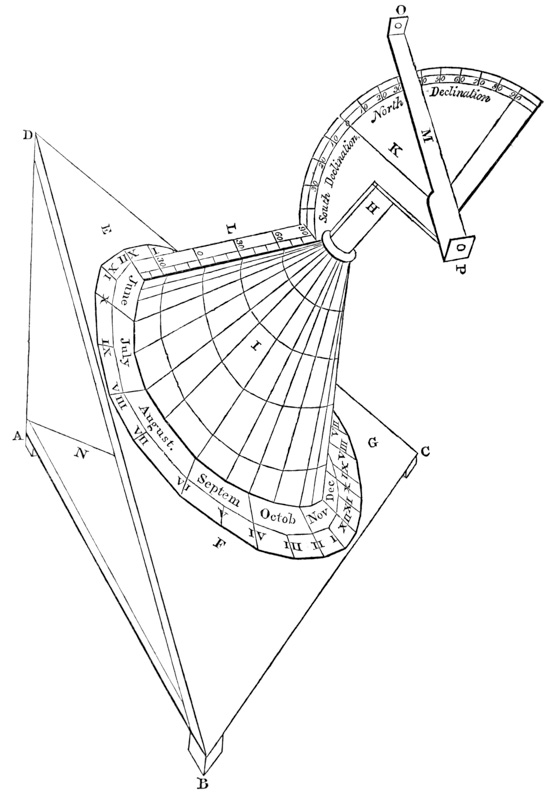
On the top of the pillar is fitted a segment of a circle, K, of [p375] about 140°: viz. 90° of north, and 40° of south declination, which may be made to revolve upon the pillar as an axis independently of the cone. To this part is attached the scale, L, divided into degrees of north and south declination, corresponding to those on the semicircle,—and so contrived as in every situation to touch lightly the surface of the cone.
To the declination circle K is attached the alidade M, which may be set to any degree required, and serves as an index to direct the eye of the observer to any object, which may be viewed along the edge of it, or through the small holes in the sights O P.
Having described the several parts of the instrument, it only remains to shew the use of it; which will be best explained by means of a few problems.
PROBLEM 1. To adjust the instrument.
The instrument being made for the place of observation, need only to be placed on a perfectly horizontal stand, and with the line joining the hours XII and XII on the circle, in the direction of the meridian: the former of these adjustments may be verified by means of a small level applied to the stand at N, in the directions B C and A N successively. If found incorrect in either position, let a piece of card be put under that foot (A, B, or C) from which the bubble is found to recede, and let this operation be repeated until the bubble rests in the middle, in both positions.
The instrument may be brought into the meridian by the assistance of a magnetic needle fixed to the frame at N, or on the opposite side, or more correctly by means of the sun, provided the time be exactly known, thus:—
Set the index M to the sun’s declination, turn the circle K round its axis, till the scale L points to the hour and minute on the circle E F G. Then if the instrument be correctly placed, the sun will be seen through the sights O, P, or what is the same thing, the light admitted at the hole O will fall on the hole P. If not, the instrument must be turned about till this effect is produced.
The instrument being once carefully adjusted to the meridian on any immoveable stand, such as the sill of a window, [p376] the top of a post, &c., lines may be drawn on the stand in the direction of the sides A B, A C, or B C, by means of which it may at any time be replaced with little trouble.
PROBLEM 2. The instrument being correctly placed and levelled, the next operation will be to adjust the conical projection to the day and hour of observation.
Turn the cone round till the day of the month on the circle, at the bottom of it, coincides with the hour and minute on the circle E F G.
Example.—To adjust the cone for the 15th January, at twenty minutes past nine at night. Turn the cone till the 15th January on the circle attached to it coincides with IX h. 20 m. P. M. on the circle E F G.
PROBLEM 3. The cone being adjusted, and any star proposed, to find its place in the heavens.
The cone remaining at rest, turn the declination segment K till the scale L cuts the proposed star on the projection; note its declination on the scale and set the index M to the same degree on the segment K, when the index will point to the star, which, if the adjustments have all been correctly made, will be seen through the sights P, O.
Example.—To find the star Aldebaran; look for Aldebaran on the projection, bring the scale L to cut it, and you will find it against 16° north declination. Set index M to 16° N. P., and look along the edge of it, or through the holes P, O, and you will see the star.
PROBLEM 4. Having observed a star in the heavens, to find it on the projection.
Set the cone as accurately as you can to the day and hour, then turn the declination segment round, and elevate the index till you can see the star through the sights P, O. Note the declination at the segment K, cut by the index M, and against the corresponding degree of the scale you will find the star on the projection.
If no such star can be found, you may then conclude that it is a planet, or a new star.
By this means the place of the moon, of a planet, or a comet, may be noted down, from time to time, and their apparent paths traced out. [p377]
PROBLEM 5. To find the hour of the day by the sun.
Turn the segment K, and elevate the index M, till the sun is seen or shines through the sights O, P, and the scale L point to the hour and minute on the circle E F G.
PROBLEM 6. To find the hour of the night by means of a star.
Direct the index M to the star, so as to be seen through the sights P, O; then laying hold of the scale L, to keep it in that position, turn the cone till the star on the projection is cut by the scale, when the day of the month on the circle at the bottom of the cone will coincide with the hour and minute on the circle E F G.
This instrument, though not capable of extreme accuracy, might, by means of careful workmanship, and the addition of a small telescope, be made sufficiently so for finding stars in the day time; but such a one as that now described will answer all the purposes of a learner, and enable very young people to acquire a correct and extensive knowledge of the stars in a very short time.
The surface of a cone has been adopted for the projection, in preference to that of a globe or planisphere, having been found, after repeated trials, the figure best suited to the nature of the instrument.
An Introduction to the Comparative Anatomy of Animals, compiled with constant reference to Physiology, and elucidated by twenty copper-plates. By C. J. Carus, M.D., &c. Translated from the German, by R. T. Gore, Member of the Royal College of Surgeons in London. ◊
IF we except Sir Everard Home’s splendid work on comparative anatomy, we have no original treatise on that subject which deserves notice; and even Sir Everard’s lectures must rather be considered as a series of essays on detached parts of that branch of science, than as a regular and systematic view of it. We have long been acquainted with the work of Dr. Carus, and have always considered it as a laborious and accurate epitome of the principal facts and authorities in the study to which it relates. From the immense field of inquiry which it embraces, it is necessarily complicated, and [p378] in some places a little obscure, but it is entirely free from those speculative and hypothetical wanderings which are too characteristic of the German school of physiology; and though it contains some systematic notions in which we cannot acquiesce, and a few new words, not the most harmonious in the world, it may very safely and properly be recommended to the student as a text-book, and to the proficient as a work of reference. The plates by which it is illustrated are upon an economical scale, sometimes rather too small to be distinct, but they are otherwise accurate and carefully drawn; and we are aware that it is impossible to obviate these objections without incurring such expense as would probably render the work inaccessible to those readers for whom it is principally compiled.
Mr. Gore has assiduously and faithfully executed the difficult task of translation, and has added no inconsiderable quantity of new and important matter in the form of notes, rendering the English work more complete, and upon many points much more satisfactory than the original.
Experiments to determine the Comparative Value of the principal varieties of Fuel used in the United States, and also in Europe, and on the ordinary Apparatus used for their Combustion. By Marcus Bull. Philadelphia and London, 1827. ◊
THE population of London and its immediate environs may be estimated at about two millions, and the annual consumption of coals within the same district does not fall far short of two millions of chaldrons, or seventy-two millions of bushels. Of this prodigious quantity of inflammable matter, a very considerable portion escapes combustion, and lodges in the form of soot in our chimneys, or is vomited forth to contaminate and cloud the atmosphere of the metropolis: so great is this loss, that independent of the mere advantage of getting rid of smoke, its prevention is an important economical problem; and though the rage for smoke-burning has passed over, we are quite certain that the subject still deserves the most serious attention, being convinced that, of the fuel consumed in the ordinary processes of warming our houses and cooking food, at least one-third is uselessly thrown away, and might be saved by a more economical and scientific construction of common grates and fire-places. All useful and well-conducted experiments, therefore, in [p379] relation to these matters, deserve notice; and though much of Mr. Bull’s essay is not applicable to our case, it contains a variety of interesting facts and information: his experiments appear to have been very carefully conducted, and should be consulted by all those who are engaged in similar investigations.
Meteorological Essays and Observations. By J. Frederic Daniell, Esq., F.R.S. Second Part, 1827. ◊
WE hope to be able in our next Number to enter into a detailed examination of the subject of Mr. Daniell’s inquiries; at present, therefore, our object is merely to announce the second edition of his valuable and laborious essays, and the publication of the present second part, in which, for the convenience of those who possess the former edition, all the new matter is collected. It includes the following essays:—
1. On the Trade winds, considered with reference to Mr. Daniell’s theory of the constitution of the atmosphere; in a letter from Capt. Basil Hall, R.N., F.R.S.
2. On evaporation as connected with atmospheric phenomena.
3. On climate, considered with regard to horticulture.
4. On the oscillations of the barometer.
5. On the gradual deterioration of barometers, and the means of preventing the same.
6. Addenda and notes—among which will be found a valuable table of the elastic force of aqueous vapour, calculated by Mr. Galbraith from the experiments of Dr. Ure, by the formula of Mr. Ivory.