Front matter (continued 4)
Reading edition
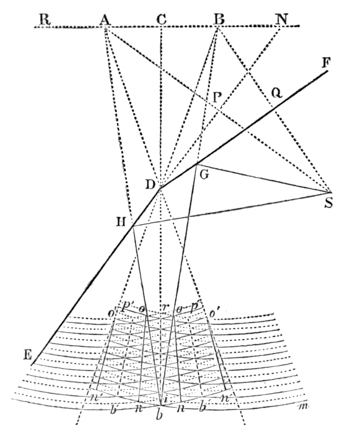
This will be more easily understood by the inspection of a figure, which represents a section of the two mirrors and of the reflected undulations, formed by a plane drawn from the luminous point perpendicularly to the mirrors represented by DE and DF. The luminous point is supposed to be S, and A and B are the geometrical positions of its two images, which are determined by the perpendiculars SA and SB falling from S on the mirrors, taking in them PA = SP [p132] and QB = SQ. The points A and B, thus found, are the centres of divergence of the rays reflected from the respective mirrors, according to the well known law of reflection. Thus, in order to have the direction of the ray reflected at any point G of the mirror DF, for example, it is sufficient to draw a right line through B and G, which will be the direction of the reflected ray. Now it must be remarked, that, according to the construction by which the position of B is found, the distances BG and SG will be equal, and thus the whole route of the ray coming from S and arriving at b, is the same as if it had come from B. This geometrical truth being equally applicable to all the rays reflected by the same mirror, it is obvious that they will arrive at the same instant at all the points of the circumference n′bm, described on the point B as a centre, with a radius equal to Bb; consequently this surface will represent the surface of the reflected undulation when it arrives at b, or, more correctly speaking, its intersection with the plane of the figure: the surface of the undulation being understood as relating to the points which are similarly agitated at the same instant: the points being all, at the commencement of the whole oscillation, for example, or at the middle or the end, completely at rest; and in the middle of each semioscillation, possessed of the maximum of velocity.
In order to represent the two systems of reflected undulations, there are drawn, with the points A and B for their centres, two different series of equidistant arcs, separated from each other by an interval which is supposed equal to the length of a semiundulation. In order to distinguish the motions in opposite directions, the arcs on which the motions of the ethereal particles are supposed to be direct, are represented by full lines, and the maximum of the retrograde motions are indicated by dotted lines. It follows that the intersections of the dotted lines with the full lines are points of complete discordance, and of course show the middle of the dark stripes; and, on the contrary, the intersections of similar arcs show the points of perfect agreement, or the middle of the bright stripes. The intersections of the arcs of the same kind are joined by the dotted lines b′p′, br, b′p′, and those of arcs of [p133] different kinds by the full lines n′o′, no, no, n′o′: these latter representing the successive positions or the trajectories of the middle points of the dark stripes, and the former the trajectories of the bright bands.
It has been necessary to magnify very greatly in this figure the real length of the luminous undulations, and to exaggerate the mutual inclination of the two mirrors, so that we must not expect an exact representation of the phenomenon, but merely a mode of illustrating the distribution of the interferences, in undulations which cross each other with a slight inclination.
It is easy to deduce from geometrical considerations, that the length of these fringes is in the inverse ratio of the magnitude of the angle made by the two pencils which interfere, and that the interval, comprehended between the middle points of two consecutive dark or bright bands, is as much greater than the length of the undulation, as the radius is greater than the sine of the angle of intersection.
In fact the triangle bni, formed by the right line bi, and the two circular arcs ni and nb, may be considered as rectilinear and isosceles, on account of the smallness of the arcs; and the sine of the angle bni, considered as very small, may be called ibbn: so that bn being the radius, ib will represent the sine of the angle bni, which has its legs perpendicular to those of the angle AbB: consequently, these angles being equal, one of them may be substituted for the other; and representing by i the angle AbB, formed by the reflected rays, we have bn = ibsin i; consequently nn, which is twice bn, will be equal to 2ibsin i. But nn is the distance between the middle points of two consecutive dark stripes, and is the distance which has been called the breadth of a fringe; and ib being the breadth of a semiundulation, according to the construction of the figure, 2ib will be that of a whole undulation; consequently the breadth of a fringe may be said to be equal to the length of an undulation divided by the [numerical] sine of the angle made by the reflected rays [p134] with each other, which is also the angle under which the interval AB would appear to an eye placed at b. We find another equivalent formula, by remarking that the two triangles, bni and AbB, are similar, whence we have the proportion bn: bi = Ab : AB, and bn = bi × AbAB, or 2bn = 2bi × AbAB: which implies that we may find the numerical breadth of a fringe by multiplying the length of an undulation by the distance of the images A and B from the plane on which the fringes are measured, and dividing the product by the distance of the two images.
It is sufficient to inspect the figure, in order to be convinced of the necessity of having the two mirrors nearly in the same plane, if we wish to obtain fringes of tolerably large dimensions; for in the little triangle bni, the side bi, which represents the length of a semiundulation, being little more than the hundred thousandth of an inch for the yellow rays, for example, the side bn, which measures the half breadth of a fringe, can only become sensible when bn is very little inclined to in, so that their intersection may be remote from ib; and the inclination of bn to in depends on the distance AB, which is the measure of the inclination of the mirrors.
If A and B, instead of being the images of the luminous point, were the projections of two very fine slits cut in a screen RN, through which the rays of light were admitted from a luminous point placed behind the screen in the continuation of the line bDC, the two paths described between the point and the slits A and B being equal, it would be sufficient to compute the paths described by the rays, beginning from A and B, in order to have the differences of their lengths; and it is obvious in this case, that the calculations which we have been making of the breadth of the fringes, produced by the two mirrors, would remain equally applicable, at least as long as each slit remained narrow enough to be considered as a single centre of undulation, relatively to the inflected rays which it transmits. It may therefore be said that the breadth of the fringes, produced by two very fine slits, is equal to the length of an undulation supposed [p135] to be multiplied by the interval between the two slits, and divided by the distance of the screen from the wires of the micrometer employed for measuring the fringes.
This formula is also applicable to the dark and bright stripes which are observed in the shadow of a narrow substance, substituting the breadth of this substance for the interval which separates the two slits, as long as the stripes are far enough from the edges of the shadow: for when they approach very near to the edges, it is shown, both by theory and by experiment, that this calculation does not represent the facts with sufficient accuracy; and it is not perfectly correct in all cases, either for the fringes within the shadow, or for those of the two slits, but only for the fringes produced by the mirrors, which exhibit the simplest case of the interference of rays slightly inclined to each other. In order to obtain from the theory, a rigorous determination of the situation of the dark and light stripes in the two former cases, it is not sufficient to calculate the effect of two systems of undulations, but those of an infinite number of similar groups must be combined, according to a principle which will shortly be explained, in treating of the general theory of diffraction.
ii. Rule for the Correction of a LUNAR OBSERVATION. By Mr. WILLIAM WISEMAN, of Hull. ◊
RULE.
ADD together the reserved logarithm (found as directed, page 111 and 112 of the Appendix to the third edition of the Requisite Tables) the log. sines of half the sum, and half the difference of the apparent distance, and difference of apparent altitudes, and 0.3010300, the log. of 2. Then, to the natural number corresponding to the sum of these four logarithms, add the natural verse sine of the difference of true altitudes, and the sum will be the natural verse sine of the true distance.
Or, having obtained the natural number, as directed above, subtract it from the natural cosine of the difference of the true altitudes, and the remainder will be the natural cosine of the true distance. [p136]
EXAMPLE.
(From page 112, Appendix to Requisite Tables.)
Reserved log. from Tables (Req.) 9th and 11th 9.9938860
Log. sin. 43° 23′ 5″ = 12 sum of app. dist. and diff. app. altitudes 9.8368895
Log. sin. 6° 45′ 36″ = 12 diff. ditto ditto 9.0708157
Log. of 2 0.3010300
Nat. num. to sum of 4 logarithms .1594488 9.2026212
Nat. vers. 37° 13′ 12″ = diff. true altitudes .2036812
Nat. vers. 50° 26′ 28″ = true distance .3631300
Or, Nat. cos. 37° 13′ 12″ = diff. true altitudes .7963188
Nat. number found above .1594488
Nat. cosin. 50° 26′ 28″ = true distance .6368700
DEMONSTRATION OF THE RULE.
Let M′, S′, D′, d′ and M, S, D, d, respectively denote the true and apparent altitudes, distances, and differences of true and apparent altitudes of the moon and sun (or a star); then will the theorem answering to the above rule be expressed by vers. D′ = 2 cos M′ cos S′cos M cos S × sin12(D + d) × sin12(D−d) + vers. d′.
By Bonnycastle’s Trig. p. 175, the cosine of the angle contained by the co-altitudes is cos D−sin M sin Scos M cos S = cos D′−sin M′ sin S′cos M′ cos S′; consequently the verse sine of the same angle = 1−cos D−sin M sin Scos M cos S = 1−cos D′−sin M′ sin Scos M′ cos S′; that is, cos M cos S+sin M sin S−cos Dcos M cos S = cos M′ cos S′+sin M′ sin S′−cos D′cos M′ cos S′.
Substituting cos d and cos d′ for cos M cos S + sin M sin S and cos M′ cos S′ + sin M′ sin S′. (Bon. Trig. p. 282), we have cos d−cos Dcos M cos S = cos d′−cos D′cos M′ cos S′; whence cos D′ = cos d′−cos M′ cos S′cos M cos S × (cos d−cos D); or, which is the same, cos D′ = cos d′−cos M′ cos S′cos M cos S × (vers D−vers d); or, (Bon. Trig. p. 286.) [p137] cos D′ = cos d′−cos M′ cos S′cos M cos S × (2 sin212D − 2 sin212d); that is, cos D′ = cos d′−2 cos M′ cos S′cos M cos S × sin12(D + d) × sin12(D−d); whence also vers D′ = vers d′ + 2 cos M′ cos S′cos M cos S × sin 12(D + d) × sin12(D−d).
It may be observed, that Requisite Tables 9–11, answer logarithmically to cos M′ cos S′cos M cos S; and the verse sines, and the cosines can be very readily taken out of the tables in the Appendix. Also no ambiguity can arise from the application of the rule before given: for all the arcs concerned in the operation will always be (each of them) less than a quadrant, except the resulting true distance, which cannot cause any ambiguity; and the verse sines are given in the Appendix, to 126°.
EXAMPLE.
(Example 2nd, p. 39, Requisite Tables.)
Reserved log. from Tables 9 and 10 9.995307
Log. sin 62° 45′ 56″ = 12 sum app. dis. and diff. app. alts. 9.948971
Log. sin 40° 43′ 31″ = 12 diff. ditto ditto 9.814536
Log. 2 0.301030
Nat. num. corres. 1.147741 0.059844
Nat. vers. 22° 48′ 16″ = diff. true alts. 0.078167
Nat. vers. 103° 3′ 23″ = true distance 1.225908
De l’Influence des Agens Physiques sur la Vie. Par W. F. Edwards, D.M., Membre associé de l’Académie royale de Médicine de Paris, Membre de la Société Philomatique, de la Société de Médicine de Dublin, &c. ◊
THE researches of science among the phenomena of the physical world have long obtained a high degree of estimation and interest in general society; but it is of late years only that their application to living functions has attracted much of the attention of the literary world.
The laws which govern the action of animal organs (the proper department of Physiology) have usually been investigated by the medical profession, to which they especially [p138] refer. Now we find the public take some pains, and with reason, to inform themselves upon subjects connected with physiological knowledge. A well-educated person, disposed to philosophical inquiries, is not merely contented with the consciousness of living, and the common information he derives of its means by experience, but he seeks also to comprehend the relations subsisting between his own organisation and the matters with which he is surrounded, and which at once furnish him with nutrition, life, and support, and assail him with disease and annihilation. His own instincts and observation, joined to the more learned experience of his medical advisers, help him through the precarious stages of life, and these may perhaps be sufficient for all its purposes; and under this impression many will seek to know no more of the secrets of nature.
But we live in an inquiring and scrutinising age, when the demand for scientific principles is very generally urgent. All, therefore, relating to organisation seems of equal interest with that appertaining to what is termed the physical creation or inert matter.
Under this impression we have perused the book before us with great satisfaction, and propose to present our readers with an analysis of the valuable materials which it contains. We have some knowledge of Dr. Edwards, a countryman domiciliated in France, and long resident in Paris. We have confidence in his reports, and highly estimate his philosophical skill, extensive acquirements, and accuracy of observation, ranking him among the first physiologists of the age.
The work, now under consideration, contains an elaborate account of a long series of experiments, instituted for the purpose of ascertaining the influence of the physical agents upon animal life. These agents comprehend the atmospheric air, water, and temperature; the two first constituting the media in which all animals exist, and the last influencing in common the inhabitants of both media. It is true, this is a subject by no means new, for it has engaged the attention of experimenters from the earliest days of science. But Dr. Edwards has diligently and patiently sought to investigate the subject himself, to correct previous errors, and to embody the facts which he has accumulated into a more complete and regular system than heretofore adopted. In this attempt he has been eminently successful, and has effected more perhaps than all who preceded him, availing himself, nevertheless, of the experience of former inquiries.
The extent of his book, and the number of the experiments [p139] are indeed somewhat appalling, but his clear and distinct method of arrangement greatly facilitates the reader’s endeavours to master the extensive subjects of his pages. As a book of reference it should find a place in the library of every scientific society, and no individual devoted to philosophy should omit the possession of it.
The agency of the air around us, water, and heat and cold, have often been the objects of chemical inquiry, from their known great influence upon the animal economy. The changes effected by the phenomena of animal life upon these agents have been accurately examined, and partly reduced to a mathematical precision of calculation.
Spallanzani and others have viewed the subject as it regards physiology, but with such results as left the field open to subsequent investigation. Dr. Edwards seems to have seized upon the deficiencies of his predecessors, and, by going over their ground, and extending his own inquiries, he has arrived at most interesting and important results. These he has divided into four parts, as they relate to the different orders of the animal creation. The first part includes some of the lower animals, particularly tenacious of life, and of cold blood, such as frogs, toads, and salamanders. The second part is devoted to other animals of cold blood, and of the vertebrated order, as fish, and those reptiles which include lizards, snakes, and turtles. The third part refers to warm-blooded animals; and the fourth part of the work is dedicated to the influence of the physical agents upon the human race and vertebrated animals. To these the author has added the discoveries of modern times, relative to electricity on the animal economy, in an Appendix. A collection of tables is appended to the work, exhibiting the principal series of his experiments, as they regard the relative influence of physical agents on the duration of life, and the phenomena resulting from their mutual action.
The great importance of the four grand divisions of the work forbids our hastily reviewing them, and we will endeavour to condense so much of the information they contain as may forward the objects of our analysis. Dr. Edwards thus announces the arrangement of his work:—
“Ces recherches auront donc rapport à l’air dans les conditions de quantité, de mouvement et de repos, de densité et de raréfaction; à l’eau liquide et à la vapeur aqueuse; à la température, dans ses modifications de degré et de durée; à la lumière et à l’électricité. Ces causes agissent à la fois sur l’économie animale, ordinairement d’une manière sourde et imperceptible; et toujours [p140] l’impression qu’on reçoit est le résultat de toutes ces actions combinées.”
“Lors même que, par l’intensité de l’une d’elles, il nous arrive de distinguer la cause qui nous affecte, l’observation de l’effet se borne le plus souvent à la sensation, et les autres changemens qui l’accompagnent nous échappent. On conçoit par la que l’observation la plus attentive des phénomènes tels que la nature nous les présente, ne saurait démêler dans cette combinaison d’actions l’effet propre à chaque cause, ni reconnaître des effets qui ne seraient pas révélés par la sensation.
“Il est une méthode qui règle les conditions extérieures, qui fait varier celle dont on veut apprécier l’action, et qui fait juger, par la correspondance entre ce changement et celui qui survient dans l’économie, du rapport de cause et d’effet: c’est la méthode expérimentale; c’est celle que j’ai suivie. Pour en tirer parti il fallait, d’une part, déterminer l’intensité de la cause, d’autre part celle de l’effet. La physique nous fournit ordinairement les moyens de remplir la première indication.”
In the true spirit of philosophical investigation, Dr. Edwards, in the first place, proceeds to examine the action of physical agents upon the simplest forms, and least elaborately developed organised beings, extending his inquiries upwards, in the scale of the animal world, to man, the most perfect creature, and the ultimate object of all physiological researches.
The peculiarity of constitution belonging to cold-blooded reptiles, among which there is so little mutual dependance of organs, renders these the best tests of the relative and proportionate influence of the different agents, the intense action of which is liable to destroy the more perfect animals; and the great development of the nervous system in the higher orders gives them a wider and more acute range of sensibility. It is difficult, at all times, and often impossible, to insulate corporeal functions among the warm-blooded classes, so as to ascertain the amount and limits of physical agency. The four classes of vertebrated animals, or such as are furnished with true spines, afford ample means of comparative illustrations; and these departments have engaged the author’s attention, in order to display the result of the action of the same agent exercising a uniform influence upon constitutions very differently constructed. The air, for example, exercises its influence uniformly upon he four mentioned classes of vertebratæ, and their different families are similarly exposed to the action of the atmosphere by respiration.
Curious and interesting as is this subject, it is singular [p141] that, while it was among the first to be noticed, it has been the latest in producing satisfactory results. Among the opposing causes of the advancement of knowledge in this department, the ignorance of our ancestors in chemical science seems to be the principal. Without chemical aid it is perfectly useless to attempt the investigation. The composition of the air respired must be well understood; the different gases must be carefully examined, or the physiological inquiry will be darkened and obscured.
Dr. Priestley laid the foundation of our chemical knowledge of gases in their relation to respiration; but some time elapsed before it was understood in what manner the air was connected with animal organisation. Oxygen gas, one of the known constituents of atmospheric air, was Priestley’s discovery, in its effect upon the blood, of converting this fluid from a dark purple to a bright crimson. Lavoisier founded a chemical theory upon this discovery of the agency of air, which was subsequently applied by Goodwin to physiology. The latter author demonstrated, by a series of excellent and correct experiments, that the exclusion of atmospheric air produces death in animals, in consequence of the dark-coloured blood usually circulating in the veins being prevented from becoming crimsoned. The state in which any animal may be thus placed, is known by the term ASPHYXY, and by which is to be understood a deficient or suspended aërification of the blood, from whatever cause it may proceed that the atmospheric air is prevented from access to the blood as it circulates through the lungs.
The great French anatomist, Bichat, pursued this subject still farther, and published a treatise on Asphyxy. He sought, by numerous experiments, to determine the threefold relation of the air to the nervous system, respiration, and the circulation; and he arrived at this great and important conclusion, that the VENOUS OR DARK BLOOD CIRCULATING THROUGH THE BRAIN, CREATES A CESSATION OF THE FUNCTIONS OF THAT ORGAN, AND THAT IN CONSEQUENCE THE HEART LOSES ITS ACTION. This discovery shows us at once the direct cause of asphyxy in all its different degrees, according, in effect, to the vitiated state of the blood from its deficient or suspended aërification.
Le Gallois also investigated the subject of asphyxy; and he found that, when dark blood circulated through the spinal marrow, the motions of the heart ceased; and thus he not only determined the relations of the nervous system to atmospheric air, but also those of the respiration and the circulation, [p142] explaining the action of the air upon animals physiologically.
In this inquiry warm-blooded animals were almost exclusively referred to.
Spallanzani certainly investigated the action of the air on animals of cold blood, but less in relation to the three grand objects of Bichat and Le Gallois; and Spallanzani had the misfortune to live in an age when neither chemistry nor physiology had made such advances as the present age has produced.
Messrs. Humboldt and Provençal have, indeed, supplied much of this deficiency, by their researches into the respiratory functions of fishes. Nevertheless, the ground was still open, and our author has justly appreciated the extent of former inquiries, and observed that the phenomena of cold-blooded animals were too extraordinary to be noticed lightly, and required much more extensive observation than was previously bestowed upon them. With this impression, he proceeded to form an estimate of the comparative influence of the air and water upon the nervous and muscular systems of cold-blooded animals, which the singular modifications of life among reptiles in particular afford ample means of ascertaining.
We know that these animals possess the extraordinary property of existing a considerable time after the removal of the heart, with the free exercise of their senses and of voluntary motion, notwithstanding the suppression of the circulation. Dr. Edwards accordingly selected salamanders for his first investigations, and removed the heart, with the bulb of the aorta. Two of these were exposed to the free action of the air, and the other two were submersed in water previously deprived of air by boiling; a similar temperature being maintained in each medium. In four or five hours, those submersed in the non-arëated water ceased to be active, unless irritated, when they still appeared to retain voluntary power. One died in eight, and the other in nine hours. The salamanders in air lived from twenty to twenty-six hours and upwards. These comparisons were frequently repeated, and upon frogs and toads, with the same results, showing the experiments in air to be far more favourable to their existence than with the animals submersed in the water. Eight hours were about the maximum of the duration of life among the animals submersed in the water, and twenty-nine among those exposed to the air; so that, independently of respiration, the air is thus proved to be the most proper [p143] medium for the action of their nervous and muscular systems, in their insulated state, the respiration and the circulation of the blood being both suspended. As a further corroboration of the superior vivifying property of the air over simple water, when the same animals were plunged into unaërated water during a certain time, as soon as they were, removed into the atmosphere, they instantly revived; and their nervous and muscular systems were acted on according as they were placed in either medium. Dr. Edwards also confirmed the observation of Goodwin relative to the effect produced on the colour of the blood. Properly speaking, the asphyxy comes on the instant the air is excluded, the shades of difference in the colour of the blood being referrible to the air left in the lungs after cessation of respiration.
The next point to determine was the influence of the air upon the same animals exercising the respiratory function, and retaining their circulation, compared with those deprived of these functions.
The difference of time in the two cases developes the influence which the general circulation of the blood, free from aërial contact, exercises upon the nervous system.
To ascertain this point, an equal number of frogs, deprived of the power to exercise their respiratory and circulating functions, together with others left entire, were respectively plunged into disaërated water. At times the difference in favour of the untouched animals was twenty-four hours in favour of the duration of life. Similar trials with toads and salamanders produced the same results. In each case asphyxy came on; but the existence of the animals which lived without the respiration and circulation was much shortened. Thus the relative powers of life between the sole and insulated action of the nervous system, and its action combined with the circulation of dark blood, were estimated. The inference to be deduced, therefore, is, that although disaërated blood furnishes but an ephemeral sort of existence, it nevertheless exercises a comparatively favourable influence upon the nervous and muscular systems, since it tends to the prolongation of the action of these animal functions.
Dr. Edwards next proceeds to investigate the phenomena of asphyxy produced by strangulation, or the mechanical obstruction to the access of air to the lungs, and consequently to the blood. The same animals were employed. When the windpipe was rendered impervious by ligature, the muscles of the animals seemed to be paralysed directly; and although their motions became subsequently revived at times, [p144] they never altogether recovered their perfect freedom. As a comparative illustration, an equal number of frogs were submersed in water, all of which died in about ten or eleven hours, while those which were strangled lived from one to five days. Salamanders continued active longest, and one did not cease to exist till the eleventh day, although during this time he was in a complete state of asphyxy from perfect strangulation.
Dumeril once found that a salamander lived a long time after decapitation, even when the cicatrix of the wound was healed so as to stop all access of air to the lungs.
In comparing the effects of strangulation with those of submersion or drowning, it is to be supposed either that these animals exist a limited period without the necessity of the nervous system being in contact with atmospheric air, or that the air influences their blood through the integuments of the body. Accordingly Dr. Edwards put this to the test by making experiments upon cutaneous respiration.
Spallanzani found that the exposure of cold-blooded animals to the air was attended with exudation of carbon, a phenomenon similar to that of respiration. There appears, however, to be some source of error in these experiments, for Spallanzani removed the lungs, and this operation rendered the animal liable to the absorption of air and loss of blood. Dr. Edwards sought to effect the same purpose by a different and more successful measure. He also confined frogs in vessels of atmospheric air, and fastened bladders round the head and neck, tight enough to stop the entrance of air to the lungs. At the expiration of two hours the air was examined in the bladder, and it was found to contain an excess of carbonic acid. The same result was obtained from salamanders. It appears, therefore, that while air is in contact with the skin, carbon is given out; but whether this be the effect of exhalation merely, or that oxygen is actually absorbed, and carbon transpired, is a question which led to further inquiries. Dr. Edwards, therefore, inclosed cold-blooded animals in solid substances, in order to determine the influence of dark-coloured blood, free of all external agency, in the production of chemical changes, and to observe its sensible effect upon the nervous system.
In the year 1779 three toads were confined in a box hermetically sealed, and so deposited in the Academy of Sciences. Eighteen months after, the box was opened, and one toad was found dead. These animals have been found alive in blocks of coal after an imprisonment of some years, and have [p145] also been sealed up during similar periods without perishing. Possibly some hole or crevice might have admitted a little air. But, in Hevissant’s experiment of 79, care seems to have been taken to obviate this suspicion.
Dr. Edwards, however, determined to put the question to the test. He enclosed ten out of fifteen frogs in thick wooden boxes, and filled the interstices with plaster, covering them over with the same substance, the toads lying each in a central hole or bed. The other five toads were at the same time submersed in water, and at the expiration of eight hours they were found to be dead. In sixteen hours more, one toad was taken from a box and found to be lively, and was reconsigned to its prison. On the sixteenth day the toads in the boxes were discovered alive, and thus the fact was established that these animals can live far longer in a state of asphyxy confined in solid substances, than when submersed in water. This was confirmed by repeated trials on salamanders, frogs, and toads. The frogs perished quickest.
Thus an extraordinary fact is established, as regarding reptiles, since it affords an exception to the general rule that all animals require a CONSTANT supply of fresh air for the maintenance of their existence.
Similar trials were repeated in sand, and with the same results.
Dr. Edwards found that although a certain quantity of air enters the boxes and sand, yet that it is far too little to maintain life. His conclusion, therefore, stands, that animals of the kind employed can live longer in solid substances than in a limited quantity of dry air.
It remains, however, to be considered in what manner these animals have their lives extended beyond those exposed to the action of a body of air. Dr. Edwards supposes the moisture of the sand to be one cause, since in the dry air the animals become desiccated, the cutaneous transpiration being lost in one case, and retained in the other, by the exclusion of air. A rapid and abundant transpiration from the body, united with deficiency of air, seems to be a greater cause of dissolution than confinement in solid substances wherein there is no waste by transpiration.
The author’s inquiries are next directed to the influence of temperature upon animals of cold blood, and two and forty experiments are practised upon this subject, from the month of July to September following, during which period frogs were submersed in aërated water, with a view of settling the duration of life, acted on by varieties of temperature. The [p146] continuance of life, generally, in these experiments, varied from one to two hours and twenty-seven minutes. The mean term of life was one hour and thirty-seven minutes, as averaged in July, and in September one hour and forty-five minutes, the two extremes of the seasons approximating the effects. The duration of the frog’s existence was greatest in the greatest depression of temperature. Thus at ten degrees the duration of life was more than double what occurred at sixteen or seventeen degrees, and at zero it was about triple. As the heat was increased, the duration of life was diminished; at forty-two the frogs died, and in the lowest temperature they lived longest.
It appeared that at zero the frogs did not become stiffened, but retained their motion, and their resistance to the frozen state is the cause of the continuance of their existence at a low temperature. The cause of this resistance is to be found in their peculiarity of constitution. Toads produced similar results.
It may be alleged that frogs naturally live in climates at from forty to forty-two; but, it is to be observed, that they are then placed in a situation of liberty to come to the surface of the water to respire when they please; whereas in these experiments their respiration is limited, from their inability to reach the surface.
Taking a wider range of temperature, Dr. Edwards sought to ascertain the influence of the seasons. In July and September frogs were found to live from one to two hours and twenty-seven minutes in aërated water at fifteen and seventeen degrees. In November they died at the end of more than double this period, under the same temperature, and all other circumstances being similar excepting the season. As the autumn advanced life was prolonged.
To what are we to ascribe the modifications of the seasons? Probably to circumstances appertaining to the intensity of light, to electricity, to temperature, to the pressure of the atmosphere, to dryness and moisture, &c.? Such existing causes naturally suggest themselves. But it appears that little or no account can be rendered as to pressure, since its variations were too trifling during the two seasons. Moisture could not effect an influence, because the experiments were performed in water. The motion of the air was also obviated. Of all the suggested modifications temperature alone acted, and this, as it related to the surrounding air, was rendered ineffectual by artificial temperature. The animals, therefore, could only be affected as to the temperature of the [p147] seasons by that which preceded the experiments. The modifications of the seasons, therefore, appeared to influence the cold-blooded animals used in the experiments in this point of view only. Accordingly we have this remarkable result, that the animals lived twice as long in autumn as in the summer preceding, when plunged in water of equal temperature. The seasons evidently influence their constitutions, so as to extend the duration of life independently of other causes, that is, from summer to autumn. Dr. Edwards endeavoured to ascertain if it proceeds from atmospheric temperature, and he found that frogs lived in aërated water at ten degrees, during November, from five or ten to eleven, and even to forty hours, in some instances, the last term being about double the duration of life in water of the same degree in summer. This proves the remarkable dependence of the frog’s life under water, and the temperature of the month preceding. Two curious facts are thus developed by experiments instituted at different seasons. First, the influence of the temperature of the water in which the animals were placed; and secondly, the influence of the temperature of the air during certain periods preceding the experiments, for in autumn the duration of life was about double that of summer, and in winter he found the term to equal autumn, the temperature of the air being in each comparative experiment artificially raised to the same degree.
It appears from the foregoing experiments that frogs, toads, and salamanders, exist in water according to its lowness of temperature, and that their lives are prolonged by the temperature which precedes the experiment being lowered. It then becomes a question, what are the limits of this influence? This is to be ascertained by observing the greatest duration of life among animals deprived of external air by submersion in water; and noticing at the same time all the favourable circumstances dependent on the concurrent temperature in prolonging life among the cold-blooded animals.
A point relative to the natural history of frogs first presents itself to our notice. Spallanzani is of opinion that frogs do not pass the winter under water, but retire in October from their native rivers into moist sands, in which they make openings to breathe the air through, called by the Italian fishermen il respiro della ranà.
M. Bose, and other French naturalists, found that frogs retire from October to spring into water, but they give us no direct proof that they constantly remain submersed. The presence of the observer may alarm the frogs, and thus prevent [p148] their putting their heads above the water, so that the assertion is but a negative kind of proof that they remain so long under the water without coming up to respire, as some affirm. M. Bose declares he watched frogs approach the surface at regular periods every day during the winter season. Under the most favourable circumstances Dr. Edwards found that frogs could not remain submersed, in winter, more than two days and a half. Frogs are less active during winter than at the other seasons, but they never lose their motion. Were it true, as Spallanzani thinks it is, that they remained so long under water, it is probable that they would become frozen in winter and die. Spallanzani derives his opinion from what occurs with fish, forgetting that frogs are amphibious, and live as well on land as in water; whereas fish are limited to a watery medium, and can, therefore, furnish no example.
Dr. Edwards found that frogs, placed in certain quantities of aërated and non-aërated water of an equal temperature, lived longest in the former; but that the difference was not constant in its results, being often twice as long in one case as in the other, as to the duration of life.
The next inquiry regarded stagnant water renewed at intervals, and in this the duration of life was prolonged beyond the term of the last experiments, and even to eight days. During winter when the temperature was lowest the frogs remained active, though less so than in spring.
The conclusions to be drawn from these experiments are, that frogs pass the winter in an animated state in water, not becoming stiffened as in ice, and that they need not to approach the surface of the water in order to respire, provided the water they inhabit be renewed at intervals; but if the water be not renewed, or if disaërated water be employed, the frogs perish.
Considering that these animals are truly amphibious, these results are very curious; and it is interesting in a physiological point of view, to know that frogs are able to respire the air contained in the dense medium of water for an indefinite period, and just as easily as they breathe the finer medium on land.
Respecting the action of aërated water on the skin, the conclusion drawn seems to be correct, that it must be from cutaneous absorption that the air contained in the water promoted the continuance of life in Dr. Edward’s experiments upon this point, since the animals were in a state of asphyxy regarding respiration by the lungs; and that no [p149] air entered in combination with water was shewn from Dr. Edwards never having seen water in the lungs. Therefore, unless the air acted on the blood through some other organ, the lives of these animals would be definite and shortened, even though the water be renewed from time to time, and their asphyxy would be complete and continued. And since the skin is the only organ in contact with the air, it is fair to conclude that it is the medium of aërial absorption.
When the webs were examined under water, these membranes indicated the action of air upon their blood-vessels, by the bright tint of the blood.
Spallanzani imagined that frogs perish sooner in running than in stagnant water; but Dr. Edwards having secured some of these animals in ten feet of the Seine, whilst others were simultaneously placed in unrenewed stagnant water, he found the latter did not survive many hours, and the former lived a long time.
In order to fix the limits of this kind of existence, frogs were placed in renewed aërated water, and with a temperature never forced beyond ten degrees they were found to live in all seasons of the year; but when the temperature was elevated from twelve to fourteen, they died in a few hours. In running streams they lived longest, and at twelve degrees they were thus more favourably placed than in stagnant water, at a lower temperature even, and taking the precaution to renew the water daily; and at seventeen degrees in running water they died prematurely. Toads exhibited the same comparative results, but they lived the longest.
It appears, therefore, that water contained in vessels is less favourable to the lives of these animals than running streams, although the water and the temperature were identical. Probably the great advantage of running water is its constant and unceasing renewal. The separate and comparative influence of air, water, and temperature, being thus investigated, the combined action of the three physical agents was next inquired into, and it is demonstrated that frogs submersed in water are influenced by three circumstances,—1. the presence of air in water; 2. the quantity of its renewal; 3. the temperature of the medium. If the manners of frogs be closely examined, they appear to live in water under very considerable influence from the atmosphere.
From circumstances developed in the foregoing experiments, cutaneous respiration seems to be pretty evidently indicated. A chapter is, therefore, devoted to this subject, one that is not well known, although pulmonary respiration is [p150] generally understood. In frogs, the function of pulmonary respiration is united with that of deglutition, and the air enters only by the nostrils, the mouth being closed during respiration. While the mouth remains open, the action of deglutition is stopped, and, therefore, the animal does not then breathe. Dr. Edwards availed himself of this circumstance by gagging the mouth so as to keep it open, and thus prevent the air from entering the lungs. The frogs were sufficiently exposed to moisture and renewal of air to their bodies: the results were, that, at twenty-four degrees, five frogs so placed died next day, and one lived a week.
Dr. Edwards immersed some frogs in wet sand, and adopted an improved method of excluding air from the lungs, and some of them lived twenty days. Hence it evidently appears that air influences the skin materially, and counterbalances the asphyxious state induced by obstructing the air’s passage to the lungs. By adopting other methods, the existence of frogs was prolonged to thirty or forty days. It is, therefore, sufficiently proved that the blood undergoes its necessary changes from atmospheric influence through the medium of the skin, although in a minor degree compared with those which it passes through from pulmonary respiration. Frogs are thus shewn to possess a double source of respiration.
By substituting oil for water, frogs immersed in this fluid died in a few hours, being at liberty to breath the air on its surface. And, when plunged into oil, with the means of breathing by the lungs arrested, they lived an equal time with frogs simultaneously placed in water without power to respire. A comparison was instituted with frogs in oil and in water, being allowed to breathe air, when the difference was found to be very considerable in favour of the aquatic bath. These circumstances shew, that, even with the feeble succour of the air through the skin, absorbed from the water, the respiratory function was far more prolonged, than in the case of the obstruction afforded by the oil. Thus we have abundant evidence of the double function by which frogs are maintained, from the action of the air on the skin and the lungs; and this appears to be the means of existence among amphibious animals generally.
It may be asked why these animals die in deep water when prevented from approaching the surface? It appears that, having expelled the respired air from their lungs, which is imperfectly renewed from the water, they become specifically heavier than the water, and unable to rise from the bottom; and thus placed, the duration of their lives depends upon [p151] the resistance offered by their constitutions to the depressing effects of a state of asphyxy while remaining submersed.
Dr. Edwards next proceeds to inquire into the effects of TRANSPIRATION. A liquid transfusion from the skin of animals is constantly going on, either in the form of vapour or of fluid in a denser state.
The latter constitutes sweat. This phenomenon exhibits great variations, and it is important to know what diminution of weight the body suffers in different circumstances. In the course of an hour remarkable fluctuations occur.
Dr. Edwards suspended frogs, toads, and salamanders, in a calm air, weighed them, and noted the results, which, though very changeable in an hour, were generally uniform in three, and in nine hours they averaged an equal result. The successive diminution in the mass of fluids was evident.
The results were modified by the alternate position of the animals in a body of air in repose, or agitated by a draft. And these results do not appear to depend upon any principle of vitality, for they take place equally in death and in life, and indeed among unorganized bodies, as, for example, lumps of charcoal soaked in water. Therefore the cause of the phenomenon of transpiration seems to be referrible entirely to physical agents. The motion of the air seems to be its exciting cause; for even when, to all appearance, it is calm, it is in reality agitated more or less, and produces a sensible evaporation from the skin. But the difference between the effect of calm and agitated air is remarkable; for in a draft, the animals exposed to it sweated away double the quantity of liquid compared with those confined in a room shut up. The amount lost was proportioned to the intensity of the wind, and reached a triple amount over those animals in stagnant air; and this fact explains the variations noticed from hour to hour among animals exposed to currents of air.
The transpiration which occurs in very moist air, always amounts to a diminution of weight; but in dry air it is five or ten times greater; and when the influence of a moist state of the atmosphere is compared with that of a dry state, the amount of evaporation is equal to that of a dry and calm air.
Transpiration may, therefore, be referred to the agitation of the atmosphere for its exciting cause, beyond any modifications of its density. And, although an elevated temperature be favourable to transpiration, its modifying influence is less than that of other causes.
In comparing the effects of absorption and transpiration, [p152] in water and in air, frogs were found to gain an addition to their weight according to the term of their continuance in the former medium. An absorption of water was rendered evident by the loss of bulk it had sustained, when measured after the experiment.
Thus, when the comparative influence of water and air is estimated, the former appears to be absorbed, and adds to the weight of the body; and the latter tends to diminish the weight, by different and fluctuating degrees of evaporation taking place, and dependent much more on the degree of motion in the air, than on its dryness or humidity: these last conditions modify evaporation in a minor degree, when compared with the influence of a current of air.
The celerity of absorption exceeds that of transpiration six times, in the most rapid cases. It therefore results, that the losses by transpiration in air should be repaid by absorption of water in a much less time than the expenditure occurs. But the decrease of weight is not prolonged; it is sudden, and not continuous, alternating with augmentation of weight, by absorption of liquid going on in a ratio superior to the loss; and thus nature’s provision is manifested for the nutriment of the body.
With this last inquiry Dr. Edwards concludes the first part of his work; and it is observed, that, with regard to transpiration, the losses of weight have been considered without reference to the existence of any other influence than water. The losses by transpiration have been examined generally without regard to the matters lost. What relates to water differs essentially in one respect from that which regards the air. The losses sustained by the body ought to be more particularly examined. Temperature and loss of time require estimation. An excretion of solid matter evidently takes place; for the water, in which animals are submersed, becomes turbid, especially in hot weather, and it sensibly contains animal matters, affecting the weight of the body in water.
When animals are submersed in water, their skins exercise two functions, acting inversely in determining their weight. And it results, from comparative experiments, that the absorption at zero exceeds the loss in water; while at thirty degrees the loss exceeds the increase by weight from absorption; and the higher the temperature, the greater is the excess in the discharge of animal matters. We may therefore presume, that the agency of temperature produces analogous effects, upon aërial transpiration, to those before observed [p153] in other inquiries; and the effects of dryness and moisture in the air produce a minor degree of influence also, when compared with temperature, on the losses of animal substances.
We have been thus minute in our analysis, because the subject of it is new to science in its present shape, and of a high degree of interest. Dr. Edwards’s researches among the different classes of animals have tended more to the illustration of the influence of physical agents upon life than any previous authorities; and the persevering industry, accuracy of observation, and patient inquiry which he has evinced in his investigations among cold-blooded animals, have placed this department of the creation in a point of view at once curious, interesting, and valuable to science. We attach the greater importance to this part of the author’s work, as it is a ground on which he may be consulted, and quoted as indisputable authority, until equal inquiries have shewn him to be fallacious.
Our limits will not at present permit us to proceed farther in our analysis, and we must refer the remainder of the book to a future opportunity. The subjects of the three other parts, though greatly extended, will not probably require such minute analysis as those novel experiments which form the subject of the first part; but we imagine that the application of the principles laid down, in the previous inquiries, to human physiology, will be found not less interesting than those which relate to the natural history of the lower orders of the animal creation.
An Account of Professor Carlini’s Pendulum Experiments on Mont Cenis. ◊
WE believe that no account of Professor Carlini’s pendulum experiments on Mont Cenis has hitherto appeared in the periodical scientific publications of this country: the experiments are, however, well deserving of such notice, having been conducted with great care, and having had a specific object in view, which object seems to have been satisfactorily accomplished. The following brief account of them, taken from the original memoir published in the Appendix to the “Ephéméride di Milano” for 1824, may not be unacceptable to those of our readers who interest themselves in subjects of this class.
The length of the simple pendulum vibrating seconds is a [p154] measure of the intensity of gravitation; i. e. of the excess of the force of gravity over the centrifugal force. In consequence of the ellipticity of the earth, and of the difference in the direction of the two forces, the intensity of gravitation varies according to the different latitudes. It also varies, in the same latitude, according to the greater or less elevation of the pendulum above the level of the sea; i. e. according to its greater or less distance from the centre of the attracting force.
Had the earth a perfectly level surface, such, for instance, as it would have if it were everywhere covered by a fluid, the force of gravity, in receding from the surface, would diminish in the duplicate proportion of the distance from the earth’s centre. In the actual state of the globe, however, its continents and its islands are raised above the general level of the sea by which it is only partially covered; and if a pendulum be raised, on the surface of the land, to a known elevation above the sea, the diminution of gravity will not be, as in the more simple case, proportioned to the squares of the respective distances from the earth’s centre, but that proportion will require to be modified, by taking into account the attraction of the elevated materials, interposed between the general surface and the place of observation.
When pendulums are employed in different latitudes, to obtain the ratio of gravitation between the equator and the pole, for the purpose of deducing the ellipticity of the earth, all the places of observation, being on land, are more or less elevated above the sea; inland stations, in particular, are sometimes at considerable elevations: to render these results comparable one with another, it is necessary to reduce each result to what it would have been, had it been made at some level common to all the experiments; and the surface of the sea has hitherto been taken as that common level. Previous to the publication of a paper of Dr. Young’s in the Philosophical Transactions for 1819, the consideration which we have mentioned, that of the attraction of the matter interposed between the place of observation and the level of the sea, was generally unheeded in estimating the allowance to be made for the reduction of different heights to the common level: in that paper, however, Dr. Young took occasion to point out the probable effect of [p155] the interposed matter in modifying considerably the usual allowance; that, supposing its density to be about half the mean density of the earth, the effect of an hemispherical hill of such matter, on the summit of which the pendulum should be placed, would be to diminish the correction, deduced from the duplicate proportion from the earth’s centre, about 15; that, in like manner, a tract of table-land, considered as an extensive flat surface, of the same relative density, would diminish the correction about 38; and that, accordingly, in almost any country that could be chosen for the experiment, the proper correction for the height would vary, according to the form and density of the interposed materials, from rather more than a half to rather less than three-quarters of the usual allowance. This view has been subsequently acted upon by the English pendulum experimentors, in reducing their observations; but it has not been yet adopted by the French. The experiments of Professor Carlini were calculated to afford a practical illustration of the correctness of Dr. Young’s reasoning.
Professor Carlini was engaged, in the summer of 1821, in concert with Professor Plana, in determining the amplitude of the celestial arc between the Hospice on Mont Cenis and the Observatory at Milan, by means of fire-signals made on the Roche Melon, and observed simultaneously at Milan and at a temporary observatory established at the Hospice. Whilst thus engaged, Professor Carlini, being stationary for several days on Mont Cenis, and obliged to have time very accurately determined, for the purpose of comparing with the observatory at Milan, availed himself of the opportunity to employ a pendulum apparatus of the same general nature as that used by M. Biot at Paris, which had been prepared at Milan some years before, under the direction of a commission of weights and measures, with the view of determining the value of the divisions of the national linear scale. As this apparatus differed in some few particulars from the original employed in France, we shall briefly notice the differences, presuming our readers to be acquainted with the apparatus of MM. Borda and Biot.
1. In the Milan apparatus, by means of two microscopes furnished with wire micrometers, the length of the pendulum [p156] may be measured without touching it; without approaching it; without even opening the case which contains it. The measure is obtained by bringing the wires in contact with the images of the knife-edge suspension, and of the upper and lower borders alternately of the platinum disk suspended to the thread: thus preventing the risk of deranging the equilibrium, and avoiding the effect which the heat of the body might have on the dilatable metallic thread.
2. The half sum of the distances taken between the suspension, and the upper and lower edges of the disk, gives the distance of the centre of the disk itself; without measuring its diameter with a compass, an operation exceedingly difficult to execute with the necessary precision. By this apparatus of microscopes the length may be measured at pleasure, even during the time of oscillation; and being attached to the wall, instead of supported by the floor, the risk of derangement by the tread of the observer is avoided.
3. The pendulum, and the clock by which its oscillations are measured, were not, as usually, near together and resting on the same base, but were perfectly separated. The coincidences of the oscillations were observed, by bringing the image of the pendulum of the clock, reflected by means of an oblique mirror, in contact with the image of the simple pendulum seen direct through a telescope. By this modification the risk of the mutual influence of the pendulum and the clock is avoided.
4. The disk was attached to the thread by means of knots in the thread itself; avoiding the correction for the small cup usually employed for that purpose.
5. An alteration was made in the weight and shape of the knife-edge suspension; reducing its weight to about 10 grains, and giving it the shape of a rotella, instead of that of a triangular prism.
The simple pendulum and microscopes were attached to a strong wall, in a room on the ground floor, contiguous to the temporary observatory, and well sheltered from the sun and weather. The clock with which the pendulum was compared, was supported by a pyramid of masonry resting on the ground, and occupying the middle of the room. The experimental length between the microscopes was referred to three standard metres, [p157] in perfect agreement with each other: one received from Paris by the Commission of Weights and Measures at Milan; a second brought more recently from Paris by Conte Moscati; and a third in the possession of the Royal Academy of Turin.
The experiments were commenced on the 3rd of September, and terminated on the 27th, being interrupted by M. Carlini’s absence at Chambery from the 7th to the 12th. The distance between the microscopes, and the oscillations and length of the pendulum, were measured alternately. Thirteen independent results were thus obtained, of which the greatest discordance from the mean was not more than 1310000ths of a British inch. The mean result was 39.0992 British inches, the length of the pendulum vibrating seconds in a vacuum, at the place of observation on Mont Cenis, 1943 metres, or 6374 feet above the sea, in the latitude of 45° 14′ 10″. To compare with this determination, we may obtain a tolerably fair approximation to the pendulum at the level of the sea in the latitude of 45° 14′ 10″, such as its length might have been found, if the mountain could have been removed and the pendulum placed on its site, by deduction from the lengths actually measured with a similar apparatus, on the arc between Formentera and Dunkirk, at stations not far removed from the level of the sea, in the adjacent parallels to Mont Cenis, and in the countries adjoining. Of these there are five, not including the station at Clermont, in consequence of its great elevation: they are as follows:—
Dunkirk 51° 02′ 10″; its pendulum at the level of the sea = 39.13771
Paris 48 50 14 ; ditto 39.12894
Bordeau 44 50 26 ; ditto 39.11295
Figeac 44 36 45 ; ditto 39.11212
Formentera 38 39 56 ; ditto 39.09176
The mean length of the seconds pendulum at the level of the sea, in the latitude of 45° 14′ 10″, deduced from these determinations, is 39.1154; and it is so equally, whether an ellipticity of 1288th, or of 1304th, or any intermediate ellipticity, be assumed in the reduction.
We have, then, 39.1154−39.0992 = ·0162 inch., as the [p158] measure of the difference in the intensity of gravitation at the place of observation elevated 1943 metres; and at the level of the sea. The radius of the earth, being 6,376,478 metres, this measure, according to the duplicate proportion of the distances from the earth’s centre, should be ·0238 inch. The attraction of the mountain is, then, equal to ·0238−·0162 = ·0076 inch. Whence it appears that, in this particular instance, the correction for the elevation is reduced, by the attraction of the interposed matter, 68100ths, or to about 710ths of the amount immediately deducible from the squares of the distances.
It is obvious that, if we possessed a correct knowledge of the density and arrangement of the materials of which Mont Cenis is composed, so as to enable a computation of the sum of all the attractions which they exercise on the place of observation, this result might furnish, as well as Dr. Maskelyne’s experiments on the deviation of the plumb-line produced by the attraction of Mount Schehallien, a certain determination of the mean density of the earth. Professor Carlini considers that the form of the eminence may be sufficiently represented by a segment of a sphere, a geographical mile in height, having as its base a circle of 11 miles diameter, the distance from Susa to Lansleburgo; the attractive force, on a point placed on the summit, would, in such case, be equal to 2 π δ (1−23 √111) or in numbers to 5·020 δ, δ being the density of the mountain, and 2 π the ratio of the circumference to radius. The attractive force of the earth, on a point at its surface, is 43 π r Δ, = 14394 Δ, r being the radius of the earth = 3437 geographical miles, and Δ its mean density. Now these two quantities, 14394 Δ and 5·020 δ, should be, to each other, in the proportion of 39.1154,—the pendulum at the level of the sea, representing gravitation at the surface of the earth,—to ·0076, the portion of gravitation at the summit of the mountain due to the attraction of the mountain. By the observations of M. de Saussure and other geologists, Mont Cenis is chiefly composed of schistus, marble, and gypsum; the specific gravities of which substances were ascertained, from numerous specimens in the possession of M. Carlini, to be respectively as follows:— [p159]
The schistous 2·81.
The marble 2·86.
The gypsum 2.32.
In the absence of a precise knowledge of the quantity and position or each of these three component parts, we may take the mean, 2.66, of their several densities as approximatively the density of the mountain, = δ. We have then
Δ = 5.02 δ × 39.115414394 × ·0076 = 4.77,
a result differing little from that of Cavendish as recently corrected by Dr. Hutton, and still less from that of the Schehallien experiments.
The most hypothetical element of this calculation is the width assigned to the base of the mountain; but by the very nature of the question, it has but little influence on the final result; since, by even doubling the assigned diameter, the total attraction would not be altered a twentieth. In regard to the mean density of the mountain, if it were taken at 2.75, instead of 2.66, that of the earth would result 4.94, instead of 4.77, as given above.
E. S.