Volume 7 / Part 1 — VI. Report upon the New or Rare Plants which flowered in the Garden of the Horticultural Society at Chiswick, between March, 1825, and March, 1826. Part 1. Tender Plants. By John Lindley, Esq. ◊
Reading edition
VI. Report upon the New or Rare Plants which flowered in the Garden of the Horticultural Society at Chiswick, between March, 1825, and March, 1826. Part 1. Tender Plants. By John Lindley, Esq. ◊
The subject of this paper consisting of botanical details which do not bear curtailing, we shall only extract the names of the new species described in it, as a guide to our botanical readers. In the whole, thirty-three species are noticed; of which the following are published for the first time:—
2 Passiflora obscura.
7 Solanum dealbatum.
10 Tabernæmontana gratissima.
13 Tephrosia? Chinensis.
15 Hellenia abnormis.
16 Gesneria Douglassii.
21 Gynandropsis pulchella.
23 Rodriguezia planifolia.
26 Brassavola nodosa.
33 Phycella corusca.
VII. Account of a Protecting Frame for Fruit-Trees on Walls. By Mr. John Dick. ◊
In order to protect the fruit upon walls from the ravages of bees, wasps, flies, and other winged enemies, a frame is contrived fitting close to the face of the wall, and having a moveable sliding canvass front, which can be readily removed when the fruit is to be gathered, and replaced again afterwards. A plan of the frame accompanies the paper. From what we have seen of this contrivance, we know that it is well adapted to its purpose, and that no garden in which fine fruit is required, should be without one or more of such frames. For the mode of making them, we must refer to the paper itself.
VIII. On the Esculent Egg-Plants. By Mr. Andrew Mathews. ◊
In this country, the egg-plant, brinjal, or aubergine, is chiefly cultivated as a curiosity; but in warmer climates, where its growth is attended with less trouble, it is a favourite article of the kitchen-garden. In the form of fritters, or farces, or in soups, it is frequently brought to table in all the southern parts of Europe; and forms a pleasant [p168] variety of esculent. This paper describes the only two kinds that are worth cultivation in England.
IX. Notices of Communications to the Horticultural Society, between January 1, 1824, and January 1, 1825. Extracted from the Minute Books and Papers of the Society. ◊
A novel kind of pine pit is described, which is said to answer every purpose that can be desired. It is heated by flues passing through a chamber, formed by beams extending from the back to the front wall, and so becoming a sort of floor, upon which is first placed a layer of turf; and then the tan in which the pine-plants are plunged. The warmer air is conveyed into the upper part of the pit by means of small apertures contrived in the walls, at four inches and a half apart, both in the back and front of the pit, and also through iron pipes resting on the beams and passing through the tan. The ventilation is effected by air-holes in the front wall, and sliding shutters in the back walls. An explanatory figure accompanies the statement.
The famous rhubarb, which has of late acquired so much celebrity under the name of Buck’s rhubarb, is mentioned as excellent when forced. It is not generally known, that this sort is the genuine Rheum undulatum of botanists uncontaminated by mixture with the common garden kinds. The plant generally called Rheum undulatum, is a half-bred, possessing none of the good qualities of the native species.
George Tollet, Esq., of Betley Hall, in Staffordshire, recommends the preservation of apples for winter store, packed in banks or hods of earth like potatoes. The method is said to be effectual and economical.
Thomas Bond, Esq., of East Looe, in Cornwall, describes his mode of cultivating strawberries. He does not adopt the common practice of cutting off the runners, but they are confined to the bed by being turned back among the plants from which they spring. In the autumn, the beds are covered to the depth of two inches with fresh earth, through which the strawberry plants shoot in the spring with great vigour.
A kind of wicker basket is described, which is cheap and well adapted for screening half hardy plants during the winter. It is fixed in the earth by means of the points of the ribs of the wicker work, which are allowed to project a few inches for the purpose.
It is stated by John Wedgewood, Esq., that good celery may be readily obtained by transplanting seedling plants that have remained in the seed bed, till they had acquired a [p169] considerable size. They grow more vigorously than the younger plants that are transplanted in the usual way.
William Cotton, Esq., of Wellwood-house, describes the good effects of painting an old garden wall with seal oil and anticorrosion paint. The wall in question was covered with trees, which were every year attacked by blight. Since the operation the trees have borne good fruit, made healthy wood, and been free from the bad consequences of blight.
Mr. John Mearns states, that the red and white Antwerp raspberries may be brought to bear abundantly in August, long after the usual crop of raspberries is past, by the following management. In May he removes the young fruit, bearing shoots, from the canes, leaving in some cases one or two eyes, in others, cutting them clean off. Under either plan, they soon produce an abundance of vigorous new shoots, which blossom freely in July.
Mr. Elias Hildyard, gardener to Sir Thomas Frankland, kills the grub which infests his onion beds by trenching the beds in winter, digging in manure at the same time, and leaving them exposed to the frost in a rough state till the time of sowing.
A mode of inducing fertility in a barren Swan’s-egg pear-tree trained upon a wall, is described by the Rev. John Fisher, of Wavenden, in Buckinghamshire. It consists in twisting and breaking down the side shoots of the main branches in such a way, as to make them pendulous without separating them wholly from the parent limb. In a short time a grumous formation takes place where the fracture has occurred, the wound heals, the flow of the sap is moderated, and fruit buds are formed instead of sterile shoots.
Mr. William Mowbray, gardener to the Earl of Mountnorris, states, that the different species of eatable Passifloras which do not generally produce fruit, may be induced to do so abundantly, if the pollen of other species is applied to their stigmas.
Currants are preserved in perfection in the garden of James Webster, Esq., of Westham, by being covered with bunting when the fruit is fully ripe, care being had to unloose the bunting occasionally from the bottom of the bushes, in order to remove the decaying fallen leaves.
X. Report on the Instruments employed in, and on the Plan of a Journal of Meteorological Observations, kept in the garden of the Horticultural Society at Chiswick. ◊
This and the following paper we propose to notice in detail on a future occasion. [p170]
XI. Journal of Meteorological Observations made in the garden of the Horticultural Society at Chiswick, during the year 1826. By Mr. William Beattie Booth. ◊
XII. On Orache, its Varieties and Cultivation. By Mr. William Townshend. ◊
The herb orache was formerly cultivated as a kind of summer spinach; but in this country it has long been expelled from the kitchen garden by other kinds. It is, however, still seen in the gardens of France, where it is commonly called Arroche des jardins, being used in that country, both by itself as a spinach, and mixed with sorrel, the acidity of which it corrects. Seven varieties are described, which do not differ in their qualities, but are distinguished by the colour of their foliage.
XIII. On planting the moist Alluvial Banks of Rivers with Fruit-Trees. By Mr. John Robertson. ◊
The object of this writer is to show that the low grounds that form the banks of rivers are, of all others, the best adapted for the growth of fruit trees; the alluvial soil of which they are composed, being an intermixture of the richest and most soluble parts of the neighbouring lands, with a portion of animal and vegetable matter, affording an inexhaustible fund of nourishment. In such situations, however, the trees are liable to injury from floods in the winter, unless some means are used of draining off the stagnant water. This is to be effected by digging deep trenches between the rows of trees, casting up the earth from the trenches around the trees on either side, so as to form elevated banks. Such is the practice in Holland, where the western slopes of the dykes are generally covered with fruit-trees, chiefly apples and pears. Mr. Robertson is of opinion, that the banks should be raised, if possible, at least three or four feet above the highest water-mark, and be made eighteen feet broad at the base, and twelve at top; the trenches should be fifteen or sixteen feet wide, admitting the soil to be three or four feet deep.
Upon this plan, it is probable that abundant crops would be obtained; but with regard to the quality of the produce, we suspect it will be quite as indifferent as the apples and pears of the Dutch, which are notorious for their want of flavour.
XIV. On Dahlias. By Mr. William Smith. ◊
This is an attempt to distinguish by words the best varieties of the Dahlia, and to fix the names of those which are the most worthy of cultivation. Sixty kinds are well described, [p171] arranged in divisions depending upon the size of the plants and the colour of their flowers. We do not propose to analyze this paper, which is far too extensive for our limits; but instead, to throw together a few remarks which are suggested by the subject.
The first fact to which we would call attention has reference to acclimatization. The Dahlia has now been cultivated in Europe with the utmost assiduity for nearly thirty years. During that period millions of plants have been raised from seeds, and under almost every possible variation of climate; and anomalies the most singular, not only in colour, but in general constitution and physiological structure, have been obtained. The colour of the flower has been altered from pale yellow, or lilac, to every hue of red, purple, or yellow, to pure scarlet and to deepest morone, or has even been wholly discharged from the radial florets in the white varieties; the period of flowering has been accelerated nearly two months; the tall rank weed, exceeding the human standard in height, has been reduced to a trim bush, emulating the pæony in dwarfishness; the yellow inconspicuous florets of the disk have been expelled to make room for the showy deep-coloured florets of the ray; what is more remarkable still, the same yellow inconspicuous florets of the disk have been enlarged, and stained with rich morone, so as to rival the colours of the ray without losing their own peculiarity of form; and finally, the whole foliage and bearing of the plant has been altered by the substitution of simple leaves for compound ones. But notwithstanding all this proneness to change, notwithstanding the multitude of varieties which have been thus procured by seed, not one individual has yet been discovered, in any degree whatever, more hardy than its ancestors. The earliest frosts destroyed the Dahlias as certainly in 1826, as they could have done in 1789.
But, however strong may be the disposition of the Dahlia to vary from its original structure, it is curious to observe how strictly it conforms to the laws by which such variations are controlled by nature. In altered structure all the changes take place from circumference to centre. The florets of the ray displace those of the disk, but the latter never attempt to occupy the ray; when a change occurs among the florets of the disk, they merely dilate and assume the colour of the ray, without changing their position or their peculiar form. So with the leaves; by a reduction of the lateral leaflet, till the terminal one only remains, simple foliage is substituted for that which was compound: but no case has been found in [p172] which the suppression of the terminal leaflet has taken place and the lateral ones have been preserved. In change of colour, too, there is a circumstance which demands consideration, and of which no explanation has yet been offered. It is not generally known, although long ago noticed by M. De Candolle, that among flowers, yellows will not produce blues, nor blues yellows, although both these primitive colours will sport into almost every other hue. Thus the hyacinth, the natural colour of which is blue, will not produce a yellow, for the dull, half-green flowers called yellow hyacinths, are, in our judgment, whites approaching green; the blue crocus will not vary into yellow, nor the yellow into blue; and the ranunculus and the dahlia, the natural colour of both which, notwithstanding the popular belief to the contrary, with respect to the dahlia, is, we believe, yellow, although they are the most sportive of all the flowers of the gardens, varying from pink to scarlet, and deepest shades of purple, have never yet been seen to exhibit any disposition to become blue. This subject offers a most amusing field for investigation, and would well repay the attentive consideration of the philosopher.
XV. On the Cultivation of Camellias in an open Border. By Mr. Joseph Harrison. ◊
Mr. H. finds that the double red camellia, the double white, and the double striped, will bear an English winter if planted out when about two feet high, having been previously stunted in their growth by repeatedly stopping their leading shoots. For two winters the young plants are to be protected by a wooden screen fixed round them, and covered by a hand-glass, the whole being enveloped in mats; afterwards they require no other protection than to be guarded from heavy snowstorms, and to be assisted by a thick covering of old tan upon the ground in which they grow, to the distance of two or three feet from their stems. If this success has been met with in Yorkshire, what may not be expected in our more southern counties! On the 12th of March of the present year these camellias were not injured by a frost which did considerable damage to the common laurel.
XVI. A Method of growing Crops of Melons on open Borders. By Mr. William Greenshields. ◊
The sorts fitted for this purpose are the black rock, scarlet rock, green-fleshed, netted and early Cantaloup melons. The method consists of forming a bed, by half filling a shallow [p173] trench with decayed vegetables, and covering them with the exhausted linings of cucumber beds. The young plants are reared for some time under handlights. For full particulars of this practice, we must refer to the paper itself, which is clearly written, and, coming as it does from one of our most skilful gardeners, well worthy of attention.
XVII. Notice of Five Varieties of Pears received from Jersey in the year 1826. By John Lindley, Esq. ◊
The fruits here described are of the highest excellence. They are, 1. the Marie Louise; 2. the Duchesse d’Angoulême; 3. the Doyenné gris; 4. the Doyenné panaché; 5. the Beurré d’Aremberg; and 6. the Gloux morceaux. The second, the fifth, and the sixth kinds are represented in two very beautiful coloured plates; and are, perhaps, the most exquisitely flavoured of all the varieties of the pear. The Beurré d’Aremberg and Gloux morceaux are long keepers; the others are autumnal kinds. Of the former it is said, “the flesh is whitish, firm, very juicy, dissolves in the mouth, and is wholly destitute of grittiness; it is sweet, rich, and so peculiarly high flavoured, that I know no pear that can be compared with it in that respect.”
XVIII. Upon the Culture of the Prunus Pseudo-cerasus, or Chinese Cherry. By Thomas Andrew Knight, Esq. ◊
This species of cherry is expected to become an acquisition of considerable value, for the purpose of forcing; and also as an early fruit, when trained upon an open wall. Mr. Knight recommends its propagation by cuttings, which root freely, and that it be abundantly supplied with liquid manure. From its highly excitable habits, he suspects it to be a native of a cold climate, probably of Tartary.
XIX. On the Culture of the Pine-Apple. By Mr. James Dall.
XX. On forcing Asparagus. By the same. ◊
These two papers were communicated by the Cambridge Horticultural Society, having gained one of the annual silver medals presented by the London to Provincial Societies. They contain good practical directions for the cultivation upon which they treat.
XXI. Observations upon forcing Garden Rhubarb. By Mr. William Stothard. ◊
This plan is perhaps the best that can be followed, as it is at once the most certain and the most simple. You sow rhubarb seed on a rich moist border in the beginning of April, [p174] The young plants are well thinned during the summer; in the end of October they are very carefully transplanted into forcing-pots, five or six in each pot. They are placed in a north aspect, to recover the effect of their removal from the seed-bed, and in a month they are fit for forcing. We can safely recommend this method.
XXII. Account of some remarkable Holly Hedges and Trees in Scotland. By Joseph Sabine, Esq. ◊
This is in elaborate account of extraordinary specimens of hollies, and appears to have been written with a view to induce the more general cultivation in this country of that very valuable tree. At Tynningham, the residence of the Earl of Harrington, are hedges extending to no less a distance than 2952 yards, in some cases thirteen feet broad, and twenty-five feet high. The age of these hedges is something more than a century. At the same place are individual trees of a size quite unknown in these southern districts. One tree measured five feet three inches in circumference at three feet from the ground; the stem is clear of branches to the height of fourteen feet, and the total height of the tree is fifty-four feet. The other places at which the hollies are of unusual size, are Colinton-house the seat of Sir William Forbes; Moredun, the seat of David Anderson, Esq.; Hopetoun-house, the seat of the Earl of Hopetoun, and Gordon-castle, where are several large groups of hollies, apparently planted by the hand of Nature.
XXIII. An Account of a Plan of Heating Stoves by means of Hot Water, employed in the Garden of Anthony Bacon, Esq. ◊
We conceive that a new æra in horticulture will commence with the publication of this paper. We already possessed contrivances of a sufficiently good kind for all purposes connected with artificial climate, except the power of commanding heat; for which the two methods hitherto employed have been either too clumsy or too costly, and in either case liable to numerous objections. The old mode of introducing heat into a stove, by means of brick flues, has long been considered so bad, that every scheme that promised to supersede such flues has been hailed with joy; the uncertainty of the quantity of heat given out by a brick flue, its continual liability to explosion, the impossibility of preventing the escape of smoke from between the joints of the bricks, are all evils that require a remedy. For this purpose steam was introduced, and with great advantage in extensive ranges of hothouses. But the enormous expense of erecting a steam [p175] apparatus, the danger attending its use in the charge of an unskilful or careless gardener, and also the rapid loss of heat from the pipes upon any neglect of the boiler, have all contributed to prevent the use of steam becoming very general. The plan now described has the great merit of possessing all the good qualities of steam, without any of its objectionable accompaniments; its cost cannot in any considerable degree exceed that of flues, and its effects are so certain and durable, that a house so heated may be almost said to be beyond the power of neglect on the part of the gardener.
Without entering into the details of this plan, for which we must refer to the paper itself, we shall content ourselves with explaining its principle. Suppose two iron reservoirs, A and B, of equal capacity, placed twenty feet apart, and connected at the top and the bottom by iron pipes, the level of both reservoirs being the same; it is obvious that water poured into one of these reservoirs will flow into the other through the connecting pipes, and that it will consequently stand at the same height in both. Let the reservoirs be thus filled above the level of the uppermost pipe, and heat be applied to the bottom of one reservoir, A; the water in this will presently be forced through the upper pipe into the reservoir, B, of water not heated; in proportion as the heated water flows out of A, through the upper pipe, the cold water will flow out of B through the lower pipe; and by this means a circulation of water heated and water to be heated will be formed, which will continue as long as the application of fire to the bottom of one reservoir is continued. When it is discontinued, the temperature of the two reservoirs and of the intermediate pipes will be the same within three or four degrees. As it is the property of heated water to part with its heat very slowly, it follows that heat will continue to be disengaged from the reservoirs and pipes long after the application of fire has ceased. In fact, when the two reservoirs are once heated, the gardener may make up his fires and retire to rest, certain that his house is sufficiently provided with heat for the night.
The paper is accompanied with a plan of a vinery warmed upon this principle. [p176]
On the Recent Elucidations of early Egyptian History. ◊
SINCE the commencement of the present century, the researches of philologists have ascertained that the language of ancient Egypt,—the language of the hieroglyphical inscriptions engraven on its ancient temples and monuments, and of the still existing manuscripts of the same period,—differs from the modern Egyptian or Coptic, only in the mixture in the latter of many Greek and Arabian and a smaller portion of Latin words, introduced during the successive dominion of the Greeks, the Romans, and the Arabs, and occasionally substituted for the corresponding native words. The grammatical construction of the language has remained the same at all periods of its employment: and it finally ceased to be a spoken language towards the middle of the seventeenth century, when it was replaced by the Arabian.
In writing their language, the ancient Egyptians employed three different kinds of characters. First, figurative; or representations of the objects themselves. Second, symbolic; or representations of certain physical or material objects, expressing metaphorically, or conventionally, certain ideas; such as, a people obedient to their king, figured, metaphorically, by a bee; the universe, conventionally, by a beetle. Third, phonetic, or representative of sounds; that is to say, strictly alphabetical characters. The phonetic signs were also portraits of physical and material objects; and each stood for the initial sound of the word in the Egyptian language which expressed the object pourtrayed: thus a lion was the sound L, because a lion was called Labo; and a hand a T, because a hand was called Tot. The form in which these objects were presented, when employed as phonetic characters, was conventional, and definite to distinguish them from the same objects used either figuratively or symbolically; thus, the conventional form of the phonetic T was the hand open and outstretched; in any other form the hand would either be a figurative, or a symbolic sign. The number of distinct characters employed as phonetic signs appears to have been about 120; consequently many were homophones, or having the same signification. The three kinds of characters were used indiscriminately in the same writing, [p177] and occasionally in the composition of the same word. The formal Egyptian writing, therefore, such as we see it still existing on the monuments of the country, was a series of portraits of physical and material objects, of which a small proportion had a symbolic meaning, a still smaller proportion a figurative meaning, but the great body were phonetic or alphabetical signs: and to these portraits, sculptured or painted with sufficient fidelity to leave no doubt of the object represented, the name of hieroglyphics, or sacred characters, has been attached from their earliest historic notice.
The manuscripts of the same ancient period make us acquainted with two other forms of writing practised by the ancient Egyptians, both apparently distinct from the hieroglyphic, but which, on careful examination, are found to be its immediate derivatives; every hieroglyphic having its corresponding sign in the hieratic, or writing of the priests, in which the funeral rituals, forming a large portion of the manuscripts, are principally composed; and in the demotic, called also the enchorial, which was employed for all more ordinary and popular usages. The characters of the hieratic are for the most part obvious running imitations, or abridgments of the corresponding hieroglyphics; but in the demotic, which is still further removed from the original type, the derivation is less frequently and less obviously traceable. In the hieratic, fewer figurative or symbolic signs are employed than in the hieroglyphic; their absence being supplied by means of the phonetic or alphabetical characters, the words being spelt instead of figured; and this is still more the case in the demotic, which is, in consequence, almost entirely alphabetical.
After the conversion of the Egyptians to Christianity, the ancient mode of writing their language fell into disuse; and an alphabet was adopted in substitution, consisting of the twenty-five Greek letters, with six additional signs expressing articulations and aspirations unknown to the Greeks, the characters for which were retained from the demotic. This is the Coptic alphabet, in which the Egyptian appears as a written language in the Coptic books and manuscripts preserved in our libraries; and in which, consequently, the language of the inscriptions on the monuments may be studied. [p178]
The original mode in which the language was written having thus fallen into disuse, it happened, at length, that the signification of the characters, and even the nature of the system of writing which they formed, became entirely lost; such notices on the subject as existed in the early historians being either too imperfect, or appearing too vague, to furnish a clue, although frequently and carefully studied for the purpose. The repossession of this knowledge will form, in literary history, one of the most remarkable distinctions, if not the principal, of the age in which we live. It is due primarily to the discovery by the French, during their possession of Egypt, of the since well-known monument called the Rosetta Stone, which, on their defeat and expulsion by the British troops, remained in the hands of the victors, was conveyed to England, and deposited in the British Museum. On this monument the same inscription is repeated in the Greek and in the Egyptian language, being written in the latter both in hieroglyphics and in the demotic or enchorial character. The words Ptolemy and Cleopatra, written in hieroglyphics, and recognized by means of the corresponding Greek of the Rosetta inscription, and by a Greek inscription on the base of an obelisk at Philæ, gave the phonetic characters of the letters which form those words: by their means the names were discovered, in hieroglyphic writing, on other monuments of all the Grecian kings and Grecian queens of Egypt, and of fourteen of the Roman emperors ending with Commodus; and by the comparison of these names one with another, the value of all the phonetic characters was finally ascertained.
The hieroglyphic alphabet thus made out has been subsequently applied to the elucidation of the earlier periods of Egyptian history, particularly in tracing the reigns and the succession of the Pharaohs, those native princes who governed Egypt at the period of its splendour; when its monarchy was the most powerful among the nations of the earth; its people the most advanced in learning, and in the cultivation of the arts and sciences; and which has left, as its memorials, constructions more nearly approaching to imperishable, than any other of the works of man, which have been the wonder of every succeeding people, and which are now serving to re-establish, at the expiration of above 3000 years, the details of [p179] its long-forgotten history. To trace these stupendous monuments of art to their respective founders, and thus to fix, approximatively, at least, the epoch of their first existence, is a consequence of the restoration of the knowledge of the alphabet and the language of the inscriptions engraven on them. We propose to review, briefly as our limits require, the principal and most important facts that have thus recently been made known in regard to those early times; and shall deem ourselves most fortunate if we can impart to our readers but a small portion of the interest which we have ourselves derived in watching their progressive discovery.
The following are the authors to whom we are chiefly indebted for the few particulars we know of early Egyptian history. Herodotus and Diodorus Siculus, Grecians, and foreigners in Egypt. Manetho, a native; and Eratosthenes, by birth a Cyrenean, a province bordering on Egypt, both residents. Josephus, a Jew, and Africanus, Eusebius, and Syncellus, Christians, Greek authors. Herodotus visited Egypt four centuries and a half before Christ, and within a century after its conquest by the Persians. In his relation of the affairs of the Greeks and Persians, he has introduced incidentally a sketch of the early history of Egypt, such as he learnt it from popular tradition, and from information obtained from the priests. It is, however, merely a sketch, particularly of the earlier times; and is further recorded by Josephus to have been censured by Manetho for its incorrectness. Diodorus is also understood to have visited Egypt about half a century before Christ; and from him we have a similar sketch to that of Herodotus; a record of the names of the most distinguished kings, and for what they were distinguished; but with intervals, of many generations and of uncertain duration, passed without notice. Manetho was a priest of Heliopolis in Lower Egypt, a city of the first rank amongst the sacred cities of ancient Egypt, and long the resort of foreigners as the seat of learning and knowledge. He lived in the reign of Ptolemy Philadelphus, two centuries and a half before Christ, and wrote, by order of that prince, the history of his own country in the Greek language, translating it, as he states himself, out of the sacred records. His work is, most unfortunately, lost; but the fragments which have been preserved to us, by the writings [p180] of Josephus in the first century of the Christian æra, and by the Greek authors above named of the third and fourth centuries, contain matter, which, if entitled to confidence, is of the highest historical value, viz., a chronological list of the successive rulers of Egypt, from the first foundation of monarchy, to Alexander of Macedon, who succeeded the Persians. This list is divided into thirty dynasties, not all of separate families; a memorable reign appearing in some instances to commence a new dynasty, although happening in the regular succession. It originally contained the length of reign as well as the name of every king; but in consequence of successive transcriptions, variations have crept in, and some few omissions also occur in the record, as it has reached us through the medium of different authors. The chronology of Manetho, adopted with confidence by some, and rejected with equal confidence by others,—his name and his information not being even noticed by some of the modern systematic writers on Egyptian history,—has received the most unquestionable and decisive testimony of its general fidelity by the interpretation of the hieroglyphic inscriptions on the existing monuments: so much so, that by the accordance of the facts attested by these monuments with the record of the historian, we have reason to expect the entire restoration of the annals of the Egyptian monarchy antecedent to the Persian conquest, and which, indeed, is already accomplished in part.
Before we pursue this part of our subject, we must conclude our brief review of the original authorities in early Egyptian history, by a notice of Eratosthenes. He was keeper of the Alexandrian library in the reign of Ptolemy Evergetes, the successor to Ptolemy Philadelphus, under whose reign Manetho wrote. Amongst the few fragments of his works, which have reached us transmitted through the Greek historians, is a catalogue of thirty-eight kings of Thebes, commencing with Menes, (who is mentioned by the other authorities also as the first monarch of Egypt,) and occupying by their successive reigns 1055 years. These names are stated to have been compiled from original records existing at Thebes, which city Eratosthenes visited expressly to consult them. The names of the two first kings in his catalogue are the same with the names of the two first kings of the first dynasty of Manetho; but the [p181] remainder of the catalogue presents no further accordance, either in the names or in the duration of the reigns.
To return to Manetho:—amongst the monarchs of the original Egyptian race there was one named by him Amenophis, (the eighth king of the eighteenth dynasty,) of whom it is stated, in a note of Manetho’s preserved by Syncellus, that he was the Egyptian king whom the Greeks called Memnon. The statue of Memnon at Thebes, celebrated through all antiquity for the melodious sounds which it was said to render at sunrise, is identified in the present day by a multitude of Greek inscriptions; one of which, in particular, records the attestation of Publius Balbinus, who visited the ruins of Thebes in the suite of the empress the wife of Adrian, to his having himself heard the “divine sounds of Memnon or Phamenoph;” which latter name is Amenophis, with the Egyptian masculine article φ prefixed, and omitting the Greek termination. The hieroglyphics carved on the statue, and coeval with its date, had been very carefully copied by the French whilst in possession of Egypt, and were engraved in the splendid work, the Description de l’Egypte, to which their researches had given rise. These hieroglyphics contain the alphabetic characters Amnf (being the initial vowel and all the consonants of the name Amenof) inclosed within a ring; a distinction which had been previously observed to take place with the names of the Roman emperors, and of the Grecian kings and queens; and as the rings have hitherto been found to occur in no other instance whatsoever than when containing the names and titles of sovereigns, they are regarded as characteristic signs. It should be remarked, that in the hieroglyphic writing, as in the languages of other eastern nations most nearly connected with Egypt, the vowels are often omitted, and when expressed, have not always a fixed sound. The coincidence of the reading of the hieroglyphic name with that recorded by Manetho, and with the Greek inscription on the statue itself, was so far confirmatory of Manetho’s authority; it was also highly interesting in the evidence it afforded of the employment of the same hieroglyphic alphabet, that was in after use in the times of the Ptolemies and the Cæsars, even in the very early periods of the Egyptian monarchy; for the reign of Amenophis was in the dynasty preceding that of Sesostris: it also indicated the further [p182] advantage to be gained by the application of the alphabet in decyphering other proper names, distinguished by being inclosed in rings, existing on other statues, and in the more ancient temples generally. Considerable progress had been made in reading these, which in several instances had been found to correspond with the names of the kings of the same and of subsequent dynasties to Amenophis, as given by Manetho, when a most important discovery was made of the existence of a genealogical record, in hieroglyphics, of the titles of thirty-nine kings anterior to Sesostris, chronologically arranged. We have already noticed that the names and titles of kings were distinguished by being inclosed in rings; the ring containing the proper name being accompanied usually by a second, inclosing certain other hieroglyphics, expressing the title by which that particular king was designated; and it appears probable that the kings of Egypt were distinguished by their titles rather than by their names, since the same name recurs frequently in different individuals, but the titles are all dissimilar; with a single exception amongst the very many that have come under observation, and in which the same title is common to two brothers. The signification of the titles is yet obscure, except that they are of the same general nature as is frequent in the East, such as “Sun of the Universe,” &c.; but for the purpose of individualizing, the sign is to us of the same value as the thing signified; and as other monuments furnish the names in connexion with the titles, we are enabled to compare the succession evidenced by the titles with the record of the historian, and thus to test the fidelity of the record. The discovery of this hieroglyphic table was made by Mr. William Banks in 1818, in excavating for the purpose of obtaining an accurate ground-plan of the ruins of Abydus, near Thebes. On a side wall of one of the innermost apartments, hieroglyphics were sculptured inclosed in rings, ranged symmetrically in three horizontal rows, each row having originally contained twenty rings, of which twelve of the upper row, eighteen of the middle, and fourteen of the lower row were still remaining, the others having been destroyed by the breaking down of the wall. The hieroglyphics having been copied and lithographed, it was speedily recognised that the rings in the two upper rows consisted of titles only; with the exception of one [p183] proper name, the last of the second row, since known to be the name of the king whose title is the last in the succession, and who was the fourth in reign and generation before Sesostris. The third row was recognised to consist of one proper name and one title, each repeated ten times, and alternating with each other: these are since known to be the name and title of Sesostris, to whose reign the construction of the table is with much probability ascribed. The titles in the same row with that of the ancestor of Sesostris and preceding it, have been identified on other monuments, coupled with names which are those of the predecessors of the same king in the list of Manetho.
It would exceed our limits, and it is not our purpose, to trace in detail the successive steps by which the existence of each of the kings of Manetho’s list, from the expulsion of the Phœnician shepherds from Lower Egypt, and the consequent union of Upper and Lower Egypt in a single monarchy, to the reign of Sesostris, has been attested by the monuments. Suffice it to say, that the same number of individuals as stated by Manetho, namely, eighteen, filling a space of four centuries, are shown, by the monuments, to have reigned in that interval, and to have borne the same relationship, as well as succession, to each other, as is expressed by the historian: that, of the eighteen names, eight in different parts of the list are read on the monuments identically as in the historical record; and that in regard to the names that are not identical, we have the testimony of Manetho that some amongst the kings, Sesostris, for example, were known by two and even by more names. The table of Abydus appears to have been strictly a genealogical record; a record of generations, in which view it is strictly accordant with the historian.
The period of the Egyptian annals on which this light has been thrown, is precisely that which might have been selected in the whole history of Egypt as the most desirable for such purpose. Independently of its very high antiquity, it was the period of the greatest splendour and power of the native Egyptian monarchy, and of the highest (Egyptian) cultivation of the arts. The greater part of the more ancient, and by far the most admirable in execution, of the temples, palaces, and statues, which still attest by their ruins their former magnificence, are the work of that age; and the hieroglyphic inscriptions still [p184] extant on them, and which, when not defaced by wanton injury, are almost as perfect as when first executed, make known the reigns in which they were respectively constructed, and frequently the purposes for which they were designed. This is in itself no small achievement, when we reflect that these extraordinary remains of ancient art were equally the objects of vague wonderment in the times of the Roman emperors, as they were in those of the generation preceding ourselves; but that they are become to us objects of a more enlightened curiosity, which they promise amply to repay, when the study that has already made known their founders, shall reveal the signification of the hieroglyphic histories, with which the walls of the palaces and temples are covered. Already have we gained some very important facts in regard to the condition, political and otherwise, of the countries adjoining to Egypt at that early period. The monuments of Nubia are covered with hieroglyphics, perfectly similar both in form and disposition to those on the edifices at Thebes; the same elements, the same formulæ, the same language; and the names of the kings who elevated the most ancient amongst them, are those of the princes who constructed the most ancient parts of the palace of Karnac at Thebes. As far as Soleb on the Nile, 100 leagues to the south of Philæ the extreme frontier of Egypt, are found constructions bearing the inscriptions of an Egyptian king; evidencing that, during the period of which we have been treating, Nubia was inhabited by a people having the same language, the same belief, and the same kings as Egypt. To the south of Soleb, and for more than 100 leagues in ascending the Nile, in ancient Ethiopia, very recent travellers have discovered the remains of temples, of the same general style of architecture as those of Nubia and Egypt, decorated in the same manner with hieroglyphics representing the same mythology, and analogous to those of Egypt in the titles, and in the mode of representing the names and titles, of the sovereigns. But the proper names of the kings inscribed on the edifices of Ethiopia in phonetic characters, have nothing in common with the proper names of the Egyptian kings in the dynasties of Manetho; nor is one of the Ethiopian names found either on the monuments of Nubia or of Egypt. Thus there was a time when the civilized part of Ethiopia,—Meroe, and the banks [p185] of the Nile between Dongola and Meroe,—were inhabited by a people having language, writing, religion, and arts similar to Egypt; but, in political dominion, independent of that country, and ruled by kings of whom it does not appear that any historical record whatsoever has come down to us.
The dates of the expulsion of the Phœnican shepherds from Egypt, and of the reign of Sesostris, in years of the æra of our computation, have been favourite subjects of discussion with chronologists: Archbishop Usher fixed the former of these events in the year B. C. 1825; which would make the commencement of the reign of Sesostris about B. C. 1483. The reign of Sesostris is connected with the early Grecian chronology by the migration of Danaus, brother of Sesostris, who, according to the Parian marbles, arrived in Greece in 1485, which is a very few years earlier than the dates of Usher would assign to that event. M. Champollion Figeac, brother of the M. Champollion to whom the greater part of the discoveries made by the interpretation of hieroglyphics are owing, himself a distinguished chronologist, has assigned the year B.C. 1822 to the expulsion of the Phœnicians, which Usher had placed in 1825: the date of M. Champollion being derived from Manetho’s statement, that the Phœnician invasion took place in the 700th year of the Sothiacal period, viz., B.C. 2082, and that their dominion in Egypt continued 260 years. Historical accuracy may make it desirable, that the exact year of the most ancient as well as of more modern events should be determined, if it be possible: but for purposes of general interest, and especially for comparison with the chronology of cotemporary nations, which at that early period is in every case more unsettled than the Egyptian, the period seems sufficiently determined. The date before Christ 1822, pursued downwards through the dynasties of Manetho, conducts with very close approximation to the known period B.C. 525 of the conquest of Egypt by the Persians; and intermediately, accords very satisfactorily with the dates, according to the Bible chronology, of the conquest of Jerusalem in the reign of Jeroboam by Shishak, king of Egypt, and of Tirhakah, king of Ethiopia and Egypt, who made war against Sennacherib; these are the Sesonchis of Manetho, and Sh.sh.n.k of hieroglyphic inscriptions on a temple at Bubaste, and on one of the courts of the [p186] palace at Karnac,—and the Taracus of Manetho, and T.h.r.k of hieroglyphic inscriptions existing in Ethiopia and in Egypt33.
In respect to the connexion of the events of the Jewish and Egyptian histories, the period between the expulsion of the Phœnicians and the reign of Sesostris possesses a peculiar interest, as being that of the residence of the Israelites in Egypt, and of the Exodus. In the history of Josephus, we have an extract from Manetho, in which this latter event is expressly stated to have taken place under the father of Sesostris, a king whose name, in Manetho’s list, is Amenophis, (the third of that name,) and on the monuments Ramses. The date which chronologists are generally agreed in assigning to the Exodus is 1491; that of the termination of the reign of Amenophis, according to Champollion, is 1473, or, if the correction of his chronology which we have suggested in a note be just, 1478: it is singular that the difference of thirteen years (between 1491 and 1478) should be precisely the duration of a very suspicious interval which Manetho states to have taken place, after Amenophis had gone with his army in pursuit of the Israelites; and during which interval neither the king nor his army returned to [p187] Egypt, but are stated to have been absent in Ethiopia. If the Exodus occurred during the reign of any of the kings of the eighteenth dynasty, it could only have been in the reign of the immediate predecessor of Sesostris; since his conquests in Phœnicia, and his expeditions against the Assyrians and Medes, must have brought him in contact with the Israelites, had they been then residing in the Holy Land, so as at least to have caused some mention to have been made in their history of the passages of so great a conqueror. But presuming Amenophis, father and predecessor of Sesostris, to have been the Pharaoh of the Exodus, the wandering of the Israelites in the desert for forty of the fifty-five years ascribed to the reign of Sesostris, is a sufficient explanation of his being unnoticed in the Jewish history; whilst the fact of that nation having been subject to the Egyptians during the reign of Ousirei, commencing 124 years before the death of Amenophis, is attested by the paintings on the wall of one of the chambers of the tomb of that king, discovered by Belzoni, and with which we are so well acquainted by means of the model exhibited in England.
Whilst recalling to recollection the peculiar physiognomy of the Jews pourtrayed in that tomb,—and which is as characteristic of their present physiognomy as if it had been painted in the present age, instead of above 3000 years ago,—the equally well characterized, but very different physiognomy of the Phœnician shepherds, represented on the monuments of the same period, is decisive of the error of Josephus, who imagined the Jews and the Shepherds to be the same people. The Phœnician shepherds, long the inveterate enemy of the Egyptians, form a leading feature as captives, in the representations of the exploits of the monarchs who conducted the warfare against them. These people are always painted with blue eyes and light hair; and it is not a little curious to see assembled on the wall of the same apartment, different races, so distinctly characterised as the Jew, the Phœnician, the Egyptian, and the Negro; the latter in colour, and in the outline of the features, in painting and in sculpture, precisely as at present; all, moreover, inhabitants of countries not very distant from each other, and at a period when not more than twelve or thirteen centuries had passed since all these races had descended from a single parent. In the writings which attempt to explain from natural causes [p188] the diversity of race amongst mankind, much power has been ascribed to the effects of time and climate: but the facts with which we are now becoming better acquainted than before, do not appear to admit of explanation from those circumstances. It is worthy of notice that the negro, and the light-haired and blue-eyed people, the two races who might be deemed at the greatest distance apart amongst the varieties of man, are, equally with the intermediate Egyptians, the descendants of Ham.
Of the succession of kings in Manetho’s chronology, from Sesostris to the Persian conquest, a space of nine centuries and a half, about one half the names have been already identified on different monuments: four of the Persian monarchs, subsequent to the conquest, have also been traced in inscriptions in phonetic characters; their names are written, as nearly as can be spelt with our letters, Kamboth, (Cambyses); Ntariousch, (Darius); Khschearscha, (Xerxes); and Artakschessch, (Artaxerxes.)
The ascent by monumental evidence to yet more remote antiquity than the expulsion of the Phœnician shepherds, (B.C. 1822), is not altogether without hope, notwithstanding the general demolition of the temples of the gods, which took place according to Manetho, during the long dominion of the Phœnicians in Egypt. We learn from the Description de l’Egypte that even the most ancient structures at Thebes are themselves composed of the debris of still more ancient buildings, used as simple materials, on which previously sculptured and painted hieroglyphics are still existing; these are doubtless the remains of the demolished temples, but the inscriptions will require to be studied on the spot. There is also reason to believe, that there exists amongst the ruins of the palace of Karnac, a portion of still more ancient construction than the palace itself; which, having escaped demolition, was incorporated with the more recent building. The inscriptions on this apparently very ancient ruin present the name and title of a king, which form a very interesting subject for future elucidation. The title does not accord with any one now extant on the table of Abydus, but possibly may have been one of those which were destroyed with a portion of the wall, and which are of kings of earlier date than the expulsion of the shepherds. The name is Mandouei, which name occurs in the dynasty anterior to Sesostris, but coupled [p189] with a different title, an effectual distinction; nor does the name recur in any subsequent dynasty. M. Champollion Figeac has, with much ingenuity, shown the probability of the identity of the Mandouei of the ancient ruin with the Osymandyas, Ousi-Mandouei, mentioned by Diodorus Siculus as an Egyptian king greatly distinguished by his conquests, whose reign M. Champollion infers, from the historical passages relating to him, to have commenced 190 years before the Phœnician invasion, or B.C. 2272 years; a prodigious antiquity, and of the very highest interest should it be established, since there exist of this individual no less than three statues in European collections, distinguished by the same name and title: two of these are colossal, one at Turin, and a second at Rome: a third is in the British Museum; and as all particulars must interest which relate to a statue, of which there is at least probability that is the most ancient existing in the world,—the date attributed to it being earlier than the birth of Abraham,—we copy from Burckhardt the following short description of its discovery: “Within the inclosure of the interior part of the temple at Karnac, Belzoni found a statue of a hard, large-grained sandstone: a whole length naked figure sitting upon a chair with a ram’s head upon the knees: the face and body entire; with plaited hair falling down to the shoulders. This is one of the first, I should say, the first Egyptian statue I have seen: the expression of the face is exquisite, and I believe it to be a portrait.”—(J. L. BURCKHARDT, Travels in Nubia, lxxvii. Letter to Mr. W. Hamilton, 20th February, 1817.)—This statue is in the farthest corner on the right hand side after entering the gallery of the Egyptian antiquities in the British Museum; and compared with other statues in the same gallery, which are of kings of the eighteenth dynasty, the dissimilarity of the features from the very characteristic ones of the latter family is too striking to be questioned. The problem of the age of this king Mandouei is, at all events, a highly curious one; and will probably receive its solution amongst the many other valuable discoveries which cannot fail to result from M. Champollion’s projected visit to Egypt, in which he will be accompanied by the sincere good wishes of every one in every country, who feels an interest in the restoration of authentic history. E. S.
Proceedings of the Horticultural Society. ◊
June 19th.
AT this meeting a paper was read from the President, T. A. Knight, Esq., upon the culture of the mango and cherimoyer. Its object was to suggest some improvements in the management of these and other trees cultivated in stoves, deduced from an application of Dutrochet’s electrical theory of vegetation to practice. It has now become generally known that this observer is of opinion that the motion of the fluids in plants depends upon two currents of electricity, setting with very unequal force between the denser fluid of the tree and the lighter fluid of the soil in which the tree is planted; the more powerful current setting from the latter to the former, and so producing absorption, by conveying aqueous particles into the roots, through the vegetable membrane of the epidermis. In applying this theory to practical purposes, Mr. Knight recommends that the pot in which the cherimoyer or mango is planted, should itself be surrounded by a medium through which an equable and regular supply of fluid may be conveyed to the roots, and that the naked surface of the pot should by no means be exposed to the free action of the atmosphere. Without entering upon any question of the accuracy of the French philosopher’s observations, it is quite certain that such a mode of cultivation is that which is most congenial to plants, and which is indispensable to those of a habit at all delicate. The common practice of plunging pots into a tan-bed, or among sand, if in glass-houses, or in the earth if in open borders, is a proof of the necessity that gardeners have found, of securing as regular a temperature and degree of humidity as is possible for the outside of their flower-pots; through the pores in which, moisture is chiefly conveyed to the roots, which always cling to the inside surface of the pot.
Specimens of roses produced by branches budded upon the Rosa indica, were exhibited by Alexander Evelyn, Esq. We notice these not only on account of their extraordinary beauty, but also for the sake of recommending most strongly the adoption of the practice where delicate roses are found difficult of cultivation per se. If we consider what happens when the operation of budding, or grafting has succeeded, the reason of the advantage derived from such an operation will be apparent. When a bud of one variety is inserted under the bark of another variety, a union takes place between the cellular substance of the two; the bud is then placed in the same [p191] situation with regard to the stock, as the seed when sown is with regard to the earth. It immediately derives its nutriment from the ascending sap of the new tree, and begins to form its wood and branches, and to secrete its proper juices in proportion to the supply of food it now receives. If a plant from any cause produces roots with difficulty, its whole habit will be delicate, and its flowers if formed, will, as in the case of that most lovely of flowers, the double yellow rose, probably fall off without expanding, from the want of an adequate supply of nutriment from its roots; but, as in all trees, every bud is, when fully formed, in itself a perfect and distinct individual, if such an individual be removed from its own root, and placed where it will be supported by the healthy vigorous roots of another species of variety, which happens in budding, it will no longer have to depend upon a source, the supplies from which are imperfect, but on the contrary, like a seed removed from barren fertile ground, it will flourish in a degree before unknown. The contrary effect takes place when a vigorous plant is transferred to one less vigorous. And hence, the whole effect of stocks upon the scions, or buds inserted upon them.
There was also a great variety of fruit and flowers upon the table, and seeds of several useful vegetables were distributed.
July 3rd.
Seven medals were awarded to different individuals for fruit sent by them to the Society’s fête on the 23rd of June; and one to Capt. Drummond, for his “successful exertions in bringing living plants of the mangosteen from the East Indies.” A paper by the president was read upon an improvement in the mode of constructing hotbeds, but we despair of explaining it successfully without reference to figures. Among the display of fruits and flowers, which were exceedingly numerous, we were particularly struck by a collection of twenty-two varieties of strawberries from the Society’s garden.
Upon this occasion, thirty-nine new members were either ballotted for, or proposed, a striking proof of the estimation in which the Society is held by the public.
July 17th.
Upon this occasion, an enormous pine-cone from the River Columbia was exhibited. It measured 1612 inches in length, and was stated to have been procured by the Society’s collector, Mr. David Douglas. Its seeds were represented to be as large as those of the stone-pine, and eatable. The tree is of the family of Pinus strobus, [p192] and will be an invaluable acquisition to our forests, if it should prove to succeed as well in this climate as in its own. We have already given some account of this plant in the last number of the old series of this Journal. The usual display was made of the finest fruit and flowers of the season.
August 7th.
A complete coloured set of the costly Flora danica was placed upon the table, having been presented by His Majesty the King of Denmark. An improved apparatus for fumigating hothouses was exhibited by its inventor, Mr. John Read: it consists of a brass cylinder, attached to the orifice of a pair of bellows, and fitted up with a chimney and draft-hole closed by a valve. The tobacco is put into the cylinder and ignited, and the blast from the bellows expels the smoke. The contrivance is ingenious enough, but while a hot-house fifty feet long, may be filled with smoke in ten minutes by means of a flower-pot, with a hole in its bottom, and a common pair of bellows, we cannot recommend any more expensive, and certainly less efficient apparatus.
The table was covered with a profusion of fruits and flowers.
August 21st.
The meeting-room this day exhibited a gratifying proof of the excellence of the productions of our English gardens. Of flowers, there were dahlias of the richest colours, and the most varied hues; some produced by plants that retain all their ancient stature, and others by dwarfs which seem to have lost nearly every character of the dahlia but its beauty. Of fruits, there were endless varieties of apricots, apples, pears, peaches, nectarines, grapes, pine-apples, and melons; one of the latter, from the garden of John Fuller, Esq., weighed thirteen pounds. The best apricot was the Moorpark; the best apple, the Duchess of Oldenburg, than which no princess has a fairer bloom, the best pear the Jargonelle, the best peach the Bourdine (forced), the best pine apple the Black Jamaica. We mention these as a guide to our readers, in their purchases of fruit-trees; for it is certain, that no greater service can be rendered to the public, than to point out the means by which they may avoid encumbering themselves with the polyonymous trash with which every nursery abounds. [p193]
MISCELLANEOUS INTELLIGENCE.
I. MECHANICAL SCIENCE. ◊
1. On the combined Action of a Current of Air and the Pressure of the Atmosphere.—The phenomena observed by M. Clement Désormes34, when a flat plate is opposed to air or vapour passing into the atmosphere from an aperture in a plane surface, have been rendered so easy of production by M. Hachette, as to be at the command of any person in any situation. M. Hachette has also accompanied the description of his instruments with elucidations, experiments, and philosophical reasonings.
The first simplification by M. Hachette was to make the nozzle of a pair of double chamber-bellows terminate in the middle of a flat plate; he found that when the bellows were worked, effects were produced opposite the jet of air of the kind described by M. Clement, disks of card and other substances being drawn towards the aperture against the direction of the current. At the same time that he described this experiment, he also announced his having produced the same effects by using a stream of water instead of a stream of air.
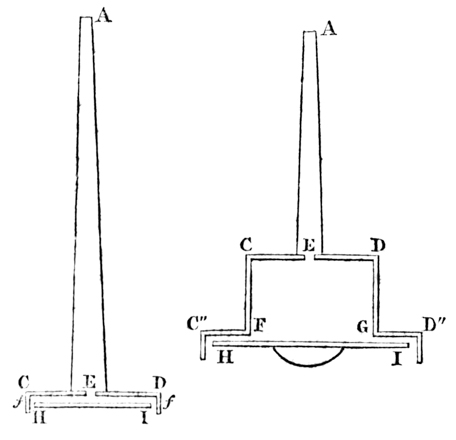
Fig. 1.
Fig. 2.
The apparatus was still further simplified, so as to make the stream of air from the mouth sufficient to produce the effect. A tin tube, A, Fig. 1, was soldered to the middle of a round tin plate, in the centre of which was a small orifice, E; three or four small projections of the tin, f f, were left at the edges of the plate, to prevent the disks of paper, card, or metal, from slipping off sideways. The figure is on a scale of one-half. Instead of the tin plate, a piece [p194] of smooth cork may be used, and for the tin tube, a glass tube, or one made by rolling up a piece of paper.
If the tube be held horizontally, or inclining a little upward, and a disk of card or paper be placed loosely against the aperture in the plate, it will be found that, on applying the mouth to the end of the tube, and blowing air through, that the disk will not be driven away, but actually made to apply closely to the surface of the plate; and if turned towards the ground it will be found to remain opposite the hole, and not to fall until the current of air is stopped. Even a plate of tin may in this way be suspended by a current of air; which at first would be supposed to conjoin with gravity in forcing it to the ground. When the disk is flexible and slightly elastic, a heavy sound, and sometimes even a shrill tone, is produced by the vibrations of the plate.
In explanation of this experiment, M. Hachette says, “The air is pushed from the mouth A of the tube, towards the orifice E of the plate; it strikes the part of the disk opposed to this orifice, and the mean pressure on that part is greater than the pressure of the atmosphere. The blown air then takes place of that between the plate and the disk opposed to it; it moves in this interval with a velocity decreasing from the edges of the aperture: the elastic force of this air decreases at the same time, so that its mean pressure between the plate and the inner face of the disk becomes less than the atmospheric pressure; and as this last pressure is exerted on the whole external face of the disk H, I, this disk, subject at the same time to the two contrary pressures on its opposing faces, obeys the greater, and is pushed towards the plate C D.”
“It is not necessary that the disk, C D, should be near the orifice E, of the tube A E. Let Fig. 2 be an instrument composed of a hollow cylinder, C D F G, and a flat border of the dimensions C″ F, or G D″. Let a tube, A E, be fixed to the bottom of the cylinder, the orifice E having a diameter of about three millimeters (0.12 of inch). If air be blown in at A, against the disk, H I, in the neighbourhood of the flat border, the disk will be urged towards the orifice E. This instrument is also delineated on a scale of one half. The disk, with the attached weight, weighs about 12 grammes (184.87 grains), being 54 millimeters in diameter; the pressure of the atmosphere upon it equals 23 kilogrammes: from which it follows that, in this experiment, the pressure of the air blown upon the inner surface of the disk, and the atmospheric pressure exerted on the exterior of the same disk, only differs from each other by about one two-thousandth part of the latter.”—Annales de Chimie, xxxv. 34.
2. Considerations relative to Capillary Action, by M. Poisson.—M. Dutrochet, whilst explaining his views relative to the cause of vital movement in plants and animals, stated that if an animal or vegetable membrane were formed into a bag, having a tube of [p195] glass attached to its aperture, and were then filled with a liquid substance, having a strong affinity for another liquid, into which the bag was to be immersed, it would not only have the power of absorbing the latter liquid into its pores, but also, in certain cases, of forcing it up to the top, and even out of the glass tube held in a vertical position. On this point, a difference of opinion with regard to the force of capillarity took place: M. Ampère maintaining that capillary action would raise the fluid to the top of the tube, but not cause its expulsion; while M. Poisson maintained that, in certain cases, the latter effect could be produced. The latter has since then published a note, which we transcribe in part, from the Annales de Chimie, xxxv. 98.
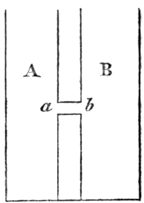
Suppose that two different fluids, A, B, are contained in a vessel, and separated the one from the other by a vertical division; the heights being in an inverse ratio to the densities, so that the points, a and b, in the two faces of the division, and situated in the same horizontal plane, shall support equal and opposite pressures: suppose also that the division is pierced with one or more holes of small diameter, or, in other words, that it is traversed by several very narrow canals, as a, b, perpendicular to the two faces, and which may be regarded at first as filled with air, or any other fluid.
If the substance of the division exerts upon each of the two liquids an action superior to the half of that which the liquid has upon itself, each liquid will enter into the canal a, b, just as it would rise above its ordinary level in a capillary tube of the same size and substance. It would also be urged, by the excess of pressure which it would exert at the extremity of the canal, against the elasticity of the included air. When the two fluids have penetrated the interior of a, b, the air will be pushed on both sides in different directions by forces each of which is equal to the primitive pressure augmented by the corresponding capillary force, i. e. augmented by forces proportional, according to the known theory of M. Laplace, to double the action of the tube on the liquid, less the proper action of the liquid itself. It will only be in the case when the capillary force shall be the same on both sides, that the air, after being compressed to a certain degree, will remain at rest: for whenever this force preponderates at one end of the canal, the air will be driven out at the opposite end, and the liquid with the strongest capillary attraction will entirely fill the canal.
Suppose this liquid to be A, then let us consider the forces which will act on the portion a, b, of this liquid. At the extremity a, it will be submitted to the attraction of the exterior fluid A: at the extremity b, it will be attracted in the opposite direction by the liquid B. Now the two liquids being different, their attractions will be unequal, and we will suppose that that of B, on the matter [p196] of A, is greater than that of A for itself. As to the action of the canal on the portion a, b, that will be equal, and exerted in contrary directions at its two extremities; it will not, therefore, be either adverse or favourable to the movement of the fluid in the canal: and the same will be the case with respect to the pressures exerted at a and b, by the external liquids, as long as they are equal: nevertheless, the action of the canal, and the external pressures, will prevent the thread of fluid from being broken, so that it will move without interruption in the direction in which it is drawn by the greatest attraction, or from a to b. Hence will result an elevation of the level of B, and, consequently, an increase of pressure at the extremity b, of the passage, and this elevation will proceed until the difference of pressure in a and b shall be equal to that of the attractions exerted by the two fluids A and B, on the thread a b; this effect will be produced the more rapidly as the division is pierced with a greater number of passages similar to that which has been considered.
Now let us examine what would occur if the division were formed of two others different in their nature, and exactly superposed; exerting no action on one of the liquids, B for example, and one only acting on the other liquid. The liquid B will then retain its original position undisturbed; in consequence of the action it exerts upon itself it cannot penetrate the canal a b, just as mercury cannot escape by a capillary aperture made in a barometer-tube. It will be the same with A, when that face of the division which exerts no action upon the liquid is turned towards it; so that how numerous soever the apertures, the two liquids would, under such circumstances, remain separate and preserve their original level. But if the division be turned so that the face which acts upon A shall be in contact with that liquid, it will penetrate the canal a b by means of capillary attraction; and the velocity which the liquid urged by this force may acquire, may make it pass that point in the canal where the division changes its nature, and even make it reach the extremity in the liquid B, so that it is possible that the liquid A should entirely fill the canal a b, as in the case which has already been examined. Then if we always suppose the attraction of B for A to be superior to that which A has for itself, the thread a b will flow into B until the level of the latter is so far altered that the excess of pressure at b can balance the difference of attractions exerted by the two liquids at a and b.
M. Poisson then observes that, without pretending to assign a cause, exclusive of all others, for the phenomena of absorption by vegetable and animal membranes observed by M. Dutrochet, his object is to show that effects which have at least a great resemblance to these important phenomena, may be produced by capillary action conjoined with the difference of affinity existing between heterogeneous substances without the assistance of electricity, either moving or quiescent. It appears that M. Dutrochet afterwards [p197] found mineral substances, as a piece of slate, might be substituted for the organized tissues; this being the case, the opinion which refers such effects to a general cause, as capillary attraction, acquires more probability.
3. Novel Use of the Plough.—Mr. Bruckmann states that he has long thought the plough might be used in levelling roads and clearing the foundations for fortifications. In 1824 he had an opportunity of applying it in the construction of a canal required to furnish a motive force for the service of the rock-salt works of Friedrichshall. The bed was to have a section of 700 square feet, and it had been calculated that the excavations would require 200 men for two years, whereas the king of Wurtemburg wished it to be done in one year from the spring of 1824.
Three ploughs were employed; the first had two handles, a coulter, and a share, the latter being in the form of a wedge. This plough was preferred in the beds and gravelly grounds; and it was found advantageous to give it an oscillatory movement by the handles during its progress. Drawn by eight horses, it could turn up 25,000 cubic feet of an argillaceous soil, in three hours; with ten horses it turned up 19,800 cubic feet of a gravelly soil, in the same time. This plough was tried in 1815, against fifteen others of the ordinary kind, in the construction of a watercourse for a mill; all the fifteen were quickly broken by the work.
The second plough had two handles and a coulter, but the share had only one cutting edge, which was rounded and with an ear. It was made five times as strong as an ordinary plough, and succeeded well in compact and argillaceous soils, where, with eight horses and four men, it moved 48,000 cubic feet of earth in three hours. In case of fracture ten minutes sufficed to change the coulter and share, and, during the work, 2,300,000 cubic feet of earth were loosened by it.
The third plough was smaller and lighter, it had two handles, a coulter, an ear, and a share, the latter lance-shaped. It was used for excavating the sides of the canal, on which the horses attached to the first plough found it difficult to walk because of the inclination. It was worked by ten or twelve men.
To establish an accurate comparison between the work of these ploughs and that done by the pickaxe and spade, a piece of ground was wrought solely in the latter manner by six strong working men. The result of a long trial was the breaking of 150 cubic feet of ground by each man in nine hours. Comparing this result with the work of the ploughs, the following are the results:—The first plough did the work of 477 men, the second of 960 men, and the third that of 50 or 60 men. The canal was finished on April 30th, 1825, the ploughs having saved 32,000 days, according to the work-day of a labourer.—Bull. Univ. D. vii. 343. [p198]
4. Discovery of Rocks under the Surface of the Sea.—The fishers of the Mediterranean use an apparatus for the discovery of rocks beneath the surface in those places where they wish to cast their nets, which supplies, in a great measure, the insufficiencies of the ordinary means of taking soundings. The method consists in carrying a long and thin cord over the bottom to be examined, and which, when it meets with an obstacle, is stopped by it and becomes folded in the place where it occurs. It will easily be understood, that when a cord has been carried over a certain space without meeting with any resistance, that proof is obtained of the non-existence of rocks or other obstacles, at a depth less than that to which the cord has been sunk; and as the examination can easily be carried on to 100 feet below the surface, it may be said that, wherever such an apparatus has passed unimpeded, the navigation is free. If, on the contrary, some isolated rocks are found during the examination, the place where the cord becomes doubled points out the locality, which may then be determined more accurately by other trials, and the summit and neighbourhood of the submersed rocks be accurately examined by means of soundings.—Annales Marit.; Bull. Univ. F. viii. 44.
5. Paper to resist Humidity.—This process, which is due to M. Engle, consists in plunging unsized paper once or twice into clear solution of mastic in oil of turpentine, and drying it by a gentle heat. The paper, without becoming transparent, has all the properties of writing-paper, and may be used for the same purposes. It is especially recommended for passports, workmen’s books, legal papers, &c. When preserved for years it is free from injury, either by humidity, mice, or insects. It is further added, that a solution of caoutchouc will produce even a still better effect.—Kunst und Gewerbe-blatte.
6. Professor Amici’s Microscopes.—This distinguished personage has lately exhibited to the savans of this country two microscopes of his own workmanship,—an achromatic refractor, and a reflector of his own particular invention. The object-glass of his refractor is of a very complicated construction, and is composed of three double-object glasses combined together in the space of about an inch. The flint-glass from which his concaves are formed is of the manufacture of Frauenhofer; his convexes are of Dutch plate, crown-glass, and French plate, separately. Each object-glass detached has but a small aperture, and is of long focus; but when the three are combined together, the angle of aperture is very considerable, and the focus short. By this ingenious arrangement the trouble and difficulty of manipulating deep single-object-glasses of large aperture is avoided; but advantages gained one way, in practical optics, are generally lost in another, and the twelve surfaces of the objective produce a kind of softness and muddiness in [p199] the image strongly contrasted by the effect of a good single triple-glass of equivalent power. When, however, only two of the object-glasses are combined, the effect is very fine. Between the object-glass and eye-glasses is placed one of those prisms originally invented by Sir I. Newton to act as an eye-piece of his telescope, and of which a description may be seen in his correspondence at the end of Dr. Gregory’s Optics. The utility of the introduction of this device appears very questionable in an instrument already so complicated. The diversion of the rays into a course at a right angle to their original progress (merely to give an horizontal instead of a vertical position to the body) is surely no warrant for the employment of two extra refracting surfaces and one reflexion, which cannot fail to have a pernicious influence on the formation of the image. An horizontal position of the body is attained with the utmost facility by a proper construction of the mounting, &c. Setting aside the dulness of the image produced by the numerous refractions, the performance of the instrument on test-objects was highly respectable and satisfactory.
The reflector is a modification of the original construction recommended by the Professor, who seems to have profited by the schooling he received from Dr. Goring, and now sails much closer to the wind than he did. His objective metal is now two inches focus, with an aperture of 112 inch; but half an inch is cut off for the purpose of preventing the bad effect of the marginal rays, so that only 1 inch of the central portion of the metal is employed;—the diameter of the diagonal mirror is also reduced to its proper standard, by which means the blot in the centre of the visual pencil is rendered as small as possible. It may be asserted of this instrument, that it does as much as can possibly be expected from an objective part of 2 inches focus, showing many test-objects faintly, and with much effort; but it is totally unable to compete with deeper ones equally perfect and of the same angular opening. The Professor has, in some of his instruments, reduced the focus of the elliptic metal to 112 inch, and will, no doubt, gradually slide into the adoption of that radical reform in his instrument, so happily carried into effect in this country by Dr. Goring, in conjunction with Mr. Cuthbert,—at least if the figuration of elliptic metals of 310 inch focus with 210 inch of aperture shall not surpass his powers of execution. During the Professor’s stay in this country there was a grand field-day at his hotel, at which both his microscopes were tried against the Goringian modification of the reflector, the superior weight of metal of which completely beat every thing opposed to it. For the honour of the Professor it must be stated, that he admitted this defeat with great candour and good sense, and even had some difficulty in believing in the identity of some of the objects used, so differently was the ordinary apparent structure developed by the English improvements on his instrument. It may with safety be averred that no refractor, at least, will ever be [p200] made to surpass Dr. Goring’s improved Amician Engiscope; and it seems equally certain that no other reflector will ever be invented capable of the same facilities of application to the examination of both opaque and transparent objects. If Professor Amici has been beaten, it has been done with his own weapons,—the copy has surpassed the original,—the child, by virtue of foreign nursing and tuition, has exceeded the stature and strength of the father.
II. CHEMICAL SCIENCE. ◊
1. On the Specific Heat of Gases, by MM. de la Rive and Marcet.—The principle on which these philosophers proceeded in their researches, was, to expose equal volumes of different gases to an equal source of heat during equal times, and to judge, by the augmentation of elastic force in each gas, the temperature which it had acquired. The apparatus was a kind of manometer, and consisted of a glass balloon to retain the gas, and a bent tube attached to it, which, descending into a vessel of mercury, served to show, by the column of metal within it, what was the elasticity of the gas. This method was adopted, because, i. The gas was not altered in volume by the change of temperature, its elasticity only changing: ii. The temperature was indicated by the gas itself, and not by a thermometer: iii. Water was easily separated previously from the gases, and excluded from the apparatus: iv. All the gases were placed in exactly the same circumstances, so as to render it unnecessary to refer to any calculation for the purpose of comparison.
Two methods of applying heat were resorted to: in one the balloon, containing the gas at a certain temperature, was placed in water at a higher but constant degree, for a certain time (generally 4′), and the elevation of temperature noticed: in the other, the balloon with the gas was inclosed in a larger copper balloon, blackened inside, and the space between the two exhausted as much as possible of air; the apparatus being then immersed in warm water, the heat gained access slowly to the gas, and the time of each experiment was increased, at the same time that certain sources of error were avoided.
The gases experimented with were, atmospheric air, oxygen, azote, hydrogen, carbonic acid, olefiant gas, oxide of carbon, nitrous oxide, nitrous gas, sulphuretted hydrogen, ammonia, sulphurous acid, muriatic acid, and cyanogen. Great care was taken in their preparation. The result of the experiment was very unexpected; for, during the five minutes allotted for each, all had acquired the same temperature,—a circumstance which proves that they all have the same specific heat. The equal volumes of gas at the pressure of 65 centimeters (15.59 inches) and the temperature of 20° C., being exposed to a source of heat at 30° C., acquired a mean temperature of 6.32 degrees in five minutes, the extreme difference, in any of the experiments, not being more than 0.04 of a [p201] degree. One gas only forms an exception to the above statement, namely, hydrogen, which was always heated more than the others, namely, to 6.6 degrees in the five minutes. This effect is considered as due not to any difference in specific heat, but to a difference in conducting power.
Experiments were then made with dilated gases, to ascertain whether dilatation caused any change in capacity, and it was found to diminish slowly but regularly with the diminution of pressure. These results, with a third which is also interesting, have been thus generally expressed by the authors at the end of their memoir.
i. All gases in equal volumes, and at the same pressure, have the same specific heat.
ii. Other circumstances being the same, the specific heat of gases diminishes with diminution of pressure, and equally for all the gases: the progression converges slightly and in a ratio much less than that of the pressures.
iii. Each gas has a different conducting power, i.e., all the gases have not the some power of communicating or receiving heat.—Ann. de Chimie, xxxv. 5.
2. On the Incandescence and Light of Lime.—The experiments made by Lieutenant Drummond upon the light of lime and other earths when highly ignited, with the highly interesting application which he has made of that emitted from lime, to the purpose of geodesical surveys, has induced M. Pleischel to repeat and vary the results. He states that the utmost light is given by lime; the earth being pulverised and exposed on burning charcoal to the heat excited by a jet of oxygen falling upon it. He endeavours to account for the effect, by supposing a kind of pulverulent atmosphere disengaged from the lime at the high temperature used, and considers that the substances which are competent to emit molecules only in the gaseous state, cannot produce this intense light.—Zeitschrift für Physik, &c.
3. Evolution of Heat during the Compression of Water. May 14, 1827.—M. Arago announced to the Academy of Sciences, that M. Despretz had ascertained experimentally, that the compression of water by a force equal to 20 atmospheres, caused the disengagement of one sixty-sixth part of a degree of heat.
4. On Electrical Excitation.—M. Walcker affirms positively from experiments made with great care, that three bodies of different exciting power are necessary, in every case of excitation of electricity by contact, and that all the phenomena of this kind are subject to this condition. If, for instance, two portions of the same metal being put in contact, electricity is produced, it is because there are three different states of temperature brought into play, one being the result of the other two, and a mean between them. One fact which more than any other sanctioned this idea, was, that the electric [p202] currents were the more apparent as this third state of temperature was made more sensible.—Bull. Univ., A. vii. 374.
5. Magnetic Repulsion.—A very remarkable result has been obtained by M. Becquerel, from the use of an extremely delicate magnetic arrangement, which he has for the present called a sideroscope. Its use is exactly the same in principle as that of the magnetic needle, indicating iron, for instance, by the attraction manifested; but it is so delicate that it will show it in the most minute quantity possible, as, for instance, in gold, silver, or copper money, innumerable minerals, &c. This instrument shows no magnetic power or attraction in gold, silver, copper, palladium, tin, lead, zinc, or brass, when chemically pure, and a great many vegetable and mineral substances have no action on it: but the most curious result is, that very pure bismuth and even that of commerce has a repulsive power, which, if it be found ultimately to be independent of any magnetic polarity, is the first fact of the kind that has been made known. Antimony also presents the same phenomenon.
6. Diminished Solubility of Substances by Heat.—Mr. Graham has added one to the few facts of this kind with which we were acquainted, and has accompanied its description with some very interesting considerations, which may be found at length in the Philosophical Magazine, N. S., ii. 20. The salt experimented with by Mr. Graham is the phosphate of magnesia; which may be prepared by mixing a solution of 21 parts of phosphate of soda with one of 15.375 parts of sulphate of magnesia: within 24 hours the phosphate of magnesia precipitates in acicular crystals; they should be agitated with repeated portions of water, then thrown upon a filter with more water, and left to dry.
Solutions were obtained by occasionally agitating this salt with water in the proportion of 2 ounces to a pint of the fluid, for four days; being then decanted and filtered, they had a sweetish taste. A quantity of this fluid being heated in a water-bath, became turbid before the temperature had attained 120° F.; at 212° a cloudy precipitate slowly subsided, and the supernatant fluid became nearly transparent. The precipitate was found to be anhydrous phosphate of magnesia; and, by further experiment, the difference in solubility was found to be such, that water at 45°, dissolving 1744th part its weight of the anhydrous salt, water at 212° only dissolved 11151th part. When in the state of crystals, or as hydrate, the proportions of salt were 1322 and 1498 to 1 of water.
Mere continuance of the heat had no effect in increasing the precipitate either of this salt, or from aqueous solution of lime, provided no part of the solution was at any time converted into vapour; but if the solution only occupied a small part of the vessel, and ebullition came on, then, although all the water might be returned to the solution, yet the precipitation went on, and might be [p203] increased ad libitum, particularly in the case of lime water. The cause of the precipitate appears to be the same in all these cases. The moment a drop of the solution is converted into vapour, it deposits the quantity of lime or salt which it held in solution; and in the case of bodies which dissolve so sparingly and with so much difficulty, although the water be returned again to the solution, it is incapable of re-dissolving what it has deposited. We know that it would be a hopeless task to form a saturated solution of lime by agitating with the water no more than the few grains which it is capable of dissolving; and in the case of ebullition, when the lime is once deposited, there should be the same difficulty in taking it up.
Mr. Graham states that he has observed this effect not only in lime-water and in solution of phosphate of magnesia, but to a certain extent in all bodies of difficult solubility, in the sulphate of lime, for instance, even when greatly diluted; and he believes that the deposite from slight boiling observed in many mineral waters, and generally attributed to the dissipation of carbonic acid gas, depends, in some instances, upon this cause. However weak the solution may be, it is evident that a portion of the salt may be deposited in this way.
7. On the Composition of Cyanic Acid.—M. Wohler some time since announced the production of cyanic acid, and cyanates, corresponding in composition to the substance presumed to exist in the fulminating compounds of silver, mercury, &c., the nature of which was made out by MM. Liebig and Gay Lussac. M. Liebig, upon repeating M. Wohler’s experiments upon his cyanate of silver, obtained only 71.012 per cent. of oxide of silver, instead of 77.23, which was the quantity present according to M. Wohler’s analysis, and concluded that the acid was the cyanous, and not the cyanic. The latter philosopher was consequently induced to repeat his experiments: one of his methods of decomposing the cyanate of silver was by muriatic acid gas: at first liquid cyanic acid forms, which is very soon transformed into a white crystalline mass; but, on continuing the operation, and applying a higher heat, a large quantity of muriate of ammonia and cyanic acid is evolved. This process indicated 77.5 per cent. of oxide of silver in the salt. Another process consisted in dissolving the cyanate in nitric acid, and precipitating the silver by muriatic acid, the result was 77.05 of oxide per cent. A third analysis, made by reducing the silver of the salt, gave a result of 77.35 per cent. oxide. The mean of these is 77.3, and the theoretical number obtained by calculation is 77.23, so that the acid appears to be truly the cyanic; and the curious fact of its being the same in composition with that in the fulminating compounds of silver and mercury, but very unlike in properties, still remains undisturbed.—Bull. Univ., A. viii. 53.
8. Iodous Acid.—According to M. Wohler, the iodous acid of [p204] M. Sementini35 is nothing more than a mixture of chloride of iodine and iodine. When saturated with carbonate of soda, the iodine in solution is precipitated, and on evaporating the solution to dryness, and heating it strongly, the residue fuses, and by proper tests is found to be a mixture of chloride and iodide of sodium.
These statements apply only to the iodous acid: as to the oxide of iodine, no source of chlorine exists in the process last described by M. Sementini.
9. On Manganesic Acid, by M. Unverdorben.—When manganesate of potash is distilled with a little anhydrous sulphuric acid, manganesic acid is evolved in the form of a red transparent gas, which dissolves in water, forming a red solution. The gas frequently decomposes spontaneously in the retort, with explosion, producing oxide of manganese and oxygen.
Manganesate of potash was analysed by distilling it with excess of sulphuric acid, collecting the oxygen disengaged, and estimating the proportion of protoxide of manganese and salts of potash remaining in the retort. According to these experiments the acid consists of
Manganese 58.74
Oxygen 41.26
100.00
And the manganesate of potash of Or being calcined
Potash 25.63 32.75
Manganese acid 52.44 67.25
Water 21.93 100.00
100.00
Ann. des Mines, 1827, p. 145.
10. Heavy Muriatic Ether, and Hydrocarburet of Chlorine or Chloric Ether.—Some comparative experiments have been made on these two substances by M. Vogel. He prepared the former of them by passing chlorine gas into alcohol. The muriatic acid was then separated by distilling the fluid from off chalk, in which operation the muriatic ether and alcohol passed over together, and these were divided by the addition of water, which dissolved the latter, and left the former. The chloric ether was made as usual from chlorine and olefiant gases. The results that were obtained by acting on these substances by a high temperature, potash, phosphorus, &c., induced M. Vogel to consider them as identical in composition, notwithstanding some differences in their physical properties; the specific gravity of the muriatic ether was 1.134, that of the chloric ether 1.214, and the odour of the latter is more aromatic, and the taste more sweet than of the former.