Volume 7 / Part 2 — Philosophical Transactions of the Royal Society of London, for the year 1827. Part II. ◊ (continued 2)
Reading edition
“Who but rather turns To heaven’s broad beam his unconstrained eye, Than to the glimmering of a waxen flame?”
The Moon, in the meantime, inferior as she is to the Sun, has been “blessed,” from age to age, for her “useful light;” and the “useful light” of the Aurora, also, has its claims to “blessing.” It co-operates with the Sun, the Moon, and with other agents of nature, to make, not merely the Polar regions of the earth, but the entire globe of the earth, fruitful, at once, and habitable127! [p422]
XII. In a succeeding paper, the author may possibly submit to the consideration of his reader, the particular and novel hypotheses which he has allowed himself to form, as to the substance, causes, and effects of the Aurora; hypotheses partly dependent upon those facts in its natural history, which, above, have been almost the exclusive objects of attention. At present, the leading particulars of the natural history of the phenomenon, which it has been attempted either to bring or to fix in view, are these:
1. That the Aurora is a phenomenon observed both in the Northern and Southern Hemispheres.
2. That, in either hemisphere, it is observed in the general direction of the corresponding pole of the earth.
3. That, in the Northern Hemisphere, on the shores of the Icy Sea, or at the furthest distance north, its situation is still observed to be the northward.
4. That, in the Southern Hemisphere, it has been observed to the east of the South Pole, and in the Northern, to the east and west of the North Pole.
5. That, upon the late occasion, the place of its columns, during the exhibition, was observed to change from the west of north to the east of north; but, so as always to have the north for the apparent centre of its strength.
6. That, in the Arctic regions, the appearance of the Aurora is said to be usually followed by clear and calm weather.
7. That the appearance of the Aurora Borealis is no wise peculiar to the winter solstice, but has been observed in each of the eight months of September, October, November, December, January, February, March, and April, and may be regarded, therefore, as coincident with the Arctic winter; and that the appearance of an Aurora in the Southern Hemisphere, in the month of February, or beginning of the Antarctic winter, as observed during the voyage of Captain Cook, in the year 1773, is [p423] consistent with the persuasion, that the Aurora Australis, in its turn, is a phenomenon of the Austral or Antarctic winter.
8. That considerable or powerful displays of the Aurora are infrequent, even in the extreme Polar regions; and that it is very considerable or powerful displays alone, which make themselves visible in the lower latitudes, north or south of the equator.
9. That no appearance belongs to the Aurora itself, but that of its coruscations, columns, spears, or streamers; and that all colours, therefore, or coloured figures, not belonging to the coruscations, but coincident in their appearance, are to be regarded only as reflections or refractions of light, derived from the coruscations by the clouds which happen to cover the sky.
10. That the colours, or coloured light, proper to the Aurora, or seen in the columns or coruscations themselves, are varied from column or coruscation to column or coruscation, and severally continued in the direction, and throughout the length or height, of each.
11. That, in the late example, the columns or coruscations situate in the due north, or apparent centre or focus of the phenomenon, exhibited a light at least comparatively white; and that the variation, from white to colour, had an apparent relation to the comparative remoteness of each column or coruscation from the column or coruscation in the central north.
12. That the direction or position of the columns or coruscations of the Aurora, are so far from being uniformly convergent toward the zenith, or uniformly vertical, or from the horizon to the zenith, that, in the late example, they did not converge toward the zenith, but, contrariwise, diverged from it; spreading themselves like the sticks of a fan, or like stalks in a flower-basket.
13. That the columns or coruscations of the Aurora are not uniformly rectilinear in their figure; but that, in the late example, those on the north-eastward were curved outwardly, or “bent sideways,” as described in the appearance of the columns or coruscations of an Aurora seen in the Southern Atlantic, during the voyage of Captain Cook, in the year 1773.
“The Pensell, or Pennoncelle, was the diminutive of the Pennon, being a long narrow flag.”—MEYRICK’S ANCIENT ARMOUR.
“STREAMER.—A Streamer shall stand in the toppe of a shippe, or in the forecastle, and therein be put no armes, but a man’s conceit or device, and may be of the lengthe of twenty, forty, or sixty yards; and it is slit, as well as a guydhomme or standarde.”—HARLEIAN MSS.
An item, in a bill of parcels, charged to the Earl of Warwick, in 1437, consists of “a great Stremour for the Ship, of xl yerdis lenghth, and viij yerdis in brede.”—BANNERS USED IN THE ENGLISH ARMY, &c.
[p424]
Proceedings of the Royal Society. ◊
THE anniversary meeting of the Royal Society for the election of a president, and other officers, was held as usual at Somerset House, on Thursday, the 30th of November, being St. Andrew’s day.
Till within a few days of the election, it was generally understood that the Rt. Hon. Robert Peel was a candidate for the chair; in consequence, however, of that gentleman having declined, Davies Gilbert, Esq., M.P., was put in nomination, and was almost unanimously elected the President of the Royal Society.
The late secretaries, Messrs. Herschel and Children, having resigned their respective offices, Dr. Roget and Captain Sabine were nominated in their places, and were duly elected.
The accession of Mr. Gilbert to the chair having rendered vacant the office of Treasurer, Major Kater was elected in his place.
The following council was elected, to continue in office until St. Andrew’s day, 1828.
Davies Gilbert, Esq.
Major Kater.
Dr. Roget, M.D.
Captain Sabine, R.A.
Dr. Wollaston, M.D.
Dr. Fitton, M.D.
Dr. Young, M.D.
Dr. Paris, M.D.
Dr. Prout, M.D.
Dr. Goodenough, D.D.
Dr. Buckland, D.D.
J. W. Croker, Esq.
Lord Colchester.
Sir E. Home, Bart.
Sir H. Davy, Bart.
John Pond, Esq.
Capt. F. Beaufort, R.N.
Francis Baily, Esq.
John Guillemard, Esq.
[p425]
In consequence of having been elected President pro tempore by the council, (the chair having been vacated some weeks previous to the general election,) the duties of the office were performed by Mr. Gilbert, on occasion of the present anniversary. After having read over the list of members admitted, and of those deceased during the last year, he proceeded to announce the disposal of the Royal and Copley Medals, as awarded by the votes of the council.
Of the Royal Medals, one was awarded to Sir H. Davy, and the other to Professor Struve. Of the Copley Medals, one was given to Dr. Prout, and another to Lieutenant Forster. On this occasion Mr. Gilbert pronounced an eulogium upon the respective receivers of the medals; and, in adverting to the labours of the several individuals, he justified the decision of the council, in bestowing upon them these marks of distinction, in a learned and eloquent discourse.
Proceedings of the Horticultural Society. ◊
September 4th.
A PAPER by Mr. Lindley was read upon the new hardy plants which had flowered in the Society’s garden; among them a number of new shrubs were mentioned, which appeared likely to prove acquisitions to the public. A thermometer was exhibited by Mr. Bregazzi, of Derby, for ascertaining the temperature of bark-beds. It consisted of a thermometer enclosed in a shaft of copper with a wooden handle, and a door in its side, by which the temperature can be ascertained with precision. It is needless to point out the superiority of this plan, over the common mode of determining this very essential point, by feeling of a stick previously stuck in the bed; the sensation of heat when the stick is grasped in the hand will obviously depend in a great degree upon the temperature of the hand itself. As usual, there was an extensive display of all the choicest flowers and fruit of the season. One hundred and seventy-two subjects of this description were placed upon the table. Among the flowers, the most remarkable was a new hardy climber from Mexico, with deep purple blossoms studded [p426] with glittering green glands, called Maurandya Barclaiana; among the fruit was a fine specimen, from Lord Grantham’s garden, of the Papaw, a tropical fruit never ripened in England before.
September 18th.
The exhibitions of this day were chiefly confined to a display of Dahlias, which for magnificence exceeded any thing of the kind we ever witnessed before. The large meeting-room was filled with masses of the richest and most lively colours. In the whole, eight hundred and fifty-one varieties were shown, among which the finest were from the garden of William Wells, Esq., of Redleaf; but where all are so excellent, it is almost invidious to particularize. The time will be remembered by many of our readers when gardens in the autumn contained little besides marigolds, sun-flowers, and sweet-peas; by the aid of dahlias and chrysanthemums the autumn has now become the liveliest season of the year, and the beauty of the flower-garden is only destroyed by the severest of the winter frosts. Among the grapes upon the table was a remarkably excellent yellow-berried kind, from Portugal, from the garden of Mr. Holford, of Hampstead, which was quite new to this country. Apples, nectarines, peaches, and pine-apples abounded.
October 2nd.
Among the flowers was a fine bunch of ranunculuses, from Mr. Groom, of Walworth, a rare sight in October; they were obtained by having been planted in July and carefully protected by tulip-shades when coming into flower. The season for softer fruits being nearly over, pears and apples formed the chief display; of these a vast number, upwards of one hundred and eighty of the latter, were upon the table: the Blenheim orange, or Woodstock pippin, pomme gris, scarlet nonpareil, courtpendu plat, golden reinette, and packhorse apples; and Chapman’s, Marie Louise, and brown beurré pears, appeared to us to excel all their rivals. The famous gloux morceau and beurré d’Aremberg pears were also exhibited, but were not ripe. [p427]
October 16th.
The first number of a new periodical work, called the Pomological Magazine, consisting of coloured figures of the fruits cultivated in Great Britain, was placed upon the table. Among the apples were specimens of a variety sent from England to Connecticut, in the year 1636, and reimported from America within a few years. It proved to be a kind not known at the present day in this country, but still cultivated in France. In the gardening books of the sixteenth and seventeenth centuries it is mentioned under the name of the haute bonté. The specimens exhibited served to disprove the opinion that many of the American apples are European kinds altered by climate; these, although the produce of trees which have been growing in America for nearly two hundred years, differed in no respect from French samples exhibited at a subsequent meeting of the Society.
November 6th.
An excellent paper was read upon the method of cultivating horse radish, in Denmark. The roots are cut into slips, and planted horizontally, the lower end inclining a little upwards, and the crown of the plant hanging over the alleys, by which the beds are separated. From time to time the roots are uncovered, and all the lateral fibres are carefully removed, by which the size and length of the roots are much increased. The place hitherto occupied by dahlias, was now taken by Chinese chrysanthemums, of which a large number, consisting of twenty-two different varieties, was exhibited at the bottom of the room.
November 20th.
Cuttings of the fine new Portugal grape, of which fruit was exhibited on the 18th of September, were distributed to the members present. A few dahlia flowers still showed themselves, notwithstanding the unusual severity of some early frosts, and the room was crowded with chrysanthemums. The gloux morceau and beurré d’Aremberg pears were tasted, and found to retain the station which has been assigned to them at the head of all known varieties. [p428]
ASTRONOMICAL AND NAUTICAL COLLECTIONS. For Jan. 1828.
i. EPHEMERIS of the periodical COMET for its Return in 1828, computed with the consideration of a RESISTING MEDIUM. By Professor ENCKE. ◊
Elements.
Mean anomaly 1829 Jan.9.72, mean time at Paris, = 0° 0′ 2″.83 Mean daily sidereal motion = 1069″.87572.
Longitude of the perihelion = 157° 17′ 26″.2 Mean Equinox 1829 Jan.9.72.
Ascending node = 334 28 47.1
Inclination = 13 20 47.9
Angle of the eccentricity = 57 38 25.2
Ephemeris.
Mean Parisian time, 1829. A. R. Decl. N. Log. Dist.
° ′ ″ ° ′ ″


Aug. 23.3 26 50 +.. 22 42 +.. .34603 .19571
24.3 50 ... 52 .34411 .18983
25.3 49 ... 23 1 .34217 .18390
26.3 48 ... 10 .34022 .17791
27.3 46 ... 19 .33825 .17187
28.3 44 29 .33626 .16577
29.3 41 38 .33425 .15962
30.3 37 47 .33222 .15341
31.3 33 56 .33017 .14714
Sept. 1.3 28 24 6 .32810 .14082
2.3 22 15 .32602 .13444
3.3 16 24 .32392 .12801
4.3 9 34 .32180 .12153
5.3 1 43 .31966 .11499
6.3 25 53 52 .31749 .10839
7.3 44 25 2 .31531 .10174
8.3 34 11 .31310 .09504
9.3 23 20 .31087 .08829
10.3 11 29 .30862 .08148
11.3 24 58 38 .30635 .07462
12.3 45 47 .30406 .06771
13.3 30 56 .30174 .06075
14.3 15 26 5 .29940 .05375
15.3 23 58 14 .29704 .04670
16.3 41 23 .29465 .03961
Sept. 17.3 23 22 +.. 26 32 +.. .29224 .03247
18.3 2 41 .28980 .02529
19.3 22 41 49 .28733 .01806
20.3 19 58 .28484 .01080
21.3 21 56 27 6 .28232 .00350
22.3 32 14 .27978 .99617
23.3 6 22 .27721 .98881
24.3 20 39 30 .27461 .98142
25.3 10 37 .27198 .97400
26.3 19 40 45 .26933 .96656
27.3 9 52 .26665 .95910
28.3 18 37 58 .26393 .95162
29.3 3 28 5 .26118 .94413
30.3 17 27 11 .25840 .93663
October 1.3 16 50 17 .25559 .92913
2.3 16 11 22 .25275 .92164
3.3 15 31 27 .24987 .91415
4.3 14 49 32 .24696 .90668
5.3 5 36 .24402 .89923
6.3 13 20 39 .24104 .89181
7.3 12 34 42 .23803 .88442
8.3 11 45 44 .23498 .87707
9.3 10 55 46 .23189 .86976
10.3 4 47 .22876 .86251
11.3 9 10 47 .22559 .85532
12.3 8 15 46 .22238 .84820
13.3 7 19 45 .21913 .84116
14.3 6 21 43 .21584 .83421
15.3 5 21 39 .21251 .82735
16.3 4 20 35 .20913 .82059
17.3 3 18 30 .20570 .81394
18.3 2 14 24 .20223 .80741
19.3 1 9 17 .19871 .80101
20.3 0 3 9 .19515 .79474
21.3 358 56 0 .19154 .78861
22.3 357 47 27 49 .18787 .78263
23.3 356 38 38 .18415 .77681
24.3 355 28 25 .18038 .77116
25.3 354 17 11 .17656 .76568
26.3 353 5 26 56 .17268 .76037
27.3 351 53 40 .16874 .75525
28.3 350 40 22 .16475 .75031
29.3 349 27 4 .16069 .74557
30.3 348 14 25 44 .15657 .74102
31.3 347 1 23 .15239 .73668
Nov. 1.3 345 47 1 .14814 .73253
2.3 344 34 24 38 .14382 .72858
3.3 343 21 +.. 24 14 +.. .13943 .72483
4.3 342 9 23 49 .13497 .72128
5.3 340 56 23 .13044 .71793
6.3 339 44 22 56 .12583 .71477
7.3 338 33 29 .12114 .71180
8.3 337 23 0 .11638 .70902
9.3 336 13 21 31 .11153 .70642
10.3 335 4 1 .10660 .70399
11.3 333 56 20 31 .10158 .70172
12.3 332 48 0 .09647 .69961
13.3 331 41 19 29 .09126 .69765
14.3 330 36 18 57 .08595 .69583
15.3 329 31 25 .08055 .69415
16.3 328 27 17 52 .07505 .69258
17.3 327 23 19 .06944 .69113
18.3 326 21 16 46 .06372 .68979
19.3 325 19 12 .05788 .68854
20.3 324 18 15 39 .05193 .68738
21.3 323 18 5 .04585 .68630
22.3 322 19 14 31 .03965 .68529
23.3 321 20 13 56 .03331 .68434
24.3 320 21 22 .02684 .68345
25.3 319 23 12 47 .02022 .68261
26.3 318 26 12 .01346 .68182
27.3 317 28 11 37 .00655 .68106
28.3 316 31 2 .99948 .68034
29.3 315 34 10 26 .99225 .67964
30.3 314 37 9 50 .99484 .67897
December 1.3 313 40 9 14 N. .97726 .67833
2.3 312 43 8 37 .96949 .67772
3.3 311 45 8 0 .96153 .67713
4.3 310 48 7 23 .95336 .67657
5.3 309 49 6 45 .94499 .67605
6.3 308 50 6 6 .93640 67556
7.3 307 50 5 27 .92759 .67513
8.3 306 49 4 47 .91854 .67476
9.3 305 47 4 6 .90924 .67446
10.3 304 44 3 24 .89969 .67425
11.3 303 40 2 42 .88987 .67415
12.3 302 34 1 58 .87978 .67418
13.3 301 27 1 13 .86939 .67437
14.3 300 18 0 27 N. .85870 .67475
15.3 299 7 0 19 S. .84770 .67536
16.3 297 54 1 8 .83638 .67623
17.3 296 40 1 58 .82474 .67742
18.3 295 23 2 49 .81276 .67896
19.3 294 5 3 42 .80042 .68091
Dec. 20.3 292 45 +.. 4 36 +.. .78771 .68333
21.3 291 23 5 32 .77465 .68627
22.3 289 59 6 29 .76123 .68980
23.3 288 34 7 27 .74746 .69399
24.3 287 8 8 27 .73334 .69889
25.3 285 42 9 27 .71890 .70456
26.3 284 15 10 28 .70416 .71107
27.3 282 48 11 30 .68917 .71845
28.3 281 23 12 32 .67399 .72677
29.3 280 0 13 34 .65871 .73604
30.3 278 39 14 36 .64342 .74629
31.3 277 21 15 37 .62830 .75750
1830 Jan. 1.3 276 9 16 37 .61348 .76969
2.3 275 2 17 36 .59920 .78278
3.3 274 1 18 33 .58572 .79670
4.3 273 9 19 29 .57332 .81139
5.3 272 25 20 22 .56231 .82673
6.3 271 50 21 12 .55304 .84259
The opposition to the sun will be 1828, Oct. 12.34: while its light is weak, it may be observed on or near the meridian.
On the 10th of Nov. 1828, its distance from the sun will be the same as at the time of its discovery in 1818, and it will be considerably nearer to the earth; and on the 21st of December, its position with respect to the sun will be the same as at its last observation in 1819; and with respect to earth, its situation will be more advantageous. The 1st of January, 1829, it will set with the sun.
It follows, that the most advantageous time for seeing it will be during the whole of November, and the first 25 days of December. It will scarcely be seen before the end of September, as it has heretofore never been observed more than two months before the time of its perihelion, and even in the dark winter nights will scarcely be visible more than 14 or 15 weeks before that period. After the perihelion it will not be visible in these parts of the world.
ii. Elementary View of the UNDULATORY Theory of Light. By Mr. FRESNEL. ◊ [Continued from the last Number.]
IN order to complete the explanation of the conditions necessary for the formation of the fringes, it remains to show why a small luminous point must be employed in experiments on diffraction, and not an object of any considerable dimensions. If we resume the case of the interior fringes of the shadow of [p432] a narrow body, it will be easy to apply similar arguments to other cases of diffraction.
The middle of the central band, which is always formed by the simultaneous arrival of rays, which depart at the same instant from the luminous point, must be found in the plane drawn through this point, and the line bisecting the narrow body: because, since every thing is symmetrical on each side of this plane, the rays which unite in it must have passed through equal routes on each side, and must consequently arrive at the same instant, unless they have passed through different media, which is not the case to be considered at present. The situation of the middle stripe being determined, that of every other stripe must also be determined accordingly. Now it is evident that if the luminous point should change its situation a little, and be moved to the right, for example, the plane, which has been supposed, would incline to the left, and would carry with it all the fringes which accompany the middle stripe. And if, instead of supposing motion, we suppose the luminous point to become of sensible dimensions; the integral points of which it is composed will each produce a group of fringes, and their situations will be so much the more remote as the luminous object is larger; and ultimately, if its size is sufficiently increased, they will extinguish each other and disappear. This is the reason that, when the rays cross each other at sensible angles, as in all the phenomena of diffraction, it becomes necessary to employ a very fine luminous point, in order to discover their mutual influence: and the point must be so much the finer as the angle formed by the rays is greater.
However minute the luminous point may be, it is always composed, in reality, of an infinite number of centres of oscillations, and it is of each of these centres that we must understand what has been said of a luminous point. But as long as they are very near to each other in comparison with the breadth of the fringes, it is obvious that the different groups of fringes which they produce, instead of mixing with each other in a confused manner, will be superposed almost exactly, and instead of extinguishing, will co-operate with each other. [p433]
When the two systems of waves which interfere are parallel, the interval which separates their corresponding points must remain the same for a great portion of the surface of the waves, that is to say, in other words, the fringes will become almost infinite in breadth, so that a very considerable displacement of the centre of undulation will cause very little difference in the agreement or disagreement of their vibrations. And in this case it is no longer necessary to employ so small an object in order to perceive the effects of their mutual influence.
If the coloured rings, which are produced by the interference of two systems of undulations nearly parallel, exhibit, like the fringes, and often within a very short distance, alternations of dark and bright stripes; this circumstance depends entirely on the want of uniformity in the thickness of the plate of air interposed between the glasses, which causes a variation of the difference of the routes of the rays reflected at the first and at the second surface of this plate, of which the mutual interference produces the bright and dark rings.
We shall readily be able, to understand why the luminous rays, although they always exert a certain influence on each other, exhibit it to the eye so seldom, and in cases so much limited, if we consider that it is necessary, for such an exhibition, first, that the rays concerned shall have been derived from a common source; secondly, that the difference between their paths shall amount to a limited number of undulations only, even when the light is as homogeneous as possible; thirdly, that they shall not intersect each other at too great an angle, because the fringes would become so small as to be invisible even with the assistance of a strong magnifier; and fourthly, unless the rays are nearly parallel, that the luminous object should be of very small dimensions, and the smaller in proportion as the inclination of the rays is greater.
It has been thought necessary to insist so much at length on the theory of interferences, because of its numerous applications to the calculation of the most interesting of the laws of optical phenomena. These considerations may perhaps appear at first somewhat delicate and difficult of comprehension, notwithstanding the minuteness of the [p434] explanation; but with some reflection it will be found that nothing can be simpler than the principles on which they are founded, and their application will soon become familiar to the imagination.
In order to complete the bases of the general theory of diffraction, it remains for us to consider the principle of Huygens, which appears to be a rigorous consequence of the system of undulations.
The principle may be thus expressed: The vibrations of a luminous undulation, in each of its points, may be regarded as the result of the elementary motions which would be transmitted to that point, at the same instant, from all the points of the undulation, considered separately, as they existed in any one of its earlier situations.
It is a consequence of the principle of the co-existence of small motions, that the vibrations, produced at any point of an elastic fluid, by several agitations, are represented by the result of all the velocities belonging to that point at the same instant, as derived from the different centres of the undulations, combined according to the laws of motion, whatever may be the number and situation of the centres, and whatever the periods and nature of the undulations. This general principle is applicable to every particular case. We may suppose the agitations infinite in number, of the same kind, simultaneous, and taking place in contiguous points of a plane or a spherical surface: it will also be convenient to suppose the motions of the particles to take place in the same direction, perpendicular to the surface, their velocity being proportional to the condensation of the medium, and none of them retrograde in their direction. In this manner a derivative undulation will be produced by the union of these agitations, and the principle of Huygens may be truly applied to such a propagation. [This may be called a rigorous consequence of the system, but it can scarcely be considered as a proposition mathematically demonstrated: and the fundamental law of Huygens must perhaps be assumed as an axiom or a phenomenon. TR.]
The intensity of the primitive undulation being uniform throughout the surface, it results from this “theoretical” [p435] consideration, as well as from other reasoning, that the uniformity will be preserved throughout the progress of the undulation, unless any part of it be intercepted or retarded; because the result of the elementary motions, which have been mentioned, will be the same for all the points. But if a portion of the undulation be intercepted by the interposition of an opaque body, then the intensity of each part will vary according to the distance from the margin of the shadow, and these variations will be particularly sensible in the neighbourhood of the tangent rays.
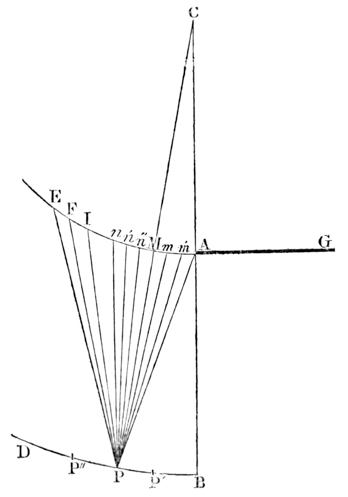
Let C be the luminous point, AG the screen, and AME the wave, arrived at A, and partly intercepted by the opaque body. We may suppose it to be divided into an infinite number of small arcs, Am′, m′m, mM, Mn″, n″n′, n′n, and so forth. In order to find its intensity at the point P, belonging to any subsequent situation of the undulation, BPD, we must find the result of all the elementary agitations which each of these portions of the primitive undulation would produce there if they acted separately.
The impulse, which has been given to every part of the [p436] primitive undulation, being perpendicular to its surface, the motions of the particles of ether in this direction must be more considerable than in any other; and the rays depending on these motions, if separately considered, would be so much the weaker as they deviated the more from this direction.
The investigation of the law by which their intensity would be governed, according to their direction, as derived from any separate centre of agitation, would certainly be of very difficult investigation: but happily we are not obliged to determine this law, for it is easy to see that when the inclination to the perpendicular is considerable, the effects of the different rays must very nearly destroy each other: so that these rays, which sensibly affect the quantity of light received at each point P, may safely be regarded as being equal in intensity.
When the centre of agitation has undergone a condensation, the expansive force tends to urge the molecules in every direction; and if they do not perform a retrograde motion, it is only because their initial velocities forwards destroy those which the expansion of the condensed fluid would otherwise generate backwards: but it does not follow from this that the agitation can only be propagated in the direction of the initial velocities; for the expansive force in a perpendicular direction, for example, will combine with the primitive impulse without any diminution of its effects. It is obvious that the intensity of the undulation thus produced may vary much at the different points of its circumference, not only from the nature of the initial impulse, but also because the condensations are not subject to the same law on every side of the centre of the agitated part[?]. But the variations of the intensity of the derivative undulation must necessarily be subjected to a law of continuity, and may consequently be considered as insensible in a very small angular interval, especially in the neighbourhood of the perpendicular to the surface of the primitive undulation; for the initial velocities of the molecules, referred to any given direction, being proportional to the cosines of the angles made by that direction with the perpendicular, these results vary much [p437] more slowly than the angles themselves, while they remain inconsiderable.
If, in fact, we consider rays sensibly inclined to each other, such as EP, FP, IP, meeting in the point P, which we may suppose at the distance of a great number of breadths from the undulation EA: and if we take two arcs, EF and FI, of such a length that the differences EP−FP and FP−IP may be equal to half an undulation: on account of the marked obliquity of the rays, and of the smallness of a semiundulation, in proportion to their length, these two arcs will be almost equal, and the rays which come from them to the point P will be nearly parallel; so that on account of the difference of a semiundulation between the corresponding rays of the two arcs, their effects will mutually destroy each other.
We may therefore suppose all the rays sent by the different parts of the undulation at AE, to the point P, to be of equal intensity, since the only rays, with respect to which this hypothesis would be incorrect, are such as have no sensible influence on the quantity of light which it receives. For the same reason, in order to simplify the calculation of the result of all these elementary undulations, we may consider their constituent motions as performed in the same direction, the angles which they form with each other being inconsiderable. The problem is thus reduced to that which has been solved in the Memoir on Diffraction, already quoted: To find the result of any number of systems of parallel undulations of light, of the same frequency, when their intensities and relative situations are given.—The intensities are here proportional to the length of the small illuminating arcs, and the relative situations are given from the differences of the paths described.
We have considered, correctly speaking, only the section of the undulation made by a plane perpendicular to the margin of the screen represented by A. We may now take into account the whole extent of the undulation, and suppose it to be divided, by equidistant meridians perpendicular to the plane of the figure, into infinitely thin wedges or strata; and we may apply to all of these the reasoning which has [p438] been employed for one section, and thus demonstrate that the rays which have a marked obliquity must destroy each other.
These strata, in the case here considered, being all parallel to the edge of the screen, and infinitely extended, while the undulation is intercepted but on one side; the intensity of the result of all the impressions, which they transmit to P, will be the same for each of them: for the rays emanating from them must be considered as of equal intensity, at least for the very small extent of the generating undulation, which has a sensible influence on the light received at P. Besides, each elementary result will evidently be retarded by the same quantity, with respect to the ray derived from the point of the stratum nearest to P, that is to say, to the point in which it cuts the plane of the figure: consequently the intervals between these elementary results will be equal to the differences of the paths described by the rays AP, m′P, mP, and so forth, which are in the plane of the figure, and their intensities will be proportional to the arcs Am′, m′, m, mM, and so forth. We may therefore consider the intensity of the general result as determined by the calculation already mentioned, as belonging to the section of the undulation made by a plane perpendicular to the margin of the screen.
While the outline of the screen remains rectilinear, it is sufficient, in order to determine the situations of the dark and light stripes, and their relative intensities, to consider the section of the undulation made by a plane perpendicular to that outline: but when it is curved, or composed of lines meeting at any angles, it becomes necessary to obtain the integral effect for two directions at right angles to each other, or for a circle surrounding the point considered. This last method is the most simple in some particular cases, as when we have to calculate, for example, the intensity of the light in the projection of the centre of a circular screen or opening: [a simplification which, though sufficiently obvious, had perhaps not occurred to Mr. FRESNEL, until it was pointed out to him by the Translator of this paper.]
It will now be easy to form a distinct idea of the method [p439] which must be followed, in order to calculate the situation and the intensity of the dark and bright stripes, in the different circumstances under which it is proposed to compare the theory with experiment. When the screen is infinitely extended on one side, or is broad enough to allow us to neglect the rays which pass beyond it, we are to determine, for any point P at the distance of the place at which the fringes are to be observed, the result of all the elementary undulations coming from the part AMF only of the incident wave; and comparing the intensities at different collateral points, P, P′, P″, we are to find the situation of the darkest and the brightest points. In this manner we find, for a screen closed on one side, 1st, that the intensity of the light decreases rapidly within the [shadow] beginning from the tangent CAB, and so much the more rapidly as the undulation is smaller; and this in a continuous manner, without any alternations of maxima and minima; 2ndly, that out of the shadow, the intensity of the light, after augmenting considerably to a certain point, which may be called a maximum of the first order, decreases to another point, which is the minimum of the first order: that it increases again to a second maximum, to which succeeds a second minimum, and so forth; 3rdly, that none of these minimums completely vanish, as in the case of fringes produced by the concourse of two luminous pencils of equal intensity, and that the difference between the maxima and minima diminishes in proportion as we go further from the shadow; whence we may understand why the fringes which surround shadows in a homogeneous light, are less marked and less numerous, than those which are obtained by a combination of two mirrors, and those in white light much less brilliant; 4thly, that the intervals been the maxima and minima are unequal, and diminish, as we depart from the shadow, in proportions which remain unaltered, whatever may be the distance from the screen at which we measure them; and 5thly, that the same maxima and minima, calculated for different distances from the screen, are situated in hyperbolas of a sensible curvature, of which the foci are the edge of the screen, and the luminous point. All these consequences of the theory are precisely confirmed by experiment. [p440]
The general formula gives the position of the maxima and minima for any distances whatever of the luminous point from the screen, and from the screen to the micrometer, when the length of the undulation of the light employed is known. In order to submit the theory to a decisive test, instead of determining the length of the undulation by measures of the external fringes, and then employing it in calculations of the same kind, I deduced it from an experiment on diffraction of a very different kind; and after having first verified it by the fringes obtained from two mirrors, of which it represented the breadth within a hundredth part of the truth, I introduced it into the formula which I afterwards compared with 125 measurements of exterior fringes, made under very different circumstances; for the distance of the radiant point from the screen was varied from four inches to six or seven yards, and the distance between the screen and the micrometer was varied from 113th of an inch to more than four yards: and the results of all these comparisons were perfectly satisfactory, as maybe seen in the comparative table published in the XIth volume of the Annales de Chimie et de Physique, p. 339, 343.
When the screen, instead of extending infinitely on one side, is narrow enough to admit some light on that side, not too much weakened by the rapid decrease of intensity produced by obliquity, we must take into the calculation the light on both sides, and find, for each point of the shadow, the general result of all the elementary undulations derived from the points on the right and left. We thus demonstrate that the interior parts of the shadow must be divided by a series of dark and bright stripes, nearly equal in breadth, of which the situations differ very little from those which would be deduced from the approximative formula which has already been given for the same purpose, when they are still separated from the borders of the shadow by an interval of several of their breadths. But when the opaque body is narrow enough, and the micrometer far enough removed for the observed stripes to be very near the exterior stripes, then the results of this more exact calculation, as well as those of experiment, show that the approximation is no longer accurate. The [p441] calculation determines also, with remarkable precision, the singular alterations which the exterior fringes often undergo, when the other series extends beyond the shadow, and mixes its effects with those of the exterior.
I have also verified the theory by examining the fringes derived from a narrow slit of indefinite length; and determining, for the different points enlightened by the luminous pencil, the result of all the elementary undulations derived from the part of the primitive wave comprehended in the breadth of the slit; and I have found a satisfactory agreement between the calculation and the observations, even when the fringes thus obtained afforded the most capricious and apparently irregular appearances.
In this mode of considering the problems relating to diffraction, we have not taken into the calculation the greater or less thickness of the edges of the screen, but merely the extent of the primitive wave which is capable of sending elementary undulations to the points for which we are to find the intensity of illumination; and the opaque substance has no other effect than simply to intercept a part of the wave: for this reason the result is necessarily independent of the nature of the body, of its mass, and of the thickness of its edges. Nevertheless, if the surface of the edges were very extensive, it would be impossible to consider the portion of the wave as quitting the slit without having received some previous modification, and it would be necessary to take into the calculation the small fringes derived from the effect of the remoter parts of the slit. But while the thickness is moderate, or the edges rounded off into a well marked curve, the small fringes derived from this cause may be neglected, and the emerging wave may be considered as of equal intensity throughout, at the moment of its quitting the screen, especially if the intensity of the light is to be calculated for a pretty considerable distance from the screen. We must not, indeed, forget, that according to the reasoning which has been employed, the formulas for diffraction are only sufficiently exact when this distance is very considerable, in comparison with the breadth of an undulation, since it is in this case only that we can neglect the rays that are decidedly oblique, and [p442] can suppose all those, which are essentially concerned in the effect, to be nearly of equal intensity. It is not, however, surprising that the same formulas will give the position of the fringes with sufficient accuracy at small distances from the screen, when its edges are thin, since, the mean breadth of an undulation being but about one fifty thousandth of an inch, a tenth of an inch becomes comparatively a very considerable distance.
These are the three principal kinds of phenomena presented to us by diffraction, when the edges of the screen, or of the opening made in it, are sufficiently extensive to afford fringes independent of any effect from their terminations: and in such cases it is sufficient to make the integral calculation for the plane perpendicular to the edges of the screen only, in order to determine the position of the dark and bright stripes, and their comparative intensities. But when the screen or the opening are of small dimensions in every direction, it becomes necessary to extend the integration to the effects produced in two perpendicular planes: and the results of the calculation agree perfectly with observation, as will appear from two curious instances.
When the screen is circular, the calculation leads to this singular result, that the centre of the shadow projected by it must be as much enlightened as if the screen were not in existence. It was Mr. POISSON that first pointed out this consequence of my formulas, which I did not at first observe, though it is immediately deducible from the theory by very simple geometrical considerations. Mr. ARAGO made the experiment with the shadow of a screen 113th of an inch in diameter, perfectly round, and fixed on a plate of glass. The result confirmed the fact which had been announced by the theory. It is only the centre itself that possesses this property, and the same brightness is only extended to a sensible distance from this mathematical point when the screen is of very small diameter, and when its shadow is observed at a great distance: for the wider that the screen becomes, the more the little bright circle is contracted; and when the screen is four tenths of an inch in diameter, we only see a single point of light, at the distance of a yard, even with a powerful magnifier. It must be observed, that if the screen [p443] were too large, the reasoning, from which the formulas have been deduced, would no longer be rigorously applicable to the rays inflected into the shadow, because of their too great obliquity, which would render it impossible to consider their effects as equal in intensity to those of the direct rays.
When we calculate, by the same formulas, the intensity of the light in the centre of the projection of a small circular aperture, made in a large screen, we find that this centre will exhibit alternately a bright and a dark appearance, according to the distance at which the shadow is viewed; and that in homogeneous light this darkness must be perfect. This new inference from the general formulas may be deduced from the theory by very simple geometrical considerations. Thus we find that the values of the successive distances, at which the centre of the shadow becomes completly dark, are b = ar22ad−r2, b = ar24ad−r2, b = ar28ad−r2; and so forth; r being the semidiameter of the aperture, a and b its respective distances from the luminous point and from the micrometer, and d the length of the undulation of the light employed. Now, if we place the micrometer at the distances indicated by these formulas, we observe, in fact, that the centre of the projection of the opening is so completely deprived of light, that it appears like a spot of ink in the middle of the illuminated part, at least with respect to the minimums of the first three orders, as indicated by the formulas here inserted: those of the subsequent orders, which are nearer to the screen, exhibiting no longer the same degree of darkness, on account of the want of homogeneity of the light employed.
There is still a multitude of other phenomena of diffraction, such as those of multiplied and coloured images, reflected by striated surfaces, as seen through a texture of fine fibres, as well as the coloured rings, produced by an irregular collection of such fibres, or of light powders, consisting of particles nearly equal, placed between the eye of the spectator and a luminous object; all of which may be explained and rigorously computed by means of the theory which has been laid down. It would, however, occupy too much of our time to describe them here, and to [p444] show how exactly they concur in confirming the theory; which indeed appears to be abundantly demonstrated by the numerous and diversified facts which have been already adduced in support of it. It will be sufficient to conclude this extract of the Memoir on Diffraction with a detailed description of an important experiment of Mr. ARAGO, which furnishes us with a method of determining the slightest differences of the refractive powers of bodies, with a degree of accuracy almost unlimited.
We have seen that the fringes, produced by two very narrow slits, are always placed symmetrically with regard to a plane passing through the luminous point and the middle of the interval between the slits, as long as the two pencils of light which interfere have passed through the same medium, for instance, the air, as happens in the ordinary arrangement of the apparatus. But the result is different when one of the pencils continues to pass through the air, and the other has to be transmitted by a more refractive body, a thin plate of mica, for example, or a piece of glass blown very thin: the fringes are then displaced, and carried towards the side on which the transparent substance is placed: and if its thickness becomes at all considerable, they are removed out of the enlightened space, and disappear altogether. This important experiment, which was first made by Mr. Arago, may also be performed with the apparatus of the two mirrors, if the plate be placed in the way of one of the pencils, either before or after its reflection.
Let us now see what inference may be drawn from this remarkable fact, by the assistance of the principle of interferences. The light stripe in the middle is always derived, as we have already seen, from the simultaneous arrival of rays which have issued at the same moment from the luminous point; consequently, in the common circumstances of the experiment, they must have described paths exactly equal, in order to arrive in the same time at the place of meeting: but it is obvious that if they pass through mediums in which light is not propagated with the same velocity, that pencil, which has travelled the more slowly, will arrive at the given point later than the other, and the point will [p445] therefore no longer be in the bright stripe. The stripe must therefore necessarily change its place towards the pencil which travels the more slowly, in order that the shortness of its path may compensate for the delay during its transmission through the solid: and the converse of the proposition enables us to conclude, that where the stripes are displaced, the pencil towards which they move has been retarded in its passage. The natural inference, therefore, “from Mr. ARAGO’s experiment,” is, that light is propagated more rapidly in the air than in mica or glass, and generally in all bodies more refractive than the air; a result directly opposite to the Newtonian theory of refraction, which, supposes the particles of light to be strongly attracted by dense substances, which would cause the velocity of light to be greater in these bodies than in rarer mediums.
This experiment furnishes a method of comparing the velocity of the propagation of light in different mediums, [or, in other words, the refractive density, which is always supposed in this theory, to be reciprocally proportional to it.] If, in fact, we measure very accurately, by means of a spherometer, the thickness of the thin plate of glass which has been placed in the way of one of the luminous pencils, and if the displacement of the fringes has been measured by the micrometer; since we know that, before the interposition of the glass, the paths described were equal for the middle of the central stripe, we may calculate how much difference is occasioned by the change of position, and this difference will give the retardation in the plate of glass, of which the thickness is known: so that, by adding this thickness to the difference calculated, we shall find the little path which the other pencil has described in the air, while the former was transmitted by the plate of glass; and this path, compared with the thickness of the plate of glass, will give the proportion of the velocity of the light in the air, to its velocity within the glass.
We may also consider this problem in another point of view, with which it is convenient to make ourselves familiar. The duration of each undulation, as we have seen, does not depend on the greater or less velocity with which the [p446] agitation is propagated along the fluid, but merely on the duration of the previous oscillation which gave it birth; consequently, when the luminous waves pass from one medium into another, in which they are propagated more slowly, each undulation is performed in the same interval of time as before, and the greater density of the medium has no other effect than that of diminishing the length of the undulation, in the same proportion as the velocity of light is diminished: for the length of the undulation is equal to the space that the first agitation describes during the time of a complete oscillation. We may therefore calculate the relative velocities of light in different mediums, by comparing the length of the undulations of the same kind of light in those mediums. Now, the middle of the central stripe is formed by the reunion of such rays of the two pencils as have performed the same number of undulations, in their way from the luminous point, whatever may be the nature of the mediums transmitting the light. If then the central stripe is brought towards the side of the pencil which has passed through the glass, it is because the undulations of light are shorter within the glass than in the air; and it is necessary, in consequence, that the path described on this side should be shorter than the other, in order that the number of undulations may remain the same. Let us suppose, then, that the central stripe has been displaced to the extent of twenty breadths of fringes, for example, or of twenty times the interval between the middle points of two consecutive dark stripes; we must necessarily conclude that the interposition of the plate of glass has retarded the progress of the pencil passing through it to the extent of twenty undulations; or that it has performed within the plate twenty undulations more than the same pencil would have performed in an equal thickness of air, since each breadth of a fringe answers to the difference of a single undulation. If then we know the thickness of the plate, and the length of an undulation of the light employed, which is easily deduced from the measurement of the fringes, by the formula that has been given, we can calculate the number of undulations comprehended in the same thickness of air, and by adding twenty to the number, we shall have that of the [p447] undulations performed in the thickness of the glass; and the proportion of these two numbers will be that of the velocities of light in the different mediums. Now this proportion is found by experiment the same with that of the sines of incidence and of refraction between air and glass; which agrees with the theory of the refraction of undulations, as will be seen hereafter.
The same experiment may be employed, on the other hand, for determining with extreme precision the thickness of a thin plate of a substance of known refractive density; placing it in the way of one of the two pencils of light, and measuring the displacement of the fringes which it occasions.
This method of determining refractive densities is however liable to some difficulties, when we wish to apply it to a body much more dense than air, such as water, or glass, for example; since it is necessary to employ a very thin plate only, in order that the fringes may not be too much displaced for observation; and then it becomes difficult to measure the thickness of such a plate with sufficient accuracy. We may, indeed, place in the way of the other pencil a thick plate of a transparent substance, of which the refractive density has been ascertained by the ordinary methods, and we can then employ as thick a plate of the new substance. But then it becomes simpler to measure its refractive density by the common method: [unless we choose to immerse the whole apparatus in a fluid very nearly approaching to it in refractive density, which may sometimes be done without inconvenience. TR.]
The case, in which Mr. Arago’s experiment has a decided advantage over the direct method, is when we desire to determine very slight differences of velocity in mediums of nearly equal refractive density: for by lengthening the passage of the light in the two mediums of which we wish to compare the refractive density, we can increase the accuracy of the results almost without limit. In order to form an idea of the extreme precision that may be attained by these measurements, it is sufficient to observe that the length of the yellow undulations in air being about .000021 E.I., there are two millions of them in the length of about 42 inches. Now [p448] it is very easy to observe the difference of one fifth of a fringe, which corresponds to a retardation of one fifth of an undulation in one of the pencils, that is, the ten millionth part of the whole length of 42 inches; we might therefore, by introducing any gas or vapour into a tube of this length, terminated by two plane glasses, estimate very accurately the variation of its refractive power.
I take the length of an undulation of the yellow rays, which are the most brilliant of the spectrum, and of which the dark and light stripes consequently coincide with the darkest and brightest stripes of the fringes produced by white light, which is commonly employed in these experiments, both because of its greater brightness, and because of the more marked character which it gives to the central stripe, so as to prevent any other from being mistaken for it.
It was an apparatus of this kind that Mr. ARAGO and myself employed for measuring the difference of the refractive powers of dry air, and of air saturated with moisture at 80° F., which is so small, that it would escape every other method of observation, because the greater refractive power of aqueous vapour is almost exactly compensated by the less specific gravity of moist air. But, in the generality of cases, the slightest mixture of one vapour or gas with another produces a considerable displacement in the fringes: and if we had a series of experiments of this kind, made with care, the apparatus might become a valuable instrument of chemical analysis.
[To be continued.]
iii. Remarks on the Action of CORPUSCULAR FORCES. In a Letter to Mr. POISSON. ◊
My dear Sir,
I AM very glad to see that you have been applying your analytical powers to the investigation of the acustical effects of corpuscular forces, and that, among many more refined determinations, you, have confirmed several of the results relating to sounding bodies, which were published twenty years ago in my Lectures on Natural Philosophy: though they were generally such as might have been derived from the calculations of Bernoulli and Euler; which I attempted in some [p449] measure to simplify by the introduction of the element which I called the Modulus of Elasticity of each substance. You have very properly observed that it is often difficult to represent the combination of these corpuscular forces by an integral, since in many practical cases the integral must vanish, where it would naturally be applied to the phenomena: and, from similar considerations, I trust you will be prepared to admit the objections that I made long ago, to the reasoning of your great predecessor, Mr. Laplace, to whose station in the mathematical world you appear so eminently qualified to succeed.
The equation, which may be called final, in Mr. Laplace’s Supplement to the Xth Book, p. 47, is Q cos. (ω−θ) = (2ς−ς′) K sin. θ. Now this, in my opinion, is a perfect reductio ad absurdum: for Q must always be incomparably less than K; the attraction of the particles lying between a cylinder and its tangent plane being always infinitely less than that of the particles in an angular or prismatic edge: or if this were denied in general, it would obviously become true when the cylinder itself becomes a plane, and Q vanishes altogether; which will always be the state of the problem, when the surface of the solid is so inclined to the horizon, that the surface of the fluid may remain horizontal, the appropriate angle of contact being unaltered in these circumstances, as it is easy to show by making the experiment with mercury.
I entreat you to consider this objection with patient attention, and to tell me if you can find any arguments to supersede it. I would also presume to ask your opinion of my own method of deducing the force of capillarity from the elementary attractions and repulsions of bodies, at the end of my Illustrations of the Celestial Mechanics, Art. 382; Appendix A, p. 329 to 337. The volume is in the Library of the Academy; or I should have taken the liberty of sending you a copy, as an inadequate return for so many valuable communications with which you have had the kindness to favour me.
Believe me always, dear Sir,
Very truly yours,
* * * *
London, 18 Nov. 1827.
[p450]
iv. Calculations of LUNAR PHENOMENA. By THOMAS HENDERSON, Esq. ◊
Principal LUNAR OCCULTATIONS of the Fixed Stars in the Months of January, February, March, and April, 1828; calculated for the Royal Observatory at Greenwich.
Date. Names of Stars. Magn- itude. Immersion and Emersion. Mean Time. Apparent Difference of Declination.* Point of Moon’s Limb.
H. M. S. ′ ″ °
Jan. 4 κ Cancri 5.6 Imm. 10 51 43 13 18 S. 172 R.
Em. 11 44 48 7 19 S. 91 R.
31 α1 Cancri 6 Imm. 11 14 52 7 45 S. 134 L.
Em. 12 35 56 2 19 N. 88 R.
" κ Cancri 5.6 Imm. 18 38 0 0 58 N. 47 L.
Em. Under Horizon.
Feb. 7 α2 Libræ 3 Imm. 20 29 54 1 35 S. 69 L.
Em. 21 37 54 4 33 N. 107 R.
22 δ3 Tauri 5 Imm. 7 0 9 3 47 S. 90 L.
Em. 8 16 39 6 34 S. 146 R.
28 ω Leonis 6.7 Imm. 11 24 25 14 57 S. 165 L.
Em. 12 3 15 9 17 S. 145 R.
March 10 ρ1 Sagit- tarii 5 Imm. 16 14 54 4 24 N. 105 L.
Em. 17 20 39 1 25 N. 62 R.
23 u Gemin- orum 5.6 Imm. 8 4 36 2 48 N. 55 L.
Em. 9 18 11 7 46 N. 94 R.
24 k Gemin- orum 5 Imm. 9 12 5 3 53 S. 78 L.
Em. 10 28 34 3 55 N. 111 R.
26 κ Cancri 5.6 Imm. 7 41 25 7 6 S. 132 L.
Em. 9 3 38 3 14 N. 83 R.
April 2 ν1 Libræ 6 Imm. 14 7 43 12 43 N. 38 L.
Em. 14 34 56 15 49 N. 10 R.
ν2 Libræ 6.7 Imm. 13 58 36 2 1 S. 99 L.
Em. 15 13 58 6 19 N. 76 R.
29 α1 Libræ 6 Imm. 16 15 38 14 48 S. 126 L.
Em. 16 48 16 11 55 S. 174 R.
α2 Libræ 3 Imm. 16 33 5 15 54 S. 145 L.
Em. 16 43 5 15 3 S. 162 L.
The fifth column shows the apparent difference of declination between the Star and Moon’s centre at the immersion and emersion; the letters N and S denoting the Star to be north or south from the Moon. The sixth or last column shows the point of the Moon’s limb where the immersion and emersion take place, reckoning from the vertex or highest point; the letters L and R signifying to the left hand or right hand of the observer.
An error of 11 seconds in the computed difference of declination between the Moon and Star, will be sufficient to convert the expected Occultation of α2 Libræ, on 29th April, into an Appulse; and a less error will considerably affect the times and places of immersion and emersion.
[To be continued.] [p451]
ELEMENTS for computing the ECLIPSES of the SUN and OCCULTATIONS of the PLANETS by the MOON, in the Year 1828.
Conjunction in A. R. Apparent Time. Diff. Dec. Relative H. M. Relative Orb. Ang. or Planet’s A. R. at or Planet’s N. P. D. at


D. H. M. S. ′ ″ ′ ″ ° ′ H. M. S. ° ′ ″
Jan. 11 10 47 11 21 1 S. 34 6 S. 76 58 E. 14 35 47 104 2 30

Jan. 11 16 40 36 4 29 N. 33 14 S. 78 4 14 49 29 105 12 34

Feb. 7 22 17 54 5 44 N. 33 26 S. 77 35 14 46 40 104 48 7
Mar. 6 4 48 7 16 46 N. 33 29 S. 77 47 14 49 7 104 53 57
April 2 8 6 49 9 6 N. 34 12 S. 77 26 14 42 44 104 21 7
April 13 21 23 53 8 50 N. 31 23 N. 74 7 1 30 20 80 32 14
April 29 10 49 53 9 3 S. 34 50 S. 76 40 14 30 21 103 22 5
May 12 8 58 41 7 44 N. 27 31 N. 78 28 2 30 50 76 35 6

May 26 14 58 46 20 58 S. 34 38 S. 75 54 14 17 53 102 23 57
June 22 21 27 33 14 27 S. 33 40 S. 75 26 14 11 5 101 55 51
July 13 12 0 30 68 43 S. 30 15 S. 76 50 8 55 0 76 17 27

July 20 6 18 33 10 12 N. 32 33 S. 75 28 14 12 35 102 11 28
Aug. 16 17 18 6 44 49 N. 31 50 S. 75 59 14 22 10 103 7 21
Sept. 5 3 7 12 4 10 S. 28 8 S. 78 3 8 13 4 75 7 21
Oct. 8 12 23 35 6 39 S. 29 6 S. 73 2 12 57 44 96 10 27
Dec. 3 13 30 46 39 10 S. 29 39 S. 75 23 14 3 58 100 19 38
ELEMENTS for computing the ECLIPSES of the SUN and OCCULTATIONS of the PLANETS by the MOON, in the Year 1828. [continued from above]
Conjunction in A. R. Apparent Time. Nearest Appr- oach. Time of nearest Approach, Apparent Time. or Planet’s
Horary Motion Semi-diam-eter Hor. Par.
in A. R. in Time. in N. P. D.
D. H. M. S. ′ ″ D. H. M. S. SEC. ″ ″ ″
Jan. 11 10 47 11 20 28 11 10 38 51 +1·3 +6 17 2
Jan. 11 16 40 36 4 23 11 16 42 16 +5·9 +27 3 5
Feb. 7 22 17 54 5 36 7 22 20 7 +0·6 +2 18 2
Mar. 6 4 48 7 16 23 6 4 54 29 −0·2 −1 20 2
April 2 8 6 49 8 53 2 8 10 18 −0·9 −4 21 2
April 13 21 23 53 8 30 13 21 19 16 +9·2 −54 958 9
April 29 10 49 53 8 48 29 10 46 17 −1·2 −6 22 2
May 12 8 58 41 7 35 12 8 55 19 +19·8 −119 3 7
May 26 14 58 46 20 20 26 14 49 55 −0·9 −4 21 2
June 22 21 27 33 13 59 22 21 21 5 −0·3 −1 20 2
July 13 12 0 30 66 55 13 11 29 28 −3·4 +22 26 27
July 20 6 18 33 9 53 20 6 23 16 +0·5 +3 18 2
Aug. 16 17 18 6 43 29 16 17 38 31 +1·2 +6 17 2
Sept. 5 3 7 12 4 5 5 3 5 22 +5·8 −1 18 19
Oct. 8 12 23 35 6 21 8 12 19 35 +9·2 +57 963 9
Dec. 3 13 30 46 37 54 3 13 10 46 +11·5 +61 7 8
The places of the Sun and Moon have been taken from the Nautical Almanac, those of Mercury from Lindenau’s Tables, and those of the other Planets from Schumacher’s Ephemeris.——The sign + denotes the motion in A. R. to be direct; the sign −, retrograde. The sign + denotes the motion in N. P. D. to be towards the South; the sign − towards the North.——None of the preceding Conjunctions will prove to be an Eclipse or Occultation visible at Greenwich. [p452]
Apparent Distance of Jupiter’s Satellites from Jupiter’s Centre, at his Conjunctions in A. R. with the Moon.
Date. Satellite. Distance.
1828. ′ ″
January 11 I. 1 14 East
II. 0 51 ——
III. 4 16 West
IV. 2 21 ——
February 7 I. 1 6 West
II. 2 40 East
III. 2 16 West
IV. 4 27 ——
March 6 I. 1 51 East
II. 2 24 West
III. 3 14 East
IV. 8 44 ——
April 2 I. 1 44 West
II. 0 15 ——A
III. 4 58 East
IV. 7 30 West
29 I. 0 14 WestB
II. 2 51 East
III. 0 32 West
IV. 1 6 East
May 26 I. 1 44 East
II. 3 8 West
III. 5 15 ——
IV. 6 38 East
June 22 I. 1 59 West
II. 0 4 EastC
III. 3 10 West
IV. 8 56 ——
July 20 I. 1 51 East
II. 2 50 ——
III. 1 55 ——
IV. 4 51 ——
August 16 I. 1 43 West
II. 1 12 ——
III. 4 21 East
IV. 1 53 ——
A: On Jupiter’s disk. B: Eclipsed. C: On Jupiters disk. These Configurations have been computed from De Lambre’s Tables. [p453]
MISCELLANEOUS INTELLIGENCE.
I. MECHANICAL SCIENCE. ◊
1. On the Adhesion of Screws.—The following results, respecting the force necessary to draw iron screws out of given depths of wood, are by Mr. Bevan, and should be placed by the side of those he has given with regard to nails128.
“The screws I used were about two inches in length, 0.22 diameter at the exterior of the threads, 0.15 diameter at the bottom, the depth of the worm or thread being 0.035, and the number of threads in one inch = 12. They were passed through pieces of wood exactly half an inch in thickness, and drawn out by the weights specified in the following table:
Dry beech 460 pounds
Do. Do. 790
Dry sound ash 790
Dry oak 760
Dry mahogany 770
Dry elm 655
Dry sycamore 830
“The weights were supported about two minutes before the screws were extracted.
“I have also found the force required to draw similar screws out of deal and the softer woods about half the above.
“From which we may infer as a rule to estimate the full force of adhesion, in hard wood . . . 200.000 d δ t = f, and in soft wood . . . 100.000 d δ t = f, d being the diameter of the screw; δ the depth of the worm or thread; and t the thickness of the wood into which it is forced;—all in inches; f being the force in pounds to extract the same.” We may, from the above experiments, observe the approximation to perfection in the art of screw making; for had the screw been greater in diameter, there would have been a waste of material, or had it been less, it would not have been sufficiently strong, which may be proved as follows: the cohesion of wrought iron has been found, from a number of experiments, to be about 43000 lbs. per cylindrical inch; and as the smallest diameter of screw used in my experiment was 0.15, it would have been torn asunder by a force of about 968 lbs.; or if the hard wood had been about 58 of an inch thick into which it had been screwed, the screw would have been broken instead of forcing its passage out of the wood.—Phil. Mag. N. S. ii. 291.
2. Improvement in Steam-engines.—According to the valuable records kept of the duty of the steam-engines at the mines in Cornwall, a most important improvement has been effected in two [p454] instances, of engines erected by Captain Samuel Grose; dependent entirely upon attention to the smaller details of the machines. The best engines, heretofore, had not done more than raise forty millions of pounds of water one foot high, by each bushel of coals consumed, except indeed upon short occasions. In one of the cases in question, an engine at Wheal Hope, of sixty-inch cylinder, working single as usual, the duty rose to fifty, fifty-four, and fifty-five millions of pounds; and in the other, an engine of eighty-inch cylinder, at Wheal Towan, the duty rose in
April 61,877,545
May 60,632,179
June 61,762,210
July 62,220,820
August 61,764,166
thus exceeding by nearly fifty per cent. what had been effected before that time.
3. Improved Clock.—Among the articles displayed at the first National Exhibition of the Objects of Arts and Industry, at Neufchatel, Switzerland, last year, was a clock made by F. Houriet, of Locle; in which steel was used only in the main springs and in the axes of the moveable parts; all the other parts were in brass, gold alloy, and white gold. The number of pieces in gold, gold and silver, gold and platina, is sixty-two: all the pivots turn on jewels, and the functions of the free escapements are effected also by means of pallets in precious stones. It had been supposed that the escapements and the spiral spring not being of steel, inconvenience would result from the smaller degree of elasticity, but numerous trials with favourable results have removed the objection; and it appears that gold, hardened either by hammering or other means, is more elastic than hardened and untempered steel. The clock had gone for six days, exposed to the contact of a magnet competent to lift twenty-five or thirty pounds, without suffering any derangement.—Rév. Ency.
4. Method of dividing Glass by Friction.—The following method is described by Dr. Hare: “Some years ago Mr. Lukin showed me that a small phial or tube might be separated into two parts, if subjected to cold water after being heated by the friction of a cord made to circulate about it, by two persons alternately pulling in opposite directions. I was subsequently enabled to employ this process in dividing large vessels of four or five inches in diameter, and likewise to render it in every case more easy and certain by means of a piece of plank forked like a boot-jack, and also having a kerf cut by a saw, parallel to and nearly equidistant from the principal surfaces of the plank, and at right angles to the incisions productive of the fork.
“By means of the fork, the glass is easily held steadily by the hand of one operator; by means of the kerf, the string, while [p455] circulating about the glass, is confined to the part where the separation is desired. As soon as the cord smokes, the glass is plunged in water, or if too large to be easily immersed, the water must be thrown upon it; the latter method is always preferable when, upon immersing the body, the water can reach the inner surface. As plunging is the most effectual method of employing the water in the case of a tube, I usually close the end which is to be immersed.”—Silliman’s Journal, xiii. 7.
5. Use of Soapstone in diminishing Friction.—In a letter to Professor Silliman upon this subject, Mr. E. Bailey of Boston, says, “I understand the Soapstone has been used for this purpose in the extensive manufactories at Lowell, for about two years, and with great profit and success. Besides answering the purpose to which it is applied very much better than any other substance that can be procured, it saves a great deal of trouble and expense. It is first thoroughly pulverized, and then mixed with oil, tallow, lard, or tar, whichever may be the best adapted to the use for which it is designed. It is of course important to procure that which is free from grit, and it can be purified in a good degree by mixing the powder with oil, and decanting it after it has stood a few minutes. The heavier particles will form a sediment to be rejected. It is used in all kinds of machinery where it is necessary to apply any unctuous substance to diminish friction, and it is said to be an excellent substitute for the usual composition applied to carriage-wheels.”
Some idea of the value of soapstone thus applied, may be formed from the following fact communicated by D. Moody, Esq., the superintendent of the tar-works on the mill-dam near this city. Connected with the rolling machine of that establishment, there is a horizontal balance-wheel, weighing fourteen tons, which runs on a step of five inches diameter, and makes from seventy-five to one hundred revolutions in a minute. About one hundred tons of iron are rolled in this machine in a month; yet the wheel has sometimes been used from three to five weeks without inconvenience, before the soapstone has been renewed. The superintendent thinks, however, that it ought to be more frequently employed.
“The use of soapstone was discovered at Lowell. It has been said never to fail in producing the desired result when applied to machinery which had began to be heated, even in those cases when nothing else could be found that would answer the purpose.”—Silliman’s Journal, xiii. 192.
6. On peculiar Physical Repulsions, by M. Saigey.—I intend to give in this bulletin the description of a very simple apparatus, by means of which I have made many experiments, which have conducted me to the following results:—
i. All bodies exert between themselves a feeble repulsive action in ordinary circumstances. The repulsion between bismuth and [p456] antimony and the poles of a magnetic needle, is a case of this general law, and is not due to magnetism. Nor is it magnetism which occasions the direction of needles formed of other substances than iron, announced lately by M. Becquerel.
ii. A very marked attraction may be observed between a cold and a heated body, or between two bodies of different temperature, whether screens be interposed or not.
iii. The metallic plates in the Cabinet de Physique de Paris, intended for the repetition of M. Arago’s experiments on magnetism by rotation, contain more or less of iron capable of attracting a very mobile magnetic needle. These plates, and those of M. Arago, were made by the same person and from the same materials.
iv. I believe that, in many cases, results obtained without the appreciable developement of magnetism or electricity, have been attributed to these powers; and from well-proved experiments I shall deduce new results relative to the diurnal variation of the needle, the direction of the plumb-line and the density, temperature and attraction of the planetary masses.—Bull. Univ. A. viii. 287.
7. On the Magnetic Effects of Metals in Motion.—M. Seebeck has endeavoured to determine the effects of various metals in diminishing the oscillations of a magnetic needle 218 inches in length, and suspended by a silk fibre three lines distant from and above the plates. The oscillations were counted from an amplitude of 45° to 10°.
116 oscil- lations above a plate of marble
112 layer of mercury 2 lines in thickness.
106 plate of bismuth 2
94 platina 0.4
90 antimony 2.0
89 lead 0.75
89 gold 0.2
71 zinc 0.5
68 tin 1.0
62 brass 2.0
62 copper 0.3
55 silver 0.3
6 iron 0.4
It is also stated that he has found, from experiments, that by alloying such metals as are magnetic, like iron, nickel, and cobalt, with other metals, which like antimony diminish the magnetic force, alloys are obtained entirely neutral in their effects; thus the alloys formed by four of antimony with one of iron, three of copper with one of antimony, and two of copper with one of nickel, produce no diminution of the number of oscillations, these amounting to 116 as with the plate of marble. These three alloys are, therefore, the best for the manufacture of compasses, those of copper and nickel being the most malleable.—Annal. des Phy. 1826. Bull. Univ. A. viii. 136. [p457]
8. Duration of the Effects of Light upon the Eye.—M. Plateau of Liege has endeavoured to determine the length of time during which the impression of certain luminous rays upon the eyes remains; and has given the following results:
Flame 0″.242
Ignited Charcoal 0″.229
White 0″.182
Blue 0″.186
Yellow 0″.173
Red 0″.184
9. On the Measurement of the Intensity of Light, by M. Peclet.—A very usual photometrical process is to interpose an opaque body between a white screen and the two lights to be measured, and to move the latter until the shadows produced are of equal intensity; the intensity of the lights being then as the square of their distances from the shadows they illuminate. Sometimes a translucent body, as unpolished glass or oiled paper, is used in place of an opaque one, the shades produced by transmission being observed.
In both these methods, the apparent intensity of the shadow varies with the position of the observer. If the shadows are equal when observed from a point perpendicular to the white screen at the middle of the distance of the two shades, they will be no longer so on removing from that position, and the shadow nearest to the observer will always appear the darkest. These apparent variations are greater as the shadows are farther apart, or with reflected shadows as the screen is smoother, or with transmitted shadows as the interposed obstacle is more diaphanous.
The explanation given of this fact is, that unpolished opaque bodies, like paper, plaster, &c. never disperse the light incident upon them, in an uniform manner, more rays passing in the direction in which regular reflexion would take place, than in any other. Hence, when two equal shadows are produced upon such a surface, either by two equal lights at equal distances, or by two unequal lights at unequal distances; the shadow nearest to the observer must necessarily appear deeper than the other, because it is enlightened by the nearest light, the rays from which are reflected in greatest abundance away from the observer; and, on the contrary, the shadow further from the observer should appear lightest, because the rays which fall on it from the furthest light are reflected in greatest abundance towards the side on which the observer stands. The reason, also, why the effect is greater as the shadows are further apart is evident; and why in every case it is reduced to nothing when the observer is in a plane perpendicular to the screen and equidistant from the two shadows.
From these facts and explanations it may be concluded, that, in all photometrical measurements by reflected shadows, the screens should have all smoothness removed from them, and the two [p458] shadows brought as near together as possible, and even made to touch or over-lap; or that, when this cannot be done, the observation should be made from a point equidistant from the two shadows. As to the shadows by transmission, the apparent variations of intensity are so great for small changes in the position of the eye, as to render the method altogether inapplicable.—Bull. Univ. A. viii. 248.
10. On the apparent Decomposition of White Light by a Reflecting Body when in Motion.—The following experiment is described in the MSS. of M. Benedict Prevost and published by M. P. Prevost. A ray of solar light being introduced into a darkened chamber, is to have a square piece of white paper about two inches in the side, passed across it perpendicularly to the direction of the ray. The light reflected by the paper, instead of being white, will present a small white central portion, surrounded by the seven principal colours, nearly in the order of the prismatic spectrum. When a red surface is used instead of a white one, the decomposition of the light is still more complete. When the paper has a slight blue tint, the effect is less perfect than with the white paper. With a black surface no colours appear, but a sort of smoky shade towards the middle. A single passage of the paper is sufficient, but it is necessary that it pass entirely through the ray, no part remaining in it.—Bib. Univ.—Bul. Univ. A. viii. 248.
11. On the Barometer.—The following are conclusions at which M. Bohnenberger has arrived relative to the barometer: i. The surface of mercury in a tube 14.5 lines in diameter, is slightly rounded at the edge; but, at the distance of two lines from the glass, capillary depression disappears, and the surface is level. ii. The mercury in a tube 5.8 lines in diameter is convex over the whole surface, the depression being .035 of a line. iii. The depression is generally less in a vacuum than in the air, so that a syphon barometer gives results too high, and the more so as the tube is smaller. iv. Barometers constructed with tubes five lines in diameter, do not require tapping to cause them to assume their proper height; and comparatively slight blows easily make the mercury rise too high in tubes of a smaller diameter.—Annal. der Phys. und Chem.
12. Easy Method of reducing Barometrical Observations to a Standard Temperature, by S. Foggo.—The expansion of mercury deduced by the different philosophers who have examined it, is given below; omitting the results of Sir G. Shuckburgh, as being rather too far from the mean of the others.
Expansion of mercury, from 32° to 212° F.
De Luc 1-56th
Lavoisier and Laplace 1-55.22th
Halstrom 1-55th
Dulong and Petit 1-55.5th
mean, 1-55.43th.
[p459]
For 1° of Fahrenheit’s scale, this is equal to 19977.4, or .00010023: which may be called one ten-thousandth, without the most trifling error in practice. The barometric column may, therefore, be reduced to the standard temperature of 32° F. by the following simple rule, which will make a table unnecessary. Before the first three figures of the observed height place two cyphers, multiply by the temperature of the mercury −32°, and subtract the product from the observed height. Example; barometer 30.597, temperature of mercury 74°.
74° − 32° = 42°.00305 × 42 = .128 and 30.597 − .128 = 30.469 the correct height.
When the temperature of the mercury is lower than 32°, the temperature is to be subtracted from 32°, and the product, obtained as before, is to be added to the observed height. Thus, let the barometer be as before, and the temperature 15°: then 32° − 15° = 17°; .00305 × 17 = .052, and 30.597 + .052 = 30.649, the correct height.—Jameson’s Journal, 1827, p. 378.
13. Diamond Lenses.—I see by the last number of the Journal of Science and the Arts, that Mr. Varley has made a Diamond Lens, and also a single microscope with such motions as enable the observer to follow an animalcule in a diagonal direction. It is very odd, but this is precisely my plan for a microscope, which I drew up about four years ago; and as I could not get any optician to undertake it, I sent it to the Society of Arts, and recommended them to offer a premium for the best diamond lens, but they returned it. I have had a microscope of this sort (made by W. and S. Jones, Holborn) about a year and a half, and it answers the purpose completely; as a person not at all used to microscopes may use a lens of 160 inch focus and find a small object with it, and bring any part of it into the field of view with the greatest facility, and follow the motions of an animalcule in a diagonal direction. There are some alterations and improvements, which I have since made, that have rendered it a very complete microscope; a drawing of which I could send you, if you think it would be acceptable.
I am, Sir, yours, &c.
G. DAKIN.
Tringham, Norfolk, July 9th, 1827.
14. Sapphire Lenses for Single Microscopes.—As it may justly be feared that, notwithstanding the incontestable superiority of diamond lenses, the cost and difficulty attendant on their production will enhance their value beyond the reach of the public, Mr. A. Pritchard, No. 18, Pickett Street, has applied himself with indefatigable perseverance to the formation of Sapphire Lenses. The valuable experiments of Dr. Brewster have determined that the sapphire possesses a stronger refraction than any other substance capable of giving a single image (diamond excepted), [p460] while its dispersive power is only 0.026 compared to water as 0.035. Thus if a sapphire is ground in the same tool which will form a lens of glass of the 160 inch focus, it will come out about the 1100 inch focus; being almost double the power of the glass in linear amplification, and more than double in superficial; in which latter mode of estimation the powers of the glass and sapphire may be rated at 360,000 to 1,000,000. The faint blue tinge of the sapphire is not felt in thin small lenses formed of this substance, which thus come next in order to diamond ones, and form an excellent pis aller for those who cannot come at the latter. Many of our first microscopists are already in possession of them, and have honoured them with their unqualified approbation.
There is a property possessed by small single lenses formed by precious stones, which is worthy of being commented on: viz. They can be burnished fast into brass rings, and thus safely cleaned and removed at pleasure from one setting to another. The cohesion of glass is too slight to permit this operation, during which it is almost sure to burst into shivers.—C. R. G.
15. On a Method of Securing and Preserving the Rowing Pins in Boats.—Dear Sir,—To remove a petty inconvenience of hourly occurrence, by some simple contrivance, is often productive of a greater mass of advantage than an invention of greater splendour, and of apparently more extensive utility.
In the accompanying drawing, you have a plan for preserving that indispensable requisite in a boat, the towels, or rowing pins; the loss of which is not only very teasing, but often productive of serious inconveniences; while the practice of stealing them from each other forms a constant source of petty depredations, leading to perpetual quarrels among seamen in harbours. He who has been detained the better part of a day in the island of Sky, till half [p461] a dozen of these pins could be procured, well knows how to value that trifle, the neglect of which has caused the loss of his voyage, and might have led to that of his boat and his life also.
Fixed towels cannot well be used when boats are to be hoisted in alongside, as they are subject to be broken; and they are often inconvenient in getting in water casks, as well as in many other cases. Hence, pins capable of being unshipped are preferable. These are frequently lost, and the want is not always discovered till it cannot be replaced; or else it is not replaced without loss of that time which is often so valuable at sea. Very often, also, the delay of even a minute is rendered inconvenient or even dangerous; when the boat is dragging alongside by the painter in a heavy sea, and the vessel is either drifting or standing on.
The drawing requires little explanation. By pulling at the lower pin, the two upper are fixed at once, and on being unshipped they hang secure from loss; while the lower one serves us a spare towel, should any be broken. As not one boat in twenty thousand is provided with this invention, which is indeed scarcely known, it will not perhaps be found undeserving a place in your Journal.—
I am, &c.
J. M.
16. Cold Injection for Anatomical Preparation.—If a mixture of varnish and vermilion has a small quantity of water mixed with it, it soon sets and becomes hard. This affords an excellent composition for anatomical injection, being very beautiful and very penetrating, (so much so, that it frequently returns by the veins,) and requiring no heat to be applied to the subject. The writer of this article frequently had, in the course of his medical education, the office of preparing this injection, of which he has, however, unfortunately forgot the proportions, and the particular nature of the varnish. It was, he thinks, a spirit varnish; the water was not mixed until the instant the injection was wanted, when it was well worked up with the syringe, and immediately thrown in; in the course of a night it would have set beautifully. This particular kind of injection was invented by an American anatomist of the name of Ramsay, and preserved as a valuable secret by him for the exclusive use of his own dissecting room. The proportions, &c. of the ingredients will soon be attained by a few experiments.
II. CHEMICAL SCIENCE. ◊
1. Extraordinary Experiments on Heat and Steam by Mr. Perkins.—“I discovered that a generator at a certain temperature, although it had a small crack in it, would not emit either water or steam. This fact I mentioned to a very scientific friend, who questioned its accuracy, and to convince him I tried the experiment; but he concluded that the expansion of the metal must have closed the fissure. To remove every doubt, I proposed to drill a small [p462] hole through the side of the generator, which was accordingly done. After getting the steam up to a proper temperature, I took out the plug, and although we were working the engine at thirty atmospheres, nothing was seen or heard to issue from the plug-hole; all was perfectly quiet: I next lowered the temperature by shutting the damper, and opening the furnace door; a singing from the aperture was soon observable, and when a coal was held before it, rapid combustion ensued; nothing, however, was yet visible: but as the temperature decreased, the steam became more and more visible, the noise at the same increasing, until finally the roar was tremendous, and might have been heard the distance of half a mile. This was conclusive. I should mention that, at the aperture, the iron was red-hot.” “The hole was one quarter of an inch in diameter.”
“The experiment affords some data towards answering the question, at what distance from the heated metal the water remained, when under the pressure of thirty atmospheres; we may safely aver that it exceeded one-eighth of an inch.”—Silliman’s Journal, xiii. 46.
2. On the Use of feeble Electric Currents, for effecting the Combination of numerous Bodies, by M. Becquerel.—A highly interesting memoir on this subject is inserted in the thirty-fifth volume of the Annales de Chimie, the intention of M. Becquerel being to show that electro-chemical powers may be used not only for the decomposition and analysis of bodies, but also for the production of new compounds.
The facts described in the paper are commenced by one intended to illustrate future reasoning, by shewing what takes place when a very feeble electric current traverses a metallic circuit, interrupted in one part by a neutral solution, into which the two extremities of the wires forming the circuit are immersed. Two small copper wires were connected together by loops, and the two free ends joined to the ends of a galvanometer wire; the circuit was then cut in one place, and the extremities immersed in a solution of chloride of sodium. Then, if one of the loops be raised to a red heat by a spirit lamp, an electric current is produced, the heated loop furnishing negative electricity. Now if the ends plunged in the saline solution are terminated by platina or gold wires, no current of electricity is observed; with silver terminations, the current is very feeble; but with wires of zinc, lead, iron or tin, the current is very energetic. These remarkable effects, highly important in the phenomena hereafter to be considered, are no way connected with the conductibility of the metals; for lead and zinc, which are the worst conductors, are those which, with the copper, produce the most powerful effects. The current ceases altogether as soon as the lamp is removed.