Volume 7 / Part 1 — VI. Report upon the New or Rare Plants which flowered in the Garden of the Horticultural Society at Chiswick, between March, 1825, and March, 1826. Part 1. Tender Plants. By John Lindley, Esq. ◊ (continued 5)
Reading edition
Another of Mr. Wilkinson’s very valuable inscriptions, from a temple at Kous, must be allowed to give evidence much more favourable to Mr. Champollion, as far as it regards the signification of the plough, which seems to enter into the composition of Philometor, as applied to Cleopatra and “Ptolemy Alexander,” who are called Philometores Soteres, both here and in Anastasy’s Greek Manuscript. The name of Alexander had never occurred to the author of the article EGYPT, but he had evidently a foresight in what way it would make its appearance when he observed, N. 55, “it will appear hereafter, that a knowledge of the enchorial forms may possibly contribute very materially, at some future time, to assist us in determining it:” and he immediately proceeds to the subject of PHONETIC HIEROGLYPHICS.
The plough seems to be exchanged on the Minervean obelisk for the dentated quadrant and chain, which may hence have been synonymous with the dentated parallelogram or comb: both perhaps having represented instruments which bore the same name, and served the same purposes, though of different forms: they may, for instance, have been rakes or harrows, and may hence have borne some analogy to the plough or hoe. Whether they had names beginning with M, may still be questionable.
Mr. Champollion has endeavoured to explain the absence of the names of our queens from the tablet of Abydus, by saying that it must be considered as a tablet “purely genealogical.” First Letter to the D. de B. p. 89. A reader is naturally disposed to acquiesce in this explanation, since Mr. Champollion, who has carefully examined it, asserts it on his own credit; especially as the assertion appears to be supported by a long and minute discussion. Unhappily, however, it is only necessary to compare his brother’s chronology in P. 107, with his own Plates II. and III. fig. 5, from which it appears that Amenses, who reigned more than 20 years, was the mother of Thuthmosis the second, whose name is in the tablet, while his mother’s is omitted. It is true that, with his usual ingenuity, Mr. Champollion seems afterwards to change his ground in the same page: for he says, that one only of two brothers or sisters was inserted, in order to keep the number of the [p320] generations unaltered: and he might have added that Amenses was the sister of Amenophis, whom she succeeded. If he had stated this clearly, the reader might have judged for himself, whether such a coincidence was or was not sufficient to support the chronology of Manetho; which was, however, by no means in want of such support: in the article EGYPT, for example, Manetho’s chronology of this dynasty is fully adopted: and the same ‘cartouche’ is read Thuthmosis, which Mr. Champollion, after all his parade, still admits to be Thuthmosis: nor is there a difference of half a century in the dates assigned to his reign by various chronologists. It was established in the article Egypt, that the name contained that of Thoth, the Egyptian Hermes, and for this reason it was considered as better established than any other of the names of the Pharaohs. Mr. Champollion had never discovered this for many years afterwards: and yet we have been told by an ENGLISHMAN in the last Quarterly Journal, that to Mr. Champollion the greater part of the discoveries made by the interpretation of hieroglyphics are owing!
Believe me, dear Sir, very sincerely, yours,
* * * *
London, 24 Nov. 1827.
On the Naturalization of Fish. By J. Mac Culloch, M.D., F.R.S., &c. ◊
Dear Sir,
As I promised you that I would communicate to you, from time to time, any new remarks or facts which might occur on the subject of naturalizing sea-fish in fresh water, I am pleased to have an opportunity of noticing a few circumstances which may serve to keep alive in the public mind a subject, from which I cannot yet help foreboding useful results, in spite of the neglect and opposition which it has experienced from every person, I believe I may safely say, to whom it has been proposed, except Mr. Arnold. I am perfectly safe in saying, that, with this sole exception, every individual to whom the facts have been described, and the experiment proposed, have replied by doubts, or cavils, or objections of some kind; many, by [p321] positive disbelief of the very facts; while the far greater number have been persons, whose entire ignorance of every requisite point of physiology, natural history, and chemistry, must, of course, have rendered their objections sufficiently unworthy of notice, though not sufficient to restrain the confidence with which they have been urged. The satirical writers of the day view this as the character of the age: the more obvious aspect which this disposition presents, is the feeling, as if he who attempted, by suggesting an improvement, to render a service, was meditating an injury, and was an enemy to be opposed at all hazards. I must permit you to settle metaphysical and moral questions so profound as to exceed my own ingenuity.
But I cannot avoid regretting that Mr. Arnold is not the rich and idle proprietor of some of the tens of thousands of acres of fresh water, whether Scotch or English, in which a ‘sea-fish cannot possibly live,’ or ‘would certainly not be eatable’: and, in addition, that, instead of a not very opulent and very busied ‘notary public,’ he was not in possession of some five thousand of these acres, with as much money, and as much leisure. And I feel bound to add to this apology for what he has not yet done, that the expense of such a course of experiments is considerable; at least in this comparison. A superintendent would be necessary; and for the purpose of taking and transporting the fish, still more of drawing nets periodically and frequently, to ascertain the progress of the transplanted fish, there must be expensive assistance, for which, as yet, there can be no returns; while that, in addition to irregularities and rocks in the pond itself, impeding the accurate drawing and examination, must also be the apology for the imperfection of the present additional report as to the success for certain fishes. It is plain that, though ten or a hundred turbots were present in a pond of four or five acres, the fact is not one that can easily be ascertained. Let those who have money, leisure, and water, and nothing else towards the investigation of this object, restrain, at least, their incredulity and opposition; as may also they, very safely, who never saw a fish, except on the stall of a London fishmonger.
With respect now to some facts: it had been said that the water was salt, because this pond was situated at a sea [p322] embankment. I stated before, that it admitted the sea, by leakage, in summer, when there was little comparative supply of fresh water, and was therefore brackish, or saline. I have since ascertained the exact proportion of salt in the water, at those times when the fresh water is least. In the driest and hottest part of one summer, the proportion of salt in it, as compared to the sea without, was as 40 to 150. In another, peculiarly dry, 1827, it was one half; and the water, having then been at the lowest, it cannot ever be computed to exceed this. Moreover, this period of saltness cannot easily, even in such a summer, occupy more than the months of June, July, August, and September; or, more strictly speaking, it is probable, scarcely one half of that time in general, in so rainy a climate; a climate equalling Penzance in the quantity of rain.
In winter, that is, during five or six months, or less, if any objector pleases, it is fresh. That cattle drink it freely, is not an exact chemical proof; but I must admit, that I have not analyzed the water at that period, holding the objection in great contempt. It may be sufficient to say, that it then occupies a space of about sixteen acres, or increases to this magnitude from four and a half acres; so that it cannot, at least, be very salt, while the fish, and the mullet in particular, are found in the remotest ditches, among the meadows. But, in defect of an analysis, which I have not had the means of making, there is a valid reason why the water should be fresh when the size of the pond is much extended. The presence of sea-water in it, is, in all cases, the consequence of a depression of the water within the sea-wall, which allows of leakage or infiltration at the upper part, so as, in high tides, to equalize, as far can be done in the short period of high water, the levels within and without. This, it is plain, must cease whenever the water within is higher than the sea without; and hence it is that there can be no access for the salt water in the winter or rainy months.
Enough of the mere fact: the objections derived from which ought not to demand an answer among physiologists; while to those who argue physiological points in utter ignorance of all that belongs to physiology, it is probable that all answer is fruitless. It was stated before—the question is simply twofold; [p323] respiration and food. If fish can breathe indifferently salt water or fresh, for one week or one month, and if, in their new element, translated from salt to fresh, they thrive or grow, fatten and breed, the trial of three weeks or three months is a sufficient proof that they will neither sicken nor die of fresh water. If they can find food, it is indifferent whether the medium is fresh or salt. It is the misfortune of the age to understand every thing without knowing its principles; just as every man is now a physician. A few, more profound, who chance to know that salmon divide their time between fresh and salt water, possess other reasons, and find other objections; which they must be permitted to explain for themselves. I ought not, while on this particular subject, to omit one fact, which has come to my knowledge since the former papers were written, on the voluntary emigration of a fish, supposed to be peculiarly delicate and peculiarly attached to the sea, into fresh water. This is, that, in Virginia, the herring ascends the rivers, even up into the most minute communicating branches, and as far as it can reach; while a somewhat recent traveller describes them as being so abundant, that it is impossible to cross the fords on horseback during the season of their migration, without destroying them by the horse’s feet. To proceed to the historical condition of this pond.
I have already stated the difficulties arising from want of leisure and wealth in the proprietor, added to non-residence I should say, whence chiefly has arisen the difficulty of tracing the results. Let those try for themselves, who consider that all this might have been ascertained in a twelvemonth, and with the same means. Since the communications I formerly made, the Pilchard has been introduced. It swam away briskly, therefore it would not die of the fresh water; but it has not been retaken. The retaking of individual fish, to ascertain their presence, is a fundamental difficulty, as I before pointed out.
The Brill has also been introduced since my former list. It has been retaken; and, within one year, had grown to double the original size.
The Turbot. Fifty or sixty were introduced, averaging about eight inches in length. Some were retaken in a year, for the purpose of examination merely, like the former and most others; [p324] they also had grown to double the size. There is no prospect of dying in these cases, it is abundantly plain; that they will breed is probable, but there has been no time, nor would the young have been taken. What is to prevent healthy fishes from breeding? The young, indeed, may be eaten; if so, it is for want of room, or want of a proper balance in this mixed population. No one knows any thing, either of the ordinary growth, propagation, or destruction of fishes; and how then can any one decide on what is regular or extraordinary?
The Wrasse has been retaken after a considerable period; therefore it is not dead.
The Basse has propagated; and so has the Brill.
The Red Mullet has been introduced, and is living.
The Whiting was introduced, and taken in good health many weeks after, but not since.
The Grey Loach is thought to have bred considerably.
The Atherine continues to breed.
I formerly mentioned that the flavour of the several fishes was improved: this is now more positively asserted, in addition, of the Basse, the Plaice, and the Red Loach. Others were mentioned in former communications.
Loss of property, or flavour, has been made a speculative objection by the unvarying objectors. General experience has shown, that in all fishes, as far as known, the access to fresh water, or fresh water food, improved the flavour; in many, in oysters, muscles, cockles, shrimps, it is vulgarly notorious; as in mere sea water they are worthless.
There is a popular objection, on this head, made by the country gentlemen, which I must answer; to those who think about what they know, it would have been superfluous. The salmon is good when it comes from the sea, and bad when it is returning. Doubtless, it is; while the reason ought to be plain, even to an angler. It is in full health in the first case: in the latter, it has spawned; and, at that period, every fish is proportionally as bad as the salmon; many are a great deal worse. The fault is not in the water, nor probably in the food; it is in the spawning, and with any food the same effect takes place, in all fishes, everywhere.
I suggested in former communications, that an essential point [p325] to ascertain, in any view of economy, or management, would be the proper balance of species; to discover what kinds would so live together that all the species might find food; might breed, each to its useful limits, so as to be serviceable to ourselves, the keepers or the flocks, and without hazard of the extermination of any kind. I may illustrate what is here meant, by a simple fact, in the ordinary economy of fresh water fishes in confinement. Pike and perch can live together, because the natural defences of the perch prevent the pike from exterminating the race, voracious as the enemy is. If trout and pike were confined in a narrow water, the trout would be destroyed.
Or otherwise, it must be our object to ascertain, in an economical view, how to feed, by means of species that we do not desire to eat, those which we do cultivate for our own uses. This is a difficult question, which can only be overcome by time and experience; by knowledge; by knowledge, when we are in a state of entire ignorance; ignorance of every thing that relates to fishes, as great as if they were the inhabitants of another planet. This was one great source of difficulties with us in this case; and I, myself, must plead guilty, I fear, to a general recommendation of introducing every fish as a mere matter of trial; the result of which has been mischievous. The basse appears to have been the great enemy; to have eaten up the greater number of many species, and given no return. It has proved the pike of this pond. This could not have been foreseen; it is a caution for future speculators. Others will be discovered in the course of trial. It appears also that the common crab has proved destructive, probably by eating the spawn of larger fishes. From some enemy or other, the eels, which at first abounded to an incredible degree, have most materially diminished, and so have the shrimps. The latter, at least, appear to have been destroyed by the basse. Time and trial will teach us what to do in this case; in the infancy of ignorance, man might have supposed that he could keep wolves and sheep in one field, and have constructed a pen for foxes and fowls, rabbits and weasels. We must not accuse nature of our own ignorance.
The question is here a difficult one; but a little more study [p326] of the general habits of fishes, merely as we know them already, and even of their anatomy, will go far to lay the foundation of useful rules on this head, even without a hazardous trial, which may ultimately not become in our power to remedy, as I much fear may prove the case with respect to these unlucky basse. Not to enter on this further than as it may serve for a general illustration of what is here meant, the anatomy of the mullet proves that it lives on worms; on the lumbricus marinus, and others; and so do its habits. So also may the very food of others, as found in the stomach, serve to indicate their natural or ordinary food. Reversely, the anatomy of a cod’s jaws, and its stomach also, prove it to be omnivorous, omnivoracious. Or, further, the anatomical character of the diodon proves that it eats shell-fish; as we are equally able to limit the range of food in the flat-fish which have no air-bladders, and cannot quit the ground.
But in this brief communication, I must not enter further into this subject than is necessary for mere illustration. I may take some further opportunity to point out the probabilities, as to mutual food and protection, in any artificial cultivation of this nature, as they might be derived from studying the little that we do know about the structure and habits of fishes. All that I need add here, is, that I have suggested the introduction of limpets, periwinkles, and cockles; as affording food without furnishing enemies: a matter which had been overlooked. To exterminate the enemies which have been unwarily introduced, will not prove so easy a task; unless, at least, we could find their natural enemies; find the great secret by which alone, in all cases, man can make war on those whom neither his artillery, his physic, nor his politics can reach.
The transportation of fishes has been objected to as difficult. I had occasion to make some remarks on this formerly, and on the vitality of some kinds. The difficulty is not so great as has been imagined. The fact generally is, that fishermen, even down to the very sentimentalists who worship the gentle Izaak, and who are sometimes scarcely possessed of the wit of a fish, treat them as they would a stone; as if they had not lives, and wills, and opinions, and were not part of the same [p327] creation as ourselves; as if that creation, which outnumbers ourselves by millions of millions almost beyond algebra to express, was not, like ourselves, under His care. They are easily killed by violence; they kill themselves by over-exertion, from anatomical peculiarities; as every trout-fisher knows; that is to say, the fact, not the cause. Let them be treated with gentleness when taken, as if they could feel; and they will not die in being removed into a cask of water. The flat fish are all peculiarly tenacious of life, so are all those of firm muscles generally: the vitality of the carp and of the minnow also is notorious; and so it is as to many other kinds. All these can be removed, and carried far, even in straw; but in truth, he who chooses to make his experiments like a philosopher, and who desires to succeed, will not fail.
Yet let me point out what I have suggested to Mr. Arnold, among other things: to him, whose merit as an ardent experimenter, always ready to adopt a reasonable suggestion, and never seeking for an objection, ought to stamp his character as a genuine follower of the true philosophy; the exception, in this particular case, to every one else. This is, to adopt the Chinese method of transporting the spawn of fishes; as affording a far greater facility to the introduction of species. I presume that the general fact must be known to your readers; though I believe that I ought to doubt: because I quoted the same practice from Columella formerly, as in use among the most ancient Romans, among the common farmers.
This substance is perpetually brought up by the trawl net, very injuriously, as it relates to fisheries; and in many cases, the fishermen contrive to guess tolerably well to what fish it belongs. That it may be transported to any distance, the familiar practice of China proves: since it is there a common article of sale in the markets; while there also, I may incidentally remark, the cultivation of fish for sale, their transportation to market, and their replacement in the ponds, if unsold, is as much matter of ordinary farming as the management of a poultry-yard; while the pond is often the most profitable part of the farm. They also, who do not already chance to know it, may be informed, that this species of poultry-yard, or fish-pond, is as easily and regularly [p328] stocked in this manner, and managed, as any other portion of the farm: since it is even destroyed, or suffered to become dry occasionally, and again renewed in the wet season, by the means of purchased spawn, or stock; just as a sheep farmer buys lambs to stock his mountains. If England is too wise to learn of Rome or China, or of France and Germany, or even of the experiments on which I have dwelt so much and so often, it must be a pleasing reflection that it is already so amply informed as to have passed the bounds of all possible improvement and all possible wishes. But that I may terminate this particular suggestion, I will only further point out, that lobsters, and the crab tribe generally, might very easily be transported in this manner, and that, in them, it is easily known when the ovum has been impregnated, by means of a black spot with which it is then marked.
If I ought to apologize already for the length of this communication, I shall conclude it by saying, that whatever may be judged of the general philosophy of this subject, there is not and never has been any thing to prevent the cultivation of fish, in ponds of salt-water at least, or the preservation of them in any water in which they will live for a sufficient length of time, so as to render that a depôt for the purposes of a fish store, calculated for the steady supply of a market, in the manner which I formerly described and proposed. If, after so many years as this proposal has been made, London has not seen either the facility, or the utility, it will discover them at some future day; just as it discovered, ten years after there had been twenty-six steam-boats on the Clyde, that a steam-boat might possibly be of use on the Thames; just as it opposed gas-lights, and just as it has adopted gas-lights. [p329]
Nugæ Chirurgicæ; or, a Biographical Miscellany, illustrative of a Collection of Professional Portraits. By W. Wadd, Esq., F.L.S. &c. 8vo. pp. 276. London, 1824 Longman and Co., and Callow and Wilson. Nugæ Canoræ; or Epitaphian Mementos (in Stone-cutter’s Verse) of the Medici Family of Modern Times. By Unus Quorum. London, 1827. Callow and Wilson. Mems., Maxims, and Memoirs. By W. Wadd, Esq., F.L.S., Surgeon-Extraordinary to the King, &c. 8vo. pp. 303. London, 1827. Callow and Wilson. ◊
WE have placed these three Works together, because they are so closely allied as to form a whole, and also because Nugæ Canoræ and Nugæ Chirurgicæ bear internal evidence of being written by the same pen; and when we say further, that they are characterized by good feeling and good humour, we are sure we are not far off in our guess about who is ‘UNUS QUORUM.’ These volumes come within the scope of our Journal, as comprising an outline of the history of medical science, sketched in a vein of pleasantry that makes it no less agreeable to the general than to the professional reader, and we have derived both amusement and information from its perusal. Like the ‘Gold Headed Cane,’ it helps us to much curious modern biographical anecdote, with the addition of varied entertainment for the medical antiquary. While, however, we recommend these ‘Mems.,’ and commend the literary loungings of contemporary practitioners, we cannot but regret the neglected volumes of Aikin and Walker, and lament that the lack of feeling for the annals and literature of their profession, should be less active in the medical public of this country, than with our professional brethren on the Continent.
‘Nugæ Chirurgicæ’ is a Catalogue Raisonnée of a scarce collection of Medical Portraits. We believe only 250 copies were printed; from which circumstance, and its recording the congregation of the greatest assemblage of medical men ever met together, it is probable that it may some day become a medical rarity. The author’s original intention appears merely to have been to describe the portrait, with some characteristic trait; but an after-thought seems to have occurred, and in the “Memorabilia,” the “Medici Family” are, as it were, retouched and varnished, so as to become [p330] very agreeable pictures. We shall now present our readers with a few specimens of this gallery, taken at random.
EURICUS CORDUS.
“Cordus, who was accustomed to receive his fees only at the termination of patient’s disease, describes, in a facetious epigram, the practitioner at three different times, in three different characters.
Three faces wears the doctor; when first sought An angel’s—and a god’s the cure half wrought: But when, that cure complete, he seeks his fee, The devil looks then less terrible than he.
“The epigram of Cordus is illustrated by the following conversation, which passed between Bovart and a French marquis, whom he had attended during a long and severe indisposition. As he entered the chamber on a certain occasion, he was thus addressed by his patient: ‘Good day to you, Mr. Bouvart; I feel quite in spirits, and think my fever has left me.’ ‘I am sure of it,’ replied the doctor; ‘the very first expression you used convinces me of it.’ ‘Pray explain yourself.’ ‘Nothing more easy: in the first days of your illness, when your life was in danger, I was your dearest friend; as you began to get better, I was your good Bouvart; and now I am Mr. Bouvart: depend upon it you are quite recovered.’ Bouvart’s observation was grounded on a knowledge of human nature: every day’s experience shows, that ‘accipe dum dolet’ should be the medical man’s motto.
JOHN CASE.
“In one of the profound pieces of astrological bombast written by this singular genius, he gives an account of the creation of Adam: ‘Thus Adam was created in that pleasant place Paradise, about the year before Christ 4002, viz. on April 24, at twelve o’clock, or midnight.’ His name was latinized to Caseus, which was occasionally interpreted Dr. Cheese. Granger says the following anecdote of Case was communicated to him by the Rev. Mr. Gosling, in these terms: ‘Dr. Maundy, formerly of Canterbury, told me, that in his travels abroad, some eminent physician, who had been in England, gave him a token to spend at his return with Dr. Radcliffe and Dr. Case. They fixed on an evening, and were very merry, when Radcliffe thus began a health: ‘Here, brother Case, to all the fools your patients.’ ‘I thank you, good brother,’ replied Case; ‘let me have all the fools, and you are heartily welcome to the rest of the practice.’’
THOMAS DAWSON.
“The following anecdote is related of him: After he became M.D. he attended his neighbour Miss Corbett, of Hackney, who [p331] was indisposed; and found her one day sitting solitary, piously and pensively musing upon the Bible, when, by some strange accident, his eyes were directed to the passage where Nathan says to David, ‘Thou art the Man.’ The doctor profited by the kind hint; and, after a proper time allowed for drawing up articles of capitulation, the lady, on 29th May, 1758, surrendered herself up to all his prescriptions, and the doctor very speedily performed a perfect cure.
PHILIP HECQUET.
“‘C’est une erreur de penser que le sang soit nécessaire à la conservation de la vie; on ne peut trop saigner un malade;’ are the words put into the mouth of our doctor, in the character of Sangrado by the facetious Le Sage. Hecquet, both in theory and practice, carried the anti-phlogistic system to a greater extent than any other man, and defended the ‘boisson’ and the bleeding, saying, ‘J’ai pour garants de mon sentiment, sur le Régime maigre, les médecins les plus fameux, tant anciens que modernes.’ He was a conscientious practitioner of his own eccentric doctrines, and it was perfectly consistent with his character, that ‘loin d’imputer la mort du chanoine à la boisson et aux saignées, il sortit en disant, d’un air froid, qu’on ne lui avait pas tiré assez de sang, ni fait boire assez d’eau chaude.’
“The practice of bleeding was carried to a singular extent in France, and it was the fashion, at one time, to bleed on the opposite side to the part affected; if the pain was on the right side, they bled in the left arm, and vice versâ. Pierre Brissot produced a civil war in the medical world by writing against the custom, and, in the year 1600, was driven into exile, by edict of the University of Paris, for thus opposing the established practice.
SIR CHARLES SCARBOROUGH
“Was a man of great versatility of talents; he wrote a ‘Treatise on Trigonometry,’ and a ‘Compendium of Lilly’s Grammar;’ gave lectures on mathematics at Cambridge, and on anatomy in London. His epitaph records that he was
Inter Medicos Hippocrates, Inter Mathematicos Euclides.
He read the lecture founded by Dr. Caldwell, at Barber-surgeons’ Hall, for many years; where he was the first who attempted to account for muscular strength and motion on geometrical principles. He was a man of amiable manners and great vivacity of conversation. Seeing the Duchess of Portsmouth eat to excess, he said to her, with his usual frankness, ‘Madam, I will deal with you as a physician should do; you must eat less, use more exercise, take physic, or be sick.’
DR. PITCAIRN
“Was a great enemy to quackery and quacks, of whom he used [p332] to say that there were not such liars in the world, except their patients. A relation of his, one day, asking his opinion of a certain work on fevers, he observed, ‘I do not like fever curers; we may guide a fever—we cannot cure it. What would you think of a pilot who attempted to quell a storm? Either position is equally absurd. We must steer the ship as well as we can in a storm; and in a fever we can only employ patience and judicious measures, to meet the difficulties of the case.’”
Turn we now to the second article in our list,—Nugæ Canoræ; and we are satisfied that our readers will agree with us in the correctness of our guess. It is the production, at any rate, of one who has lived much in the medical world, and no unobservant spectator of the vices and virtues, the feelings and failings of contemporary practitioners, possessing tact to “catch the manners living as they rise.” In short, it is a pleasant jeu d’esprit; and we hail it as an omen, that in these “piping times of peace,” the days of Garth, Goldsmith, and Darwin may be revived, and that the medical fraternity may again employ their leisure hours in amusements for which their education and intercourse with society so well qualify them.
After a humorous preface, in which the removal of the College of Physicians to Pall-mall East is lamented, the work, for very satisfactory reasons, is dedicated to the Presidents of the two Colleges and to the Master of the Company of Apothecaries, for the year 1927—and as a character in one of Foote’s farces wishes he were to be born “fifty years hence,” so should we like to have a peep at the “Clines and Coopers,” the “Halfords and Warrens,” of that day. We wish, with the author, that they may be as distinguished ornaments of their profession as those of our own.
That the old college should still be preserved for medical purposes, it is proposed to turn it into a “Medical Mausoleum,” where the “Medical Fraternity” are to be buried on the same terms as the Parisians are at Père la Chaise—and then follow the supposed Epitaphs of the present race of the “Medici.” Due honour is done to learning and talents; while quackery, in all its ramifications, meets with just castigation. The names of Heberden, Turton, and Baker are noticed with the respect to which their virtues and acquirements entitle them.
Passing from these, we are introduced to an eccentric of the old school. [p333]
“SIR RICHARD JEBB, BART. M.D.
“Here, caught in Death’s web, Lies the great Doctor JEBB, Who got gold-dust just like Astley Cooper; Did you speak about diet, He would kick up a riot, And swear like a madman or trooper. “When he wanted your money, Like sugar or honey, Sir Richard looked happy and placid; Having once touched the cash, He was testy and rash, And his honey was turned to an acid.
“Sir Richard was very rough and harsh in manner. He said to a patient, to whom he had been very rude, ‘Sir, it is my way.’ ‘Then,’ replied the patient, pointing to the door, ‘I beg you will make that your way.’ Sir Richard was not very nice in his mode of expression, and would frequently astonish a patient with a volley of oaths. Nothing used to make him swear more than the eternal question, ‘What may I eat?—Pray, Sir Richard, may I eat a muffin?’ ‘Yes, Madam, the best thing you can take.’ ‘O dear! I am glad of that. But, Sir Richard, you told me the other day, that it was the worst thing I could eat!’ ‘What would be proper for me to eat to-day?’ says another lady. ‘Boiled turnips.’ ‘Boiled turnips! you forget, Sir Richard, I told you I could not bear boiled turnips.’ ‘Then, Madam, you must have a d—— d vitiated appetite.’”
We cannot help bringing before our readers the following well-known “characters” of their day, and should have indulged in more ample quotations from these amusing “Epitaphs,” were we not afraid of the imputation of “inappropriateness.”
“On a most venerable and highly venerated Surgeon, lately deceased.
‘Multis ille bonis flebilis occidit, Nulli flebilior quam mihi.’—HOR.
“Of manners gentle, and in soul sincere, Removed beyond this sublunary sphere, Here lies an honest man! Endued with caution, yet devoid of fear, In practice dexterous, in judgment clear— Excel him if you can!”
To this, we think, may be affixed the name of Henry Cline! [p334]
“CHARLES GOWER, M.D.
‘Discours de bons mots!’
“Ye sons of humour, of frolic, and fun, This stone will inform you that Gower is gone. Poor Gower! eccentric, facetious, and funny, Lik’d nothing so well as other men’s money. Alas! he is gone—’tis hard to say where, The victim of mirth, imprudence, and care. Where’er he is gone, his companions he’ll smoke, For, cost what it will—he will have his joke.
“‘I knew him well, Horatio!’” exclaims our Author—“‘a fellow of infinite jest!’—Chairman of the St. Alban’s Club, where oft ‘he set the table on a roar.’—And who did not know this eccentric oddity? Gower had considerable talents, but they were directed every way but the right. He made medicine a plaything, never being steady in professional pursuits. He wrote several singular books: one he entitled ‘Auxiliaries to Medicine;’ another, ‘The Art of Painting;’ both of which pourtray the character of their author. His unsteadiness led him into difficulties, and he died in obscurity.”
“DALMAHOY.
‘Thrice happy were those golden days of old, When dear as burgundy p’tisans were sold.’
“Dalmahoy sold infusions and lotions, Decoctions, and gargles, and pills; Electuaries, powders, and potions, Spermaceti, salts, scammony, squills. Horse-aloes, burnt alum, agaric, Balm, benzoine, blood-stone, and dill; Castor, camphor, and acid tartaric, With specifics for every ill. But with all his specifics in store Death on Dalmahoy one day did pop; And although he had doctors a score, Made poor Dalmahoy shut up his shop.”
“HENRY REVELL REYNOLDS, M.D.,
‘Os placidum moresque benigni.’
“Here well-dressed Revell Reynolds lies, As great a beau as ever! We may perhaps see one as wise, But sure a smarter never.
“Dr. Reynolds may be considered as the link between the ancient and modern costume of the Faculty: to the last, he wore a well-powdered wig and a silk coat. He was an excellent [p335] specimen of a well-dressed and well-bred gentleman. As a practitioner he ranked in the first class, and he was one of the physicians who attended King George the Third during his afflicting and protracted malady.”
“RICHARD GRINDALL, ESQ.
‘Eamus quo ducet gula.’
“Within this place Dick Grindall lies, Who was a rare game chicken. So, so, friend Dick, an old chum cries, The worms have pretty picking! No Surgeon better lov’d himself; He lov’d old rum and brandy As much as misers do their pelf, Or children sugar-candy. And as for eatables—in short, He lov’d both roast and boil’d; Fish, flesh, or fowl, of any sort, If not by cooking spoil’d. But though full well he lov’d good cheer, It was a venial fault; Since Reason’s feast to him was dear, Season’d with Attic Salt.
“He was an excellent surgeon of his day; that is, fifty years before Abernethy or Cooper was dreamt of. He was also a great oddity, but a perfect gentleman in his appearance and manner; never seen, by any accident, but in a well-powdered wig, silk stockings, and shoe-buckles. He practised in the City, when the city aristocracy resided within its walls, and Haberdashers’ “Hall, in the season, assembled all the wit, wisdom, and wealth of London merchants, in a sort of conclave of saltatory civic magnificos.”
We just remember him, and that, after a long illness, he went round in his carriage to return thanks for “obliging inquiries,” leaving his card, on which was written, “the remains of Dick Grindall.”
The third and last work we have to notice, comes more legitimately before us, and is a novelty in medical literature—a sort of Sketch Book, containing much entertaining anecdote, that makes the information it contains extremely amusing.
The work is divided into three parts, as the alliterated title quaintly informs us—Mems., Maxims, and Memoirs. The first is a chronological record, giving, as it were, a “bird’s eye view” of the most interesting events in the history of medicine, from the time of the conquest up to the [p336] present century. The second consists of comments, or short essays, illustrative of some of the most important facts; and the third of biographical anecdotes.
Under the head of “Medical Books,” we are presented with curious specimens of our earliest writers, with comments; but let the author speak for himself.
“One of the first of our English writers, is John of Gaddesden, whose ‘Rosa Anglica,’ was greatly esteemed, and he is favourably mentioned by Chaucer. John was a man to whom nothing came amiss; he had an anodyne necklace for fits, and an infallible cataplasm for gout; he was a dexterous bone-setter, and a good dentist. He was very assiduous in inventing lotions for ladies’ complexions; and was complaisant enough to cut their corns; and as for those troublesome animalcules, which, in those days, used to infest gentlemen’s heads, he had a most effectual method of destroying them; and in his celebrated book, he favours us with a whimsical cure for small-pox.—‘Immediately after the eruption, cause the whole body of your patient to be wrapped in red scarlet cloth, or in any other red cloth, and command everything about the bed to be made red. This is an excellent cure. It was in this manner I treated the son of the noble King of England, when he had the small-pox; and I cured him, without leaving any marks.’
“Such was our countryman, John of Gaddesden, who deserves notice, moreover, as being the first English surgeon employed at court; and that the King (Edward III.) wrote a letter to the Pope in favour of him.”
Speaking of Ardern’s manuscripts, he observes—
“These manuscripts, though they are more ludicrous than luminous, are extremely well worth the attention of the surgical antiquary, from the numerous illustrations they contain of the mode and manner in which Ardern performed his operations; which, considering that he was an improver of surgery, gives us a glorious notion of what the art was previously to John’s refinements, or those of Roger Franks, whom he mentions with great praise.”
“ANATOMICAL LECTURES.
“When Dr. Hunter began his anatomical lectures, they were given in the evening—but as he lived at the period when Garrick was in his zenith, he soon discovered that he stood no chance with the actor, for whenever Garrick lectured, the anatomical lectures were neglected. In vain did the Doctor preach to the pupils on the immorality of attending theatres, and the impropriety of neglecting him; it was of no avail; Romeo’s apothecary and Dr. Last were the only medical characters to spend the evening with, and for the rest, they thought Macbeth sufficient authority, to ‘throw physic to the dogs.’ [p337]
“For this reason, and for this reason alone, the anatomical lectures were afterwards given in the middle of the day.
“Dr. Hunter may be considered as the father of the anatomical schools of London, and he bequeathed a fame and character to his class, which has been supported with undiminished lustre to the present day. Previously to his time, very little had been done; Cheselden had given a few lectures—so had André, and Nourse; and Dr. Frank Nicholls gave what he considered a systematic course, and published a Syllabus of thirty-nine lectures. Dr. Maclauren and Dr. Marshal were also anatomical teachers. To the late Mr. Cline, however, and to Mr. Abernethy, we are indebted for the anatomical schools at two of our largest hospitals.
“Mr. Cline, it is true, found a place to lecture in, but it was his great talents and his high character, that brought it into notice, and subsequently, with Sir Astley Cooper, made it one of the first schools in Europe.
“To Abernethy is due the sole honour of establishing the Anatomical School at St. Bartholomew’s, now second to none; and it is to the advantages arising from the hospital education of the metropolis, that London has become, within the last half century, the most distinguished seat of medical tuition in the world. Long may it flourish!
‘Quicquid est laudabile, idem est beatum et florens.’—Cicero.”
“APOTHECARY.
“Apothecary, in its derivative sense, does not seem to allude particularly to the sellers of medicines. Αποθηκη is of very indefinite signification, (Horreum,) a market, shop, or repository, which may be used or applied to any other business. Chaucer and Pegge make it Poticarry, while some have derived it from A-pot-he-carries, intimating, that they used to carry the medicines themselves, as well as see them administered. ‘Give me an ounce of civet, good apothecary,’ says Shakspeare.
“The ancient apothecaries were called ΡΙΖΟΤΟΜΟΙ, root-cutters; and root-cutters they may still be considered; at any rate, no one will deny to honest, herborizing Tom Wheeler, the character of a primitive ΡΙΖΟΤΟΜΟΣ.
“That they may still be characterised by this appellation, their ‘herborizing walks,’ and their botanic garden at Chelsea, afford very creditable proofs; nor is there any circumstance in the history of the present worshipful society, that reflects more honour on their zeal in promoting those branches of science, which appertain to their avocation, than the disinterestedness and liberality with which, during the last two centuries, they have maintained their establishment at Chelsea.
“An active and intelligent member of their court has furnished them with a very interesting and ample memoir on the subject, [p338] by which it appears, that this expensive design was commenced at a time when the society was without any disposable funds, when their hall was burnt down in the memorable fire, and when they were obliged to draw upon their own private pecuniary resources, to enable them to enter on an undertaking, ‘whose principal design was honourable reputation, without any prospect of worldly advantage.’
“Previously to the establishment of this garden, there had been nothing of the kind, with the exception of a few private gardens, the most conspicuous of which were those of the celebrated John Gerarde, and the elder Tradescant; the former of these not then being in existence, and the latter in a state of neglect and ruin; and the locality of their position is now only known from the records of the times.
“There was, however, besides these, a small garden in Westminster, belonging to Mrs. Gape, the plants from which furnished the first specimens for the Chelsea Garden. It appears from Evelyn’s journal, that he paid old Mrs. Gape’s medical garden a visit in June 1658; whether he begged, borrowed, or bought any plants, does not appear; that he had a very fine garden at Sayer’s Court, is well known; but that he lent it to that royal barbarian, Peter the Great, when he was studying ship-building at Deptford, is, perhaps, not so generally known, nor, moreover, the return this royal carpenter made to Evelyn’s politeness, or the manner in which he showed his horticultural taste, in being wheeled through his landlord’s ornamental hedges, and over his borders, in a wheel-barrow; a circumstance which is recorded in a letter to the then Secretary of the Royal Society.
“In France, the apothecaries were incorporated so early as 1484; but it was not till the reign of King James the First, when the metropolis abounded in dangerous empirics, who made and compounded many ‘hurtful, false, and pernicious medicines,’ that the Worshipful Society of Apothecaries were incorporated in London. Notwithstanding a charter was given them to correct these abuses, it was found to be nugatory with respect to those who were not members of the society; and, although they made repeated applications to parliament, it is only within these very few years that their powers have been extended, and that they could legally enter the shop of any ‘person or persons using the art and mystery of an apothecary, in any part of England and Wales, for the purpose of searching, surveying, and proving whether the medicines, wares, drugs, or any thing or things whatsoever, in such shop or shops contained, and belonging to the art or mystery of an apothecary, be wholesome, meet, and fit for the cure, health, and ease of His Majesty’s subjects.’” [p339]
“TOBACCO.
‘Tobacco’s a physician, Good both for sound and sickly; ’Tis a hot perfume, That expels cold Rheume, And makes it flow down quickly.’
“So says an old song, in an old play, and so said Dr. Ralph Thorius, and the learned Dr. Everard, who wrote a book, entitled ‘Panacea, or a Universal Medicine, being a Discovery of the wonderful Virtues of Tobacco’ (1659); and in the frontispiece of his book, the Doctor is represented with a pipe in his mouth. Dr. William Butler, styled, by Fuller, the Æsculapius of his age, was also a great admirer of tobacco, and that he might not smoke a dry pipe, he invented a medical drink, called ‘Butler’s Ale;’ afterwards sold at the Butler’s Head, in Mason’s-alley, Basinghall-street.
“Sir Theodore Mayerne gives a curious specimen of his tobacco practice: ‘A person applying to him with a violent defluxion on his teeth, Butler told him, that ‘a hard knot must be split with a hard wedge,’ and directed him to smoke tobacco without intermission, till he had consumed an ounce of the herb. The man was accustomed to smoke; he therefore took twenty-five pipes at a sitting. This first occasioned extreme sickness, and then a flux of saliva, which, with gradual abatement of the pain, ran off to the quantity of two quarts. The disorder was entirely cured, and did not return for seventeen years.’
“Ant. Wood says, that he was much resorted to, ‘and had been more, did he not delight to please himself with fantastical humours.’
“Many singular stories are related of him, perhaps they are travelling stories, as may be conjectured, from the nature of the prescription, when he ordered a lethargic parson to be put into the warm carcase of a newly-killed cow!
“Fuller paints this humorist in striking colours, but observes, ‘that he made his humorsomeness to become him; wherein some of his profession have rather aped than imitated him, who had morositatem æquabilem, and kept the tenor of the same surliness to all persons.’
“The following extracts from Letters from the Bodleian, vol. ii., will give a notion of his humour, and of his mode of treating his patients.
“‘Dr. Gale, of St. Paul’s schoole, assures me that a Frenchman came one time from London to Cambridge, purposely to see him, whom he made stay two houres for him in his gallery, and then he came out in an old blue gowne. The French gentleman makes him two or three very low bowes downe to the ground; Dr. Butler whippes his legge over his head, and away goes into his chamber, and did not speake with him. He kept an old mayd, whose name [p340] was Nell. Dr. Butler would many times goe to the taverne, but drinke by himselfe: about nine or ten at night, old Nell comes to him with a candle and lanthorne, and sayes, “Come home, you drunken beast.” By and by Nell would stumble, then her master calls her “drunken beast;” and so they did “drunken beast” one another all the way till they came home.’
“‘The Dr. lyeing at the Savoy in London, next the water side, where was a balcony look’t into the Thames, a patient came to him that was grievously tormented with an Ague. The Dr. orders a boate to be in readinesse under his windowe, and discoursed with the patient (a gent.) in the balcony, when, on a signal given, two or three lusty fellows came behind the gent., and threw him a matter of twenty feet into the Thames. This surprise absolutely cured him.’
“‘A gent. with a red, ugly, pimpled face, came to him for a cure. Said the Dr. “I must hang you.” So presently he had a device made ready to hang him from a beam in the roome; and when he was e’en almost dead, he cuts the veins that fed these pimples, and lett out the black ugly blood, and cured him.’
“Butler must have been a man of abilities, for the Lord Treasurer Burleigh wrote to the President of the College of Physicians, desiring that Butler might be allowed to practice in London occasionally, and he was consulted, with Sir Theodore Mayerne and others, in the sickness that proved fatal to Prince Henry; and it is reported that Butler, at first sight of him, gave an unfavorable prognostic. The account of this case affords such an excellent notion of the consultations and practise of the doctors of those days, that I am induced to give it as stated in the ‘Desiderata Curiosa.’
“The Manner of the Sickness and Death of Prince Henry, 6th Nov. 1612.
“‘Dr. Atkins, a Physician of London, famous for his practyce, honestie, and learninge, was sent for to assiste the reste in the cure.
“‘He got worse, whereupon bleedinge was again proposed by Dr. Mayerne, and the favorers thereof, alledging that in this case of extremity, they must (if they meant to save his life) proceed in the cure, as though he was some meane person.
“‘This was not agreed to, and next day, the Physicians, Chirurgeons, and Apothecaryes seemed to be dismayed, as men perplexed, yet the most part were of opinion, that the crisis was to been seene before a final dissolution. This day a cock was cloven by the backe, and applyed to the soles of his feete. But in vayne. Shortly after it was announced that all hope was gone. His Majestie then gave leave and absolute power to Dr. Mayerne, to do what he woulde of himselfe, without advise of the rest; but the Doctor did not it seems like this, “for hee, weighing the greatness [p341] of the cure and eminencye of the danger, would not, for all that, adventure to doe any thinge of himself, without the advice of the rest, saying, that it should never be said in after ages, that he had kylled the Kynge’s eldest sonne.”
“‘Bleeding was again proposed by Mayerne, but Doctors Hamond, Butler, and Atkins could not agree about it; instead of which they doubled and tripled the cordials.
“‘Then came to assist the rest, Dr. Palmer and Dr. Giffard, famous physicians for their honestie and learninge. The result of this consultation was Diascordium, which was given in the presence of many honourable gentlemen.
“‘All sorts of cardials were sent. Sir Walter Rawleigh sent one from the Tower.’”
“MRS. MAPP.
“No part of surgery is supposed to be so easy to understand as bone-setting; it is regarded by a considerable part of the people as no matter of science, an affair on a level with farriery, as easily learnt, and like a heritage, to be transmitted from father to son; in short, the pretensions of these people are very like those of the man who set up as an oculist, because he had lost an eye, or the rupture doctor, who cured bursten children, because his grandfather and grandmother were both bursten.
“We are not without plenty of ignorant and impudent pretenders at the present day, but the celebrated Mrs. Mapp, the bone-setter of Epsom, surpasses them all. She was the daughter of a man named Wallis, a bone-setter at Hindon, in Wiltshire, and sister to the celebrated ‘Polly Peachem,’ who married the Duke of Bolton. Upon some family quarrel, Sally Wallis left her professional parent, and wandered up and down the country in a miserable manner, calling herself ‘Crazy Sally,’ and pursuing, in her perambulations, a course that fairly justified the title. Arriving at last at Epsom, she succeeded in humbugging the worthy bumpkins of that place so decidedly, that a subscription was set on foot to keep her among them; but her fame extending to the metropolis, the dupes of London, a numerous class then as well as now, thought it no trouble to go ten miles to see the conjuror, till at length, she was pleased to bless the afflicted of London with her presence, and once a week drove to the Grecian Coffee-house, in a coach and six, with out-riders! and all the appearance of nobility. It was in one of these journeys, passing through Kent-street, in the Borough, that being taken for a certain woman of quality from the Electorate in Germany, a great mob followed, and bestowed on her many bitter reproaches, till Madame, perceiving some mistake, looked out of the window, and accosted them in this gentle manner: ‘D—— n your bloods, don’t you know me? I am Mrs. Mapp, the bone-setter!’ upon which, they instantly changed their revilings into loud huzzas.
“That she was likely enough to express herself in these terms, [p342] seems very natural from her origin and history; but that she should be on visiting terms with decent people, and keep quality company, is as unnatural. Mr. Pott, who wrote with the pen of a master, has noticed this in no very gracious terms:—‘We all remember,’ says he, ‘that even the absurdities and impracticability of her own promises and engagements, were by no means equal to the expectations and credulity of those who ran after her; that is, of all ranks and degrees of people, from the lowest labourer or mechanic, up to those of the most exalted rank and station; several of whom not only did not hesitate to believe implicitly the most extravagant assertions of an ignorant, illiberal, drunken, female savage, but even solicited her company; at least, seemed to enjoy her company.’”
“TAR WATER.
“Bishop Berkeley, who brought this remedy into fashion, was greatly aided by the faith of the clergy, who preached it up in all quarters. Among these, none was more strenuous than Dr. Young, the author of the ‘Night Thoughts.’ ‘They who have experienced the wonderful effects of tar water,’ says he, ‘reveal its excellencies to others. I say reveal, because they are beyond what any can conceive by reason or natural light. But others disbelieve them, though the revelation is attested past all scruple, because to them such strange excellencies are incomprehensible. Now give me leave to say, that this infidelity may possibly be as fatal to morbid bodies, as other infidelity to morbid souls. I say this in honest zeal for your welfare. I am confident, if you persist, you’ll be greatly benefited by it. In old obstinate chronical complaints, it probably will not show its virtue under three months; tho’ secretly, it is doing good all the time.’
“Such was the universality of its power, that it was good for man and beast, and a sure remedy for the plague!”
After this miscellaneous and amusing collection, we arrive at the Memoirs, which is not a dry, biographical record of birth, death, parentage, and education, but a lively sketch of characteristic particulars of eminent medical men. We will select a few of them.
“BUTTER.
“Mr. John Whitehurst (author of an ingenious theory of the earth) was the means of Dr. William Butter’s settling at Derby, where he (Mr. W.) then resided. Mr. Whitehurst had met at Buxton with Lord Hopetown, who had asked him what physicians were at Derby, and upon his telling him, that there could not be a finer opening, as the two physicians there had both declined practice, his Lordship said it would be a good place for Butter; and shortly afterwards, the Doctor made his appearance loaded with recommendations, and among others, with one from Dr. Hope [p343] to Mr. Whitehurst. Mr. W. was very civil to him, but before he had been a fortnight in the town, Butter came and complained, that he had not had a single patient. Mr. W. told him, that he could hardly expect any so soon, that he must be known a little, and so on, which so offended Butter, that ever afterwards he considered Mr. W. as his enemy. He was very rude and coarse in his manner, always averse to consultations, and used to say, that nobody but himself and Sir John Pringle knew any thing of physic. Among his patients at Derby were two brothers, opulent men, who lived together; one of them being dangerously ill, and attended by Butter, the other brother sent a messenger to Birmingham for two physicians, and then told Butter what he had done, and that he intended to have a consultation. Butter immediately went to the apothecary, and got some laudanum, of which he gave large doses to the patient, so that when the Birmingham physicians came, the patient was in a state of lethargy. They asked if he had been taking opium, but Butter denied that any had been given; it was accidentally discovered, however, by means of the apothecary, and from that time Butter, who was before in excellent practice, lost considerably in public estimation.
“A tailor at Derby, whom Butter had offended, once played him a trick. A curer of smoky chimnies came to Derby, and one day, when the tailor knew the Doctor was out of town, he called on the chimney-man, and told him that Butter had desired to have a smoky chimney cured, belonging to his best parlour; and had left positive orders that he should go to his house and set about it immediately. The operator accordingly went, delivered his message to Butter’s servant, pulled out his utensils, and fell to work; and in a short time the marble slab, and other ornaments of the chimney, were down. Butter came in while he was engaged in this business; finding his parlour full of bricks and dirt and mortar, his fury was excessive, and his hatred to the tailor was ever after implacable. The story got wind in the town, and the boys in the street would sometimes talk about chimney-doctors as he passed.
“Butter lived close to a churchyard, and one day, seeing a grave-digger at work, he asked him for whom he was digging the grave—‘For so and so,’ said the grave-digger, naming the tailor who had so highly offended him, which so pleased the Doctor, that he gave the fellow a shilling. This occasioned a fresh laugh at his expense, as the tailor was in good health, and it was merely a piece of pleasantry of the grave-digger’s. Butter and his wife lived in the most frugal manner, and never visited anybody. After he came to London, a lady of fortune, who had been his patient in Derbyshire, and wished to countenance him, invited him often to her table, till at length Butter brought in an account of fees for each visit.” [p344]
“CADOGAN.
“Universal temperance in eating and drinking has been considered as particularly incumbent on a physician, in every period of his practice. It is a virtue he is frequently obliged to inculcate on his patients; and his doctrines will have little effect if they be not regularly exemplified in his own conduct.
“Dr. Cadogan, however, thought it right to try all things, and considered it his duty to speak experimentally on both sides of the question, to qualify himself to say, in the language of Dido,—
‘Non ignara mali miseris succurrere disco.’
“Thus, dining one day at a College dinner, after discoursing most elegantly and forcibly on abstinence, temperance, and particularly against pie-crust and pastry, he is reported to have addressed a brother M.D. in the following terms: ‘Pray, doctor, is that a pigeon pie near you?’ ‘Yes, sir.’ ‘Then I will thank you to send me the hind-quarters of two pigeons, some fat of the beef-steak, a good portion of the pudding-crust, and as much gravy as you can spare!’”
“BLAIR.
“‘We physicians were always politicians,’ was a favourite expression of Warren’s, but nevertheless, there are very few instances of medical men embroiling themselves in political troubles.
“Dr. Patrick Blair, however, who was in the rebellion of 1745, got himself into Newgate, and was condemned to be hanged. In the British Museum are several of his letters to Sir Hans Sloane, written in prison, soliciting his intercession, and in one of them he writes, ‘If you come towards Newgate, I hope you will favour me with a call.’ Dr. Martyn, the professor of Botany at Cambridge, supped with him in Newgate the night previous to his expected execution. Blair had been all along confident that he should be reprieved: Dr. Martyn said, he sat pretty quietly till the clock struck nine, and then he got up and walked about the room; at ten he quickened his pace; and at twelve, no reprieve coming, he cried out—‘By my troth! this is carrying the jest too far!’ The reprieve, however, came soon after, and in due time a pardon. Blair went afterwards, and settled at Boston in Lincolnshire, where he practised till his death.”
“SIR WILLIAM DUNCAN.
“Sir William Duncan once met Dr. Thomas Reeve, when the latter was President of the College, and insisted that his name should not follow Reeve’s, because he was physician to the king. Reeve asserted his dignity as president, and the consequence was, that each wrote his own prescription (the same they had agreed to) and gave it to the apothecary.
“There are many instances of medical etiquette being carried to a great extent, but polite etiquette in a sick room was perhaps [p345] never exceeded by the following exhibition of it, between the Duke of Ormond and a German Baron.
“The Duke of Ormond and a certain German Baron were both considered models of pride and politeness. When the Duke perceived that he was dying, he desired that he might be seated in his elbow chair, and then, turning to the Baron, with great courteousness, he requested that he would excuse any unseemly contortions of feature, as his physicians assured him, that he must soon struggle with the last pangs. ‘My dear Lord Duke,’ replied the Baron, with equal politeness, ‘I beg you will be on no ceremony on my account!’”
“BAILLIE,
“Not Matthew Baillie, but an Irish gentleman who had been rejected by the College, called the next day on Dr. Barrowby, who was one of the censors, and insisted upon his fighting him. Barrowby, who was a little puny man, declined it. ‘I am only the third censor,’ said he, ‘in point of age—you must first call out your own countryman, Sir Hans Sloane, our president, and when you have fought him and the two senior censors, then I shall be ready to meet you.’
“Many medical duels have been prevented by the difficulty of arranging the ‘methodus pugnandi.’ In the instance of Dr. Brocklesby, the number of paces could not be agreed upon; and in the affair between Akenside and Ballow, one had determined never to fight in the morning, and the other that he would never fight in the afternoon. John Wilkes, who did not stand upon ceremony in these little affairs, when asked by Lord Talbot, ‘How many times they were to fire?’ replied, ‘Just as often as your Lordship pleases; I have brought a bag of bullets and a flask of gunpowder.’”
“WOODVILLE.
“Dr. Joseph Adams, who was much with Woodville just before his death, used to relate several traits of his firmness and seeming unconcern with respect to death. Woodville lived in lodgings at a carpenter’s in Ely-place, and Adams, a few days before his death, advised the matron of the Small-pox Hospital to invite him to have a bed made up there, that he might be better attended to: this she did, and Woodville accepted it. He observed to Adams, the next day, that he was a poor man come to die at the hospital, and he remarked, that some of those who called on him flattered him with hopes of his getting better. ‘But I am not so silly,’ he said, ‘as to mind what they say; I know my own case too well, and that I am dying. A younger man with better stamina might think it hard to die; but why should I regret leaving such a diseased, worn-out carcase as mine?’
“The carpenter with whom he lodged had not been always on the best terms with him; Woodville said he should wish to [p346] let the man see that he died in peace with him, and as he never had much occasion to employ him, desired he might be sent for to come and measure him for his coffin. This was done; the carpenter came, and took measure of the Doctor, who begged him not to be more than two days about it; ‘For,’ said he, ‘I shall not live beyond that time;’ and he did actually die just before the end of the next day. He got between one and two thousand pounds by his Medical Botany, and with the money bought a small estate, which he left to his natural daughter, being all the property he possessed.”
We happen to know this fact, and moreover, that the Doctor was playing at chess when the carpenter was introduced to measure him for his wooden surtout. “Mr. ——,” said the Doctor, “you come at the proper season, for my game is nearly finished!”
The work is embellished with three etchings, which remind us that Mr. Wadd not only uses the pen, but the pencil, with facility and taste. His published works afford ample proof of his power of illustrating morbid anatomy, but we happen to know of some unpublished folio proofs of equal merit. To his fair fame as a surgeon, by the works we have just noticed, he may add the reputation of being one of the most vivacious literary illustrators of his art.
On Tic Douloureux. ◊
SIR,
PRESUMING that popular and domestic medicine may occasionally find a niche in your Journal, I beg to offer a few remarks upon the above complaint, which has lately become, as it would appear at least, singularly prevalent; and as I address myself to general readers, I shall avoid all learned terms of art, and minute descriptions requiring them. The genuine tic douloureux is usually considered as a morbid affection of the nerves of the face, very commonly attacking the circumference of the orbit, and producing frequent and violent paroxysms of excruciating pain; the disease, however, varies considerably in intensity, and sometimes bears the same name when attacking other parts; it frequently occurs under the integuments of the head, and may or may not be attended with external tenderness. Though opiates relieve the pain, they are ineffectual as to its cure. Peruvian bark, in [p347] various forms, has sometimes afforded relief, and preparations containing the metallic tonics, more especially the oxides of iron, have been regarded as giving more permanent and beneficial assistance. Local remedies are of very uncertain utility, and electricity and galvanism have generally done more harm than good. The division of the nerves has been resorted to, but never with permanent, and often not even with temporary benefit. The cause of the disease is unknown, and though sometimes organic derangement would appear to excite it, no plausible source of the mischief can usually be discovered. The patient’s principal solace is that the disorder frequently wears itself out, and as far as my experience goes, the less we rely upon individual remedies, the better—the main thing being strict attention to the general health, and especially to the state of the stomach and bowels. These remarks apply to the genuine Tic Douloureux; but it has of late years been the fashion in physic to give that alarming name to a variety of painful affections, resulting from very various causes, by which much needless uneasiness has been given to the patient, and which has often led to erroneous and even mischievous systems of practical treatment. As cases of this kind are of every day occurrence, a short notice of them can scarcely be inappropriate to a Journal, the chief object of which is to familiarize every branch of science.
Rheumatic affections of the head and face often put on the appearance of Tic; like it, they come on at short intervals, and are limited to a small space; there is, generally, more or less of external tenderness, sometimes confined to spots upon the face and scalp, not larger than a shilling; at others, more diffused. More or less of this is usually attendant upon habits subject to chronic rheumatism, and it not uncommonly is the leading feature of the complaint. The internal use of opiates and sudorifics, especially small doses of Dover’s powder, warm fomentations, and keeping the head, especially at night, wrapped up in flannel, are sovereign remedies.
But the most common cases of painful affections, mistaken for Tic, are those which occur in nervous and irritable persons, and especially amongst men of business, statesmen, lawyers, merchants, over-studious persons, and all whose minds are [p348] occasionally exercised beyond their powers, who are subject to reverses of fortune, or sudden changes in the posture of their affairs, and who are constant objects of public attention, praise, or censure. For a time, the constitution, if a good one, bears up against such wear and tear, but as you advance, one or other symptom of a shattered nervous system appears, and this, more quickly and certainly, where the body has been pampered by too good living, false spirits excited by indulgence in wine, and fatigue relieved by narcotics, instead of sleep. Among the host of disordered affections to which such persons are liable, violent local nervous pains are most common, but they are invariably relieved by such means as contribute to quiet the mind and invigorate the body. Abstinence from business, retirement into the country, regular hours, plain food, moderate exercise, and avoiding excitement, are here certain remedies, and indeed the only ones, but they are unfortunately not always easy of attainment, and sometimes altogether unattainable. I have, however, mentioned these cases, to enjoin an early attention to the overhanging evil, and to criticise its improper treatment. I would, upon the first point, enjoin early attention to the first symptoms, and when they appear let the individual seriously ask himself whether it be worth while to gain a little more money, glory, or honour, or renown, at the expense of all future comfort, and a painful, wearisome, and probably shortened existence; or whether such apparent advantages had not better be at once conceded, and the host of evils, which will almost certainly ensue, warded off by a timely retirement? I could illustrate this subject by reference to many individuals, especially in the legal and medical professions, some of whom are harassing themselves to death by over-exertion, whilst others (I regret to say but few) are preserving a healthy constitution, by sacrificing a certain share of fame and emolument: the exceeding folly, too, of persevering in business, when neither mental nor bodily powers are adequate to the exertion, might here be animadverted on, but I must, for the present, waive such topics, and return to the treatment of those nervous pains called Tic Douloureux, which are of such common occurrence in the cases alluded to. These will certainly give way under [p349] that quiet and retirement which has been above recommended; but it is really provoking to see such means so commonly neglected, and the unfortunate patients tormented by blisters, fomentations, and galvanism, and their already debilitated stomachs further overpowered by gigantic doses of powdered bark, rust of iron, and other (in such cases) equally ineffective and hurtful medicines. I write to warn against them.
I have spoken of Peruvian bark as a remedy in tic douloureux. Where the painful affection so called, let it arise from what cause it may, assumes an intermitting form,—and nothing is more common than to have it coming on at stated periods, generally one violent attack in the twenty-four hours,—in such, as in other similar cases, bark has often been effective; but of late, sulphate of quinine has very properly been substituted for it; and as this extremely curious and valuable medicine is now in every one’s hands, and even finding its way into family medicine chests, a few words respecting its use, or rather abuse, may not be here misplaced. I would first remark, that it is too commonly given in over-doses: it then produces thirst, and a white tongue, and, what is remarkable, it excites in most people that uneasy sensation of fulness about the stomach, which is generally complained of after a large dose of powdered bark, and ascribed to the indigestible nature of the large quantity of inert and insoluble woody fibre in which that substance abounds. For these reasons sulphate of quinine is too often laid aside in cases where, if properly and judiciously administered, it might prove of important service; instead of three or four grains, or even more, repeated every four or six hours, let a grain be given once a day; and if it agree, and occasion require, let this dose be repeated twice or thrice daily, either in the form of pill or solution. I prefer the latter; two drachms of tincture of orange-peel being used as the solvent, and diluted afterwards with half a wine-glass of water. It is not meant here to insinuate, that in obstinate agues, and other disorders, large doses of quinine are always improper, but to enforce the occasional mischief which they produce, and by which the medicine is unjustly brought into distrust and disrepute.
Decayed teeth are fertile sources of pains and twitches [p350] about the facial nerves and muscles, analogous to Tic; and great irritation from inflamed membranes of some cavity in the upper jaw has also occasioned them. I knew a person who suffered six months from such an attack, and for whom a physician prescribed, in the course of that period, some pounds of carbonate of iron. Symptoms then ensued, for which a course of sarsaparilla was ordered, but it was of no avail. Mercurials were then given, with manifest mischief. The extraction of the second grinder effected a permanent cure; its roots were connected with a cavity of fetid discharge, which had no sooner vent, than all the symptoms disappeared.
Without exceeding the limits which I have set myself, I cannot proceed farther in these remarks; but I hope enough has been said to quiet the apprehensions of some invalids who suffer themselves to be exceedingly alarmed at the name given to their complaint, and to be dosed with large quantities of useless medicines, which rather aggravate than relieve it. In many of these cases, the less that is done the better; in all of them, careful reference must be had to the real exciting cause; and, in addition to the other circumstances adverted to, a strict attention to diet must be enforced, and more than ordinary watchfulness exerted over the state of the stomach and bowels: plain roast and boiled, and no grease or piecrust in the former; and for the latter, an occasional blue pill and a tea spoonful of Epsom salt.
MEDICUS.
Remarks on some Quadrupeds supposed by Naturalists to be extinct. By John Ranking, Esq. ◊
THERE is not any part of the creation more interesting to mankind than the gigantic classes of quadrupeds. In them, we are able to contemplate the power of the Creator of all things, in one of the most magnificent exercises of his will. Such, however, is the limit to this kind of knowledge, that there is probably not any one class, even of the largest quadrupeds, all the species of which are, or possibly ever can be, known to the student of natural history. More than half of [p351] the surface of the earth is still undiscovered by the civilised portion of its inhabitants: regions as extensive as Europe, in Asia, Africa, and America, are, at this time, either wholly unknown or undescribed.
The imperfection of history is such, that the most civilised ancient states of the world have left little behind but what may be called fragments of their annals. If we include the Gothic age, as it is called, from the fifth to the fifteenth century, there are not less, out of the fifty-eight centuries which the earth is said to have existed, than forty of them which may be termed a blank, as far as regards profane and natural knowledge.
The period assigned to the Deluge is seventeen centuries after the creation, or upwards of four thousand years past. There are not any known real historical annals that can contest this event, and the natural state of the earth offers abundant proofs of its reality. Under all these considerations, the fossil remains of elephants and other large quadrupeds, known to have been employed or slain by the Romans and Moguls, may justly be considered as independent of any relation to that catastrophe, and in no wise concerned in the discussion. Established truths are rather disturbed and weakened by arguments which are open to refutation.
The time is not distant when it will be generally acknowledged that all those kinds of quadrupeds, the remains of which have been found at the very places mentioned in history, are still in existence; a fact which, when proved, will be of infinitely greater interest as it regards so grand a portion of nature, than the single supposition that they are all extinct, because we are not acquainted with the exact species which corresponds with many of the fossil kinds frequently discovered: this being the foundation on which such a conclusion is principally built.
Naturalists have endeavoured to prove that such bones are found where they could only have been placed by the Deluge: but the changes in the surface from deposits by rivers, earthquakes, and imperceptible alterations from the accretion of vegetable matter, and from dust, volcanoes, digging of mines, wells, canals, foundations, and other disturbances of the soil, [p352] are such as cannot be observed or registered; and a few lines will prove how difficult and uncertain this part of the question remains to this day.
“In quarrying limestone at Aix, in Provence, A.D. 1788, under eleven strata, separated from each other by a bed of sand and clay, at the depth of forty-five feet, the surface was covered with shells. The stones of this bed being removed, under a stratum of argillaceous sand, stumps of columns and fragments of stones, like the quarry, half wrought, were found; and also coins, handles of hammers, and a board, one inch thick and seven feet long, broken, but all the pieces there, and could be joined; it was like the boards used by quarry-men, and worn in the same manner. The pieces of wood were changed into agate53.”
“On sinking a well on a hill near Tobolsk, sixty-four fathoms deep in the earth, an oaken beam was found; it was quite black, and not round but shaped54.”
“At Watlington-park, Oxfordshire, at fifty or sixty feet depth, many whole oaks, hazel-nuts, a stag’s-head and antlers, were found, and on the same spot two Roman urns55.”
“In Oxfordshire there is a tumulus which has become a perfect mount of stone.”
“Ralph, the brother of Earl Widdrington, showed me many human bones taken from whole skeletons, with British beads, chains, iron rings, and brass bits of bridles, dug up in a quarry at Blankney, Lincolnshire, which was probably plain mould when these old corpses of the Britons were interred: and I Saw many human bones and armour, with Roman coins, fibluæ &c., found in a stone-pit in Hunstanton-park, Norfolk, belonging to Sir Nicholas L’Estrange56.”
Very numerous instances could be added, in order to prove that the local circumstances, when skeletons of these quadrupeds are found, are not of a nature to disprove the historical origin of fossil bones. From the highest authority we learn, that the “bones of species which are apparently the same with [p353] those that still exist alive, are never found except in the latest alluvial depositions, or in the fissures of caverns and rocks, in places where they may have been overwhelmed by debris, or even buried by man57.”
Thus it appears that a comparative view of the exact species now living, with that of the fossil remains, is what we must depend on to decide whether the fossil kinds may not be still in existence.
With respect to the very numerous theories of the earth, the last, by Werner, has been confidently quoted in opposition to the writer’s historical proofs58. But Werner himself, before his death (in 1817), tacitly acknowledged that it is not a tenable doctrine, and which is clearly indicated by the compilers of REES’s Cyclopedia59, although it is generally allowed to be the best extant. This hypothesis was formed on a circumscribed view of the strata in Saxony, but it is found to be quite inapplicable, in America for instance60. To account for fossil bones of elephants, &c., being found high in the north, the American author who discovered this defect in the geological doctrine, conjectures that those large quadrupeds may have migrated, like the buffalos, during the change of seasons. This notion, however, would not apply to Asia, the native countries of those animals being well supplied with leaves or other food the year round.
With these prefatory remarks some historical proofs are offered, for the probability of the following animals found in a fossil state, not being of extinct species, beginning with the
ELEPHANT.
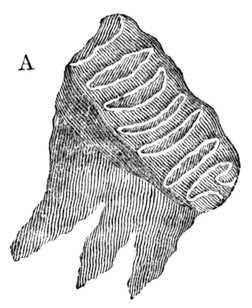
“On sinking the foundation for a mill, near the side of a small brook in the Bishop of Kilmore’s lands, at Maghery, [p354] eight miles from Belturbet, in the north of Ireland, A.D. 1715, four large teeth were found, with a piece of the under jawbone and part of the skull of a young elephant. The teeth were more solid and petrified than when in a natural state.”
Fig. A is one of the above grinders. B is a fossil grinder in the possession of the Royal Society. C is the grinder of an elephant between 10 and 11 feet high, the entire skull of which was then in Westminster61.
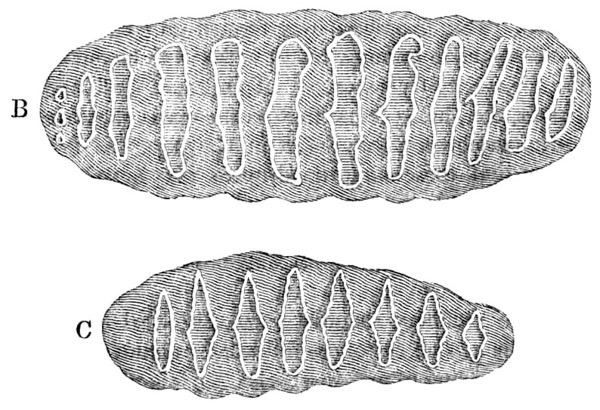
It is thus apparent that two fossil elephants are of the same species as those now in existence.
It is not improbable that the Maghery animal was conveyed to Ireland as a present, or for exhibition. “Fiacra, son of Eacha Moymedon, was mortally wounded at the battle of Caonry, which was fought A.D. 380, wherein he was victorious against the army of Momonia, (Munster). On his return to Hy-mac-uais, in Meath, he died of his wounds. His funeral [p355] leacht was erected, and on his tomb was inscribed his name in the Ogham character62.”
We here find that the native sovereign of the northern part of Ireland resided in Meath, the borders of which county are not many miles from the place where the elephant was found. It was at about the year of the battle of Caonry that Maximus, the emperor in Britain, aspired to be master of the Roman empire. Finding the union of the Scots and Picts prevented his peaceable possession of Britain, which was a great obstacle to the execution of his project, he persuaded the Picts to join their forces to his, on the promise of giving them the lands of the Scots. The Scots were thus overpowered, and were forced to fly to Ireland and the adjacent isles. The Scots, being assisted by the Irish, invaded the north, and were driven back to Ireland by Maximus, at the head of his troops. The emperor threatened to invade Ireland, and punish the Irish; but the dread they had of the presence of a Roman army, induced them to grant Maximus his own terms, which, in order to conciliate all parties, were moderate63. Now it is by no means impossible that the British emperor, on this conciliating occasion, sent this very elephant to his Irish majesty. Tacitus observes, that Agricola (three centuries before Maximus) received an expelled petty king of Ireland into his protection; that in manners the natives vary little from the Britons; and that the ports and landings of Ireland are better known, through the frequency of commerce and merchants, than those of Britain64.
THE MASTODON.
This quadruped is now known not to differ from the elephant, except in the form of the grinders, and has probably been called by the name of elephant by the Romans. Remains of the mastodon have been found mixed with those of the elephant, in Europe, Siberia, and America; and for the following [p356] reasons there is every probability of this animal being in existence.
Captain C. S. Cochrane, in his Journal in Colombia, vol. ii., p. 390, relates that numbers of the carnivorous elephants have been seen feeding on the plains at the foot of a ridge of mountains, at Choco, in New Granada. “Part of the foot of a mastodon, with five nails attached, was found in a cave, with a tooth, by a savage west of the Missouri: it was very fresh, and perfectly resembling that of an elephant: it was obtained of a Mexican, who had purchased it of a native65.”
“The native Americans describe the elephant as still existing in the northern parts of their country (the Missouri).”—Mr. Jefferson’s Notes on Virginia, p. 57.
Many bones of the mastodon were found in the county of Wythe, Virginia, with a mass of half-ground branches, roots, and leaves, enclosed in a kind of sack, supposed to be the stomach, in the midst of them; so as to leave no doubt that they were substances which the animal had devoured, and among them were distinguishable the remains of some plants known in Virginia66. Teeth of the mastodon have been found in Little Tartary, (for five centuries possessed by the Moguls,) in Siberia, near the Oural mountains, and one at Harwich, in England67.
There, have been brought from Ava, found on the left bank of the Irawaddy, in N. lat. 20° to 21°, near the wells of petroleum, in narrow ravines, sand-hills, beds of gravel, ironstone, and calcareous breccia, evidently a diluvial formation,—fossil bones, shells, and wood. Bones of the mastodon, equal in size to those of the Ohio, a grinder 1612 inches in circumference, a humerus, measuring 25 inches round the condyles, with several [p357] grinders and bones of younger individuals, and fragments of tusks: fossil molares of the rhinoceros, resembling two species of a genus named by Cuvier Anthracotherium: bones like an animal of the horse kind: remains of crocodiles, supposed to be the gavial, or long-nosed alligator of the Ganges, (not now known in the rivers of Ava.) The fossil bones were upon or near the surface, more or less exposed, not decomposed or rolled, and are of animals that died there. The bones are petrified, and deeply coloured with iron, the substance siliceous and very hard. The blocks of wood are larger than the trees growing there, but it is not known if they are of the same kind. “An idle notion is entertained by many, that these fossil remains have been generated by a petrifying quality in the water of the Irawaddy68, but I think they are the result, as elsewhere, of one of the last catastrophes; in fact, the remains of a former world, before man was called into existence.”—Morning Herald, Sept. 14, 1827.
Bones of the mastodon have been found in Europe, mixed with menagerie collections, which cannot possibly be attributed to any other origin than that of sports of the amphitheatre. They are found in western Siberia, which was conquered by Sheibani, Genghis Khan’s grandson, A.D. 1242, and held 300 years, and whose first capital was at Tiumin69, on the river Tura, near the Ural mountains, where the remains of the mastodon were found. Ava was conquered by the Grand Khan Kublai in 1272, in a battle with the king of eastern Bengal, in which there were a thousand elephants70. The places where they have been found in America correspond with history and tradition so faithfully, as to assist the other numerous proofs of Mexico and Peru having been conquered by the Moguls, in the year 1283, and the bones of the mastodon are there found, as well as remains of elephants, precisely like those of Siberia71. With regard to the tooth found at Harwich, the [p358] British kings Cuneboline72 and Arviragus had representations of elephants on their coins. The bones of elephants, rhinoceroses, and crocodiles found in Ava are not, as those found in Europe and Siberia, what are termed extraneous fossils; the same kinds of animals being natives of the spot in Ava. The one like the horse cannot be ascertained; but the kings of Pegu, in former times, had camelopards, and, therefore, probably, zebras in their calichars, or parks; they also had unicorns, ostriches, and rein-deer73. Timur Khan, grandson of Kublai, who invaded Siberia with such powerful armies, resided at Tali, in Yunan, N. lat. 25° east of the Irawaddy74.
The writer is of opinion that all those fossil bones found in Ava are of species still in existence: they may have floated down from more northern parts, the river in question being as long as the Ganges, said to be navigable into China; and has its source in Thibet,—(see RENNELL’s Memoir, p. 217.) According to the hypothesis of the writer, Montezuma’s ancestor was a Mongul grandee from Assam; and mastodontes’ remains have been found in Mexico, and those beasts are, as above related, supposed to be found alive near the Missouri.
This is the first instance the writer has met with of similar bones not being extraneous; and is, therefore, a remarkable fact, which excites the strongest suspicion that their species are still living. Ava is a new world on a small scale, and this collection of bones will, very probably, at no distant date, lead to positive proof of the existence of other quadrupeds, now conjectured by naturalists to be extinct. With respect to the local position, it is in all probability the old bed of the river, as [p359] the beds of those in Asia change in a wonderful manner.—(See Rennell, p. 255.)
A skeleton of an elephant or mastodon, for it is not known which, was found in a tomb in Mexico, which had evidently been built on purpose.—(Clavigero, vol. i., p. 84.) No authority whatever dates the foundation of Mexico earlier than A.D. 1324. The Aztecs advanced from Culiacan, when they took possession of the marshes, and founded Mexico: other Aztecs had preceded them who had arrived by land; but the writer hazarded a theory75 that Montezuma’s ancestors had, like those of the Natchez and of the Incas, arrived in America by sea with elephants, under Mango Capac; and he has had the satisfaction to find a confirmation of his conjectures in a decade written by Peter Martyr, the Milanese, (employed by Ferdinand V., King of Castile and Arragon, and who died in the year 1526,) addressed to Adrian VI., who had been co-regent of Spain with Cardinal Ximenes. “Montezuma spoke thus to Cortez:—We have heard by our ancestors that we are strangers. A certain great prince, in ships, before the memory of all men living, brought our ancestors unto these coasts; whether voluntarily or driven by tempest it is not manifest; who, leaving his companions, departed into his country, and, at length returning, would have had them to have gone back again. But they had built houses, and joining themselves with the women of the country had begotten children, and had settled. Wherefore our ancestors, having chosen a senate and princes to govern the people, refused to go, and he departed with threatening speeches. Never any appeared unto this time who denied the right of that captain and commander. We think, therefore, that the king who sent you derived his descent from him, and all the kingdoms which we possess are yours76.” It is impossible to know clearly what the allusions to the return of the great commander may mean, but whatever it be, it does not change the date. As the Mexicans considered Cortez to be a child of the sun, the great prince must have been a descendant from Genghis Khan; and thence the [p360] terrors and submission of Montezuma and the Mexicans, who had always dreaded such a visit.
The Aztecs had sojourned in Culiacan and other places, from the date of the arrival of the ships, till they proceeded to Anahuac. The foundation of Tenochtitlan (or Mexico) having been in 1324, and the first king, Montezuma’s ancestor, elected in 1377; therefore, the empire, when Montezuma died, had lasted only 144 years; and this calculation is from the most authentic documents known, that is, the pictures in Purchas’s collection. In Harris’s Voyages, vol. ii., p. 97, Montezuma is said to have told Cortez, that it was only a century since they had been settled where they were, meaning, probably, that it was not two centuries.