Note 47 — VI. Report upon the New or Rare Plants which flowered in the Garden of the Horticultural Society at Chiswick, between March, 1825, and March, 1826. Part 1. Tender Plants. By John Lindley, Esq. ◊ (continued 3)
Reading edition
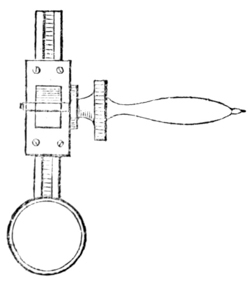
This is the theoretical view of the case, the practical one is different, as frequently happens. Opaque objects are not affected at all by the eccentricity of the axis of the body: nor can I recollect that I ever felt any particular inconvenience from the motion of the optical part, even with transparent subjects, unless it was thrown very much indeed out of the axis of the illuminating mirror. On the other hand, it is notorious that living aquatic insects and animalcules are the most popular and entertaining objects which microscopes can show. These are, for the most part, abundantly restless; and if the stage on which they are placed has any motion, their natural unquietness is so much exasperated, that it becomes almost impossible to get a good observation of them at all. I once set to work at making some drawings of a variety of new and original objects of this class (which, I trust, will one day be published) with a microscope having all the requisite motions applied to its stage, and am confident that I had thrice the labour fairly appropriate to the execution of my task from this oversight. The very tremor produced by the transition of a carriage in the street, is frequently sufficient to unsettle live objects when disposed to be still and quiet, and put them in a fidget for a quarter of an hour. It is very unfortunate that the mountings of optical instruments are made in general by mere mechanics, who seldom or never observe with them, and consequently know not the exigencies which occur in practice. It is still more unfortunate, that in the science of fitting up microscopes, an ounce of a man’s own wit is worth about a ton of his neighbour’s. Was it not that I dislike to verify this adage myself, I should recommend the following motion to be applied to the body:—let the socket of the arm which carries it have a smooth rotatory motion on the head of the bar in the usual way, conjoined with another horizontal one produced by rackwork attached to the said socket. Let the pinion which belongs to the latter movement be made very strong, so that a lever about three inches long may project from its centre: this is to be held in the hand, the thumb and index finger operating on the rackwork, while the two little fingers give a rotatory motion by working the lever end. This rapid double motion is here completely under the command of one hand, while the other is at liberty to adjust the focus. I know of nothing better for general purposes, or in particular for following the motions of live insects, &c.; but when only inanimate ones are to be the subject of microscopical study, I prefer the motion of the stage, for the reasons stated by Mons. C.