Volume 1 / Part 4 — PART IV CONTRIBUTIONS FROM THE JOURNAL: MISCELLANY (continued 4)
Reading edition
Case 2.—F. S., man, aged 28, married, machinist, had an initial lesion on the penis. Treatment with sixty injections of 5 grains of sodium cacodylate gave results as follows: The initial sore on the penis disappeared in ten injections; there were severe mucous patches of the mouth; the tonsils were badly infected. There was a positive Wassermann reaction. There were syphilids of both arms and shins; marked papular eruption; malaise, and a slight trace of albumin in the urine. I placed the patient on mercurials and at last give him three salvarsan injections three weeks apart. The result was a negative Wassermann reaction, the skin was clear and the patient felt fine.
Case 3.—D. C., woman, aged 21, single, seamstress, had an initial lesion on the left side of the cervix, and a macular eruption on the face, neck and shoulders, and also, though faint, on the forearms. Thirty injections of sodium cacodylate of 5 grains each were given. The initial lesion disappeared in one week. Mucous patches of the mouth appeared and persisted. The Wassermann reaction was positive. I gave mercurials and potassium iodid for seven months, and salvarsan once. The Wassermann reaction is now negative.
My conclusion after two trials of the use of sodium cacodylate in small or large doses is that it has no effect toward curing the condition; in fact, the throat symptoms were seemingly increased in severity by its use. It has no effect on syphilids of the forearms and shins, and if anything makes them worse.
It improves the appetite, as one would expect. It has some effect on the kidneys, as noted in Case 2; it has some effect in healing the initial lesion, as noted in all three of this series; why, I do not know.
I am entirely satisfied that it has no beneficial effect on syphilitics and have discontinued its use entirely in my practice.
I am glad to have read Cole’s excellent article, as it shows me that I was correct in my decision not to use it again, as it was worthless.
William G. Ward, M.D., Lynn, Mass.
To the Editor:—Dr. William G. Ward’s letter (The Journal, Feb. 3, 1917, p. 390), and the recent admirable article by Dr. Harold N. Cole (The Journal, Dec. 30, 1916, p. 2012) recall to mind Dr. J. B. Murphy’s clinical note on the use of sodium cacodylate in the treatment of syphilis (The Journal, Sept. 24, 1910, p. 1113), and the experimental work of Cap. H. J. Nichols, U. S. Army (The Journal, Feb. 18, 1911, p. 492). The results of Nichols’ work conclusively proved, at least from a laboratory standpoint, that this drug was of very little value as a spirocheticide in combating syphilis. Prior to the publication of Dr. Murphy’s letter I had employed sodium cacodylate extensively as a remedy in psoriasis, and I still continue to use it in selected cases of the disease.
Adopting Dr. Murphy’s suggestion, I gave the agent an extensive trial in syphilis in all stages of the disease. The results were extremely disappointing, from both clinical and serologic points of view. More recently, during the scarcity of salvarsan, I gave the drug a second trial, employing it in large dosage in the hope that the previous failure had been due to the employment of insufficient amounts. The results were not tabulated, but, judging roughly from my experience in a score of cases, its therapeutic value as an antisyphilitic was nil. A few of the patients underwent a temporary improvement, probably owing to the tonic effect of the drug, but in every instance the serologic findings were unaffected.
R. L. Sutton, M.D., Kansas City, Mo.
—(Correspondence in The Journal A. M. A., Feb. 3, 1917.)
TABLETS: DEPENDABILITY OF DOSAGE
The tablet form of administering medicines is popular among many physicians because of its convenient availability and dosage. There is no doubt about the convenience of tablets, but the accuracy of the dosage content is not always to be depended on. One reason for this is that the demand for palatable and convenient “medicaments has led manufacturers to attempt to produce in tablet form mixtures which, from the nature of the case, are not suited to that method of compounding.” In a series of painstaking experiments307 on bismuth, opium and phenol tablets, conducted a number of years ago in the A. M. A. Chemical Laboratory, it was shown that no tablets on the market then contained the amount of phenol the label indicated, the variation being from 12.3 to 112.5 per cent. Similarly, the laboratory found that in the case of several different brands of Aromatic Digestive Tablets,308 the amount of hydrochloric acid present in these absurd combinations was true to label in only one half of the specimens, notwithstanding the fact that the amounts claimed to be present were ridiculously small; in two specimens, there was no hydrochloric acid whatever present, while a third contained only a trace. These examples illustrated clearly the very evident unwisdom of attempting the pharmaceutically impossible merely for the sake of convenience or pharmaceutical “elegance.”
Another reason for doubting the accuracy of dosage, irrespective of the characteristics of the drugs composing the tablets, has been the manifest lack of care in their manufacture. In 1914, Kebler309 reported the results of a far-reaching investigation of tablet compounding in which he pointed out that tablets on the market were not as uniform or accurate as was generally believed, the variations being “unexpectedly large in numbers and amount.” During the past year, the Connecticut Agricultural Experiment Station310 undertook the examination of tablets—proprietary and nonproprietary—taken from the stock of dispensing physicians. The variations found in weights of the tablets were strikingly similar to those reported by Kebler.
VARIATION IN WEIGHTS OF TABLETS
VariationKebler Per Cent.Connecticut Per Cent.
Less than 10 per cent.4344
More than 10 per cent.5756
More than 12 per cent.4435
More than 15 per cent.2826
More than 20 per cent. 910
The determinations of the composition of the tablets when compared with that claimed for them showed wide variation—from 54 per cent. above to 70.5 per cent. below; in almost two thirds of the tablets examined, the variation amounted to more than 10 per cent.; in three fifths of the tablets, the variation was more than 15 per cent.; in one fourth, more than 20 per cent., and in one twentieth, more than 50 per cent.; only in one eighth of the tablets was the variation less than 5 per cent.
The Connecticut investigators substantiate once again the work previously reported, namely, that there are a number of firms who are either incompetent or careless. For tablets of simple composition, a variation from the declaration of 10 per cent. should be amply sufficient to compensate for the errors of careful manufacture. It may be added that the best tablets originate generally from firms having competent chemical control.—(From The Journal A. M. A., July 27, 1918.)
Torald Sollmann, M.D., Cleveland
According to the good old truism, the last and crucial proof of the pudding is in the eating thereof; and so, the last and crucial test of a therapeutic agent is its consumption by a patient. There is, however, one essential difference: When the pudding is eaten, with a sense of satisfaction, we know that it was a good, or at least an eatable, pudding.
If the patient improves after taking a remedy, we do not yet know that he improved on account of the remedy. The post hoc type of reasoning or logic is not respectable; but it is all too apt to creep in unawares, unless one takes great precautions indeed.
Clinical evidence needs especially to be on its guard against this pitfall, for the conditions of disease never remain constant; nor is it possible to foresee with certainty the direction which they are going to take. It is just this point which makes the clinical evidence so much more difficult to interpret than laboratory evidence, in which the conditions can be more or less exactly controlled, and any changes foreseen. It is on this account, also, that clinical experiments must be surrounded with extra painstaking precautions.
In brief, while the “proof” of a remedy is on the patient, that is not the whole story, but merely an introduction. The real problem is to establish the causative connection between the remedy and the events. The imperfect realization of this has blocked therapeutic advance, has disgusted critical men to the point of therapeutic nihilism, and has fertilized the ground for the commercial exploitation of drugs that are of doubtful value or worse.
This has been impressed on me particularly by my service on the Council on Pharmacy and Chemistry. In the course of its work of passing on the claims advanced for commercial remedies, this Council is forced to inquire critically into the basis of the claims of manufacturers.
It is interesting to note the qualitative differences in the evidence for the various kinds of claims: The chemical data are usually presented in such a form that it is possible to tell at a glance whether or not they are based on demonstrated facts, which could usually be verified or refuted without special difficulty. The deductions are usually such as can be legitimately drawn from the data, or else they are obviously absurd. All this agrees with the relatively exact status of chemical science.
In passing to data and deductions from animal experiments, a distinct change is noticeable: Not only are the data less reliable, and less worthy of confidence, but they are more often stated in a less straightforward manner. The presentation of the data often shows evidence of manipulation of the results, so as to make them most favorable to a preconceived conclusion that would recommend the drug. This is not always intentional, but is partly due to the less exact nature of animal experimentation, which leaves a wider play to the arbitrary interpretation of the reporter. A certain amount of this is unavoidable. No serious objection can be raised, provided the experimenter presents all the essential data, and discusses fairly all of the interpretations that would apply to them.
On the whole, it is usually possible to form a fairly definite estimate of the value of experimental data.
When one comes to the clinical evidence, an entirely different atmosphere obtains. When the Council demands evidence of the usefulness of a remedy, the manufacturers generally respond with every sign of enthusiasm. They may have ready a series of articles already published, or they instruct their agents to bring in letters from physicians. The last method seems to meet the most cordial response, judging from the deluge of letters and opinions that floods the Council.
The quality of the published papers is a fair reflection of the deficiencies of what is still the common type of clinical evidence. A little thought suffices to show that the greater part cannot be taken as serious evidence at all. Some of the data are merely impressions—usually the latest impressions of an impressionable enthusiast—the type of man who does not consider it necessary to present evidence for his own opinions; the type of man who does not even realize that scientific conclusions must be based on objective phenomena.
Some of the papers masquerade as “clinical reports,” sometimes with a splendid disregard for all details that could enable one to judge of their value and bearing, sometimes with the most tedious presentation of all sorts of routine observations that have no relation to the problem.
The majority of reports obtained by the agents belong to these classes, notwithstanding the fact that they are often written for the special use of the Council, and therefore with the realization that they are likely to be subjected to a thorough examination, and therefore presumably representing the best type of work of which the reporter is capable. So, at least, one would suppose.
It is also possible, however, that some of these reports are written merely out of thoughtlessness, or perhaps often to get rid of an importunate agent. This is illustrated by the following correspondence, taken literally from the files of the Council.
A letter from a prominent physician “A,” endorsing a certain preparation “D,” having been submitted to the Council, the secretary was directed to write to Dr. A as follows:
Dear Dr. A:—The B Company of C has requested the Council on Pharmacy and Chemistry to admit its preparation D to New and Nonofficial Remedies. As part evidence for the value of the preparation, the company submitted a letter from you which contains the following:
So far as my experience has thus far gone, they are certainly superior to a number of other iodine compounds now on the market, and I should judge that they ought to take a superior place in therapy involving the use of iodine.
The referee of the Council in charge of D writes that he was interested by your letter and asks that I inquire: As compared with sodium or potassium iodid, what would you say are the differences between, and real advantages of, D and the alkaline iodids? Did you make any comparative experiments and keep a record of them? If so, the referee would like to receive an account of your trials. In what direction could D be expected to occupy a superior place in iodin therapy?
I hope that you can give the information asked by the referee and thus aid the Council in arriving at a correct estimate regarding the value of D.
The following reply was received from the physician in response to the foregoing:
Dear Professor Puckner:—In reply to yours of January 19, I did not proceed far enough in the investigation of D to draw conclusions of any particular value for the purpose of the Council on Pharmacy and Chemistry; and I so stated in my letter to the proprietors of that remedy.
Answers to the questions you put in your letter require an amount of investigation of the remedy far beyond anything I undertook. As a matter of fact, I returned about five sixths of the capsules sent me, because of lack of time and opportunity to carry out the extensive clinical experiments that I plainly saw would be required to give an opinion at all worth while. I believe you had better not consider me in the matter at all.
The report was furnished by a physician for whom I have a high personal regard. I introduce it here, not so much in a spirit of criticism, but as a justification of the opinion that I have formed of clinical evidence obtained by manufacturers through their clinical adjutors.
When commercial firms claim to base their conclusions on clinical reports, the profession has a right to expect that these reports should be submitted to competent and independent review. When such reports are kept secret, it is impossible for any one to decide what proportion of them are trustworthy, and what proportion thoughtless, incompetent or accommodating. However, if this were done it is quite possible that such firms would find much more difficulty in obtaining the reports. Those who collaborate should realize frankly that under present conditions they are collaborating, not so much in determining the scientific value, but rather in establishing the commercial value of the article.
Often the best type of clinical reports—those in which the observations are directed to the significant events and not to mere side lines, and in which the significant events are correctly and adequately reported—generally lack one important essential, namely, an adequate control of the natural course of the disease.
Since this cannot be controlled directly, it must be compensated indirectly. For this purpose, there are available two methods:
The first is the statistical method, in which alternate patients receive or do not receive the treatment. This method can usually only be of value when a very large series of patients is available. Even then, its value is limited or doubtful, because it cannot take sufficient account of the individuality of cases.
The second method consists in the attempt to distinguish unknown preparations by their effects—the method that might be called the “comparative method” or the “blind test.”
In this, the patient, or a series of patients, is given the preparation which is to be tested, and another preparation which is inactive, and the observer aims to distinguish the two preparations by their effects on the patient. Surely if the drug has any actions at all it will be possible to select correctly in a decided majority of the administrations.
The same principle can be applied in distinguishing the superiority of one preparation over another. In this case, the two preparations would be given alternately to different patients, and the observer would try to distinguish them by their effects. Here again, if one drug is really superior or otherwise different from another, to a practically important extent, the observer will surely be able to make the distinction.
This method is really the only one that avoids the pitfalls of clinical observation; it is the only method that makes the results purely objective, really independent of the bias of the observer and the patient. It is the only method, therefore, which determines whether it was really the pudding that was eaten and not some other dessert.
In principle this method does not usually offer any very great difficulties. It is, of course, necessary that the two preparations to be compared shall resemble each other so closely or shall be flavored, etc., so that they cannot be distinguished by their physical properties. This is usually not a very difficult matter. The method does not jeopardize the interests of the patient, for it is understood that no drug would be tested in this way unless there is some reason to believe that it has a value. When the patient’s condition is such as to demand treatment, then he would be receiving either the standard drug or the drug which the experimenter believes may be superior to the standard.
CONCLUSIONS
The final and crucial test of a remedy is on the patient; but the test must be framed so as to make it really crucial. Most clinical therapeutic evidence falls far short of this. The “blind test” is urged to meet the deficiencies.—(From The Journal A. M. A., July 21, 1917.)
“VACCINES IN TOXIC CONDITIONS”
Commercialized Propaganda in the Guise of Science
Under the title “Vaccines in Toxic Conditions,” what purports to be a scientific contribution appears in the original department of the official organ of a state medical society.311 The apparent purpose of the article is to overcome any hesitancy on the part of practitioners to use vaccines in toxic infectious conditions for fear that they might thereby cause harm. Such a thesis is interesting and might be important—if true. Two outstanding facts, however, give pause. First, the theory promulgated is contrary to the experience of those who have studied the subject; second, the man who writes the article is in the business of making and selling vaccines! The former fact is a matter of fairly general knowledge among the better informed members of the medical profession; the latter fact is nowhere made evident in the article, which the reader might infer came from a disinterested investigator in the realms of immunology.
The article purports to prove that the special investigations carried on by its author show that there is no basis for the well-grounded fear that vaccines might be harmful to a patient suffering from toxic infectious conditions. Thus:
From a closer study of these infective processes we find that this toxic condition is due to the rapid multiplication of the infecting organisms with the incidental production of ferments which the germs secrete to digest the food on which they live. These toxic ferments have a distinct destructive tendency on tissue cells, without any marked influence in stimulating tissue cells for antibody production. The crying need, however, in these extensive acute infections is rapid antibody formation to neutralize these germ-produced poisons and to eliminate the germs.
Now vaccines, we are informed, are not toxic and so stimulate the production of antibodies. In other words, the same organism that in the body is toxic and without marked antigenic properties becomes nontoxic and actively antigenic when converted into a vaccine. The details of the experiments of the “closer study” made by the author of this paper (and the manufacturer of vaccines) which give such definite and convincing results are not published. Possibly the article is a preliminary contribution, and future issues of the same publication will carry further articles on the same subject. The follow-up system is well recognized in the advertising world. At all events, this “closer study” has convinced the author of the article that:
... even in extreme toxic conditions, in acute infections, bacterial vaccines may be employed without the least fear of doing any harm. In fact, we find that in extreme acute infections, bacterial vaccines not only give the best clinical results, but they may also be given in larger doses at shorter intervals with less reactions than in minor or chronic infections and the earlier they are given the better the results.
Here again no details are given; there are no comparative results of the careful study of a series of cases. The sum and substance of this remarkable contribution to a scientific publication is to the effect (1) that the organism that in the body is toxic becomes nontoxic when introduced in vaccine form; (2) that the organism that in the body is but little antigenic becomes when introduced in vaccine form actively antigenic, and (3) that “in extreme acute infections” when the body is affected profoundly by the infectious agent and its product, the oftener and the more one injects of these very materials, the better the results!
And this astounding plea for the use of vaccines in conditions in which vaccines are generally held to be contraindicated, or even injurious, is made by one whose business is the manufacture of vaccines and selling them to the medical profession!—(Editorial from The Journal A. M. A., Oct. 23, 1920.)
VITAMINS: THEIR DISTRIBUTION
Our knowledge of the accessory food factors, commonly spoken of as vitamins, is so recent, comparatively speaking, and the exact nature of these factors still so enveloped in mystery, that it was inevitable that the public’s lack of knowledge on the subject should be capitalized. It is not surprising that there are on the market a number of preparations of the “patent medicine” type that are being sold under the claim that they are rich in vitamins—although the exploiters of these fail to explain which, if any, of the three accessory food factors their products contain. The renaissance of yeast as a therapeutic agent has given an opportunity to the manufacturers of this product of unduly stressing the fact that yeast is particularly rich in the antineuritic vitamin (water-soluble B). Because milk and certain milk products are rich in the fat-soluble A factor, the dairy interests would apparently have the public believe that this particular vitamin is to be obtained only from their products. Thus, a journal devoted to the dairy interests recently claimed that those who want vitamins must get them in their milk, butter, cheese and other milk products. The truth is, the accessory food factors are so well distributed throughout the dietary of modern man that, generally speaking, the individual who uses ordinary judgment in selecting his food is in no danger of suffering from a deficiency of any of these three factors. It would be well if every physician might read the excellent monograph on the present state of knowledge concerning accessory food factors written by a committee appointed jointly by the Lister Institute and Medical Research Committee. In this report the distribution of the vitamins in our common foodstuffs is thus briefly summarized: “... broadly speaking it is safe to say that the individual always finds sufficient supply of vitamins in his food so long as that food is reasonably varied and has received no artificial or accidental separation into parts, and so long as no destructive influence has been applied to it.” At the end of the committee’s report is a table (reproduced on page 562) which shows the distribution of the three accessory factors in the commoner foodstuffs.—(Editorial from The Journal A. M. A., Aug. 13, 1921.).
Distribution of Three Accessory Factors in Commoner Foodstuffs
Classes of FoodstuffFat-Soluble A or Anti- rachitic FactorWater-Soluble B or Antineuritic (Antiberiberi) FactorAntiscor- butic Factor
Fats and Oils:
Butter+++
Cream++
Cod-liver oil+++
Mutton fat++
Beef fat or suet++
Peanut oil+
Fish oil, whale oil, etc.++
Margarin prepared from animal fatValue in proportion to amount of animal fat contained
Nut butters+
Meat, Fish, etc.:
Lean meat (beef, mutton, etc.)+++
Liver+++++
Kidneys+++
Heart+++
Brain+++
Sweetbreads+++
Fish, white very slight, if any
Fish, fat (salmon, herring, etc.)++very slight, if any
Fish roe+++
Canned meats?very slight
Milk, Cheese, etc.:
Milk, cow’s whole, raw++++
Milk, skim, raw ++
Milk, dried wholeless than +++less than +
Milk, boiled, wholeundetermined+less than +
Milk, condensed, sweetened++less than +
Cheese, whole milk+
Eggs:
Fresh+++++?
Dried+++++?
Cereals, Pulses, etc.:
Wheat, maize, rice, whole grain++
Wheat germ+++++
Wheat, maize, bran ++
Linseed, millet ++++
Dried peas, lentils, etc. ++
Soy beans, haricot beans+++
Germinated pulses or cereals+++++
Vegetables and Fruits:
Cabbage, fresh (raw)++++++
Cabbage, fresh (cooked) ++
Cabbage, dried++very slight
Cabbage, canned very slight
Swede (rutabaga) raw expressed juice ++++
Lettuce+++
Spinach (dried)+++
Carrots, fresh raw+++
Carrots, driedvery slight+
Beetroot, raw, expressed juice less than +
Potatoes, raw++
Potatoes, cooked +
Beans, fresh, scarlet runners, raw ++
Onions, cooked + at least
Lemon juice, fresh +++
Lemon juice, preserved ++
Lime juice, fresh ++
Lime juice, preserved very slight
Orange juice, fresh +++
Raspberries ++
Apples +
Bananas++very slight
Tomatoes (canned) ++
Nuts+++
Miscellaneous:
Yeast, dried +++
Yeast, extract and autolyzed?+++
Malt extract + in some specimens
Our Knowledge of Vitamins
Commenting on the trend of medical research concerning vitamins, the latest report of the British Medical Research Council says:
The present situation is a curious one, upon which posterity will probably look back with great interest. We still have almost no knowledge of the nature of these elusive food substances or of their mode of action, but we have gained empiric knowledge already of the greatest practical value for the prevention of scurvy and of other grave diseases and for the promotion of health and beauty in the population.
This statement, it will be noted, emphasizes the foundation on which rests our present use of vitamins. From time to time The Journal has commented on our lack of actual knowledge of these mysterious substances, emphasizing particularly the generally accepted fact that the taking of a well-balanced diet results in providing the individual with such vitamins as are necessary to his growth and nutrition. Last week appeared a brief report of a meeting of the Chicago Medical Society devoted to this subject, and it was gratifying to have the conservative view which The Journal has emphasized substantiated by many of those who took part in the discussion. Moreover, the British Medical Journal, in its leading editorial for February 11, reiterates that an abundant supply of vitamins exists in all fresh vegetables, and that a considerable quantity occurs in milk and meat, provided the latter substances are obtained from animals fed on fresh foods. “A normal adult,” it says, “living on an ordinary diet containing a reasonable proportion of fresh vegetables is, therefore, certain of obtaining a plentiful supply of vitamins.” Of all the mass of evidence which has accumulated relative to these substances, this fact is the point of greatest importance. It is, however, very unfortunately, the one point which those commercially inclined are unwilling to recognize.—(Editorial from The Journal A. M. A., March 11, 1922.)
The Demand for Vitamins
Thus the British Medical Journal in its current issue:
In spite of the fact that ordinary fresh foods are the simplest, cheapest and richest sources of vitamins, the public apparently demands to be supplied with vitamins in the form of medicinal products.
The public “demands” vitamins in pill form! Why? For the same reason that the public, lay or medical, demands many things today that it does not need—because the whole trend of modern advertising is toward creating demands, rather than supplying needs. Vitamin concentrates are being “demanded” by the public because shrewd and forward-looking “patent medicine” exploiters are using all the subtle arts of modern advertising to convince the public that it is in serious danger of vitamin starvation, and that the only hope lies in buying these alleged concentrates to make up a hypothetical deficiency. It seems inconceivable that a rational man would pay a tremendously high price for certain food factors which are already present in his ordinary diet. But he will; and advertising is the reason. Advertising campaigns such as these of the vitamins constitute a vicious circle; an artificial demand is created and then the manufacturer excuses his business on the ground that he is merely supplying a demand! As our British contemporary says, “ordinary fresh foods are the simplest, cheapest and richest sources of vitamins.”—(Editorial from The Journal A. M. A., March 18, 1922.)
THE WILLIAM A. WEBSTER CO. AND THE DIRECT PHARMACEUTICAL CO.
The following letter from a Detroit physician was received a few days ago.
To the Editor:—I have just received a letter from the Direct Pharmaceutical Co. of St. Louis, Mo., quoting prices on drugs which are not more than one half what the leading manufacturers are quoting on the same drugs. I have received previous literature from this company but have not done business with them. I would be unwilling to prescribe their drugs unless I were satisfied that they are what is claimed for them. I would be glad to receive any information regarding this firm that may be available.
The Journal has also received some letters from physicians regarding the William A. Webster Co. of Memphis, Tenn., relative to a letter the concern was sending physicians in the form of a testimonial (reproduced in miniature on this page) and alleged to be from Dr. F. W. P. Butler of Columbia, S. C. Typical letters on the Webster advertising follow:
To the Editor:—Is there not some way through which the dignity of the medical profession can be protected from the circulation of such idiotic drivel as the enclosures display?
To the Editor:—I am sending you an example of the sort of “evidence” which some so-called ethical pharmaceutical houses expect physicians to take for scientific proof. It is pathetic that there are some in our profession who “fall for” such rot. I trust you will continue your campaign for honest and intelligent medicine.
The “evidence” to which one of the correspondents refers and which another characterizes as “idiotic drivel” is reproduced on the following page in miniature. It is a testimonial for William A. Webster Company’s “Ferritonic-Woods.”
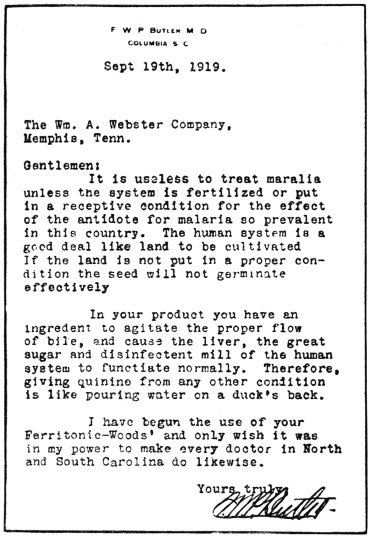
Reproduction (reduced) of a testimonial letter sent to physicians by William A. Webster Company of Memphis, Tenn. Those who operate this concern also have a sales agency in St. Louis, Mo., known as the Direct Pharmaceutical Co.
Our readers may wonder why we are discussing in one article the William A. Webster Company of Memphis, Tenn., and the Direct Pharmaceutical Co. of St. Louis. The reason is that the Direct Pharmaceutical Co. of St. Louis is apparently merely a sales agency for the William A. Webster Company of Memphis. It appears that orders sent in to the Direct Pharmaceutical Co. go to Memphis to be filled.
The following information regarding some of the products that have in the past been put out by the William A. Webster Company should be of interest to the profession. In government bulletins issued by the Department of Agriculture in October, 1913, there were reported some cases of adulteration and misbranding on the part of the William A. Webster Co., of Memphis, Tenn. A “Pure Concentrated Extract of Lemon” shipped by this concern was found by the federal chemists to be colored with a coal-tar dye “whereby inferiority was concealed,” and while purporting to be a concentrated lemon extract, “in fact, it was not a concentrated lemon extract.” Some “Pure Concentrated Extract of Banana” was found to have mixed with it an imitation banana flavor and an artificial color so as to “injuriously affect its quality and strength” and so that “its inferiority was concealed.” “Pure Concentrated Extract of Pineapple” was found to have had mixed with it “an imitation extract of pineapple artificially colored.” “Pure Concentrated Extract of Strawberry” had been mixed with “an imitation strawberry extract artificially colored.” The same bulletins described the case of the government against a shipment of “Syrup Iron Iodide” made by the Webster concern in which the amount of iron iodid was less than half that claimed on the label. In each of the cases just described, the company pleaded guilty and was fined.
In a similar bulletin issued August, 1914, there were recorded several more cases of adulteration and misbranding charged against the William A. Webster Company. Some “Wine Coca Leaves” was held adulterated in that the amount of alcohol present was wrongly declared on the label; it was held misbranded in that while it contained cocain, the label failed to bear any statement regarding the quantity of proportion of this drug. Tablets of “Acetanilid and Sodium Bromid Compound” were found deficient in strength. “Anti-Vomit Tablets,” “Aspirin Tablets,” “Bismuth and Calomel Tablets,” “Quinin Laxative Tablets,” “Salol Tablets,” “Sodium Salicylate Tablets,” “Neuralgic Tablets,” “Diarrhea Calomel Pills” and “Morphin Sulphate Hypodermic Tablets” were also misbranded in that the amount of certain ingredients found in them failed to tally with the amount declared on the label. In all of these cases also the William A. Webster Company pleaded guilty and was fined.
In a government bulletin issued in June, 1917, the same company was charged with adulterating and misbranding a quantity of Aspirin tablets which, instead of containing 5 grains as labeled, contained only a fraction over 1 grain. In this case, too, the company pleaded guilty and was fined. The table that follows briefly summarizes some of the cases just referred to:
Amount ClaimedAmount Found
“Syrup Iron Iodid, U. S. P.”
Ferrous Iodid10%4.6%
“Acetanilid and Sodium Bromid Tablets”
Acetanilid3.50 gr.2.94 gr.
“Anti-Vomit Tablets”
Bismuth subnitrate2.50 gr.1.76 gr.
Cerium Oxalate2.50 gr.1.78 gr.
Cocain Hydrochl.0.0833 gr.0.0637 gr.
“Aspirin Tablets”5.0 gr.3.82 gr.
“Bismuth and Calomel Comp. Tablets”
Bismuth subnitrate0.1 gr.0.22 gr.
Calomel0.1 gr.0.22 gr.
“Quinin Laxative Tablets”
Acetanilid2.0 gr.1.69 gr.
“Salol Tablets”2.50 gr.2.05 gr.
“Sodium Calicylate Tablets”5.0 gr.3.88 gr.
“Neuralgic Pills”
Morphin sulphate0.05 gr.0.015 gr.
“Diarrhea Calomel Pills”
Morphin sulphate0.062 gr.0.05 gr.
“Morphin Sulphate Hypodermic Tablets”0.25 gr.0.21 gr.
“Aspirin Tablets”5.00 gr.1.13 gr.
—(From The Journal A. M. A., Oct. 18, 1919.)
YEAST
From time to time yeast has attained a transitory popularity as a therapeutic agent. Its use in this way in practical medicine has been based essentially on empiric considerations. Yeast is rich in nucleic acid, but this has not found any special applications. The fatlike substances obtainable from yeast have been recommended in certain alimentary conditions, without finding any widespread acceptance.
More recently yeast has acquired interest from somewhat different angles. In these days of food shortage and enforced conservation, it has come to be realized that the minute yeast cells are endowed with a remarkable capacity of synthesizing one of the most valued nutrients, namely, protein. This substance can be built up out of the simplest forms of nitrogenous compounds by yeasts, in contrast with the incapacity of the higher organisms to construct protein out of anything less complex than the ready made aminoacids. It is reported that in Europe yeast has actually been grown on a large scale in solutions of sugar, salt and simple nitrogenous compounds for the sake of securing the much desired proteins. The utilization of yeast protein for cattle feeding is a current practice abroad; and the satisfactory digestibility and availability of the same product by the human organism has repeatedly been announced since the beginning of the war. In this country the yeast which is produced as a by-product of the brewing industry is for the most part discarded as waste; in the distilleries it becomes a part of the distillers’ grains that are extensively employed as feeds in the dairy industry.
Still newer is the indication that yeast is comparatively rich in at least one of the as yet unidentified accessory factors in nutrition now popularly spoken of as vitamins. Hopkins of the University of Cambridge, England, first directed attention to this unique property of yeast. It has been verified by Funk and Macallum, and recently Osborne and Mendel have given substantial evidence of the potency of yeast to render a diet not otherwise capable of inducing maintenance effective in nutrition.
Yeast has been used, like extracts of rice polishings, to cure the experimental polyneuritis induced in birds by a diet of polished rice. From the experiments of Osborne and Mendel it appears that less than 2 per cent. of dried brewers’ yeast suffices to induce small experimental animals to grow on artificial food mixtures on which alone they fail to thrive. How the use of yeast as an adjuvant to otherwise inadequate food mixtures exerts its beneficial effect is not yet made clear. Satisfactory growth in these cases is promoted by liberal eating. Anything which renders food more palatable may stimulate one to eat more liberally of it. This can scarcely be the explanation of the potency of the yeast as it is effective even when fed apart from the rest of the food. It may have a favorable effect on the metabolism and thus improve the general condition so that more food is consumed. Small quantities of milk and extracts of many of the common plant foods, such as the cereal grains, have been found to act in the same way. There seems to be little doubt, therefore, that yeast also contains something comparable with the so-called water-soluble vitamins of the diet. A specific need for yeast can scarcely be predicated on this fact, however; for any well selected human dietary containing the usual variety of animal and vegetable foods is not likely to be devoid of the widely distributed water-soluble type of vitamin. We mention this to check premature enthusiasm for a new vitamin.—(Editorial from The Journal A. M. A., Sept. 8, 1917.)
Yeast and Its Uses
To the Editor:—Is there available information concerning the medicinal use of yeast? How is it taken? I should like to know whether the use of it would cause any digestive disturbance, and whether the flesh gained is normal and permanent.
S. E. L., Bridgeport, Conn.
Answer.—Yeast is one of those remedies that have undergone alternating cycles of use and of disuse; just at present it appears again to be in its ascendency. No doubt, the reason for these cycles has been excessive praise and uncritical use, followed by disappointment and consequent discard.
Hawk and his associates (Hawk, P. B.; Knowles, F. C.; Rehfuss, M. E., and Clarke, J. A.: The Use of Bakers’ Yeast in Diseases of the Skin and of the Gastro-Intestinal Tract, The Journal, Oct. 13, 1917, p. 1243) have recently called renewed attention to its laxative qualities. When from one-half to one cake of yeast was given three times daily before meals, it produced regular bowel movements in a number of patients suffering from constipation. That this result is not due to any vital processes in the yeast is shown by the fact that yeast killed by boiling water was employed with success. It is suggested that such yeast might be preferred for patients troubled with flatulence. Aside from the tendency of living yeast to produce diarrhea, and the possibility that it may aggravate flatulence, no digestive disturbance has been charged against it. Aaron, in his “Diseases of the Digestive Organs,” speaks favorably of its use in atonic constipation.
The much debated question whether yeast may serve as a food can be answered in the affirmative in view of such work as that of the Germans on “Nährhefe”—yeast food (Schottelius, Deutsch. med. Wchnschr., July 8, 1915, p. 817) and Boruttau (ibid., July 29, 1915, p. 924) and of Hawk and his associates. There is no reason to assume that weight gained under its use would be more readily lost than weight gained from any other food. However, in view of its laxative action, the average individual can ingest only from 1 to 2 gm. of nitrogen a day in this form. This obviously greatly limits its value as a food. Owing to its high nuclein content, it is contraindicated in gout.
As a source of water soluble growth promoting as well as antineuritic vitamin, yeast has become thoroughly established as the result of the recent works of numerous investigators. However, as such common foods as milk, rice, wheat, oats and beans also contain such vitamin, there is little likelihood of its proving of therapeutic value on that account. In other words, yeast and other vitamin containing foods have specific growth promoting qualities only when the stunting is due to lack of vitamin. A minute amount of this substance suffices to produce maximal results. More is of no use. Hess (Proc. Soc. Exper. Biol. & Med. 13:145, 1916) found yeast of no value in infantile scurvy.
The most important question in connection with yeast therapy is to what extent it is endowed with “antibiotic” power, that is, to what degree it is capable of inhibiting the growth of other organisms. That this frequently occurs in cultures in vitro is shown by the fact that yeast contamination may practically eradicate the growth of certain other organisms. That, on the other hand, this is not true for all forms of bacterial life is shown by the fact that there is definite symbiosis between yeast and lactic acid bacilli (Northrup: Soc. Tech. Bull. 15, Mich. Agr. Expa. Sta., 1912).
That its “antiseptic power is, on the whole insignificant” has been shown by Palier (Diet. & Hyg. Gaz., March, 1906), who found commercial yeasts commonly contaminated with numerous bacteria, the most frequent being Bacillus coli-communis or one of its congeners. An antagonistic action by yeast is claimed against Staphylococcus pyogenes, and on the strength of this, Buchholtz (Ueber Acne und eine neue erfolgreiche Behandlung derselben, Berl. klin. Wchnschr., Feb. 2, 1914, p. 215) employed it locally in the treatment of acne and obtained a positive but temporary effect. He believes that the effect is improved by the combination of yeast with an equal quantity of boric acid. He employed this as a dusting powder applied freely to the skin once daily, after the application of a thin layer of a boric acid salve (boric acid powder from 40 to 50, glycerin and water, of each 100) to make it stick better. In cases in which the nose was markedly involved, he also used this as a snuff. Yeast poultices have been employed with asserted great benefit in the treatment of wound infection of all kinds (Kempf, E. J.: Ind. M. J., September, 1904, p. 97).
The use in leukorrhea was recommended by Hippocrates Abraham (Mon. Geb. Sym., 1910) and many others report favorable results from yeast in the treatment of gonorrheal vaginitis. In various gastro-intestinal infections, yeast has been lauded by many, among others, Thiercelin and Chevrey. It has been given by mouth, but most especially in high rectal enemas.
Still more from a theoretical standpoint is the reassertion of the curative value of the oral administration of yeast in various cutaneous disorders. Thus Hawk and his collaborators report cure or improvement in all of seventeen cases of acne vulgaris and eight cases of acne rosacea. They also report seventeen cases of furunculosis, in all but one of which there was cure or improvement from yeast treatment. They are unable to decide whether the result is due to the laxative action, the production of leukocytosis, or to other influences.
Yeast is probably best taken incorporated in food. Hawk and his associates found that yeast may well be incorporated in wheat biscuits, and that in this way a yeast-wheat combination of most agreeable flavor was produced: that, in fact, the biscuits with the yeast tasted better than those without it. They found by tests that in bread making as much as 20 per cent. of the flour might be replaced by dry yeast, and that thereby a loaf would be produced that was excellent in every way and possessed of an attractive flavor. The dry yeast was prepared by desiccating compressed yeast at 105 C. in a current of air, and then milling it to produce a flour of the approximate fineness of ordinary wheat flour. They also found that yeast may be added to meat preparations, such as Hamburger steak, to the extent of 2.5 per cent., yielding a preparation of very satisfactory taste.—(Query in The Journal A. M. A., Aug. 23, 1919.)
BRIEFER PARAGRAPHS
Laxol and Lysol—The Short and Catchy Proprietary Name
A laborer went to a Brooklyn physician for treatment and was given three prescriptions. One of the prescriptions, according to the Food and Drug Bulletin of the Department of Health, City of New York, called for “Laxol,” the word being written on a piece of blank paper without directions. The drug clerk misread the prescription and dispensed an “original” bottle of “Lysol” which bore the usual poison label with skull and cross bones. The man drank the entire 3 ounces of Lysol and died half an hour later. The case is now in the hands of the District Attorney, the drug clerk being held under $10,000 bail. “Laxol,” as our readers know, is castor oil sweetened with saccharin and flavored with peppermint. There is no excuse for prescribing the product. The official Aromatic Castor Oil (Ol. Ricin. Arom.) of the National Formulary would answer every purpose served by the proprietary preparation.—(Editorial from The Journal A. M. A., May 29, 1920.)
Look Up Its Rating
Modern business has become so complex that it is no longer possible for those engaged in trade to know, offhand, the financial responsibility of their prospective customers. The commercial agency is a natural development; it aims to supply the technical (financial) information which the conservative business man needs but is otherwise unable to get. When John Doe & Co. contemplates entering into business arrangements with Henry Roe & Son to a degree that involves financial obligations, it looks up Roe in the rating book of Dun or Bradstreet and probably calls for a special commercial report on the concern. These facts are so elemental and obvious as to be trite. The complexity of modern medicine, especially in the pharmacologic field, has made it a physical impossibility for physicians to know the scientific status of scores of pharmaceutical products put out under proprietary or brand names. It was recognition of this fact that brought about the creation by the American Medical Association of the Council on Pharmacy and Chemistry. This body of experts, serving without remuneration and reporting without fear or favor on the newcomers to the pharmaceutical world, places at the disposal of physicians unbiased information, free alike from prejudice or prepossession. As the commercial agency reports on the commercial probity of individuals and firms, so the Council on Pharmacy and Chemistry reports on what might be called the scientific probity of proprietary and unofficial pharmaceutical products. The commercial agency issues, at no small expense to its customers, rating books; the council on Pharmacy and Chemistry issues, at a nominal price, “New and Nonofficial Remedies.” The commercial agency, for a substantial fee, will furnish reports on business concerns; the Council on Pharmacy and Chemistry will, without any expense to the profession, furnish reports on proprietary products used for the relief or cure of human ailments. The careful business man avails himself of the services of the commercial agency; there are financial interests at stake. The conscientious physician will avail himself of the services of the Council; there are, it may well be, lives at stake.—(Editorial from The Journal A. M. A., April 24, 1920.)
The Medical Profession and Commercial Interests
Last week The Journal published a letter received by a physician in Milwaukee from a firm of lawyers representing the Farbwerke-Hoechst Company. In this communication the physician was threatened with suit if he published further unfavorable reports regarding that firm’s preparation. Quoting from the attorney’s letter:
“Mr. Metz directs us to inform you that the publication of this article and the statements therein were seriously damaging to the Farbwerke-Hoechst Company, and directs us to say further to you that he and the corporation will hold you personally responsible for any repetition, oral or written, of the same or of similar statements to the same effect.”
We were under the impression that the time had passed when a proprietary medicine manufacturer would presume to threaten a physician for making an honest report of his results with any therapeutic agent. Such condition did exist once, before the Council on Pharmacy and Chemistry undertook its work. Now comes Mr. Metz to revive this relic of an historic but infamous period in the history of American proprietary medicine manufacturing. Even Mr. Vanderbilt regretted that he ever said “The public be d——.” One of the elementary principles in the practice of medicine is that the individual physician shall let others know his results, whether good or bad, in any line of treatment. It is by such interchange of knowledge and experience that progress in medicine is possible. Yet Mr. Metz would interfere with the diffusion of such knowledge and experience when it applies to proprietary medicines. His legal threat against Dr. Sargent is “terrorism” applied to the medical profession.—(Editorial from The Journal A. M. A., June 8, 1918.)
Rabbit-Foot Therapy
Few but ignorant darkies have any great faith in the therapeutic efficacy of the left hind foot of a rabbit caught in the churchyard in the dark of the moon. In the light of modern therapeutics one is tempted to believe, however, that had some one person or firm an exclusive proprietary right to this particular brand of rabbits’ feet, there would be many intelligent people—and not all of them laymen—ready to swear by rabbits’ foot therapy. In medical journals (whose advertising pages set forth the virtues of the pedal extremities of Lepus sylvaticus) many solemnly scientific articles would probably appear relating the success that the writers had had with this form of therapy in the treatment of some distressing stubborn conditions that had failed to respond to all previous efforts. Is it ubiquity that has saved the homely cotton-tail from being a therapeutic hero?—(Editorial from The Journal A. M. A., Sept. 29, 1917.)
Secret Remedies and the Principles of Ethics
Many hundreds, possibly thousands, of inquiries are received each year by The Journal from physicians asking for information on, or an opinion of certain proprietary remedies. In many instances the preparations in question are essentially secret in composition, although advertised to the profession under a fair-seeming exterior of apparent frankness. There are on the market today—and used by members of the American Medical Association—dozens, yes scores, of widely advertised proprietaries that are, to all intents and purposes, secret. The physicians who prescribe them do not know and cannot know what they are giving their patients. On this point Section 6 of Chapter II of the Principles of Medical Ethics of the American Medical Association says:
“... it is ... unethical to prescribe or dispense secret medicines or other secret remedial agents, or manufacture or promote their use in any way.”
The inherent and basic reasonableness of the various requirements of the Principles of Medical Ethics needs no exposition or defense. A large number of proprietary remedies which at present degrade medicine would be wiped out of existence or, at any rate, go over to the “patent medicine” class, where they belong, if physicians would live up to Section 6, Chapter II, of the Principles.—(Editorial from The Journal A. M. A., Sept. 27, 1919.)
“Sterling Violet Ray Generator”
To the Editor:—I am curious to learn the value of the violet ray in the treatment of disease. The violet ray seems to be much in evidence in Canada at the present time in various towns. It is well advertised, not in the same way as a “patent medicine” would be, but as a genuine form of treatment. The enclosed booklet gives a brief outline of what the agents for the “Sterling Violet Ray Generator” claim it will do. The reason I am troubling you about the matter is that I feel if there is anything in it as is claimed, it should be better known. It also seems that if this treatment is not capable of doing what is claimed for it, it is a rather serious thing for a person who may defer calling a physician.
J. A. G.
Answer.—The “Sterling Violet Ray Generator” is a small high frequency apparatus with some vacuum and possibly other electrodes. There is a violet color in these vacuum electrodes when they are energized. The apparatus is not one for producing violet or ultraviolet rays in the scientific meaning of those words. The apparatus certainly will not do the things claimed for it in the booklet which includes the treatment of practically every ailment known to mankind.—(Correspondence in The Journal A. M. A., April 14, 1917.)
Strontium Salicylate Not Superior to Sodium Salicylate
Sodium salicylate is a valuable drug. It is official and cheap; it is the compound generally relied on when salicylate effects are desired. And there is no mystery about it. With the other salicylates, mystery begins. For this reason, such studies as that of Blankenhorn on strontium salicylate are of special value. Blankenhorn shows that strontium salicylate possesses no advantages over sodium salicylate, as regards either therapeutic efficacy or freedom from undesirable by-effects. He calls attention to the fact that “the salicyl content of strontium salicylate is about four-fifths that of sodium salicylate based on the amount of available anion.” The question naturally arise whether this smaller salicylate content may not contribute to the notion that strontium salicylate is less likely to cause salicylism. The impression as to the greater freedom of this salt from undesirable by-effects may have arisen in part also from the fact that the more expensive preparations are more likely to be given in small doses than is the cheaper sodium salicylate. As Blankenhorn suggests, when once such a tradition gains currency, it will be “lugged along” from one textbook to another, with little or no attempt at critical examination.—(Editorial from The Journal A. M. A., Jan. 29, 1916.)
Vaccine As a Prophylactic in Influenza
To the Editor:—I am chief surgeon for a large steel industry in Canton, and desire to do all in my power to prevent the threatened recurrence of influenza. What is the status of the various vaccines as a preventive or prophylactic measure? Would you advise their use as a preventive measure, to immunize the workers in the industries?
M.D., Canton, Ohio.
Answer.—The status of vaccine therapy as a prophylactic for influenza may be ascertained from the two articles appearing in The Journal, Aug. 9, 1919: that of E. C. Rosenow and B. F. Sturdivant entitled “Studies in Influenza and Pneumonia: Further Results of Prophylactic Inoculations,” and that of G. W. McCoy, director, Hygienic Laboratory, U. S. Public Health Service, on “Status of Prophylactic Vaccination Against Influenza.” In brief, the conclusion of Rosenow and Sturdivant is: “It appears from all of the facts at hand that by the use of a properly prepared vaccine it is possible to rob influenza of some of its terrors.” On the other hand, McCoy states: “The general impression gained from uncontrolled use of vaccines is that they are of value in the prevention of influenza; but, in every case in which vaccines have been tried under perfectly controlled conditions, they have failed to influence in a definite manner either the morbidity or the mortality.” To make a conservative statement: The use of vaccine as a prophylactic in influenza is an experiment.—(Query in The Journal A. M. A., Sept. 27, 1919.)
Vaccines for “Colds”
To the Editor:—Has there been work done of sufficient extent to be of value in justifying use of mixed “shotgun” vaccines to abort or immunize “common colds,” that is, rhinitis, pharyngitis, acute bronchitis, coryza, etc.?
Charles E. Bennett, M.D., Aneta, N. D.
Answer.—We know of no investigation which demonstrates that the use of the commercial mixed vaccines are of value in the prevention or treatment of “common colds” or of similar affections. The Council on Pharmacy and Chemistry accepts for New and Nonofficial Remedies mixed vaccines only on condition that their usefulness has been established by acceptable clinical evidence; so far it has not admitted any of the “influenza” or “catarrhal” mixed vaccines.—(Correspondence in The Journal A. M. A., Nov. 10, 1917.)
To the Editor:—Please advise me of the latest and best vaccine for common colds.
L. J. Smith, M.D., Wilson, N. C.
Health Officer, City and County Health Department.
Answer.—There is no scientific evidence that common colds can be prevented by the use of vaccines, despite the glowing recommendations of vaccine makers and the patter of the detail man. Colds characterized by catarrhal inflammation of the mucous membranes of the nose and throat are caused by various organisms, including a number of the commoner cocci and the bacillus of Pfeiffer. They are contagious, and spread rapidly from one person to another by the transfer of the bacteria concerned, so that small epidemics of colds are continually occurring in homes and communities. The organism concerned in one small epidemic may be different from that in another, and it is impossible to anticipate what organism is about to invade the household or community. The inoculation of mixed vaccines in the hope of providing against a number of possible invaders fails to produce immunity sufficient to prevent the infection of mucous membranes. Where completely controlled experiments have been made with large numbers of persons, colds have occurred among the inoculated in as large proportion as among the uninoculated. During the war, some evidence was obtained which indicated that preventive inoculation of troops with a vaccine containing large numbers of pneumococci reduced the incidence and mortality of pneumonia. In the case of superficial infection of the nasal and pharyngeal mucous membranes with diverse etiology, less can be expected, and practical results indicate that this skepticism based on theoretical considerations is well founded.—(Query in The Journal A. M. A., Nov. 13, 1920.)