Volume 1 / Part 3 — PART III CONTRIBUTIONS FROM THE JOURNAL: PROPRIETARY PRODUCTS
Reading edition
NOSTRUMS IN RETROSPECT
A Series of Nine Articles Reviewing Worthless or Unscientific Proprietary Mixtures Previously Criticized
S. Q. Lapius, M.D.
[Foreword.—It is more than twelve years since the Council on Pharmacy and Chemistry of the American Medical Association was created. Since then there have been but few issues of The Journal that have not called the attention of the medical profession to the debasing influence on scientific medicine of unscientific or worthless proprietary mixtures advertised to physicians for their use in prescribing. The Council on Pharmacy and Chemistry has investigated and shown many of these preparations to be fraudulent in one way or another, and these reports have been published in The Journal. In spite of this, these preparations have been advertised continuously to physicians, through medical journals and otherwise, and prescribed by a large number of physicians. One reason for this is that there are many physicians who have never seen these reports—who were not in active practice at the time, or who were not reading The Journal. We probably have among our readers at the present time 35,000 or 40,000 physicians who were not among the readers of The Journal twelve years ago. It is desirable, then, that we should take up, in more or less detail, several of the more widely advertised products that have been the subjects of previous reports. It has been repeatedly stated in The Journal that many of the proprietary mixtures—the so-called ethical proprietaries advertised to physicians—were no better and no worse than “patent medicines” advertised to the public.
Every physician who has the welfare of medicine at heart should put these questions squarely to himself if he has not already taken a firm stand on this whole problem: What is my attitude toward the work of the Council? Are its reports worthy of acceptance? Am I upholding the Council in its efforts to place therapeutics on a rational basis, not by blind faith alone, but by an honestly critical attitude toward it? Am I following the path of indolence by taking the advice of nostrum makers without any serious effort to determine whether they are true or false? In a word, am I really practicing medicine, or am I an unpaid agent and a dupe of nostrum makers? There are other revolutions than political. The public can be wronged just as certainly by the abuse of its confidence in clinicians as by the usurpers of political power, and when the public is thoroughly aroused the heavy hand of retribution is not likely to be too discriminating. That the sins of clinicians are standing out plain for any one who wishes to read is becoming more and more evident. There is but one short and ugly word that properly characterizes the physician who accepts a fee for prescribing that about which he has no more knowledge than has the one for whom he prescribes it. Are you with the nostrum makers or with decent medicine?
The article below is the first of a series written for The Journal by one who is thoroughly conversant with the work of the Council on Pharmacy and Chemistry and can speak authoritatively on questions dealing with the action of drugs and the treatment of diseases. We believe that these articles will prove of interest and profit and that they will help physicians to answer the questions just propounded.]
[Article I]
Bell-Ans (Pa-Pay-Ans Bell)[K]
Bell-ans, for years advertised only in medical journals under the name “Pa-pay-ans (Bell),” is now advertised in newspapers as a remedy that “Absolutely Removes Indigestion.” As it is still being advertised to physicians, we propose to analyze the claims made for it with as much care as would be exercised in the discussion of the newest discovery in medicine, because we believe that it is desirable to show the trend of exploitation of a certain type of preparation in the medical press.
In the New York Medical Journal the following advertisement recently appeared on the front cover:
Acute Indigestion
Yesterday a great soldier and today the head of a big trust succumbed to an attack of Acute Indigestion; and every day we hear from some physician of some case he has saved with BELL-ANS by giving SIX (6) tablets dissolved in a glass of hot water and repeating if necessary. Can any doctor who reads this fail to provide himself with the free supply of BELL-ANS which we gladly send for his emergency case?
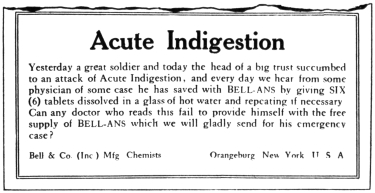
Typical of Bell-ans advertisements as appearing in medical journals.
A recently purchased package of Bell-ans contained a circular in which it was stated that Bell-ans removes flatulence, vertigo, weakness and other symptoms of indigestion quickly and pleasantly; that it aids the digestion of food and tends to restore the digestive tract to a normal condition; that it relieves vomiting in pregnancy, alcoholism, seasickness and cholera morbus, besides being pleasant, harmless and effective for colic, sour stomach, feverishness, and wakefulness of infants and children. The circular contained paragraphs purporting to be taken from various medical journals, including the New York Medical Journal, Wisconsin Medical Recorder, the Lancet Clinic, International Journal of Surgery, and Massachusetts Medical Journal. No exact references were given to permit verification or to determine whether or not the quotations were from “reading notices” (advertisements) or from the scientific part of the journals in question. To quote one of the statements given:
“The results from the use of Bell-ans (Pa-Pay-ans Bell) in the treatment of indigestion are so prompt and so generally good—and the evidence of this fact is accumulating so rapidly and from such reliable sources—that we venture to suggest to our readers who have not tried this remedy that they prescribe one original sealed package of Bell-ans (Pa-pay-ans Bell) and that they carefully note the results from its use.
“We suggest an original sealed package because the preparation is widely and badly imitated, and unless such a package is specified an imitation of little value may be substituted and the experiment be thus rendered useless.”
It is possible that Bell-ans has been imitated, but it is not true that it is widely imitated, for no such imitation has ever been called to our attention, and we strongly suspect that the main reason for desiring that an original package be dispensed is that the patient may see for himself the name BELL-ANS plainly blown in the glass.
The circular in question states that there is no derangement of the digestive organs on which the proper dose of Bell-ans will not act quickly and pleasantly! These are samples of the claims made for Bell-ans. Let us inquire into the nature of the conditions for which the preparation is recommended and the treatment advised by well known clinicians.
The subject of indigestion is discussed by Robert Hutchison and Robert Saundby under the general title of dyspepsia in the “Index of Treatment by Various Writers,” Edition 6, 1912, pp. 260–265. Hutchison says: “In the first place it must be remembered that in many patients who complain of ‘indigestion’ the seat of the trouble is not in the stomach at all.”

Newspaper advertisement of Bell-ans, capitalizing the statements of physicians.
The general principles to be observed in the treatment of functional dyspepsia, as given by Hutchison, are: (1) to remove the cause; (2) to adapt the diet to the impaired functional power of the stomach; (3) to administer such drugs as are calculated to stimulate or correct the particular function or functions which happen to be impaired, or disordered. Proper diet, proper mastication of food, hygiene of the mouth, and constipation are enumerated as deserving attention. Careful attention to securing a proper diet is essential. The choice of drugs depends, of course, on the conditions that give rise to indigestion, and he calls attention to the necessity of avoiding all routine treatment and compiling one’s prescription with an eye to the special disorder or disorders of function, whether secretory, motor or sensory, believed to be present. Hutchison gives the following typical prescriptions to illustrate the use of drugs in the different disorders of function:
FOR HYPERSECRETION (HYPERCHLORHYDRIA, ACID DYSPEPSIA, ETC.)
Sodium bromid10 grains
Bismuth subcarbonate15 grains
Chloroform water1⁄2 ounce
This mixture to be taken before meals. Sodium bicarbonate. Bismuth subcarbonate. Heavy magnesium carbonate, of each equal parts. A small teaspoonful of the powder to be taken mixed with a little water or milk about two hours after meals.
FOR DEFICIENT SECRETION (HYPOCHYLIA, ACHYLIA, GASTRITIS, ETC.)
Sodium bicarbonate10 grains
Tincture of nux vomica10 minims
Spirit of chloroform 8 minims
Compound infusion of gentian1⁄2 ounce
This mixture to be taken before meals. Dilute hydrochloric acid and glycerin, of each 15 minims with enough water to make half an ounce, to be taken about twenty minutes after meals.
FOR DEFECTIVE MOTILITY (ATONIC DYSPEPSIA, GASTROPTOSIS, ETC.)
Hutchison recommends the use of 10 minims of tincture of nux vomica in an aromatic vehicle, such as infusion of quassia and compound tincture of cardamom; but another aromatic bitter, such as the compound tincture of gentian, will serve quite as well, of course. This is to be taken before each meal, and for the flatulence that often accompanies this trouble he gives menthol, aromatic spirit of ammonia and spirit of chloroform, as may be needed.
FOR ACID DYSPEPSIA
Robert Saundby recommends the following to be used before each meal for the relief of acid dyspepsia: sodium bicarbonate, bismuth subcarbonate, magnesium carbonate, of each 10 grains; mucilage of tragacanth 15 minims, and enough peppermint water to make an ounce.
These are only a few of the conditions that are discussed by Hutchison and Saundby, but they serve to show that the treatment of indigestion by a single prescription or combination is wholly irrational.
Bell-ans, both under its present name and under its older name, “Pa-pay-ans (Bell),” has always been alleged by its manufacturers to contain papain or to be a preparation of the digestive juice from the fruit of Carica papaya (papaw) with other substances. Various chemists have attempted to find papain present and to determine the digestive power of the tablets, but without success. For this reason The Journal suggested that the change of name from “Pa-pay-ans (Bell)” to “Bell-ans” was probably not made entirely for euphonious reasons, as alleged, especially when one considers that the name of a nostrum is its most valuable asset. It is much more likely that as analyses indicated there was not and probably never had been any papain present in the product, the name was changed for fear that some day the misleading term “Pa-pay-ans” might bring the preparation in conflict with the federal Food and Drugs Act.
Pa-pay-ans (Bell) was examined for the Council on Pharmacy and Chemistry in 1909 and the tablets were found to consist of charcoal, sodium bicarbonate, ginger, saccharin and oil of gaultheria. No digestive ferment could be detected in the tablets. Sodium bicarbonate is antacid and serves to dissolve mucus; ginger, if in sufficient amount, causes the expulsion of flatus, and charcoal, while an absorbent in the dry state, is probably useless for any therapeutic purpose whatever after it becomes saturated with gastric juice. Bell-ans, then, has all of the virtues, which are few, and all of the limitations, which are many, of a tablet of sodium bicarbonate and ginger. Its value in the treatment of acute indigestion would be limited to the value of a tablet of such a composition. It is absurd to suppose that it could have the slightest value in the far more serious conditions attended with intestinal indigestion, with the toxemia and autointoxication to which they give rise.
Bell-ans is now advertised directly to the public—but it is no less valuable on that account. True, it is a “patent medicine” in the commonly accepted sense of the term, but it is no more a “patent medicine” today than it was fifteen years ago when it reached the public, not through the direct medium of the newspapers but the more indirect route of the medical journals and undiscriminating physicians. It is true that, in view of the serious nature of many conditions which are loosely spoken of by the public as “indigestion,” its present method of exploitation is likely to make it just that much more dangerous because of the larger publicity that will be given. The point to be borne in mind is that Bell-ans is now in fact what it has always been in essence, a “patent medicine.”
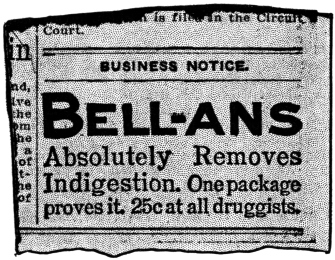
Typical of Bell-ans advertisements as appearing in newspapers.
Again we ask the question: How do you wish to be classified, Doctor—among those who follow blindly the lead of a firm of nostrum makers, or among the intelligent members of the profession who study their cases carefully and prescribe intelligently? The manufacturers of Bell-ans claim that 100,000 American physicians now prescribe Bell-ans, and that 600,000,000 of the tablets are sold annually. If this is even approximately true it is a serious reflection on the medical profession, for the Council examined Bell-ans and reported its findings nearly eight years ago (J. A. M. A. 53:569 [Aug. 14] 1909), and the statements made in that report are as incontrovertible today as they were then.—(From The Journal A. M. A., Nov. 24, 1917.)
[Article II]
Anasarcin and Anedemin
“Anasarcin” and “Anedemin” are the twin nostrums of cardiac pseudotherapy. They are dubbed “twin nostrums” not so much because of any similarity in their formulas, that being a minor consideration in the average nostrum, but because of the close similarity in their methods of exploitation, the therapeutic claims made for them, and the time and place of their birth.
It may be remembered that they both claim Winchester, Tenn., as their birthplace, and they appeared on the market at about the same time; furthermore, a comparison of the claims formerly made for both of them indicated that one mind conceived the main idea that lies back of their exploitation. While Anasarcin is especially dealt with in this article, much of the discussion applies with equal force to Anedemin.
A LUSH FIELD FOR NOSTRUMS
Cardiac disease, with its resultant renal involvement, is frequently encountered; and running, as it does, a chronic course, it offers an almost ideal field of exploitation for the typical nostrum vender. By a typical nostrum vender we mean one whose knowledge of his product is far below that of his appreciation of a certain element of human character. On this element rests the whole secret of the nostrum vender’s success. It is variously termed credulity, gullibility and childlike simplicity, but it is that which often causes even the most conscientious clinician to turn aside from the use of the best known and most dependable drugs at his command, in the face of disappointment and failure, and employ some vaunted mixture which, in his saner moments, he scorns to use.
Anedemin is said to consist of a “Scientific Combination of three of the more recently investigated members of the Digitalis Series, with Sambucus”; that is, of apocynum, strophanthus and squill with elder. It is difficult to know just what idea the statement that it is a “scientific combination” of these drugs is intended to convey, for it is unscientific to mix three drugs of this group for use in fixed proportion in a wide range of conditions, if indeed, there is ever any indication for their use.
The great disadvantages of strophanthus and apocynum pertain to the extreme uncertainty of their absorption from the gastro-intestinal tract. Strophanthus is occasionally absorbed promptly, sometimes so slowly that the therapeutic effects are not induced until an amount equal to several times that which would prove fatal if all of it were absorbed into the circulation has been administered, and, unfortunately, one cannot control the absorption which may continue until a fatal effect is induced. This is true to an even greater degree of apocynum, and it was due to the recognition of this fact that apocynum was not admitted to the U. S. Pharmacopeia IX, the committee on dosage having agreed that no safe and effective dose could be given.
THE COUNCIL’S PREVIOUS FINDINGS
In 1907 the Council on Pharmacy and Chemistry examined the literature used in the exploitation of Anasarcin and Anedemin and published its report. Anasarcin tablets, it was pointed out, were said to contain the active principles of Oxydendron arboreum (sour wood), Sambucus canadensis (elder) and Urginea scilla (squill), and the following claims were made for the nostrum:
“Does what dropsy medicaments have hitherto failed to accomplish.”
“Superior to digitalis, strophanthus, scoparius, squills, acetate of potash and the hydragogue cathartics all put together.”
“The only known relief and permanent cure of dropsies.”
“Unrivaled heart tonic.”
“The most powerful agent known.”
“Safe in administration.”
“Non-toxic as ordinarily administered.”
“Will nauseate some persons,” but “the reaction from the temporary depression is prompt.”
“In Bright’s disease, both the interstitial and parenchymatous forms of nephritis, acute or chronic, no remedy ... to equal it in efficacy.”
“Without increasing the debility of the patient or interfering with nutrition by producing loss of appetite ...”
“This treatment is to be continued without cessation until all symptoms of dropsy have disappeared.”
A comparison of the earlier claims with those now being made (see advertisement reproduced from the New York Medical Journal) illustrates one of the results of the work of the Council. Today the nostrum exploiter avoids the cruder forms of obvious misstatement, but continues to make, by inference, claims that are equally misleading. It will be observed in this case that a more cautious pen worded the later advertisement, but there is still evident the intent to convince the reader that Anasarcin is superior to the official drugs in the treatment of cardiovascular diseases. The facts are that Anasarcin is at best a dangerous remedy in the hands of the average clinician in the treatment of such conditions, and its use is at all times to be condemned.
No competent investigator has ever investigated the pharmacology of sour wood (Oxydendron arboreum), and it appears to have no therapeutic value other than that due to a slight acidulousness. Elder (Sambucus canadensis) contains a trace of a volatile oil as its most important constituent, according to the British Pharmaceutical Codex of 1911 (p. 908), but it is difficult to explain why a trace of volatile oil should be considered important. Elder may be dismissed without further consideration in connection with Anasarcin tablets.
THE PHARMACOLOGY OF SQUILL
This leaves only squill among the constituents of Anasarcin for consideration. Sollmann (Manual of Pharmacology, 1917, p. 409) in discussing the advantages claimed for squill over other drugs of the digitalis group, says: “Dixon, 1906, points out that any superiority is outweighed by its disadvantages: uncertain absorption; strong gastro-intestinal irritation.” Squill was formerly used as an expectorant and diuretic, the activity having been attributed to two amorphous glucosids, scillipicrin and scillitoxin, but Ewins, 1911, found these to be impure mixtures. A later investigator claimed to have isolated two glucosidal agents from squill, but similar claims have often been made only to be disproved later, and we know of no confirmation of the claims regarding the isolation of any pure principles from squill having any true typical digitalis action.
The statement quoted from Sollmann is accepted by practically all pharmacologists, and we may say with certainty that squill is decidedly inferior to digitalis in the treatment of cardiovascular, and cardiorenal diseases, and certainly no active principles of squill were known to the scientific world at a time that the remarkable claims were first made for Anasarcin by an obscure pharmacist of Winchester, Tenn. Indeed, if Anasarcin were all that it was claimed to be, its discovery would have made Winchester as famous as a certain Wisconsin city was said to have been made by a popular beverage.
It has been abundantly demonstrated, and it is now almost universally accepted among well informed pharmacologists and clinicians, that all digitalis principles exert the same kind of action on the heart after they enter the circulation in effective doses, though they differ to an extraordinary degree in the intensity of their action and in their undesired sideactions, such as nausea and vomiting. When the use of Anasarcin (squill) is followed by immediate improvement after digitalis has failed, it merely shows that the dosage of digitalis was insufficient or that it was discontinued and the squill mixture was substituted before the full therapeutic effects of the digitalis developed.
WHEN THE DIGITALIS GROUP IS CONTRAINDICATED
If the administration of a sufficient dose of digitalis is not followed by improvement in the circulation, it shows that the heart is incapable of responding to such treatment and the further use of any of the drugs of this group is distinctly contraindicated. This is confirmed by the experience of nearly every competent observer of digitalis therapy, and numerous fatalities have resulted from the failure to appreciate this fact and further administer some other member of the group, such as strophanthus or squill.
It is now well known that the cardiac effects of toxic doses of squill, and other members of the group, resemble closely those of cardiac disease, and it is often impossible to determine whether the behavior of the heart in a given case is attributable to insufficient dosage, to excessive dosage, or to the progress of the cardiac disease itself. If this occurs when one uses the best known members of the group, it is certain that it occurs even more frequently when others that are less understood are employed. In the light of this knowledge of the dangers attending the incautious use of any member of the digitalis group, and more especially the use of impure principles, such as are commonly obtained from squill, it is impossible to condemn sufficiently the recommendation that the use of Anasarcin should be continued without cessation until all symptoms of dropsy have disappeared.
Digitalis bodies are not suited for the treatment of all cardiac disturbances, and it is, of course, self-evident that a time must come in the treatment of chronic cardiac disease when the heart is incapable of responding to any form of treatment with improvement. But, unfortunately, it never loses its response to toxic doses, and to push the administration of any drug or mixture containing any drug of the entire digitalis group—and especially those, like squill, in which the side actions are most prominent—beyond the point of tolerance is to court certain disaster.
THE TREATMENT OF CARDIAC DROPSY
While it is quite certain that many lives have been sacrificed to the failure to understand this phase of cardiac therapy, it is equally certain that many lives have been sacrificed because of insufficient dosage, and one can steer a safe course between these dangers only by using the best known preparation available; and in the present state of our knowledge it is indisputable that digitalis and the tincture of digitalis are best suited for the treatment of cardiac disease except in those few cases in which intramuscular or intravenous administration must be employed temporarily for immediate effect.
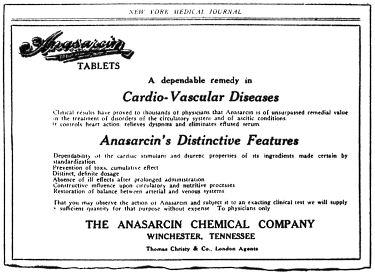
The secret of prescribing successfully for the relief of dropsy in cardiac disease consists in understanding the effects of digitalis on the heart, in administering it until these effects indicate that the desired object has been obtained, and stopping, or interrupting, the administration at that point until the effects begin to wear off. Cumulation, so called, is a positive advantage in such cases. It merely means that the desired therapeutic effects once induced persist for a time, and that further medication is unnecessary during such persistence of action. Eggleston has recently shown (Arch. Int. Med. 16:1 [July] 1915; abstr., J. A. M. A. 44:459 [July 31] 1915) that the full therapeutic effects of digitalis can be induced in suitable cases within a few hours even with oral administration.
We are not aware of a single publication in which a careful, detailed clinical study of Anasarcin has been reported. The claims made for Anasarcin, past and present, indicate either a deliberate purpose to mislead or crass ignorance of the rudiments of pharmacology and therapeutics. The exploiters of the nostrum claim that thousands of physicians have found Anasarcin tablets of unsurpassed remedial value in the treatment of disorders of the circulatory system and of ascitic conditions.244 It must be admitted that too many physicians have prescribed Anasarcin, otherwise the manufacturers would not have continued to spend thousands of dollars in advertising it in medical journals during a period of more than ten years.
Doctor, this article is meant to be a candid discussion with you, whether you use Anasarcin or not, because every clinician is vitally interested in the customs that obtain in the practice of medicine, and we wish to put a hypothetic question to you. Answer it, at least to yourself, in exactly the spirit in which it is put. Suppose that you prescribe Anasarcin for a patient who is critically ill with cardiac disease. He dies. Are you willing to tell the relatives frankly just what you used and the nature of the evidence on which you based your choice of this nostrum? Let the supposition be carried further and say that the case was hopeless, and agree that digitalis and all other drugs would have been equally ineffective. Granting all this, would your explanation satisfy? Would you in all candor dare to offer such an explanation? Try it as a hypothetic case before you are forced to apply it.—(From The Journal A. M. A., Dec. 8, 1917.)
[Article III]
Pepto-Mangan
It would be interesting, and even instructive, to know how many educated physicians, if any, are now prescribing Pepto-Mangan (Gude): interesting as indicating the number who have neglected to avail themselves of the work of the Council on Pharmacy and Chemistry, especially the earlier work; instructive in that it would show how many are still prescribing by the rule of thumb, and who are taking their therapeutic instructions from purely commercial sources instead of striving to learn how to choose those drugs that are most effective in the treatment of disease.
It has been pointed out many times in the pages of The Journal that many nostrums are advertised first to physicians, and that after physicians have served as the unpaid agents of the manufacturers in introducing the preparations, their exploitation is then commonly continued by means of advertisements in the public press. This plan has been followed successfully in so many cases that we have now come to look on it as the regular course. It is in keeping with this rule that we find Pepto-Mangan now advertised in the public press, the physicians having served the manufacturer’s purpose.
DISCARDED THEORIES OF IRON MEDICATION
It will be recalled that many years ago the theory was held that hydrogen sulphid (sulphureted hydrogen) interfered with the absorption of the iron of the food, and that the administration of medicinal iron prevented this interference by neutralizing the hydrogen sulphid (sulphureted hydrogen). It was only a short step to argue that manganese might replace the medicinal iron in combining with the hydrogen sulphid, permitting the food iron to be absorbed, and it was held that only food iron could be utilized in the formation of hemoglobin.
It is hardly necessary to remind the reader that this theory rests on numerous fallacies. There is no hydrogen sulphid worth mentioning in the small intestine where iron is absorbed; food iron cannot be utilized directly in the formation of hemoglobin but must be broken into simple forms for absorption; and, further, inorganic iron, such as ferrous carbonate, serves the purpose admirably when iron is indicated. With the acceptance of these well established facts, all possible excuse for the therapeutic employment of Pepto-Mangan in place of iron vanished; but as plain and simple as this fact is, the unnecessary and expensive Pepto-Mangan continues to be prescribed by physicians who will not take the slight trouble to investigate the claims for this nostrum.
FALSE AND MISLEADING CLAIMS
There is not merely a difference of opinion between the exploiters and the Council, but there has been also actual misrepresentation in the exploitation of this nostrum to physicians. This has been shown on more than one occasion. About twelve years ago, the M. J. Breitenbach Company, the proprietors of Pepto-Mangan, claimed that the report of the commission that had been appointed for the investigation of anemia in Porto Rico “would alone suffice to establish Pepto-Mangan at once as the foremost hematinic known.” Examination of the report showed that the commission made no such claims; on the contrary the commission protested against this misrepresentation (J. A. M. A. 45:1099 [Oct. 7] 1905).
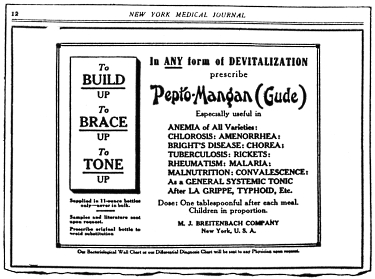
From the New York Medical Journal.
Undaunted by this exposure of their methods, the Breitenbach Company later sent out a statement of results purporting to have been obtained by one Mateo M. Gillen, in the treatment of infantile anemia on Randall’s Island in New York City. At the instance of The Journal the hospital records in these cases were examined, and it was found that the pretended report was little more than a tissue of falsehood (J. A. M. A. 48:1197 [April 6] 1907).
About two years ago the Council reported that while the statements just referred to were no longer made, they had never been definitely admitted by the Breitenbach Company to be erroneous, and that Pepto-Mangan was then being exploited to the public indirectly. (Council Reports, 1914, p. 121.)
We reproduce an advertisement that has been appearing weekly in the New York Medical Journal for several months. One can only suppose that this advertisement was intended to mislead physicians, and it would be an insult to the intelligence of the average reader to attempt any detailed discussion of it, but enough has been said to show how misleading the statements are. One should note particularly the advice—old as the nostrum business itself—contained in the advertisement, to prescribe an original bottle. The reason for such advice is simple. Experience has shown that when original bottles are dispensed patients soon learn to buy the nostrum without consulting the physician, for they shrewdly suspect that he knows no more about the preparation than they, and that he gets his information from precisely the same sources that are available to them. They are obviously right. In truth, the physician who prescribes Pepto-Mangan as a hematinic shows ignorance of the most rudimentary facts of iron therapy, and the intelligent patient soon perceives his limitations.
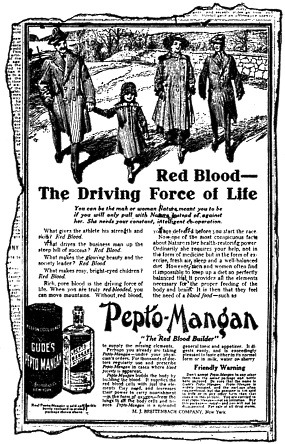
A newspaper advertisement of Pepto-Mangan.
THE PROBLEM OF IRON THERAPY
The investigation of the problems of iron therapy and its utilization in the formation of hemoglobin forms one of the most brilliant chapters in pharmacologic research, and there is no better established fact in therapeutics than that any organic or inorganic preparation of iron that does not irritate the stomach may be employed effectively when the administration of iron is indicated. “Useful Drugs” contains a list of iron preparations that are suitable for all conditions which call for iron, and the clinician may rest assured that he will never have occasion to go outside that list to prescribe any substitute.
As a matter of fact, it seems probable that the very number of available iron preparations has served to cause confusion, thus affording an opportunity for the nostrum maker to introduce his superfluous compounds. It may be difficult at times to select the preparation of iron best suited to the individual patient; and it is this difficulty that has led the clinician to listen to the seductive claims made for the various pretended substitutes for iron. One should approach the question of choosing the proper form of iron for therapeutic use with the recognition of the fact that there is no such thing as a substitute for iron in the formation of hemoglobin, that there are no ideal forms of iron other than those found in the foodstuffs. Further, the clinician cannot avoid the disadvantages inherent in all forms of iron that he can prescribe, and he must therefore seek that which seems best suited for the individual patient.
Bunge estimated the amounts of iron present in various foods; and a table based on this, and other data, is given in “Pharmacology of Useful Drugs” (published by the American Medical Association). Ordinary foods in an ample diet contain enough iron to supply the normal daily loss, which amounts to only a few milligrams, but many persons who have poor appetites take an insufficient amount of iron in their food and become anemic. In such cases the additional iron required can be supplied best by adding spinach, eggs, apples, or other iron-rich food to the dietary.
SOME IRON COMBINATIONS
William Hunter discusses the subject of anemia and its treatment at considerable length in the “Index of Treatment,” Ed. 6, pp. 17–37, and gives many prescriptions containing iron for use under different conditions; and while it is unnecessary to reproduce all of these here, a few may be given in order to suggest suitable methods of prescribing iron when it cannot be given in sufficient amounts in the food.
In chlorosis Hunter advises that that form of iron which experience has shown to be least disturbing to the patient’s stomach should be used, and he suggests separate stomachic mixtures to be used simultaneously, not mixed with the iron itself. When constipation exists—and this is a very common accompaniment of chlorosis—he gives the following aperient iron combination:
Gm. or c.c.
℞ Ferrous sulphate│25gr. iv
Magnesium sulphate 4│Ʒ i
Aromatic sulphuric acid│5♏ vii
Tincture of ginger│7♏ x
Compound infusion of gentian (B. P.) q. s., ad30│℥ i
This, constituting a single dose, is to be taken twice daily—at 11 a. m. and 6 p. m. A little compound tincture of gentian and water may be used in place of the compound infusion of the British Pharmacopeia. He modifies this somewhat as occasion demands by using sodium sulphate and adding sodium bicarbonate (which converts the sulphate of iron into ferrous carbonate) and adds 10 minims of spirit of chloroform to act as a stomachic.
Hunter also suggests the use of pills of aloes and iron in place of the mixture described above, and when constipation has been corrected, the aloes may be omitted and the pill of ferrous carbonate alone may be used for the iron. Hunter’s comment regarding this pill is, “very satisfactory.”
The same form of iron is available in the compound iron mixture, formerly official, which Hunter says is exceedingly good. In this country the compound solution of iron and ammonium acetate, Basham’s mixture, so called, has long enjoyed a wide reputation as causing very little disturbance of the stomach, and the homely tincture of ferric chlorid is probably useful in a large majority of cases in which the stomach is not especially irritable.
We may say with assurance that one of the forms suggested here will suffice for practically every case in which it is necessary to reinforce the amount of iron available in the food by some pharmaceutical preparation. If these do not satisfy your requirements, consult a really competent pharmacist and enlist his aid in devising a mixture especially suited to your individual patient.—(From the Journal A. M. A., Dec. 29, 1917.)
[Article IV]
Cactina Pillets
This preparation may be considered briefly in view of the recent discussion in this series of articles of the pharmacology of the digitalis group and the principles of treatment in cardiovascular disease. The manufacturers maintain that cactina is wholly unlike digitalis, and that is the truth, as we shall show; but since they claim that it is useful in certain conditions of the heart in which digitalis is commonly employed by well informed clinicians, it is necessary to consider its cardiac actions—or its lack of them! It is difficult to determine just what action cactina is supposed to exert on the heart. For example, one advertisement contains the following:
“Cactina Pillets. A gentle cardiac tonic that supports and sustains the heart through its capacity to improve cardiac nutrition.”
Just how the cardiac nutrition is to be improved without an improved coronary circulation is not explained. It would be interesting to know in what other way this is to be accomplished, and how an improved coronary circulation can be induced without acting on the heart or vessels. But that is what digitalis does, and you should remember that cactina is so very different from digitalis! Then again:
“Cactina Pillets. A remedy that steadies and strengthens the heart by imparting tone to the heart muscle.”
That is a pretty direct statement, but digitalis imparts tone; and we must not forget that “cactina” is wholly unlike digitalis, and we are told that “cactina” is:
“Invaluable in all functional cardiac disorders such as tachycardia, palpitation, arrhythmia, and whenever the heart’s action needs regulating or support.”
If these are merely functional disorders of the heart, it is highly desirable to know what are the symptoms of really serious cardiac disease! Since the manufacturers give us no information concerning the mode of action of “cactina” we will turn to the literature of disinterested observers. If one attempts to discover the origin of “cactina,” he will probably meet with disappointment, for various bibliographies fail to mention the name of Sultan, who is said to have isolated “cactina” from Cactus grandiflorus. It seems that Sultan worked with Cactus, or some other plant, when a student of pharmacy, and it is to be remembered that Cactina Pillets are manufactured by the Sultan Drug Company.
It is doubtful whether Sultan actually worked with genuine Cactus grandiflorus; and, in fact, there is good reason for thinking that he did not, for all subsequent workers who have taken pains to secure genuine Cactus grandiflorus have failed to detect the presence of any active principle, except possible traces that are of no therapeutic importance whatever.
WHAT THE COUNCIL FOUND
The Council on Pharmacy and Chemistry examined the literature relating to cactus and certain proprietary preparations, including Cactina Pillets, alleged to be made from cactus, and has reported the results of its investigation (J. A. M. A. 54:888 [March 12] 1910) and we will quote from that report.
“The therapeutic value of this plant has been variously estimated by different observers. Experimental evidence as to its action is scanty and no complete chemical examination has ever been made.
“Reputable men have testified that some of the plants of the cactus family contain very active principles, but so far experiments seem to prove that Cactus grandiflorus has neither the action of digitalis nor that of strychnin. The principal contributions, clinical and experimental, for and against the drug are set out below.”
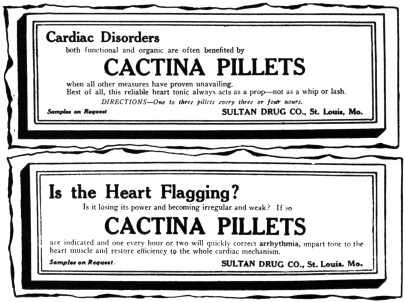
Typical advertisements of “Cactina Pillets” from the Medical Record and New York Medical Journal, respectively.
The report then proceeds to analyze the work of O. H. Myers, R. A. Hatcher, Boinet and Boy-Teissier, Sayre, Gordon Sharp, S. A. Matthews, P. W. Williams, Aulde and Ellingwood, and comes to conclusions that are set forth as follows, in brief:
1. It is uncertain what part of the plant contains the active principle, if any such principle exists.
2. Part of the experimental and clinical work has been published under proprietary auspices.
3. The value of clinical evidence when unsupported by animal experimentation is much diminished by the tendency of enthusiastic and untrained observers to attribute to the drug given the effect really due to general remedial measures, psychic suggestion and so forth.
In other words, the literature does not afford a report of a single piece of careful painstaking work the results of which lend support to the claims made for Cactina Pillets as stated above, for it is obvious that if Cactus grandiflorus contains no active principle, no active principle can be extracted from it. Some time after the report of the Council was published, Hatcher and Bailey secured genuine Cactus grandiflorus directly from a competent botanist, Dr. C. A. Purpus, of Vera Cruz, Mexico, and studied it experimentally. They reported (J. A. M. A. 56:26 [Jan. 7] 1911) in part as follows:
“We have been unable to obtain any evidence that the true Mexican Cactus grandiflorus possesses any pharmacologic action whatever; but, on the contrary, it appears to be a singularly inert substance when administered either by the mouth or by the vein.”
When colossal doses of Cactus grandiflorus are given by the vein, they sometimes—but not always—appear to exert an extremely feeble action on the heart; but this action is so slight that its nature could not be determined. Even the most colossal doses of Cactus grandiflorus administered by the mouth to cats, dogs and frogs exert no perceptible effect.
Sollmann thus satirizes the absurd claims made by the exploiters of proprietary forms of cactus: “Should the heart be too slow, cactus quickens it; if the heart is too fast, cactus slows it; should the heart be too weak, cactus strengthens it; if the heart is too strong, cactus weakens it; does the heart wobble, cactus steadies it; if the heart is normal, cactus does not meddle with it” (J. A. M. A. 51:52 [July 4] 1908).
Will physicians continue to accept the statements of an interested nostrum vender—who submits not a shred of evidence to support his claims, but who has a financial interest in convincing them—even when his statements are diametrically opposed to all the evidence that the Council on Pharmacy and Chemistry has been able to secure?—(From The Journal A. M. A., Jan. 19, 1918.)
[Article V]
Ammonol and Phenalgin
At the time that synthetic chemical drugs were coming into fame and when every manufacturer who launched a new headache mixture claimed to have achieved another triumph in synthetic chemistry, Ammonol and Phenalgin were born. Of course, these twins of analgesic pseudotherapy were claimed to be synthetics and were duly christened with “formulas.” They were among the first of the nostrums examined for the Council on Pharmacy and Chemistry, and the false claims made for them were exposed.
The analyses made for the Council showed that Ammonol and Phenalgin were simple mixtures, having the following composition:
ACETANILIDSODIUM BICARBONATEAMMONIUM CARBONATE
Ammonol502520
Phenalgin572010
The reports of the Council on, and numerous references to, these two nostrums may be found in The Journal of various dates.245 The reports will prove interesting to those who are not familiar with, or have forgotten, the methods of nostrum exploiters at the time the Council was formed. Following the Council’s exposure of the false claims made by the manufacturers of Phenalgin, the Medical Record published an advertisement of that nostrum in which an attempt was made to discredit the Council’s report. The editor of the Medical Record was requested by the Council to publish the facts in the case but he refused to do so.
Long after the death of Dr. Cyrus Edson, the claim was made that Phenalgin was made under his direction and that it was his “discovery.” As a matter of fact, Dr. Edson had favored the use of Ammonol at one time, and when the Council exposed the false claims then being made for Phenalgin, The Journal charged that a fraud was being perpetrated on the medical profession. Despite the exposure of the methods used in exploiting Ammonol and Phenalgin, one finds just as glaringly false statements made in the advertisements of Phenalgin today as were made in its unsavory past. This would seem to indicate either that physicians have short memories or that they are strangely indifferent to the welfare of their patients, to their own reputations and to the good name of medicine.
The New York Medical Journal of Dec. 22, 1917, contained an advertisement of Phenalgin—it has been running for months—from which the following is quoted:
“For the relief of PAIN the ‘logical supplanter of opium and other habit-forming drugs’ is Phenalgin. No matter how severe or where located pain is promptly and satisfactorily controlled by this effective anodyne—and without disturbing the digestion, suppressing the secretions, causing constipation or inducing a drug habit.
“This is why Phenalgin has superseded opium and its derivatives for relieving Headaches, Rheumatism, Gout, La Grippe, Lumbago, Neuralgia, Disorders of the Female, Dysmenorrhea, and Painful Conditions generally. To thousands of physicians Phenalgin ‘is the one dependable analgesic—the logical supplanter of opium.’ ”
If we are to suppose that the composition of Phenalgin is today essentially the same as when it was examined, the claims just quoted are obviously false for, of course, such a mixture must have the properties of acetanilid with all of its drawbacks and limitations. We may contrast the statements made in the advertisement just quoted with those made in Bulletin 126 of the Bureau of Chemistry of the U. S. Department of Agriculture. This bulletin on “The Harmful Effects of Acetanilid, Antipyrin and Phenacetin” summarizes the replies received from 400 physicians to whom a questionnaire had been sent. The information thus gained was tabulated and the figures that follow are from these tables. There were reported no fewer than 614 cases of poisoning by acetanilid with 16 deaths and 112 cases of its habitual use. The larger number of cases of poisoning followed the administration of the drug, by physicians, in doses larger than those now regarded as fairly safe. This large number reported by only 400 physicians indicated an excessively large number in the whole country. Since the questionnaire was sent to nearly a thousand physicians, of whom about 500 failed to reply, it may be assumed that had it been sent to the entire 130,000 physicians in the country, at least 75,000 cases of poisoning would have been reported.
Prior to the passage of the federal Food and Drugs Act (the “Pure Food Law”) many nostrum makers had declared that their preparations contained no acetanilid. When that law went into effect, some of these manufacturers triumphantly pointed to the fact that they were still able to make the same claim without conflicting with the requirements of the law. This was accomplished in fact by changing the formula and substituting acetphenetidin (phenacetin) for the acetanilid. While acetphenetidin is somewhat less toxic than acetanilid, bulk for bulk, the toxicity and therapeutic activity of the two drugs are nearly proportional.
The claim made by many proprietary medicine manufacturers that they are “strictly ethical” because they advertise only to physicians is mere verbal camouflage. There may be no more certain way of insuring the continued use of a nostrum by the public than to have it prescribed by physicians; and none know this better than the makers of nostrums. A proprietary individuality is obtained by giving some special form to the tablets and package or a special coloring to the capsules (“Specify ‘Phenalgin Pink Top Capsules’ ”) so as to indicate the identity of the products in such a way that the patient may in the future procure them without the advice or warning of the physician. When a proprietary preparation with the name or initials stamped on it or attached to it is prescribed, the patient immediately is aware of the fact, and his respect for the physician’s intelligence and wisdom is naturally lessened.
The physician should never place such dangerous drugs as acetanilid and acetphenetidin, or ready made mixtures of them, in the hands of the patient in such a way that they can be employed without his supervision or control. He should never prescribe more than is needed at the time and should not form the habit of using fixed doses or combinations of drugs without a special reference to the particular needs of the individual.
Certain forms of headache yield more readily to a mixture of caffein and acetanilid or caffein and acetphenetidin than to either acetanilid or acetphenetidin alone. When the physician wishes to prescribe such a mixture he may combine 1 grain of caffein or 2 grains of citrated caffein with 3 grains of acetanilid or 4 grains of acetphenetidin in a powder or capsule. Under supervision such a dose may be repeated at intervals of from two to four hours if necessary to control pain. It is necessary to remember, however, that when small doses fail to give relief, increase in the dose is useless. This fact is especially important, and disregard or ignorance of it has been responsible for many cases of poisoning. Further, it should be remembered that while it was taught for many years that the admixture of caffein with acetanilid lessened the effect of the latter drug on the heart, Hale has shown that this is not the case and such mixtures must be used with special caution.—(From The Journal A. M. A., Feb. 2, 1918.)
[Article VI]
Fellows’ Syrup, and Other Preparations of the Hypophosphites
We hope that it is clear to those who have read the several articles of this series that their purpose is to present evidence that will enable the reader to form a correct estimate of the literature employed in the exploitation of various nostrums. The distinction between mere assertion—however plausible, and from however eminent an authority—and evidence should again be emphasized. Satisfactory evidence rests on careful observation by those who are capable of accurately determining to what extent any changes that may be observed are due to the therapeutic agent employed and not mere accompaniments of such treatment.
When the Council on Pharmacy and Chemistry was organized in 1905, the greater part of the literature of the nostrums was so palpably misleading, the statements often so ludicrously false, that it was only necessary to call attention to this fact to have those claims collapse. As a result of the Council’s work, the exploiters of worthless nostrums have developed a greater degree of shrewdness in avoiding the easily exploded falsehoods. This has made it increasingly difficult to point out the exact statements on which many of the false claims now rest, even though the exploitation as a whole is as inherently dishonest as before. If a nostrum is worthless, any exploitation must be false and misleading in effect, even though not one single false direct statement is made.
A platitude may be given an appearance of importance if uttered in an impressive manner, and it may be employed to suggest far more than it categorically affirms. These two facts are appreciated by many nostrum exploiters and we find that they have adopted the impressive manner to secure attention, and the platitude to suggest far more than they could defend in direct statement. Thus we have the “lie with circumstance.”
FELLOWS’ SYRUP
A full page advertisement, which has been appearing regularly for about a year and which must represent a good deal of money, is used to give an appearance of importance to a few words which, if printed in ordinary type, would either pass wholly unnoticed or would lead one to assume that something essential to the full meaning had been omitted. The statement, in full reads:
“Fellows’ Syrup differs from other preparations of the hypophosphites. Leading clinicians in all parts of the world have long recognized this important fact. Have you? To insure results, prescribe the genuine ℞ Syr. Hypophos. Comp. Fellows’. Reject cheap and inefficient substitutes. Reject preparations ‘just as good.’ ”
The only direct statement contained in the advertisement is to the effect that many clinicians have observed that Fellows’ syrup and other preparations of the hypophosphites are not alike. In truth, Fellows’ is not like the better preparations of this type, since after standing it contains a muddy looking deposit that any pharmaceutical tyro would be ashamed of. Technically, then, the statement is true, but it is hardly credible that the manufacturer is paying for an entire page in a medical journal to make this statement without any attempt to suggest something else.
The advertising pages of six medical journals were examined in the order in which they chanced to come to hand. In five of these, the entire advertisement of Fellows’ syrup was in the words just quoted; not a single word more. In one there was the further statement:
“Not a new-born prodigy or an untried experiment, but a remedy whose usefulness has been fully demonstrated during half a century of clinical application.”
These advertisements show that the exploiters of Fellows’ Syrup are spending a great deal of money to induce physicians to prescribe the preparation, and it is equally evident that they wish to convey the impression that the preparation has some therapeutic value. Since we find nothing directly false, in the first mentioned advertisement at least, we must take the evident intent for consideration and determine what therapeutic value, if any, this preparation has, and whether it is advisable for physicians to employ it in any case.
The preparation, according to the statement just cited, has been in use for fifty years. As the exploiter of any preparation cites the most convincing evidence in his possession in support of his views, this claim may be assumed to be the strongest available, and if this evidence fails we must reject the contention as not proved. Here we face a dilemma, for examination of the literature used in the exploitation of Fellows’ Syrup fails to disclose any evidence of the kind that we have described as satisfactory; and we are, therefore, forced to conclude that none has ever been found. By this it is not to be implied that no reputable physician has ever reported favorably concerning the therapeutic effects of this preparation. It is quite possible that an extensive literature of that sort might be found if one examined the older medical journals. But the day has passed when every improvement that follows the administration of a preparation is blindly attributed to the drug in question. Clinical research today is far more exacting.
We will assume that the reader who has investigated the question with an open mind will have come to the decision that the contention that Fellows’ syrup is of especial therapeutic value is not proved. We might rest with that assumption and ask the clinician whether he is prepared to use a nostrum that has been before the medical profession for half a century without any satisfactory evidence having been gained that it possesses therapeutic value. We might ask him whether he would be willing to tell his patients that he was prescribing such a nostrum for them in the face of the absence of any such evidence of its value.
THE INERTNESS OF THE HYPOPHOSPHITES
But we prefer to go even further and show him that not only is there an entire absence of any evidence of its therapeutic value so far as we have been able to learn, but in addition there is an abundance of evidence that the hypophosphites are devoid of any such therapeutic effect as they were formerly reputed to have, and that, in fact, they are, so far as any effect based on their phosphorus content is concerned, singularly inert.
While we have thus far taken the Fellows’ preparation as the subject of the discussion, we may take a broader view and examine the subject of the hypophosphites in general, and the substitutes containing phosphorus that have been introduced from time to time. It hardly needs to be said that if the hypophosphites are without therapeutic value, it is impossible to give them value by combining them in a muddy-looking, ill-made preparation such as Fellows’ Syrup. Such evidence was submitted to the medical profession in a report of the Council on Pharmacy and Chemistry (J. A. M. A. 67:760 [Sept. 2] 1916); and we would strongly advise any one who is disposed to act on the suggestion contained in the advertisements of Fellows’, and other hypophosphite preparations, to read that report in full and to think the matter over before prescribing one of these nostrums. Quoting briefly from the report in question:
“Although the overwhelming weight of evidence was against the probability that the hypophosphite preparations are of value as therapeutic agents, the Council thought it well to investigate the subject. Dr. W. McKim Marriott of Baltimore was therefore requested to review the evidence for and against the therapeutic usefulness of the hypophosphites and to conduct such experiments as seemed necessary.”
The Council was not content to rest on the mere absence of evidence for the value of these preparations or any one of them, but sought to obtain evidence that would fulfil the conditions mentioned above, and in pursuance of this plan it secured the cooperation of a trained investigator, one who would work under the best of conditions for learning the truth. The results of Dr. Marriott’s investigation were published in The Journal, Feb. 12, 1916, p. 486, and should be read by everyone who has any interest in the problem. Lest some of our readers may fail to refer to the original of Marriott’s paper, we will quote briefly from it:
“None of the subjects of the experiment experienced any effect whatsoever from the administration of the drug ... Almost all of the ingested hypophosphite is eliminated unchanged....
“These experiments (Forbes) demonstrate conclusively that the hypophosphites possess no specific value as a source of phosphorus for the body.... It is doubtful if there are any conditions in which the body suffers from lack of phosphorus. Even should such conditions exist, phosphorus, in the form that it occurs in the ordinary foods, or as phosphates, is more efficient in supplying the deficit than hypophosphites that must be oxidized before utilization and which are only about 15 per cent. oxidized if at all. For example, half a glass of milk contains more available phosphorus than three large doses of hypophosphites of 15 grains each, as great a dosage as is usually given.
“What then, is the therapeutic value of hypophosphites? There is no reliable evidence that they exert a physiologic effect; it has not been demonstrated that they influence any pathologic process; they are not ‘foods.’ If they are of any use, that use has never been discovered.”
The case seems to stand about like this: A nostrum maker spends thousands of dollars to tell physicians that his cloudy preparation is not like other preparations, and physicians are expected to accept that as convincing evidence that they should prescribe and their patients, perforce, take it. This too, in spite of the evidence gained by careful scientific investigators that the hypophosphites in fairly large doses contain less available phosphorus than half a glass of milk, and that there is no evidence available that they exert any therapeutic effects at all.
Should we take the meaningless statement of a nostrum maker, who does not submit evidence of any therapeutic value of his preparation—unless one can call certain careless habits of prescribing evidence—and assume the responsibility of prescribing a nostrum that according to all scientific evidence available is useless, and of no more effect than a few teaspoonfuls of milk, so far as its hypophosphite content is concerned? It may be argued that it possesses some value because of its bitter nature. We will not deny that it is bitter; so is strychnin, so is quinin, so are scores of simple drugs, but what physician would care to admit to his patients that he did not know how to prescribe a simple bitter, such as nearly every layman can select for himself, without recourse to a preparation such as Fellows’ Syrup?
We have felt that it is not wholly satisfactory to discourage the use of a given nostrum without making an effort to assist the physician in choosing wisely in the treatment of the condition for which the nostrum is claimed to be useful. In the present instance, however, we fear that would prove a task beyond our powers, for the hypophosphites have been used in such a variety of conditions that the discussion would have to include nearly the whole materia medica if we were to follow our usual procedure.—(From the Journal A. M. A. Feb. 16, 1918.)
[Article VII]
Shotgun Nostrums
Formerly it was customary to prescribe mixtures of many drugs on the assumption that if one of the ingredients missed the mark another might be expected to hit it, just as a poor marksman is more likely to hit a target at short range with a blunderbuss than with a high powered rifle. Increased precision in every branch of science has become the outstanding feature of civilization. The soldier today must shoot straight with a rifle that sends a single ball. There is none of the disposition to rely on chance as when the blunderbuss was used. A capable physician directs his drug straight at the seat of the trouble, and we now have many drugs that can be depended on to exert definite actions. The complex mixture is just as preposterous in modern therapeutics as the blunderbuss would be on a modern battlefield.
Every drug exerts undesired side actions, and it is the aim of the modern physician to try to select the one which will have a maximum of therapeutic with a minimum of undesired actions. When a complex mixture is employed, it is obvious that only the best is utilized, whereas all the undesired side actions come into play. We do not pretend that even the best studied drug has not much to be learned about it; but the nostrum maker who exploits a complex mixture either knows practically nothing of the side actions that it will exert, or, if he knows, he conceals that knowledge. He knows that massive doses of hydrated chloral combined with various narcotics can be relied on to cause unconsciousness in nearly all cases, but he prefers to speak of this as a hypnotic action. This is plain gambling with human life. When the patient dies, it is difficult to prove that death was caused by the mixture alone.
The Council on Pharmacy and Chemistry has expended a great deal of time and energy in combating the “shotgun” nostrum evil. It is easy to understand the disadvantages of such mixtures but it is not so easy to demonstrate the misleading character of the claims made, with an entire disregard of the truth, for these mixtures. No one believes that a pot of gold lies at the end of the rainbow, but no one has actually gone there to see for himself.
BROMIDIA
There are many types of “shotgun” nostrum. Some are dangerous, as in the case of “Bromidia”; some are preposterous, therapeutic monstrosities which excite the contempt of educated physicians, as in the case of “Tongaline”; some are merely useless mixtures of well known drugs, sold under grotesquely exaggerated claims, as in the case of “Peacock’s Bromides.”
Various formulas have been given for Bromidia. The manufacturers appear to be more cautious under those circumstances in which falsehood might lead them into collision with the federal authorities, than when giving reign to fancy and considering only the best means of winning the favor of the physician. It is said to consist of hydrated chloral, potassium bromid, Indian cannabis, and hyoscyamus. It is impossible to determine from the published formulas just how much hydrated chloral and potassium bromid it contains, but is probable that there are about 15 grains of each of these two drugs to the fluidram, and variable amounts of Indian cannabis and a small amount of either extract or tincture of hyoscyamus.
This much is certain: Bromidia is a distinctly dangerous mixture for indiscriminate use. The claim of the manufacturers, implied, rather than directly stated, that it is superior to an extemporaneously prepared mixture of those drugs is especially reprehensible because it tends to create the impression that the nostrum is safer in effective doses, conducing to a false sense of security on the part of those who are deluded into prescribing it in larger doses than they would a mixture of the same drugs prepared extemporaneously.
A report of the Council on Pharmacy and Chemistry published in The Journal, May 16, 1914, p. 1573, mentions three instances in which death is reported to have followed the use of Bromidia. The manufacturers of Bromidia have no magic power to render hydrated chloral harmless, while it retains its hypnotic action. It depresses the central nervous system, and it is nothing less than monstrous for any one to pretend to rob this drug of its dangerous properties while it retains its hypnotic effects. If the patient requires a hypnotic, the physician should choose that one which his judgment and experience dictate as the best for that particular patient. If he needs hydrated chloral, the physician should prescribe exactly as much as he believes the patient needs. If the effect is slightly greater or slightly less than anticipated, no harm is done and the physician has gained experience that will be valuable in future prescribing. If Bromidia is prescribed and unexpected effects are induced, it is impossible to know whether these were due to the hydrated chloral or to one of the other narcotics or to a synergistic action; and there is nothing to guide in the further use of the nostrum, for mixtures of narcotics commonly have much less uniformity of action than a single drug.
The irritant action of hydrated chloral on the stomach can be avoided by the use of bland fluids or dilute solutions. The following serves as an example of the way in which it may be prescribed conveniently:
Gm. or c.c.
Hydrated chloral 2│6gr. xl
Syrup of orange peel│
Water of each30│fl ℥ i
A tablespoonful (15.0 c.c.) of this mixture, containing 10 grains (0.65 gm.) of hydrated chloral, will often induce sleep in the absence of severe pain or serious disturbance, and seldom does this dose have to be repeated more than once in such simple cases. Hydrated chloral is often used in somewhat smaller doses in combination with potassium bromid, which may be prescribed in a mixture such as the following:
Gm. or c.c.
Hydrated chloral 1│3gr. xx
Potassium bromid 3│9gr. lx
Syrup of orange peel│
Water of each30│fl ℥ i
In producing sleep when severe pain is absent this is as effective as the preceding, in similar doses. The use of repeated doses of hydrated chloral in such a mixture as this, or in the form of Bromidia or other nostrum when sleeplessness is due to severe pain is highly dangerous. It should be remembered that while hydrated chloral is an effective hypnotic in case of simple sleeplessness, it is not actively analgesic except in distinctly dangerous doses. Bromidia in repeated doses will induce sleep even in the presence of pain, of course; but any active narcotic does that, and it is correspondingly dangerous. Small doses of morphin given alone are preferable when sleeplessness is due to severe pain.
TONGALINE
“Tongaline” is an example of the type of “shotgun” nostrum that would be merely ludicrous if we could look on anything that degrades therapeutics so lightly. A report was made to the Council on Pharmacy and Chemistry, and published in The Journal, July 17, 1915, p. 269, and in this report it is stated that Tongaline is said to consist of tonga, cimicifuga racemosa, sodium salicylate, colchicum, and pilocarpin. Whether the formula was cut short just there because the office boy ran out of breath at that point, or because the discoverers of this wonderful combination had not heard of the eminently potent substances that the witches added to their cauldron, we can leave to the reader’s imagination, for it is manifestly impossible to present an orderly discussion of the pharmacology and therapeutics of such a preposterous jumble of drugs.
PEACOCK’S BROMIDES
“Peacock’s Bromides” belongs to a slightly different class. It is said to consist of the bromids of sodium, potassium, ammonium, calcium and lithium. In the absence of a logical explanation of the pretended superiority of this mixture over one that is made extemporaneously, the exploiters seem to have been driven to the necessity of pretending that its freedom from contaminating chlorids explains its claimed advantages over mixtures of the official or commercial bromids. The truth is that the chlorids are used as antidotes in bromid poisoning.
Disregard the claims made for Peacock’s Bromides, and ask yourself the question whether you have ever actually seen any ill results following the use of the official bromids that you could reasonably attribute to contaminating chlorids. Furthermore, carefully consider the relative advantage of a single bromid (say the bromid of potassium, or bromid of sodium, if you prefer it), with the opportunity of observing its effects and adjusting the dose in accordance with the results of your experience, and a mixture such as Peacock’s Bromides, the composition of which you do not know, and which the manufacturer can alter to suit his own convenience.
While it is true that the therapeutic art will not degenerate in its entirety merely because some physicians continue to use the most fraudulent and worthless nostrums, yet, on the other hand, to the extent that a physician continues to be guided by the false teachings of nostrum venders who have no therapeutic training, he is plunged into therapeutic chaos.—(From The Journal A. M. A., March 2, 1918.)
[Article VIII]
Tyree’s Antiseptic and Aseptinol
It may seem paradoxic to say that recent progress in the medical sciences has made therapeutic chaos possible, but it is true nevertheless. Revolutions are sometimes slow and orderly, sometimes sudden and attended with confusion. The revolutionary changes in the medical sciences have been so numerous and so rapid that the general practitioner has been unable to keep pace with them, and in the resulting confusion the nostrum maker has seen his opportunity for exploiting his useless, dangerous or unscientific preparations. The greater the confusion, the greater his opportunity; and it is no exaggeration to say that he has been the most potent factor in maintaining the chaos of therapeutics.
The majority of our readers would probably say that the existing scientific medical literature insures the permanence of established beliefs, but every one who has delved into the literature has found instances of truths that had been established and forgotten—buried under the ever-increasing avalanche of contributions to that literature.
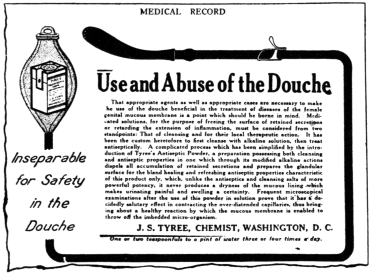
Typical half-page Tyree advertisement appearing in medical journals.
Rapid advances are still being made in the medical sciences and unless constant vigilance is exercised therapeutics will return to the chaotic condition from which it has so recently emerged. It was in recognition of these facts—the danger of this return to chaos, and the difficulty, in fact, impossibility, of any individual’s keeping pace with all of the medical sciences—that the American Medical Association secured the cooperation of men in various branches of medicine in the Council on Pharmacy and Chemistry, in order that it may place the results of therapeutic progress before the readers of The Journal in an impartial manner.
Are you profiting by this work, or are you still depending on your unaided efforts to distinguish the false teachings of the nostrum venders from that of scientific medicine? Are you prescribing “Antikamnia” and “Ammonol” or a simple member of the group, such as acetanilid or phenacetin? Are you depending on “Tyree’s Antiseptic,” so called, or are you using an antiseptic about which there is no mystery, for which no false claims are made, and one which is really effective? In short, are you using drugs of unquestioned value, such as are described in “Useful Drugs,” or are you taking your therapeutic instructions from nostrum makers’ circulars?
Perhaps you have been led to believe that the Council on Pharmacy and Chemistry is composed of “theorists” and that the nostrums represent the work of “practical men.” Every one should strive to be practical, of course, and it is worth while to inquire whether scientific experimenters, who so largely mold medical literature, should be termed theorists, or practical men. A practical man practices that which is useful in the treatment of the sick, and he must determine who is capable of furnishing him with a better materia medica. A perusal of medical literature will convince any unbiased mind that medical science progresses only by means of experiment, hence experimenters must be considered the really practical men while those who cling to outworn theories are really the “theorists.”
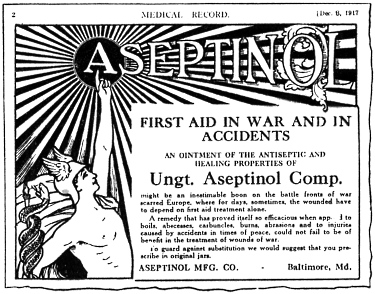
Typical Aseptinol advertisement.
When Lister introduced antiseptic methods into surgery he inaugurated a veritable revolution, which afforded the nostrum makers opportunities for reaping rich harvests through the exploitation—under extraordinary claims—of cheap mixtures of little, or no, value. There is no lack of antiseptics of extraordinary activity in the test tube that are practically harmless to man, and it would seem natural to suppose that such antiseptics could be used to control the development of bacteria in such diseases as typhoid fever, but, unfortunately, such hopes have not been fulfilled. Ehrlich experimented with many phenol derivatives that showed decided antiseptic activity in the test tube, in the hope that he might find some that could be used to combat such common diseases as diphtheria and typhoid fever, but while many of these are of low toxicity for man, he was unable to find even one that could be used effectively in the treatment of any of these diseases. His discovery of arsphenamin (“salvarsan”) resulted from quite another type of investigation.
Many practitioners lose sight of the essential difference between antiseptics and disinfectants and employ antiseptics in cases in which only a disinfectant action would be of value. An antiseptic does not destroy bacteria, it merely inhibits their growth; and when it is diluted too much, it loses its effects and the bacteria may begin to multiply as though no antiseptic had been used. This is especially true after the use of weak antiseptics in the mouth. These are soon diluted or removed by the saliva, and the bacteria continue to multiply with only a momentary interruption at best; hence to advise the use of an oral antiseptic as an effective means of treating diphtheria is little short of criminal.
“Tyree’s Antiseptic Powder” was submitted to the Council nearly twelve years ago. The label on the package stated:
“This preparation is a scientific combination of borate of sodium, alumen, carbolic acid, glycerin and the crystallized principles of thyme, eucalyptus, gaultheria and mentha in the form of a powder.”
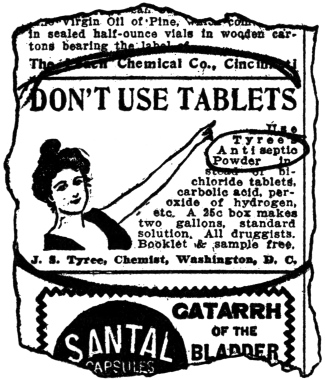
One of the older newspaper advertisements of Tyree’s Antiseptic Powder.
A leaflet issued several years ago by the Aseptinol Manufacturing Company states that “Pulv. Aseptinol Comp.” combines in an elegant form boric acid, the salts of aluminum, crystallized phenol, and the active crystalline principles of thymus, mentha and gaultheria.
A comparison of these formulas would justify the designation of the two preparations as twins, but even one twin may have a wart where the other lacks it. The formula of Pulv. Aseptinol Comp. given in the leaflet also includes Hydrastis canadensis, but we believe that a wart should be quite as much of an addition to the anatomy of man as the hydrastis is to this already preposterous formula. Similar as the formulas of these two nostrums were said to be, the general methods of exploiting them were even more similar. A partial list of the diseases for which each has been recommended by its exploiters shows the similarity of methods pursued:
Tyree’s was Said to be Useful in the Treatment of:Pulv. Aseptinol Comp. was Said to be Useful in the Treatment of:
LeucorrheaLeucorrhea
GonorrheaGonorrhea
VaginitisVaginal inflammation
PruritusPruritus
Ulcerated conditions of the mucous membraneUlceration of vagina or cervix
Scrofulous ulcersChronic ulcers
Syphilitic ulcersProphylactic against specific disease
Disinfecting offensive cavitiesCleansing pus cavities
DeodorantDeodorant
Profuse and offensive perspirationChecks abnormal secretion
We stated that the formula furnished by Tyree was that given above, but the Council was never able to learn when Tyree actually employed the formula except for advertising purposes; and analysis of the powder showed that Tyree’s Antiseptic Powder was essentially a mixture of boric acid and zinc sulphate, with insignificant amounts of odorous principles.
A remarkable fact brought out in the course of the consideration of the preparation by the Council was that Tyree admitted that he had changed the formula without having published the new one. The Council then showed that a specimen of the “antiseptic” that had been kept in a retail drug store for several years was essentially similar to that sold at the later date. Thus it would seem that Mr. Tyree had been making his powder by one formula and publishing an entirely different one for years before the Council published the facts in the case.
If Tyree found it necessary to change the formula of his powder—if indeed, he ever used the published formula—why did the Aseptinol Manufacturing Company adopt it, or one so closely resembling it?
It is obvious that both of these twin nostrums are utterly unfit for treating the various conditions for which they are or have been recommended; and in view of the misrepresentation in one case, it is difficult to understand why it should be taken as the model for the other. Do physicians believe that a simple mixture of boric acid and zinc sulphate, or a mixture such as that given in the formula of “Aseptinol” powder, is in any way superior to a prescription such as any physician could write?
There is a far more important question to consider than the relative merits of such nostrums and a prescription of the physician’s own devising. That question is whether the medical profession is going to help perpetuate the chaotic conditions that the use of such nostrums fosters or to assist in therapeutic progress by maintaining its independence of such false teachers, and seeking to aid in the establishment of a rational use of drugs and remedial measures.—(From The Journal A. M. A., March 30, 1918.)
[Article IX]
Neurosine and the Original Package Evil
We called attention recently to the skill which the nostrum vender displays in avoiding the particular thorn that pricks him, and his development of the art of impressively saying, “Nothing in General,” as exemplified in the advertisements of Fellows’ Syrup. Nostrum sellers are more canny than original; and when once an idea finds lodgment with one of them, it is made to serve many masters. Formerly exploiters of either vicious or worthless nostrums were wont to boast that their preparations were exploited in a “strictly ethical manner.” Recent perusal of as choice a lot of advertisements as can be found in the most degraded of medical journals failed to disclose this claim in a single instance, although the claim that a preparation is “advertised only to physicians” is still common.
The advertisement of “Neurosine,” which we reproduce, was the first one which came to our attention when we searched through some medical journals for one that would illustrate a discussion of the “original package” evil. This is the only reason for selecting Neurosine rather than another. Such half page advertisements and others of similar size in various medical journals cost a good deal of money and they presuppose that the Dios Chemical Company is interested in having original bottles of Neurosine dispensed every time that nostrum is prescribed.
Why should the firm have any such deep interest in seeing that an original bottle gets to the patient? Why should it be necessary to do anything more than see that the genuine mixture reaches the patient? Does it seem within the bounds of reason that substitution is so commonly practiced by pharmacists that this firm must go to large expense to prevent the substitution of spurious mixtures for its product? Is dishonesty the rule among pharmacists? Common sense rejects the plea as placing too great a strain on one’s credulity. Obviously, then, the advertisement does not tell the whole truth, though it does indeed tell exactly what the nostrum maker wishes to have done, that is, to have only original bottles dispensed when physicians prescribe that nostrum. The fact we have; the reason is not far to seek.
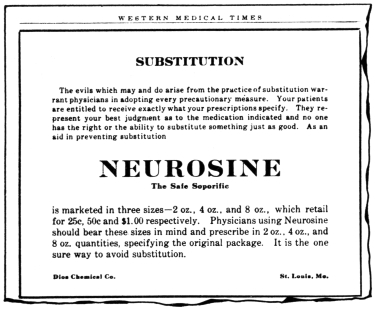
When the pharmacist puts up an ordinary, nonproprietary prescription, the patient gets no clue from the package as to the nature of the prescription employed. But when an original bottle of Neurosine is dispensed, even though the pharmacist puts his own prescription label on it, the patient sees the difference at once and knows just why the usual prescription bottle was not employed. He also knows that he can get the medicine with its original wrapper or label by merely showing the bottle to the druggist, for the words “Neurosine” and “Dios Chemical Co.” are blown in the glass. Here, then, may be a plausible reason for desiring that only original bottles be dispensed.
You may ask, “What difference does it make if the patient does learn the name of the nostrum, he must go to his physician for advice concerning its use?” Having learned the name of the remedy that has been prescribed for sleeplessness, let us say, he proceeds to use it whenever he imagines that he needs it; and that need, real or imaginary, has a way of increasing in frequency. As a result, the patient takes far more Neurosine than the physician would think of permitting if the matter had not passed entirely beyond his control.
Not only has the patient acquired a dangerous habit of self-prescribing, but he takes especial delight in recommending his favorite remedy to friends whose symptoms, real and imaginary, seem to resemble his own. This offers him an opportunity to prescribe with an air of authority. It was prescribed for him by Dr. Blank, and it gave relief, ergo it may be depended on to give relief to others! Thus is the basis laid for its general use by the laity, when this process is multiplied sufficiently. The statement is susceptible of easy proof by any one who cares to investigate the matter for himself. There is probably no physician worthy of the name who will attempt to deny that the promiscuous use of hypnotics and narcotics is dangerous, and certainly no careful physician will deliberately place a narcotic in the hands of patients to be used freely and without control.
Since we have selected Neurosine at random, so far as this particular discussion is concerned, it is worth while to inquire into its composition, the claims that have been made for it and the evidence, if any exists, for or against its therapeutic value. Even the most active of hypnotics are worse than useless if they are inferior to other readily available hypnotics, or if they have undesired side-actions that outweigh any advantages that they might otherwise have.
The Council on Pharmacy and Chemistry investigated the literature relating to Neurosine and published its report in The Journal, Jan. 9, 1915, p. 165. According to this report the manufacturers of Neurosine claimed that each fluidounce contained:
Bromid of potassium, C. P.40 grains
Bromid of sodium, C. P.40 grains
Bromid of ammonium, C. P.40 grains
Bromid of zinc 1 grain
Extract lupulin32 grains
Cascara sagrada, fl. ex.40 minims
Extract henbane 0.075 grain
Extract belladonna 0.075 grain
Extract cannabis indica 0.60 grain
Oil bitter almonds 0.60 grain
Aromatic elixir
This chemical blunderbuss was recommended for use in insomnia, hysteria, neurasthenia, migraine, neuralgia, delirium tremens, epilepsy and many other conditions. Also it was called an ideal calmative for children suffering from chorea, the exploiters claiming that “All authorities recommend the bromids, hyoscyamus and cannabis indica in this disease.” Oliver T. Osborne, professor of therapeutics in Yale Medical School, does not mention one of these three drugs in his discussion of the Medicinal Treatment of Chorea, in the Handbook of Therapy, though he quotes several authorities in this article. Indeed, he does not mention one of the ten drugs included in the above formula of Neurosine in connection with the treatment of this disease. It is a curious fact that Osborne gives the greatest prominence to the use of that drug which is claimed to be wanting in the formula of Neurosine, namely, hydrated chloral.
Perhaps you may have seen temporary relief follow the administration of Neurosine in chorea, and may argue that theorizing is of little value in the face of personal experience. We shall not deny that some may have had that experience, for Osborne calls attention to the fact that the success of any medicinal treatment must be judged in the light of the fact that chorea is self-limited, and the intensity of the symptoms will abate in from two to four weeks. In view of this, we would hardly dispute the claim that one may administer narcotics, such as those contained in Neurosine, and the symptoms of chorea may abate in spite of such mistreatment. In all the years that Neurosine has been exploited to physicians with such remarkable claims, we have never seen a report of a careful clinical study in which the product has been used under the conditions which scientific investigation demands. Would you prescribe any nonproprietary preparations which had never been studied clinically, if a horse-shoer or grocer’s boy told you it would cure epilepsy or malaria?
According to an editorial note appended to the report of the Council on Neurosine, the Dios Chemical Company consisted at that time (1915) of J. H. Chambers, his wife and two sons. It appeared that Chambers never claimed to have any special knowledge of chemistry, pharmacy or medicine, yet we find that he arrogated to himself or to his employees the right to offer therapeutic advice to the medical profession, and even to direct them as to how they should prescribe a given mixture.
We sometimes fail to see the forest because of the trees. It may help us to obtain a better perspective, in a problem that concerns us intimately, by resorting to a hypothetic case, if a close analogy is maintained. In order that we may see ourselves as others see us in such a situation, let us consider the following imaginary case: You become involved in a lawsuit in which an effort is made to deprive you of your property and your liberty. You seek what you had reason to believe was competent legal advice; but, nevertheless, you lose your case and find yourself deprived of your property and your liberty. Now let us suppose further that you discover, when too late to permit you to correct your mistake, that your legal adviser (we can hardly call such a man a lawyer) had been acting all along under the guidance of a plumber who made no pretense of knowing anything about law. How would you feel regarding that pretended lawyer? Would you feel that you had been treated fairly? Would you feel disposed to speak with all charity of him, to recommend him to those in need of legal advice?
You would probably feel toward such a lawyer as patients must feel toward physicians who prescribe proprietary nostrums based on information and advice offered by those who, though without any special knowledge of chemistry, pharmacy or medicine, will be benefited financially if their information and advice are accepted and acted on.—(From The Journal A. M. A., April 27, 1918.)
ANASARCIN ADVERTISING[L]
To the Editor:—As an old Fellow of the A. M. A. I beg to present the following facts to you, and to ask if anything can be done by you to expose the methods of these people: A concern calling itself “The Anasarcin Chem. Co.” of Winchester, Tenn., has caused to be sent to physicians a chart on the subject of “Diagnostics of Renal Diseases.” This chart contains eighteen plates, which were all taken without knowledge or permission of either myself or my publishers, William Wood & Co., from the third edition of my book on “Urinary Analysis and Diagnosis.” The plates are partly composite plates, but mostly portions of plates, exactly reproduced from my book. I at once caused my publishers to write to the Anasarcin Company; and a few days ago I received a letter from a Dr. H. Elliott Bates of 118 East Twenty-Eighth Street, New York, whose letterhead says, “Medical Advertising.” In this letter the writer says that it was he who suggested the sending of such a chart, and admits that all the plates were taken from my book. In this letter he offers to have a letter sent to every physician of the country “in which it is explicitly stated that the cuts on the chart were taken from your book, and that complete information regarding the matters treated on the chart can be found in your book.” In other words he offers to advertise my book free of cost to me, so that I should take no further steps in the matter. I consider this entire matter an outrage, and thought it best to write to you for advice, since my publishers seem to think that in spite of the violation of the copyright nothing can be done.
Besides the cuts, some of the text on the chart is bodily taken from my book, while some of the other text, not taken from my book, but apparently compiled from different articles, is in part entirely wrong, so much so that I must be ashamed of its being associated with any of my own work.
By giving this letter your early consideration, and advising me what you think it best for me to do, you would greatly oblige
Louis Heitzman, M.D., New York.
[Comment.—Readers of The Journal are, of course, familiar with the articles246 that have been published on “Anasarcin,” the “dropsy cure”! Knowing the standard of ethics that the Anasarcin concern adopts in the exploitation of its ridiculous squill mixture, our readers will not be surprised at the standard of commercial ethics which would justify the appropriation of copyrighted scientific material for nostrum advertising purposes. The statement of Dr. Heitzmann’s publishers that “in spite of a violation of copyright nothing can be done” is, of course, incorrect. Something can be done by those who hold the copyright.—Ed.]—(From The Journal A. M. A., Oct. 18, 1919.)
ANTIMERISTEM-SCHMIDT
Some, possibly many, of our readers have received a letter from Cologne, Germany, from the “Bakteriologisch-Chemisches Laboratorium Wolfgang Schmidt.” The letter contains a circular directing the attention of American physicians to “Antimeristem-Schmidt.” It also contains some advertising leaflets. One physician in sending this material to The Journal writes:
“A copy of the enclosed circulars has been sent to many of the physicians in this city, and probably elsewhere. Perhaps it has already been called to your attention. Let us be as liberal as possible with our recent enemies. The sooner the old channels of scientific communication are re-opened, the better. But let us not allow such blatant commercialism from a foreign country to go unprotested, any more than we should if it were from our own.”
It should be noted in passing that the envelop in which the Wolfgang Schmidt letter came has on its face a rubber-stamped impress to the effect: “Concerns Cancer Treatment.” The circular letter declares that by means of Antimeristem-Schmidt “either a cure or improvement has been effected in numerous inoperable cases” of malignant tumors. American physicians are asked “to employ the preparation when occasion arises” and are assured that “every medical man in city or country will be able to carry out treatment without preliminary knowledge.” With the letter are two leaflets discussing the use and administration of the product; one contained what was called a “Synopsis of some of the more recent publications regarding the employment of Antimeristem-Schmidt in inoperable malignant tumors.” The “recent” publications comprised three articles published in 1910 and one published in 1912!
Antimeristem-Schmidt was rather widely exploited some six or seven years ago. As was explained in The Journal, March 8, 1913, p. 766, it is a preparation claimed to be useful in the treatment of inoperable cancer and as a supplementary treatment after operations for cancer. The treatment is founded on a theory advanced by one O. Schmidt that the cause of cancer is found in a fungus, Mucor racemosus, which, Schmidt at first asserted, carried a protozoon which he regarded as the real cause of the disease. The vaccine is said to be prepared from cultures from this fungus. While Schmidt claims that he has been able to produce cancer by means of the organism, scientific research has not verified his claims. Extensive clinical trials have shown the treatment to be without effect. The Journal also advised its readers on April 19, 1913, that no license for the sale of Antimeristem-Schmidt had been granted by the Treasury Department and, therefore, its importation into this country was prohibited. Neither the therapeutic nor the legal status of the product has been changed since then.—(From The Journal A.M.A., Dec. 6, 1919.)
ANTIPHLOGISTINE
To the Editor:—Last September, my chief, Dr. J. S. Millard, received a letter from the Denver Chemical Mfg. Co., manufacturers of “Antiphlogistine.” This letter purported to quote many large commercial concerns as testifying to the value of Antiphlogistine. Recently, I doubted the veracity of these claims and wrote to some of those quoted. I quote from the original letter of the Antiphlogistine company:
“The surgeon to the electric light and electric railroad company in New Orleans says that Antiphlogistine is the finest thing he has ever used in burns, especially flash and brush burns.
“The physician to the New York Edison Co. makes a similar statement. He says that the application gives speedy relief and the burns heal quickly without scars.”
I wrote to Dr. John Woodman, the physician to the New York Edison Co., who replied in part as follows:
“The Denver Chemical Manufacturing Company have no authority to quote me.... I gave Antiphlogistine a thorough trial, and found it had a very limited use, and I cannot recommend it for burns....”
Again, the Antiphlogistine letter said:
“It may be of interest to you to know that at the emergency hospital of the Ford Automobile Co. in Detroit, Antiphlogistine is carried in stock and is used extensively by the three physicians in burns, bruises, infected wounds, sprains and other traumatic conditions which are constantly arising in such a plant....”
I wrote to Dr. Mead who replied as follows:
“In answer to your letter of January 25th, will state that no Antiphlogistine has been purchased or used in this hospital for years past, and I cannot imagine why the representative of the Denver Chemical Company should make such a statement as attributed to him....”
He adds that “Antiphlogistine has never been used” in his department “on an open wound, abrasion or burn.” Is there not some way that such exploitation of our large companies can be prevented?
A. G. Gould, M.D., Akron, Ohio. Plant Physician, the Goodyear Tire & Rubber Co.-(From the Journal A.M.A., Feb. 23, 1918.)
“AUTO-HEMIC SERUM”
A Cure for Laziness, Ugliness, Frigidity and Many Other Things
The following letters are typical of many that have been received asking for information regarding Dr. L. D. Rogers and his “Auto-Hemic Serum.” This from a physician in New York state:
“Can you give me any information in reference to Dr. Rogers of Chicago, Ill., who has an Auto-Hemic Institute?”
And this from Kansas:
“Just received a letter from a Dr. L. D. Rogers, 2812 North Clark St., who is anxious to sell me a course in ‘Auto-Hemic Therapy.’ Would you kindly inform me what he has to sell? He did not tell me what it consisted of; am inclined to believe it is a rank fake. Kindly let me know what The Journal thinks about it. Just what is it? In the letter they claim that it is practically a panacea for every blood disease.”
This from Maine:
“What is Auto-Hemic Therapy? I have a handsome red and yellow circular from the Ideal Life Extension Press, 2812 North Clark St., Chicago, soliciting subscriptions to their publication, offering as a bonus this book, ‘Auto-Hemic Therapy’ by L. D. Rogers, A.M., M.D., LL.D., Chicago, and membership in the American Medical Union.”
THE NATIONAL MEDICAL UNIVERSITY
In order better to appreciate the probable scientific status of “Auto-Hemic Serum,” it is well briefly to sketch some of the previous activities of its discoverer, Dr. L. D. Rogers. For many years Rogers was the head and chief owner of the National Medical University of Chicago, a low-grade school of the “sun-down” variety. The “university” is now out of existence and for some time before it went out of existence was not recognized either by the board of health of the state in which it operated or by the boards of the majority of the other states in the Union. The report of the Carnegie Foundation on medical education had this to say about the laboratory facilities of Rogers’ school: