Volume 1 / Part 1 — FOREWORD (continued 6)
Reading edition
IODEOL AND IODAGOL
Report of the Council on Pharmacy and Chemistry
Iodeol and Iodagol (formerly called Iodargol) are products of Viel and Company, Rennes, France, widely advertised in this country by David B. Levy, Incorporated, New York. The claim made for both preparations is that they depend on “colloidal iodin” for their action. They are put up in a number of forms, for instance:
“Iodeol Ampoules each containing 1 c.c. (20 centigrammes colloidal iodin in an oily vehicle).”
“Iodeol External, containing 50 per cent. colloidal iodine.”
“Iodagol Ampoules, each containing 2 c.c. (50 centigrammes colloidal iodine in an oily vehicle).”
The claim is, that, the iodin being in the colloidal state, it has the properties of elementary iodin and thus the preparations may be used in concentrations and under conditions which would make the use of free iodin impossible. The products have been extensively and extravagantly advertised for use in a wide range of conditions. Thus Iodeol has been proposed in the treatment of:
“Pulmonary Tuberculosis” “Laryngeal Tuberculosis,” “Glandular Tuberculosis” “Tuberculosis of the Bones” “Pneumonia, Broncho-pneumonia, and Congestive Conditions” “Whooping Cough, Influenza, Asthma” “Typhoid Fever” “Syphilis” “Obesity.”
Iodagol, which is for external use, has been advised in the treatment of:
“Gonorrhea and its Sequelæ” “Cystitis” “Tetanus” “Wounds complicated by gaseous gangrene” “Burns” “Old Suppurations, ulcers, abscesses, etc.” “Articular rheumatism” “Abscess Alveolar” “Pyorrhea Alveolaris” “Stomatitis (Canker-Sores).”
Nearly two years ago the American agents requested the Council to consider Iodeol and Iodagol for admission to New and Nonofficial Remedies. The information submitted in regard to their character and composition was vague and indefinite, the pharmacologic information practically nil and the clinical data as voluminous as it was unconvincing.
On the basis of chemical, pharmacologic, bacteriologic and clinical investigation carried out under the direction of the referee and a study of the submitted evidence, the referee reported:
1. Iodeol and Iodagol do not contain the amount of iodin claimed.
2. The iodin is not present as elementary iodin, but instead the preparations behave similarly to the well-known organic iodin compounds such as iodized fats.
3. The therapeutic claims made for the preparations are exaggerated and unwarranted.
In view of his findings he recommended that Iodeol and Iodagol be declared inadmissible to New and Nonofficial Remedies for conflict with Rules 1 and 2 (misleading statements regarding composition and identification) and Rule 6 (unwarranted therapeutic claims). The Council adopted the recommendation of the referee, directing inclusion of the full report in the annual Council reports after submission to the manufacturer, and recommending publication of an abstract of this report in The Journal.
This report was brought to the attention of the American agent, David B. Levy, Inc., and through them to the French manufacturers, E. Viel and Company. The manufacturers have intimated that they will not file a reply to the report. The firm of David B. Levy, Inc., has decided to sever its connection with these products and to discontinue their sale.
W. A. Puckner, Secretary.
Summary of Referee’s Report
Iodeol and Iodagol were submitted to the Council nearly two years ago as “electro-colloidal iodine” and with the claim that they produced all the antiseptic and other effects of ordinary iodin without any of its side actions. The referee has done much work on the subject, conducted a large amount of correspondence and has contended with long delays. He feels that the consideration of these products should be brought to a conclusion and accordingly he submits this report of their consideration. The following is a summary of the report, which is appended:
I. Discrepancy in Iodin Percentage.—The examination at the Chemical Laboratory of the American Medical Association, as well as that of the referee, shows that the various samples of Iodeol and Iodagol examined contained a little less than one-half of the total iodin claimed. These facts were reported to the American agent. After a lengthy delay a reply was received which presented a double excuse: (1) that the full amount of iodin had been added, whatever had become of it later; (2) that the claims were made for “colloidal iodin” and that this is not elementary iodin in the colloidal state, but a preparation of iodin containing only 50 per cent. of real iodin. Neither explanation can be taken seriously, as they are obvious quibblings. The referee concludes that the preparations are falsely labeled as to iodin content.
II. Nature of the Iodin Compound in Iodeol and Iodagol.—In the information sent the Council, Iodeol and Iodagol were defined as “A suspension of electro-chemical colloidal iodin in a vehicle of purified oil.” Numerous inquiries have failed to elicit more specific information from the manufacturer or his agent. The statement of composition can mean only that the preparations contain free iodin (but in colloidal form) suspended in oil. No evidence to substantiate this claim has been submitted. (There is evidence that the preparations contain colloidal particles, but it does not indicate if this colloidal material is iodin, or a combination of iodin or indeed whether the colloidal component contains any iodin.) The recent statements of the agent seem to concede that what they call “electro-colloidal iodin” contains only about 50 per cent. of real iodin, in other words that it is not “colloidal iodin” at all, but a mixture or combination of iodin with some other unnamed substance. This, of course, is something very different.
Certain results reported from the American Medical Association’s Chemical Laboratory suggest that the so-called “colloidal iodin” of Iodeol may be a combination of iodin with a volatile oil. The investigations of the referee indicate that the iodin exists in a rather resistant form or combination behaving altogether differently from ordinary free iodin, and rather resembling the behavior of iodin substitution products, such as iodized fats or phenols. Briefly then the recent admissions of the agents indicate that Iodeol does not contain “colloidal iodin” in a chemical sense, and there are indications that it does contain its iodin in a rather firm (chemical) combination.
III. Chemical Properties of Iodeol.—From a study of different specimens of Iodeol, the referee concludes that fresh specimens contain no free iodin and that old ones contain small amounts as a result of decomposition. Iodeol has the solubility characteristics of fats and fat-like compounds. The examination, as a whole, shows that Iodeol contains a peculiar and rather resistant form or combination of iodin. There is nothing in the chemical data that suggests that it could act differently from ordinary iodin compounds, such as iodized fats. It would not act as ordinary iodin.
IV. Pharmacologic Data.—The pharmacologic statements which were submitted were loose and apparently meaningless or misleading. In reply to questions submitted by the referee, the manufacturer finally had some work done and submitted a report by Jean Laumonnier. The referee was unable to confirm some of this work, and as a whole it does not appear materially to elucidate the action of Iodeol. From a consideration of the submitted evidence, and as a result of his own work, the referee concludes that Iodeol does not behave like elementary iodin; it does not coagulate proteins and therefore is not irritant. It is presumably absorbed, but quite probably after chemical change; it is changed into iodid and, like organic iodids, is excreted somewhat more slowly than when inorganic iodids are administered, but the difference does not appear important.
V. Antiseptic and Bactericidal Action.—Elementary iodin is considered a fairly powerful agent in these respects. The activity is presumably due to changes in the proteins, etc., of the bacteria, analogous to the effects which produce pain, irritation and necrosis of the tissue cells. Since the latter effect is not produced by Iodeol, it seems highly improbable, if not impossible, that it should act on bacteria like elementary iodin. It is entirely unjustifiable to credit the known antibacterial qualities of ordinary iodin to “colloid” iodin. This misrepresentation is especially prominent in the circular “Notable New Therapeutic Agents,” as will be seen, for instance, from the following citations:
“Iodine has long been universally recognized as an antiseptic of extraordinary potency. Not only is it rapid and certain in its germ-destroying action, but it also possesses an attribute denied many other antiseptic agents, namely, the power to penetrate and impregnate the tissues. Other antiseptics, as is well known, act on the surface epithelium only.”
“According to Kinnaman (J. A. M. A., Aug. 26, 1905), iodine is far superior to bichloride of mercury, a two per cent. solution killing streptococcus pyogenes in two minutes. Iodine does not coagulate albumin, and is very penetrating.”
The citations imply that this “colloidal iodin” of Iodeol and Iodagol acts as an antiseptic like ordinary iodin, except that it is claimed to be more efficient by “diffusing” more readily. This is entirely unjustified and misleading. If Iodeol and Iodagol are really antiseptic, they must act by some other mechanism than that through which elementary iodin acts, and such antiseptic action would have to be demonstrated by direct observation and not assumed from the known action of free iodin.
Antiseptic and bactericidal effects are easily estimated by laboratory methods. Yet no evidence on this point appeared to have been available until the Council called for this. Laumonnier then carried out some experiments which were in turn submitted to bacteriologic control. The bacteriologist failed to obtain any results with some of the tests, and considered the other data of little value.
The claim that Iodeol and Iodagol have the antiseptic and bactericidal action of free iodin lacks proof and must be considered unwarranted and misleading in the extreme.
VI. Clinical Trials.—The manufacturers and agents of Iodeol presented many letters from physicians; but few, if any, of these gave evidence of careful, critical, controlled observations. They could not, therefore, be considered as acceptable evidence. The more important claims, letters and published papers, however, were submitted to clinical specialists collaborating with the Council, with the request that they examine these and conduct some clinical trials, if they considered it advisable. The results obtained in these preliminary trials did not appear sufficient to warrant further experimentation.
From a consideration of the evidence presented, the referee concludes that the claims made for Iodeol and Iodagol are unwarranted, exaggerated and misleading. He recommends that Iodeol and Iodagol be declared ineligible for New and Nonofficial Remedies for conflict with Rules 1 and 2 (misleading statements as to composition and identification) and with Rule 6 (unwarranted and misleading therapeutic claims). He further recommends that the Council authorize publication of the preceding summary of the consideration of Iodeol and Iodagol in The Journal and inclusion of the full report in the annual Council reports after submission to the manufacturer.—(From The Journal A. M. A., Nov. 17, 1917.)
CAPSULES BISMUTH RESORCINOL COMPOUND NOT ADMITTED TO N. N. R.
Report of the Council on Pharmacy and Chemistry
In response to inquiries received, the Council took up the consideration of Capsules Bismuth Resorcinol Compound (The Gross Drug Company, Inc., New York City). The label, sent by the Gross Drug Company, bore the following:
Capsules
Bismuth Resorcinol Compound
Bismuth Subgallate2 grs.
Resorcinol1 gr.
Beta Naphthol 1⁄2 gr.
Creosote (Beechwood)1 m.
This combination is of acknowledged value in reducing the intestinal putrefaction and fermentation, allaying the pain and discomfort of flatulent conditions in the intestinal tract.
Dose.—One or two capsules before or after meals repeated in two hours if necessary.
The Gross Drug Company, Inc. 20 Laight Street, New York
The Council held this preparation inadmissible to New and Nonofficial Remedies or the Appendix, because (1) the claim “acknowledged value in reducing the intestinal putrefaction and fermentation, allaying the pain and discomfort of flatulent conditions in the intestinal tract” is an unwarranted, exaggerated and misleading claim of therapeutic value (Rule 6); because (2) the name does not indicate the identity of the bismuth salt contained in the capsules, nor declare the presence of betanaphthol and creosote (Rule 8); and because (3) the combination of bismuth subgallate, resorcinol, betanaphthol and creosote in fixed proportions is irrational (Rule 10).—(From Reports of Council on Pharmacy and Chemistry, 1917, p. 139.)
DIXON’S TUBERCLE BACILLI EXTRACT AND DIXON’S SUSPENSION OF DEAD TUBERCLE BACILLI
Report of the Council on Pharmacy and Chemistry
New and Nonofficial Remedies, 1917, contains general descriptions of Dixon’s Tubercle Bacilli Extract and Dixon’s Suspension of Dead Tubercle Bacilli; the products of these manufactured by the H. M. Alexander Company being listed as dosage forms. It having become necessary to omit the preparations of the Alexander Company (see page 158) the referee recommended that the general articles of “Dixon’s Tubercle Bacilli Extract” and “Dixon’s Suspension of Dead Tubercle Bacilli” also be omitted. He reported that no other firm appears to be marketing these products and that they had not been shown to be of special value.
The Council accepted the recommendation and directed the omission as proposed. In accordance with the procedure of the Council, these have been transferred to the annual Council Reports for reference and appear below.
W. A. Puckner, Secretary.
Dixon’s Tubercle Bacilli Extract.—An extract of tubercle bacilli dissolved in normal saline solution. (See “Fluid of Dixon,” Medical News, Jan. 17, 1891.)
Dixon’s Suspension of Dead Tubercle Bacilli.—A suspension in physiologic salt solution of dead tubercle bacilli which have been defatted by prolonged treatment with alcohol and ether. (See “Possibility of Establishing Tolerance for Tubercle Bacilli,” Medical News, Oct. 19, 1889.)—(From Reports of Council on Pharmacy and Chemistry, 1917, p. 140.)
FORMOSOL
Report of the Council on Pharmacy and Chemistry
Sunshine’s Formosol (The Formosol Chemical Company, formerly the Sunshine Chemical Company, Cleveland, Ohio) is claimed to contain 18 per cent. formaldehyd in a solution of soap. It is therefore very similar to Veroform Germicide which was deleted from New and Nonofficial Remedies because of the low phenol coefficient reported by the Hygienic Laboratory of the United States Public Health Service (The Journal, Nov. 22, 1913, p. 1920.) The Council voted that in view of the Hygienic Laboratory’s finding that formaldehyd has a low germicidal value, the manufacturers of Formosol be required to produce definite evidence of the degree of germicidal value for this product.
In submitting the preparation to the Council, it was claimed that Formosol had “all properties peculiar to Formaldehyde.” This conservative tone was, however, not maintained in the form-letters submitted. These contain the following unwarranted statements:
“As the name implies, FORMOSOL is a formaldehyde preparation, which embodies all the innate antiseptic merits and eliminates all the ill features of the world’s greatest disinfectant.”
“The elimination of all the destructive elements and the incorporation of all the established therapeutic virtues of formaldehyde, have been scientifically blended in FORMOSOL.”
“Formosol is unique in the sphere of antisepsis because of its peculiar healing properties as diametrically opposed to irritation to the tissue of mucous membrane.”
“Formosol may be used for the thousand niceties of modern antisepsis, but is specific in Gynecology and Obstetrics and is indicated in Dermatology.” [Italics not in original.]
“The constant use of FORMOSOL is to develop a habit sympathetic to ethics.”
“To prescribe FORMOSOL is a great step toward Personal Hygiene, a duty of the medical fraternity to the laity.” [Italics not in original.]
The trade package recommends the use of Formosol “for cuts, wounds, ulcers, abscesses ...” This is a conflict with Rule 4. The Council held Formosol in conflict with Rules 4 and 6, and advised the manufacturers that Formosol is refused admission to New and Nonofficial Remedies until they submit evidence establishing the degree of antiseptic and germicidal efficiency, and justify the quotations listed above; or until these and any other existing conflicts with the Rules have been removed.
After submission of this report to The Formosol Chemical Company the Council authorized its publication.—(From Reports of Council on Pharmacy and Chemistry, 1917, p. 145.)
IODOLENE, A SOLUTION OF IODIN IN LIQUID PETROLATUM, INADMISSIBLE TO N. N. R.
Report of the Council on Pharmacy and Chemistry
The Council was asked to consider a solution of iodin in liquid petrolatum, said to be prepared from Gulf Coast petroleum by a special process. It was to be marketed as “Iodolen” provided the Council found the preparation admissible to New and Nonofficial Remedies. The preparation was claimed to contain over 1.5 per cent. free iodin. The following claims were made:
“It is less irritating in its use on the skin, or in wounds.” “Will kill pathogenic micro-organisms present.” “Is a suitable medium for cell proliferation.” “Will penetrate a useful distance into the walls of a wound.” “Facilitates an easier, less painful and better method of dressing wounds or ulcers.”
Examination in the American Medical Association Chemical Laboratory showed a submitted sample to contain 1.32 per cent. free iodin and to emit a strong odor of hydrogen sulphid. A specimen of liquid petrolatum, said to be composed chiefly of hydrocarbons of the naphthene series, after saturation with iodin at room temperature was found to contain 1.42 per cent. free iodin. Another specimen of liquid petrolatum, said to be composed chiefly of saturated hydrocarbons, after saturation at room temperature was found to contain 1.30 per cent. free iodin.
The preparation having been shown to be an unoriginal, simple solution of iodin in liquid petrolatum, the Council declared the name “Iodolene” unacceptable (Rule 8) and the therapeutic claims made for the preparation unwarranted (Rule 6).—(From Reports of Council on Pharmacy and Chemistry, 1917, p. 148.)
KALAK WATER
Report of the Council on Pharmacy and Chemistry
The following report, submitted by a member of the Council’s committee on chemistry, was endorsed by the committee and adopted by the Council:
Kalak Water, sold by the Kalak Water Company, Inc., New York, is an artificial mineral water said to be made by adding certain salts to carbonated, distilled water and supersaturating with the gas under pressure. Such merit as it may possess by virtue of sodium bicarbonate and sodium phosphate is quite insufficient to warrant the extravagant claims made in the advertising pamphlets.
According to the analysis furnished, the water contains, in 1,000,000 parts (milligrams per liter) the following:
Sodium carbonate4049.0
Sodium phosphate238.5
Sodium chloride806.3
Calcium carbonate578.2
Magnesium carbonate48.9
Potassium chloride47.9
Among the many misleading statements found in the advertising pamphlet bearing the title “A Brief for Physiological Alkalescence” these may be quoted:
“The calcium content of Kalak is over 100% greater than ever before placed in solution in any vehicle, a fact of supreme importance when the unique alkalinizing power of the alkaline salts of this metal is considered; the ratio of calcium metabolism to its enormous waste in pregnancy, the diseases of infancy and childhood and the rapidly growing group of ‘acidoses’ make its availability in Kalak of double value.”
The first part of this statement is untrue; the last part is muddled and without much meaning. Evidently the “acidosis” fad is to be overworked as was the old “uric acid diathesis,” of unsavory memory. Again this:
“One of the most important characteristics of Kalak is the close approximation of its formula to the correlation of the contained salts as they occur in the human body, together with its freedom from salts foreign to the human economy. Another is its almost unbelievable palatability, considering its high degree of alkalinity, it being eleven times greater than any other known mineral water, artificial or natural.”
These statements are false. The salts dissolved here bear no discernible relation to the needs of the body, as disclosed by the composition of the blood or solid tissues or as shown by the character of the urinary excretion. The last statement concerning the high alkalinity is neither clear nor accurate. Then, this warning and remedy:
“It seems to be an unappreciated fact that the degree of urinary acidity, checked with the acidity of the saliva, is in direct ratio to the existing acid toxemia, and a urine acid to methyl red should be the signal for immediate and adequate alkalinizing treatment....
“Startling clinical results have been observed by physicians who have used Kalak thoughtfully and sufficiently in the more serious types of acidosis associated with diabetes, nephritis, rheumatism, gout and the acute infections. There is also evidence of its good effect in acute alcoholism and the respiratory edemas; in fact a certain few have hailed Kalak as a possible solution of the annual hay fever problem. Of perhaps supreme importance, however, is the use of Kalak throughout pregnancy as preventive medicine against the inevitable ‘toxemia of pregnancy.’ ”
Also this:
“Kalak has accomplished certain unexplainable things for the diabetic and nephritic, and if, in future years, diabetes and nephritis should prove to be constitutional diseases, based upon functionation or its lack, Kalak therapy, the embodiment of physiological alkalescence may come into its own, for if acidity retards, alkalinity must normalize functionation.”
It is not necessary to quote further. In order to insure that everyone will recognize the great need of Kalak it is advised to test the urine for acidity by means of a group of indicator solutions sent out to the physicians. Methyl red is one of these and any urine showing an acid reaction with this is said to be open to suspicion. Paranitrophenol is another of the indicators and the explanations given of the behavior of the two and the conclusions to be drawn are questionable. The methyl red solution furnished is too concentrated for proper use and perfectly normal urines from normal individuals have given a rather marked color with it. This indicator gives some color at [H+] = 1.2 × 10⁻⁶ and a strong reaction at 3 × 10⁻³. To condemn a urine on such a finding is entirely unwarranted.
Sodium bicarbonate is the main constituent of the water. The value of the phosphate in such a combination, with so much calcium, is problematical. In case an alkaline reaction in the intestine is reached some of it would be left as insoluble phosphate. A few grams of bicarbonate daily would have equal therapeutic value with this water. The advice based on the indications of methyl red and the urine is bad.
The committee’s report was sent to the Kalak Water Company for comment. The company promised to withdraw the advertising circular referred to in the report and disclaimed responsibility for the accuracy and value of the set of indicators which it sent out, but, on the whole, the previous advertising claims were insisted on.
In view of the absurd and false claims made for the product the Council declared Kalak Water inadmissible to N. N. R.—(From Reports of Council on Pharmacy and Chemistry, 1917, p. 148.)
MINSON’S SOLUBLE IODIN “KELPIDINE” NOT ADMITTED TO N. N. R.
Report of the Council on Pharmacy and Chemistry
Minson’s Soluble Iodin “Kelpidine” was submitted to the Council by J. J. Minson, Washington, D. C., trading as the Kelpidine Company, with the statement that in future “literature” it was to be known as Minson’s Soluble Iodin, only. The following statement of composition was furnished:
“Minson’s Soluble Iodin is somewhat of an indefinite character, chemically. Its formula is, Iodin 4 per cent., Distilled Water 6 per cent., and Absolute Alcohol q. s. 100 per cent. By a process of chilling and heating an iodid of uncertain character is produced, and because of the extreme sensitiveness of the product to chemical tests, it is hard to determine. So far as I have been able to judge, however, the result is about 3 or 31⁄2 per cent. free iodin and from 1⁄2 per cent. to 1 per cent. iodid, possibly ethyl and hydrogen iodid in combination.”
The A. M. A. Chemical Laboratory reports that the preparation is an alcoholic solution containing free iodin and iodid, probably hydrogen iodid and ethyl iodid, but that the free iodin content was only 2.69 gm. per 100 c.c.
It is claimed that the “therapeutic indications” of Minson’s Soluble Iodin are the “same as those of all iodin and iodid preparations, internally, externally, hypodermically and intravenously; excepting, however, counter irritation.” It is admitted that there are no “clinical reports” as to the hypodermic and intravenous use, but the belief is expressed “that in an emergency it is a safe remedy under proper dilution.” It is further claimed that “for all practical purposes it is nontoxic and nonirritating” and that “it has none of the undesirable features such as is the case with the iodids and the organic preparations of iodin, proprietary or otherwise.”
It was assigned for consideration to the Committee on Pharmacology, whose referee reported:
“According to the information submitted, this is a tincture of iodin; differing from the official tincture in that it is more dilute and in that hydrogen and ethyl iodid is the solvent in place of potassium iodid. It is practically immaterial for internal administration, whether the cation of the solvent iodid is hydrogen, ethyl, potassium or sodium. It would certainly be inadvisable to inject a preparation containing free iodin hypodermically. It is not ‘a safe remedy’ for intravenous injection and it would not be nonirritant. The statement that ‘it has none of the undesirable features’ of other iodin compounds is inherently impossible. Apparent freedom of any iodin preparation from undesirable effects is generally due to the use of small doses. Such claims are plainly therapeutic exaggerations and therefore in conflict with Rule 6. Even should these be removed, the preparation must be held an unessential modification of the official tincture, and therefore in conflict with Rule 10.”
The report was agreed to by the committee and adopted by the Council and Minson’s Soluble Iodin “Kelpidine” declared inadmissible to New and Nonofficial Remedies.—(From Reports of Council on Pharmacy and Chemistry, 1917, p. 152.)
NUTONE
Report of the Council on Pharmacy and Chemistry
NuTone (NuTone Company, Lowell, Mass.) is a “nutritive tonic” said to have the following complex composition:
Cod Liver Oil, Pure Norwegian, 25 per cent. Malt Extract, 91⁄3 per cent. Beef juice, Glycerine, Hypophosphite Lime, Hypophosphite Soda, Chemically pure, 11⁄2 grs. each to the oz. Fl. Ext. Nux Vomica, 3⁄64 of a minim in each teaspoonful.
It is advertised with claims that will lead thoughtless physicians and a confiding public to depend on it in cases in which fresh air, hygienic surroundings and nutritious food are of prime importance.
A sample package (the phrase “as recommended by your physician” and other statements suggest that it is expected to be given the patient by the physician and thus effectively advertise NuTone to the public) describes NuTone as an “Agreeable Concentrated Nutritive Tonic Emulsion of Malt Extract, Beef Juice and Cod Liver Oil, Combined with Nerve Tonics and Bone Nutrients.” Emphasizing the nutritive value of this “Malt Extract, Beef Juice, and Cod Liver Oil” preparation, it is advised, “As NuTone is rich in nutritive properties, it is well to begin with one-fourth teaspoonful, gradually increasing to regular dose, which is: Adults, 1 to 2 teaspoonfuls after meals and at bedtime. Children according to age.” It thus appears that adults are to take this preparation as a “nutritive” in doses which represent from 3 to 12 grains of sugar (on the assumption that malt extract may contain as much as 50 per cent. sugar) and 8 to 30 minims of cod liver oil with unstated, but probably equally small, amounts of beef juice.
A consideration of the negligible food value of NuTone as well as of the inefficiency of the other components and the claim that it is indicated in “malnutrition,” “wasting diseases” and “incipient phthisis” classes NuTone with that large group of shotgun mixtures which do harm in that dependence is placed on them in conditions in which the patient will probably be restored to health if proper medical and hygienic measures are adopted in time.
The Council declared NuTone inadmissible to New and Nonofficial Remedies because it is an irrational shotgun mixture advertised indirectly to the public with unwarranted therapeutic claims and a nondescriptive therapeutically suggestive name.—(From Reports of Council on Pharmacy and Chemistry, 1917, p. 154.)
TRI-ARSENOLE, L. O. COMPOUND NO. 1 AND L. O. COMPOUND NO. 2
Report of the Council on Pharmacy and Chemistry
Tri-Arsenole.—According to the advertising of the Medical Supply Company of Atlanta, Ga., “Tri-Arsenole” is “Merco-Arseno-Benzo-Chloride,” and the claim is made:
“This compound is the result of many years’ research. The toxicity has been fully tested upon animals before using clinically, the latter having proven such complete success, we take pleasure in presenting it to the public ...”
“The manufacturers of TRI-ARSENOL, before placing it upon the market, tested it biologically.”
Tri-Arsenole is “recommended and suitable for the treatment of primary, secondary, tertiary and hereditary syphilis. It has also been found very useful in pellagra and malaria.” The preparation is supplied in ampules containing varying amounts of the dry substance. It is to be dissolved in water and is to be administered intravenously. In the advertising attention is called to the yellow color of Tri-Arsenole; this, and the style of package suggest that it is a preparation similar to salvarsan.
In reply to a request sent the Medical Supply Company for the quantitative composition and chemical formula of the compound “Merco-Arseno-Benzo-Chloride” and for the details of the biologic test by which its toxicity is claimed to have been determined and evidence for its efficiency, the following statement was received:
“Tri-Arsenole No. 1 equals to each Ampoule,gr.
Sodium chlorid41⁄2
Hydrarg chlor.-cor. 1⁄4
Arsenous acid 1⁄4
Sodium benzoate4
Hydrastin (resinoid)2
Tri-Arsenole No. 2 equals to each Ampoule,
Sodium chlorid4
Hydrarg chlor.-cor. 1⁄2
Arsenous acid 1⁄2
Sodium benzoate4
Hydrastin (resinoid)2
Tri-Arsenole No. 3 equals to each Ampoule,
Sodium chlorid31⁄2
Hydrarg chlor.-cor. 3⁄4
Arsenous acid 3⁄4
Sodium benzoate4
Hydrastin (resinoid)2
Tri-Arsenole No. 4 equals to each Ampoule,
Sodium chlorid3
Hydrarg chlor.-cor.1
Arsenous acid1
Sodium benzoate4
Hydrastin (resinoid)2
The request for information regarding the animal experiments said to have determined the toxicity was ignored, nor were references supplied to clinical reports demonstrating the value of the product.
The Council declared Tri-Arsenole inadmissible to New and Nonofficial Remedies because of conflict with the rules as follows:
In the absence of details of the method used, the claim that the preparation has been tested biologically is in conflict with Rule 2, which requires that for preparations claimed to be physiologically standardized the method of testing must be published so as to permit of control by independent investigators.
The claims that “Merco-Arseno-Benzo-Chloride” is “the result of many years research,” that its “toxicity has been fully tested upon animals before using clinically” and that clinical use has “proven such complete success” have not been substantiated by evidence and must be held as unwarranted.
The name is in conflict with Rule 8, which requires that pharmaceutical mixtures shall bear names descriptive of their composition. Further, the name “Tri-Arsenole” by its similarity to Diarsenol, the Canadian brand of arseno-phenolamin hydrochlorid, suggests that this pharmaceutical mixture is a chemical compound similar to salvarsan. Moreover, the danger of confusion is increased by the addition of the hydrastis preparation which imparts a yellow color like that of salvarsan to the solution obtained when the colorless mercury and arsenic compounds of the mixture are dissolved. Again, the synonym “Merco-Arseno-Benzo-Chloride” conveys the false impression that Tri-Arsenole is a definite chemical compound.
The label does not declare the poisonous constituents claimed to be contained in the mixture; namely, “arsenous acid” and corrosive mercuric chlorid (Rule 7).
There is no evidence that arsenous acid (arsenic trioxid) used intravenously is efficient and safe as a spirocheticide, and the administration of this drug in conjunction with mercuric chlorid in fixed proportion is irrational and dangerous—particularly so because of the implied similarity of Tri-Arsenole to arsenphenolamin hydrochlorid (Salvarsan, Diarsenol) (Rule 10).
L. O. Compound No. 1 and L. O. Compound No. 2.—In submitting these preparations to the Council, the Medical Supply Company stated that “No. 1” was “composed of the following ingredients; chloral, camphor, menthol, iodin, and oil of gaultheria, incorporated in a fatty base. Each ounce contains fifteen grains of chloral hydrate, nine grains of resublimed iodine.” “No. 2” was said to have the same composition as “No. 1” except that the oil of gaultheria had been omitted. The Medical Supply Company was informed that the rules of the Council required declaration of the amounts of each therapeutic constituent of pharmaceutical mixtures and that, therefore, in addition to the information furnished the amounts of camphor, menthol and oil of gaultheria should be given for “No. 1” and the amount of camphor and menthol for “No. 2.” The following reply was received:
“L. O. Compound No. 1 equals to each Tube,
Chloral hydrategr. 15
Camphorgr. 22
Mentholgr. 71⁄2
Iodin (resublime)gr. 32⁄3
Oil of gaultheriam. 3
Petrolatum, q. s.oz. 1
L. O. Compound No. 2,
The same as above formula for L. O. C. No. 1, except the oil of gaultheria which is omitted.”
It should be noted that when the preparations were submitted each ounce of the preparation was claimed to contain 9 grains of iodin, while in the subsequent letter the company declares that they contain only 32⁄3 grains to the ounce. If it be assumed that the unit intended is the avoirdupois ounce, the preparation should contain 2.06 per cent. of iodin according to the first statement and 0.84 per cent. of iodin according to the second statement. While the dark color of the preparations suggested the presence of appreciable amounts of free iodin, the A. M. A. Chemical Laboratory reported that an examination of the specimens submitted by the Medical Supply Company showed that “No. 1” and “No. 2” each contained but 0.033 per cent. of free iodin; hence both preparations are in conflict with Rule 1.
For both preparations the labels suggest their use for the treatment of “septic wounds, burns, pustular processes of all varieties, and especially bronchial troubles.” This constitutes a conflict with Rule 4. Regarding No. 1 the advertising circular included with the trade package asserts:
“Its merits have been practically demonstrated in the following conditions. We invite your especial attention to its use in diseases of the thoracic cavity, especially Bronchitis and Pneumonia, Rheumatism, Lumbago, Migraine, Neuralgia, Orchitis, Balanitis, enlarged glands or any disturbance of the lymphatic system, anti-galactagogue, or wherever analgesic action is required.”
“No. 2” is said to be especially adapted to the needs of the surgeon, it “can be applied in any wound either aseptic or infected.” It is asserted that the usual method of preparing patients for operation may be discarded and that patients may be operated on after application of this ointment:
“... We have no other preparation to-day which serves the purpose of L. O. Compound in operative and post operative treatment.
“It is a powerful antiseptic and germicide combining anesthetic, analgesic and alterative properties.”
After attempting to discredit the approved methods of preparing the field for surgical operations, the advertising circular continues:
“Method of today: A liberal amount of L. O. Compound No. 2 is applied to the intended area of operation, massage thoroughly until absorption is complete. Patient is ready for operation ...”
Both products are in conflict with Rule 6. Further, as the names of these pharmaceutical mixtures are not descriptive of their composition, they also conflict with Rule 8.
The use of complex mixtures such as these is irrational and leads to misplaced confidence on the part of the physician; particularly when, as in this case, neither the label nor the advertising matter gives the necessary information regarding the composition of the preparations further than that, in accordance with the requirements of the Federal Food and Drugs Act, the amount of chloral is declared (Rule 10).
The Council declared L. O. Compound No. 1 and L. O. Compound No. 2 inadmissible to New and Nonofficial Remedies for conflict with Rules 1, 4, 6, 8 and 10.
The Council’s consideration of Tri-Arsenole, L. O. Compound No. 1 and L. O. Compound No. 2 was based on information received from the Medical Supply Company, the correspondence being signed “Medical Supply Co., per Dr. H. E. Pontius.” The findings having been sent to the Medical Supply Company, the following reply was received:
(June 27, 1917) “Replying to your registered letter of this A. M. relative to the Medical Supply Company’s products, will state that the party furnishing you with such information as you have in hand was misinformed. He is no longer with this company and whereabouts unknown.
Respectfully,
Medical Supply Company, (Signed) W. B. Lingo, President.”
The Medical Supply Company then was asked to point out any statements occurring in the report, as submitted, which the company considered to be inaccurate; but no reply has been received to this request. The advertising sent out by the Medical Supply Company during the last part of August contained essentially the same statements and claims as those to which reference is made in the preceding report. A qualitative examination of Tri-Arsenole made in the A. M. A. Chemical Laboratory indicated the presence of sodium, mercury, arsenic, chlorid, benzoate and a hydrastis preparation. Quantitative determinations were not made as there was no guarantee that an analysis of the present supply would indicate the composition of that marketed later on.
In view of the statement of the president of the company, that the information submitted in the letters from the Medical Supply Company was inaccurate, Tri-Arsenole and L. O. Compound must definitely be placed with preparations, the composition of which is not divulged by their owners; hence Tri-Arsenole as well as L. O. Compound No. 1 and L. O. Compound No. 2 are in conflict with Rule 1.—(From Reports of Council on Pharmacy and Chemistry, 1917, p. 156.)
UNCTOL
Report of the Council on Pharmacy and Chemistry
Unctol, sold by the R. R. Rogers Chemical Company, San Francisco, is a paste stated to contain approximately 40 per cent. of metallic mercury in a soap base. It is claimed that a part of the mercury is “precipitated mercury” and a part “mechanically comminuted mercury.” Unctol is sold as a substitute for mercurial ointment and is to be rubbed into the skin with the aid of water. The claim is made for Unctol that “It is more active than blue ointment because the mercury in it (40 per cent.) is more finely divided and the lathering still further subdivides the mercury particles and hence promotes absorption.”
No evidence was presented to the Council in support of the claimed superior efficacy of mercury soap paste over the official mercurial ointment. On the other hand, a consultant of the Council who has studied the absorption of mercury and mercury compounds, when applied to the skin, reported that he had used mercury preparations in which soap was the base, and that in his opinion Unctol could have no advantage over the official mercurial ointment from the standpoint of therapeutic effect. Moreover, the Council is advised that some trials with Unctol at the skin clinic of Leland Stanford University Junior School of Medicine did not confirm the claim that Unctol is more active than mercurial ointment.
The Council declared Unctol inadmissible to New and Nonofficial Remedies because: 1. The claim of superiority over mercurial ointment is not substantiated, and constitutes an unwarranted therapeutic claim (Rule 6). 2. The name does not indicate the composition of this pharmaceutical mixture (Rule 8). 3. The circular wrapped with the trade package advertises proprietary preparations not accepted by the Council (Rule 4).—(From Reports of Council on Pharmacy and Chemistry, 1917, p. 162.)
V-E-M (SCHOONMAKER LABORATORIES, INC.)
Report of the Council on Pharmacy and Chemistry
Because of inquiry received, the Schoonmaker Laboratories, Inc., New York, were requested to submit information in regard to the “V-E-M” products.
According to information received, these products have the following composition:
V-E-M Unguentum Eucalyptol Compound
Menthol 5 grs.
Eucalyptol (Sander’s)15 gtts.
White Vaseline 1 oz.
V-E-M with Ichthyol
Menthol 21⁄2 grs.
Eucalyptol (Sander’s)15 gtts.
Ichthyol10 grs.
White Vaseline 1 oz.
V-E-M with Stearate of Zinc
Menthol 21⁄2 grs.
Eucalyptol (Sander’s)15 gtts.
Stearate of Zinc 1 drm.
White Vaseline 1 oz.
V-E-M with Camphor
Camphor15 grs.
Eucalyptol (Sander’s)15 gtts.
White Vaseline 1 oz.
V-E-M with Boric Acid
Pulv. Boric Acid 1⁄2 drm.
Eucalyptol (Sander’s)15 gtts.
White Vaseline 1 oz.
In an advertising circular this claim is made:
“V-E-M Unguentum Eucalyptol Compound Combining, in well-balanced proportions, the cooling, soothing and healing virtues of Menthol with the antiseptic and deodorizing properties of Eucalyptol, in a base of pure, neutral white Vaseline. Furnished in five formulas as follows:
“V-E-M Unguentum Eucalyptol Compound: Menthol, Eucalyptol (Sander’s), White Vaseline.
“V-E-M with Ichthyol: Menthol, Eucalyptol (Sander’s), Ichthyol, White Vaseline.
“V-E-M with Stearate of Zinc: Menthol, Eucalyptol (Sander’s), Stearate of Zinc, White Vaseline.
“V-E-M with Camphor: Camphor, Eucalyptol (Sander’s), White Vaseline.
“V-E-M with Boric Acid: Pulv. Boric Acid, Eucalyptol (Sander’s), White Vaseline.
“For local application in the treatment of affections of the nose and throat.
“The efficacy of these combinations of remedial agents is so well established as to preclude the necessity of more than passing mention. What is obvious is that in acute coryza, in chronic and acute nasal catarrh, in dry catarrhal conditions especially, in both forms of chronic rhinitis—atrophic and hypertrophic—in the latter stages of the prevailing grippe colds, and even in hay fever, V-E-M Unguentum Eucalyptol Compound affords pronounced relief and proves a most grateful application....”
Though the identity and purity of eucalyptol are provided for by the standards of the U. S. Pharmacopeia, the claim is made that the product contained in these preparations “transcends in purity and efficiency all other brands.”
A package of V-E-M Unguentum Eucalyptol Compound, recently sent to a physician, contains the following:
“If your head is all stuffed up to-night, or you feel a cold coming on, use V-E-M just before going to bed. It will break up the cold, and you’ll wake up in the morning, with your head clear and feeling fine all over.
“If you suffer with chronic or acute catarrh, use V-E-M regularly night and morning. You’ll be agreeably surprised at the relief it will give you in a short time.
“There is nothing quicker, nothing surer to alleviate rhinitis, grippe-colds, or hay fever.
“In a word—V-E-M is the best antiseptic ointment for all diseased conditions of the nose....”
The Council declared these preparations in conflict with its rules because unwarranted therapeutic claims were made for them (Rule 6); because the public was advised to depend on them in the treatment of diseases (Rule 4), and because these combinations of ingredients, in fixed proportions, under proprietary names, are irrational (Rules 8 and 10).—(From Reports of Council on Pharmacy and Chemistry, 1917, p. 163.)
HEMO-THERAPIN
Report of the Council on Pharmacy and Chemistry
The following report on Hemo-Therapin has been adopted by the Council, and its publication authorized.
W. A. Puckner, Secretary.
According to the Hemo-Therapin Laboratories of New York City:
“Hemo-Therapin is a combination of highly refined creosols and phenols (which have been detoxicated by special processes) with salts of iron, potassium, sodium, phosphorus and calcium in minute but physiologic proportions—the solution as a whole being designed to approximately closely in various fundamental details the chemistry of the blood.”
No statement is made as to the quantities of the several ingredients, nor is any information given as to the identity of the “creosols” and “phenols,” nor the nature of the processes whereby these are “detoxicated.” It is further claimed that it is:
“... The composite character of Hemo-Therapin, the relative proportion and balance of its several ingredients, and the action of the compound as a whole, to which its potency is due.”
And it is suggested that:
“It will be apparent that the ingredients which enter into the composition of Hemo-Therapin, a remedy used intravenously exclusively, have been selected with the utmost care with the object of assuring not only maximum therapeutic potency but also absolute safety and freedom from all dangers of toxic or other unpleasant or harmful action.” [Italics in the original.]
The advertising does not explain, however, why the complex preparation should be therapeutically efficient or why the intravenous administration of this mixture should be absolutely safe and free from toxic or harmful action. Of the origin of Hemo-Therapin it is said:
“For many years Dr. E. B. Witte, a prominent physician of Trenton, N. J. [apparently owner of the Hemo-Therapin Laboratories] has devoted himself to the study of the blood. As a result of his researches, he early determined that when the blood is close to normal standards, the body is well nourished, the natural waste products are properly eliminated, an effective resistance is offered to the invasion of pathogenic bacteria, and the various functions of the body are kept normally active. But when, for one reason or another, the blood falls away from normal standards, the nutrition of the body suffers, the elimination of waste products is impaired, the resistance to germ attack is weakened, and the various functions of the body become sadly deranged and perverted. In other words, instead of the physiologic processes of the body being normally active, as soon as the blood is depreciated, they become depressed or deranged, with a loss of the physiologic harmony or equilibrium that constitutes a state of health.
“Recognizing the relation of clinical conditions to these various phenomena, Dr. Witte reached the conclusion that the correction of many aberrant or diseased conditions depended on restoring the blood to as near to its normal state as possible. He accordingly applied himself especially to investigation of the chemistry of the blood, with the object of evolving a substance in liquid form that would so closely approximate normal blood in its essential chemical characteristics that when introduced into the circulation it would bring the blood nearer to the condition in which it exists in health.”
After the usual “many years of hard painstaking labor,” Dr. Witte elaborated a “fluid meeting the foregoing conditions” and now the Hemo-Therapin Laboratories inform us that 5 to 10 c.c. of this synthetic blood administered once in one, two or three days in “acute affection” and at longer intervals in “chronic ills”—once a week is said to be usually sufficient—will restore blood to a normality and empower it to overcome most ills. While disclaiming that “Hemo-Therapin is an infallible panacea,” the medical profession is asked to believe that:
“In erysipelas, septicemia, pyemia, the acute fevers, puerperal infection, furunculosis, carbuncles, malaria, acute rheumatism, pneumonia, typhoid fever, and in various skin diseases, such as eczema, psoriasis, herpes zoster, etc., the results have been prompt and gratifying.”
It is “no less effective” in such “chronic ailments” as:
“... diabetes, chronic Bright’s disease, goiter, pulmonary tuberculosis, chronic rheumatism, the severe anemias, arterio-sclerosis [sic], various nervous disorders, locomotor ataxia, varicose and indolent ulcers....”
Evidence of the virtues of Hemo-Therapin is submitted as a series of “case reports”—unsigned—which bear a striking likeness to the testimonials of “patent medicine” almanacs. A specimen of the “case reports” is the following:
“Blood Poisoning due to Snake Bite.—Case 9.: Mrs. ——; age, 52; was bitten by a poisonous snake—a copperhead—seventeen years ago. On the anniversary of the bite the arm would swell to more than twice its normal size and there would be pain, chills and fever. After a month of this the acute symptoms would disappear and the arm would show large scaly blotches which upon being removed would disclose a thin mucous liquid. Throughout the seventeen years pain was constant, being particularly acute in midsummer around the anniversary of the bite. This patient had consulted many physicians during the seventeen years of suffering without any relief. Large doses of narcotic remedies were necessary each day to subdue the pain. Twenty-four hours after the first injection of Hemo-Therapin all pain was dissipated. After four treatments the patient was considered well and there has been no return of any of the symptoms since the last treatment six months ago.”
Hemo-Therapin is sold in ampules: 6 for $5 and 12 for $10, and a circular sent to a physician contained this typewritten note:
“Fees.—While the physician’s fee is not regulated by this company, the physicians who use Hemo-Therapin get $5.00 and $10.00 for each treatment.”—(From The Journal A. M. A., Jan. 5, 1918.)
VENOSAL
Report of the Council on Pharmacy and Chemistry
The following report on Venosal has been adopted by the Council, and its publication authorized.
W. A. Puckner, Secretary.
“Venosal” is one of the products of the Intravenous Products Company, Denver, Colo. Its composition has been variously, and obscurely, described:
“Venosal is a sterile solution representing 1 gm. (15.4 gr.) of salicylates in combination, together with colchicum.”
“This is a product for intravenous use. The composition of which is Sodium Salicylate, 15.4 grs. (1 gm.), Iron Salicylate a minute quantity and the equivalent of approximately 2 grs. Dried Colchicum Root.”
None of these “formulas” gives the quantity of the product containing the 1 gm. of salicylate, etc., but presumably it refers to the contents of 1 ampule or 20 c.c. This inference is in accord with the analysis of the product made in the Chemical Laboratory of the American Medical Association. The analysis also brought out the fact that the amount of iron in a given ampule was 0.0008 gm. (about 1⁄80 grain). This trace of iron in the presence of salicylate gives the product a purple color.
Venosal is recommended for the treatment of “rheumatism,” meaning, the context would indicate, infectious rheumatic fever. As colchicum has no special action on this disease and as there is no apparent reason for the employment of the trace of iron present, these additions in fixed proportions are unscientific, if not absurd. According to the advertising matter:
“Venosal ... eliminates unpleasant digestive disturbances which frequently forbid the use of salicylates by mouth and, in addition, insures their full therapeutic value.”
The statement is misleading, as the cases in which the oral administration of the salicylates is contraindicated are not “frequent” but exceptional and there is no evidence to justify the implication that the “full therapeutic value” of salicylates cannot readily be attained by their oral use. Still more astonishing is the following claim:
“Venosal is a combination carrying the true salicylates (sodii) in doses much larger than given by mouth. With this preparation given intravenously, there is no nausea or disagreeable digestive after-effects, tinnitus aurium, or the accumulating effects of the drug; yet the specific action of the salicylates seems to be increased many-fold, according to reports received.”
What are the facts? By mouth sodium salicylate is given in doses of from 3 to 15 gm. in a day; whereas Venosal is advised as 1 gm., in from one to three day intervals; as a matter of elementary arithmetic it is plain that these doses of Venosal are smaller instead of being “much larger.” The absence of digestive ill effects, tinnitus, etc., is explained by the small dosage. That the specific action of the salicylates should be increased by intravenous administration is surprising when it is remembered that the drug is absorbed rapidly and completely from the intestines; in fact, the quoted statement is incredible.
The company further alleges that, on the basis of “clinical reports” it has received, it does not “hesitate to recommend this product for routine use in all streptococcic infections.” Such a therapeutic suggestion is, to put it conservatively, gross exaggeration.
The whole question of the justification of using salicylates intravenously is open to grave doubt. Since it is possible to obtain the salicylate effects promptly and certainly by oral administration, the inherent dangers of intravenous medication render its routine employment unwarranted. A further objection to Venosal, especially at this time when economy is a national policy, is the unnecessarily high expense of Venosal itself and of its administration.
The referee recommends that Venosal be declared ineligible to New and Nonofficial Remedies because of conflicts with Rule 1 (indefinite chemical composition), Rule 6 (therapeutic exaggerations) and Rule 10 (unscientific composition).—(From The Journal A. M. A., Jan. 5, 1918.)
SECRETIN-BEVERIDGE AND THE U. S. PATENT LAW
Report of the Council on Pharmacy and Chemistry
Two years ago the Council published reports on two proprietary preparations said to contain secretin, namely, “Secretogen,” sold by the G. W. Carnrick Company (The Journal A. M. A., May 1, 1915, p. 1518), and “Duodenin,” sold by Armour and Company (The Journal A. M. A., Aug. 14, 1915, p. 639). These reports explained that there was no evidence to indicate that an insufficient amount of secretin was the cause of gastro-intestinal diseases, and further that there was no evidence that secretin in any form was physiologically active when administered by the mouth.
Subsequently, A. J. Carlson and his co-workers, at the request of the Council, studied the question of the stability of secretin and demonstrated (The Journal A. M. A., Jan. 15, 1916, pp. 178 and 208) that commercial secretin preparations contained no secretin and, further, that secretin given both by the mouth and even in enormous doses directly into the intestine is entirely inactive.
Shortly after the publication of Professor Carlson’s work the attention of the Council was called to a U. S. patent issued, May 2, 1916, to James Wallace Beveridge, “Means for and Method of Stabilizing Secretin.” In this patent Beveridge claimed to have invented “The process of producing secretin in stable form as a commercial article for therapeutic use ...” that is, a process for preparing preparations which would contain secretin when they reach the consumer and in a form resisting destruction in its passage through the stomach.
In view of the demonstrated instability of secretin, the Council asked Professor Carlson to investigate the validity of the claims of the Beveridge patent. The study on “The Question of the Stability of Secretin,” by A. J. Carlson, A. E. Kanter and I. Tumpowski, which appears below, shows that the Beveridge patent furnishes no process for the manufacture of commercially stable secretin preparations, nor any means for preventing the destruction of secretin by the gastric juice when administered orally. It further demonstrates that the preparation made by Beveridge was devoid of secretin.
The Council adopted the report of Carlson and his co-workers, and declared Secretin-Beveridge inadmissible to New and Nonofficial Remedies.
The Council directed that the report of Carlson and his collaborators be sent to the Commissioner of Patents with a protest against the granting of patents without competent and thorough investigation of the claims advanced therein.
W. A. Puckner, Secretary.
THE QUESTION OF THE STABILITY OF SECRETIN
A. J. Carlson, A. E. Kanter and I. Tumpowski
[From the Hull Physiological Laboratory of the University of Chicago]
In a letters patent, filed May 6, 1914, the patent granted May 2, 1916, James W. Beveridge, M.D., makes certain claims concerning the stability and physiologic activity of secretin prepared according to the method patented by him.
In brief, Dr. Beveridge claims that secretin prepared by digesting intestinal mucosa with a weak acid at a temperature slightly below boiling, and mixed with 0.2 per cent. to 2 per cent. blood serum, albumin or peptone (1) remains active for at least six months, (2) stimulates the pancreas when given by mouth, and (3) “may be injected intravenously in man, if desired.” The only thing in the letters patent in support of these claims is the statement: “I have found out by actual tests that the preparation maintains its stability for five or six months.”
Here are the claims in detail:
“For the source of secretin I preferably use that part of the alimentary tract of any lower animal—such as a hog or sheep—including the gastric pylorus, the duodenum and the jejunum. This part is split open and washed with a normal saline solution to clean the mucosa or mucous membrane of any detritus which may be present. The mucosa with the epithelial cells is then removed or separated from the muscular wall by scraping with a blunt knife or in any other suitable way. The scrapings or cuttings, which contain the secretin, are then macerated or broken up.”
“The macerated mass is placed in a suitable vessel and subjected to the action of an acid solution until digested. The time for the digestion of the mass will, of course, depend upon the strength and temperature of the acid solution employed. The stronger the solution and the higher the temperature, the shorter the time necessary for complete digestion. This period may vary from several minutes to several hours. In my experiments I found that the best results were obtained with hydrochloric acid solution of one-tenth to five-tenths of one per cent. in strength, although as high as eight-tenths per cent. might be used. The mixture is brought to a temperature of approximately 210 F., and it may even for a few moments exceed that temperature, but it should be kept below the boiling point, for excessive heat injures or breaks down the secretin molecule and impairs or destroys its activity. Although I prefer to use hydrochloric acid, I would have it understood that other acids—both organic or inorganic—may be employed, provided that the percentage of acidity is regulated to prevent a chemical change in the secretin, and further provided, of course, that the acid has no injurious effect on the human system.”
“After the mass has been digested in the heated solution, the decoction is decanted, and after being allowed to cool is passed through a suitable filter until the filtrate is clear. I found that by filtering the decoction from four to six times through a carbon filter, I obtained a clear colorless filtrate. This is a solution of secretin and the acid which was used, and the clearness of the solution shows that it is practically free from albumoses, gelatin and other impurities (such as cell tissues, etc.) present in the raw material under treatment.”
“To the solution of pure and active secretin prepared as above explained, there is added a suitable quantity of blood serum—say from one-fifth to two per cent. or any equivalent medium—such as albumin solution or a peptone solution—which will aid and sustain the activating power of secretin as provided by the blood. That is to say, any medium having the same power, similar quality or chemical composition that the blood-stream possesses in combining with secretin to stimulate the pancreas. The addition of such a medium to the active secretin solution increases the potency of the secretin and its degree of stability by preventing oxidation or deterioration thereof. If this strengthening or fortifying medium, as it may be properly termed, is alkaline, it performs the additional function of lowering the acidity of the secretin filtrate. It is preferable that the final product be just faintly acid. If desired, the final product may be made into an elixir by the addition of aromatics.”
“Any desired strength of secretin solution may be obtained according to the quantity of acid solution. In my experiments I used from ten to fourteen duodena to a pint of acid solution.”
“The solution of secretin prepared as above described is characterized by its ability to resist oxidation or deterioration for a sufficient period of time to render the solution available as a commercial article, and is furthermore characterized by freedom from poisonous and irritable chemical substances, whereby the secretin is chemically adapted to the human system to stimulate the pancreas to increased secretion.”
“As previously stated, the secretin prepared according to my method may be administered orally to produce the desired physiological action. Of course, if desired, the secretin might be injected intravenously, but this more or less dangerous procedure is not at all necessary, and I merely mention it here to point out that when I refer to the oral administration of my new secretin preparation, I do not mean to exclude its administration by injection.”
“As to the commercial stability of the secretin prepared according to my method, I may say that I have found by actual tests that the preparation maintains its stability for as long a period as five or six months. When I refer to my product as being “commercially stable,” I mean that it resists oxidation or deterioration for a sufficient period to render the same available as a commercial article. This period may vary from several weeks to several months, depending upon certain commercial factors well understood by the manufacturer. So, roughly speaking, I should say that secretin is commercially stable when it retains its activity from one to six months. I do not wish to be understood, however, as limiting myself to these exact figures.”
That active secretin may be extracted from macerated intestinal mucosa by weak acids below the temperature of boiling is well known. In fact, weak acids at body temperature in contact with the duodenal mucosa lead to the formation of secretin. The claims that secretin given by mouth reaches the blood and acts on the pancreas has been made for other preparations of secretin. It has also been shown that these claims are erroneous.122 Thus it would appear that the only novel element in Dr. Beveridge’s patented secretin is the addition of serum, soluble proteins or peptones. What reason is there for believing that this will render the secretin stable for months, and physiologically active when taken by mouth? We do not believe Dr. Beveridge ever injected his secretin—protein mixture—intravenously in man or animals not under anesthesia, otherwise he would not have stated: “Of course, if desired, the secretin may be injected intravenously.”
BEVERIDGE’S PATENTED SECRETIN IS NOT STABLE
I. The Samples of Secretin Sent Us by Dr. Beveridge.—Physiological tests were made on four quart bottles of the secretin kindly sent us by Dr. Beveridge June 26, 1916. According to a letter from Dr. Beveridge of July 20, 1916, those samples of secretin were prepared June 20, that is, only six days before received by us. The material came in dark colored bottles. It was kept in the original bottles and placed in the ice box immediately on receipt. Dr. Beveridge stated the secretin “should remain active until the month of November, 1916, at least.”
Tests were made on three out of the four bottles. The fourth bottle was not opened, as we desired to learn what change it might undergo in the way of protein precipitation and bacterial decomposition. There is nothing in the Beveridge method of preparation that insures a sterile secretin unless it is passed through a Berkefeld filter. In all our crucial experiments the animals (dogs) were kept under light ether anesthesia, a cannula inserted into the pancreatic duct, the blood pressure recorded from the carotid artery and the various secretin preparations injected intravenously. When inactive secretin preparations were encountered, control tests were always made with active solutions of secretin to eliminate possible individual peculiarities of the animal. Thus when the pancreas of a dog reacts to the injection of preparation A, but not to preparation B, it is evident that absence of response to B is due to this preparation and not to the animal or to the experimental conditions.
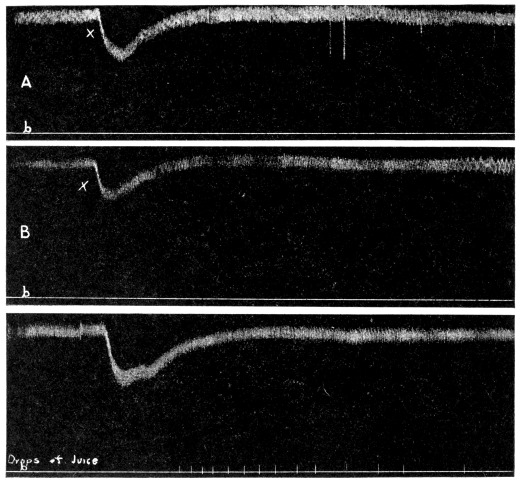
Fig. 1.—Records of carotid blood pressure and secretion of pancreatic juice on intravenous injection of Beveridge’s secretin in dogs. X, injection of 10 c.c. secretin; b, record of flow of pancreatic juice in drops. Tracing A, injection of 10 c.c. of one sample secretin (ten days old) furnished by Dr. Beveridge. Tracing B, injection of 10 c.c. of second sample of secretin (ten days old) furnished by Dr. Beveridge. Tracing C, injection of 10 c.c. of secretin (twenty hours old) made by us according to the Beveridge method. Showing that the secretin preparations sent us by Dr. Beveridge contained no secretin.
Each of the three samples of secretin sent us by Dr. Beveridge was tested in the above manner on five dogs. The first tests were made June 27, 28 and 29, respectively, that is, within nine days of the preparation of these samples of secretin. None of the samples was active (Fig. 1), even when injected intravenously in quantities up to 50 c.c.: 40–50 c.c. of Beveridge’s secretin mixture may kill a dog by too great lowering of the blood pressure. A good secretin preparation yields a copious secretion of pancreatic juice on intravenous injection of a few cubic centimeters.
It is not difficult to prepare a secretin, by the original Bayliss or Starling method or by the Beveridge method, that retains some activity for a longer period than nine days. Hence we cannot account for the absolute inactivity of these preparations except on the assumption that they did not contain any secretin to start with; that is, faulty preparation and absence of physiologic standardization.
The sample kept intact in its original container for six months became gradually cloudy, a large mass of amorphous precipitate settled to the bottom and the odor showed bacterial decomposition. It is reprehensible, to say the least, to state concerning such a mixture: “Of course, if desired, it may be injected intravenously.” The fact that Beveridge’s secretin may be rendered clear by filtering through carbon is not sufficient evidence that it is “pure secretin,” free from bacteria and other injurious substances.
II. Beveridge Secretin Mixture Is Rapidly Rendered Inactive by Human Gastric Juice.—We prepared active secretin solutions by the Beveridge method, using 0.2 per cent. serum as the protein “stabilizer” (?). The addition of the serum does not appear to affect the activity of the fresh secretin preparation. If Beveridge’s secretin is able to act on the pancreas when given by mouth, it is obvious that it must run the gamut of gastric digestion, except in cases of complete achlorhydria. It has been repeatedly demonstrated that all other secretin preparations are rapidly destroyed by pepsin-hydrochloric acid digestion. Is Beveridge’s secretin an exception? What is there in a little serum, native albumin, or peptones to protect secretin against gastric digestion?
The pure human gastric juice used in these tests was secured from the fistula case (Mr. F. V.) that has been under observation in our laboratory for years.123
BEVERIDGE’S SECRETIN AND BAYLISS-STARLING SECRETIN PREPARED Sept. 29, 1916
Date of TestQuantity of Secretin Injected, C.c.Response of Pancreas (No. of Drops of Secretin)

Bayliss-Starling SecretinBeveridge Secretin
Sept. 29107578
Oct. 2106161
Oct. 6102817
Oct. 13102531
Oct. 2710 5 6
Nov. 310 7 6
Nov. 1710 4 5
Nov. 3010 3 4
Dec. 410 2 2
Dec. 2010 0 0
Two cubic centimeters of fresh gastric juice added to 8–10 c.c. Beveridge secretin, the mixture being kept at body temperature (38 C.), renders the secretin completely inactive in from 5 to 8 minutes (Fig. 2). There is no exception to this rule, as we have repeated the test on many different secretin preparations and using different samples of human gastric juice. The secretin of Beveridge is just as vulnerable as the secretin of Bayliss and Starling to pepsin-hydrochloric acid digestion. On what kind of tests does Beveridge base his claim that his secretin mixture acts on the pancreas when given by mouth?
III. The Relative Rate of Deterioration of the Secretin Solutions Prepared According to Bayliss and Starling and According to Beveridge.—Six different preparations of the two kinds of secretin were made, kept in dark stoppered bottles in the ice box, and tested by intravenous injection in dogs under ether anesthesia from time to time until all influence on the pancreas had been lost. One typical series of these tests is given by the way of illustration. (See Table on page 126.)
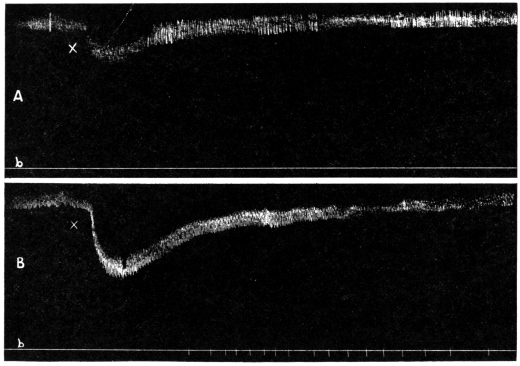
Fig. 2.—Records of carotid blood pressure and flow of pancreatic juice on intravenous injection of secretin prepared by us according to the Beveridge method. X, injection of 10 c.c. of the secretin; b, record of flow of pancreatic juice in drops. Tracing A, the 10 c.c. of Beveridge’s secretin injected had been digested for five minutes with 3 c.c. of human gastric juice. Tracing B, injection of 10 c.c. of the same secretin preparation not subjected to gastric digestion. Showing rapid and complete destruction of Beveridge’s secretin by human gastric juice.
It will be seen that the rate of deterioration (oxidation or decomposition) of the secretin is practically the same whether prepared according to Bayliss and Starling or according to Beveridge (Figure 3). In both preparations the rate of deterioration is most rapid the first few days after preparation. It is scarcely necessary to point out that secretin preparations not kept constantly at low temperature and in the dark, as in the above experiments, will deteriorate more rapidly.
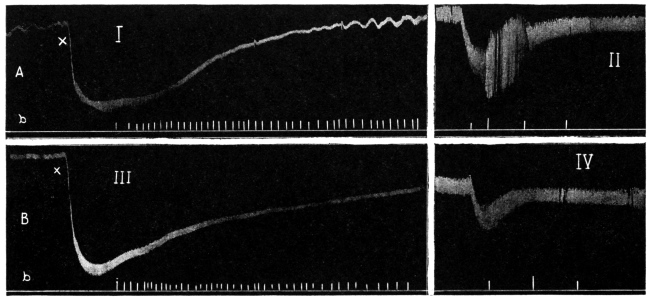
Fig. 3.—Records of carotid blood pressure and flow of pancreatic juice on intravenous injection of secretin preparations. X, injection of 10 c.c. secretin; b, record of flow of pancreatic juice in drops. Tracing A, secretin prepared according to the Beveridge method September 30. I, injection of 10 c.c. October 2. II, injection of 10 c.c. November 30. Tracing B, secretin prepared by the Bayliss-Starling method September 30. III, injection of 10 c.c. October 2; IV, injection of 10 c.c. November 30. Showing no greater stability of Beveridge’s secretion over that of Bayliss and Starling.
Why can we hope that the addition of serum or any solution of protein will render secretin more stable? In the intact man or animal under normal conditions of digestion, secretin reaches the pancreas by way of the blood, that is, it is in solution in blood. Does that fact render the secretin stable? By no means. The reader is familiar with the fact that the response of the pancreas to a single intravenous administration of secretin is very transitory (5–15 min.). The cessation of activity is due, not to fatigue of the pancreas, as a second injection of secretin gives a prompt response of pancreatic secretion, but to the disappearance of active secretin from the blood. In fact, secretin left in the test tube or in the bottle remains active over a much longer period of time than when introduced into the blood stream.
IV. Beveridge’s Secretin Given by Mouth to the Intact Animal Has No Specific Action on the Pancreas.—Active secretin prepared according to the method of Beveridge was fed on an empty stomach to a small dog (5 kilo) with permanent fistula of one of the pancreatic ducts. On control days we gave the dog (a) equal quantities of n/10 HCl, and (b) bread and milk. The Beveridge secretin was prepared with 0.3 per cent. HCl and the addition of 0.2 per cent. serum. The results may be stated by the following summary:
GIVING BEVERIDGE’S SECRETIN BY MOUTH
Material FedNumber of TestsSecretin of the Pancreas for Three Hours Following the Feeding
150 c.c. Beveridge Secretin610.2 c.c.
150 c.c. n/10 HCl522.7 c.c.
Bread soaked in milk4 6.6 c.c.
The Control experiments with pure hydrochloric acid show that the secretion of pancreatic juice following the introduction of Beveridge’s secretin into the stomach is due to the acid factor and the protein content.
CONCLUSIONS
The patented secretin of Beveridge is rendered inactive by gastric juice, is without effect when given by mouth, and exhibits no greater stability or keeping qualities than the secretin prepared according to Bayliss and Starling. It has no merit as a therapeutic agent. It should under no conditions be administered intravenously in man, as it contains deleterious protein split products and living bacteria.—(From The Journal A. M. A., Jan. 12, 1918.)
NEED FOR PATENT LAW REVISION
Report of the Committee on Patent-Law Revision of the Council on Pharmacy and Chemistry of the American Medical Association
At the present critical time when the efficiency of this nation must be raised to the highest point, it is essential that the United States government should lead in the efforts tending to such increased efficiency. To bring this about the government must protect and stimulate science, art and industry and at the same time curb or prevent waste of the country’s resources. In this field the United States Patent Office has unlimited power for good and evil—good, in the issuance of patent grants for novel devices and substances which go to increase national efficiency; evil, in the granting of patent protection where such protection is not in the interest of national efficiency, conservation of energy and material resources.
For years the American Medical Association, in common with the national pharmaceutical bodies, has been urging amendment of the law which governs the issuance of patents on medicinal preparations and more particularly revision of the procedure under which such patents are issued. At the Chicago (1908) meeting of the American Medical Association a special committee of five was appointed by the House of Delegates to study the questions involved, and to cooperate with the Association’s committee on medical legislation in preparing and securing the enactment of a bill which would correct the abuses connected with the enforcement of our patent laws (The Journal A. M. A., June 13, 1908, p. 2003). This committee presented a comprehensive report at the Atlantic City (1909) meeting of the American Medical Association (The Journal A. M. A., June 19, 1909, p. 2063). A further report was presented at the St. Louis (1910) meeting of the American Medical Association (The Journal A. M. A., June 18, p. 2079). In 1911 (The Journal A. M. A., Nov. 25, 1911, p. 1780) the Council on Pharmacy and Chemistry of the American Medical Association issued a report which set forth the inadequacy of our patent laws as they are administered in relation to medical products particularly.
AGAINST PUBLIC INTEREST
Since that time the Council has continued its study of the U. S. Patent law as it applies to medicine and has become convinced that in many instances the patent law or its enforcement is contrary to the best interest of the public, both as concerns health and prosperity. The Council feels it a duty at this time to protest against the provisions of our patent law, or the methods of its enforcement, which permit the granting of patents without thorough and scientific investigation of the claims advanced in such letters patent. As one means of improving conditions the Council urges that the U. S. Public Health Service, the Bureau of Chemistry, U. S. Department of Agriculture and other scientific departments of the United States government conversant with medicines and related subjects be consulted before the issuance of patents on medicinal preparations.
In support of the Council’s contention that the patent law procedure requires revision, the following is offered: In 1912 a U. S. Patent (No. 1,031,971) was granted on a cresol derivative, metacresyl acetate, a product described in chemical literature in 1903. When the Council inquired as to the grounds for the issuance of a patent for a substance known to science, the Patent Office replied that it was not familiar with the publication in which metacresyl acetate had been described. It seems evident that this patent would not have been issued had the application first been submitted to a government department familiar with chemical literature.
An illustration of the granting of a patent on the use of well-known chemical bodies which present no discovery or originality, is the patent issued for the use of peroxids, perborates and percarbonates as ingredients of tooth powders (U. S. Patents Nos. 760,397 and 802,099). Regarding these patents The Journal of the American Medical Association (Sept. 20, 1913, p. 978) commented:
“The patents held by McKesson and Robbins give this firm the exclusive right of manufacturing tooth powders containing peroxids, perborates and percarbonates. It is another illustration of the unfair monopolies that may be secured under our present patent laws.”
GRANTING A PATENT TO A NOSTRUM
Again in 1913 U. S. Patent No. 1,081,069 was granted to a citizen of Switzerland (a country which does not grant patents on medicinal preparations) for a “composition which is intended to be used internally and which confers to the organisms immunity against the following microbial infectious illnesses: diphtheria, pneumonia, typhus, scarlet fever, influenza, septic infections, cerebral-spinal meningitis, syphilis, pest, cholera and tuberculosis; it is also effective in another kind of disease, viz., goiter.” (Italics not in original). The patent specification states that “The principal of these substances is creatinin …,” but offers no evidence whatever that this well-known chemical body has the extensive and miraculous powers claimed for it. In publishing a notice of this patent The Journal of the American Medical Association (Jan. 3, 1914, p. 54) explained:
“It appears that the inventor is dead, and that his estate took out the patent. Since this great benefactor should have been, by the use of his preparation, immune to practically all diseases, he must have died of senility, although this seems hardly to have been the case.”
and held:
“Assuredly granting patents on such claims ought to be sufficient to show the need of a change in the methods of granting patents—at least of the methods governing the issuance of patents for medicinal products.”
We submit, that had the department of the government entrusted with the enforcement of the federal Food and Drugs Act been consulted as to the claims of this patent, it would probably have advised that, if the absurd and palpably fraudulent claims set forth in this application for a patent were made on the label of a preparation of creatinin offered for sale in interstate commerce or in the District of Columbia, the vendor would be prosecuted.
In 1914 there was issued U. S. Patent No. 1,086,339. Here the “inventor” declared:
“It is the object of my invention to destroy parasitic micro-organisms, particularly on living tissue without injuring the latter, by progressively evolving sodium hydroxid contiguous to said tissue, from and in a moist mixture of calcium hydroxid, sodium carbonate, aluminum sulfate and boric acid ...”
In a word, this patent apparently was granted for the production of sodium hydroxid by a chemical reaction which had been in use for several centuries. Because the patentee had twisted the granting of this patent into a quasi-endorsement of his nostrum, the Council’s consideration of this preparation was sent the Patent Office as a protest against the present law which authorizes the granting of patents on unproved and improbable medical claims. At that time the Council was informed by the Patent Office that reforms in the issuance of patents for medicinal substances had been instituted, and that “the trouble will not be so pronounced in the future as it has been in the past.”
FLAVORING EPSOM SALT A “DISCOVERY”
There was issued early in 1917 U. S. Patent No. 1,212,888 for a method of flavoring Epsom salt—yet this “discovery” is a procedure which has been practiced ever since the cathartic action of this bitter salt has been known. Not only does the patent describe a process long known to physicians and pharmacists, but it sets forth claims that the flavored cathartic salt produced by the process cures flatulency, indigestion, sick and sour stomach, colic and destroys worms. In commenting on this patent The Journal of the American Medical Association (June 23, 1917, p. 1914) was constrained to remark:
“The splendid conception of the framers of our constitution in providing a plan for promoting progress in science and useful arts by granting to inventors for a limited time the exclusive use of their inventions, in exchange for the publication of full knowledge thereof, is being debased. No branch of our government is of greater importance to the progress of the country than the patent office, provided that office is intelligently administered. When the patent office is used, however, for an extension of the nostrum business, founded on the abuse of patent and trade-mark laws, it becomes a menace to the public health. The objects of the patent law are being defeated by the practices of the patent office.”
Still further, attention is called to U. S. Patent No. 1,226,394 for a process of making hexamethylenamin tetraiodid and on the product so produced. This patent was issued after the Council had notified the Patent Office that hexamethylenamin tetraiodid had been discovered in 1888 and that a process identical in principle with that for which patent application appeared to have been made was published in 1916. On the basis of claims for which no evidence is produced this patent is issued for a well-known substance on the ground that as previously produced it contained a little free iodin or that the known processes were less economical. This patent appears to be an illustration of our patent procedure which obliged American users of acetylsalicylic acid to pay an exorbitant price because this country granted a patent which gave to the patentee, a foreigner, the exclusive right to the manufacture of the substance, whereas no such patent was issued in the patentee’s own country nor, so far as we can learn, in any other country. It forcibly illustrates the need for a revision either of our patent laws or of their methods of enforcement or both.
THE BEVERIDGE PATENT
In further justification of the Council’s protest against the provisions of our present law, or the methods of its enforcement, which permit the granting of patents without thorough and scientific investigation of the claims advanced in such letters patent, the Council calls attention to the report, appearing above, of an investigation made by A. J. Carlson, A. E. Kanter and I. Tumpowski, “The Question of the Stability of Secretin,” which relates to U. S. Patent No. 1,181,424, issued to James Wallace Beveridge.
Whereas the regulations governing the issuance of patents demand that the processes shall be described in such detail that one versed in the sciences can confirm the claims made by the patentee, no pretense whatever of fulfilling this requirement is made in the patent specifications of this patent. The substance of the first three paragraphs of this patent has long been general knowledge. Nearly every sophomore medical student has himself performed, or seen performed such “experiments” as are therein described. The claims of novelty evidently are confined to the assertion that the preparation is able to “resist oxidation or deterioration”; that it is free from “poisonous and irritable chemical substances”; that it “may be administered orally to produce the desired physiological action.” etc., etc. Not the slightest hint is given as to how any person can substantiate these claims. As a matter of fact, the investigation of Professor Carlson and his co-workers has shown that a preparation having the properties claimed cannot be made by the process described in this patent. Any one familiar with the subject could have demonstrated readily that the applicant was withholding information concerning essential features of his process, assuming that he had any information on the subject (which he probably did not have) and would have advised against the issuance of the Beveridge patent.—(From The Journal A. M. A., Jan. 12, 1918.)
SURGODINE
Report of the Council on Pharmacy and Chemistry
The following report submitted by a referee was adopted by the Council and authorized for publication.
W. A. Puckner, Secretary.
Surgodine (Sharp and Dohme, Baltimore, Md.), according to an advertising pamphlet, is a solution of 21⁄4 per cent. of iodin in alcohol, containing no alkaline iodid, but miscible with water in all proportions. The A. M. A. Chemical Laboratory reports that Surgodine is an alcoholic liquid (containing 91.8 per cent. alcohol by volume) containing free iodin, combined iodin and free acid, probably hydrogen iodid (hydriodic acid). Quantitative estimations gave 2.51 gm. free iodin per 100 c.c. and 1.78 gm. combined iodin (the greater part apparently was present as hydrogen iodid).
It is therefore similar to several other iodin preparations already considered by the Council. Like these, it is essentially similar to the official tincture of iodin, except that it is considerably weaker, and instead of potassium iodid it presumably contains hydrogen iodid and probably ethyl iodid to render the iodin water-soluble. Its composition, however, is secret.
There would be no objection to the use of ethyl iodid or hydrogen iodid, except perhaps the acidity of the latter, as a solvent agent rather than of potassium iodid. But neither is there any important advantage, and these preparations would have to be considered as unessential modifications of official preparations, and therefore ineligible for New and Nonofficial Remedies.
The attempt to make these modifications commercially profitable, however, seems inevitably to lead to exaggerations and misstatements. In an advertising pamphlet the following claims for Surgodine are unsupported by any evidence:
“But from the surgical viewpoint the addition of this potassium salt is most objectionable because when such solutions as the official tincture are used locally in the antiseptic treatment of open and often infected wounds the Potassium Iodide acts as an irritant to the wound and therefore produces a localized irritation which is not only objectionable from the surgical standpoint but also materially lessens the antiseptic power of the Iodine itself.”
“It has been demonstrated repeatedly that Iodine without the admixture of any alkaline iodide is much more efficient as a surgical antiseptic than any iodine solution that contains such an addition.”
“Iodine does not produce ‘iodism’ as quickly as the alkaline iodides do because it is eliminated more quickly and more perfectly than the alkaline iodides.”
The next statement intimates that iodin taken by mouth enters the intestinal tract unchanged and is there free to combine with various gases:
“Iodine in the presence of phosphorated or sulphurated gases in the gastro-intestinal tract unites with their hydrogen and thus breaks up these noxious compounds.”
This is certainly untrue at least for ordinary doses.
It is recommended that Surgodine be held inadmissible to New and Nonofficial Remedies because its composition is secret (Rule 1); because the therapeutic claims made for it are exaggerated and unwarranted (Rule 6); and because it is an unessential modification of the official tincture of iodin (Rule 10).
[Editorial Comment.—Surgodine is a good illustration of the economic waste inseparable from most proprietary medicines. A hospital pharmacist writes that whereas his hospital obtains tincture of iodin at less than 82 cents a pint, Surgodine costs $2.13 a pint. This means that while the free-iodin strength of Surgodine is only about one-third that of the official tincture, its price is between two and three times as high.]—(From The Journal A. M. A., Jan. 26, 1918)
MEDEOL SUPPOSITORIES
Report of the Council on Pharmacy and Chemistry
The following report on Medeol Suppositories has been adopted by the Council, and its publication authorized.
W. A. Puckner, Secretary.
“Medeol Suppositories” (Medeol Company, Inc., New York) appear to be an imitation of “Anusol Suppositories” which, in 1907, were found to be inadmissible to New and Nonofficial Remedies. A comparison of the composition and of the claims made for the two preparations will be of interest in the present consideration of Medeol Suppositories:
Anusol Suppositories (1909) Medeol Suppositories (1917)
Anusoli 7.5Medeol0.25
Zinc oxid 6.0Zinc oxid0.5
Balsam Peru 1.5Acid. tannic0.15
Ol. theobrom.19.0Bals. Peru0.16
Ungt. cerat. 2.5Cocoa butter and wax q. s. for 1 suppository.
for 12 suppositories.
“Anusol” was formerly said to be bismuth iodoresorcinsulphonate. The A. M. A. Chemical Laboratory published a report in 1909 showing that the suppositories contained only 1 per cent. of the iodin declared in the “formula,” and were greatly deficient in bismuth and sulphur. After the publication of the report the American agents for the product disclaimed that “Anusol” was a definite chemical compound. Today Anusol Suppositories are said to contain unstated amounts of the indefinite “bismuth oxyiodid and resorcinsulphonate.”
“Medeol” is said to be “resorcinated iodo bismuth,” but no information is vouchsafed as to the character or composition of the ingredient. The therapeutic claims made for the two preparations are similar, as the following, taken from circulars, show:
Anusol Suppositories
An innocuous, non-irritant remedy for anal, rectal and vaginal inflammatory affections, especially for Hemorrhoids!
The local medicinal treatment of hemorrhoidal and other inflammatory ano-rectal conditions has always been unsatisfactory. The usual media cannot be applied in effective concentration without producing intense inflammatory reactions; they are either ineffective or intolerable....
Anusol suppositories are absolutely free from narcotic, caustic or other injurious ingredients and may unhesitatingly be used by both sexes, at any age and under all conditions.
Medeol Suppositories
An innocuous, Non-irritant, Efficient Antiphlogistic for use in inflammatory diseases of the rectum, anus and vagina especially in Hemorrhoids.
Hitherto most of the local remedies used in these conditions have either been too irritating to be employed in sufficient concentration to be efficient or they have lacked efficiency per se....
Medeol suppositories do not contain any narcotic or any caustic or other constituent having violent action; their blandness permits of their use in either sex and at all ages.
The claims made for these preparations—as for instance “that surgical treatment ... should rarely be undertaken until Medeol Suppositories have been given a thorough trial”—are misleading in that they create the inference that the limitations in the palliative treatment of piles have been overcome. It is altogether untrue that these mixtures can be expected to “relieve the most obstinate cases,” as stated in a Medeol circular. This, from an Anusol circular, is equally misleading:
“If dietetic and other requirements are complied with, even the most obstinate chronic cases will frequently readily yield to treatment with Anusol Suppositories.”
The Council declared Medeol Suppositories inadmissible to New and Nonofficial Remedies because their composition is secret (Rules 1 and 2); because unwarranted therapeutic claims are made for these (Rule 6); because the name is objectionable (Rule 8), and because the combination is unscientific (Rule 10).
In those cases of hemorrhoids in which palliative measures may be expected to enable the patient to avoid surgical interference and afford relief from attacks, the object should be to secure cleanliness, to avoid irritation, whether it be by friction or irritating fecal matter, to reduce inflammation by astringents and, when necessary, to relieve pain by analgesics. If an antiseptic dusting powder is desired, boracic acid in impalpable powder with talc may be employed; if an astringent, finely powdered oxid of zinc may be added; if a local analgesic is necessary, a little extract of belladonna may be incorporated with petrolatum or other ointment base. The main reliance, in any event, should be to effect normal bowel movements by regulating the diet rather than by the use of purgatives; the use of warm water to insure cleanliness; the avoidance of irritation, especially that caused by friction and secretions; a mild astringent to reduce inflammation.—(From The Journal A. M. A., March 9, 1918)
GUAIODINE
Report of the Council on Pharmacy and Chemistry
The following report on Guaiodine, marketed by the Intravenous Products Company, Denver, has been adopted by the Council and its publication authorized.
W. A. Puckner, Secretary.
A referee of the Committee on Pharmacology, in submitting to the Council a report from the A. M. A. Chemical Laboratory on Guaiodine, advises that the Laboratory’s examination shows that instead of containing free “colloidal” iodin as claimed, the preparation is essentially an iodated fatty oil, containing only combined iodin. Equally misleading, in view of the Laboratory’s findings, are the implied claims that the antiseptic action of Guaiodine corresponds to that of free iodin.
Guaiodine is advertised mainly for the treatment of gonorrhea. While it may be true that the guaiacol contained in Guaiodine has some beneficial effect, especially when preceded by potassium permanganate irrigation as advised, the advertised claim that “Guaiodine acts as a specific for gonorrhea in a majority of cases” is utterly false.
The “case records” offered to establish the therapeutic value of Guaiodine are in themselves sufficient to condemn the “evidence.” The following are fair samples:
“The second boy came a day or so later with a slight discharge with the characteristic burning and itching, and with symptoms of a beginning gonorrhea, and judging from the source of the infection, it was believed to be so. Two injections of Guaiodine were given when the discharge ceased.”
“I have several cases that were completely cured in a very short time. I note this, that the first dose causes a cessation of the discharge and the second seems to increase the flow, but the color is changed. I give three doses, and then use a mild wash, and in ten days they are well. I am very pleased with this preparation and very truly believe that it is the best there is to date for the positive cure of gonorrhea.”
REPORT OF THE CHEMICAL LABORATORY
Guaiodine is manufactured by the Intravenous Products Company, Denver, Colorado. The “literature” which accompanies the product describes Guaiodine as:
“... an electro-chemically prepared iodin, suspended in oil, containing iodin, the same strength as the U. S. P. tincture of iodin, or 7 per cent., together with a therapeutic dose of guaiacol.”
The Intravenous Products Company claims that Guaiodine is made by an “electro-chemical process of preparing colloidal iodine,” discovered by one E. B. Page, and that by this process the tendency of iodin to produce iodism has been “overcome.” It is said to be “pre-eminently an antiseptic and germicide.” Guaiodine is a dark brown, oily liquid with a specific gravity of 0.9845 at 15.6 C. and an odor suggestive of guaiacol. Its solubilities were those of a fat. Free iodin was absent in the recently purchased specimen (traces were present in an older one). Steam distillation indicated that the product consisted of volatile and nonvolatile constituents. The volatile matter was concluded to consist, in the main, of guaiacol or some guaiacol-like body, and the nonvolatile matter to be an iodized fatty oil. Quantitative determinations indicated that Guaiodine contained about 7.25 per cent. of iodin in combination, and that it is composed approximately of 3 per cent. volatile matter and 97 per cent. nonvolatile matter. Hence Guaiodine appears to be an iodized fatty oil to which a small amount of guaiacol or some guaiacol-like substance has been added.
THE COUNCIL’S ACTION
On the recommendation of the referee, the Council voted that Guaiodine be declared inadmissible to New and Nonofficial Remedies because of false statements as to composition and action.—(From The Journal A. M. A., April 6, 1918.)
SEVERAL “MIXED” VACCINES NOT ADMITTED TO N. N. R.
Report of the Council on Pharmacy and Chemistry
The “mixed” vaccines which are discussed in the reports that follow were considered by the Council during the past year because inquiries had been received in regard to them.
In publishing these reports it is desirable that the attitude of the Council toward “mixed” vaccines again be stated. In view of the rapid development of bacterial therapy, the possibility for harm that attends the use of bacterial vaccines and the skepticism among experienced clinicians as to the value of vaccines representing a combination of organisms, the Council has felt that it should scrutinize the claims for such agents with exceptional care and that there should be admitted to New and Nonofficial Remedies only those vaccine mixtures for which there is acceptable evidence to indicate that the use of the particular mixtures is rational.
In considering the subject the Council has borne in mind the fact that in many institutions in which cases are studied and the results of therapeutic measures carefully observed and controlled, vaccines of any sort are practically never used—certainly here the stock mixed vaccine has no recognition. Experienced clinicians have generally come to the conclusion that mixed vaccines have no specific action and that any effect they may produce is due to a non-specific protein reaction.
As set forth in the reports, in no case was the evidence submitted by the proprietors sufficient to establish the claims made for the preparations. Hence none was accepted for New and Nonofficial Remedies.
The preparations that form the basis for the accompanying reports are only a few of the many that are being made and sold by some biological houses. Doubtless many of those not dealt with in this report are equally irrational and sold under claims equally—or probably even more—unwarranted than those with which the present report deals.
W. A. Puckner, Secretary.
Mixed Vaccines-Abbott
In response to inquiry the Council undertook a consideration of the following “mixed{”} vaccines sold by the Abbott Laboratories:
M. Catarrhalis-Combined-Bacterin, said to contain killed Micrococcus catarrhalis, Bacillus Friedländer, Pneumococci, Streptococci, Staphylococcus aureus and Staphylococcus albus.
B. Coli-Combined-Bacterin, said to contain killed Streptococcus viridans, Streptococcus hemolyticus and Bacillus coli.
Pertussis-Combined-Bacterin, said to contain killed Bacillus pertussis, Pneumococci, Streptococci, Staphylococcus albus, Staphylococcus aureus and Micrococcus catarrhalis.
Streptococcus-Rheumaticus-Combined-Bacterin, said to contain killed “Streptococci (Rheumaticus, Viridans, etc.)” and Pneumococci.
Streptococcus-Viridans-Combined-Bacterin, said to contain killed Streptococcus viridans, Streptococcus hemolyticus, Pneumococcus and Staphylococcus albus.
The Abbott Laboratories were asked to assist in the investigation of these products and to submit evidence to establish their eligibility for admission to New and Nonofficial Remedies. The manufacturer was informed that the Council accepts “mixed” vaccines or bacterins, provided the usefulness of these products is established by acceptable clinical evidence, and references to the literature bearing on the value of the preparations were requested.