Volume 1 / Part 3 — PART III CONTRIBUTIONS FROM THE JOURNAL: PROPRIETARY PRODUCTS (continued 3)
Reading edition
As a result of the publicity that was given the Koch treatment, the Wayne County (Detroit) Medical Society appointed a committee to investigate the treatment. Its first report appeared in the Bulletin of the society for Dec. 22, 1919. Briefly, this report said that the Board of Health of Detroit had placed at the disposal of the committee twelve beds in a local hospital with the necessary special nurses and everything else required free of charge. The committee sent certain patients to the hospital; and there were also some other patients recommended by different physicians as proper cases for treatment. There were nine altogether. After going over the cases carefully, the committee found some in which the diagnosis was doubtful. There were five cases, however, of undoubted cancer, a positive diagnosis having been made from specimens and microscopic examination. The management and treatment of these patients were turned over to Dr. Koch.
Dr. Koch seems to have raised certain objections and to have made certain criticisms. He also insisted that he ought to have some representative on the committee. The committee offered to put on any and all he would name. He failed to name any. The committee reported further that Dr. Koch was very negligent in his treatment of the patients and finally, on November 26, the committee met with Koch and went over all the cases with him. At that time he gave the patients injections and promised to attend to the treatment regularly in the future. According to the report, he saw the patients only once more (three days later) and then did not come near them again. As the patients became disgusted with the neglect, some of them left and the committee sent the rest home and closed its connections with the investigation of the subject.
In the same issue of the Bulletin of the county society in which this committee’s report was published, the editor of the Bulletin stated that from all sections of the country inquiries were coming relative to the treatment and “from long distances patients are coming to Detroit to be ‘cured’ of cancer.” The editor further stated: “It is reported that Dr. Koch is treating many patients, promising much and charging well.” To this Dr. Koch retorted that only about 30 per cent. of his patients had “contributed.” The rest were treated free.
The Wayne County Medical Society Bulletin for Jan. 5, 1920, was devoted almost exclusively to another discussion of Dr. Koch’s “cancer cure.” It was there stated that a second committee had been appointed to gather what information could be obtained from outside sources relative to cases treated by Dr. Koch. This committee reported that of fifty-six cases of which it was able to obtain data, only three of the patients showed clinical improvement; twenty-one of the patients were dead. Three more patients treated both by the Koch injections and by operation were reported as clinically improved. The condition of eighteen of the patients was reported as stationary, or unimproved. In eleven of the cases, the results were unknown but the surgeons reported unfavorably.
The committee reported further that Dr. Koch’s records were incomplete and that he had submitted no proof that his injections have any particular merit and the committee concluded that the study “is entirely experimental and improperly supervised.”
Evidently, the most that can be said of Dr. Koch’s alleged “cure” for cancer is that the claims made for it have not been supported by independent investigators.—(From The Journal A. M. A., Feb. 12, 1921.)
Further Comment
Last week some space was given to the alleged cure for cancer put out by Dr. William F. Koch of Detroit. Incidentally, it should be mentioned that Dr. Koch’s article of Oct. 30, 1920, to which reference was made, appeared not in the New York Medical Journal, as stated, but in the New York Medical Record.
The following correspondence throws additional light on the subject:
To the Editor:—To the number of inquiries which you have received regarding the alleged cure of cancer by Dr. Koch, permit me to add the following personal experience. On July 1, 1920, I was asked to examine an ex-patient of mine whom I had not seen professionally for many years. Her husband frankly told me that for several months his wife had been treated by Dr. W. F. Koch for inoperable carcinoma of the pelvic organs, that he wished Dr. Koch to retain charge of the treatment but hoped I would give my opinion regarding certain nervous manifestations in the patient which were causing him (her husband) much concern.
At the same time, he showed me a letter written by Dr. Koch purporting to explain the symptoms and offering suggestions regarding treatment. I called on the patient and found her in the last stages of generalized carcinomatosis. Simple palpation of the abdomen revealed multiple nodules involving both lower and upper abdominal quadrants. I did not feel justified in making a pelvic examination but noted a profuse foul-smelling discharge on the vulvar pad. My prognosis did not meet with the deluded husband’s approval. The patient died within a week and a necropsy confirmed the clinical picture of carcinomatosis. Enclosed is Dr. Koch’s letter; the patient’s name should, of course, be omitted if you see fit to publish this note.
George de Tarnowsky, M.D., Chicago.
The letter from Dr. Koch which Dr. de Tarnowsky enclosed with his own, follows. We have, of course, deleted the name of the patient.
Dear Doctor: Mrs. —— has absorbed and is still absorbing some killed tumor tissue. She has absorbed some three pounds, I judge. The results of the absorption are intoxication quite general (nervous, muscular, perhaps nephritic). The myocardium at present shows no signs of poisoning but the skeletal muscles and nerve do. The important toxin liberated by the killed tissue is methyl cyanimide which combines ammonia (NH2){sic} from the amino acids, and thus becomes methyl guanidine. This latter has produced in my patients an intoxication varying in similarity to: idiopathic tetany in children, chorea in children, eclampsia in women, and has even been so severe as tetanus in some of the muscle spasms; a toxic albuminuria has resulted in some of my cases.
All of my cases have cleaned up so far. Of course, I cannot predict in any individual case, except that when the absorption has been completed and the toxin all eliminated, everything should return to normal, unless the toxin has destroyed tissue beyond physiological repair. My suggestions as to treatment would be elimination, saving the kidneys as much as possible, by whatever methods you find best and necessary.
At present I am treating symptomatically thus—atropin as a guanidine antidote, arsenic as a chorea coupled antidote as a prevention to the production of guanidine from the cyanimide, the use of dilute hydrochloric acid has proven successful to me. Even a urine boiling solid—albumen has cleared up in one case in three days just by taking large quantities of 1⁄2 per cent HCl. I am explaining the factors I have contended with in these cases, but do not want to influence your plan of treatment when your judgment finds me insufficient.
Sincerely,
Wm. F. Koch.
I shall have a publication out very soon on the treatment of these tetanics and eclampsia with HCl.
It is worth noting that this letter of Dr. Koch’s was written June 28, just three days before Dr. de Tarnowsky saw Mrs. —— and less than a week before she died of generalized carcinoma.
Not the least important element in the story which these two letters tell is the optimism engendered in the husband of the poor cancer patient by the widely vaunted treatment of Koch. And herein lies one of the most pernicious features connected with the exploitation of alleged cures for cancer, tuberculosis, etc. All such remedies, whether fraudulent both in their inception and exploitation or those which while equally worthless are at least honestly put forward and are based on a certain amount of scientific investigation, produce a profound and marked temporary change in the patient’s condition. It is this that tends to warp the judgment not only of the unscientific layman, but also of the physician. The psychic element in cancer has been well described by Weil:
“It is, indeed, very remarkable that a patient who has been consigned to death as a victim of a hopeless malady, should regain his spirits and his appetite, when he is again confronted with the hope of a cure, and of the eradication of his disease? It is a phenomenon well known to every student of the disease that a large proportion of cases responds in just this manner to any treatment which is offered them. Osler has described a case of cancer of the stomach in which the mere visit to a consultant of sanguine temperament, though poor judgment, whose assurance of the patient that there was no possibility of cancer, resulted in the disappearance of all the symptoms and a gain of 18 pounds in weight. It is this psychic influence, which has occasionally deluded the honest student of cancer cure, and which has also so generously played into the hands of the dishonest.”—(From The Journal A. M. A., Feb. 19, 1921.)
THE LUCAS LABORATORIES’ PRODUCTS
The Journal has received several inquiries about the products put out by the Lucas Laboratories, Incorporated, of New York City. A typical inquiry is that received from Dr. F. A. Jewett of Brooklyn, who writes:
“The enclosed circular is sent out to the medical profession by Dr. William Lucas, 287 W. 70th St., New York. What do you know of this man and his methods?”
William H. Lucas was graduated by the Medical College of Ohio in 1895 and was licensed in 1897. He is not a member of his local medical society. The products put out by the Lucas Laboratories are for intravenous use, and their method of exploitation indicates that the concern is less interested in the science of therapeutics than it is in taking commercial advantage of the present fad for intravenous medication. The Journal has protested editorially against the unnecessary use of the intravenous administration of drugs, and the abuse of this method of drug giving prompted the Council on Pharmacy and Chemistry recently to emphasize the danger of indiscriminate intravenous medication.
The products of the Lucas Laboratories, Inc., have not been examined either by the A. M. A. Chemical Laboratory or by the Council on Pharmacy and Chemistry. The composition of these products is essentially secret, which in itself should be sufficient to deter physicians from using them. Of course, in accordance with all the tenents of orthodox nostrum exploitation, “formulas” are furnished. Even the crude hieroglyphics that used to be palmed off on the medical profession by nostrum exploiters under the guise of “graphic formulas” are outdone by the Lucas Laboratories in publishing the alleged formulas of its preparations. If we, as physicians, knew more chemistry, the Lucas Laboratories would not find it profitable to publish such ineffable nonsense as that which characterizes their “literature.” For instance:
“ ‘Luvein’ Arsans (Plain)” is said to be: “Di hypo sodio calcio phosphite hydroxy arseno mercuric iodid.” The first part of this “formula” might stand for sodium and calcium hypophosphite. The remainder is meaningless except that it suggests (but does not insure) the presence of arsenic and mercury iodide.
“ ‘Luvein’ Arsans, Nos. 1, 2 and 3.”—“Meta hydroxy iodide sodio arsano mercuric dimethyl benzo sodio arsenate, ai oxy sodio tartaria sulpho disheuyl hydrazin.” Who can venture even a conjecture as to the possible significance of this?
“ ‘Luvein’ Creosophite.”—“Ammonio hydroxy calcio sodio hypo-phosphite arsenous pentoxy iodide.” While the name suggests creosote, the “formula” gives no hint of this. It might refer to hypophosphites of ammonium, calcium and sodium with iodide of arsenic. Whether arsenous (trivalent arsenic) or arsenic (pentavalent arsenic) iodide or both are intended, is a question.
“ ‘Luvein’ Hexacol.”—“Hexa methylenepyro catechin mono methyl amino ether glycerite.” By moving these syllables around like the old “fifteen puzzle” they can be arranged to represent hexamethylenamin and monomethyl-ether of pyrocatechin, or guaiacol, having the “glycerite” left over.
It is futile to discuss the therapeutic claims made for the various preparations put out by the Lucas Laboratories. One might as profitably discuss the therapeutic claims made for “Peruna” or “Paine’s Celery Compound” for the exploitation of the latter products is on just as high a scientific plane as the exploitation of the “Luvein” nostrums. The proposition offered to physicians by the Lucas Laboratories, Inc., is an insult to the intelligence of the medical profession. Not that the products themselves are necessarily any worse or any better than many offered for intravenous use; the selling methods are more crude, that is all.
The facts are, we have entered a new cycle of nostrum development. The unscientific mixtures for oral administration that characterized so large and disreputable a part of the proprietary medicine business of the past two or three decades are giving way to equally unscientific mixtures for intravenous use. The dangers of the older nostrums are accentuated in the newer by the added element of risk that is inseparable from intravenous therapy. Add to this the temptation to the physician in the way of more substantial fees which, legitimately enough, may be charged when intravenous administration is called for, and the menace of the new style nostrum becomes evident. The Journal can only reiterate the warning that intravenous therapy should be employed only when most positively indicated. Further, because of the danger that is inseparable from this method of drug administration, physicians should be doubly careful to see that products employed for intravenous use come from firms of unquestioned scientific standing.—(From The Journal A. M. A., Sept. 20, 1919.)
“PHYLACOGENS” [O]
A physician in Florida writes:
“I am enclosing a copy of a circular letter just received from Parke, Davis & Company, and will call your attention to a marked paragraph in this letter on which I would like to have an expression of your opinion.”
The circular letter which the doctor forwards is devoted to singing the praises of “Pneumonia Phylacogen.” It opens with the statement: “Influenza, we learn, has appeared in your section.” The paragraph marked by our correspondent reads:
“Pneumonia Phylacogen has been found to be a dependable means of preventing and treating pneumonic complications of Influenza. In one large city it became a routine measure to give all persons affected with Influenza an injection of Pneumonia Phylacogen as a prophylactic of pneumonia. The results were remarkable. Not only did the cases improve rapidly, but in a great majority of them the pneumonia did not occur.”
The “Phylacogens” were repeatedly discussed in The Journal during 1913 and 1914 when these products were being pushed with much vigor by the manufacturers. We know of no evidence that calls for a revision of the statements then made regarding them. The injection of phylacogens is simply the administration of a mixture of the filtered products of several bacterial species. The results which follow represent the reaction of the bacterial protein—a reaction for good or evil. There is no scientific evidence to show that they possess any specific prophylactic virtue. To recommend their use in cases of influenza, as a prophylactic against pneumonia, is unwarranted, and the physician who acts on the advice of the manufacturer must assume the responsibility for the results. In case of mishap he cannot fall back on the manufacturer; he will find no scientific evidence to support him.—(From The Journal A. M. A., Nov. 15, 1919.)
PINEOLEUM ADVERTISING METHODS
Capitalizing the Name and Position of the President of the American Medical Association
To the Editor:—Enclosed is a postal card which a physician in Oklahoma has sent me together with thirty-six cents in stamps. The envelop was addressed to me at the address of the Pineoleum Company. The postoffice corrected the address and sent it to me. It is evident, therefore, that the physician in Oklahoma thought I was sending these postals as an employee of the Pineoleum Company, or, at least, was endorsing their products.
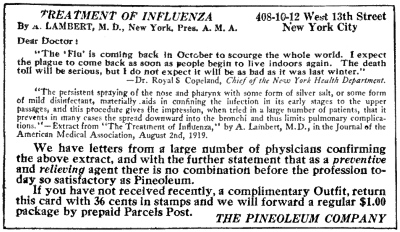
Postal card capitalizing the name and position of the President of the American Medical Association.
Kindly do me the favor to publish this letter in The Journal as a protest against the dishonesty of this method of advertising. What is quoted from an article that I wrote appeared originally in the New York State Journal of Medicine and was abstracted in The Journal of the American Medical Association of August 2, 1919. The obvious inference to be drawn from this postal is that I referred to the products of the Pineoleum Company in that article. I did not have the products of the Pineoleum Company in my mind. I never have used their products and never prescribed them.
This form of advertising is done with intent to deceive and did deceive the doctor in Oklahoma. It was therefore a successful falsehood, its success depending on the false use of the name of the President of the American Medical Association to bolster up the sale of the product.
I resent the use of my name in connection with the quack advertising of nostrum venders. The low, vulpine cunning of the method used is on the same level as the deceit and dishonesty which use this form of advertising to the injury of my name and reputation. As President of the American Medical Association I must insist that you protect me by publishing this letter in The Journal, giving it as widespread publicity as possible.
Alexander Lambert.
[Comment.—“Pineoleum” is a “patent medicine” advertised in the cheapest and most effective way—by the aid of the easy going and complacent physician. In 1906 Pineoleum was being marketed by the Winslow Laboratory of New York City, which also put out three or four other nostrums—“Morumalt,” “Egeriol,” “Digestylin,” and “Ford’s Nucleo-Peptone.” Pineoleum was advertised to the public then as it is advertised now, via the medical profession. Physicians are circularized and are offered a petty graft in the form of a cheap nebulizer and a sample bottle of Pineoleum. Some time ago the company seems to have developed a scheme whereby physicians could make money “dispensing Pineoleum nebulizer outfits at more than 140 per cent. profit.” The Pineoleum concern for years has also polluted the stream at its source by attempting to get the secretary of the senior class of every medical school to distribute its free nebulizer outfits to members of the class and receive therefor 5 cents for each outfit distributed! The life history of Pineoleum is that of the typical nostrum. Epidemics, of course, are utilized as opportunities for pushing the product. In 1911 a card was sent out featuring “A Special LaGrippe Offer”; in 1916 the profession was circularized recommending Pineoleum as “The Ideal Prophylactic” in infantile paralysis; during the past year influenza has again been the selling point.
The case described by Dr. Lambert is not the first example of the misuse of names and statements of physicians. Last December the Pineoleum concern was sending out an advertising card in which Dr. McCoy of the United States Public Health Service was quoted as recommending Pineoleum as the “bulwark of prevention” and “battery of relief” in influenza. Of course, Dr. McCoy never said anything of the sort. A protest against this particular falsehood resulted in another card being sent out several months later by the Pineoleum people purporting to explain and apologize for the misquotations and putting the blame on the printer. The “apology” ended with a postscript (in larger and bolder face type than the body of the card) that urged physicians to “secure our liberal introductory advertising proposition on improved oil nebulizer outfits.” From the standpoint of publicity for Pineoleum, the “explanation and apology” was doubtless as good an advertisement as the original card of misrepresentation.—Ed.]—(From The Journal A. M. A., Nov. 1, 1919.)
“PROTEAL THERAPY” AND HENRY SMITH WILLIAMS
To the Editor:—Will you please advise as to the success and safeness in using the Proteal treatment for tuberculosis by Henry Smith Williams, M.D., LL.D., 104 East 40th Street, New York?
C. P. Burchard, Alamogordo, N. M.
To the Editor:—Kindly send me any available information on “The Proteal Treatment for Cancer.” An article by Dr. Henry Smith Williams, 120 West 32 Street, New York City, in April Hearst’s has caused relatives to request its use in a case of carcinoma of the liver under my care.
M. M. Reppard, Middlebourne, W. Va.
To the Editor:—I am enclosing a leaflet, mailed to me on request, by Dr. Henry Smith Williams of New York City, who published a series of articles during the last year in Hearst’s Magazine on “Proteal Therapy.” If you have investigated this man and his proteal treatment, I should like to know the result of your findings. I am a consumptive and am, therefore, particularly interested in its alleged benefactions for the treatment of tuberculosis.
Michael A. Long, Glen Lake Sanitarium, Hopkins, Minn.
To the Editor:—What information can you give me regarding Henry Smith Williams, M.D., LL.D., 104 East Fortieth Street, New York, and the therapeutic value of the “Proteal Therapy” that he has originated?
M. D. Baker, M.D., San Jose, Calif.
The above letters are selected from many received on the subject. Henry Smith Williams is better known in the journalistic world than in the field of scientific medicine. He was graduated by the Chicago Medical College in 1884. In the thirteen issues of medical directories of the United States that have been published during the past thirty years Dr. Williams’ name does not appear—except for the issues of 1890 and 1893—until the 1914 edition. So far as we have been able to find, Dr. Williams had not until 1915 contributed any articles to medical journals. The catalog of the Surgeon General’s Library contains no reference to any articles of Dr. Williams except those that have appeared in popular magazines. The volumes of the Index Medicus from 1907 until 1914, inclusive, also contain no references to any articles by him in medical journals. The Journal‘s author index to current medical literature from 1900 to 1914, inclusive, fails to record any articles by Dr. Williams in medical journals. Dr. Williams’ articles, however, in popular magazines have been voluminous and numerous. Sometimes his articles have been under his own name and sometimes under the nom de plume, “Stoddard Goodhue, M.D.” Under the latter name the Cosmopolitan published articles on “Adding Years to Your Life,” “Battle of the Microbes,” “Do You Choose Your Children?” and “What is the Matter With Your Brain?” Under his own name articles have appeared in popular magazines on such subjects as “Burbank’s Way with Flowers,” “Every Woman Her Own Burbank,” “Why Not Live Forever?” “Science of Breeding Kings,” “New Cancer Treatment” and “New Hope for Rheumatism Sufferers.” In addition, Dr. Williams has published books on such subjects as “History of the Art of Writing,” “Historians’ History of the World,” “Story of Nineteenth Century Science,” “Luther Burbank,” “Twilight Sleep” and others. The Goodhue Company of New York City, which publishes some of Dr. Williams’ books has, we understand, for its president, Dr. Henry Smith Williams, for its vice president, Dr. Williams’ wife, and for its secretary-treasurer, Dr. Williams’ daughter.
Readers of The Journal will remember the publicity given in 1915 and 1916 to an alleged treatment for cancer, sometimes called the “Horowitz-Beebe Autolysin Treatment.” The method was heralded widely both in a certain portion of the medical press and in popular magazines and newspapers. A popular article by Henry Smith Williams on “The New Cancer Treatment” appeared in the Illustrated World for October, 1915, with pictures of Dr. Horowitz, Dr. Beebe, etc. A month or two later, physicians received, gratis, from the Goodhue Company a neatly bound little book on “Alcohol Hygiene and Legislation,” by E. H. Williams, M.D. (brother of Henry Smith Williams). Enclosed with it was a letter from the Goodhue Company asking physicians to accept the book. The body of the letter was devoted to calling the attention of physicians to an “important work” by Dr. Henry Smith Williams on “The Autolysin Treatment of Cancer” that the Goodhue Company was publishing. With the letter, there was a small advertising pamphlet “Issued by the Autolysin Laboratory” and advertising that product. In addition, the last thirteen pages of the book on “Alcohol Hygiene” contained advertisements of the Goodhue Company’s publications with particular emphasis (four pages of it) on the “Autolysin Treatment of Cancer,” by Henry Smith Williams.
In May, 1917, physicians in the West received a letter from the “Ellison-White Chautauqua System” informing them that Dr. Henry Smith Williams was to lecture at “your Chautauqua” and reminding them that “he has recently issued two volumes, ‘The Autolysin Treatment of Cancer’ which he believes will be his greatest contribution to medical science.” The present “Proteal” treatment appears to be a modification of the “Autolysin” treatment. Dr. Williams, in attempting to justify the use of his “Proteal” in tuberculosis, cancer, rheumatism, etc., takes advantage of certain investigations bearing on the nonspecific reactions resulting from the parental injection of foreign proteins. So far as we can discover, there is no scientific evidence to indicate that the “Proteal” treatment expounded by Williams is of value in the treatment of cancer, tuberculosis or the other numerous diseases for which the “Proteals” are recommended.
It is a question whether such articles as those on “The Proteal Treatment of Cancer,” “New Hope for Rheumatism Sufferers,” etc., published in popular magazines or newspapers serve any useful public purpose. May they not, on the contrary, by raising false hopes, cause much mental suffering and do scientific medicine great harm?—(From The Journal A. M. A., July 6, 1918.)
PROTEOGENS
Commercial Therapeutics [P]
A report of the Council on Pharmacy and Chemistry that appears elsewhere253 in this book deals with another attempt to foist on our profession a series of essentially secret preparations whose therapeutic value has not been scientifically demonstrated. Grotesquely extravagant claims are advanced as to the therapeutic potency and range of action of substances of whose nature and effects we have no trustworthy information. Physicians are advised to use—and many undoubtedly are using—these alleged remedies in the treatment of diseases in which delay in the proper kind of treatment may be of the greatest danger to the patient. As stated, there is available no reliable information regarding the effects of these substances when they are introduced in the human body. They may have no effect whatever, or they may produce more or less direct injury; in either case, there is the chance that damage, even irreparable to the patient, may result because rational treatment is withheld.
If we accept the statement that the preparations are largely vegetable proteins, it is a fair inference that, under certain conditions, they may cause a febrile reaction of the same general nature as that caused by other foreign proteins when injected into the body. We know that such reactions are not without danger and that the treatment of certain infections by induced reactions to foreign proteins is strictly an experimental procedure to be undertaken only under very special conditions. There is, therefore, no known valid reason why a physician should assume the responsibility for using these alleged remedies in the treatment of his patients; there is a very obvious reason why he should not—the therapeutic instructions of “the House of Merrell, always interested in the progress of plant therapy” to the contrary notwithstanding. It is the old story of exploiting physicians through commercial pseudoscience; of trading on the credulity of the profession to the detriment of the public. As Osler254 recently protested so vigorously:
Some time ago a pamphlet came from X and Company, characterized by brazen therapeutic impudence, and indicating a supreme indifference to anything that could be called intelligence on the part of the recipients. That these firms [manufacturing pharmacists] have the audacity to issue such trash indicates the state of thraldom in which they regard us. And I would protest against the usurpation on the part of these men of our function as teachers. Why, for example, should Y and Company write as if they were directors of large genito-urinary clinics instead of manufacturing pharmacists? It is none of their business what is the best treatment for gonorrhea—by what possibility could they ever know it, and why should their literature pretend to the combined wisdom of Neisser and Guyon? What right have Z and Company to send on a card directions for the treatment of anemia and dyspepsia, about which subjects they know as much as an unborn babe, and, if they stick to their legitimate business, about the same opportunity of getting information? For years the profession has been exploited in this way, until the evil has become unbearable, and we need as active a crusade against the pseudoscience in the profession as has been waged of late against the use of quack medicines by the public. We have been altogether too submissive, and have gradually allowed those who should be our willing helpers to dictate terms and to play the rôle of masters. Far too large a section of the treatment of disease is today controlled by the big manufacturing pharmacists, who have enslaved us in a plausible pseudoscience.
What shall the profession do to protect itself against this humiliation—to throw off the credulity that extols pseudoscience and makes commercialized empiricism financially profitable? Osler says the remedy is obvious: “Give our students a firsthand acquaintance with disease, and give them a thorough practical knowledge of the great drugs, and we will send out independent, clear-headed, cautious practitioners who will do their own thinking and be no longer at the mercy of the meretricious literature, which has sapped our independence.” Excellent! But must humanity wait a generation? Why not stop this evil at once? The American Medical Association has provided the means whereby this can be done, if physicians will only make use of it—the Council on Pharmacy and Chemistry.—(Editorial from The Journal A. M. A., July 12, 1919.)
An Alleged Endorsement of Proteogens Repudiated
To the Editor:—I note in the issue of The Journal for July 12, a statement regarding the so-called “Proteogens” manufactured by the Wm. S. Merrell Company of Cincinnati.
My attention has been called to the fact that salesmen of this company have been exhibiting a letter purporting to show that this department has endorsed their products in the treatment of venereal diseases. The letter in question was written by a physician employed in one of the clinics conducted jointly by this department and the U. S. Public Health Service, and the stationery of the department was used without authority. The physician in question has made numerous efforts to recall the letter, but the Merrell people profess an inability to control its use.
I need not add that this department has not endorsed and will not endorse these products, and has no evidence that they are of any value whatsoever.
Allen W. Freeman, M.D., Commissioner of Health, State of Ohio, State Department of Health.
—(Correspondence in The Journal A. M. A., July 26, 1919.)
The Manufacturer’s Protest and a Reply
To the Editor:—Allow us to direct your attention to several misstatements which appear in the letter signed, “Allen W. Freeman, M.D., Commissioner of Health, State of Ohio,” published in The Journal of the American Medical Association for July 26.
1. Salesmen of this company have not been exhibiting a “letter purporting to show that this department has endorsed their products in the treatment of venereal diseases,” as stated by Dr. Freeman.
2. The author of the letter has not “made numerous efforts to recall the letter, but the Merrell people profess an inability to control its use,” as stated by Dr. Freeman.
A physician employed in one of the clinics used our Proteogens Nos. 10 and 11 extensively and is still using them to a large extent in his private practice. He is a man of standing in the community in which he practices and is also a professor in one of the leading medical colleges in the state.
The letter in question cites the case of a man who had been under treatment for three years with 606, 914 and most of the other treatments in general use, and on August 31, a year ago, still gave a Wassermann test plus 4. He was given Proteogen No. 10, and by the middle of December the Wassermann was negative and the man was discharged as cured.
While this letter was written on the stationery of the Bureau of Venereal Diseases of the Department of Health, State of Ohio, it was written in the first person, and made no pretension in any way to being official nor was any such pretense made or authorized by the Merrell Company.
The author of the letter has not made “numerous efforts to recall the letter,” nor has the Merrell Company “professed an inability to control its use.”
The physician did ask that the letter be returned to him, and his request was complied with promptly.
[Then follows the full text of the letter in question. As its contents have no bearing on the question under discussion, it is omitted.—Ed.]
In over ninety-one years of honorable service as manufacturers of medicinal preparations, the Wm. S. Merrell Company has never endeavored to advance its interests through misrepresentation.
The Wm. S. Merrell Company, Chas. G. Merrell, Pres.
[The letter above was submitted to Dr. Allen W. Freeman, Commissioner of Health of the State of Ohio. Dr. Freeman’s comments appear below.—Ed.]
To the Editor:—The plain issue of veracity raised in the communication of the Merrell Company must be settled on the evidence, which is unfortunately too voluminous to be published in full in The Journal. Copies of the correspondence in the case have been furnished the editor, and the originals are on file in the office of the state department of health in Columbus.
1. Whether or not the photographic reproduction of a letter written on the letter head of this department, and the distribution of copies to salesmen for display to physicians, was a conscious effort on the part of the firm in question to create the impression that the letter was an official one is perhaps a matter of inference. That it did create such an impression is evidenced by the letters of inquiry received from physicians who saw it.
2. The statement that the Merrell Company refused to return the letter is perhaps erroneous. They did apparently return the original letter but not the photographic copies which had been distributed to their salesmen. On May 22 the firm wrote as follows:
“A number of physicians who are in cooperation with both state and national bureaus of venereal diseases have been using our Proteogens with marked success and there are doubtless many letters carried by our salesmen—reports from some of these physicians.”
This was interpreted to mean that the firm had no method of knowing what letters were carried by their salesmen and was not responsible for them. Whether or not this interpretation is correct is again, perhaps, a matter of opinion.
The purpose of the original communication was to make plain to those of the profession who have already seen or might subsequently see the letter referred to that the communication was the expression of an individual and not of the Department.
A. W. Freeman, Commissioner.
—(Correspondence in The Journal A. M. A., Sept. 6, 1919.)
Details of the Alleged Endorsement of Proteogens
Our readers will remember the recent correspondence published in The Journal of July 26 and September 6, by Dr. A. W. Freeman, Commissioner of Health of the State of Ohio and the Wm. S. Merrell Co. The letters dealt with the use that had been made by the Wm. S. Merrell Co. of a letter, written on the official stationery of the Bureau of Venereal Diseases of the State Department of Health of Ohio, puffing one of the company’s proprietary remedies—Proteogen No. 10.
Dr. Freeman wrote to The Journal calling the attention of the profession to the use of this letter and explaining that the letter was merely the expression of opinion of an individual, and not an expression from the State Department of Health. The Wm. S. Merrell Co. took exception to certain inferences made in Dr. Freeman’s letter and in the course of a letter to The Journal regarding this, incorporated the contents of the testimonial letter. The Journal, in publishing the Merrell letter, omitted this testimonial on the ground that the contents of the letter had no bearing on the question under discussion.
We have now received a letter from the company protesting against this omission. The Journal, therefore, takes this opportunity of briefly restating such facts as it has been able to get regarding the entire matter and publishing the letter. The facts are as follows:
1. In February of this year a Cincinnati physician, Dr. C. J. Broeman, wrote to Dr. A. S. Horovitz relative to alleged results with Proteogen No. 10. The letter was written—without authority—on the official stationery of the Bureau of Venereal Diseases of the State Department of Health of Ohio.
2. The Wm. S. Merrell Co. had linen mounted photographs made of Dr. Broeman’s letter and distributed them to their Proteogen detail men. Accompanying these photographic copies was a communication to these detail men describing the photographed letter as one written by:
“... a Cincinnati physician who is now Acting Assistant Surgeon, U. S. Public Health Service, cooperating with the Bureau of Venereal Diseases of the Department of Health of the State of Ohio.”
3. The right hand top corner of the official stationery, as can be seen by the reproduction, bore the name of “James D. Bauman, Deputy Commissioner.” Dr. Broeman’s signature was rather illegible and could easily be mistaken, by those not knowing the handwriting of either man, for the signature of Deputy Commissioner Bauman. In at least one instance it was so mistaken, and the physician who was misled wrote to the Director of the Bureau asking whether the testimonial for Proteogen No. 10 which had been shown him by the Merrell detail man was really an official communication.
4. On May 15, 1919, Commissioner of Health Freeman wrote to the Merrell Co. stating that he had been informed that one of the Merrell representatives was using as an advertisement a letter bearing the letterhead of the Bureau of Venereal Diseases of the State Department of Health and what purported to be a report signed by “Mr. Bauman, Deputy Commissioner.”
5. On May 19, the Wm. S. Merrell Co. wrote Dr. Freeman that he was certainly mistaken in regard to the use of any “report signed by Mr. Bauman.” Dr. Freeman then sent to the company the letter he had received from the physician who had mistaken Broeman’s letter for an official letter by Bauman. Although it would seem that this letter and Commissioner Freeman’s protest should have made plain to the Wm. S. Merrell Co., the fact that the letter, incorrectly referred to as Mr. Bauman’s, was in reality Dr. Broeman’s, the company remained silent regarding its use of the Broeman letter and, on May 22, merely reiterated that there had been “no letter circulated by this company containing a testimonial of your Mr. Bauman.” On May 28 (six days later) the Merrell company sent to its Proteogen detail men another general letter, “for personal use of agents,” in which it again called their attention to the “photographic copy mounted on linen” of Dr. Broeman’s letter. This communication to the detail men also declared that it “has been suggested that the further use of Dr. Broeman’s letter might antagonize the State Department of Health” and, therefore the detail men were told to “discontinue using the photographic copy in question” and to return the photographs to the head office.
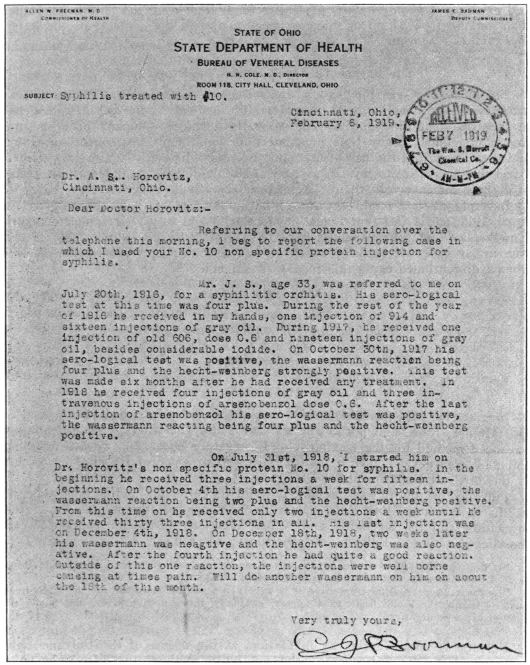
Reproduction (reduced) of one of the photographic copies sent out by the Wm. S. Merrell Co. to its Proteogen detail men to be shown to physicians. While the letter is a private one, it was written (without authority) on official stationery. Some physicians were misled into thinking it was an official endorsement of Proteogens. The Merrell concern denied any intention to mislead and claimed that it was interested only in bringing to the attention of physicians the contents of the letter!
Here, briefly are the bald facts in the case. The essential point at issue is whether these photographic copies of Dr. Broeman’s letter would or would not be likely—whether or not they were so intended—to mislead physicians into believing that the endorsement was an official one by the State Board of Health rather than an individual one. One can but wonder why, if, as the Merrell company so vehemently asserts, there was no intention of misleading physicians on this point, the company should have gone to the trouble and expense of photographing the entire letter, including the letterhead, rather than making typewritten or mimeographed copies of the contents of the letter.—(From The Journal A. M. A., Sept. 27, 1919.)
Dr. Broeman’s Final Report on Proteogens
To the Editor:—In the September 27 issue of The Journal my name was mentioned in connection with the Merrell Chemical Company’s “Proteogens” in the treatment of syphilis. The Merrell Chemical Company promised not to use my name at any time in connection with their “Proteogens” injection and they know that the use of my name has been distinctly against my wishes. I feel that in justice to myself, as well as the public, I should report the result of my experiments with their “Proteogens” in private practice.
In explanation I might say that I began the use of their “Proteogens” in April, 1918, and I feel that I now have enough data to give a complete report. I might say that all my results have been practically nil; particularly is this true in my cases of syphilis, which all had a four plus Wassermann reaction when I discontinued using this form of treatment.
Very truly yours,
C. J. Broeman, M.D., Cincinnati.
—(Correspondence in The Journal A. M. A., Oct. 11, 1919.)
PULVANE
In a twelve-page pamphlet, sent out by the Pulvane Laboratories, Inc., of Des Moines, Iowa, and purporting to deal with “The Therapy of Pulvane, an advanced method for the treatment of Respiratory Diseases,” we are told that Pulvane “was developed in a United States Army General Hospital by officers of the Medical Department.”
Pulvane “originally was intended only for its germicidal action upon tubercle bacilli in the lung,” but it is now also recommended for asthma, hay fever, bronchitis, rhinitis, laryngitis and “other affections of the air passages.” Of the alleged action of Pulvane on tuberculosis we read:
“It destroys the spores of the bacilli as well as the germs themselves. It prevents infection of new areas by aspiration, gravity or surface contact.
“In cases where sputum is positive it is a very noteworthy fact that shortly after treatment is begun, the bacilli begin to disappear, gradually diminish in number, and finally the sputum becomes negative.”
Pulvane is administered, by inhalation, at the offices of the Pulvane Laboratories, Inc. Its “discoverer” chanced on a method of “introducing into solution and volatizing a certain germicide, extremely rare in its usage because of its resistance heretofore to attempts to bend it to scientific will.” This “rare” medicament is alpha naphthol! But since the discovery of this volatizing method “three other ingredients of high therapeutic value have been added.” What are these other ingredients?
“They would be named were it not that Pulvane requires special technique in its preparation and administration. Our medical directors do not consider it advisable to identify them here because of the possibility of incompetent hands attempting their use. The medical directors, however, will be glad to name every ingredient of Pulvane for any reputable member of the profession. Pulvane Laboratories reserve only the method of compounding.”
Presumably, therefore, if physicians desire to know what Pulvane is, the Pulvane Laboratories, Inc., “will be glad to name every ingredient of Pulvane.” It is worth noting that nothing is said about quantities. It is also worth remembering that “Peruna” and some other “patient medicines” have for years printed on the label the names of the alleged ingredients. How much longer is the medical profession going to be fooled with the trick of nostrum exploiters pretending a frankness that means nothing?
From a recent issue of a Des Moines newspaper we learn that the Pulvane Laboratories are about to establish a sanatorium where the Pulvane treatment can be given. This announcement is said to be made by John P. Mosher, the alleged discoverer of Pulvane. Mosher is not a physician. The newspaper article states, further, that Mosher’s experiments were tried out “under the observation of Major Sharpe,” commander at Fort Des Moines. It appears also that an ex-newspaper reporter is connected with the Pulvane Laboratories. The value of having a good publicity man is obviously recognized. There also seems to be connected with the concern a Dr. Harry P. Hall. We find in the records reference to one Harry P. Hall who was graduated by the Medical Department of Drake University of Des Moines, Iowa, in 1894, and was licensed in Iowa in 1896. Our records indicate that he has not been in practice for some years. We also find in our files some newspaper clippings regarding a Dr. Harry P. Hall who, in 1914, pleaded guilty to a charge of using the mails to defraud and was fined in the federal courts. Whether there is any connection between these two names, we do not know.
Reverting to the claims made by the Pulvane Laboratories that Pulvane was “developed in a United States Army General Hospital by officers of the Medical Department” the following statement has recently been received by The Journal from Surgeon-General Ireland of the United States Army:
“It has been brought to my attention that a concern in Des Moines, Iowa, known as the Pulvane Laboratories, has issued a pamphlet in which statements are made which would naturally lead medical men to believe that the experiments, etc., referred to therein were made with the approval of and more or less under the direction of the Medical Department of the Army. I wish to say that this is not so; that the Medical Department had nothing whatever to do with the matter and that it thoroughly disapproves of the methods used by the promoters of this concern.—(From The Journal A. M. A., March 11, 1922.)
SAL HEPATICA
Sal Hepatica is a saline laxative sold by the Bristol-Myers Company of New York. Little information is given, or, apparently, ever has been given, concerning the composition of this product. Many years ago the stock medical journal advertisement contained this statement:
“Composition.—Sal Hepatica contains all of the Tonic, Alterative and Laxative Salts of the celebrated ‘Bitter Waters’ of Europe, especially those of Bohemia, as determined by actual chemical analysis of these waters, and fortified by the addition of Lithium and Sodium Phosphates.”255
Sal Hepatica no longer “contains all the tonic, alterative and laxative salts ...,” etc., for the label on a package recently purchased reads:
“Sal Hepatica is an effervescent saline combination possessing medicinal properties similar to the natural ‘Bitter Waters’ of Europe, and fortified by the addition of Sodium Phosphate.”
In 1909, the Druggists Circular published an analysis of Sal Hepatica which showed that the preparation contained only 0.04 per cent. of lithium phosphate. By referring to the two quotations just given it will be noticed that today the manufacturers make no claim that their preparation is fortified with any salt of lithium. A circular accompanying recent trade packages states:
“Sal Hepatica is composed solely of harmless salts, being absolutely free from Acetanilid, Phenacetin, Caffein, Calomel, opium or coal tar derivatives.”
Since neither the names nor the amounts of the “harmless salts” are mentioned, the composition of Sal Hepatica is secret. It is a trick of the nostrum exploiter, old but ever popular, to mention numerous drugs which his preparation does not contain; it helps to distract attention from the fact that he does not tell what the preparation does contain!
In the old-time medical journal advertisements, one reads, “Sal Hepatica is the most powerful solvent of Uric Acid known.” (The same advertisement as it appeared in those days in The Journal shows that claim toned down to, “Sal Hepatica is a powerful solvent of Uric Acid.”) In those easy going days, the Bristol-Myers Company declared that “diabetes is treated with decided advantage by means of Sal Hepatica ... it ... possesses the property of arresting the secretion of sugar in the liver.” In the old days, too, Sal Hepatica was recommended in the treatment of cirrhosis of the liver, Bright’s disease, gravel, phthisis, etc.
The present advertising circular recommends Sal Hepatica as an eliminant, laxative or cathartic in gout, autointoxication, “Bilious Attacks,” rheumatism, acute indigestion, catarrhal conditions of the stomach, pyorrhea, headache, dizziness, heart burn, “Summer Complaints,” “Derangements of the Stomach and Liver,” skin diseases, colic, alcoholic excesses, and as a “preventive of Seasickness.”
In 1914 the Council on Pharmacy and Chemistry published256 a report on Sal Hepatica declaring it secret in composition and sold under exaggerated and unwarranted claims.
In view of the inquiries which The Journal continues to receive it seemed worth while to make a chemical examination of the present-day product. Accordingly specimens were purchased and analyzed in the A. M. A. Chemical Laboratory. The report that follows was submitted by the chemists:
“Sal Hepatica is a white, granular, odorless powder. It effervesces on the addition of water in which it eventually dissolves. The aqueous solution, after boiling to remove carbon dioxid, has an acid reaction to litmus.
“Since a great many medicinal substances are sold in effervescent form, and since practically no information is given by the manufacturer concerning the composition of Sal Hepatica, it became necessary to test for a considerable number of therapeutic agents. The absence of acetanilid, acetphenetidin, alkaloids, ammonium salts, benzoates, caffein, citrates, heavy metals, hexamethylenamin, magnesium, potassium, salicylates and sugars was demonstrated by appropriate tests. The presence of a carbonate (probably in the form of a bicarbonate), a phosphate, a sulphate, a chlorid, tartaric acid, sodium and traces of lithium was shown by qualitative tests.
“Quantitative analysis indicated that the composition of the specimens examined was essentially as follows:
Sodium phosphate, anhydrous 4.4 per cent.
Sodium sulphate, anhydrous26.5 per cent.
Sodium tartrate, anhydrous12.7 per cent.
Sodium bicarbonate19.5 per cent.
Tartaric Acid, free20.8 per cent.
Sodium chlorid 8.9 per cent.
Lithium phosphate trace
Water of hydration (by difference) 7.2 per cent.
“From the results of the analysis, it appears probable that the composition of the mixture before ‘granulation’ was approximately as follows:
Sodium phosphate 4 per cent.
Sodium sulphate25 per cent.
Sodium bicarbonate30 per cent.
Tartaric Acid30 per cent.
Sodium chlorid 8 per cent.
Lithium phosphate trace
Water of hydration (by difference) 3 per cent.
“Sal Hepatica, therefore, is essentially an effervescing mixture of dried sodium sulphate (Glauber’s salt) and sodium tartrate with a little dried sodium phosphate and table salt added. It is similar to the effervescent artificial Carlsbad Salt described in the National Formulary.
“In 1909 the Druggists Circular published the following analysis of Sal Hepatica:
Sodium phosphate29.80 parts
Sodium sulphate (Glauber’s salt)26.27 parts
Sodium bicarbonate (baking soda)18.00 parts
Sodium chlorid (salt)13.05 parts
Lithium phosphate 0.04 parts
Citric and tartaric acids (to make 100)12.84 parts
“A comparison of the recent analysis with the earlier one would seem to indicate that considerable changes have been made in the formula since the first examination. The proportions of sodium phosphate have been greatly reduced, while the sodium bicarbonate and tartaric acid have been increased and the citric acid entirely eliminated.”
Sal Hepatica, then, is a simple effervescent saline laxative, essentially secret in composition and sold under claims that would be laughed at were the full formula of the product a matter of public knowledge.—(From The Journal A. M. A., Oct. 29, 1921.)
SALICON
“Salicon” is marketed by the K. A. Hughes Company, Boston, as “an improved aspirin.” In a circular sent out to the public a little over a year ago the following claims were made for it:
“We rendered aspirin absolutely harmless and yet retained all its virtues as a medicine.”
“It positively will not depress the heart nor upset the stomach no matter how large amounts of it are taken.”
“... the Massachusetts state medical authorities ... adopted its use at all the state camps for fighting the Spanish influenza....”
The first two statements quoted above are obviously false. The third statement might have been true although it seemed unlikely. A letter was, therefore, written to the Department of Public Health of the Commonwealth of Massachusetts and the claim of the K. A. Hughes Company relative to the adoption of Salicon in all the state camps by the “state medical authorities” was brought to their attention. The reply of the department on this point was emphatic:
“The State Department of Health of Massachusetts did not endorse the use of Salicon for any purpose.”
Some Salicon was purchased on the open market and submitted to the A. M. A. Chemical Laboratory for analysis. Here is the chemists’ report.
“One original bottle of ‘Salicon’ (K. A. Hughes Company, Boston) was submitted by the Propaganda department of The Journal to the Association’s Chemical Laboratory for examination. The bottle contained 100 white tablets having an average weight of 0.407 gram (6.3 grains), each. The amount of ash was 20.9 per cent. Qualitative tests indicated the presence of magnesium, carbonate, starch, acetylsalicylic acid and a trace of calcium; a very small amount of a petrolatum-like substance was present. Alkaloids and drugs used for a laxative effect were not found. The amount of acetylsalicylic acid extracted by chloroform was 50.7 per cent. The amount of magnesium present as magnesium oxid was 14.3 per cent. The amount of magnesium oxid derived from magnesium carbonate U. S. P. is variable; but calculating on the lowest limit, 14.3 per cent. of magnesium oxid is equivalent to at least 35.5 per cent. of magnesium carbonate. This figure agreed closely with that obtained from the U. S. P., method of assay. The acetylsalicylic acid was not combined with the magnesium. From the above, it may be stated that each tablet consisted essentially of a mixture of 3.2 grains of acetylsalicylic acid (aspirin), 2.2 grains of magnesium carbonate and some starch. Although labeled 5 grains, each tablet did not contain 5 grains of the most active ingredient, acetylsalicylic acid.”
The same old story. An ordinary mixture of well known drugs put on the market as a new discovery and foisted on the public under false and misleading claims.—(Correspondence in The Journal A. M. A., Feb. 5, 1921.)
SO-CALLED SECRETIN PREPARATIONS
In China the administration of powdered tiger-bone is—or was—a favorite form of treatment in cases of supposed cardiac weakness. The theory is, presumably, that the cardiac strength of the tiger would be a good thing for the patient to acquire. Since many patients have recovered after taking tiger-bone, and no one has proved that they might not have died had they failed to take it, “clinical experience” stands back of the treatment; and where is the skeptic so rash as to challenge that? The Chinese physician believes in his tiger-bone therapy, and, with the best interests of his patient at heart, insists on obtaining absolutely true and authentic tiger-bone. Not satisfied with the assertions of the dealers, the conscientious Chinese physician subjects his tiger-bone to a kind of physiologic standardization. He offers the bone in question to a dog! If it is an ox-bone—a frequent form of substitution—the dog will seize and eagerly gnaw it, whereas, according to all the teachings of Chinese pharmacognosy, if it is a tiger-bone the dog will depart hurriedly with his tail between his legs. Very foolish? Yes! But before we smile superciliously at the Chinese medical man, let us turn to the report of the Council on Pharmacy and Chemistry on “So-Called Secretin Preparations.”257 After reading this report let us put to ourselves, squarely and honestly, the question: Has the attitude toward secretin therapy, of a certain portion of those who represent Western modern medicine, really been much more scientific than that of the Chinese medical profession toward tiger-bone therapy? On the basis of a hypothesis scarcely less crude and unsubstantiated than that which assumes that tiger-bone is of value in heart disease, it has been assumed that secretin is of value in gastro-intestinal diseases. On the ground of “clinical evidence” scarcely more critical than that exhibited by our confrères in the antipodes, it has been asserted that alleged secretin preparations actually are efficious. Indeed, in one respect the methods of the Chinese physician appear more scientific than those of his Western brethren. To the best of his ability, the Oriental at least makes sure that he is administering genuine tiger-bone; he does not rely on the unverified word of his dealer alone. The American physician has not been making the least effort to ascertain whether his supposed secretin preparations are truly such; and, as a matter of fact, scientific investigation seems to indicate that some of these products contained no secretin at all! Whatever one may think of the validity of his test, the Chinese physician does his best according to his lights. As to “clinical experience,” Dr. Jacobi has well said that some people make the same mistake a hundred times and call it “experience.”—(Editorial from The Journal A. M. A., Jan. 15, 1916.)
SUCCUS CINERARIA MARITIMA
Another Illustration of One of the Weaknesses of the Federal Food and Drugs Act
The Walker Pharmacal Company of St. Louis was, we understand, if it is not still, one of the subsidiary concerns of the Luyties Homeopathic Pharmacy Company. It has for years sold a nostrum, “Succus Cineraria Maritima,” under the claim that by simply dropping this stuff into the eye, twice daily, cataract and other opacities of the eye will be cured. For instance:
“... the only remedy for the relief of cataract and other opacities of vision, which stands before the medical fraternity on a firm foundation of accomplished results....”
“... possesses a specific power in removing the obstruction to vision.”
“In this class of cases [cataract] physicians can place reliance on Succus Cineraria Maritima (Walker) which does not require the services of a specialist but is simply dropped into the eye with an ordinary medicine dropper twice daily....”
“... has been used with success in cataract, both lenticular and capsular, pterygium and opacities of the cornea, softening the opaque deposits, causing dissolution, and by its stimulating properties, hastening absorption.”
Succus Cineraria Maritima is advertised to the medical profession in true “patent medicine” style by means of testimonials from doctors, obscure and deceased. The preparation is valueless for the purposes for which it is sold and “has about as much effect on the dissolution or dispersal of opacities due to organic changes in the lens as pouring the same down the back of the patient’s neck!” More than five years ago the Council on Pharmacy and Chemistry reported on the worthlessness of the drug, Cineraria maritima, and, at the same time, The Journal pointed out that the drug would have been forgotten long ago had it not been for the prodigal use of printers’ ink by the Walker Pharmacal Company in advertising its Succus Cineraria Maritima.
These facts are given for the purpose of refreshing the memory of our readers and are but incidental to the object of this article. In due time the federal authorities proceeded against the Walker Pharmacal Company charging that Succus Cineraria Maritima was misbranded under the federal Food and Drugs Act. The government chemists reported that analysis “showed that the product was essentially an aqueous solution of glycerin, boric acid and vegetable drug extractives carrying tannin-like bodies.” The direct and inferential claims made in the advertising matter accompanying the trade package were quoted by the federal authorities, who pointed out that the Walker Pharmacal Company was selling the nostrum under claims that would create in the minds of the purchasers the belief that Succus Cineraria Maritima was a remedy for cataract and other opacities of the eye causing impaired vision and that it was a cure for senile cataract, trachoma, secondary opacities, etc. These claims the government charged were “false and fraudulent in that the same were applied to the article knowingly, and in reckless and wanton disregard of their truth or falsity,” because “in truth and in fact it was not, in whole or in part, composed of, and did not contain, such ingredients and medicinal agents” as would produce the therapeutic effects claimed.
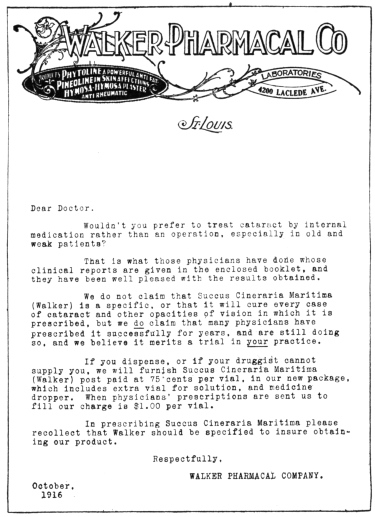
Facsimile of a letter, dated October, 1916, suggesting the use of “Succus Cineraria Maritima” as a cure for cataract and other opacities of vision. Eight months previously (February, 1916), the Walker Pharmacal Company had pleaded guilty to the charge that the claims that “Succus Cineraria Maritima” was a cure for cataract and other eye opacities were false and fraudulent and applied knowingly and in reckless and wanton disregard of their truth or falsity. The federal Food and Drugs Act does not apply to claims made in circular letters or elsewhere than in the trade package.
These charges put the matter flatly up to the Walker Pharmacal Company. This company has for years been telling physicians that their stuff could and would do just what the federal authorities insisted it can not and will not do. Did the Walker Pharmacal Company attempt to defend its claims? Did it demonstrate that Succus Cineraria Maritima would cure cataract? Did it produce evidence of the numerous cases of recovery from blindness or partial blindness which must have been available if the preparation had the powers claimed for it? No! The Walker Pharmacal Company in February, 1916, pleaded guilty—and was fined a paltry $10 and costs.
This, however, is not the end of the story. The company was prosecuted because it had published the false and fraudulent claims in the trade package, thus bringing the claims within the purview of the federal Food and Drugs Act. Had the Walker Pharmacal Company confined its false statements to medical journal advertisements, to the circular letters sent to physicians or to any other advertising matter not part of the trade package, it could have snapped its fingers at the Food and Drugs Act.
It was in February, 1916, that the Walker Pharmacal Company pleaded guilty to the charge of making false and fraudulent claims for Succus Cineraria Maritima. In October, 1916, they were still sending out circular letters to physicians urging the use of Succus Cineraria Maritima in the treatment of cataract and enclosing the usual booklet of testimonials claiming cures for cataract and other opacities of the lens and cornea!

Facsimile of some of the pages from the booklet that accompanied the letter reproduced herewith. The obvious intent of this booklet was to lead physicians to believe that Succus Cineraria Maritima will cure “Opacity of the Cornea,” “Opacity of the Lens,” “Senile Cataract,” “Incipient Cataract,” “Double Cataract,” etc.
Can one conceive a better illustration of the inadequacy of the Food and Drugs Act? The dishonest exploiter of proprietary medicines cares little that the law requires him to keep within certain bounds of truthfulness in the advertising that accompanies the trade package. It isn’t the claims in the trade packages that sell the product; it’s the advertising in medical journals, in circular letters, etc. Yet, the Food and Drugs Act offers no check or curb on false statements or fraudulent claims made for proprietary or “patent medicines” in any other place than the trade packages.
A few weeks ago The Journal called attention to a flagrant case of fraud; and at that time it said, “It is justifiable to assume that when any man, whatever his business, admits in court that he has made fraudulent claims and then continues to make the same claims through channels that are not controlled by penal enactment, that man’s standard of business ethics is such that the public needs protection against it. There are many such men in the ‘patent medicine’ world. The only way in which the public may properly be protected against being defrauded in such cases is for the federal Food and Drugs Act to have its scope extended to cover all advertising of the products coming under the purview of the act.”—(From The Journal A. M. A., March 17, 1917.)
TEKARKIN
Edward Percy Robinson’s “Cure” for Cancer
From various parts of the country The Journal has received a sixteen page pamphlet, Therapeutic Leaves. The publication, which has a saffron colored cover, is said to be published by the National Bio-Chemical Laboratory, Mount Vernon, N. Y. The National Bio-Chemical Laboratory seems to be a style used by Dr. Edward Percy Robinson. The “editorial offices” of Therapeutic Leaves are given as “501 Knox Bldg., 5th Ave. at 40th St., New York,” which is a roundabout way of describing 452 Fifth Ave., the office address of Edward Percy Robinson. The first number (February, 1921) of Therapeutic Leaves gives the names of the “editors” as “E. P. Robinson, M.D., and W. A. Jenner, B.A.” In addition, there is “Assistant Editor, F. J. Geiger,” and “Gen’l Manager, Beverly K. Robinson.” The first and second numbers of Therapeutic Leaves (February and March, 1921) are practically identical, being evidently printed from the same plates. Therapeutic Leaves purports to be a periodical published as “a medium for the dissemination of knowledge, pertaining to therapeusis.” Actually, it is an advertising medium dealing with the products of the National Bio-Chemical Laboratory: “Osmo-Calcic Solution,” “Tekarkin” and “Osmotic Mangano-Potassic Solution.”
These preparations are said to be the “formulas” of Dr. Edward Percy Robinson who lives in Mt. Vernon, N. Y., and has an office at 452 Fifth Ave., New York City. They are used by Dr. Robinson in the treatment of cancer. At an earlier stage they seem to have been known under different names: “Tekarkin” was first “Hypotonic Sal-Cella” and then “Neoanabolin-X;” “Osmo-Calcic Solution” was “Osmotonic Calcic” while “Osmotic Mangano-Potassic Solution” was “Osmotonic Drops.” The three solutions are put up in one package containing 4 c.c. (about 65 minims) of “Tekarkin” and 1 ounce each of the other preparations. The package sells for $10.00. “Remittance with order ... We have no agents.”
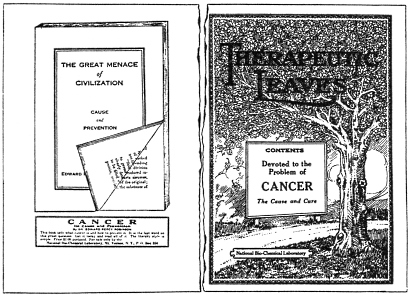
Most of the material in Therapeutic Leaves is a rehash of four papers published by Edward Percy Robinson in the New York Medical Record of various dates between September, 1917, and July, 1920. In these Robinson advances the theory that cancer is caused by an excess of sodium chlorid (table salt) in the blood and tissues and that it can be cured by administering a solution of potassium nitrate. Such a treatment sounds ideally simple. One might assume that all that was necessary was to make up a solution of potassium nitrate and inject it. One might further wonder how it would be possible to commercialize such a “treatment.” “Homemade solutions,” says Dr. Robinson, “are apt to be disappointing.” Their use is likely to cause “considerable swelling at the site of an injection, accompanied with tenderness and some heat.” Moreover, “a wide hyperemic area with red blotches has been observed in a number of instances.” In order to avoid “accidents of this sort” which would “bring discredit upon an excellent agent,” Dr. Robinson, “after considerable experimental work” has obtained “a solution of this chemical which would meet the ideal requirements.” This is available under the name “Tekarkin.” Dilute potassium nitrate solution sold under the name “Tekarkin” sells for $67 an ounce. The physician can make his own solution, of the purest and highest grade potassium nitrate on the market, at an expense, for the chemical, not exceeding 5 cents an ounce.
Therapeutic Leaves also contains the usual number of those “clinical reports” which bulk so large in the literature of “cures” for cancer. Then there is a full page advertisement of a side-line of the National Bio-Chemical Laboratory: “Vitamines (Compressed) Tekarkin Brand;” “They have a meaty taste.”
The medical profession, naturally, is interested in knowing more about the physician who admits that he has discovered the cause and cure of cancer. According to our records, Edward Percy Robinson was born in 1871 and was graduated in 1897 by Bellevue Hospital Medical College. He was licensed in New York State the same year and has practiced in New York City continuously since that time. He is not, and apparently never has been, a member of his local medical society.
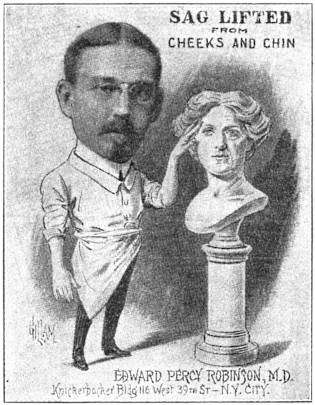
Reproduction (reduced) of some advertising matter issued in 1914 when Edward Percy Robinson was specializing in “facial contouring.”
In 1914 Robinson was specializing in “facial contouring.” One piece of advertising purports to be the reprint of an interview with “Dr. E. P. Robinson, Specialist, as he sat in his office at 116 West 39th Street, having questions fired at him by the reporter.” Thus Dr. Robinson:
“There are physicians everywhere who abandon the general, or family, practice of medicine, to devote their life to some specialty. My specialty is the improvement of the facial features and the beautifying of the shoulders, neck and arms. I round out hollow cheeks, build up the neck, eradicate wrinkles, make irregular noses perfect and remove defects by a process which is my own secret. I claim no superhuman power or ability; I have simply bent my whole professional study and energy to the one line of remodeling—so to speak—the human features, and I employ only scientific methods and aids in my operations.”
In another piece of advertising, a little booklet bearing Edward Percy Robinson’s name, we find the following:
“This is what I accomplish....
“Remove all wrinkles and traces of age from the forehead, or about the eyes and mouth. Lift sag from cheeks and chin.
“Round out hollow cheeks.
“Remove depressions and defects from the chin.
“Build up the neck and shoulders.
“Build up and enlarge the bust.
“Round out and give symmetry to unshapely arms and remove the lines of age from the hands.
“Correct many of the defects not mentioned here, but which may be possessed by exceptional cases.”
Still another advertising leaflet purports to be a reprint of an “editorial” from the Mercantile and Financial Times of March 11, 1914. It is a pretentious puff of Robinson, telling about his “scientific attainments” and his marvelous secret preparations used in “Youthifying the Face.” The Mercantile and Financial Times is an utterly discredited sheet run for the purpose of selling what appear to be editorial comments. Such “editorial” puffs are paid for through the purchase of a certain number of copies of the paper by the party who desires the publicity. The Associated Advertising Clubs of the World exposed this publication in a special bulletin issued in June, 1919, and described it as an “example of publications that serve as convenient tools of fake promoters.” In 1911 the Mercantile and Financial Times published an “editorial” endorsement of the consumption cure “Nature’s Creation.” It has done the same for a fakish device known as the “Ideal Sight Restorer.” It published a puff on the “Oxypathor,” a swindle so preposterous that the exploitation of this “gaspipe” fake was debarred from the U. S. mails and its exploiter was sent to the federal penitentiary.
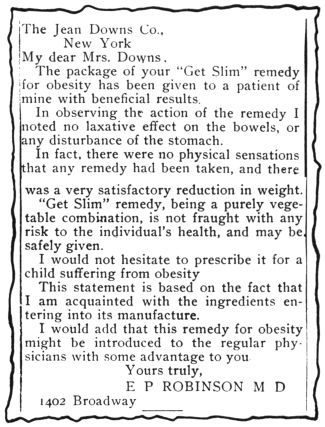
Reproduction (reduced) of a testimonial for an obesity cure fake, “Get Slim.” The A. M. A. chemists reported that this “vegetable combination” consisted of baking soda and pink-tinted tartaric acid and sugar.
We also find in our files a testimonial signed E. P. Robinson, M.D., 1402 Broadway (Edward Percy Robinson’s address in 1912), extolling the virtues of a foolish piece of quackery, the obesity cure “Get Slim.” This nostrum was exposed in The Journal some years ago and was also exposed by Dr. Wiley in Good Housekeeping. The “Get Slim” concern sued Good Housekeeping for libel but a jury decided that Good Housekeeping had told the truth. In the “Get Slim” testimonial Robinson is quoted as saying that he is “acquainted with the ingredients entering into its manufacture” and he describes it, as did the “Get Slim” concern, as “a purely vegetable combination.” The fact is the Association’s chemists found this “purely vegetable combination” to consist of sugar and tartaric acid, each colored pink, and baking soda.
And this is the gentleman who claims to have discovered the cause of, and offers for sale a cure for, one of the most baffling scourges known to modern medicine—cancer. Except for the articles that have been published during the past three years in the Medical Record, we are unable to find anywhere in representative medical literature anything to indicate that Edward Percy Robinson can lay any claim to special knowledge of, or skill in the treatment of, cancer. What we do find are advertisements describing Edward Percy Robinson’s alleged abilities as a “face beautifier,” puffs from utterly uncritical or discredited sources and a testimonial to the value of a preposterous “fat cure” fake.
With the best brains of the world at work on the problem of cancer, it is reasonable to assume that any man who has found out even a little more than has previously been discovered or is able to accomplish even a little better results than the average in the treatment of this dreaded disease, would be well known to scientific medicine.
After this article was in type physicians began sending in No. 3 (April, 1921) of Therapeutic Leaves. This is still another reprint of Nos. 1 and 2, with minor changes. In the first two, Tekarkin is described as “a solution of potassium nitrate of special strength;” in No. 3 it becomes “a special solution containing potassium nitrate.” In Nos. 1 and 2, Robinson described an alleged case of “Cancer of the Rectum Treated with Tekarkin.” In No. 3 this becomes “Medicinal Treatment Cures Cancer of the Rectum.” In No. 3 the names of the editors, assistant editor and general manager are eliminated.
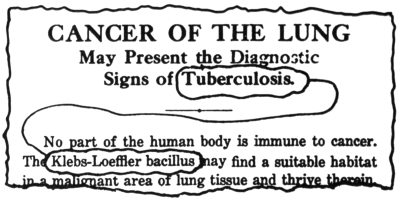
The inside back cover of No. 3 contains an advertisement of Tekarkin, in which physicians are warned that “Cancer of the Lung May Present Diagnostic Signs of Tuberculosis.” It contains the further startling information that the particular micro-organism responsible for pulmonary tuberculosis is the Klebs-Loeffler bacillus! Thus:
“The Klebs-Loeffler bacillus may find a suitable habitat in a malignant area of lung tissue and thrive therein. The presence of the bacillus does not necessarily exclude the presence of cancer. A chronic cough with blood-streaked sputum may be the result of tuberculosis and cancer.”—(From The Journal A. M. A., May 28, 1921.)
TYREE’S ANTISEPTIC POWDER AGAIN
The “Ethical and Commercial Requirements” of the Drug Business
“I am fond of the retail drug business and follow it every day of my life. I know and observe to the fullest extent its ethical and commercial requirements.” This from a circular letter recently received by physicians, and signed J. S. Tyree, who asks that he be forgiven for writing you personally, but there are several reasons why he thinks the circumstances warrant it. All of which is preliminary to calling attention to an enclosure, which accompanies the circular letter, and is described as a “short memorandum” submitted for “your consideration.”
The “memorandum” is a four-page leaflet of which three pages are devoted to “Tyree’s Antiseptic Powder.” One of these three pages is a reproduction of a letter on the stationery of the Surgeon General’s Office of the War Department, and signed “W. M. Gray, M.D., Microscopist, Army Medical Museum; Pathologist to Providence Hospital.” The letter describes a series of “bacteriological and comparative tests” made by Dr. Gray with Tyree’s Antiseptic Powder. The entire second page of the circular is given over to the results of these bacteriologic tests which compare various strengths of Tyree’s Antiseptic Powder with “mercuric bichlorid,” phenol and formaldehyde.
The physicians who received this advertising material in April, 1919, might easily overlook the fact that Dr. Gray has been dead several years, that the letter which is reproduced is dated Jan. 3, 1890, and that the bacteriologic tests were made in 1889—thirty years ago!
The Council on Pharmacy and Chemistry in 1906258 published the results of an analysis of Tyree’s Antiseptic Powder which showed that although the stuff was advertised as a mixture of borax and alum, it was in fact essentially a mixture of zinc sulphate and boric acid. The publication of the Council’s report in 1906, showing the falsity of the formula, brought out the admission that the composition had recently been changed. Certain it is, however, that for at least a decade past, the Tyree product has been a zinc sulphate-boric acid preparation. Yet, according to the manufacturer’s own statement, Tyree’s Antiseptic Powder in 1889, when Dr. Gray made his bacteriologic tests, was an entirely different substance from the present mixture.
Here then we have a manufacturer publishing in 1919, in behalf of a certain product, tests that were made in 1889 with a product of different composition, although of the same name! Is this observing “to the fullest extent” the “ethical and commercial requirements” of the “retail drug business”?
There is no scientific excuse for such a mixture as Tyree’s Antiseptic Powder. If, however, physicians feel that they must use an irrational conglomeration such as this, why not prescribe Pulvis Antisepticus, N. F.? Like the Tyree product, this, too, is essentially a mixture of zinc sulphate and boric acid, with minute amounts of phenol, eucalyptol, menthol and thymol, to say nothing of a dash of salicylic acid. This official article has at least the virtue of constancy of strength, composition and purity assured under the federal Food and Drugs Act.—(From The Journal A. M. A., May 17, 1919.)
WHEELER’S TISSUE PHOSPHATES
“The Commissioner of Health directs me to call to your attention the enclosed advertisement issued by T. B. Wheeler, M.D., Company, Montreal, Canada, in which the name of the Association’s Journal is being used.”
Accompanying this brief note to The Journal from the secretary of Dr. Haven Emerson, Commissioner of the Department of Health of the City of New York, was a four page leaflet devoted to the exploitation of “Wheeler’s Tissue Phosphates.” The trend of the circular is to lead the average reader to infer that The Journal of the American Medical Association has endorsed Wheeler’s Tissue Phosphates. For example, in describing the preparation one reads:
“It embodies ... the best recent scientific opinion concerning the treatment of the disease (tuberculosis) as stated ... by the official Journal A. M. A.”
Elsewhere in the circular The Journal’s criticisms of the hypophosphites and the glycerophosphates (proprietary preparations which are competitors of the Wheeler product) are quoted and twisted into a tribute to the ingredients of Wheeler’s Tissue Phosphates. Garbling quotations, distorting statements, separating phrases from their contexts and omitting qualifying clauses, all for the purpose of making out a case for some proprietary remedy is a trick as old as quackery itself. That it should be used in advertising Wheeler’s Tissue Phosphates is entirely fitting. Obviously, the T. B. Wheeler, M.D., Company esteems the opinion of The Journal on pharmacologic matters. This being the case, it should, in the interest of truth and scientific accuracy, publish in its advertising circulars just what The Journal has said about Wheeler’s Tissue Phosphates. It could not do this better than by quoting from a recent editorial note which commented on a report of the Chemical Laboratory on this preparation. Here is part of the The Journal’s comment:
“ ‘Wheeler’s Tissue Phosphates’ is an unscientific shotgun mixture whose most active and powerful drug is the alcohol it contains. That it was not years ago relegated to the realms of obsolete and discarded preparations is a commentary alike on the lack of scientific discrimination and on the power of advertising.”
Here we have “Wheeler’s Tissue Phosphates” stripped of the verbal camouflage with which its exploiters have invested it.—(Editorial from The Journal A. M. A., Sept. 22, 1917.)
BRIEFER PARAGRAPHS
Alcresta Lotion
To the Editor:—What is the composition of Alcresta Lotion?
L. T. A. Hotten, M.D., Paris, Idaho.
According to a circular in our files, “Alcresta Dental Lotion-Libby” contains “Emetin, the active amebicidal principle of Ipecac, together with Benzoic Acid, Thymol, Eucalyptol and Aromatics.” The theory that emetin is an active amebicide against pyorrhea alveolaris has been exploded. In this connection, it is interesting to note that the firm does not list the product in the latest catalogue in our files.—(Query from The Journal A. M. A., Oct. 29, 1921.)
Calcidin Tablets (Abbott)
To the Editor:—What is the composition of calcidin tablets (Abbott) and what is their value?
J. S.
Answer.—Calcidin is claimed to be a mixture of iodin, lime and starch. In contact with water, the iodin and lime react to form calcium iodid and calcium iodate. By the acid of the gastric juice, the calcium iodid and calcium iodate are decomposed with liberation of free iodin. The administration of calcidin tablets amounts to giving free (elementary) iodin. In the past, the advertising for calcidin has contained the unwarranted claim more or less directly that it was the most effective and only noninjurious preparation of iodin for internal use, and that it possesses all of the valuable properties of the iodin with all of the objectionable effects left out. So far as we know, the effects produced by the administration of free iodin do not differ from those produced by the administration of iodids and, therefore, calcidin has no advantage over the iodids, such as sodium iodid.—(Query in The Journal A. M. A., Sept. 25, 1920.)
Di-Crotalin Treatment of Epilepsy
To the Editor:—Do you have any literature or information relative to the Di-Crotalin treatment for epilepsy? I will be very grateful if you can furnish information as to method of preparation, rationale of the treatment, etc.
R. C. Decker, Captain, M. R. C., U. S. Soldiers’ Home, Washington, D. C.
Answer.—Di-Crotalin is a rattlesnake venom preparation sold by the Swan-Myers Company of Indianapolis as a “Treatment for Epilepsy, Chorea, Bronchial Asthma, Chronic or Hereditary Nervous Headache, Nervous Prostration Incident to Change of Life, Hysteria-Mania, Insomnia, Neurasthenia, etc.” Dr. Thomas J. Mays of Philadelphia advocated the use of rattlesnake venom for tuberculosis. Later his former assistant, Dr. R. H. Spangler, used the same material in the treatment of epilepsy. That any measure of success sufficient to justify the adoption of the rattlesnake venom or crotalin treatment for epilepsy has resulted is not to be concluded from the available reports. Still less evidence is there for the use of rattlesnake venom in the list of conditions for which the Swan-Myers Company has recommended its preparation. There are a number of good reasons why a cautious physician will shun the administration of this treatment and advise against it. J. F. Anderson, working in the hygienic laboratory of the United States Public Health Service, reported a death from the crotalin treatment in consequence of infection, and reports that the market supply of crotalin solution and crotalin tablets is highly contaminated. He also found both crotalin and crotalin solution to vary in activity. The use of rattlesnake venom was discussed in The Journal, March 15, 1913, p. 850.—(Query in The Journal A. M. A., Aug. 17, 1918.)
Estivin
To the Editor:—What is “Estevin,” or something like that? It is said to be good in hay-fever.
Constant Reader.
Answer.—The product called “Estivin” is sold by Schieffelin and Company, New York. A request for a statement of the composition of this preparation sent to Schieffelin and Company by the Council on Pharmacy and Chemistry brought the indefinite and, therefore, meaningless statement that “ ‘Estivin’ is an extract of Rosa Gallica containing no alcoholic or foreign ingredients.”—(Query from The Journal A. M. A., Nov. 12, 1921.)
Iron Arsenite
To the Editor:—Can you inform me how iron arsenite can be prepared for subcutaneous injection? A commercial firm furnishes physicians with ampules of arsenite of iron. Is this really arsenite of iron?
S. H. Kempner, M.D., New York.
Answer.—Ferric arsenite (iron arsenite) is in itself relatively insoluble in water, but may be treated with ammonium citrate, the resulting product thus being soluble; the latter substance was at one time described in New and Nonofficial Remedies as “Ferric Arsenite, Soluble” and is sometimes sold as a solution in ampule form. In 1912, the Council on Pharmacy and Chemistry deleted “Ferric Arsenite, Soluble” from New and Nonofficial Remedies because “one cannot, in administering Ferric Arsenite, Soluble, give a useful dose of iron without giving too much arsenic; and, vice versa, one cannot give a safe dose of arsenic without giving too little iron.” The Council, therefore, held the preparation to be irrational and unscientific.—(Query in The Journal A. M. A., Feb. 19, 1921.)
K-Y Lubricating Jelly
To the Editor:—1. What is the composition of “K-Y Lubricating Jelly”? 2. Can you furnish a formula for a simple nongreasy lubricating jelly?
S. T.
Answer.—1. The composition of “K-Y Lubricating Jelly” has not been divulged. Examination of the advertising matter reveals only meaningless statements, such as: “This is a judicious combination of vegetable products ... Combined in well balanced proportions with non-irritating antiseptics...,” “It incorporates a sufficient quantity of mild antiseptics (of the Thymol class) ...” and “... contains NO formaldehyde.”
2. Probably a simple tragacanth jelly, which can be made cheaply, will produce the same effects as those of the proprietary preparation. The following formula was published by Mr. J. K. Thum, apothecary at the German Hospital, Philadelphia (Druggists Circular, September, 1915, p. 586):
LUBRICATING JELLY
Tragacanth, whole 3 gm.
Glycerin25 c.c.
Phenol 1.5 gm.
Distilled water, a sufficient quantity to make 300 c.c. The tragacanth is broken in small pieces, and put into a wide-mouthed bottle; the other ingredients are added and the bottle frequently shaken.
In regard to this formula, Mr. Thum writes:
It has been used in our gynecologic department for years.... For the last six years we have been dispensing it in collapsible tubes throughout the hospital for general work.—(Correspondence in The Journal A. M. A., May 12, 1917.)
“Nikalgin”
To the Editor:—Collier’s has a special article this week on “Nikalgin.” Have you any information on this subject? It sounds like nostrum stuff.
P. R. Minahan, M.D., Fond du Lac, Wis.
Answer.—“Nikalgin” is said to be the “invention” of Gordon Edwards, an engineer. Large claims for its anesthetic and antiseptic virtues have been made. While no very definite information seems to be forthcoming regarding the preparation, it has been said to be “composed of quinin, hydrochloric acid and urea.” This would indicate that “Nikalgin” may be nothing more wonderful than the well known local anesthetic, quinin and urea hydrochlorid, the Quininae et Ureae Hydrochloridum of the U. S. Pharmacopeia, or a modification of it.—(Query in The Journal A. M. A., Sept. 22, 1917.)
Pertussin and Syrup of Thyme
To the Editor:—A short time ago I received a sample of “Pertussin” and used some in an obstinate case of bronchitis with excellent results. I have since received a catalog from a pharmaceutical firm, which advertises syrup of thyme. I have searched for a formula to make my own syrup of thyme, but have not been able to find one. Will you publish one?
E. F. Benner, M.D., Salfordville, Pa.
Answer.—The subjoined formula yields a product very similar to “Pertussin” in taste, flavor, composition, and probably in activity as well:
Fluidextract of thyme 15 c.c.
Glycerin 15 c.c.
Syrupto make 100 c.c.
The original German preparation contained 1.5 gm. of sodium bromid in each hundred cubic centimeters, and this might be added to the foregoing formula with advantage, so far as action is concerned. However, a sample of “Pertussin” purchased in the open market in the United States failed to respond to tests for bromids.
As fluidextract of thyme is not official, this formula is presented as furnishing an acceptable preparation:
Thyme, in No. 60 powder100 gm.
Moisten with a mixture of:
Water25 c.c.
Alcohol15 c.c.
Glycerin10 c.c.
After standing five hours, pack in a percolator. Exhaust with a menstruum of alcohol, 1 volume, and water, 3 volumes. Reserve the first 85 c.c. of percolate. Concentrate the weak percolate to a soft extract and dissolve in the reserved portion. Make up to 100 c.c. by addition of a mixture of alcohol, 1 volume, and water, 3 volumes.
Other aromatic expectorants, such as terebene, terpin hydrate or creosote, might be expected to have similar but greater effect in chronic bronchitis.—(Query in The Journal, A. M. A., March 27, 1920.)
Quinin and Urea Hydrochlorid
To the Editor:—Could you tell me why quinin and urea hydrochlorid has not become more popular for local anesthesia? Is it less efficacious or more toxic than other preparations? If it is useful, can you name some trustworthy firm or brand? Please omit my name in answering.
L. F. C., M.D., Mexico.
Answer.—Quinin and urea hydrochlorid “has the actions of quinin. When injected hypodermically it exerts an anesthetic action much more prolonged than that of cocain” (Useful Drugs, Ed. 4, 1920, p. 127). It has been pointed out editorially in The Journal (Feb. 14, 1920, p. 462) that quinin has been regarded for more than half a century by toxicologists as a protoplasmic poison capable of destroying various forms of animal and vegetable cells, and hence it need not be surprising that tissue necrosis may be produced by strong solutions of the quinin salts. That this deleterious reaction actually does occur and has militated against the general use of quinin and urea hydrochlorid is confirmed by the report of the Committee on the Advantages and Disadvantages of Local Anesthesia in Nose and Throat Work (The Journal, July 31, 1920, p. 315). To quote:
The only local anesthetic that produces edema and sloughing is quinin and urea hydrochlorid. So many statements were found in the literature that this anesthetic has been abandoned in other fields of medicine because of edema and sloughing, that writers who had presented favorable reports in nose and throat operations were communicated with by your committee. One writer who had recorded 390 cases of tonsillectomies extolling this anesthetic, which he had used for four years and is still so recorded, now states that he has not used it in two years, although no publication has been made retracting his former endorsement. Still another writer, who stated that quinin-urea came nearest the ideal local anesthetic, now states that he has ceased using it. Your committee finds that as far as nose and throat operations are concerned, this drug has practically gone into “innocuous desuetude.”
The anesthesia produced by this drug at the time of operation is good and the recovery of the patient might often be enhanced by its use if it did not have the serious drawback. The product is official in the U. S. Pharmacopeia, and may be obtained from any reputable pharmaceutical house.—(Query in The Journal A. M. A., Aug. 21, 1920.)
Ricord Pills and House Organ Therapeutics
To the Editor:—My mail is frequently cluttered with pseudo-scientific data from various manufacturers of proprietary remedies which contain as much real scientific information as the Police Gazette. I am enclosing a sample page of such a periodical. The article has been so cleverly worded in the first paragraph, as to impress the unthinking with the idea that sodium cacodylate is superior to arsphenamin, when we know in reality that sodium cacodylate has been proved practically worthless in syphilis (vide “Venarsen”). One case is reported, in which twenty injections of sodium cacodylate were administered intravenously, from October 23 to December 14. On December 18, a Wassermann test proved negative, it had been strongly positive on October 20, but during the same interval from October 23 to December 14, the patient had been taking by mouth “Ricord pills” each containing half a grain of yellow iodid of mercury; granted that he had taken these pills regularly, during all that time, it might well be that the Wassermann would be sharply influenced by them. Again, a negative Wassermann in the midst of treatment proves little; it might be positive again in a few days. The article stimulates the further use of a product of known worthlessness in the treatment of syphilis. How any one can use sodium cacodylate in preference to arsphenamin in syphilis is beyond me. If I mistake not, the Propaganda Department has not taken up the matter of these various pamphlets of the drug companies, such as the Doctor’s Factotum, Therapeutic Notes, etc., lauding to the skies such articles as “Seng,” “Cactina Pillets,” etc., ad nauseam. The saddest part of the whole thing is that it must bring returns from the unthinking, otherwise they would soon disappear, which would be a great relief for the scrubwomen who empty our waste baskets.
Paul E. Bechet, M.D., New York.
[Comment.—The “sample page” sent by Dr. Bechet is from the March-April, 1918, number of Parke, Davis & Company’s Therapeutic Notes. It contains an “Original Communication” on “The Treatment of Syphilis with Sodium Cacodylate, by Adolph Lappner, M.D., Detroit, Mich.” The “article,” while nominally devoted to the praise of sodium cacodylate, is virtually a puff for “Ricord Pills.” a Parke, Davis & Co. product.]—(Correspondence in The Journal A. M. A., July 13, 1918.)
Stannoxyl
To the Editor:—I am very anxious to know whether tin or stannous oxid (SnO) has or has had any place among useful drugs. I have seen such a prescription given in the treatment of mucous colitis, and would be very glad to learn what its use may be.
Carlos Manuel Garcia, M.D., Havana, Cuba.
Answer.—Recently, on the assumption that tin workers are less troubled with boils than the average person, two French investigators proposed the use of tin compounds in the treatment of staphylococcic infections. Based on their work, a proprietary preparation—Stannoxyl—has been placed on the market which is claimed to be “composed of stannous oxide and specially purified metallic tin.” Absurd claims are made for the product: for instance, “... We have no hesitation in offering STANNOXYL—in Tablets or Cachets—as the only true specific for diseases of Staphylococcus origin.” The available evidence is unconvincing and in no way warrants such exaggerated statements.—(Query in The Journal A. M. A., March 6, 1920.)
To the Editor:—I was much interested in your answer to a query about Stannoxyl (The Journal, March 6, p. 629). I submit the following experience as a confirmatory note:
While serving with the Royal Army Medical Corps in Egypt, I for some time had charge of the medical division of a hospital in which most of the skin diseases occurring among soldiers in the district were treated. The most common conditions were boils and septic sores, chiefly due to staphylococcal infection, though several of the latter cases were diphtheritic. The treatment adopted was that in ordinary use, namely, incision and evacuation of pus, application of antiseptic dressings, and in most cases employment of the specific vaccine. It was possible to judge of the efficacy of any variations of treatment, as there were always plenty of cases undergoing the usual treatment with which the results could be controlled.
An available supply of Stannoxyl, a proprietary remedy consisting of a mixture of metallic tin and tin oxid, enabled me to give it a fair trial in full doses in eight cases of boils of average severity, in which culture revealed the infecting organism to be Staphylococcus aureus. The boils were treated locally as usual, but no vaccine was given. No improvement could be demonstrated in these cases that could not be shown in other cases similarly treated with the omission of Stannoxyl; in fact, three of the treated cases were much longer in clearing up than the untreated controls. Eight cases do not constitute a very large series from which to draw conclusions; but if the preparation were as good as the descriptive literature would lead one to believe, one should have expected an evident result in at least one of these cases.