Volume 1 / Part 2 — FOREWORD
Reading edition
THE CHEMICAL LABORATORY OF THE AMERICAN MEDICAL ASSOCIATION
The Chemical Laboratory of the American Medical Association was established in 1906 to assist the Council on Pharmacy and Chemistry in the investigation of proprietary remedies.
In accordance with the principle of its foundation, the Laboratory examines and checks the claims made for the composition and chemical properties of the products under examination by the Council, and when these are admitted to New and Nonofficial Remedies, it insures the establishment of tests and standards whereby the identity and purity of these products may be controlled. In addition, the Laboratory supplies information, secured by reference to chemical and pharmaceutical literature or by actual analytic work, in regard to proprietary and unofficial medicines, either for publication in The Journal of the American Medical Association or through direct correspondence.
Those portions of the Laboratory’s activities which are of special interest to physicians and which were not included in the Reports of the Council on Pharmacy and Chemistry were included in the Propaganda for Reform in Proprietary Medicines, ninth edition (1916), so far as they had been published up to the time when the edition was issued; those made during the last five years are included in Part II of this volume.
For a detailed report of the Laboratory’s work, the reader is referred to the article that follows on “The Work of the American Medical Association Chemical Laboratory.” Those who are interested in the analysis of drugs are referred to the Reports of the Chemical Laboratory issued annually for the details of the analyses which have been made by the Laboratory.
THE WORK OF THE AMERICAN MEDICAL ASSOCIATION CHEMICAL LABORATORY[G]
W. A. Puckner, Phar.D.
The American Medical Association Chemical Laboratory was established nearly ten years ago—in fall of 1906. The reason for its existence was primarily the fact that the Council on Pharmacy and Chemistry found it difficult to secure from outside sources such help as it needed in checking up the composition and properties of proprietary medicines under investigation. Medical schools and similar institutions were found ready to lend their assistance in pharmacologic and medical investigations; but the chemical investigation required the establishment of a laboratory under the control of the American Medical Association.
As years have passed, the scope of the laboratory has been extended: Its services have been requisitioned by The Journal in various ways. Thus, when requested, the laboratory reviews and verifies the chemical data contained in editorials and original contributions. The laboratory is often called on for information as to the character and composition of quack treatments and so-called “patent medicines.” Through the columns of The Journal and through direct correspondence, the laboratory responds to requests of physicians with information regarding the composition of medicines which they prescribe or in which they are interested. The laboratory attempts to be to the members of the American Medical Association what the prescription pharmacist is, or should be, to the prescribing physician—a storehouse of chemical and pharmaceutical information. In the belief that an insufficient familiarity with the chemistry and pharmacy of drugs constitutes the chief reason for the extensive use of unscientific, worthless or fraudulent proprietary remedies, this service is rendered by the laboratory as a contribution to the cause of rational therapy.
Since the efficiency of the American Medical Association Chemical Laboratory will increase as its activities are better known, the following more detailed statement of its work is offered:
THE LABORATORY AND THE COUNCIL
As stated in the rules of the Council on Pharmacy and Chemistry, it is “manifestly impossible for the Council to investigate the composition of every complex pharmaceutical mixture ...”; “it can only give an unbiased judgment on the available evidence.” In line with this, the laboratory does not undertake to prove the composition of constitution of all new synthetics, nor does it attempt to determine the individual composition of proprietary mixtures. It checks all claims that seem doubtful, however, and uses its best endeavors to secure correction of misstatements with regard to proprietary remedies and improvement in the quality of these products. Further, it reexamines, when this seems desirable, the products which have been admitted by the Council to New and Nonofficial Remedies, and thus determines, from time to time, their dependability. The fact that no product admitted to New and Nonofficial Remedies has later been shown to be untrue to its claimed composition is, it is believed, an indication that in this respect the laboratory has succeeded in performing the work for which it was primarily created.
In this connection the question may be asked, Are many proprietary medicines exploited to the medical profession with false claims in regard to their composition? Also it may be asked, Has the number of proprietaries marketed with false statements of composition decreased since the Council and the laboratory began their work? Answering the latter question first: There is no doubt that today fewer proprietary medicines are being sold with false claims as to composition than there were ten years ago. When the Council began its work, medical journal advertising teemed with statements regarding the composition of medicines which any chemist familiar with medicine would not hesitate at sight to brand as untrue. Today such manifestly false claims are rare. Coming to the former question: Many false statements regarding the identity and composition of remedies have been made in ignorance. This is not surprising when it is remembered that the most ignorant may and do engage in the manufacture of medicine. Besides ignorance, however, an accommodating conscience on the part of the manufacturer and a failure on the part of the medical profession to appreciate the danger which lies in the use of medicines of unknown composition unquestionably have greatly encouraged the marketing of falsely declared medicines. A glaring illustration of the ignorance of manufacturers—for it is hard to believe that any business concern would deliberately court prosecution by the federal authorities through false statements on labels—is the fact that nearly thirty years ago A. B. Lyons published a report147 pointing out that the proprietary Iodia was falsely declared as to composition and that in 1914 when the Council examined this preparation such incorrect declaration appeared on the label.148 That many physicians do not recognize the danger to their patients and their reputation in the use of medicines, the composition of which they do not know, is illustrated by the fact, disclosed by inquiries sent to the laboratory, that physicians were found willing to employ an arsenical preparation (Venarsen), advertised for intravenous use, although its promoters vouchsafed no information in regard to the nature of the arsenic compound contained therein.
UNRELIABILITY OF LITTLE USED DRUGS
The purpose of the federal Food and Drugs Act is to secure the prosecution and punishment of all who sell medicines which are adulterated or misrepresented as to composition. As a matter of fact, the wording of the law relating to the adulteration and misbranding of drugs is such that the federal authorities have been able to do little more than to require that the drugs for which standards are provided in the Pharmacopeia shall when sold comply with those standards. Similarly, those states which attempt to improve the quality of drugs sold within their borders—few states do efficient work along these lines—limit their work to the enforcement of the Pharmacopeial standards. This leaves the vast number of unofficial drugs and medicaments beyond the control of federal or state authorities. While most of these drugs are relatively unimportant, and while the amounts of them which are used are not great individually, the total consumption of them is large. With a view of furnishing to physicians standards for drugs of this sort the Council has described in New and Nonofficial Remedies not only distinctly proprietary drugs, but also some of the unofficial drugs which are apparently of therapeutic value and used to a considerable extent. Aiding the Council in this line of endeavor, the laboratory has attempted to establish standards for these little used drugs, and New and Nonofficial Remedies, 1916, provides standards for such unofficial and non-proprietary drugs as quinin and urea hydrochlorid quinin, tannate, sodium acid phosphate, and sodium perborate. An example of work which furnished much needed standards for an unofficial article is the investigation of zinc permanganate by W. S. Hilpert.149 Reference to the published reports of the laboratory will give an idea of the amount of work such standardization entails. A reference to the new U. S. Pharmacopeia, when this comes from the press, will show that a considerable number of unofficial articles described in New and Nonofficial Remedies have been admitted to the Pharmacopeia along with the standards worked out in this laboratory.
While in a way the work done in connection with these less important drugs has attracted little attention from the medical profession, it has had an effect on pharmaceutical manufacturers. In the past, pharmaceutical houses, ever anxious to market something new, on the slightest provocation have placed on the market, in the form of pills, powder, elixir, ampule, etc., every drug for which some sort of medical recommendation could be found. In marketing these dosage forms, the manufacturer has too often been little concerned about the quality of the drugs used.150 Just at present, for instance, some interest is being shown in iron cacodylate; but while manufacturers appear to be most ready to take advantage of this interest by offering the drug in the form of ampules, etc., they have given little help toward the establishment of standards for this arsenic compound. Manufacturers are ever ready to sell drugs of all sorts, but in view of the small demand they cannot or will not safeguard the identity and purity of such drugs. A further illustration of the unreliability of unofficial drugs is the recent report by Levy and Rowntree151 showing not only that the various dosage forms of emetin hydrochlorid obtained from different manufacturers varied from manufacturer to manufacturer, but also that the product of the same manufacturer was variable and that the supply furnished by one pharmaceutical firm was so toxic as to make its use dangerous.
THE ANALYSIS OF “PATENT MEDICINES”
In the preface to the first annual report of the chemical laboratory it was stated that the laboratory “occasionally takes up the examination of ‘patent medicines’ ...” At that time it was felt that the widespread use by the medical profession of irrational and even secret medicines made it necessary to devote the laboratory’s attention to the correction of this evil. As the years have passed on, these conditions have been remedied to some extent, at least so far as chemical analysis can correct them. On the other hand, public opinion has been aroused to the many evils connected with the exploitation of “patent medicines,” and has more and more insistently demanded that the medical profession aid in the correction of this evil. Accordingly, the laboratory has paid much attention to the analysis of “patent medicines” during the last few years. As the chief asset of “patent medicines” is the element of secrecy which surrounds their composition, it is hoped that the laboratory’s analysis of such widely used “patent medicines” as Nature’s Creation,152 Mayr’s Wonderful Stomach Remedy,153 Sanatogen,154 Eckman’s Alterative,155 Tonsiline,156 and Bromo-Quinin157 has been worth the labor. In addition, the work of this laboratory has been published, including not only the results of its analyses, but also the methods which are used. In view of the dearth of published reports regarding the methods used in the analysis of “patent medicines,” it is hoped that this feature of the laboratory’s work has been of aid to chemists engaged in similar work.
The laboratory’s activities along these lines have done much to discount the claim of proprietary manufacturers that chemical analysis is unable to determine the character of “patent medicines.” The recent Wine of Cardui trial has brought it out prominently that chemical analysis can determine the presence of potent constituents, and that “patent medicines” which fail to reveal such potent ingredients to the analyst may safely be put down as worthless. The demonstration that the essential composition of medicinal preparations may be determined by chemical analysis should also prove an effective answer to the manufacturers in their protest against the requirement, now being urged for enactment into law in various states, that the medicinal ingredients of their wares must be declared on the label. Manufacturers have held that this would lay them open to competition with imitations and substitutions. The possibility of chemical identification proves, however, that secrecy of composition, though it prevents consumers from knowing the character of a “patent medicine,” will not be a hindrance to the imitator and substitutor.
IDENTITY OF DRUGS USED IN INVESTIGATIONS
In the past, much of the experimental work in medicine has seriously suffered in that the identity of the material used in such investigations was not established. In view of this the laboratory has watched the contributions submitted to The Journal, and whenever necessary and feasible has urged the authors to identify their material before publication of the findings. For instance, a number of staining agents—so-called “anilin dyes”—have been found to possess therapeutic action. Since the identity of many of these staining agents is today essentially secret, the laboratory has urged through The Journal that those who experiment with these substances make an effort to determine their identity whenever possible and to give preference to those the chemical identity of which is known. The need for such identification has been discussed in the reports of the laboratory.158 The amount of work involved in the chemical identification of drugs used for experimental work is illustrated in a contribution entitled “An Examination of Several Commercial Specimens of Opium Alkaloids or Their Salts.”159 by L. E. Warren, in which was determined the identity of the various opium products used in an investigation by D. I. Macht, carried out under a grant of the Therapeutic Research Committee.
THE LABORATORY AND PHARMACEUTICAL LITERATURE
In the past much of the information in regard to the composition and properties of medicines which has appeared in pharmaceutical journals has not become available to medicine. In many cases medical journals could not afford to publish such data because this would have been contrary to the interest of their advertisers, and hence the publications regarding the irrational character of Lactopeptine, of Bromidia, etc., which appeared in the pharmaceutical journals did not become a matter of common medical knowledge. Through the laboratory an attempt has been made to keep the medical profession informed in regard to pharmaceutical literature. The laboratory has a good working pharmaceutical and chemical library, and subscribes to the important American and foreign pharmaceutical and chemical publications. The discussion of new remedies, such as medinal and sodium veronal,160 salvarsan, atoxyl and arsacetin,161 and neosalvarsan162 soon after their introduction, illustrates the work of the laboratory along these lines.
THE LABORATORY’S EFFORTS TOWARD RATIONAL PRESCRIBING
The laboratory naturally is in thorough sympathy with the present day efforts toward a more rational use of drugs, as exemplified in the Council’s publication “Useful Drugs.” Two recent contributions of the laboratory may be cited as a further support of the movement for limiting prescribing to the more widely used drugs. In line with the general tendency of manufacturers to put out all sorts of modifications and asserted improvements over official substances, there have been placed on the market a number of preparations said to represent some improvement over the pharmacopeial Blaud pills. The report, “The Quality of Commercial Blaud’s Pills,”163 by L. E. Warren, shows that the ordinary pharmacopeial Blaud pill is in every way the equal of the semiproprietary preparations claimed to be improvements. Further, the examination of the various brands of sodium and theobromin salicylate as compared with the preparation diuretin by P. N. Leech164 shows that the former preparations, sold at 35 cents per ounce at the time the examination was made, are fully the equal of the proprietary Diuretin, which then cost the druggist $1.75 per ounce.
THE LABORATORY AS AN INFORMATION BUREAU
It is generally admitted that the proprietary medicine business, particularly the exploitation of complex mixtures, attained the extensive vogue which it has or had because instruction in medical schools was deficient in materia medica, pharmacy and chemistry. As a result of lack of knowledge along these lines, the young graduate after some trial became fearful of formulating his own prescriptions, and in time became dependent on pharmaceutical firms which provided him with medicines ready to dispense. That physicians have been insufficiently trained in regard to the pharmacy and chemistry of drugs has often been emphasized in pharmaceutical journals where prescriptions containing incompatible drugs are reported and where even plans are brought forward whereby the pharmaceutical profession may aid in remedying this difficulty.
During my pharmaceutical experience I was often sorely vexed as to what to do when prescriptions contained drugs which on mixing would undergo decomposition which the physician surely did not anticipate. I remember well a prescription directing that potassium permanganate be made into pills with extract of gentian and other things, and how, the physician having spurned the suggestion to modify the prescription so as to avoid decomposition of the permanganate, I was obliged to select a mortar, gently triturate the drugs until a conflagration was started, and to finish the prescription after the combustion had subsided. However, in my pharmaceutical experience I generally found the physician most ready to receive suggestions from the pharmacist which would prevent incompatibilities, improve the palatability and appearance of his prescriptions, and protect the patient from unnecessary expense.
Similarly it has been my experience since the establishment of the Association’s laboratory that physicians are anxious to receive information in regard to the materia medica, pharmacy and chemistry of drugs. As the druggist earns the respect and support of the physician when he makes available to him the pharmaceutical knowledge and experience which he has, so this laboratory has aimed to gain the endorsement of the American Medical Association membership by furnishing to physicians information in regard to the composition, chemistry and pharmacy of drugs through replies in the Query and Minor Notes Department of The Journal as well as through direct correspondence. It has been most gratifying to the laboratory that The Journal receives an increasing number of inquiries both as regards the chemical and pharmaceutical questions involved in the writing of prescriptions and as regards the composition of secret and semisecret proprietaries (often because they are prescribed by the inquirer’s colleague) and “patent medicines” (which are taken by his patient). The laboratory has tried its best to answer the many inquiries received. Many of the questions which come in can be answered by a pharmacist or chemist without hesitation. Others, particularly as to the composition of medicines, the laboratory has been able to answer by reference to its library and its extensive card index. Still others have required experimentation and chemical analysis.
While, as stated a moment ago, the laboratory has encouraged the sending of inquiries and has earnestly striven to furnish the information asked for, it is obvious that the amount of chemical work which can be done is limited. The small size of the laboratory force, consisting of three chemists engaged in actual analytical work, makes it necessary to select for investigation those problems which shall be of general interest to the medical profession. As the American Medical Association is national in its scope, the laboratory has held that it can do analytical work only when such work will be of general interest to physicians and of value both to the medical profession and the public. In view of this it has refrained from undertaking analyses which would benefit only the physician making the inquiry and possibly his patient. The laboratory further has not felt justified in undertaking work of merely local interest; instead it has used its endeavors to secure the investigation of such local problems by municipal or state authorities.—(From The Journal A. M. A., Nov. 25, 1916.)
LEAD IN “AKOZ”
Akoz is a mineral product sold by the Natura Company of San Francisco, and said to possess most remarkable medicinal properties.
A circular issued by the Natura Company begins thus:
“While scientists have been striving through the centuries to compound remedies for man’s various ills, Nature, greatest chemist of them all, has been working wonders in her crucibles and has achieved results far beyond man’s greatest expectation.”
“Nature’s chief handicap has been the difficulty of placing her gifts in the hands of those whom she would benefit. By accident or fate, as you will, one of Nature’s greatest medicinal products has just been discovered. It is the mineral given the name of Akoz by John D. Mackenzie, president and manager of the Natura Company of San Francisco, which is now giving this rare remedy of Nature to the public.”
The circular then describes how the power of the “rare remedy” to cure rheumatism is claimed to have been discovered and asserts that:
“Akoz was subjected to every known scientific test before being presented to the public. It was practically determined that the ore contained a new element having radium-like qualities but containing nothing poisonous or harmful.”
“After the curative virtues of Akoz for rheumatism, stomach trouble, eczema, catarrh, piles, ulcers and numerous other ailments had been fully established in chemical laboratory, hospital clinic, and the private practice of physicians in various parts of the world, Mr. Mackenzie effected the organization of the Natura Company.”
This product, put up in the form of “Akoz Medicinal Mineral Water, Akoz Ointment, Akoz Powder and Akoz Suppositories,” was submitted to the Council on Pharmacy and Chemistry for consideration some years ago with the claims that “Akoz” itself consists essentially of zinc sulphid, barium sulphate and aluminum oxid. The submitted analysis did not declare the presence of lead or of uranium though “special tests” for the latter had been “run.” Without checking the claimed composition, the Council at that time refused recognition to Akoz because there was no evidence submitted for the very extravagant and altogether improbable therapeutic claims.
After the Council had concluded the consideration of Akoz a letter was received from a California physician stating that according to an analysis submitted to him Akoz contained 0.34 per cent. of lead in the form of lead sulphate. The correspondent held that, while the lead sulphate did not pass into solution, persons drinking the supernatant liquid from Akoz (the “medicinal mineral water” is made by adding Akoz to ordinary water) might inadvertently swallow some of the powder. He was inclined to believe that this might account for a case of lead poisoning which had been observed in a patient who had been taking Akoz.
Inasmuch as it has been demonstrated by Carlson and Woelfel (Carlson, A. J., and Woelfel, A.: Solubility of Lead Sulphate and Basic Lead Carbonate in Human Gastric Juice.... In Hygiene of the Painter’s Trade by Alice Hamilton, Bull. of U. S. Bureau of Labor Statistics No. 120, May 13, 1913, pp. 22–32) that even small quantities of lead sulphate when taken into the system for a long time, have produced lead poisoning, the laboratory deemed it important that the products be examined for lead.
A specimen of “Akoz Powder” submitted to the Council by the Natura Company and contained in a sifter-top can was taken for analysis. The contents of the can were thoroughly mixed. To determine the presence of lead some of the powder was extracted with ammonium acetate solution.
Details of Analysis
Qualitative tests showed the presence of lead and sulphate in the ammonium acetate solution.
The presence of lead was demonstrated by the black precipitate with hydrogen sulphid, the yellow precipitate with potassium chromate and the typical yellowish crystalline precipitate with potassium iodin.
The presence of sulphates in the ammonium acetate solution was shown by the formation of a precipitate with barium chlorid solution and acetic acid.
Two 2 gm. samples (A and B) were taken for the quantitative determination of lead. Each was treated repeatedly with a saturated solution of ammonium acetate until the filtered ammonium acetate solution gave no appreciable precipitate with potassium chromate solution. The ammonium acetate extractions from each specimen were combined and treated with hydrogen sulphid, the precipitated lead sulphid filtered off and washed, and ignited with sulphuric acid at a low heat. The crucible with the residue of lead sulphate was cooled and weighed.
A yielded 0.0469 gm., or 2.34 per cent., lead sulphate. B yielded 0.0440 gm., or 2.20 per cent., lead sulphate.
While the laboratory has no evidence to show that the amount of lead-sulphate thus found to be present is likely to prove harmful, the following cautionary letter was sent to the Natura Company:
“According to information which you sent to the Council on Pharmacy and Chemistry your product “Akoz” does not contain lead. In view of reports received ascribing symptoms, resulting from the internal use of Akoz, to chronic lead poisoning, an examination of a specimen of Akoz Powder, which you sent to the Council, was made. This examination indicates the presence in Akoz Powder of about 2.2 per cent. lead sulphate. In view of the disastrous results likely to follow the internal use of products containing even small amounts of lead, the above is submitted to you for your consideration.”
No reply to the foregoing was received from the Natura Company.—(From Reports A. M. A. Chemical Laboratory, 1916, p. 103.)
SODIUM ACETATE IN WARMING BOTTLES
Recently the laboratory’s attention was called to the “ThermoR Waterless Hot Bottle,” manufactured by the Royal Thermophor Sales Co., New York. The following claims appear in one of the advertising pamphlets:
“There is moist heat.” “Rubber hot-water (? ? ?) naturally give a moist heat.” It (ThermoR) gives a dry heat.
“The ‘THERMOR’ Bottle is not a hot-water bottle—it acts on a principle that is entirely different and new.”
“... gives you first, last and all the time a fixed degree of dry usable heat—a heat that holds steadily at 125 degrees for fully twelve hours—you will easily see why it is that ‘THERMOR’ relieves and cures where hot-water bottles fail.”
The bottle was nickel plated, 83⁄8 inches in diameter and 11⁄2 inches thick, and in appearance resembled an exaggerated closed Ingersoll watch.
The bottle is not flexible and weighs 31⁄2 pounds. The contents consisted essentially of sodium acetate. This salt melts when heated. When it cools the temperature inside the bottle is relatively constant, as it will remain at the “freezing point” until all of the sodium acetate has solidified. The duration of the time that it remains warm when well wrapped is simply in inverse proportion to the conductivity of the surrounding environment. When two ordinary towels were carefully arranged about it, the air between the bottle and the wrappings was maintained at a temperature of 40–50 C. (104–122 F.) for a period of eight hours.
The company’s implication that the heat given out by the Thermor bottle differs from that given out by an ordinary hot-water bottle is an absurdity. The use of sodium acetate in the preparation of warming bottles has been in practice many years, and is not “a principle that is entirely different and new.” Furthermore, the therapeutic claims are extravagant.—(From Reports A. M. A. Chemical Laboratory, 1916, p. 105.)
ANTI-SYPHILITIC COMPOUND (SWEENY)
A specimen of Anti-Syphilitic Compound (Sweeny), sold by The National Laboratories of Pittsburgh, was received from a physician. The package (1 ounce size) has been opened by the sender and about three fourths of the contents removed.
From the rather indefinite statements in the literature of the manufacturer it is gathered that the preparation is claimed to be a “sterile, oily emulsion” which contains 1⁄20 grain of mercuric benzoate in each 5 minims, together with some sodium chlorid. According to information furnished by the Laboratory’s correspondent, the price asked for the preparation is $15 an ounce.
The quantity of the preparation received was too small to permit a complete examination, but, from the tests which it was possible to make, the preparation appears to be an aqueous solution containing some suspended matter and small quantities of mercuric benzoate and a chlorid, presumably sodium chlorid. There was no evidence of the presence of an “oily emulsion.” Quantitative tests indicated the presence of a mercuric salt, equivalent to about 0.2783 gm. of crystallized mercuric benzoate per 100 c.c. This corresponds to about 0.00086 gm. in each 5 minims, or about 26.5 per cent. of the amount claimed.—(From Reports A. M. A. Chemical Laboratory, 1916, p. 106.)
“AMBRINE” AND PARAFFIN FILMS[H]
Paul Nicholas Leech, Ph.D.
In the last year or so, the hot-wax or paraffin treatment of burns has been widely discussed both in medical and lay periodicals. Although the treatment is simply a modification of the well-known use of oil and ointments, it has received unusual attention, owing to the widespread sensationalism following the exploitation in France of a secret and therefore mysterious mixture, “Ambrine,” the formula of Dr. Barthe de Sandfort. Owing to this publicity, it seemed desirable to investigate the chemical composition, and to compare its physical properties with other waxlike substances.
“Ambrine” is promoted as a dressing for burns, frostbites, neuritis, varicose ulcers, phlebitis, neuralgia, rheumatism, sciatica, gout, etc. It is a smoky-appearing substance, resembling paraffin in consistency and without odor. For application, “Ambrine” is melted and applied to the wound either with a brush or with a specially devised atomizer. It cools quickly, and leaves a solid, protecting film.
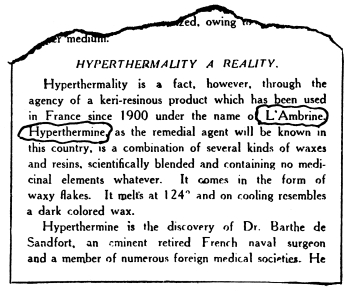
“Ambrine” has been exploited in the United States for some time. To physicians it was sold under the name “Hyperthermine.” Above is a photographic reproduction (reduced) of a portion of a booklet describing “Hyperthermine,” which has been in The Journal office for some years.
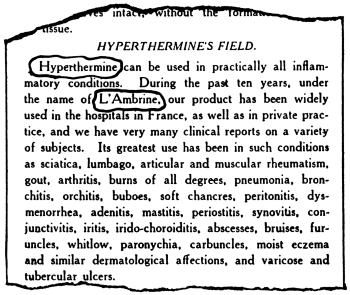
Photographic reproduction (reduced) from the “Hyperthermine” (“Ambrine”) booklet recommending it for use in rheumatism, gout, pneumonia, buboes, dysmenorrhea, eczema, tuberculous ulcers, etc.
It is said that de Sandfort “stumbled on this treatment by accident.”165 Being a sufferer from rheumatism, he had been benefited by hot mud baths; on returning home he sought a substitute, and finally made a mixture of paraffin, oil of amber and amber resin. This was applied hot, serving as a firm poultice. “Years later, he went on service to a railway in China and was in Yunnan at the time of the incendiary insurrection, and many badly burned Chinese were brought in for treatment. Remembering that Ambroise Paré treated such cases with hot oil, he tried the effect of covering the burn with his melted ambrine, which at once glazes over, forming a coat impervious to the air, and his patients ceased to suffer.”166
“Ambrine” has been sold in America under two names: “Hyperthermine,” as exploited to physicians, and “Thermozine,” as advertised to the public. Physical comparison alone shows that Ambrine as now sold differs from “Hyperthermine” of a few years ago; the probable reason is that “Ambrine” has changed its formula. This is borne out by Matas,167 who states that de Sandfort “admitted that Ambrine was a compound of paraffin, oil of sesame and resins, but was not at liberty to divulge its exact composition, as the formula and manufacture of this substance was now the property of a private corporation, which was exploiting it as a proprietary and secret remedy.” The later formula differs from the original.
Besides the foregoing paraffin preparations, two others have recently been placed on the American market, “Parresine” (nonsecret) and “Mulene” (secret).
ANALYSIS OF AMBRINE
“Ambrine” comes in rectangular cakes, about 11⁄2 inches wide, 6 inches long and 1⁄2 inch thick. It is moderately soft, but somewhat brittle at ordinary room temperature. A black substance is present, which evidently settles out during the compounding, as in one side of the cake these particles can be clearly discerned by holding it up to the light; in the other side there are no suspended particles. When melted, the solution is not clear, and a sediment forms. The melting point (U. S. P. method; see later) is 48.4 C. The plasticity and ductility168 are 27 and 30.5, respectively. It is pliable and strong at body temperature. The saponification number and acid number are both very low, but a fatty oil is present. Tests indicated oil of sesame. Ninety-eight per cent. of “Ambrine” is soluble in ether; this soluble portion may be treated with low-boiling ligroin (petroleum ether), out of which, on standing, a black asphalt-like substance separates. Of the ether-insoluble substance, 65 per cent. is soluble in chloroform. The remaining insoluble substance contains a small amount of silica and vegetable fiber. The paraffin obtained from “Ambrine” melted at 48.6 C. As a result of various experiments, it appears that the composition of “Ambrine” is essentially as follows:
Paraffin (M. P. 48.6 C.) 97.0 per cent.
Fatty oil (sesame?) 1.5 per cent.
Asphalt-like body 0.5 per cent.
Coloring matter, and undetermined 1.0 per cent.
——
100.0
OTHER PROPRIETARY FILMS
A cursory examination of “Mulene,” manufactured by the Mulene Company, Pittsburgh, was also made. This appears to contain paraffin, beeswax, a fat-soluble red dye and considerable rosin. When heated carefully in a beaker, the rosin “sticks” to the bottom, and does not go into solution readily.169
“Paresine,”170 according to the manufactures, is a mixture composed of paraffin, 94 to 96 per cent.; gum elemi, 0.20 to 0.25 per cent.; Japan wax, 0.40 to 0.50 per cent.; asphalt, 0.20 to 0.25 per cent., and eucalyptol, 2 per cent., the whole being colored with alkannin and gentian violet.171
FORMULA FOR PARAFFIN FILM
In a recent article, Sollmann172 presented various suggestions for the compounding of paraffin films. Some of the formulas were promising and others were not, but all were simple. He did not try to imitate “Ambrine.” Lieut.-Col. A. J. Hull173 of the Royal Army Medical Corps, after experimenting with different combinations, concluded that a mixture of “1 part resorcin, 2 parts eucalyptus oil, 5 parts olive oil, 25 parts soft paraffin [petrolatum]174 and 67 parts hard paraffin” served the purpose as well as “Ambrine.” The following formula, which might be called Asphalt-Paraffin No. 21, much more closely resembles “Ambrine,” and it seems to have certain advantages, due to the use of a more suitable grade of paraffin:
Paraffin175 (M. P. by U. S. P. method 47.2 C.)97.5 gm.
Asphaltfrom 3 to 5 drops
Olive oil 1.5 c.c.
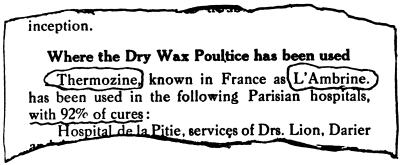
Photographic reproduction from a booklet on “Thermozine” showing that it is identical with “Ambrine.”
About 10 c.c. of “asphalt varnish” (B. Asphaltum)176 is placed in a beaker and heated on the steam bath for one-half hour. From 3 to 5 drops, delivered from a 1 c.c. pipet, are then placed in a casserole, and 1.5 c.c. of olive oil added. The mixture is heated and stirred for a few minutes until perfect solution is effected. To this is then added, with stirring, the paraffin, which has been previously melted. When it is cooled, a brown solid is obtained.177 The physical factors of this paraffin mixture are, melting point 45.4 C. (U. S. P. method); plasticity, 28.5; ductility, 29; it is very pliable and strong at 38 C., and adheres exceedingly well to the skin, although it detaches easily. This mixture, which is easy to prepare, is inexpensive, the cost of the materials being approximately 10 cents a pound.
Both Hull and Sollmann noticed that tarlike substances and melted paraffin do not mix well. This is noticeable in “Ambrine,” which cannot be called an “elegant” preparation. The difficulty may be overcome by first mixing hot olive oil and asphalt; the asphalt will then go into solution. It is interesting to note that the suggested formula (as well as others which were also prepared) is not as plastic as the paraffin itself.178 This is also true of “Ambrine.” On the other hand, the melting point of the paraffin is higher. The important point, however, in compounding all paraffin preparations, is to select a proper grade of paraffin as elaborated below.
EXAMINATION OF PARAFFINS AND PARAFFIN PREPARATIONS
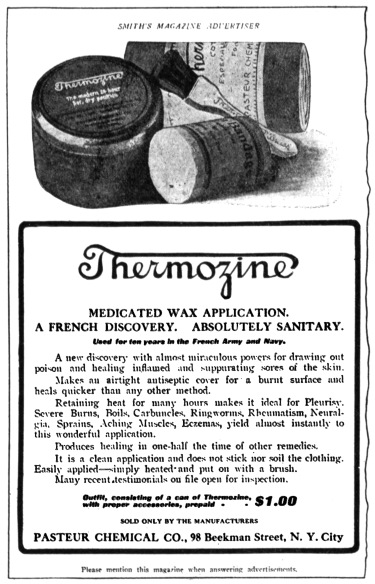
Photographic reproduction (greatly reduced) of a full page magazine advertisement of “Thermozine,” the name under which “Ambrine” was sold to the public.
The name “paraffin” generally applies to a colorless and tasteless waxlike substance that is solid at ordinary temperature. It is composed of saturated hydrocarbons, that is, they are unable to take up any more hydrogen, and thereby are quite stable; the hydrocarbons in paraffin have the general formula of CnH2n+2, ranging as high as C24H50 to C27H56. Paraffin may be found in crude form in coal, from which source the first paraffin candles were made. It may be produced from the distillation of brown coal, as in Germany, or from bituminous shale. In America, it is obtained chiefly from the distillation of crude petroleum, being in the residue after the distillation of such products as naphtha (gasoline), kerosene and the lubricating oils. The residue is treated by one of a number of processes causing the unpurified solid paraffin to be made available. The crude paraffin is either sold as such, or is refined. Paraffin or “paraffin waxes”179 are designated in the trade by their melting points (which in the “American standard” is expressed in Fahrenheit degrees), and as to their state of refinement as “crude,” “semirefined” and “fully refined” paraffin. There are certain chemical and physical differences so that two refined waxes having the same melting point would not have the same plasticity. The higher melting point varieties of paraffin are hard and tough at room temperature: when melted, paraffin expands and forms a thin mobile liquid.
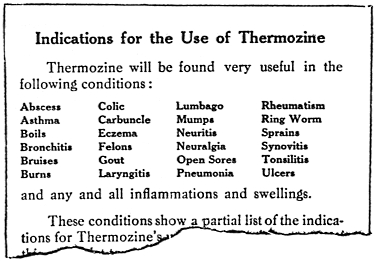
Photographic reproduction from a booklet on “Thermozine” giving the conditions in which the stuff was alleged to be “very useful.”
The significant requirements of paraffin for surgical dressings are that it should be solid at body temperature, at the same time having flexibility and adhesiveness, together with a certain amount of strength. A number of brands of paraffin are sold in the United States, so that it seemed advisable to examine some of them and compare them with certain paraffin-film preparations. They were tested as to their melting points, plasticity, ductility, strength of film, etc.
Melting Point Determination.—The melting point was determined by the method of the U. S. Pharmacopeia IX, p. 596. The melting point as obtained by this method is lower than the melting point used by manufacturers of paraffin (after conversion to Fahrenheit).
Pliability and Ductility, Limit Temperature.180—A little of the melted wax was poured from a teaspoon on the surface of the water at about 40 C., in a tin pan (bread mold). This formed a fairly thin film. The temperature of the water was then lowered by the addition of cold water. At each temperature the pliability and ductility were tested thus:
Pliability Test.—The film, immersed in water, was doubled on itself, note being taken whether or not it broke.
Ductility Test.—The film was pulled under water, note being taken whether it stretched on being pulled and broke with a ragged fracture; or whether it broke sharp without stretching. It is desirable that the pliability and ductility be preserved at as low a temperature as possible.
Cotton Films, Adhesives and Detachability.180—The melted wax was applied as it would be for burns; namely, a thin layer was painted on the inner surface of the forearm with a camel’s hair brush,181 a transverse strip about an inch wide being made. This was covered with a very thin layer of absorbent cotton, and over this another layer of melted wax was painted. As soon as this had cooled a little, it was covered by a few layers of bandage and left on for at least an hour. At the end of that time, the bandage was removed. The cotton film should be found at the place at which it was applied, showing that it is sufficiently adherent. It should detach without “pulling” the skin.
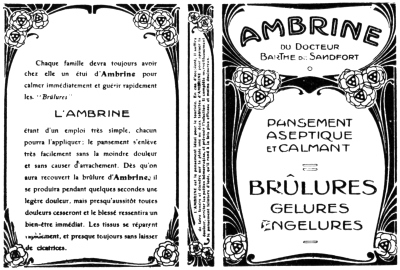
Photographic reproduction (greatly reduced) of the carton in which “Ambrine” is now sold.
The results of these tests are given in the accompanying table. It can be seen that nearly all the paraffins examined have properties which would make them useful, the notable exceptions being Nos. 8, 15 and 16. The more satisfactory products would be those having a melting point about 47 C., ductility of 30 or below, and plasticity of 28 or below. The paraffin described in the U. S. Pharmacopeia is not so satisfactory, the required melting point being between 50 and 57 C.
The use of paraffin bandages has been suggested by Fisher182 and Sollmann.183 In such cases, it may very likely be that a paraffin of higher melting point would be more satisfactory, owing to its greater resistance and tougher fiber.
SUMMARY
1. “Ambrine” is essentially paraffin in which a small amount of fatty and asphalt-like body is incorporated; like most secret mixtures, its composition varies.
2. A simple formula for a paraffin film, similar in chemical composition but superior in physical properties to “Ambrine,” is that described as Formula 21. The superiority is due to using a grade of paraffin that is better adapted to the purpose. The cost of materials is about 10 cents a pound.
3. The properties of the paraffin used for a surgical dressing are important. A number of different grades have been examined, in order to determine the ones that appear most promising. Paraffins Nos. 3, 4, 10, 11 and 25 are the best in the table, and surpass “Ambrine” itself.
4. It is exceedingly probable that further experience will show that for most purposes simple paraffin will serve just as well as the mixtures—if, indeed, not better.
Addenda
(Reprinted from the Annual Report of the Chemical Laboratory of The American Medical Association, Vol. 10 (1917), p. 32)
Since the foregoing was published, two other products—“Cerelene” and “Stanolind Surgical Wax”—were submitted to the Council on Pharmacy and Chemistry for investigation as to their acceptability for inclusion in New and Nonofficial Remedies. In this connection the Laboratory was requested to examine them.
“Cerelene” is manufactured by the Holliday Laboratories, Pittsburgh. According to the manufacturers, “Cerelene” is a compound composed of 84 per cent. paraffin, 15 per cent. myricyl palmitate and 1 per cent. elemi gum. As ordinarily marketed, “Cerelene” contains the following materials: To the beeswax is added Oil of Eucalyptus, U. S. P., 2 per cent., and Betanaphthol, U. S. P., 0.25 per cent. The manufacturer further states that the myricyl palmitate is a purified form of beeswax, free from all impurities, acids, etc., which is solely manufactured by this company and for which patents are pending. The properties described for “Cerelene” were as follows:
When cold, Cerelene is a solid wax-like cake of a fine yellow brown color. On exposure to air for long periods, the amber color darkens to some extent. It is entirely free from solids, odorless and tasteless; does not separate or change when melted repeatedly, and cannot in the melted state be separated by fractional crystallization. It is entirely neutral to indicators being perfectly free from both acids and bases.
Tests: Melting Point, U. S. P. method, 126 F.
Density, U. S. P. method, 0.907.
Iodin value, 0.5.
Saponification number, 0.9.
“Stanolind Surgical Wax” is manufactured by the Standard Oil Company of Indiana. In the submission of the product to the Council on Pharmacy and Chemistry, it was stated that the product was a specially prepared paraffin “free from dirt or other deleterious matter.... It has been steamed and resteamed to drive out any free oil and repeatedly filtered.”
The examination of the foregoing products yielded the figures described in Table “B.”—(From The Journal A. M. A., May 19, 1917.)
THE STABILITY OF IODINE OINTMENTS
L. E. Warren, Ph.C., B.S.
In general, the literature on the keeping qualities of iodine ointment, and on the stability of iodine if mixed with ointment bases, is confusing. The recorded evidence is often contradictory. The attention of the writer was brought to this condition by studies of several proprietary preparations, Iodex,184 Iod-Izd-Oil,185 Iocamfen, and Iocamfen Ointment.186
Iodex was sold under the claim that it is
“... an embodiment of vaporized iodine, in an organic base, reduced and standardized at 5 per cent. by incorporation with a refined petroleum product.”
The exact composition of Iodex is a trade secret. Analysis showed that it contains petrolatum-like substances and combined iodine, the latter probably in combination with oleic acid. Tests for free iodine were made in five specimens of Iodex. In one of these no free iodine was present; in the others the merest traces were found.
Two years ago a preparation called “Iod-Izd-Oil” was examined. This was claimed to contain 2 per cent. of free iodine in liquid petrolatum. At the time of the examination the age of the preparation was not known, but it had been obtained just prior to the analysis, and was thought not to be very old. The analysis showed that it contained but about 0.43 per cent. of iodine, all of which was in a free state. The fact that all of the iodine present was in the free state appeared to indicate that iodine is relatively stable in liquid petrolatum solutions.
Iocamfen is a liquid composed of iodine, camphor and phenol. It was claimed to contain 10 per cent. of free iodine. Analysis showed that it contained 9.3 per cent. of total iodine (of which 7.5 per cent. was present in an uncombined state), 66.1 per cent. of camphor and 19.7 per cent. of phenol. After storing for several months a second assay of Iocamfen showed no appreciable loss in iodine content. This would indicate that iodine is relatively stable in presence of phenol and camphor, although immediately after mixing there is some loss of free iodine. The Iocamfen Ointment was supposed to contain 50 per cent. of Iocamfen (equivalent to 5 per cent. of free iodine) in a lard-wax-cacaobutter base. The analysis showed that the ointment contained but 0.4 per cent. of free iodine, the balance being in combination. From the results of the examination, and from correspondence with the manufacturers (Schering and Glatz), it became evident that the only plausible explanation for the loss of free iodine in the preparation of Iocamfen Ointment from Iocamfen lay in the combination of the free iodine with the ingredients of the ointment base. It seems likely that the free iodine originally present in Iocamfen for the most part had gradually gone into combination with the fatty substances after the ointment had been prepared.
The literature was then examined to determine the consensus of opinion concerning the stability of iodine in iodine ointment. In the older literature the belief that iodine ointment is unstable appears to be quite general. Such statements as the following are typical:
The ointment should be prepared only when wanted for use, for it undergoes change if kept, losing its deep, orange-brown color, and becoming pale upon its surface.187
It is better to prepare it only as it is required for use.188
This ointment must not be dispensed unless it has recently been prepared.189
In 1909 Lythgoe,190 of the Massachusetts Board of Health laboratory, reported an examination of four samples of iodine ointment. Three were found to be pure, the fourth was low in iodine. Experiments showed that iodine ointment deteriorates rapidly; consequently, no further collections of samples were made.
In 1912 Pullen191 reported that he had prepared two specimens of iodine ointment according to the British Pharmacopeia, one being from new lard and the other from a specimen of lard at least 2 years old. Assays for free iodine were carried out immediately after the preparations were made, and at intervals afterward up to four months. The following values were found:
Sample ISample II
Ointment from new lard, per cent.Ointment from old lard, per cent.
Iodine introduced4.0 4.0
Iodine found immediately after making3.953.38
Iodine found after twenty-four hours3.303.15
Iodine found on the third day3.182.62
Iodine found on the seventh day3.152.46
Iodine found on the fourteenth day3.002.45
Iodine found after one month3.002.39
Iodine found after two months2.902.31
Iodine found after four months2.922.26
Pullen found that the loss in free iodine could be accounted for by the iodine which had gone into combination with the fats of the ointment base.
Pullen also found that if the potassium iodide and glycerin were omitted in the preparation of the ointment, the loss in free iodine was very rapid, the preparation containing practically no free iodine (only 1⁄20) after a few hours. He concludes that the use of potassium iodide and glycerin is necessary for the preservation of the ointment. He obtained specimens of iodine ointment in drug stores, and assayed them for free iodine. It is to be presumed that the ages of the several specimens were not known. The results are found in the following table:
Specimen No. 12.74 per cent.
Specimen No. 22.85 per cent.
Specimen No. 32.62 per cent.
Specimen No. 42.48 per cent.
Specimen No. 52.53 per cent.
Specimen No. 62.79 per cent.
Fried192 prepared iodine ointment according to the U. S. P. VIII formula, and assayed it at intervals. His results are tabulated herewith:
Per cent.
Iodine introduced4.00
Iodine found immediately after making3.89
Iodine found one hour after making3.51
Iodine found one day after making3.48
Iodine found five days after making3.06
Iodine found ten days after making2.84
Iodine found thirty days after making2.81
Iodine found ninety days after making2.81
Iodine found eight months after making2.81
Iodine ointment has been official in the U. S. Pharmacopeia since 1870. Briefly, the method now used for making the preparation is as follows:
Four gm. of iodine, 4 gm. of potassium iodide and 12 gm. of glycerin are weighed into a tared mortar and the mixture triturated until the iodine and potassium iodide are dissolved and a dark, reddish-brown, syrupy liquid is produced. Eighty gm. of benzoinated lard are then added in small portions and with trituration after each addition. The mass is then triturated until of uniform consistence.193
PARAFFINS AND PARAFFIN PREPARATIONS—TABLE A
FormulaSubstanceMelting Point, U. S. P.Ductility LimitPlasticity Limit(a) Adhesiveness and Detachability (b) Strength of Film at 38 C.
1“Parowax,” Stand. Oil Co. of Ind.50.832.529.0(a) Adheres and detaches well; rather hard (b) Pliable and strong
3“Paraffin 118–120 F.,” Stand. Oil Co. of Ind.46.828.524.5(a) Does not adhere well; detaches easily (b) Pliable but not strong
4“Paraffin 120–122 F.,” Stand. Oil Co. of Ind.47.229.024.5(a) Adheres well; detaches well (b) Pliable and fairly strong
5“Paraffin 123–125 F.,” Stand. Oil Co. of Ind.48.831.528.5Same as 4
6“Paraffin 128–130 F.,” Stand. Oil Co. of Ind.52.033.030.0(a) Adheres well; detaches not so easily (b) Pliable and strong
7“Texwax,” Texas Co., Port Arthur, Texas51.232.529.8Same as 6
8“Paraffin Wax 122–124 F.,” Warren Refining Co., Warren, Pa.50.636.034–35(a) Unsatisfactory; does not adhere (b) Only slightly pliable; too tough
9“Paraffin No. 910,” Waverly Oil Works, Pittsburgh47.030.526–27(a) Adheres well; detaches well (b) Pliable and strong
10“Paraffin No. 920,” Waverly Oil Works, Pittsburgh44.427.525.0(a) Adheres well; detaches well (b) Pliable and fairly strong
11“Hard Paraffin,” Rob’t Stevenson & Co., Chicago48.028.524.5–25.5(a) Adheres well; detaches well (b) Pliable and strong
12“Paraffin,” Island Petroleum Co., Chicago47.233.032.5Not quite as good as 11
13“Paraffin 122 F.,” Gulf Refining Co., Pittsburgh46.830.527.5–28(a) Does not adhere so well; detaches well (b) Very pliable
14“Paraffin 125 F.,” Gulf Refining Co., Pittsburgh50.032.031.0About as 13
15“Paraffin 132 F.,” Gulf Refining Co., Pittsburgh54.835.534.0(a) Does not adhere well (b) Not very pliable, but strong
16“Paraffin No. 301,” National Refining Co., Cleveland50.233.032–32.5(a) Does not adhere well (b) Not very pliable
18Paraffin recovered from “Ambrine”48.630.528–28.5(a) Adheres well; detaches well (b) Pliable but not strong
19“Hyperthermine”49.433.530.5–31(a) Does not adhere well; detaches well (b) Very pliable and strong
20“Ambrine”48.430.527.0(a) Adheres well; detaches well (b) Very pliable and strong
21Paraffin 120–122 F. (see 3), 97.5; olive oil, 1.5; asphalt, 4 drops45.429.028.5(a) Adheres excellently; detaches well (b) Very pliable and strong
22“Parowax” (see 1), 97.5; olive oil, 1.5; asphalt, 4 drops49.232.030.5(a) Adheres well; detaches well (b) Pliable and strong
23“Mulene”51.036.028.0(a) Adheres but detaches with difficulty (b) Pliable but not strong
24“Parresine,” Abbott Laboratories, Chicago46.029.526.0(a) Adheres well; detaches easily (b) Pliable and fairly strong
25“Paraffin 118–121 F.,” The Atlantic Refining Co., Philadelphia45.826.423.2(a) Adheres well; detaches easily (b) Pliable and fairly strong
TABLE B
26“Cerelene,” Holliday Lab.,* Pittsburgh50.030.526.5(a) Adheres well; detaches with pulling (b) Not strong at 38 C.
27“Stanolind” Surgical Wax,† Standard Oil Co. of Ind.47.028.825.0(a) Adheres well; detaches easily (b) Fairly strong at 38 C.
* On being heated, it readily loses eucalyptol, and a small amount of resinous substance forms in the bottom of the beaker. If “Cerelene” is heated to 145 C. and cooled, the resulting product no longer has the properties of the original “Cerelene.”
† Accepted by the Council on Pharmacy and Chemistry for inclusion in New and Nonofficial Remedies.
Iodine ointment is officialized also in several foreign pharmacopeias, although the iodine strength of the several preparations is not uniform. The formula in the British Pharmacopeia is exactly like that in the U. S. Pharmacopeia except that pure lard is directed to be used instead of benzoinated lard. Some of the foreign pharmacopeias also specify that the preparation must be freshly prepared when wanted. In the earlier editions the U. S. Pharmacopeia directed the ointment to be prepared by using water as the solvent for the potassium iodide. In the U. S. Pharmacopeia VIII the formula was changed so as to employ glycerin, and that solvent is now official. Water is still prescribed as the potassium iodide solvent by the Pharmacopeias of the Netherlands and of France.
From the examination of the literature it seems probable that iodine ointments which contain petrolatum products only as the ointment bases are apt to be relatively stable, so far as the content of free iodine is concerned. On the other hand, ointments the bases of which contain fats of the unsaturated fatty acid series, such as oleic acid, do not satisfactorily preserve the iodine in the free state. In the latter class it seems likely that the iodine enters into combination with the unsaturated fatty acids. Accordingly, on theoretical grounds, an ointment base composed of pure stearin (if such substance were available) but softened by an admixture of liquid petrolatum would preserve the iodine satisfactorily. Cocoanut oil (iodine No. 8) ought to be suitable also if mixed with hard paraffin.
Since the literature was not sufficiently concordant to warrant positive conclusions concerning the stability of ointments containing free iodine, it seemed worth while to conduct experiments with preparations of known origin. Accordingly, a number of preparations containing free iodine were made under varying conditions and each was assayed for its free iodine content immediately after its manufacture and from time to time later.
Leaf lard of the best quality obtainable was purchased from a butcher. This was rendered in an open dish on the steam bath. The preparation was of a fine color, and uniform consistence and had a faint but not unpleasant odor. Two specimens of lard were furnished by the research department of Armour and Company. An effort was made to procure specimens of lard having iodine absorption numbers as far apart as possible, i. e., one with a low and the other with a high iodine value. This was done in order to determine whether the keeping qualities of the ointments prepared from the two would be alike.
One of the specimens (a) was described as
“Natural lard; iodine value, 57.1. Leaf lard used exclusively for butterine and benzoinated lard.”
The other specimen was described as
“Prime steam lard. Good, commercial grade of lard for general use; iodine value, 69.0.”
The iodine absorption numbers of the three specimens were determined by the U. S. P. process to be as follows:
Laboratory rendered specimen57.1
Armour specimen (a)57.65
Armour specimen (b)67.55
Each specimen was benzoinated according to the process described in the U. S. P. IX and 100 gm. of iodine ointment were prepared from each according to the U. S. P. process. Another specimen was made from benzoinated lard and iodine only194 without the addition of either glycerin or potassium iodide. This was made to contain 4 per cent. of iodine.
Immediately after preparation each of these iodine ointments was assayed for free iodine, and each was reassayed at intervals later. The method for the determination of iodine in the ointment was that employed in this laboratory for the determination of iodine in Iocamfen Ointment.195 It is essentially the same as was employed by Pullen for the determination of uncombined iodine in iodine ointment.196 As carried out in this laboratory for iodine ointment it is as follows:
From 5 to 8 gm. of the ointment were weighed in a small porcelain capsule, the capsule and contents placed in a 16 oz. salt mouth bottle together with 20 c.c. of chloroform, 10 c.c. of potassium iodide solution and 40 c.c. of water. Tenth-normal sodium thiosulphate was slowly added with agitation until the pink color of the chloroform layer had nearly disappeared. A little soluble starch was then added and the titration continued until a blue color in the aqueous layer could no longer be obtained by repeated shaking.
The findings for the several assays are tabulated herewith:
Age at time of assayU. S. P. Ointment from laboratory rendered lardU. S. P. Ointment from commercial lard Grade IU. S. P. Ointment from commercial lard Grade IIOintment from lard and iodine only (laboratory rendered lard)
(% I)(% I)(% I)(% I)
Freshly made3.323.263.300.32
After 3 days3.25............0.23
After 7 days2.993.173.15......
After 3 weeks3.013.193.07......
After 7 weeks3.12*3.103.02......
After 3 months2.982.882.88......
* This slight rise in iodine content followed by a fall could not be accounted for. The specimen was believed to have been very thoroughly mixed at the time of manufacture.
That the fatty constituents of the ointment contained iodine after the preparation had been made for some time was demonstrated. Some of the material was examined as follows:
A portion of the ointment which had been made for nearly three months was shaken in a separator with chloroform and a dilute mixture of potassium iodide and sodium thiosulphate solutions. After all of the free iodine had been removed the chloroformic solution of the fats was washed several times with a very dilute solution of sodium thiosulphate. The chloroformic solution was filtered, evaporated and the residue dried over sulphuric acid.197
The separated fat was then tested for iodine by Kendall’s method.198 It was found to contain iodine in considerable amounts, but quantitative determinations were not made.
The Pharmacopeia of the Netherlands directs that iodine ointment shall contain 3 per cent. of potassium iodide and 2 per cent. of iodine instead of equal proportions (4 per cent. of each) as prescribed by the U. S. Pharmacopeia. Likewise the French Pharmacopeia directs that 10 per cent. of potassium iodide and only 2 per cent. of iodine shall be used. Both of these pharmacopeias use water instead of glycerin as the solvent. Loose combinations of iodine and potassium iodide, such as are represented by the compound having the formula KI3, have been described. The quantity of potassium iodide prescribed by the U. S. Pharmacopeia for the preparation of iodine ointment is not sufficient to form such a compound as KI3 with all of the iodine directed to be used. Since some of the pharmacopeias use larger proportions of potassium iodide (more than sufficient to form the compound, KI3), it seemed worth while to determine whether an ointment containing a greater proportion of potassium iodide than that required by the U. S. Pharmacopeia would be more stable than the official article. Accordingly a specimen was prepared to contain 4 per cent. of iodine, 8 per cent. of potassium iodide (twice the U. S. P. requirement), 12 per cent. of glycerin and 76 per cent. of lard. This was assayed for its free iodine content immediately after preparation, and found to contain 3.68 per cent. Nine days later it contained 3.70 per cent. Another specimen of the same iodine strength prepared from grade No. 2 of commercial lard assayed 3.69 per cent. at the initial assay, and seven days later 3.40 per cent. From these experiments it seems likely that the free iodine content of the U. S. Pharmacopeia iodine ointment could be raised somewhat by increasing the proportion of potassium iodide.
The results of these studies confirm the findings of Pullen and of Fried in all essential particulars. It appears that during the process of manufacture of iodine ointment about 20 per cent. of the free iodine goes into combination with the fatty constituents of the ointment. On standing for a month approximately an additional 5 per cent. goes into combination, after which there is practically no loss in free iodine content. In other words iodine ointment which is a month old is a relatively stable preparation. It appears to make no noticeable difference upon the rate and amount of iodine absorption whether the lard from which the ointment is made has a high or a low iodine absorption value. The composition of iodine ointment, which has been made sufficiently long to have reached equilibrium, is approximately as follows:
Free iodine 3 per cent.
Iodine combined with fat 1 per cent.
Potassium iodide 4 per cent.
Benzoinated lard (containing iodine)80 per cent.
The U. S. Pharmacopeia requirement that iodine ointment shall be freshly prepared when wanted appears to be unnecessary. Probably most pharmaceutical manufacturers are aware of this, for many of them include the preparation in their trade lists. The presence of an iodide appears to be necessary, to prevent practically all of the iodine from entering into combination with the fat.199—(From the American Journal of Pharmacy, August, 1917.)
IODOLENE AND THE SOLUBILITY OF IODIN IN LIQUID PETROLATUM
The Council on Pharmacy and Chemistry was asked to examine a preparation submitted with the statement that it was “iodin crystals incorporated in a petroleum product.” The name “Iodolene” was proposed by the promoters, providing the product was found eligible for New and Nonofficial Remedies.
Iodolene was stated to have been prepared by treating a liquid petrolatum, obtained from Gulf Coast petroleum, with an excess of iodin; the mixture was subsequently “placed in an oven for three hours.” The claim was made that this method of procedure produced a preparation containing more iodin than market specimens which had been examined, namely: “over 1.50 per cent. free iodine.”
Two specimens of the product were submitted, one stated to have been unfiltered, and the other filtered. Both of the specimens emitted a strong odor of hydrogen sulphide upon removing the stopper from the respective containers.
Iodin Content of Iodolene.—The iodin content of the filtered specimen was determined thus: A weighed amount—3 to 5 gm.—was transferred to a separator by means of 20 c.c. of ligroin, used in portions. Twenty c.c. of 10 per cent. potassium iodid solution was added and the free iodin titrated with tenth-normal sodium thiosulphate solution (with agitation), the end point being the absence of a yellow color in the aqueous layer. The amount of free iodin was found to be 1.32 per cent.
The Solubility of Iodin in Liquid Petrolatum.—To determine the solubility of iodin in Liquid Petrolatum, 200 c.c. of Liquid Petrolatum-Squibb (said to be composed of hydrocarbons of the naphthene series) and 200 c.c. of Stanolind Liquid Paraffin (said to be composed chiefly of marsh gas hydrocarbons) were each treated with 5 gm. of iodin crystals. The two mixtures were maintained for a week at a temperature somewhat above that of the room and agitated occasionally. Each was then cooled to room temperature (about 22 C.), agitated for a day and then filtered. The amount of iodin in the preparation made with Liquid Petrolatum-Squibb was found to be 1.42 per cent. The iodin content of the preparation made with Stanolind Liquid Paraffin was 1.30 per cent.
In view of these findings the prospective manufacturer was advised that the Council cannot countenance a proprietary name for an unofficial, simple solution of iodin in liquid petrolatum.—(From Reports A. M. A. Chemical Laboratory, 1917, p. 87.)
AMERICAN-MADE SYNTHETIC DRUGS—I
Examination of American-Made Acetylsalicylic Acid
Paul Nicholas Leech, Ph.D.
At the request of the Council on Pharmacy and Chemistry, the A. M. A. Chemical Laboratory has undertaken examinations of American-made synthetic drugs. The most extensively used synthetic is acetylsalicylic acid and hence an investigation of this product was deemed expedient.
For seventeen years acetylsalicylic acid was protected by a United States Patent (the proprietors were not given a patent in other countries) and sold under the name “Aspirin.” In February, 1917, the patent expired, and since then a number of firms have engaged in the manufacture of acetylsalicylic acid, selling it either as such or as aspirin, modified, of course, by a distinctive firm designation. During this period the former manufacturers (The Bayer Co., New York, in past years called Farbenfabriken of Elberfeld Co., New York) have been extensively advertising, both to physicians and the public, the alleged superior qualities of their product. The chemical examination, therefore, was concerned chiefly with tests of purity, and the comparison of the American brands with the formerly patented product.
In European countries, acetylsalicylic acid200 is described in the various pharmacopeias as a condensation product of acetic anhydride or acetyl chloride with salicylic acid (o-hydroxybenzoic acid). Generally the test of identification is hydrolysis of acetylsalicylic acid and qualitative tests for acetic acid and salicylic acid. For purposes of purity the requirements are essentially that the specimen should have a certain melting point, should show absence of salicylic acid by means of ferric chloride (the manipulations for the tests are variously described) and leave no appreciable ash. The two tests of purity most generally employed, however, are the melting point and the reaction with ferric chloride.
MELTING POINT
The melting point of acetylsalicylic acid has been given at various temperatures from 118 to 137 C.201; the British Pharmacopeia describes the melting point at 133 to 135 C.; the German Pharmacopeia “about 135 C.;” the French Pharmacopeia at 135 C.; New and Nonofficial Remedies, 1917, 134 to 136 C. The Bayer Company, in the patent trial at Chicago a number of years ago, gave among the “four infallible tests” a melting point of “about 135 C.” Several men have carefully determined the melting point in recent years. Emery and Wright202 in 1912 found that “Aspirin, Bayer” melted at 130.5 to 131 C. In France, François203 has determined the melting point of pure acetylsalicylic acid, which, according to his method, is 132 C. When various samples of acetylsalicylic acid were examined in this laboratory, it was found that the melting point of none was as high as that described in New and Nonofficial Remedies or the British, French, or German pharmacopeias when taken according to the general method of the U. S. Pharmacopeia, Vol. 9, p. 596. On critical observation, it may be seen that the melting point of acetylsalicylic acid is preceded and accompanied by decomposition. If the sample in the melting tube is heated from the original room temperature of the bath to 120 C., the temperature of melting will be lower than if the bath is first heated to 120 C. and the melting-point tube then placed in the bath.204 Thus the melting point of acetylsalicylic acid, like so many organic compounds which decompose and do not melt sharply, is unsatisfactory and cannot be taken as an “infallible test” of purity, especially when determined by different operators who do not give their method in detail. After making a large number of melting-point determinations of acetylsalicylic acid, alone and in parallel with other operators, it was decided to use the method described in the U. S. Pharmacopeia modified by first heating the bath to 120 C. before attaching the melting-point tube to the thermometer.
The melting point of purified acetylsalicylic acid was found to be 131.5 to 132.5 C. (corr.).205 With the exception of one specimen, which was obviously impure, the various specimens examined melted between 128 and 133 C. as may be seen in the accompanying table. It would appear that this range of melting points would be more acceptable and reliable than the melting points described in various standards.
PRESENCE OR ABSENCE OF FREE SALICYLIC ACID
It is generally conceded that the presence of salicylic acid in amounts more than traces is deleterious. Furthermore, the amount of salicylic acid is a good index of the purity of the acetylsalicylic acid, because the test is so delicate that, under favorable conditions, mere traces may be determined and, as a rule, the better the product, the less the amount of free salicylic acid.
The tests appearing in various pharmacopeias for salicylic acid as an impurity in acetylsalicylic acid do not give concordant results, different workers interpreting the results differently, nor are they detailed in such a manner as to yield maximum delicacy.
After experimentation, it was decided to establish a “limit” test of approximately 0.1 per cent. free salicylic acid, when carried out according to the following method:
0.1 gm. of the substance was placed in a dry colorimeter tube and 1 c.c. of alcohol,206 previously distilled over NaOH, was added. After the acetylsalicylic acid had dissolved, 48 c.c. of water and 1 c.c. of fresh 0.1 per cent. ferric chloride (FeCl3.6H2O) solution were added. At the same time a control was run by treating 1 c.c. of a “standard” salicylate solution the same as above.207 If within two minutes the color given by acetylsalicylic acid is not more intense than the color given by the “standard,” the presence of not more than 0.1 per cent. free salicylic acid is proved.208
The solutions used were prepared as follows:
Redistilled alcohol was treated with a small amount of sodium hydroxide for twenty-four hours, then again distilled.
The color standard was made by dissolving 0.116 gm. of dried sodium salicylate in water, adding 1 minim of glacial acetic acid, and making up to 1,000 c.c. Each c.c. represents 0.1 mg. of salicylic acid.209
The ferric chloride solution was made by diluting 1 c.c. ferric chloride (FeCl3.6H2O) test solution U. S. P. with 99 c.c. of water. The diluted solution must be freshly prepared each day.
With one exception, all of the commercial specimens examined responded satisfactorily to the above test showing less than 1 part salicylic acid in 1,000 parts acetylsalicylic acid. The individual results are given in the accompanying table.
Melting Point and Salicylic Acid Determinations
BrandMelting Point CorrectedFree Salicylic Acid Colorimetrically
Acetylsalicylic acid, P. W. R.¹130.0–131.0°Colored, but showing less than 0.1 per cent.
Acetylsalicylic acid, Millikin²130.0–131.0°No color
Acetylsalicylic acid, Millikin²
5-grain capsules129.0–130.0°No color
Acetylsalicylic acid, Millikin,¹
5-grain capsules³128.0–129.0° (a)Colored, but showing less than 0.1 per cent. (a)
125.5–126.5° (b)Considerably more than 0.1 per cent. (b)
Acetylsalicylic acid, Squibb²131.0–132.0°No color
Acetylsalicylic acid (Aspirin),¹ Monsanto131.0–132.0°No color
Acetylsalicylic acid, M. C. W.¹130.5–131.5°Colored, but showing less than 0.1 per cent.
Acetylsalicylic acid, M. C. W.¹131.5–132.5°Colored, but showing less than 0.1 per cent.
Acetylsalicylic acid, M. C. W.¹131.0–132.0°Colored, but showing less than 0.1 per cent.
Aspirin, Bayer¹ (before patent expired)131.5–132.5°No color
Aspirin, Bayer¹ ⁴ (after patent expired)128.5–129.5°Colored, but showing less than 0.1 per cent.
Aspirin, Bayer¹ ⁴ (after patent expired)129.5–130.5°Colored, but showing less than 0.1 per cent.
Aspirin, Lehn and Fink²130.5–131.5°0.1 per cent.
Aspirin, Lehn and Fink²130.5–131.5°Colored, but showing less than 0.1 per cent.
Aspirin, Lehn and Fink¹131.0–132.0°Colored, but showing less than 0.1 per cent.
1: Obtained on the open market. 2: Obtained from manufacturer. 3: One-third of the capsules (a) contained a white powder; two-thirds of the capsules (b) contained a pink powder having strong odor of acetic acid and not complying with the tests. 4: Not described in “New and Nonofficial Remedies, 1917”; the other products are.
OTHER TESTS
New and Nonofficial Remedies, 1917, requires that acetylsalicylic acid shall form a clear solution with warm sodium carbonate solution; that sulfates, chlorides and heavy metals shall be absent; that 0.5 gm. shall leave no weighable ash. All the brands reported in this paper complied with these requirements.
So far there has been no satisfactory quantitative estimation of acetylsalicylic acid. True, various methods have been proposed, but they are objectionable. It was thought that hydrolysis of acetylsalicylic acid and then titrating the solution by comparing the color formed by ferric chloride with that of a standard control might yield interesting results, providing that the conditions were alike. For this purpose 1 gm. of acetylsalicylic acid was dissolved in 10 c.c. of alcohol and diluted to 1,000 c.c. The solution was then heated at 98 to 100 C. for two hours, allowing the alcohol to evaporate, then allowed to stand at room temperature (22 C.) for twenty-two hours. After adding water sufficient to make 1,000 c.c., it was compared colorimetrically for salicylic acid strength. The amount of hydrolysis varied so with different samples under the same conditions, that it was realized that an approximate assay by this method was unreliable. If the assay were made under more exact conditions, quantitative comparisons might be possible. In one experiment, after sixty days the hydrolysis of the acetylsalicylic acid was 61 per cent., which is in rough agreement with the work of Tsaklatos and Horsh.210
DISCUSSION
Apart from the proposed revision of the standards for the melting point and limit of salicylic acid in acetylsalicylic acid, the examination shows that there is no appreciable difference between the various brands of acetylsalicylic acid examined, all of them with one exception (acetylsalicylic acid, Millikin, 5-grain capsules, purchased on the open market) complying with the tests described in this paper. The Journal of the American Medical Association, in past years, has protested repeatedly against the monopoly given to the Bayer Company for their “Aspirin,” contending that acetylsalicylic acid (aspirin) was not new, and that “Aspirin, Bayer” was simply a good brand of acetylsalicylic acid which could be bought in foreign countries at much lower prices than here. Although the patent in the United States has expired, “Aspirin, Bayer” is still being retailed at higher prices than other products which are now enjoying the privilege of American manufacture.
Mr. Paul Bakewell,211 in an opinion answering the warning circular of the Bayer Co. in reference to the use of the word “aspirin” by firms other than Bayer, argues very ably that acetylsalicylic acid, before the patent was granted, meant the impure substance which was not used therapeutically, while “aspirin” was designated as the improved product (a new article of manufacture, the particular acetylsalicylic acid made under the Hoffman patent) and “is the substance now known in pharmacy as aspirin” (statement made by an officer of the Farbenfabriken of Elberfeld Co. in U. S. Circuit Court, 1909). The products reported in this paper are (with the one exception) the same as described in the Hoffman patent, and, in the sense of Mr. Bakewell’s argument, are “aspirin.” However, it would seem better if the name acetylsalicylic acid, instead of aspirin, were used, especially by physicians in their prescriptions because (1) it is a generic, scientific name; (2) “Aspirin, Bayer” is sold at higher prices than other products, whereas chemically equivalent products sold under the descriptive name may be purchased at a lower price. Finally, the manufacture of acetylsalicylic acid in this country is another example of the fact that American chemists can produce the drug synthetics, and at the same time make products as good as, if not better than, those of German origin.
I express my appreciation to Dr. W. A. Puckner for his kind interest.—(From the Journal of Industrial and Engineering Chemistry, April, 1918.)
THE STANDARDIZATION OF COMMERCIAL BISMUTH TRIBROMPHENATE
William Rabak, Ph.G., Sc.B.
This work was begun in view of a request received by the Council on Pharmacy and Chemistry from the Medical Section of the Council of National Defense for a report on the quality of bismuth tribromphenate, offered to the government by a certain firm.
In submitting a specimen of its product, “Bismuth Tribromphenolate,” the firm claimed that “it is of high character, matching exactly the German product formerly imported into this country,” and expressed the belief that it would be found to conform to the standards for this preparation in New and Nonofficial Remedies. Later a second specimen was received from the same company, with the request that this be substituted for that first received. It was explained that the first had been taken from an experimental lot, and that the second, taken from the regular factory output, was identical with the first except that it was free from odor because of the more thorough washing to which it had been subjected. Accordingly, the examination which is reported below refers to the second specimen only.
New and Nonofficial Remedies, 1918, defines bismuth tribromphenate as basis bismuth tribromphenate having the formula Bi(C6H2Br3O)2OH.Bi2O3, and it is required to yield not less than 49.5 per cent. of bismuth oxid (the chemical formula requires 46.2 per cent. bismuth, or 51.6 per cent. bismuth oxid, Bi2O3, and 49.2 per cent. tribromphenate, C6H2Br3.OH). It describes it as a “fine, yellow, nearly odorless and tasteless powder, neutral in reaction,” and “only slightly soluble in water, alcohol, chloroform, liquid petrolatum and vegetable oils.” It is required to yield tribromphenol (to which a melting point of 95 C. is assigned) when decomposed by alkali and the alkali tribromphenate decomposed by acid, the separated tribromphenol purified and dried.
As the New and Nonofficial Remedies description appeared loosely drawn—it had been based on information furnished for the product Xeroform when this, because of patent protection, was the only bismuth tribromphenate on the market—it was decided to include in the examination also specimens of the two brands of Bismuth Tribromphenate included in New and Nonofficial Remedies, namely, Bismuth Tribromphenate-Merck (Merck and Company) and Xeroform-Heyden (The Heyden Chemical Works). The Merck specimen had been received by the Council from Merck and Company in 1915, while the Heyden preparation was obtained direct from the firm’s Chicago branch in April, 1918. At this time Bismuth Tribromphenate-Merck could not be obtained from the Chicago wholesale houses.
All three specimens were nearly odorless. Two of the specimens (the Research Council Specimen and Merck products) were of a lemon-yellow color, while the Heyden preparation was of a grayish color.
BISMUTH DETERMINATION
Four methods for the determination of the bismuth content of the specimens were tried:
(A). Direct Ignition to Bismuth Oxid.—This method was abandoned because of the tendency to ignite suddenly during the incineration and the consequent loss of material.
(B). The Method of the Japanese Pharmacopeia, Third Revised Edition, Translated by the Pharmaceutical Society of Japan.—The method consists in treatment of the product with nitric acid, evaporation and subsequent heating to bismuth oxid. This method also was abandoned because of tendency toward sudden ignition with loss of material.
(C). The Method of Kollo (Apotheker Zeitung, 1910, p. 99).—The method consists in decomposition of the product by heating on water bath with normal sodium hydroxid solution, with formation of soluble sodium tribromphenate and insoluble bismuth hydroxid. The bismuth hydroxid is collected on a filter, washed with hot water until a few drops of the filtrate no longer turn litmus paper blue, dried and heated to constant weight and weighed as bismuth oxid.
(D). A. M. A. Method (Reports A. M. A. Chem. Lab., 1911, p. 18).—This method consists in dissolving the product in hot, strong hydrochloric acid, diluting, filtering and precipitating by saturation with hydrogen sulphid. The bismuth sulphid obtained is dissolved in nitric acid and from the solution obtained the bismuth is precipitated by addition of an excess of ammonium hydroxid and ammonium carbonate. The precipitate is collected and converted to bismuth oxid by heat.
The following tabulation shows the results obtained by Methods “C” and “D”:
TABLE 1.—BISMUTH CONTENT OF BISMUTH TRIBROMPHENATE
MethodGm. of SaltGm. of Bi2O3Per Cent. of Bi2O3
No. 1 Research Council SpecC2.13121.175455.1
No. 1 Research Council SpecD0.51510.277250.03
No. 2 (Merck & Company)C2.02871.254361.8
No. 2 (Merck & Company)D0.50640.263452.01
No. 3 (Heyden Chem. Works)C2.04721.602078.2
No. 3 (Heyden Chem. Works)D0.52270.354667.8
It is seen from the tabulation that the results obtained by the Kollo method (Method C) are higher than those by the sulphid method (Method D) and that duplicate determinations show a rather wide variation. The results by the sulphid method are somewhat lower than those by the Kollo method, but duplicates agree fairly well. In view of the fact that the Kollo method will give excessive results if impurities such as talcum, etc., are present and in consideration of the satisfactory results obtained in previous work with the sulphid method, the figures obtained by this method are taken as indicative of the bismuth content of the specimens examined. Calculating the per cent. of bismuth oxid obtained to bismuth (Bi), the following values are obtained:
Bismuth Tribromphenolate, Research Council Specimen: Bismuth, 44.8 per cent. Bismuth Tribromphenate-Merck, Merck & Co.: Bismuth, 46.6 per cent. Xeroform, Heyden Chemical Works: Bismuth, 60.7 per cent.
TOTAL TRIBROMPHENOL
The content of tribromphenate radical, C6H2Br3O-, was determined by the method of Kollo (Apotheker Zeitung, 1910, p. 99). It consists in titrating the filtrate of the bismuth oxid determination of Kollo, described under “C” (bismuth determinations), with normal hydrochloric acid, using phenolphthalein as an indicator. The cubic centimeters of normal alkali consumed multiplied by the theoretical factor 0.331 gives the weight of tribromphenol (combined and free) contained in the specimen.
The following results were obtained:
TABLE 2.—DETERMINATION OF TOTAL TRIBROMPHENOL IN BISMUTH TRIBROMPHENATE
Gm. of Salt TakenGm. Tribromphenol Calculated from Theoretical FactorPer Cent. of Total Tribromphenol
No. 1 (Research Council Spec.)1.78171.059259.44
No. 2 (Merck & Co.)0.97430.562757.75
No. 3 (Heyden Chem. Works)2.04400.430321.04
UNCOMBINED TRIBROMPHENOL
The definite chemical formula given in New and Nonofficial Remedies for bismuth tribromphenate and the statement that it is “only slightly soluble in ... alcohol ...” requires the absence of uncombined tribromphenol, but no method for its detection or determination is provided.
In the U. S. Patent 516,358 (expired March 13, 1911), issued to Bruno Richard Seifert, assignor to Dr. F. Von Heyden, for “Phenol Bismuth Compound” the freedom from uncombined tribromphenol was provided for by the direction to wash with alcohol the product obtained.
In the Swiss Pharmacopeia the permissible content of uncombined tribromphenol is limited thus:
“If 0.5 gm. be shaken with 5 c.c. of alcohol and 1 c.c. of the filtrate be diluted with 15 c.c. of water, neither a turbidity nor a flocculent precipitate should appear....”
When this test was applied to the three specimens under examination, the Merck and Heyden specimens complied, while the Research Council specimen did not comply, with this requirement.
Method 1.—About 1 gm. of bismuth tribromphenate was placed in a flask, 20 c.c. of 95 per cent. alcohol added and shaken for fifteen minutes, after which it was filtered by suction through a Gooch filter into an Erlenmeyer flask. The flask was rinsed with 10 c.c. of alcohol and finally the filter was washed with 10 c.c. of alcohol, 25 c.c. of tenth-normal sodium hydroxid solution were added to the alcoholic filtrate (which was nearly but not perfectly clear) containing the tribromphenol, and the residual alkali titrated with tenth-normal hydrochloric acid.
The number of cubic centimeters of tenth-normal alkali consumed multiplied by 0.331 gave the weight of tribromphenol (Table 3).
TABLE 3.—DETERMINATION OF FREE TRIBROMPHENOL
Gm. of Salt TakenGm. Tribromphenol Calculated from Theoretical FactorPer Cent. Free Tribromphenol
Research Council Spec.2.33510.380616.31
Merck & Co.0.79800.0364 4.56
Heyden Chemical Works1.94600.0132 0.68
Method 2.—About 2 gm. of bismuth tribromphenate were placed in a glass stoppered Erlenmeyer flask, 100 c.c. of alcohol were measured in and shaken during one-half hour and allowed to stand over night. Fifty c.c. of the supernatant liquid were then removed by means of a pipet, a slight excess of tenth-normal sodium hydroxid added and the residual alkali titrated with tenth-normal HCl.
Table 4 gives results obtained.
TABLE 4.—PER CENT. OF TRIBROMPHENOL BY METHOD 2
Gm. of Salt TakenGm. Tribromphenol Calculated from Theoretical FactorPer Cent. Free Tribromphenol
Research Council Spec.2.07120.390518.85
Merck & Co.1.94170.0760 3.92
Heyden Chemical Works2.04400.0198 0.97
Table 5 gives a comparison of the results obtained by the two methods.
TABLE 5.—COMPARISON OF RESULTS BY METHODS 1 AND 2
Method 1Method 2
Research Council Spec.16.3118.85
Merck & Co. 4.56 3.92
Heyden Chemical Works 0.68 0.97
The results obtained in Method 1 (the percolation method) apparently are reliable and, as the method is the more simple, may be given preference.
COMBINED TRIBROMPHENOL (TRIBROMPHENATE)
The amount of tribromphenol existing in the specimen in combination was calculated by subtracting from the per cent. of total tribromphenol determined, the per cent. of free tribromphenol found by Method 1.
The figures obtained are given in Table 6.
TABLE 6.—THE TRIBROMPHENATE CONTENT OF BISMUTH TRIBROMPHENATE
Per Cent. of Combined Tribromphenol
Research Council Specimen43.13
Merck & Co.53.19
Heyden Chemical Works20.36
SUMMARY
From the foregoing the specimens examined contain the percentages shown in Table 7 of bismuth (Bi), combined tribromphenate and free tribromphenol.
TABLE 7.—PERCENTAGES OF BISMUTH AND OF COMBINED TRIBROMPHENATE AND FREE TRIBROMPHENOL
Per Cent. BismuthPer Cent. Combined TribromphenatePer Cent. Free Tribromphenol
Research Council Specimen44.843.1316.31
Merck & Co.46.653.19 4.56
Heyden Chemical Works60.720.36 0.68
This examination shows:
1. The Bismuth Tribromphenolate submitted to the Council of National Defense, does not correspond to the description of bismuth tribromphenate in New and Nonofficial Remedies.
2. As now supplied, Xeroform-Heyden does not meet the requirements for bismuth tribromphenate, nor does its composition correspond to that of the product formerly supplied.
3. The description in New and Nonofficial Remedies of bismuth tribromphenate should provide an upper, as well as a lower, limit for the bismuth content; it should provide tests for the absence of adulterants, and also set a limit of permissible uncombined tribromphenol.
Report to Council of National Defense
The results of this examination with reference to the Research Council specimen having been submitted to the Council on Pharmacy and Chemistry, this body advised the Medical Section of the Council of National Defense as follows:
1. The specimen of “Bismuth Tribromphenolate” sent to the Council of National Defense complies with the New and Nonofficial Remedies description for bismuth tribromphenate, except that it contains considerable amounts (approximately 16 per cent.) of alcohol-soluble, uncombined tribromphenol.
Revision of N. N. R. Standards
The results of the examination of the three specimens were sent to the Heyden Chemical Works and to Merck and Co. (in each case disclosing the identity of the particular firm’s product), asking aid in the standardization of the product. After Merck and Co. had submitted valuable advice for a revision of the somewhat loosely drawn standards for bismuth tribromphenate in N. N. R., 1918, the inquiry whether the following proposed revision of the description of bismuth tribromphenate in New and Nonofficial Remedies was acceptable, was submitted to both firms:
BISMUTH TRIBROMPHENATE.—Bismuthi Tribromphenas.—Bismuth Tribromphenol.—Xeroform.—A basic bismuth tribromphenate of variable composition.
An amorphous, yellow, nearly odorless and tasteless powder, neutral to moistened litmus paper.
It is only slightly soluble in water, alcohol, chloroform, liquid petrolatum and vegetable oils. Alkalies and strong acids decompose it. It is stable at temperatures below 120 C.
When about 1 gm. of the salt is boiled with 10 c.c. of sodium hydroxide test solution, the liquid filtered, and the filtrate acidulated with sulphuric acid, the white curdy precipitate produced, when washed and dried, melts at 90 to 95 C. (tribromphenol). The contents of the filter dissolve completely in dilute hydrochloric acid (insoluble inert material).
Boil 1 gm. of bismuth tribromphenate with 20 c.c. of a mixture of equal parts of acetic acid and distilled water, cool the solution and filter. Free the filtrate from bismuth by the addition of hydrogen sulphide, boil the mixture and again filter. The latter filtrate leaves not more than 0.005 gm. of residue on evaporation and gentle ignition (alkalies and alkali earths).
Shake for one minute in a separatory funnel, 2 gm. of bismuth tribromphenate, 20 c.c. of ether, and 20 c.c. of a mixture of equal volumes of hydrochloric acid and distilled water. Draw off the aqueous portion and concentrate to about 4 c.c.; pour it into 100 c.c. distilled water, filter, evaporate the filtrate on the water bath to 30 c.c., again filter and divide this filtrate into portions of 5 c.c. each. Mix one portion with an equal volume of dilute sulphuric acid; it does not become cloudy (lead). Treat another portion with a slight excess of ammonia water; the supernatant liquid does not exhibit a bluish tint (copper). Another portion is not immediately affected by barium nitrate test solution (sulphate).
Heat gently a mixture of about 0.2 gm. of bismuth tribromphenate with 5 c.c. of potassium hydroxide test solution and about 0.2 gm. of aluminum wire; the vapors evolved do not turn red litmus blue (nitrates).
Shake 1 gm. of bismuth tribromphenate frequently during fifteen minutes with 30 c.c. of alcohol (95 per cent.), filter and rinse flask with two separate 10 c.c. portions of alcohol, allowing the washings to run through filter. To the combined filtrate and washings add 20 c.c. of tenth-normal sodium hydroxide and a few drops of phenolphthalein solution and determine the excess of alkali with tenth-normal hydrochloric acid. Not more than 1 c.c. of tenth-normal sodium hydroxide should have been consumed by the alcoholic liquid (free tribromphenol).
Add 2 c.c. of nitric acid to 2 gm. of bismuth tribromphenate in a porcelain crucible, carefully evaporate to dryness on a sand bath and incinerate. Dissolve the residue in 5 c.c. of concentrated hydrochloric acid and add to the solution 10 c.c. of a saturated solution of stannous chloride in concentrated hydrochloric acid. The mixture should not darken on standing thirty minutes (arsenic).
Mix 0.5 gm. of the salt with 10 c.c. of a mixture of equal parts of hydrochloric acid, U. S. P., and distilled water. No effervescence should occur (carbonate).
To about 0.5 gm. of bismuth tribromphenate, accurately weighed, add 20 c.c. of hydrochloric acid and digest on water bath. Add 150 c.c. of distilled water and filter. Rinse the beaker with 30 c.c. of distilled water and allow the washings to run through the filter. Saturate the combined filtrate and washings with hydrogen sulphide, filter off the bismuth sulphide, wash and dissolve in hot dilute nitric acid. Add a slight excess of ammonia water followed by 2 c.c. of ammonium carbonate test solution. Allow to stand thirty minutes, filter off the precipitated bismuth hydroxide and heat to constant weight at dull red heat. The residue of bismuth oxide (Bi2O3) should not be less than 45 per cent. nor more than 55 per cent. of the original weight of bismuth tribromphenate taken, corresponding to not less than 40 per cent. nor more than 49 per cent. of bismuth.
The Heyden Chemical Works accepted the proposed monograph. Regarding the Laboratory’s findings, the firm stated that “the product had to be made in this country after importations from Europe became impossible and the first lots were not fully up to the standard.” Later the firm stated that it could furnish a product which it considered equal to that which was previously imported and offered to submit “samples of the new material.”
Merck and Co. acknowledged the receipt of the monograph but made no statement as to its acceptance or suggestions for its revision. As the new monograph was accepted by the Heyden Chemical Works and as Merck and Co. offered no objections, it was adopted for N. N. R., 1919, by the Council on Pharmacy and Chemistry.
In November, 1918, Merck and Co. sent a specimen labeled “Bismuth Tribromphenate-Merck,” “Merck and Co., New York, Distributors and Guarantors” and wrote: “You will notice this sample conforms in nearly all details to the tests submitted with our letter of June 4. We have been able to produce better goods, but just at present unsatisfactory starting material confronts us.”
Examination of the specimen demonstrated that it was soluble to a considerable extent in alcohol (the N. N. R., 1918, description provides that it should be only slightly soluble in alcohol) and, according to the standards adopted for New and Nonofficial Remedies, 1919, contained 18 per cent. of uncombined tribromphenol (more than five times the permitted amount).
In December, 1918, Merck and Co. submitted another specimen and said: “We believe this is a better grade than we have been able to make in the recent past. It seems to meet all the tests for N. N. R., 1919, with two exceptions: these are (a) solubility in alcohol, and (b) the test for uncombined tribromphenol.{”}
When the two recent samples of bismuth tribromphenate-Merck and two samples of Xeroform-Heyden were examined according to the new monograph the results given in Table 8 were obtained.
TABLE 8.—EXAMINATION OF TRIBROMPHENATE AND XEROFORM
1. BISMUTH.
Brand and Date ReceivedWeight Taken, Gm.Weight of Bi2O3 Obtained, Gm.Per Cent. of Bismuth, Gm.
Xeroform-Heyden (from mfr.) July, 19180.67540.356547.2
Xeroform-Heyden (open market) July, 19180.82590.615666.7
Bismuth tribromphenate-Merck Nov., 19180.48820.251246.1
Bismuth tribromphenate-Merck Dec., 19180.88690.449545.5
2. UNCOMBINED TRIBROMPHENOL.
Brand and Date ReceivedWeight Taken, Gm.No. C.c. of Tenth-Normal NaOH Con- sumed, C.c.Per Cent. of Free Tribromphenol
Xeroform-Heyden (from mfr.) July, 191817.424.5
Xeroform-Heyden (open market) July, 191810.7 2.3
Bismuth Tribromphenate-Merck Nov., 191815.718.8
Bismuth Tribromphenate-Merck Dec., 191815 16.5
In view of the laboratory’s report the referee of the Council on Pharmacy and Chemistry in charge of bismuth tribromphenate recommended that the acceptance of Xeroform-Heyden and bismuth tribromphenate-Merck be withdrawn, but that this should be without prejudice to their reinstatement when satisfactory products are again offered for sale. The Council adopted the recommendation of the referee and accordingly Xeroform-Heyden and bismuth tribromphenate-Merck are omitted from New and Nonofficial Remedies, 1919.
When the laboratory’s findings with regard to Xeroform-Heyden and the action of the Council deleting the article from New and Nonofficial Remedies was reported to the Heyden Chemical Works, the firm expressed regret that efforts to produce a product equal to that formerly obtained from Germany had so far not been successful and announced that it had decided to withdraw Xeroform-Heyden from the market for the present. When Merck and Co. was advised in regard to the report of the laboratory and Council’s action, this firm questioned the feasibility of producing a product meeting the Council’s standards and suggested that the test for free tribromphenol be revised to permit as much as 15 per cent. of this constituent. When Merck and Co. was reminded that its product submitted in 1915 essentially complied with the adopted standards (an old sample of Xeroform-Heyden was also found to comply) and that the estimate of the therapeutic value of bismuth tribromphenate is based on a product essentially devoid of free tribromphenol, the firm replied:
“As stated in our letter of the 12th inst., we do not wish to market the chemical unless it meets all legitimate requirements of the physicians that use it. If, therefore, your standard proves to be good and it is commercially possible to make supplies conforming to it, we shall do so. We shall discontinue the article unless it is of suitable quality.”—(From Reports A. M. A. Chemical Laboratory, 1918, p. 93.)
THE STANDARDIZATION OF PROCAIN AND EXAMINATION OF THE MARKET SUPPLY
Procain, which chemically is the mono-hydrochlorid of para-amino-benzoyldiethyl-amino-ethanol, is the nonproprietary name selected by the Federal Trade Commission as the official designation for the drug previously known under the proprietary name “novocaine.” Before the war procain was obtainable in this country only through the Farbwerke Hoechst Co., the American representative of the German establishment, Farbwerke, vorm, Meister, Lucius and Bruening, under the name “novocaine.” This monopoly on “novocaine” was exercised by virtue of United States patent No. 812554, which was issued to Alfred Einhorn, Munich, Germany, assignor to Farbwerke, vorm, Meister, Lucius and Bruening, Hoechst a. M., in 1906. With the outbreak of hostilities, Congress passed the Trading with the Enemy Act, and under this, the Federal Trade Commission took charge of the novocain patent with a view of securing the production of this product in the United States. To ensure an adequate supply of the drug, the Federal Trade Commission on recommendation of the Committee on Synthetic Drugs of the National Research Council, in addition to issuing a license to the Farbwerke Hoechst Company (which license was later transferred to the H. A. Metz Laboratories) granted authority to the Abbott Laboratories and the Rector Chemical Company to manufacture it under the U. S. patent after specimens submitted by these firms had been found satisfactory in the Association’s laboratory and at the Cornell Pharmacologic Laboratory.