Volume 1 / Part 4 — PART IV CONTRIBUTIONS FROM THE JOURNAL: MISCELLANY (continued 2)
Reading edition
It occurred to me that it might be well to inform you of this man’s methods, as he told us that he had been to a good many institutions, and I am sure he will soon start a plan to systematically force his pseudoscientific test on credulous physicians everywhere.
J. O. Cobb, M.D., Senior Surgeon in Charge.
The Propaganda Department has in its files a business card reading: “Capell’s Laboratories, Room 1510 Masonic Temple, Chicago. Dr. H. F. Matthews, Special Representative.” Capell’s Laboratory has its headquarters in Omaha, and is apparently conducted by Dr. W. L. Capell, who, for many years, seems to have been more or less interested in proprietary medicines. Some years ago he was connected with a concern known as “Acneine Pharmacal Company,” which, apparently, was dissolved some time in 1910; and soon thereafter a new company was organized known as the LeRoy Drug Company. In 1917 W. L. Capell was connected with the Capell, Cameron Co., Inc., of Lincoln, Neb., which was selling “Capell’s Uroluetic Test”, “Capell’s Treatment for Syphilis” and other remedies. The “Treatment for Syphilis” was said to be
“Painless, Pleasant, Harmless, Efficacious, and requires usually from 30 to 90 days only to eradicate the disease.”
The name of the treatment is “Mercarodin”—earlier it was called “Camit”—and it is now being sold from “Capell’s Laboratory,” Omaha. In addition, Capell’s Laboratory sells Acneine, which apparently is the same product that was sold in 1906 and 1907 under the name of “Sambu-Co” by the Holtman-Stringer Co. of Omaha and later was put out by the Acneine Pharmacal Company of Omaha.
While Capell’s Laboratory sells proprietary remedies, it is the “Uroluetic Test” which the concern now seems to be featuring. The claims made for this are:
“This test requires no expert knowledge, is inexpensive, and can be made in a few minutes, and is so plain that it cannot be mistaken.”
The idea of being able to determine the absence or presence of syphilis by a simple color test of the urine is a fascinating one. The present reliable diagnostic tests are, as Capell’s Laboratory so plausibly emphasizes, somewhat involved, and call for rather delicate technic. But there are no short-cuts to knowledge.
A physician who ordered Capell’s Uroluetic Test some weeks ago received with the bill the letter that follows: It is given not so much for what it says, as for how it says it. It is copied verbatim et literatim:
“Your letter received, and we have mailed you as per your letter 1 Doz. of Capell’s ‘Uroluetic’ Tests. In close find statement and instructions, for same.
“The ‘Uroluetic’ Test is meeting a far greater approval from the Medical profession than we had expected, while we do not claime that it is perfect, yet we have only received one unfavorable report, and we daily feel incuraged in its efficacy.
“You know Doctor that there are two dangerous elements in this world, one is the extreme pessimist and the other is the extreme optimist. The immoral Lincoln said, ‘That there was nothing that was wholly good or wholly evil,’ and we presume that this is equally true of the ‘Uroluetic’ test. But we want the truth no matter what it is.”
“Capell’s Uroluetic Test” would be “important if true.” Unfortunately, its scientific value to the sufferer is negligible compared with its economic value to the exploiter. It is not so much a test for lues in the patient as of credulity in the doctor.—(From The Journal A. M. A., Aug. 23, 1919.)
Another Urinary Test for Syphilis
To the Editor:—Will you kindly inform me whether the test in the enclosed “literature” is what it is represented to be?
Charles M. Thomas, M.D., Sunbury, Pa.
Answer.—The “literature” referred to by Dr. Thomas dealt with the “Uri-Na Test” sold by the Standard Appliance Company of Philadelphia. There seems to be a strong family resemblance between this alleged test and that known as “Capell’s Uroluetic Test,” which was discussed in the Propaganda Department of The Journal, Aug. 23, 1919. Of that The Journal said: “Unfortunately, its scientific value to the sufferer is negligible compared with its economic value to the exploiter. It is not so much a test for lues in the patient as of credulity in the doctor.” The same may be said of the “Uri-Na Test.” The facts are, there is no method at present known by which the absence or presence of syphilis may be determined by a simple color test of the urine.—(Query in The Journal A. M. A., Nov. 22, 1919.)
Richard Weil, M.D., New York
Within the last three years a number of reports have appeared in the medical press which bear on the treatment of malignant growths in human beings by chemical preparations. The most persuasive and the most insistent claims have been made in connection with the colloidal solutions of certain metalloids and metals, notably selenium, vanadium and copper. At the same time a number of drug houses, both in this country and abroad, have placed on the market proprietary preparations of these substances in various forms, for which the claim is made that they produce striking therapeutic effects and sometimes even cures in malignant neoplasms.
The impulse toward the use and production of this type of preparation is directly traceable to a series of scientific experiments on the tumors of animals, which date back no farther than the year 1911. In that year Wassermann and his co-workers267 published a report on the treatment of rat tumors by means of the intravenous injection of selenium compounds. This paper received wide notoriety through its enthusiastic diffusion by the lay press. Shortly afterward Neuberg and his co-workers268 published their observations upon the therapeutic effects of certain metallic compounds. The clinical application of the encouraging results obtained by these authors in animal tumors followed rapidly, and up to the present time a number of papers have appeared in which the claim is made that human tumors also may be favorably influenced through the constitutional use of substances similar to those used by Wassermann or Neuberg. In some cases, use has been made of colloidal solutions of the heavy metals, such as copper; in others, selenium compounds have been used, while in a third set of observations the therapeutic agent represents an attempt to combine the virtues of these two types of therapy by employing selenium in colloidal form. As an example of the first class, may be cited the cuprase of Gaube du Gers;269 of the second, the seleniovanadic ointment of Roemer and the sulpho-selene of Walker; of the third, seleniol and electro-selenium.
Inasmuch as this new type of cancer therapy derives its origin, its justification and its support, in very large measure, from the laboratory results obtained in animals, it is a matter of considerable importance to examine those results with care, in order to determine whether they furnish a satisfactory basis for human therapy, and whether they justify the hopes to which they have given rise.
It is safe to assert that the application of chemotherapy to the treatment of tumors practically dates from the publications of Wassermann. He stated the principle that a rational therapy of tumors must be based on constitutional treatment. It appears evident that local treatment can have only local effects. The lymphatic extensions of tumorous growths, and the often unsuspected metastases in distant organs must of necessity escape the effects of purely local treatment. Hence, Wassermann reached the conclusion that all treatment of cancer which was to be effective, and not merely palliative, must be carried to all parts of the body by means of the blood stream. He therefore introduced the use of intravenous injections in the experimental therapy of rat and mouse tumors. An accidental observation led him to believe that selenium was a substance possessing a high degree of affinity for tumor cells.
In order to insure the penetration of the tumor in the live animal by this substance, however, he considered it essential to combine it with some other highly diffusible substance. This type of substance, which was to act as a carrier of the selenium, he described under the name “cytotrochin,” from the Greek word τροχιά {trochia}, meaning road. For this purpose he selected eosin. The eosin and the selenium were then combined by a method and in a form the details of which have never been published. All that we know of this preparation is contained in the statement that it is very difficult to produce, and that it is extremely unstable and difficult to keep. Mice can be given amounts of from 2 to 3 mg. of this substance in solution. Wassermann experimented with mice inoculated with transplanted tumors of the types of carcinoma and sarcoma. After from three to five intravenous injections of the drug, he noted that the tumors become softer and fluctuate. After still further injections the fluid mass undergoes absorption, and the tumor gives the impression of an empty sac. If it is possible to carry the injections up to the number of ten or twelve, recovery ensues. In such cured animals there remain only the unabsorbed portions of the fibrous capsule. Recurrences were not observed in the cured animals. Wassermann further stated that two spontaneous tumors in mice which had been treated by this method presented favorable results.
Wassermann’s original presentation gave few experimental details, and has not been followed by the promised scientific report. From his article it is impossible to determine what proportion of his animals were cured and what proportion failed to survive the treatment. From a later paper by Keysser270 we learn that by far the larger portion of the animals perished during the treatment in the stage of softening, so that a cure was accomplished in from only 3 to 5 per cent. of the animals. This is a point of great importance, inasmuch as it furnishes an indication of the highly dangerous character of this mode of treatment. Fatal results are attributed by Keysser to the absorption of toxic products from the tumor. This contention, however, is supported by no observations, and it is certainly equally fair to assume that death results from the toxic effects of the compound. A microscopic study of tumors taken from animals undergoing treatment was made by Hansemann. He found that the death of the cells was the result of nuclear destruction.
Within a very few months after Wassermann’s publication, Neuberg and Caspari268 published a paper which was the first of a series of studies on the therapeutic effects of the heavy metals on the animal tumors. They used zinc, platinum, tin, selenium, copper, silver and cobalt in the form of certain complex organic compounds, the composition of which is not revealed. Owing to the fact that intravenous injections of these compounds produced a specific effect on the tumors, they are described as “tumoraffin” substances. Immediately after the intravenous injection of these preparations, there followed a marked hyperemia of the tumor, whereas the remainder of the mouse’s body appeared markedly anemic. The hyperemia was often attended by hemorrhage into the tumor. This first stage was succeeded by liquefaction and absorption followed by recovery in favorable cases. The authors failed to state in what proportion of their experiments the animals died, and in what proportion recovery ensued.
The second paper on this subject is by Neuberg, Caspari and Löhe,268 in which further details are vouchsafed. They state that with the compounds used by them the toxic and the therapeutic doses approximate very closely, from which it follows that the treatment, as with the Wassermann method, results in a very high mortality. Smaller doses produce no therapeutic effect; on the contrary, they seem to act as a stimulus to the tumor, accelerating the normal rate of growth. Spontaneous tumors show similar effects, but no cures are recorded. Only in tumors in which autolysis is active intra vitam does the method exert any effect. Consequently the benign primary tumors of animals, such as fibromas, are not influenced by it.
Neuberg and Caspari are to a great extent responsible for the colloidal theory of treatment in tumors. Accepting the observations of Petri and others that the autolytic ferments in tumors are quantitatively greater and qualitatively different from those present in the normal tissues of the body, they venture the assumption that the process of recovery in the experimental tumors of animals is due to the self-digestion of the tumor by these ferments. Ascoli and Izar271 had shown that such ferments are materially stimulated by the presence of metals, and more especially of metals in colloidal form. This contention is apparently in harmony with the well-established fact that certain colloidal metals of themselves are capable of acting under certain circumstances as ferments. Neuberg and Caspari were at first of the belief that the compounds produced by them circulate in colloidal form. Subsequently they stated that these compounds were crystalline substances, but they assumed, under the influence of the theoretical consideration mentioned above, that these substances are broken up in the tumor and there undergo transformation into the colloid state.
In connection with the preceding observations there are certain other experimental results which require mention. Izar271 succeeded in curing rat tumors by means of injection of colloidal sulphur. C. Lewin272 cured subcutaneous mouse tumors with various preparations of gold. Werner and Szécsi273 produced similar results through a combination of selenium-vanadium with cholin-borate; in these experiments the selenium-vanadium was supposed to be present in colloidal form.
Within a comparatively brief period of time, therefore, it fell to the lot of a number of observers, using strikingly different substances, to produce therapeutic effects amounting in a certain percentage of cases even to cure in the experimental tumors of the lower animals. The various procedures have little in common. Both metals and nonmetallic substances have been employed either in colloidal form or in combination with organic radicals. In some instances a diffusible carrier is combined with the basic substances; in others not. All of the preparations appear to possess a high degree of toxicity, although adequate data on this very essential feature are almost invariably withheld.
Wassermann’s results with eosin-selenium were soon critically examined by other observers. Uhlenhuth274 and Contamin275 were unable to confirm his observations, but their negative results are attributed by Keysser to the fact that they were not in possession of the proper formula for the preparation of the eosin-selenium compounds as used by Wassermann. Apolant,276 however, in Ehrlich’s name confirmed Wassermann’s findings.
The most important critique of eosin-selenium has been contributed by the subsequent investigations of one of Wassermann’s original collaborators, F. Keysser.277 Keysser’s publication contains a large number of very careful observations on the various forms of eosin supplied by the German manufacturers, as well as on other matters which cannot here be considered in detail. He finally reached the conclusion that the eosin furnished by the manufacturing house of Sandoz was the most effective for his purposes, inasmuch as it combined the lowest grade of toxicity with the highest capacity for discoloring the tissues. The selenium he used in the form of selenio-vanadium furnished by Clin of Paris, which was the identical preparation used by Werner and Szécsi in combination with borcholin. The maximum dose of this selenio-vanadium is 0.06 c.c. for each gram of mouse. Eosin, 0.01 gm., dissolved in 0.5 c.c. of physiologic salt solution, is mixed with 0.5 c.c. of the selenio-vanadium. This mixture is then used for intravenous injections. The results produced by the injection of this mixture are to all intents and purposes similar to those obtained by Wassermann, except that Keysser induced cure in a larger proportion of animals, namely, from 6 to 8 per cent. It is evident from his careful description of his experiments that the treatment is extremely toxic to the animals. The therapeutic dose is considerably greater than one-half the toxic dose. This accounts for the fact that an extremely large proportion of the animals perish during the course of the treatment. The tumors failed to be influenced unless the dose given fell very little short of the fatal amount. Moreover, in order to accomplish a complete cure, at least eight to ten injections must be given, and in some instances not less than fourteen.
Keysser’s most important conclusions, however, were obtained by following an altogether different line of procedure. It has been pointed out by Carl Lewin272 that the therapeutic results obtained from subcutaneous mouse tumors, however encouraging, could not be logically applied to the treatment of human cancers. The subcutaneous transplanted tumors, as is well known, are as a rule limited by a distinct capsule and show no tendency to infiltrative growth. In this particular they present a most striking difference when compared with human tumors. On the other hand, the metastases of mouse tumors in the internal organs present an infiltrative mode of growth and thus approximate very much more closely to the human type of tumors. Keysser, therefore, determined to test the therapeutic effectiveness of his compounds on tumors implanted in various organs. He developed a technic which enabled him to implant tumors in the liver, the spleen, the kidneys and other parts of the mouse by means of injection through special needles, often without the assistance of a cutting operation.
The tumors so implanted grew rapidly, and within from two to three weeks reached the size of cherry pits. The growth was characteristically infiltrative. Animals with these tumors were then submitted to intravenous injection of the therapeutic agents in exactly the same fashion as the animals carrying subcutaneous tumors. The results, however, were absolutely different. Whereas the subcutaneous tumors invariably showed a much more intense discoloration than the other tissues of the mouse, this feature was entirely lacking in the case of the internal tumors. Softening and liquefaction, which almost invariably follows on the third or fourth injection in the case of subcutaneous tumors, and which is the first symptom of cure, never presented itself in the case of the internal tumors. Their consistency throughout the treatment was indistinguishable from that of the tumors of control animals. The treatment, in fact, appeared to exercise not the slightest influence on internal tumors. There was neither cessation nor retardation in growth, but the tumors continued their normal rate of destructive increase with the production of metastases, leading eventually to the death of the animal either during the course of the treatment or shortly thereafter. Microscopic changes, such as had been observed by Hansemann in the case of subcutaneous tumors, were entirely lacking. No matter in what organ the tumors were implanted, these results remained the same. No matter what type of tumor was employed, whether carcinoma, adenocarcinoma or sarcoma, the therapeutic outcome was regularly and consistently nil.
These results induced Keysser to determine whether or not eosin-selenium could actually be shown to exercise a deleterious effect on cancer cells outside the body. In order to do this he made a suspension of mouse tumor cells in salt solution and mixed this with the eosin-selenium-vanadium, using the latter in amounts equivalent to three times the fatal dose for a mouse. After the mixture had stood from one to three hours, it was injected either subcutaneously or intravenously into mice in order to test the vitality of the cells. In every instance the injections resulted in the production of tumors which could be in no way distinguished from the tumors produced by untreated cancer cells. In other words, the therapeutic preparation had absolutely no effect on the tumor cells.
In the same way Keysser carried out experiments along the lines inaugurated by Neuberg, using a combination of glycocoll and copper. He also tested the combination of borcholin with selenium-vanadium used by Werner and Szécsi. He was able to confirm the fact that both of these substances produced an unmistakable therapeutic effect on subcutaneous tumors. On the other hand, they were absolutely without influence on the internal tumors. In this respect, therefore, they were entirely comparable with the eosin-selenium compound. The theoretical basis constructed by Neuberg, which rests on the assumption that the metallic compounds stimulate autolytic processes in the tumors, was also subjected by Keysser to destructive criticism.
Finally, Keysser showed that none of these therapeutic agents were effective even in the case of subcutaneous tumors, unless the latter had reached at least the size of cherry pits. If a therapeutic injection were made immediately after inoculation of the tumors, no effect was observed. The tumors grew exactly as in the control animals, and the injected animals died in about the same period of time as they.
All of these facts, which taken together constitute a very remarkable and convincing piece of scientific investigation, permit of but one conclusion. It is quite clearly established that none of the preparations of which the therapeutic effectiveness has hitherto been proclaimed exercise any direct influence on the life or development of the tumor. Under certain very definite and restricted conditions, however, they do appear to produce certain changes in the tumors, and in a small proportion even cures. These results, however, are obtained only in the case of tumors which are subcutaneous in location and not smaller than a cherry pit in size. Keysser’s interpretation of the striking differences between tumors is of interest in this connection. He believes that the constant palpation and examination of the subcutaneous tumors, which is prompted by interest in the experiment, produces circulatory changes with hyperemia and hemorrhage. These circulatory changes are responsible for the increased tendency of the injected substances to lodge in the tumors, thereby possibly increasing the tendency to autolysis which the circulatory changes have inaugurated. It is, of course, questionable whether this explanation can be regarded as final. In a series of experiments which I performed many years ago, I was able to show that sodium iodid when injected intravenously accumulates in tumors in larger amounts than in any other tissue of the body in rats. A similar observation has been recorded by Wells, De Witt and Corper.278 In the same way I found that various dyes, such as Congo red, when injected intravenously, could be demonstrated in tumors long after the rest of the body had recovered its normal color; the liver alone vied with the tumors in this respect. The dyestuff was invariably sharply localized in the necrotic portions of the tumor. The conclusion seemed obvious that, owing to circulatory conditions or possibly even to chemical conditions, the dye was retained longest in the necrotic parts of the tumor. This effect was unquestionably not due to handling, inasmuch as the animals in my experiments were not palpated from the time of injection until death.
I have, however, had an even more striking demonstration of the same fact. I have given intravenous injections of dyes to patients suffering with various forms of internal tumors, as, for example, cancer of the breast, in the hope of favorably influencing the growths. At operation, the picture presented by the tumor is striking in the extreme. It presents areas of various size which are intensely discolored by the dye. These areas, both to the naked eye and under the microscope, are the necrotic parts of the tumor. The actively growing areas of tumor tissue and all the normal tissues of the organ present their normal color. All of these observations lead to the conclusion that the necrotic areas in tumors either possess a higher affinity for sodium iodid and for the dyes than do the normal tissues, or that these substances are more slowly absorbed from the necrotic areas owing to the circulatory deficiency. Whichever of these explanations is accepted, it is quite reasonable to believe that necrotic areas might well undergo liquefaction under the influence of the various substances which have been used for therapeutic injection. Such a result is, of course, without direct effect on the growth or vitality of the living part of the tumor. This fact is quite clearly evidenced by the experimental data, which show that the internal portions of the tumor might undergo liquefaction and yet the tumors were not cured. Indeed, Löhe, who made microscopic examinations of the tumors treated by Caspari and Neuberg, states particularly, with reference to a tumor which had been subjected to treatment, that “the central portion of the tumor showed softening, while the external margin was composed of actively growing cells.” The central portions of implanted tumors are, of course, those which first undergo spontaneous necrosis.
It still remains to explain the small percentage of cures achieved by Wassermann and by Keysser. It does not appear to me that this problem presents any insuperable difficulties. The fact must be emphasized that practically 95 per cent. of the animals die under the treatment, which sufficiently indicates the toxic effects of the agent used. We must remember that transplanted tumors are under all circumstances at a certain disadvantage as compared with the normal tissues of the body. After all, they are implanted on a foreign soil. Their blood supply is impoverished and imperfect. They have a natural tendency to undergo necrosis, and in many cases spontaneous retrogression. It is not strange, therefore, that they should prove in slight degree more susceptible to toxic effects than are the normal tissues of the body.
If we remember that the various therapeutic agents introduced in all probability reach a somewhat higher degree of concentration in the necrotic areas of the tumor than in the normal tissues of the body, an assumption which is entirely in accord with the facts as observed in the case of sodium iodid and of various dyes, we may be quite prepared to believe that this factor is sufficient to induce the destruction of the marginal healthy and living cells of the tumor. The fact that small subcutaneous tumors were found by Keysser to be entirely refractory to the treatment is entirely in accord with this assumption, in view of the fact that tumors of this size present practically no central necrosis. The same explanation holds of the observation previously cited from Caspari that the primary spontaneous tumors of animals do not yield to the treatment. Indeed, he himself states that the treatment is effective only in tumors in which autolysis takes place during life. The word autolysis, however, in this connection is a misnomer and represents a gratuitous assumption; as an actual fact, one is entitled to say only that such tumors undergo central necrosis, in all probably owing to defective circulatory supply. The process is exactly similar to the coagulation necrosis described in the case of tubercles by Weigert. If autolysis occurs, it is only secondary to the preceding necrosis.
This explanation, however, is confronted by the fact that the internal tumors produced by Keysser showed no tendency to effect a localization of the dyes, and correspondingly no tendency to be affected by the therapeutic agents. One might be permitted to inquire whether these internal tumors had undergone any necrosis. Keysser unfortunately makes no mention of this matter. It is certainly true that the infiltrative mode of growth of the internal tumors, which is entirely different from that of the subcutaneous implantations, is associated with a much better blood supply and a lessened tendency to undergo necrosis. That such tumors can undergo necrosis, however, is evidenced by certain illustrations given by Carl Lewin in his paper on internal tumors. But such changes usually occur only in advanced stages. To judge from his plates, Keysser worked with relatively small tumors, an assumption which is rendered even more likely by the fact that his injections were undertaken in a fairly early stage of their growth. In this connection I may quote certain experiments of my own on internal tumors.279 The implantations made in my experiments were produced by intravenous injections of a tumor suspension into the jugular vein of rats. Such injections resulted almost invariably in the production of a large number of tumors in the lungs, which, as is well shown in the figures accompanying the original article, differed very markedly in size. The smaller of these tumors are composed throughout of actively growing cells, while the large tumors present an area of central necrosis exactly as do the subcutaneous tumors. If such an animal be given an intravenous injection of a dye such as Congo red, it will be found that the larger tumors present an area of central discoloration corresponding to the area of previous necrosis, while the smaller tumors, like normal tissues, are not colored. Thus, it is clear that the internal tumors implanted in animals are subject to the same laws concerning the distribution of dyes and, of course, other substances as are the subcutaneous tumors. As I have stated previously, an exactly analogous observation has been made in a human breast tumor. In the absence of any contradictory evidence, therefore, I think that it is perfectly justifiable to assume that Keysser failed to achieve a result in the internal growths simply owing to the fact that those growths presented practically no areas of necrosis at the time of his injection.
Another theoretical question which bears closely on the recent therapeutic investigations in human beings concerns the rôle of colloids, as such, in the procedure. It is quite clear from what has already been said that all experiments with animal tumors have been largely influenced by the belief that metals in the colloidal form exercise a peculiar and characteristic influence on the destruction of tumors. Even when the therapeutic agents have been introduced in crystalline form, as by Neuberg and Caspari, the authors find themselves compelled to assume that the metals are reduced to colloidal form within the tumors. For the latter assumption there is absolutely no evidence; it is due simply to the influence of the colloidal theory. If one critically examines the data on which this theory is based, one is forced to the conclusion that it has practically no established claim to validity. If we grant that colloidal metals have been shown to stimulate autolysis in the test tube, the same fact must be admitted of metals in noncolloidal solution. The experiments, however, are very far from establishing either of these facts satisfactorily. But even were this the case, it is an unjustifiable inference that living tumor cells would be influenced in anything like the same manner as are the dead cells observed in test tube experiments. As an actual fact, we know from the work of Evans and Schulemann that only the “scavenger cells” of the body take up foreign colloids, and to this class the tumor cells do not belong. Moreover, the form in which metals are introduced into the circulation is not necessarily or even probably the form in which they act on the tissues. Colloidal solutions of the metals are certainly subject to precipitation and other changes on entering the blood. This fact I have shown experimentally in a previous study on colloidal copper.280 In the same way it is probable, as has been pointed out by Wells, that metals when introduced in crystalloid form may rapidly be altered so that they are carried throughout the body in colloidal form. All of these considerations indicate how unjustifiable is the assumption that colloidal metals exercise a peculiar action on growing tumors. It is hardly surprising that their empiric use has failed to measure up to expectations based on so slim a foundation of fact.
CLINICAL OBSERVATION
Clinicians have not been slow in following the lead suggested by the therapeutic experiments in animals. It is perfectly proper that this should be the case. In dealing with a disease of the character of cancer, in many instances entirely beyond our power to influence, no one can question the advisability of trying any and every agent which holds out the slightest promise. Unfortunately, a closer analysis of the animal experiments fails to vindicate even that degree of faith. When one considers the facts which have been analyzed in the preceding discussion, it would appear not only futile but actually dangerous to attempt to benefit cancer sufferers by means of any of the agencies which have been employed in animal experimentation. Nevertheless, the fact remains that a variety of preparations have been used in the human clinic. The various types of preparations may be satisfactorily grouped under four classes, namely:
1. The crystalline salts of selenium. 2. Selenium in colloidal solution. 3. Other metals in colloidal solution. 4. Compounds of metals with organic radicals.
These substances have been administered by injection or by the mouth. In the case of injection, the injections have been made either into the subcutaneous tissues, intramuscularly, or intravenously, or finally, directly into the tumors. Before passing to a further consideration of this subject in detail, it may be well to recall the fact that in the experimental tumors of animals, no matter what preparation has been used, it has been possible to accomplish therapeutic effects only by the use of relatively enormous doses of the medicament, of doses, in fact, which were scarcely lower than the lethal dose. Certain experimenters have noted that smaller doses actually stimulated the growth of the tumors. In the second place, it has almost invariably been found necessary to administer the treatment intravenously, inasmuch as the other modes of administration failed of therapeutic effect. It is quite apparent that a procedure in human beings in any degree analogous to that pursued in animals is entirely impossible. The doses used, with one notable exception to be subsequently mentioned, have invariably been relatively small. Hence it is apparent at the outset that at least one fundamental condition of success in the treatment of animal tumors has been necessarily excluded in the clinical application.
The salt used by Wassermann is not stated in his original publication. Wolff281 speaks of it as a sodium salt, whereas Keysser says that it was a combination with potassium cyanid. In only one instance, as far as I am aware, has the sodium salt been used therapeutically in human beings. Delbet282 states that he employed this salt intravenously in one case, and that its use was shortly followed by death. Unquestionably the salts of selenium are very much too toxic to be used in this way.
The majority of those who have worked with selenium have used it in colloidal form, either preparing it themselves or employing one of the preparations put on the market by the pharmaceutic firms. Of the latter the best known are the electro-selenium of Clin, and the Seleniol of Couturieux. Of those who have made use of selenium in these forms may be mentioned Cade and Girard,283 Bougeaut and Galliot,284 Blumenthal,285 Thiroloix and Lancien,286 Delbet, Laurent and Bohec,287 and most extensively of all, M. Touche.288 All of these authors have described cases of malignant new growths of the most varied character which were treated by these preparations.
The results obtained are fairly concordant. The intravenous injection of the preparation produces but slight disturbance. There is leukocytosis, a moderate rise of temperature, and not infrequently a chill. Otherwise the substance seems to possess no toxicity. The effects produced on the tumors have almost invariably been described as encouraging. Touche, who treated twenty-seven cases in this way and has described each case in detail, states that under the treatment the surface of the tumors, if ulcerated, became cleaner and healthier; the tumors became softer; the rate of growth was arrested, and there was relief of pain and of the accompanying functional disturbances; often, too, there was a gain in weight and an improvement in general well-being.
Touche concludes his article with the statement that “it is certain that the effect is not curative but it is actually palliative.” Delbet, on the other hand, states that he has seen no beneficial effects from the use of colloidal selenium injected intravenously. In the discussion on Delbet’s paper, Ledoux-Lebard states that he has observed nothing from selenium further than the temporary improvement which is shown by almost all cancer cases on the application of any new therapeutic measure. In one or two instances the claim is made in the literature of an actual cure of malignant growth through the use of selenium. Such, for example, is the case described by Blumenthal. From the clinical description this might have been a cancer of the tongue, and was judged to have been such in view of the negative Wassermann reaction. No microscopic examination was made. Arsphenamin was given. The patient recovered. It is clear that instances of this type cannot be accepted as beyond criticism, and it is safe to say that nothing more convincing in the way of actual cure is offered in the rather voluminous literature on the use of selenium.
Numerous compounds of selenium, some of them claiming to circulate in colloidal form, have been described, and have been put on the market for use in malignant disease. Such are Walker’s sulpho-selene, and selenio-vanadium, which has been prepared in the form of an ointment by Schering and Glatz. These preparations lay claim to the same palliative effects which have been previously described for colloidal selenium.
Of the other metals in colloidal form, chiefly silver and copper have come into use. Colloidal silver was first recommended for malignant growths by Vogel. It is obtainable on the market in proprietary form under the name of fulmargin, and also as electrargol. Recently Rohdenburg289 has made a careful study of the effects of colloidal silver in experimental and in human tumors, and finds that they have no value. Colloidal copper has been used in recent times for the same purpose by Gaube du Gers and by others. I have recently examined the effects of colloidal copper on malignant tumors in man, and have been unable to find that it has any therapeutic value. Furthermore, a study of the distribution of the copper in tumors obtained at operation or by necropsy from individuals so treated failed to show that the copper had been deposited therein.
Finally, preparations similar to those used by Werner and by Caspari in animals have also been used in human beings. In these cases also the authors have been able to record palliative effects on the tumor, but in no instance cures.
We have seen that it has been quite impossible to duplicate in human beings the therapeutic technic employed in animal experiments. We have seen further that the use of a modified technic in animal experimentation has never been productive of favorable results even at the hands of enthusiastic adherents. In striking contrast to these conclusions are the observations made in human therapeutics. For every type of preparation described in the preceding paragraphs, the claim has been made practically without exception that it exercises a markedly beneficial effect on malignant diseases in the human being. Not only are the subjective symptoms alleviated, but also the tumors appear to become cleaner and softer; the rate of growth is retarded; necrosis and metastasis are prevented, and inoperable tumors become operable. How are we to interpret these observations? How are we to explain the fact that they are the almost invariable accompaniment of the most diverse methods of treatment? I have already quoted the statement of Ledoux-Lebard that every therapeutic novelty appears to exercise a favorable effect on cancer cases. The same fact has been observed in a variety of other diseases, such as locomotor ataxia.
In order to arrive at a safe and reliable estimate as to the value of any new or experimental procedure in cases of cancer, it seems advisable to accept certain definite therapeutic criteria by which the cases are to be judged. In the absence of such a method, alterations in symptoms which are actually of no real value or importance receive undue emphasis. The natural course of the disease is associated with such fluctuations that a sanguine therapeutist can gain some encouragement from even the most hopeless cases. Hence it follows that every mode of treatment has found adherents. The market is flooded with cancer drugs, and cancer charlatans flourish in the most highly educated communities. Unfortunately, even well trained, honest and reputable physicians have fallen victims to this fallacy, and have lent their names to the support of modes of treatment which in reality produce no determinable effect on the natural evolution of the disease. It was the desire to combat this unfortunate tendency which led me some time ago to attempt to establish a reliable set of criteria of therapeutic effects in cancer. These were embodied in an article280 which appeared two years ago, and I may be here permitted to quote them in extenso:
CRITERIA OF THERAPEUTIC EFFECTS
In determining the effects of any given mode of treatment on a tumor, a variety of criteria may be relied on. Circulatory changes in the tumor, the relief of pain and the restoration of a secondarily impaired function are certain of the criteria on which stress has been laid by the majority of observers in the past. Important as are these criteria in determining the progress of purely inflammatory processes, it is unquestionable that their value in judging of the effects of therapeutic methods when applied to malignant disease is open to criticism. It is a curious and interesting fact that almost every therapeutic claim made in recent years in connection with cancer has included among its virtues the relief of pain. This is true of vaccination with cancer tissue, of Hodenpyl’s method and of many others. In view of this very general effect, not much stress can be laid on this symptom, and it is probably fair to assume that in the great majority of these cases the result is in no small measure psychic. The improvement of function is also largely a subjective phenomenon, and as such requires most careful criticism. Osler relates that he has known a patient with gastric cancer to be relieved of digestive disturbances and to gain 18 pounds in weight as the result simply of the visit of a sanguine consultant who denied the presence of a tumor. Improvement in the ability to chew food, to articulate words or to move a limb are phenomena familiar to those who attempt to treat cases of cancer. The victims of this disease seem to be in a very high degree “suggestible” and impressionable and respond nobly to every therapeutic effort.
Circulatory changes in tumors offer an interesting group of clinical symptoms. The observation has often been made, especially in ulcerated new growths, that treatment is associated with swelling, peripheral hyperemia, and an altered character of the discharge. In spite of the fact that there is no reasonable relationship between this congeries of symptoms and the actual cure of the tumor, they generally receive considerable emphasis and are cited as an indication of the specific local action of the agent employed. It is also true, however, that the growth may continue to advance in spite of their presence. It is of some importance to inquire into the mechanism which produces these circulatory changes and into their clinical interpretation. It is a well known fact that many drugs, when introduced into the body either by the mouth or through the skin, are excreted not only by the normal channels of elimination, such as the kidney or the intestine, but also from such ulcerated surfaces as may be present on the body. This is easily shown to be true, for example, of certain of the anilin dyes, which, when introduced by way of the veins, produce an intense discoloration of the dressings over ulcers. It is likewise true of certain of the metals, such as arsenic. In order to understand the series of events previously enumerated it is therefore only necessary to assume that the therapeutic agent is excreted from the ulcerated surface of tumors. If an irritant, it will tend to produce hyperemia of the margins of the ulcer, and an increase of the secretions. If an astringent, however, it may produce just the opposite of these effects. Such a result, however striking, is purely accidental, and has no necessary bearing on the growth or destruction of the tumor itself. It constitutes a symptom on which no reliance should be placed.
Excluding from consideration all of these secondary factors, we may conclude that the observation of the size of the tumor itself is the sole criterion on which we can place reliance in judging of the effect of therapeutic measures. This implies, in the first place, that a tumor must be accessible to fairly accurate measurement. Tumors of the uterus, for example, and intra-abdominal growths will only exceptionally fall into this class. In the second place, indirect evidence of a decrease in the size of tumors, such as is afforded by the increased permeability of obstructed passages, as in the case of tumors of the esophagus, pylorus or intestine, must be accepted only with great reserve. Remissions in the obstructive symptoms characteristic of such tumors are a frequent feature of the normal evolution of the clinical history of such growths. The relief of obstruction, however, may be due either to necrosis of the obstructing portions of the tumor, while the remainder continues to grow progressively, or to a relief of the accompanying muscular spasm. Finally, evidence of decrease afforded by the roentgenogram is not sufficiently exact in most cases to afford ground for so important a conclusion as that at present in question.
Not only must there be unquestionable evidence, however, of the diminution in size of the tumor, but this diminution must be of a kind not ordinarily attributable to the natural evolution of the tumor.... It is safe to say that multiple tumors offer enormous difficulties in the matter of interpreting therapeutic results. At present we have in the wards of the hospital a patient with multiple metastatic carcinomas of the skin. For several months we have at intervals made accurate measurements of certain of these tumors and have found that some have undergone retrogression, others have entirely disappeared, while still others have continued to grow steadily. In the case which afforded the ascitic fluid used in Hodenpyl’s experiments, many of the lymphatic metastases underwent complete retrogression, while the metastatic process in the liver, as was demonstrated at necropsy, increased progressively, and ultimately almost destroyed that organ. Thus, in multiple carcinosis, the retrogression of individual nodules is no indication that therapeutic intervention has produced an improvement.
I shall not delay to emphasize those variations in the size of solid tumors which accompany hemorrhage and its absorption, edematous swelling, necrosis in the depths, and other familiar factors which clinically simulate, or induce, the softening and the reduction that are so often attributed to therapeutic interference. But it is important to draw attention to a similar feature in that type of superficial epithelioma known as rodent ulcer. These new growths not infrequently advance at one point of the periphery, while they recede at another, and thus cicatrization and contracture may simulate a partial recovery. This effect is due in part to alterations not in the growth itself, but in the accompanying ulcerative process. The secretions from the growths, especially if confined under dressings, may have eroded and destroyed the surrounding skin, and it is tempting to interpret a recession of the associated ulcerative disease as an indication of a favorable effect on the new growth. It is unquestionably this aspect of rodent ulcers which plays so generously into the hands of the numerous venders of nostrums for this disease.
In brief, the demonstrable reduction in size of a tumor, of a kind not to be attributed to the natural processes of evolution of that tumor or of its associated lesions, is the one essential feature of effective therapeutic intervention.
When the various methods of treatment which have been discussed in this paper are judged by the standard advocated above, it is apparent that none of them can lay claim to therapeutic effectiveness. The modifications of the disease attributed to them are modifications which occur spontaneously in a very large proportion of cases as a result of the natural evolution of the disease process. This is a fact which cannot be too strongly emphasized. Owing unfortunately to the hopeless character of cancer, men are not prone to study with care all the lesser changes which the disease and the patient present under ordinary conditions; but when a “cure” is under investigation, the patient and his medical attendant note every apparent improvement with painstaking attention and enthusiasm. As a result, some evidence of improvement in treatment is entered on the books.—(From The Journal A. M. A., April 17, 1915.)
THE DIRECT SALES COMPANY
During the past four or five years, The Journal has had inquiries similar in effect to this, just received from Dr. E. P. Jewett of Gardner, Mass.:
“Will you kindly inform me regarding a drug manufacturing company by the name of the Direct Sales Company, Buffalo, New York? Are their products standard and reliable so far as you know?”
The Direct Sales Company, Inc., Buffalo, has, according to its letterhead, the following officers:
Geo. J. Dotterweich, President and Treasurer, C. K. Dotterweich, Vice-President, Louis B. Seufert, Secretary.
This concern circularizes physicians and emphasizes that it sells “Only by Mail.” It also features a “profit sharing rebate” scheme, whereby purchasers receive a coupon representing 10 per cent. of the invoice value of each purchase. After $100 worth of merchandise has been purchased the $10 worth of coupons when “presented for redemption at one time” will be “honored as cash”—presumably on the purchase of additional goods.
The Direct Sales Company catalogues have for some years, carried a guaranty, which reads, in part:
“We absolutely guarantee all preparations to be in exact accordance with the National Pure Food and Drugs Act, June 30, 1906.
“We also absolutely guarantee all preparations bearing our label to be equal, if not superior, to any on the market.”
In one of the Quarterly Bulletins of the State Board of Health of New Hampshire, issued last year, this paragraph appeared:
“The Direct Sales Company, Inc., Buffalo, N.Y., is a pharmaceutical concern which until recently has done business direct with New Hampshire physicians. In two or three instances complaints have been received by this department that the preparations sold seemed to be lacking in potency. Some time ago a physician sent us a specimen of codein sulphate tablets, one-fourth grain, concerning which he was suspicious, admission being made that the price paid was very much less than current quotations. The amount of codein sulphate actually found per tablet proved to be but one-sixteenth grain. Later on, having subsequently received a new lot from this source, the same physician sent us a second sample, the composition of which was found to be practically identical with the first. Acting under the federal law, 500 lot packages of the following preparations were next purchased of the company direct, the analytical results indicating serious deficiency in every case, as follows:
“Tablets salicylic acid, 5 grains ... 1.72 grains found. “Tablets acetylsalicylic acid, 5 grains ... 2.31 grains found. “Tablets acetanilid, 3 grains ... 1.88 grains found. “Tablets codein sulphate, 1⁄4 grain ... 1⁄15 grain found. “Tablets nux and pepsin No. 2, claiming pepsin 1 grain, extract nux vomica, 1⁄10 grain, found to have a gross average weight per tablet of only 1.17 grains, 0.54 grains of which was represented by sugar and other medicinally inert material. “Tablets Infant’s Anodyne (Waugh) showed serious discrepancy from formula.”
The Bulletin added the statement that, as the company could not be reached under the New Hampshire laws, the federal authorities were appealed to. The result of this appeal appeared in Chemical Supplement 54, issued Aug. 21, 1918, by the Bureau of Chemistry of the U. S. Department of Agriculture. This government bulletin contained Notice of Judgment No. 6193, which describes cases of adulteration and misbranding of some of the drugs put out by the Direct Sales Company. Briefly, it may be said that some 2 grain acetanilid tablets sold by this concern were found by the government chemists to contain, roughly, about 12⁄3 (1.61) grains; some 1⁄4 grain calomel tablets were found to contain only about 1⁄6 (0.163) grain; some 1 grain quinin sulphate tablets were found to have only about 2⁄3 (0.63) grain; some 21⁄2 grain salol tablets contained only about 11⁄3 (1.39) grain; some 5 grain sodium salicylate tablets contained less than half that amount (2.32 grain). In addition, the federal chemists found that some Elixir of Iron pyrophosphate Quinin and Strychnin (Elix. Ferr. Pyrophos. Quin. et Strych. N. F.) fell considerably below the standard of strength laid down by the National Formulary by having less than one-eighth the amount of quinin sulphate which the official standard calls for, and only about one-fifth the amount of sugar, saccharine, which is not a normal ingredient of the official preparation, having been substituted for part of the sugar. The chemists found, too, that some hydriodic acid sold by the same concern, instead of containing, as the label declared and as the United States Pharmacopeia requires, 1 per cent. of absolute hydriodic acid, contained less than one half of 1 per cent. The Direct Sales Company pleaded guilty in this case and was fined $700.—(From The Journal A. M. A., Sept. 27, 1919.)
DISCOVERIES AND DISCOVERERS
In spite of the wonderful achievements of modern science, it seems impossible to get the public to think in scientific terms. This is doubtless due to a fundamental weakness in our educational system. The tendency still is to think in terms of the eighteenth century rather than of the twentieth. Many times The Journal has been chided, even by its friends, for failing to take seriously preposterous claims made for alleged discoveries in medicine by well-meaning but self-deluded enthusiasts or by shrewd and conscienceless charlatans. Far too often the attitude is that any alleged discovery in medicine, no matter how bizarre or how humanly improbable, should be taken up in all seriousness and subjected to the tests of modern laboratory methods. It was only a few years ago that a quack of unsavory antecedents brought forth an alleged cure for consumption—a disease that for years has been the subject of study by the best brains in the world—and a medical college spent thousands of dollars “investigating” the “cure,” thereby giving it a standing that it would never have received otherwise and incidentally obtaining for the school an amount of publicity that may or may not have been desired. As The Journal said at the time, it would have been just as pertinent for a body of astronomers to determine by scientific methods whether or not the moon is really made of green cheese.
The point we would make is that the strides made by modern science have practically eliminated the possibility of men without training or special knowledge evolving any epoch-making discovery. In this connection an editorial in the Scientific American of recent date, dealing with the mechanical sciences rather than the medical, is well worth quoting in part. The editorial discussed the “Garabed” incident. “Garabed,” as Our readers know, was a name given to a device which one Garabed T. K. Giragossian claimed to have developed and which, so far as could be learned from the generalities in which Mr. Giragossian indulged, would take energy out of the cosmos and transfer it directly into mechanical motion. Mr. Giragossian would give no details regarding his “engine,” but was so able to hypnotize Congress into a belief that he had something worth looking into that it passed a joint resolution calling for the appointment of five scientists to pass on the claims for Garabed. The investigation proved, as might have been expected, that the thing was unsound in principle and nonoperative as a device.
The methods by which Garabed was brought before the public savored strongly of those used by quacks in the medical world, the one difference being that Giragossian was apparently perfectly sincere and unequivocally honest. The point that we bring out, however, and which, as we have said before, was so well expressed by the Scientific American, is the utter futility of wasting the time of scientific men on alleged inventions or discoveries by men without training who substitute secrecy and glittering generalities for facts and accomplishments. Quoting the Scientific American:
Scientific discovery, once an open field for all comers, is today becoming more and more a matter calling for the most intensive special qualifications. As the body of human knowledge broadens and deepens, it becomes increasingly difficult to make any material addition to it. Any one undertaking such a task must of necessity bring to it a long and careful training, acquired either in the refined atmosphere of the laboratory, or in the rougher school of close contact with the operation of apparatus constructed by those who have already qualified. In particular, he must possess a carefully developed power of making accurate observations and drawing correct conclusions. It is rather the habit to point to men like Edison and Maxim in refutation of these necessities; but they are not to be so refuted. These men are examples, raised to the nth power, of the great inventor who has qualified in the University of Hard Knocks and Long Experience.
On these grounds, when a man comes before us in the self-assigned rôle of a great inventor, it is incumbent upon him to answer, not necessarily the bald question “Who are you?” but certainly the more searching one, “What are your qualifications to undertake this work?” Only by his answer can we decide whether he possesses a competence deserving of attention, or is but a dilettante playing with fire. Yet this obligation was one which Mr. Giragossian, far from meeting, did not even appear to comprehend. To every effort to ascertain his qualifications he replied in the same terms, that he was an honest man, and could prove it by letters from his technically nondescript collection of friends and sponsors. The very fact that more than personal integrity is necessary in a man who would unravel the secrets of the creation of energy appears to have escaped his comprehension.
The fundamentals thus stated apply with equal force to the sphere of medical discovery. At the time when medicine was pure empiricism it was not only possible but also probable that the medicinal value of certain products or combinations of products might be stumbled on by those untrained and unskilled. That time has passed. Today, while it is not impossible, it is so improbable that there is no justification in taking up the time of scientific men in investigating alleged discoveries by men who are utterly lacking in the fundamental qualifications needed for the study of the complex problems of human pathology.—(Editorial from The Journal A. M. A., Aug. 10, 1918.)
“DRUG REFORM”
As It Appears to the Cleveland Medical Journal
The matter which follows appeared originally as an editorial in the Cleveland Medical Journal, November, 1915. It expresses, we believe, the attitude of the thinking physician toward the subject discussed:
Physicians have come to the realization that drugs are as a two-edged sword—under proper conditions, striking against the disease; otherwise, against the patient’s health. The first condition for their proper use is adequate knowledge of their composition and purity; of their actions and malefactions; their field and limitations. Slowly and painstakingly—sometimes painfully—this scientific knowledge has been gathered, is still being gathered, by chemists and pharmacists, pharmacologists and clinicians, with increasing thoroughness, care and discrimination.
Where wisdom fears to venture, unwisdom and cupidity find ample room. The wise physician knows that there are ills that drugs cannot cure; that drugs generally only aid or relieve; and that to obtain even this aid efficiently and safely, the existing scientific knowledge is none too great. Not so the unwise. He who sees in disease only a name, to him a name is a sufficient cure. Let there be a mixture with a convenient and suggestive name and a pleasant taste, a compendious index of diseases and symptoms—and a lively imagination—and the cure is accomplished. Few things could be easier, and few more false. It is not surprising that the “man on the street” should fall into these errors; it is sad that any physician should be misled by the sophistry of interested drug vendors.
Physicians have the moral obligation to instruct the public in matters of health. Preaching before practice is of little avail. It behooves the medical profession to make at least a reasonable effort to clean its own house before it passes the broom to the public. Realizing this responsibility, the American Medical Association some years ago established its Council on Pharmacy and Chemistry. This Council is strictly an educational agency—it collects and disseminates knowledge about drugs, especially those drugs that are advertised to physicians and that are not described in the legal pharmacopeias. Physicians are thus put in a position to discriminate. Many have done so; others will, a few may never see the light on this earth.
Journals can no longer claim that they mislead their readers in good faith. Some—the Cleveland Medical Journal among the first—have frankly acknowledged their obligations, and sacrificed a lucrative income from advertisements; others are still occupied in compounding the matter with their conscience. Manufacturers are in a similar position. Those who are on the side of scientific progress—or to put it materially, those who realize that honesty is the best policy—are taking the opportunity to separate themselves from the dishonest and ignorant.
Altogether, the medical profession may safely advise the public on the subject of drugs without laying itself open to the charge that it preaches what it is unwilling to practice.
Meantime, the public itself has had a somewhat similar awakening. The progress of the profession has necessarily spread more or less to the laymen. All sorts of educational agencies have been working to convince the public that individual and national health is too precious an asset to be entrusted to any quack who may spell his praise in printer’s ink. Legislators have passed food, drug, and antinarcotic laws which have aroused interest and discussion. Even the “drugless cults” have somewhat offset their harm by causing the public to reflect that drugging is not a panacea for all ills. All this has not been without effect. The public is in a receptive mood; it is not convinced, but wishes to learn. Legislators are prepared to follow public opinion. The purveyors of patent medicines are watching events.
What, under these conditions, should be the attitude of the medical profession? Plainly, it should continue to be what it always has been: to stand aggressively for the protection of the public health, without any compromise. In doing so, it is true, physicians will expose themselves to the imputation of selfish motives. Selfishly commercial minds cannot or will not understand the unselfish ideals of a profession—that is their loss. Physicians, however, must be careful not to give a semblance of reason to the charge; for that would diminish the effect of their attitude. They must confine themselves to informing the public of the facts; and to guarding the health of the public at large, and of their own patients in particular.
No one, in a free country, can force a diseased individual to seek effective treatment or prevent him from using an ineffective treatment, unless his disease imperils the health of others. At that point, and not before, the government can and should take personal measures. However, it is a well recognized function of the government to protect individuals against their own ignorance. It does this when it forces the child to go to school; it does this when it places the swindler in jail.
On exactly the same principle, the government has the right and the duty to protect the uninformed public against the flagrant evil of the patent medicine traffic—and the patent medicine traffic as now carried on is a flagrant evil and series of evils. The government should protect the public against advertisements that are framed to suggest or create imaginary ailments, with their attendant miseries; it should protect the public against being deluded by false promises of cure; against the specious relief that merely hides the disease and blinds the patient to its dangers; against drugs that may and do work positive harm; against the veil of mystery that makes these abuses possible.
The individual layman cannot protect himself against these dangers, and has a right to expect that the government will prohibit the indiscriminate sale of any medicine that may be harmful to him. He has a right to expect, when the government permits the sale of a patent medicine, that the medicine will do him no harm; just as he has a right to expect that any physician whom the government permits to practice, should be competent.
These are some of the reasons why physicians oppose patent medicines as they are now exploited; and for these reasons, physicians should take an absolutely uncompromising attitude, and use every opportunity to educate the public. The patent medicine interests naturally try to obscure the issue. By the art in which they are so skilful, they aim to suggest to the public that physicians are opposed to patent medicines, in order to drive patients to their offices. They “forget” to mention that physicians have never conducted a “campaign” against really efficient preventive public-health measures, no matter how many prospective patients were involved. No physician has ever refused to give diphtheria antitoxin because this would diminish the number of his visits. A short memory is a very convenient asset for self-interested persons. It is not so convenient for the public—but it is all too frequent. Physicians must, therefore, make it plain that their stand is not against patent medicines, but for the protection of the health of the public.—(From The Journal A. M. A., March 4, 1916.)
DRUG THERAPY: THE FALLIBILITY OF TEXTBOOKS
Until very recently, we were compelled to acknowledge that little, if any, progress was being made in internal medicine so far as drug therapy was concerned. Everybody knows of the progress made in other branches—in bacteriology, in pathology, in biologic chemistry, in surgery, in etiology and in application of technical methods to diagnosis. Recently, however, pharmacologic research and the application of scientific methods in the study of the physiologic action of drugs are resulting in definite, positive progress. An important lesson, incidentally learned through this scientific investigation, is the fallibility of the drug therapy described in textbooks. The explanation is, of course, that many of these textbooks are mere compilations containing false statements, unproved theories, and unverified clinical evidence representing the guesswork of ancient uncritical observers. Many drugs have been, and still are, vaunted in textbooks as valuable in a variety of conditions, whereas scientific investigation and controlled clinical observation have proved them to be totally worthless; others are proving to be of value in an extremely limited number of conditions. The sooner writers of textbooks realize this fact and enter into the spirit of the new era, the better for the public and for scientific medicine.—(Editorial from The Journal A. M. A., May 27, 1916.)
THOMAS WEBSTER EDGAR
Tired Rabbits for Diabetes; Ring-Tailed Monkeys for Sex Stimulation
During the last two or three years The Journal has received inquiries regarding one Thomas Webster Edgar, M.D., of New York City, first, relative to his alleged treatment for diabetes and more recently about his “monkey gland” treatment for sex stimulation. Here is one from a physician in Washington:
“Have you any knowledge of the efficacy of a serum made from the pancreas of rabbits for the relief or cure of diabetes? It is made by Dr. T. W. Edgar of 766 West End Ave., New York City.”
And this from a layman in Pennsylvania:
“Last year there was published in the New York Herald an account of the new treatment for diabetes in which a serum was injected in the veins and as a result it was claimed that over sixty-five per cent. of the treatments made were successful. The account further stated that they proposed to establish some sort of a sanitarium in New York City used especially for the treatment. The writer having mislaid the account, wrote the New York Herald as to the doctor who had charge of it and in return was given the name and address. Dr. Edgar in a letter under date of last year stated that the cost of the treatment was $300.00, payable beginning of the treatment, and he gave very little information as to the success of it, with the exception that if the treatment did not give the desired effect after the end of three months, it would be continued without any further cost. The writer wrote and asked him the names of one or two of the patients who had been cured, because it seemed rather unusual that if the treatment were a success, it was necessary for a patient to pay the cost of the treatment in advance. To that letter I have never received a reply.”
While a physician from Illinois writes:
“I am enclosing a clipping from a Chicago paper relative to Dr. Thomas Webster Edgar of New York and his operation for transplanting the glands of ring-tailed monkey. I note that he is a member of the New York County Medical Society! What is there to this? I have seen no mention of these wonders in The Journal.”
Thomas Webster Edgar was born in 1889. The records show that he was graduated in medicine by the University and Bellevue Hospital Medical College in 1913, and was licensed to practice medicine in the State of New York the same year. In March, 1919, an article by T. Webster Edgar appeared in the New York Medical Journal on “Diabetes Mellitus.” In this Edgar gave a theory of the cause of diabetes mellitus and stated that he had “treated successfully, twenty cases of definite diabetes.” In the article he spoke positively of the successful results he had obtained by the “intramuscular injections of my diabetic serum.” No information was given regarding this serum except that he mentioned vaguely that it was “prepared from normal blood after the animal is exercised to the point of fatigue.”
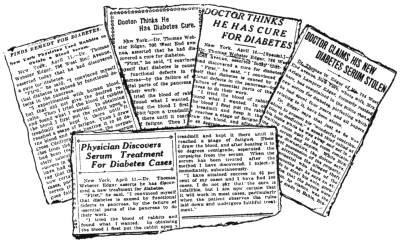
Photographic reproduction (reduced) of a few of the newspaper items that appeared in various parts of the country regarding Thomas Webster Edgar’s alleged serum for diabetes.
A few days after the appearance of this article in the New York Medical Journal, newspaper articles appeared regarding a cure for diabetes perfected by “Dr. Thomas Webster Edgar, 766 West End Avenue, New York City.” According to these reports, Edgar said:
“I tried the blood of rabbits and found what I wanted. In obtaining the blood I first put the rabbit upon a treadmill and keep it there until it reaches a stage of fatigue. Then I draw the blood, and after heating it to 60 degrees centigrade separate the corpuscles from the serum. When the serum has been treated after the method I have discovered, I inject it immediately subcutaneously.
“I have attained success in 65 per cent. of my cases and I have had 100 cases. I do not say that the cure is infallible, but I am now certain that it will work in most cases, particularly when the patient observes the rules laid down and undergoes faithful treatment.”
In April, 1919, a physician in Kansas wrote to Edgar at the request of a diabetic patient asking for information about the “serum.” Edgar replied that it would be impossible to send the physician any of the serum for administration unless the “patient is willing to pay me for the cost of same, which will be approximately the sum of $25.” He stated further that, in a few months’ time, he hoped to be able to manufacture the serum in larger quantities which would “more than cut the expense in half.”
In the same month a layman in Chicago who read the newspaper story wrote to Edgar and asked for details regarding terms and the arrangements that would have to be made to take the “treatment.” Edgar replied that he expected to be in Chicago in a few weeks’ time and would see the man in consultation with his regular physician, that he would administer the first injection and give instructions to the physician as to subsequent injections. Edgar added:
“My custom is to have all fees paid in advance and my charge is $200.00 by certified cheque or money-order.”
A layman in one of the smaller cities of New York wrote to Edgar in May, 1919, and received a reply from Edgar’s secretary stating that the treatment extends “over a period of three months, cost $150.” He was also told that the serum could be sent to his physician for administration “for the sum of $25 prepaid by money-order.” The letter closed with the statement that Edgar “has been very successful with the serum.”
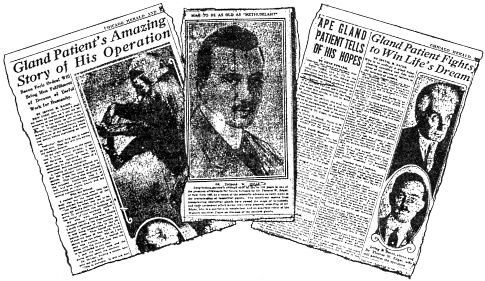
Photographic reproduction (greatly reduced) of small portion of the publicity that has been given to Edgar relative to his operation for “sex stimulation” by the transplantation of the glands of ring-tailed monkeys!
A layman in South Carolina who wrote to Edgar in June, 1919, was told that the treatment as administered by Edgar “extends over a period of two months; fee $300” and that if he wanted the serum administered by his own physician the cost would be “$50 prepaid.”
In May, 1920, Edgar had another article on diabetes, also in the New York Medical Journal. In this, too, he refers to his serum in the following words:
“In conclusion I may state that I have been able to produce some rather startling results by the use of my serum, which is prepared from the blood of rabbits after they have undergone a series of maneuvres capable of activating the various internal secretory glands to increased action. The serum contains the internal secretions in hormone form.”
Gradually the newspaper publicity on Edgar’s diabetic “serum” died down. Then, in November, 1920, there appeared—again in the New York Medical Journal—an article by Edgar on “Sterility, Sex Stimulation and Endocrines.” Edgar there stated that he wished to place himself “on record as being interested in sex stimulation” and that he wanted to notify the profession that he had another serum which he was using “with success in the treatment of this condition.” Thus:
“... I feel entitled to state that I have a distinctly beneficial serum for the alleviation of presenile and senile deficiency; and that my product is capable of producing a new lease of life in those whose functions have been reduced to a minimum.”
How long Edgar has been featuring his “serum” for “sex stimulation” it is difficult to determine, but during the last year the newspapers have carried sporadic reports of alleged remarkable results produced by “Dr. Thomas Webster Edgar of 766 West End Ave., New York,” through the transplantation of the “interstitial gland” taken from “a special species of orangoutang.” A layman who wrote Edgar some months ago regarding this “gland implantation” received a letter from Edgar’s secretary stating that the treatment “has been most successful in all cases” and assuring him that “the experimental stage had been passed, and the operation is advised in all cases presenting symptoms of presenility or age.” A week later the same man received a letter written by Edgar himself in which he reiterated the claim that all of the operations had been successful. Edgar added that he was now treating all cases “by operation instead of the serum,” and that “the fee for operation is $500, inclusive of the sanitarium,” the patients remaining in the “sanitarium” “for from two to three days.” A month or two later the prospective patient received another letter signed, “Thomas Webster Edgar, M.D.,” assuring him that “the effect is permanent, and does not wear off. No ill effects can possibly result.”
Commencing, Oct. 1, 1921, a series of sensational articles appeared regarding one of Edgar’s alleged monkey gland implantations performed on an individual described as “one time lawyer and then a writer.” These articles purport to be written partly by one of the newspaper staff, partly by the man undergoing the “operation” and at least one by Thomas Webster Edgar. The material is played up in the style typical of yellow journalism. In addition to repeated pictures of the individual who is being operated on, there also are given pictures of Thomas Webster Edgar and one of his “ring-tailed monkeys.” Doubtless the “story” has sold many newspapers. Its sensational character, the element of mystery and above all its sex slant will appeal to that large class of newspaper readers that hunger for stuff of this sort. Doubtless, too, it has proved a large advertising asset for Thomas Webster Edgar.
The statement that appears in the series to the effect that Edgar “is a member of the County Medical Society of New York” is incorrect. Edgar is not a member.
The further newspaper claim that Edgar is “an authority on glandular transplantation” should also be accepted with reservations. “Authorities” are created with ease in the pages of newspapers. Edgar may possibly be termed an authority in a newspaper or, shall we say, Pickwickian sense.—(From The Journal A. M. A., Oct. 15, 1921.)
The Journal Receives a Letter Denouncing “Medical Clerks” and “Biased Sceptres”
The Journal recently published in this department some inquiries regarding Thomas Webster Edgar, M.D., of New York City, relative to some alleged serums that Dr. Edgar had developed for diabetes and sex stimulation, respectively, and relative also to the newspaper publicity given Dr. Edgar in connection with the alleged transplantation of glands from “ring-tailed monkeys.”
We are in receipt of a letter signed, “Thomas Webster Edgar, M.D.,” and reading as follows. It is given verbatim et literatim:
“Gentlemen:—I have read with great interest your editorial regarding the publicity given my work in metabolism, and gland implantation.
“Your pseudo, expose, and distinctly libelous insinuations are unjust, and they lead me to believe that you are going to be called to account at a very early date.
“My profession is the practice of medicine, and the policy of my practice is not controlled by the editorial department of the journal. I am progressive, and a firm believer that legitiment medicine and surgery can not be practiced if the physician be governed by a set of medical clerks, who disdainfully boast that they control, and govern the healing art through out the breadth of the land, with a sceptre that is biased and steeped in the unadulterated commercialism of a certain medical clique.
“Aside from the fact that I am an associate editor on a medical publication, it is disgraceful, as well as unjust that you have written such an editorial with out first investigating the therapeutic value of my serum, and implantation operation.
“The psychology of your editorial, only reflects on your editorial department, and will tend to belittle some of the greatest surgeons in the country.
“It may be to your advantage to know, that this very afternoon, I was on the program with the following men.
“Dr. Lewis Gregory Cole—New York “Dr. Charles H. Mayo—Rochester, Minn. “Dr. John B. Deaver—Philadelphia “Dr. Charles Peck—New York.
“My paper was entitled—Senility, its etiology and treatment by gland implantation. I am sure the above mentioned gentlemen are thoroughly ashamed of your actions in the matter, as well as thoroughly disgusted with the baby like attitude you have displayed. You have no sense of fair play, and if it is with in my power to undue the wrong which you have wrought me, I shall endeavor to vindicate myself in the eyes of the clear thinking members of the profession.
“I sincerely trust you will publish this communication, in order that my brethren shall understand and appreciate that your thrust has not gone unnoticed.
“It is my hope that the various medical societies through out the country, will call upon me to read a paper on my work, so that I may be able to offer substantial evidence to the fact that you have done me an injustice.
“Very truly yours,
TWE/AEL[Signed] “Thomas Webster Edgar, M.D.”
Dr. Edgar’s statement that he had been on the program with Drs. Cole, Mayo, Deaver and Peck was sufficiently startling to prompt further investigation. It was found that the program in question was that of the annual meeting of the New York and New England Association of Railway Surgeons. It was further found that Edgar’s name did appear on some of the printed programs but not on others. It was rather naturally assumed that the name had been put on the program before the officers of this organization had seen the crude publicity to which The Journal recently called attention. It was found, however, that after several hundred programs had been printed about 150 more were needed and “in the meantime, Dr. Edgar had come into the limelight” in his ring-tailed monkey gland transplantation rôle and “was invited to read a paper on the subject.” While he accepted this invitation the secretary of the organization tells us that Edgar did not read his paper but, when the paper was called, declined, saying it was time for him to be in his office!
As for the rest of Dr. Edgar’s communication, The Journal appreciates that courtesy is due “an associate editor on a medical publication”—referring doubtless to the Western Medical Times. Dr. Edgar’s pronouncement that “legitimate medicine and surgery can not be practiced if the physician be governed by a set of medical clerks” seems reasonable—if cryptic. But it is when he charges that these “clerks” govern the healing art “with a sceptre that is biased and steeped in the unadulterated commercialism of a certain medical clique,” that he really shines. Whatever opinion one may hold of Dr. Edgar’s ability to compound serums, surely no one can question his skill as a mixer of metaphors. His reference to “sceptres” deserves to be embalmed in every textbook on rhetoric with the classic of the Hibernian statesman who passionately declared: “I smell a rat! I see it floating in the air! But, mark you, Sir, I shall nip it in the bud!”—(From The Journal A. M. A., Dec. 3, 1921.)
GLYCEROPHOSPHATES
Physicians who prescribe on definite principles must often be puzzled by the number and variety of glycerophosphates on the market. All available evidence indicates that, as sources of phosphorus to the animal organism, the glycerophosphates possess no advantages over the ordinary inorganic phosphates.290 The glycerophosphates are split up in the intestine, and liberate inorganic phosphates. In this form they are absorbed and utilized, if they are utilized at all. There is no evidence that glycerophosphates have any pharmacologic action to warrant the belief that they are of use as therapeutic agents. The theory that organic phosphorus compounds are more readily assimilable than inorganic compounds and hence a better means of introducing phosphorus into the system is still kept alive in the promotion of certain proprietary mixtures, in spite of the scientific evidence that the organism can assimilate phosphorus quite as readily from inorganic as from organic phosphorus compounds.291 The glycerophosphates will continue to be manufactured until physicians refuse to prescribe them. A chemist in the “research laboratory” of a well known manufacturing firm has recently given a rather interesting reason for the use of glycerophosphates—from the manufacturers’ point of view. He is quoted as saying: “On account of the instability of phosphorus in elixir of phosphorus, nux vomica and damiana we have quite recently replaced the phosphorus by glycerophosphates. Such a preparation is apparently equally as effective, for we continue to have a great demand for it.” This is doubtless a sufficient reason for the substitution from the manufacturers’ point of view; but how about the patient, who, after all, is the one to be considered? Is it not a matter of considerable importance to the patient whether he receives phosphorus, one of the most powerful drugs known, or the inert glycerophosphates? The chemist’s statement seems to imply that it is not. It may be of interest to recall that a member of the firm whose chemist gives this “reason” for the use of glycerophosphates, in a recent address, was rather severe in his condemnation of institutions of learning, hospitals, etc., for their lack of cooperation with manufacturers: he said that “they should welcome an opportunity to let any manufacturer try out or test his products in their clinics, laboratories, etc.” A test as to whether there is a difference between the action of glycerophosphates and ordinary poisonous yellow phosphorus, especially when the former are mixed with extracts of nux vomica and damiana, would not be likely to appeal to many hospitals and laboratories as a very promising field of research at this day since, as has been stated, the scientific evidence at present available does not furnish any warrant for the therapeutic use of glycerophosphates.—(Editorial from The Journal A. M. A., April 15, 1916.)
INFLUENZA VACCINES
With the appearance of the epidemic of influenza, reports began to appear, chiefly in newspapers, as to new serums, vaccines, drugs and other methods for checking and even for curing the disease. A few samples of such as have come to The Journal appear in our Tonics and Sedatives Department this week. In Massachusetts, Commissioner E. R. Kelly appointed two committees to investigate the value of influenza vaccines as a preventive agent and as a treatment of the disease. The first committee, a special board for scientific investigation, consisting of Dr. M. J. Rosenau, chairman, and Frederick P. Gay and George W. McCoy, was appointed to consider the evidence available on the prophylactic and therapeutic use of vaccines against influenza. This committee presented the following conclusions:
1. The evidence at hand affords no trustworthy basis for regarding prophylactic vaccination against influenza as of value in preventing the spread of the disease, or of reducing its severity. The evidence from the present epidemic, though meager, suggests that the incidence of the disease among the vaccinated is smaller than among the nonvaccinated. The board, therefore, concludes that further experimental evidence should be collected.
2. The evidence at hand convinces the board that the vaccines we have considered have no specific value in the treatment of influenza.
3. There is evidence that no unfavorable results have followed the use of the vaccines.
The second committee, known as the Special Board of Statistical Investigation, consisted of Dr. George C. Whipple, chairman, William H. Davis and F. C. Crum. This committee reported:
1. The weight of such statistical evidence as we have been able to accumulate indicates that the use of the influenza vaccine which we have investigated is without therapeutic benefit. Exceptional cases where apparent benefit has resulted from the use of the vaccine can be matched by other cases where similar recoveries have been made without vaccination.
2. The statistical evidence, as far as it goes, indicates a probability that the use of this influenza vaccine has some prophylactic value.
3. There is also some evidence to the effect that other methods of protection, such as open-air treatment and the use of proper masks, are effective in protecting exposed attendants, and the use of vaccine should not be taken as an excuse for omitting such safeguards.
As a result, the following recommendations were made:
That the state encourage the distribution of influenza vaccine intended for prophylactic use, but in such manner as will secure scientific evidence of the possible value of the agent. The use of such vaccine is to be regarded as experimental.
That the state shall neither furnish nor endorse any vaccine at present in use for the treatment of influenza.
These reports are conservative, and offer to other health commissioners and their communities a reliable guide as to procedures that should be adopted before subjecting or trying out on the public any method of prevention or treatment that may be offered. These matters are the domain of medical science, and medical scientists of recognized ability should be called on to make the decision.—(Editorial from The Journal A. M. A., Oct. 19, 1918.)
Serums and Vaccines
With respect to serums and vaccines in influenza, there are certain simple facts and considerations that physicians will do well to keep in mind at this times. The main point to keep always in sight is that unfortunately we as yet have no specific serum or other specific means for the cure of influenza, and no specific vaccine or vaccines for its prevention. Such is the fact, all claims and propagandist statements in the newspapers and elsewhere to the contrary notwithstanding. This being the case, efforts at treatment and prevention by serums and vaccines, now hurriedly undertaken, are simply experiments in a new field, and the true value of the results cannot be predicted by any one. Indeed, the exact results can be determined if at all only after a time, in most cases probably not until the epidemic is past and all the returns fully canvassed. Consequently, the physician must keep his head level and not allow himself to be led into making more promises than the facts warrant. This warning applies especially to health officers in their public relations.
As to serum treatment, the only noteworthy new method so far is the injection in severe cases of influenzal pneumonia of the serum of patients who have recovered from such pneumonia.292 The principle of this method is rational; analogous procedures have given seemingly good results in scarlet fever and other diseases; and the results reported in influenzal pneumonia appear promising. Further trial of this treatment under proper conditions consequently seems to be warranted. It should be borne in mind, however, that McGuire and Redden292 made their observations in the declining phase of the epidemic when the organism or organisms concerned appeared to be losing virulence. For this and other reasons, the expectations as to what may be accomplished by this method must be kept within reasonable bounds. Influenza is a self-limited disease with variable complications and of variable severity in different places, thus offering great difficulties in the way of evaluation of different methods of treatment.
At least two kinds of vaccine are in use in the hope that they may have preventive effects. One consists solely of killed influenza bacilli; it being extensively used in the East. We have as yet no decisive figures as to its effects, but there is an impression that it may have some value. The other vaccine is a mixed vaccine of the more important bacteria in the respiratory tract in influenza, principally pneumonococci, streptococci and influenza bacilli. It appears that vaccines of this nature are in extensive use, but we have no evidence that any benefit will be derived from them. To say that thousands have been vaccinated with apparently good results means nothing at all, simply because we are still in the midst of the outbreak, in many places even in the earlier stages. How slender the basis of this anti-influenzal vaccination when it is considered that the real nature of influenza is still unknown! In any event, it will require many carefully elaborated and controlled observations before anything definite may be learned in regard to the effect of these vaccines, and it is probably safe to say that nothing on which to rely in the future can be learned from the indiscriminate vaccination now going on. There is, therefore, no basis on which promise of protection from vaccines may be made. They may be harmless, and they may or may not be of preventive value.—(Editorial from The Journal A. M. A., Oct. 26, 1918.)
INTRAVENOUS THERAPY
The intravenous administration of drugs is a new departure in therapy, but one which is rapidly increasing in use. Among its reputed advantages are that it is the quickest means of obtaining the effects of a drug, the effects are obtained with a certainty not obtained by other methods, and they are so marked that they cannot fail to impress the observer. These advantages in many cases are apparent rather than real; but even were they real advantages, they should not blind us to the various and serious dangers which this method involves. The technic, although not difficult, must be thoroughly mastered, or undue pain, infection, air embolism, or even death may result. Such accidents, however, are ordinarily easily avoided, and should be considered quite inexcusable. More serious is the fact that the drugs given intravenously reach the system, and especially the heart, in a different manner and concentration from that to which physicians are accustomed with ordinary methods of administration. Pharmacologists have long practiced intravenous administration, when studying acute effects of drugs, and they have observed that frequently the immediate result of such injections is a prompt fall of blood pressure, not obtained when the same drugs are given by mouth or even hypodermically. This fall in blood pressure is commonly attributed to irritation of the endocardium. It is usually of short duration, but is certainly undesirable and sometimes may have serious results.
It has also been observed that several drugs, for instance, quinin and potassium, depress the cardiac muscle when given intravenously much more than when given in other ways. Furthermore, any substance which tends to precipitate proteins must be injected slowly and with extreme caution, or it will produce intravascular clotting and sudden death. Deaths have resulted not only from a lack of knowledge of the technic of intravenous therapy, but also from a lack of knowledge of drugs which may be so administered. Sudden death has been reported following the injection of an iron preparation containing peptone, and also following intravenous injection of ether. Intravenous injections, while sometimes superior to the slower methods, are distinctly inferior when a continuous, rather than a sudden, action is desired. Drugs leave the blood system with great rapidity, and therefore their action on the circulation will cease promptly unless they are continuously supplied. It would be undesirable to inject intravenously such drugs as iodids, nitrites, iron or salicylates.
With these dangers and disadvantages in mind, it seems unwise to resort to promiscuous intravenous medication until the effects of this method have been studied in detail for the drugs employed, and unless there are distinct advantages to be secured. This is the case when an immediate action is necessary in emergencies, as in the use of strophanthin for cardiac collapse, quinin in pernicious malaria, etc., or if the drug would be destroyed in the stomach or tissues as in the case of salvarsan, or when the drug is not adequately absorbed by any other channel, as in the case of epinephrin.
Intravenous therapy will be most securely advanced if its employment is restricted to such well defined fields. These fields can be satisfactorily determined only by a scientific pharmacologic study of the action of these drugs when so administered in animals, as well as in man, under conditions in which the results are carefully controlled. The intravenous method is an impressive one, approaching in preparation almost to that which goes with a surgical operation. The patient is usually interested and impressed by this new, and to him, mysterious method. There is a psychic element in his reaction to the injection which is not a factor in his reaction to the same drug when given by mouth. The intravenous injection of a complex mixture would appear to be particularly reprehensible. Little is known, as has been stated, of the results to be expected from intravenous therapy, even with simple substances. The use of complex mixtures will without doubt react against the proper use of the method.—(Editorial from The Journal A. M. A., Nov. 11, 1916.)
IODIN FUMES
One of the important factors connected with therapeutics as a science is the method of administration of medicinal substances. Drugs may be given by mouth, by hypodermic or intravenous injection, by inhalation, by inunction or, less frequently, by the use of other entrances into the body. In choosing a method, the physical characters of the substance to be administered and the immediate effects of the substance on the body tissues with which it may come in contact must be especially taken into consideration.