Volume 1 / Part 4 — PART IV CONTRIBUTIONS FROM THE JOURNAL: MISCELLANY (continued 3)
Reading edition
These factors apply particularly in the case of substances like iodin, arsenic, mercury or the biologic products in which the mode of administration radically modifies the action. For some time, manufacturers have urged substitutes for tincture of iodin, claiming that their substitutes were free from the undesirable properties of the tincture, and, at the same time, possessed special virtues which the tincture could not possess. More recently, attention has been directed to the administration of iodin in the form of vapor. The diffusing and penetrating powers of gases have particularly attracted the attention of therapeutists, since by this method drugs may be applied to rather inaccessible portions of the body, such as the lining of the lungs, the throat and the mucous membranes of the genito-urinary tract. Furthermore, it has been asserted that iodin in the form of fumes has increased combining powers, and is thus far more potent in effect than iodin administered by any other route. There do not seem to have been any adequate scientific investigations of the subject, however, until the recently published results of Luckhardt and his collaborators293 at the University of Chicago. In their experiments, both on man and on animals, accurately determined quantities of iodin were vaporized in a special device, and the fumes applied to the skin. At the same time, the tincture was applied to the skin of other persons as a control. Iodin was also applied to the skin of dogs with hyperplastic thyroid glands; and the effects on the gland, before and after administration, studied. Dogs were also used to determine whether iodin fumes were absorbed from the lungs. As a result of these investigations, which are reported in great detail, it was found that iodin, when deposited on the skin in the form of fumes, is absorbed. More iodin was recovered from the urine, following the application of the tincture, than was recovered following the use of the fumes. This result is explained by the authors on the ground that probably more iodin was actually applied, and that the iodin so deposited was held in combination with the protein during the process of coagulation of the latter by the alcohol of the tincture, leading to a state of continuous absorption. It is probable, furthermore, that the iodin deposited on the skin in the form of fumes is revaporized to some extent by the heat of the body.
Most important were the effects of iodin administered intratracheally in the forms of fumes. Iodin given in this way seems to be rapidly and completely absorbed; but it was found that the administration of the fumes of iodin by inhalation through the respiratory passages, even in small quantities, is fraught with great danger. Such administration induces dyspnea; and when it is given in large quantities, acute and fatal pulmonary edema ensues within twenty-four hours. When respiratory disorders are present at the time of administration, the fatal edema supervenes very quickly. Thus far, no device designed to deliver fumes controls the dosage.
It is interesting to consider, as do the authors, the fact that the fumes of iodin have the same effect as those of two other halogens, bromin and chlorin. The results of these experiments with iodin fumes on the dog, as shown by necropsy findings, are practically identical with those reported by military surgeons as found in soldiers gassed with chlorin during the war.
The results of these researches are additional evidence as to how scientific research may confirm or deny conclusions based on empiric therapeutic observations. The work may well serve as a model for similar experiments, now being made, on the therapeutic use, intravenously, of such substances as nonspecific proteins or organic preparations of toxic drugs. The patient should at least have the chance that is afford him by preliminary experiments, scientifically performed on animals in the research laboratory.—(Editorial from The Journal A.M.A., May 29, 1920.)
ITALIAN PHYSICO-CHEMICAL COMPANY
Many and various are the letters received by The Journal asking for information about an alleged scientific organization in Italy styled l’Académie Physico-Chimique Italienne. This Italian Physico-Chemical Academy is operated from Palermo, Italy. Here is the scheme: Dr. John Doe, an American physician receives an imposing-looking letter bearing the Palermo, Sicily, postmark and addressed to “Monsieur le Docteur John Doe, Médecin.” On opening the letter “Monsieur le Docteur” finds that the “Council” of l’Académie Physico-Chimique Italienne has nominated him “Honorary Member of this Academy” and furthermore has bestowed on him “a First Class Medal for technical work and scientific merit.” All this, “in consideration of your many dignities and great learning.” Dr. Doe is told that as soon as he will write an acceptance of this honor “in conformity with Section 19 and 22 of the Constitution” he will be sent “the Medal, Diploma and all the other documents relating to the title accorded.” The joker in the scheme lies in the necessity for Dr. John Doe “conforming” with “Section 19 and 22 of the Constitution.” Here are the sections:
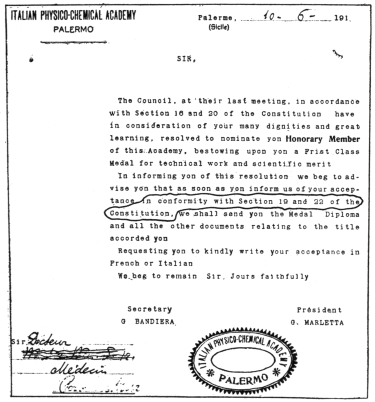
Reduced photographic reproduction of the stock letter sent to American physicians by the Italian Physico-Chemical Academy. The “joker” lies in the requirement around which we have drawn a line.
“Sec. 19.—The entrance fee to cover office and postal expenses, including postage of diploma is 5 Dollars, and is payable once at the admission to the Academy by special bulletin filled up, stamped and signed.”
“Sec. 22.—Those to whom medals are awarded and who wish to possess them must pay for their coinage 10 Dollars as the Academy does not, at present, possess the necessary funds for this purpose....”
In short the whole thing means that if Dr. Doe is willing to send $15 in good American money he will receive in due time from the academy a “diploma” and a gilt (not gold) medal.
About four years ago when the “Academy” seemed to be making a particularly heavy bid for American dollars the member of The Journal staff in charge of the Propaganda Department wrote to the “Academy,” on his personal stationery, asking about the cost of membership in the “Academy” and asking also for a copy of the “prospectus.” And that was all. In reply he received a letter stating that “in consideration of” his “many dignities and great learning” he had been nominated “an officer of this academy” and had been awarded “la médaille de première classe” for humanitarian work and scientific merit. In order to obtain these tokens of the “Academy’s” regard it would be necessary to inform the “Academy” of acceptance “in conformity with Section 19 and 22 ...” As the Propaganda Department did not consider the diploma and gilt medal worth $15 even as exhibit for its museum of fakes, the “Form of Acceptance” was not filled in and returned “in accordance with Section 19 and 22.”
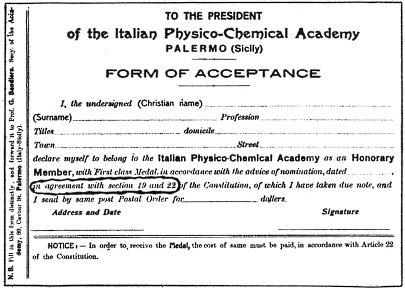
Photographic reproduction (reduced) of the “Form of Acceptance” to “membership” in the “Italian Physico-Chemical Academy.” Filling out this blank and sending it with $15.00 to the “Academy” will bring the gilt medal and “diploma.”
The leading spirits in the operation of this diploma and medal mill are D. and G. Bandiera, who, so far as we can learn, are neither physicians nor pharmacists nor have any scientific standing. The “Academy” has been referred to at various times294 by The Journal.—(From The Journal A. M. A., Feb. 26, 1916.)
WHAT IS LIQUID PETROLATUM?
The use of liquid petrolatum in chronic constipation, which has recently become the vogue, has naturally been commercialized; as a result, also naturally, claims of superiority of one brand over another have been made. Some of these claims may have been well founded; others certainly are not. Some have claimed superiority for those products made from Russian oil over those made from American oils. As naphthene hydrocarbons predominate in Russian crude petroleums, and paraffin hydrocarbons in many or most American crude petroleums, it was assumed that the petrolatums derived from these sources differed from one another in like manner. Both the naphthenes and the paraffins are chemically inert; but some unexplained therapeutic superiority has been assumed to reside in the naphthenes. Consequently, it has been urged that the American liquid petrolatums should not be used internally. So far these claims and counterclaims have been based on much theory and little fact. The Journal publishes this week a contribution by Benjamin T. Brooks, Senior Fellow in charge of petroleum investigations at Mellon Institute, Pittsburgh. Brooks calls attention to the fact that Marcusson, in 1913, pointed out that most of the so-called “mineral oils” used for therapeutic purposes contain no paraffin hydrocarbons whatever; that they consist solely of naphthenes and polynaphthenes. Brooks confirms this statement so far as American liquid petrolatums are concerned. He states that many American petroleums, such as most of those from the Gulf region, are like the Russian in containing no paraffin; and that, in the case of those petroleums that do contain it, the customary refinery method of removing paraffin is sufficient to produce true naphthene and polynaphthene petrolatums. “The claim that only Russian oils belong in this class,” he says, “has no basis in fact and has been advanced presumably for business reasons.” The name “paraffin oil” applied to these liquid petrolatums, then, is a misnomer. The new name, “white naphthene oils,” suggested by Brooks, seems superfluous, however, since the pharmacopeial title, “liquid petrolatum,” is subject to no such objection.—(Editorial from The Journal A. M. A., Jan. 1, 1916.)
THE LOWENTHAL POSTGRADUATE COURSE
Which Tells How to Make Diagnoses Accurately, Scientifically Check the Christian Scientists and Increase Your Earning Power
During the past year The Journal has received letters from physicians in various cities asking for information regarding the “Post Graduate Course of Lectures and Clinics on Nervous and Mental Diseases” which was going to be given in their respective cities by Dr. Albert A. Lowenthal of Chicago. The following inquiries are typical:
“To the Editor.—Please note the enclosed letter from the American Organotherapy Company which appears to be conducted by Lowenthal. The proposition of conducting these clinics impresses me as a piece of colossal gall which is amazing even in these days. Do you know anything about this matter?”
“To the Editor.—Who the dickens is Albert A. Lowenthal, M.D.? Note the circular enclosed. I have blue circled the remarks he evidently thinks will attract.”
In May, 1919, Chicago physicians received a form letter, signed, and on the stationery of, Albert A. Lowenthal, notifying them that Dr. Lowenthal was about to “give a Post Graduate Course of Lectures and Clinics on nervous and mental diseases” in the “Banquet Hall, Morrison Hotel.” Enclosed was a “Programme and Reservation Card” and a self-addressed envelop for physicians to notify Dr. Lowenthal that they would be present. In addition to showing physicians “how to make diagnoses accurately,” Dr. Lowenthal offered to “explain fully how to scientifically check the Christian Scientists and increase your earning power!” And all for nothing!
At later dates similar letters were received by physicians in other cities, on the stationery of the “American Organotherapy Company, Room 902, 31 North State St., Chicago.” Dr. Lowenthal, whose Chicago office is Room 901, 31 North State St., is, apparently, president, treasurer and practical owner of this company. Enclosed with each of these letters—which offered the same inducements, free—was an envelop addressed to Albert A. Lowenthal in care of the hotel at which Dr. Lowenthal would stay while in that city. There was also a “Programme and Reservation Card” as in the case of the letters sent to Chicago physicians.
According to our records, Dr. Albert A. Lowenthal was born in Chicago in 1874 and was graduated by the College of Physicians and Surgeons, Chicago, in 1895, receiving his license the same year.
In a leaflet issued some time ago by Albert A. Lowenthal, M.D., “for the sole purpose of enlightening Prospective Patients in regard to the therapeutic value of the Organo Therapy Treatment for Nervous Diseases,” we learn that Dr. Lowenthal is, or was:
“Professor Nervous and Mental Diseases, Chicago Hospital College of Medicine.” “Formerly Professor Nervous and Mental Diseases, Dearborn Medical College, Jenner Medical College.” “Adjunct Professor on Neurology and Psychiatry, University of Illinois College of Medicine.” “Formerly Physician Illinois Eastern Hospital for the Insane.” “Formerly Supt., Riverview Hospital for Nervous Diseases, Kankakee, Ill.” “Formerly on Advisory and Associated Attending Staff Cook County Hospital.”
In Polk’s Medical Directory for 1904, Dr. Albert A. Lowenthal’s name appeared, under Chicago, at 910–912 Chicago Opera House Building. He was described as “Superintendent of Lowenthal’s Sanitarium.” In the same issue of the directory, there was a display advertisement of the Lowenthal Sanitarium, which, while located at Kankakee, Ill., had its “main offices” at 912 Chicago Opera House Bldg., Chicago. The advertisement was headed “GOAT LYMPH TREATMENT,” and read in part:
“Goat Lymph has revolutionized medicine, and has been adopted by the scientific medical world as the only therapeutical agent that will absolutely bring about positive results in chronic conditions, such as Neurasthenia, Nervous Collapse, Paralysis, Locomotor Ataxia, Brain Fag, Oncoming Insanity, Chronic Stomach Disorders, in fact such diseases needing cell stimulation.”
It mentioned further that Dr. Albert Lowenthal “introduced Goat Lymph to the medical world as a curative agent.”
A few years ago a Chicago concern, known as the “American Animal Therapy Co.,” put out such products as “Lymphoid Compound (Lowenthal),” “Ova Mammoid (Lowenthal),” “Prostoid (Lowenthal),” etc. The American Animal Therapy Co. had for its manager James M. Rainey. Rainey also operated the “Rainey Medicine Co.,” a mail-order “patent medicine” concern that sold “Vitaline,” a “general debility cure.” The Rainey “Vitaline” quackery was exposed in The Journal, Oct. 1, 1910, and the matter appears in “Nostrums and Quackery.”
When the American Animal Therapy Company was operating from 84 Adams St., Chicago, it claimed to have a hospital and laboratory at Kankakee. At the same time letters were being sent out on the stationery of “The Lymph Hospital,” signed Albert A. Lowenthal, M.D. Although this “hospital” was at Kankakee, Ill., the address on the stationery was 84 Adams St., Chicago, and its telephone number was that of the American Animal Therapy Company. According to the stationery, the “Medical Department” of the Lymph Hospital was “under the personal direction of Dr. Albert A. Lowenthal, who introduced the Lymph Compound and Lymphoid Compound to the Scientific Medical World as a curative agent in Chronic Nervous conditions.” A layman received a letter from the “Lymph Hospital” urging him to take “Lymphoid Compound.” Later he received a “follow-up” letter, from which the following extracts are made. Capitals used as in the original:
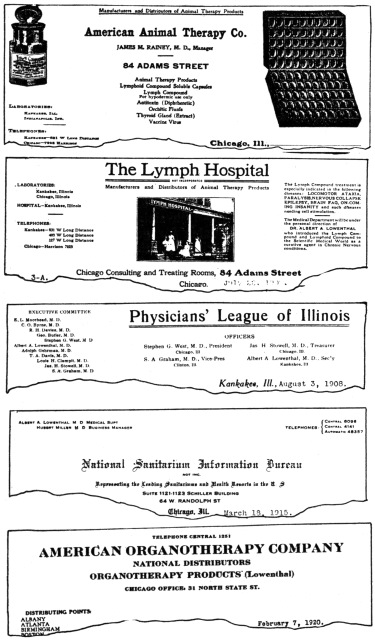
Some letterheads (greatly reduced) of concerns in which Dr. Albert A. Lowenthal has been interested.
“Do you know that the doctors of this country are using the Lymphoid Compound Exclusively in all cases, where the nervous system is greatly involved, with the most Marvelous Results. Isn’t that Sufficient Proof as to the merit of the remedy?”
“... Nobody can tell you there is something just as good, because THERE IS NOTHING JUST AS GOOD AS THE LYMPH—in fact IT IS THE ONLY THING THAT CAN BE DEPENDED UPON.”
“... Our Dr. Lowenthal gives his personal attention to all cases at the Hospital and devotes a portion of his time advising by mail those persons under treatment who are unable to come to the Hospital. He is a man of WORLD WIDE REPUTATION IN TREATING NERVOUS DISEASES—HIS ADVICE ON CASES LIKE YOURS IS WORTH EVERYTHING TO YOU.”
“Think this over and if you do, you will write an order today for the Lymphoid Compound. The home treatment costs $9.50 for thirty three days—think of that. You have our physician’s advice and care free of charge—could anybody ofter more to you?”
In 1908 Dr. Lowenthal appeared as a witness for Edward R. Hibbard, who was being prosecuted by the federal authorities. Hibbard operated a “men’s specialist” office in Chicago; it had two entrances and a different name for each entrance—the “Boston Medical Institute” and the “Bellevue Medical Institute.” Hibbard was found guilty of fraud in the operation of this concern and was fined $1,500. The transcript of the testimony in the Hibbard case records that Dr. Albert A. Lowenthal, when on the stand, claimed to “have treated as many nerve patients as any nerve specialist in Chicago.” He further declared, according to the transcript, that physicians who make a specialty of nervous diseases “mature in about ten years” and that after that time most of them become nervous wrecks or insane. This was in 1908. In this connection it is worth noting that in letters sent out by Lowenthal in May, 1919, he claimed:
“In the past twenty-five years I have limited my work to neurological and psychological cases....”
In 1908 also, Dr. Lowenthal was sending out letters to Illinois physicians in his capacity as secretary of the “Physicians’ League of Illinois.” The “league” issued a “report on candidates for governor and members of legislature,” giving the names of the various political candidates for office whom “the members of the league can safely support.” There were no “membership” fees and a physician who wrote asking “who foots the bills” received no reply.
In 1915 Albert A. Lowenthal, whose “valuable discoveries in the domains of Organo Therapy, Neurology and Pediatrics, have given him an international reputation as a Neurologist, Alienist and Climatological Expert of high standing,” was “Medical Superintendent” of the “National Sanitarium Information Bureau.” This purported to represent the “Leading Sanitariums and Health Resorts in the U. S.” The “Bureau” expected to make its “profit from the 10 per cent. honorarium received on every referred patient.” The “Business Manager” of this concern was one Hubert Miller, M.D. The following advertisement appeared in the classified department of the St. Louis Post Dispatch in 1915:
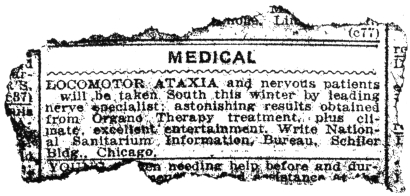
A layman who wrote in answer to this advertisement received a letter from Dr. Lowenthal in which he said that it was his intention to take about thirty patients south with him for four months—cost of trip $500, which includes medical treatment, board, etc. Dr. Lowenthal stated further:
“I have treated probably more cases of Locomotor Ataxia and Paralysis than any Physician in United States and can honestly state that with Organo Therapy Treatment your walk can be improved and pains controlled.”
In March, 1919, Dr. Lowenthal paid a visit to Spokane, Wash., and Portland, Ore. A Portland paper heralded his coming and printed a picture of “Dr. A. A. Lowenthal, World famous alienist.” The paper described Dr. Lowenthal as “the alienist consulted in the Harry Thaw case” and the one “who treated John Alexander Dowie of Zion City fame and Pope Leo XIII.” The fulsome puffery that Dr. Lowenthal got while in Spokane drew criticism from one or two members of the local medical profession, who wrote to the newspapers protesting. One of the physicians who thus wrote declared that Lowenthal’s “coming was announced in a circular sent through the Owl Drug Company which is agent for the sale of products of an organo-therapy company.”
Apparently, it was after Dr. Lowenthal’s return from the Pacific Coast that he commenced to announce his “Post-Graduate Course of Lectures and Clinics” to the physicians of Chicago, Denver, St. Louis, Columbus, etc.—and, incidentally, to bring to the attention of the medical world the alleged virtues of the products of the American Organo-Therapy Company.—(From The Journal A. M. A., July 3, 1920.)
MEDICAL SOCIETY OF THE UNITED STATES
From “Division of Fees” to “Down with Autocracy”
The “Medical Society of the United States” has for its “Honorary President” one A. H. Ohmann-Dumesnil, A.M., M.D., M.E., Sc.D., Ph.D., and for its “Secretary and Treasurer” one Emory Lanphear, M.D., C.M., Ph.D., LL.D. As originally planned, the “society” seems to have been based on the idea of organizing the “fee-splitters.” In May, 1916, the birth of the organization was announced to the medical profession through a letter signed Emory Lanphear, written on the stationery of the “Medical Society of the United States.” Even in its embryonic state the society had A. H. Ohmann-Dumesnil, A.M., M.D., M.E., for its president, and Emory Lanphear, M.D., Ph.D., LL.D., as its treasurer. The letter read in part:
“We—the majority of the medical profession—who believe in division of fees (i. e., that the surgeon should not ‘hog’ the whole of a patient’s money and leave nothing for the family doctor), are no longer welcome in the A. M. A. We are therefore organizing the Medical Society of the United States, which will not be conducted for the benefit of a few selfish egotists. We would like to have you with us.
“It costs only $1.00 to join. This covers dues for 1916, and includes expense for the beautiful certificate of membership (suitable for framing), which you will receive on admission. Fill enclosed blank and return to me with $1.00.”
But presumably the idea of organizing on a basis of “fee splitting” did not make a hit, so the lure was changed. Today physicians are approached with the plea that the “Medical Society of the United States” will make the medical world free for democracy; it is, we are assured, a “Society of Protest Against the Autocracy of the A. M. A.,” and a “Society of Medical Democracy.”
Membership costs “only $1.00 ... including the cost of a beautiful certificate of membership.” No penalties or punishments are involved for belonging to other societies, and:
“Joining our body need not affect your membership in any other society—even the A. M. A., if you wish to belong to it, and be ‘bossed’ by the ‘Simmons Gang’.”
The dollar for the “beautiful certificate” and membership is solicited by means of circular letters signed “Emory Lanphear,” coming from 3447 Pine St., St. Louis, Mo., the address of what has been variously called the “American Polyclinic,” the “American Hospital,” and later, the “German Hospital.” The “Surgeon-in-Charge” of the “German Hospital” is Emory Lanphear, M.D., C.M., Ph.D., LL.D. When running under the name of the “American Hospital,” Lanphear solicited operative work on a “division of fees” basis, which, the general practitioner was told, meant that “you are to have 40 per cent. of all fees received from your patients sent to our staff for operation or treatment.”
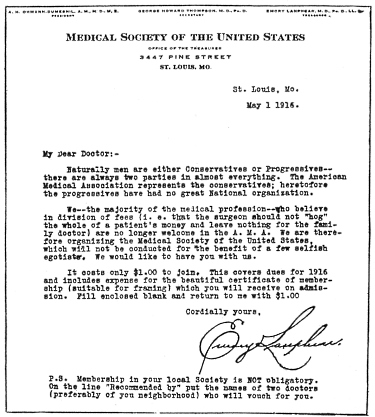
The “Medical Society of the United States,” was originally organized on a basis of “fee-splitting,” as is shown by the reduced facsimile of a letter sent broadcast in 1916, announcing the birth of the new “society.” Apparently, “fee-splitting” as a rallying point did not bring in the desired returns, so today the “Medical Society of the United States” is alleged to be a “Society of Protest Against the Autocracy of the A. M. A.”
With the change in name from “American Hospital,” to “German Hospital,” Lanphear appealed for a “portion of your operative work on a basis of pure reciprocity.” This “pure reciprocity” seems to have been a still more liberal distribution of the patient’s money, for from a 40 per cent. basis it was raised to an even fifty-fifty. Said Lanphear, in a letter sent out a few months ago:
“I wish also to inform you in spite of the despicable opposition of the hypocritical gang in charge of the A. M. A., and the no less contemptible action of the St. Louis Medical Society, I am going to remain in St. Louis and continue to do surgical work upon a ‘division of fee’ basis. To be more explicit, if you bring me a case for operation I shall allow you one half of the fee for your time, trouble, responsibility and help in the management of the case.”
Before leaving the interesting professional personality of Lanphear, and carefully avoiding any details of a personal nature, we may remind our readers that as long ago as 1908 Lanphear was the “Dean” of the “Hippocratean College of Medicine,” with A. H. Ohmann-Dumesnil, A.M., M.D., M.E., Sc.D., “Vice-Dean.” At that time Lanphear sent out letters to physicians proposing the organization of a “Post Graduate Faculty” on the following basis:
“Those who hold full professorships shall purchase stock in the corporation to the amount of $1,000.00; those who become lecturers or instructors shall pay in the sum of $500.00; those who are to be merely clinical assistants will buy ten shares of stock, $100.00.”
The “Hippocratean College” was a “sundown” affair; it never graduated a student, and expired in 1910.
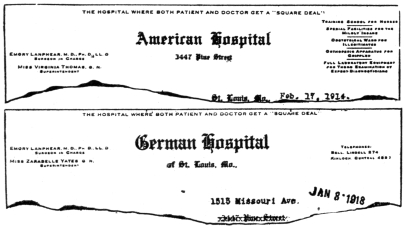
Reduced facsimile of the letter-heads of an institution known variously as the “American Hospital” and the “German Hospital.” The change in name from “American” to “German” seems to have taken place early in 1915—when things German were more popular and profitable than they are today!
But to come back to the “Society of Medical Democracy”: The “Medical Society of the United States” seems to have been born in 1916. Its parents, so far as is apparent, seem to have been Lanphear and Ohmann-Dumesnil. The latter, it may be remembered, used to be the editor and proprietor of the St. Louis Medical and Surgical Journal, a publication so obviously venal, that its value to the nostrum makers, whose interests it espoused, must have been small. Advertising pages, “original articles” and “editorials”—all were used to puff nostrums of the crudest type. It was Ohmann-Dumesnil and his journal that came to the defense of the “patent medicine” interests when they were so hard hit by Mr. Adam’s “Great American Fraud” series. In commenting on this phase of “patent medicine” activities, Collier’s, in January, 1907, said:
“Headache powders came in for a considerable share of attention in the patent medicine articles. There was much talk of libels among the headache powder makers, but they decided upon the safer methods of hiring a meretricious medical publication, the St. Louis Medical and Surgical Journal, to print an article in which the Collier’s statements were branded as lies, and the Collier’s editors and writers as liars and libelers. This article the Proprietary Association of America circulated in pamphlet form. The journal which printed it died a natural death a few weeks later. Its editor, one A. H. Ohmann-Dumesnil, has just appeared in the public prints in an unsavory connection with a corrupt lobbying project in St. Louis.”
Some of the nostrums that Ohmann-Dumesnil has recommended are: “Sanmetto,” “Gonosan,” “Cactina Pillets,” “Pepto-Mangan,” “Satyria,” “Campho-Phenique,” “Tongaline,” “Germiletum,” “Narkogen,” “Nosophen,” “Mercauro,” “Arsenauro,” and “Hydrozone.” Many of these testimonials were, of course, used by the manufacturers in their advertising “literature.”
At the time that the Medical Society of the United States was being organized—in 1916—there was published what purported to be a preliminary program of its first meeting. The meeting was held in St. Louis, and the program, while containing the names of men with special fads or interests to exploit, also contained the names of some men of standing. It appeared, however, on investigation, that at least some of the latter had but a hazy conception of the use to which their names were being put, and protested vigorously on learning the facts, repudiating the organization.
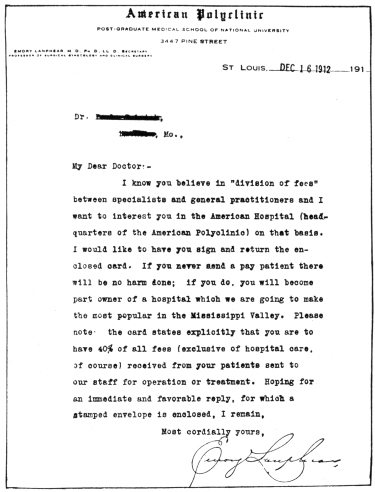
Reduced facsimile of a letter sent out in 1912, soliciting the purchasing of stock in the “American Hospital” on a division of fee basis—forty-sixty!
Now, in 1918, another drive is on for membership; letters signed “Emory Lanphear” are being sent to various selected groups of physicians. For example, the Eclectics are being coaxed by a letter which commences:
“We want every reputable Eclectic practitioner in this country to join our society of protest against the iniquities of the A. M. A.”
An identical letter has been addressed to Homeopaths, the words “Homeopathic practitioner” being substituted for “Eclectic practitioners.” In all of the letters the “beautiful certificate of membership” is emphasized, and the trivial cost—“only $1.00 a year”—is referred to, while the plea: “surely you are willing to help to that amount to ‘down’ the ‘gang’ in charge of the A. M. A.,” is featured. Another group of letters has gone out to the graduates of the Barnes Medical College. This commences:
“Most graduates of ‘Old Barnes’ have joined our society of protest against the iniquities of the A. M. A. Why should you also not come in? It costs only $1.00 to become a member, including the cost of a beautiful certificate of membership.”
Still another group appeal is based on sex; thus Lanphear:
“We want every reputable ‘lady physician’ in this country to join our society of protest against the iniquities of the A. M. A.”
And yet another:
“You formerly belonged to the Tri-State Medical Society, of which I was Treasurer for 20 years. It is now dead. I wish you would join our new society which has superseded Tri-State in this territory.”
With these various letters is enclosed a “preliminary program” of the 1918 meeting which is to be held October 8 and 9 in Chicago. As might be expected, many of the names on the program are characteristic of the organization and an interesting “story” might be made from the material in The Journal’s files on the individuals. Such names are of men, who, professionally speaking, range from faddists, who ride grotesque and bizarre medical hobbies, to those who with special interests to exploit and unable to use reputable medical organizations for that purpose, take refuge in such hybrid conglomerations as the Medical Society of the United States. Not that the program contains the names of crude quacks, or obvious medical swindlers. It is representative, rather, of that twilight zone of professionalism, the penumbra, in whose uncertain light it is difficult to distinguish between the unbalanced visionary, with a fad, and the more sinister near-quack, with a “scheme.”—(From The Journal A. M. A., Oct. 5, 1918.)
THE NATIONAL FORMULARY—A REVIEW OF THE FOURTH EDITION
The fourth edition of the National Formulary appears simultaneously with the U. S. Pharmacopeia IX, and is to become official at the same time (September 1). The principles which determine its scope, as frankly set forth in the preface, are apparently the same as those applied, though more faint-heartedly, in the compilation of the Pharmacopeia. A statement in the preface of the new National Formulary runs:
“The scope of the present National Formulary is the same as in previous issues, and is based on medical usage rather than on therapeutic ideals. The committee consists entirely of pharmacists, or of men with a pharmaceutical training, and it cannot presume either to judge therapeutic practice or to follow any particular school of therapeutic practice. The question of the addition or deletion of any formula was judged on the basis of its use by physicians and its pharmaceutical soundness. The considerable use by physicians of any preparation was considered sufficient warrant for the inclusion of its formula in the book, and a negligible or diminishing use as justifying its exclusion.”
Part I of the volume contains formulas, good, bad and indifferent, including the equivalents of a large number of shotgun proprietaries. Part II contains descriptions of drugs. This is a new feature. The purpose is to provide standards for those drugs not described in the Pharmacopeia but used in N. F. preparations. Many of these drugs were described in the U. S. Pharmacopeia VIII, but have not been included in the ninth revision. Practically all are either worthless or superfluous. Part III contains descriptions of special tests and reagents.
Among the therapeutically useful formulas are those for aromatic castor oil, emulsion of castor oil, sprays or nebulae, solution of aluminum acetate, solution of aluminum subacetate and wine of antimony. The two last named are also included in “Useful Drugs.” Several formulas for new classes of preparations which may or may not be found superior to old forms are paste pencils for the application of medicaments to limited areas of the skin, mulls, which are ointments spread like plasters, and fluidglycerates, which are fluidextracts in which glycerin takes the place of alcohol. It should be noted also that, as a result of criticism, the alcohol content of some preparations has been reduced.
As a whole, the present edition of the National Formulary, like its predecessors, is “pharmaceutically useful but not a therapeutic necessity.” To say that it is not a therapeutic necessity is to state the matter mildly, since most of the formulas and almost all of the drugs described have been discarded long since by rational therapeutists. So long as there are physicians who prescribe therapeutic monstrosities, however, the druggist should have the aid that is furnished by this book in compounding them. From the pharmacist’s point of view, therefore, the book is a valuable one. Physicians who have a scientific training in the pharmacology of drugs will not want it; others will be better off without the temptations offered by its many irrational formulas.—(Book Review in The Journal A. M. A., Sept. 2, 1916.)
NONSPECIFIC PROTEIN THERAPY
The treatment by nonspecific methods in a series of cases of influenzal pneumonia has been the subject of two recent papers.295 These methods are a development of the work of Ichikawa, Kraus, Lüdke, Jobling and Petersen, and others on the treatment of typhoid fever and of Miller and Lusk’s work on arthritis. In the original work in this field it was recognized that there were certain inherent dangers in the method and that wide application would be permissible only with the greatest caution and under careful control.
When vaccines and other toxic protein substances are injected intravenously a train of reactions takes place that includes: (a) a primary leukopenia, followed by a leukocytosis; (b) a primary lessening of the coagulability of the blood, followed after some interval by a reduction of the coagulation time; (c) a pronounced lymphagogue effect, the flow of lymph from the thoracic duct being increased threefold; (d) a hyperperistalsis of the intestinal tract, and (e) a marked splanchnic engorgement with a resulting lowering of the systemic blood pressure. The alteration of the coagulability of the blood, together with the vascular engorgement of the splanchnic area and the coincident increase in motility of the intestinal tract that follow the therapeutic injection, all tend to increase the possibility of intestinal hemorrhage. Protein therapy is therefore not a safe procedure in this particular disease. That we are able to terminate a certain number of cases of typhoid fever by crisis by means of such injections is of very great interest from a theoretical point of view.
In the treatment of arthritis, the results seem much more satisfactory. The work of Miller and Lusk296 has been confirmed by a number of observers, among them Culver, Cecil, Snyder, Cowie and Calhoun; and there seems little doubt that we may be able to give prompt relief and even permanent freedom from symptoms in a considerable percentage of cases of acute and subacute arthritis, especially those classed as of rheumatic origin—and this with practically no risk to the patient.
As with other new therapeutic measures, there is still some uncertainty as to the proper dosage, which is a matter of considerable importance, in order to arrive at a just estimate of the relative advantage or danger in the treatment. Typhoid vaccines have been extensively used because they are readily procured and give a prompt and sharp reaction. However, they have the disadvantage of inexactitude in the bacterial count, as well as being of varying degrees of toxicity, the latter factor depending not only on the use of different strains of bacteria in their preparation but on the age of the vaccine. Synder,297 as well as other workers, is of the opinion that the primary dose should be small—from five to ten million organisms—and that the dose of typhoid bacilli injected should never exceed two hundred and fifty million. While a sharp reaction on the part of the patient is apparently a desideratum, a sufficient response can usually be elicited with a relatively small dose. There is no object in subjecting the patient to the risk of the profound depression that follows occasionally in the wake of large doses. Indeed, the only serious results so far ascribed as due to this form of therapy have followed very large doses or the use of relatively large doses in moribund patients; or such unreasonable procedures as the intravenous injection of milk. It is true that milk injections were recommended by some of the German investigators, but they were always used intramuscularly.
In the treatment of pneumonia, Roberts and Cary298 have employed a vaccine made up of 100 million of each of the following organisms per cubic centimeter: influenza bacilli, pneumococci, staphylococci and streptococci. Of this vaccine they injected, intravenously, first 0.5 c.c., later 1 c.c. In the series of 200 patients so treated there was no evidence of injury to the patients in any way. The mortality in this series was 9.5 per cent.; in a series of eighty-six patients not treated with vaccine, the mortality was 31.2 per cent. In the untreated series, 20 per cent. recovered by crisis; in the treated, 36 per cent. so recovered. Before any reliance is placed on such statistics they should be analyzed and compared carefully according to age periods, as the death rate may vary at different ages. Cowie and Beaven298 used typhoid vaccine in the treatment of their patients, and they consider the vaccine shock as indicated only in the early stages of pneumonia.
Before applying the treatment to such diseases as pneumonia it would seem that prudence would demand a thorough familiarity with the range of the reaction and the degree of toxicity of the preparation it is intended to use by first employing it in some arthritic cases. In pneumonia we must ever keep before us the vital factor of cardiac impairment; and certainly we must not undertake any measure that may depress the function of the heart. In arthritis this danger is largely a negligible one; and, with proper precaution, nonspecific therapy is not only without risk but indeed frequently followed by gratifying clinical improvement. Only in the light of experience gained in the manner indicated would it seem permissible for us to attempt to extend this form of therapy to more acute infections.—(Editorial from The Journal A. M. A., May 17, 1919.)
WILLARD EALON OGDEN
A “Specialist in Proctology” and His “Clinics”
Within the past few weeks a number of inquiries have reached The Journal from physicians in Ohio, Indiana and Pennsylvania. Those that follow are typical:
“I am in receipt of literature from H. L. Roberts, 1126 Masonic Temple, Chicago, advertising clinic in Cleveland by Dr. Willard E. Ogden who claims to be a member of the Chicago Medical Society and the A. M. A. What can you say of this man and his methods?”
“I am enclosing a folder received a short time ago. I would be glad to know if Dr. Ogden is a member of the A. M. A. as he claims to be.”
“The enclosed folder has been sent to many doctors in Indiana. The purpose is plain. The attached post card on this one was returned to him for further literature.”
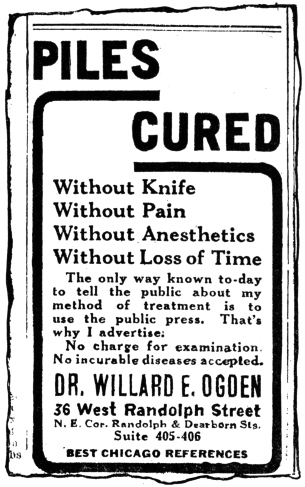
Photographic reproduction of one of Ogden advertisements in Chicago newspapers at the time he was at 36 W. Randolph Street.
In each case the correspondents send in a four-page folder bearing the title “Proctology, A Clinic. Who? Where? Why?” Three of the four pages purport to answer the interrogations given on the title page. Under “Who?” we read:
DR. WILLARD E. OGDEN Chicago, Ill. SPECIALIST IN PROCTOLOGY Member Chicago Medical Society and A. M. A. Author of “Improved Method of Treating Rectal Diseases” Formerly associated with Drs. Burleson & Burleson Grand Rapids, Mich.
Under the question “Where?” there appears the statement that “Dr. Ogden Will Hold a Clinic for The Treatment of Rectal Diseases” and the name of the city and the dates of the “clinic” are inserted with a typewriter.
Under “Why?” we read:
“Dr. Ogden does not use the usual surgical methods. His many years of experience in the treatment of Rectal Diseases (during which time he has been associated with the leading Proctologists of America) have enabled him to develop a system of office treatment which is not taught by any other practitioner.
“Tear off, sign and mail attached postcard and I will send you a booklet giving you full particulars as to the course.
Yours truly,
H. L. Roberts, Business Manager.
“Eighty-three per cent. of the people have some Rectal trouble. THIS IS THE DAY OF SPECIALISTS. Why not fit yourself to specialize in Proctology?”
The fourth page is a post card addressed to “H. L. Roberts, Room 1126, Masonic Temple, Chicago.” On the reverse side there is a printed statement which the recipient is expected to sign to the effect that he is interested in “Dr. Ogden’s Clinic” and wishes to have “full particulars of the course.”
A visit to Room 1126, Masonic Temple, failed to disclose the name of H. L. Roberts, either on the door (or doors, for there are two rooms having this number) or on the office building directory board. In fact, Rooms 1126 seem to contain a somewhat miscellaneous assortment. The signs, either on the door or on the directory board, show that there is a public stenographer (who operates a “Mailing Service,” and does “Addressing, Mailing, Multigraphing, Mimeographing”), a bookstore, a chocolate company, a publishing company, a lumber company, and one or two other concerns; but the name of “H. L. Roberts” does not appear. Incidentally, no “H. L. Roberts” is to be found listed in the Chicago telephone directory.
A few yards away from Rooms 1126 and on the same floor there appears the name, “Dr. Willard E. Ogden” on Room 1102.
According to our records, Willard Ealon Ogden was born in 1866. Before taking up the study of medicine he seems to have been a preacher. In 1899 he was graduated by the Saginaw Valley Medical College, Saginaw, Mich. He was licensed in Michigan in 1900, in Illinois and Indiana in 1913, and in Wisconsin in 1921. From 1900 until 1904 he practiced in Lyons, Mich.; from 1906 until 1911 he was at Ionia, Mich.
In 1911, he was in Grand Rapids, Mich., and was associated with Burleson and Burleson, an advertising pile cure concern. From some of the voluminous Burleson advertising on file, we learn that they “cure all diseases of the rectum (except cancer);” and claim to have “the most successful method ever discovered,” and to have cured “many desperate cases that have been given up to die.” Furthermore, they “guarantee to cure in every case or make no charge.”
On Jan. 1, 1914, Ogden was sending out a card to physicians in which he stated that he had removed from Grand Rapids, Mich., and LaPorte, Ind., to 36 W. Randolph St., Chicago, and that he would limit himself “exclusively to the treatment of diseases of the rectum.” Later, Ogden was sending out an advertising booklet filled with testimonials.
In 1914, Ogden was carrying display advertisements in Chicago papers reading, in part, in large back-faced type: “Piles Cured Absolutely Without Knife, Anesthetics, Pain or Loss of Time.... Cure Guaranteed or Money Refunded.”
In March, 1918, he became a member of the Chicago Medical Society and qualified for Fellowship in the American Medical Association, August, 1918.
In 1921, Ogden had a copyrighted mail-order course on the “Treatment of Rectal Diseases by Improved Method.” This “course” consisted of thirty-eight pages of foolscap printed on one side in imitation typewriting. The material abounded in typographical errors. Among the proprietary products recommended in this “course” as “essential” to those taking it, was “Mecca Ointment.” This nostrum, made by a Chicago concern, was declared misbranded in 1916 because of false and fraudulent claims made knowingly, recklessly and wantonly. The “course” was divided into ten parts, and with it, apparently, came ten consecutively numbered sealed envelops, and the purchaser was instructed to open these envelops, one at a time, as he completed the corresponding part in the “course.” He would there find questions which were to be answered and returned to Ogden. This, according to the description, was to enable Ogden to determine whether it was necessary to “enter more into detail upon that particular subject,” which, he stated, he would gladly do if necessary.
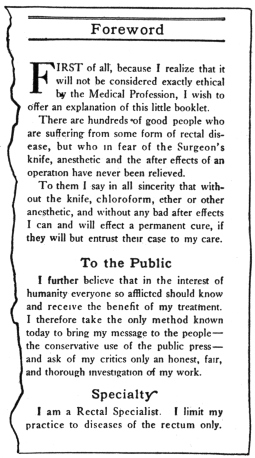
Photographic reproduction (reduced) of the first page of a booklet Ogden was sending out in the latter part of 1914.
Furthermore, the purchaser had the privilege of asking questions of Ogden relative to symptoms, diagnosis and treatment for a period of six months after the purchase of the “course.” Although, in Ogden’s opinion, “you should have the subject well understood long before that time.”
The charge for this course and “services as outlined” was $200, but in order to show his confidence in the ability of those who purchased it, Ogden was willing to take $100 down and the other $100 paid in “five per cent. of monies received from CURED patients” until the balance was paid.
Reverting to the present “post-graduate course” and “clinic”: Those who send in the postal card to “H. L. Roberts” receive a form-letter, signed “H. L. Roberts” in facsimile handwriting, stating that information was enclosed “regarding THE OGDEN METHODS” and stating that Dr. Ogden would be in Indianapolis or Cleveland or Pittsburgh, as the case might be, on a certain date and that the fee for the “clinic” would be $100. With this letter is an eight-page pamphlet entitled “Some Facts Concerning the Ogden Method of Treating Rectal Diseases.” The first page is headed in black-faced type: “About References and Endorsements.” It then states that the “usual references and endorsements are omitted from this booklet.” Further:
“As to Dr. Willard E. Ogden: The professional and social standing of Dr. Ogden is such that he does not need to offer any.
“As to ‘THE OGDEN METHOD’ and its value to you in your professional work: What others say or think has little if any weight. You are your own man. You do your own thinking. You decide for yourself—Do you not?”
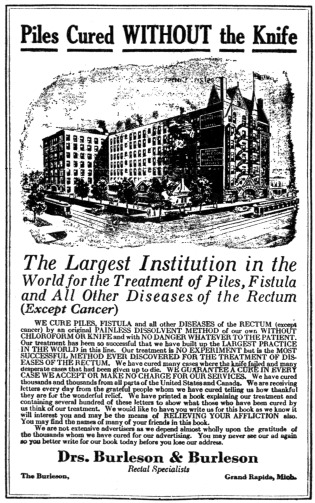
Photographic reproduction (greatly reduced) of an advertisement of the Burleson concern with which Ogden was connected previous to 1914, and which connection he is capitalizing in his present advertising.
The booklet gives an outline of the “Course of Instruction,” which is almost identical, word for word, with the outline given in the letter advertising the mail-order course previously referred to.
The booklet further states that “THE OGDEN METHOD has entirely eliminated the use of cautery, the ligature or any injections, in the treatment of hemorrhoids,” but that “the use of the electric current has proved to be the very correct method in such cases, as will be demonstrated at the clinic.” The booklet reiterates the statement that Ogden’s association with the Burleson and Burleson concern at Grand Rapids makes him “eminently well qualified to instruct members of the medical profession in this important branch of the medical science!”
In addition to this booklet there is a four-page advertising leaflet illustrating and describing the “Ogden Rectal Cabinet” and also the “Ogden Rectal Table and Stool.” There is also a little postcard—addressed, of course, to “H. L. Roberts”—for the physician to fill in stating that “you may enroll me as intending to attend Dr. Ogden’s Clinic in Proctology, to be held at——.” Should the recipient not fill in and mail this enrolment card he gets another form letter calling attention to the fact that the enrolment card has not been received and stating further that “available hotel facilities make it necessary to limit our enrolment to twenty students.”
Careful search fails to disclose that Dr. Willard Ealon Ogden has ever distinguished himself in the practice of the specialty in which he now wishes to instruct physicians. Equally careful search fails to show that Dr. Ogden has ever published a paper either on any proctologic subjects or on any other phase of medicine or surgery. Neither does there seem to be any evidence for the claim that Dr. Ogden “has been associated with the leading Proctologists of America.”—(From The Journal A. M. A., Feb. 4, 1922.)
“PATENTS”
Patent Laws and Patent Office Practice
The inequity of our patent laws, or possibly it would be more correct to say, of the interpretation of our patent laws, has been commented on many times in The Journal. The Journal also has had occasion to call attention to patents that have been issued for obviously unscientific and quackish devices and preparations. The cases of the preposterous gas-pipe fake “Oxydonor” and the creatinin mixture for the alleged conferring of immunity against diphtheria, pneumonia, scarlet fever, syphilis, tuberculosis, etc., are cases in point.
In a patent issued the early part of this year for the “discovery” of a method of flavoring Epsom salt, the patent office has, in fatuity, piled Pelion on Ossa. The “inventor” declares that his invention relates to a pharmaceutical preparation and a special method of treatment of the medicinal agents whereby said agent will be rendered much more efficient in character. He further avows that the “prime object” of his “invention” is to “disguise the normal taste and impart an agreeable odor or smell to salts commonly employed as a cathartic.” Parenthetically it may be said that probably not a day passes that some physician in the United States does not do substantially the same thing when writing a prescription. The “inventor” further claims that the object of his “invention” is to utilize the salts as a vehicle to carry an antiseptic and anesthetic agent whereby the salts when administered as a cathartic “will also act beneficially on the entire digestive tract” and “whereby cramped and spasmodic conditions are at once relieved with a resulting cure of flatulency, indigestion, sick and sour stomach, colic and the destruction of worms, etc.”
Such claims are so absurd that the only excuse for commenting on them is the effect they have on the public mind. The layman reading the specifications of this patent would naturally conclude that an invention of great importance had been made—of such importance as to warrant the government in rewarding its inventor by granting him a seventeen-year monopoly on the sale of his invention.
The law requires that, to be patentable, inventions shall be new and useful and shall show a higher degree of skill in their inception than is naturally to be expected from those who are skilled in the arts to which the inventions belong. It has been decided again and again that physicians’ prescriptions are not patentable because it is assumed that an educated physician will utilize his knowledge of pharmacy in devising proper compounds of medicines to meet the indications of disease. When a physician prescribes a dose of Epsom salt to be taken in one of the official aromatic waters, he does not produce or create a new invention by so doing. Of course, in one sense every prescription is an invention—an invention to meet the conditions presented by the patient—but such inventions are not patentable, because they represent the ordinary skill of a physician in carrying on his vocation.
If the patent office goes on granting patents for such “inventions” as flavored Epsom salt, and it should be found financially profitable to secure such patents and place the products on the market, it will only be a matter of time before the materia medica will be so restricted that a physician will be unable to write a prescription without infringing on somebody’s patent.
The splendid conception of the framers of our constitution in providing a plan for promoting progress in science and useful arts by granting to inventors for a limited time the exclusive use of their inventions, in exchange for the publication of full knowledge thereof, is being debased. No branch of our government is of greater importance to the progress of the country than the patent office, provided that office is intelligently administered. When the patent office is used, however, for an extention of the nostrum business, founded on the abuse of patent and trade-mark laws, it becomes a menace to the public health. The objects of the patent law are being defeated by the practices of the patent office.—(Editorial from The Journal A. M. A., June 23, 1917.)
Our Archaic Patent Laws
In this issue we publish two reports of the Council on Pharmacy and Chemistry which illustrate the weaknesses of the present working of the United States patent laws. In the first report the Council presents an investigation of a recently granted patent, and shows that the patent was issued on the mere claims of the applicant and without the presentation of any evidence for such claims. The second report—“Need for Patent Law Revision”—is an appeal to the Patent Office for a more enlightened administration of the patent law, and it presents a few illustrations of the unfair protection which has been granted by the Patent Office. The protest of the Council appears at an opportune time. In Science299 the “Patent Office Society,” an association of employees of the U. S. Patent Office, announces that a committee has been created on request of the National Research Council to make a study of the U. S. Patent Office and its service to science and arts. It states that this committee will meet in Washington shortly to consider the adequacy of the present Patent Office equipment and the simplification of procedure as well as responsiveness to present national and international requirements. The committee also hopes to coordinate, in the interest of an improved public service, the endeavors of the various national societies, manufacturing interests, patent bar associations and all others aiming at genuine patent reform. Unquestionably, there is a growing conviction that in the case of medicines the monopoly given by the patent laws, if granted at all, should be granted with greater consideration of the public welfare. Too often the United States Patent Law has been used to obtain an unfair monopoly on a medicament or to abet quackery. There is no question that one of two things is needed: either a radical change in the patent law itself or the application of more brains in its administration.—(Editorial from The Journal A. M. A., Jan. 12, 1918.)
Patents Perpetuated by Trade Names
The patent on aspirin300 (acetylsalicylic acid), controlled by the Bayer Company, American representative of the Farbenfabriken of Elberfeld Company, will expire next year (1917). The Journal has previously stated that the grant of this patent was regrettable and worked injustice to American citizens. It is unnecessary again to go into the grounds for this statement; neither in the Farbenfabriken’s home country, Germany, nor in any other country except in the United States, has a patent been granted for this product. Owing to their monopoly, the manufacturers have been able to exact a much higher price for acetylsalicylic acid, or aspirin, in this country, than elsewhere. Naturally, the Bayer Company, the American agents, view with disfavor the prospect of being compelled to share this rich field with competitors. The foregoing furnishes the answer to inquiries which have reached us from all over the country with regard to the campaign of publicity which the Bayer Company has inaugurated in the lay press. A presumably authentic and apparently candid exposition of the methods used and the motives behind the aspirin advertising is furnished in Printers’ Ink:301
“The manufacturers of aspirin are about to launch an extensive advertising campaign to clinch the market as far as possible before the expiration of their patent rights next year.... The purpose of the campaign is to identify the product with the trademark of the Bayer Company and to this extent hamper competition after the expiration of the patent.”
The business of the Bayer Company, the article goes on to say, has been hurt by the sale of worthless or even harmful imitations put on the market by irresponsible and unauthorized persons when the present war stopped importations from Germany.
“The public knew aspirin, but did not know who made it [italics ours].... When the Bayer Company, Inc., took over the manufacture of aspirin in this country, the first steps were taken to identify the product with the firm who made it.... Of course, there are good reasons why the makers were loth to advertise the product or to exploit their trademark. As every one knows, the advertising of a medical proposition is an extremely ticklish subject.... It is easy to make a misstep. Aspirin is one of those proprietary drugs that are extensively prescribed by physicians. If anything were done that might possibly associate this drug with the patent medicines that are in disfavor with the profession, the valuable influence and cooperation of thousands of doctors might be lost. It is believed that this knotty phase of the question is being answered in the present advertising.... Since nothing is mentioned about ‘medicine,’ ‘cures’ or ‘ailments,’ it is anticipated that there will be but little objection to the copy. All that the advertising attempts to do is to link up the name ‘Bayer’ with aspirin.... The nearest the copy gets to medical talk is in this sentence in very small type at the bottom of the advertisement, ‘The trademark “Aspirin” (Reg. U. S. Patent Office) is a guarantee that the monoacetic acid ester of salicylic acid in these tablets is of the reliable Bayer manufacture.’ ”
From this it appears that, not content with seventeen years of monopoly, the aspirin people are attempting to retain a hold on the market in perpetuo by associating the name of the company with the trade name “aspirin.” There can be no better time than the present, therefore, for the medical profession to substitute, for the nondescriptive name “aspirin,” the descriptive and correct name acetylsalicylic acid.—(Editorial from The Journal A. M. A., Aug. 12, 1916.)
Patenting Therapeutic Agents
In the past, therapeutic agents and apparatus have been controlled by patents and trademarks for profit. If there have been exceptions, they have been rare. The Principles of Medical Ethics of the American Medical Association contain this statement: “It is unprofessional to receive remuneration from patents for surgical instruments or medicines.” This does not mean that the patenting is wrong in itself; there are occasions when it is wise, if not necessary, to obtain a patent in the interest of the public, and, in the case of surgical instruments and medicines, of the medical profession. In certain instances it is absolutely necessary that the article produced shall maintain a definite standard of quality and purity—and, it may be added, shall be sold at a reasonable price. Enterprising pharmaceutical manufacturers have usually been ready to appropriate the results of scientific research by investigators or therapeutic measures suggested by practicing physicians. Not infrequently, in such instances, the desire for financial gain has caused the marketing of such products with extravagant, if not false, claims as to their value. Yet the patent laws may be used so as to protect and benefit the public and the medical profession. In research laboratories, work is being carried on resulting in the production of new therapeutic agents. It is important that these agents shall be so controlled that they may be made available without subordination to commercial interests. It has become practically necessary, therefore, for research workers to protect their products in the interest of the public welfare and scientific medicine. It has not been an easy matter to decide how best to bring about the desired results. This question has been before the Board of Trustees of the American Medical Association; and, in 1914, the House of Delegates passed a resolution authorizing the board to accept at its discretion patents for medical and surgical instruments and appliances; as trustees, for the benefit of the profession and the public, provided that neither the Association nor the patentee should receive remuneration from these patents. The Rockefeller Institute for Medical Research has solved the problem in a similar manner. In connection with the report of the discovery of several new arsenic compounds, Jacobs and Heidelberger,302 working in the Rockefeller Institute, say:
It may be appropriate to mention here that this substance and related compounds, described in the present and following papers of the series, are covered by U. S. Patents Nos. 1280119-27. Patents have also been applied for in foreign countries. All discoveries made at the Rockefeller Institute are made freely available to the public, in accordance with the philanthropic purposes of the institution. In order to insure purity of product and protection against exploitation, it has been deemed necessary in certain instances to protect the discoveries by patents. It is the purpose of the institute to permit any drugs which may prove of practical therapeutic value to be manufactured under license by suitable chemical firms and under conditions of production which will insure the biological qualities of the drugs and their marketing at reasonable prices. Other than through the issuance of license, the Rockefeller Institute does not participate in any way in the commercial preparation or sale of the manufactured chemicals; and it receives no royalties or other pecuniary benefits from the licenses it issues.
Here we have medicine at its best. The altruism of pure science operating for the benefit of the general public: scientific therapeutics freed from commercial domination.—(Editorial from The Journal A. M. A., Oct. 18, 1919.)
PHARMACEUTICAL BARNUMS
Does the public love to be humbugged? We doubt it. That we, whether sage or fool, are humbugged is undeniable. We are humbugged just to the extent that we are ignorant. There lies one of the most powerful factors operating to the advantage of the “patent medicine” maker and the quack. The layman’s ignorance of the possibilities and limitations of drugs is wide and deep. Hence the ease with which he is fooled on this subject. A seeming frankness in advertising being the order of the day, the nostrum maker makes a pretense of telling what is in his stuff without disclosing any facts that will tend to lift the veil of mystery and thus destroy his greatest asset. So the exploiter of nostrums to the medical profession, realizing that at least a pretense must be made of giving the composition of medicaments offered to the physician, declares that his clay poultice has for its base “anhydrous and levigated argillaceous mineral.” This sounds much more imposing than dry and finely powdered clay, and satisfies by its very sonorousness. Now comes a product exploited chiefly to members of the dental profession but also, it seems, to physicians. Tablets, “activated tablets,” if you please! They are “an anodyne, analgesic febrifuge sedative, exorcising [sic!] antineuralgic and antirheumatic action.” And their composition? Simply “an activated, balanced combination of the mono-acetyl-derivative of para-amidophenetol together with a feebly basic substance in the alkaloidal state from the Thea-Sinensis.” As clear as the Missouri River! Some day some dentist or physician is going to investigate and find that this awe-inspiring, polysyllabic example of exuberant verbosity means nothing more mysterious than our old friends acetphenetidin (phenacetin) and caffein. In the meantime, the exploiters may smile softly and murmur, “Barnum was right!”—(Editorial from The Journal A. M. A., Jan. 1, 1921.)
THE PHARMACOPEIA
The Ninth Decennial Revision
The ninth revision of the United States Pharmacopeia became official this week, Sept. 1, 1916. It is more fully reviewed elsewhere;303 here we desire merely to call attention to two points; what the book is and what it is not. It is a book of standards for drugs; it is not a book of standard remedies. The Committee of Revision of the Pharmacopeia included physicians and pharmacists (retail, wholesale and manufacturing), but the pharmacists were in the majority and in control. The majority of the representatives of the medical profession on this committee would have preferred to see the bulk of the Pharmacopeia reduced and its value as a work of reference enhanced by the rejection of therapeutically worthless drugs. The representatives of commercial interests, on the other hand, argued that it was necessary for the Pharmacopeia to provide standards for drugs in more or less general use, whether worthless or otherwise. The force of this argument is somewhat impaired by the fact that the National Formulary, which has also been made a book of legal standards, now includes individual drugs as well as combinations; the new edition of the Formulary, in fact, contains a large number of drugs which had been dropped from the U. S. Pharmacopeia VIII. The principle of making use the sole criterion for admission to the Pharmacopeia, however, on the whole carried the day. It has not been strictly observed; good results from the efforts of the medical contingent are to be observed here and there, as in the deletion of elixir of the phosphates of iron, quinin and strychnin and of emulsion of cod liver oil with hypophosphites. That these instances were not expressions of policy on the part of the Committee on Revision, but merely deviations from policy, may be seen by a glance at the contents of the new Pharmacopeia. These include substances which have been shown to be inert, like the hypophosphites (calcium, potassium and sodium hypophosphites), complex and obsolete mixtures, like the compound syrup of sarsaparilla, and drugs which have been tried and found wanting, like saw palmetto berries. Even substances seldom used by the medical profession, but chiefly or altogether by the public, like sassafras, hops and peppermint (the herb), are standardized and made official. It seems difficult to discover any principle by which the sphere of the Pharmacopeia may be definitely marked off from that of the National Formulary. There is one great advantage in specifying U. S. P. drugs and preparations: Physicians who do so invoke legal standards of purity and identity. The only way to be sure of obtaining substances of therapeutic efficiency, however, is to exercise discrimination. The Pharmacopeia is no guide. Being prepared mainly by pharmacists to meet the needs of pharmacists, the Pharmacopeia of course contains much matter of little interest to physicians and entirely foreign to scientific medicine.—(Editorial from The Journal A. M. A., Sept. 2, 1916.)
Review of Ninth Revision
The ninth revision of the United States Pharmacopeia, which has been in the hands of the Committee of Revision for more than six years, has just appeared. As was to be expected, the desire of medical men on the Committee of Revision to have therapeutic value made a requirement for admission to the Pharmacopeia has not been fully realized; it remains a book of standards for therapeutically good, bad and indifferent remedies. Among the drugs of little or no therapeutic importance or value are musk, arnica, eriodictyon, quassia, pumpkin seed, saw palmetto berries, sarsaparilla and couch grass. Many superfluous drugs and preparations are included. For instance, of the nine forms of quinin described (quinin alkaloid, bisulphate, dihydrochlorid, hydrobromid, hydrochlorid, salicylate, sulphate and tannate, and quinin and urea hydrochlorid), at least four might well have been eliminated. Two insoluble forms (the alkaloid and the tannate), two soluble forms (the hydrochlorid and quinin and urea hydrochlorid), and a moderately soluble form (the sulphate) are all that could reasonably be demanded by even the most extreme partisans of the doctrine of “pharmaceutic necessity.” Further, the use of quinin salicylate for its salicylic acid content and of quinin hydrobromid for its bromid content is unscientific. The inclusion of these salts in the Pharmacopeia is regrettable.
Those interested in the promotion of rational therapy will also regret the inclusion of a number of fluidextracts of violently toxic drugs, such as aconite and gelsemium (dose 1⁄2 minim each), belladonna root, digitalis, nux vomica and ipecac (dose 1 minim each), and lobelia (dose 21⁄2 minims). The more diluted forms, the tinctures, of these drugs are preferable. The inclusion of such fluidextracts in the Pharmacopeia is playing into the hands of certain pharmaceutical manufacturers, who recommend the tincture be prepared from fluidextracts—an unscientific procedure.
The efforts of the medical members of the committee, however, have not been entirely fruitless. Of the articles described in the U. S. Pharmacopeia VIII, 243 have been deleted; sixty-seven new articles have been added. The loss of 167 titles may be set down as a gain. Moreover, most of the new substances give promise of therapeutic usefulness. Thirty-six are taken over from New and Nonofficial Remedies; nineteen are substances which are in the edition of Useful Drugs now in the press. It cannot be said, however; that all of the additions have been judiciously selected. It is an infelicitous time to add calcium and sodium glycerophosphate just when grave doubts of their therapeutic efficiency are being felt. The addition of the extracts of aconite, hydrastis and viburnum prunifolium is likewise unfortunate. All are superfluous preparations, the first because a drug so powerful that an average dose of the extract is only 10 mg. or 1⁄6 grain is better given in the form of tincture; the second because hydrastis is a drug of uncertain value, already represented by three preparations, and the third because viburnum prunifolium has been discarded and discredited by the best therapeutic authorities. It must be accounted clear gain, on the other hand, that the deletions include many inert, obsolete or superfluous substances like bismuth citrate, kaolin cataplasm, pipsissewa, coca leaves, ladyslipper, wahoo, cotton root bark, compound acetanilid powder and compound syrup of hypophosphites, not to mention nine salts of iron and thirty-eight fluidextracts of various drugs. Wines, unmedicated and medicated, whisky and brandy are also among the articles dropped.
A number of new features are introduced, such as microscopic standards for powdered drugs, standard abbreviations for titles, the use of the term “mil” instead of “cubic centimeter,” and a chapter each on sterilization, diagnostic reagents, biologic assays, electrolytic determination of metals and the determination of alcohol, the melting point, the boiling point and the congealing point.
The chemical nomenclature is substantially the same as that adopted in the previous revision; so is the nomenclature of drugs. The addition of official abbreviations for the Latin titles of drugs will doubtless be found a useful feature.
Less commendable is the change from the familiar “Cc.” to “mil.” The term “cubic centimeter” is so thoroughly established and so widely used, wherever the metric system is employed, that it cannot be expected that it will be universally displaced by the word “mil.” The latter is therefore only a superfluous synonym, and as such out of harmony with the simplicity of the metric system. Perhaps it may even be taken for the abbreviation of “millimeter,” “milligram” or other words derived from “mille,” which would be equally entitled to the same abbreviation.—(Book Review in The Journal A. M. A., Sept. 2, 1916.)
PHYSICIAN’S STOCK IN PRESCRIPTION PRODUCTS
The letter that follows comes from a physician who feels that he has a grievance regarding a company in which he holds stock:
“In 1914, I bought some stock of the —— —— Company, and in 1917 bought some more stock in the same company. I notice that the company advertises in The Journal of the American Medical Association, and I believe it does this not so much to acquaint the medical profession with its product, as to acquaint physicians with its name in order that its stock salesmen can keep on unloading more stock to members of the medical profession.
“The company gets the doctors’ money through the sale of stocks, it gets its product on the market with the doctors’ assistance and through their influence, and it looks to me as if the doctors were getting very little in return, as the dividend checks have been few and far between since I have known anything of the company.
“It is not my idea to criticize the product; but I do believe and feel that the stockholders are entitled to a square deal from a company which in turn is expecting so much from them, and again I feel that the publishers of The Journal should be made aware of these conditions so that they do not either consciously or unconsciously foster a concern that is depriving the physician of his hard-earned money.
“If this letter is unfair, I am willing to be shown otherwise. Kindly publish it in The Journal, omitting my name and address.”
The company to which our correspondent refers put out a proprietary product prescribed by physicians and used by the public. Some years ago the company in question advertised its product in The Journal until its stock-selling scheme was brought to the attention of The Journal; the advertisements were then rejected. Some years later, on evidence that the company had discontinued its stock-selling methods to physicians, its product was again admitted to the advertising pages of The Journal. Our correspondent says that he believes that the physicians who hold stock in this company “are entitled to a square deal.” What about the public? Is it getting a square deal when physicians are financially interested in the products that they may be called on to prescribe? Is the average layman’s confidence in the medical profession likely to be enhanced when he learns that the physician to whom he went for treatment has a financial interest in the therapeutic agent which was prescribed? Our correspondent’s complaint against the company seems to be, not that the company sold stock to physicians, but that “the dividend checks have been few and far between,” the assumption being that had the dividends come regularly, there would have been no complaint. It cannot be too often emphasized that it is against public interest and scientific medicine for physicians to be financially interested in the sale of products which they may be called on to prescribe for the sick. It is perfectly true that there are many physicians who would not consciously permit financial considerations to warp their judgment; but it is not humanly possible to remain unbiased in cases of this sort. It is conceivable that a judge on the bench might make every effort to dispense impartial justice in a suit in which one of the parties was a firm in which he, the judge, had financial interest. Nevertheless, it would be obviously improper for such a judge to try a case of this kind. Yet, in this supposititious case the only harm that could result would be of a financial nature. In the case of the physician, the harm is not to the public’s purse but to the public’s health.—(From The Journal A. M. A., Dec. 11, 1920.)
PITUITARY GLAND PREPARATIONS
The importance of the standardization of preparations of the posterior, or infundibular, lobe of the pituitary gland (the liquor hypophysis of the new United States Pharmacopeia, pituitary solution, pituitary extract, etc.) is exemplified by a recent publication of Roth.304 As is well known, the active constituent or constituents of this gland have not been isolated, and there is no chemical method of determining the activity and therapeutic value of various preparations. There are, however, certain physiologic methods by which the activity of such preparations may be determined with a considerable degree of exactness. The last revision of the Pharmacopeia, recognizing that the best attested field of usefulness for such preparations is in obstetrics, adopted as a test their activity on the uterus of the guinea-pig; the details of the method adopted by the Pharmacopeia are those described by Roth.305 Roth now reports on the activity of seven samples of commercial infundibular extracts, the products of five American manufacturing pharmacists. Four of these samples were found to be of Pharmacopeia strength; the other three were much weaker. Of the latter, one had but one tenth, another but one fifth and the third but one fourth of the required activity. Those preparations which had been accepted by the Council on Pharmacy and Chemistry for inclusion in New and Non-official Remedies corresponded to the Pharmacopeia requirements. Roth also compared the activity of these seven preparations on the blood pressure, another method by which it has been proposed to standardize infundibular extracts. The four preparations which were equally active on the uterus were found to be equally active on the blood pressure; the other three were much weaker. Roth points out, however, that the results of the two methods are not necessarily parallel; in one instance, for example, two samples caused equal rises of blood pressure, but one was twice as active as the other on the uterus. Hence it is evident that the blood pressure test is not a satisfactory method for determining the activity of a preparation on the uterus, and vice versa.
The subject of pituitary standardization, or perhaps it may be said the application of the present method is, however, in need of further study. Thus the statement has recently been made306 that commercial preparations are on the market which have from three to five times the activity of the Pharmacopeia standard; this was not the case, however, with the preparations examined by Roth. It is probable that some have used for comparison a weaker standard than that proposed by the Pharmacopeia; this, of course, would lead to the conclusion that the commercial preparations were stronger than the Pharmacopeia standard. Roth suggests that the employment of standards of unequal activity by the various supply houses could easily be eliminated by having a central laboratory distribute material for use as a standard. It will be recalled that before the United States Public Health Service established and began the distribution of standards for diphtheria and tetanus antitoxins, the commercial preparations of these varied even more in activity than do those of the pituitary extracts at present.
It is unnecessary to emphasize the importance of this subject; this is sufficiently evident to those who have followed the recent clinical literature on the use of pituitary extracts in obstetrics. These preparations are used in times of emergency; a weak preparation is valueless, whereas overdosage, either from too strong a preparation or from too free use of a preparation of the official strength, is often followed by disaster to the mother or child or both. Roth cites a number of cases of ruptured uterus and other injuries resulting from their use.—(Editorial from The Journal A. M. A., May 5, 1917.)
PROPRIETORSHIP IN MEDICINE
To the Editor:—I am enclosing a reprint of my article on the “Present Status of Pituitary Extract in Labor,” which appeared in The Journal, June 2, 1917, p. 1601, and also the September issue of Parke, Davis and Company’s Therapeutic Notes, on page 89 of which they quote this article, that you may compare the two. The Therapeutic Notes article is ostensibly a copy, but as a matter of fact, it gives it only in part, which seems to me to be a gross misrepresentation, and one which I do not think should go unnoticed.
Joseph J. Mundell, M.D., Anacostia, D. C.
[Comment.—Therapeutic Notes is one of the house organs of Parke, Davis and Company. A part of each issue is usually devoted to “excerpts” from current literature. The Therapeutic Notes may be judged from the manner of “excerpting” the article of Dr. Mundell. Naturally the interest of Parke, Davis and Company is in those sections of the article which may be expected to promote the use of Parke, Davis and Company’s proprietary preparation of pituitary extract—pituitrin. The following passages from the article of Dr. Mundell were not among those “excerpted” in Therapeutic Notes:
“Used here in properly selected cases, after due consideration by one who has good obstetric judgment, its results are usually happy, and it is a boon to the tired mother and her attendants.”
“To step beyond these narrow confines of indications is indeed entering on dangerous territory. Especially is this true as regards the life of the baby. It is recommended in small doses by some good authorities and is frequently used in cases of slight contraction at the brim with sometimes very good results if the birth occurs within a few minutes, but frequently with disastrous results to the baby if delivery is delayed. In such cases, forceps are urgently indicated. Its use in such cases is risky beyond question. Pituitary extract is recommended in cases of postpartum hemorrhage, but ergot is undoubtedly to be preferred.”
“All means should be exhausted to arrive at a definite diagnosis, and the dangers of its use should be fully appreciated and due consideration given before its administration in any case, for such a powerful drug, used indiscriminately, will surely produce sad results to mother or child or both.”
“During the past two years a number of untoward effects and consequences of severe character have arisen. As far as the maternal accidents and complications are concerned, I firmly believe that were the slogan of the hour “safety first” borne in mind, a number of them could have been prevented, for beyond question this drug has been greatly abused, as it has been given in too large doses, in cases in which its use was strongly contraindicated, and often, I am sorry to say, for no reason other than the accoucheur’s expediency. Its use has been reckless and careless. The many reports of its rapid and safe action have been one of the greatest dangers. DeLee says, ‘It provides for the physician and his brother gynecologist a lot of chronic sufferers, often incurable, even after mutilating operations.’ ”
“An analysis of the detailed reports of all these cases of ruptured uterus with one or two exceptions reveals the fact that pituitary extract was abused, being given to patients who should not have had it. To my mind, to give a dose of pituitary extract to a woman who has a contracted pelvis, mild or severe, when the head has not passed through the pelvis, is criminal and, if the obstetrician is not aware of the contraction, he is still little short of being a criminal.”
In the latter part of his article in The Journal, Dr. Mundell analyzes the reports of twelve cases of rupture of the uterus, thirty-four cases of fetal deaths, and forty-one cases of asphyxia pallida in which “resuscitation was effected only after prolonged and vigorous efforts.” These also were not excerpted.—Ed.]—(Correspondence in The Journal A. M. A., Nov. 24, 1917.)
The Manufacturer’s Protest
To the Editor:—The article in The Journal, November 24, page 1818, on proprietorship in medicine does us a gross injustice, and in reply thereto we beg leave to submit the following:
For reasons which every publisher (yourself included) understands, it is not practicable for us to reproduce in full, in the columns of Therapeutic Notes, all the clinical papers to which we wish to direct the attention of our readers. But that the article of Dr. Mundell was not garbled to make capital for Parke, Davis & Co. is quite apparent on comparison of the omitted portions with a previous paper by the same author, reprinted in the January (1917) issue of the Notes, and herewith submitted together with clippings from other issues of the Notes which prove that we have not hesitated to present to our readers the dangers incidental to the misuse of Pituitrin as well as the advantages of its proper use.
Therapeutic Notes, in quoting other journals, puts into its readers’ hands the means of investigating the fairness of its quotations. It is a house organ—true enough; but the organ of a house which has always appealed to the honor as well as to the progressiveness of the medical profession. Its publishers could not afford to resort to deception in advertising their products, through this or any other medium.
The profession is indebted to Parke, Davis & Co. for Pituitrin (among other medicaments), and it is to the profession that the manufacturers look for the ultimate verdict. The contraindications are quite as important as the indications, and, as the excerpts submitted show, we have taken account of these, not only in forming our own estimate, but in presenting the evidence to the readers of Therapeutic Notes.
We cite these facts that you may give us a square deal in an early issue of The Journal if so disposed.
Parke, Davis & Co., Detroit.
[Comment.—The Journal has no desire to discuss Parke, Davis and Company’s motives in omitting certain parts of Dr. Mundell’s paper. What The Journal did was to publish those parts of Dr. Mundell’s paper on the “Present Status of Pituitary Extract in Labor” that Parke, Davis and Company left out of their circular. That it is not practicable, as Parke, Davis and Company points out, for the manufacturers of proprietary products to reproduce in full all clinical papers dealing with such products is obvious. It is not so obvious why such concerns in abstracting or quoting papers of this kind should delete those parts that are unfavorable to the products dealt with rather than those that are favorable. Curiously, however, whenever an author is quoted only in part those parts are almost invariably those favorable to the product.—Ed.]—(Correspondence in The Journal A. M. A., Dec. 8, 1917.)
Why Proprietaries Flourish
To the Editor:—The following experiences seem to add one more to the many reasons offered to explain why proprietaries and ready-made preparations flourish at the expense of the official drugs and preparations: A few days ago I prescribed Troches of Ammonium Chloride, U. S. P., for a patient of exceptional perseverance. The next day he had not yet secured the troches and told me that he had submitted the prescription to seven pharmacies, including the largest, and three of the best known and admittedly the best equipped in New York. All told him that these troches were “not being made any more,” and that they were therefore unable to supply him. He thereupon communicated with one of the largest wholesale manufacturing pharmaceutical houses in America and received precisely the same answer. I then took the matter up with a first class pharmacist whom I knew and induced him to prepare this difficult (!) troche, for which the U. S. Pharmacopeia gives the following directions: “Rub the powders together until they are thoroughly mixed; then form a mass with syrup of tolu and divide ...”
Seven pharmacists declined to fill a prescription for an official preparation because they could not buy the preparation from a wholesaler, and it required some persuasion to get the eighth to make the preparation. But even worse, several of the pharmacists offered my patient some ready-made troche more or less resembling the official, or offered compressed tablets of ammonium chlorid.
That this is not an isolated example of what often poses as pharmacy is shown by the fact that I have found it extremely difficult to find a pharmacist who would extemporaneously coat pills with gelatin. Most want the physician to alter his prescription so that one of the ready-made gelatin coated pills can be dispensed, if a gelatin coating is necessary. Some gelatin, hot water, a large cork, and a few domestic sewing needles are all that is required for very satisfactory coating of pills with gelatin, yet few pharmacists seem willing to perform this simple procedure.
Two other illustrations, not so recent, have come to me from a colleague. A few years ago he was unable to obtain from either of two pharmacists an emulsion of cod liver oil without the hypophosphites because, as both said, “It does not come without hypophosphites.” On another occasion four of the best drug stores in Boston were asked for the Compound Laxative Pill, U. S. P., then official in the Pharmacopeia. In every case he was told that he must have meant the compound cathartic pill, which in no way resembles the pill he sought.
With this attitude on the part of the men supposed to be serving the public and the medical profession by the practice of pharmacy, is it any wonder that it is difficult to induce the medical profession to prescribe official preparations or combinations of official drugs in place of ready-made commercial substitutes largely drawn from among the proprietaries or specialties? Real pharmacy by real pharmacists is a necessity if we are to succeed in combating the proprietary evil.
Cary Eggleston, M.D., New York.
—(Correspondence in The Journal A. M. A., Aug. 21, 1920.)
PHILIP RAHTJEN AND HIS DISCOVERIES
Recent newspaper reports regarding the alleged “discovery of the Germ of Pernicious Anemia” and the development of “an antitoxin and serum” by Dr. Philip Rahtjen of Pasadena, California, have brought inquiries of which the two that follow are typical. This from a physician in Indiana:
“Please let me know about the supposed recent discovery of Dr. Philip Rahtjen concerning pernicious anemia. The information I have is from a newspaper clipping of October 21, Pasadena, California. Kindly omit my name.”
A New York physician writes:
“If you could send me any information as to the enclosed I would appreciate it. The article impresses one as absolutely inconclusive. However, I promised the patient I would investigate the matter.”
The enclosures referred to consisted of a reprint and a letter from “Ph. Rahtjen, M.A., Ph.D.,” Pasadena, Calif., both of which had been sent to a layman who had written to Rahtjen. The reprint was a translation of a brief article by Rahtjen “On the Etiology of Idiopathic Anemia,” translated from the Centralblatt für Bakteriologie Parasitenkunde und Infektionskrankheiten. Rahtjen’s letter to the layman read:
“Your inquiry relative to my isolation and classification of the Germ of Anemia received.
“I herein enclose my paper published in August in the Central Magazine of Bacteriology.
“I have succeeded in immunizing goats against the Germ therein described. Five thousand injections of the Serum have been given. Three hundred cases diagnosed as Anemia and Chlorosis were treated under observation. Six cases of Pernicious Anemia were observed under treatment. All responded favorably.
“The Serum is at your disposal from my laboratory here for the use of your physician. The price is five dollars for twelve ampoules each containing 1 ccm., the amount of one injection.
“The treatment consists of intramuscular injection every second day accompanied with a nitrogenous free diet, preferably milk diet. Your attending physician should very easily give them.”
Just what Rahtjen’s serum is we do not know. Nor have we been able to find any information on the subject in any available medical literature. In fact, a rather careful search of American medical literature for some years past fails to reveal any article by Rahtjen on any subject.
Philip Rahtjen is not a physician. In the Propaganda files is a circular issued in 1917 by the “Rahtjen Tuberculosis Sanatorium” of San Francisco, Calif. This exploits “The Rahtjen Cure for Tuberculosis” and tells of “The Discovery of Dr. Philip Rahtjen.” The circular states that:
“Dr Rahtjen studied in Heidelberg, Berlin, Munich, Marburg, and Rostock, Germany, from which latter school in 1904, he graduated in chemical pathology as Doctor of Philosophy. He became assistant professor of pathology at the Imperial Biological Station at Heligoland, and was later appointed assistant to Dr. Piorkowsky, head of the Deutsche Schutz und Heilserum Gesellschaft.”
The same circular summarizes the potentialities of “Rahtjen’s Cure for Tuberculosis” thus:
“The remedy seems to cure tuberculosis in all its forms with equal celerity and certainty. The evidences indicate that it does not matter how far the disease has progressed, if there be tissue of the attacked organ remaining sufficient to sustain life, the disease can be wholly eradicated and the patient restored to health. This is indicated alike in tuberculosis of the lungs, of the throat, of the bladder, of the kidneys.”
The booklet stated further that patients might be treated at one of two places: at the offices of the sanatorium in the city of San Francisco, or at the sanatorium itself near Glenwood. The cost of treatment at the sanatorium was to be $1,000, which would entitle “the patient to residence and attention there for four months.” According to the leaflet, “This is regarded as a period sufficient to restore the patient to health whatever be the stage of his disease; provided only, as we remark, that he has enough left of the infected organ to sustain life with the T. B. expelled.”
“At the end of four months the patient is sent to his home, not alone relieved of his disease, but in a highly vigorous state of health.”
All this, as stated previously, was in 1917. And yet people are still dying of tuberculosis!
In March, 1920, Rahtjen (so the newspapers have it) was offering a “New-Life Fluid.” According to a San Francisco paper, Dr. Philip Rahtjen “announces the discovery that by the injection of secretions from the ductless glands the human body may be reinvigorated.” The paper described the discovery “as a long step forward in the fight to counteract old age” and stated that a syndicate was being formed by Rahtjen and others to “produce the extract in such quantity that it may be available for every one.” The newspaper article showed the learned doctor in a laboratory apron in the characteristic pose of the newspaper “scientist” pouring something from a beaker into a test tube—and gazing intently at the camera while doing it! This was in March, 1920; yet people still grow old.
Within the last month the Los Angeles Examiner has heralded some more wonderful accomplishments of Rahtjen. According to this paper Rahtjen has:
1. Isolated the “germ of pernicious anemia.”
2. Found the “serum” for the cure of this disease.
3. Discovered the secret of human virility.
4. Evolved a fluid “from the glands of selected bulls and cows” which will “restore ‘pep’ for worn-out human bodies! Give added weight, clearer eyes, brighter minds, quicker bodies and a generally ‘firmer grip’ on oneself!”
This “amazing discovery” was, according to the Los Angeles paper, the culmination of “five years of continuous study” and had only just been revealed by Rahtjen.
“Dr. Rahtjen has for years been working silently in a bio-chemical laboratory in Pasadena, surrounded by microscopes, scales, test-tubes, acids, alkalis, reagents and all the accompanying stage settings that spell bio-chemical science.”
All of these wonders might still have been a closed book to the public had not “friends” of Dr. Rahtjen brought the matter to the attention of the Examiner.
“Dr. Rahtjen yesterday, with the usual reserve of the ethical scientist, was disinclined to talk of his work until publication of it in a scientific journal.”
Fortunately for a palpitating public, the Los Angeles Examiner “was able to learn the essence of his study” and pass the information on. It seems from this newspaper report that Rahtjen first made his extracts from the glands of goats and sheep but these extracts “were found to be too strong.” As a result “Dr. Rahtjen is now using the glands of specially selected Mexican bulls and cows.” The male patients who are “weak, uninterested in life, unable to concentrate in thought” are given the extract of bull; the female patients who are in a similarly deplorable condition receive an “injection of the cow gland extract.”
We have not yet learned whether the Los Angeles Examiner has deprecated Dr. Rahtjen’s use of Mexican bovines. Remembering the attitude of the Hearst papers toward all things Mexican, one may look for the suggestion that Mr. Rahtjen use 100 per cent. American bull.—(From The Journal A. M. A., Nov. 26, 1921.)
SODIUM CACODYLATE IN SYPHILIS
To the Editor:—I was much interested in the study of this subject by Dr. H. N. Cole (The Journal, Dec. 30, 1916, p. 2012.)
In 1913 I treated a series of cases of syphilis with sodium cacodylate; but, not getting the desired results, I discontinued its use. In 1915, I became interested again because of the writings of Dr. J. B. Murphy, and applied it in three cases in which the patients had initial lesions:
Case 1.—J. M., man aged 21, single, shoeworker, came to me with an initial lesion of the penis to the right of the frenum. I began intramuscular injections of sodium cacodylate, 5 grains, in ampules made by Parke, Davis & Co., every day for ten days. Then I halted for ten days and repeated ten more injections. The sore on the penis entirely disappeared about the ninth day. There was a slight, faintly macular eruption of the forearms and abdomen, which soon disappeared. There was no alopecia. When he returned, after the last series of ten injections, there were mucous patches in the throat and some involvement of the left tonsil. I put the patient on mixed treatment, which cleared his throat. He had, at end of twenty doses of 5 grains of sodium cacodylate each, a positive Wassermann reaction. After mercury and potassium iodid for two months there was a positive Wassermann reaction. To date, after three salvarsan treatments intravenously there have been two negatives.