Volume 1 / Part 1 — FOREWORD (continued 4)
Reading edition
W. A. Puckner, Secretary.
Glycerophosphates are the salts of glycerophosphoric acid, H2[C3H5(OH)2]PO4. This acid is produced by the interaction of glycerin and phosphoric acid. In general, only sodium glycerophosphate, Na2[C3H5(OH)2]PO4 +51⁄2H2O, and calcium glycerophosphate, Ca[C3H5(OH)2]PO4 +H2O, are used in medicine, though the glycerophosphates of lithium, potassium, manganese, magnesium, iron, quinin and strychnin are claimed as constituents of proprietary preparations. At a time when certain disorders were assumed to be due to a deficiency of phosphorus in the nerve structure in the body, glycerophosphates were introduced as “nerve foods” and “tonics” on the theory that they would be assimilated more readily than hypophosphites or ordinary phosphates. What led to this assumption was the fact that the lecithins, which form a part of the nerve structure, were known to contain the glycerophosphate radical in the molecule. The belief that inorganic phosphates cannot supply the body’s need of phosphorus is implied or expressed in most of the “literature” devoted to proprietary phosphorus preparations.
Thus, Schering and Glatz quote G. Meillière as saying that “the organism is incapable of assimilating inorganic forms of phosphorus.”
Again, when exploiters of glycerophosphates admit that the body can synthesize its phosphorus compounds from inorganic phosphates, they attempt to counterbalance the admission by contending that the use of organic compounds “spares” the system the necessity of making such synthesis. This assumption rests on the theory that the organic phosphorus compounds are absorbed and stored as such.
This theory is contradicted by evidence which has been presented97 that the organic phosphorus compounds are split up into inorganic phosphates before absorption.
The Council requested E. K. Marshall, Jr., to review the evidence for and against the therapeutic value of organic phosphorus compounds. Marshall’s study98 brings out the following points:
1. In various tissues of the animal body, enzymes have been found which hydrolyze complex organic phosphorus compounds so as to liberate the phosphorus in the form of inorganic phosphates.
2. Metabolism studies of the phosphorus balance with diets containing inorganic phosphorus compounds, as compared with diets containing organically bound phosphorus, are somewhat conflicting in their results. The balance of evidence, however, is in favor of the view that there is no difference between organically combined phosphorus and inorganic salts with respect to the phosphorus balance.
3. Experiments indicate that the organism thrives on and supplies its phosphorus needs quite as well from inorganic phosphorus compounds as from organically bound phosphorus.
Marshall concludes:
“We see that the evidence is very convincing of the view that the animal organism can synthesize its complex organic phosphorus constituents from inorganic phosphates, and that organic phosphorus is of no more value as a food than inorganic.”
In view of this report, the Council deemed it advisable to take up the consideration of certain glycerophosphate preparations on the market. As the therapeutic claims are all similar, it is not necessary to quote them extensively.
TONOLS (SCHERING’S GLYCEROPHOSPHATES)
Tonols (Schering and Glatz, New York) comprise iron, lime, lithium, magnesium, manganese, potassium, quinin, sodium and strychnin “Tonols” or glycerophosphates; also Duotonol Tablets, said to contain equal parts of calcium and sodium glycerophosphates; Triotonol Tablets, each said to contain “Sodium Tonol 21⁄2 grains, Lime-Tonol 21⁄2 grains, Strychnine-Tonol 1⁄60 grain”; Quartonol Tablets, said to contain “Sodium and Lime-Tonols, each 21⁄4 grains, Quinine Tonol 1⁄2 grain, Strychnine-Tonol 1⁄200 grain”; Sextonol Tablets, said to contain “Sodium and Lime-Tonols, each 2 grains, Iron-Tonol, 1⁄2 grain, Manganese and Quinine-Tonols, each 1⁄4 grain, Strychnine-Tonol, 1⁄200 grain.”
The name “Tonols” is objectionable in that it is not only nondescriptive of the composition, but also therapeutically (and falsely) suggestive. The composition of the more elaborate Tonols is particularly unscientific; there is no justification for combining quinin, strychnin, iron, manganese, etc., in one formula.
PHOSPHORCIN COMPOUND
Phosphorcin Compound, called “The Elementary Phosphorus indicated in all forms of Nervous Diseases” and the “Perfect Formula,” is said to be manufactured by the Organic Products Company, Wetzlar an der Lahn, Germany, and Greenwich, Conn. It is sold in the United States by Eimer and Amend, New York, according to whom:
“Each two fluidrachms contain:
“Acidulated Bone Phosphor O. P. Co.2 grains
“Calcium Glycerinophosphate, Merck & Co.11⁄2 grains
“Magnesium Glycerinophosphate, Merck & Co.11⁄2 grains
“Sodium Glycerinophosphate, Merck & Co.21⁄2 grains
“Lactated Pepsin2 grains
“Ignatia Extract 1⁄20 grain
“C. P. Glycerin (Special Process) O. P. Co.50 per cent.
“Acidulated bone phosphor” presumably is acid phosphate of calcium. This formula is an unscientific shotgun combination.
ROBINOL
Robinol, manufactured by John Wyeth and Brother, Philadelphia, is called a “Universal Tonic.” It is said to be:
“A preparation of the glycerophosphates of lithium, calcium, sodium, iron, manganese, quinine, with 1-16 gr. strychnine glycerophosphate in each fluidounce.”
This is a semisecret preparation, since the quantities of most of the ingredients are not given and the vehicle is not named. This complex combination, too, is unwarranted.
PHOSPHOGLYCERATE OF LIME (CHAPOTEAUT)
This is said to be prepared by the Laboratories de Pharmacologie Générale, Dr. Ph. Chapelle, Paris and New York. It is sold in this country by E. Fougera and Co., Inc., New York. It is offered in several forms, especially in that of wine, which is called the “Medicinal Wine and Tonic Par Excellence.” The alcohol is no doubt the constituent to which this preparation is indebted for such popularity as it has attained, for it is much more freely advertised than the syrup, capsules or granulated form. The usual claims are made with regard to the efficacy of calcium glycerophosphate “during convalescence, in cases of enfeebled vitality, and nervous affections associated with an excessive elimination of phosphates.”
ELIXIR GLYCEROPHOSPHATES, NUX VOMICA AND DAMIANA
This is manufactured by Sharp and Dohme, Baltimore. The manufacturers’ statement of composition is:
“Each fluidounce represents Nux Vomica 8 grains, Damiana 64 grains, combined with Glycerophosphates of Calcium and Sodium.”
“Alcohol 20 per cent.”
Sharp and Dohme call this mixture a “Reconstructive Nerve Stimulant, Aphrodisiac,” and claim that:
“Phosphorus in elemental form has long been prescribed under the title of Elixir Phosphorus, Nux Vomica and Damiana, but due to the rapidity of chemical change occurring in preparations containing this form of Phosphorus, much of the Physiologic action is lost. The Glycerophosphates present Phosphorus in its most available form—the form in which it exists in the brain and nervous system. They powerfully stimulate the functions of nutrition and are rapidly assimilated by the system.
“Nux Vomica is a general Nerve Tonic. Damiana exerts a stimulant effect upon the sexual appetite and function.”
The claim that the glycerophosphates may be substituted for elementary phosphorus is, at least, novel.
The elixir is an unscientific semisecret combination.
RECOMMENDATIONS
All of the preparations mentioned violate Rule 6 (unwarranted therapeutic claims). In addition, Robinol and Elixir Glycerophosphates, Nux Vomica and Damiana violate Rule 1 (secrecy of composition) in that not all the quantities of the ingredients are declared; Tonols, Phosphorcin Compound and Robinol violate Rule 8 (objectionable names). It is recommended that the Council endorse Marshall’s findings98 and declare that Tonols (Schering and Glatz), Phosphorcin Compound (Eimer and Amend), Robinol (John Wyeth and Brother), Phosphoglycerate of Lime Chapoteaut (E. Fougera and Co.), and Elixir Glycerophosphates, Nux Vomica and Damiana (Sharp and Dohme) are ineligible for New and Nonofficial Remedies.—(From The Journal A. M. A., Sept. 30, 1916.)
HYDRAS
Report of the Council on Pharmacy and Chemistry
Hydras, sold by John Wyeth and Brother, Philadelphia, is one of the many proprietary, so-called “uterine tonics.” It is said to contain “Cramp Bark, Helonias Root, Hydrastis, Scutellaria, Dogwood and Aromatics,” but as the amounts of the several ingredients are not given the statement regarding its composition is valueless. The label declares the presence of 24 per cent. alcohol.
The name “Hydras,” taken in connection with the statement of composition, would suggest that hydrastis (golden-seal) is an important constituent. The report of the Chemical Laboratory of the American Medical Association, however, indicates that hydrastis is present in unimportant amounts:
“The hydrastin content of Hydras was determined by extraction with immiscible solvents (Pharm. Review, May, 1908, p. 132). Twenty-five c.c. was found to yield an alkaloid residue of 0.0160 gm. The preparation contains, therefore, not more than 0.064 gm. ‘hydrastin’ per 100 c.c. Inasmuch as hydrastis is required to contain about 2.5 per cent. ‘hydrastin,’ hydras contains an equivalent of not more than 2.56 gm. hydrastis (golden seal) in 100 c.c. and the stated dose of Hydras—one dessertspoonful (8 c.c.)—represents not more than 0.2 gm. or 1⁄10 of the U. S. P. average dose of hydrastis.”
The label of a recently purchased bottle of Hydras bears the following recommendations for its use:
“Indicated in treatment of Dysmenorrhea, Menorrhagia Anti-Abortive, with anodyne and tonic properties.”
“For dysmenorrhea, suppressed menses, etc., a dessertspoonful three times daily, before or after meals.”
“To relieve pain due to uterine disorders, a dessertspoonful every three hours, or increased to a tablespoonful, at the discretion of the attending physician.”
A circular wrapped around the bottle declares that Hydras is:
“A valuable preparation to the physician in the treatment of dysmenorrhea, colic, cramps, spasm, palpitation incident to pregnancy, and the various pains resulting from diseases of the female sexual organs.”
It is further claimed that:
“In the dysmenorrhea of young girls due to some mechanical difficulty, as anteflexion or of a congestive character, of suppressed menses from exposure to cold and other causes of a similar character, Hydras will prove efficient and can be administered freely without danger.”
The value of hydrastis in the treatment of the diseases and conditions mentioned is problematical at best, and the small amount present in Hydras is wholly useless. As for the other constituents, cramp bark (Viburnum opulus), helonias (false unicorn—Chamælirium luteum or Helonias dioica) and scutellaria (skullcap—Scutellaria lateriflora) are drugs which are practically ignored by most writers on materia medica and therapeutics.99 Dogwood (Cornus florida) is a mildly astringent aromatic bitter for the use of which there is no scientific evidence.100
To sum up: Of the five ingredients of Hydras (aside from alcohol and aromatics), one (hydrastis), which apparently gives the preparation its name, is present in unimportant amounts; three (cramp bark, helonias and scutellaria) are therapeutically unimportant; the fifth (dogwood) has never been shown to have any specific action on the uterus. The potent constituent, therefore, appears to be the alcohol.
But, even if every one of the several drugs said to be contained in Hydras were possessed of distinct therapeutic properties, and if each were present in known and therapeutically active amounts, still the combination in fixed proportion would be irrational. No one could foresee the joint effect of the five drugs in the several conditions for which the mixture is advertised. Hydras is evidently meant to appeal to the thoughtless and to be used at random; witness the suggestion made in the advertising that
“Owing to its palatability, it is acceptable to patients with impaired digestion, and will serve as a stomachic tonic, promoting appetite and digestion.”
A useless alcoholic nostrum “administered freely” to women and girls is as dangerous as the recommendation for such administration is reprehensible.
This preparation is semisecret. The recommendations for its use in specified diseases which appear on the label and in the advertising accompanying the bottle are sure to lead to its ill-advised use by the public. The claims made for its curative properties are exaggerated and unwarranted. The name, in view of the small content of hydrastis, is misleading. Finally, the combination of five drugs, even if individually they were of therapeutic value, is irrational. Hydras, consequently, is inadmissible to New and Nonofficial Remedies for conflict with Rules 1, 4, 6, 8 and 10, and publication of this report is authorized.
[Editorial Comment.—Products like “Hydras” are the bane of scientific medicine. The physician who prescribes them could with just as much reason prescribe any of the various alcoholic “patent medicines” of the “women’s tonic” type. In fact, his patients would be running less risk of contracting the alcohol habit if he prescribed the “patent medicines,” as these nostrums usually have less alcohol than is contained in their “ethical” prototypes—and alcohol is the only really important drug in practically all of them. Whatever one may think of reputable pharmaceutical houses who put out products of the “Hydras” type, the fault really lies with the profession which tolerates such therapeutic monstrosities.]—(From The Journal A. M. A., Oct. 7, 1916.)
BROMIN-IODIN COMPOUND
Report of the Council on Pharmacy and Chemistry
“Bromin-Iodin Compound,” according to the Bromin-Iodin Chemical Company, San Diego, Calif., has the following “formula”:
IodinGr. 1
BrominGr. 1⁄4
PhosphorusGr. 1⁄100
ThymolGr. 2⁄3
MentholGr. 2⁄3
Sterilized OilGr. 1
The only statement regarding its method of preparation is the line “Solution in Cod Liver Oil, Norwegian.” According to the promoters, “Bromin-Iodin” is:
“A Powerful Anti-Tubercular Agent for Hypodermic Use in Pulmonary and Laryngeal Tuberculosis. Useful in other forms of Tubercular Diseases, and in Non-Tubercular Pulmonary Diseases of a Sub-Acute or Chronic Nature.”
The “formula,” in the form in which the manufacturers publish it, is either impossible or meaningless, according to the interpretation that may be given. It is impossible if it is intended to indicate the actual composition of the product because that would mean that the oil is alleged to contain free or uncombined iodin, bromin and phosphorus. Both on theoretical grounds and also in the light of the findings of the Chemical Laboratory of the American Medical Association, it is not possible that all these constituents can be present in the free state. The formula is meaningless if it is intended to convey the idea, merely, that iodin, bromin, phosphorus, thymol, menthol and sterilized oil are combined to form “Bromin-Iodin.” In the absence of any details of the method of manufacture, it is futile to attempt to pass judgment on the actual composition of the preparation.
The use of an almost identical product (said, however, to contain only 1⁄2 grain iodin to each fluidram) was described in 1908 by Dr. Ingraham of Binghamton, N. Y., in “Five Years Successful Experience with a Special Mode of Treating Pulmonary Tuberculosis.” In 1910 The Journal99 characterized the preparation as “one of the innumerable ‘treatments’ for pulmonary tuberculosis that have arisen, had their day and, more or less gracefully, retired.” If the preparation had value for the purpose for which it is recommended, its use during these twelve years should have secured its general recognition. There is no satisfactory evidence of its therapeutic efficacy. The Council refused recognition to Bromin-Iodin Comp. and, after submitting this report to the Bromin-Iodin Chemical Company, authorized its publication.—(From The Journal A. M. A., Dec. 23, 1916.)
AMMONIUM HYPOPHOSPHITE OMITTED FROM N. N. R.
Report of the Council on Pharmacy and Chemistry
Ammonium hypophosphite was admitted to New and Nonofficial Remedies in 1908 as a preliminary step in the consideration of a preparation containing it—“Gardner’s Syrup of Ammonium Hypophosphite”—because the Council standardizes unofficial products before considering preparations or mixtures of these.
The therapeutic use of hypophosphites being irrational (see, “The Hypophosphite Fallacy,” Report of the Council on Pharmacy and Chemistry, The Journal, Sept. 2, 1916, p. 760), the salt, ammonium hypophosphite, deserves continued recognition only on condition that this salt of ammonium is superior to other salts from which may be obtained the effect of the ammonium radical. It has been claimed that ammonium hypophosphite has a less objectionable taste than other ammonium salts used for similar purposes. This claim would merit serious consideration if in addition to being less objectionable to the taste, the effects of ammonium hypophosphite were equal to or more desirable than the official ammonium salts. There is no evidence that this condition is met by the hypophosphite salt.
Ammonium hypophosphite has long been known, yet it is not official in the Austrian, Belgian, British, French, German, Hungarian, Italian, Swedish, Swiss or United States Pharmacopeias. Neither is it mentioned in the leading textbooks on materia medica, pharmacology or therapeutics. In short it appears to be an instance of an obscure and superfluous salt selected for proprietary exploitation.
Since the continued recognition of ammonium hypophosphite would tend to perpetuate the hypophosphite fallacy, and because there is no evidence supporting its advantage as a means of securing the effect of ammonium salts the Council directed its omission from New and Nonofficial Remedies.—(From Reports of Council on Pharmacy and Chemistry, 1916, p. 51.)
ALPHOZONE OMITTED FROM N. N. R.
Report of the Council on Pharmacy and Chemistry
The following advertisement appeared in the New Idea (September, 1916), a house organ of Frederick Stearns & Co., the proprietors of Alphozone:
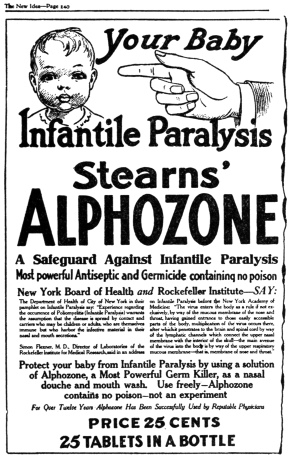
In the light of our present knowledge the claim that Alphozone is a preventive of infantile paralysis is without warrant and the advice that the public depend on it for this purpose is reprehensible and dangerous. Therefore, the Council directed that Alphozone be omitted from New and Nonofficial Remedies.—(From Reports of Council on Pharmacy and Chemistry, 1916, p. 50.)
CALCIUM GLYCEROPHOSPHATE AND SODIUM GLYCEROPHOSPHATE OMITTED FROM N. N. R.
Report of the Council on Pharmacy and Chemistry
Calcium glycerophosphate and sodium glycerophosphate were accepted for New and Nonofficial Remedies chiefly in order that these products might be standardized. These mixtures now being defined in the new edition of the U. S. Pharmacopeia, this reason for including them in N. N. R. no longer exists. The report of Marshall (The Journal, Feb. 13, 1915, p. 573) which has the endorsement of the Council (The Journal, Sept. 30, 1916, p. 1033) shows that organic phosphorus compounds are split up into inorganic phosphates before absorption, that the animal organism can synthesize its complex organic phosphorus constituents from inorganic phosphates and consequently that the glycerophosphates, so far as their phosphorus value is concerned, are not superior to other phosphates. In fact, sodium and phosphate are more effectively administered as neutral or acid phosphate. It is evident that sodium glycerophosphate is a superfluous pharmaceutical preparation, particularly when the difficulty of obtaining a pure product and its high price is considered. So far as its calcium value is concerned, calcium glycerophosphate has no advantages over such calcium salts as the carbonate, phosphate, lactate, or chlorid. In view of the foregoing, the Council directed that sodium glycerophosphate and calcium glycerophosphate be omitted from New and Nonofficial Remedies.—(From Reports of Council on Pharmacy and Chemistry, 1916, p. 52.)
GARDNER’S SYRUP OF AMMONIUM HYPOPHOSPHITE OMITTED FROM N. N. R.
Report of the Council on Pharmacy and Chemistry
In recognition of the considerable revision of the therapeutic claims made by the manufacturer, Gardner’s Syrup of Ammonium Hypophosphite was retained in New and Nonofficial Remedies, 1916, and the proprietor advised of this provisional retention.
In the most recent advertising for this ammonium hypophosphite syrup the claim is made:
“Besides being an active expectorant Syrup of Ammonium Hypophosphite (Gardner) is useful as an alterative and resolvent and by virtue of its phosphorus element, which is in the form of a hypophosphite, PH2O2, has a tonic value.”
As detailed in the report of the Council “The Hypophosphite Fallacy” (The Journal, A. M. A., Sept. 2, 1916, p. 760) careful studies show that the hypophosphites are devoid of the “alterative” and “tonic” actions claimed by the manufacturer of Gardner’s Syrup of Ammonium Hypophosphite. Accordingly the Council voted to omit Gardner’s Syrup of Ammonium Hypophosphite from New and Nonofficial Remedies and authorized publication of this report.—(From Reports of Council on Pharmacy and Chemistry, 1916, p. 55.)
GLUTEN PRODUCTS MADE BY THE KELLOGG FOOD COMPANY
Report of the Council on Pharmacy and Chemistry
For over two years the Council has had under consideration certain products offered for the use of diabetics by the Kellogg Food Company of Battle Creek, Mich. These are:
Pure Gluten Biscuit. Pure Gluten Meal. 40 per cent. Gluten Biscuit. 40 per cent. Gluten Flour. 40 per cent. Gluten Meal. 20 per cent. Gluten Meal.
The Council found these products ineligible for New and Nonofficial Remedies because the statements of composition (particularly of starch content) were insufficient and because the exploitation of the products to the laity was objectionable. June 21, 1915, the company promised to place a statement of the starch content on the package of each gluten product, to place on the gluten flour sacks a caution that diabetics use the flour only on the advice of their physicians, and to revise its advertising in accordance with the suggestions of the Council. Nothing further having been heard from the company, in April, 1916, specimens of the product were obtained, through a layman, direct from the Kellogg Food Company. These specimens, together with the advertising matter received at the same time, and also a letter of advice from the company to another layman, were sent to the Council’s referee, whose report follows. As will be seen, the referee finds that the amounts of carbohydrates contained in Pure Gluten Flour, 40 per cent. Gluten Flour and Pure Gluten Meal are greater than the amounts claimed in the company’s published analyses; that in the two first mentioned the amounts of protein are less than the amounts claimed; that exaggerated claims are made on all the labels and in the advertising literature, and that the company prescribes directly to the patient.
The following report was sent to the Kellogg Food Company for consideration. In reply the firm stated that a revision of its advertising was under consideration but would make no statement as to how soon this revision would be carried into effect. As the consideration had already consumed two years, the Council decided to give the profession the facts and authorized publication of the report. At the same time the Kellogg Food Company was advised that its products would be considered further whenever any submitted evidence warranted this.
W. A. Puckner, Secretary.
Referee’s Report
I submit herewith my report on certain foods offered by the Kellogg Food Company for the use of diabetics. I shall discuss these products from the standpoint of the claims made on the label, from the standpoint of the company toward nonmedical treatment as revealed in a letter to a layman, and lastly, on the basis of the claims made for the foods in the company’s literature.
CLAIMS MADE ON THE LABEL
PURE GLUTEN BISCUIT
RefereeCompany
Water 8.30 5–10
Ash 2.04 1–2
Protein (N × 5.7)73.87 75–80
Fiber 0.12 2.4–3
Carbohydrates14.84 0–5
Fat 0.810.25–0.70
Starch 4.02 0–5
The sample analyzed does not contain the amount of protein claimed for it. It also contains more starch than one might suspect from the company’s analysis. A more conservative claim would be “starch less than 5 per cent.” The company makes the error of using the terms “starch” and “carbohydrates” as synonymous. If the maximum figures of the company’s analysis are used, the carbohydrates would amount to 5 per cent., whereas I find 14.84 per cent. The claim on the label “Guaranteed to contain less than 5 per cent. of carbohydrates” is incorrect. The next claim, “Each ounce of this gluten contains 23 grams of protein and represents 95 calories” is approximately correct, as my analysis shows 20.9 grams of protein and 103 calories.
The following remarks under “Vegetable Proteins” are in my judgment exaggerated:
“Leading authorities are now agreed that meat, fish, eggs and other animal proteins are greatly inferior to vegetable proteins in diabetes, often increasing the sugar output and the dangerous acidosis which leads to diabetic coma.... After many years of experimentation, we have succeeded in perfecting a process whereby the carbohydrates are excluded.”
In this connection, von Noorden, whom the company constantly quotes, says:
“In the slighter forms (of diabetes), the influence of meat albumins is not great and it is difficult to demonstrate the reaction of the patient to different forms of albumin. It may be necessary to add more albumin than the patient can actually take before glycosuria indication is reacted.... Once a medium amount of albumin is exceeded, say 70 to 80 grams, the glycosuria increases, no matter what the type of albumin is.”
My analysis also shows that the carbohydrates are not excluded from this food as claimed above.
40 PER CENT. GLUTEN BISCUIT
Referee
Water 8.50
Ash 1.48
Protein (N × 5.7)41.15
Fiber 0.08
Carbohydrates47.81
Fat 0.98
Starch36.98
No analysis is supplied by the company, but this may be called properly a “40 per cent. Gluten Biscuit.” The company claims, however, that this is “Best for Diabetics,” which is not true.
Here, as in the case of “40 per cent. Gluten Flour,” the company’s label attributes to “Dr. Wm. Osler in ‘Practice of Medicine,’ ” the following quotation: “Of Gluten Foods, many are very unpalatable, others are frauds. A Good Gluten Flour is made by the Battle Creek Sanatarium Co., Mich.” I have no way of knowing to which gluten flour of the company Dr. Osler had reference. The “Pure Gluten Meal” might be called properly a “good gluten flour,” but this “40 per cent. Gluten Flour” is no better, and no worse, than the average gluten flour on the market. The quotation from Osler gives an entirely false impression.
40 PER CENT. GLUTEN FLOUR
RefereeCompany
Water 8.62 5–10
Ash 0.890.5–1
Protein (N × 5.7)33.63 40–45
Fiber 0.08 1–3
Carbohydrates55.35 40–45
Fat 1.430.2–0.5
Starch48.04 ...
My analysis shows 6.37 per cent. less protein than the company’s minimum, and 10.35 more carbohydrates than their maximum. In past years I have found the protein in this brand to range from 35.0 to 42.9 per cent. (using the factor 5.7). It is true that the manufacturer does not state what protein factor is used in his reported analysis, but as in four other brands 5.7 is used, it is fair to assume that the same factor applies to this as well. At least such should be the case, as otherwise the manufacturer’s analyses would be meaningless. Even using the factor 6.25 this later sample contains only 36.88 per cent. of protein.
The following statement, in my judgment, as applied to a food containing over 48 per cent. of starch, does not hold water: “This food is of special service in cases of Glycosuria and in the milder forms of Diabetes.” With this brand as with “40 per cent. Gluten Biscuit” the manufacturer again uses the misleading quotation from Osler.
40 PER CENT. GLUTEN MEAL
RefereeCompany
Water 7.30 5–10
Ash 1.36 1–2
Protein (N × 5.7)41.55 40–45
Fiber 0.10 1–2
Carbohydrates48.58 40–45
Fat 1.110.2–0.5
Starch36.5940–45
The claimed analysis is justified by my findings. I must take exception, however, to the following statement: “Prepared with great care from a good grade of Spring Wheat, by our special process, which preserves the natural food properties of the product.” The company evidently tries to carry water on both shoulders, on the one hand claiming a reduction in the starch content, while on the other claiming the preservation of all “the natural food properties.”
20 PER CENT. GLUTEN MEAL
RefereeCompany
Water 7.65 5–10
Ash 1.22 1–2
Protein (N × 5.7)24.6820–30
Fiber 0.12 1–2
Carbohydrates65.4165–70
Fat 0.92 1–2
Starch51.2465–70
The company’s analysis is confirmed. As the company claims directly that this is “Not A Diabetic Food,” any criticism of its use for that purpose is disarmed. However, again exception must be taken to the statement that “the natural food properties of the product” are preserved.
PURE GLUTEN MEAL
Referee Company
Water 4.60 5–10
Ash 0.96 1–2
Protein (N × 5.7)76.78 75–80
Fiber 0.08 1–3
Carbohydrates16.77 0–5
Fat 0.810.25–0.70
Starch 6.77 0–5
The minimum claim as to protein is justified. Again the company confuses carbohydrates and starch, and the food instead of containing from 0 to 5 per cent. of “carbohydrates (starch)” actually contains 16.77 per cent. of carbohydrates, of which 6.77 per cent. is starch. Once more the statement that “the natural food properties” are preserved is untrue as applied to a wheat product deprived of most of its starch.
In justice to the company, it should be noted that on the labels of “Pure Gluten Biscuit” and “Pure Gluten Meal” appears the warning: “Every person suffering from diabetes should be under the care of an experienced physician,” and on the label of “40 per cent. Gluten Meal,” “Persons suffering from diabetes should use this food only on the advice of a physician.” On the other hand, the suggestion on the label of “Pure Gluten Meal,” “Write for a copy of Diabetic Foods and How to Use Them” is a more or less direct invitation to self-treatment. Moreover, a letter dated May 9, 1916, apparently dictated for the Kellogg Food Company by one Ruth French, in reply to an inquiry from a layman, gives direct advice with no reference whatever to a physician.
CLAIMS MADE IN A LETTER TO A LAYMAN
In addition to this inconsistent attitude the letter makes certain clear misstatements, as follows:
“40 per cent. Gluten Flour actually contains 40 per cent. of pure Gluten, making it a perfectly safe article of diet in all but the gravest cases of diabetes. From our Gluten Flour excellent bread, gems and puffs are made that perfectly satisfy the craving for bread with no harmful results.” This flour contains 33.63 per cent. of gluten, not 40 per cent.; it is not “a perfectly safe article of diet in all but the gravest cases of diabetes,” for if one reads the literature correctly, starch restriction is more necessary in mild than in severe cases of diabetes. Furthermore, the bread, gems and puffs made from such a flour do not “satisfy the craving for bread with no harmful results.”
In the next paragraph of the letter, undue emphasis is laid on the “objectionable properties” of flesh foods, a statement only in accord with the tenets of extreme vegetarians. I also doubt very much whether the statement is true that “under a diet of our diabetic foods the thirst to which diabetics are so often subject is usually very much relieved.”
In the next paragraph the assertion is made that “The diet indicated ... is in keeping with the ideas of the highest medical authorities.... Meat is entirely excluded from the dietary.” My reading of the literature does not show that the leading authorities take any such position. Later on reference is made to von Noorden’s claim as to the superiority of vegetable over animal proteins, which I have already discussed under “Pure Gluten Biscuit.” (Certain detached sentences of von Noorden might justify such a statement, but a reading of all he says on the subject leads to a very different conclusion.)
CLAIMS MADE IN AN ADVERTISING BOOKLET
The whole booklet is written from the standpoint of an extreme vegetarian, and therefore is often misleading in its conclusions.
Page 5. “The researches of Ogata and others have shown that cane sugar is a less wholesome food than the natural sugars found in fruits and produced in the body by the digestion of starch, that is, fruit sugars and malt sugars.” In opposition to this I quote from von Noorden, their own authority, “Die Zuckerkrankheit und ihre Behandlung,” Berlin, 1910, page 270:
“That levulose, milk sugar and inulin are more useful than the other carbohydrates is a common opinion, but the importance of their use in practice does not correspond with the theory. In light cases the form of carbohydrates makes little difference; in severe cases the advantage from using levulose, milk sugar, etc., is only slightly greater than from using bread and flour.... Only in certain cases does it appear to me that the special form of carbohydrates possesses any particular significance.”
On page 92 of the same work von Noorden tells us that of the carbohydrates dextrose is the worst, with maltose almost as bad (in spite of the fact that Kellogg exploits his “Meltose,” the “new carbohydrate,” as of special value for diabetics). He also says that levulose increases glycosuria only about half as much as dextrose, when used occasionally, but with long use it is as bad as dextrose and starch.
Page 5. The company refers to sugar as “possibly also causing diabetes.” Sugar or any other carbohydrate may under diabetic conditions cause an increase of glucose in the urine, but I do not believe that any food or any diet can cause diabetes.
Page 7. “That the large use of meat and eggs is not only detrimental but positively dangerous in many cases of diabetes is now a well known and recognized fact.” The dietaries of well known authorities on diabetes are not in harmony with this statement.
Page 13. “It has been discovered that the complete suppression of carbohydrates from the dietary is not only unnecessary but is highly detrimental and even dangerous.” “The complete suppression of carbohydrates from the dietary” is the only means the physician has to determine the diabetic’s carbohydrate tolerance. If carbohydrate-poor foods are so “highly detrimental and even dangerous,” why does the company exploit foods like “Pure Gluten Flour” and “Pure Gluten Biscuit,” whose chief claim to excellence is their comparative freedom from carbohydrates?
Page 17. “Cream is an emulsion, and, with the exception of egg yolk, is the only form in which animal fat is found in an emulsified state.” Milk, Nature’s most wonderful emulsion, is apparently overlooked.
Page 19. “... these foods ... will be found of great value ... especially as substitutes for the breads and meats which are the most objectionable features of the ordinary diet, and which should, as far as possible, be interdicted in this class of cases.” This is simply special pleading for the Kellogg vegetarian diet.
Page 19. “Our glutens ... are all thoroughly standardized, so that in their use the physician and the patient know just the amount of starch eaten.” This standardization is largely mythical. For instance, “Pure Gluten Biscuit” claims 0 to 5 per cent. “carbohydrates (starch),” whereas I find 14.84 per cent. carbohydrates with 4.02 per cent. starch. “40 per cent. Gluten Flour” claims 40 per cent. gluten and 40 to 45 per cent. carbohydrates, whereas I find 33.63 and 55.35 per cent., respectively. “Pure Gluten Meal” claims 0 to 5 per cent. “carbohydrates (starch)” whereas I find 16.77 per cent. carbohydrates and 6.77 per cent. starch. I have a record of six analyses each of “40 per cent. Gluten Flour” and “40 per cent. Gluten Biscuit,” which show the hollowness of this claim of “standardization.” The flour showed 33.6, 35.0, 42.9, 36.8, 35.6, and 40.9 per cent. of protein, with from 40.8 to 55.4 per cent. of carbohydrates; the biscuits 32.7, 33.2, 39.5, 43.3, 33.9, and 41.2 per cent. of protein, with from 41.1 to 54.0 per cent. of carbohydrates. In fact, my experience shows that the Kellogg products are more poorly “standardized” than most of the diabetic foods on the market.
Page 20. “May be made to carry a large amount of fat in the form of butter, a most desirable thing in the treatment of diabetes,” while on page 16 the company claims that in an experiment of Minkowski on a dog, butter “passed through the body without change, none being absorbed”; these are certainly contradictory statements. The explanation is that on the one page the company is exploiting its biscuits, and on the other its nut preparations.
Page 20. Again the incorrect claim is made for “40 per cent. Gluten Flour” that “we believe this to be the only standardized gluten flour made.”
Page 21. The claim is made that flesh foods are “objectionable on account of the large amounts of ptomains and toxins which they contain.” I was not aware that fresh meats contained any ptomains whatever. On the same page the claim is again made that by the use of the Kellogg nut foods “diabetics lose their thirst,” a claim which I think is more than doubtful.
Page 22. “Nuts are a whole food, containing all the elements required for the perfect nutrition of the body.” A marked characteristic of nuts is that they are not “a whole food,” as with the exception of a few varieties, such as the chestnut, they are extremely poor in carbohydrates, which fact gives them their value in the diabetic diet.
Page 23. “With the exception of the potato, the beet and the carrot, vegetables contain little sugar or starch.” Corn, beans and peas are all vegetables which are relatively high in carbohydrates, and for this reason are specifically excluded from the diabetic’s dietary.
From the foregoing considerations I would recommend that the company’s analyses of “40 per cent. Gluten Biscuit,” “40 per cent. Gluten Meal,” and “20 per cent. Gluten Meal” be accepted as correct. Before the Council can accept any of these products, the following steps should be taken:
The company on all its labels should correct the impression that “carbohydrates” and “starch” are synonymous terms.
The labels of all the preparations examined should be changed in accordance with the criticisms given above.
In all cases in which analytic data are given, it would be preferable to state only the minimum of protein and the maximum of carbohydrates.
The booklet, “Practical Suggestions About Diet in Diabetes,” should be radically changed along the lines noted above.—(From Reports of Council on Pharmacy and Chemistry, 1916, p. 56.)
IODO-MANGAN OMITTED FROM N. N. R.
Report of the Council on Pharmacy and Chemistry
Iodo-Mangan, made by the Chemische Fabrik Helfenberg A. G., near Dresden, Germany, and sold in the United States by the Reinschild Chemical Company, New York, is a solution said to contain iron, manganese and iodin in combination with peptone. It is claimed to be a reconstructive tonic and blood-making adjuvant, with favorable action in affections of the glandular system. It was admitted to New and Nonofficial Remedies in 1907, before the Council had adopted the present Rule 10, which provides that no article shall be admitted to New and Nonofficial Remedies which, because of its unscientific composition, is useless or inimical to the best interests of the public or of the medical profession. In 1911 the Council considered the question whether or not this product was still eligible and decided in the end to retain it as probably having some merit. To determine if Iodo-Mangan was eligible for New and Nonofficial Remedies, 1917, the Reinschild Chemical Company was requested to send in the current advertising matter. As this advertising was not sent in and as apparently the product was not marketed at the present time, the Council on Pharmacy and Chemistry voted to omit Iodo-Mangan from New and Nonofficial Remedies. At the same time the Reinschild Chemical Company was informed that the preparation might be submitted for reconsideration at any time.—(From Reports of Council on Pharmacy and Chemistry, 1916, p. 64.)
LIQUID ALBOLENE
Report of the Council on Pharmacy and Chemistry
As now marketed, Liquid Albolene (McKesson and Robbins, New York), is claimed to be made only from genuine Russian oil and hence to possess distinct advantages over
“... Oils purporting to be Russian, most of which are imperfectly purified and many of which are positively dangerous for continued use.”
On the other hand, a short time ago, McKesson and Robbins claimed that Liquid Albolene was then available.
“... Of as high a quality as we had supplied before the European War. Thanks to the research and scientific achievement of Our Chemists, we are now able to offer LIQUID ALBOLENE, using as a base a specially refined Domestic Oil that is in every way suitable for medicinal purposes, and having the same viscosity as Russian Oil.”
The advertising matter suggests the promiscuous, thoughtless and irrational use of Liquid Albolene and of a number of Albolene preparations by extravagant claims, such, for example, as the following:
“Albolene will never fail to bring a free, easy stool, no matter what condition may be present, from obstinate atony of the bowel to fissure, fistula, or even malignant disease, and in spite of the failure of ordinary purgatives to which the patient may have become habituated....
“Aromatic Liquid Albolene is actually the first laxative presented to the medical profession that seems to have no drawback....
“It will not have been lost upon the physician who has read the remarks on the use of Aromatic Liquid Albolene to regulate the bowels in surgical cases, that there are many instances where it would prove equally valuable during the treatment of acute diseases. In the exanthemata, in pneumonia, for example, to cite only a few of the conditions where it may be used to advantage, an absolutely reliable laxative that will not in any way weaken or distress the patient, presents obvious superiority to any of the agents heretofore in common use.”
The Council held Liquid Albolene ineligible because the product is marketed in a way to encourage its indiscriminate and irrational use by the public (Rule 4) and because unwarranted therapeutic claims are made for it (Rule 6).—(From Reports of Council on Pharmacy and Chemistry, 1916, p. 65.)
NAPHEY’S MEDICATED UTERINE WAFERS
Report of the Council on Pharmacy and Chemistry
Naphey’s Medicated Uterine Wafers were submitted to the Council by the manufacturers, Naphey & Co., some years ago and were rejected. Naphey & Co. has recently requested reconsideration of the preparation, and has submitted advertising matter, trade packages and sample packages. The label of the trade package contains the following:
“Naphey’s Wafers. For the local treatment of diseases of women, indicated in catarrhal conditions of the vagina, and of the uterine cervix. As a [sic!] adjuvant for the physician to use in carrying out treatment of disease of the uterus.”
“Zinc Sulphate, 33⁄4 gr., Sodium Sulphate, 31⁄2 gr., Sodium Borate, 4 gr., Boric Acid, 3⁄4 gr.”
“Naphey & Co., Warren, Pa., U. S. A.”
“Each box contains 25 wafers, sufficient for three months’ treatment. Price per box, 25c.”
In name, composition, and general appearance of the package, Naphey’s Medicated Uterine Wafers bear a strong resemblance to Micajah’s Medicated Uterine Wafers (The Journal, A. M. A., March 26, 1910, p. 1070). An advertising pamphlet reads:
“In every form of leucorrhea Naphey’s Medicated Uterine Wafers are indicated ...”
“What is true of leucorrhea is also true of all other functional troubles affecting the female genital canal; they are all treated best by astringents and antiseptics. And these, to be effective, must be applied in prolonged contact.”
The implication that all “functional troubles affecting the female genital canal” are best treated by astringent tablets like Naphey’s Medicated Uterine Wafers is an absurdity. The naming of disease conditions on the label, the manifestly unwarranted and exaggerated therapeutic claims, the name, which is non-descriptive of composition but suggestive of use, and the fixed formula, which cannot rationally be expected to give uniformly satisfactory results in the wide range of conditions for which the product is recommended, render Naphey’s Medicated Uterine Wafers ineligible for New and Nonofficial Remedies under Rules 4, 6, 8 and 10.
The report having been sent to Naphey & Co., the manufacturer offered, on condition that the preparation be accepted, to revise the advertising matter in minor particulars, to remove disease names from the trade package and to adopt the name Naphey’s Wafers or Naphey’s Tablets. The Council advised Naphey & Co. that the proposed names do not conform to the requirements for acceptance in New and Nonofficial Remedies because they do not indicate the composition of this pharmaceutical mixture, and moreover, that the routine use of a complex formula such as that of these tablets is irrational.—(From Reports of Council on Pharmacy and Chemistry, 1916, p. 66.)
NUJOL
Report of the Council on Pharmacy and Chemistry
Nujol, a liquid petrolatum (Standard Oil Company of New Jersey, Bayonne, N. J.), was submitted to the Council by the manufacturers. The Council advised the company that, before Nujol could be made eligible for New and Nonofficial Remedies, the advertising claims made for it must be revised to conform to the rules of the Council and the term “liquid petrolatum” must be used in connection with the brand designation and given equal prominence on the labels, advertisements and all circulars. The company thereupon submitted a label on which the name “Nujol” appeared in large red letters and under it in small letters the words “Liquid Petrolatum.” This did not meet the Council’s requirement with regard to the name. Moreover, Nujol continued to be advertised to the public under exaggerated and unwarranted claims.
The foregoing report was sent to the Standard Oil Company of New Jersey, which thereupon submitted revised advertising copy. This copy was decidedly less objectionable than the previous advertising but still contained exaggerated statements. The copy for use in lay journals particularly evidenced exaggeration. Observation on many occasions of a similar fact has convinced the Council of the inexpediency of admitting to New and Nonofficial Remedies any article which is advertised to the public.101
The Council held that conflict with Rules 3, 6 and 8 prevented the acceptance of Nujol and authorized the publication of this report.—(From Reports of Council on Pharmacy and Chemistry, 1916, p. 68.)
PULVOIDS NATRIUM COMPOUND
Report of the Council on Pharmacy and Chemistry
Pulvoids Natrium Compound was submitted to the Council by the Drug Products Company, Inc., New York, with the statement that each pulvoid (coated tablet, said to be made to dissolve in the intestinal tract) represents the equivalent of:
Potassium Nitrate21⁄2 grs.
Sodium Nitrite 1⁄2 gr.
Sodium Bicarbonate2 grs.
Fl. Ext. Crataegus Oxycantha1 min.
Nitroglycerin 1⁄250 gr.
According to the advertisements the tablets are “indicated in the treatment of high blood pressure and all forms of hypertension of the cardio-vascular system.” It is claimed that the tablets “will not irritate the kidneys.”
The Council, having submitted its objections to the manufacturer and considered the firm’s reply, held that Pulvoids Natrium Compound was inadmissible to New and Nonofficial Remedies for the following reasons:
1. The claim is made that the tablets disintegrate in the intestines; experiments conducted by the Council indicated that in most cases they would be broken up in the stomach. It was found that the tablets were visibly changed immediately after being put into gastric juice or even into distilled water; they disintegrated within from three to four hours, not only in gastric juice (obtained from a dog) at 37 C., but also in distilled water. It is quite usual for solids to remain in the stomach for more than three hours. If they make their way out of the stomach in less than that time the gastric movements must be so vigorous as further to hasten the disintegration of the tablets.
2. The rules of the Council require that the name of a pharmaceutical mixture shall indicate the potent ingredients. The name of this mixture does not indicate the presence of the nitrites, the potassium nitrate, the bicarbonate or the extract of hawthorne and the nondescriptive name is likely to lead physicians to use the tablets without fully realizing what they are giving.
3. No evidence was submitted that the tablets, as found on the market, contained the amount of sodium nitrite and nitroglycerin claimed. That is, it does not appear that the manufacturer checks the sodium nitrite and nitroglycerin content by analysis. The Council did not determine the nitrite content of the tablets. It maintains that when a manufacturer places a product on the market the burden of proof is on that manufacturer to show that the facts are in accordance with his claims for his product. Further, the examination by the Council of one or several specimens of any commercial product (particularly in the case of nitroglycerin preparations) would not be a guarantee of the constancy of its composition so long as the manufacturer does not himself control the composition by analysis. The necessity of such control of tablets containing nitroglycerin is evident from the report102 of L. F. Kebler of the U. S. Bureau of Chemistry. Dr. Kebler said:
“... nitroglycerin tablets have in a majority of cases been found deficient in the nitroglycerin content declared.”
“... these commodities are manufactured largely by rule of thumb. Little checking obtains in their manufacture and generally no analyst is employed.”
A further proof that nitroglycerin tablets are likely to be deficient in strength is contained in the convictions under the Food and Drugs Act of manufacturers who sold tablets below the declared strength, recorded from time to time (Notices of Judgments Nos. 3405, 2059, 1843, 1799).
4. There is no good evidence, experimental or clinical, to justify the simultaneous administration in fixed proportion of two vasodilators like sodium nitrite and glyceryl trinitrate (nitroglycerin). Also there is no rational excuse for combining extract of hawthorne, which is said to have a tonic effect on the heart muscle, with nitrites, which cause relaxation of the vascular system, or for the combination with these constituents of potassium nitrate or of sodium bicarbonate.
In the absence of evidence for the combination, Pulvoids Natrium Compound must be considered an irrational mixture, the use of which is a detriment to sound drug therapy and, hence, not admissible to New and Nonofficial Remedies.—(From Reports of Council on Pharmacy and Chemistry, 1916, p. 69.)
SALOFORM
Report of the Council on Pharmacy and Chemistry
A referee submitted the following report of the American Medical Association Chemical Laboratory to the Council:
ANALYSIS OF SALOFORM
Saloform (Flexner) is advertised by the Robinson-Pettet Company of Louisville, Ky. In the advertisements for the product it is stated that:
“Saloform is a definite chemical compound the component parts of which are Hexamethylene Tetramine, Salicylic Acid and Lithia.”
“As a Uric Acid Solvent it is indicated in Rheumatism, Gout, in Phosphaturia, in Gravel, and in Renal Colic.”
“As a Genito-Urinary Antiseptic it limits suppuration anywhere along the Urinary Tract, from the Kidneys down to the orifice of Urethra.”
As, even after diligent search, no description of a compound of hexamethylenamine (hexamethylenetetramine), salicylic acid and lithia was found in chemical literature, it seemed probable that Saloform is merely a mixture of hexamethylenamine and lithium salicylate. Accordingly the separation of Saloform into its component parts by means of selected solvents was attempted. By triturating the powder with chloroform, filtering and evaporating the filtrate, a residue was obtained which gave satisfactory tests for hexamethylenamine but contained only traces of salicylic acid or lithium salicylate. The portion insoluble in chloroform was dissolved in water. The solution gave satisfactory tests for lithium salicylate but not for hexamethylenamine. From these tests it is evident that Saloform is a simple mixture of hexamethylenamine and lithium salicylate. Quantitative examination indicated that the two ingredients, hexamethylenamine and lithium salicylate, are present in approximately equal amounts.
REFEREE’S RECOMMENDATION
The report of our Chemical Laboratory shows that Saloform is not a definite compound as claimed, but a simple mixture of hexamethylenamin and lithium salicylate. It is therefore in conflict with Rule 1. It is also in conflict with Rule 6, for neither hexamethylenamin, lithium, nor salicylate are therapeutically effective “uric acid solvents”; nor would any of these have any effect on “phosphaturia.”
The mixture also conflicts with Rule 10; for it is inadvisable to administer the ingredients in fixed, but unknown proportions.
It is recommended that Saloform be deemed inadmissible to N. N. R.
The Council adopted the recommendation of the referee and authorized publication of this report.—(From Reports of Council on Pharmacy and Chemistry, 1916, p. 71.)
SECRETOGEN
Report of the Council on Pharmacy and Chemistry
About a year ago the Council declared Secretogen,103 a product the active ingredient of which was stated to be “pancreatic secretin” and advertised as a remedy for certain conditions of defective digestion and assimilation, to be ineligible for New and Nonofficial Remedies. The reasons for this decision were stated at the time as follows:
“1. No evidence has been presented that the absence of secretin is a cause of gastro-intestinal diseases. It is usually present, and if not present, as in achylia gastrica, there is evidently some compensating arrangement by which the pancreas is stimulated to perform its regular functions.
“2. There is no evidence that secretin in any form is physiologically active when administered by mouth.”
Since Secretogen was not the only so-called secretin preparation on the market, and since the use of secretin preparations was recommended by certain writers, notwithstanding the lack of evidence of its value, the Council caused an experimental investigation of the question to be made. This was carried out by Prof. A. J. Carlson of the University of Chicago.
No secretin was found in the commercial products examined, namely, Secretogen Tablets, Secretogen Elixir and Duodenin. Furthermore, Carlson’s results104 confirmed the Council’s previous conclusion as to the inertness of secretin administered by mouth. The Council endorsed Professor Carlson’s findings.105
The G. W. Carnrick Company has replied to the publication of this report in the letter printed below. (A portion of this letter, which consists of a communication from an unnamed correspondent of the G. W. Carnrick Company and the company’s comment thereon, has been omitted.) The Council offered to publish this if the Carnrick Company would furnish the name of the writer. This it has not done. As will be seen, the company now shifts ground, abandoning entirely the claim that Secretogen contains secretin. The Council has authorized publication of the letter (omitting the part just mentioned), together with the comment that follows.
W. A. Puckner, Secretary.
“The Council on Pharmacy and Chemistry of the American Medical Association.
“Gentlemen:—The opinion of the Council and the contribution by Professor Carlson which appeared in The Journal of the American Medical Association for Jan. 15, 1916, have been read by us with interest. The column of Current Comment dealing with ‘Tiger-Bone Therapy and Clinical Experience’ has appealed to our good nature and, under the circumstances, our sense of humor.
“Professor Carlson seems to have quite well established that the so-called secretin preparations do not contain secretin to any appreciable extent, and that they are inert in laboratory experiments on normal animals. At the same time, to do away with an apparent discrimination on the part of the management of the Council, it would have been well if Professor Carlson had included the so-called secretin preparations belonging to another well-known firm which markets such a product. This discrimination has already been referred to by us.
“Had Professor Carlson stopped at the determination of the therapeutic availability of secretin given by mouth, his work might have been accepted without comment, even if we should have thought it advisable to object to the matter published by the Council. But the professor went beyond his province entirely when, in commenting on the findings obtained by using Secretogen clinically, he said: ‘It is, perhaps, impertinent for laboratory men to comment on these clinical results.’ It is. His point was well taken and it is a profound pity that Professor Carlson did not observe his own ruling.
“In the words of a correspondent of The Journal of the American Medical Association, in discussing Professor Carlson’s criticism of Dr. Crile’s ‘Kinetic Drive,’ ‘it behooves the laboratory man to be circumspect in his criticism of clinical theories, since going beyond the bounds of well-established things weakens his position, not merely with reference to the particular subject under discussion, but with reference to clinical phenomena in general.’ Clinical results have definitely established the value of Secretogen. As the matter now stands this statement is beyond criticism.
“When Secretogen was first introduced we assumed that it depended on secretin for results produced. In this assumption we were in good company, as witnessed by the testimony of Moore, Edie and Abram when, in the course of their investigations as to the value in diabetes of a secretin-bearing extract given by mouth,106 they said: ‘In the majority of these cases ... there has been no appreciable fall in the output of sugar ... in some of these negative cases there has been noted, however, improvement in the digestion and, in certain cases, the patient’s weight has increased.’ They also state that the secretin-bearing product ‘appears to stimulate the functional activity of the duodenum.’106 They give a most significant report.107 We quote from the paper as follows:
“ ‘The patient had been under observation for six months before treatment and the sugar was not reducible by diet. Almost at once the dyspepsia from which he was suffering was relieved and his general nutrition improved to such an extent that he regained over eighteen pounds in weight, which he had previously lost, and this improvement was accompanied by complete recovery of his physical and mental energies.’106
“Inasmuch as this improvement could not have been due to the contained secretin it must have been due to some other principle contained in the extract. Our experience and that of the physicians who have used Secretogen establish the fact that Moore, Edie and Abram made no mistake when they came to the conclusion that what they termed a secretin-bearing extract stimulates the functional activity of the duodenum and improves the digestion.
“When Professor Carlson was investigating Secretogen he must have realized that he was dealing essentially with an extract of the duodenal mucosa. It is, therefore, all the more surprising, considering his extensive researches into the literature, that he should have ignored the testimony of some of his own authorities, particularly Hallion, as to the value of extracts of the duodenal mucosa in duodenal insufficiencies. The meticulous carefulness with which this evidence was avoided is hardly worthy of the best traditions of physiology, a science which has truth for its first and last aim.
“Hallion in his ‘La Pratique de l’Opothérapie’ says that the ‘aims of duodenal opotherapy are: 1, To supply deficient duodenal juice. 2, Above all to stimulate and to relieve this organ—notably to aid the production of secretin106—and so profit by the stimulating action which duodenal extract exercises on the duodenal mucosa which action we, Enriquez and myself, believe and have experimentally proved, conforms to the general principles of opotherapy. 3, By means of the production of secretin, to reinforce the biliary, pancreatic and intestinal secretions. 4, To stimulate intestinal peristalsis.
“ ‘Principal indications: Intestinal dyspepsias, intestinal autointoxications, certain forms of constipation and duodenal insufficiency.’
“At the International Congress of Medicine, Madrid, 1903, Hallion said that he felt justified in stating that duodenal opotherapy correctly carried out must be classed under the very best methods of treating dyspepsia.106 The results had been satisfactory and, in many cases, remarkable. It had been nil in a few cases but it had never been harmful in any degree. He pointed out that Marfan was the first to employ this substance clinically. Marfan had had particularly excellent results in children of 15 months to 4 years suffering with marked malnutrition, anorexia and constipation. Marfan prescribed the duodenal extract given in milk.106 Hallion further remarks that, as he is not a practitioner, he had had only one opportunity to test duodenal opotherapy clinically. The case was that of a man of 26 years with obstinate intestinal dyspepsia and severe constipation which had persisted from childhood. This patient had been treated by enemas, laxatives, diet, etc. Treatment with duodenal extract resulted in a complete cure.106 Hallion points out that the most satisfactory aspect of duodenal opotherapy is the permanent effect produced,106 which bears out his statement that these extracts have the power to aid in the restoration of function and structure of an organ.
“This has been so well established that the principle is now embodied in a law which is frequently referred to as ‘Hallion’s Law’: ‘Extracts of an organ exert on the same organ an exciting influence which lasts for a longer or shorter time. When the organ is insufficient it is conceivable that this influence augments its action and, when it is injured, that it favors its restoration.’
“In ‘La Pratique de l’Opothérapie’ Hallion points out that ‘the opotherapeutic product which corresponds to the affected organ represents in some way the stimulating and elective food for that organ, and if we supply the organ with a food which is more complete than it necessarily needs, the affected organ can exercise its elective action and take up only those substances of which it is in need.’
“Hallion’s observations on this point are beautifully borne out by the classic work of J. W. Draper, as reported in The Journal of the American Medical Association, Sept. 26, 1914. This report gives results in both laboratory and clinical experiments.
“In order to show that fed jejunal and ileac epithelium exercise some special detoxicating power, not yet understood but definitely recognizable, Draper fed a control series of dogs with intestinal obstruction, experimentally produced, on emulsified cells of liver, spleen, pancreas and muscle tissue. These animals lived a few hours longer than not-fed controls, but Draper says that it is evident that these cells had either no detoxicating action, or a very feeble one compared with intestinal epithelium. He used jejunal and ileac epithelium clinically in two instances: 1st, In a female dog which had had ‘chronic stomach trouble’ for six months. When Draper saw her she had had complete intestinal obstruction for five days, with symptoms of tachycardia, extreme nervousness and great weakness in the hind legs. Draper removed a pebble from her intestine but her condition was still grave.
“She was immediately put on small-intestine epithelium derived from two dogs of different breed. Draper says that from a long experience with duodenally obstructed dogs, he should not have expected her to recover, but the symptoms gradually subsided and she lived. The second instance in which he used the epithelium therapeutically was in the case of a man who suffered from an annular cancer of the intestine with definite symptoms of obstruction. After the operation, and realizing that the patient was in a desperate condition, he fed him an emulsion of intestinal epithelium from a dog. The pulse improved and the patient lived.
“Some of Draper’s conclusions are as follows:
“ ‘Autotoxemia in intestinal obstruction undoubtedly arises from an interference with cellular reactions of the intestinal epithelium.... When small-intestine epithelial cells of healthy animals are placed in the stomach106 of duodenally obstructed animals, such animals have lived nearly twice as long as not-fed controlled animals. This evidence is strongly opposed to the bacterial theory of origin of toxins.’
“The point to be emphasized is this: If this emulsion of intestinal epithelium had been fed to a normal dog and a normal man, what would have happened? Absolutely nothing. On the other hand, given as it was to a dog and a man in desperate need it exercised a potent effect.
“Abundant clinical testimony can be cited in support of the opinions of Moore, Edie and Abram, Hallion, Marfan and Draper as to the value of extracts of the intestinal mucosa given by mouth in pathological conditions. We have previously cited the published favorable opinions of such gastroenterologists as Anthony Bassler, Lewis Brinton, G. R. Lockwood, and R. C. Kemp, so there is no need to recapitulate their experiences with what they honestly believed to be secretin-bearing extracts, but which were essentially extracts of the duodenal mucosa.
“Supplementing the evidence of these men as to the value of these extracts we submit an excerpt from a letter from one of the best known physicians of Edinburgh:
“ ‘I can speak in very high praise of Secretogen, which I have used in both tablet form and as the elixir. There is no doubt about its value in a certain class of intractable indigestion which refuses to be benefited by any other remedy. On several occasions I have been much gratified by the definite relief obtained in this class of cases. It hits the mark also in some types of obstinate constipation—I think those cases where the trouble is wrapped up in impaired enervation of the intestine, and where stasis occurs at certain segments of the canal.’
“Hallion very pertinently points out108 that it is now accepted that opotherapy is not substitutive, but homostimulative and he remarks further that it is well to bear in mind that the so-called active substances which make the extract efficacious need not necessarily be the hormones. ‘It may be the elements of tissue structure which may come to the aid of the injured organ. The hormone should not therefore be looked on as the only active agent of opotherapy and, while its action is important, it need not necessarily be preponderant. The chemical isolation of the hormones is, of course, of interest but may not be as vital to organotherapy as we have thought.’ ...”
COMMENT BY THE COUNCIL ON PHARMACY AND CHEMISTRY
The G. W. Carnrick Company, which formerly claimed that Secretogen was efficacious because it contained secretin, now admits this claim to be unfounded. Notwithstanding, the manufacturers still call their product Secretogen and make for it practically the same therapeutic claims as before. They now base these claims on vague “principles of opotherapy” and on so-called “clinical testimony.” The burden of proof rests on them to show that these old claims, already discredited but put forth again on new grounds, are justified. Have they done so?
The “clinical testimony” is not convincing. So much of it as is definite enough to permit of criticism has already been dealt with. The remainder consists of mere assertions; it is not through reliance on such evidence that the Council can discharge its trust. On this side of the question there is nothing new to be said—reassertion of a refuted argument does not constitute fresh proof.
Nor is the case better on the experimental side. The statements of Hallion, Enriquez, Zuelzer and others109 as to the existence of a “peristaltic hormone” not only have failed of confirmation, but also have been positively discredited. With regard to Draper’s work, which dealt with acute intestinal obstruction, it is difficult to see what is its relevance to the present issue, particularly since Draper’s results were obtained with a product derived from the mucosa of the jejunum and ileum and not with an extract of the duodenum such as Secretogen purports to be.
The innuendo that the Council discriminates in favor of certain manufacturers, is itself a confession of weakness.
In publishing this correspondence the Council’s sole object is to put the medical profession in possession of the exact facts of the case. These may fairly be summed up as follows:
1. Secretogen was originally marketed as a preparation containing secretin. None was found in it.
2. Notwithstanding proof of this fact, the G. W. Carnrick Company retain the original name of the product, knowing that, by its association with their former erroneous assertions concerning Secretogen, this name must inevitably convey to a physician using the product the impression that he is administering secretin. In the advertising literature no hint is given that this original statement was erroneous.
3. The product called “Secretogen” has not been shown, either experimentally and by sound clinical evidence, to possess useful therapeutic properties.
Under these circumstances the Council reaffirms its decision.—(From Reports of Council on Pharmacy and Chemistry, 1916, p. 72.)
IRON CITRATE GREEN
Report of the Council on Pharmacy and Chemistry
H. K. Mulford Company and E. R. Squibb and Sons submitted to the Council ampules containing solutions of iron citrate green. It thus became necessary to consider the eligibility of iron citrate green itself for admission to New and Nonofficial Remedies. As the rules of the Council provide that nonessential modifications of official or nonproprietary preparations will not be recognized, the above named firms were asked to state what advantages, if any, the so-called iron citrate green had over the official iron and ammonium citrate. In reply the H. K. Mulford Company wrote that it had come to the conclusion that iron citrate green and ampules thereof would undoubtedly be considered by the Council as a nonessential modification of an official product, adding:
“It seems to differ from the official ferric citrate so far as essentials go only in color, but custom, which is exceedingly hard to change in South America, demands that this green variety of ampules be used in place of the official product.”
In reply to a similar letter of inquiry E. R. Squibb and Sons wrote:
“Iron citrate green (iron and ammonium citrate green) differs from the U. S. P. iron and ammonium citrate in that it contains less iron and more citric acid and more ammonium citrate than does the latter. It is of course a modification of the official salt and is supplied to meet a real demand. Its reaction is quite decidedly acid and our present stock contains Fe slightly below the U. S. P. requirements for iron, assaying 15.74 per cent. instead of 16 per cent. Fe. The tests used to control its quality are those for the official product except as before indicated, it is always acid instead of neutral, as the U. S. P. requires for that salt.”
The smaller iron content (98 per cent. of the U. S. P. requirement) of the green variety referred to by E. R. Squibb and Sons is so small as to be negligible. Further, the low iron content as well as the acidity of the green salt would appear to be detriments rather than advantages. Inasmuch as no evidence has been presented to show that iron citrate green is superior in any way to the well-known iron and ammonium citrate the Council held that iron citrate green, and with it the dosage forms, was ineligible to N. N. R.
The preceding report was submitted to the Mulford Company and to E. R. Squibb and Sons for comment before publication. The former firm replied that in the present case it felt bound to supply the existing demand, the latter replied that, to give the Council its support in this matter, the sale of iron citrate green and ampules thereof would be discontinued.—(From The Journal A. M. A., Jan. 13, 1917.)
ASPIRIN
Report of the Council on Pharmacy and Chemistry
The referee’s report on Aspirin-Bayer which follows was submitted to the Council and adopted by it and, in accordance with the referee’s recommendation, was sent to the Bayer Company, Inc. The company’s reply contained nothing to warrant the continued recognition of this product by the Council. It was accordingly directed that Aspirin-Bayer be omitted from New and Nonofficial Remedies.
W. A. Puckner, Secretary.
REFEREE’S REPORT
The referee’s attention has been called to the systematic campaign of advertising aspirin to the public. He is informed that tablets have been marketed for some time in “vest-pocket” boxes, bearing the name “Aspirin” permanently affixed, which is in technical conflict with the Council’s rule against indirect advertising to the public. More recently, conspicuous advertisements have appeared in daily papers. These are technically in conflict with the rule against direct advertising to the public.
In addition to the plain technical conflicts with the Council’s rules there is a feature of the case which has not hitherto been raised and which should be fully considered: It may be remarked that the advertisements contain no therapeutic recommendation, and do not, on their face, urge the public to employ aspirin but apparently merely tell the public how it may protect itself against sophistication. In substance, they say: “If you are a user of aspirin, this is how you may obtain the genuine.” It might be said that this is not an attempt to increase the use or sale of aspirin—the ordinary object of advertising—but that the means of protection against adulteration is a “subject on which the public should be instructed.” The principle of such exceptions is stated in the comments to Rule 3 (New and Nonofficial Remedies, 1916, p. 15); and although the present case does not come under the exceptions specified under these comments, it may be urged that the exceptions need to be increased as occasion arises. The notorious adulteration of aspirin may well be urged as establishing a need for a similar exception in its use.
The general principle of protecting the public against fraud, adulteration and substitution is directly in line with the objects of the Council, and deserves commendation and support. It is obvious, however, that the means adopted for this end must be efficient, that they must not open the door to other, perhaps greater evils and that they must be used in good faith. The policy of advertising “Aspirin-Bayer” must be examined in these respects.
In the first place, the acceptance of a product by the Council implies an agreement by the manufacturers or agents that they will adhere strictly to the Council’s rules and will not depart from the letter or spirit of these rules without notice to the Council. This principle has been grossly infringed in the present case. There can be no doubt that the agents were aware that their advertisements conflicted, at least with the letter of Rule 3. Nevertheless, they did not, in any way, inform the Council of the change in policy. In this respect, at least, they have not acted in good faith.
Secondly, the wording of the advertisement implies that only the tablets stamped with “The Bayer Cross” are genuine. This is misleading, since every druggist has the right to make unstamped tablets of aspirin, fully as genuine as those stamped with the cross.
Thirdly, the cross itself cannot be considered an efficient protection; for people who imitate aspirin will not hesitate to imitate the stamp. The remedy, in either case, and as with any other drug, is the examination of trade samples, and the vigorous prosecution of those guilty of violating the law.
Fourthly, the permanent affixing of the name “Aspirin” to the vest-pocket boxes is also inefficient as a protection, and serves mainly as an advertisement.
Fifthly, whatever may have been the motives of the advertisers, and however carefully the advertisements are worded, they will inevitably tend to increase the use of aspirin by the public, and this is directly against the interests of public health. The public does not know, as physicians do, that headaches are merely symptoms of other, sometimes very serious conditions; and that they are often the signal for the need of a thorough physical examination and diagnosis. It is true that they are often also the symptoms of very minor derangements, which will right themselves spontaneously; and that, in such cases, drugs like aspirin may give relief and may do no harm. The patient, however, is not educated to distinguish one class from the other, and therefore anything that tends to promote the indiscriminate use of such remedies as aspirin is detrimental to the public health. Furthermore, aspirin itself is not always harmless. Alarming idiosyncrasies are sufficiently common that the use of the first doses, at least, should require medical supervision. With these considerations in mind, the referee is of the opinion that the direct and indirect advertising of aspirin is to be condemned.—(From The Journal A. M. A., Jan. 20, 1917.)
PIL. CASCARA COMPOUND-ROBINS
Report of the Council on Pharmacy and Chemistry
A circular issued by the A. H. Robins Company of Richmond, Va., contains the following statement:
“PIL. CASCARA COMPOUND-ROBINS is a rational therapeutic formula, composed of CASCARA, PODOPHYLLIN, COLOCYNTH and HYOSCYAMUS, which promotes a natural flow of secretions, which is, in turn, the physiologic stimulant of peristalsis. Thus, a normal evacuation is produced without subsequent inhibition.
“They contain no Mercury, Strychnia nor Belladonna.
“An ideal aid to any remedial agent, when a Mild, Medium or Strong alimentary stimulant is needed [sic].
“Made in two strengths, the dosage may be easily regulated so as to obtain the effects of an Anti-Dyspeptic, Aperient, Laxative or Cathartic, as desired. They never cause discomfort unless given in larger dose than needed.”
This preparation is another example of the innumerable mixtures of well-known drugs having nothing in the way of originality or of special therapeutic value to recommend them.
The advertising implies that this particular combination has a special action on the secretions of the gastro-intestinal tract; otherwise it would be hard to explain the claim that the preparation is antidyspeptic, if that means anything more than a laxative or cathartic.
The claim is made that this preparation contains no belladonna—yet it admittedly contains hyoscyamus! This manifests either ignorance on the part of the manufacturers, or an effort to impose on the medical profession. Both belladonna and hyoscyamus contain variable amounts of similar alkaloids, chiefly hyoscyamin. Hyoscyamus is feebler than belladonna in its action, as it contains less alkaloid. The qualitative differences between the two drugs, with reference to their use as laxatives, is so slight as to make the company’s claim for hyoscyamus appear either deliberately misleading or to be the result of crass ignorance. Promoting this mixture of well-known laxatives and cathartics as an “ideal aid to any remedial agent when a mild, medium or strong alimentary stimulant is needed” is a slur on the intelligence of physicians.
Pil. Cascara Compound-Robins is not acceptable for New and Nonofficial Remedies.—(From The Journal A. M. A., Jan. 27, 1917.)
CASTA-FLORA
Report of the Council on Pharmacy and Chemistry
Casta-Flora is one of those complex preparations which are offered to the medical profession, with plausible arguments in support of the claims made. It is put out by the Wm. S. Merrell Chemical Co., Cincinnati. Each fluidounce is said to represent:
“Castanea, fresh leaves, 40 gr.; Passiflora, fresh plant, 40 gr.; Gelsemium, green tincture, 8 minims; Inula, represented by the camphoraceous stearoptene Helenin, 20 grs.; Iodized Lime, 8 grs.; Menthol, 1-4 grs.; Aromatic Syrup Yerba Santa, 60 minims.”
It is said to be:
“A new combination of well-tried remedies of especial value in pertussis and other spasmodic coughs. It is composed of astringent, antispasmodic, sedative and expectorant agents, that control the paroxysms, relieve the irritation, promote expectoration, and give tone to mucous membranes involved.”
Still more exaggerated claims are made for the individual constituents of Casta-Flora, partly by direct statement, partly by inference. For example:
“Castanea is almost a specific in whooping cough and other spasmodic coughs.
“Passiflora is a narcotic, sedative and antispasmodic without habit-forming properties, nor does it lock up the secretions and upset digestion like opiates.
“Inula (elecampane) has been employed as a cough remedy in England for centuries. Its action is similar to guaiacol and creosote. Its active principle, helenin, is destructive of tubercle bacilli in dilutions of 1 to 10,000.
“Iodized Lime, Menthol, and Yerba Santa are too well known as expectorants and antiseptics to require more than passing mention.”
That Casta-Flora is a “new” combination may be admitted; it is improbable that exactly this combination of obsolete drugs was ever before selected for any purpose whatever, but the statement is misleading in that no new principle of therapeutics is involved. On the contrary, the combination is just what might be expected from haphazard choosing of discarded and nearly forgotten drugs. It seems incredible that a reputable firm of manufacturing pharmacists would make the positive statement that castanea is almost a specific in whooping cough. Why not say it is a specific? It would be about as true. A specific or “almost specific” for this disease would rank among great medical discoveries; but castanea is merely a slightly astringent drug neither better nor worse than scores of other astringent drugs that have been tried, found valueless and discarded.
Hardly less surprising are the statements regarding passiflora. This herb has been on the market about three quarters of a century. Not only has it never established itself in scientific medicine, but it is not even mentioned in modern standard works on therapeutics.
Of all the statements made in the circular perhaps the most remarkable, in that it is so dangerously misleading, is that regarding helenin, the active principle of elecampane. The statement that this principle (helenin) is destructive of tubercle bacilli in dilutions of 1-10,000 can only mean that it is of extraordinary value in the treatment of tuberculosis; in fact, it is definitely stated that the action of elecampane is similar to that of guaiacol and creosote.
It is obvious that any drug which would destroy the tubercle bacilli in the human lungs without exerting a toxic action on the patient would be a great contribution to medicine. But although elecampane may have been used for centuries it has proved to have little, if any, merit, and even the National Standard Dispensatory, p. 848, says: “Elecampane was formerly employed as a tonic, stimulant, diuretic, diaphoretic, expectorant, and emmenagogue, but has now largely fallen into disuse.” One looks in vain in the standard textbooks on therapeutics for a description of the uses of inula (or elecampane), and of its so-called “active principle,” helenin.
The circular to which reference has been made says, referring to the use of castanea and passiflora in the treatment of whooping cough:
“Gelsemium, when made from the fresh, green plant—as is Merrell’s—is an excellent adjuvant to the above drugs, and allays the nervous irritability so frequently present.”
H. C. Wood, Jr. (Pharmacology and Therapeutics, 1916, p. 160), says of gelsemium: “Gelsemium was originally employed as an arterial sedative and febrifuge in the malarial fevers of the South, and subsequently in sthenic fevers. It appears in some way to depress the bodily temperature, but it does not appear probable that any advantage to be derived from it will counterbalance the danger attending its employment in the large doses required. In asthma, spasmodic laryngitis, whooping cough, and nervous cough it has been recommended by Bartholow, but is little used.”
That is about as favorable a statement for the drug as is to be found in the textbooks, and it serves to illustrate how little new there is in this mixture of obsolete drugs that Merrell seeks to market as one possessing extraordinary therapeutic value.
Even though the ingredients, or certain of them, were singly useful in the treatment of those conditions for which Casta-Flora is recommended, no one could possibly foresee the effect in any given case of such a jumble of drugs, both active and inert, as is said to be represented in this preparation. The prescribing of such mixtures, the action of which cannot in any way be foreseen, is plain charlatanism.
In addition, the various drugs in Casta-Flora are present in such proportions that the dose of each of the several ingredients bears no relation to the commonly accepted dose.
Casta-Flora is not acceptable for New and Nonofficial Remedies.—(From The Journal A. M. A., Jan. 27, 1917.)
FIRWEIN
Report of the Council on Pharmacy and Chemistry
Firwein is a product of The Tilden Company, New Lebanon, N. Y. It is sold under the claim that when swallowed it has a “predilection” both for the bronchial mucosa and also for the genito-urinary organs. To quote:
“Expectorant, Sedative, Antispasmodic in the Treatment of Inflammations of the Bronchial and Genito-Urinary Mucosæ.”
“Firwein being a bland, soothing balsam possesses a wide range of adaptability and increased potency because of its healing virtues and usefulness as an expectorant, sedative and antispasmodic in bronchitis, and inflammation and catarrh of nose, throat and lungs.”
“Firwein has a special predilection for mucosæ, this being as marked in diseases of the genito-urinary system as it is in the respiratory organs. In inflammatory diseases of the genito-urinary organs, its bland, curative properties are exerted in a gratifying degree. In cystitis and uritis it is clearly indicated....”
Little information is given concerning the composition of Firwein. An old circular says:
“Firwein contains Phosphorus, Iodin and Bromin finely blended with a balsameous elixir made from the fir tree.”
From a more recent circular we quote:
“Firwein is prepared from the inside fresh green bark of the fir tree ...”
The label on the product reads:
“Firwein is pleasantly and effectively blended with salts of iodin and bromin, held in solution with 20 per cent. alcohol.”
The therapeutic claims made for Firwein and the mystery enshrouding its composition make it obvious that the product is intended to appeal to those who are either thoughtless or ignorant. This is emphasized by the suggestion that Firwein be combined with (1) cod liver oil (under the claim that it will “promote the efficiency of the oil”), with (2) whisky for the treatment of bronchorrhea of the aged, and with (3) syrup of hypophosphites for the treatment of persistent bronchitis.
As the composition of Firwein is secret, the therapeutic claims unwarranted, and its use irrational, the Council declared it inadmissible to New and Nonofficial Remedies.—(From Journal A. M. A., Feb. 17, 1917.)
FIROLYPTOL PLAIN AND FIROLYPTOL WITH KREOSOTE
Report of the Council on Pharmacy and Chemistry
Firolyptol, another product of The Tilden Company, is, we are told, composed of eucalyptol 10 drops, cottonseed oil 1⁄2 ounce and Firwein enough to make 1 ounce. As the composition of Firwein is secret, it is evident that the composition of Firolyptol is also unknown, except to the manufacturers. “Firolyptol with Kreosote” is said to contain, in addition to whatever may be the component parts of Firolyptol, 10 minims of creosote to each ounce. According to an advertisement, Firolyptol with Kreosote is “antituberculous, antistrumous” and “contains all the desired features of cod liver oil and is readily assimilated.”
The advertisements of “Firolyptol Plain” and “Firolyptol with Kreosote” seem to have for their key-note the assertion that cottonseed oil is a particularly valuable nutriment and that when combined with constituents of Firolyptol and Firolyptol with Kreosote becomes particularly valuable to the tuberculous. To quote from an advertising circular:
“Now that the reconstructive properties of cottonseed oil are better appreciated by the profession, the advantages that follow the administration of a palatable emulsion of this strengthening and fattening food product are being demonstrated in hundreds of cases where formerly reliance would have been placed in cod liver oil.... A recent writer says that pure cottonseed oil is the greatest and purest vegetable oil known to chemistry, and will do much toward revolutionizing the treatment of the GREAT WHITE PLAGUE.... If the treatment of tuberculosis could resolve itself into the administration of a fatty substance in a readily assimilated form, there would be no need for any part of FIROLYPTOL but the Cottonseed Oil.... The toxic material constantly produced in the system by the germs of tuberculosis tend to expose it more and more to the ravages of the disease, and the physiologic functions of the body suffer a constant depression. To neutralize this germ activity with a consequent production of toxins it seems most logical to employ such agents as have demonstrated their suitability for such purposes, for which reason Eucalyptol and Kreosote with Firwein are incorporated in FIROLYPTOL.”
The assertion that cottonseed oil is an especially valuable form of fat is without warrant, but even if it were true the fat is available in cheap and palatable forms in numerous other cottonseed oil products. It is unnecessary to discuss the problematic value of creosote in the treatment of tuberculosis or the value of eucalyptol (now generally abandoned), or even of the secret mixture Firwein. Food and fresh air, not drugs, constitute the fundamentals of the treatment of tuberculosis, and it is both irrational and detrimental to the interests of the tuberculous to administer various potent agents in fixed and unknown amounts with such simple articles of food as cottonseed oil. Neither of these products is acceptable for New and Nonofficial Remedies.
Editorial Note.—Firwein110 has been advertised to physicians for twenty-five or thirty years and it is a sad commentary on the intelligence of our profession that a preparation sold under such obviously false and misleading, not to say silly, claims, should still be in existence. Firwein is claimed to “prevent waste of tissue” in tuberculosis. If it had this power, it would have found its place long ago among the few great agents in drug therapy. As a matter of fact, Firwein has gained virtually no recognition outside of the “literature” of the Tilden concern. The claims made for Firwein are a peculiar mixture of studied candor—when the truth is not likely to hurt its sale—and inane vaporing—when the facts would not redound to its credit. The Tilden Company declares that “Firwein stands without a peer in its class.” But the company adds 10 drops of eucalyptol and some cottonseed oil to this peerless product and an improvement is born—“Firolyptol”! Then, to perfect the already perfectly perfected, 10 drops of creosote are added to “Firolyptol” and the profession is offered “Firolyptol with Kreosote”! In just what verbal pyrotechnics the Tilden Company might indulge, should it decide to add ten drops of something else to “Firolyptol with Kreosote,” one shudders to contemplate.
If we are accused of exhibiting undue levity in discussing a therapeutic problem, we can only answer that it is impossible to consider seriously the Charlie Chaplins of the nostrum world.—(From The Journal A. M. A., Feb. 17, 1917.)
BINIODOL
Report of the Council on Pharmacy and Chemistry
In accordance with the usages of the Council, the report which appears below along with the reports of the clinical investigation by Drs. Cole and Keidel upon which the recommendations of the referee were based were sent to the manufacturer for comment. The reply of the manufacturer contained no evidence which justified the Council in modifying the action already taken. Publication of the report was therefore authorized.
W. A. Puckner, Secretary.
Biniodol was submitted to the Council by the manufacturer, Charles C. Yarbrough, Memphis, Tenn. The manufacturer claims the product is a solution of 1 per cent. of red mercuric iodid and 2.75 per cent. of guaiacol in bland vegetable oil. It is marketed with the implication that it is new and superior to other oil solutions of mercuric iodid. For instance:
“... it is a straight solution of this mercurial compound, as no alkaline iodide or other chemical is used to bring about the solution.” “... It is probably the first and only one-percent oil solution of straight mercury biniodide made in America....”
[The manufacturer, in a letter addressed to the secretary of the Council, explains: “By straight solution, I mean that the solution of the red mercuric iodid is effected without the aid of any alkaline iodid or other chemicals.... Biniodol was first offered early in 1912 ...”]
“Biniodol is, therefore, superior and much to be preferred to other mercurials used for like purposes. It is highly active therapeutically, producing the desired effects, usually without the inevitable disadvantages of other mercurials. It rarely causes salivation, diarrhea, or other symptoms of mercurial intolerance, even when pushed to full therapeutic effect and when given for a considerable period of time. Nor does it produce anemia.”
The Chemical Laboratory of the American Medical Association found that Biniodol contained 1 per cent. of mercuric iodid and 2.5 per cent. of guaiacol; hence the composition is essentially as claimed. It is not true, however, that Biniodol is the “first and only one-percent solution of straight mercury biniodide made in America.” As shown in The Journal A. M. A., Dec. 9, 1914, p. 2247, formulas by Lemaire and Dunning for making a “straight” solution of mercuric iodid were published in this country in 1909 and 1910, respectively. Moreover, a 1 per cent. solution of mercuric iodid in oil is on the market and is described in New and Nonofficial Remedies.
To determine whether or not Biniodol is “superior and much to be preferred to other mercurials used for like purposes,” the Council secured the cooperation of the Department of Dermatology and Syphilology of the Western Reserve University cooperating with the Cleveland City Hospital, and of the Johns Hopkins Hospital. Each received three samples, labeled respectively, 1, 2 and 3: 1 contained Biniodol; 2, a 1 per cent. solution of mercuric iodid in oil; 3, a solution made up according to the formula of Biniodol, namely, 1 per cent. of mercuric iodid and 2.5 per cent. of guaiacol in oil. All the solutions were sterile. The investigators were not informed which preparation was designated by the respective numbers, but they were asked to use the preparations when intramuscular injections of a 1 per cent. oily solution of mercuric iodid were indicated, and to note what differences, if any, were observed following the use of the different solutions regarding pain, discomfort, induration and any other evidences of effects of the medicaments.
The Cleveland investigator reports that the patients were more or less confused in their replies to inquiries and gave rather indefinite and conflicting answers. After carefully tabulating the replies, however, the following summary resulted:
1 was worse than 2 or 3 in 6 cases. 2 was worse than 1 or 3 in 5 cases. 3 was worse than 2 or 1 in 1 case.
The report from Johns Hopkins records a series of 117 injections followed by the estimated reactions recorded below:
1. Severe, 13; mild, 14; none, 4; unrecorded, 8 = 39 2. Severe, 5; mild, 15; none, 16; unrecorded, 5 = 41 3. Severe, 7; mild, 25; none, 3; unrecorded, 2 = 37
That is, when recorded in percentages:
1. (Biniodol) severe, 33.3; mild, 35.9; none, 10.3; unrecorded, 20.5. 2. (Without guaiacol) severe, 12.2; mild, 36.8; none, 39.0; unrecorded, 12.2. 3. (With guaiacol) severe, 18.9; mild, 67.5; none, 8.1; unrecorded, 5.5.
The manufacturer of Biniodol supplied the names of several physicians who have used that preparation in their practice. Correspondence with these elicited the following statements:
One had used Biniodol in forty-eight cases and states that “only a few patients complain of pain at all and then only of a general soreness in the muscle.” This physician reports a limited experience with the use of another manufacturer’s “mercury biniodide oil solution” (apparently six cases), but severe pain following the injections made it necessary to abandon that preparation.
Another of these physicians named by the manufacturer, without reference to any series of cases, reports that “Biniodol is superior to any [oily solution of mercury biniodid] that I have tried.”
A third physician has “used it [Biniodol] a few times” and is “convinced that it has no special action or virtue” over “any red mercuric iodide in oil.”
This evidence, in its most favorable estimate, shows Biniodol to be a good 1 per cent. solution of mercuric iodid in oil, but fails to justify attributing to the preparation any unique characteristics. The preparations made in the laboratory were as satisfactory, or better than the Biniodol, and the presence or absence of the guaiacol was of no consequence.
Biniodol conflicts with Rule 6, since claims of superior therapeutic efficiency made for it are not established; and with Rules 8 and 10, since it is an unessential modification of an established nonproprietary article marketed under a proprietary name.
In view of the foregoing, the referee recommends that Biniodol be not accepted for New and Nonofficial Remedies, and that this report, including the clinical investigations of Drs. Cole and Keidel, be authorized for publication.
COMPARATIVE SYMPTOMS RESULTING FROM THE USE OF SEVERAL OILY SUSPENSIONS OF RED MERCURIC IODID (MERCURY BINIODID)
Report of Dr. H. N. Cole[D]
At the request of Prof. Torald Sollmann of the Council on Pharmacy and Chemistry of the American Medical Association, we made a comparative study of several oily preparations of red mercuric iodid for intramuscular injections in syphilis.
The information, concerning the preparations submitted to the investigators, was as follows:
OILY SOLUTION OF RED MERCURIC IODID
“It is desired to ascertain whether there is any difference between three preparations, each containing 1 per cent. of mercuric iodid, as to pain, discomfort, induration, etc. The preparations will be labeled “1,” “2” and “3.” They will be sterile.
“One of these preparations will be a plain solution in oil; another will contain, in addition, 2.5 per cent. of guaiacol; the third will be a proprietary preparation containing the guaiacol.
“It is also desirable to know how the oily solution compares with the plain watery solution; but this is of secondary importance.”
The preparations all had the same appearance. The patients were taken indiscriminately, and we attempted to keep them on the injections as long as possible, in order to compare symptoms. Owing, however, to discharge from hospital, symptoms of mercury intoxication, etc., we were unable in all cases to give a thorough trial with each preparation.
In all, eleven patients were treated and seventy-one injections given—by which time our experimental supply was exhausted.
In each case the drug was given intramuscularly in the buttocks and the patients carefully observed for subjective symptoms of pain and for objective symptoms of swelling, induration, abscess formation, etc. The details are given in Table 1.