Chapter III · TOTEMISM AND FETISHISM.
Reading edition
Olim truncus eram ficulnus, inutile lignum,
Cum faber incertus scamnum faceretne Priapum,
Maluit esse deum.
Horace, Sat. I. viii. 1–3.
Origin of Totemism.
Recent inquiries in the course of the Ethnographical Survey of Bengal and the North-Western Provinces enable us perhaps to approach to a solution of the problem.
To begin with, at a certain stage of culture the idea of the connection between men and animals is exceedingly vivid, and reacts powerfully on current beliefs. The animal or plant is supposed to have a soul or spirit, like that of a human being, and this soul or spirit is capable of transfer to the man or animal and vice versâ. This feeling comes out strongly in popular folk-lore, much of which is made up of instances of metamorphosis such as these. The witch or sorcerer is always changing into a tiger, a monkey, or a fish; the princess is always appearing out of the aubergine or pomegranate.
We have, again, the familiar theory to which reference has already been made, that the demon or magician has an external soul, which he keeps occasionally in the Life Index, which is often a bird, a tree, and an animal. If this life index can be seized and destroyed, the life of the monster is lost with it.
These principles, which are thoroughly congenial to the beliefs of all primitive races, naturally suggest a much closer union between man and other forms of animal or vegetable life than people of a higher stage of development either accept or admit. With people, then, at this stage of culture, the theory that the ancestor of the clan may have been a bear or a tortoise would present no features of improbability.
This theory accounts, as Mr. Frazer shows, for many of the obscure rites of initiation which prevail among most savage tribes and in a modified form among the Brâhmanized Hindus. The basis of such rites is probably to extract the soul of the youth and temporarily transfer it to the totem, from which in turn fresh life is infused into him.
Lastly, the result of the Indian evidence is that it is only in connection with the rules of exogamy that totemism at the present day displays any considerable degree of vitality. The real basis of exogamy in Northern India seems to be the totem sept, which, however, flourishes at the present day only among the Drâvidian tribes and those allied to them. But it would, it is almost certain, be incorrect to say that while totemism is at present most active among the Drâvidians, in connection with marriage, it was peculiar to them. It is more reasonable to infer that it continues to flourish among these races, because of their isolation from Brâhmanical influence. As among the inferior races of the Gangetic valley, the primitive family customs connected with marriage, birth, and death have undergone a process of denudation from their connection with the more advanced Hindu races which surround them, so to a large degree in Northern India, the totemistic sept names have been gradually shed off, and replaced by an eponymous, local, or territorial nomenclature. In short, under the pressure of higher culture, the kindred of the swan, turtle, or parrot have preferred to call themselves Kanaujiya or “men of Kanauj,” Sarwariya or “residents of the land beyond the Sarju river,” and Raghuvansa or Bhriguvansa, “descendants of the sages Raghu or Bhrigu.”
We find, then, among such races, as might have been expected, that at the present day the totemistic sept system exists only in obscure and not easily recognizable forms. Folk etymology has also exercised considerable influence, and a sept ashamed of its totemistic title readily adopts some title of the eponymous type, or a local cognomen sounding something like the name of the primitive totem. It is perhaps too much to expect that a careful exploration of the sept titles or tribal customs of Northern India will lead to extensive discoveries of the primitive totemistic organization. The process of trituration which has affected the caste nomenclature for such a lengthened period, and the obscuration of primitive belief by association with more cultured tribes, have been so continuous as to leave only a few fragments and isolated survivals; but it is by a course of such inquiry that the totemistic basis of the existing caste system can alone be reached.
For the purpose of such an investigation it is convenient to have some sort of working classification of the tests of, and the forms in which, totemism usually appears. These have been laid down by the late Professor Robertson-Smith as follows:—
(a) The existence of stocks named after plants, animals, or similar totems.
(b) The prevalence of a conception that the members of the stock are of the blood of the eponym, or are sprung from a plant, etc., of the species chosen as the totem.
(c) The ascription of a sacred character to the totem.
Stocks Named from Animals, Plants, etc.
First as to the stocks named from animals, plants, etc. There are two divisions of the Pûra Brâhmans of the Dakkhin, known as Bakriyâr and Chheriyâr, founded on the names of the male and female goat. In Upper India, the Kâchhis or market gardeners, and the Kachhwâha sept of Râjputs allege that they take their names from the Kachchhapa or tortoise, as the Kurmis refer their name to the Kûrma or turtle. The Ahban Râjputs and the Ahiwâsis of Mathura connect their names with Ahi, the dragon. The Kalhans Râjputs derive their name from the Kâlahans or black goose. Among Brâhmans and other high castes, Bhâradvaja, “the lark, the bringer of food,” has given its name to many sections. Mr. Risley thinks that the fact of there being a Kasyapa division of Kumhârs or potters, who venerate the tortoise, points to the name being a corruption of Kachchhapa, the tortoise, in which case their name would have the same origin as that of the Kâchhis already mentioned.
Totem Names among the Drâvidians.
The Panjâb Snake Tribe.
Totemism in Proper Names.
The evidence of nomenclature must, of course, be received with caution. The essence of totemism is a confessed belief in animal descent, a name declaring that descent and some sacredness attached to the animal or other fancied ancestor. Many of these names may be nicknames, or titles of opprobrium selected, as we have already shown, to baffle the Evil Eye or the influence of demons. Besides, as has been pointed out, it does not necessarily follow because an Englishman lives in “Acacia Villa” or “Laburnum Cottage,” and calls his daughter “Rose” or “Violet,” that he is in the totemistic stage. At the same time, it is quite possible that further inquiry will discover undoubted instances of totemism in the nomenclature of Northern India, as is the case with other races in a similar stage of culture.
Descent from the Totem.
Special Respect Paid to the Totem.
The Devak.
The Vâhanas and Avatâras.
The same is the case with the Avatâras or incarnations of the deities. Vishnu appears in the form of Vârâha, the boar; Kurma, the tortoise; Matsya, the fish; Nara Sinha, the man-lion; Kalki, the white horse. Rudra and Indra are also represented in the form of the boar.
The Boar as a Totem.
Garuda, another of these vehicles, is the wonder-working bird common to many mythologies—the Rukh of the Arabian Nights, the Eorosh of the Zend, the Simurgh of the Persians, the Anka of the Arabs, the Kargas of the Turks, the Kirni of the Japanese, the Dragon of China, the Norka of Russia, the Phœnix of classical fable, the Griffin of chivalry and of Temple Bar.
Fetishism Defined.
Fetishism Illustrated in Afghânistân.
The same process is daily going on before our eyes in Northern India, and it would be difficult to suggest anything curious or abnormal which the Hindu villager will not adopt as fetish.
The Lorik Legend.
The legend of Lorik is very popular among the Ahîr tribe, and has been localized in the Mirzapur District in a curious way which admirably illustrates the principles which we have been discussing. The story is related at wearisome length, but the main features of it, according to the Shâhâbâd version, are as follows: Siudhar, an Ahîr, marries Chandanî, and is cursed by Pârvatî with the loss of all passion. Chandanî forms an attachment for her neighbour Lorik and elopes with him. The husband pursues, fails to induce her to return, fights Lorik and is beaten. The pair go and meet Mahapatiya, a Dusâdh, the chief of the gamblers. He and Lorik play until the latter loses everything, including the girl. She urges that her jewels did not form part of the stake, and induces them to gamble again. She stands opposite Mahapatiya and distracts his attention by giving him a glance of her pretty ankles. Finally Lorik wins everything back. The girl then tells Lorik how she has been insulted, and Lorik with his mighty sword cuts off the gambler’s head, when it and the body are turned into stone.
Lorik had been betrothed to a girl named Satmanâin, who was not of age and had not joined her husband. Lorik had an adopted brother named Semru. Lorik and Chandanî, after killing the gambler, went on to Hardoi, near Mongir, where Lorik defeated a Râja and conquered his country. Lorik was finally seized and put into a dungeon, whence he was released by the aid of the goddess Durgâ.
He again conquered the Râja, recovered Chandanî, had a son born to him, and gained considerable wealth. So they determined to return to their native land.
Meanwhile Semru, Lorik’s brother by adoption, had been killed by the Kols and all his cattle and property were plundered. Lorik’s real wife, Satmanâin, had grown into a handsome woman, but still remained in her father’s house. Lorik was anxious to test her fidelity; so when she came to sell milk in his camp, not knowing her husband, he stretched a loin cloth across the entrance. All the other women stepped over it, but the delicacy of Satmanâin was so excessive that she would not put her foot across it. Lorik was pleased, and filling her basket with jewels, covered them with rice. When she returned, her sister saw the jewellery and charged her with obtaining them as the price of her dishonour. She indignantly denied the accusation, and her nephew, Semru’s son, prepared to fight Lorik to avenge the dishonour of his aunt. Next day the matter was cleared up to the satisfaction of all parties.
Lorik then reigned with justice, and incurred the displeasure of Indra, who sought to destroy him. So the goddess Durgâ took the form of his mistress Chandanî and tempted him. He succumbed to her wiles, and she struck him so that his face turned completely round. Overcome by grief and shame, he went to Benares, and there he and his friends were turned into stone and sleep the sleep of magic at Manikarnika Ghât.
The Mirzapur Version.
The Mirzapur version is interesting from its association with fetishism. As you descend the Mârkundi Pass into the valley of the Son, you observe a large isolated boulder split into two parts, with a narrow fissure between them. Further on in the bed of the Son is a curious water-worn rock, which, to the eye of faith, suggests a rude resemblance to a headless elephant. On this foundation has been localized the legend of Lorik, which takes us back to the time when the Aryan and the aboriginal Dasyu contended for mastery in the wild borderland. There was once, so the tale runs, a barbarian king who reigned at the fort of Agori, the frontier fortress on the Son. Among his dependents was a cowherd maiden, named Manjanî, who was loved by her clansman Lorik. He, with his brother Sânwar, came to claim her as his bride. The Râja insisted on enforcing the Jus primae noctis. The heroic brethren, in order to escape this infamy, carried off the maiden. The Râja pursued on his famous wild elephant, which Lorik decapitated with a single blow.
When they reached in their flight the Mârkundi Pass, the wise Manjanî advised Lorik to use her father’s sword, which, with admirable forethought, she had brought with her. He preferred his own weapon, but she warned him to test both. His own sword broke to pieces against the huge boulder of the Pass, but Manjanî’s weapon clave it in twain. So Lorik and his brother, with the aid of the magic brand, defeated the infidel hosts with enormous slaughter, and carried off the maiden in triumph.
If you doubt the story, there are the cloven boulder and the petrified elephant to witness to its truth, and both are worshipped to this day in the name of Lorik and his bride with offerings of milk and grain.
Jirâyâ Bhavânî.
Of a similar type is Jirâyâ Bhavânî, who is worshipped at Jungail, south of the Son. In her place of worship, a cave on the hillside, the only representative of the goddess is an ancient rust-eaten coat of mail. This gives her name, which is a corruption of the Persian Zirah, meaning a coat of armour. Close by is a little stream, known as the Suaraiya, the meaning of which is, of course, assumed to be “Hog river,” from the Hindi Sûar, a pig. Here we have all the elements of a myth. In one of the early fights between Hindu and Musalmân, a wounded hero of Islâm came staggering to the bank of the stream, and was about to drink, when he heard that its name was connected with what is an abomination to the true believer. So he preferred to die of thirst, and no one sees any incongruity in the fact that the armour of a martyr of the faith has become a form of the Hindu goddess. The shrine is now on its promotion, and Jirâyâ Bhavânî will be provided with a Sanskrit etymology and develop before long into a genuine manifestation of Kâlî.
Village Fetish Stones.
It is quite possible that the worship of stocks and stones may not in all places be based on exactly the same train of ideas. To the ruder races, the more curious or eccentric the form of the stone is, the more likely it is to be the work and possibly the abode of a spirit, and in a stoneless land, like the Gangetic plain, any stone is a wonder, and likely to be revered. The conception of the worshipper will always vary in regard to it. To the savage it will be the actual home or the occasional resting-place of the spirit; to the idolater of more advanced ideas it will be little more than a symbol, which reminds him of the deity without shape or form whom he is bound to worship.
Other fetish stones, again, by their form prove that they are the work of another or a higher race. Thus, on the village fetish mounds we often find the carved relics of some Buddhistic shrine, or the prehistoric stone implements, which were the work of a forgotten people.
Lastly, many stones lend themselves directly to the needs of the phallic cultus.
The respect for these perforated stones rests, again, on the well-known principle that looking through a stone which has a hole bored through it improves the sight.
Much, however, of the worship of stones appears to be the result of the respect paid to the tombstone or cairn, which, as we have already said, keeps down the ghost of the dead man, and is often a place in which his spirit chooses to reside.
Human Sacrifice among the Indo-Aryans.
Human Sacrifice in the Folk-tales.
Human Sacrifice in Modern Times.
Up to quite modern times the same was the case, and there is some evidence to show that the custom has not quite ceased.
Besides the religious form of human sacrifice in honour of one of these bloodthirsty deities, there are forms of the rite which depend on the mystic power attributed to human flesh and blood in various charms and black magic.
Survivals of Human Sacrifice.
Human Sacrifice and Buildings.
Modifications of Human Sacrifice.
Momiâî.
In connection with human sacrifice may be mentioned the curious superstition about Momiâî or mummy.
The virtues of human fat as a magical ointment appear all through folk-lore. Othello, referring to the handkerchief which he had given to Desdemona, says,—
“It was dyed in the mummy which the skilful
Conserved of maidens’ hearts.”
Writing of witches Reginald Scot says: “The devil teacheth them to make ointment of the bowels and members of children, whereby they ride in the air and accomplish all their desires. After burial they steal them out of their graves and seethe them in a cauldron till the flesh be made potable, of which they make an ointment by which they ride in the air.” In Macbeth the first witch speaks of—
“Grease that sweaten
From the murderer’s gibbet.”
In India, the popular idea about Momiâî is that a boy, the fatter and blacker the better, is caught, a small hole is bored in the top of his head, and he is hung up by the heels over a slow fire. The juice or essence of his body is in this way distilled into seven drops of the potent medicine known as Momiâî.
This substance possesses healing properties of a supernatural kind. Sword cuts, spear thrusts, wounds from arrows and other weapons of warfare are instantly cured by its use, and he who possesses it is practically invulnerable. In Kumaun, this substance is known as Nârâyan Tel or Râm Tel, the “oil of Vishnu or Râma.”
It is further believed that a European gentleman, known as the Momiâî-wâla Sâhib, has a contract from Government of the right of enticing away suitable boys for this purpose. He makes them smell a stick or wand, which obliges them to follow him, and he then packs them off to some hill station where he carries on this nefarious manufacture.
The Dânapurwâla Sâhib.
Another of these dreaded Sâhibs is the Dânapurwâla Sâhib, or gentleman from Dinapur. Why this personage should be connected with Dinapur, a respectable British cantonment, no one can make out. At any rate, it is generally believed that he has a contract from Government for procuring heads for some of the museums, and he too has a magic stick with which he entices unfortunate travellers on dark nights and chops off their heads with a pair of shears. The influence of these magic wands by smelling may perhaps be associated with the fact that the nose is a spirit entry, as we have seen in the case of sneezing.
Fetish Stones.
Fetishes among the Santâls.
Fetish Stones which Cure Disease.
Fetish Stones the Abode of Spirits.
Family Fetishes.
Some fetishes, like the Bombay Devaks, are special to particular families. Such is the case with the Thârus, a non-Aryan tribe in the sub-Himâlayan Tarâî. Each member of the tribe constructs a hollow mound in front of his door, and thereon erects a stake of Palâsa wood (Butea frondosa), which is regarded as the family fetish and periodically worshipped.
Tool Fetishes.
A good example of this is the pickaxe fetish of the Thags.
When Kâlî refused to help them in the burial of their victims she gave them one of her teeth for a pickaxe, and the hem of her lower garment for a noose. Hence the pickaxe was venerated by the Thags. Its fabrication was superintended with the utmost care, and it was consecrated with many ceremonies. A lucky day was selected, and a smith was appointed to forge it with the most profound secrecy. The door was closed against all intruders; the leader never left the forge while the manufacture was going on; and the smith was allowed to do no other work until this was completed. Next came the consecration. This was done on Monday, Tuesday, Wednesday, or Friday, and care was taken that the shadow of no living thing fell upon the axe. The consecrator sat with his face to the west, and received the implement in a brass dish. It was then washed in water which was allowed to fall into a pit made for the purpose. Then further ablutions followed, the first in sugar and water, the second in sour milk, and the third in spirits. The axe was then marked from the head to the point with seven spots of red lead, and replaced on the brass dish with a cocoanut, some cloves, white sandalwood, and other articles.
Here we have another example of magic in its sympathetic form, the use of sundry spirit scarers, which have been already discussed, and the cocoanut representing an actual human victim.
Weapons and Implement Fetishes.
Among these implement fetishes the corn-sieve and the plough, the basket, the broom, and the rice-pounder are of special importance.
The Corn-sieve.
The corn-sieve or winnowing basket, the Mystica vannus Iacchi of Virgil, has always enjoyed a reputation as an emblem of increase and prosperity, and as possessing magical powers. The witch in Macbeth says:—
“Her husband’s to Aleppo gone, Master of the Tiger;
But in a sieve I’ll thither sail.”
In India the sieve is the first cradle of the baby, and in Bombay the winnowing fan in which a newly-born child is laid is used on the fifth day for the worship of Satvâî. This makes it impure, and it is henceforward used only for the house sweepings. In Northern India, when a mother has lost a child, she puts the next in a sieve and drags it about, calling it Kadheran or Ghasîtan, “the dragged one,” so as to baffle the Evil Eye by a pretence of contempt.
The Broom.
The Rice-pounder.
The Plough.
Fire.
Fire is undoubtedly a very ancient Hindu protective fetish, and its virtue as a scarer of demons is very generally recognized. One of the earliest legends of the Hindu race is that recorded in the Rig Veda, where Agni, the god of fire, concealed himself in heaven, was brought down to earth by Mâtarisvan, and made over to the princely tribe of Bhrigu, in which we have the Oriental version of the myth of Prometheus. In the Vedas, Agni ranks next to the Rain god, and takes precedence of every other god in connection with sacrificial rites. Even the Sun godling is regarded as a form of the heavenly fire. One of the titles of Agni is Pramantha, because on each occasion when he was required he was summoned by the friction of the Aranî, or sacred fire-drill. This word Pramantha is probably the equivalent of the Prometheus of the Greeks.
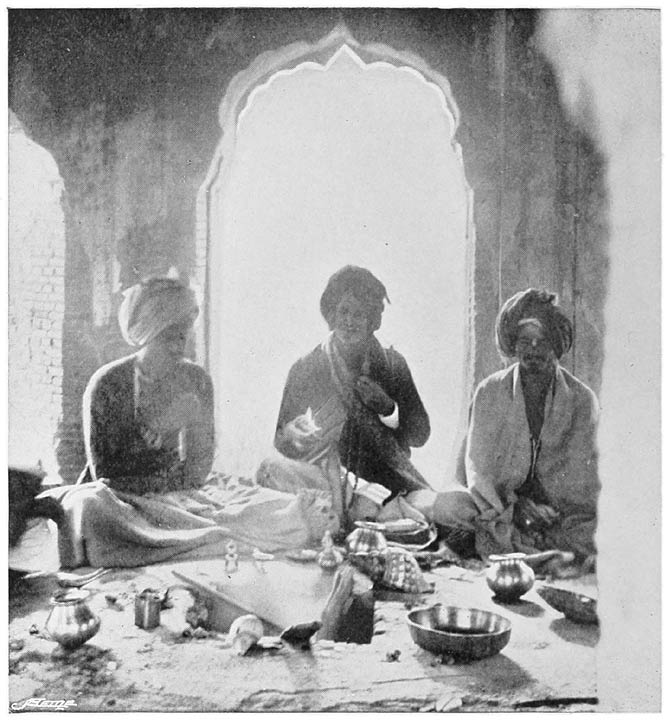
PRIESTS OF THE SACRED FIRE.
Origin of Fire-worship.
The Sacred Fire.
But it is almost certainly erroneous to class the sacred fire as an institution peculiar to the so-called Aryan races. The Homa is, of course, one of the most important elements of the modern Hindu ritual; but at the same time it prevails extensively as a means of propitiating the local or village godlings among many of the Drâvidian races, who are quite as likely to have discovered for themselves the mystical art of fire production by mechanical means, as to have adopted it by a process of conscious or unconscious imitation from the usages of their Hindu neighbours.
The production of fire by means of friction is a discovery which would naturally occur to jungle races, who must have constantly seen it occur by the ignition of the bamboo stalks rubbed together by the blasts of summer. From this would easily be developed the very primitive fire-drill or Asgara, used to this day by the Cheros, Korwas, Bhuiyas and other Drâvidian dwellers in the jungle. These people even to the present day habitually produce fire in this way. A small round cavity is made in a dry piece of bamboo, in which two men alternately with their open hands revolve a second pointed piece of the wood of the same tree. Smoke and finally fire are rapidly produced in this way, and the sparks are received on a dry leaf or other suitable tinder. The use of the flint and steel is also common, and was possibly an early and independent invention of the same people. Even to the present day in some of their more secret worship of the village godlings of disease, fire is produced for the fire sacrifice by this primitive method.
The Fire-drill.
The Aranî in its modern form consists of five pieces. The Adhararanî is the lower bed of the instrument, and is usually made of the hard wood of the Khadira or Khair—Acacia catechu. In this are bored two shallow holes, one, the Garta, a small shallow round cavity, in which the plunger or revolving drill works and produces fire by friction. Close to this is a shallow oblong cavity, known as the Yonî or matrix, in which combustible tinder, generally the husk of the cocoanut, is placed, and in which the sparks and heated ashes are received and ignited. The upper or revolving portion of the drill is known as Uttararanî or Pramantha. This consists of two parts, the upper portion a piece of hard, round wood which one priest revolves with a rope or cord known as Netra. This part of the implement is known as Mantha or “the churner.” It has a socket at the base in which the Sanku, a spike or dart, is fixed. This Sanku is made of a softer wood, generally that of the Pîpal, or sacred fig tree, than the Adhararanî or base; and each Aranî is provided with several spare pieces of fig wood for the purpose of replacing the Sanku, as it becomes gradually charred away by friction. The last piece is the Upamantha or upper churner, which is a flat board with a socket. This is pressed down by one priest, so as to force the Sanku deep and hard into the Garta or lower cavity, and to increase the resistance.
The working of the implement thus requires the labour of two priests, one of whom presses down the plunger, and the other who revolves the drill rapidly by means of the rope. It is not easy to obtain specimens of the implement, which is regarded as possessing mystical properties, and the production of the sacred fire is always conducted in secret.
The Agnikunda, the hole or enclosed space for the sacred fire, out of which, according to the popular legend, various Râjput tribes were produced, is thus probably derived from the Garta or pit out of which the sparks fly in the fire-drill.
The Muhammadan Sacred Fire.
Volcanic Fire; Will-o’-the-Wisp.
The Tomb Fetish.
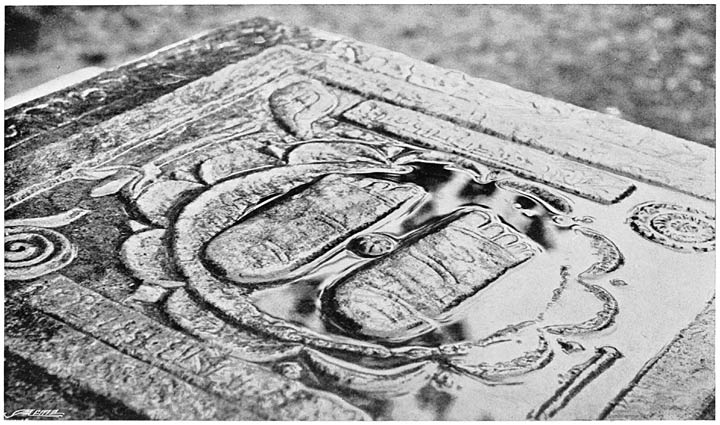
THE FOOTPRINTS OF VISHNU.
Miscellaneous Fetishes.
The same respect is paid to the footprint of Râmanand in his monastery at Benares, and the pin of Brahma’s slipper is now fixed up in the steps of the bathing-place at Bithûr, known as the residence of the infamous Nâna Sâhib, where it is worshipped at an annual feast.