Chapter I · THE EVIL EYE AND THE SCARING OF GHOSTS.
Reading edition
Nescio quis teneros oculus mihi fascinat agnos.
Virgil, Eclogues, iii. 103.
Asma ’bint ’Umais relates that she said, “O Prophet! the family of Ja’ afar are affected by the baneful influence of the Evil Eye. May I use spells for them or not?” The Prophet said, “Yes; for if there were anything in the world which would overcome fate, it would be the Evil Eye.”—Miskât, xxi.–i. Part II.
Hence comes the device of making an intentional blot in anything one values, so that the glance of the Evil Eye may be deprived of its complete satisfaction. Thus, most people put lampblack on the eyes of their children as a protection against fascination, because black is a colour hateful to evil spirits; it has the additional advantage of protecting the eye from the fierce heat of the Indian summer. Women when delivery approaches often mark themselves with black to avert the demon who causes protracted labour. It is also believed that a person whose eyelids are encircled with lampblack is incapable of casting the Evil Eye himself; and it is considered nice in a woman to ornament herself in this way, since because she herself, except at some crisis of her life, such as marriage or parturition, is not liable to fascination, it shows her indisposition to covet the beauty of others, with the inference that she has no cause to do so.
The same customs prevail in India. Thus, if a native gentleman brings his child to visit a European, he dislikes to hear it praised, unless the praise be accompanied with some pious ejaculation. And it is safer to speak in a complimentary way of some conspicuous ornament or piece of dress, which is always put on as a protective.
Another mode of protecting boys from demoniacal influence is based on the same idea of the blot of imperfection. Boys of rich parents are often dressed in mean or filthy clothes so that they may be considered unworthy of the malicious glance of some envious neighbour or enemy.
The supposition may then be hazarded, that in the light of the Indian examples the object may be that some one assumes the part of the bride in order to divert on himself from her the envious glance of the Evil Eye. With the same object it is very common in India to bore the noses of little boys and thus to make them resemble girls. The usual names of Nathu or Bulâqi, the former where the ring was placed in the side of the nose and the latter in the septum, are evidence of this.
So, all natives dread being stared at, particularly by Europeans; and you will often see a witness cast his eyes on the ground when the magistrate looks him full in the face, sometimes because he knows he is lying and fears the consequences, but it is often done through fear of fascination. A European, in fact, is to the rustic a strange inscrutable personage, gifted with many occult powers both for good and evil, and there are numerous extraordinary legends current about him. We shall return to this in dealing with the wonderful Momiâî story. Here it may be noted that he has control over the Jinn. There was a place near Dera Ghâzi Khân so possessed by them that passersby were attacked. A European officer poured a bottle of brandy on the spot and no Jinn has been seen there ever since. A very dangerous ghost which some time ago used to infest a road in the Rûrki Cantonment was routed in the same way by an artilleryman, who spat on him when he came across him one dark night. The nails of a European, like those of the Râkshasa, distil a deadly poison, and hence he is afraid to eat with his fingers, as all reasonable people do, and prefers to use a knife and fork.
A few other examples illustrating the same principle may be given here. When a man is copying a manuscript, he will sometimes make an intentional blot. A favourite trick is to fold the paper back before the ink of the last line has time to dry, so as to blot and at the same time make it appear the result of chance. We have noticed the same idea in the case of carpet patterns. A similar irregularity is introduced in printing chintzes and like handicrafts, and this goes a long way to explain the occasional and almost unaccountable defects to be found in some native work. The letter from a Râja is spotted with gold leaf, partly to divert fascination and partly to act as a scarer of demons. In fact the two conceptions meet and overlap all through the theory of these protectives.
We now come to consider the various articles which are believed to have the power of scaring spirits, and counteracting demoniacal influence of various kinds.
Gold and Silver Protectives.
Gold, and in a less degree silver, have a similar protective influence. The idea is apparently based on their scarcity and value, and on their colour—yellow and white being obnoxious to evil spirits. Hence a little bit of gold is put into the mouth of the dying Hindu, and both gold and silver, combined with tigers’ claws and similar protectives, are largely used as amulets. These metals are particularly effective in the form of ornaments, many of which are images of the gods, or have some mystic significance, or are made in imitation of some sacred leaf, flower, or animal. This is one main cause of the recklessness with which rich natives load their children with masses of costly jewellery, though they are well aware that the practice often leads to robbery and murder.
Copper and Brass Protectives.
Next come copper and brass. The use of copper in the form of rings and amulet cases is very common. Many of the vessels used in the daily service of the gods, such as the Argha, with which the daily oblations are made, are made of this metal. So with brass and various kinds of alloy used for bells, drinking and cooking utensils.
Coral and Marine Products Protectives.
Precious Stones Protectives.
Beads Protectives.
Blood a Protective.
We shall meet with instances of the same rite when dealing with the blood covenant and human sacrifice. On the same analogy many Indian tribes mark the forehead of the bride with blood or vermilion, and red paint is smeared on the image of the village godling in lieu of a regular sacrifice.
Incense.
Spittle.
Salt.
Salutation.
Another way of dispelling evil spirits is by the various forms of salutation, which generally consist in the invocation of some deity. The Hindu says, “Râm! Râm!” when he meets a friend, or Jay Gopâl! “Glory to Krishna!” or whoever his personal god may be, and the same idea accounts for many of the customs connected with the reception of guests, who, coming from abroad, may bring evil spirits with them.
The Separable Soul: Waving.
Blacksmith, Respect for.
Water.
We have already referred to water as a protective against the influence of evil spirits. We see this principle in the rite of ceremonial bathing as a propitiation for sin. It also appears in the use of water which has been blown upon by a holy man as a remedy for spirit possession. Among many menial tribes in the North-Western Provinces with the same object the bride is washed in the water in which the bridegroom has already taken his wedding bath. Again, on a lucky day fixed by the Pandit the rite of Nahâwan or ceremonial bathing is performed for the protection of the young mother and her child two or three days after her confinement. Both of them are bathed in a decoction of the leaves of the Nîm tree. Then a handful of the seeds of mustard and dill are waved round the mother’s head and thrown into a vessel containing fire. When the seeds are consumed the cup is upset, and the mother breaks it with her own foot. Next she sits with grain in her hand, while the household brass tray is beaten to scare demons and the midwife throws the child into the air. All this takes place in the open air in the courtyard of the house. Here we have a series of antidotes to demoniacal possession, the purport of which will be easily understood on principles which have been already explained.
Grain.
Urad.
Barley.
Sesamum.
Til or black sesamum, again, has certain qualities of the same kind. Hence it is used in the funeral rites, and in form of Tilanjalî or a handful mixed with water is one of the offerings to the sainted dead, and made up in the form of a cow, called Tiladhenu, it is presented to Brâhmans.
Sheaves.
Milk.
So with the products of the sacred cow, which are, as might have been expected, most valuable for this purpose. Hence the use of Ghilor or clarified butter in the public and domestic ritual. Milk for the same reason is used in offerings and sprinkled on the ground as an oblation. Cowdung, in particular, is regarded as efficacious. After the death or birth impurity the house is carefully plastered with a mixture of cowdung and clay. No cooking place is pure without it, and the corpse is cremated with cakes of cowdung fuel. Even the urine of the cow is valued as a medicine and a purificant. The cow guards the house from evil, and every rich man keeps a cow so that his glance may fall on her when he wakes from sleep, and he regards her as the guardian of the household.
Colours.
Yellow and red are the usual colours of marriage garments, and the parting of the bride’s hair is stained with vermilion, though here the practice is probably based on the symbolical belief in the Blood Covenant. The same idea is probably the explanation of the flinging of red powder and water coloured with turmeric at the Holî or spring festival.
Black, again, is feared by evil spirits, and the husbandman hangs a black pot in his field to scare spirits and evade the Evil Eye, and young women and children have their eyelids marked with lampblack. In the Mirzapur Baiga’s sacrifice the black fowl or the black goat is the favourite victim, and charcoal is valued, some put into the milk as a preservative and some buried under the threshold to guard the household from harm.
Grasses.
Tattooing.
Among the Drâvidian tribes of the North-Western Provinces tattooing generally prevails. The Korwas and many other of these tribes get their women tattooed by a woman of the Bâdi sub-division of Nats. They are tattooed only on the breast and arms, not on the thighs. There are no ceremonies connected with it, nor any special pattern. Any girl gets herself tattooed in any figure she approves for a small sum. Well-to-do women always get it done; but if a woman is not tatooed, it is not considered unlucky. The men of the tribe are not tattooed. The Ghasiya women tattoo themselves on the breasts, arms, thighs, and feet. They say that when a woman dies who is not tattooed, the Great Lord Parameswar is displeased and turns her out of heaven, or has her branded with the thorn of the acacia. In the same way among the Chamârs, when a woman who has not been tattooed dies, Parameswar asks her where are the marks and signs which she ought to possess to show that she had lived in the world. If she cannot show them, she will in her next birth be re-born as a Bhûtnî, Pretnî, or Râkshasî.
We may close this long catalogue of devices intended to scare spirits, with a number of miscellaneous examples.
Augustus having by oversight
Put on his left shoe ’fore his right,
Had like to have been slain that day
By soldiers mutinying for pay.”
The same feeling for the power of leather possibly explains the use as a seat of various kinds of skins, such as those of the tiger and antelope, by many kinds of ascetics, and in the old ritual the wife with her husband sat on the hide of a bull to promote the fertility of their union.
Garlic.
Glass.
Gonds: Procedure in Cases of Fascination.
Amulets.
The Ring, Bracelet, and Knotted Cord.
From the same principle arises the belief in the magic virtue of the ring, the bracelet, and the knotted cord.
Face-covering.
Omens.
Closely connected with the class of ideas which we have been discussing is the belief in omens. This constitutes a very important branch of folk-lore both in the West and in the East. The success of a journey or enterprise is believed in a great measure to depend on the object which was first seen in the morning, or observed on the road at an early period of the march. Thus, according to Theophrastus, “The superstitious man, if a weasel run across his path, will not pursue his walk until some one else has traversed the road, or until he has thrown three stones across it.” And Sir Thomas Brown writes: “If an hare cross the highway, there are few above threescore years that are not perplexed thereat, which, notwithstanding, is but an augurial terror according to that received expression, Inauspicatum dat iter oblatus lepus. And the ground of the conceit was probably no greater than this, that a fearful animal passing by us portended unto us something to be feared; as upon the like consideration, the meeting of a fox presaged some future imposture.”
Tulasi Dâs, in his Râmâyana, sums up the favourable omens:—
The face of a Teli or oilman, perhaps from the dirt which accompanies his business, is about the worst which can be seen in the early morning; but, with the curious inconsistency which crops up everywhere in phases of similar belief, that of a sweeper is lucky. His face should be always looked at first, but on meeting a Brâhman, the glance should start from his feet.
The jungle tribes have a strong belief in such omens. The Korwas of Mirzapur abandon a journey if a jackal cross the road from the left, or if a little bird, known as the Suiya or small parrot, calls in the same direction. The Patâris and Majhwârs return if the Nîlgâê cross the road from the right.
The time when screech-owls cry and lean dogs howl,
And spirits walk and ghosts break up their graves.
Black is, of course, unlucky, and if a man, when digging the foundations of a new house, turns up a piece of charcoal, it is advisable to change the site.
To see a Dhobi, or washerman, who is associated with foul raiment, is exceedingly dangerous. I once had a bearer who was sadly afflicted because on tour he had to sleep in the same tent with a Dhobi. The old man was constantly bruising his shins over the ropes and pegs, because he was in the habit of stumbling out before dawn with his hands pressed over his eyes to protect himself from the sight of his ill-omened companion.
One of the last of the Anglo-Indians, who had become thoroughly orientalized, used to insist on his valet, when he came to wake him, holding in his hand a tray containing some milk and a gold coin, so that his first glance on waking might fall on these lucky articles.
Numbers.
There are mystic qualities attached to numbers. Thus, when Hindus have removed the ashes from a burning ground they write the figures 49 on the spot where the corpse was cremated. The Pandits explain this by saying that when written in Hindi the figures resemble the conch-shell and wheel of Vishnu, or that it is an invocation to the forty-nine winds of heaven to come and purify the ground. It is more probably based on the idea that the number seven, as is the case all over the world, has some mystic application. So in the folk-tales the number three has a special application to the tests of the hero who endures the assaults of demons or witches for three successive nights. The idea of luck in odd numbers is universal, and the seventh son of a seventh son is gifted with powers of healing.
Bodily Functions.
“When our cheek burns, or ear tingles, we usually say some one is talking of us,” writes Sir Thomas Brown, “a conceit of great antiquity, and ranked among superstitious opinions by Pliny. He supposes it to have proceeded from the notion of a signifying Genius, or Universal Mercury, that conducted sounds to their distant subjects, and taught to hear by touch.” The number of beliefs of this class is infinite and recorded in numerous popular handbooks.
Lucky and Unlucky Days.
The catalogue of superstitions of this class might be almost indefinitely extended. The principles on which most of them depend are clear enough. They rest on a sort of sympathetic magic. Things which are good-looking, people who are healthy or prosperous, give favourable omens, while those that are ugly, or of low caste, or associated with menial or unpleasant duties, and so on, are ominous. Europeans in India usually quite fail to realize the influence which such ideas exercise over the minds of the people. Most of us have been struck by the almost unaccountable failure of natives to attend a summons from the Courts, to keep an appointment to meet a European officer for the inspection of a school or market. If inquiries are made it will often be found that some idea of this kind explains the matter.
So, there is hardly a village in which it is not considered ominous to name before breakfast some one who, from his misery, rascality, or some other reason, is considered unlucky. In Mathura there is a tank built by Râja Patni Mall.
The Mirzapur Patâris when they have to mention a monkey in the morning, call him Hanumân, and the bear Jatari, or “he with the long hair,” or Dîmkhauiya, “he that eats white ants.” The Pankas call the camel Lambghîncha or “long-necked.” “I asked the Râja,” says Gen. Sleeman, “whether we were likely to fall in with any hares, making use of the term Khargosh, or ‘ass-eared.’” “Certainly not,” said the Râja, “if you begin by abusing them by such a name. Call them Lambkanna or ‘long-eared,’ and you will get plenty.”
It is, of course, easy to avoid the effect of evil omens by the use of a little tact and wit, as was the case with William the Conqueror, and there are many natives who are noted for their cleverness in this way. Of an Eastern Sultân it is told that, leaving his palace on a warlike expedition, his standard touched a cluster of lamps, called Surayya, because they resembled the Pleiades. He would have turned back, but one of his officers said, “My Lord! our standard has reached the Pleiades;” so he was relieved, advanced, and was victorious.
Facilitating Departure of and Barring the Ghost.
We now come to consider the various means adopted to facilitate the journey of the departing soul, and to prevent it from returning as a malignant ghost to bring trouble, disease, or death on the survivors.
In the case of the Dhângars and Basors, both menial tribes in the North-Western Provinces, we come across an usage which appears to be of a very primitive type and to be intended to secure the same object of barring the return of the ghost. After they have buried the corpse they return to the house of the dead man, kill a hog, and after separating the limbs, which are cooked for the funeral feast, they bury the trunk in the courtyard of the house, making an invocation to it as the representative of the dead man, and ordering him to rest there in peace and not worry his descendants. In the grave in which they bury this they pile stones and thorns to keep the ghost down.
This custom of parading the corpse also prevails in Ireland.
The Korkus of Hoshangâbâd have a remarkable method of laying the ghost. “Each clan has a place in which the funeral rite of every member of that clan must be performed; and however far the Korku may have wandered from the original centre of his tribe, he must return there to set his father’s spirit to rest, and enable it to join its own family and ancestral ghosts. In this spot a separate stake (munda) is set up for every one whose rites are separately performed, and if a poor Korku performs them for several ancestors at once, he still puts up only one stake. It stands two or two and a half feet above the ground, planed smooth and squared at the top; on one side is carved at the top the likeness of the sun and moon, a spider, and a wheat ear, and below it a figure representing the principal person in whose honour it is put up, on horseback, with weapons in his hands. If more than one person’s death is being celebrated, the rest are carved below as subordinate figures. I could not learn that the spirits are supposed to specially haunt this grove of stakes, or that Korkus have any dread of going near it at night; but they are far bolder than Hindus in this respect. When the funeral rite is to be performed, the first thing is to cut a bamboo and take out the pith, which is to represent the bones of the deceased, unless he has been burnt, in which case the bones themselves will have been preserved. A chicken is then sacrificed at the grave, and all that night the mourners watch and dance, and sing and make merry.
“Next day they go out very early, and cut down some perfectly unblemished tree, either teak or Salâi, not hollow or decayed or marked with an axe, which they cut to make the Munda stake. It is brought home at once and fashioned by a skilful man. In the afternoon it is carried to the place where cattle rest outside the village at noontide, and is washed and covered with turmeric like a bridegroom, and five chickens are sacrificed to it. It is then brought home again, and the pith representing the bones is taken outside the village and hung to some tree for safety during the night.” (The idea, as we have elsewhere seen, is more probably to allow the ghost an opportunity of revisiting them.)
All this ritual, carried out by one of the most primitive Indian tribes, admirably illustrates the principles which we have been discussing. The obvious intention of the custom is to provide a resting-place for the spirit of the dead man, so that it may no longer be a source of danger to the survivors.
Similar customs prevail among other aboriginal races of the Central Provinces. In some places they burn their dead and then erect platforms, at the corners of which they place tall, red stones. In other places a sort of low square mound is raised over the remains of the deceased, at the corners of which are erected wooden posts, round which thread is wound to complete the sacred circle, and a stone is set up in the centre. Here offerings are presented, as in the jungle worship of their deities, of rice and other grains, fowls or sheep. On one occasion after the establishment of the Bhonsla or Marhâta Government in Gondwâna a cow was offered to the manes of a Gond; but this having come to the notice of the authorities, the relations were publicly whipped, and all were interdicted from doing such an act again.
The Funeral Feast.
The funeral feast is evidently a survival of the feast when the dead kinsman was consumed by his relatives, who wished thus to partake of the properties of the dead. By another theory the feasting of the mourners is intended to resist the attempt of the ghost of the dead man to enter their bodies, food being offensive to spirits.
Mutilation a Sign of Mourning.
Respect Paid to Hair.
We have already come across instances of growing hair as a curse. Mr. Frazer gives numerous examples of this custom among savage races, and in the Teutonic mythology the avenger of Baldur will not cut his hair until he has killed his enemy.
A curious instance of mutilation regarded as a charm may be quoted from Bengal. Should a woman give birth to several stillborn children, in succession, the popular belief is that the same child reappears on each occasion. So, to frustrate the designs of the evil spirit that has taken possession of the child, the nose or a portion of the ear is cut off and the body is cast on a dunghill.
Food for the Dead.
Articles left with the Corpse.
The same is the case among the Drâvidian races. Thus, the Bhuiyârs of Mirzapur after the funeral feast throw a cupful of oil and some food into the water hole in which the ashes of the dead man are deposited. They say that he will never be hungry or want oil to anoint himself after bathing. The Korwas, when burning a corpse, place with it the ornaments and clothes of the deceased, and an axe, which they do not break, as is the habit of many other savages. They say that the spirit of the dead man will want it to hack his way through the jungles of the lower world. When the Bhuiyârs cremate a corpse they throw near the spot an axe, if the deceased was a man, and a Khurpi or weeding spud, if a woman. No one would dare to appropriate such things, as he would be forced to join the ghastly company of their owners. Where the corpse is burned they leave a platter made of leaves containing a little boiled rice, and they sprinkle on the ground all the ordinary kinds of grain and some turmeric and salt as food for the dead in the next world.
All these tribes and many low-caste Hindus in Northern India lay out platters of food under the eaves of the house during the period of mourning, and they ascertain by peculiar marks which they examine next day whether the spirit has partaken of the food or not. Among the jungle tribes there is a rule that the food for the dead is prepared, not by the house-mother, but by the senior daughter-in-law, and even if incapacitated by illness from performing this duty, she is bound at least to commence the work by cooking one or two cakes, the rest being prepared by one of the junior women of the family.
Among the more Hinduized Majhwârs and Patâris we reach the stage where the clothes, implements of the deceased, and some food are given to the Patâri priest, who, by vicariously consuming them, lays up a store for the use of the dead man in the other world. This is the principle on which food and other articles are given to the Mahâbrâhman or ordinary Hindu funeral priest at the close of the period of mourning.
Among the Bengal Chakmas, a bamboo post or other portion of a dead man’s house is burned with him, probably in order to provide him with shelter in the next world. Among the Kâmis, before they can partake of the funeral feast, a small portion of every dish must be placed in a leaf plate and taken out into the jungle for the spirit of the dead man, and carefully watched until a fly or other insect settles upon it. The watcher then covers up the plate with a slab of stone, eats his own food, and returns to tell the relatives that the spirit has received the offering prepared for him.
The Fly as a Life Index.
“It was a black, ill-favoured fly,
Like to the empress Moor; therefore I kill’d him.”
Recalling the Ghost.
Ashes.
This use of ashes as a means of identifying the ghost, constitutes in itself quite an important chapter in folk-lore. It reminds us of the Apocryphal legend of Bel and the Dragon. The idea probably originally arose from the respect paid to the ashes of the house fire by primitive races, among whom the hearth and the kitchen are the home of the household godlings.
Replacing Household Vessels.
Funeral Rites in Effigy.
Ghosts Lengthening Themselves.
Kindly Ghosts.
Tree Ghosts.
Hence in regard to trees great caution is required. A Hindu will never climb one of the varieties of fig, the Ficus Cordifolia, except through dire necessity, and if a Brâhman is forced to ascend the Bel tree or Aegle Marmelos for the purpose of obtaining the sacred trefoil so largely used in Saiva worship, he only does so after offering prayers to the gods in general, and to the Brahmadaitya in particular who may have taken up his abode in this special tree.
The Brahmaparusha.
The Jâk and Jâknî.
Ghosts which Protect Cattle.
Another cattle godling in the Hills is Kaluva or Kalbisht, who lived on earth some two hundred years ago. His enemies persuaded his brother-in-law to kill him. After his death he became a benevolent spirit, and the only people he injured were the enemies who compassed his death. His name is now a charm against wild beasts, and people who are oppressed resort to his shrine for justice. Except in name he seems to have nothing to say to Kâlu Kahâr, who was born of a Kahâr girl, who by magical charms compelled King Solomon to marry her. His fetish is a stick covered with peacock’s feathers to which offerings of food are made. He has more than a quarter of a million worshippers, according to the last census, in the Meerut Division.
Bugaboos.
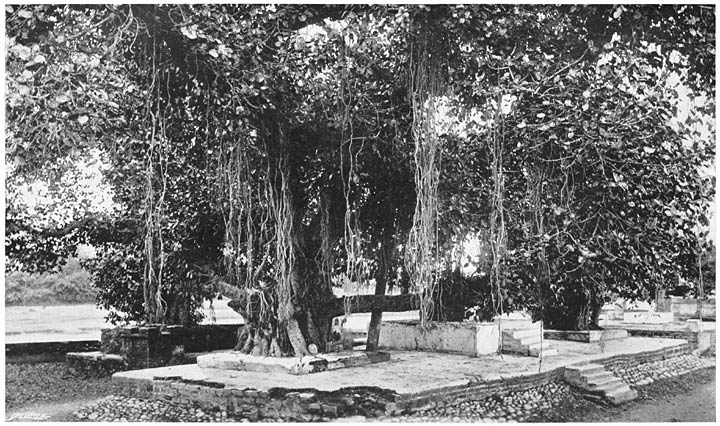
SACRED FIG TREE AND SHRINES.