Chapter II · TREE AND SERPENT WORSHIP.
Reading edition
Sylvarum numina, Fauni
Et satyri fratres.
Ovid, Metamorp. iii. 163.
Αὐτὰρ ἐπ’ αὐτῷ
Κυάνεος ἐλέλικτο δράκων, κεφαλαὶ δὲ οἱ ἢσαν
Τρεῖς ἁμφιστρεφέες, ἑνὸς αὐχένος ἐκπεφυυῖαι.
Iliad, xi. 38–40.
The worship of trees and serpents may be conveniently considered together; not that there is much connection between these two classes of belief, but because this course has been followed in Mr. Ferguson’s elaborate monograph on the subject.
The basis of the cultus may then perhaps be stated as follows: There is first the tree which is regarded as embodying or representing the spirit which influences the fertility of crops and human beings. Hence the respect paid to memorial trees, where the people assemble, as at the village Pîpal, which is valued for its shade and beauty and its long connection with the social life of the community. This would naturally be regarded as the abode of some god and forms the village shrine, a convenient centre for the religious worship of the local deities, where they reside and accept the worship and offerings of their votaries.
It may, again, be the last survival of the primitive forest, where the dispossessed spirits of the jungle find their final and only resting-place. Such secluded groves form the only and perhaps the earliest shrine of many primitive races.
Again, an allegorical meaning would naturally be attached to various trees. It is invested with a mystic power owing to the mysterious waving of its leaves and branches, the result of supernatural agency; and this would account for the weird sounds of the forest at night.
Many trees are evergreen, and thus enjoy eternal life. Every tree is a sort of emblem of life, reproducing itself in some uncanny fashion with each recurring spring.
It has some mystic connection with the three worlds—
Quantum vertice ad auras
Aetherias tantum radice in Tartara tendit.
Further than this, it may be reasonably suspected that this cultus rests to some extent on a basis of totemism. Some of the evidence in support of this view will be discussed elsewhere, but it is, on the analogy of the various modes in which the Brâhmanical pantheon has been recruited, not improbable that trees and plants, like the Tulasî and the Pîpal, may have been originally tribal totems imported into Brâhmanism from some aboriginal or other foreign source.
On the whole it is tolerably certain that there is more in tree worship than can be accounted for either by Mr. Ferguson’s theory that the worship sprang from a perception of the utility or beauty of trees, or by Mr. Spencer’s theory of nicknames. It is sufficient to say that both fail to account for the worship of insignificant and comparatively useless shrubs, weeds, or grasses.
Next come the numerous sacred groves scattered all over the country. These, as we have seen, are very often regarded as a survival from the primeval jungle, where the forest spirits have taken refuge. The idea is common both to the Aryan as well as to the Drâvidian races, from the latter of whom it was possibly derived.
How sprites come to inhabit trees is well shown in an instance given from Bombay by Mr. Campbell. “In the Dakkhin, when a man is worried by a spirit, he gives it a tree to live in. The patient, or one of his relations, goes to a seer and brings the seer to his house, frankincense is burnt, and the sick man’s spirit comes into the seer’s body. The people ask the spirit in the seer why the man is sick. He says, ‘The ghost of the man you killed has come back, and is troubling you.’ Then they say, ‘What is to be done?’ The spirit says, ‘Put him in a place in his or in your land.’ The people say, ‘How can we put him?’ The spirit says, ‘Take a cock, five cocoanuts, rice, and red lead, and fill a bamboo basket with them next Sunday evening, and by waving the basket round the head of the patient, take the ghost out of the patient.’ When Sunday afternoon comes they call the exorcist. If the ghost has not haunted the sick man for a week, it is held that the man was worried by that ghost, who is now content with the proposed arrangement. If the patient is still sick, it is held that it cannot be that ghost, but it must be another ghost, perhaps a god who troubles him.
“The seer is again called, and his familiar spirit comes into him. They set the sick man opposite him, and the seer throws rice on the sick man, and the ghost comes into the patient’s body and begins to speak. The seer asks him, ‘Are you going or not?’ The ghost replies, ‘I will go if you give me a cock, a fowl, a cocoanut, red lead, and rice.’ They then bring the articles and show them to the spirit. The spirit sees the articles, and says, ‘Where is the cocoanut?’ or, ‘Where is the rice?’ They add what he says, and ask, ‘Is it right?’ ‘Yes, it is right,’ replies the spirit. ‘If we drive you out of Bâpu, will you come out?’ ask the people. ‘I will come out,’ replies the ghost. The people then say, ‘Will you never come back?’ ‘I will never return,’ replies the ghost. ‘If you ever return,’ says the seer’s spirit, ‘I will put you in a tanner’s well, sink you, and ruin you.’ ‘I will,’ says the spirit, ‘never come back, if you take these things to the Pîpal tree in my field. You must never hurt the Pîpal. If you hurt the Pîpal, I will come and worry you.’
From ceremonies like these, in which a malignant spirit is entombed in a tree and its surrounding stones, the transition to the general belief in tree sprites is easy. The use of the various articles to scare spirits will be understood from what has been already said on that subject.
The Karam Tree.
Passing on to trees which are considered specially sacred, we find a good example in the Karam (Neuclea parvifolia), which is revered by the Kharwârs, Mânjhis, and some of the other allied Drâvidian races of the Vindhyan and Kaimûr ranges.
In Shâhâbâd, their great festival is the worship of the sacred tree. “Commenced early in the bright portion of the month Bhâdon (August—September), it continues for fifteen days. It marks the gladness with which people wind up their agricultural operations all over the world. The festivities begin with a fast during the day. In the evening the young men of the village only proceed in a gay circle to the forest. A leafy branch of the Karam is selected, cut, and daubed with red lead and butter. Brought in due state, it is planted in the yard in front of the house, and is decorated with wreaths of wild flowers, such as autumn yields to the Hill men with a bountiful hand. The homely ritual of the Kharwâr then follows, and is finished with the offering of corn and molasses. The worship over, the head of the village community serves the men with a suitable feast. But the great rejoicing of the season is reserved for a later hour. After dinner the men and women appear in their gala dress, and range themselves in two opposite rows. The Mândar, or national drum of the aborigines, is then struck, and the dance commences with a movement forward, until the men and women draw close. Once face to face, a gradual movement towards the right is commenced, and the men and women advance in a slow but merry circle, which takes about an hour to describe.
This account omits two important points which enable us to explain the meaning of the rite. The first is that when the festivities are over the branch of the Karam tree is taken and thrown into a stream or tank. This can hardly, on the analogy of similar practices to which reference has been already made, be anything but a charm to produce seasonable rain. Another is that sprigs of barley grown in a special way, as at the Upper India festival of the Jayî, which will be discussed later on, are offered to the tree. This must be an invocation to the deity of the tree to prosper the growth of the autumn rice, which is just at this time being planted out.
I have seen the Karama danced by the Mânjhis, a Drâvidian tribe in Mirzapur, closely allied to the Kharwârs. The people there seem to affect no secrecy about it, and are quite ready to come and dance before Europeans for a small gratuity. The men expect to receive a little native liquor between the acts, but the ladies of the ballet will accept only a light supper of coarse sugar. The troupe consists of about a dozen men and the same number of women. The sexes stand in rows opposite to each other, the women clinging together, each with her arms clasped round her neighbour’s waist. One man carrying the sacred Mândar drum, beats it and leads the ballet, hopping about in a curious way on one leg alternately. The two lines advance and retreat, the women bowing low all the time, with their heads bending towards the ground, and joining occasionally in the refrain. Most of the songs are apparently modern, bearing on the adventures of Râma, Lakshmana, and Sîtâ; some are love songs, many of which are, as might have been expected, rude and indecent. The whole scene is a curious picture of genuine aboriginal life. At the regular autumn festival the ceremony degenerates into regular saturnalia, and is, if common rumour be trusted, accompanied by an absolute abandonment of decency and self-respect which culminates in the most unrestrained debauchery.
The modern explanation of the dance is embodied in a folk-tale which turns on the verbal confusion between Karam, the name of the tree, and the Sanskrit Karma, meaning “good works.” It is, of course, comparatively modern, and quite useless as a means for ascertaining the real basis of the custom, which is probably a means of propitiating the tree god to grant favourable weather.
The Fig Tree.
Among the sacred trees the various varieties of the fig hold a conspicuous place. Many ideas have probably united in securing reverence for them. Thus the Banyan with its numerous stems may fitly be regarded as the home of gods or spirits. Others are valued as a source of food, or because they possess juices valued as drink or medicine.
So with the Pîpal (Ficus religiosa), which is connected with old temples, as it forces its roots into the crumbling masonry, grows to a great age, and, like the poplar, moves its leaves at the slightest breath of wind. The English tradition about the aspen is that since its wood was used to make the Cross it ever trembles with shame. The Pippala or Asvattha is said by some to be the abode of Brahma, and is sometimes invested with the sacred thread by the regular Upanâyana rite. Others say that in it abide Brahma, Vishnu, and Siva, but specially Vishnu in his incarnation as Krishna. Others, again, connect it with Bâsdeo or Vasudeva, the father of Krishna.
Of the Gûlar (Ficus glomerata) it is believed that on the night of the Divâlî the gods assemble to pluck its flowers; hence no one has ever seen the tree in blossom. It is unlucky to grow a Gûlar tree near the house, as it causes the death of sons in the family.
High-caste Hindu women worship the Pîpal tree in the form of Vasudeva on the Amâvasya or fifteenth day of the month, when it falls on Monday. They pour water at its roots, smear the trunk with red lead and ground sandalwood, and walk round it one hundred and eight times in the course of the sun, putting at each circuit a copper coin, a sweetmeat, or a Brâhmanical cord at the root, all of which are the perquisite of beggars. An old woman then recites the tale of the Râja Nikunjali and his queen Satyavratî, who won her husband by her devotion to the sacred tree. Hence devotion to it is supposed to promote wedded happiness.
The tree should be touched only on Sunday, when Lakshmî, the goddess of wealth, abides in it; on every other day of the week, poverty and misfortune take up their quarters in it. The son of a deceased parent should pour three hundred and sixty brass vessels of water round its root to ensure the repose of the dead man. Hindus on Sunday after bathing pour a vessel of water at its root and walk round it four times. Milk and sugar are sometimes mixed with the water to intensify the charm. When the new moon falls on Monday, pious Hindus walk one hundred and eight times round it and wind cotton threads about the trunk. In rich Hindu families small silver models of the tree answer the same purpose. When a statement is made on oath, the witness takes one of the leaves in his hand and invokes the gods above him to crush him, as he crushes the leaf, if he is guilty of falsehood.
The Sâl.
The Sâl or Sâkhu is also a holy tree. It is held in much respect by the jungle races, who consider it the abode of spirits and erect their shrines under its shade. The Bâgdis and Bauris of Bengal are married in an arbour made of the branches of the Sâl (Shorea robusta) after they have been first married to a Mahua tree (Bassia latifolia). Patches of this tree are often reserved as fragments of the primitive jungle, of which it must have constituted an important part.
The Shîsham.
The Jand.
The Aonla.
The Mahua.
The Cotton Tree.
The Nîm.
The Nimba or Nîm (Azidirachta Indica) is sacred in connection with the worship of the godlings of disease, who are supposed to reside in it. In particular it is occupied by Sîtalâ and her six sisters. Hence during the season when epidemics prevail, from the seventh day of the waning moon of Chait to the same date in Asârh, that is during the hot weather, women bathe, dress themselves in fresh clothes, and offer rice, sandal-wood, flowers, and sometimes a burnt offering with incense at the root of the tree.
The Cocoanut.
The cocoanut is considered one of the most sacred fruits, and is called Srîphala, or the fruit of Srî, the goddess of prosperity. It is the symbol of fertility, and all through Upper India is kept on shrines and presented by the priests to women who desire children. One of the main causes of the respect paid to it seems to be its resemblance to a human head, and hence it is often used as a type of an actual human sacrifice. It is also revered for its uses as food and a source of intoxicating liquor. But it is not a native of Northern India, and is naturally more revered in its home along the western coast. In Gujarât and Kanara it represents the house spirit, and is worshipped as a family god. The Konkan Kunbis put up and worship a cocoanut for each of their relations who dies, and before beginning to cut the rice, break a cocoanut and distribute it among the reapers. The Prabhus, at every place where three roads meet, wave a cocoanut round the face of the bridegroom, and break it into pieces to repel evil influences. The Musalmâns of the Dakkhin cut a cocoanut and lime into pieces and throw them over the head of the bridegroom to scare evil spirits. Among some classes of ascetics the skull is broken at the time of cremation with a cocoanut in order to allow the ghost to escape. In Western India, at the close of the rains, cocoanuts are thrown in to pacify the sea. Its place as a substitute for a human sacrifice in Northern India seems to have been taken by the pumpkin, which is used in much the same way.
The Mimosa.
The Khair, or Mimosa (Acacia catechu) seems to owe most of the estimation in which it is held to its use in producing the sacred fire. It forms, on account of its hardness, the base of the Aranî or sacred fire-drill, and in it the wedge of the softer Pîpal wood works and fire is produced by friction. The Yûpa or sacrificial post to which the victim was tied for the sacrifice was often made of this wood. In the great horse sacrifice of the Râmâyana, twenty-one of these posts were erected, six made of Vilva (Agle marmelos), six of Khadira or Acacia, six of Palâsa (Butea frondosa), one of Udumbara (Ficus glomerata), Sleshmataka (Cordia myxa), and one of Devadru, the Deodâr pine tree.
This superstition regarding the rowan tree and the elder is familiar in European folk-lore. In Ireland the roots of the elder and those of an apple tree which bears red apples, boiled together and drunk fasting, expel evil spirits. In connection with this idea that the mimosa sleeps at night, pious Hindus prefer not to eat betel leaves after sunset, as catechu forms part of the ingredients with which they are prepared.
The Plantain.
“Take thou some new infection to thine eye,
And the rank poison of the old will die.”
To which Romeo answers:—
“Your plantain leaf is excellent for that.”
“For what, I pray thee?”
“For your broken skin.”
The Pomegranate.
The Tamarind.
The Siras.
The Mango.
The Mango is used in much the same way. It is, as we shall see, used in making the aspersion at rural ceremonies. The leaves are hung up at marriages in garlands on the house door, and on the shed in which the rite is performed, and after the wedding is over these are carefully consigned to running water by the bride and bridegroom. It is also used as a charm. Before you see a flower on a mango tree shut your eyes and make some one lead you to a tree in flower. Rub the flowers into your hands, and you thus acquire the power of curing scorpion stings by moving your hand over the place. But this power lasts only for one year, and must be renewed when the season of flowers again returns.
The Tulasî.
The Tulasî is also connected with Sîtâ and Rukminî, and the prayer to her is: “I adore that Tulasî, in whose roots are all the places of pilgrimage, in whose centre are all the deities, and in whose upper branches are all the Vedas.” The plant is specially worshipped by women after bathing, and more particularly at the full moon of Kârttik, if the bathing be in the Ganges. The chief ceremony is, however, the marriage of the infant Krishna to the plant, which is carried out by pious people, often at a considerable cost, in accordance with the standard ritual.
The Palâsa.
The Palâsa or Dhâk is sacred, partly on account of its use in producing the sacred fire, and partly because its orange blossoms are used to dye the coloured dust and water thrown about at the Holî festival. It is supposed to be in some way connected with the Soma, and by one account was produced from the feather of the falcon imbued with the Soma. Its trifoliate leaves represent the trident, or the three great gods, Brahma, Vishnu, and Siva, or birth, life, and death. The leaves are used to form the platters employed at various feasts and religious rites; the wood in the Yûpa, or sacrificial pole, and in the funeral pyre.
The Bel.
The Bel (Aegle marmelos) is specially dedicated to Siva, because it has three leaflets in the leaf, and because of its medicinal value. Siva is called Bilvadanda, “he with a staff of the Bel wood,” and its leaves are used in his service. Its leaves laid on the Lingam cool and refresh the heated deity. The wood is one of those used for the sacrificial post. Its fruit is called Srîphala, because it is supposed to have been produced from the milk of the goddess Srî.
The Bamboo.
The Sandal.
The Birch.
The Bhûrja, a species of birch, is also sacred. It, too, is supposed to drive away evil spirits. Its bark, now called Bhojpatra, is used for writing charms, and for other mystic purposes. When a corpse is burnt by low-caste people, when a person dies at the hands of an executioner, when he dies on a bed, or when he is drowned and his body cannot be found, a rite known as Palâsvidhi is performed. An effigy of the deceased is made, in which twigs of the Palâsa tree represent the bones, a cocoanut or Bel fruit the head, pearls or cowry shells the eyes, and a piece of birch bark or the skin of a deer the cuticle. It is then filled up with Urad pulse instead of flesh and blood, and a presiding priest recites a spell to bring life into the image, which is symbolized by putting a lighted lamp close to the head. When the light goes out, life is believed to be extinct and the funeral rites are performed in the regular way, the only exception being that the period of impurity lasts for three, instead of ten days.
Other Sacred Trees.
The number of these trees and plants which scare evil spirits or are invested with other mystic qualities is infinite. We may close the catalogue with the Babûl or Kîkar (Acacia Arabica), which when cut pours out a reddish juice. One of these trees, when the Musalmâns tried to cut it near a shrine at Lahore, is said to have poured out drops of blood as a warning. But on the whole it is an unlucky tree, and the resort of evil spirits. If you throw water for thirteen days successively on a Babûl tree, you will get the evil spirits which inhabit it into your power. They tell of a man who did this near Sahâranpur, who when taken to his cremation, no sooner was the light set to his pyre than he got up and walked home, and is alive to this day. His neighbours naturally look on his proceedings with a certain degree of suspicion. The ghost of a man burnt with this wood will not rest quietly, and any one who rests on a bed made of it is afflicted with evil dreams. An old servant of mine once solemnly remonstrated against the use of such a bed by his master. Such a bed, he remarked, should be only used for a clergyman guest, who by virtue of his profession is naturally protected against such uncanny visitations.
Tree Marriages.
We have, again, folk-tale references to the same custom in a tradition of the Vallabhachârya sect of the daughter of a banker, who, by her devotion to him, won the love of the god Krishna in the form of an image. Finally the deity revealed himself, and she went with him to Brindaban and remained with her divine husband till he carried her off to the heaven of Vishnu. This, however, is hardly perhaps more than an example of the mystic union of the god with his worshippers, which forms such a large part of the Vaishnava hagiology, and is familiar in the tales of Krishna and the Gopîs.
There is, again, among children in the neighbourhood of Sahâranpur, a game which may be a survival of some more primitive rite. At the Tîj festival, which occurs in the rainy season, girls dressed in their best go to a tank near the city. After dropping offerings into the water in honour of Khwâja Khizr, they divide into two parties, each of which selects a leader, one of whom is known as the bride and the other a bridegroom. The latter is decorated with a paper crown decked with tinsel. The clothes of the pair are knotted together, and they are made to walk round a Tulasî plant or a Pîpal tree on the banks of the tank, in a mock form of the marriage ritual. Meanwhile each party chaffs the other, saying, “Your bride (or bridegroom) is one-eyed.” They return home with merriment of this kind, and when they come to the house the knot tied in the garments of the pair is unloosed.
So, there have been many instances of Râjas marrying animals with the customary rites. Some years ago, one of the Gâekwârs of Baroda spent a large sum in marrying some favourite pigeons, and a Râja of Nadiya spent a lâkh of rupees in marrying two monkeys.
On the whole, it seems probable that this custom of pseudo-marriages may be based on various principles. The popular explanation of the custom is, as we have seen, that it is intended to avoid the curse of widowhood, the tree-husband being always alive; the woman, even if her husband die, can never be a widow, nor can the parents be liable to the contempt which, according to popular Hindu belief, awaits those who keep a girl who has reached maturity unmarried. But when we find the same custom prevailing among races who habitually permit pre-nuptial infidelity, and among whom every marriageable widow is either subjected to the levirate or made over to a stranger, it seems obvious that this cannot be the original explanation of the practice.
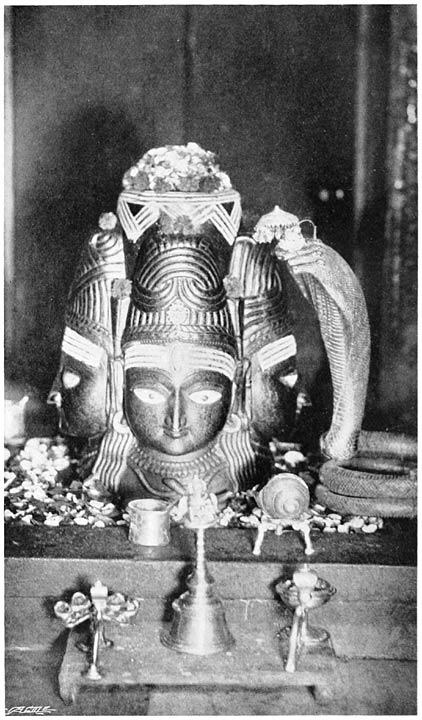
DEVÎ AND THE COBRA.
Lastly, we have seen instances in which the wedded pair are made to clasp the tree or are tied to it in some special way. There are numerous cases in which women, in order to procure offspring, clasp an idol, like that of Hanumân and one of the other guardian deities. The clasping of the tree at marriage may possibly be a sort of sympathetic magic to bring on the pair the fertility and power of reproduction, of which vegetable life is the well-known symbol. We have the same principle of the wedding of the grove to its well, and every Hindu who goes to the expense of making a tank, does not drink of its waters until he has married the tank to a plantain or some other tree growing on its banks.
Tree and Serpent Worship.
It is almost needless to say that snake-worship prevails largely in Northern India. The last census showed in the North-Western Provinces over twenty-five thousand Nâga worshippers; one hundred and twenty-three persons recorded themselves as votaries of Gûga, the snake god. There are also a certain number who worship Sânp Deotâ, or the snake godling, and Ahîran, another deity of the same class, who is worshipped in Sultânpur by daily offerings of red lead, water, and rice. Sokha, said to be the ghost of a Brâhman killed by a snake, has nearly fourteen thousand worshippers. In the Panjâb, again, there are over thirty-five thousand special votaries of the snake godlings, of which the great majority worship Gûga.
That the cultus of the snake has been derived from aboriginal beliefs appears tolerably certain. The Hindus of Vedic times looked on the serpent with fear and dislike. It was impersonated as Ahi or Vritra, the snake demon which brings darkness and drives away the kindly rain. The regular snake-worship, as we now find it, was obviously of a later date.
It does not appear difficult to disentangle the ideas on which snake-worship is based. To begin with, the snake is dreaded and revered on account of the mysterious fear which is associated with it, its stealthy habits, its sinuous motion, the cold fixity of its gaze, the protrusion of its forked tongue, the suddenness and deadliness of its attacks. It would be particularly dreaded by women, whose habits of walking barefoot in fields in the early dawn, and groping in dark corners of their huts, render them specially exposed to its malice. The chief basis of the cultus would then be fear, as in the case of the tiger and other beasts of prey.
It would soon be discovered that there were various harmless snakes which would, as house-hunters, come to be identified with the ancestral ghosts as the protectors of houses and goods. The power of controlling and taming the more venomous snakes would then be discovered, and the snake-charmer would come to be regarded as the wisest of mankind, as a wizard, and finally as a priest. We have thus three aspects under which the snake is worshipped by many savage races—as a dreaded enemy, as the protector of home and treasure, as the accompaniment and attribute of wisdom. The village temple would be often in early times a storehouse of treasure, and the snake, respected as its guardian, would finally, as in Kashmîr, be installed there as a god.
Next, we have the early connection between the serpent and the powers of nature, the cloud and the rain, as appears in the familiar Vedic legend of Indra and the Dragon Ahi, and Seshanâga, the great world serpent, which appears in so many of the primitive mythologies.
The serpent would again receive respect as the emblem of life; his shape would, as in many forms of primitive ornament, be associated with the ring, as a symbol of eternity; he is excessively long-lived, and periodically renews his life.
Lastly, the cultus may have a totemistic basis. As Strabo describes the Ophiogeneis or serpent races of Phrygia actually retaining physical affinity with the snakes to whom they were to be believed to be allied, the Cheros of the eastern districts of the North-Western Provinces and the Bais Râjputs of Oudh profess to be descended from the Great Serpent. Gautama Buddha himself is said to have been of serpent lineage.
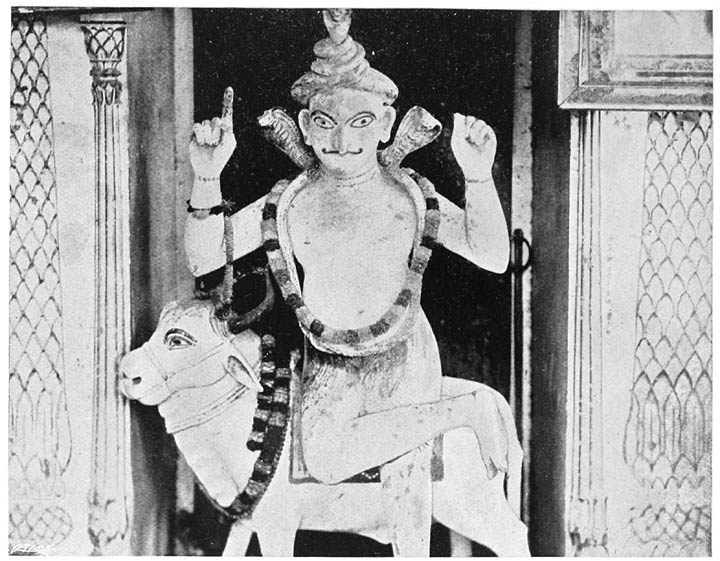
SIVA AND THE COBRA.
Seshanâga.
Below the seven Pâtâlas, according to the Vishnu Purâna, is Vishnu incarnated as Seshanâga, and known by the name Ananta, or “Endless.” He has a thousand heads adorned with the mystical Swâstika, and in each head a jewel to give light. He is accompanied by Varunî, the goddess of wine (who has nowadays been replaced by Madain, who is venerated by Chamârs in Oudh), supports the world on his head, holds in one hand a pestle and in the other a plough, which, as we shall see later on, connects him with agriculture.
Snake Shrines.
A curious legend tells how Kadrû and Vinatâ were the two wives of the patriarch Kasyapa, the former being the mother of the serpent race, and the other of the birds. A discussion arose between them regarding the colour of the tails of the horses of the sun, Vinatâ insisting that they were white and Kadrû that they were black. It was agreed that whichever of the two was proved to be wrong should serve the other. So Kadrû contrived to fasten one of her black snakes on to the back of one of the horses, and Vinatâ, thinking this was the real tail, accepted defeat; so the snakes rule the birds for ever.
Nahusha, according to one version of his legend, aspired to the love of the queen of India when her husband concealed himself because he had killed a Brâhman. A thousand Rishis bore the litter of the presumptuous sinner through the air, and when in his pride he touched Agastya Muni with his foot, the offended sage cursed him, and he became a serpent. Finally he was pardoned by the intercession of Yudhisthira, threw off his serpent form, and was raised to the heaven of the gods.
There are many instances of this control of the Nâga over the weather. Thus, in Nepâl, when Râja Gunkamdeva committed incest, the gods in their wrath withheld the rain. Finally the Râja managed to catch the great Nâga Karkotaka, and the other Nâgas came and worshipped him and gave him each a likeness of himself drawn with his own blood, and declared that whenever there was a drought hereafter, plentiful rain would fall as soon as these pictures were worshipped.
The Snake Gods.
The Sinhas.
Connection of Snakes with Ancestor-worship.
Deified Snake Heroes.
Snake Treasure Guardians.
Powers of Snakes in Folk-lore.
Modern Snake-worship.
Some instances may be given of the form assumed by the worship of the snake in modern times.
In parts of the North-Western Provinces, with the usual Nâgpanchamî, is performed what is known as the Guruî festival. On that day offerings are made by women to the Dragon godling Nâg Deotâ. Girls let dolls float in the water of some convenient river or tank, and the village lads beat the dolls with long switches specially cut for the purpose. The legend of this rite is thus told. When Râja Janamejâya held the Sarpa Sattra or snake rite in order to destroy Takshaka, the king of the serpents, all the snakes were captured by spells and killed. But Takshaka escaped and was found to have taken refuge with Indra, on whose throne he seated himself in the shape of a mosquito. Indra was ordered to produce the fugitive, and begged the life of Takshaka, which was granted on condition that he was banished from the land. So the snake king took the shape of a Brâhman lad and retired to the Caucasus. There he settled and married, but he foolishly told the story to his wife, and she being unable to keep the secret, it finally reached the ears of Janamejâya, who sentenced him to death. Takshaka then retorted by ordering Janamejâya to cause everyone in his dominions to kill his wife as a revenge for his own wife’s treachery. Janamejâya was unwilling to issue such a cruel order, so he consulted the Brâhmans. Finally, it was proclaimed that on the Nâgpanchamî, every woman, to prove her devotion to her husband, should make a doll and offer it up as a vicarious sacrifice for herself. It would seem that the rite is the survival of some rite of human sacrifice in connection with snake-worship.
The Agarwâla Banyas, who say that they are descended from Râja Vâsuki, have a special rite in honour of Astika Muni, who is said to have been the instructor of Vâsuki. They bathe and make marks representing the snake on the walls of the house, which they worship, feed Brâhmans, and do the Ârtî or lamp rite. Each woman takes home with her some of the sesamum offered to the snake, which they sprinkle with the recitation of a spell in their houses as a means of driving away venomous snakes.
Cure of Snake-bite.
The Snake in Folk-lore.
A very common incident in the folk-tales is that the heroine is beset by snakes which come out of her nose or mouth at night and kill her newly-wedded husband, as the evil spirit kills the husband of Sara in the marriage chamber, until the hero lies awake and succeeds in destroying them.
Snakes and Euphemism.
Snakes should, of course, be addressed euphemistically as “Maternal uncle,” or “Rope,” and if a snake bites you, you should never mention its name, but say, “A rope has touched me.” The Mirzapur Kharwârs tell of a man who once came on a Nâgin laying her eggs. When she saw him she fell at his feet and asked him to throw the eggs in a water-hole. So he took up the eggs on a bamboo sieve and went with her to the brink. The Nâgin plunged in and said, “Do not be afraid! Come on!” He followed her, the waters dried up, and he came to the palace of the Nâg, who entertained him royally, and offered to give him anything he wished. The boor asked only for a pan, pot, and spoon, which the Nâga gave him, and he came home to find his relations doing the death ceremonies in his honour, believing he had been carried off by a tiger. He said nothing of his adventures till the day of his death, when he told the story. So the Nâga in other tales of the same class blesses and rewards the lucky man who has delivered the young snake from his persecutors who caught him while in the upper air. So in the Arabian Nights, the relations of Jullanar of the sea show their gratitude to the king who is kind to her on earth.
The Snake Jewel.
The Rainbow and the Snake.
The Household Snake.
The belief in the influence of the guardian domestic or national snake is universal. When the Persians invaded Athens the people would not leave the city till they learned that the guardian snake had refused its food and abandoned the citadel. A snake at Lanuvium and at Epirus resided in a grove and was waited on by a virgin priestess, who entered naked and fed it once a year, when by its acceptance or refusal of the offering, the prospects of the harvest were ascertained. The Teutons and Celts had also their sacred guardian snake.
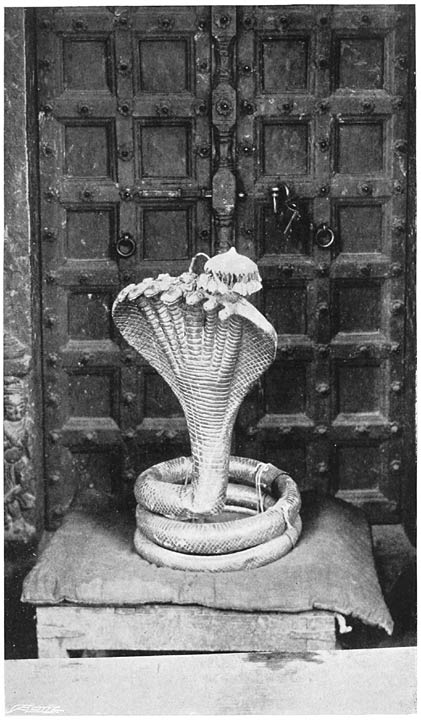
IMAGE OF THE HOUSEHOLD SNAKE.