← Table of contents
The Popular Religion and Folk-Lore of Northern India, Vol. 2 (of 2)

Chapter IV · ANIMAL-WORSHIP.

Reading edition

Τῶ δέ καὶ Αὐτομέδων ὕπαγε ζυγὸν ὠκέας ἵππους

Χάνθον καὶ Βαλίον, τὼ ἅμα πνοιῆσι πετέσθην

Τούς ἔτεκε Ζεφύρω ἀνέμω Ἅρπυια Ποδάργη

Βοσκομένη λειμῶνι παρὰ ῥόον Ὠκεανοῖο.

Iliad, xvi. 148–51.

Origin of Animal-worship.

We now come to consider the special worship of certain animals. The origin of this form of belief may possibly be traced to many different sources.

In the first place, no savage fixes the boundary line between man and the lower forms of animal life so definitely as more civilized races are wont to do. The animal, in their belief, has very much the same soul, much the same feelings and passion as men have, a theory exemplified in the way the Indian ploughman speaks to his ox, or the shepherd calls his flock.

To him, again, the belief is familiar that the spirits of his ancestors appear in the form of animals, as among the Drâvidian races they come in the shape of a tiger which attacks the surviving relatives, or as a chicken which leaves the mark of its footsteps in the ashes when it re-visits its former home.

So, all these people believe that the witch soul wanders about at night, and for want of a better shape enters into some animal, takes the form of a tiger or a bear, or flies through the air like a bird.

All through folk-lore we find the idea that man has kinship with animals generally accepted. We constantly find the girl wooed by the frog, marrying the pigeon, elephant, eagle, or whale. Every child in the nursery reads of the frog Prince, and no savage sees any particular incongruity in his marriage and transformation. In more than one of the Indian tales the childless wife longs for a child and is delivered of a snake.

Other animals, again, are invested with particular qualities, fierceness and courage, strength or agility, and eating part of their flesh, or wearing a portion as an amulet, conveys to the possessor the qualities of the animal. A familiar instance of this is the belief in the claws and flesh of the tiger as amulets or charms against disease and the influence of evil spirits.

Many animals, too, are respected for their use to man or as scarers of demons, as the cow; as possessors of wisdom, like the elephant or snake; as semi-human in origin or character, as the ape. But it is, perhaps, dangerous to attempt, as Mr. Campbell has done, to push the classification much farther, because the respect paid to any particular animal is possibly based on varied and diverging lines of belief.

Lastly, as Mr. Frazer has shown, many animals are regarded as representing the Corn spirit, and are either revered or killed in their divine forms to promote the return of vegetation with each recurring spring.

Horse-worship.

To illustrate some of these principles from the worship of certain special animals, we may begin with the horse.

Another horse often spoken of in the early legends is Syâma Karna, “he with the black ears,” which alone was considered a suitable victim in the horse sacrifice or Asvamedha. One hundred horse sacrifices entitled the sacrificer to displace Indra from heaven, so the deity was always trying to capture the horse which was allowed to roam about before immolation. The saint Gâlava, who was a pupil of Visvamitra, when he had completed his studies, asked his tutor what fee he should pay. The saint told him that he charged no fee, but he insisted in asking, till at last the angry Rishi said that he would be content with nothing less than a thousand black-eared horses. After long search Gâlava found three childless Râjas, who had each two hundred such horses, and they consented to exchange them for sons. Gâlava then went to Yayâti, whose daughter could bear a son for any one and still remain a virgin. By her means the three Râjas became fathers of sons, Visvamitra took them, and to make up the number, had himself two sons by the same mystic bride.

Modern Horse-worship.

The Worship of the Ass.

The worship of the ass is chiefly associated with that of Sîtalâ, whose vehicle he is. The Agarwâla sub-caste of Banyas have a curious rule of making the bridegroom just before marriage mount an ass. This is done in secret, and though said to be intended to propitiate the goddess of small-pox, is possibly a survival of some primitive form of worship.

The Lion.

The Tiger.

In Nepâl they have a regular festival in honour of the tiger known as the Bâgh Jâtra, in which the worshippers used to dance in the disguise of tigers.

Tiger-worship among the Jungle Races.

Bâgh Deo, the Tiger Godling.

Further west the Kurkus of Hoshangâbâd worship the tiger godling, Bâgh Deo, who is the Wâgh Deo of Berâr. At Petri in Berâr is a sort of altar to Wâghâî Devî, the tiger goddess, founded on a spot where a Gond woman was once seized by a tiger. She is said to have vanished as if by some supernatural agency, and the Gonds who desire protection from wild beasts present to her altar gifts of every kind of animal from a cow downwards. A Gond presides over the shrine and receives the votive offerings.

In the same way in other parts of the Central Provinces the village sorcerers profess to be able to call tigers from the jungles, to seize them by the ears, and control their voracity by whispering to them a command not to come near their villages, or they pretend to know a particular kind of root, by burying which they can prevent the beasts of the forest from devouring men or cattle. With the same object they lay on the pathway small models of bedsteads and other things which are supposed to act as charms and stop their advance.

Magical Powers of Dead Tigers.

Tigers, Propitiation of.

Tiger-worship among the Gonds.

Men Metamorphosed into Tigers.

The only visible difference between the ordinary animal and a man metamorphosed into a tiger was explained to Colonel Sleeman to consist in the fact that the latter had no tail. In the jungles about Deori there is said to be a root, which if a man eats, he is converted into a tiger on the spot; and if, when in this state, he eats another species of root, he is turned back into a man again.

Dog-worship.
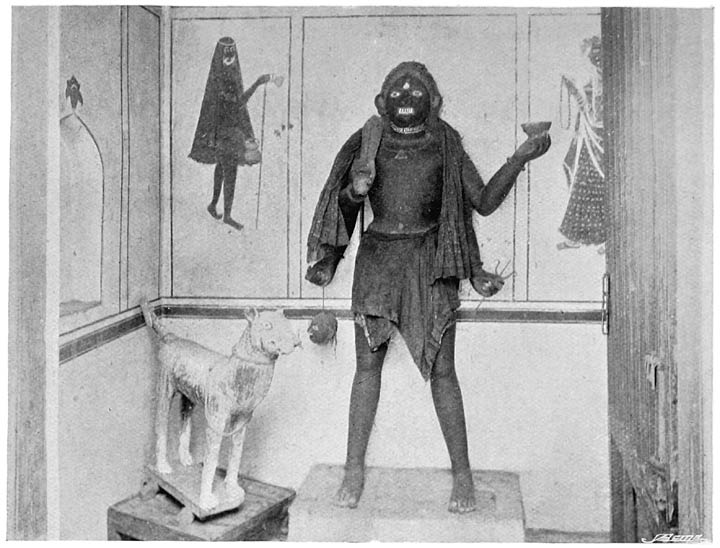
BHAIRON AND HIS DOG.

BHAIRON AND HIS DOG.

Dog-worship: Bhairon.

Dogs in Folk-lore: The Bethgelert Legend.

“The owl shriek’d at thy birth, an evil sign;

The night-crow cried, aboding luckless time;

Dogs howled and hideous tempests shook down trees.”

Hence in all countries the howling of dogs in the vicinity of a house is an omen of approaching misfortune.

All over Northern India the belief in the curative power of the tongue of the dog widely prevails. In Ireland they say that a dried tongue of a fox will draw out thorns, however deep they be, and an old late Latin verse says:—

In cane bis bina sunt, et lingua medicina

Among Musalmâns the dog is impure. The vessel it drinks from must be washed seven times and scrubbed with earth. The Qurân directs that before a dog is slipped in chase of game, the sportsman should call out, “In the name of God, the great God!” Then all game seized by him becomes lawful food.

The Goat.

Goat and Totemism.

Cow and Bull Worship.

Respect for the Cow Modern.

That the respect for the cow is of comparatively modern date is best established on the authority of a writer, himself a Hindu. “Animal food was in use in the Epic period, and the cow and bull were often laid under requisition. In the Aitareya Brâhmana, we learn that an ox, or a cow which suffers miscarriage, is killed when a king or honoured guest is received. In the Brâhmana of the Black Yajur Veda the kind and character of the cattle which should be slaughtered in minor sacrifices for the gratification of particular divinities are laid down in detail. Thus a dwarf one is to be sacrificed to Vishnu, a drooping-horned bull to Indra, a thick-legged cow to Vâyu, a barren cow to Vishnu and Varuna, a black cow to Pûshan, a cow having two colours to Mitra and Varuna, a red cow to Indra, and so on. In a larger and more important ceremonial, like the Aswamedha, no less than one hundred and eighty domestic animals, including horses, bulls, goats, sheep, deer, etc., were sacrificed.
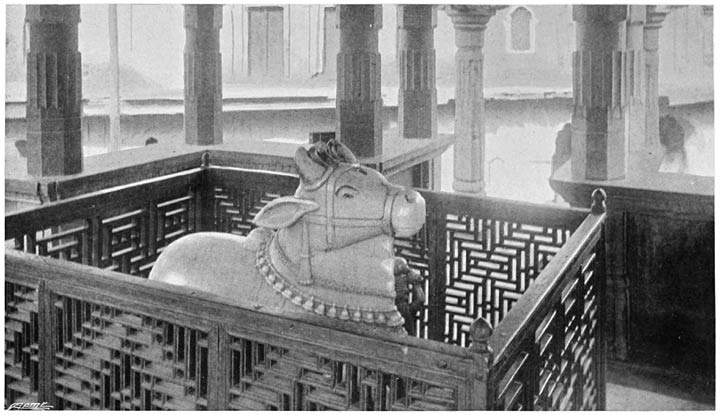
IMAGE OF THE SACRED BULL.

IMAGE OF THE SACRED BULL.

Origin of Cow-worship.

There is some evidence that the same process of religious development may have taken place in India. It is at least significant that the earlier legends represent Indra as created from a cow; and we know that Indra was the Kuladevatâ or family godling of the race of the Kusikas, as Krishna was probably the clan deity of some powerful confederation of Râjput tribes. Cow-worship is thus closely connected with Indra and with Krishna in his forms as the “herdman god,” Govinda or Gopâla; and it is at least plausible to conjecture that the worship of the cow may have been due to the absorption of the animal as a tribal totem of the two races, who venerated these two divinities.

Cow-worship assumes another form in connection with the theory of transmigration. It has become part of the theory that the soul migrates into the cow immediately preceding its assumption of the human form, and she escorts the soul across the dreaded river Vaitaranî, which bounds the lower world.

Cow-worship: Its Later Development.

Re-birth through the Cow.

Respect Paid to the Cow.

Modern Cow-worship.

Feeling against Cow-killing.

Bull-worship among Banjâras.

Superstitions about Cattle.

The Buffalo.

The respect paid to the cow does not fully extend to the buffalo. The buffalo is the vehicle of Yama, the god of death. The female buffalo is in Western India regarded as the incarnation of Savitrî, wife of Brahma, the Creator. Durgâ or Bhavânî killed the buffalo-shaped Asura Mahisa, Mahisâsura, after whom Maisûr is called. According to the legend as told in the Mârkandeya Purâna, Ditî, having lost all her sons, the Asuras, in the fight with the gods, turned herself into a buffalo in order to annihilate them. She underwent such terrible austerities to propitiate Brahma, that the whole world was shaken and the saint Suparsva disturbed at his devotions. He cursed Ditî that her son should be in the shape of a buffalo, but Brahma so far mitigated the curse that only his head was to be that of a buffalo. This was Mahisâsura, who ill-treated the gods, until they appealed to Vishnu and Siva, who jointly produced a lovely representation of a Bhavânî, the Mahisâsurmardanî, who slew the monster. This Mahisâsura is supposed to be the origin of the godling Mahasoba, worshipped in Western India in the form of a rude stone covered with red lead.

Sadasiva, one of the forms of Mahâdeva, took the form of a buffalo to escape the Pândavas, and sank into the ground at Kedârnâth. The upper portion of his body is said to have come to the surface at Mukhâr Bind in Nepâl, where he is worshipped as Pasupatinâtha. When the Pândavas were freed from their guilt, they in their gratitude built five temples in honour of the hinder parts of the deity, which are now known as the Pânch Kedâr-Kedarnâth, Madhya Maheswar, Rudranâth, Tungunâth, and Kalpeswar.

The buffalo is constantly sacrificed at shrines in honour of Durgâ Devî. The Toda worship of the buffalo is familiar to all students of Indian ethnology.

The Antelope.

The Elephant.

The elephant naturally claims worship as the type of strength and wisdom. To the rustic he impersonates Ganesa, the god of wisdom, the remover of obstacles, who is propitiated at the commencement of any important enterprise, such as marriage and the like. Many legends are told to account for his elephant head. One tells how his mother Pârvatî was so proud of her baby that she asked Sani to look at him, forgetting the baneful effects of the look of the ill-omened deity. When he looked at the child its head was burned to ashes, and Brahma, to console her, told her to fix on the first head she could find, which happened to be that of the elephant. By another account she put Ganesa to guard the door while she was bathing, and when he refused to allow Siva to enter, the angry god cut off his head, which was afterwards replaced by that of the elephant. Again, one of his tusks was broken off by Parasurâma with the axe which Siva, father of Ganesa, had given him.
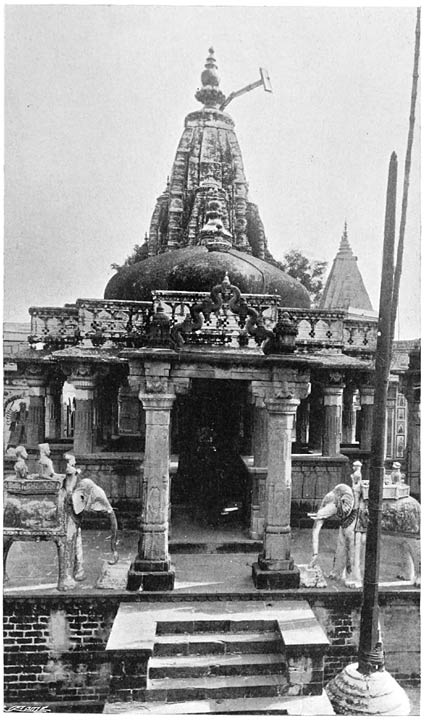
THE ELEPHANT A TEMPLE WARDEN.

THE ELEPHANT A TEMPLE WARDEN.

Again, there are the Lokapâlas, the eight supporters of the world. These eight pairs of elephants support the earth. Indra with Airâvata and Abhramu support the east; Agni with Pundarîka and Kapilâ the south-east; Yama with Vâmana and Pingalâ the south; Sûrya with Kumuda and Anupamâ the south-west; Varuna with Anjana and Anjanavatî the west; Vâyu with Pushpadanta and Subhadantî the north-west; Kuvera on the north with Sarvabhauma, and Soma on the north-east with Supratîka. As usual, there are differences in the enumeration.

The hair of the elephant’s tail is in high repute as an amulet, and little village children, when an elephant passes, pat the dust where his feet have rested and sing a song, of which one version is—

Hâthi hâthi, bâr dé

Sone kî tarwâr dé—

“Give us a hair, elephant, like a sword of gold.”

The Cat.

The cat is everywhere invested with demoniac qualities, and is the companion of the witch. In “Macbeth” the first witch says, “Thrice the brinded cat has mewed.” Among Muhammadans the cat is a pure animal, and to kill a cat is very unlucky, and brings on trouble and sickness. So, among Hindus, the killing of a cat can be expiated only by the performance of the rite known as the Prajapati Yajna, which secures the birth of male issue. They say that Mahâdeva and Pârvatî were one day playing dice, and Pârvatî called in Ganesa in his form as a rat to upset the dice with his tail and cause her to make a good throw. Mahâdeva was wroth, and called in a demon like a cat, but he was afraid to kill Ganesa. Then Mahâdeva cursed any one in after days who should kill a cat. We have the same tale in the Rasâlu cycle, where the rat of Dhol Râja changes the course of the game between him and Râja Sarkap. The cat is respected because she is the vehicle of Shashthî, the protectress of children, and part of the orthodox Hindu rite at dinner is giving food to the cat. Among the Orâons, as we have seen, the birth fiend Chordeva comes in the form of a cat.

The Rat and Mouse.

The Squirrel.

The little Indian squirrel is called in the Panjâb Râma Chandra Kâ Bhagat, or the saint of Râma Chandra, because when he was building the bridge across the strait to Lanka, the squirrel helped by shaking dust from his tail, and the god stroked it on the back, hence the dark marks which it bears to the present day. Many of the Drâvidian tribes claim descent from the squirrel.

The Bear.

The bear is regarded as a scarer of disease, and sickly children are taken for a ride on the back of a tame bear or one of his hairs is worn round the neck as an amulet. It was Jâmbavat, the king of the bears, who carried off the celebrated amulet, Syamantaka. He was pursued by Krishna, to whom he surrendered the gem and gave him his daughter Jâmbavatî to wife. He afterwards with his army of bears assisted Râma in his invasion of Lanka.

The Jackal.

The jackal is an important character in the folk-tales, where he assumes the part taken in Europe by the fox. Many are the tales told of his acuteness. The pack is supposed to howl only at each watch of the night, and the leader says, Main Dilli kâ Bâdshâh hûn—“I am King of Delhi” thrice, and his companions say, Ho! ho! ho!—“Yes! of course you are.”

The Hare.

Birds: The Crow.

Bhusundi is the legendary crow of the battlefield, who drinks the blood of the slain. He had more blood than he could drink in the wars of the two Asuras, Sumbha and Nisumbha, who contended with the gods. He just quenched his thirst in the wars of Râma, but broke his beak against the hard, dry ground, which had soaked in the small amount of blood shed by the comparatively degenerate heroes of the Mahâbhârata. He now croaks over the armies as they go out to war, and looks for some Armageddon, when his thirst will at last be satisfied.

The Hand of Glory.

The Fowl.

The Dove and Pigeon.

Pisûn thi, kâtûn thi:

Ayâ thâ, chalâ gayâ.

The Goose or Swan.

Sundry Sacred Birds.

Mention has already been made of Garuda, half man, half bird, the vehicle of Vishnu. He is the son of one of the daughters of Daksha, whom we have already met with in connection with the moon, and the sage Kasyapa. According to the Mahâbhârata, he was given leave to devour wicked men, but not to touch a Brâhman. Once he did devour a Brâhman, but the holy man so burnt his throat that he was glad to disgorge him. In the Râmâyana we meet with Jatâyu, who is said to be a son of Garuda and king of the vultures. He tried to stop the chariot in which Râvana was abducting Sîtâ, and though wounded, was able to carry the news to Râma.

A bird known as the Malahâri or “filth destroyer” is a sort of totem of the Kanjar gipsies. If they see it singing on a green branch to the front or right, it is an auspicious omen, and they start at once on the prowl.

The Hoopoe.

The Woodpecker.

The Peacock.

The peacock is, of course, a sacred bird. He is specially venerated by the Jâts, who strongly object to seeing the bird killed near their villages. A bunch of the feathers is waved over the sick to scare the demon of disease. As we have already seen, it is a charm against snake-bite to smoke one of its feathers in a pipe. In Europe the loud calling of the bird presages a death.

The Pheasant.

Once upon a time the Monâl pheasant of the Hills and the Kalchuniya had a dispute as to when the sun arose. The Monâl woke first and then walked between the legs of the other, who was so injured that he has never been able to do anything but skip ever since.

The Kite.

The Partridge.

The partridge and the peacock once contended in dancing, and when the turn of the partridge came he borrowed the pretty feet of the peacock, which he has never returned since. Râja Nala, at one period of his life, came under the malignant influence of Sani or Saturn and lost all he possessed in the world. At last, as he was starving, he managed to catch a black partridge and set about roasting it. But the ill-luck of the evil planet asserted itself and the dead bird came to life and flew away. The result is the black marks of charring which still remain upon its body. Now it cries in the words, Subhân terî qudrat—“Great is the power of the Almighty,” because it was saved from the fire.

The Parrot.

The Alligator.

Fish.

The Fish in Folk-lore.

The Eel.

The Tortoise.

The Frog.

Insects.

The ant-hill is, as we have seen, used as an altar by some of the Drâvidian tribes, and on it they take their oaths. Hence ants are carefully fed on certain days by both Hindus and Jainas, and are regarded as in some way connected with the souls of the sainted dead. We have in many of the folk-tales the ant as a helper.

Lastly, comes the Tassar silkworm. In Mirzapur, when the seed of the silkworm is brought to the house, the Kol or Bhuiyâr puts it in a place which has been carefully plastered with cowdung to bring good luck. From that time the owner must be careful to avoid ceremonial impurity; he must give up cohabitation with his wife, he must not sleep on a bed, he must not shave nor have his nails cut, nor anoint himself with oil, nor eat food cooked with butter, nor tell lies, nor do anything opposed to his simple code of morality. He vows to Singârmatî Devî that if the worms are duly born he will make her an offering. When the cocoons open and the worms appear, he collects the women of his house and they sing the usual song as at the birth of a baby into the family, and some red lead is smeared on the parting of the hair of all the married women of the neighbourhood. He feeds his clansmen, and duly makes the promised offering to Singârmatî Devî. When the worms pair, the rejoicings are made as at a marriage.

Notes in this chapter

Note 1 · Tawney, “Katha Sarit Sâgara,” i. 342; ii. 135, 230, 302, 363; “North Indian Notes and Queries,” iii. 13; Clouston, “Popular Tales,” i. 448.Note 2 · Lâl Bihâri Dê, “Folk-tales,” 139.Note 3 · Tawney, loc. cit., i. 499; ii. 276; Grimm, “Household Tales,” No. 33; i. 357; Knowles, “Folk-tales of Kashmîr,” 432; Campbell, “Santâl Folk-Note 4 · Temple, “Wideawake Stories,” 74, 412; Lâl Bihâri Dê, loc. cit., 40, 106, 134, 138, 155, 210, 223; “Cinderella,” 526; “North Indian Notes andNote 5 · Campbell, “Notes,” 259.Note 6 · “Rig Veda,” iv. 33; Datt, “History of Civilization,” i. 72 sq., 79; Monier-Williams, “Brâhmanism and Hinduism,” 329.Note 7 · Wright, “History,” 165; “Iliad,” v. 265 sqq.; Tawney, “Katha Sarit Sâgara,” ii. 593.Note 8 · Tawney, ibid., i. 130, 574, quoting Grimm, “Teutonic Mythology,” i. 392.Note 9 · Campbell, “Popular Tales,” Introduction, lxxviii.Note 10 · Miss Cox, “Cinderella,” 476; Clouston, “Popular Tales,” i. 373.Note 11 · Clouston, loc. cit., i. 417; Grimm, “Household Tales,” ii. 479; Tawney, loc. cit., ii. 261; Clouston, ibid., 110, 218; Tawney, ibid., i. 13.Note 12 · Rousselet, “India and its Native Princes,” 116.Note 13 · “Indian Antiquary,” xi. 325 sq.; “Panjâb Notes and Queries,” ii. 2.Note 14 · Campbell, “Notes,” 392.Note 15 · “Germania,” 10.Note 16 · Henderson, “Folk-lore of the Northern Counties,” 142.Note 17 · Gubernatis, “Zoological Mythology,” i. 332.Note 18 · “Panjâb Notes and Queries,” i. 113.Note 19 · “Annals,” ii. 319.Note 20 · Lubbock, “Origin of Civilization,” 275.Note 21 · Campbell, “Notes,” 292.Note 22 · Hislop, “Papers,” Appendix, i. iii.Note 23 · Burton, “Arabian Nights,” ii. 340.Note 24 · Knowles, “Folk-tales,” 90; Tawney, “Katha Sarit Sâgara,” ii. 168; Clouston, “Popular Tales,” i. 97; Grimm, “Household Tales,” ii. 419.Note 25 · Tawney, loc. cit., i. 37, 78; ii. 28, 32; Grimm, loc. cit., ii. 404; Tawney, loc. cit., ii. 107.Note 26 · Gubernatis, loc. cit., ii. 160.Note 27 · Forsyth, “Highlands of Central Indian,” 278; Tod, “Annals,” ii. 660; Rowney, “Wild Tribes,” 139; Dalton, “Descriptive Ethnology,” 214; FrazeNote 28 · Trumbull, “Blood Covenant,” 312; Tylor, “Primitive Culture,” i. 309; Sleeman, “Rambles,” i. 153 sqq.Note 29 · “Folk-lore,” i. 169; Lyall, “Asiatic Studies,” 13; Spencer, “Principles of Sociology,” i. 323; Conway, “Demonology,” i. 313 sq.; Scott, “LetNote 30 · “Berâr Gazetteer,” 62; Wright, “History of Nepâl,” 38; Frazer, “Golden Bough,” ii. 101.Note 31 · Dalton, loc. cit., 132, 133, 158, 214.Note 32 · “Berâr Gazetteer,” 191 sq.; “Hoshangâbâd Settlement Report,” 255 sq.Note 33 · See for example Knowles, “Kashmîr Folk-tales,” 3, 45, 46.Note 34 · Dalton, loc. cit., 33.Note 35 · Knowles, loc. cit., 47; Campbell, “Santâl Tales,” 18.Note 36 · Wright, “History,” 169.Note 37 · “Annals,” ii. 669.Note 38 · Dalton, “Descriptive Ethnology,” 280.Note 39 · “Rambles and Recollections,” i. 154 sqq.Note 40 · “Zoological Mythology,” i. 160 sq.Note 41 · Wright, “History,” 161; Tawney, “Katha Sarit Sâgara,” ii. 348 sq.Note 42 · “North Indian Notes and Queries,” iii. 65.Note 43 · Temple, “Wideawake Stories,” 116; Campbell, “Santâl Folk-tales,” 40; Clouston, “Popular Tales,” i. 146.Note 44 · Sherring, “Sacred City,” 63, 65.Note 45 · “Notes,” 276.Note 46 · Cox, “Mythology of the Aryan Nations,” ii. 336.Note 47 · “Journal Asiatic Society, Bengal,” lix. 212. The horror with which the Homeric Greeks regarded the eating of a corpse by dogs comes out veryNote 48 · “Indian Antiquary,” v. 358 sq.Note 49 · “Original Inhabitants,” 157 sq.Note 50 · “Archæological Reports,” xxiii. 26.Note 51 · “North Indian Notes and Queries,” i. 118.Note 52 · Campbell, “Notes,” 276 sq.Note 53 · Wright, “History,” 39 sq.Note 54 · Hislop, “Papers,” 6.Note 55 · “Folk-lore,” iii. 127; “Panjâb Notes and Queries,” iii. 94, 148; iv. 46, 150, 173; “North Indian Notes and Queries,” iii. 18, 67; Knowles, “Note 56 · Conway, “Demonology,” i. 134; Gregor, “Folk-lore of North-East Scotland,” 126 sq.Note 57 · “Remaines,” 53.Note 58 · Risley, “Tribes and Castes,” i. 79 sq.Note 59 · “Panjâb Notes and Queries,” i. 88.Note 60 · “Journal Asiatic Society, Bengal,” 1847, p. 234.Note 61 · “Household Tales,” ii. 444.Note 62 · Atkinson, “Himâlayan Gazetteer,” ii. 329.Note 63 · “Folk-lore,” iv. 351; “Gesta Romanorum,” 25.Note 64 · Brand, “Observations,” 583.Note 65 · Robertson-Smith, “Kinship,” 194.Note 66 · “Demonology,” i. 122.Note 67 · “North Indian Notes and Queries,” i. 15.Note 68 · Brand, “Observations,” 785.Note 69 · “Epigrams,” i. 6.Note 70 · “Panjâb Notes and Queries,” iv. 131; Moorcroft, “Travels,” i. 22; “Journal Asiatic Society Bengal,” 1840, p. 572; “Aîn-i-Akbari,” i. 289.Note 71 · Miss Cox, “Cinderella,” 473.Note 72 · Muir, “Ancient Sanskrit Texts,” i. 24 sq.; iii. 166, 310 sq.; McLennan, “Fortnightly Review,” 1870, 198 sq.Note 73 · Cox, “Mythology of the Aryan Nations,” i. 107, 437 sq.; ii. 49 sq.Note 74 · Romesh Chandra Datt, “History of Indian Civilization,” i. 253 sq.Note 75 · Bühler, “Sacred Laws,” Part i. 64, 119, note.Note 76 · Rajendra Lâla Mitra, “Indo-Aryans,” ii. 134; Muir, “Ancient Sanskrit Texts,” i. 24 sqq.Note 77 · Schliemann, “Ilios,” 112; Rawlinson, “Herodotus,” ii. 27 sq., 41; Ewald, “History of Israel,” ii. 4; Robertson-Smith, “Kinship,” 196; FrazerNote 78 · Campbell, “Notes,” 285.Note 79 · Gubernatis, “Zoological Mythology,” i. 3 sqq.; Cox, “Introduction,” 151 sqq.; Kuenen, “Religion of Israel,” i. 236 sq.; Goldziher, “MythologNote 80 · “Golden Bough,” ii. 60.Note 81 · Hartland, “Legend of Perseus,” i. 158.Note 82 · Sellon, “Memoirs Anthropological Society of London,” i. 328.Note 83 · “Institutes,” xi. 60, 80.Note 84 · Tawney, “Katha Sarit Sâgara,” i. 227.Note 85 · “North Indian Notes and Queries,” iii. 215.Note 86 · Atkinson, “Himâlayan Gazetteer,” ii. 914; “Râjputâna Gazetteer,” ii. 67.Note 87 · “North Indian Notes and Queries,” iii. 39.Note 88 · Miss Gordon-Cumming, “From the Hebrides to the Himâlaya,” i. 141.Note 89 · Atkinson, loc. cit., ii. 771; Wright, “History of Nepâl,” 82.Note 90 · “Panjâb Notes and Queries,” iii. 109.Note 91 · “North Indian Notes and Queries,” i. 154.Note 92 · Dyer, “Popular Customs,” 18.Note 93 · Yule, “Marco Polo,” ii. 341.Note 94 · Dalton, “Descriptive Ethnology,” 283.Note 95 · “Indian Antiquary,” i. 348 sq.Note 96 · Atkinson, “Himâlayan Gazetteer,” ii. 913.Note 97 · Jarrett, “Aîn-i-Akbari,” ii. 348, quoting Erskine; “Babar,” Introduction, 47.Note 98 · “Rambles,” i. 199 sqq.Note 99 · “Central India,” i. 329, note; ii. 164.Note 100 · Balfour, “Journal Asiatic Society Bengal,” xiii. N.S.; Gunthorpe, “Notes on Criminal Tribes of Berâr,” 36.Note 101 · Ball, “Jungle Life,” 165; “North Indian Notes and Queries,” i. 60; “Calcutta Review,” lxxx. 53, 58.Note 102 · Gubernatis, “Zoological Mythology,” i. 75.Note 103 · “Notes,” 287.Note 104 · Dalton, “Descriptive Ethnology,” 131.Note 105 · “Golden Bough,” ii. 93.Note 106 · Manu, “Institutes,” ii. 41.Note 107 · Burton, “Arabian Nights,” ii. 508; Tawney, “Katha Sarit Sâgara,” i. 166; Clouston, “Popular Tales,” i.; “Gesta Romanorum,” Tale xviii.Note 108 · Wright, “History,” 81.Note 109 · Blochmann, “Aîn-i-Akbari,” i. 121.Note 110 · Führer, “Monumental Antiquities,” 8, 73, 105, 188; Cunningham, “Archæological Reports,” i. 225.Note 111 · Tawney, “Katha Sarit Sâgara,” i. 73, 177, 328 sq.; ii. 102, 215, 500, 540; Knowles, “Kashmîr Folk-tales,” 17.Note 112 · Black, “Folk Medicine,” 152.Note 113 · Führer, loc. cit., 161.Note 114 · Campbell, “Notes,” 267.Note 115 · Brand, “Observations,” 739.Note 116 · “Panjâb Notes and Queries,” iv. 2.Note 117 · Hunt, “Popular Romances,” 377.Note 118 · For the crow in English folk-lore, see Henderson, “Folk-lore of the Northern Counties,” 126; Gregor, “Folk-lore of N.E. Scotland,” 135 sq.Note 119 · Gubernatis, “Zoological Mythology,” ii. 253 sq.; “Panjâb Notes and Queries,” i. 27.Note 120 · Tawney, “Katha Sarit Sâgara,” ii. 64, 73.Note 121 · Balfour, “Journal Asiatic Society of Bengal,” N.S. xiii.Note 122 · Monier-Williams, “Brâhmanism and Hinduism,” 301; Atkinson, “Himâlayan Gazetteer,” ii. 329.Note 123 · “North Indian Notes and Queries,” i. 15.Note 124 · Lady Wilde, “Legends,” 81 sq., 172; “Panjâb Notes and Queries,” iii. 24; Brand, “Observations,” 732; Henderson, “Folk-lore of the Northern CNote 125 · “Mythology of the Aryan Nations,” ii. 219 sq.Note 126 · “Notes,” 264.Note 127 · “Folk-lore,” iv. 350.Note 128 · Grimm, “Teutonic Mythology,” iii. 977.Note 129 · Leland, “Etruscan Roman Remains,” 354.Note 130 · Robertson-Smith, “Kinship,” 196 sq.Note 131 · “North Indian Notes and Queries,” i. 12, 42, 60; ii. 29; iii. 161; Grimm, “Household Tales,” i. 367; ii. 428, 573.Note 132 · McLennan, “Fortnightly Review,” vi. 582.Note 133 · Knowles, “Kashmîr Folk-tales,” 449.Note 134 · Brand, “Observations,” 699.Note 135 · Rhys, “Lectures,” 175.Note 136 · Ferguson, “History of Indian Architecture,” 54; Tennent, “Ceylon,” i. 484.Note 137 · Gubernatis, “Zoological Mythology,” ii. 307 sqq.Note 138 · Lady Wilde, “Legends,” 177.Note 139 · Hislop, “Papers,” 6.Note 140 · “North Indian Notes and Queries,” iii. 178.Note 141 · Tawney, “Katha Sarit Sâgara,” ii. 105.Note 142 · Brand, “Observations,” 701.Note 143 · Leland, “Etruscan Roman Remains,” 272.Note 144 · “Panjâb Notes and Queries,” iii. 81; “North Indian Notes and Queries,” iii. 162.Note 145 · “Zoological Mythology,” i. 375.Note 146 · Tawney, “Katha Sarit Sâgara,” ii. 18.Note 147 · Temple, “Wideawake Stories,” 139, 205, 255 sqq.Note 148 · “Folk-lore,” iii. 342.Note 149 · “North Indian Notes and Queries,” i. 4, 38.Note 150 · Rhys, “Lectures,” 553.Note 151 · Lady Wilde, “Legends,” 238 sq.Note 152 · Rousselet, “India and its Native Princes,” 402; “North Indian Notes and Queries,” i. 76; ii. 57, 93; iii. 130.Note 153 · Atkinson, “Himâlayan Gazetteer,” ii. 380, 775.Note 154 · Tawney, “Katha Sarit Sâgara,” i. 24, 207; ii. 599.Note 155 · Knowles, “Folk-tales,” 27, 158.Note 156 · Cox, “Mythology of the Aryan Nations,” i. 292, note; ii. 25 sq.Note 157 · Hartland, “Science of Fairy Tales,” 65.Note 158 · Buchanan, “Eastern India,” iii. 532.Note 159 · Grimm, “Household Tales,” ii. 407.Note 160 · Tawney, loc. cit., ii. 271.Note 161 · “Gloucestershire Folk-lore,” 9.Note 162 · Tawney, loc. cit., ii. 594; Grimm, loc. cit., i. 357.Note 163 · Hunt, “Popular Romances,” 130.Note 164 · “Panjâb Notes and Queries,” iii. 8.Note 165 · Brand, “Observations,” 685.Note 166 · “Katha Sarit Sâgara,” ii. 39.Note 167 · Buchanan, “Eastern India,” ii. 157.Note 168 · Dyer, “Popular Customs,” 270.Note 169 · The incident of animal metamorphosis is also familiar. Thus, in one of Somadeva’s tales his mistress turns a man into an ox; in another his Note 170 · We have again the very common incident in the folk-tales of animals understanding the speech of human beings, and men learning the tongue ofNote 171 · Then there is the large cycle of tales in which the grateful animal warns the hero or heroine of approaching danger, as in the story of BopuNote 172 · Another series of cognate ideas has been very carefully analyzed by Mr. Campbell. The spirits of the dead haunt two places, the house and thNote 173 · War horses were so highly prized by the early Aryans in their battles with the aborigines, that the horse, under the name of Dadhikra, “he tNote 174 · In the Mahâbhârata, Uchchaihsravas, “he with the long ears,” or “he that neighs loudly,” is the king of the horses, and belongs to Indra. HeNote 175 · At a later mythological stage we meet Kalki, the white horse which is to be the last Avatâra of Vishnu, and reminds us of the white horse ofNote 176 · The flying horse of the Arabian Nights has been transferred into many of the current folk-tales, and has found its way into European folk-loNote 177 · There are numerous other horses famous in Hindu legend. The saint Alam Sayyid of Baroda was known as Ghorê Kâ Pîr, or the horse saint. His hNote 178 · There is a stock horse miracle story told in connection with Lâl Beg, the patron saint of the sweepers. The king of Delhi lost a valuable hoNote 179 · The horse is regarded as a lucky and exceedingly pure animal. When a cooking vessel has become in any way defiled, a common way of purifyingNote 180 · It is popularly supposed that the horse originally had wings, and that the chestnuts or scars on the legs are the places where the wings oriNote 181 · Of modern horse-worship there are many examples. The Palliwâl Brâhmans of Jaysalmer worship the bridle of a horse, which Colonel Tod supposeNote 182 · In Western India this form of worship is common. It is the chief object of reverence at the Dasahra festival. Some Râjput Bhîls worship a deNote 183 · The contempt for the ass seems to have arisen in post-Vedic times. Indra had a swift-footed ass, and one of the epithets of Vikramaditya wasNote 184 · In folk-lore the ass constantly appears. We have in Somadeva the fable of the ass in the panther’s skin, which also appears in the fifth booNote 185 · The lion, from his comparative rarity in Northern India, appears little in popular belief. It is one of the vehicles of Pârvatî, and rude imNote 186 · The tiger naturally takes the place of the lion. According to the comparative mythologists, “the tiger, panther, and leopard possess severalNote 187 · Much also of the worship of the tiger is probably of totemistic origin. Thus the Baghel Râjputs claim descent, and from him (bâgh, vyâghra, Note 188 · Another idea appearing in tiger-worship is that he eats human flesh, and thus obtains possession of the souls of the victims whom he devoursNote 189 · He is, again, often the disguise of a sorcerer of evil temper, an idea similar to that which was the basis of the European dread of lycanthrNote 190 · Hence in India the jungle people who are in the way of meeting him will not pronounce his name, but speak of him as Gîdar, “the jackal,” JânNote 191 · But, as is natural, the worship of the tiger prevails more widely among the jungle races. We have already met with Bâgheswar, the tiger deitNote 192 · In Hoshangâbâd the Bhomka is the priest of Bâgh Deo. “On him devolves the dangerous duty of keeping tigers out of the boundaries. When a tigNote 193 · All sorts of magical powers are ascribed to the tiger after death. The fangs, the claws, the whiskers are potent charms, valuable for love pNote 194 · Some tigers are supposed to be amenable to courtesy. In one of the Kashmîr tales, the hero in search of tiger’s milk shoots an arrow and pieNote 195 · Among the Gonds tiger-worship assumes a particularly disgusting form. At marriages among them, a terrible apparition appears of two demoniacNote 196 · “A melancholy instance of this,” said Colonel Sleeman’s informant, “occurred in my own father’s family when I was an infant. His washerman RNote 197 · This is a curious reversal of the ordinary theory regarding the tail of the tiger, to which a murderous strength is attributed. A Hindu provNote 198 · A Nepâl legend describes how some children made a clay image of a tiger, and thinking the figure incomplete without a tongue, went to fetch Note 199 · We have many instances in the folk-tales of the tiger befooled. In one of the tales told by the Mânjhis of Mirzapur the goat has kids in theNote 200 · In the Nepâl legend which we have been discussing we find Bhairava associated with the tiger, but his prototype, the local godling Bhairon, Note 201 · Two conflicting lines of thought seem to meet in dog-worship. As Mr. Campbell says, “There is a good house-guarding dog, and an evil scavengNote 202 · An ancient epithet of the dog is Kritajna, “he that is mindful of favours,” which is also a title of Siva. The most touching episode of the Note 203 · The Kois of Central India hold in great respect the Pândava brethren Arjuna and Bhîma. The wild dogs or Dhol are regarded as the Dûtas or meNote 204 · In modern times dog-worship appears specially in connection with the cultus of Bhairon, the Brâhmanical Bhairava, the Bhairoba of Western InNote 205 · At Lohâru, in the Panjâb, a common-looking grave is much respected by the Hindus. It is said to contain the remains of a dog formerly possesNote 206 · Thus, close to Bulandshahr, there is a grove with four tombs, which are said to be the resting-place of three holy men and their favourite dNote 207 · In Pûna, Dattâtreya is guarded by four dogs which are said to stand for the four Vedas, and at Jejuri and Nâgpur children are dedicated to tNote 208 · The famous tale of Bethgelert, the faithful hound which saves the child of his master from the wolf and is killed by mistake, appears all thNote 209 · Throughout folk-lore the dog is associated with the spirits of the dead, as we have seen to be the case with Syâma, “the black one,” and SabNote 210 · The respect for the dog is well shown in the case of the Bauris of Bengal, who will on no account kill a dog or touch its body, and the wateNote 211 · Various omens are in the Panjâb drawn from dogs. When out hunting, if they lie on their backs and roll, as they generally do when they find Note 212 · We have seen already that some of the Central Indian tribes respect the wild dog. The same is the case in the Hills, where they are known asNote 213 · Naris odoratus, amor intiger, atque latratus.63Note 214 · The goat is another animal to which mystic powers are attributed. In the mythology of the West he is associated with Dionysos, Pan, and the Note 215 · Mr. Conway asks whether this idea about the goat is due to the smell of the animal, its butting and injury to plants, or was it demonized meNote 216 · In the Panjâb it is believed that when a goat kills a snake it eats it and then ruminates, after which it spits out a Manka or bead, which, Note 217 · The horn is regarded as somehow most closely connected with the brain. So, in the “Merry Wives of Windsor,” Mrs. Quickly says: “If he had foNote 218 · It is for this reason that the local shrines in the Himâlaya are decorated with horns of the wild sheep, ibex, and goat. In Persia many housNote 219 · We perhaps get a glimpse of totemism in connection with the goat in some of the early Hindu legends. When Parusha, the primeval man, was divNote 220 · But the most famous of these animal totems or fetishes is the cow or bull. According to the school of comparative mythology the bull which bNote 221 · “The same Brâhmana lays down instructions for carving, and the Gopatha Brâhmana tells us who received the portions. The priests got the tongNote 222 · The evidence that cows were freely slaughtered in ancient times could be largely extended. It is laid down in the early laws that the meat oNote 223 · It need hardly be said that the worship of the cow is not peculiar to India, but prevails widely in various parts of the world.77Note 224 · The explanation of the origin of cow-worship has been a subject of much controversy. The modern Hindu, if he has formed any distinct ideas aNote 225 · There is, again, something to be said for the theory which finds in these animals tribal totems and fetishes.79 We have a parallel case amonNote 226 · So, speaking of Egypt, Mr. Frazer writes: “Osiris was regularly identified with the bull Apis of Memphis and the bull Mnevis of Heliopolis. Note 227 · Further, the phallic significance of the worship, in its modern form at least, and its connection with fertility cannot be altogether ignoreNote 228 · Though cow-worship was little known in the Vedic period, by the time of the compilation of the Institutes of Manu it had become part of the Note 229 · When the horoscope forebodes some crime or special calamity, the child is clothed in scarlet, a colour which repels evil influences, and tieNote 230 · The same idea is illustrated in the legend of the Pushkar Lake, which probably represents a case of that fusion of races which undoubtedly oNote 231 · The respect paid to the cow appears everywhere in folk-lore. We have the cow Kâmadhenû, known also as Kâmadughâ or Kâmaduh, the cow of plentNote 232 · The Hill legend tells how Siva once manifested himself in his fiery form, and Vishnu and Brahma went in various directions to see how far thNote 233 · There are numerous instances of modern cow-worship. The Jâts and Gûjars adore her under the title of Gâû Mâtâ, “Mother cow.” The cattle are Note 234 · During an eclipse, the cow, if in calf, is rubbed on the horns and belly with red ochre to repel the evil influence, and prevent the calf beNote 235 · Of the unhappy agitation against cow-killing, which has been in recent years such a serious problem to the British Government in Northern InNote 236 · General Sleeman gives a case at Sâgar, where an epidemic was attributed to the practice of cattle slaughter, and a popular movement arose foNote 237 · There is a good example of bull-worship among the wandering tribe of Banjâras. “When sickness occurs, they lead the sick man to the foot of Note 238 · Infinite are the superstitions about cattle, their marks, and every kind of peculiarity connected with them, and this has been embodied in aNote 239 · Another of these buffalo demons is Dundubhi, “he that roars like the sound of the kettle-drum,” who in the Râmâyana bursts with his horns thNote 240 · The black buck was in all probability the tribal totem of some of the races occupying the country anciently known as Âryâvarta. Mr. CampbellNote 241 · The antelope constantly appears in the folk-tales as a sort of Deus ex machinâ, which leads the hero astray in the chase and brings him to tNote 242 · From these all the modern elephants are descended. As Abul Fazl writes: “When occasion arises people read incantations in their names and adNote 243 · Through India the reverence for the white elephant of Burma and Siam has arisen. The figure of the elephant appears on some of the pillars oNote 244 · The elephant constantly occurs in folk-lore. In the projection of its forehead it possesses a pearl, known as the Kunjara Mani, or Gaja MuktNote 245 · In Europe, it may be noted, the hair from the tail of a horse is commonly regarded as a cure for wens.112Note 246 · In the Fatehpur District there is an elephant turned into stone. The famous Jaychand of Kanauj, it is said, as in the Carthage legend, offerNote 247 · The rat is sacred as the vehicle of Ganesa. In Bombay, “to call a rat a rat is considered by lower classes of Hindus as unlucky, and so theyNote 248 · The curiously deformed idiot boys which are collected at the shrine of Shâh Daula at Gujarât are known from their wizened appearance as the Note 249 · Of the hare in the moon we have spoken already, and also referred to the animal in connection with omens. In Cornwall, when a girl has lovedNote 250 · Passing on to birds, the crow is a famous totem or sacred bird.118 It personifies in Indian tradition the soul of the dead man; hence, to giNote 251 · In the Mahâbhârata, the son of Drona, one of the few survivors of the Kauravas, sees an owl killing the crows on a sacred fig tree, and thisNote 252 · In the Garuda Purâna a tale is told of a wicked hunter who was killed by a tiger in the depths of the forest, and his ghost became a troubleNote 253 · Manifold are the ideas about crows and omens taken from their appearance and cawing. Some people think a crow has only one eye, which he shiNote 254 · It is a common belief in Europe that the Hand of Glory, or the dried-up hand of a criminal who has been executed, is a powerful charm for thNote 255 · Among some of the Indian races the value set on the fowl may possibly, as Mr. Campbell suggests, depend on the feeling that the spirits of tNote 256 · One of the Italian charms directs, “To bewitch one till he die, take a black hen and pluck from it every feather; and this done, keep them aNote 257 · The dove is held in much respect by Musalmâns. “Among the Northern Semites the dove is sacred to Ashtoreth and has all the marks of a totem,Note 258 · “While I was grinding flour and spinning, he came and departed.”131Note 259 · The goose or swan is possibly an illustration of what may be a tribal totem. It is said in the Bhâgavata Purâna that at one time there existNote 260 · To the Hansa is ascribed the fabulous power of being able to separate milk from water after the two have been mixed together.133 In England Note 261 · In the story of Nala and Damayantî, a flock of these birds arranges the interviews between the lovers, and in the Mahâbhârata the Rishis takNote 262 · So with the Khanjarît, in Sanskrit Khanjanâkriti, the wagtail, which is also known as Râm Chiraiya or “the bird of Râma.” It is associated wNote 263 · The Ojhiyâls or wizards of the Central Provinces sell the skins of a species of Buceros, called Dhanchirya, which are used to hang up in theNote 264 · The legend of the hoopoe is thus told by Arrian: “To the king of the Indians was born a son. The child had elder brothers, who, when they caNote 265 · Somadeva gives another story of this bird. Rajatadanshtra one day saw his sister Somaprabhâ playing on a Pinjara, and when she would not givNote 266 · The Muhammadan tradition is that the Hudhud, or hoopoe, had the power of finding water which the devils have buried under the earth, and sheNote 267 · So of the woodpecker, which is said to have been a Râja in a former birth, and still to retain his royal crest. In Italian tradition the wooNote 268 · Young kites do not open their eyes till they are shown a bit of gold. The best cure for weak eyes is to apply to them antimony mixed with thNote 269 · Last among sacred birds comes the parrot. Of course, according to Professor De Gubernatis and his school, he represents the sun.145 The birdNote 270 · The alligator and crocodile are revered because of their habit of killing human beings. Writing of South Africa, Mr. Macdonald says: “To theNote 271 · Fish are in many places regarded as sacred. The salmon of knowledge appears in the Celtic folk-lore.150 The sacred speckled trout are found Note 272 · There are many places in India where fish are protected, such as those at Kota and in the Mahânadî river, the Betwa at Bhilsa, Hardwâr, MathNote 273 · The fish constantly appears in the folk-tales. We have in Somadeva the fish that laughed when it was dead; the fish that swallows the hero oNote 274 · The eel is a totem of the Mundâri Kols of Bengal and of the Orâons, neither of whom will eat it. In Northern England an eel skin tied round Note 275 · The tortoise, again, is sacred. Vishnu appeared as a tortoise in the Satya Yuga or first age to recover some things of value which had been Note 276 · The Gonds have a similar tradition that the tortoise saved their ancestor Lingo from the clutches of the alligator. The tortoise is also a hNote 277 · The frog, again, is invested with mystical powers. The monstrous toad of Berkeley Castle is said to be really a seal.161Note 278 · In English folk-lore it is associated with witches, and wears a precious jewel in its head. Hindus believe that the female frog is the spiriNote 279 · Even insects are in some cases regarded with veneration. In Cornwall, the ants are “the small people” in their state of decay from off the eNote 280 · So, in many parts of the Panjâb, the many-coloured grasshopper, which feeds on the leaves of the Madâr or great swallow wort, is called RâmjNote 281 · The souls of the dead are believed to enter into flies and bees. Hence in parts of Great Britain news of a death in a family is whispered inNote 282 · In Bengal, in addition to these precautions, the women, apparently through fear of sexual pollution, are carefully excluded from the silkwor
Explore with AITake your curiosity a little further.

Reading settings