Volume 4 — CHAPTER IX. ANTIQUITIES OF THE CENTRAL PLATEAUX.
Reading edition
Anáhuac—Monuments of Puebla—Chila, Teopantepec, Tepexe, Tepeaca, San Antonio, Quauhquelchula, and Santa Catalina—Pyramid of Cholula—Sierra de Malinche—San Pablo—Natividad—Monuments of Tlascala—Los Reyes—Monuments of Mexico—Cuernavaca, Xochicalco, Casasano, Ozumba, Tlachialco, Ahuehuepa, and Mecamecan—Xochimilco, Tlahuac, Xico, Misquique, Tlalmanalco, and Culhuacan—Chapultepec, Remedios, Tacuba, and Malinalco—City of Mexico—Tezcuco—Tezcocingo—Teotihuacan—Obsidian Mines—Tula—Monuments of Querétaro—Pueblito, Canoas, and Ranas—Nahua Monuments.
The monuments of the Mexican tierra templada, of Anáhuac and the adjoining plateaux, next claim our attention. The territory in question is bounded on the south and east by that treated in the two preceding chapters—Oajaca and Guerrero on the south toward the Pacific, and Vera Cruz on the east toward the gulf. The present chapter will carry my antiquarian survey to a line drawn across the continent from Tampico to the mouth of the Zacatula river, completing what has been regarded as the home of the Nahua civilized nations, with the exception of the Tarascos in Michoacan, and leaving only a few scattered monuments to be described in the broad extent of the northern states of the republic. On most of the maps extant the territory whose monuments I have now to describe, is divided into the states of Mexico, Puebla, Tlascala, and Querétaro, to which have been added in later years Morelos and Hidalgo, formed chiefly, I believe, from the old state of Mexico. In my description, however, I shall pay but little attention to state lines, locating each group of antiquities by its distance and bearing from some well-known point. Respecting the physical features of this central Nahua region, enough has been said in the preceding volumes; I consequently begin at once the description of antiquarian relics, dealing first with those found in Puebla and Tlascala, starting in the south and proceeding northward.
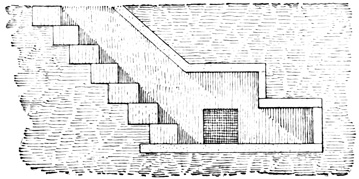
Section of Chila Tomb.
REMAINS AT CHILA.
At Chila, in the extreme southern part of Puebla, is a hill known as La Tortuga, on which is built an unterraced pyramid eighty-eight feet square at the base, fifty-five feet high, with a summit platform fifty feet square. It is built of hewn stone and covered, as it appears from Castañeda's drawing, with cement. The exterior surface is much broken up by the trees that have taken root there. A stairway leads up the western front. Near the north-eastern corner of the mound is an entrance leading down by seven stone steps to a small tomb about eleven feet below the surface of the ground and not under the mound. At the foot of the steps is an apartment measuring five and a half feet long and high, and four feet wide, with a branch, or gallery, four feet long and a little less than three feet wide and high, in the centre of each of the three sides, thus giving the whole tomb in its ground plan the form of a cross. Its vertical section is shown in the cut. There is certainly a general resemblance to be noted in this tomb-structure to those at Mitla; the interior is lined with hewn blocks laid in lime mortar and covered with a fine white plaster, the plaster on the ceiling being eight or nine inches thick. The discovery of human bones in the lateral galleries leaves no doubt respecting the use to which the subterranean structure was devoted.[IX-1]
At Tehuacan el Viejo, two leagues eastward of the modern town of Tehuacan, in the south-eastern part of the state, were found ruins of stone structures not particularly described.[IX-2] At San Cristóval Teopantepec, a little native settlement north-westward of the remains last mentioned, is another hill which bears a pyramid on its top. A road cut in the rocky sides leads up the hill, and on the summit, beside the pyramid, traces of smooth cement pavements and other undescribed remains were noticed. The pyramid itself from a base fifty feet square rises about sixty-seven feet in four receding stories with sides apparently sloping very slightly inward toward the top, the fourth story being moreover for the most part in ruins. The most remarkable feature of this structure is its stairway, which is different from any yet noticed, and similar to that of the grand teocalli of Mexico-Tenochtitlan as reported by the conquerors. It leads up diagonally from bottom to top of each story on the west, not, however, making it necessary to pass four times round the pyramid in order to reach the summit, as was the case in Mexico, since in this ruin the head of each flight corresponds with the foot of the one above, instead of being on the opposite side of the pyramid. The whole is built of stone and mortar, only the exterior facing being of regular blocks, and no covering of cement is indicated in Castañeda's drawing.[IX-3]
TEPEXE AND TEPEACA.
At Tepexe el Viejo, on the Zacatula River, some sixteen leagues south-east of the city of Puebla, Dupaix discovered, in 1808, a structure which he calls a fortification. It was located on a rocky height, surrounded by deep ravines, and the rough nature of the ground, together with the serpents that infest the rocks, prevented him from making exact measurements. There are traces of exterior enclosing walls, and within the enclosed area stands a pyramid of hewn stone and lime mortar, in eight receding stories. A fragment of a circular stone was also found at Tepexe, bearing sculptured figures in low relief, which indicate that the monument may have borne originally some resemblance to the Aztec calendar-stone, to be mentioned hereafter. Another round stone bore marks of having been used for sharpening weapons.[IX-4]
At Tepeaca and vicinity four relics were found:—1st. A bird's, perhaps an eagle's, head sculptured in low relief within a triple circle, together with other figures, on a slab about a foot square; apparently an aboriginal coat of arms. 2d. A stone head eighteen inches high, of a hard, reddish material; the features are very regular down to the mouth, below which all is deformed. 3d. A sculptured slab, built into a wall, shown only in Kingsborough's plate. 4th. A feathered serpent coiled into a ball-like form, six feet in diameter. It was carved from a red stone, and also painted red, resting on a cubical pedestal of a light-colored stone.[IX-5]
At San Antonio, near San Andres Chalchicomula, on the eastern boundary of the state, a pyramid stands on the summit of a rocky hill. The pyramid consists of three stories, with sides sloping at an angle of about forty-five degrees, is about twenty-five feet in height, and has a base fifty-five feet square. A stairway about ten feet wide, with solid balustrades, leads up the centre of the western front; and on the top, parts of the walls of a building still remained in 1805. This summit building was said to have been in a good state of preservation only twelve years before. The material is basalt, in blocks about two by five feet, according to Dupaix's plate, laid in mortar, and all but the lower story covered with cement.[IX-6]
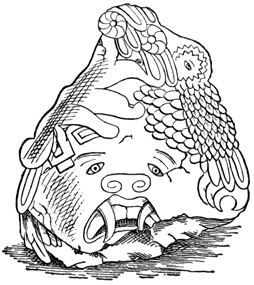
Stone Monster's Head.
At Quauhquelchula, near Atlixco, in the western part of the state, Dupaix noticed four relics of antiquity. 1st. A rattlesnake eight feet and a half long, and about eight inches in diameter, sculptured in high relief on the flat surface of a hard brown stone. 2d. A hard veined stone of various colors, four feet high and ten feet and a half in circumference, carved into a representation of a monster's head with protruding tusks, a front view of which is given in the cut. The rear is flat and bears a coat of arms, made up of four arrows or spears crossing a circle, with other inexplicable figures. 3d. Another coat of arms, three lances across a barred circle, carved in low relief on the face of a boulder. 4th. A human face, larger than the natural size, on the side of another boulder, and looking towards the town.[IX-7] At the town of Atlixco a very beautifully worked and polished almond-shaped agate was seen.[IX-8]
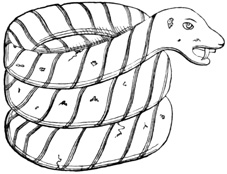
Serpent-Cup—Santa Catalina.
On the hacienda of Santa Catalina, westward from Atlixco, was found the coiled serpent shown in the cut. The material is a black porous volcanic stone, and the whole seems to form a cup, to which the head of the serpent served as a handle. Another relic from this locality was a masked human figure of the same stone.[IX-9]
PYRAMID OF CHOLULA.
About ten miles west of the city of Puebla de los Angeles, and in the eastern outskirts of the pueblo of Cholula, is the famous pyramid known throughout the world by the name of Cholula. The town at its base was in aboriginal times a large and flourishing city, and a great religious centre. The day of its glory was in the Toltec period, before the tenth century of our era, and tradition points for the building of the pyramid to a yet more remote epoch, when the Olmecs were the masters of the central plateaux. Several times during the religious contests that raged between the devotees of rival deities, the temple of Cholula was destroyed and rebuilt. Its final destruction dates from the coming of the Spaniards, who, under Hernan Cortés, after a fierce hand-to-hand conflict on the slopes of the pyramid, maddened by the desperate resistance of the natives, elated by victory, or incited by fanatical religious zeal and avarice, sacked and burned the magnificent structure on the top of the mound. Since the time of the Conquistador, after the fierce spirit of the Spaniards had expended its fury on this and other monuments reared in honor of heathen gods, the mound was allowed to remain in peace, save the construction of a winding road leading up to a modern chapel on the summit, where services are performed in which the great Quetzalcoatl has no share.[IX-10]
Since 1744, when the historian Clavigero rode up its side on horseback, this pyramid has been visited by hundreds of travelers, few tourists having left Anáhuac without having seen so famous a monument of antiquity, so easily accessible from the cities of Mexico and Puebla. Humboldt's description, made from a personal exploration in 1803, is perhaps the most complete that was ever published, and most succeeding visitors have deemed it best to quote his account as being better than any they could write from their own observations. Dupaix and Castañeda, and in later times Nebel, also examined and made drawings of Cholula. The four or five views of the mound that have been published differ greatly from each other, accordingly as the artist pictured the monument as he saw it or attempted to restore it more or less to its original form. Humboldt's drawing, which has been more extensively copied than any other, contrary to what might be expected from his text, was altogether a restoration, and bore not the slightest resemblance to the original as he saw it, since Clavigero found it in 1744, "so covered with earth and shrubs that it seems rather a natural hill than an edifice," and there is no reason to suppose that at a later date it assumed a more regular form.[IX-11]
For the past two centuries, at least, the condition and appearance of the mound has been that of a natural conical hill, rising from the level of a broad valley, and covering with its circular base an area of over forty acres.[IX-12] On closer examination, however, traces of artificial terraces are noted on the slopes, and excavations have proven that the whole mound, or at least a very large portion of it—for no excavation has ever been made reaching to its centre—is of artificial construction. By the careful surveys of Humboldt and others the original form and dimensions have been clearly made known. From a base about fourteen hundred and forty feet square, whose sides face the cardinal points, it rose in four equal stories to a height of nearly two hundred feet, having a summit platform of about two hundred feet square.[IX-13] Humboldt in 1803 found the four terraces tolerably distinct, especially on the western slope; Evans in 1870 found the lower terrace quite perfect, but the others traceable only in a few places without excavation.
The material of which the mound was constructed is adobes, or sun-dried bricks, generally about fifteen inches long, laid very regularly with alternate layers of clay. From its material comes the name Tlalchihualtepec, 'mountain of unburnt bricks,' which has been sometimes applied to Cholula. An old tradition relates that the adobes were manufactured at Tlalmanalco, and brought several leagues to their destination by a long line of men, who handed them along singly from one to another. Humboldt thought some of the bricks might have been slightly burned. Respecting the material which constitutes the alternate layers between the bricks, called clay by Humboldt, there seems to be some difference of opinion between different explorers. Col. Brantz Mayer, a careful investigator, says the adobes are interspersed with small fragments of porphyry and limestone; and Mr Tylor speaks of them as cemented with mortar containing small stones and pottery. Evans tells us that the material is adobe bricks and layers of lava, still perfect in many places. The historian Veytia by a personal examination ascertained the material to be "small stones of the kind called guijarros, and a kind of bricks of clay and straw," in alternate layers.[IX-14] Beaufoy claims to have found the pyramid faced with small thin hewn stones, one of which he carried away as a relic—a very wonderful discovery certainly, when we consider that other very trustworthy explorers, both preceding and following Beaufoy, found nothing of the kind. Mr Heller could not find the stone facing, but, as he says, he did find a coating of mortar as hard as stone, composed of lime, sand, and water.[IX-15] Many visitors have believed that the pyramid is only partially artificial, the adobe-work having been added to a smaller natural hill. This is, however, a mere conjecture, and there are absolutely no arguments to be adduced for or against it. The truth can be ascertained only by the excavation of a tunnel through the mound at its base, or, at least, penetrating to the centre. It is very remarkable that such an excavation has never been made, either in the interests of scientific exploration or of treasure-seeking.
Bernal Diaz, at the time of the Conquest, counted a hundred and twenty steps in a stairway which led up the slope to the temple, but no traces of such a stairway have been visible in more modern times. There are traditions among the natives, as is usually the case in connection with every work of the antiguos, of interior galleries and apartments of great extent within the mound; such rumors are doubtless without foundation. The Puebla road cuts off a corner of the lower terrace, and the excavation made in building the road not only showed clearly the regular interior construction of the pyramid, but also laid bare a tomb, which contained two skeletons with two idols in basalt, a collection of pottery, and other relics not preserved or particularly described, although the remains of the tomb itself were examined by Humboldt. The sepulchre was square, with stone walls supported by cypress beams. The dimensions are not given, but the apartment is said to have had no traces of any outlet. Humboldt claims to have discovered a peculiar arrangement of the adobes about this tomb, by which the pressure on its roof was diminished.
It is very evident that the pyramid of Cholula contains nothing in itself to indicate its age, but from well-defined and doubtless reliable traditions, we may feel very sure that its erection dates back to an epoch preceding the tenth century, and probably preceding the seventh. Humboldt shows that it is larger at the base than any of the old-world pyramids, over twice as large as that of Cheops, but only slightly higher than that of Mycerinus. "The construction of the teocalli recalls the oldest monuments to which the history of the civilization of our race reaches. The temple of Jupiter Bélus, which the mythology of the Hindus seems to designate by the name of Bali, the pyramids of Meïdoùm and Dahchoùr, and several of the group of Sakharah in Egypt, were also immense heaps of bricks, the remains of which have been preserved during a period of thirty centuries down to our day."[IX-16]
The historical annals of aboriginal times, confirmed by the Spanish records of the Conquest, leave no doubt that the chief object of the pyramid was to support a temple; the discovery of the tomb with human remains may indicate that it served also for burial purposes. It is by no means certain, however, that the mound was in any sense a monument reared over the two bodies whose skeletons were found; for besides the position of the skeletons in a corner of the pyramid, indicating in itself the contrary, there is the possibility that the bodies were those of slaves sacrificed during the process of building, and deposited here from some superstitious motive. It will require the discovery of tombs near the centre of this immense mound to prove that it was erected with any view to use as the burial place of kings or priests.[IX-17] Wilson, always a sceptic on matters connected with Mexican aboriginal civilization, pronounces the pyramid of Cholula "the finest Indian mound on this continent; where the Indians buried the bravest of their braves, with bows and arrows, and a drinking cup, that they might not be unprovided for when they should arrive at the hunting-grounds of the great spirit." "It is sufficiently wasted by time to give full scope to the imagination to fill out or restore it to almost any form. One hundred years ago, some rich citizen constructed steps up its side, and protected the sides of his steps from falling earth by walls of adobe, or mud-brick; and on the west side some adobe buttresses have been placed to keep the loose earth out of the village street. This is all of mans labor that is visible, except the work of the Indians in shaving away the hill which constitutes this pyramid. As for the great city of Cholula, it never had an existence."[IX-18] At a short distance from the foot of the large pyramid, two smaller ones are mentioned by several visitors; one of which is doubtless a portion of the chief mound separated by the road that has been already mentioned. One of them is described by Beaufoy as having perpendicular sides, and built of adobes nine inches square and one inch thick; the second was much smaller and had a corn-patch on its summit. Cuts of the two small mounds are given by the same explorer. Bullock claims to have found on the top of one of the detached masses a ditch and wall forming a kind of figure-eight-formed enclosure one hundred feet long, in which were many human bones. Evans has a theory that the small mounds were formed of the material taken from the larger one in shaping its terraces. Latrobe says that many ruined mounds may be seen from the summit; in fact, that the whole surface of the surrounding plain is broken by both natural and artificial elevations. Ampère was led by his native guide, through a misunderstanding, to a flat-topped terraced hill, still bearing traces of a pavement, at a locality called Zapotecas.[IX-19]
The only miscellaneous Cholulan relics of which I find a mention, are three described by Dupaix and sketched by Castañeda. They were, a stone head, said to have originally been the top of a column; a quadrangular block, with incised hieroglyphics on one of its faces; and a mask of green jasper, reported to have been dug from the pyramid.[IX-20]
REMAINS AT NATIVIDAD.
On the summit of the Sierra de Malinche, which forms the boundary between Puebla and Tlascala, the existence of ruined walls and pyramids, with fragments of stone images, is mentioned without description.[IX-21] At San Pablo del Monte two kneeling naked females in stone, modestly covering the breasts with the hands, were sketched by Castañeda.[IX-22] Of an important group of remains in the vicinity of Natividad, between Puebla de los Angeles and Tlascala, a very unintelligible account has been written by Cabrera, for the Mexican Geographical Society. The ruins seem to cover a hill, different localities on the slopes of which are called Mixco, Xochitecatl, Tenexotzin, Hueyxotzin, and Cacaxtlan. The western slope has gigantic terraces, and among other relics five vertical stones called huitzocteme, supposed to have been used for sacrificial purposes. They are two varas high and three fourths of a vara wide. On the northern slope a concavity of stone and mud is mentioned, whose bottom is strewn with pottery and obsidian weapons. At Cacaxtlan, the site of the principal fortress in the wars between Tlascala and Mexico, are ditches and subterranean passages running in all directions. The chief ditch extends from north to south across the hill; it is about twenty-eight feet wide and eleven or twelve feet deep, with embankments formed of the earth thrown out. The subterranean passages are believed to penetrate the heights of Cacaxtlan. One has an opening among the rocks on the north, beginning at the cave of Ostotl; another begins on the east at San Miguel del Milagro, having for an entrance a square hole five or six yards deep, from the bottom of which it extends horizontally in a semicircular course; the third opening is on the south, and its top is supported by columns left in the volcanic stone; and finally, the fourth subterranean passage sends out vapor when it is about to rain. This is all I can glean from Cabrera's account—in fact, rather more than I can fully understand.[IX-23] Dupaix found at Natividad two wooden teponastles, or aboriginal musical instruments, similar to the one found at Tlascala by the same explorer and shown in the accompanying cut. The former were, however, less elaborately carved; the latter was three feet long and five inches in diameter, the cut showing a side and end view. Other relics found by Dupaix in the city of Tlascala and vicinity, are the following:—a lance-head, nine inches long, of green flint; a small stone statue, nine or ten inches in height, representing a seated female, whose head bears a strong resemblance to some of the Palenque profiles; a mask of green agate a little smaller than the natural size of the face, pronounced by Dupaix the finest specimen of sculpture seen in America; an earthen vase called popocaxtli, used in ceremonies in honor of the dead, found in connection with some human bones; two mutilated human heads carved from a gray stone; and a masked, bow-legged idol of stone, twenty-four inches high, standing on a small pedestal, covering the breasts with the hands.[IX-24]
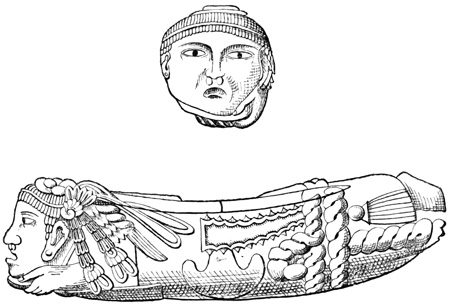
Teponastle from Tlascala.
ABORIGINAL BRIDGES.
At Pueblo de los Reyes, northward from Tlascala, on the road to San Francisco, two aboriginal bridges over a mountain stream were sketched by Castañeda. One is eleven feet high and thirty-seven feet wide; the other fifty-five feet high and thirty-three feet wide; each being over a hundred feet in length. They are built of large irregular stones in mortar. The conduits through which the stream passes are from four to six feet wide and high, one of them having a flat top, while in the other two large blocks meet and form an obtuse angle. On the top of the bridges at the sides are parapets of brick four or five feet high, pierced at intervals to allow water to run from the road; and at each of the four corners stands a circular, symmetrical, ornamental obelisk, or pillar, over forty feet high, of stone and mortar, covered with burned bricks. It is quite probable that the brick-work of these bridges, if not the whole structure, is to be referred to Spanish rather than to aboriginal times. Sr Almaraz sketched at Xicotepec, in the north, some fifty miles west of Papantla, a teponastle of iron-wood, gracefully carved and brilliantly polished.[IX-25]
The famous wall that was found by Cortés, extending along the frontier of Tlascala, has been spoken of in another part of this work. Brasseur de Bourbourg tells us that many remains of this wall are still visible, and some other authors vaguely speak to the same effect; but as no modern traveler describes or locates these remains, I think it altogether likely that the statements referred to may be simply echoes of those made by the early writers, who represented the ruins of the wall as visible in the years immediately following the Conquest.[IX-26]
RELICS AT CUERNAVACA.
Passing westward into the state of Mexico, and beginning again in the south, I find a notice in a Mexican government report, of ruins at Tejupilco, in the south-west, about sixty miles westward of Cuernavaca. The remains are noticed especially on the hill of Nanchititla, consisting of buildings standing on regular streets yet traceable, and built of very thin blocks, or slates, of stone without mortar. In the valley of San Martin Luvianos, in the same region, a subterranean apartment with polished sides of cement, discovered in 1841, contained quantities of carbonized maize.[IX-27] At Zacualpan, midway between Cuernavaca and Tejupilco, and some leagues further south, flint spear-heads, stone masks, and other relics not specified are said by the same authority to have been found in a cave.[IX-28] A peculiarity of the aboriginal relics found by Dupaix at Cuernavaca and vicinity was that all consisted of sculptured figures on the surface of large naturally shaped boulders. The first was an immense lizard over eight feet long and a foot and a half thick, carved in high relief on the top of a rough block. Four small circular projections are seen on the side of the rock below the animal. On the southern face of another isolated boulder was sculptured in low relief the coat of arms shown in the cut, which, in its principal features of a circle on parallel arrows or lances, is very similar to others that have been mentioned.[IX-29] On the flag that projects from the upper part of the circle, a Maltese cross is seen, and the bird's head above is pronounced of course by Dupaix to be that of an eagle.[IX-30] On the opposite, or northern, side of the same boulder are sculptured the figures shown in the cut. The left hand figure, thirteen inches high, may in connection with the small circles be a record of a date—thirteen calli. M. Lenoir, however, on account of the column shown within the building, believes the whole may be an emblem of phallic worship, the column being a phallus and the building its shrine or temple. The sculpture on both sides of this rock is described as having been executed with great care and clearness. Somewhat less than a league south of the city is another isolated rock, said to have served as a boundary mark to the ancient Quauhnahuac, 'place of the eagle,' of which the modern name Cuernavaca is a corruption. On the face of this rock is carved in rather high relief the figure represented in the cut, which, in consideration of the aboriginal meaning of the name, and the purpose served by the stone, may be regarded as an eagle. The material is a fine gray stone, the bird is thirty-five inches high, and the boulder, or its locality, is called by the natives Quauhtetl, 'stone eagle.'[IX-31]
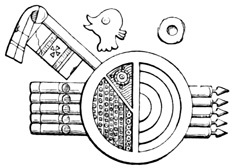
Coat of Arms—Cuernavaca.
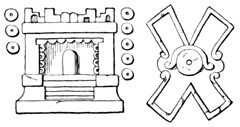
Boulder-Sculptures at Cuernavaca.
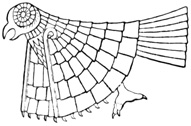
Eagle of Cuernavaca.
RUINS OF XOCHICALCO.
The ruins of Xochicalco, doubtless the finest in Mexico, are about fifteen miles 13° west of south from Cuernavaca, and about seventy-five miles south-west from the city of Mexico. The first published description was written by Alzate y Ramirez, who visited the locality in 1777, and published his account with illustrative plates as a supplement to his Literary Gazette in November, 1791.[IX-32] Humboldt made up his account from that of Alzate; Dupaix and Castañeda included Xochicalco in their first exploration; Nebel visited and sketched the ruins in 1831; and finally an account, perhaps the most complete extant, written from an exploration in 1835 by order of the Mexican government, was published in the Revista Mexicana.[IX-33]
RUINS OF XOCHICALCO.
Xochicalco, the 'hill of flowers,'[IX-34] is a natural elevation of conical form, with an oval base over two miles in circumference, rising from the plain to a height of nearly four hundred feet.[IX-35] Mr Latrobe claims to have found traces of paved roads, of large stones tightly wedged together, one of them eight feet wide, leading in straight lines towards the hill from different directions. The account in the Revista mentions only one such causeway running towards the east. A ditch, more or less filled up and overgrown with shrubbery, is said to extend entirely round the base of the hill, but its depth and width are not stated; perhaps in the absence of more complete information its existence should be considered doubtful.
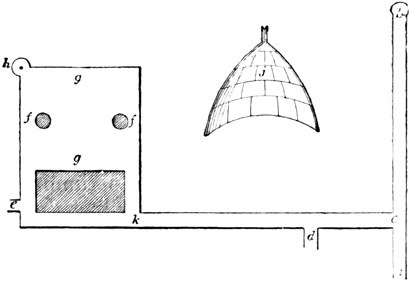
Subterranean Galleries—Xochicalco.
Very near the foot of the northern slope are the entrances to two tunnels or galleries, one of which terminates at a distance of eighty-two feet; at least, it was obstructed and could not be explored beyond that point. The second gallery, cut in the solid limestone of the hill, about nine feet and a half wide and high, has several branches running in different directions, some of them terminated by fallen débris, others apparently walled up intentionally. The floors are paved to the thickness of a foot and a half with brick-shaped blocks of stone, the walls are also in many places supported by masonry, and both pavement, walls, and ceiling are covered with lime cement, which retains its polish and shows traces in some parts of having had originally a coating of red ochre. The principal gallery, after turning once at a right angle, terminates at a distance of several hundred feet in a large apartment about eighty feet long, in which two circular pillars are left in the living rock to support the roof. The accompanying cut is Castañeda's ground plan of the galleries and subterranean apartment, a being the entrance on the north; b the termination of main gallery; c, k, the branch gallery; e and d, obstructed passages; g, g, the room and f, f, the pillars. The scale of the plan is about fifty feet to the inch, but the dimensions, according to the scale, are doubtless inaccurate. According to the plan the galleries are only a little over four feet wide; and the apartment thirty-three by thirty-nine feet. Alzate's plan agrees with it so far as it goes; the Revista gives no plan, and its description differs in some respects, so far as the arrangement of the galleries is concerned, from the cut.[IX-36] In the top of the room at the south-east corner, at h, is a dome-like structure, a vertical section of which is shown at j of the preceding cut, six feet in diameter and six feet high, lined with stone hewn in curved blocks, with a round hole about ten inches in diameter extending vertically upward from the top. It has been generally believed that this passage leads up to the pyramid on the top of the hill, to be described later; but it will be seen that if the hill be two miles in circumference, or even half that size, the galleries are not nearly long enough to reach the centre under the pyramid. Nebel fancied that the hole in the cupola was so situated that the rays of the sun twice a year would penetrate from above and strike an altar in the subterranean hall. The natives report other passages in the hill besides the one described, and believe that one of them leads to Chapultepec, near the city of Mexico.
THE HILL OF FLOWERS.
Passing now from the interior to the outer surface of the 'hill of flowers,' we find it covered from top to bottom with masonry. Five terraces, paved with stone and mortar, and supported by perpendicular walls of the same material, extend in oval form entirely round the whole circumference of the hill, one above the other. Neither the width of the paved platforms nor the height of the supporting walls has been given by any explorer, but each terrace, with the corresponding intermediate slope, constitutes something over seventy feet of the height of the hill. The terrace platforms have sometimes been described, without any authority, as a paved way leading round and round the hill in a spiral course to the summit. Dupaix speaks of a road about eight feet wide, which leads to the summit, but no other explorer mentions any traces of the original means of ascent. Each terrace wall, while forming in general terms an ellipse, does not present a regular line, but is broken into various angles like the bastions of a fortification. The pavements all slope slightly towards the south-west, thus permitting the water to run off readily. According to the plans of Alzate and Castañeda there are two additional terraces where a spur projects from the hill at the north-eastern base. Latrobe is the only authority on the intermediate slopes between the terraces, which he says are occupied with platforms, bastions, and stages one above another. It is evident from all accounts that the whole surface of the hill, very likely shaped to some extent artificially, was covered with stone work, and that defense was one object aimed at by the builders. The Revista represents the terrace platforms as additionally fortified by the perpendicular supporting walls projecting upward above their level, forming what may perhaps be termed a kind of parapet.
On the summit is a level platform measuring two hundred and eighty-five by three hundred and twenty-eight feet.[IX-37] According to Alzate, Humboldt, Dupaix, and other early authorities—except Nebel, who is silent on the subject—this plaza is surrounded by a wall. Dupaix says the wall is built of stones without mortar, is five feet and a half high, and two feet and nine inches thick. Alzate represents the wall as perpendicular only on the inner side, being in fact a projection of the upper terrace slope, forming a kind of parapet, and making the plaza a sunken area. Latrobe also speaks of the plaza as a hollow square, and Alzate's representation is probably a correct one; for the author of the account in the Revista says that the wall described by previous visitors could not be found; and moreover, that there was no room for it on the north between the central pyramid and "one of the solid stone masses, or caballeros, that surround the platform," the caballeros, which may perhaps in this connection be translated 'parapets,' being doubtless the same structures that the others describe as a wall.
PYRAMID OF XOCHICALCO.
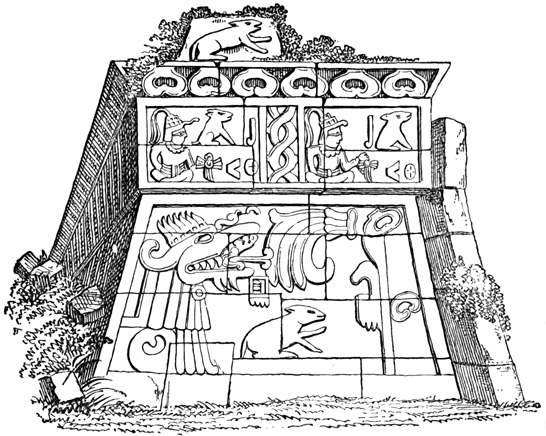
In this plaza, cultivated in later years as a cornfield, there are several mounds and heaps of stones not particularly described; and near the centre is a pyramid, or rather the lower story of one, with rectangular base, the sides of which, exactly or very nearly facing the cardinal points, measure sixty-five feet from east to west, and fifty-eight feet from north to south. The lower story, which in some parts is still standing to its full height, is divided into what may be termed plinth, frieze, and cornice, and is about sixteen feet high.[IX-38]
Pyramid of Xochicalco.
In the centre of one of the façades is an open space, something over twenty feet wide, bounded by solid balustrades, and probably occupied originally by a stairway, although it is said that no traces of steps have been found among the débris. The cut, from Nebel, shows the front of the pyramid on one side of the opening, being the eastern portion of the northern front, according to Nebel, who locates the stairway on the north, or the northern part of the western front, according to the Revista, which speaks of the opening as being on the west.
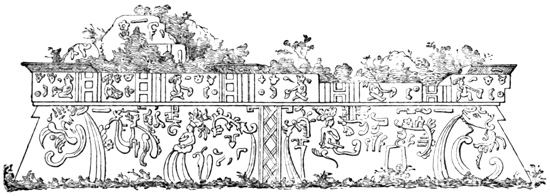
The pyramid, or at least its facing, is built of large blocks of granite or porphyry,[IX-39] a kind of stone not found within a distance of many leagues. The blocks are of different sizes, the largest being about eleven feet long and three feet high, and few being less than five feet in length. They are laid without mortar, and so nicely is the work done that the joints are scarcely perceptible. The cut shows one of the façades, probably the northern, from Castañeda's drawing, which corresponds almost exactly to that given by Alzate. So far as the details of the sculpture are concerned it is probably not very trustworthy. The preceding cut, from Nebel, is perhaps the only reliable drawing in this respect that has been published. The whole exterior surface seems to have been covered with sculptured figures in low relief, apparently executed after the stones were put in place, since one figure extends, with the greatest exactitude at the joints, over several blocks of stone.[IX-40]
Pyramid of Xochicalco.
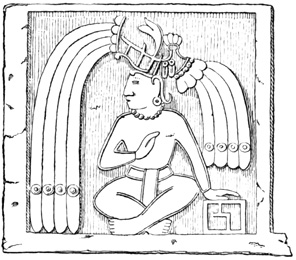
I translate from the Revista the following remarks about the sculptured figures: "At each angle, and on each side, is seen a colossal dragon's head, from whose great mouth, armed with enormous teeth, projects a forked tongue; but in some the tongue is horizontal, while in others it falls vertically; in the first it points towards a sign which is believed to be that of water, and in the others towards different signs or emblems.... Some have pretended to see in these dragons images of crocodiles; but nothing certain can be known of these fantastic figures which have no model in nature.... On the two sides still standing there are two figures of men larger than the natural size, seated cross-legged in the eastern fashion, wearing necklaces of enormous pearls, rich ornaments, and a head-dress out of all proportion, with long flowing plumes. In one hand they hold a kind of sceptre, and the other is placed on the breast; a hieroglyphic of great size, placed in the middle of each side, separates the two figures, whose heads are turned, on the east side, one north and the other south, while on the north side both face the west. The frieze which surrounds this story presents a series of small human figures, also seated in the eastern manner, with the right hand crossed on the breast, and the left resting on a curved sword, whose hilt reminds us of ancient swords; a thing the more worthy of attention since no people descended from the Toltecs or Aztecs has made use of this kind of arms. The head-dress of these small figures, which closely resemble those mentioned before, is always disproportionately large, and this circumstance, which is found in all the Egyptian mythologic fables, is considered in the latter an emblem of power or divinity. With the human figures are seen various signs, some of which seem allegorical and others chronologic, so far as may be judged from their conformity with those employed in the Aztec paintings.... Another sign, apparently of a different nature, is often repeated among the figures; it is a dragon's mouth, open and armed with teeth, as in the large reliefs, from which projects instead of a tongue a disk divided by a cross.... It has also been thought (Alzate) that dances are represented on the frieze of Xochicalco, but its perfect preservation makes such an error inexcusable, and figures seated with legs crossed and hands on a sword, exclude any idea of sacred or warlike dances, and suggest only mythologic or historical scenes. Over the frieze was a cornice adorned with very delicate designs in the form of oalmetas or meandres in the Greek style." The cut shows one of the bas-reliefs on a larger scale than in the preceding illustrations. There is, as Nebel observes, a certain likeness between these sculptured designs and the stucco reliefs of Palenque, although in the architectural features of the monument, and of the base on which it rests, there seems to be no analogy whatever with any of the southern ruins.
Bas-Relief from Xochicalco.
On the summit of this lower structure a few sculptured foundation stones of a second story were found yet in place, the walls being two feet and three inches from the edge of the lower, except on the west, where the space is four feet and a half. According to the report of the inhabitants of the vicinity, the structure had originally five receding stories, similar to the first in outward appearance, which were all standing as late as 1755, making the whole edifice probably about sixty-five feet high. It is said to have terminated in a platform, on the eastern side of which stood a large block, forming a kind of throne, covered with hieroglyphic sculpture. The proprietors of neighboring sugar-works were the authors of the monument's destruction, the stone being of a nature suitable for their furnaces, and none other being obtainable except at a great distance. Alzate puts on record the name of one Estrada as the inaugurator of this disgraceful work of devastation.[IX-41] Several restorations of the pyramid of Xochicalco have been attempted on paper, that by the artist Nebel being probably the only one that bears any likeness to the original; and even his sketch, so far as the sculptured designs are concerned, must be regarded as extremely conjectural, having as a foundation only a few scattered blocks and the reports of the 'oldest inhabitant.' At the Paris international exhibition in 1867 a structure was built and exhibited in the Champs de Mars, purporting to be a fac-simile of this monument; but judging from a cut published in a London paper, it might with equal propriety have been exhibited as a model of any other ruin in the new or old world.[IX-42]
The second story seems to have had interior apartments, with three doorways at the head of the grand stairway. On the summit of the lower story, according to the Revista, is a pit, perhaps a covered apartment originally, measuring twenty-two feet square, and nearly filled with fragments of stone, some of them sculptured, which were not removed. It is of course possible that there exists some means of communication between this apartment and the subterranean galleries of the hill below.
East of the hill of Xochicalco, on the road to Miacatlan, an immense stone was said to have been found serving as a kind of cover to a hole, perhaps the entrance to a subterranean gallery, on the face of which was sculptured an eagle tearing a prostrate native Prometheus. It was broken up and most of the pieces carried away, but Alzate saw one fragment containing a part of the sculptured thigh, from which perhaps with the aid of his imagination and his knowledge of Grecian mythology the good padre prepared a drawing of the whole, which he published. Later visitors have not even seen a fragment of so wonderful a relic. Mr Tylor speaks of a small paved oval space somewhere in connection with the ruin, in which he found fragments of a clay idol. There are no springs of water on or near the hill.
The Revista says, "adjoining this hill is another higher one, also covered with terraces of stone-work in form of steps. A causeway of large marble flags led to the top, where there are still some excavations and among them a mound of large size. Nothing further in the way of monuments is to be seen on the lower (part of the?) hill except a granite block, which may be the great square stone mentioned by Alzate, which served to close the entrance to a subterranean gallery, situated east of the principal monument." There are also some traces of one terrace indicated on Castañeda's view of the larger hill. On the sculptured façades of the pyramid, all have found traces of color in sheltered places, and have concluded that the whole surface was originally painted red, except the author of the account in the Revista, who thinks that the groundwork of the reliefs only was covered with a colored varnish, as was the usage in Egypt. Löwenstern claims to have found in the vicinity of Xochicalco the foundation of many aboriginal dwellings.
A slight resemblance has been noted in some of the sculptured human figures, seated cross-legged, to the Maya sculptures and stucco reliefs of Central America; a few figures, like that of the rabbit, may present some analogies to Aztec sculptures, many specimens of which will be shown in the present chapter; the very fact of its being a pyramid in several stories, gives to Xochicalco a general likeness to all the more important American ruins; the terraces on the hill-slopes have their counterparts at Quiotepec and elsewhere; the absence of mortar between the façade-stones is a feature also of Mitla; still as a whole the monument of Xochicalco stands alone; both in architecture and sculpture it presents strong contrasts with Copan, Uxmal, Palenque, Mitla, Cholula, Teotihuacan, or the many pyramids of Vera Cruz. There is no definite tradition referring the origin of this monument to any particular pre-Aztec period, save the universal modern tradition among the natives referring everything wonderful to the Toltecs. It is not, moreover, improbable that the pyramid was built by a Nahua people during the Aztec period; for it must be remembered first that all the grand temples in Anáhuac—the Aztec territory proper—have disappeared since the Conquest, so that a comparison of such buildings with that of Xochicalco is impossible; and second, that the Aztecs were superior to the nations immediately surrounding them in war rather than art, so that it would be by no means surprising to find a grander temple in Cuernavaca than in the valley of Mexico. The Aztec sculpture on such monuments as have been found in the city of Mexico if different from, is not inferior to that at Xochicalco, and there is no reason whatever to doubt the ability of the Aztecs to build such a pyramid. Still there remains of course the possibility of a pre-Aztec antiquity for the building on the hill of flowers, and of Maya influence exerted upon its builders.[IX-43]
REMAINS IN THE SOUTH-EAST.
Sculptured stone—Casasano.
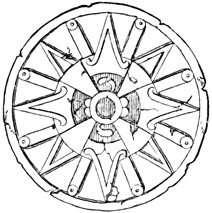
In the south-eastern part of the state from Yahualica northward to Mecamecan, relics have been discovered, mostly by Dupaix, in several localities. At Yahualica, near Huautla, there are tombs, with stone images, human remains, pottery, and metates, also some metallic relics not described.[IX-44] At Xonacatepec was seen a mask of about the natural size, carved very neatly from a whitish translucent stone.[IX-45] At the sugar plantation of Casasano, in the same region, a somewhat remarkable relic was a stone chest, of rectangular base, larger at the bottom than at the top, with a cover fitting like that of a modern chest. It was cut from a grayish stone, and when found by laborers engaged in digging a ditch, is said to have been filled with stone ornaments. At the same place was seen a circular stone, three feet in diameter and nine inches thick, sculptured in geometric figures on one side, as shown in the preceding cut.[IX-46]
Another similar stone of the same thickness, and about three feet and a half in diameter, was built into a modern wall at Ozumba. These geometrically carved circular blocks are of not infrequent occurrence on the Mexican plateaux; of their use nothing is known, but they seem to bear a vague resemblance to the Aztec calendar and sacrificial stones to be described later. Another class of circular blocks, from two to three feet in diameter, with curves and various ornamental figures sculptured on one face, are also of frequent occurrence. Several of this class will be mentioned and illustrated in connection with the relics of Xochimilco. Two of them were seen by Dupaix at Chimalhuacan Tlachialco, near Ozumba, together with two small idols of stone. At Ahuehuepa, in the same region, was a statue which had lost the head and the legs below the knees; a hieroglyphic device is seen on the breast, and a small cord passes round the waist, and is tied in a bow-knot in front. Two fragments of head-dresses carved in red stone were found at the same place. A few miles east of the village of Mecamecan is an isolated rock of gray granite, artificially formed into pyramidal shape as shown in the cut. It is about twelve feet high and fifty-five feet in circumference, having rudely cut steps, which lead up the eastern slope. Dupaix conjectures that this monument was intended for some astronomic use, and that the man sculptured on the side is engaged in making astronomical observations, the results of which are expressed by the other figures on the rock. The only possible foundation for the opinion is the resemblance of some of the signs to those by which the Aztecs expressed dates.[IX-47]
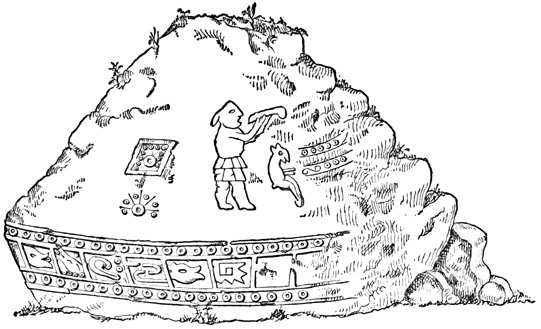
Pyramidal stone—Mecamecan.
REMAINS IN ANÁHUAC.
REMAINS AN XOCHIMILCO.
Entering now the valley of Mexico, we find many localities on the banks, and islands of Lake Chalco where relics of the ancient inhabitants have been brought to light. At Xochimilco on the western shore of the lake, Dupaix mentions the following:—1st. A stone block with regular sides, on one of which about three feet square are sculptured two concentric circles, as large as the space permits, with smaller circles outside of the larger, at each corner of the block. 2d. A crouching monster of stone thirty inches high, which apparently served originally for a fountain or aqueduct, the water flowing through the mouth. 3d. A semi-spherical pedestal of limestone, broken in two pieces, three feet high, and decorated on the curved surface with oval figures radiating from the centre. 4th. A lizard thirty inches long, sculptured on a block which is built into a modern wall. 5th. A coat of arms, also on a block in a wall, consisting of a circle on parallel lances like some already described. Within the circle is a very perfect Maltese cross, hanging from the lower part is a fan-like plume, and elsewhere on the smooth faces of the stone are nine very peculiar knots or tassels. 6th. A kind of flat-fish three feet eight inches long, carved from a bluish gray stone. 7th. A coiled serpent in red porphyry, a foot and a half in diameter, and nine feet long if uncoiled. This relic is shown in the cut. 8th. Two death's heads in stone. 9th. A rabbit in low relief on a fragment of stone. 10th. An animal in red stone on a cubic pedestal of the same material. 11th. A stone image of a seated female. 12th. An idol with a man's head and woman's breasts. 13th. Ten sculptured blocks, the faces of which are shown in the following cut, and which would seem to have served only for decorative purposes. Most of them have rough backs, evidently having been taken from ancient walls; and many of these and other similar blocks found in this region had tenons like that shown in fig. 9 of the cut. Fig. 7 shows one of the several death's heads found at Xochimilco.
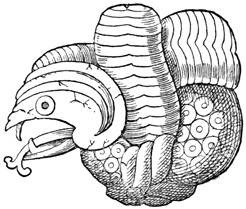
Coiled Serpent—Xochimilco.
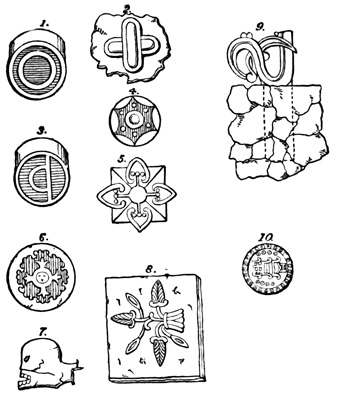
Sculptured Stones—Xochimilco.
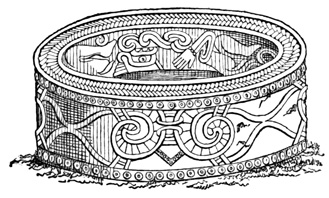
Sculptured Vase—Tlahuac.
At Tlahuac, or Cuitlahuac, were seen two circular stones something over three feet in diameter and half as thick, of black porous volcanic material. Each had a circular hole in the centre, rude incised figures on the faces, and a tenon at one point of the circumference. They strongly remind me of the rings in the walls of the so-called gymnasium at Chichen in Yucatan. Another relic was a cylindrical stone of a hard gray material, of the same dimensions as the preceding, but without a supporting tenon. The circular faces were plain, but the sides, or rim, were decorated with circles, bands, and points symmetrically arranged and sculptured in low relief. And finally there was found at Tlahuac the very beautiful vase of hard iron-gray stone shown in the cut. It is eight feet four inches in circumference on the outside, one foot nine inches in diameter on the inside, and elaborately sculptured in low relief on both the exterior and interior surface. In Kingsborough's edition of Dupaix's work it is stated that the two causeways which led to the town across the waters of Lake Chalco are still in good preservation, five or six yards wide and of varying height, according to the depth of the water. In the report of the Ministro de Fomento in 1854 there is also a mention of a dike built to keep the waters of the lake from Mexico. Another dike, serving also as a causeway at Tulyahualco is mentioned in the same report.
At Xico, on an island in Lake Chalco, there are some traces of an aboriginal city, in the shape of foundation walls of masonry, stone terraces, and what is very important if authentic, well-burned bricks of different forms and dimensions. In the Mexican government report referred to, the foundations of a palace are alluded to.
At Misquique, on another of the lake islands Dupaix found the following objects left by the antiguos:—1st. A sculptured monster's head, with a tenon for insertion in a wall. 2d. A large granite vase, circular in form, four feet and a half in diameter, three feet and a half high, sculptured on the upper rim, painted on the inside, and polished on the outer surface. It rests on a cylindrical base, smaller than the vase itself, and is used in modern times as a baptismal font. 3d. A mill-stone shaped block, with a tenon, very similar to those found at Tlahuac, except that the sculptures on the face are evidently in low relief in this case. 4th. An animal called by Dupaix a coyote, sculptured on the face of a block. 5th. A cylindrical stone twenty-one inches in diameter and twenty-eight in height, round the circumference of which is sculptured, or apparently merely incised, a serpent. 6th. A square block with concentric circles and other figures, similar to those at Xochimilco. 7th. Another block with a spiral figure. 8th. A very finely formed head of gray veined stone, furnished with a tenon at the back of the neck. 9th. Three small and rudely formed images, one of green jasper and two of a red stone.
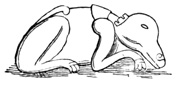
Animal in Stone—Tlalmanalco.
TLALMANALCO AND CULHUACAN.
At Tlalmanalco were four small idols in human form, three of which were built into a modern wall; two heads, one of which is of chalchiuite; three of the ornamental blocks, one bearing clearly defined cross-bones; and the nondescript animal in gray stone shown in the cut. Also at Tlalmanalco, in the official report already several times cited, mention is made of three fallen pyramids, one of which was penetrated by a gallery, supposed to have been intended for burial purposes.
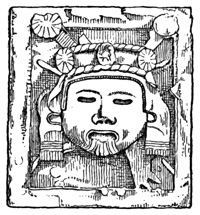
Terra-Cotta Idol—Culhuacan.
Culhuacan, on the north-eastern bank of the same lake, is a small village which retains the name of the city which once occupied the site, famous in the annals of Toltec times. Veytia tells us that in his time some vestiges of the ancient capital were still visible; and Gondra describes a clay idol found at Culhuacan, and shown in the cut, as an image of Quetzalcoatl, giving, however, no very clear reasons for his belief. This relic is fourteen inches high, thirteen inches wide, and is preserved in the Mexican Museum.[IX-48]
The relics discovered in Anáhuac at points westward from the lakes, I shall describe without specifying in my text the exact locality of each place referred to. At Chapultepec there is a tradition that statues representing Montezuma and Axayacatl were carved in the living rock of the cliff; and these rock portraits are said to have remained many years after the Conquest, having been seen by the distinguished Mexican scientist Leon y Gama. Brasseur de Bourbourg even claims to have seen traces of them, but this may perhaps be doubted. One was destroyed at the beginning of the eighteenth century by order of the over-religious authorities; but the other remained in perfect preservation until the year 1753, when it also fell a victim to anti-pagan barbarism. The immense cypresses or ahuehuetes that still stand at the foot of Chapultepec, 'hill of the grasshopper,' are said to have been large and flourishing trees before the coming of the Spaniards.[IX-49]
HILL OF OTONCAPOLCO.
A few miles from the celebrated church of Nuestra Señora de los Remedios, is a terraced stone-faced hill, similar perhaps in its original condition to Xochicalco, except that the terraces are more numerous and only three or four feet high. Although, only a short distance from the capital in an easily accessible locality, only two writers have mentioned its existence—Alzate y Ramirez in 1792 and Löwenstern in 1838. The former calls the hill Otoncapolco, and his article in the Gaceta de Literatura is mainly devoted to proving that this was the point where Cortés fortified himself after the 'noche triste,' instead of the hill on which the church of Remedios stands, as others in Alzate's time believed. The author, who visited the place with an artist, says, "I saw ruins, and hewn stones of great magnitude, all of which proves to the eye that this was a fortification, or as the historians say, a temple, because they thought that everything made by the Indians had some connection with idolatry; it is sure that in the place where the celebrated sanctuary stands, there is not found the slightest vestige of fortress or temple, while on the contrary, all this is observed at Otoncapolco." This with the remark that this monument, although not comparable to Xochicalco, yet merits examination, is all the information Padre Alzate gives us; and Löwenstern adds but little to our knowledge of the monument. He found débris of sculptured stone, obsidian, vases, and pottery; also the ruins of a castle two-thirds up the slope, in connection with which was found a flat stone over six feet long, bearing a sculptured five-branched cross—a kind of coat of arms. The hill is from two hundred and sixty to three hundred and twenty-five feet high, has a square summit platform, and the whole surface of its slopes was covered with stone-work, now much displaced, in the shape of steps, or terraces, between three and four feet high. At one point the explorer found, as he believed, the entrance to a subterranean passage, into which he did not enter but inserted a pole about nine feet.[IX-50]
At Tacuba, the ancient Tlacopan, Bradford mentions the "ruins of an ancient pyramid, constructed with layers of unburnt brick," and Löwenstern speaks of broken pottery and fragments of obsidian. The latter author also claims to have seen near the church of Guadalupe the foundations of many small dwellings which constituted an aboriginal city.[IX-51] At Malinalco, near Toluca, two musical instruments, tlamalhuilili, are mentioned. They were carved from hard wood and had skin stretched across one end, being three feet long and eighteen inches in diameter.[IX-52] Mr Foster gives a cut of a tripod vase in the Chicago Academy of Sciences, which was dug up near San José. "It is very symmetrically moulded, and is ornamented by a series of chevrons or small triangles. This chevron mode of ornamentation appears to have been widely prevalent."[IX-53]
CITY OF MEXICO.
In describing the relics which have been discovered from time to time in the city of Mexico, the ancient Aztec capital, I shall make no mention for the present of such objects, preserved in public and private antiquarian collections in that city, as have been brought from other parts of the state or republic. When the locality is known where any one of this class of relics was found I shall describe it when treating of antiquities in that locality. The many relics whose origin is unknown will be alluded to at the end of this chapter. Since all who have visited Mexico or written books about that country, almost without exception, have had something to say of antiquities and of the collections in the National Museum, as well as of the relics belonging strictly to the city, I shall economize space and avoid a useless repetition by deferring a list of such authorities to my account of the miscellaneous relics of the Mexican Republic at the end of the chapter, referring for my present purpose only to the more important authorities, or such as contain original information or illustrations.
No architectural monuments whatever remain within the city limits. The grand palaces of the Aztec monarchs, the palatial residences of the nobility, the abodes of wealth and fashion, like the humbler dwellings of the masses, have utterly disappeared; monuments reared in honor of the gods have not outlasted the structures devoted to trade; the lofty teocalli of the blood-thirsty Huitzilopochtli, like the shrines of lesser and gentler deities, has left no trace.
Movable relics in the shape of idols and sculptured stones are not numerous, although some of them are very important. No systematic search for such monuments has ever been made, and those that have been brought to light were accidentally discovered. Some sculptured blocks of the greatest antiquarian value have been actually seen in making excavations for modern improvements, and have been allowed to remain undisturbed under the pavements and public squares of a great city! There can be no doubt that thousands of interesting monuments are buried beneath the town. The treasures of the Plaza Mayor will perhaps be some day brought out of their retirement to tell their story of aboriginal times, but hundreds of Aztec divinities in stone will sleep on till doomsday. It is unfortunate that these gods of other days cannot regain for a time the power they used to wield, turn at least once in their graves, and shake the drowsy populace above into a realization of the fact that they live in the nineteenth century.
The three principal monuments of Mexico Tenochtitlan are the Calendar-Stone, the so-called Sacrificial Stone, and the idol called Teoyaomiqui. They were all dug up in the Plaza Mayor where the great teocalli is supposed to have stood, and where they were doubtless thrown down and buried from the sight of the natives at the time of the Conquest. In the years 1790 to 1792 the plaza was leveled and paved by order of the government, and in the excavations for this purpose and for drainage the three monuments were discovered, the Calendar-Stone and the idol very near the surface, and the third relic at a depth of twenty-five or thirty feet.
The Calendar-Stone was a rectangular parallelopipedon of porphyry, thirteen feet one inch and a half square, three feet three inches and a half thick, and weighing in its present mutilated state twenty-four tons. The sculptured portion on one side is enclosed in a circle eleven feet one and four-fifths inches in diameter. These are the dimensions given by Humboldt, who personally examined the stone, and agree almost exactly with those given by Leon y Gama, who examined and made drawings of the monument immediately after its discovery. Gama pronounced the material to be limestone, which provoked a sharp controversy between him and Padre Alzate, the latter calling the material, which he tested by means of acids, a volcanic rock. Humboldt's opinion is of course decisive in such a matter. The centre of the circle does not exactly correspond with that of the square, and Gama concludes from this circumstance that the stone had a companion block which might be found near the place where this was found.[IX-54]
THE CALENDAR-STONE.
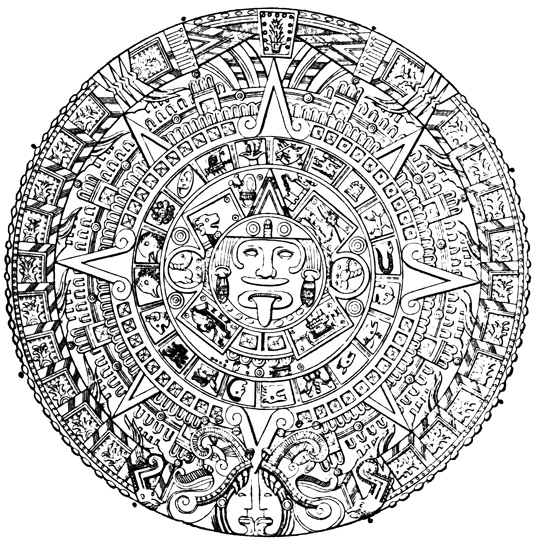
Aztec Calendar-Stone.
The stone has been for many years built into the wall of the cathedral at the base, where it is exposed to the view of all passers-by, and to the action of the elements. While lying uncovered in the plaza it was considerably mutilated by the natives, who took the opportunity of manifesting their horror of the ancient gods, by pelting with stones this relic of their paganism. Parts of the stone were also broken off when it was thrown down and buried by the conquistadores. Fortunately the sculptured portions have been but slightly injured, and are shown in the cut. The plates published by Gama, Humboldt, Nebel, Mayer, and others, are all tolerably accurate; except that they were drawn to represent the stone correctly on the plate or block, and of course reversed in printing. The origin of this error is probably to be found in the fact that nearly all have copied Gama's plate. In my cut the error is corrected and the sculptured figures agree exactly with Charnay's photograph.[IX-55] These figures are the symbols of the Aztec calendar, many of which are well understood, while others are of unknown or disputed signification. The calendar has been sufficiently explained in a preceding volume, and I shall not enter upon its elucidation here. The sculpture is in low relief, very accurately worked, and the circle which encloses it projects, according to Mayer, seven inches and a half, according to Gama and Nebel about three inches, and the rim of the circle is also adorned with sculptures not shown in the cut. Respecting the excellence of the sculpture Humboldt says: "the concentric circles, the divisions, and the subdivisions without number are traced with mathematical exactitude; the more we examine the details of this sculpture, the more we discover this taste for repetitions of the same forms, this spirit of order, this sentiment of symmetry, which, among half-civilized peoples, take the place of the sentiment of the beautiful."
No stone like that from which the Calendar-Stone is hewn, is found within a radius of twenty-five or thirty miles of Mexico, and this may be regarded as the largest block which the natives are known to have moved over a long distance. Prescott tells us that the stone was brought from the mountains beyond Lake Chalco, and was dropped into the water while being transported across one of the causeways. There is no reason to attribute this monument to any nation preceding the Aztecs, although the calendar itself was the invention of an older people. Wax models of this and other relics, described by Mr Tylor as very inaccurate, are sold in Mexico; and a plaster cast, taken by Mr Bullock in 1823, was exhibited in London.[IX-56]
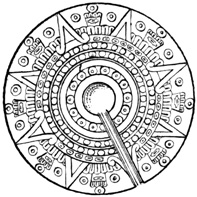
Sacrificial Stone—Mexico.
THE SACRIFICIAL STONE.
The Sacrificial Stone, so called, is a cylindrical block of porphyry, nine feet and ten inches in diameter, three feet seven and one fourth inches thick. This also was dug from the Plaza Mayor, was carried to the courtyard of the University, where it has lain ever since, much of the time half covered in the ground, and where different visitors have examined it. The cut, which I have copied from Col. Mayer's drawing, shows the sculpture which covers one side of the stone, the other side being plain. The name of Sacrificial Stone, by which it is generally known, probably originated from the canal which leads from the centre to the edge, and which was imagined to have carried off the blood of sacrifices; but the reader will notice at once that this stone bears not the slightest resemblance to the altars on which the priests cut out the hearts of their human victims, as described in a preceding volume. Some authors, among whom is Humboldt, believe this to be the temalacatl, or gladiatorial stone, on which captives were doomed to fight against great odds until overcome and put to death. The bas-relief sculptures, the central concavity, the canal, and the absence of any means of securing the foot of the captive, are very strong arguments against this use of the cylinder. A smooth surface would certainly be desirable for so desperate a conflict, and the sculptured figures on the rim, or circumference, soon to be noticed, show that the plain side of the stone was not in its original position uppermost. Gama, the first to write about the monument, pointed out very clearly the objections to the prevailing ideas of its aboriginal purpose. He claimed that the stone was, like the one already described, a calendar-stone, on which was inscribed the system of feast-days. The strongest objection to this theory was the existence of the central concavity and canal, which, however, Gama considers not to have belonged to the monument at all, but to have been added by the ruder hands of those who wished to blot out the face of the sun which originally occupied the centre. Latrobe also says, "I have but little hesitation in asserting that the groove in the upper surface formed no part of the original design;" but Col. Mayer, who has carefully examined this relic, tells me that the canal presents no signs whatever of being more recent than the other carving, and it must be admitted that the Spaniards would hardly have adopted this method of mutilation. Tylor suggests that this was a sacrificial altar, but used for offerings of animals. Fossey speaks of it as a 'triumphal stone.' But in alluding to these theories I am departing somewhat from my purpose, which is to give all the information extant respecting each relic as it exists.
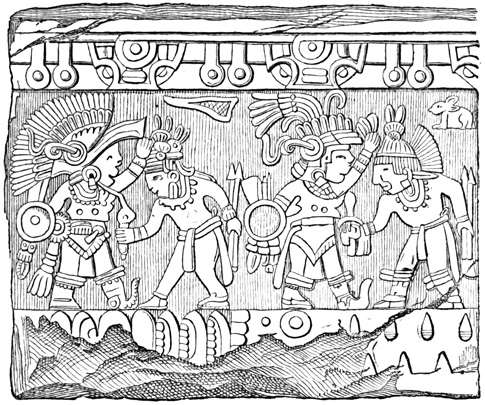
Sculpture on the Sacrificial Stone.
The whole circumference of the stone is covered with sculptured figures, consisting of fifteen groups. Each group contains two human figures, apparently warriors or kings, victor and vanquished, differing but little in position or insignia in the different groups, but accompanied by hieroglyphic signs, which may express their names or those of their nations. Two groups as sketched by Nebel are shown in the cut. According to Gama these sculptured figures represent by the thirty dancers the festivities celebrated twice each year on the occasion of the sun passing the zenith; and also commemorate, since the festivals were in honor of the Sun and of Huitzilopochtli, the battles and victories of the Aztecs, the hieroglyphics being the names of conquered provinces, and most of them legible.[IX-57]
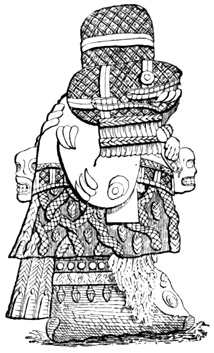
The idol of which the cut on the opposite page shows the front, was the first to be brought to light in grading the Plaza Mayor in August, 1790. It is an immense block of bluish-gray porphyry, about ten feet high and six feet wide and thick, sculptured on front, rear, top, and bottom, into a most complicated and horrible combination of human, animal, and ideal forms. No verbal description could give the reader any clearer idea of the details of this idol than he can gain from the cuts which I present, following Nebel for the front, and Gama for the other views. Gama first expressed the opinion, in which other authors coincide, that the front shown in the opposite cut represents the Aztec goddess of death, Teoyaomiqui, whose duty it was to bear the souls of dead warriors to the House of the Sun—the Mexican Elysion.[IX-58]
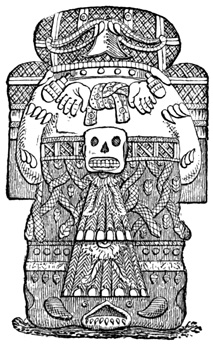
Huitzilopochtli, God of War.
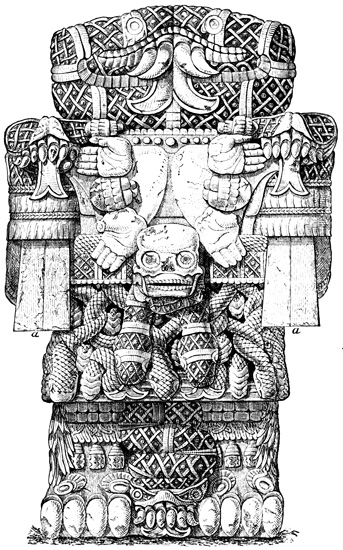
Teoyaomiqui, Goddess of Death.
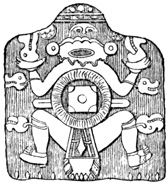
Mictlantecutli, God of Hell.
THE GODDESS OF DEATH.
The following cut is a rear view of the idol, and represents, according to Gama, Huitzilopochtli, god of war and husband of the divinity of gentler sex, whose emblems are carved on the front.[IX-59] The bottom of this monument bears the sculptured design shown in the following cut, which is thought to represent Mictlantecutli, god of the infernal regions, the last of this cheerful trinity, goddess of death, god of war, and god of hell, three distinct deities united in one idol, according to the Aztec catechism. The sculptured base, together with the side projections, a, a, of the cut showing the front, prove pretty conclusively that this idol in the days when it received the worship and sacrifices of a mighty people, was raised from the ground or floor, and was supported by two pillars at the sides; or possibly by the walls of some sacred enclosure, the space left under the idol being the entrance. The next cut shows a profile view of the idol, and also a representation of the top. This idol also was removed to the University, and until 1821 was kept buried in the courtyard, that it might not kindle anew the aboriginal superstitions.[IX-60]
THE GODDESS TEOYAOMIQUI.
Profile of Teoyaomiqui.
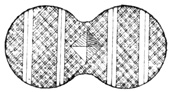
Top of the Idol.
A monument similar in form and dimensions to the Sacrificial Stone, was found in the Plaza Mayor during certain repairs that were being made, and although it was again covered up and allowed to remain, Sr Gondra made a drawing of the upper sculptured surface, which was published by Col. Mayer, and is copied in the cut. The surface presented the peculiarity of being painted in bright colors, yellow, red, green, crimson, and black, still quite vivid at the time of its discovery. Sr Gondra believed this to be the true gladiatorial stone, but the sculptured surface would hardly agree with this theory. Mayer notes as a peculiarity "the open hand which is sculptured on a shield and between the legs of some of the figures of the groups at the sides" not shown in the cut. Gama also speaks of a painted stone found in June, 1792, in the cemetery of the Cathedral, which was left in the ground, and which he says evidently formed the entrance to the temple of Quetzalcoatl.[IX-61]
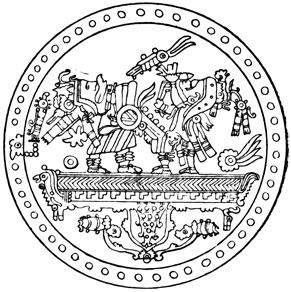
Stone buried in Plaza of Mexico.
Another relic found during the excavations in January, 1791, was a kind of tomb, six feet and a half long and three feet and a quarter wide, built of slabs of tetzontli, a porous stone much used for building-purposes in Mexico, filled with sand, which covered the skeleton of some animal like a coyote, together with clay vases and bells of cast bronze. It was perhaps the grave of some sacred animal. Gama also mentions an image of the water god Tlaloc, of a common black stone, three feet long and one foot wide; he also vaguely speaks of several other relics not particularly described, and even found some remains in digging the foundations of his own house.[IX-62]
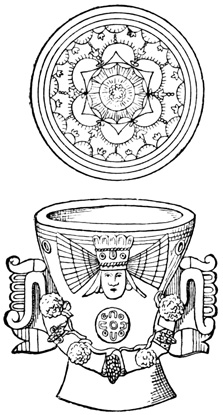
Burial Vase—Tlatelulco.
TLATELULCAN VASE.
The plaza of Tlatelulco is nearly as prolific in ancient monuments as the Plaza Mayor. Here was found the beautiful earthen burial vase shown in the cut. It is twenty-two inches high, fifteen inches and a half in diameter, covered with a circular lid, also shown in the cut, and when found was full of human skulls. The beauty of this vase can only be fully appreciated by a glance at the original, or at the sketch in Col. Mayer's album made by himself from the original in the Museum at Mexico, and showing the brilliant colors, blue, red, and yellow, with which it is adorned. The author says, "in many respects, it struck me as belonging to a higher grade of art than anything in the Museum, except, perhaps, the obsidian carvings, and one or two of the vases." Gondra mentions another burial casket, carved from basalt and of rectangular form.[IX-63]
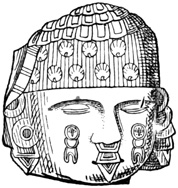
Head of Goddess Centeotl.
The head shown in the cut, taken from the Mosaico Mexicano, measures twenty-nine by thirty-six inches, and is carved from a block of serpentine, a stone rarely found in Mexico. It was dug up near the convent of Santa Teresa in 1830, and has been supposed to represent the Aztec Goddess Centeotl. The bottom being covered with sculpture, it seems that the monument is complete in its present state. Another serpentine image of somewhat peculiar form, is shown in an original sketch in the Album of Col. Mayer, who says, "it appears to have been a charm or talisman, and in many respects resembles the bronze figures which were found at Pompeii, and are preserved in the Secret Museum at Naples." It was found at Tlatelulco, and is preserved in the Mexican Museum.[IX-64]
MISCELLANEOUS RELICS.
Mr Bullock speaks of several relics not mentioned by any other visitor:—"In the cloisters behind the Dominican convent is a noble specimen of the great serpent-idol, almost perfect, and of fine workmanship. This monstrous divinity is represented in the act of swallowing a human victim, which is seen crushed and struggling in its horrid jaws." The corner-stone of the Lottery Office he described as "the head of the serpent-idol," not less than seventy feet long, when entire. Under the gateway of a house opposite the mint was a fine life-size recumbent statue found in digging a well. A house on a street corner on the south-east side of the plaza rested on an altar of black basalt, ornamented with the tail and claws of a reptile.[IX-64] Mayer dug up in the courtyard of the University two feathered serpents, of which he gives cuts, as well as of several other relics found within the city limits, including the 'perro mudo,' a stone image of one of the dumb dogs bred by the Aztecs, and a seated human figure known as the 'indio triste.'[IX-65]
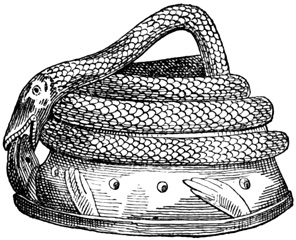
Aztec Musical Instrument.
Mr Christy's London collection of American antiquities contains, as we are told by Mr Tylor, a number of bronze hatchets, dug up in the city of Mexico.[IX-66] Sr Gondra gives plates of nine Mexican musical instruments, one of which of very peculiar construction was found in the city, and is shown in the preceding cut. The top shaped like a coiled serpent is of burned clay, resting on the image of a tortoise carved from wood, and that on a base of tortoise-shell. The whole is about twelve inches high.[IX-67] And finally I give a cut which represents part of a block built into the wall of the Convent of Concepcion, as sketched by Sr Chavero, who joins to his plate some remarks on the meaning of the hieroglyphic sculpture.[IX-68]
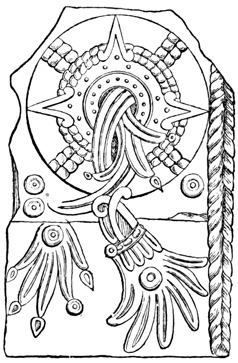
Sculptured Block in Convent Wall.
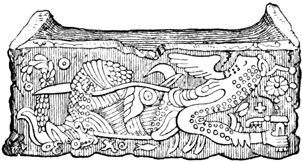
Stone Basin from Tezcuco.
RUINS OF TEZCUCO.
Tezcuco, the ancient rival of Mexico, across the lake eastward, formerly on the lake shore, but now by the retirement of the water left some miles inland, has, notwithstanding her ancient rank in all that pertained to art, left no monuments to compare with those taken from the Plaza Mayor of Mexico. But unlike the latter city Tezcuco yet presents traces, and traces only, of her aboriginal architectural structures. Fragments of building-material are found wherever excavations are made, and the material of the old city is said to have been extensively used in the construction of the modern, so that plain or sculptured stone blocks, shaped by the aborigines, are often seen in modern walls in different parts of the town. In the southern part of the city are the foundations of several large pyramids, apparently built of adobes, burnt bricks, and cement, since the materials named all occur among the débris. The foundations show the structures to have been originally about four hundred feet square, but of course supply no further information respecting their form. These pyramids were three in number at the time of Mayer's visit, standing in a line from north to south, and strewn with fragments of pottery, idols, and obsidian knives. Tylor found traces, barely visible, of two large teocallis; he also speaks vaguely of some burial mounds, and states that there is a Mexican calendar-stone built into the wall of one of the churches. In the north-west part of the town Mayer found another shapeless heap of bricks, adobes, and pottery, overgrown with magueys. On the top were several large basaltic slabs, squared and lying north and south. The rectangular stone basin with sculptured sides shown in the cut, was found in connection with this heap and preserved in the Peñasco collection in Mexico. Also in this heap of débris, according to Mayer, Mr Poinsett found in 1825 an arched sewer or aqueduct built of small stone blocks laid in mortar, together with a 'flat arch' of very large blocks over a doorway. I find no mention of these remains in Mr Poinsett's book. Bradford states that, "lying neglected under a gateway, an idol has been observed nearly perfect, and representing a rattlesnake," painted in bright colors. Mr Latrobe found a stone idol, perhaps the same, in 1834, and Nebel gives a sketch of a most interesting relic, said to have come from Tezcuco, and shown in the cut. It was the custom of the Aztec priests at certain times to wear the skin of sacrificed victims.[IX-69] This figure seems to represent a priest thus clad. It is carved from basalt, and was half the natural size, the natural skin being painted a bright red, and the outer one a dirty white. A collection of Tezcucan relics seen by Tylor in 1856, contained, 1st. A nude female figure four or five feet high, well formed from a block of alabaster. 2d. A man in hard stone, wearing a mask which represents a jackals head. 3d. A beautiful alabaster box containing spherical beads of green jade, as large as pigeons' eggs and brilliantly polished.[IX-70]
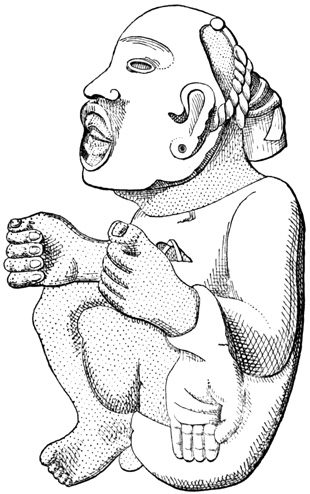
Skin-clad Aztec Priest.
HILL OF TEZCOCINGO.
About three miles eastward from Tezcuco is the isolated rocky hill known as Tezcocingo, which rises with steep slopes in conical form to the height of perhaps six hundred feet above the plain. A portion of one side of the hill, beginning at a point probably on the south-eastern slope, is graded very much as if intended for a modern railroad, forming a level terrace round a part of the circumference. From the termination of the grading, an embankment with level summit, variously estimated at from sixty to two hundred feet high, connects this hill with another three quarters of a mile distant, the side of which is likewise graded into a terrace thirty feet wide and a mile and a half long, extending two thirds round the circumference; and then another embankment stretches away towards the mountains ten or fifteen miles distant, although no one seems to have recorded any attempt to explore its whole extent. The object of both grading and embankments was to support an aqueduct or pipe ten inches in diameter, which is still in very good preservation at several points. Waddy Thompson brought away a piece of the water-pipe as a relic, and he pronounces the material to be a very hard plaster made of lime and small portions of a soft red stone. "It is about two feet wide, and has a trough in the centre about ten inches wide. This trough is covered with a convex piece of the same plaster, which being placed upon it when the plaster was soft, seems to be all one piece, making together a tube of ten inches in diameter, through which the water flowed from the distant mountains to the basin, which it enters through a round hole about the size of one made with a two-inch auger. No plasterer of the present day can construct a more beautiful piece of work; it is in its whole extent as smooth as the plastering on a well-finished wall, and is as hard as stone." Mayer tells us that the aqueduct was made of baked clay, the pipes being as perfect as when they were first laid. He also seems to imply that along the graded terraces the water was conducted in a ditch, or canal, instead of the regular pipes. But Tylor, on the other hand, says "the channel of the aqueduct was made principally of blocks of the same material [porphyry], on which the smooth stucco that had once covered the whole, inside and out, still remained very perfect."
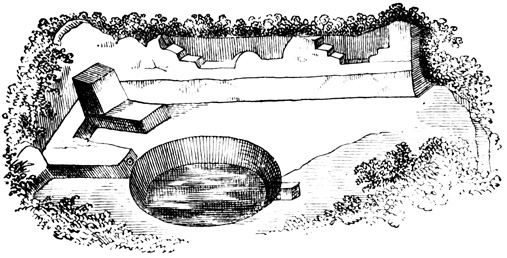
Montezuma's Bath.
MONTEZUMA'S BATH.
At the termination of the aqueduct on the eastern slope of Tezcocingo, on the brink of a precipitous descent of two hundred feet to the plain, is the work shown in the cut, from Mayer, hewn from the living rock of reddish porphyry, and popularly known as Montezuma's Bath. There was of course no reason whatever to attach this name to it, for although it is possible, if not probable, that it may have been used for a bath, it is very certain that it never belonged to Montezuma, but rather to Nezahualcoyotl or some other of the Tezcucan kings.[IX-71] The circular basin in the centre is four feet and a half in diameter, and three feet deep, and the circular aperture through which it received water from the aqueduct, is shown in the cut, together with what seem to be seats cut in the rock. Respecting this monument Col. Mayer says: "Its true use, however, is perfectly evident to those who are less fanciful or antiquarian than the generality of visiters. The picturesque view from this spot, over a small plain set in a frame of the surrounding mountains and glens which border the eastern side of Tescocingo, undoubtedly made this recess a favorite resort for the royal personages at whose expense these costly works were made. From the surrounding seats, they enjoyed a delicious prospect over the lovely but secluded scenery, while, in the basin, at their feet, were gathered the waters of a neighboring spring, [implying that the basin and aqueduct were not connected] which, whilst refreshing them after their promenade on the mountain, gurgled out of its stony channel and fell in a mimic cascade over the precipitous cliff that terminated their path. It was to this shady spot that they no doubt retired in the afternoon, when the sun was hot on the west of the mountain, and here the sovereign and his court, in all probability, enjoyed the repose and privacy which were denied them amid the bustle of the city."
Accounts of the other remains at Tezcocingo are somewhat confused. On the northern slope is another recess, bordered by seats cut in the living rock, and leading to a perpendicular cliff on which a calendar is said to have been carved, but destroyed by the natives in later days. Traces of a spiral road winding up to the summit were found by Mayer. Tylor reports a terrace round the hill near the top, some sculptured blocks on the summit, and a second circular bath. Bullock speaks of "ruins of a very large building—the cemented stones remaining in some places covered with stucco, and forming walks and terraces, but much encumbered with earth fallen from above.... As we descended our guide showed us in the rock a large reservoir for supplying with water the palace, whose walls still remained eight feet high; and as we examined farther, we found that the whole mountain had been covered with palaces, temples, baths and hanging gardens." Beaufoy saw a mass of porphyry on the summit, which had been fashioned artificially and furnished with steps. The whole surface, overgrown with nopal-bushes, abounds in fragments of pottery, obsidian, cement, and stone.[IX-72]
BOSQUE DEL CONTADOR.
North-westward from Tezcuco on the level plain is the Bosque del Contador, a grove of ahuehuetes, or cypresses, arranged in a double row and enclosing a square area of about ten acres, whose sides face the cardinal points. The trees are between five and six hundred in number, some of them forty to fifty feet in circumference, and are supposed to date from a time preceding the conquest. The ground on which they stand is firm and somewhat raised above the level of the surrounding plain, which itself is but little above the waters of the lake. The enclosed area, however, is soft, miry, and impassable. It is uncertain whether this area was originally an inland lake surrounded by trees, or an island grove in the waters of the lake. From the north-west corner of the square a double row of similar trees extends some distance westward, and near its termination is a dyke and a walled tank full of water; at the north-east corner, a rectangular mass of porphyry is said to project above the surface and to be surrounded by a ditch; and from this point some traces of a causeway may be seen extending towards the east. Small stone idols, articles of pottery, and various small relics have been dug up in and about this grove, which was not improbably a favorite promenade of the Chichimec, or Acolhuan monarchs.[IX-73]
On the hacienda of Chapingo, about a league south of Tezcuco, an ancient causeway was found in excavating, at a depth of four feet below the surface, the cedar piles of which were in a good state of preservation. Under the causeway was the skeleton of a mastodon, and similar skeletons are said to have been found at other points in the valley of Mexico.[IX-74]
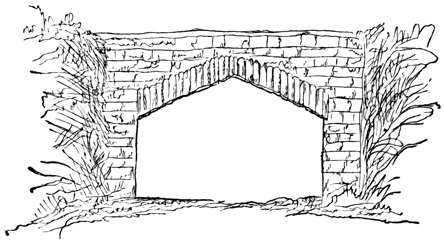
Bridge at Huejutla.
At Huejutla, also in the vicinity of Tezcuco, a wall was still standing as late as 1834, which was nearly thirty feet high, between five and six feet thick, and built of stone and mortar. From bottom to top the wall was divided into five distinct divisions distinguished by the arrangement of the stones. The widest of these divisions was built of cylindrical and oval stones, the rounded ends of which projected symmetrically. The wall terminates on the east at a ravine, which is crossed by a bridge of a single span, twenty feet long and forty feet high. The span is an arch of peculiar construction, being formed of stone slabs, set on edge, and the interstices filled with mortar. The irregularities of the stones and the firmness of the mortar support the structure, forming a near approach to the regular arch as shown in the cut from Tylor. Its antiquity has been doubted, but the near approximation to the keystone arch seems to be the only argument against the theory that it was built by the natives, and as we have seen a very similar arch in the mounds of Metlaltoyuca, there seems to be no good reason to attribute it to the Spaniards. This is probably the bridge known as the Puente de los Bergantines, where Cortés is said to have launched his brigantines which rendered so efficient service in the siege of Mexico. The fact that it is set askew instead of crossing the ravine at right angles with the banks adds greatly to the difficulty of its construction. Near this place there are also some heaps of débris, which according to Bullock could be identified in 1823 as small adobe pyramids; and the foundations of a building and two reservoirs, one of the latter in good preservation and covered with rose-colored cement, were mentioned. Beaufoy tells us that in 1826 a serpent's head carved in stone protruded from the ground near the modern church. A stone column, seven feet high, was among the relics seen; it had a well-carved pyramidal piece of hornblende on its top. Two idols of stone were brought away, one of them described by Latrobe as "an ugly monster of an idol in a sitting posture, deftly carved in a hard volcanic substance."[IX-75]
RUINS OF TEOTIHUACAN.
Not quite two miles north-east from the little village of San Juan, and about twenty-five miles in the same direction from Mexico, on the road to Otumba, are the ruins of Teotihuacan, 'city of the gods,' to which, according to Brasseur, the names Veitioacan, 'city of signals,' and Toltecat are sometimes applied in the native traditional annals.[IX-76] These monuments stand on a plain which slopes gently towards the south, and are included in a rectangular space of about a third of a mile from east to west and a mile and a half from north to south, extending from the Tulancingo road on the north to the Otumba road on the south, with, however, some small mounds outside of the limits mentioned. By reason of its nearness to Mexico, Teotihuacan, like Cholula, has naturally had hundreds of visitors in modern times, and is more or less fully described by all the early chroniclers. Humboldt, Bullock, Beaufoy, Ward, Latrobe, Mayer, Thompson, Tylor, and many other actual visitors have written accounts, which still others have quoted; but by far the most complete and reliable account, which is also the latest, is that given in the report of a scientific commission appointed by the Mexican government in 1864, accompanied by plates prepared from careful measurements and photographic views. I have used this report as my chief authority, carefully noting, however, all points respecting which other authorities differ.[IX-77]
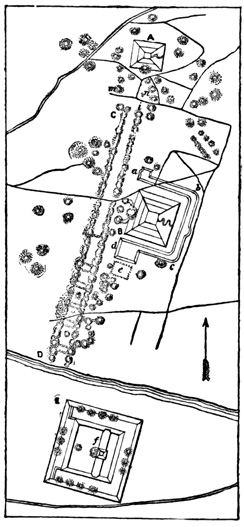
Plan of Teotihuacan.
The annexed cut, reduced from that of Almaraz, shows clearly, on a scale of about twenty-five hundred and fifty feet to an inch, the plan of the different monuments. I shall describe them in the following order:—1st. The Pyramid of the Moon, A of the plan; 2d. The Pyramid of the Sun, B; 3d. The Road of the Dead, CD; 4th. The Citadel, E; 5th. The scattered mounds and miscellaneous relics.
HOUSE OF THE MOON.
The first pyramid, Metztli Itzacual, 'house of the moon,' [I find no word in Molina's Vocabulary corresponding at all to Itzacual with the meaning of 'house.' It may be a compound of calli incorrectly written] the most northern of the remains, measures four hundred and twenty-six feet north and south, and five hundred and eleven feet east and west at the base, has a summit platform of about thirty-six by sixty feet, and is a hundred and thirty-seven feet high, the sides facing almost exactly the cardinal points.[IX-78] The slope of the sides, according to Beaufoy's observations, is at an angle of about forty-five degrees. The pyramid, as seen from a little distance, bears much resemblance to a natural hill, being overgrown with shrubbery; still the regular original outlines and angles are much more apparent here than in the case of Cholula, already described, as is proven by the photographs taken by the Mexican commission. A terrace, three feet wide, is plainly visible at a height of sixty-nine feet from the base, but a close examination shows there were originally three of these terraces, dividing the pyramid into four stories, except on the east, which has no terrace, and where the commission mentioned claim to have found traces of a zigzag road leading up the slope, as shown in the plan. None but the authority referred to have discovered the zigzag path, and no other explorers note that the terraces were interrupted on one side of the pyramid. Humboldt states that the space between the terraces was divided into smaller grades, or steps, about three feet high, still visible, and also that there still remained parts of a stairway of large blocks of hewn stone. Mr Tylor also says, not referring to this pyramid particularly: "As we climbed up their sides, we could trace the terraces without any difficulty, and even flights of steps." There is hardly any other American monument respecting which the best authorities differ so essentially.[IX-79]
HOUSE OF THE MOON.
The material of the structure has generally been described as a conglomerate of small irregular stones and clay, encased, according to Humboldt and most other writers, in a wall of the porous volcanic rock, tetzontli; or this facing covered with a coating of stucco, which is salmon-colored, light blue, streaked, and red, according to the views of different observers. The Mexican commissioners disagree with all previous explorers by doing away altogether with the facing of hewn stone, and representing the facing to consist of different conglomerates arranged in successive layers, as follows:—1st, small stones from eight to twelve inches in diameter, with mud, forming a layer of about thirty-two inches; 2d, fragments of volcanic tufa as large as a man's fist, also in mud, to the thickness of sixteen inches; 3d, small grains of tetzontli, of the size of peas, with mud, twenty-eight inches thick; 4th, a very thin and smooth coat of pure lime mortar. These layers are repeated in the same order nine times, and are parallel to the slopes of the pyramid, which would make the thickness of the superficial facing about sixty feet. There have been no excavations sufficiently deep to show what may be the material in the centre. Almaraz states that a somewhat different order and thickness of the strata was observed in certain excavations, or galleries, to be described later; but none of these galleries are described as of sufficient depth to penetrate the facing of sixty feet, and the exact meaning of the report in question it is very difficult to determine. I give in a note, however, what others have said of the building-material.[IX-80]