Volume 4 — CHAPTER XIII. WORKS OF THE MOUND-BUILDERS.
Reading edition
American Monuments beyond the Limits of the Pacific States—Eastern Atlantic States—Remains in the Mississippi Valley—Three Geographical Divisions—Classification of Monuments—Embankments and Ditches—Fortifications—Sacred Enclosures—Mounds—Temple-Mounds, Animal-Mounds, and Conical Mounds—Altar-Mounds, Burial Mounds, and Anomalous Mounds—Contents of the Mounds—Human Remains—Relics of Aboriginal Art—Implements and Ornaments of Metal, Stone, Bone, and Shell—Ancient Copper Mines—Rock-Inscriptions—Antiquity of the Mississippi Remains—Comparisons—Conclusions.
TREATMENT OF FOREIGN REMAINS.
I announced in an introductory chapter my intention to go in this volume beyond the geographical limits of my field of labor proper, the Pacific States, and to include a sketch of eastern and southern antiquities. I am not sure that this departure from my territory is strictly more necessary or appropriate in this than in the other departments of this work;—that is, that the material relics of the Mississippi Valley and South America have a more direct bearing on the institutions and history of the Native Races of the Pacific, than do the manners and customs, mythology, and language of the South American and eastern tribes. Yet there is this difference, that to have included the whole American continent in the preceding volumes would have required a new collection of material, additional time and research, and an increase of bulk in printed pages, each equal at least to what has been done; and I believe that the original scope of my work, and the bulk of that part of it devoted to the Native Races, is already sufficiently extensive. But in the department of antiquities, making the present volume of uniform size with others of the work, I have, I think, sufficient space and material to justify me in extending my researches beyond the Pacific States; and this seems to me especially desirable by reason of the fact that all the important archæological remains outside of what I term the Pacific States, may be included in the two groups to which my closing chapters are devoted, and the present volume may consequently present some claim to be considered a comprehensive work on American Antiquities.
My treatment of the subject in this and the following chapter will, however, differ considerably from that in those preceding. I have hitherto proceeded geographically from south to north, placing before the reader all the information extant, be it more or less complete, respecting every relic in each locality, and giving besides in every case the source whence the information was obtained. In this manner the notes become a complete bibliographical index to the whole subject, not an unimportant feature, I believe, of this work. In the broad eastern region bordering on the Mississippi and its tributaries, a region thickly inhabited, and thoroughly explored by antiquarians, or at least comparatively so, so numerous are the relics and the localities where they have been found, that to take them up one after another for detailed description would require at least a volume; and these relics, although of great importance, present so little variety in the absence of all architectural monuments, that such a detailed account could hardly fail to become monotonous to a degree unparalleled even in the pages of the present volume. Moreover, the books and other material in my possession, while amply sufficient, I think, to furnish a clear idea of the Mississippi and South American monuments, are of course inadequate to a continuation of the bibliographical feature referred to. For these reasons I deem it best to abandon the elaborate note-system hitherto followed, and shall present a general rather than a detailed view of material relics outside the Pacific States, formed from a careful study of what I believe to be the best authorities, and illustrated by the cuts given in Mr Baldwin's work.[XIII-1]
THE MISSISSIPPI VALLEY.
Material relics of the aboriginal tribes are found in greater or less abundance throughout the Eastern United States and the Canadas. But those found in New England and the region east of the Alleghanies, extending southward to the Carolinas, may be dismissed in an account so general as the present with the remark that all are evidently the work of the Indian tribes found in possession of the country, many of them evidently and others probably having originated at a time subsequent to the coming of Europeans. But whatever may be decided respecting their antiquity, it may be regarded as absolutely certain that none of them point to the existence of any people of more advanced culture than the red race that came in contact with Europeans. They consist for the most part of traces of Indian villages or camps, burial grounds, small stone-heaps, scattered arrow-heads, and some other rude stone implements.
CLASSIFICATION OF REMAINS.
The great Mississippi Valley system of ancient works, consisting of mounds and embankments of earth and stone, erected by the race known as the Mound-builders, extends over a territory bounded in general terms as follows: on the north by the great lakes; on the east by western New York, Pennsylvania, and Virginia in the north, but farther south extending to the Atlantic coast and including Florida, Georgia, and part of South Carolina; on the south by the Gulf of Mexico, including Texas according to the general statements of most writers, although I find no definite account of any remains in that state; on the west by an indefinite line extending from the head of Lake Superior through the states of Minnesota, Nebraska, Kansas, and Indian Territory, although there are reported some remains farther west, particularly on the upper Missouri, which have not been thoroughly explored. The map in the accompanying cut is intended only to show the reader at a glance the relative position of the states in the territory of the Mound-builders.
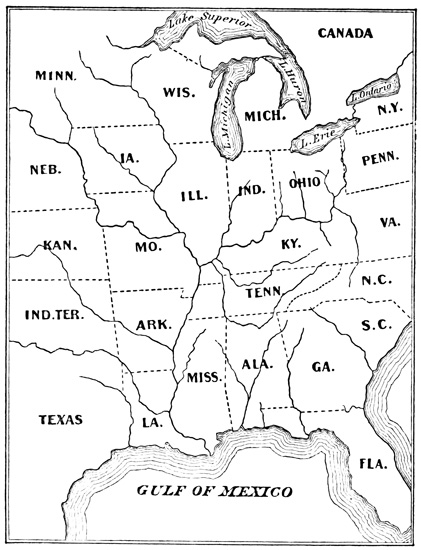
Map of the Territory of the Mound-Builders.
Throughout this broad extent of territory, but chiefly on the fertile river-terraces of the Mississippi and its tributaries, the works of the ancient inhabitants are found in great abundance, and may be classified for convenience in description as follows:—I. Embankments of earth or stone, and ditches, often forming enclosures, which are subdivided by their location into, 1st, fortifications, and 2d, sacred enclosures, or such as are supposed to have been connected with religious rites.
II. Mounds of earth or stone, of varying location, size, form, material, and contents; divided by their form into, 1st, 'temple mounds,' of regular outline and large dimensions, having flat summit platforms, and often terraced sides with graded ascents; 2d, 'animal-mounds,' or those resembling in their ground plan the forms of animals, birds, or even human beings; and 3d, conical mounds, which are again subdivided according to their contents into 'altar-mounds' or 'sacrificial mounds,' 'burial mounds,' and 'anomalous mounds,' or such as are of mixed or undetermined character.
III. Minor relics of aboriginal art, for the most part taken from the mounds, including implements and ornaments of metal, stone, shell, and bone.
IV. Ancient mines, and perhaps a few salt-wells which bear marks of having been worked by the aborigines.
V. Rock-inscriptions.
These different classes of remains, although sufficiently uniform in their general character to indicate that the Mound-builders were of one race, living under one grand system of institutions, still show certain variations in the relative predominance of each class in different sections of the territory. The Ohio River and its tributaries would seem to have been in a certain sense the centre of the Mound-builders' power, for here the various forms of enclosures and mounds are most abundant and extensive, and their contents show the highest advancement of aboriginal art. This section, including chiefly the state of Ohio, but also parts of Kentucky, Indiana, Tennessee, Illinois, and Missouri, was the ground embraced in the explorations of Squier and Davis, by far the best authorities on eastern antiquities. In the northern region, on the great lakes, on which Lapham and Pidgeon are the prominent authorities, chiefly in Wisconsin, but also in Michigan, Illinois, Missouri, Iowa, and Minnesota, animal-mounds are the prominent feature, the other classes of mounds, and the enclosures, being of comparatively rare occurrence. The animal-mounds occur in the central Ohio region only in a very few instances, and never, so far as is known, in the south. In the southern or gulf states the temple-mounds are more numerous in proportion to other classes than in the north, and enclosures disappear almost altogether. The southern antiquities have, however, been comparatively little explored, Mr Jones' late work referring for the most part only to the state of Georgia.
Throughout the whole region traces of the tribes found by Europeans in possession of the country are found; and besides the three territorial divisions already indicated, it is noted that in the north-east, in western New York and Pennsylvania, the works of the Mound-builders merge so gradually into those of the later tribes, the only relics farther east, that it becomes well-nigh impossible to fix accurately the dividing line.
REMAINS IN NEW YORK.
In many parts of western New York traces are found of Indian fortified camps, surrounded by rows of holes in the ground, which once supported palisades, and in all respects similar to those in use among the Indians of the state in their wars against the whites. There are also found low embankments of earth, or very rarely of small stones, which form enclosures or cut off the approach to the weaker side of some naturally strong position. Such embankments are always on hills, lake or river terraces, or other high places, and are often protected on one or more sides by morasses or by streams with steep banks. Their strong natural position, with due regard to the water supply, carefully planned means of exit, and in many instances graded roads to the water, leaves no doubt of their original design as fortifications, places of refuge and of protection against enemies. The slight height of the embankments would suggest that they were thrown up to support palisades; indeed, traces of these palisades have been found in some cases. The practice of throwing up an embankment at the foot of palisades, although seemingly a very natural one, does not, however, seem to have been noticed among the Indian tribes of New York. In nearly all the enclosures remains of the typical Indian caches are found, with carbonized maize, and traces of wood and bark; and in and around them the sites of Indian lodges or towns are seen, indicated by the presence of decomposed and carbonaceous matter, together with burned stones, charcoal, ashes, bones, pottery, and Indian implements. These circumstances go far to prove that all the New York works, if not built by the Indians, were at least occupied by them after their abandonment by the Mound-builders, from some of whose works they do not differ much except in dimensions and regularity of form.
The enclosures vary in extent from three to four acres, the largest being sixteen acres. The embankments are from one to four feet high, generally accompanied by an exterior ditch;—the highest is seven or eight feet from bottom of ditch to top of embankment. Many such works in a country so long under cultivation have of course disappeared. Mr Squier ascertained the locality of one hundred of them in New York, and estimates the original number at not less than two hundred and fifty.
The works of the Mound-builders are almost exclusively confined to the fertile valleys still best fitted to support a dense population. The Mississippi and its tributaries have during the progress of the centuries worn down their valleys in three or four successive terraces, which, except the lowest, or latest formed, the ancient peoples chose as the site of their structures, giving the preference in rearing their grandest cities—for cities there must have been—to the terrace plains near the junction of the larger streams. On these plains and their surrounding heights, are found the ancient monuments, generally in groups which include all or many of the classes named above; for it is only for convenience in description that the classification is made; that is, the classification is by no means to any great extent a geographical one. I have already said that Ohio was the centre, apparently, of the Mound-builders' power. Northward, eastward, and perhaps westward from this centre, the works diminish in extent, fortifications become a more prominent feature, and the remaining monuments approximate perceptibly to those of the more barbarous and later peoples. In fact, we find the modifications that might naturally be expected in a frontier country. Southward from the Ohio region down the Mississippi Valley, it is a common remark in the various writings on the subject, that the monuments increase gradually in magnitude and numbers. This statement seems to have originated, partially at least, in the old attempt to trace the path of Aztec migration southward. The only foundation for it is the fact that the class of mounds called temple-mounds are in the south more numerous in proportion to those of the other classes. The largest mound and the most extensive groups are in the north; while the complicated arrangement of sacred enclosures appears but rarely if at all towards the gulf. It is not impossible that more extensive explorations may show that the comparative numbers and size of the large temple-mounds have been somewhat exaggerated. Yet the claims in behalf of Nahua traces in the Mississippi region are much better founded than those that have been urged in other parts of the country; although we have seen that the chain is interrupted in the New Mexican country, and I can find no definite record of temple-mounds in Texas. The total number of mounds in the state of Ohio is estimated by the best authority at ten thousand, while the enclosures were at least fifteen hundred.
FORTIFICATIONS.
I begin with the embankments and enclosures. They are found, almost always in connection with mounds of some class, on the hills overlooking the valleys, and on the ravine-bounded terraces left by the current of rapid streams. The first, or oldest, terraces, with bold banks from fifty to a hundred feet high, furnish the sites of most of the works; on the lower intermediate terraces, whose banks range from ten to thirty feet in height, they are also found, though less frequently than above; while on the last-formed terrace below no monuments whatever have ever been discovered.
The embankments are simply earth, stones, or a mixture of the two, in their natural condition, thrown up from the material which is nearest at hand. There is no instance of walls built of stone that has been hewn or otherwise artificially prepared, of the use of mortar, of even rough stones laid with regularity, of adobes or earth otherwise prepared, or of material brought from any great distance. The material was taken from a ditch that often accompanies the embankment, from excavations or pits in the immediate vicinity, or is scraped up from the surface of the surrounding soil. There is nothing in the present appearance of these works to indicate any difference in their original form from that naturally given to earth-works thrown up from a ditch, with sides as nearly perpendicular as the nature of the material will permit. Of course, any attempt on the part of the builders to give a symmetrical superficial contour to the works would have been long since obliterated by the action of the elements; but nothing now remains to show that they attached any importance whatever to either material or contour. Stone embankments are rarely found, and only in localities where the abundance of the material would naturally suggest its use. In a few instances clay has been obtained at a little distance, or dug from beneath the surface.
FORTIFIED HILLS.
Accordingly as they are found on the level plain, or on hill-tops or other strong positions, enclosures are divided into fortifications and sacred enclosures. Of the design of the first class there can be no doubt, and very little respecting many of the second class, although it is very probable that some of the latter had a different purpose, not now understood. Naturally some works occur which have some of the features of both classes. The fortifications are always of irregular form as determined by the nature of the ground.
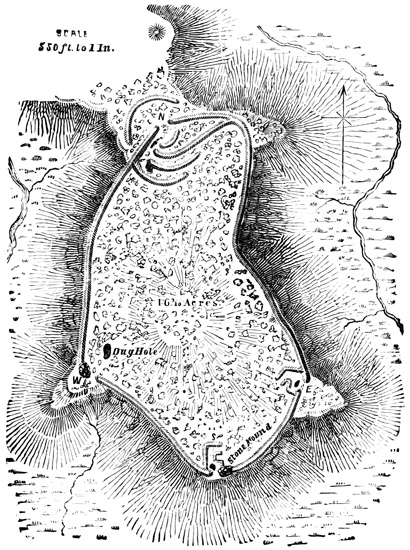
Fortification—Butler Hill.
A fortification at Butler Hill, near Hamilton, Ohio, is shown in the cut. The summit of the hill is two hundred and fifty feet above the river, the enclosing wall is of earth and stones, five feet high, thirty-five feet thick at the base, and unaccompanied by a ditch, although there are some pits which furnished the material of the wall. Two mounds or heaps of rough stones are seen within the enclosure and one without, the stones of all showing marks of fire.
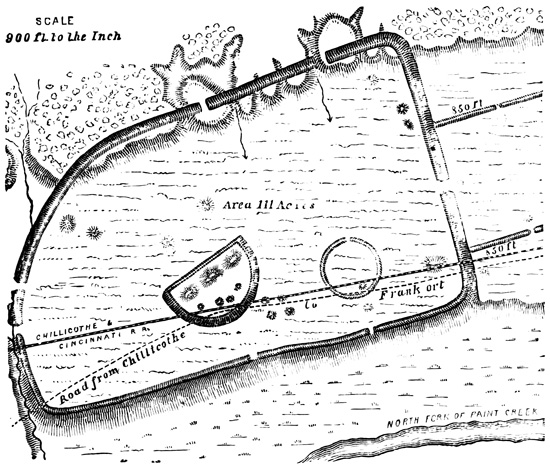
Fort Hill, Ohio.
The next cut shows a work at Fort Hill, Ohio, which seems to unite the characters of the two classes of enclosures. It measures twenty-eight hundred by eighteen hundred feet, and is on the second terrace. The wall along the creek side is of stones and clay, four feet high: the other main walls are six feet high and thirty-five feet thick, with an exterior ditch. The walls of the square enclosure at the side are of clay, present some marks of fire, and have no ditch. Mr Squier concludes that this was a fortified town rather than a fort like many others. The walls of the enclosure shown in the following cut, on Paint Creek, Ohio, are of stone, thirteen hundred feet in circumference, and have no ditch. The heaps of stones connected with this work have been exposed to excessive heat, either perhaps by being used as fire signals, or by the burning of wooden structures which they supported. In the works at Fort Ancient, on a mesa two hundred and thirty feet above the Miami River, the embankment is four miles long in an irregular line round the circumference, and in some parts eighteen or twenty feet high. There are also some signs of artificial terraces on the river side of the hill. A line of these defensive works is found in northern Ohio, with which very few regular mounds or sacred enclosures are connected. Pidgeon states that a single line of embankment may be traced for seventeen miles, and that there are three hundred and six miles of embankment fortifications in the state. It is quite probable that these embankments originally bore palisades. They vary in height from three to thirty feet, reckoning from the bottom of the ditch; but this gives only a very imperfect idea of their original dimensions, since in some localities the height has been much more reduced by time than in others, owing to the nature of the material. In hill fortifications the ditch is usually inside the wall, but when the defences guard the approach to a terrace-point, the ditch is always on the outside. The entrances to this class of enclosures are governed by convenience of exit, accessibility of water, and facilities for defence. They are usually guarded by overlapping walls as shown in the cuts that have been presented. Several of the larger fortifications, however, have a large number of entrances, generally at regular intervals, which it is very difficult to account for.
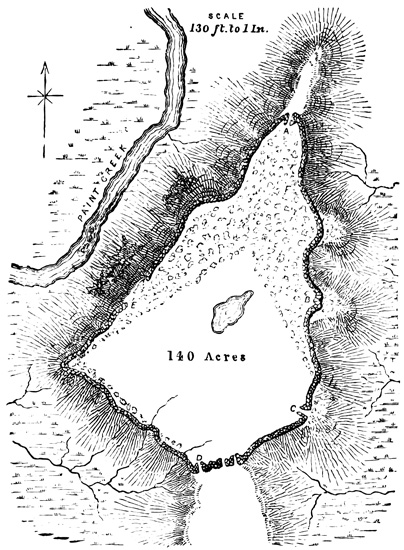
Fort near Bourneville.
SACRED ENCLOSURES.
Other enclosures are classed as sacred, or pertaining in some way to religious rites, because no other equally satisfactory explanation of their use can be given. That they were in no sense works of defence is evident from their position, almost invariably on the most level spot that could be selected and often overlooked by neighboring elevations. Unlike the fortifications they are regular in form, the square and circle predominating and generally found in conjunction, but the ellipse, rectangle, crescent, and a great variety of other forms being frequent, and several different forms usually occurring together. A square with one or more circles is a frequent combination. The angles and curves are usually if not always perfectly accurate, and the regular, or sacred, enclosures probably outnumber by many the irregular ones, although they are of lesser extent. Enclosed areas of one to fifty acres are common. The groups are of great extent; one at Newark, Ohio, covers an area of nearly four square miles. A remarkable coincidence was noticed by Mr Squier in the dimensions of the square enclosures, five or six of these having been found at long distances from each other, which measured exactly ten hundred and eighty feet square. Circles are, as a rule, smaller than the squares with which they are connected, two hundred to two hundred and fifty feet being a common size. The largest of the enclosures, with an area of some six hundred acres, are those reported in the far west and north-west by early travelers whose reports are not confirmed.
The embankment itself differs from those already described only in being, as a rule, somewhat lower and narrower, although at Newark one is thirty feet high, and in being constructed with less exceptions without the use of stones. The material as before was taken from the surface, ditches, or from pits, which latter are often described as wells, and may in some instances have served as such.
The following cut represents a group at Liberty, Ohio, typical of a large class in the Scioto Valley. The location is on the third terrace, the embankments of earth are not over four feet high, there is no ditch, and the earth seems to have been taken exclusively from pits, which, contrary to the usual custom, are within the enclosure. The square is one of those already spoken of as agreeing exactly in dimensions with others at a distance. Additional dimensions are shown in the cut. The enclosures, both square and round, usually include several mounds. One at Mound City, square with rounded corners, covering thirteen acres, has twenty-four sacrificial mounds within its walls. At Portsmouth, there are four concentric circles, cut by four broad avenues facing, with slight variation, the cardinal points, and having a large terraced and truncated mound in the centre. The banks of one enclosure near Newark measure thirty feet in height from the bottom of the ditch; the usual height is from three to seven feet.
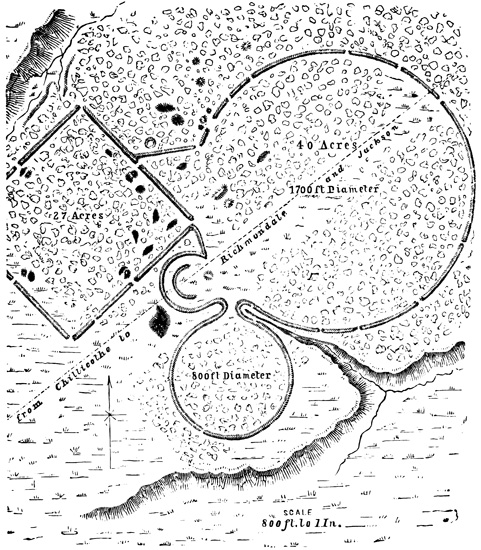
Sacred Enclosures—Liberty.
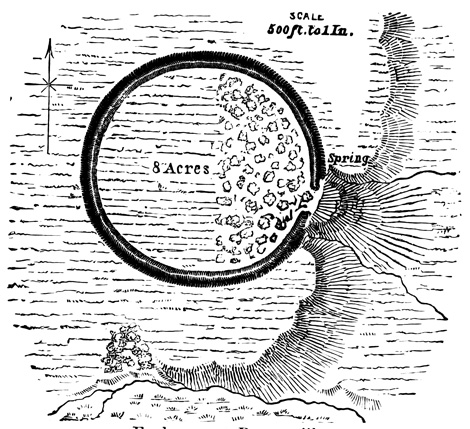
Enclosure at Bourneville.
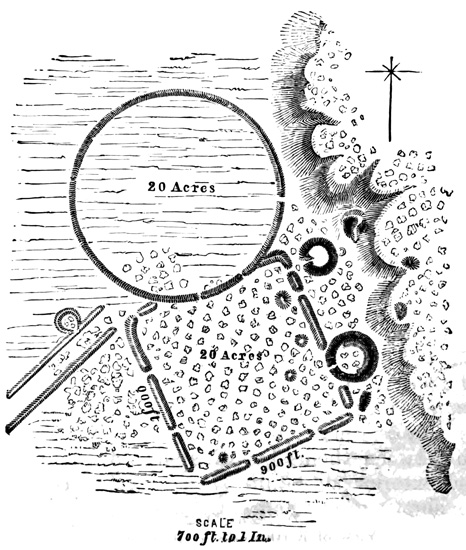
Works at Hopeton.
The circles often have an interior ditch; in some cases, as at Circleville and Salem, there are two circular embankments one within the other with a ditch between them; but there is only one instance of an exterior ditch, in the work at Bourneville, Ohio, shown in the first cut. The wall is from eight to ten feet high, and the ditch is shallow. The larger circles have generally a single entrance, which is usually, but not always, on the east. There are numerous small circles from thirty to fifty feet in diameter, found in connection with groups of large enclosures, which have very light embankments and no entrances. These may very likely be the remains of lodges or camps. The larger circles are almost invariably connected with squares or rectangles, which have similar embankments but no ditches. These have very commonly an entrance at each angle and one in the middle of each side, but the larger squares have often many more entrances.
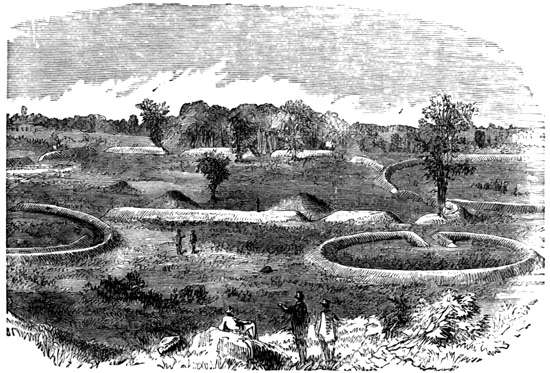
View of Earth-works at Hopeton.
The second cut shows a group of sacred enclosures at Hopeton, Ohio, located on the third terrace. The walls of the rectangle are of a clayey loam, fifty feet thick and twelve feet high, without a ditch. The summit is wide enough for a wagon road. The walls of the circle are somewhat lower and composed of clay differing in color from that found in the vicinity. The two smaller circles have interior ditches. The cut gives a view of the same works as they appear from the east. The parallel embankments in the south are one hundred and fifty feet apart and extend half a mile to the bank of an old river bed. Two hundred paces north of the large circle, and not shown in the cuts, is another circle two hundred and fifty feet in diameter.
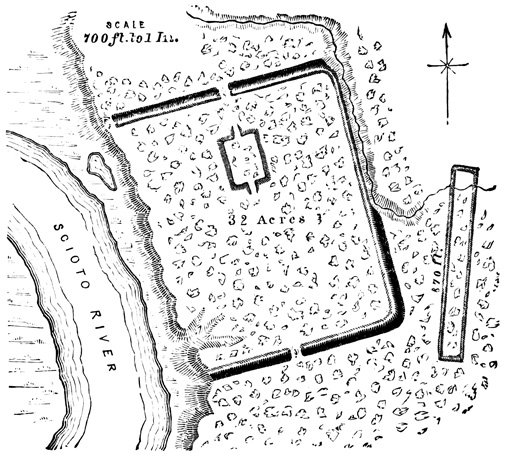
Cedar Bank Enclosures.
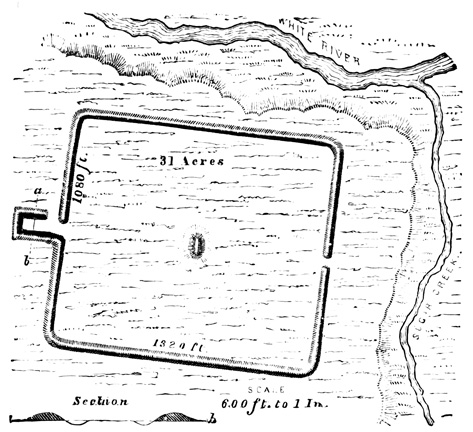
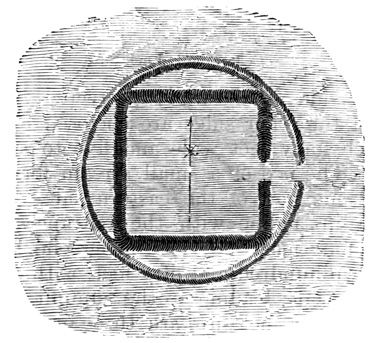
The enclosure shown in the next cut is that at Cedar Bank, near Chillicothe, Ohio, and seems to partake somewhat of the nature of a fortification. The west side is naturally protected by the river bank, and the other sides are enclosed by a wall and ditch, each forty feet wide and five to six feet high or deep. The bed of a small stream forms a natural ditch for one half of the eastern side. Within the enclosure in a line with the entrances is a raised platform four feet high, measuring one hundred and fifty by two hundred and fifty feet, with graded ways thirty feet wide, leading to the summit. The parallels outside the enclosure are three or four feet high. The earth-work in Randolph County, Indiana, is sufficiently explained by the cut. This work, like the preceding, would seem to have been constructed partially with a view to defence. The work shown in the next cut is part of a group in Pike County, Ohio. The circle is three hundred feet in diameter.
Parallel Embankments—Piketon.
Fortified Square—Indiana.
Earth-work in Pike County, Ohio.
EARTH-WORKS.
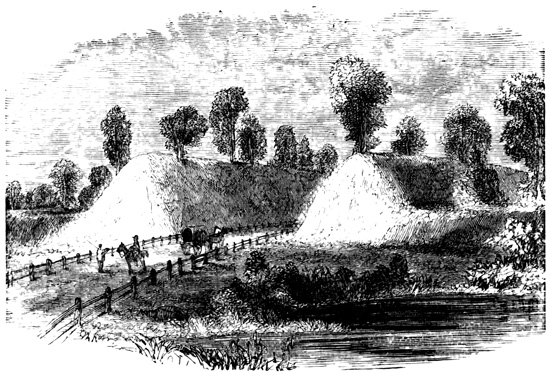
The different enclosures of a group are often connected by parallel embankments. Similar embankments protect the roads leading from fortified works to the river bank or other source of water. Many are not connected with any enclosures, though in their vicinity; and in such cases they are very slight, from seven hundred to eight hundred feet long, and sixty to eighty feet apart. Some of these parallels were very likely raised roads instead of enclosed ones, as on the Little Miami River, where the embankments extend about a quarter of a mile from two mounds, forming a semicircle round a third, being a rod wide and only three feet high. At Madison, Louisiana, there is a raised way three feet high, seventy-five feet wide, and two thousand seven hundred feet long, with broad excavations three feet in depth extending on both sides for about two thirds its length. Two parallel banks at Piketon, Ohio, are shown in the cut. They are ten hundred and eighty feet long, two hundred and three feet apart at one end, and two hundred and fifteen at the other; the height on the outside being from five to eleven feet, but on the inside twenty-two feet at one end. A modern carriage road now runs between the mounds. From the end of one of them a slight embankment extends twenty-five hundred and eighty feet to a group of mounds.
DITCHES AND MOUNDS.
In the north ditches seem never to occur, except with embankments; but in the south, where embankments are rarely if ever found, ditches, or moats, are sometimes employed to enclose other works, especially in Georgia. Such a moat at Carterville communicates with the river, extends to a pond perhaps artificial, and has two reservoirs, each of an acre, connected with it. The mounds and other monuments are located between the river and the moat. I have already spoken of the pits which furnished earth for the various works, sometimes called wells; some wells of another class, found in the bed of streams and supplied with round covers, were found by Mr Squier to be the natural casts of septaria, or imbedded nodules of hard clay.
The mound or heap form is the one most common in American antiquities as in those of nearly the whole world. Mounds are found throughout the Mississippi region as before bounded, and beyond its limits in many directions they merge into the small stone heaps which are known to have been thrown up by the Indians at road-crossings and over graves. They are most numerous in the upper Mississippi and Ohio valleys, in the same region where the embankments also most abound. As I have said, the number in Ohio alone is estimated at more than ten thousand. They are almost always found in connection with embankments and other works of the different classes described, but they are also very numerous in regions where enclosures rarely or never occur, as in Wisconsin and in the gulf states. From the central region about the junction of the Mississippi, Missouri, and Ohio, they gradually diminish in numbers in every direction, and also in size except perhaps towards the south. They are found in valley and plain, on hill-side and hill-top; isolated and in groups; within and without enclosures; and at long distances from other works. By their location alone no satisfactory classification could possibly be made; still, when considered in connection with their contents and other circumstances, their location assumes importance. By their forms the tumuli are classified as temple-mounds, animal-mounds, and conical mounds.
TEMPLE-MOUNDS.
Temple-mounds always have level summit platforms, and are supposed to have once supported wooden structures, although no traces of such temples remain. A graded road straight or winding, of gentler slope than the sides of the mound, often leads to the top; and in many cases the sides have one or more terraces. One in Tennessee, four hundred and fifty feet in diameter and fifty feet high, has ten clearly marked terraces, except on the east. The bases assume a variety of forms, square, rectangular, octagonal, round, oval, etc., but the curves and angles are always extremely regular. In the north they are usually within enclosures, but in the south, where they are most numerous, they have no embankments and are often arranged in groups, the smaller about a larger central mound. In size the temple-mounds vary from a height of five feet and a diameter of forty feet to ninety feet in altitude and a base-area of eight acres. In respect to form, material, structure, contents, and probable use they admit of no subdivision. Like the embankments they are made of earth, or rarely of stones, simply heaped up, with little care in the choice of material and none at all in the order of deposit.
The largest mound of this, or in fact of any, class is that at Cahokia, Illinois. Its base measures seven hundred by five hundred feet. The height is ninety feet. On one end above mid-height is a terrace platform one hundred and sixty by three hundred and fifty feet, and the summit area is two hundred by four hundred and fifty feet, or nearly two acres, the base covering over eight acres. On the top a small conical mound was found, with some human bones, a deposit of doubtful antiquity. A mound is described at Lovedale, Kentucky, as being of octagonal base, five feet high, with sides of a hundred and fifty feet, three graded ascents, and two conical mounds on its summit. Mr Jones states that parapet embankments, round the edge of the summit, sometimes occur on the southern temple-mounds.
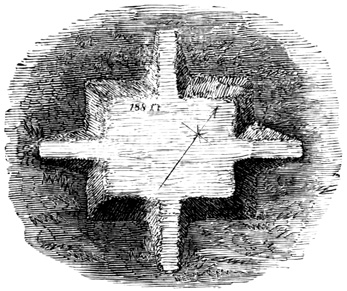
Temple-Mound—Marietta, Ohio.
At Marietta, Ohio, are four mounds like that shown in the cut, within a square enclosure. The height of this one is ten feet. The mound at Seltzerton, Mississippi, forty feet in height, covers nearly six acres, and has a summit area of four acres, on which are two conical mounds, also forty feet high and thirty feet in diameter. The base is surrounded with a ditch ten feet deep, an unusual feature. There are said to be large adobe blocks in the northern slope of this pyramid, and the same material is reported in other southern structures. These reports require additional confirmation.
The Messier Mound, in Early County, Georgia, differs in its location from most temple-mounds, standing on the summit of a natural hill which overlooks a broad extent of country. The artificial height is fifty-five feet, and the summit area sixty-six by one hundred and fifty-six feet. There are no traces of any means of ascent, and the slopes are very steep. A ditch extends in a semicircle from corner to corner at the southern end, and thence down the slope of the hill. An excavation of two acres, twenty-five feet deep on an average, seems to have furnished the earth for the mound. A round well, sixty feet in diameter and forty feet deep is found at one end of the excavation. A temple-mound in the Nacooche Valley, Georgia, is elliptical in form, and has a summit area of sixty by ninety feet.
An octagonal mound, forty-five feet high and one hundred and eighty feet in diameter at the top, is located on a hill-top opposite the city of Macon; it was formed of earth carried from the valley below. A temple-mound at Mason's Plantation, on the Savannah River, has been partly washed away by the water, which reveals along the natural surface of the ground a stratum a foot thick of charcoal, baked earth, ashes, broken pottery, shells, and bones of animals and birds, with a few human bones. The mound, which is of the surrounding alluvial soil, would seem to have been erected over a spot long occupied as an encampment. This mound, and another near it, were originally enclosed by a moat which communicated with the river, and widened on one side into a broad lagoon.
On Plunkett Creek, Georgia, is a mound of stones which has the appearance of a temple-mound, having a summit area forty feet in diameter. Stone is rarely used in structures of this class; perhaps this was originally a conical mound. There seem to be few large mounds in the south unaccompanied by ditches, which seem here to have been introduced where embankments would have been preferred in the north.
In a late number of the Cincinnati Quarterly Journal of Science I find described, unfortunately only on newspaper authority, a remarkable temple-mound, near Springfield, Missouri, on a hill three hundred feet high. It is of earth and stones, sixty two feet high, five hundred feet in diameter at the base and one hundred and thirty at the summit. A ditch, two hundred feet wide and five feet deep, surrounds the base, and is crossed by a causeway, opposite which a stairway of roughly hewn stones leads up the northern slope. The top is covered by a platform of stone, in the centre of which lies a stone ten by twelve feet, and eleven inches thick, hollowed in the middle. This report without further confirmation must be considered a hoax—at least so far as the stone steps, pavement, and altar are concerned.
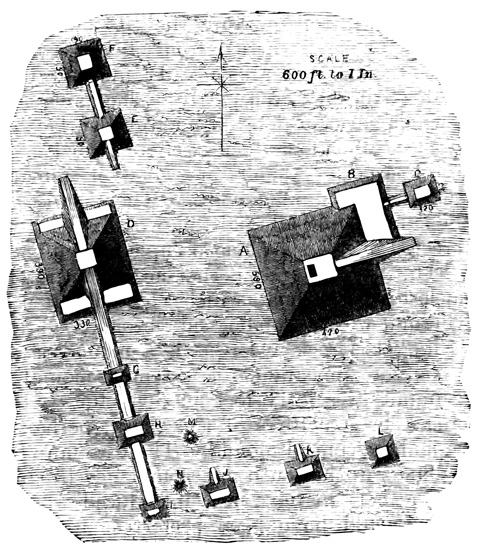
Mississippi Temple-Mounds.
The group of temple-mounds shown in the cut is in Washington County, Mississippi. Others similar in many respects to these are found at Madison, Louisiana.
Temple-mounds are homogeneous and never stratified in their construction, and contain no relics; that is, the object in their erection was simply to afford a raised platform, with convenient means of ascent.
Animal-mounds, the second class, are those that assume in their ground plan various irregular forms, sometimes those of living creatures, including quadrupeds, birds, reptiles, fishes, and in a few cases men. Mounds of this class are very numerous in the north-west, particularly in Wisconsin, and rarely occur further south, although there are a few excellent specimens in Ohio. They are most abundant in fertile valleys and rarely occur on the lake shore. Nine tenths of them are simple straight, curved, or crooked embankments of irregular form, slightly raised above the surface, bearing no likeness to any natural object. In many, fancied to be like certain animals, the resemblance is imaginary. Those shaped like a tapering club, with two knobs on one side near the larger end—a very common figure—are called 'lizard-mounds;' add two other protuberances on the opposite side and we have the 'turtle-mounds.' Yet a few bear a clear resemblance to quadrupeds, birds, and serpents, and all evidently belong to the same class and were connected with the religious ideas of the builders. They are not burial mounds, contain no relics, are but a few feet at the most above the ground, and are always composed of whitish clay, or the subsoil of the country. Their dimensions on the ground are considerable; rude effigies of human form are in some cases over one hundred feet long; quadrupeds have bodies and tails each from fifty to two hundred feet long; birds have wings of a hundred feet; 'lizard-mounds' are two and even four hundred feet in length; straight and curved lines of embankment reach over a thousand feet; and serpents are equally extensive. They are grouped without any apparent order together with conical mounds, occasional embankments, and few enclosures. They often form a line extending over a large tract. In some cases the animal form is an excavation instead of a mound, the earth being thrown up on the banks. An embankment in Adams County, Ohio, on the summit of a hill much like those often occupied by fortifications, is thought to resemble a monster serpent with curved body and coiled tail, five feet high, thirty feet wide in the middle, and over one thousand feet long if uncoiled. The jaws are wide open and apparently in the act of swallowing an oval mound measuring one hundred and sixty by eighty feet. On a hill overlooking Granville, Ohio, is a mound six feet high and a hundred and fifty feet long, thought to resemble the form of an alligator. Stones are rarely used with the earth in the construction of animal-mounds, and only in a few cases has the presence of ashes or other traces of fire been reported.
The third class of tumuli includes the conical mounds, mere heaps of earth and stones, so far as outward appearance is concerned, generally round, often oval, sometimes square with rounded corners, or even hexagonal and triangular, in their base-forms, and varying in height from a few inches to seventy feet, in diameter from three or four to three hundred feet. A height of from six to thirty feet and a diameter of forty to one hundred feet would probably include a larger part of them. Of course the height has been reduced and the base increased by the action of rains more or less in different localities according to the material employed. Mounds of this class never have summit platforms or any means of ascent. They are here as elsewhere in America much more numerous than other mounds. Although so like one to another in form, they differ widely in location and contents. They are found on hill-tops and in the level plain. In the former case they are either isolated, grouped round fortifications, or extend in long lines at irregular intervals for many miles, suggesting boundary lines or fire signals. In the valleys they stand alone, in groups, or in connection with sacred enclosures. The groups are sometimes symmetrical, as when a number of mounds are regularly arranged about a larger central one, or are so placed as to form squares, circles, and other regular figures; but often no systematic plan is observable. Also in connection with the enclosures part of them are symmetrically located with respect to entrances, angles, or temple-mounds; while others are scattered apparently without fixed order. There are few enclosures that do not have a mound opposite each entrance on the inside. A complete survey and restoration would probably show many mounds to belong to some regular system, that now appear isolated.
The material of the mounds requires no remark in addition to what has been said of other works. A large majority are simply heaps of the earth nearest at hand. Stone mounds, or those of mixed materials, are rare, and are chiefly confined to the hill-top structures. Most of the earth mounds are homogeneous in structure, but some are regularly and doubtless intentionally stratified. Some of them in the gulf states are composed of shells, in addition to the shell-mounds proper formed by the gradual deposit of refuse shells, the contents of which served as food.
CONTENTS OF THE MOUNDS.
The contents of the mounds should be divided into two great classes; those deposited by the Mound-builders, and those of modern Indian or European origin. The distinction is important, but difficult; and in this difficulty is to be found the origin of many of the extraordinary reports and theories. The Indians have always felt a kind of veneration for the mounds as for something of mysterious origin and purpose, and have used them as burial places. The Indian habit of burying with their dead such articles as were prized by them when living, is well known; as is also the value attached by them to trinkets obtained by purchase or theft from Europeans. Consequently articles of European manufacture, such as must have been obtained long before the country was to any great extent occupied by the whites, are often dug from the mounds and found elsewhere. The discovery of silver crosses, gun-barrels, and French dials, does not, however, as Mr Squier remarks, justify the conclusion that the Mound-builders "were Catholics, used fire-arms, or spoke French." The mounds are usually opened by injudicious explorers or by treasure-seekers, who have paid little attention to the location of the relics found or the condition of the surrounding soil. Museums and private collections are full of spurious relics thus obtained. It is certain in some cases, and probable in many more, that the mounds have been 'salted' with specimens with a view to their early investigation. Yet many mounds have been opened by scientific men, who have brought to light curious relics, surely the work of the Mound-builders. Such relics are found in the centre of the mounds, on or near the original surface of the ground, with the surrounding material undisturbed. In the stratified mounds any disturbance in the soil is easily detected, but with difficulty in the others. Reports of unusual relics should be regarded as not authentic unless accompanied by most positive proof.
Neither the embankments of sacred enclosures, the temple-mounds, nor the animal-mounds, have been proved to contain any relics that may be attributed to the original builders. Many of the conical mounds do contain such relics, and by their contents or the lack of them, are divided into altar-mounds, burial mounds, and anomalous mounds.
Altar-mounds are always found within or near enclosures, and each one is found to contain something like an altar, made of burned clay or stone. The altars are generally of fine clay brought from some distance, burned hard sometimes to a depth of twenty inches. They were not burned before being put in place, but by the action of fires built upon or round them. Such as were very slightly burned had no relics. The stone altars are very rare, and are formed of rough slabs, and not hewn from a single block. They are square, rectangular, round, and oval; vary in size from two feet in diameter to fifteen by fifty feet, but are generally from five to eight feet; are rarely over twenty inches high; rest on or near the surface of the ground, in the centre of the mound; and have a basin-shaped concavity on the top. The basin is almost always filled with ashes, in which are the relics deposited by the Mound-builders. Relics are much more numerous in the altar than in the burial mounds, but as they are of the same class, both may best be spoken of together. These altars are probably the structures spoken of by early explorers and writers as hearths; there are reports that some of them were made of burnt bricks.
A peculiarity of the altar-mounds is that they are formed of regular strata of earth, gravel, sand, clay, etc., which are not horizontal, but follow the curve of the surface. The outer layer is commonly of gravel. This stratification renders it easy to detect any modern disturbance of the mounds, and makes the altar relics especially interesting and valuable for scientific purposes. Over the ashes in one altar-mound, were found plates of mica and some human bones. Skeletons are often found near the surface of these mounds, the strata above them being disturbed; in one case the Indians had penetrated to the centre and deposited a body on the altar itself. Sir John Lubbock inclines to the opinion that these were really sepulchral rather than sacrificial mounds, although he had not personally examined them. Whatever their use, they certainly constitute a clearly defined class distinct from all others, and the name altar-mounds is as appropriate as any other.
BURIAL MOUNDS.
Unstratified mounds, never within enclosures and generally at some little distance from them, containing human remains in their centres and undoubtedly erected as places of sepulture, constitute the second class, and are called burial mounds. The custom of heaping up a mound over the dead was probably imitated for a long time by the tribes that followed the Mound-builders, so that the relics from these mounds are less satisfactory than those found on the altars. In the burial mounds that may be most confidently ascribed to the Mound-builders, the human remains are found in a situation corresponding to that of the altars. They are usually enclosed in a frame-work of logs, a covering of bark or coarse matting, or a combination of these, which have left only faint traces. Of the skeleton only small fragments remain, which crumble on exposure to the air. In some cases there are indications that the body was burned before burial. Each mound contains, as a rule, a single skeleton, generally but not always placed east and west. Where several skeletons are found together, they are sometimes placed in a circle with the heads towards the centre. The mounds never contain large numbers of skeletons, and cannot be regarded as cemeteries, but only as monuments reared over the remains of personages high in rank. Very few skulls or bones are recovered sufficiently entire to give any idea of the Mound-builders' physique, and these few show no clearly defined differences from the modern Indian tribes. Four or five burial mounds are often found in a group, the smaller ones in such cases being grouped round a larger central one, generally in contact with its base. Mr Lapham sketched mounds in Wisconsin where the body is deposited in a central basin-shaped excavation in the ground very much like those in Vancouver Island already described.
Of the eastern burial deposits not connected with the mounds I shall say very little. It has already been stated that the mounds were in no sense cemeteries. Only a favored few of what must have been a dense population were honored by these sepulchral monuments. Obliged to seek elsewhere the general depositories of the dead, we find them of various classes in large numbers; but as yet very little has been done towards identifying any of them as the resting-places of the Mound-builders. There are many bone-pits, or trenches filled with human bones, in the mound region; but some of the modern Indians are well known to have periodically collected and deposited in pits the bones of their dead. Large numbers of bodies have been found in the caves of Kentucky and Tennessee, well preserved by the natural deposits of saltpetre, and wrapped in skins, bark, or feather-cloth; but the fact that such cloths were made and used by the southern tribes, renders the origin of these bodies uncertain. Besides the caves and trenches there are regular cemeteries, some of them very extensive. Seven of these are reported about Nashville, Tennessee, within a radius of ten miles, each being about a mile in extent. The graves are of flat stones, lie in ranges, and contain skeletons much decayed, with some relics. The coffins, or graves, vary from two to six feet in length, and the smallest have sometimes been mentioned as indicating a race of pigmies; it is evident, however, that in such graves bones were not deposited until the flesh had been removed. Sometimes there are traces of wooden coffins, in other cases there are only stones at the head and feet, and often there is no trace of any coffin. A few graves contain relics similar to those in the altar-mounds, and were covered with large forest trees when first seen by Europeans. Yet the comparatively well-preserved skeletons, and the presence in many cases of iron and relics clearly modern, render it well-nigh impossible to decide which, if any, of these cemeteries contain the remains of the Mound-builders.
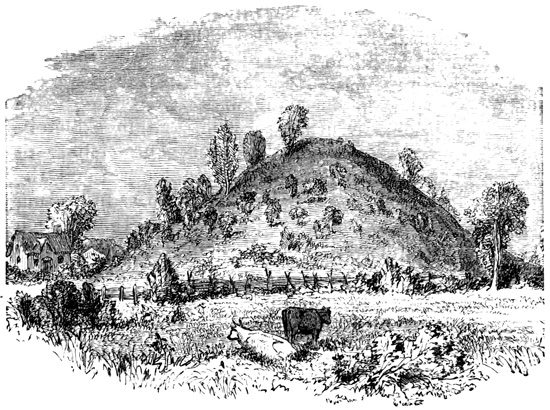
Mound at Miamisburg.
ANOMALOUS MOUNDS.
Mounds of the third class are called anomalous, and include all that are not evidently either altar or burial mounds, or which have some of the peculiarities of both classes; for instance, in an elliptical mound an altar was found in one centre, and a skeleton in the other. Most prominent among them are the hill-top heaps of earth, or—oftener than in the plains below—of stone. These have as a rule few original burial deposits, and no relics; are often near fortifications; and in many cases bear the marks of fire. Their use cannot be accurately determined, but they are generally regarded as watch-towers and fire signal stations. Of course, comparatively few of the whole number of conical mounds have been explored, but so far as examined they seem to be about equally divided between the three classes. The mound shown in the cut is at Miamisburg, Ohio, and its class is not stated. It is sixty-eight feet high and eight hundred and fifty feet in circumference. Shell-mounds abounding in relics of aboriginal work are very numerous in the gulf states.
I shall pass briefly over the minor relics of aboriginal art since it is impossible in this volume to present illustrative cuts of the thousands of objects that have been found, or even of typical specimens. Such relics as are incontestably the work of the Mound-builders include articles of metal, stone, earthen ware, bone, and shell. They include implements and ornaments, besides which many are of unknown use. Most of the smaller specimens, whose use is unknown, are called by Mr Dickeson and others aboriginal coins; perhaps some of them did serve such a purpose.
The only metals found in the mounds are copper and silver, the latter only in very small quantities. A few gold trinkets have been reported, but the evidence is not conclusive that such were deposited by the Mound-builders. Iron ore and galena occur, but no iron or lead.
Copper is found in native masses, and also hammered into implements and ornaments. There is no evidence that this metal was ever obtained from ore by smelting; it was all doubtless worked cold from native masses by hammering. Concerning the locality where it was procured, there is little or no uncertainty. The abundant deposits of native copper about Lake Superior naturally suggest that region as the source of the copper supply; the discovery of anciently worked mines strengthens the supposition; and the finding among the mounds of copper mixed with silver in a manner only found at Lake Superior, makes the matter a certainty. The modern tribes also obtained some copper from the same localities. The Mound-builders were ignorant of the arts of casting, welding, and alloying. They had no means of hardening their copper tools, being in this respect less advanced than the Nahuas and Mayas. In fact copper implements are much more rare than ornaments of the same metal. The implements include axes, hatchets, adzes, knives, spear-heads, chisels, drills, etc. Ornaments are in the form of rings, gorgets, medals, bracelets, and beads, with a large variety of small articles of unknown use, some of them probably used as money. Very small models of larger implements like axes are often found, and were doubtless worn as ornaments.
Silver is of much rarer occurrence than copper, was obtained probably from the same region, and is almost invariably found in the form of sheets hammered out very thin and closely wrapped about small ornaments of copper or shell. So nicely is the wrapping done that it often resembles plating. The gold whose discovery has been reported has been in the form of beads and so-called coins. Mr Dickeson speaks confidently of gold, silver, copper, and galena money left by the Mound-builders. There is no evidence that the use of iron was known, except the extreme difficulty of clearing forests and carving stone with implements of stone and soft copper.
ABORIGINAL POTTERY.
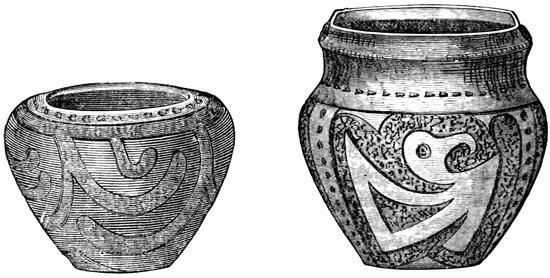
Earthen Vases from the Mounds.
Specimens of aboriginal pottery are very abundant, although much less so within the mounds than elsewhere near the surface. Mr Squier says, "various though not abundant specimens of their skill have been recorded, which in elegance of model, delicacy, and finish, as also in fineness of material, come fully up to the best Peruvian specimens, to which they bear, in many respects, a close resemblance. They far exceed anything of which the existing tribes of Indians are known to have been capable." The specimens in the mound-deposits are, with very few exceptions, broken. The material is usually a pure clay, sometimes with a slight admixture of pulverized quartz or colored flakes of mica, but such admixtures are much rarer than in modern specimens. Notwithstanding their great regularity of form and beauty of finish, none bear signs that the potter's wheel was used in their construction, and no vessels are glazed by vitrification. They are decorated with various graceful figures, including those of living animals, cut in with sharp instruments. A few crucibles, capable of withstanding intense heat, have been found, also terra-cotta images of animals and men, and ornaments or coins in small quantities. Pottery-kilns are found in the south, but that they were the work of the Mound-builders has not been satisfactorily proven. Specimens of the finer class of vases are shown in the cut. The first is of pure clay with a slight silicious mixture. It is five and a half inches high and six and a half in diameter, not over one sixth of an inch in uniform thickness, pierced with four holes in the line round the rim, dark brown or umber in color, and highly polished. The decorative lines are cut in with a sharp instrument which left no ragged edges. The second vase is of somewhat smaller size and coarser material; but more elaborately ornamented and only one eighth of an inch in thickness.
STONE IMPLEMENTS.
Stone implements are more abundant than those of any other material in the altar-mounds and elsewhere. They include arrow and spear heads, knives, axes, hatchets, chisels, and other variously formed cutting instruments, with hammers and pestles. These are made of quartz and other hard varieties of stone, all belonging to the mound region except the obsidian. There is no doubt that obsidian implements were used by the Mound-builders, and as this material is said not to be found nearer than Mexico and California, it is perhaps as likely that the implements were obtained by trade as that they were manufactured in the country. Neither the obsidian knives, nor other stone weapons, show any marked differences from those found in Mexico, Central America, and most other parts of the world. Lance and arrow heads, finished and in the rough, entire or more frequently broken by the action of fire, are taken by hundreds and thousands from the altar-mounds; several bushels of lance-heads of milky quartz were found in one mound. It is a remarkable fact, however, that no weapons whatever are found in burial mounds. Beads, rings, and other ornaments of stone are often found, with a variety of anomalous articles whose use is more or less imperfectly understood. Besides weapons and knives, pipes are the articles most abundant, and on which the Mound-builders expended most lavishly their skill, carving the bowls into a great variety of beautiful forms, at what must have been an immense outlay of labor. A remarkable peculiarity of their pipe-carvings is that accurate representations are given of different natural objects instead of the rude caricatures and monstrosities in which savage art usually delights. Nearly every beast, bird, and reptile indigenous to the country is truthfully represented, together with some creatures now only found in tropical climates, such as the lamantin and toucan. The pipes generally consist of a bowl rising from the centre of the convex side of a curved base, one end of which serves as a handle and the other is pierced for a stem. They are always cut from a single piece, the material being generally a hard porphyry, oftenest red, and strongly resembling in some cases the red pipe-stone of the Coteau des Prairies. The locality where this pipe material was obtained is unknown. Many of the sculptured figures show skillful workmanship and a high polish; I think that many of them are not inferior to the products of Nahua and Maya skill. Some rude stone images of unknown use have been found at various points, but I am not aware that any relics have been authentically reported from the altar-mounds which indicate that the ancient people were worshipers of idols. Mica is the mineral most common in both altar and burial mounds, where it occurs in plates cut into a great variety of forms. Some of them have been conjectured to have served as mirrors. Bushels are sometimes deposited in a single mound. Pieces of coal artificially formed are included by Dickeson among his aboriginal coins.
Bones of indigenous animals are found worked into daggers, awls, and similar implements; or as ornaments in the form of beads. Similar use was made of the teeth and talons of beasts and birds. Teeth of the bear, wolf, panther, alligator, and shark, have been found, some of the latter being fossils, together with large quantities of teeth resembling those of the whale, but not fully identified.
Five varieties of marine shells, all from the gulf shores, have been examined, with pearls whose size and numbers prove that they are not of fresh-water origin. Both are used for ornaments, chiefly in the form of beads. Pearls are also found in a few instances serving as eyes for animal and bird sculptures. Some articles of bone and shell have been mistaken for ivory and accredited with an Asiatic origin, through ignorance that their material is found on the shores of the gulf. Many articles found in the mounds, and not perhaps included in the preceding general description, are interesting, but could only be described in a detailed account, for which I have no space; but most relics not thus included are of doubtful authenticity, and a doubtful monument of antiquity should always be attributed to modern times.
ANCIENT MINES.
The ancient miners have left numerous traces of their work in the region of Lake Superior. At one place a piece of pure copper weighing over five tons was found fifteen feet below the surface, under trees at least four hundred years old. It had been raised on skids, bore marks of fire, and some stone implements were scattered about. There is no evidence that the tribes found in possession of the country by the first French missionaries ever worked these mines, or had any tradition of a people that had worked them, although both they and their ancestors had copper knives hammered from lumps of the metal, which are very commonly found on the surface. All the traditions and Indian stories of 'mines' may most consistently be referred to these natural superficial deposits. The ancient mines were for the most part in the same localities where the best modern mines are worked. Most of them have left as traces only slight depressions in the surface, the finding of which is regarded by prospectors as a tolerably sure indication of a rich vein of copper. The cut represents a section of one of the veins of copper-bearing rock worked by the ancient miners. The mass of copper at a weighed about six tons. At the top a portion of the stone had been left across the vein as a support. Copper implements, including wedges used in mining as 'gads,' are found in and about the old mines; with hammers of stone, mostly grooved for withe handles. Some weigh from thirty to forty pounds and have two grooves; others again are not grooved at all. In one case remains of a handle of twisted cedar-roots were found, and much-worn wooden shovels often occur. There are no enclosures, mounds, or other traces of a permanent settlement of the Mound-builders in the mining region. It is probable that the miners came each summer from the south; in fact, it would have been impossible to work the mines in winter by their methods.
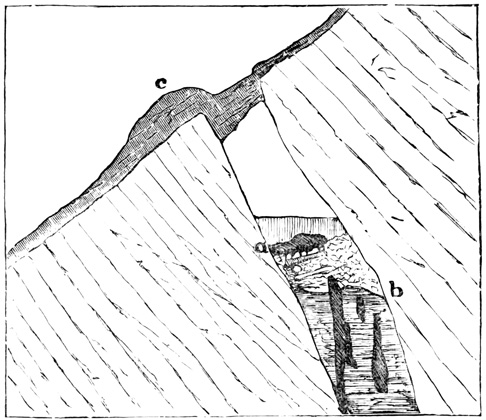
Section of an old Copper Mine.
ROCK-INSCRIPTIONS.
Nearly all the coins, medals, stone tablets, etc., that have been discovered within the region occupied by the Mound-builders, bearing inscriptions in regular apparently alphabetic characters, may be proved to be of European origin; and the few specimens that do not admit of such proof should of course be attributed to such an origin in the absence of conclusive evidence to the contrary. Rude delineations of men, animals, and other recognizable objects, together with many arbitrary, perhaps conventional, characters, are of frequent occurrence on the walls of caves, on perpendicular river-cliffs, and on detached stones. They are sometimes incised, but usually painted. Most bear a strong resemblance to the artistic efforts of modern tribes; and those which seem to bear marks of a greater antiquity, have by no means been identified as the work of the Mound-builders. These eastern rock-inscriptions do not call for additional remarks, after what has been said of similar carvings in other regions. Many of the figures have a meaning to those who make them, but that meaning, as in all writings of this class, perishes with the artist and his immediate times. Attempts by zealous antiquaries to penetrate the signification of particular inscriptions—as that on Dighton Rock, Massachusetts, and other well-known examples—have failed to convince any but the determined advocate of such theories as seem to derive support from the so-called translation. My father saw a stone tablet taken from a stone mound near Newark, covered with carved characters, which the clergyman of the town pronounced to be the ten commandments in ancient Hebrew. I have no doubt that the figures did closely resemble the ancient Hebrew in one respect at least—that is, in being equally unfamiliar to the clergyman.
CONCLUSIONS.
Without taking up here the various theories respecting the origin, history, and disappearance of the Mound-builders, it may be well to express in a few brief conclusions what may be learned of this people by an examination of the monuments which they have left.
They were a numerous people, as is sufficiently proved by the magnitude and geographical extent of their works. They were probably one people, that is, composed of tribes living under similar laws, religion, and other institutions. Such variations as are observed in the monuments are only those that would naturally occur between central and frontier regions, although the animals-mounds of the north-west present some difficulties. The Mound-builders were an agricultural people. Tribes that live by hunting never build extensive public works, neither would the chase support a sufficiently large population for the erection of such works. Moreover, the location of the monuments in the most fertile sections goes far to confirm this conclusion. Some of the larger enclosures have been supposed,—only by reason of their size, however,—to have been cultivated fields; and evident traces of an ancient cultivation are found, although not clearly referable to the Mound-builders.
There is nothing to show an advanced civilization in the modern sense of the word, but they were civilized in comparison with the roving hunter-tribes of later times. They knew nothing of the use of metals beyond the mere hammering of native masses of copper and silver; they built no stone structures; they had seemingly made no approach to the higher grades of hieroglyphic writing. Their civilization as recorded by its material relics consisted of a knowledge of agriculture; considerable skill in the art of fortification; much greater skill than that of the Indians in the manufacture of pottery and the carving of stone pipes; the mathematical knowledge displayed in the laying-out of perfect circles and accurate angles, and in the correspondence in size between different works. Their earth-works show more perseverance than skill; no one of them necessarily implies the use of mechanical aids to labor; there is none that a large number of men might not construct by carrying earth in simple baskets.
All traces of their architecture have disappeared. It has been suggested that were the temples yet standing on their pyramidal foundations, they might compare favorably with those of Central America and Mexico. But the construction of wooden edifices with any pretensions to grandeur and symmetry, by means of stone and soft copper tools, seems absolutely impossible; at least such structures would require infinitely greater skill than that displayed by the Nahuas and Mayas, and it is more reasonable to suppose that the temples of the Mound-builders were rude wooden buildings.
The monuments imply a wide-spread religious system under a powerful priesthood; private devotion manifests itself on a scale less magnificent, and one involving less hard work. Of their rites we know nothing. The altar-mounds suggest sacrifice; burned human bones, human sacrifice. Gateways on the east, and the east and west direction of embankments and skeletons may connect worship with the sun; but all is conjecture. No idols, known to be such, have been found; the cemeteries, if any of them belong to the Mound-builders, show no uniform usage in burial. The ancient people lived under a system of government considerably advanced, more than likely in the hands of the priesthood, but of its details we know nothing. A social condition involving some form of slavery would be most favorable for the construction of such works.
The monuments described are not the work of the Indian tribes found in the country, nor of any tribes resembling them in institutions. Those tribes had no definite tradition even of past contact with a superior people, and it is only in the south among the little-known Natchez, that slight traces of a descent from, or imitation of, the Mound-builders appear. Most and the best authorities deem it impossible that the Mound-builders were even the remote ancestors of the Indian tribes; and while inclined to be less positive than most who have written on the subject respecting the possible changes that may have been effected by a long course of centuries, I think that the evidence of a race locally extinct is much stronger here than in any other part of the continent.
The monuments are not sufficient in themselves to absolutely prove or disprove the truth of any one of the following theories: 1st. An indigenous culture springing up among the Mississippi tribes, founded on agriculture, fostered by climate and other unknown circumstances, constantly growing through long ages, driving back the surrounding walls of savagism, but afterwards weakened by unknown causes, yielding gradually to savage hordes, and finally annihilated or driven in remnants from their homes southward. 2d. A colony from the southern peoples already started in the path of civilization, growing as before in power, but at last forced to yield their homes into the possession of savages. 3d. A migrating colony from the north, dwelling long in the land, gradually increasing in power and culture, constantly extending their dominion southward, and finally abandoning voluntarily or against their will, the north for the more favored south, where they modified or originated the southern civilization.
The last theory, long a very popular one, is in itself less consistent and receives less support from the relics than the others. The second, which has some points in common with the first, is most reasonable and best supported by monumental and traditional evidence. The temple-mounds strongly resemble in their principal features the southern pyramids; at least they imply a likeness of religious ideas in the builders. The use of obsidian implements shows a connection, either through origin, war, or commerce, with the Mexican nations, or at least with nations who came in contact with the Nahuas. There are, moreover, several Nahua traditions respecting the arrival on their coasts from the north-east, of civilized strangers. There is very little evidence that the Mound-builders introduced in the south the Nahua civilization, and none whatever that the Aztec migration started from the Mississippi Valley, but I am inclined to believe that there was actually a connection between the two peoples; that the Mound-builders, or those that introduced their culture, were originally a Nahua colony, and that these people may be referred to in some of the traditions mentioned. Without claiming to be able to determine exactly the relation between the Mound-builders and Nahuas, I shall have something further to say on this subject in another volume.
ANTIQUITY OF THE MONUMENTS.
The works were not built by a migrating people, but by a race that lived long in the land. It seems unlikely that the results attained could have been accomplished in less than four or five centuries. Nothing indicates that the time did not extend to thousands of years, but it is only respecting the minimum time that there can be any grounds for reasonable conjecture. If we suppose the civilization indigenous, of course a much longer period must be assigned to its development than if it was introduced by a migration—or rather a colonization, for civilized and semi-civilized peoples do not migrate en masse. Moreover a northern origin would imply a longer duration of time than one from the south, where a degree of civilization is known to have existed.
How long a time has elapsed since the Mound-builders abandoned their works? Here again a minimum estimate only can be sought. No work is more enduring than an embankment of earth. There is no positive internal proof that they were not standing one, five, or ten thousand years ago. The evidences of an ancient abandonment of the works, or serious decline of the builders' power, are as follows:—1st, the fact that none of them stand on the last-formed terrace of the rivers, most on the oldest terrace, and that those on the second bear in some cases marks of having been invaded by water. The rate of terrace-forming varies on different streams, and there are no sufficient data for estimating in years the time required for the formation of any one of the terraces, at least scientific men are careful not to give a definite opinion in the matter; but it is evident that each required a very long period, and the last one a much longer time than any of the others, on account of the gradual longitudinal leveling of the river-beds. 2d. The complete disappearance of all wooden structures, which must have been of great solidity. 3d. The advanced state of decomposition of human bones in a soil well calculated for their preservation. Skeletons are found in Europe well preserved at a known age of eighteen hundred years. 4th. The absence of the Mound-builders from the traditions of modern tribes. Nothing would seem more likely to be preserved in mythic or historic traditions than contact with a superior people, and the mounds would serve to keep the traditions alive. 5th. The fact that the monuments were covered in the seventeenth century with primitive forests, uniform with those which covered the other parts of the country. In this latitude the age of a forest tree may be much more accurately determined than in tropical climates; and trees from four to five hundred years old have been examined in many well-authenticated cases over mounds and embankments. Equally large trees in all stages of decomposition were found at their feet on and under the ground, so that the abandonment of the works must be dated back at least twice the actual age of the standing trees. It is a fact well known to woodsmen that when cultivated land is abandoned the first growth is very unlike the original forest, both in the species and size of the trees, and that several generations would be required to restore the primitive timber. Consequently a thousand years must have passed since some of the works were abandoned. The monuments of the Mississippi present stronger internal evidence of great antiquity than any others in America, although it by no means follows that they are older than Palenque and Copan. The height of the Mound-builders' power should not, without very positive external evidence, be placed at a later date than the fifth or sixth century of our era.