Volume 4 — CHAPTER IX. ANTIQUITIES OF THE CENTRAL PLATEAUX. (continued 2)
Reading edition
The excavation, or gallery, already referred to, extends about twenty-five feet on an incline into the pyramid from an entrance on the southern slope, between the second and third terraces according to Mayer, about sixty-nine feet above the base according to Almaraz. It is large enough to permit the passage of a man on hands and knees, and at its inner termination are two square wells, walled with blocks of volcanic tufa three inches thick, or, as Mayer says, of adobes,—about five feet square, and one of them fifteen feet deep. No relics whatever have been found in connection with gallery or wells; Almaraz speaks of the former as simply excavations by treasure-hunters, and mentions only one well, without stating its location with respect to the gallery. Mr Löwenstern states that the gallery is a hundred and fifty-seven feet long, increasing in height to over six feet and a half, as it penetrates the pyramid; that the well is over six feet square, extending apparently down to the base and up to the summit; and that other cross galleries are blocked up by débris. Still lower on this slope, at the very base according to the plan, is a small mound like those scattered over the plain to be described later. Mr Bullock claims to have found on the summit, in 1823, walls of rough stones, eight feet high and three feet thick, forming a square enclosure fourteen by forty-seven feet, with a doorway on the south, and three windows on each side. This author's unsupported statements may be taken always with some allowance for the play of his imagination.
HOUSE OF THE SUN.
Some eight hundred and seventy-five yards south of the House of the Moon, between it and the Rio San Juan, at B of the plan, stands the Tonatiuh Itzacual, or 'house of the sun,' also called sometimes in tradition, according to Brasseur and Veytia, Tonacatecuhtli, 'god of subsistence.' In material, form, and construction, it is precisely the same, so far as my authorities go, as its northern companion; indeed, many of the remarks which I have quoted in the preceding description, were applied by the authors to both pyramids alike. Its dimensions are, however, considerably larger, and its sides vary about sixteen degrees from the cardinal points. It measures at the base seven hundred and thirty-five feet from east to west, and is two hundred and three feet high. Beaufoy estimated the size of the summit platform at sixty by ninety feet.[IX-81]
This pyramid is in better condition than the other, and the three terraces are plainly visible, although as before no one but Almaraz has discovered that they do not extend completely round the four sides, and the latter author states that the zigzag path on the eastern slope is much more clearly defined and makes more angles than that on the House of the Moon. Beaufoy found a path leading up the slope at the north-west corner, and Humboldt's remarks about a stairway of stone blocks may apply to this pyramid as well as to the other. Bullock states that the second terrace is thirty-eight feet wide. There are no traces of buildings on the summit or of galleries in the interior, but this, like the other pyramid, has a small mound on one of its sides near the base, and this mound seems to have embankments connecting it with the road on the west. The House of the Sun is also surrounded on the north, south, and east, according to the report of the Mexican commission, by the embankment a, b, c, d, which is a hundred and thirty feet wide on the summit, and twenty feet high, with sloping sides, widening out at the extremities, a and d, into unequal rectangular platforms. It is certainly very remarkable that among the many visitors to Teotihuacan no one had found any traces of this embankment before 1864.
Twelve hundred and fifty yards still further south across the stream is the Texcalpa, 'citadel,' 'palace,' or 'stone house,' as it is called, or defined, by different writers. The Citadel is a quadrangular enclosure, whose sides measure twelve hundred and forty-six and thirteen hundred and thirty-eight feet respectively, or nine hundred and eighty-four feet square according to Linares, and are exactly parallel with those of the Pyramid of the Sun. The enclosing walls, or embankments, are two hundred and sixty-two feet thick and thirty-three feet high, except on the west side, where it is but sixteen feet high; their material not being mentioned, but presumably the same as that of the pyramids. A cross-embankment of smaller dimensions divides the square area into two unequal parts, and on its centre stands a smaller pyramid, said by Linares to be ninety-two feet high, in ruins, having traces of a stairway, or path, on its eastern slope. Two small mounds stand at the western base of the small pyramid, one is found in the western enclosure, and fourteen, averaging twenty feet in height, are symmetrically arranged on the summit of the main embankments, as shown in the plan. The Citadel in some of its features seems to bear a slight resemblance to the works at Tenampua, in Honduras, and at Monte Alban, in Oajaca.[IX-82]
PATH OF THE DEAD.
Just south of the House of the Moon a line of mounds, C D, forms nearly a circular enclosure about six hundred feet in diameter, with a small mound in the centre. From this area two parallel lines of mounds extend south 15° west, parallel also with the sides of the House of the Sun and Citadel, for two hundred and fifty rods to the Rio San Juan, forming an avenue two hundred and fifty feet wide, called by the natives, as in the Toltec traditions, Micaotli, 'path of the dead.'[IX-83] The mounds that form this avenue are of conical or semispherical form, and of different dimensions, the largest being over thirty feet in height. They are built of stone fragments, earth, and clay, and stand close together, so as to resemble in some parts a continuous embankment. Six cross-embankments divide the southern part of the Path of the Dead into compartments, three of which have a mound in their centre. Linares represents the avenue as extending four or five miles beyond the House of the Moon, to the Cerro de Tlaginga; and Mayer in his plan terminates it on the south at a point opposite the House of the Sun, where it is crossed by the modern path.
MOUNDS OF TEOTIHUACAN.
Besides the mounds, or tlalteles that form the Path of the Dead, there are numerous others of the same form and material—being, so far as known, mere heaps of stone and earth—scattered over the plain, some of them in lines or groups, with an approach to regularity, and others with no apparent arrangement. They vary in height from four or five to twenty-five or thirty feet. Respecting these tlalteles I quote from Almaraz as follows: "In them many excavations have been made, causing most of the dilapidation which is noted; some of them executed for scientific purposes in search of archæological objects; others made by ignorant and rapacious persons, impelled by a hope of finding falsely reported treasures: Neither have there been wanting, and this is the cause of most of the destruction, persons of evil intentions who undertake to demolish the ruins in order to obtain the hewn blocks of porphyry which are used in the construction of their barbarous dwellings; and they do not even preserve the blocks, but break and destroy them; in this manner have perished relics truly precious. Almost under my eyes there were taken from one of the tlalteles eight hewn blocks four by three and a half feet; the outer faces were sculptured, representing a strange and grotesque figure, with the head of a serpent and of some other fierce animal, like a tiger or lion; they were curved on the outside, and all must have formed a circular monument seventeen feet in diameter; they were broken up without pity, although I was able to make a drawing of one of them. In the same tlaltel were other sculptured stones.... In the houses of San Juan de Teotihuacan are seen some of these sculptures built into the walls, and in the Ventilla, near the ruins, I have seen stones representing in my opinion a serpent.... Of all the objects of this class the most notable is a monolith found among the débris of a tlaltel, and of which I give a drawing [see next page.] It is a parallelopipedon ten feet and a half high, and five feet and a half wide and thick," weighing, according to the author's calculations, over fifteen tons. "I had an excavation made in one of the smallest, and found four walls meeting at right angles and forming a square; they are inclined, and within are found some steps which are parallel to it [the square]; in the upper part of these, begin four other walls also inclined, containing a little room:—I thought it was a tomb, although I have some doubts about its true object."[IX-84] The people of the vicinity said that in one of the mounds there had been found a stone box containing a skull, beads, and various curious relics of beryl, serpentine, heliotrope, and obsidian. They also claimed to have found quantities of gold-dust and gold vases.
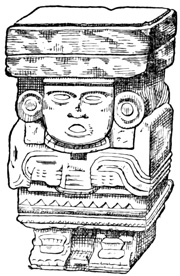
Monolith from a Teotihuacan Mound.
Humboldt speaks of hundreds of these mounds arranged in streets running exactly east and west and north and south from the pyramids. Mayer's plan represents a square area partly enclosed by a line of tlalteles north-east of the House of the Moon. According to Latrobe, the mounds extend for miles towards Tezcuco; and Waddy Thompson is confident that they are the ruins of an ancient city nearly as large as Mexico. The Citadel he calls the public square of twenty acres with a stone building in the centre, and he also finds traces of several other smaller squares. The streets are marked by large piles of rock resembling—except in size—potato-hills, formed by falling buildings. In the opinion of this author it is simply absurd to suppose these heaps to have been formed as separate mounds. Thompson also found a number of circular niches two feet in diameter on the bank of a ravine west of the other remains.[IX-85]
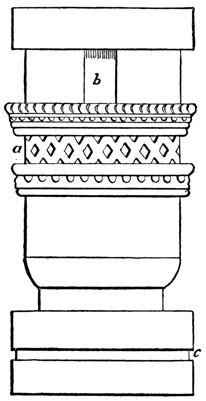
The Fainting-Stone at Teotihuacan.
Mayer found, near i of the plan—as nearly as can be determined by his plan, which differs considerably in detail from the one I have given—a globular mass of granite nineteen feet eight inches in circumference; also, near m, the stone block shown in the cut. It is ten feet and a half long, five feet wide, lies exactly east and west, and is found in the centre of a group of small mounds. The cut shows the sculpture on the face turned toward the south, that on the top and north being very indistinct. At b of the cut is a hollow described as three inches deep at the sides, and six at top and bottom. Notwithstanding Col. Mayer's opinion to the contrary, it is most natural to regard this monument as an overturned pillar. The natives believe that whoever sits or reclines on this stone will immediately faint.[IX-86]
MISCELLANEOUS RELICS.
At the time of the Conquest statues of the sun and moon are reported to have been found on the summits of their respective pyramids. The gold plates which are said to have covered or decorated these idols were of course immediately appropriated by the Spanish soldiers, and the idols themselves broken by order of the priests. Gemelli Careri claims to have seen fragments of their arms and legs at the base of the pyramid, and Ramon del Moral assured Veytia that he had found the colossal head of the statue of the moon, and that the pedestal still remained in place; Veytia, however, could find no traces of such relics in 1757, although Ixtlilxochitl and Boturini both claim to have seen them.[IX-87] Mayer claims to have found well-defined traces of an ancient road covered with cement, between the ruins and the village. The whole surfaces of the pyramids, mounds, and much of the surrounding plain, are literally strewn with the fragments of pottery and obsidian; and small terra-cotta heads are offered to the visitor in great quantities for sale, by the natives, who pick them up among the ruins, or perhaps manufacture them when their search is not sufficiently fruitful. Many of these heads have been brought away and sketched, and they are very similar one to another. One of them, sketched by Mr Vetch, is shown in the cut.[IX-88]
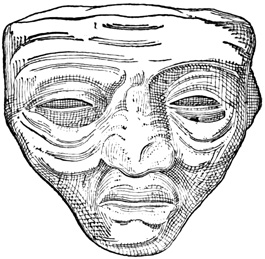
Terra-Cotta Head—Teotihuacan.
The ruins of Teotihuacan, like the pyramid of Cholula, contain no internal evidences of their age. Its building is attributed in different records to the Toltecs, Olmecs, and Totonacs, in the very earliest period of Nahua supremacy. The name Teotihuacan is one of the very earliest preserved in Nahua annals, and there can be but little doubt that the pyramids are older than that of Cholula, or that they were built at least as early as the sixth century, the commencement of what is regarded as the Toltec era in Anáhuac. The pyramids themselves served, according to tradition, as places of sepulture, but not altogether for this purpose, for Teotihuacan is spoken of as a great centre of religious worship and priestly rites, a position it would not have held had it been simply a burial place. It is altogether probable that the houses of the Sun and Moon served the double purpose of tombs and shrines, although there is no proof that any temples proper ever stood on the summit as at Cholula. These structures are said to have served as models for the Aztec teocallis of later times. Don Lucas Alaman, a distinguished Mexican statesman and author, believed that the numerous terra-cotta heads already spoken of were relics distributed by the priests to the crowds of pilgrims that assembled at the shrines.[IX-89]
At Otumba few relics of antiquity seem to have been discovered; Mayer, however, gives a cut of a pillar ornamented with geometric sculptured figures, which is said to have been found by Mr Poinsett. At Tizayuca, a little north of the lake, a low hill is spoken of with a small hole in the top, whence issues continually a current of air; I know not whether there are evidences of anything artificial about this curious phenomenon of more than doubtful authenticity. The same authority also mentions some ruined buildings on the hacienda of San Miguel.[IX-90] Brasseur de Bourbourg tells us that the ruins of Quetzalcoatl's temple at Tulancingo were visible long after the Conquest, and also speaks of a subterranean palace called Mictlancalco, and a stone cross discovered on Mount Meztitlan. Veytia also speaks of the cross of Meztitlan, sculptured together with a moon on a lofty and almost inaccessible cliff; and Chaves barely mentions relics of antiquity not described very definitely.[IX-91]
OBSIDIAN MINES.
At the Cerro de las Navajas, near Monte Jacal, about midway between Real del Monte and Tulancingo, are the mines or quarries from which the natives of Anáhuac are believed to have obtained the large quantities of obsidian used by them in the manufacture of their implements and weapons. The mines are described as openings three or four feet in diameter and one hundred and ten to one hundred and forty feet in extent, probably horizontal, with side drifts wherever the obsidian is of a desirable quality and most abundant. Large quantities of the material are found in fragments of different shapes and sizes, which throw some light on the manner in which the Aztecs manufactured their knives and other implements.[IX-92] In the vicinity of Actopan, at Mixquiahuala, we are told in a Mexican government report already often quoted, that clay relics are frequently discovered.[IX-93] At Atotonilco el Grande, south of Guautla, Mr Burkart found pieces of obsidian of many-sided pyramidal form, from which knives had apparently been split off by the natives in ancient times. The art of working this intractable material has been practically lost in modern times.[IX-94]
At Zacualtipan, in the north-eastern portion of Mexico, a very peculiar monument is described, consisting of a house excavated from a single stone. A doorway on the south, with columns at its sides, leads to an apartment measuring about twelve by seven and a half feet, and ten feet and a half high. The room contains the remains of a kind of altar and a sculptured cross. A stone bench extends round the sides, being two feet high and one foot wide. This main room is connected by a doorway on the west with another very narrow one, in the south end of which is what is described as a kind of stone bed measuring three by six feet, all of the same stone. Another stone near by has a bath, so-called, and still another, known as Caparrosa, has an inscription painted in red. These remains are of so extraordinary a character, that in the absence of confirmation the report must be considered doubtful or erroneous. At Tecomal, north of Lolotla, a stone is mentioned six feet high, which has six steps leading up to the summit, where is an oval hole a yard and a half deep.[IX-95] At Monte Penulco Mr Latrobe speaks of some remains probably of Spanish origin, like many others that are attributed to the antiguos.[IX-96]
Near San Juan de los Llanos, in the extreme north-eastern part of the state, some forty leagues from the city of Mexico, the existence of a ruined city was reported late in the eighteenth century on apparently good authority; but I find no later mention of it. The description bears some resemblance to that of Metlaltoyuca, discovered in 1865, just across the line in Vera Cruz, twenty-five or thirty miles north-east from San Juan. The two groups of remains may be identical, or the earlier report may refer to other monuments, many of which very probably exist yet undiscovered in that densely wooded district. The ruined city near San Juan was described in 1786, by Sr Cañete, as covering an area of one league by three fourths of a league, surrounded by walls of hewn stone laid without mortar, five to eight feet high and very thick. A street running from east to west was paved with volcanic stone, worn smooth, and guarded by battlements, or side walls. Several ruined temples, sculptured blocks of stone, stone metates and other implements, stone statues of men and animals—including a lion—were found here, but all of a rather coarse workmanship. A tall pine was growing on the summit of one of the temples, and there seemed to be some evidence that the town had been abandoned for want of a supply of water.[IX-97]
REMAINS AT TULA.
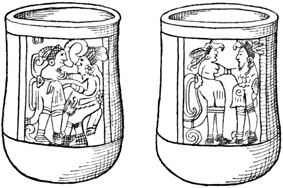
Earthen Vase—Tula.
At Tula, north-west of the city of Mexico, the ancient Tollan, the Toltec capital, we are told that extensive ruins remained at the time of the Conquest,[IX-98] but very few relics have survived to the present time, although some of the few that have been found here are of a somewhat extraordinary character. The cut shows both sides of an earthen vase from Tula, which, as Mayer says, is "of exquisitely grained and tempered material, and ornamented with figures in intaglio, resembling those found on the monuments in Yucatan."[IX-99] Villa-Señor y Sanchez, one of the early Spanish writers, names Tula as one of the many localities where giants' bones had been found.[IX-100] A commission from the Mexican Geographical Society, composed of Drs Manfred and Ord,—the latter an old resident of California, who takes a deep interest in the antiquities and history of the Pacific States—with Mr Porter C. Bliss,—whose large collection of Mexican works, with some curious relics of antiquity, has been lately added to my library—and Sr García y Cubas, made an exploration of Tula and vicinity in 1873, bringing to light some interesting monuments, of which an illustrated account was published in the Boletin of the society. The cut shows a very curious double column of basalt, somewhat over eight feet high. The sculptured knots are interpreted by the commissioners mentioned as the tlalpilli, or periods of thirteen years. None of them occur on the reverse of the column. Other relics discovered by this party included half of what seemed to be a kind of calendar-stone, a large animal in basalt or monster idol, and some hieroglyphic sculptures on the cliff of the Cerro de la Malinche. There were also found the three fragments shown in the cut, which are interesting as showing an aboriginal method of forming columns not elsewhere met with in America, a round tenon on one part fitting closely into a hole in the next. The largest of the three parts shown is four feet long and two and three fourths feet in diameter. The material is basalt and the sculpture is said to be well done. Most of the Tula relics were found at the Cerro del Tesoro, west of the modern village.[IX-101]
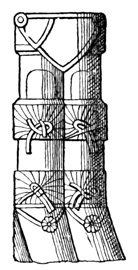
Basaltic Column—Tula.
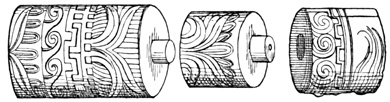
Parts of a Column—Tula.
Gondra speaks of fine pieces of basalt and other stone, about nine feet long, recently discovered on the hacienda of Tlahuililpan near Tula, leaving it to be inferred that the blocks were artificially shaped if not sculptured.[IX-102] Another author says that on the same hacienda an idol six feet high has been found,[IX-103] and mentions some ruins of dwellings about Jacala in the Tula district, especially at Santa María de los Alamos and Cerro Prieto, and also a pillar in the middle of the Rio de Montezuma.[IX-104] Other remains vaguely reported to exist in this part of the state include a subterranean arch at Huehuetoca, between Mexico and Tula, built by the natives to keep the water from the capital; and a group of ruins at Chilcuautla, among which are those of a temple of stone and mortar, and a pyramid fifty-five feet long and seven feet high, with steps in a good state of preservation.[IX-105]
Still further north-west in the state of Querétaro, three groups of antiquities are reported, but very inadequately described. At Pueblito a league and a half south of the city of Querétaro, said to have been a favorite resort for Mexican tourists and invalids in the last century, there stood on a natural elevation, in 1777, the foundations of a large rectangular building. The walls were built of stones laid in clay, and were not, when visited, standing above the level of the ground, one or two feet having been, however, brought to light by excavation. On the east and west of the main building were two smaller ones, from which many idols and other relics, including round polished stones pierced through the centre, are said to have been taken. A pavement of clay is also spoken of in connection with these ruins. On the same elevation stood an artificial sugar-loaf-shaped mound, built of alternate layers of loose stones and mud, having at its summit a level mesa thirty-three feet in diameter. It is said that many idols, sculptured fragments, pedestals, architectural decorations, and flint arrow-heads from Pueblito, were sent to enrich collections in the city of Mexico. The only writer on the subject, Sr Morfi, attempts some descriptions of the sculpture, but as is usual with such accounts unaccompanied by cuts, they convey no idea whatever of the subjects treated. Certain adobe ruins of doubtful antiquity were also shown to the author mentioned.[IX-106]
CANOAS AND RANAS.
In the Sierra de Canoas, between thirty and forty miles north-east of Querétaro, is a steep hill known as Cerro de la Ciudad, the summit of which is very strongly fortified. A lithographic plate showing a general view of the hill is given in a Mexican government report, but I do not copy it because the view is too distant to show anything further than what has already been said; namely, that the hill is steep, and the summit covered with strong stone fortifications. Another plate shows simply the arrangement of the stones, which are brick-shaped blocks, whose dimensions are not given, laid in a mortar of reddish clay and lime. There are in all forty-five defensive works on the hill, including a wall about forty feet in height, and a rectangular platform with an area of five thousand square feet. Some large trees, one of them three hundred years old by its rings, are growing over the ruins. It is very unfortunate that we have no ground plan of these fortifications.[IX-107]
Two or three leagues north-west of the ruins last mentioned is the ranchería of Ranas, situated in a small valley enclosed by hills on every side, on the summits of most of which are still to be seen traces of an ancient population. The fortifications on these hills seem to resemble, so far as may be determined by the slight accounts extant, those of the barranca-girt peninsular plateaux of Vera Cruz. One hill-summit on the north has a pyramid sixty-five feet square at the base, with four stairways leading to the top. Near the pyramid is a burial mound, or cuicillo, in which with a human skeleton were found marine shells, pottery, and beads. The cuicillos are numerous throughout the whole region, and marine shells are of frequent occurrence in them. From a mound in the vicinity of San Juan Del Rio some idols were taken as well.[IX-108]
From an article read before the Mexican Geographical Society by Sr Ballesteros in 1872, I quote the following extracts: "What all down to the present time called cities (Canoas and Ranas), are only the fortified points which guarded the city proper, which was situated between the two at the point called Ranas, where was the residence of the monarch. In a region absolutely broken up and cut in all directions by enormous barrancas, caused by the sinking of whole mountains, the settlement could not be symmetrically laid out, but was scattered, as it is still found, in the bottom of ravines, on the slopes and tops of the hills for many leagues." A small lake, and a perennial spring are supposed to have been the attractions of this locality in the eyes of the ancient people. "On all the hills about are still seen vestiges of their monuments, particularly what are called cuicillos, scattered in every direction from the pueblo of El Doctor to the banks of the streams that drain the valley opposite Zimapan, and even to that of Estorax. Although beforehand I believed that the capital was situated in the central part of Ranas, still this idea was rather vague; but now I think I may be sure of it, since I have found a place surrounded with little elevations, with all the signs of a circular plaza, with many remains of monuments, which have been destroyed through ignorance and greed. In my presence were destroyed the last remains of a cuicillo to found a house, the work not being checked by the presence of the bodies of a man and woman, whose skulls, which I wished to remove, were reduced to dust by the simple touch of the hand. This circumstance may serve to-day as a proof that the cuicillos are nothing but mortuary monuments erected over the sepulchres of persons of rank, more or less grand according to the power of the pueblo, or of the relatives of the deceased." "The idea of a remote antiquity is proved by the presence of the remains of very large oaks which sprang up among the edifices, grew and died, and from the ashes of which others equally large have grown up and cover to-day the majestic remains with their shade." "The summit of the hill on which it [the fortification] was founded is somewhat over a quarter of a league long, and between wall and wall there is room for three thousand men without crowding. The terrible sinking of the mountains cut down the cliffs, which are perpendicular on the north to a height of over eleven hundred feet. On the brow of the cliff was built the superimposed wall of stone, of a very considerable thickness, and terraced on the interior where the warriors were sheltered. On the highest part of the wall there is a kind of tower, the height of which from the bottom of the ravine is not less than sixteen hundred and fifty feet. The hill has only one entrance, but at the same time it has three projecting points which impeded the enemy from approaching in sufficient numbers to make an assault. At this same point is the tower which was perhaps the residence of the chief of the fortress, the view from which commanded the only two roads by which the enemies could approach." "The two fortifications (Canoas and Ranas) are about two leagues distant one from the other, and throughout the whole extent are seen the remains of the settlement, which territory the natives still inhabit. That of Canoas guards the entrance of Zimapan by way of Santo Domingo and Maconí; and that of Ranas protects the approach to Cadereyta and Piñal de Amoles."[IX-109]
MISCELLANEOUS REMAINS.
I have now mentioned all the relics of antiquity that have been found in stated localities within the central Mexican region, which was to constitute the geographical basis of this chapter. Besides these relics, however, there are very many others in antiquarian collections, public or private, in different parts of the world, respecting which all that is known is that they are Mexican, that is, were brought from some part of the Mexican Republic, or even from the northern Central American states. Probably a larger part did actually originate in that part of the Republic which has been treated of in the present and the two preceding chapters. Very few, if any, came from the broad northern regions, whose few scattered remains will form the subject of the following chapter. Neither do the general remarks of different writers on Mexican antiquities refer, except very slightly, to any northern monuments; consequently I may introduce here better than elsewhere such miscellaneous matter as would naturally come at the close of my description of Nahua antiquities.
THE MEXICAN MUSEUM.
The collections in the city of Mexico, embracing relics of aboriginal times gathered at different dates from all parts of the country, are described by travelers as very rich, but little cared for. The public collections were gradually united in the National Museum, where it is to be supposed they are still preserved and cared for under government auspices. M. de Waldeck at one time undertook the work of publishing lithographic plates of the relics in the Museum, but never completed it, and so far as I know no systematic catalogue has ever been given to the public. Every visitor to the city has had something to say of these monuments, but most have given their attention to the calendar-stone, and a few other well-known and famous objects. Many copies have been made by traveling artists, and such is the source whence many of the cuts in the preceding pages have been taken. Respecting the various private collections of Mexico, frequently changing hands, and scattered more or less to foreign lands at every succeeding revolution, I do not deem it important to notice them in this place, especially as I have no information about their present number and condition, or the effects of the French intervention.
M. de Fossey represents the Museum as containing "a hundred masks of obsidian, of serpentine, and of marble; a collection of vases of marble and clay; implements in clay, in wood, and in stone; metallic mirrors; amulets and ornaments in agate, coral, and shell," all in great confusion.[IX-110] Mr Mayer gives perhaps the most complete account of the monuments gathered in this and some other collections in the city of Mexico, illustrated by many cuts besides those which I have had occasion to copy or to mention in describing the monuments of particular localities. I make some quotations from this author respecting miscellaneous objects. "In the city of Mexico I constantly saw serpents, carved in stone, in the various collections of antiquities. One was presented to me by the Conde del Peñasco, and the drawings below represent the figures of two 'feathered serpents,' which, after considerable labor I disinterred (I may say,) from a heap of dirt and rubbish, old boxes, chicken-coops, and decayed fruit, in the court-yard of the University." "The carving with which they are covered is executed with a neatness and gracefulness that would make them, as mere ornaments, worthy of the chisel of an ancient sculptor." "On the benches around the walls, and scattered over the floor, are numberless figures of dogs, monkeys, lizards, birds, serpents, all in seemingly inextricable confusion and utter neglect." A mortar of basalt with a coiled serpent round the rim, and a beautifully cut human head of the same material. "In the adjoining cases [of the Museum] are all the smaller Mexican antiquities, which have been gathered together by the labor of many years, and arranged with some attention to system. In one department you find the hatchets used by the Indians; the ornaments of beads of obsidian and stone worn round their necks; the mirrors of obsidian; the masks of the same material, which they hung at different seasons before the faces of their idols; their bows and arrows, and arrow-heads of obsidian, some of them so small and beautifully cut, that the smallest birds might be killed without injuring their plumage. In another department are the smaller idols of the ancient Indians, in clay and stone, specimens of which, together with the small domestic altars and vases for burning incense, are exhibited in the following [7] drawings. Many of these figures were doubtless worn suspended around the neck, or hung on the walls of houses, as several are pierced with holes, through which cords have evidently passed. In the next place is a collection of Mexican vases and cups, most of which were discovered ... in the Island of Sacrificios," and have consequently been already mentioned. There follow cuts of an axe and two pipes; nine small clay idols; and seven musical instruments. Sixteen cuts of objects from the Peñasco collection are also given.[IX-111]
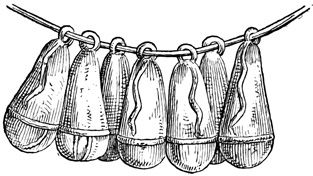
Bronze Bells—Christy Collection.
Mr Tylor tells us that the Uhde collection at Heidelberg is a far finer one than that in Mexico, except in the department of picture-writings; it contains a large number of stone idols and trinkets, pipes, and calendars. The Christy collection in London is particularly rich in small sculptured figures, many of them from Central America. It includes the squatting female figure carved from hard black basalt, fifteen inches high and seven and a half inches wide, described by Humboldt as an Aztec priestess;[IX-112] and also bronze needles and the bronze bells shown in the cut, which I take from Tylor. The same author also describes and illustrates various other relics seen by him in Mexican and European collections. These include stone and obsidian knives, spear-heads, and arrow-heads; heads and small idols in terra cotta; pottery, consisting of vases, altars, censers, rattles, flageolets, and whistles; and masks of obsidian, stone, wood, and terra-cotta. Respecting obsidian relics Mr Tylor says, "Anyone who does not know obsidian may imagine great masses of bottle-glass, such as our orthodox ugly wine bottles are made of, very hard, very brittle, and—if one breaks it with any ordinary implement—going, as glass does, in every direction but the right one." "Out of this rather unpromising stuff the Mexicans made knives, razors, arrow- and spear-heads, and other things, some of great beauty. I say nothing of the polished obsidian mirrors and ornaments, nor even of the curious masks of the human face that are to be seen in collections, for these were only laboriously cut and polished with jewelers' sand, to us a common-place process." "We got several obsidian maces or lance-heads—one about ten inches long—which were taper from base to point, and covered with taper flutings; and there are other things which present great difficulties." "The axes and chisels of stone are so exactly like those found in Europe that it is quite impossible to distinguish them. The bronze hatchet-blades are thin and flat, slightly thickened at the sides to give them strength, and mostly of a very peculiar shape, something like a , but still more resembling the section of a mushroom cut vertically through the middle of the stalk."[IX-113] These supposed hatchets were, according to some authorities, coins. They are extremely light to be used as hatchets. "Many specimens are to be seen of the red and black ware of Cholula." "The terra-cotta rattles are very characteristic. They have little balls in them which shake about, and they puzzled us much as the apple-dumpling did good King George, for we could not make out very easily how the balls got inside. They were probably attached very slightly to the inside, and so baked and then broken loose." A cut is given of a brown lava mask from the Christy collection, which seems to have some sculptured figures on the inside.[IX-114]

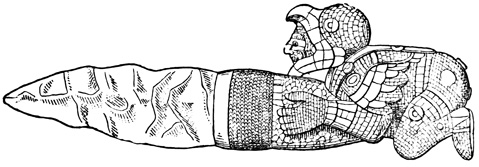
Mosaic Knife—Christy Collection.
MOSAIC WORK.
There are three very remarkable mosaic relics in the Christy collection, one of which is the knife represented in the cut, which I take from Waldeck's fine colored plate, although most of the information respecting these relics comes from Tylor. The blade is of a semi-translucent chalcedony found in the volcanic regions of Mexico. The uncolored cut gives but a faint idea of the beauty of the handle, which is covered with a complicated mosaic work of a bright green turquoise, malachite, and both white and red shell. It is certainly most extraordinary to find a people still in the stone age, as is proved by the blade, able to execute so perfect a piece of work as the handle exhibits. Two masks of the same style of workmanship are preserved in the same collection. "The mask of wood is covered with minute pieces of turquoise—cut and polished, accurately fitted, many thousands in number, and set on a dark gum or cement. The eyes, however, are acute-oval patches of mother-of-pearl; and there are two small square patches of the same on the temples, through which a string passed to suspend the mask; and the teeth are of hard white shell. The eyes are perforated, and so are the nostrils, and the upper and lower teeth are separated by a transverse chink.... The face, which is well-proportioned, pleasing, and of great symmetry, is studded also with numerous projecting pieces of turquoise, rounded and polished." The wood is the fragrant cedar or cypress of Mexico. The knife handle is "sculptured in the form of a crouching human figure, covered with the skin of an eagle, and presenting the well-known and distinctive Aztec type of the human head issuing from the mouth of an animal." "The second mask is yet more distinctive. The incrustation of turquoise-mosaic is placed on the forehead, face, and jaws of a human skull.... The mosaic of turquoise is interrupted by three broad transverse bands, on the forehead, face, and chin, of a mosaic of obsidian similarly cut (but in larger pieces) and highly polished,—a very unusual treatment of this difficult and intractable material, the use of which in any artistic way, appears to have been confined to the Aztecs (with the exception, perhaps, of the Egyptians). The eye-balls are nodules of iron-pyrites, cut hemispherically and highly polished, and are surrounded by circles of hard white shell, similar to that forming the teeth of the wooden mask. The Aztecs made their mirrors of iron-pyrites polished, and are the only people who are known to have put this material to ornamental use." These mosaic relics, and two similar but damaged masks at Copenhagen, are probably American, if not Aztec; but this cannot be directly proved; for while something is known of their European history, their origin cannot be definitely ascertained.[IX-115]
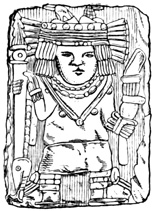
Image of Huitzilopochtli.
THE AZTEC HUITZILOPOCHTLI.
The image shown in the following cut is given by Sr Gondra as representing the Aztec deity Huitzilopochtli, although he gives no reason for the opinion; nor does he name the material, or dimensions of the relic. Sr Chavero also speaks of several images of the same god, in his possession or seen by him. They are of sandstone, granite, marble, quartz, and one of solid gold. Several had a well-defined beard.[IX-116] Gondra gives plates of many weapons, implements of sculpture and sacrifice, funeral urns, and musical instruments. The macana, an Aztec aboriginal weapon, shown in the cut, is copied from one of his plates. The material is probably a basaltic stone.[IX-117]

An Aztec Macana.
In 1831 a report was made to the French Geographical Society on a collection of drawings of Mexican antiquities executed by M. Franck. This collection embraced drawings of about six hundred objects, most of them from the National Museum in Mexico; eighty in the museum of the Philosophical Society at Philadelphia; forty in the Peñasco collection in Mexico, and others belonging to Castañeda and other private individuals. They were classified as follows: one hundred and eighty figures of men and women; fifty-five human heads in stone or clay; thirty masks and busts; twenty heads of different animals; seventy-five vases; forty ornaments; six bas-reliefs; six fragments; thirty-three flageolets and whistles; and a miscellaneous collection of weapons, implements, and divers objects.[IX-118]
MUSICAL INSTRUMENTS.
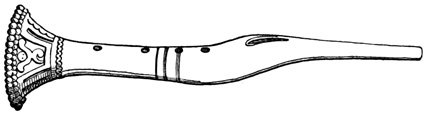
Aztec Flageolet.
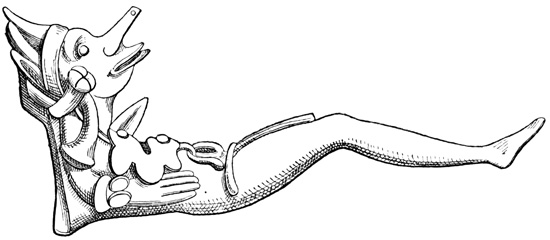
Terra-Cotta Musical Instrument.
Sixteen specimens of Mexican relics, in the possession of M. Latour-Allard in Paris, are represented by Kingsborough unaccompanied by explanations. The objects are mostly sculptured heads, idols, and animals. Bullock also gives plates of six Mexican idols, about which nothing definite is said; Humboldt pictures an idol carried by him from Mexico to Berlin; and Nebel's plates show about thirty miscellaneous relics, in addition to those that have been already mentioned. Humboldt also gives an Aztec hatchet of green feldspath or jade, which has incised figures on its surface. He remarks that he never has found this material 'in place' in Mexico, although axes made of it are common enough.[IX-119] The two musical instruments shown in the cuts are taken from Waldeck's plates. Their material is terra cotta.[IX-120] Other miscellaneous cuts and descriptions are given in the work of the German traveler Müller, and in the appendix to the German translation of Del Rio and Cabrera.[IX-121] José María Bustamante told Mr Lyon of an obsidian ring, carried away by Humboldt, which was perforated round the circumference so that a straw introduced at one side would traverse the circle and come out again at the same opening.[IX-122] The two idols shown in the cut were copied by Kingsborough's artist in the British Museum. The figures of the cut are one sixth of the original size.[IX-123] Prescott tells us that "a great collection of ancient pottery, with various other specimens of Aztec art, the gift of Messrs Poinsett and Keating, is deposited in the cabinet of the American Philosophical Society, at Philadelphia," a list of the relics having been printed in the Transactions of that Society.[IX-124]
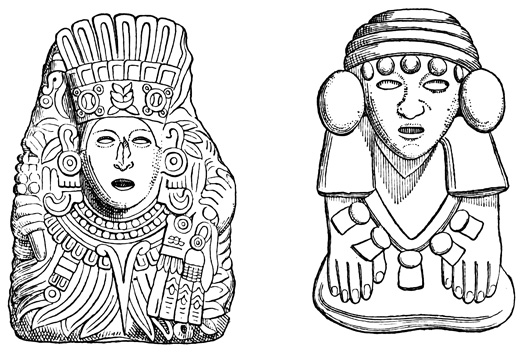
Aztec Idols—British Museum.
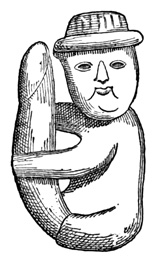
Phallic Relic in National Museum.
HIEROGLYPHIC SCULPTURES.
The preceding cut represents a serpentine relic preserved in the National Museum, and shown to Col. Mayer—from whose album I copy it—by Sr Gondra as a 'cosa muy curiosa.'
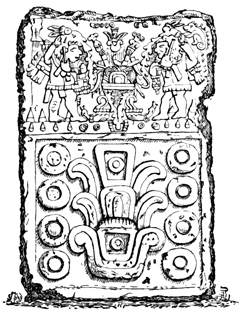
Serpentine Hieroglyphic Block.
Four interesting sculptured stones are represented and their inscriptions interpreted by Sr Ramirez, in a Spanish edition of Prescott's work. The first is a cylinder twenty-six inches long, eleven inches in diameter, representing a bundle of straight sticks bound with a double rope at each end. There are hieroglyphic sculptures on one side and both ends, which are interpreted by Sr Ramirez as a record of the feast which was celebrated at the last 'binding up of the years' in 1507. The second is a block of black lava thirteen and a half by twelve and a half inches, bearing a serpent carved in low relief. The third is a similar block somewhat larger, with a sculptured inscription, supposed to represent the date of November 28, 1456. The fourth monument is that shown in the cut. It is a block of green serpentine, measuring thirty-eight by twenty-six inches. According to the meaning attributed to the sculptures by Ramirez, the lower inscription is the year 8 Acatl, or 1487; the upper part shows the day 7 Acatl, or February 19. The left hand figure is supposed to represent Ahuitzotl, and that on the right Tizoc. The event commemorated by the whole sculpture is thought to be the dedication of the great temple of Mexico, begun by Tizoc and completed by Ahuitzotl. The same block is shown in one of Waldeck's plates.[IX-125] I may also notice a small collection of Mexican relics in my possession, obtained by Porter C. Bliss during his travels in the country. This collection includes a grotesque mask of clay; a head of terra-cotta, eight inches high and six inches wide, including head-dress; a small head carved from limestone; a wooden teponaztli; a copper coin or hatchet; five terra-cotta faces, whose dimensions are generally about two inches; six fragments of pottery, mostly ornamented with raised and indented figures—one with raised figures added after the vessel was completed, one with painted figures, one glazed, and one apparently engraved; and seven fragments, some of which seem to have been handles or legs of large vessels.
I close my description of Mexican Antiquities with the two following quotations, somewhat at variance with the matter contained in the preceding pages. "This, like other American countries, is of too recent civilization to exhibit any monuments of antiquity."[IX-126] "I am informed by a person who resided long in New Spain and visited almost every province of it, that there is not, in all the extent of that vast empire, any monument or vestige of any building more ancient than the conquest, nor of any bridge or highway, except some remains of the causeway from Guadaloupe to the gate of Mexico."[IX-127] I give in a note a list of authorities which contain descriptions more or less complete of Mexican relics, but no information in addition to what has been presented.[IX-128]
NAHUA MONUMENTS.
No general view or résumé of Nahua monuments seems necessary here, nor are extensive concluding remarks called for, in addition to what has been said in connection with particular groups of monuments, and to the conclusions which the reader of the preceding pages will naturally form. The most important bearing of the monuments as a whole is as a confirmation of the Nahua civilization as it was found to exist in the sixteenth century, reported in the pages of the conquerors and early chroniclers, and as it has been exhibited in a preceding volume. That there were exaggerations in the reports that have come down to us is doubtless true, as it is very natural; but a people who could execute the works that have been described and pictured in this and the two preceding chapters, were surely far advanced in many of the elements of what is termed civilization. And all this they did, it must be remembered, while practically still in their 'stone age;' for although copper was used by them, it has been seen that implements of that metal but rarely occur in the list of relics described. It is doubtful if any known people ever advanced so far under similar circumstances—that is in their 'stone age,' or in the earlier stages of their 'bronze age'—as did the Nahuas and Mayas of this continent.
Not only do the northern monuments confirm the reported culture existing at the Conquest, but they agree, so far as they go, with the traditional annals of Anáhuac during the centuries preceding the coming of the Spaniards. Teotihuacan and Cholula differ from any works of the later Nahua epochs; while Xochicalco and Mitla are far superior to any known works of the Aztecs proper. All remains sustain the traditions that the Aztecs were superior to their neighbors chiefly in the arts of war, and that the older inhabitants were more devoted to the arts of architecture and sculpture, if not more skillful in the practice of them, than their successors. Still, this must not be understood to indicate anything like a permanent deterioration, or the beginning of a backward march of civilization, whose march is ever onward, although making but little account of centuries or generations.
NAHUA AND MAYA RELICS.
The comparison of Nahua with Maya monuments is a most interesting subject, into the details of which I do not propose to enter. In the use of the pyramidal structure, common to both branches of American civilized nations, and in a few sculptured emblems there is doubtless a resemblance; but this likeness is utterly insufficient to support what has been in the past a favorite theory among writers on the subject;—namely, that of a civilized people migrating slowly southward, and leaving behind them traces of a gradually improving but identical culture. The resemblances in question have in my opinion been greatly exaggerated, and are altogether outnumbered and outweighed by the marked contrasts, which, as they exist between the monuments of Yucatan and Chiapas, and those of Mexico and Vera Cruz, do not need to be pointed out to one who has studied the preceding descriptions. It is true that the best architectural specimens of Nahua art have been entirely destroyed, still there is no reason to doubt that if they could be partially restored they would resemble the structures of Vera Cruz, or at best, Xochicalco, rather than those of Uxmal and Palenque.
The differences between the northern and southern remains, while far more clearly marked than the resemblances, and constituting a much more forcible argument against than in favor of the theory that all American peoples are identical, must yet not be regarded as in any way conclusive in the matter; for it may be noticed that the likeness is very vague between the Nicaraguan idols of stone and those carved by the hands of the northern Aztecs. Yet the peoples were doubtless identical in blood and language, as the divinities which the respective artists attempted to symbolize in stone were the same. The reader will probably agree with me in the conclusion that, while a comparison of northern and southern monuments is far from proving or disproving the original identity of the Civilized Races of the Pacific States, yet it goes far to show, in connection with the evidence of language, tradition, and institutions, a Nahua and a Maya culture, progressing in separate paths,—though not without contact, friction, and intermingling,—during a long course of centuries.