Part 6 — SLAUGHTER OF THE INNOCENTS BY DAVID PAULSON, M. D.
Reading edition
In the Bellevue Hospital Medical College, when I was a student, I performed an experiment that vividly impressed upon my mind the naked fact that nicotin is a deadly poison. A large, healthy cat had become such a nuisance that it was decided to kill it. This I proceeded to do by the following method: I soaked enough tobacco in water to make an ordinary cigarette. Then I injected under the cat’s skin a hypodermic syringe full of this tobacco juice. In a few moments the cat began to quiver, then to tremble more violently, then it had cramps, and in less than twenty minutes it died in violent convulsions.
I take no pride in relating this experiment, for I know a shorter as well as a more merciful method of ending a cat’s life.
But what interests me now is the truth that thousands of young men and boys are waking up to the fact that tobacco in any form, and cigarettes in particular, are unmitigated evils. And that for their own sakes, they cannot afford to introduce into their bodies that which only makes them weak, sickly, and useless.
I will tell you, briefly, how the burden of this terrible curse was rolled upon my heart. God used a never-to-be-forgotten incident to burn into my soul the tremendous importance of this cigarette evil.
One day, an old lady, with a faded red shawl thrown over her stooping shoulders, came into my office, and asked if I could see her boy. Two strong men then brought before me a poor boy of seventeen years, wild-eyed and insane. The mother asked if he could be cured.
After investigating the case, I was compelled to tell her that the outlook was hopeless, and that she might just as well send him to the lunatic asylum. She broke down and sobbed as though her heart would break. I asked her what had brought this terrible condition upon her son, and she said:—
“Oh, it was cigarettes. He began to smoke more and more, until he used fifty a day, and then his mind gave way.”
That day I became thoroughly enlisted in the anti-cigarette war. O that our souls might become saturated with the importance of fighting this awful evil! Cigarettes are making our boys weak and puny and unmanly. They are sapping the strength from their muscles, and making them unable to win their way in the world.
I care not how intelligent or brainy a boy may naturally be, a short period of cigarette smoking will tell on him. He may not notice this himself, at once, but others will. And I wish the young men and boys to remember that if there is work to be done in the world which requires much effort, either of brain or muscle, the cigarette smoker is not chosen for the job. Why?—Because when the time comes to use the brain or the muscles for some supreme effort, the poor, poison-soaked muscles fail to respond, and the benumbed brain cannot do its best work. I think if the boys only understood that cigarettes and tobacco were ruining them physically and mentally, and preparing them for certain defeat in life, they would shun both as they would the plague.
The Cigarette Fiend is an Object of Pity
When I talk on the cigarette evil in the Chicago public schools, I ask how many of the children know of some poor crippled boy whose leg was cut off by a street-car accident. Such a boy, if he has brains and character, may yet fill a position of trust and usefulness in the world, but the boy who begins to smoke cigarettes early enough, can never be of any use in this world, and unless he repents, there will be no place for him in the next. To try to put knowledge into his brain, is as hopeless a task as to try to fill a basket with water.
The cigarette-smoking boy is looked upon by other people as an object of pity. There is nothing truly brave or heroic about him. There may have been naturally, but nature has been doped and stupefied and abused, until there is nothing left in the poor lad that is manly at all. If he wants to be a great hunter or a fine marksman or sharpshooter, he must either give up this ambition, or else let the cigarette alone forever. If he would like to be a famous doctor or a skillful surgeon, he must not ruin his nerves, or he cannot trust himself to hold a surgeon’s knife. No one would be willing to risk his life in such hands.
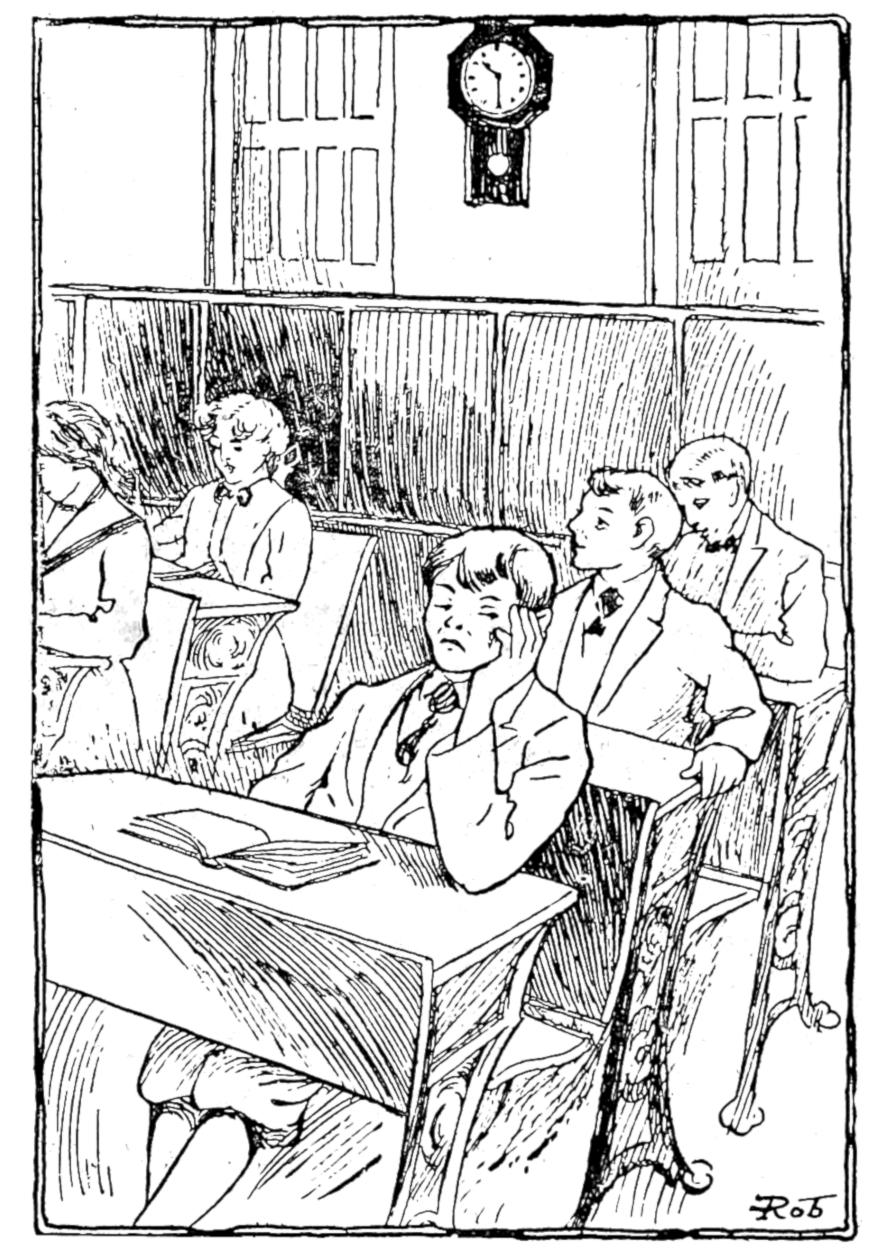
Listless Cigarette Smoker
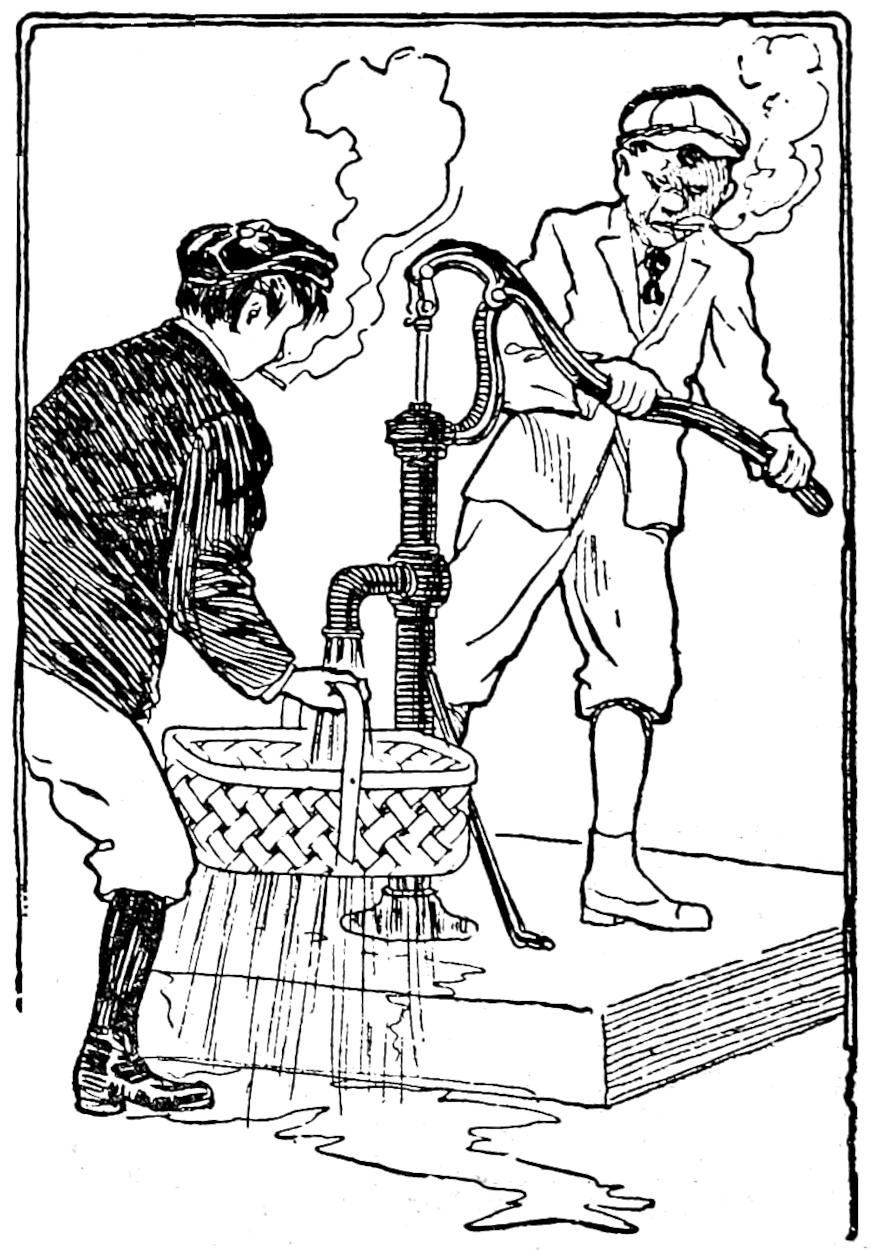
Pumping Water into Basket
Hang a half dozen brick around a boy’s neck, and ask him to swim a race with you. Would that be fair? But the cigarette habit pulls one under in life’s struggle, just the same.
What would the boys think if they saw a lad vigorously rubbing sand into his eyes? They would think him crazy. Is it any more foolish to rub sand into the eyes than it is to rub poison into the brain?
Suppose I should hand a boy my watch, and presently he begins to pour tar into its works. Would you think he had much sense?
O it is cruel and unmanly to ruin and clog up and destroy these wonderful bodies of ours. What an astonishing piece of machinery the brain is! Almost everything depends upon having the head clear,—the reasoning powers sharp and acute. But the deadly cigarette destroys the keen sensibility of the nerve and brain cells, and renders the victim unable to think clearly or logically.
Men who train great wrestlers and athletes to perform almost unbelievable feats of physical endurance, know better than to allow them to poison and paralyze these muscles of iron. Who ever heard of an athlete smoking half a dozen cigarettes just before starting in to win his medal as champion?
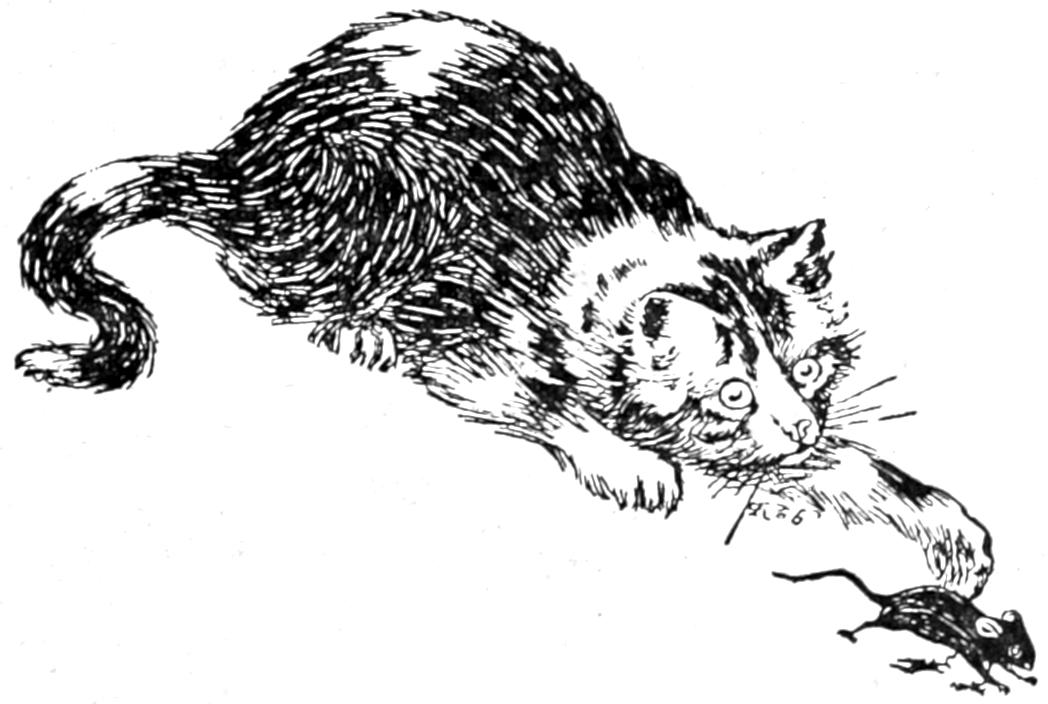
“The cigarette kills the boy in the same way.”
Destroys on the Installment Plan
Who has not watched the old family cat and noticed how she kills a mouse,—a little at a time,—crushing her teeth into the poor thing’s body, then letting it limp away a short distance, then springing upon it and crushing it some more. Now the cigarette kills the boy in just the same way, or, in other words, on the installment plan.
Any experienced physician can pick out a cigarette slave almost as far as he can see him; for no one can smoke cigarettes a very long time, before he begins to have the devil’s trade-mark stamped upon him.
We must never forget that we only pass over this road once,—we have but one life here to live; and when we reach the end of the journey, if the Master cannot say to us, “Well done,” our life has been a hopeless failure.
A Simple but Sure Cure
But suppose you have in mind some poor fellow who has become enslaved by the unmanly habit. Of course you pity him in his helpless bondage. Well, you may assure him that he may be saved by living exclusively on a fruit diet for several days, eating all he wishes of it three or four times a day, drinking plenty of water, and availing himself of a sweat bath or two if convenient. I know from experience that God is on the side of the fellow who is trying to do right,—that he may look to Him for special help. Then the poor cigarette slave will be astonished to see that it is possible to slip out from under the yoke of habit.
Now in conclusion I want to say a few words to grown people who use tobacco. I have seen a father teach his boy to pray, to ride a bicycle, and to spell; but I never yet have seen a sensible, respectable man teach his boy to smoke. This is the best argument I know against tobacco using. If a man really believed tobacco was good for him, he would want his wife, or his sister, or his mother, and his child to share with him in this blessing.
The Real Truth about Tobacco
Tobacco does give a certain amount of unearned felicity, just as alcohol or morphin does; but it charges a terrific toll in the way of high blood pressure, injury to the nervous system and the digestive organs, and more or less impairment of the whole man. Every man who is a tobacco user sacrifices some of the best that is in him, spiritually, mentally, and physically. The intolerable craving for the after-dinner cigarette is often produced by the juicy beefsteak, highly spiced food, or tea and coffee, that compose the meal. Hence, he who would be delivered from the tobacco habit, should religiously avoid such articles of food as create a demand and an unnatural craving for tobacco.
But some will ask, “is it worse for a child to smoke a cigarette than it is for a man to smoke a cigar?”—Yes, for three reasons:—
First, a man may safely tolerate a quarter of a grain of morphin, while we dare not give a child more than a sixteenth part of a grain. A young person’s nervous system is peculiarly susceptible to the influence of such narcotic drugs as nicotin and morphin, and hence an introduction to either of them early in life, spells almost certain disaster, mental or nervous, later in life.
Second, the loosely packed cigarette does not permit the nicotin to condense to the same extent as when it is drawn through pipe or cigar; hence the smoker gets the full benefit (?) of this virulent poison.
Third, the oxidation of the cigarette paper produces deadly poison which is only second in its effects to that of nicotin itself.
Well, then, to sum up: Is it any wonder that so many thousands of our brightest, smartest, keenest young men and boys are signing the Cigarette Pledge? They are keen enough to see that cigarettes and tobacco used in any form, mean weak brains, flabby muscles, diseased heart, and a useless and unhappy life.