Part 6 — ONLY THE HUSK
Reading edition
“I will have the kernel, his wife may have the husk.”
Tom Darcy, yet a young man, had grown to be a very hard one. Although naturally kind-hearted, active, and intelligent, he lacked strength of will to resist temptation and had therefore fallen a victim to intemperance.
He had lost his position as foreman of a great machine shop, and what money he now earned came from odd jobs of tinkering which he was able to do at private houses here and there; for Tom was a genius as well as a mechanic, and when his head was steady enough, he could mend a clock or clean a watch, as well as he could set up and regulate a steam engine, and this latter he could do better than any man ever employed by the Scott Falls Manufacturing Company.
One day Tom was engaged to mend a broken mowing machine and reaper, for which he received five dollars; and, on the following morning, he started for his old haunt, the village tavern. He knew that his wife sadly needed the money, and that his two little children were absolutely suffering for want of clothing; so that morning he held a debate with his better nature, but his better nature had become weak, and the demon of appetite carried the day.
So, away to the tavern Tom went, where, for two or three hours he felt the exhilarating effect of the strong drink and fancied himself happy because he could laugh and sing. He drank while he could stand, then lay down in a corner where his companions left him.
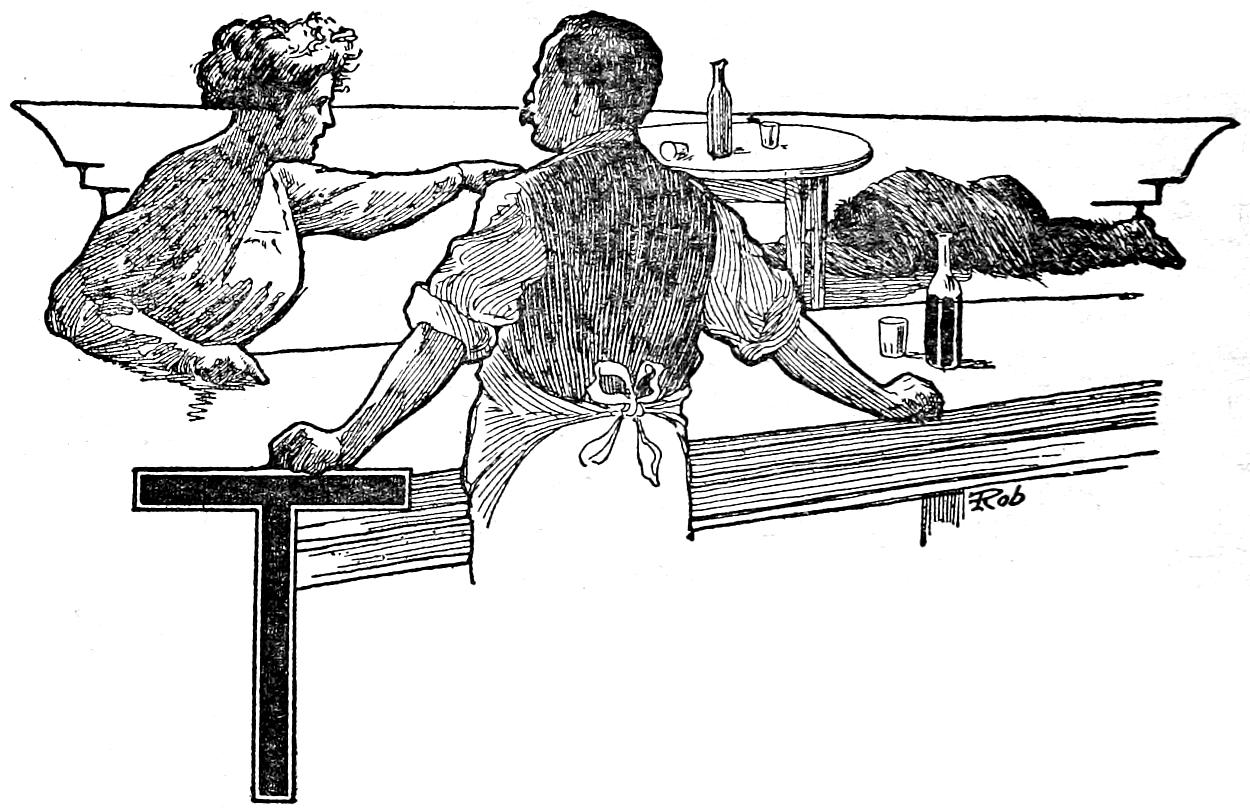
It was almost midnight, when the landlord’s wife came to the barroom to see what kept her husband up, and she quickly saw Tom.
“Peter,” said she, “why don’t you send that miserable Tom Darcy home? He’s been hanging around here long enough.”
Tom’s stupefaction was not sound sleep. The dead coma had left his brain, and the calling of his name stung his senses to keen attention. He had an insane love for rum, but he did not love the landlord.
Long years ago, Peter Tinder and Tom Darcy had wooed the same maiden,—Ellen Goss,—and Tom had won her, leaving Peter to take up with the sharp-tempered damsel who had brought him the tavern. Tom knew well enough that even lately Peter Tinder had gloated over the misery of the woman who had once discarded him.
“Why don’t you send him home?” demanded Mrs. Tinder, with an impatient stamp of her foot.
“Hush, Betsey, he’s got money. Let him be, and he’ll be sure to spend it before he goes home. I’ll have the kernel of that nut and his wife may have the husk.”
Betsey turned away, and shortly afterward Tom Darcy lifted himself upon his elbow.
“Ah, Tom, are you awake?”
“Yes.”
“Then rouse up and have a warm glass.”
Tom got upon his feet and steadied himself.
“No, I won’t drink any more to-night.”
“We’ll see!”
“It won’t hurt you, Tom,—just one glass.”
“I know it won’t!” said Tom, buttoning up his coat by the solitary button left. “I know it won’t.”
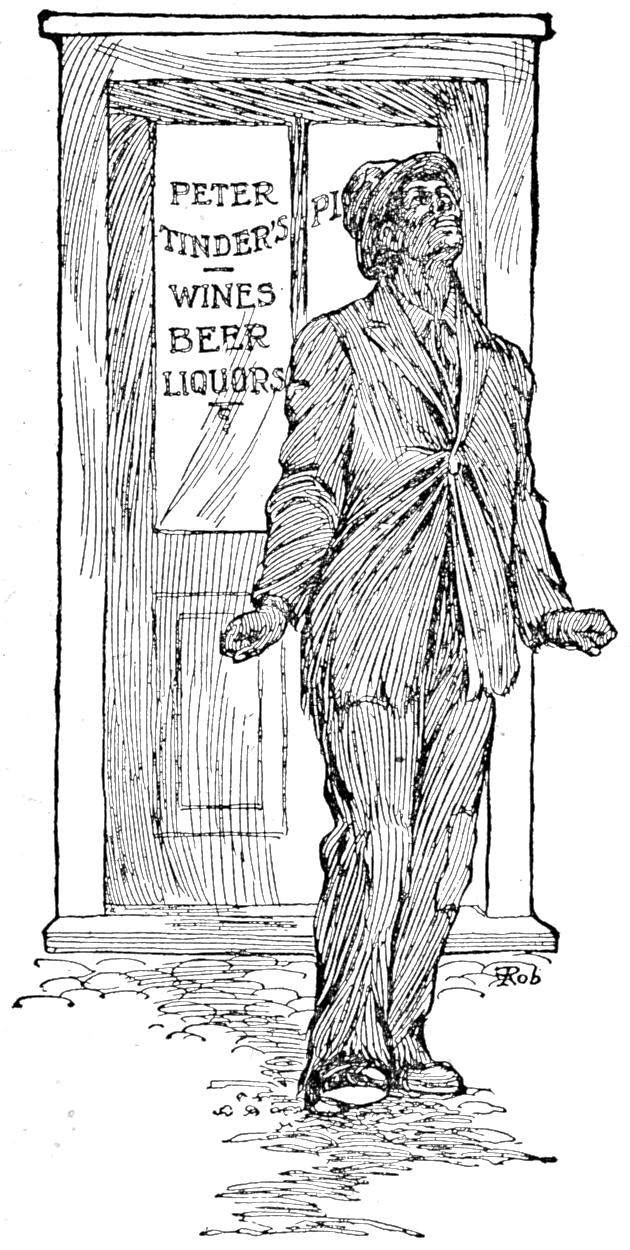
The air was damp and cold, but Tom Darcy didn’t mind it. The fact was, he was waking up at last. The words of Peter Tinder were sounding in his ears. He would go home at once. Why had he not gone before? he wondered, as he stepped out into the dimly lighted street.
Tom stopped a moment and looked up at the stars and then looked down upon the earth.
“Ay,” he muttered, grinding his heel into the gravel, “Peter Tinder is taking the kernel, and leaving poor Ellen the worthless husk,—a husk more than worthless. I am robbing my wife of joy; robbing my poor children of honor and comfort, and robbing myself of love and life, so that Peter Tinder may have the kernel and Ellen the husk. We’ll see!”
It was a revelation to the man. The saloon-keeper’s speech, meant not for his ears, had fallen upon his senses as fell the voice of the Risen One upon the ears of Saul of Tarsus.
“We’ll see!” he repeated, setting his foot firmly upon the ground; and then he wended his way homeward.
On the following morning he said to his wife, “Ellen, have you any coffee in the house?”
“Yes, Tom.” She did not tell him that her sister had given it to her. She was glad to hear him ask for coffee, instead of the old, old cider.
“I wish you would make me a cup, good and strong.”
There was really music in Tom’s voice, and his wife set about her work with a strange flutter at her heart.
Tom ate a light breakfast,—there was not much left to eat in the house,—and then went out, with a resolute step, and walked straight to the great manufactory, where he found Mr. Scott in his office.
“Mr. Scott, I want to learn my trade over again.”
“Eh, Tom, what do you mean?”
“I mean that it’s Tom Darcy come back to the old place, asking forgiveness for the past, and hoping to do better in the future.”
“Tom,” cried the manufacturer, starting forward and grasping his hand, “are you in earnest? Is it really the old Tom?”
“It’s what’s left of him, sir, and we’ll have him whole and strong very soon, if you’ll only set him to work.”
“Work! Ay, Tom, and bless you, too. There is an engine to be set up and tested to-day. Come with me.”
Tom’s hands were weak and unsteady, but his brain was clear, and under his skillful supervision the engine was set up and tested; but it was not perfect. There were mistakes which he had to correct, and it was late in the evening when the work was complete.
“How is it now, Tom?” asked Mr. Scott, as he came into the testing house and found the workmen ready to go home.
“She’s all right now, sir. You may give your warrant without fear.”
“God bless you, Tom! You don’t know how like music the old voice sounds. Will you take your old place again?”
“Wait till Monday morning, sir. If you will offer it to me then, I will take it.”
At the little cottage, Ellen Darcy’s fluttering heart was sinking. That morning, after Tom had gone, she had found a dollar bill in the coffee cup.
She knew that he had left it for her. She had been out and bought potatoes and sugar and flour and butter and a little basket of strawberries. All day long a ray of light had been dancing and glimmering before her,—a ray from the blessed light of other days. With prayer and hope she had set the tea-table and waited; but the sun went down and no Tom came. Eight o’clock, and almost nine.
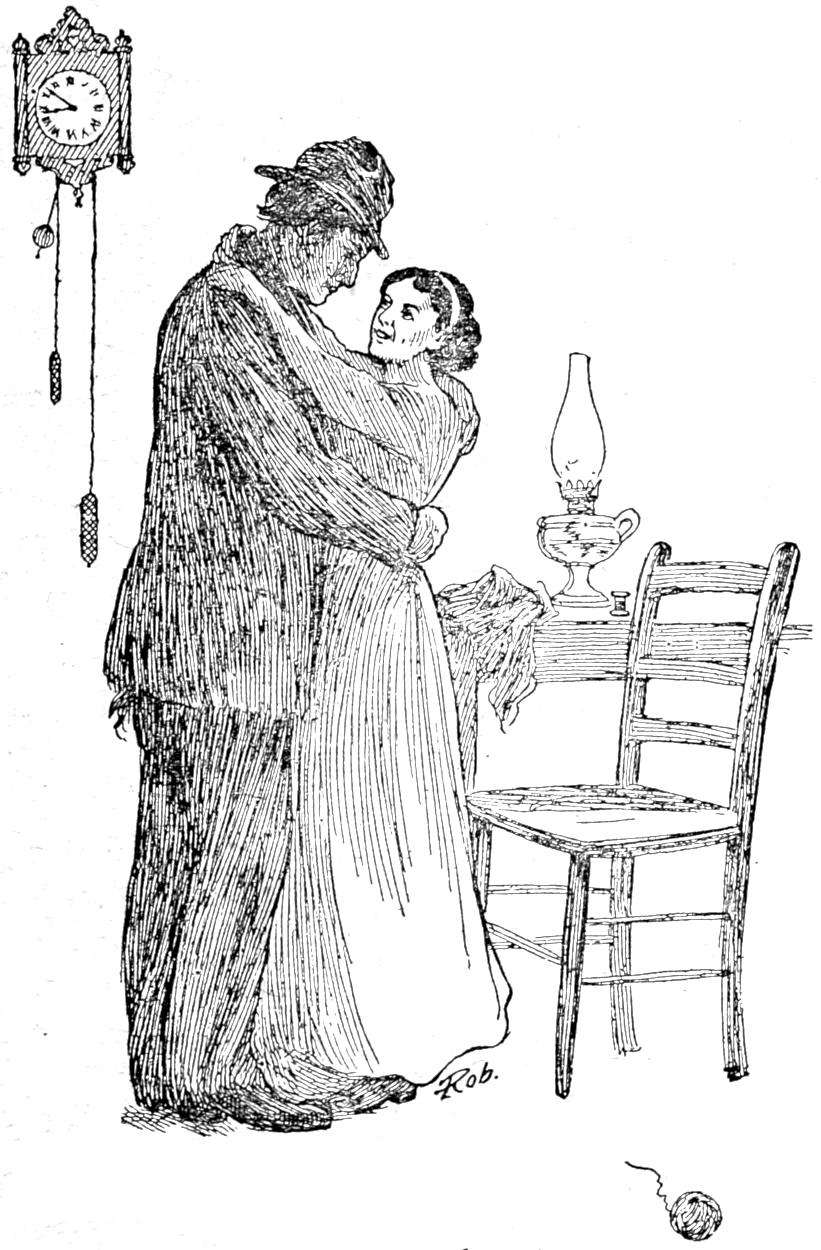
“I kept you waiting, Nellie”
Hark? The old step! quick, strong, eager, yes, it was Tom, with the old grime upon his hands and the odor of oil upon his clothing.
“I have kept you waiting, Nellie.”
“Tom!”
“I did not mean to, but the work hung on.”
“Tom! Tom! You have been to the old shop!”
“Yes, and I’m promised the old place, and—”
“Oh, Tom!”
And she threw her arms around his neck and pressed a kiss upon his lips.
“Nellie, darling, wait a little, and you shall have the old Tom back again!”
“Oh, I have him now! God bless you, my husband!”
It was a banquet—that supper—with the bright angels of peace and love and joy spreading their wings over the board.
On the following Monday morning, Tom Darcy resumed his place at the head of the great machine shop, and those who thoroughly knew him had no fear of his going back into the slough of dissipation.
A few days later, Tom met Peter Tinder on the street.
“Eh, Tom, old boy, what’s up?”
“I’m up,—right side up!”
“Yes, I see; but I hope you haven’t forsaken us, Tom!”
“I have forsaken only the evil, Peter. The fact is, I concluded that my wife and little ones had fed on ‘husks’ long enough, and if there was any goodness left in my heart or in my manhood, it was high time they had the benefit.”
“Ah! you heard what I said to my wife that night.”
“Yes, Peter, and I shall be grateful to you as long as I live. My remembrance of you will always be relieved by that tinge of brightness.”
Ten years passed away. Peter Tinder had removed to a distant state. Long ago people had ceased declaring that Tom Darcy “would be as drunk as a fiddler before long.”
The little cottage had been exchanged for a larger and more commodious home on one of the pleasantest streets. The two children, Paul and Emily, were growing to be a great help and comfort to their parents.
But you will want to know what became of Peter Tinder, the saloon keeper, into whose tills a large share of Tom Darcy’s hard-earned money had found its way in the old days.
One bitter cold evening in mid-winter, the Darcy family sat around their cozy fireside. Suddenly the door bell rang. Gentle Mrs. Darcy, grown more sympathetic and charitable with the passing of the years, hurried to open the door. But she stepped back with a look of mingled pity and terror in her eyes.
There stood the most wretched creature she had ever seen. Trembling with the cold and covered with rags, he undertook to make known his errand:—
“Is this the home of Tom Darcy?”
By this time Tom was on his feet. “Come in, come in, man, don’t stand out there, when there’s warmth inside; come right in, my poor fellow.”
“I don’t suppose you know me, Tom Darcy, or perhaps you wouldn’t be so cordial,” shivered the stranger, turning his bleared eyes toward his host.
There was something in the voice, which made Tom Darcy start:—
“Why, Ellen, wife, it’s Pete,—Mr. Tinder! Why, man, where did you come from? What has happened?”
“Ah, it’s many a year since anyone has called me Mr. Tinder—‘Old Pete’—that’s the name I answer to now-a-days. I don’t live anywhere,—I just wander till I find someone that’ll take me in for the night.”
While Ellen Darcy prepared a cup of hot milk and a large sandwich, “Old Pete” continued:—
“I heard you lived here, and that you were a Christian, Tom, and I reckoned you’d not turn me out to-night, though I never did you anything but evil,—I took the ‘kernel’ and you kept the ‘husk’ a long time, but things have turned about now. My wife died directly after we had left the old place, and then people began to say that “Old Pete” was his own best customer.
“I drank and drank until everything was gone. I often thought about the ‘husk’ and the ‘kernel,’ but I must have the drink, Tom, as long as I live, and that won’t be long, please God.”
Tom Darcy and his good wife made the poor wretch as comfortable as possible for the night, and entreated him to reform. But it was too late. “Old Pete” had fed upon “husks” too long. Like the prisoner of Chillon he had learned to love the very chains which bound him.
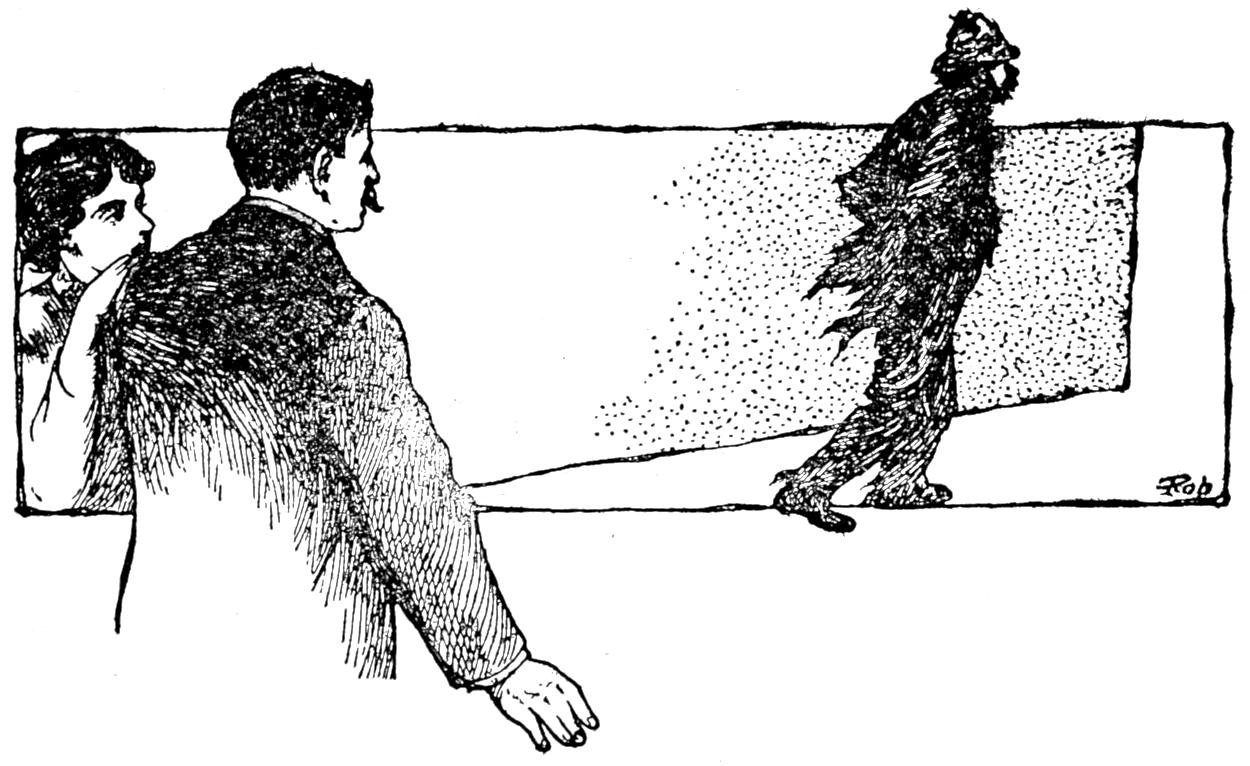
As the wretched man started off toward the nearest saloon in the village, Tom Darcy watched him with a strange fascination until the fluttering rags had passed around the corner.
“But for the grace of God, Ellen,” he said, humbly, “I would be in his condition to-day, while you and the children—”
Tom shuddered, while Ellen quoted tearfully:—
“‘No drunkard shall inherit the kingdom of God.’”