Part 6 — IN THE HOUSE OF HIS FRIENDS BY MRS. L. D. AVERY-STUTTLE
Reading edition
Yea, mine own familiar friend, in whom I trusted, ... hath lifted up his heel against me.”
The largest church in Jonesville was well filled that Sabbath, for it was communion day, and the eloquent Mr. Barnes was to fill the pulpit, and officiate with the pastor at the Lord’s table.
The congregation was very select,—in fact, it was mostly composed of the well-to-do residents of the town; and the Master’s words, “The poor ye have always with you,” would hardly have seemed an appropriate text—especially on this particular morning.
But there was one gentle little woman, with a child in her arms and a little girl by her side, who sat in a pew far up in front, toward the right of the altar, in whose dark eyes there lurked a shadow, and in whose heart had entered a terrible fear.
The man who sat beside her was a noble looking fellow, broad of shoulder, strong of limb, stalwart of frame. But to a close observer there still appeared marks of past dissipation and reckless intemperance, which had left there unmistakable tokens on cheek and brow,—tokens which even the charitable hand of time must be many years in effacing altogether.
And it had been only one little year since Burton Holbrook had been plucked even as a brand from the burning; but in all the year, not once had the accursed cup touched his lips.
Burton Holbrook could not remember when he had first learned to love the cup; the terrible heritage had been his from birth,—a heritage bequeathed him by his poor father, whose drunken carousals had made his childhood miserable.
And so the heritage of thirst had been his; and he had fought it manfully, bravely all the years. But the record of the years had been filled with shameful defeat so often that the little woman by his side had been well nigh discouraged many times.
But in the past few months a new hope had been born,—a hope bright with anticipation and big with promise.
For Burton Holbrook had been converted and joined the church.
“You can never conquer in your own strength,” she had said; and her prayers had ascended day and night unceasingly. And one glad day he had come to her, with a new light in his eyes and a new song upon his lips.
Then, almost as if by magic, prosperity seemed to come to them by leaps and bounds; friends multiplied; a position was offered him, lucrative beyond his wildest dreams. Within the year, the humble home had been exchanged for a pleasant cottage on one of the better streets, and from this cottage ascended night and morning, songs and prayers of thanksgiving and praise.
And this Sabbath he was attending communion service for the first time.
Strange that sad thoughts should intrude,—that unwelcome fears, and dim, shadowy forebodings should come trooping into the heart of the little woman by his side,—to-day of all days,—to-day, when her cup of joy was full to the brim!
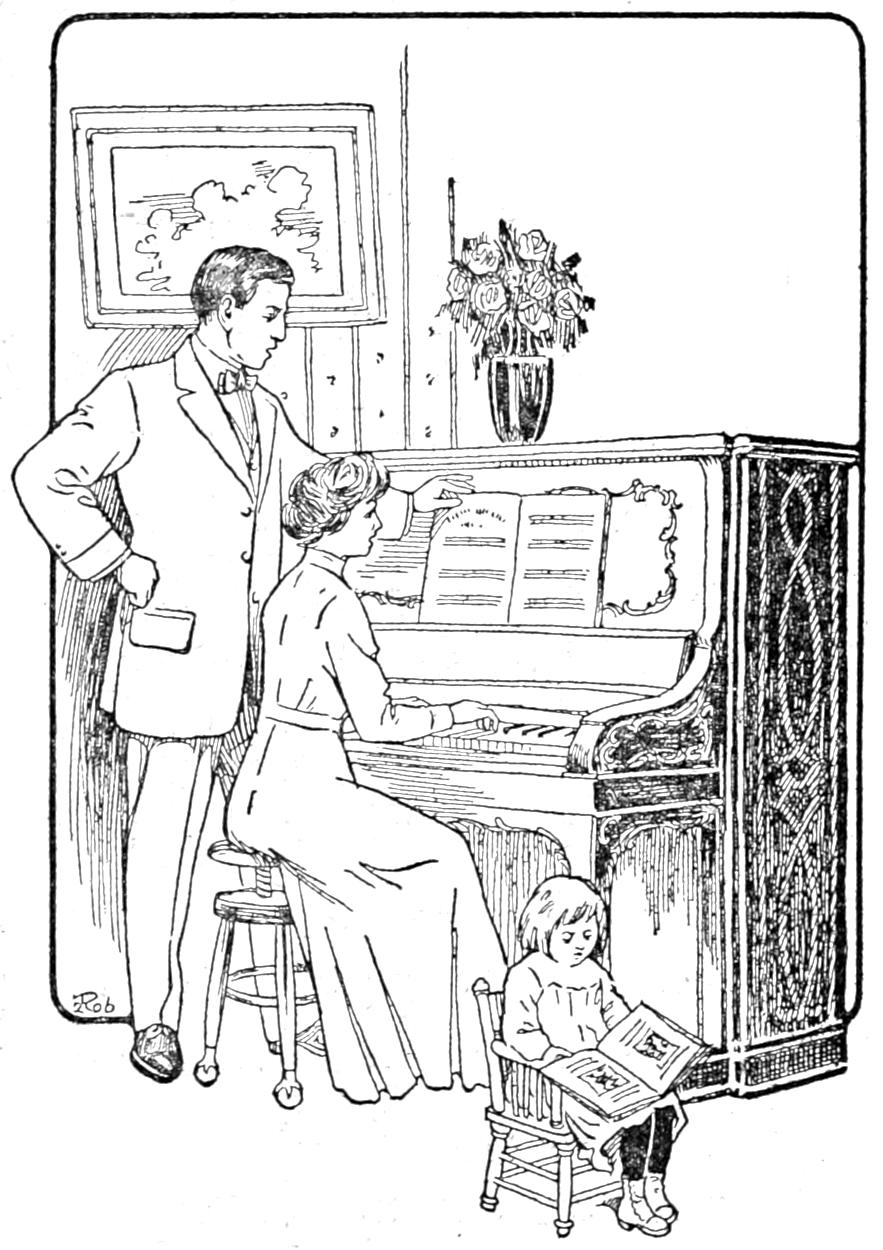
“Songs of thanksgiving and praise”
In the very beginning of the services, she had suddenly remembered that it was communion day,—yes, yes, she had known that, all the time. But now she realized with a dull pain at her heart, that there would be wine. There must be; and it would be the wine that intoxicates!
Ah! too well she knew the demons that forever dogged her husband’s footsteps! Given the slightest opportunity, and they were about him in troops. Was there, then, no spot too sacred for them to invade? Was there to be no safety, even within the sacred courts of the house of the Lord?
In her perfect happiness, she had not given it a thought; but now, she wondered vaguely why she had not remembered. Ah, once before, in those awful days that seemed so long, long ago,—once before, a single taste of red wine had been his undoing!
How helpless she felt, as she sat by his side and glanced timidly up into his handsome face—her noble husband! And she reflected that she had urged him to unite with the church long before he had thought of offering himself. She had told him that this would be such a source of strength to him! And now she shuddered.
Why had no one cared for his soul? Why had no voice been raised in protest? And then she remembered hearing Mrs. Jones, the deaconess, once say that she had protested against this thing; but the pastor had only smiled and treated the matter lightly,—in fact he had gone so far as to insinuate that “it would be casting a reflection upon the respectability” of his eminently respectable congregation, to offer them new wine at communion, when they had always been accustomed to the old!
So it would have been of no use for her to protest. The pastor would have scorned her husband as a weakling—her strong, noble husband.
But see, the red wine has already been uncovered; the blessing has been pronounced,—ah, surely it is only the emblem of the spilled blood of the Man of Sorrows!
Burton Holbrook starts. His face is white as chiseled marble. His breath comes in quick, hard gasps. Already the subtle scent of the red wine is in his nostrils.
The little woman marks with strange distinctness, the white, delicate fingers of the pastor, as he offers the glass to her husband,—for they are in the pew near the altar. The words which the minister had read that morning, ring in her ears: “Yea, mine own familiar friend, in whom I trusted, ... hath lifted up his heel against me.”
She turns her eyes in sickening fear upon the man. His face is gray and drawn, the muscles of his neck are working, and the blue veins are standing out upon his forehead. He turns his eyes in piteous appeal toward his wife, then toward the pastor. Then over his haggard face there flits an expression of mad desire. The fiends of darkness are tapping upon his forehead and beckoning to him insistently.
Even the pastor starts with alarm as Burton Holbrook reaches his trembling fingers toward the glass. A fire like the smouldering fires of the pit leaps into his dark eyes,—and the glass is drained.
There was an uneasy, expectant rustle in the congregation. The minister turned his eyes for a moment. It was enough. Burton Holbrook sprang like a famished tiger and snatched at the pitcher. In a moment more, it was empty.
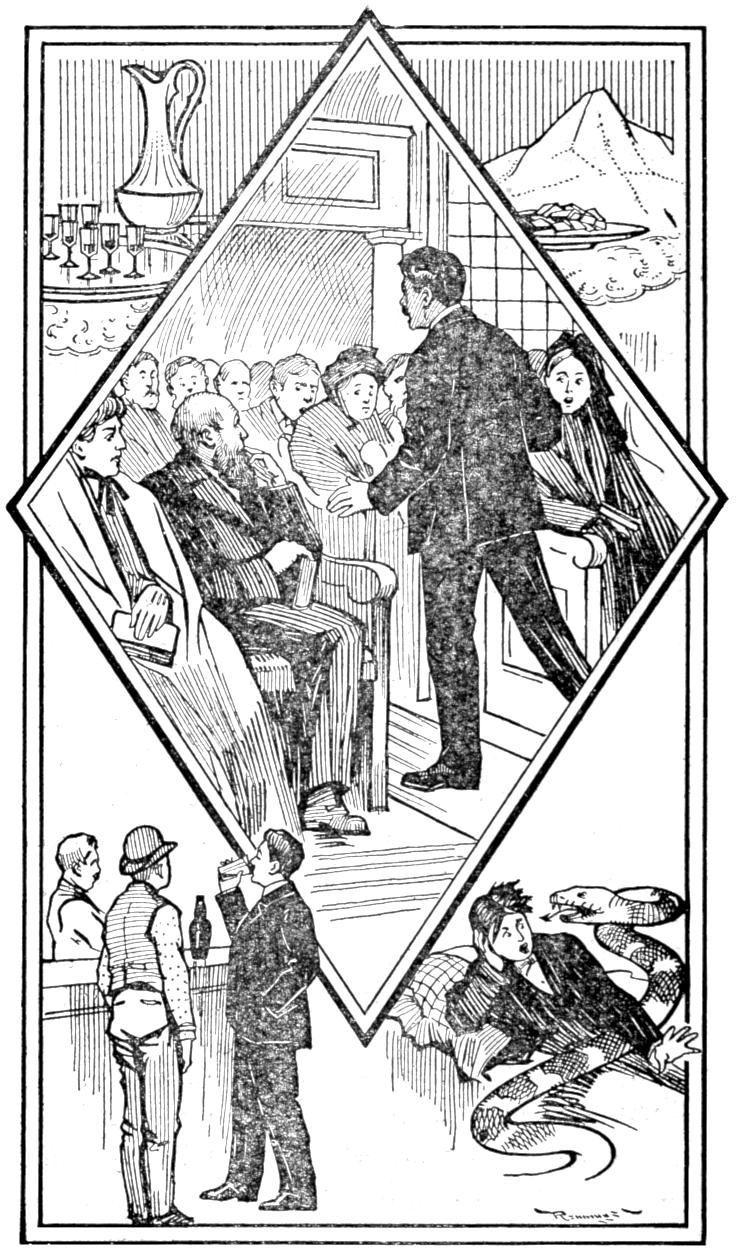
“Down the long aisle rushed a frenzied, hatless man”
Then, down the long aisle of horrified, frightened faces, and out into the quiet streets, rushed a frenzied, hatless man.
Over at the saloon on the nearest corner, lingered a few of the former companions of Burton Holbrook, discussing their old comrade, over their cups:—
“Been almost a year, I think, hasn’t it, since Holbrook last favored us with his company?” questioned the bartender sneeringly, as he handed a foaming glass to a young man whose trembling hand and thick speech told a pitiful story of disease and dissipation.
“Considers himself mighty good, I reckon,” was the reply.
“I’ve done everything I could to get him to give up those high and lofty notions of his,” shamelessly admitted another.
“I’m right glad I don’t have to sell my liberty,” blustered Jack Hartwell, “and I told him so the other day; but he had an answer ready, of course. Real, reg’lar parson, Burt’s got to be, since he’s quit us.”
“That makes me think,” stammered an old man from across the room, “Holbrook’s gone and joined the church, so they say,—got clear off the devil’s ground, I s’pose he thinks, now,—but,—” and the old man lowered his voice, while a hateful grin distorted his bloated face, “but we’ll see—we’ll see. He’s no whit better than the rest of us, that he should,—”
“No,” interrupted the bartender, with an oath, “somebody’s likely been preachin’ to him. But if he thinks he’s safe, just because—”
But the bartender never finished his speech. Into the midst of them rushed a man, breathless and hatless, with haggard face and wild, hollow eyes.
“Let me drink, man! let me drink! I’ve sold my soul for it. The demons of hell have got me this time! I have held my own against them for a year,—but they caught me,—caught me in the church,—and—and I will die, but I must have my drink!”
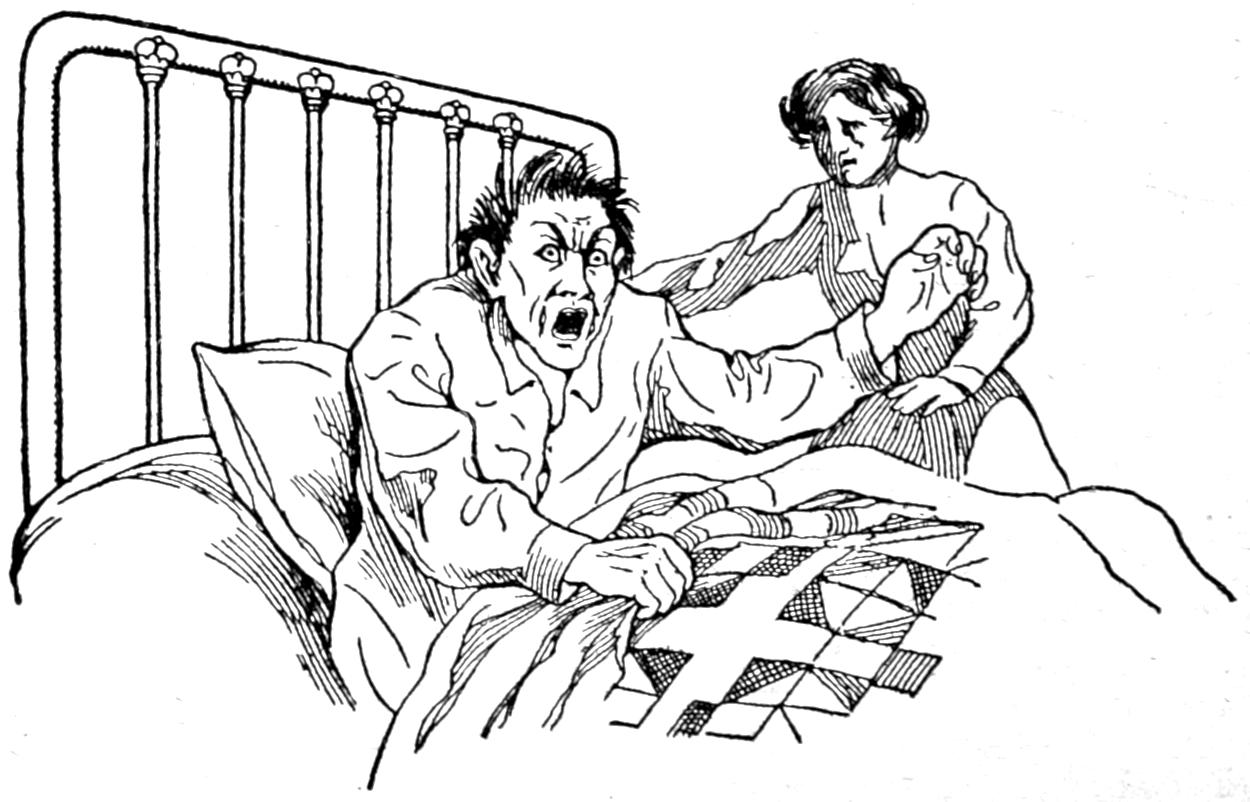
Within another month, delirium tremens, with its unspeakable horrors, had claimed its victim.
But I am glad to say that now there is one church in Jonesville, which offers nothing but pure, sweet, new wine at communion.
But still a poor, heartbroken little woman murmurs over and over again, “‘Woe unto him that giveth his neighbor drink!’”