INDEX AND DICTIONARY (continued 3)
Reading edition
Camperdown. Bk Naval victory of, 12.
Canada. Discovered by John Cabot in 1497. First settlement made by Jacques Cartier, in 1535, on the banks of the St. Charles. In 1608 Champlain founded the city of Quebec, almost on the spot where Jacques Cartier had wintered; the country ceded to Great Britain by France, by the treaty of Paris, 1763; civil government provided by Quebec Act, 1774; and a measure of responsible government by the Constitutional Act, 1791; invasion by Americans, 1775-1776; War of 1812; Rebellions of 1837-1838, in Upper and Lower Canada; union of Upper and Lower Canada, 1841; Confederation of Canada, New Brunswick, and Nova Scotia, 1867; Manitoba added to the Dominion, 1870; British Columbia, 1871; Prince Edward Island, 1873; provinces of Saskatchewan and Alberta created, 1905. Index: Dr Surrender of, 2; under military rule till conclusion of peace, 2; acquisition of, by Britain, hastened American Revolution, 3; ceded by treaty of Paris to Great Britain, 7; its wide extent at that time, 8; French population of, at cession, 9; English-speaking population, 9; petition for restoration of its ancient limits, 61; division of, into two provinces proposed, 248; political possibilities after conquest, 253-257; boundaries of, not defined by Constitutional Act, 260. B Party government—origin of the double ministries, 81-82; election frauds in 1857, 99-100; process of expansion—Confederation and after, 264. E First railway in, 99; early political conditions in, 17-40; difficulties connected with responsible government in, 26; principles of responsible government, 228; her political system contrasted with that of United States, 241 et seq. WM Interests French commanders and their men but little, 11; its vulnerable points, 17; its strong social and political organization gave it an advantage in war, 24; but was unfavourable to internal development, 24. Sy Rapid progress made in Anglicizing previous to passing of Quebec Act, 63; unfortunate change of policy regarding, 64. F Population of, 36, 55, 58, 131, 147, 148; poverty of impresses Sister Bourgeoys, 39; morals of the people, 58, 59; overgoverned, 131; trade, 148; affected by all the vicissitudes of mother country, 150, 151; "farmers" of revenue appointed for, 154; Bishop St. Vallier's first description of country and inhabitants, 192; Governor Denonville's description, 192; St. Vallier's revised opinion, 193; real character of the people, 193-195; state of depression throughout the country, 219, 240; drinking habits of people, 223; described by Laval as the country of miracles, 301; exhaustion of, after departure of New England fleet, 305, 317. See also New France; Cartier, Jacques; Cabot, John; Champlain; Quebec Act; Constitutional Act; Union Act; Upper Canada; Lower Canada; Confederation.
Canada Act. See Constitutional Act.
Canada Company. Founded in London, 1824, by John Gait, as a colonizing scheme. A large tract of land was purchased in what is now western Ontario. Dunlop, Talbot, Strickland, and other pioneers of Upper Canada were associated with Gait in the enterprise. The company is still in existence. Index: E An agency in settlement of Upper Canada, 145; its unpopularity, 145. R Offers to buy Clergy Reserves, 50. B Recommends whiskey to intending immigrants, 75. See also Galt, John; Dunlop, William; Talbot, Thomas. Bib.: Lizars, In the Days of the Canada Company; Strickland, Twenty-seven Years in Canada West; Galt, Autobiography; Jameson, Winter Sketches; Talbot, Six Years in the Canadas; McTaggart, Three Years in Upper Canada; Dunlop, The Backwoodsman.
Canada Corn Act, 1843. C Builds up flour industry in Canada, 43.
Canada First Association. B Platform, 235; criticized by the Globe, 236; suspected of aiming at national independence, 237; Goldwin Smith, leader of party, attacked by Globe, 237; his reply, 238; spirit of the movement, 239; its effect, 240-241; Liberal party injured by hostility to movement, 240-242. Md Formed in Toronto, 1870, 226; its policy, 226. Bib.: Dent, Last Forty Years; Canada First: A Memorial of the Late William A. Foster; Denison, The Struggle for Imperial Unity.
Canada Trade Act. Passed by Imperial Parliament in 1822, with the object of correcting the injustice to Upper Canada in the apportionment of duties collected. The Quebec Legislature had refused to re-enact the old Acts apportioning a share of duties to Upper Canada, and these Acts were now made permanent. Lower Canada was debarred from imposing new duties on imports by sea without the consent of Upper Canada and the approval of the Imperial Parliament. Bib.: Kingsford, History of Canada.
Canadian Alliance Society. Mc Founded, December, 1834, 258; its objects, 258. BL Founded at York, 16; its political programme, 16.
Canadian Contingents in the Boer War (1899-1902). Consisted of the Royal Canadian Infantry, Canadian Mounted Rifles, Royal Canadian Artillery, and Strathcona's Horse. The first contingent, which sailed for South Africa from Quebec, Oct. 30, 1899, numbered 1141. The second contingent, which sailed from Halifax in January and February, 1900, mustered 1320. These two contingents comprised the official Canadian contribution to the British forces in the war, but Lord Strathcona also raised a contingent at his own expense. This contingent, known as Strathcona's Horse, sailed from Halifax in March, 1900, the force numbering 540 officers and men, and 599 horses. Over 3000 Canadians therefore took part in the war against the Boers. Throughout the operations in South Africa, the Canadians signally distinguished themselves, particularly at the battle of Paardeberg on Feb. 27, 1900, when with the Gordon Highlanders and the Shropshires they led the final attack on Cronje's position. Bib.: Evans, The Canadian Contingents; Marquis, Canada's Sons on Kopje and Veldt; Doyle, The Great Boer War.
Canadian Freeman. Mc Newspaper, published by Collins, in 1825, 111.
Canadian Institute. Founded at Toronto, June 20, 1849, by Sandford Fleming, and Kivas Tully, with several other surveyors, civil engineers, and architects practising in and about Toronto. A royal charter was granted Nov. 4, 1851, in which the objects of the society are declared to be "the encouragement and general advancement of the physical sciences, the arts and the manufactures," etc. Among the early presidents were Sir W. E. Logan, Sir Henry Lefroy, Sir John Beverley Robinson, George W. Allan, W. H. Draper, Sir Daniel Wilson, and Sir Oliver Mowat. The publications of the Institute began with the Canadian Journal, 1852, and have been continued, as Proceedings, Transactions, etc., to the present time. Bib.: The Canadian Journal, 1852-1878; Proceedings, 1879-1890; Transactions, 1890- . A semi-centennial memorial volume, published 1899, contains Early Days of the Canadian Institute by Sir Sandford Fleming.
Canadian Magazines. Among the earliest magazines published in what is now Canada were the Nova Scotia Magazine, Halifax, 1789; the Quebec Magazine, Quebec, 1791-1793; L'Abeille Canadienne, Quebec, 1818-1819; the Canadian Review, 1824-1826; the Bibliothéque Canadienne, Montreal, 1825; Literary Garland, Montreal, 1838; Acadian Magazine, Halifax, 1826; and the Revue Canadienne, 1845. There have been several periodicals bearing the name of Canadian Magazine, the earliest published at Montreal in 1823; a second published at Toronto in 1833; another at Toronto, 1871; and the present periodical of the same name, which dates from 1893. Of the earlier magazines, the Literary Garland and the Revue Canadienne alone lived for any considerable time, the former having been published for over thirteen years, and the latter still survives. Bib.: Hopkins, Canada: An Ency., vol. 5.
Canadian Northern Railway. The first link in this transcontinental railway dates back to 1896, when construction was commenced on the line from Gladstone towards Lake Winnipegosis. Since then the system has been extended east and west, and within a few years will reach from the Atlantic to the Pacific, with numerous branches. Bib.: Historical Sketch of the Canadian Northern Railway in Canadian Annual Review, 1906.
Canadian Pacific Railway. The contract for construction of the railway was signed Oct. 21, 1880, the surveys having already been carried out under the direction of Sandford Fleming. Work was begun on the railway in May, 1881, and the last spike driven by Sir Donald A. Smith (now Lord Strathcona), Nov. 7, 1885. A summary of the evolution of the project will be found in Johnson's First Things in Canada. Index: Md Compact with British Columbia for its construction, 150; the Pacific Scandal, 200-211; difficulties of construction, 232; terms of agreement, 233; Mackenzie government adopts policy of government ownership, 233; Macdonald, on his return to power, reverts to original scheme, 234; contract signed September, 1880, and railway completed in five years, 234; Mackenzie's views as to time needed for completion, 234-235; Blake attacks railway policy, 235; Globe criticizes, and British financiers pessimistic, 235; directors of the syndicate, 236; terms of contract, 236; Howland syndicate, 237; financial difficulties, 237; last spike driven at Craigellachie, Nov. 7, 1885, 238; problems of operation, 238; what the great enterprise means to Canada, 238-239; its military value, 239; conflict with Manitoba as to its monopoly of transportation, 284-285; its effect on Macdonald government, 301. C First charter engineered by Cartier, 51; the railway the crowning work of Confederation, 51; its eastern terminus, 52; the Allan Company and the MacPherson Syndicate, 53; the Pacific Scandal, 53-54; bill in Parliament, 131. B Its building approved by country as a measure of national growth and expansion, 241. D Revolutionizes old conditions of trade in British Columbia, 265; Imperial government asked to guarantee its completion, 315; delays in building, 317, 323; movement for a transcontinental railway, 317-318; negotiations, 318-320; Pacific Scandal, 321; Carnarvon Terms, 320-322; building operations, 324-326; completion, 1885, 326; terminus, 327. Bib.: Hopkins, Canada: An Ency., vol. 2; Parkin, The Great Dominion; Begg, History of the North-West; Fleming, Reports on Canadian Pacific Railway, 1874, 1877, 1878, 1879, 1880.
Canadian Sharpshooters. WM In battle of Ste. Foy, 259, 263.
Canadien. Bk Newspaper founded in 1806, appealed to race prejudices, 92; claimed unconstitutional power for Legislative Assembly, 92, 93; on the rights of Parliament, 116; seized and temporarily suppressed by Governor Craig, 127; seizure not approved by British authorities, 147. Bib.: Dionne, Pierre Bédard et Son Temps (R. S. C., 1898).
Canals. The earliest canal in Canada and in North America was that at Lachine, which dates back to the beginning of the eighteenth century. Between 1779 and 1783, lock canals were built by the Royal Engineers, at the Coteau and the Cascades, on the St. Lawrence. In 1798 a boat canal was built at Sault Ste. Marie by the North West Company. A canal to connect the St. Lawrence and Lake Champlain was advocated as early as 1775, by Silas Deane of Connecticut, but was not actually undertaken until 1831. The Welland Canal was commenced in 1824; and the Rideau Canal two years later. These artificial waterways of Canada are controlled by the Department of Railways and Canals, of the Dominion government. Index: Bk First in American continent made in Canada, 48. BL Construction and improvement of, provided for by government in 1841, 98; completion of St. Lawrence canals, 286-287. B Improvement of, advocated by George Brown, 61; extension of, approved by Quebec Conference, 166; enlargement of, suggested by Fish, United States secretary of state, in 1874, 227. S Four made at different points on St. Lawrence, 112. P Opposed by Papineau, 172. See also Waterways; and under names of individual canals, as Lachine; Rideau; Welland, etc. Bib.: Keefer, Canals of Canada (R. S. C., 1893); Waterways of Canada (Women's Can. Hist. Soc. of Ottawa, Trans., vol. 2); Kingsford, Canadian Canals; Report of Royal Commission on Canals, 1871; Annual Reports on Railways and Canals, Ottawa.
Cânanée. Ch Famous French seaman, joins Champlain at Gaspé, 141; the Turks capture his ship, the Ste. Madeleine, on the coast of Bretagne, and put him to death, 141.
Canard River. A small stream in Essex County, Ontario, falling into the Detroit River. Index: Bk Americans repulsed at, in War of 1812, 237.
Candiac, Chateau of. WM Birthplace of Montcalm, 3; position of, still remains, 5.
Canning, Charles John, Viscount (1812-1862). Postmaster-general, under Aberdeen and Palmerston. Governor-general of India, 1855, and through the period of the Indian Mutiny. Index: E His record in India, 217. Bib.: Dict. Nat. Biog.
Canning, George (1770-1827). Entered British Parliament, 1793; foreign secretary, 1807; ambassador to Portugal, 1814; president of Board of Control, 1816; succeeded Londonderry as foreign secretary, 1822; prime minister, 1827. A consistent advocate of constitutional principles. Index: Sy Foreign secretary and afterwards prime minister, 16; death of, 16. Bk Secretary of war, 81; deals with matter of Leopard and Chesapeake, 83, 85; disapproves of Walcheren expedition, 118; foreign secretary, 120. Bib.: Canning, Speeches; Stapleton, Political Life of George Canning; Stapleton, George Canning and His Times; Dict. Nat. Biog.
Cannon, Captain. WM Repulses landing of English, 107.
Canterbury, John Henry Thomas Manners-Sutton, Viscount (1814-1877). Born in England. Entered Parliament, 1841; home secretary from 1841 to 1846 in Peel's ministry. From 1854 to 1861, lieutenant-governor of New Brunswick; in 1864-1866 governor of Trinidad; and in 1866-1873 governor of Victoria. Index: T Dissolves New Brunswick Assembly, 38-39. Bib.: Dict. Nat. Biog.; Hannay, History of New Brunswick.
"Canvas House." S Purchased by Simcoe from Captain Cook, and used as winter residence at York, 204.
Cap de la Victoire. On St. Lawrence, near mouth of Richelieu. Index: Ch Fur trade carried on at, 119, 139.
Cap du Ciel. Ch French vessel seized by English, 222.
Cap Rouge. On the St. Lawrence, above Quebec. Index: WM Vaudreuil orders posting of two hundred men at, 162; Bougainville's headquarters at, 163; difficulty of crossing the river, 248.
Cape Breton. An island at the eastern extremity of Nova Scotia, now forming part of that province. Discovered by John Cabot in 1497. First settlement made by the French in 1712. Town of Louisbourg built and strongly fortified. It was captured by Pepperrell and Warren in 1745; restored to France by the treaty of Aix-la-Chapelle, 1748; again captured by the British, under Amherst and Boscawen, 1758. Cape Breton was a separate colony of Great Britain, 1784-1820, with Sydney (founded 1785) as its capital. In 1820 it was incorporated with Nova Scotia. Index: Ch Named St. Lawrence Island by Champlain, 236; Jesuit mission at, for benefit of Micmacs, 236; maintained until 1659, 237. See also Louisbourg; Sydney; Nova Scotia. Bib.: Brown, History of Cape Breton; Bourinot, Cape Breton and its Memorials; Grant, Cape Breton, Past and Present.
Cape Diamond, Quebec. Ch Fortified, 157.
Cape St. Vincent. Bk British naval victory of, 10.
Car Brigade. Bk Formed, 196.
Carden, Major. Dr Killed in dispersing Ethan Allen's force, 99.
Cardinal Joseph. P At meeting of Constitutional Committee, 1834, 88.
Carey. Sy Made deputy inspector-general, 333.
Carheil, Étienne de. A Breton, of noble birth. Came to Canada as a Jesuit missionary in 1666. After two years spent at Quebec, left in 1668 for his mission among the Cayugas. Spent a number of years there in a zealous but largely fruitless effort to convert the Indians to Christianity. In 1683 sent to the Hurons at Michilimackinac, and laboured among that tribe for many years. Finally returned to Quebec, where he died. Bib.: Campbell, Pioneer Priests of North America; Jesuit Relations, ed. by Thwaites.
Cariboo Gold-fields. D History of, 284-289.
Carignan-Salières. The first regiment of regular troops sent to America from France. Raised in Savoy by the Prince of Carignan in 1644; employed for some years in the service of the king of France, and after the peace of the Pyrenees, was regularly incorporated in the French army. Fought against the Turks in 1664, and ordered to America the following year. With the original regiment was incorporated the fragment of a regiment of Germans, the whole under the command of Colonel de Salières. The regiment served with distinction in Canada until 1668, when it was ordered home; a large number of officers and men, however, remained in the colony, where they were given generous grants of land. The regiment was reconstructed in France, and under the name of the Regiment of Lorraine existed until 1794. Index: L Gives strength to the colony, 53; discharged soldiers of, become settlers, 77; further detachment of, arrives, 79. E Officers settle on lands along the Richelieu, 178-179, 181. F Sent out, 51; some of the officers settle in Canada and become seigneurs, 57. Bib.: Parkman, Old Régime; Susane, Ancienne Infanterie Française, vol. 5.
Carillon, Fort. Hd Repulse of British forces at, 18-21. WM The fort defended by Montcalm with De Lévis and Bourlamaque, 54-55; attacked by the British under Abercromby, 55-60; failure of the attack, 60-61; Bourlamaque evacuates the fort and destroys it, 146. See also Ticonderoga. Bib.: Parkman, Montcalm and Wolfe.
Carion, Philippe de. L Lays second foundation stone of church at Montreal, 88. F Officer at Montreal, refuses to recognize Frontenac's order for arrest of coureurs de bois, 91.
Carleton, Christopher. Dr Father of Guy Carleton, 29; his widow marries Rev. Thomas Skelton, 29.
Carleton, Sir Guy. See Dorchester.
Carleton, Lady Maria. Dr Gains social popularity at Quebec, 162; lives to great age, 308; her extreme hauteur, 309.
Carleton, Thomas (1736-1817). Served with Wolfe in 1755; quartermaster-general of the army in Canada, 1775; wounded in the naval battle on Lake Champlain, 1776. Appointed first lieutenant-governor of New Brunswick, 1784. Returned to England in 1803; the colony was governed by administrators until 1817, when General Smyth was appointed governor. Index: Dr Nephew of Lord Dorchester, 249; lieutenant-governor of New Brunswick, 249. W First governor of New Brunswick, 5; his Council, 5; opposes reforms in government, 13; grants charter to Fredericton Academy, 86. Hd Devastates country bordering on Lake Champlain, 149; his expedient for obtaining rebel letters, 194; his connection with the Du Calvet case, 280, 281. Bib.: Cyc. Am. Biog.; Bradley, The Making of Canada.
Carleton Island. Hd Indians of, 148; projects of Americans against, 150; reinforcements sent to, 153; depot for stores established at, great cost of transporting provisions to, 184.
Carling, Sir John (1828- ). Represented town of London in Legislative Assembly, 1857-1867; and continued to sit for the same constituency in the Dominion Parliament. Appointed receiver-general in Cartier-Macdonald ministry, 1862; and commissioner of agriculture and public works in Ontario government, 1867. Entered federal government as postmaster-general, 1882; minister of agriculture, 1885-1892. Called to the Senate, 1891; resigned, 1892; again called, 1896. Bib.: Morgan, Can. Men; Dent, Can. Por.
Carlton House. Two forts of this name were founded by the Hudson's Bay Company. One stood on the banks of the Saskatchewan, above the forks; the other on the upper waters of the Assiniboine. Both were established about the end of the eighteenth century. Index: MS Built by Hudson's Bay Company, 6.
Carnarvon, Henry Howard Molyneux Herbert, fourth Earl of (1831-1890). Colonial secretary, 1866-1867, and as such introduced the British North America Act; colonial secretary again, 1874-1878; chairman of Colonial Defence Commission, 1879-1882. Joined Imperial Federation League, 1884. Index: Md President of Westminster Conference in London, 126; effect of his resignation on Confederation, 128; Macdonald's letter to, on the franchise, 259. T Conference with, on Confederation scheme, 122. Bib.: Dict. Nat. Biog.
Caroline. Mc Steamboat, goes over Niagara Falls, 419; cutting out of, 420; merits of act, 421; international complications, 423. Bib.: Drew and Wood, The Burning of the Caroline; Dent, Upper Canadian Rebellion.
Caroline Almanac. Mc Mackenzie publishes, 459.
Caron, Sir Joseph Philippe Réné Adolphe (1843-1908). Born in Quebec. Studied law; entered public life in 1873 as member of Dominion House for Quebec County; elected for Rimouski, 1891. Minister of militia and defence, 1880-1892; postmaster-general, 1892. Bib.: Morgan, Can. Men; Dent, Can. Por.
Caron, Réné Édouard (1800-1876). Born in the parish of Ste. Anne, Lower Canada. Educated at the Seminary of Quebec and at St. Pierre College; studied law and called to the bar of Lower Canada, 1826. Mayor of Quebec, 1833-1837; sat in Assembly, 1834-1836; appointed a member of the Legislative Council of Lower Canada by Lord Gosford, but did not take his seat. Member of the Legislative Council of Canada, 1841; Speaker, 1843-1847 and 1848-1853; member of the La Fontaine-Baldwin government and of the Hincks-Morin government; judge of the Superior Court of Quebec, 1853; afterwards judge of the Court of Queen's Bench and judge of the Seigniorial Court. Index: BL Mayor of Quebec, and member of Legislative Council, 1841, 83; a man of liberal views, 83; member of La Fontaine's ministry, 83; Speaker of Legislative Council—acts as go-between for Draper and La Fontaine, 259-263; president of Legislative Council, 284. E Refuses to enter Draper ministry, 43; becomes president of Council in first La Fontaine-Baldwin Cabinet, 53; leading member of Liberal party in Lower Canada, 109; president of Council in Hincks-Morin government, 113; raised to Bench, 126; judge of Seigniorial Court, 187. Bib.: Turcotte, R. E. Caron; Morgan, Cel. Can.; Taylor, Brit. Am.; Dent, Last Forty Years and Can. Por.
Carondelet. S Spanish governor of Louisiana, his proposition to Simcoe to assist in repelling expected French invasion, 134-136.
Carroll, Charles (1737-1832). Represented Maryland in the Congress at Philadelphia, 1776, and signed the Declaration of Independence. Afterwards elected to the Senate of Maryland and the federal Senate. Index: Dr Accompanies Franklin to Canada, 135. Bib.: Cyc. Am. Biog.
Carter, Sir Frederic Bowker Terrington (1819-1900). Born at St. John's, Newfoundland. Studied law and called to the bar of Newfoundland, 1842; appointed Q. C., 1859. Member of the Legislative Assembly, 1855-1878; Speaker, 1861-1865; premier, 1865-1870 and 1874-1878; knighted, 1878; chief-justice of Newfoundland, 1880. Represented Newfoundland at the Quebec Conference, 1864. Index: T Speaker of Newfoundland Assembly, delegate to Quebec Conference, 77. Bib.: Taylor, Brit. Am.; Morgan, Can. Men.
Carter, Sir James (1805-1878). Born in England. Educated at Cambridge; called to the bar, 1832. In 1834 a puisne judge of the Supreme Court of New Brunswick, and in 1851 chief-justice of the province, retiring on a pension in 1865. In 1859 knighted. Spent the latter part of his life in England. Index: W Appointed to New Brunswick Bench and afterwards chief-justice, 74, 130; releases Doak and Hill, 75. T Appointed to New Brunswick Bench, 17, 31; resigns as chief-justice, 1865, 93. Bib.: Hannay, History of New Brunswick.
Cartier, Sir Georges Étienne (1814-1873). Md Associated with Macdonald in MacNab-Taché ministry, 75; forms administration, 86-88; member of mission to England to confer with British government on Confederation, defence, reciprocity, etc., 120; acquisition of North-West Territories, 156-157; supports demand of Red River for self-government, 160; takes advantage of Macdonald's illness to attempt to forestall the Wolseley expedition, 161-162; leads the House during Macdonald's absence in Washington, 173; defeated in Montreal, his influence weakened in Quebec, 195; his early life and alliance with Macdonald, 266; his splendid work for Confederation and its inadequate recognition, 267; the C. B. replaced by a baronetcy, 267; his defeat in Montreal East, 1872, 268; his death in England in 1873, 268; Macdonald's tribute to, on unveiling of his statue, 268. T Delegate to England in union negotiations, 63; at Charlottetown Conference, 74; at Quebec Conference, 76; presented to the queen, 124; in first Confederation ministry, 129. P A man of action, 1; lacking hi personal magnetism, 2; compared with Papineau, 2; blames Papineau and his friends for expelling Mondelet from Assembly, 72. E On Papineau's responsibility for amendment to Union Act, 122; first elected to Legislature in 1849—government candidate for speakership in 1854, defeated, 135,136; his statue, 226. C Follows Papineau, 1; subsequent loyalty to British constitution, 1; born at St. Antoine, on the Richelieu, 3; a descendant of Jacques Cartier, 3; parentage, 3; education, 3-5; Papineau's influence, 5; studies law with Édouard Rodier, 7; Rodier's influence, 7; the poet of Les Fils de la Liberté, 7; takes part in the Rebellion, 7, 8; his escape and exile, 8-9; returns to Montreal, 9; statesmanlike attitude towards Union Act, 16; takes the field against D. B. Viger, 17; his maiden speech, 17, 19; bitterness against Papineau, 18; enters the Assembly, 1849, for Verchères, 21; a born leader, 21; offered seat in Hincks-Morin ministry, 1851, and again in 1853, 22; enters Cabinet, 1855, 22; his law practice, 22-23; causes of his success as a political leader, 23-24; and clerical influence, 28; helped by Radicalism of Liberals, 29; defeated at general election, 1872, by Le Parti National, 30; member of Executive Council, 1855, 31; alliance with Sir Allan MacNab and John A. Macdonald, 31, 33; urges settlement of Seigniorial Tenure, 32; his political principles, 32-33; defends alliance with Upper Canada Conservatives, 33-34; bitterly attacked in Verchères election, 34; breadth of his political activities, 35; reorganizes system of public instruction, 37-38; protects interests of Protestant minority, 38; establishes judicial districts, 38; codifies the laws, 39; gives civil status to parishes, 39-40; his independence, 40-41; his interest in railways and other means of transportation, 45-50; his connection with Pacific Scandal, 53-54; works for Confederation, 55-56; insists on the federal principle, 57-58; and Confederation, 59-65: delegate to London to see British North America Act through Parliament, 67; guest of the queen, 67; elected practically without opposition, 67; premier of Canada, 1858, 62, 67; advises Lord Monck to intrust Taché with duty of forming Cabinet, 68; purchase of Hudson's Bay Company's territories, 68; his definition of the position of French-Canadians, 69; ignores Bishop Taché's warning as to trouble in North-West, 70; introduces Manitoba Bill, 71; safeguards interests of Roman Catholics in Manitoba as to their schools, 71-73; separate schools in New Brunswick, 73; defends federal policy of non-interference, 74-76; loses support of the Ultramontanes, 79-84; defeated in Montreal East, 84; his illness, 85; resigns upon defeat of Militia Bill, 1862, 87; reorganizes the militia, 1868, 87-88; his speeches on British connection, 92; protests against withdrawal of British troops, 92; his political wisdom, 98; establishes political union of the country, 99-100; secret of his Power, 101; relations towards Macdonald, 101-103; his character and policy, 105-108; his personal appearance, 108; his optimism and humour, 109-110; his conservatism, 111; advice to his fellow-countrymen, 112; views on property, 113-114; his economic creed, 115-116; Sir Wilfrid Laurier on, 116-117; religious views, 117; early home influences, 118-122; his social qualities, 122-124; difficulty over his refusal of the honour of C. B., 124-129; made a baronet, 128; quarrel with Wolseley, 130; his last appearance in Parliament, 131; his health breaks down, 131-132; his death in London, May 23, 1873, 132. B And the "Double Shuffle," 107; called on in 1864 to form ministry, but fails, 149; Brown's motion for constitutional changes, 1864, 150; meeting with Brown, 152; Brown's alliance with, for Confederation, 153; suggested by John A. Macdonald as premier of coalition ministry, 191; asks Brown to reconsider his resignation, 196; his prejudice against the Rouges, 200; compared with Joseph Howe, 204. H Accompanies Sir John Macdonald to Halifax in 1868, 210. Bib.: Author of Speeches on the Militia Bill, and of the popular song, O Canada! Mon Pays, Mes Amours! For biog., see David, Esquisse Biographique; Morgan, Cel. Can.: Taylor, Brit. Am.: Dent. Can. Por. and Last Forty Years; Turcotte, Sir G. E. Cartier.
Landing of Jacques Cartier at Quebec, 1535 From the painting by A. Suzor Cote
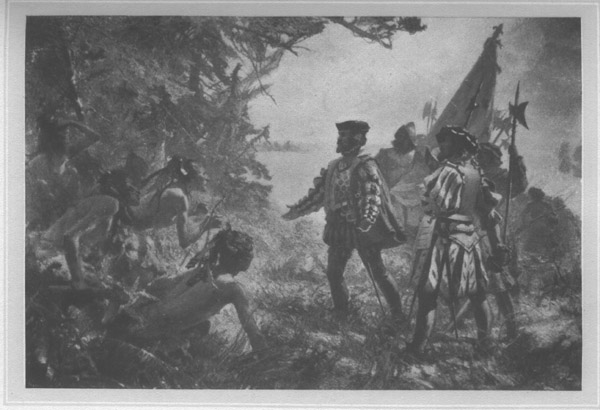
Cartier, Jacques (1491-1557). In 1534, sailing out of St. Malo, made his first voyage to the New World, entering the Gulf of St. Lawrence by way of the Straits of Belle Isle, landing on the Gaspé shore, and coasting around the eastern end of Anticosti. Returned to France. The following year again sailed to the gulf, and entered the river St. Lawrence. Continuing his voyage, passed the mouth of the Saguenay, and landed on the Island of Orleans, which he named Île Bacchus. Brought his little ships into the St. Charles River, upon whose banks stood the Indian village of Stadaconé. After exploring the St. Lawrence as far as the Indian town of Hochelaga (Montreal), returned to Stadaconé, where he wintered. In the spring of 1536 sailed back to France, taking with him the Iroquois chief, Donnacona. In 1541, made a third voyage to Canada. Roberval was to have followed with a number of colonists, but did not actually sail until the spring of 1542. When he reached Newfoundland, he met Cartier on his way home. Roberval's colony proved disastrous, and Cartier undertook a fourth voyage to the New World to rescue the survivors. Index: Ch Names Hare Island, 13; ravages of scurvy among his men, 23; finds a remedy in the plant aneda, 29; Membertou pretends to have met him in 1534, 36; his winter quarters identified by Champlain, 44-45; his Rivière de Fouez identified as the St. Maurice, 52. F His voyages, 1; attempt at colonization, 2. L With his men, receives communion from bishop of St. Malo, 7. C Sir Georges É. Cartier a descendant of the explorer's family, 3. Bib.: For a complete list of the original editions of Cartier's voyages, see Harrisse, Notes pour Servir, etc. Tross, Paris, reprinted them as follows: D'Avezac, Bref Récit et Succinte Narration de la Navigation Faite par le Capitaine Jacques Cartier aux Îles de Canada, etc. (1863); Michelant et Ramé, Voyage de Jacques Cartier au Canada en 1534 (1865); Michelant et Ramé, Relation Originale, du Voyage de Jacques Cartier au Canada en 1534 (1867). The first English version is that of Florio (1580). In 1600 Hakluyt included a more accurate translation in his Principal Navigations. H. B. Stephen's essay, Jacques Cartier and his Voyages to Canada, is accompanied by a new translation of the voyages. The Cartier voyages are discussed in the Trans. R. S. C., by W. F. Ganong (1887), (1889); Paul de Gazes (1884), (1890); Abbé Verreau (1890), (1891), (1897); Archbishop Howley (1894); and in the Quebec Lit. and Hist. Soc. Trans., Voyages de Découvertes au Canada (1843); Demazieres, Notes sur Jacques Cartier (1862). See also Pope, Jacques Cartier; Winsor, Cartier to Frontenac; Parkman, Pioneers of France; Des Longrais, Jacques Cartier; Dionne, La Nouvelle France de Cartier à Champlain; Dent, Can. Por.
Cartwright, J. S. Sy Opposes union of provinces in Upper Canada Assembly, 207, 211.
Cartwright, Rev. Richard. Sy Assists in funeral service of Lord Sydenham, 344.
Cartwright, Richard (1759-1815). Born at Albany, New York. On the outbreak of hostilities with the mother country came with his parents to Upper Canada. For a time served as secretary to Colonel Butler of the Queen's Rangers, and later engaged in business at Kingston in partnership with Robert Hamilton. Made judge of the Court of Common Pleas for the district, and on the formation of Upper Canada into a separate province appointed to the Legislative Council. Urged to accept a seat in the Executive Council, but repeatedly refused. Created lieutenant of the county of Frontenac by Simcoe, and during the War of 1812 served as colonel of the militia. Occupied a position of great prominence in the political and business life of the province. Index: BL Offered and refuses solicitor-generalship of Upper Canada, 120; his letter of explanation, 121. R His influence on Strachan, 37. Bk Brock's high opinion of, 179. S On later emigration from United States, 57; member of Legislative Council, 79; his report on marriage question, in Upper Canada, 86; accused by Simcoe of republicanism, 97, 98; asserts his loyalty, 98; advises Simcoe in regard to land regulations, 103; describes methods of business in early times, 109. Bib.: Cartwright, Life and Letters of Hon. Richard Cartwright.
Cartwright, Sir Richard John (1835- ). Grandson of the preceding. Born at Kingston. Educated at Trinity College, Dublin. Entered public life, 1863, as member for Lennox and Addington. Minister of finance in Mackenzie Cabinet, 1873-1878. On the return of the Liberals to power, in 1896, became minister of trade and commerce. Index: Md Favours commercial union, 297; introduces unrestricted reciprocity resolution, 1888, 298-299; his modified resolution of 1889, 299. B His account of pre-confederation scenes in the house, 153-154. C Discussion with Cartier in 1872, on the militia, 110. Bib.: Works: Remarks on the Militia of Canada; Memories of Confederation. For biog., see Dent, Can. Por. and Last Forty Years; Morgan, Can. Men; Canadian Who's Who.
Carver, Jonathan (1732-1780). Born at Stillwater, New York. Joined the company of rangers raised by John Burk of Northfield, 1756-1757. After the treaty of Paris, 1763, conceived the idea of exploring the Western territory acquired by England. Between 1766 and 1768, travelled from Michilimackinac to the Mississippi, ascended the Minnesota River, and returned by way of Grand Portage, Lake Superior. Went to England, 1769, to secure government support for his plans of Western exploration, but failed. Died there, Jan. 31, 1780. Index: D His River of Oregon, 19; reference to Oregon, 56-57. Bib.: Travels through the Interior Parts of North America, in the Years 1766, 1767, and 1768. The best edition is the third, published at London, 1781. For a bib. of the various editions, and translations, see Lee, Bibliography of Carver's Travels (Wisconsin State Hist. Soc. Proc., 1909). See also Durrie, Jonathan Carver and "Carver's Grant" (Wisconsin Hist. Soc. Coll., vol. 6); Gregory, Jonathan Carver: His Travels in the North-West (Parkman Club Pub., No. 5); Bourne, Travels of Jonathan Carver in Amer. Hist. Review, 1906; Parkman, Conspiracy of Pontiac.
Cas Reservé. L In connection with sale of liquor to Indians, 171, 174.
Cascades. On the St. Lawrence River. Hd Improvements in navigation at, 185.
Case, William. R Visits England, 1831, 90; his connection with split in Methodist body, 105.
Casgrain, Henri Raymond (1831-1904). After studying medicine, decided to enter the church, and ordained a priest in 1856. In 1872, owing to an affection of the eyes, compelled to abandon the ministry, and thereafter devoted himself entirely to literature. His first work, Légendes Canadiennes, appeared in 1861; and this was followed by many other publications, in history, biography, and belles-lettres. One of the principal contributors to the Soirées Canadiennes, the Foyer Canadien, and other French-Canadian periodicals. A charter member of the Royal Society of Canada; elected president of that body in 1889. Index: L His pen-portrait of Mme. de la Peltrie, 153-154. Ch On the question of Champlain's tomb, 261-262. Bib.: Among his principal works are: Histoire de la Mère Marie de l'Incarnation; Biographies Canadiennes; Un Pélerinage au Pays d'Evangéline; Montcalm et Lévis. For bib., see R. S. C., 1894, 21. For biog., see Routhier, Éloge historique de H. R. Casgrain (R. S. C., 1904); Morgan, Can. Men.
Cass, Lewis (1782-1866). Served under General Hull in War of 1812. Drew up Hull's flamboyant proclamation to the people of Canada. Opposed surrender of Detroit. Governor of territory of Michigan. Index: Bk On surrender of Detroit, 257. Bib.: Contributed to Historical Sketches of Michigan, 1834. For biog., see McLaughlin, Lewis Cass; Cyc. Am. Biog.
Castillon, Jacques de. Ch Assisted in forming Company of New France, 168; presents pictures to church of Notre Dame de la Recouvrance, 240.
Castle Frank. S Country chalet built for Simcoe near York, 215.
Castle of St. Louis. See Château St. Louis.
Catalogne, Gédéon de. Employed for some years on military and other engineering works in Canada. In 1701 commenced a canal from Lachine to the Little River, with the object of providing a boat channel around the rapids. The work was abandoned, and resumed in 1717, but was again abandoned, owing to the cost of the rock cutting. Accompanied Denonville on his expedition against the Iroquois, in 1687.
Cataraqui. A fort, built by the engineer Raudin in 1673, under Frontenac's orders, the site having been selected by La Salle. The fort stood at the mouth of the Cataraqui, on the site of the present city of Kingston. Here Frontenac held a great Council with representatives of the five Iroquois nations, 1673. On Frontenac's recommendation, Cataraqui was granted to La Salle as a seigniory, upon his repaying the amount the fort had cost the king. Fort Frontenac, as La Salle named it, became the base of his ambitious scheme of western explorations. Index: F Expedition of Courcelles to, 59; of Frontenac, 76-84; fort, afterwards known as Fort Frontenac, erected at, 83. Hd Lands allotted to Loyalists in neighbourhood of, 236, 255; settlers at, 258, 265. S Barracks of, on site of old Fort Frontenac, 51; Loyalist settlements in surrounding country, 58; detail of, 59. See also Kingston; Fort Frontenac; La Salle. Bib.: Machar, Old Kingston; Sulte, Le Fort de Frontenac (R. S. C., 1901); Girouard, L'Expédition du Marquis de Denonville (R. S. C., 1899).
Cathcart, Charles Murray, Earl (1783-1859). Served in Holland, 1799; saw service through Peninsular War; fought at Waterloo; assumed title, 1843; succeeded General Jackson as commander-in-chief of the forces in British North America, 1845; administrator the same year, on the departure of Sir Charles Metcalfe; governor-general, 1846; succeeded by Lord Elgin, 1847. Index: Md Succeeds Metcalfe as governor-general, 25; correspondence with Draper over Macdonald's appointment to Cabinet, 26. BL Becomes administrator, and afterwards governor-general, 265-266; his character and attitude towards political questions in Canada, 266. E Succeeds Metcalfe as governor-general, more interested in problems of defence than in politics, 38; replaced by Elgin, 40; his instructions to Rebellion Losses Commission, 65. B His appointment and character, 28; warns British government of disaffection in Canada, 31. Bib.: Dent, Can. Por. and Last Forty Years; Morgan, Cel. Can.
Catherine. Ch Champlain sails for France in (1626), 155.
Cauchon, Joseph Édouard (1816-1885). Educated at the Séminaire de Québec; studied law and called to the bar, but turned immediately to journalism. Edited Le Canadien for a time; and in 1842 established the Journal de Québec. Entered public life, 1844, as member for Montmorency, which county he represented continuously until 1872. Entered MacNab government, 1855, as commissioner of crown lands. Became commissioner of public works in Cartier-Macdonald ministry, 1861-1862. Speaker of the Senate, 1868-1872. Accepted presidency of the Council in Mackenzie administration, 1875-1877; minister of inland revenue, 1877. Resigned the same year to accept the lieutenant-governorship of Manitoba, 1877-1882. Index: C As journalist and politician, 24; attitude towards Cartier, 24; his writings, 24; praises Cartier in the Journal de Québec, 88. E Brings up question of Seigniorial Tenure in Parliament, 126; votes against secularization of the Clergy Reserves, 164. Bib.: Works: Remarks on the North-West Territories; Étude sur l'Union Projectée des Provinces Britanniques; L'Union des Provinces de l'Amérique du Nord. For biog., see Revue Canadienne, 1884; Dent, Can. Por.; Taylor, Brit. Am.
Caughnawaga Indians. A community of Iroquois, chiefly drawn from the Oneida and Mohawk, and speaking a modification of the Mohawk tongue. Having been converted by the Jesuit missionaries, they were induced to settle in 1668 at La Prairie, near Montreal. In 1676 they removed to Sault St. Louis, and the majority have remained in that vicinity ever since. About 1755 a new settlement was formed at St. Regis, farther up the St. Lawrence. Many accompanied the fur traders to the west as hunters. In the narratives of the fur trade they are referred to as Iroquois. Index: Hd Their sympathies secured for Congress by Jesuits, 130; village of, burned by Sir John Johnson, 156; their disloyalty, 189. Bib.: Colden, Five Nations; Hodge, Handbook of American Indians.
Caumont. Ch Pont-Gravé's clerk, 121; chief clerk of De Monts's (Rouen) company at Quebec, 133.
Cayahoga. Bk United States schooner carrying Hull's stores and baggage, captured, 218.
Cayet, Victor Palma. Ch His work on French navigation, 15.
Cayley, William. Inspector-general, 1845-1848, and again, 1854-1858. By the Act of 1859, the office was changed to minister of finance. Index: E Inspector-general, 1854, 140; favours division of Clergy Reserves among various denominations, 163. B Galt takes his place in government, 107. Bib.: Finances and Trade of Canada. For biog., see Dent, Last Forty Years.
Cayugas. One of the tribes of the Iroquois confederacy. Parkman gives four forms of the name: Cayugas, Caiyoquos, Goiogoens, Gweugwehonoh. Their fighting strength is given in the Relation of 1660 as 300. At this time, however, they had been weakened by continual warfare. The Cayuga villages stood on the shore of Cayuga Lake, and their territory extended from that lake to the Owasco, both included. The tribe lay between the Senecas on the west and the Onondagas on the east. By the beginning of the nineteenth century they had been crowded off their ancestral lands, and scattered abroad. Some seven hundred are now on the Six Nation reserve, in the Niagara peninsula. The remainder are for the most part in the western United States. Index: Ch Iroquois tribe, 50. See also Iroquois; Senecas; Onondagas; Mohawks; Tuscaroras. Bib.: Pilling, Iroquoian Languages. See also Iroquois.
Cazeau, François. Hd Arrested on charge of treason, 279.
Census. The first census in Canada seems to have been taken in 1640, when the inhabitants numbered 375, distributed as follows: married men, 64; married women (three born in Canada), 64; widower, 1; widows, 4; unmarried men, 35; boys (30 born in Canada), 58; girls (24 born in Canada), 48; nuns, 6; Jesuits, 29; others, 66. Benjamin Sulte finds the population in 1650 to have been 705; and in 1663 about 2500. The census of 1665 gives the total population as 3251. The first census of the Dominion was taken in 1871, when the population was 3,635,024; the census of 1881 gave a total of 4,324,810; of 1891, 4,833,239; of 1901, 5,371,315. See also Acadians. Index: E Provided for by La Fontaine-Baldwin government, 86; placed under Department of Agriculture by Hincks-Morin government, 117. F Of 1666, 55. Bib.: Census of Canada, 1851, 1861, 1871, 1881, 1891, 1901. See also Johnson, First Things in Canada; and General Index, Trans. R. S. C., under Census.
Centurion. WM Admiral Saunders's ship, in action off Beauport shore, 136.
Chabanel, Noél. Jesuit missionary in the Huron country, 1643. Had been a professor of rhetoric in France, before coming to Canada. When the Hurons were driven from their country by the Iroquois, in 1649, he and Garnier led their demoralized flock to the Island of St. Joseph, in Matchadash Bay, an inlet of Georgian Bay. Even here the Iroquois followed them, and attacked the mission of St. Jean, Dec. 7, 1649. Chabanel had left the place a short time before, and so escaped the general massacre. He, however, fell a victim to one of his own Hurons, who confessed that he had murdered the missionary and thrown his body into a river. Index: L Died a martyr, 62. Bib.: Parkman, Jesuits in North America.
Chabot, J. (1807-1860). Born at St. Charles, Bellechasse, Lower Canada. Studied law and practised in Quebec. Sat in the Assembly for Quebec, 1843-1850; for Bellechasse, 1851-1854; and for Quebec, 1854-1856. Became chief commissioner of public works, 1849, and again in 1852; government director of the Grand Trunk, 1854; and Seigniorial Tenure commissioner the same year. Appointed judge of the Superior Court of Lower Canada, 1856. Index: E Commissioner of public works, 1853, 126; and again in coalition ministry, 1854, 141; votes against secularization of the Clergy Reserves, 164; commissioner under Seigniorial Tenure law, 186. Bib.: Morgan, Cel. Can.; Dent, Last Forty Years.
Chalmers, Thomas. R Offered, but declines, charge of educational policy in Upper Canada, 37.
Chamberlain, Joseph (1836- ). British statesman. Mc Justifies Upper Canada Rebellion, 29, 30. Bib.: Who's Who.
Chambers, Captain. Bk Sent to Moraviantown to oppose enemy, 219, 235; in command of 2d Brigade, 247.
Chambly, Jacques de. An officer of the Carignan Regiment; built Fort St. Louis, on the Richelieu, 1665, and given its command. In 1672 the seigniory of Chambly granted to him. Succeeded De Grandfontaine as governor of Acadia; transferred to Grenada; and later to Martinique, where he died. Index: F Appointed governor of Acadia, 90, 269; taken prisoner to Boston and there set at liberty, 269; again governor, 270; governor of Grenada (W. I.), 270. Bib.: Sulte, Régiment de Carignan (R. S. C., 1902).
Chambly. Fort, otherwise known as St. Louis, on the Richelieu. Built by Jacques de Chambly, 1665. Index: F Fort erected at, 51. Dr Captured by Montgomery, 99; abandoned, 146. L Fort erected at, 53. Hd Weak defences of, 134.
Champdoré. Ch Carpenter to De Monts's expedition, 22.
Champlain, Antoine. Ch Father of Samuel Champlain, 1.
Champlain, Samuel (1567?-1635). WM His elevated sentiments, 20. Ch Birth and education, 1; sails to West Indies, Mexico, and Panama in command of Spanish vessel, 3, 4; suggests channel through isthmus, 5; captures English vessels and returns to France, 6; publishes account of travels, 7; obtains pension and made hydrographer to king of France, 8; accepts offer of Aymar de Chastes of Dieppe to go to Canada, 9; arrives at Tadoussac, 10; explores Saguenay, 12; ascends St. Lawrence to Sault St. Louis, anchors at Quebec, and explores Gaspesia, 13; sails for France, 14; submits narrative of his voyages to the king, 14; accompanies De Monts to Acadia, 19; explores country and gives names to places, 19; describes river St. John, 20; discovers a copper mine, 22; makes plan of Ste. Croix Island, 24; explores coast of Norembega, 25; describes Pentagouet (Penobscot) River, 27; further explorations, 30; describes settlement at Port Royal, 32; returns to France, 37; sails for Quebec, 40; resists Basque traders, 40; arrives at Quebec, 41; conspiracy formed against, 42; execution of chief conspirator, 43; explores vicinity of Quebec, 44; illness, 46; fits out expedition against Iroquois, 47; conference with Huron chiefs, 48; his Indian policy, 49-52; encounter with Iroquois on Lake Champlain, 53; sails for France, 54; has audience with the king, 55; consults with De Monts, 56; returns to Canada, 59; arrives at Quebec, 61; proceeds again to attack Iroquois, 61; wounded in encounter near mouth of Richelieu River, 62; returns to Quebec, 63; hears of the assassination of Henry IV, and sails for France, 64; marries Hélène Boullé, 65-67; returns to Canada, 67; arrives at Quebec, 68; makes a clearing at Montreal, 69; names St. Helen's Island after his wife, 69; sails for France, 70; final interview with De Monts, 71; motives for pursuing his work in Canada, 72, 82; becomes lieutenant in Canada of Charles de Bourbon, Comte de Soissons, 73; on death of Soissons, becomes lieutenant of the Prince de Condé and returns to Canada, 73; arrives at Quebec and proceeds to Falls of St. Louis, 74; goes up the Ottawa River, 75; his astrolabe, 76; sails for France, 79; engages the services of missionaries for Canada, 83; brings to Canada three Récollet fathers and one friar, 85; arriving at Quebec, proceeds to Falls of St. Louis, 85; ascends Ottawa River, passes through Lake Nipissing into Georgian Bay and reaches territory of Hurons, 88; proceeds with Hurons on another campaign against Iroquois, 101; wounded in fight with Iroquois, 103; desires to return to Quebec, but is detained by Hurons, 103; settles quarrel between Algonquians and Hurons, 105; returns to Quebec, 106; convokes meeting to consider question of missions, 108; sails for France, 111; returns to Canada (1617), 112; sails for France (1618), 116; returns to Canada (1620), 121; his projects for the advancement of Canada, 124, 125; obtains letter from the king in his favour, 126; his commission renewed by Duc de Montmorency, 129; takes his wife to Canada, 129; receives letters from Montmorency and the king, 130, 131; his difficulties with rival Companies, 132, 136; confirmed as lieutenant of viceroy, 137; salary and trading privileges, 138; publishes ordinances, 139; returns to France with his wife (1624), 141; meets Montmorency, 150; appointed by the Duc de Ventadour as his lieutenant, 152; sails for Canada (1626), 155; arrives at Quebec, 156; fortifies Cape Diamond, 157; reconstructs Fort St. Louis, 158; his treatment of the Indians, 159; tries to make an alliance with Iroquois, 160; his policy towards the Montagnais, 162; imprisons Montagnais suspected of murder, 165; receives three young Montagnais girls to be educated, 165; one of the Hundred Associates (Company of New France), 170; forms establishment at Cap Tourmente, 171; criticizes conduct of Roquemont, 175; summoned by David Kirke to surrender Quebec, 176; his answer, 178; builds mill for grinding pease, 180; sends part of population of Quebec to Gaspé, 181; asserts superiority of his commission over Pont-Grave's, 182; summoned by Kirke to surrender Quebec, 188; capitulates, 190; his action criticized, 192, 193; signs articles of capitulation on board Kirke's ship, 195; delayed several weeks at Tadoussac, 204; his two Indian girls, Esperance and Charité, taken back by the Indians, 205; embarks for France, 206; goes to London and sees French ambassador, 207; shows him map of the country, 211; names given by, to harbours and rivers of New England, 212; crosses over to France, and has interview with the king, 212; returns to Quebec (1633), 228; takes active part in civilization of Micmacs, 237; erects chapel of Notre Dame de la Recouvrance, 238; his bequest to it, 239; appointed governor, by Company of New France (Hundred Associates), 244; his last letter to Cardinal Richelieu, 246; defrays expenses of some families coming to Canada, 250; approves of exclusion of Protestants as settlers, 255; his piety, 258; death, 261; question of his tomb, 261; his will, 265; will set aside, 266; character and fame, 267; monument to, 268, 275; the Father of New France, 269; crossed the Atlantic twenty times, 270; his conduct towards and influence over Indian tribes, 271; his Indian alliances, 272; his writings, 274, 275; eulogies pronounced on, 276-279. F Early career of, 3; sails for St. Lawrence and explores river to Lachine Rapids, 4; explores Baie des Chaleurs, returns to France, 5; accompanies De Monts to Acadia, 7; founder of Quebec, 8; plot against his life, 8; expedition against Iroquois, 9; returns to France and sails again for Canada, 10; returns to France, marries, and sails again for Canada, 11; prospects island of Montreal, 12; returns to France (1611), sails for Canada (1613), again to France, again to Canada (1615), 13; brings out Récollet missionaries, 13; heads another expedition against Iroquois, 14; begins construction of Château St. Louis, 15; surrenders Quebec to English under Kirke, 20; lands in England, 21; urges restitution of Canada, 22; sails for Quebec (1633), 24; death of, 26. L His anxiety for the propagation of the faith, 4; his pious administration, 8. Bib.: Works: [OE]uvres de Champlain (Laverdière), 1870; Voyages (Laverdière), 1870; Voyages (trans. by Otis, with memoir by Slafter), 1878-1882; Grant, Voyages of Samuel de Champlain; Bourne, Champlain's Voyages; Biggar, Works of Samuel de Champlain (Champlain Society, in prep.). For bib. of the original editions, see Harrisse, Notes pour Servir, etc. For biog., see Gravier, Vie de Samuel Champlain; Sedgwick, Samuel de Champlain; Dix, Champlain: the Founder of New France; Verreau, Samuel de Champlain (R. S. C., 1899); Parkman, Pioneers of France; Dent, Can. Por.
Champlain Lake. Discovered by Samuel Champlain, July, 1609. Here took place the first hostile encounter between the French and the Iroquois. The French were the aggressors, and had bitter enough cause to remember the fact throughout the century. In 1666 the Sieur de la Motte built a fort on Île La Motte, which was afterwards abandoned. Fort St. Frederic was built at Crown Point, 1731. It was enlarged and strengthened in 1734, and again in 1742. Lake Champlain became the war thoroughfare, not merely between the Iroquois and French, but between New France and New England. Fort Carillon was built, 1755-1756. With this lake are associated the names of Dieskau and Sir William Johnson, Montcalm and Abercrombie, Ethan Allen and Montgomery. Index: F Champlain reaches, in his expedition against the Iroquois, 9, 10. Hd Canada to be attacked by way of, 34; trouble among the settlers on, 89, 197; guarding against invasion from, 125, 133, 134; Major Carleton on, 149; messengers intercepted on, 129; forts captured by Ethan Allen, 198; Vermont negotiations held upon, 204; fear of rebel approach by, 208, 216; Ethan Allen offers to meet Haldimand upon, 214; Loyalists on shores of, 250. WM Montcalm at, 32, 34; 54-61; forts on, evacuated by Bourlamaque, 146. Dr Armed craft on, captured, 82; Americans evacuate Canada by way of, 146; route of attack on New England, 147; Carleton builds a fleet on, 149; description of the lake, 153; Carleton defeats Arnold on, 154-157. Ch Encounter with Iroquois at southern extremity of, 53. Bib.: Parkman, Montcalm and Wolfe; Crockett, History of Lake Champlain; Smith, Our Struggle for the Fourteenth Colony; Reid, Lake George and Lake Champlain; Palmer, History of Lake Champlain. See bib. note in Crockett.
Chandler, Edward Barron (1800-1880). Elected to New Brunswick Assembly, 1827, for Westmoreland, which he represented until 1836, when called to Legislative Council. Became executive councillor, 1844. Engaged in negotiations for Intercolonial Railway, 1850-1852; reciprocity, 1854; and Confederation, 1865. Succeeded Tilley as lieutenant-governor of New Brunswick, 1878. Index: W Sent by New Brunswick Assembly to lay grievances before colonial secretary, 24; becomes member of government, 72; resigns, 76. T Goes to London to secure support for Intercolonial, 26-27; 54; member of Executive Council, 1856, 41; delegate to Charlottetown Conference, 73; to Quebec Conference, 77; Confederation delegate to England, 120. H Joins Joseph Howe in mission to Toronto on behalf of Intercolonial Railway project, 137; secures support of New Brunswick government, 139; his speech at Amherst on behalf of Howe, 140; accompanies Hincks to England on Intercolonial Railway mission, 142. B Complains at Quebec Conference, that proposed union legislative, not federal, 163. Bib.: Hannay, History of New Brunswick; Dent, Can. Por.
Chandler, Samuel. Mc Aids Mackenzie's escape, 397.
Chansons of French Canada. Most of the inimitable folk-songs of Quebec came in their original form from France, and have undergone more or less of a transformation in their new environment. A few originated in French Canada. Index: C Chansons de ronde among the habitants, 119-120; at Cartier's house, 123. Bib.: Gagnon, Chansons populaire; McLennan, Songs of old Canada; Burpee, Songs of French Canada; Wood, Footnotes to Canadian Folk-Songs (R. S. C., 1896); Bourinot, Songs of Forest and River in Rose-Belford Monthly, 1877; French Songs of Old Canada, pictured by W. Graham Robertson; Tiersot, French Folk-Songs.
Chapais, Jean Charles (1812-1885). Born in Rivière Oùelle, Quebec. Member of the Executive Council and commissioner of public works, 1864-1867. In 1867 privy councillor and minister of agriculture; and 1869-1873 receiver-general. In 1868 called to the Senate. Index: T Delegate to Quebec Conference, 76; minister of agriculture in first Dominion Cabinet, 129. Bib.: Dent, Last Forty Years.
Chapais, Joseph Amable Thomas (1858- ). Educated at Laval University. Called to the bar, 1879. Edited Le Courrier du Canada since 1884. Appointed member of Legislative Council of Quebec, 1892, and elected Speaker, 1895; president of the Executive Council, 1896, and minister of colonization, 1897. Index: F His work on Talon referred to, 57. Bib.: Works: Jean Talon, Intendant de la Nouvelle France; Discours et Conférences. For biog., see Morgan, Can. Men; Canadian Who's Who.
Chapleau, Sir Joseph Adolphe (1840-1898). Studied law and called to the bar, 1861. Elected to Quebec Legislature, 1867, and successively solicitor-general, and provincial secretary, of the province. Premier of Quebec, 1879. Entered Dominion Cabinet, 1882, as secretary of state. Appointed lieutenant-governor of Quebec, 1892; knighted, 1896. Bib.: Works: Léon XIII, Homme d'État; Question des Chemins de Fer. For biog., see J. A. Chapleau: Sa Biographie et Ses Discours; Morgan, Can. Men; Dent, Can. Por.
Chapman, Henry Samuel (1803-1881). Born in England. Came to Canada, 1823, and established at Montreal the Daily Advertiser, the first daily newspaper published in British America, 1833. Connected with several other newspapers. A strong supporter of the Reform party. Removed to England and called to the bar, 1840. Went to New Zealand, where he became a judge. Died in Dunedin, New Zealand. Index: H Attempts to secure Joseph Howe's support for agitation in Lower Canada, 50; Howe's reply, 50.
Charbonnel, Armand François Marie de. Roman Catholic bishop of Toronto, 1850-1860. Died, 1860. Index: R Opposes public schools, 219, 225; Ryerson's letter to, 224-225; referred to in Globe, 226; his letter to Ryerson, 226; his policy, 228; his complaints, 229; drafts Separate School Bill, 230; his pastoral letter, 234; resigns charge of Toronto diocese, 235.
Charest, Dufils. WM Commands party sent to heights of Lévis, 103.
Charles I (1600-1649). King of England; succeeded to the throne, 1625. Index: Ch His instructions to English ambassador at Paris, 215; restores New France and Acadia to France, 221. Bib.: Dict. Nat. Biog.
Charles II (1630-1685). King of England; succeeded to the throne, 1660. Index: W Annuls charter of London and other towns, 54. Bib.: Dict. Nat. Biog.
Charles Emmanuel III (1701-1773). King of Sardinia. Succeeded to the throne, 1730. Index: Hd His foreign policy, 5.
Charlesbourg. WM De Pontbriand retires to, 153.
Charlevoix, Pierre-François-Xavier de (1682-1761). First came to Canada in 1705, as an instructor in the Jesuits' College at Quebec. Returned to France in 1709. It was at this time that he gathered the material for his Histoire et Description Generale de la Nouvelle-France. Again visited Canada in 1720 by order of the French government to report as to the best route for an overland expedition in search of the Western Sea. In the course of this journey visited the mission and posts of what was then the extreme western frontier of New France, returning to France in 1723, by way of Mobile. Index: L On the character of the Canadian population, 117; on the character of Frontenac, 144, 145. F On bravery of Canadians and indifferent conduct of French troops, 212; on Lachine massacre, 224, 227; on old age of François Hertel, 235; his account of "flag" incident in siege of Quebec, 295; on character and conduct of Frontenac, 333-336. Ch His opinion of Lescarbot, 37; his description of the French settlements in Canada, 243; his eulogy of Champlain, 276, 277. Bib.: Besides his Histoire du Paraguay and Histoire de l'Isle Espagnole ou de S. Dominique, Charlevoix was the author of La Vie de la Mère Marie de l'Incarnation and of the first general history of Canada, Histoire et Description Generale de la Nouvelle-France. His Voyage dans l'Amerique Septentrionale was translated into English in 1756. Dr. J. G. Shea's translation of the History was published at New York in 6 vols., 1866-1872; and reprinted by F. P. Harper, New York, in 6 vols. An abridged translation of Charlevoix's Journal is found in vol. 3 of French Hist. Coll. of Louisiana. For biog., see J. E. Roy, Essai sur Charlevoix (R. S. C., 1907).
Charlottetown. Capital of Prince Edward Island. Originally founded by the French, about 1750, and then known as Port la Joie. In 1713 it was a fortified post, with a garrison of sixty soldiers. The population numbered 1354 in 1752; and in 1758 it had been increased to over 4000 by the arrival of a large number of Acadians from the mainland. It came under British rule in 1763, and received its present name about 1768. Bib.: Campbell, History of Prince Edward Island.
Charlottetown Conference, 1864. Md Arranged by Tupper, 104; the Canadian proposals, 104; terms of union, 107. H Joseph Howe invited to attend as delegate, but declines, 176-177; Sir Charles Tupper's connection with, 176-177; Nova Scotia delegates, 177; maritime union found impracticable, 178; Sir John Macdonald proposes Confederation, 178. B History of, 161. T Delegates to, 73; history of, 73-75. See Quebec Conference; Macdonald; Tupper. Bib.: Whelan, Union of the British Provinces; Saunders, Three Premiers of Nova Scotia.
Charny-Lauzon. See Lauzon-Charny.
Charron, Jean-François. L Charitable work of, and of his brother, 125; house of charity established by, 245; death of, 246.
Chartier de Lotbinière, Eustache Gaspard Michel. Dr Advised in connection with question of Canadian laws, 63, 68; elected Speaker of the Assembly, 277.
Chartier de Lotbinière, René Louis. L Appointed to Sovereign Council, 166. F Member of the Sovereign Council, 106.
Charton, François. Ch Jesuit, 152; returns to France, 208.
Chastes, Aymar de. Ch Governor of Dieppe, obtains charter for colonization of Canada, 8; suggests that Champlain should visit Canada, 9; death of, 9. F Trading patent granted to, 3; his death, 5.
Château de Ramezay. At Montreal. Index: Hd Purchased for government house, 186; belonged to William Grant, 186. BL Government offices in, during Elgin's governorship, 325.
Château Haldimand. At Quebec. Index: Hd Foundation stone laid by Haldimand, 344; used as school in connection with Laval University until 1892, then pulled down, 344.
Château St. Louis. At Quebec. Commenced by Governor de Montmagny, 1647, and completed by his successor, D'Ailleboust. Demolished, 1694, and rebuilt with new wing. Enlarged, 1723; and in 1808 renovated and again enlarged, by government of Lower Canada. Up to the close of French régime, it was the official residence of the governors of Canada; and after the cession, their British successors continued to occupy the building. It was destroyed by fire, 1834. The Château Frontenac hotel now stands immediately back of the site of the Château St. Louis, which occupied part of what is now Dufferin Terrace. See Habitation de Québec. Index: F Construction begun, 15. Bk Description of, 90; occupied by Sir James Craig, 90. Hd Governor's residence at Quebec, 169, 222, 304, 314; balls at, 223; wing added by Haldimand named in his honour, 344. Bib.: Gagnon, Le Fort el la Château St. Louis; Doughty, Fortress of Quebec; Douglas, Old France in the New World.
Châteaufort, Marc Antoine Bras-de-fer de. F Interim governor after death of Champlain, 27.
Châteauguay. Battle in War of 1812, Oct. 26, 1813. The stream from which the battle took its name, rises in Franklin County, New York, and falls into the St. Lawrence a few miles above Caughnawaga. The scene of the battle was about six miles above the confluence of the English with Châteauguay River. Hampton was in command of the Americans, and De Salaberry commanded the Canadian troops, with Colonel Macdonell in charge of the reserves. Although the former had an overwhelmingly superior force, the result of the battle was in favour of the Canadians; and the contemplated attack on Montreal was abandoned. The battle was won by French-Canadian militia under a French-Canadian commander. See also War of 1812; Salaberry. Bib.: Lucas, Canadian War of 1812; Lighthall, An Account of the Battle of Chateauguay; Macdonell, The Early Settlement and History of Glengarry in Canada; Kingsford, History of Canada.
Chateauneuf, Pierre Antoine de Castaguere, Marquis de (1644-1728). Ch French ambassador in London, instructions to, 214.
Chatel, Aimée. L Member of the Congregation de Notre Dame, 91.
Chatham, William Pitt, first Earl of (1708-1778). The "Great Commoner," who brought England "to a height of prosperity and glory unknown to any former age." He urged continually a conciliatory policy towards America, until it became apparent that the colonists would be satisfied with nothing less than independence. His broad outlook and unerring instinct in the choice of men were chiefly responsible for the triumphs of British policy at home and abroad. Sent Boscawen and Amherst to the capture of Louisbourg, and Wolfe and Saunders to victory at Quebec. Index: Dr Opposes Quebec Act, 65. Bib.: Almon, Anecdotes and Speeches of Chatham; Rosebery, William Pitt; Green, William Pitt, Earl of Chatham; Correspondence of William Pitt with Colonial Governors, ed. by Kimball. See his letters and instructions to Wolfe, Saunders, and Amherst, in Doughty, Siege of Quebec, and Wood, Logs of Conquest of Canada.
Chaumonot, Joseph. Came to Canada, 1639, with Madame de la Peltrie, Marie de l'Incarnation, and Fathers Vimont and Poncet. Accompanied Brébeuf as missionary to the Neutral Nation, whose country was along the north shore of Lake Erie, 1640. Sent to the Onondagas, 1655. Missionary in charge of the Hurons at Old Lorette, where, in 1674, he built the chapel in honour of Our Lady of Loretto. Died, Feb. 21, 1693. Index: L Accompanies mission to Gannentaha, 65; chief promoter of cult of Holy Family, 86. Bib.: Shea, Vie de Chaumonot; Parkman, Jesuits in North America; Campbell, Pioneer Priests of North America.
Chaussegros de Léry, Gaspard (1682-1756). Sent to Canada in 1716 to superintend the fortifications of Quebec, Montreal, and other places in the colony. Prepared a plan of the cathedral at Quebec in 1725; and of the fortifications at Quebec in 1730. Mentioned as having been at Fort St. Frederic in 1742; made a plan of Detroit in 1750. Index: L Makes plans for entrance to Montreal church, 90. WM Criticized by Montcalm, 79. Bib.: Traité de Fortification.
Chaussegros de Léry, Gaspard-Joseph. Son of preceding. Engineer; made a legislative councillor, in 1774.
Chauveau, Pierre Joseph Olivier (1820-1890). Born at Quebec. Educated at Quebec; studied law and called to the bar of Lower Canada. First entered public life, 1844, defeating John Neilson in Quebec County. Represented the same constituency in the Assembly until 1855. Solicitor-general, in Hincks-Morin ministry, 1851; and provincial secretary, 1853. In 1855 succeeded Dr. Meilleur as chief superintendent of education of Lower Canada. In 1867 elected to the Dominion Parliament, as well as to the Quebec House, and the same year formed a provincial ministry. Resigned, 1873, and the same year Speaker of the Senate, retiring in 1874. Three years later sheriff of Montreal. Index: Md Leader of Quebec government, 141; the appointment revealed Macdonald's judgment, 141-142. C Conservative leader in Quebec, 24; superintendent of public instruction, 24, 37; premier of Quebec, 68; his character, 68. E One of leaders of the opposition in 1847, 45; returned in elections of 1848, 50; Solicitor-general for Lower Canada, 113; provincial secretary in Hincks ministry, 126; and in MacNab-Morin government, 141; votes against secularization of the Clergy Reserves, 164. Bib.: Works: Charles Guérin, Roman de Moeurs Canadiennes; François-Xavier Garneau, Sa Vie et Ses [OE]uvres; L'Instruction Publique au Canada; Souvenirs et Légendes. For biog., see Dent, Can. Por.; Taylor, Brit. Am.; Morgan, Cel. Can.
Chauvin, Pierre, Sieur de Tonnetuit. A Huguenot, born at Dieppe. Appointed captain of the garrison at Honfleur, 1589. Obtained trading monopoly for ten years in Canada. Made a trading voyage to Canada, 1600, bringing out a few colonists, whom he landed at Tadoussac. Sailed again the following year, with a larger fleet, but no colonists; and again in 1602. Died, 1603. Index: Ch Attempts to form settlement at Tadoussac, 8; left in charge of Quebec colony, 54. F Obtains patent for exclusive trade in Canada, 2; sails for the St. Lawrence, 3. Bib.: Biggar, Early Trading Companies of New France.
Chedabucto, now known as Guysborough, Nova Scotia. Index: F Frontenac arrives at, 232.
Cheffault. Ch Agent of Company of New France, 244.
Cherououng. Ch Montagnais chief, sent on embassy to Iroquois, 163.
Chesapeake. Bk Affair of, 82-86.
Childers, Hugh Culling Eardley (1827-1896). Entered the House of Commons, 1860; financial secretary, 1865-1866; first lord of the Admiralty and privy councillor, 1868. In 1875 came to Canada on Lord Dufferin's invitation as a commissioner under the Prince Edward Island Land Purchase Act. Secretary of state for war, 1880-1882; chancellor of the exchequer, 1882-1885; and home secretary, 1886. Index: W Commissioner under Land Purchase Act, 136. Bib.: Dict. Nat. Biog.
Chimeourimou. Ch Montagnais chief, sent on embassy to Iroquois, 163.
Chipman. W Judge of Supreme Court, New Brunswick, 8; one of Maine Boundary commissioners, 8.
Chipman, Ward. W Judge of Supreme Court, New Brunswick, 8; succeeds Saunders as chief justice, 74; resigns, 129. T Resigns as chief justice, 17.
Chippewa Indians. A large tribe, of Algonquian stock, formerly ranging along both shores of Lakes Huron and Superior, and westward as far as North Dakota. First mentioned in the Jesuit Relation of 1640, as living around Sault Ste. Marie. During the eighteenth century, they fought successfully against the Sioux, Foxes, and Iroquois. They numbered in 1764 about 25,000; and at the present time count over 30,000, of whom about one-half are on reservations in Canada. Index: Hd Sioux offer to attack, 148. Bib.: Hodge, Handbook of American Indians; Schoolcraft, Indian Tribes; Grant, Sauteux Indians in Masson, Bourgeois de la Compagnie du Nord-Ouest.
Chisholm, G. C. Sy Sergeant-at-arms of Legislative Assembly, 334.
Chittenden, Thomas (1730-1797). First governor of Vermont, 1778-1797. Index: Hd Claims separation of Vermont from New York, 201; negotiates with Haldimand, 202; General Washington's letter to, 212-213; Ira Allen's proposed treaty with, 214-215. Bib.: Chipman, Thomas Chittenden; Cyc. Am. Biog.
Choiseul, Étienne-François, Duc de (1719-1785). Minister of foreign affairs; signed the treaty of 1759 with Austria; minister of war, 1761. Index: WM French minister, glad to get rid of Canada, 11.
Cholera Epidemic, 1832 and 1834. P Imported by immigrants, 87; government blamed for neglect to provide quarantine, 88; committee formed to inquire into causes, etc., 88-89; one of the grievances in the Ninety-Two Resolutions, 89. See also Epidemics.
Chouageun. See Oswega.
Chouart dit des Groseilliers, Médard. Born in France about 1621. Came to Canada, 1642. After serving the Jesuits for some years as a donné, or lay helper, engaged in the fur trade, and with his brother-in-law Radisson (q.v.) made extensive explorations in the West and North, 1659-1663. With Radisson afterwards went to England and was instrumental in establishing the Hudson's Bay Company, and laying the foundations of its gigantic fur trading monopoly on the shores of Hudson Bay. Bib.: Dionne, Chouart et Radisson (R. S. C., 1893); Sulte, Radisson in the North-West (R. S. C., 1904); Sulte, Découverte du Mississippi (R. S. C., 1903); Bryce, Hudson's Bay Company; Laut, Pathfinders of the West and Conquest of the Great North-West.
Christian Doctrine, Brothers of the. L Arrival of, in Canada, 125.
Christian Guardian. R Founded at York (Toronto), 1829, 82; Egerton Ryerson, first editor, 82; exponent of Methodist views on religious, educational, and political questions, 82-83; its policy, 94-95; Ryerson's articles in, 96, 97, 98, 100, 109, 110, 134, 137.
Christie, Alexander. MS Chief factor, Hudson's Bay Company, and later governor of Assiniboia, 222. Bib.: Ryerson, Story of my Life.
Christie, David (1818-1880). Born in Edinburgh, Scotland. Educated at Edinburgh High School. Came to Canada, 1833, and devoted himself to farming. Took a prominent part in politics as a leader of the Reformers. Sat for Wentworth in the Legislative Assembly, 1851-1854, and for East Brant, 1855-1858. Elected to the Legislative Council, 1858, and held his seat until Confederation. Appointed to the Dominion Senate, 1867; secretary of state, 1873; Speaker of the Senate, 1874-1878. Administrator of Ontario during the illness of the lieutenant-governor, 1875. Died in Paris, Ontario. Index: B A leader of the Clear Grits, 39. E Well-known agriculturist, and a leader of the Clear Grits, 110. Bib.: Dent, Last Forty Years.
Christie, Robert (1788-1856). Born in Nova Scotia. Repeatedly expelled from the Assembly of Lower Canada; re-elected after the union, and held his seat until 1854. Contributed to Quebec Gazette and Mercury. Index: F Papineau causes his expulsion on four occasions from Assembly, 80; his reconciliation with Papineau, 180; Papineau's letters to, 144, 181-182, 191-193. Mc On Union Act, 405. Bib.: History of the Late Province of Lower Canada, from the Commencement to the Close of its Existence as a Separate Province. For biog. see Morgan, Cel. Can.
Chronicle. Newspaper, published at Halifax. Index: H Published by Wm. Annand, 75; Joseph Howe contributes to, 90-93; letters of Howe in, on Irish question, 75; Jonathan McCully editor, 186; Howe's "Botheration Scheme" articles, 186; action for libel, 188; opposes Confederation, 189; attacks Howe, 209; Howe's letter to editor of, 210-212.
Chronicle and Gazette. Newspaper published at Kingston. Index: Sy Praises Sydenham's policy, 351. BL On the debate on responsible government in the Legislature, 1841, 95; on Draper's speech, 27. Mc Question of government printing, 103.
Chrystler's Farm. Battle in War of 1812-1814, fought Nov. 11th, 1813. The scene of the fight was near the head of the Long Sault Rapids, on the St. Lawrence. Morrison commanded the British troops, about 800 men, and Boyd the Americans, numbering 1800, increased during the fight to 2400. The Americans were driven off the field. Morrison captured 100 men and a gun. The American loss was 300 men; and the British, 200 men. See also War of 1812. Bib.: Lucas, Canadian War of 1812; Kingsford, History of Canada.
Chubb. F Commandant of Fort Pemaquid, fires on Indians while under flag of truce, 331; killed, 332.
Church. Newspaper published at Toronto. Index: BL Quoted on debate on responsible government in 1841, 90; on Bagot's letter to La Fontaine, 125; opposes Baldwin's University Bill, 197; on Rebellion Losses Bill, 319-320. B Controversy with the Banner—opposes responsible government, 6.
Church of England. The first Anglican church in what is now Canada was built at Halifax, Nova Scotia, in 1750, when Cornwallis was governor of the province. The first see was established in 1787. Dr. Charles Inglis as bishop of Nova Scotia had charge of the whole of British North America. The first service held in Quebec was in the Ursuline Convent, September, 1759. The first Anglican bishop of the diocese of Quebec was Dr. Mountain, appointed in 1793; and in 1839 Dr. John Strachan became first bishop of Toronto. As population grew, the eastern dioceses were subdivided into nine. The see of Rupert's Land, founded 1849, was subsequently divided into Rupert's Land, Moosonee, Saskatchewan, Calgary, Mackenzie River, Qu'Appelle, Athabaska, Keewatin, and Selkirk. In 1859 was established the see of British Columbia, divided later into New Westminster and Caledonia. In 1857 the Church of England Synod was legally constituted; and after that year bishops were elected by the votes of clergy and laity in Canada. The first Church Congress was held, 1883. The General Synod of the Church in the Dominion was established, 1893, and the metropolitans of Canada and Rupert's Land were made archbishops, the first of whom were Dr. J.T. Lewis and Dr. R. Machray. Index: B And the Family Compact, 11; and the Clergy Reserves, 48-49; privileges granted under Act of 1791, 51-52; Durham's estimate of numerical strength, 52-53; recognition of its exclusive claims said by Durham to have been chief cause of Rebellion, 53; E Its claims to the Clergy Reserves under the Constitutional Act, 1791, 145, 150 et seq. R Its relations with mother church in England, 39; advantages in Canada, 39; statistics in Upper Canada, 51. Dr Allowed use of Récollet church at Montreal, 241; Jesuit church transferred to them, 242; first Anglican conference and confirmation held in Récollet church at Quebec, 242, 272. W In New Brunswick, 7. T Controls King's College, 21. Bib.: Hopkins, Canada: An Ency., vol. 2; Cross, The Anglican Episcopate and the American Colonies; Anderson, History of Church of England in the Colonies; Akins, Church of England in North American Colonies; Taylor, The Last Three Bishops Appointed by the Crown; Lowndes, Bishops of the Day; Machray, Life of Archbishop Machray; Mockridge, Bishops of the Church of England in Canada and Newfoundland; Champion, The Anglican Church in Canada; Wynne, The Church in Greater Britain.
Churchill, Fort. See Prince of Wales, Fort.
Churchill River. Rises in La Loche Lake, lat. 56° 10' N., long. 109° 40' W., and after a course of 1000 miles, empties into Hudson Bay. The mouth of the river was discovered by Munk, a Danish navigator, in 1619, but it was not until 1774 that its upper waters were discovered by Joseph Frobisher (q.v.), and explored by Thomas Frobisher and Alexander Henry, the Elder (q.v.), in 1775. The Churchill was formerly known under various names: Danish River, in honour of Munk; English River, so called by Frobisher; and Missinipi, the native name. Bib.: Laut, Conquest of the Great North-West; Bryce, Hudson's Bay Company.
Citizen. Newspaper published at Ottawa. Established, 1844. Index: Mc Newspaper, Mackenzie's obituary in, 517; urges monument to, 518.
Civil Law. Dr Importance of the question to the French population, after 1760,10-11; British authorities at Quebec find difficulty in defining, 11; attempt to enforce English law abandoned, 13; Murray establishes courts, 13; criticisms of the grand jury, 15; confusion of English and French codes, 40-41; dissatisfaction of the French-speaking inhabitants, 41; Masères suggests four plans to Carleton, 41-42; Maurice Morgan sent out to study legal situation, 43; Carleton favours the French civil code, 43; dishonest magistrates and tyrannical bailiffs, 51-54; report of Committee on Administration of Justice, 1769, 54; Ordinance of 1770, 54; French-Canadians petition for their own laws, 61; French law established by Quebec Act, 64; discussed in British Parliament, 65-68; confusion of civil procedure, 225-227. Bib.: Bourinot, Constitutional History of Canada and How Canada is Governed; Ashley, Earlier Constitutional History of Canada; Houston, Canadian Constitutional Documents.
Civil List. Sy Permanent provision for, considered necessary, 120; Sydenham asks for, 204; possible opposition to, 308. S In Upper Canada, under Simcoe, 177.
Civil Secretary. Sy Of the governor, large range of duties undertaken by, in pre-union times, 331.
Clarendon, George William Frederick Villiers, fourth Earl of (1800-1870). Ambassador at Madrid, 1833-1839; lord privy seal, 1839-1841; foreign minister, 1853-1858, 1865-1866, and 1868-1870. Index: Sy Governor-generalship of Canada tendered to, 58. Bib.: Dict. Nat. Biog.
Clark, George Rogers (1752-1818). American frontier leader. Index: Hd Rebel leader, his cruel treatment of garrison of Vincennes, 168. Bib.: Campaign in the Illinois; English, Conquest of the Country North-West of the Ohio.
Clark, Peter. S Commands boat sent to meet Prince Edward, 183.
Clark, Samuel. T Rector of Gagetown, 5.
Clark, Lieutenant-Colonel Thomas. Bk Command assigned to, on Niagara frontier, 206. Hd Death of his wife, 237.
Clark, Sir William Mortimer (1836- ). Born in Aberdeen, Scotland. Educated at Marischal College, Aberdeen; studied law at the University of Edinburgh, and admitted a writer to the signet, 1859. Came to Toronto, 1859; called to the bar of Ontario, 1869. Engaged largely in financial affairs. Lieutenant-governor of Ontario, 1903-1908. Bib.: Morgan, Can. Men; Canadian Who's Who.
Clarke, Captain. F Killed at Fort Loyal, two daughters taken to Quebec, 303.
Clarke, Sir Alured (1745-1832). Lieutenant-governor of Lower Canada, 1790-1795. Had been governor of Jamaica before coming to Canada; and after leaving the country, filled several high offices in India, finally becoming governor-general. Returned to England, 1802, and made field-marshal, 1830. Index: Dr Appointed lieutenant-governor, 249; administers government in Carleton's absence, 269; gives names to counties, 269. S Appointed lieutenant-governor of Lower Canada in absence of Dorchester, 47; Simcoe's harmonious relations with, 130. Bib.: Morgan, Cel. Can.
Clarke, Jonathan. S Teaches school at Fredericksburg and Matilda, 167.
Claus, Colonel. Bk Command assigned to, on Niagara frontier, 206.
Clay, Henry (1777-1852). American statesman and orator. Index: Bk His confident prediction of conquest of Canada, 215. Bib.: Works, ed. by Colton, 1857; new ed., 1898; Schurz, Life of Henry Clay; Cyc. Am. Biog.
Clayoquot Sound. West coast of Vancouver Island. Index: D Natives of, attack Tonquin, 1811, and massacre crew, 37.
Clear Grits. B Leaders of the party, 39; origin of name, 40; denounced by the Globe, 40; platform, 41; significance of movement, 235. C Clamouring against institutions of Quebec, 25. E Leading members of party, 110; its platform, 111; George Brown becomes recognized leader, 112; influence of party—defection of Rolph and Cameron, 112; attack government on account of Gavazzi riots, 125; unite with Conservatives and Rouges to defeat Hincks government, 127; their strength in 1854, 134; fight for the speakership, 135; obnoxious to French-Canadians, 137; advocate secularization of Clergy Reserves, 161, 163. BL Beginnings of, 335; their programme, 341; Brown's connection with, 342. Md Struggle against religious and racial influence, 46; George Brown first opposes and later becomes leader of, 54. Bib.: Dent, Last Forty Years; MacKenzie, George Brown.
Clément, Pierre. Dr On causes of failure of West India Company, 149; on galley service, 215. Bib.: Histoire de Colbert; Madame de Montespan et Louis XIV.
Clergy, French-Canadian. Dr Faithful to the British government, 72, 80. Hd Illiterate but highly respected, 42; receive donations for fire sufferers, 44; refuse to believe that Canada would ever be ceded to Britain, 128; Quebec Act and, 174; Haldimand's attitude towards, 180, 181, 182; attempt to get French priests into Seminary, 187; their interest in establishment of public library, 191; alarmed at large numbers of Protestant settlers, 264.
Clergy Reserves. Md Question embitters public life of Upper Canada, 13, 28; nature and history of the dispute, 55-62; secularization of, carried out by MacNab-Morin coalition ministry, 63; Macdonald introduces bill, Oct. 17, 1854, 65; bill passed by Assembly, November 23, and by Legislative Council, Dec. 10, 65; provisions of the bill, 65-66. S Created by Constitutional Act, 12, 156. Dr Created by Constitutional Act, 267. Sy Designed for support of state church, 77; treatment of, in Durham's report, 93; conflict over, 238-244; Sydenham's plan for settlement of questions, 245-246; attitude of Reform party respecting, 246; bill recommended by governor passed and sent home for approval, 248; question settled by Imperial Parliament, 249. BL Set apart by Constitutional Act, 1791, 42; William Morris's connection with, 83; and Upper Canada College, 192; and Ryerson, 240; pressing for settlement, 339; secularization of, advocated by Clear Grits, 342; history of question, 343-349. B Taché advises French-Canadians to oppose secularization of, 48; history of question, 51-60. R Ryerson enters the controversy, 19, 26-27; endowment of established church provided for, in Act of 1791, 34-35; influence of John Strachan, 36-37; dominance of Church of England party, 38-40; extent and value of the Reserves, 47; question comes up in Legislature, 47; claims of Church of Scotland, 48-49; petition and claims referred to select committee of British House of Commons, 1827, 50; Ryerson proposes sale and appropriation of proceeds to general educational purposes, 115; Sir George Arthur proposes division among various religious bodies, 119; Ryerson's attitude towards division, 119-120. E Granted to Protestant clergy by Constitutional Act, 1791,102; Baldwin's attitude towards, 102-103; La Fontaine's attitude towards, 102-103; Canadian Legislature receives power to settle question, 119; settlement delayed, 126, 132; secularization proposed by Sicotte, 126-127; secularization a condition of MacNab-Morin coalitions, 140; history of the question, 145-169; report of select committee, 147; Imperial Act passes, 158-159; its repeal proposed by Price, 161; value of the Reserves, 161—162; provincial Legislature given power to vary or repeal Union Act, and to settle Clergy Reserves, on certain conditions, 167; bill introduced by John A. Macdonald, finally settling question, 168; terms of bill, 168. Mc Created by Constitutional Act, 70; details of, 70; Durham on, 71; Mackenzie's views on, 94-95; grievance report on, 72; Glenelg's position, 283. Bib.: Lindsey, The Clergy Reserves; Hincks's Letters in Montreal Herald, December, 1882; Dent, Last Forty Years; Bradshaw, Self-Government in Canada; Ryerson, Story of my Life; Bethune, Memoir of Bishop Strachan.
Clermont, Chevalier de. F Killed in skirmish on Beauport flats, 294.
Clermont, College of. L Laval studies at, 21.
Clinton, Sir Henry (1738-1795). Sent to America, 1775; served in the South, and with Howe at Philadelphia; succeeded him as commander-in-chief, 1778; Captured Charleston, 1780; succeeded by Sir Guy Carleton, and returned to England, 1782. Index: S Replaced as commander-in-chief by Sir Guy Carleton, 39; secures promotion for Queen's Rangers, 39. Dr Returns to England, 192. Hd In command at New York, 131; succeeded by Dorchester, 188; his efforts to bring Vermont back to allegiance to Britain, 199-200; Haldimand's report to, on Ira Allen's diplomacy, 207; Haldimand's letter to, on the policy of Vermont, 208; and his proposed proclamation to the people of, 211; Haldimand's letter on crisis in spring of 1782, 212; his list of rebels, 280; his emoluments in America, 330. Bib.: Works: Narrative of the Campaign in North America, Rejoinder to Cornwallis's Observations; Observations on Stedman's American War. For biog. see Dict. Am. Biog.; Cyc. Am. Biog.
Clitherow, John (1782-1852). Entered army, 1799; lieutenant-colonel, 1812; served in the Egyptian campaign, 1801; the Hanover campaign, 1805; the Walcheren expedition, 1809, and throughout the Peninsular War. Appointed major-general, 1830; lieutenant-general, 1841. Adminished the government of Canada after the death of Sydenham, 1841. Index: Sy Closes session of 1841, 342; senior military officer at Kingston, 342. Bib.: Morgan, Cel. Can.
Closse, Major. L His piety, 8.
Cloutier, Zacharie. Ch Joiner, accompanies Robert Giffard to Canada, 252.
Club Démocratique. C Their appeal to the public, 26-27.
Cobb, Sylvanus (1709-1762). A native of Plymouth, Mass. Served in the expedition against Louisbourg, 1745. For some years engaged in the coast defence of Nova Scotia. Served at the second siege of Louisbourg under Amherst and Boscawen. Removed to Liverpool, Nova Scotia. Died of the plague at the siege of Havana, 1762. Bib.: Murdoch, History of Nova Scotia; Selections from the Public Documents of Nova Scotia, ed. by Akins.
Cobden, Richard (1804-1865). British statesman. Index: Sy A more advanced radical than Sydenham, 20. Bib.: Morley, Life of Richard Cobden; Dict. Nat. Biog.
Cochrane, Thomas (1777-1804). Born in Nova Scotia. A member of the English bar. Chief-justice of the Supreme Court of Prince Edward Island, 1801; judge of the King's Bench of Upper Canada, 1804. Drowned in wreck of the Speedy, while on his way to hold court. Index: Bk Drowned in foundering of the Speedy, 69. Bib.: Morgan, Cel. Can.; Read, Lives of the Judges.
Cockburn, James (1819-1883). Born in Berwick-on-Tweed, England. Came to Canada, and called to the bar of Upper Canada, 1846. Practised his profession at Cobourg. Represented West Northumberland in the Assembly, 1861-1867; solicitor-general for Upper Canada, 1864-1867. A delegate to the Quebec Conference. After Confederation sat in the House of Commons for West Northumberland, 1867-1874, and during that time was Speaker of the House. Again elected to the House of Commons, 1878, and retained his seat until 1881, when he retired to accept the chairmanship of the commission on the consolidation of the statutes of Canada. Index: T Solicitor-general, West, delegate to Quebec Conference, 76. E Last Speaker of the House of Commons to exercise privilege of addressing the governor-general on measures of the session, 1869, 130. Bib.: Taylor, Brit. Am.; Rattray, The Scot in British North America; Dent, Last Forty Years.
Cockrel. S Establishes school at Niagara and afterwards at Ancaster, 167.
Coffin, William Foster (1808-1878). Born in Bath, England. Came to Quebec with his father, an army officer, 1813. Returned to England, 1815, and until 1824 was a student at Eton. Came back to Canada, 1830. Called to the bar, 1835. Took part in the suppression of the Rebellion of 1837. Joint sheriff of Montreal, 1840-1851. Appointed commissioner of ordnance lands, 1856, and one of the Intercolonial Railway commissioners, 1868. Held many important offices under the government of Canada and in the militia. Bib.: Works: History of the War of 1812; Three Chapters on a Triple Project; Thoughts on Defence from a Canadian Point of View; Quirks of Diplomacy. For biog., see Morgan, Annual Register, 1878.
Coke, Sir John (1563-1644). Sat in Parliament, 1621-1629; secretary of State, 1625; a commissioner of the treasury, 1635-1636. Index: Ch English Commissioner in matter of Canada, 214. Bib.: Dict. Nat. Biog.
Colbert, Jean Baptiste (1619-1683). First minister to Louis XIV. Index: F Creates West India Company, 49; disapproves Frontenac's action in summoning "three estates," 67; anti-clerical tendencies, 73; Madame Maintenon's opinion of, 74; advice to Courcelles in relation to ecclesiastical power, 115; asks for particulars as regards effect of liquor traffic, 118; speaks of bishop as aiming at too much power, 119; overthrow of his commercial policy, 151. L Minister of marine and colonies, not favourable to emigration, 80; enjoins Frontenac to act with more moderation, 165; prejudiced against clergy, 170; his despatch on subject of liquor traffic, 170. Bib.: Colby, Canadian Types of the Old Régime; Chambers, Biog. Dict.
Colebrooke, Sir William Macbean George (1787-1870). After serving in the army, and as political agent in the East, became lieutenant-governor of the Bahamas, 1834-1837; governor of the Leeward Islands, 1837; and in 1841 succeeded Sir John Harvey as lieutenant-governor of New Brunswick. Afterwards governor of Barbados and the Windward Islands, 1848-1856. Index: W Appoints son-in-law as provincial secretary, New Brunswick, 76; action resented by members of government, 76-80; his unpopularity, 100-101. Bib.: Hannay, History of New Brunswick; Rattray, The Scot in British North America; Dict. Nat. Biog.
Coles, George (1810-1875). T Delegate to Quebec Conference, 77.
Collins, Francis. Mc Reports legislative debates, 106; publishes Canadian Freeman in 1825, 111; convicted of libel, 134; fined and imprisoned, 134. Bib.: Dent, Upper Canadian Rebellion.
Collver, Jabez. S Presbyterian minister, the first to come to Upper Canada, 165.
Colonial Advocate. Newspaper, published by William Lyon Mackenzie. Index: Mc Newspaper, published at Queenston, May 18, 1824, 85; reviews condition of provinces, 86, 87; topics discussed in, 94-97; reports debates, 102, 103; granted a subsidy for printing, 103; moved to York, January, 1825, 106; House refuses publication of reports in, 108; destruction of, 113; W.J. Rattray on, 116; defendants made to pay £625 damages, 129; criminal prosecution of, 130; second destruction of, 221; last issue, November, 1834, 259. BL Its extravagant language, 12; established by Mackenzie, 13; aids in consolidating Reform party, 13; its office attacked by Tories, 14-15. R Edited by W. L. Mackenzie, 64, 66; attacks Egerton Ryerson, 98.
Colonial Conference, 1894. Opened at Ottawa, June 28, with Mackenzie Bowell in the chair. Delegates present from the Imperial government, New South Wales, Victoria, Queensland, South Australia, Tasmania, New Zealand, Cape Colony, and Canada. Resolutions were passed in favour of an Imperial Customs Union and a Pacific Cable. Conference adjourned, July 11. See also Imperial Conference. Bib.: Proceedings of the Colonial Conference, 1894; Ewart, Kingdom of Canada.
Colonial Empire. Newspaper, published at St. John. Index: T Brings charge against government, 51.
Colonial Gazette. Newspaper, published in London. Index: Sy Publishes article on Poulett Thomson's mission to Canada, 135-141; not entirely confident of his success, 140.
Colonist. Newspaper, published in Toronto. Index: B Edited by Samuel Thompson, 4; George Sheppard, editorial writer on, 135.
Colonization. L Laval's interest in, 77; arrival of colonists from La Rochelle, 1663-1664, 77; system of apprenticeship, 77-78; Sovereign Council asks for men from north of France, 78; Bourdon brings out a ship-load of girls, 79; soldiers of Carignan Regiment come out as colonists, 79; Talon's immigration policy, 80; Colbert's opposition, 80. F Cartier's attempts at, 2; settlement at Port Royal, 6-7; at Quebec, 7-8; and the trading Companies, 19, 28; of Montreal, 33-34; marriageable girls sent out, 57. Ch Character of, in New France, 143-147; by Company of New France, 168-169. D Impetus to, from western side, 2.
Coltman, W. B. A merchant of Quebec, and lieutenant-colonel in the militia. Sent by Governor Sherbrooke, 1816, to Red River, to investigate dispute between the Hudson's Bay and the North West Companies. Index: MS Sent to Red River to investigate troubles, 195; his report, 196.
Columbia. D Hudson's Bay Company, vessel, 183.
Columbia Fur Company. D Organized, 1822, by recruits from the North West Company, 134. See also Astor; Astor Fur Company.
Columbia River. Rises in Upper Columbia Lake, lat. 50° 10', long. 115° 50', and flows into Pacific Ocean. Total length about 1150 miles. Its mouth was discovered by Robert Gray, of Boston, May, 1792, and named by him after his vessel. It was first reached overland by Lewis and Clark, in 1805; and first explored throughout its entire length by David Thompson, of the North West Company, 1807-1811. Its principal branch is the Kootenay. Index: D Carver's "River of Oregon," 19; Russian colony projected at, 44; named by Gray, 57; Fraser raised mistaken for, 59; Lewis and Clark on, 67.
Comfort, Thomas. Mc Aids Mackenzie's escape, 384.
Commerce. Bk In Upper Canada, 50. See also Trade.
Commercial Union. Complete and entire free trade with the United States, first proposed by Ira Gould, before Montreal Board of Trade, February, 1852. (See Montreal Gazette, Feb. 18-22, 1852.) The question was repeatedly discussed in succeeding years, down to 1890, in and out of Parliament, and for a time was adopted by the Liberal party as a trade policy, but abandoned before they came into power in 1896. Index: Md Brought forward by Liberals as an alternative to protection, 261-262; history of the movement, 291-292; the Commercial Union League, 293-298. See also Unrestricted reciprocity; Reciprocity; Zollvrein. Bib.: Canadian Emancipation and Commercial Union; Adam, Handbook of Commercial Union; Willison, Sir Wilfrid Laurier and the Liberal Party; Pope, Memoirs of Sir John A. Macdonald.
Commissariat Department. S Abuses in, 212.
Company of Canada (Merchant Adventurers of Canada). Organized by David Kirke, and chartered by Charles I, to exploit the fur trade of the St. Lawrence. The restoration of Canada to France in 1632 brought the operations of Kirke, Sir William Alexander, and their associates to an untimely end. Index: Ch Letters patent granted to, 176. Bib.: Douglas, Old France in the New World; Kirke, The First English Conquest of Canada.
Company of De Caën. Organized by William de Caën and his nephew Emery, merchants of Rouen. Monopoly granted the company on usual terms as to settlement, missionaries, etc., 1621. Absorbed Champlain's Company, 1622, and the united Companies carried on trade until 1633. Index: Ch Organized, 130-132; rivalry with Company of Rouen, 133-137; amalgamation of two companies, 136-137. Bib.: Biggar, Early Trading Companies of New France; Parkman, Pioneers of France.
Company of New France (Compagnie des Cent-Associés). Established, 1627, by Cardinal Richelieu, on the advice of Isaac de Razilly. A monopoly of fifteen years was granted, with full ownership of the entire valley of the St. Lawrence, in return for which the Company was to take out three hundred colonists every year up to 1643. No serious effort was made to carry out this obligation, although the Company continued to enjoy its monopoly until 1663. Index: L Resigns its charter, 41; renders assistance to missions, 50; succeeded by the West India Company, 145. Ch Established, 169; list of directors, 170; documents relating to, 171; sends out four vessels, 172; equips ships to retake Quebec, 213; terms of grant to, 222; bears expense of Jesuit mission stations, 228; sincerely interested in conversion of savages and progress of colonization, 244; special committee for its financial affairs, 244; appoints Champlain governor, 244. F Created by Cardinal Richelieu, 19; colonists sent out by, 28; cedes some of its rights to colonists, 36; new arrangement works badly, 37; surrenders all its powers to the king, 1663, 49; its failure to fulfil its engagements, 55. E Creates seigniories, 175. Bib.: Biggar, Early Trading Companies of New France; Parkman, Pioneers of France.
Company of Notre Dame de Montreal. L Consecrates the island of Montreal to the Virgin, 85; makes over its rights to the Seminary of St. Sulpice, in 1663, 108, 135; its debts discharged by De Belmont, 135.
Company of Rouen and St. Malo (Champlain's Company). Established at the instance of Champlain, in 1614. The shares were divided among the merchants of Rouen and St. Malo. The terms of their charter required the Company to bring out colonists, but as usual they did not take this obligation very seriously. They did, however, make one notable addition to the population of New France, for in the spring of 1617 they brought out Louis Hébert and his family. Hébert's experience as a colonist was not such as to encourage others to follow his example. The Company's monopoly was cancelled in 1620. Index: Ch Formed by Champlain, 122; its chief members, 122; terms of its charter, 122; pays large salary to the Prince de Condé, 122; Champlain has trouble with 123, 125; the king intervenes on his behalf, 126; colonists to be brought out, 127-129; absorbed by Company of De Caën, 130, 137; conflict with new Company, 133-137. Bib.: Biggar, Early Trading Companies of New France; Parkman, Pioneers of France.
Company of the West Indies (Compagnie des Indes Occidentales). Chartered by Louis XIV, 1664, following the cancellation of the charter of the Company of New France. Its field of operations was enormous, covering the west coast of Africa, the east coast of South America from the Amazon to the Orinoco, Canada, Acadia, and Newfoundland. The Christianization of the native tribes was given as the principal object of the Company, commerce being of only secondary importance. Despite its many privileges, and the readiness with which its stock was subscribed, it did not prosper, and by 1672 was hopelessly in debt. Three years later its charter was revoked, so far as Canada was concerned. Index: L Resigns its charter, 145. E Creates seigniories, 175. Bib.: Douglas, Old France in the New World; Parkman, Old Régime.
Condé, Prince Henri de (1588-1646). Ch Licenses three vessels to trade in St. Lawrence, 78; letter to, in Champlain's Quatrième Voyage, 79; contributes to building of Récollet Convent, 117; source of trouble to the colony, 122; incarcerated for conspiracy, 122; released, and transfers his commission to the Duke of Montmorency, 127. F Lieutenant-general of New France, 12. Bib.: Parkman, Pioneers of France.
Confederation. The first definite step in the movement looking towards the union of the British North American colonies, was the Charlottetown Conference, 1864. Delegates from the three Maritime Provinces met to consider the union of those provinces. At the Conference, delegates from Canada (constituting what are now the provinces of Ontario and Quebec) appeared, and urged the broadening of the discussion to cover all the provinces. Out of this meeting grew the Quebec Conference, of the same year, attended by delegates from Canada, Nova Scotia, New Brunswick, Prince Edward Island, and Newfoundland; the two latter subsequently withdrew from the movement. The Quebec Conference drew up a series of resolutions, which were made the basis of the final legislation. In 1866 delegates from the provinces met at the Westminster Hotel in London, and framed the British North America Act. The Act was passed by the Imperial Parliament, and received the queen's assent, March, 1867. It was proclaimed throughout the new Dominion of Canada, July 1, 1867. Manitoba was created a province, July 15, 1870. British Columbia joined the union, July 20, 1871; and Prince Edward Island, July 1, 1873. The provinces of Alberta and Saskatchewan were created Sept. 1, 1905. Index: Mc Mackenzie advocates, 104-105; Robinson reports on, 105. T History of, 59-71, 73-87; defeated in New Brunswick, 89-110; accepted by New Brunswick, 111-125; completion of, 127-132. Md History of the movement, 93; outlined by Durham, 93-95; principle adopted by British American League, 95; and by Legislature of Nova Scotia, 95; advocated by Howe and Haliburton, 96; in speech from throne, 1858, 96; Galt's speech, 96; Cartier, Galt, and Rose confer with Imperial government, 96-97; growth of the movement, 97-100; attitude of Macdonald and George Brown, 100-103; the Charlottetown Conference, 104; Quebec Conference, 104-114; legislative versus federal union, 106-110; resolution of Quebec Conference debated in Parliament, 118-119; passed by Assembly, 120; mission sent to England to confer with home government on this and other questions, 120-121; Imperial government strongly in favour of, 121; supported by Brown in Globe, 123; Monck's impatience over delays, 123-124; Macdonald's reply, 124; Westminster Conference, 125-127; British North America Act passed and receives royal assent, 127; Macdonald's letter to Lord Knutsford, 128-129; opposition to Confederation, 129; negotiations with Newfoundland, 146-147; and Prince Edward Island, 147-149; and British Columbia, 149-150. Sy Favoured at first by Lord Durham, afterwards deemed impracticable, 120. H J. W. Johnstone's speech in favour of, 174; Joseph Howe's attitude towards, 180-182, 185, 186; opposition to, 186-192; abandons opposition, 214-216; advocated by Sir Charles Tupper, 186-189; opposed by Halifax Chronicle, 189. C Cartier's connection with, 55-65; Cartier insists on federal principle, 57-58; Macdonald favours legislative union, 57; Canadian constitution compared with that of the United States, 58-61; weak points of the former, 61-62; its advantages, 62-63; opposed in Quebec, 63-64. E Only feasible solution of difficulties arising out of Union Act, 118. B Ardently championed by George Brown, x, xi; indirectly promoted by United States Civil War, xi; the British American League advocates, 38; McGee on, 129-130; founders of movement, 129; George Brown and, 130-132, 137-138, 139; Reform Conventions of 1857 and 1859 discuss question, 131, 135-138, 208, 217; Galt advocates federal union, 132-133; step towards, 133; question of defence one of forces tending towards, 142; events leading up to, 147-161; the Quebec Conference, 163-166; approval of British government, 167; the debate in Parliament, 169-179, 181-185; Quebec Resolutions passed, 185; the mission to England, 186; the question in the Maritime Provinces, 187-188; attitude of Brown and the Reform party, 199-210; first and greatest step in process of expansion, 264. BL The Toronto Church proposes federal union of all British North American provinces, 125. P Papineau's opposition to, 199. See also Charlottetown Conference; Quebec Conference; Westminster Conference; Macdonald; Tupper; Brown; Howe; Cartier. Bib.: Whelan, Union of the British Provinces; Cauchon, Union of British North American Provinces; Howe, Organization of the Empire; McGee, Two Speeches on Union of the Provinces; Hamilton, Union of the Colonies of British North America; Pope, Confederation Documents; Rawlings, Confederation of the British North American Provinces; Parliamentary Debates on Confederation, 1865; Bourinot, Constitutional History of Canada. References to pamphlet and other material on this subject will be found in Johnson, First Things in Canada.