INDEX AND DICTIONARY (continued 11)
Reading edition
Pardoe, Avern (1845- ). B Librarian of Legislative Assembly of Ontario, 255; a witness of the shooting of George Brown by Bennett, 255-256.
Parent, Étienne (1801-1874). Born at Beauport, near Quebec. Educated at the Seminary of Quebec, and at the College of Nicolet. In 1822 editor of Le Canadien, but resigned, 1825, to study law. After being called to the bar and practising for a short time, abandoned the profession on his appointment as French translator to the Legislative Assembly of Lower Canada. In 1831 editor of Le Canadien, and held the position for eleven years. During the Rebellion of 1837-1838 strongly supported the extreme measures of Papineau, and imprisoned in Quebec jail. In 1841 elected to the Assembly for Saguenay. In 1842 appointed clerk of the Executive Council; and in 1847 assistant secretary for Lower Canada. Index: P Applies name of Chouayens to those who would not follow Papineau, 68; withdraws from Papineau's party, 117; denounced by La Minerve as a traitor, 123. Bib.: Christie, History of Lower Canada.
Paris, Treaty of. Between England and France, signed 1763. Ceded Canada to Britain, France retaining islands of St. Pierre and Miquelon. Index: E Guarantees institutions of French-Canadians, 24. P Grants free exercise of Roman Catholic religion, 9; breadth of view of framers of, 9. Dr Cedes Canada to Great Britain, 7. Sy Liberal provisions of, 62. WM Signed Feb. 10, 1763, 268; ends the Seven Years' War, 269. Bib.: Hertslet, Treaties and Conventions.
Parke, Thomas. Born in Ireland. Emigrated to Canada, and settled in York (Toronto) in 1820. Member for the county of Middlesex in the two last Parliaments of the province of Upper Canada. Member of the first Parliament of Canada, 1841-1844; surveyor-general in the La Fontaine-Baldwin administration, 1841-1845, when the office was abolished. Died, 1864. Index: Sy Made surveyor-general, 333. Bib.: Rose, Cyc. Can. Biog.; Dent, Last Forty Years.
Parker, Sir Hyde (1739-1807). Second son of Vice-Admiral Sir Hyde Parker. Born in England. Served in the navy under his father. In 1757 became lieutenant, and in 1763 commanded the Baleine. In 1766 transferred to the Hussar, and served under Lord Hood on the North American station until 1770; served with Howe at New York; Rhode Island in 1778; and in 1779 convoyed the troops to Savannah; knighted for his services, 1779; commander-in-chief at Jamaica, 1796-1800; promoted rear-admiral of the Red in 1799; commanded the fleet which attacked Copenhagen in 1807. Index: Bk In command of expedition to the Baltic, 24; signals Nelson at Copenhagen to leave off action, 28. Bib.: Dict. Nat. Biog.
Parker, Robert. T Attorney-general, New Brunswick, appointed to bench, 19; made chief-justice, 1865, 93-94; dies same year, 94.
Parkes, Sir Henry (1815-1896). Australian statesman. Index: Md Rhodes suggests scheme of Imperial preferential trade to, 343.
Parkman, Francis (1823-1893). Born in Boston. Educated at Harvard, where he graduated, 1844. While still at college decided to write the history of the struggle between France and Britain for the dominion of the New World, and the remainder of his life was devoted to carrying out this great plan. Lived among the western tribes for months at a time, and on several occasions visited Canada and Europe for material for his work. Index: F On the Jesuit Relations, 30; on the beginnings of education and its founders, 31-32; on the encouragement of marriage, 57-58; reference to his account of the defence of fort at Verchères, 319-320. L On the friction of Laval with the governor-general and others, 34. WM On French colonization, 19. Bib.: Works: Pioneers of France in the New World; Count Frontenac; The Jesuits in North America; La Salle and the Discovery of the Great West; The Old Régime in Canada; A Half Century of Conflict; Montcalm and Wolfe; The Conspiracy of Pontiac; The Oregon Trail. For biog., see Farnham, Life of Francis Parkman.
Parliamentary Government. E Canadian and American systems compared, 239-267. P Not at first welcomed by French-Canadians, 19, 20; their change of view, 22; Lower Canadian Assembly petitions the king to be allowed to provide for expenses of administration, 30; partial control of budget granted in 1818, 30. H Granted to Canada and the Maritime Provinces, 14; its limitations, 14-17. Bib.: Bourinot, Parliamentary Procedure and Government; Todd, Parliamentary Government in the British Colonies.
Parliaments in France. F Subjection of, to royal power, 152.
Parr, John. Served in the army for some years; appointed governor of Nova Scotia, 1782; lieutenant-governor of Nova Scotia, 1786-1791. The last governor of the province previous to the separation of New Brunswick from the old province of Nova Scotia, and instrumental in bringing about the change. Created widespread dissatisfaction by bad management of the affairs of the Loyalists in Nova Scotia. Parrtown, afterwards St. John, was named after him. Index: Dr Lieutenant-governor of Nova Scotia, 206, 235; arranges for receiving Loyalists, 214. Bib.: Hannay, History of New Brunswick.
Partelow, John R. W Opposed to responsible government, 65; his views on initiation of money grants, referred to in Wilmot's speech, 104, 108; enters government as provincial secretary, 116. T Defeated for St. John County, 11; Speaker of House of Assembly, 11; mayor of St. John, 11; elected for Victoria, 14; his character, 14-15; elected for St. John County, 30; defeated, 32. Bib.: Hannay, History of New Brunswick.
Parti Catholique. C An extreme faction of Quebec Conservatives, 82; its policy, 82; attacks Cartier, 82-83.
Parti Rouge. B Origin of, 78-79; alliance with, of George Brown and Upper Canadian Reformers, 78, 80; led by A. A. Dorion, 80; significance of movement, 235. E Its history and members, 108; help to defeat Hincks-Morin government, 127; Papineau becomes leader of, 134. BL Origin of, 335, 351. Md Formed to fight against domination of priesthood, 45, 46; members of, in Legislature in 1854, 51; defeated in 1857, 84; George Brown's rupture with, 102. Bib.: Dent, Last Forty Years; Willison, Sir Wilfrid Laurier and the Liberal Party.
Party Government. B Origin of the double ministries, 81. Sy Absence of necessary conditions for, 185, 186, 303; Robert Baldwin's premature demand for, 187, 294; party names in Canada without significance, 303. See also Representative government; Responsible government.
Paterson, General. Hd His report on state of affairs at Boston, 95.
Patriot. Newspaper published at Toronto. Index: Mc Publishes proceedings of House, 174. BL Attacks Bagot, 142, 153; on the election law, 145-146; its abuse of Bagot, 153; on Rebellion Losses Bill, 319.
Patriotes. P Name assumed by popular party in Lower Canada—particularly the followers of Papineau, 40, 68; Neilson checks the more violent among them, 46; vacillation of Quebec wing of party, 68; their press publish violent articles, 86; prepare Ninety-Two Resolutions, 85-97; Gugy belittles their cause, 103; influenced by American Revolution, 121; advocate smuggling, 122; boycott English goods, 122; the St. Charles meeting, 125; under Nelson and Brown at St. Denis and St. Charles, 128; they kill Lieutenant Weir, 134; crushed at St. Eustache, 137; in the Montreal election, 1834, 144. Bib.: Christie, History of Lower Canada.
Patriotic Fund. Bk Raised in Canada during war with Napoleon, 46.
Patterson, James Colebrooke (1839- ). Born in Ireland. Came to Canada, 1857; entered civil service at Ottawa; studied law and called to the Ontario bar, 1876. Represented North Essex in the Ontario Assembly, 1874-1878; and the county of Essex in the House of Commons, 1882-1891. Defeated at the general election of 1891, but elected for West Huron, 1892. Secretory of State, 1892; minister of militia, 1892-1895; lieutenant-governor of Manitoba, 1895-1900. Bib.: Morgan, Can. Men; Canadian Who's Who.
Patterson, Walter. Born in Ireland. Entered the army; came to Prince Edward Island in 1770 as first governor of the colony. It was then known as the Island of St. John. Patterson, who was one the largest landed proprietors in the Island, had an Act passed by the Assembly in 1780 changing the name to New Ireland, but the Act was disallowed by the Imperial government. The present name was given in 1798, in honor of the Duke of Kent. Patterson was recalled in 1787. Index: Dr Governor of Prince Edward Island, objects to make way for his successor, Fanning, 235. Bib.: Davin, The Irishman in Canada.
Paul I (1754-1801). Czar of Russia, son of Peter III and Catherine II. Ascended the throne, 1796. Index: Bk Withdraws from British alliance, 23; murder of, 30.
Paul V, Pope (1552-1621). Camillo Borghese: elected pope, 1605. Index: Ch Grants brief to Récollets for their mission in Canada, 84.
Payne, Captain. Dr His connection with the Walker case, 19.
Peace River. A tributary of the Mackenzie; rises in Thutage Lake, in northern British Columbia, its total length being 1065 miles. It is first mentioned in the Voyages of Alexander Mackenzie. Mackenzie ascended the river, in 1792, on his way to the Pacific. He says that it took its name from a place on its banks known as Peace Point, where the Crees and Beaver Indians settled their disputes. Alexander Henry learned of the river, under the same name, in 1776, from a party of Chipewyans whom he met at Île à la Crosse Lake. Index: MS Post built on, by Boyer, 1788, 19, 61; its outlet, 33, 34; described, 34; Mackenzie on, 34, 62; sends party to build post on, 61; Boyer's post known as "Old Establishment," 61; fertility of the region, 61; the falls, 62; Mackenzie winters there, 64-66; beautiful scenery, 69; Mackenzie's description of, 69, 71. D Mackenzie ascends, 54; visited by Thompson, 58; ascended by Simon Fraser, 59. Bib.: Bryce, Hudson's Bay Company; Burpee, Search for the Western Sea.
Peace River Pass. The gorge cut by the Peace River through the Rocky Mountains. The summit of the pass is 2000 feet above the sea. First traversed and described by Alexander Mackenzie, 1793. Simon Fraser followed in 1805, to build several trading-posts in New Caledonia, and explore the river that bears his name.
Péan, Mdme. Hugues, née Davennes des Meloises. WM Casemate made for, 87.
Pearson, Lieutenant-Colonel. Bk Captured at sea by United States privateer, 224.
Peel, Sir Robert (1788-1850). Born in Lancaster, England. Educated at Harrow, and Christ Church, Oxford. Entered Parliament, 1809; under-secretary for war and the colonies, 1811-1812; chief secretary for Ireland, 1812-1818; and home secretary, 1822; premier in 1834, but resigned the following year; again premier, 1841-1846. Index: E Supports Rebellion Losses Bill, 78. B His government misunderstands situation in Canada, 14, 15; his distrust of French-Canadians, 16; disapproves of Bagot's policy, 16-17; reasons for selection of Metcalfe, 18; justifies Metcalfe's action in withholding responsible government, 23. Sy Resigns from Cabinet, 16; returns to office as home secretary, 16; assists Duke of Wellington to form a government, 46; brief tenure of office, 56; anxious for due representation of commercial interest in Canada, 285; desires to give representation to Chambers of Commerce, 286; his moderation as leader of the opposition, 350. Mc His attitude towards great political movements, 16; condemns Head for inducing rebellion, 355. W Fails to form administration, 37. Bib.: Dict. Nat. Biog.
Pellegrin. WM Pilot of Montcalm's squadron, 81.
Pelletier, Captain. WM Takes soundings in the Traverse, 82.
Pelletier, Sir Charles Alphonse Pantaléon (1837- ). Born at Rivière Ouelle, Quebec. Educated at Laval University; studied law, and called to the bar, of Lower Canada, 1860. Represented Kamouraska in House of Commons, 1869-1877. Appointed minister of agriculture in Mackenzie ministry, 1877. President of the Canadian Commission at the Paris exhibition, 1878. Called to the Senate, 1877; Speaker, 1896-1901. Appointed lieutenant-governor of Quebec, 1908. Index: C One of the founders of Le Parti National and its organ Le National, 30. Bib.: Dent, Can. Por.; Morgan, Can. Men; Canadian Who's Who.
Pelly River. Rises in the Pelly Mountains about lat. 62°, and flows into the Yukon after a course of 330 miles. Discovered and explored by Robert Campbell between the years 1840-1848. Campbell reached the upper waters of the Pelly, by way of the Liard, in 1840; built Fort Pelly Banks, 1842; and descended the river to the junction of the Pelly and Lewes in 1843. He built Fort Selkirk at the forks in 1848. The river was named after Sir H. Pelly, the governor of the Hudson's Bay Company. Index: D Explored by Robert Campbell, 124. Bib.: Campbell, Discovery and Exploration of the Youcon; Dawson, Report on the Yukon (Geol. Survey, 1887-1888); Burpee, Search for the Western Sea.
Pennahouel. WM Ancient Indian warrior, 38, 41, 42.
Pennsylvania. Hd Independent temper of the colony, 11.
Pennsylvania Loyalists. Dr Commanded by Allen, 202.
Penny, Edward Goff (1820-1881). Born in England. In 1844 came to Canada, studied law, and in 1850 called to the bar of Lower Canada. Became editor-in-chief of the Montreal Herald and afterwards one of the proprietors. In 1869 published a pamphlet giving his views in opposition to Confederation. In 1874 appointed to the Senate. Index: E Signs Annexation Manifesto, 81.
Pensacola. Hd Bouquet at, 58, 63; Haldimand's headquarters in Florida, 63, 65, 70; his labours to improve, 67, 68; watch kept on Spaniards from, 77; troops transferred from, to St. Augustine, 78; Haldimand again in charge at, 79, 80; barracks built at, 81, 90; Haldimand's house at, 104, 316.
Pentagouet. F Fortress on western boundary of Acadia, captured by freebooters, 269; captured by New Englanders, 275.
Perceval, Spencer (1762-1812). Bk British prime minister, assassinated, 192. Bib.: Dict. Nat. Biog.
Perche (France). L Many colonists natives of, 116.
Perez, Juan. Voyage of, in 1774, 13, 14.
Péricard, Michelle de. L Mother of Laval, 17; death of, 26.
Péricard, Mgr. de, Bishop of Evreux. L Cousin of Bishop Laval, 21.
Perley, Moses Henry (1804-1863). Born in Maugerville, New Brunswick. Educated at St. John. In 1828 became an attorney; called to the bar of New Brunswick, 1830, but soon forsook his profession. For some years engaged in milling and lumbering, and, having mixed much with the Micmac and Melicete Indians, appointed commissioner of Indian affairs and immigration officer. In 1841 and succeeding years spent much time visiting the Indian tribes and investigating their grievances. Also active in advertising the resources of the province, and in 1846 asked to report on the capabilities of the country. A line of railway being projected, sent to England in 1847 to report on the matter. Returning to New Brunswick, pursued his investigations into the fisheries of the province. In 1849 commissioned to report on the fisheries of the Gulf of St. Lawrence; in 1850 those of the sea and rivers of New Brunswick; and in 1851 those of the Bay of Fundy. In 1852-1853 compiled the trade statistics which were used in the negotiations for the Reciprocity Treaty between Canada and the United States. In 1854 the treaty was signed, and he was appointed a commissioner to carry out the terms arranged. Index: H Fishery commissioner on behalf of Great Britain, 170; his death in Newfoundland, 1863, 170. Bib.: Sea and River Fisheries of New Brunswick. For biog., see Hannay, History of New Brunswick.
Perrault, Joseph François (1753-1844). Born in Quebec, the son of a rich merchant trading with New England and the West Indies. Given the appointment of prothonotary in Quebec, and held it throughout his life. Took a deep interest in educational matters; founded a number of schools on the Lancaster system; and is regarded in Quebec as the father of the provincial school system. Also did much, both by his writings and by furthering the establishment of model farms, to place agriculture upon a better and more scientific basis. Bib.: Biographie de Joseph François Perrault écrite par Lui-Même, à l'Age de Quatre-Vingt Ans, sans Lunettes; Casgrain, Vie de Joseph François Perrault; Bender, Old and New Canada. For list of his writings, see Casgrain's work mentioned above.
Perrault, Father Julien. Ch Jesuit, carries on mission at Cape Breton, 236, 237.
Perrot. F Curé of Montreal, disapproves of Abbé Fénelon's sermon, 95.
Perrot, François-Marie. Sent to Canada as governor of Montreal, 1670. Obtained a grant of Isle Perrot in 1672. Used his office to further his own interests; quarrelled violently with Frontenac, who had him arrested and sent to France. Imprisoned for a short time in the Bastile, released, and restored to his governorship, which he held until 1684. Governor of Acadia, 1684-1687. Index: F Succeeds Maisonneuve as governor of Montreal, 54; engages in illicit trading and shields coureurs de bois, 90; arrests Bizard, an officer of Frontenac's, 91; summoned before Sovereign Council, 92; arrested at Quebec, 93; character and conduct of, 96-97; protests competency of Sovereign Council to try him, 99; specially commended to Frontenac in a despatch from minister, 101; sent to France, 102; allowed to return to Canada, after brief imprisonment, 103; removed to government of Acadia, 270; continues to trade, 271; dismissal, and death, 272. L Governor of Montreal, lays foundation stone of church, 89; comes into contact with Frontenac, 160; punished by the king, 164. Bib.: Parkman, Frontenac.
Perrot, Nicolas (1620-1697). Born in France. Came to Canada, and entered the service of the government at Quebec. Went on several exploring expeditions, living among the Indian tribes, and mastering the Algonquian language. In 1665 returned to Quebec; and accompanied as interpreter Daumont de St. Lusson to the Falls of St. Mary. In 1684 induced a number of the western tribes to join Lefèbvre de la Barre in his campaign against the Iroquois. In 1687 his influence with the Indians proved of great service to the Marquis de Denonville, and later to Vaudreuil. Among his other notable achievements was the discovery of the lead mines on the Des Moines River, Iowa. Left manuscripts describing his sojourn among the different Indian tribes, and their manners and customs. Index: F Ordered to rendezvous at Niagara with Indians, 181, 186, 187; arrives with contingent, 210; accompanies Louvigny to Michilimackinac, 242; exhibits Iroquois scalps, 243. L Sent by Talon to visit northern and western tribes, 82. Bib.: Mémoire sur les Mœurs, Coustumes et Religion des Sauvages de l'Amerique Septentrionale. For biog., see Stickney, Nicolas Perrot; Parkman, Frontenac.
Perry, Peter. Born at Ernestown, Upper Canada. Followed his father's occupation as farmer; entered public life, 1824, as member for Lennox and Addington in the Upper Canada Assembly, and became a leader of the Reform party; defeated, 1836; again elected in 1849, for the east riding of York, succeeding William Hume Blake. Index: R Leading member of Upper Canada Assembly, on popular side, 66. B Leader of the Clear Grits, 39. E One of the leaders of Clear Grits, 110; founder of Liberal party in Upper Canada before the Union, 110. BL Fights for reform, 13; Baldwin's letter to, 39-40. Mc Expenditure of £50,000 road money, 303; defeated for the House, 308. Bib.: Dent, Can. Por. and Last Forty Years.
Peters. W Attorney-general, New Brunswick, 50.
Peters, Harry. W Retires from New Brunswick Council, 69. T Speaker of House of Assembly, 6.
Peters, Samuel Leonard. T Uncle of Sir Leonard Tilley, 5.
Peters, Susan Ann. T Mother of Sir Leonard Tilley, 5.
Peters, T. H. W Appointed to New Brunswick Council, 69.
Peters, William. W Grandfather of Sir L. Tilley, 3. T Member of Assembly, 4.
Petit, Father. L Companion of Father Marquette, 62.
Petitot, Émile Fortuné Stanislas Joseph. Roman Catholic missionary in the North-West, particularly in the Mackenzie River district. Author of several works on the languages, manners, and customs of the native tribes. Bib.: Traditions Indiennes du Canada Nord-Ouest; On the Athabaska District of the Canadian North-West in Canadian Record of Science, 1884; Essai sur une Légende Américaine (Société Philologique, Actes, Alençon, 1883).
Peto. T His proposal to build railways in New Brunswick, 25, 27.
Peuvret, de Mesnu. L Clerk of Sovereign Council, 158, 167. F Clerk of the Council, imprisoned by Frontenac, 135.
Peyras, Jean Baptiste. F Member of Sovereign Council, 106; visits Acadia, 271. L Appointed to Sovereign Council, 166.
Philadelphia. S British army evacuates, 25. Hd Spirit of rebellion strong in, 104.
Philipps, Richard (1661-1751). Early entered the army. Served at the battle of the Boyne; lieutenant-colonel, 1712; governor of Nova Scotia, 1717. Arrived in Nova Scotia, 1720, and remained until 1722. Again visited Nova Scotia for a short time, returning to England, 1731. Arranged for a lieutenant-governor to act during his absence. Did not return to Nova Scotia, but continued to draw full pay as governor until 1849. Bib.: Murdoch, History of Nova Scotia; Campbell, History of Nova Scotia; Selections from the Public Documents of Nova Scotia, ed. by Akins.
Phillips, Mary. Dr Sister-in-law of Colonel Beverley Robinson, becomes wife of Colonel Morris, 202.
Phillips, William (1731-1781). Born in England. Entered the Royal Military Academy at Woolwich as a cadet, 1746; promoted captain, 1756; commanded three companies of British artillery attached to the Duke of Brunswick's army, at Minden, 1759; served also at Warberg, 1760. In 1772 became colonel and in 1776 sent to Canada on the staff of General Burgoyne; in command of the artillery at the battles of Skenesborough, near Ticonderoga, and Mount Independence, at both of which distinguished himself; afterwards promoted major-general; in 1777 took a leading part in the two battles which led to the capitulation at Saratoga. Index: Dr Comes out with Burgoyne, 152; disappointed that Crown Point not occupied, 159. Bib.: Dict. Nat. Biog.
Phipps, Sir William (1651-1695). Born in Maine. In 1669, employed as a ship carpenter, and later became captain of a merchantman sailing from Boston. In 1687 succeeded in raising a Spanish treasure-ship which had been sunk near the Bahamas, recovering £300,000, of which his share was £16,000. Knighted the same year, and given the office of provost-marshal of New England. In 1690 commanded an expedition against Acadia, and captured Port Royal. His expedition the same year against Quebec met with failure. In 1692 appointed governor of Massachusetts, with a special commission to take aggressive measures against the French in Canada, but accomplished little. Summoned to England in 1694 to account for his administration, but died before the inquiry was held. Index: F Birth and early life, 272; conducts expedition against Acadia, 273; captures Port Royal, but violates terms of surrender, 274; ravages committed by his men, 274; captures other Acadian posts, and establishes government, 275; returns to Boston with prisoners and booty, 176; sails from Nantasket, 279; arrives at Quebec, 282; demands surrender, 285-287; his attack repulsed, 295; decides on retreat, 299; his estimate of his losses, 302; disastrous return voyage, 303; goes to England, 315; returns as governor of Massachusetts, 328; recall and death of, 331. L Commands expedition against Quebec, 11, 229-231; is forced to retreat, 231. Bib.: Dict. Nat. Biog.; Cyc. Am. Biog.; Parkman, Frontenac.
Piat, Father. Ch Récollet, sails for France, 141; goes on mission to Montagnais, 149; complains of negligence of trading company, 150; recommends seminary for young Indians, 150.
Pichon, Thomas. A native of France; in early life a medical student. Secretary to the governor of Louisbourg, 1751-1753. Sent to Fort Beauséjour as commissary of stores. Furnished information to the British, which was of great assistance in the capture of the place. Acted as a spy for the British while confined with the French prisoners held at Halifax. Went to London, 1758; resided there until his death, 1781. Bib.: Murdoch, History of Nova Scotia; Selections from the Public Documents of Nova Scotia, ed. by Akins.
Pickard, John. T Candidate in York, New Brunswick, 95; defeated, 96, 108.
Pickering, Timothy (1745-1829). Joined the revolutionary army; appointed adjutant-general, 1776, and took part in the battles of Brandywine and Germantown. In 1790 sent on a commission to the Seneca Indians, and arranged a treaty. In 1795 secretary of war, an office which also included Indian affairs; later secretary of state in the administration of John Adams; dismissed in 1800, and returned to Massachusetts, where he was appointed chief-justice of the Court of Common Pleas, 1802. Index: S American commissioner to treat with Indians, 123; entertained at Navy Hall by Simcoe, 184, 229. Bk Massachusetts Senator, his toast to Great Britain, 172. Bib.: Cyc. Am. Biog.
Picquet. L Proposed appointment of, as bishop in Asia, 23.
Pierre, Captain. See Chauvin, Pierre de.
Pijard, Father. L Establishes first brotherhood of the Holy Family, 86.
Pillet. Ch Frenchman, murdered by Montagnais Indians, 161.
Pillon. Hd Surgeon, arrested for treason, 278, 279, 280.
Pilot. Newspaper published at Montreal. Index: BL Established, March 5, 1844, by Hincks, and edited by him, 217-218; on Elgin, 275-276; offices wrecked by mob, 323.
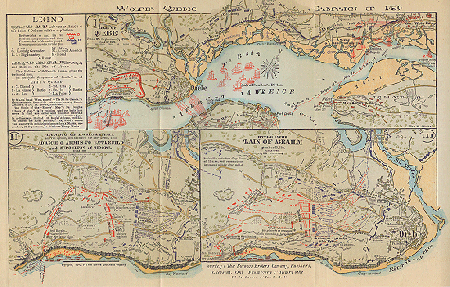
Battle of the Plains of Abraham
Pilots, Canadian. WM Deceived by the hoisting of French flag on British men-of-war, 78; forced to steer English ships, 90. See also Quebec, Siege of, 1759.
Piraube, Martial. Ch Godfather to young Hurons, 233.
Pitt, William (1759-1806). Son of William Pitt, Earl of Chatham; born at Hayes, England. Educated at Pembroke Hall, Cambridge. Entered Parliament, 1781, becoming prime minister in 1783. In consequence of French aggressions, formed in 1793 a great coalition with Russia, Sardinia, Spain, Prussia, and Austria. In 1798 formed a second coalition against France, including Russia, Austria, and other countries. Resigned office, 1801. Again premier in 1804; and in 1805 formed a third coalition with Russia, Austria, and Sweden. The union of Ireland with Great Britain was effected by his influence and under his administration. Index: S Constitutional Act introduced by, 1, 7. Dr Introduces Constitutional Act in House of Commons, 263. Sy His expectations regarding Lower Canada, 68. Bib.: Dict. Nat. Biog.
Pivert, Nicolas. Ch Early settler, 145.
Plague. L Breaks out on the St. André, 31.
Plains of Abraham. Above city of Quebec. Named after Abraham Martin, a Quebec pilot, who owned a portion of these lands in the early days of the colony. The Plains have now been set apart by the Dominion government as a national park. Index: WM Origin of name, situation and extent of, 186; battle of, the arrangement of British troops, 188; of French troops, 192, 195; engagement begins at ten o'clock in the morning, 197; defeat of French, 200, 201; losses, 205; French army seized by panic, 206. Ch Origin of name, 146-147; famous conflict fought on, Sept. 13, 1759. See also Martin, Abraham. Bib.: Doughty, Siege of Quebec; Woods, The Fight for Canada; Bradley, The Fight with France.
Plamondon, Marc Aurèle. Born in Quebec, 1823. Educated at the Quebec Seminary. In 1846 called to the bar, and practised for many years in Quebec, achieving success in the criminal courts. In his early years closely connected with newspapers published in the Liberal interests, among others the Artisan; also established Le Menestre and the Courrier Commercial. In 1855 founded Le National, for several years one of the leading organs of the Reform party in Lower Canada. In 1874 appointed a puisne judge of the Supreme Court of Quebec. In 1896 the members of the profession in Quebec celebrated the 50th anniversary of his call to the bar. Retired from the bench, November, 1897. Index: C One of the leaders of the Quebec Liberals, 24. Bib.: Morgan, Can. Men.
Plessis, Joseph Octave. Bishop of Quebec, 1806 to 1825. Named archbishop of Quebec in 1819, but never assumed the title. Index: Bk His staunch support of British rule, 87. P Accepts leadership of Papineau, 34, 45.
Plet. F Cousin of La Salle, comes from France in connection with financial matters, 177.
Pointe au Fer. Dr British troops concentrated at, 153.
Pointe-aux-Trembles. On north shore of St. Lawrence, Portneuf County. Index: WM Carleton lands at, and makes prisoners, 125; retreating army halts at, 218; Lévis's army lands at, 246.
Pointe Lévis. On south shore of St. Lawrence, opposite Quebec. Index: WM Abortive attempt to capture British batteries at, 133-135; Quebec bombarded from, 115, 116; sailors landed at daily, for military exercises, 120; Wolfe assembles three army corps at, 159.
Pollock, Duncan. MS Sent to Red River district by X Y Company, 14.
Pommier, Hugues. L Director of Seminary, 55.
Pomone. WM French frigate, loads stores at Sorel, 243.
Pompadour, Jean Antoinette Poisson, Marquise de (1721-1764). WM Assisted in Bougainville's promotion, 177.
Pond, Peter. MS Associated with Pangman and others in opposition to McTavish, 10, 11; returns to North West Company, 15; his character, 15, 17; causes death of Wadin, 15; relations with Ross, 15; death of Ross, 16; leads way to Athabaska, 21; builds post on Elk (Athabaska) River, 1778, 21; his map, 55; his error as to distance from Lake Athabaska to Pacific, 57; sells his share in North West Company to McGillivray, 58. Bib.: Burpee, Search for the Western Sea; Bryce, Hudson's Bay Company.
Pontbriand, Henri-Marie Dubreuil de (1709-1760). Born in Vannes, France. In 1741 consecrated bishop of Quebec, and left Paris for Canada. Soon after his arrival in Quebec engaged in a lawsuit with the nuns of the general hospital as to the ownership of the episcopal palace, which they claimed Bishop Saint-Vallier had bequeathed to them. The king, however, confirmed him in its possession. Another royal decree prohibited religious congregations from holding lands in mortmain, but the bishop refused to enforce it. In 1760, after the fall of Quebec, he appointed a vicar-general, admonished the clergy to observe strictly the terms of capitulation, and went to Montreal, where he died after a short illness. Index: WM Bishop of Quebec, urges inhabitants to take to arms, 63; his palace converted into redoubt, 86; visits hospital in spite of fatal illness, 153; administers last sacrament to Montcalm, 220; issues mandemant in support of Lévis' attack on Quebec, 245. L Bishop of Quebec, 12. Bib.: Têtu, Evêques de Quebec.
Pontchartrain, Louis Phélypeaux, Comte de (1643-1727). Chancellor of France. Index: F Minister of marine, 72.
Pont-Gravé, François Gravé, Sieur du Pont. A merchant of St. Malo; sailed for Tadoussac with Chauvin, 1600. Had already made several voyages to the St. Lawrence; accompanied Champlain in the voyage of 1603, and again in 1613. Index: Ch Joins expedition to Acadia, 19; arrives at Island of Ste. Croix, 26; in temporary charge of colony, 32; sails for Quebec, 40; his vessel disarmed by a Basque captain, 40; member of court to try Duval for conspiracy, 43; sails for France, 45; returns to Canada, 47; in command of the colony during Champlain's absence, 48; returns to France with Champlain, 54; sent out in charge of second expedition to Quebec, 56; sails for France, 64; returns to Quebec, 106; trades at Three Rivers, 121; rivalry with Champlain, 125; comes to Canada as representative of De Monts' (Rouen) Company, 133; proceeds to Three Rivers to trade, 135; returns to France, 136; comes to Canada with De Caën, 138; placed in charge at Quebec, 138; sails for France, 141; very ill at Quebec, 156; his commission read publicly at Quebec, 181; with Champlain signs articles of capitulation of Quebec, 191; too sick to leave Quebec, 196. F Voyages of, to St. Lawrence, 3, 8. See also Champlain. Bib.: Parkman, Pioneers of France; Biggar, Early Trading Companies of New France; Douglas, Old France in the New World.
Pontiac (1720-1769). Born on the Ottawa River. An ally of the French during their struggles against the British colonists. In 1746 he and his Indians assisted the French at Detroit in an attack by northern tribes, and in 1755 he led the Ottawas when General Braddock was defeated. In 1763 began a campaign against the British; destroyed several forts from Lake Michigan to Niagara, and massacred their garrisons. Detroit then attacked and besieged for nearly a year, until relieved by Colonel Bradstreet; Pittsburg saved only by the timely arrival of Colonel Bouquet. Eight out of twelve fortified forts destroyed by Pontiac and his Indians. They were finally subdued by Sir William Johnson, who in 1766 concluded a treaty of peace. In 1769 assassinated by a Kaskaskia Indian. Index: Hd Rouses western tribes against British, 55; his rising quelled, 57; after effects of, 259. Bib.: Parkman, Conspiracy of Pontiac.
Pontiac's War. Dr History of, 4; fomented by French traders, 5; conduct of the colonies in connection with, 5, 6. See also Pontiac. Bib.: Parkman, Conspiracy of Pontiac; Smith, Historical Account of Bouquet's Expedition.
Pontleroy. WM French military engineer, 85, 90.
Pope, James Colledge (1826-1885). Born in Bedeque, Prince Edward Island. Educated at home and in England. Engaged in mercantile pursuits. Sat in the Prince Edward Island Assembly, 1857-1867; premier, 1865-1867. A strong opponent of Confederation and succeeded in preventing the entrance of Prince Edward Island into the Dominion. Defeated, 1868; two years later elected and again became premier. His government defeated, 1872, but returned to power, 1873. Carried through resolutions under which Prince Edward Island became a province of Canada. Elected to the House of Commons for Prince County, 1873; did not offer for re-election. Again elected to the House of Commons, 1878; entered the government of Sir John A. Macdonald as minister of marine and fisheries. Held office until his retirement from public life, 1882. Bib.: Dent, Can. Por.; Rose, Cyc. Am. Biog.
Pope, John Henry (1824-1889). Born in the Eastern Townships, Quebec. Elected for Compton to the Canada Assembly, 1857; and in 1867 to the Dominion Parliament. Called to the Cabinet, 1871, as minister of agriculture, and again in 1878 on the return of the Conservatives to power; in 1880 accompanied Sir John Macdonald and Sir Charles Tupper to England in connection with the negotiations as to the Canadian Pacific Railway contract; minister of railways and canals, 1885. Index: B Conference with George Brown on Confederation, 152, 154. Bib.: Rose, Cyc. Can. Biog.; Dent, Can. Por.
Pope, Joseph (1854- ). Eldest son of William Henry Pope (q.v.). Private secretary to Sir John A. Macdonald, 1882-1891; under-secretary of state, 1896-1908; under-secretary for external affairs, 1908. Index: B On the "double shuffle," 107-108. Md On Macdonald's early life, prints Campbell's letter, 31; his pen picture of Macdonald, 73; on the double majority, 78; Macdonald's notes on Quebec Conference, 106; Macdonald's negotiations with Howe, 145; does not publish documents on last stages of Macdonald's life, 272. Bib.: Memoir of Sir John A. Macdonald.
Pope, William Henry (1825-1879). Born in Prince Edward Island. Elected to the Legislature and became provincial secretary in the Gray ministry, 1863; represented Prince Edward Island at the Charlottetown Conference, 1864, and the Quebec Conference, 1864; judge of the County Court of Prince County, Prince Edward Island, 1873-1879. T Represents Prince Edward Island at Quebec Conference, 77. Bib.: Campbell, History of Prince Edward Island.
Population. B Of Upper Canada, doubled between 1842 and 1851, exceeds that of Lower Canada in 1852, 62, 75; in 1841, 82; in 1852, 134. Dr Of Canada in 1763, 9. See also Census.
Porcupine. WM Sloop of war, commanded by Captain Jervis, 176.
Porcupine River. Discovered by John Bell, of the Hudson's Bay Company, in 1842, and explored to its junction with the Yukon, by Bell, in 1844. In 1847 Alexander Hunter Murray, of the same company, descended the Porcupine to its mouth, and built Fort Yukon, about three miles above the mouth of the Porcupine, on the east bank of the Yukon. In 1869, on the abandonment of Fort Yukon, the Hudson's Bay Company built Rampart House, on the Porcupine River, close to the international boundary. As subsequent surveys proved it to be on American territory, the fort was moved some miles to the east. Index: D Ascended by Robert Campbell in 1850, 125. Bib.: Murray, Journal of the Yukon (Canadian Archives, 1910); McConnell, Report on the Yukon and Mackenzie Basins (Geol. Survey, 1889).
Port au Mouton (Acadia). Ch De Monts stops at, 19.
Port aux Anglais. Ch Louisbourg commonly known as, 236. See also Louisbourg.
Port Hayes. On Hudson Bay, captured by Troyes, 206.
Port Nelson. Fort built by the Hudson's Bay Company, at mouth of Hayes River, west coast of Hudson Bay, 1669. Afterwards known as York Factory (q.v.). It was captured by the French under Iberville in 1694, and again in 1697. Index: F Captured by Iberville, 345; retaken by English, 347; again taken by Iberville. Bib.: Bryce, Hudson's Bay Company; Laut, Pathfinders of the West and Conquest of the Great North-West. See also Iberville.
Port Royal. Founded by De Monts in 1605. The basin had been discovered the previous year, and the land granted to Poutrincourt, who named it Port Royal. The early settlement is described in Lescarbot's History of New France. Captured by Sedgwick, under the orders of Cromwell, in 1654; restored in 1668. Again captured by Phipps, 1690, and once more restored to France by the treaty of Ryswick, 1697. Nicholson finally captured the place in 1710, and re-named it Annapolis Royal (q.v.). Index: F Capital of Acadia, 270; captured by Phipps, 274. Ch Settlement made at, 32; new settlers arrive under Poutrincourt, 36. L Captured by English, 229. Bib.: Champlain, Voyages; Lescarbot, History of New France; Parkman, Pioneers of France.
Portages. See Frog Portage; Giscome Portage; Grand Portage; Methye Portage; Rocky Mountain Portage.
Porter, G. R. Sy Statistician of Board of Trade, 54.
Portland Railway Convention. W Its object to secure a shorter route to Europe, 119-120.
Portland, William Henry Cavendish Bentinck, third Duke of (1738-1809). Educated at Eton and Oxford; entered Parliament, 1760; prime minister in 1783; and again in 1807. Index: Dr Thanks Dorchester for surrendering his fees, 292. S Secretary of state, Simcoe's despatch to, explaining his advance in American territory, 143-154; does not approve of the creation of lieutenants for the Upper Canada counties, 197; writes to Simcoe in very commendatory terms, 216. Bib.: Dict. Nat. Biog.
Portlock. D With Dixon, sails from England, 1785, 22; discovers that Queen Charlotte Islands are not part of mainland, 22.
Portneuf, De. F Commands war party from Quebec, 236; captures Fort Loyal, 252; removed for peculation, 330.
Porto Bello. Ch Champlain's description of, 4.
Porto Rico Island. Ch Taken and abandoned, by English in 1598, 3.
Portuguese. Ch Island of Cape Breton once occupied by, 236.
Post Office. Mc Report on, 153; Mackenzie offered control of department, 225; Lord Goderich requests Mackenzie's opinion on, 235; Mackenzie's scheme for reform of, 236; control of the revenue from, 236. Bk Service in Upper Canada, 155. Md Savings banks introduced in 1867, 151; rates reduced and unified at same time, 151. E Reforms brought about by La Fontaine-Baldwin government, 85-86. BL Transferred from Imperial to Canadian government, and reorganized, 338. Dr Condition of service in 1788, 243; Dorchester's improvement of, 243. Hd Difficulties of, 129, 131; improved by Haldimand, 131; inefficiency of, in 1782, 193.
Potash. S Decline in production of, 107.
Potenger, Maria. Bk Niece of Sir Isaac Brock, 133.
Potenger, Zelia. Bk Niece of Sir Isaac Brock, 133.
Pottawotomi Indians. An Algonquian tribe, allied to the Chippewas. They ranged over portions of what is now the state of Michigan, and in 1760, when Detroit fell into the hands of the British, occupied a village below the fort. One hundred and fifty of the tribe fought under Pontiac in 1763. In the War of 1812, they took the British side. Index: Hd Sioux offer to attack, 148; described as fickle, credulous, and timid, 148. Bib.: Pilling, Bibliography of Algonquian Languages; Charlevoix, History of New France; Parkman, Conspiracy of Pontiac.
Pouchot (1712-1769). Born at Grenoble, France. Entered the Engineers' corps of the French army in 1733, and served in Flanders, Corsica, and Germany. Accompanied Montcalm to Canada and took part in the defence of Fort Niagara and Fort de Lévis. Served in the campaigns against the British and Indians, until the fall of Quebec in 1759. Index: WM Quoted with reference to battle of Carillon, 58; in command at Niagara, divides his force, 122; forced to capitulate, 146. Hd In command of French fort at Niagara, 25; surrenders, 26; surrenders Fort de Lévis, 36. Bib.: Doughty, Siege of Quebec; Parkman, Montcalm and Wolfe; Bradley, Fight with France.
Poulariez. WM Placed in command of French left (Beauport to Montmorency), 158, 174, 175; protests against idea of capitulation, 209; in battle of Ste. Foy, 262.
Poulett. Sy Maiden name of Sydenham's mother, 4.
Poullain, Father Guillaume. Ch Récollet missionary, 87; goes to Nipissing mission, 149.
Pouthier, Toussaint. Bk Agent of the Hudson's Bay Company, assists in capture of Michilimackinac, 210.
Poutrincourt. See Biencourt de Poutrincourt.
Powell, Henry Watson (1733-1814). Born in England. Entered the army; in 1756 became captain; and in 1759 served in the West Indies; in 1768 and subsequent years stationed in different parts of North America, and in 1771 promoted lieutenant-colonel. Took part in General Burgoyne's expedition in 1777, with the rank of brigadier-general; in July, 1777, in command of Fort Ticonderoga, and held it successfully against the besieging forces of New Hampshire and Connecticut. Returned to England at the end of the American Revolution, and in 1801 promoted general. Index: Dr In command at Ticonderoga, discouraging messages from, 179, 180; on surrender of Burgoyne retreats to St. Johns, 180. Bib.: Cyc. Am. Biog.
Powell, John. Mc Shoots at Mackenzie, 364; his treachery, 365.
Powell, Colonel Walker (1828- ). Born in Waterford, Ontario. Educated at the county Grammar School, and at Victoria College, Cobourg. Engaged for some years in mercantile pursuits. Appointed warden of Norfolk County, 1856. Member of the Legislative Assembly for Norfolk County, 1857-1861. Appointed deputy adjutant-general for the Dominion of Canada, 1862. Served during the Fenian Raid, 1866, and in the Rebellions of 1869-1870 and 1885. Adjutant-general of the Dominion, 1875-1896. Largely responsible for the present militia system of Canada, and aided in the establishment of the Royal Military College at Kingston. Index: R Adjutant-general, graduate of Victoria College, 144. Bib.: Rose, Cyc. Can. Biog.; Morgan, Can. Men.
Powell, William Dummer (1755-1834). Born in Boston. Called to the bar, 1779. Came to Montreal, and made judge of the district of Hesse with headquarters at Detroit, 1789. Promoted to chief-justiceship, 1815. Retired from the bench, 1825. Index: S Judge of Common Pleas in Upper Canada, 178. Bk On Brock's victory at Detroit, 262. Mc Tries and banishes Robert Gourlay, 92. Bib.: Read, Lives of the Judges.
Power, Michael (1804-1848). Born in Waterford, Ireland. Emigrated to Canada. Ordained a priest, and became curé of La Prairie, which position he held until 1841, when he went to Europe with Bishop Bourget. On his return to Canada appointed bishop of the western part of Kingston, when that diocese was divided. Consecrated, May 8, 1842, and adopted the title of bishop of Toronto, from the city in which he resided. During his administration the missions which the Jesuits had formerly held in Upper Canada were restored, and others established by his aid. Index: R Chairman of the Council of Public Instruction in Ontario—favourable to public schools, 219.
Prairie de la Madeleine. L Settlement of Christian Indians at, 74.
Precedence. L Questions of, 163.
Preferential Trade. B Ended by repeal of corn laws, 31; protests from Canada, 31; Globe defends free trade and urges Canada to help herself, 31-32; Elgin against Canadian dependence on Imperial tariff legislation, 32. E Elgin on, 58-59; debates on, in Canadian Parliament, 59.
Presbyterian Church in Canada. Had its beginnings early in the eighteenth century in Nova Scotia. In 1776 the Presbytery of Truro, Nova Scotia, was organized; that of Montreal in 1793; and in 1818 the Presbytery of the Canadas was formed in Montreal. In 1831 the united Presbytery became the Synod of Upper Canada; and in 1840 joined the Church of Scotland Synod. In 1844, on the disruption of the Church of Scotland, the (Free) Presbyterian Synod of Canada was organized. Training colleges were established at Toronto, Halifax, Montreal, and other centres. In 1861 the Free and United Presbyterian synods united as the Synod of Canada Presbyterian Church; and in 1875 all Presbyterian bodies became one in the Presbyterian Church in Canada. Index: E Secures a share of Clergy Reserves, 153. B George Brown's attitude to, 2; the British Chronicle and "disruption," 4; the Banner largely devoted to the interests of, 5, 6. R Claims equality with Anglicans, 39; statistics in Upper Canada, 51. W Represented by one in New Brunswick Assembly, 69. Bib.: Torrance, Origin of the Canadian Presbyterian Church in Canada: An Ency., vol. 4; Gregg, History of the Presbyterian Church in Canada.
Prescott, Richard (1725-1788). Born in England. Entered the army, and promoted major, 1756; lieutenant-colonel, 1762, and served in Europe during the Seven Years' War. In 1773 sent as colonel of the 7th Foot to Canada, and during the next two years rendered good service. In 1775, during the investment of Montreal by the Americans, surrounded while on the way to Quebec with troops and stores, and captured. In September, 1776, exchanged; and in December, third in command of the British army, until again made prisoner, July 10, 1777. Released, and the same year became major-general, and in 1782 lieutenant-general. Index: Dr Placed in charge of Montreal, 89; leaves Montreal with Carleton, 112; captured by Americans, 113. Bib.: Cyc. Am. Biog.
Prescott, Sir Robert (1725-1816). Born in Lancashire, England. Educated for the army. Promoted captain of the 15th Foot, 1755; served in the expeditions against Rochefort, 1757, and Louisbourg, 1758. Aide-de-camp to Amherst, 1759; afterwards served under Wolfe in Canada. Promoted major, 1761; lieutenant-colonel, 1762. During the American Revolution, 1775, took part in the battle of Long Island, and at the attack on Fort Washington; engaged in the expedition against Philadelphia, 1777; promoted brevet-colonel, and took part in the battle of Brandywine; promoted colonel, 1780; major-general, 1781; lieutenant-general, 1793. Sent in 1794 to Martinique, which he reduced. On April 10, 1796, appointed governor of Canada in succession to Lord Dorchester, who was recalled. In that year the fortifications at Quebec were greatly strengthened under his direction. In 1797 also appointed governor of Nova Scotia and of New Brunswick. Held all three positions until his recall to England, 1799. Index: Bk Succeeds Dorchester as governor of Canada, 38. Dr Succeeds Dorchester as governor, 303. Bib.: Dict. Nat. Biog.; Bradley, The Making of Canada; Lucas, History of Canada.
President and Little Belt. Bk Affair of, 173.
Preston, Major. Dr Sent to occupy fort at St. Johns, 84; surrenders to Montgomery, 102.
Prévert. Ch Explorer, gives information to Champlain respecting a copper mine, 13.
Prévost, Augustin (1725?-1786). Father of Sir George Prévost. Entered the army; served under Wolfe at Quebec, 1759; became lieutenant-colonel, 1761, colonel, 1777; major-general, 1779; defeated General Ashe at Brier Creek, 1779, and defended Savannah against the Americans the same year. Index: Hd Haldimand's correspondence with, 294, 338; proposed appointment of, 330. Bib.: Cyc. Am. Biog.
Prévost, Major Augustin. Son of preceding. Index: Hd Interested in settlement of Haldimand's lands in Pennsylvania, 315; his father, General Prévost, also a friend of Haldimand's, 316.
Prévost, Sir George (1767-1816). Born in New York. Entered the army; took part in the battles of St. Vincent, Dominica, and St. Lucia. In 1803 created a baronet and promoted major-general. In 1803 appointed governor of Nova Scotia, and in 1812, governor of Canada and commander of the forces in British North America. In 1812-1813 rendered important service in the defence of Canada against the Americans, but was unsuccessful in his operations in the invasion of New York state, being severely defeated, Sept. 11, 1814. Index: Bk Governor of Nova Scotia, and second in military command in British North America, 101; arrives in Canada as governor-general and commander of forces, 157; previous career, 157, 158; his appointment satisfactory to French-Canadians, 158; appoints Bédard to judgeship, 158; hampered by his instructions from England, 184; his despatch with reference to the John Henry letters, 188; his cautious instructions to Brock, 190, 194, 204, 216; receives news of declaration of war, 203; officially informed of it, 207; his instructions to Captain Roberts at St. Joseph, 210; praises Roberts for his prompt action, 227; his despatch to Lord Bathurst, 227; sends money and stores to Upper Canada, 229; sends proposal for armistice to General Dearborn, 233; letter of congratulation to Brock, 268, 269; notifies Brock of termination of armistice, 269; disapproves of Brock's proposal to attack Sackett's Harbour, 271; his pacific policy approved by British government, 271; speaks of "infatuation" of British ministers regarding American affairs, 277; letter to Brock recommending attitude of defence, 288; his despatch on victory at Detroit, 295. P Arrives as governor, 1811, 32; political quiet restored for a time, 32, 39. Bib.: Dict. Nat. Biog.; Lucas, Canadian War of 1812. See also War of 1812.
Prevost. F Town-major of Quebec, 257; strengthens defences, 284.
Prévôte (Provost's court). F Abolished, 1674, reëstablished, 1677, 107.
Price. Dr A disaffected Montrealer, 122, 123.
Price, David Edward (1826-1833). Born in Quebec. Interested in lumbering. Sat in the Assembly for Chicoutimi and Saguenay, 1855-1864. Although English-speaking and a Protestant, returned to the Legislative Council for a purely French-Canadian district, 1864. Appointed to the Senate, 1867.
Price, James Hervey (1797-1882). Born in England. Came to Canada and settled at Toronto, 1828. Studied law and called to the bar, 1833. Took a leading part in the agitation preceding the Rebellion of 1837, but not concerned in the Rebellion itself. Elected to the Canadian Assembly as member for the 1st Riding of York, 1841; during the succeeding years one of the most influential members of the Assembly; held office as commissioner of crown lands in the La Fontaine-Baldwin government, 1848-1851; defeated at the election of 1851 and retired from public life. Returned to England and settled at Shirley, near Southampton. Died in Shirley. Index: E Returned to Parliament, 1848, 50; commissioner of crown lands, in La Fontaine-Baldwin ministry, 53; his views on Clergy Reserves, 160, 161, 162. BL Commissioner of crown lands—supports Baldwin, 214; his resolution, 215, 216; elected for York, 279; commissioner of crown lands, 284; resolution on Clergy Reserves, 346, 348. Mc At Doel's brewery, 330; rebels meet at his house, 362. Bib.: Dent, Upper Canadian Rebellion and Last Forty Years.
Prices of Commodities. S In Upper Canada, 114.
Prideaux, John (1718-1759). Born in Devonshire, England. Entered the army in 1739 as an ensign. In 1743 took part in the battle of Dettingen; in 1745 promoted captain; in 1748 became lieutenant-colonel; in 1758 colonel; and in 1759 brigadier-general. In 1759 appointed by Pitt, commander of a division of the army in Canada, under the supreme command of General Amherst. Ordered by Amherst to attack Fort Niagara, then one of the strongest of the French forts. On July 7, 1759, made the first assault on the fort, and on July 11 repulsed an attack by the French. On the same day, while directing the artillery fire, killed by the bursting of one of his own guns. Succeeded by Sir William Johnson, who carried out his plan of operations, the fort capitulating on July 24, 1759. Index: Hd Marches against Fort Niagara, 25; death of, 26. Bib.: Dict. Nat. Biog.; Bradley, The Fight with France; Parkman, Montcalm and Wolfe.
Priests. Dr Introduction of, from France, prohibited, 257.
Primogeniture. E Abolished in Upper Canada with respect to real estate, 87.
Prince, Colonel. Mc Defends Windsor, 447; shoots prisoners, 447; condemnation for, 448.
Prince Edward Island. Under the name of Isle St. John, it appears in Champlain's narrative and on his map. The name is found on earlier maps, and both the discovery and naming of the island have been attributed to Cabot, and again to Cartier, but without sufficient proof. It bore that name until the year 1798, when the present form was adopted, in honour of the Duke of Kent, father of Queen Victoria. During the French régime, it was largely settled by Acadian families, but these were expelled after the island came under British rule. In 1769 the island was granted to a number of proprietors, and settlement was very slow. It formed part of Nova Scotia until 1769, when it was made a separate province. Responsible government was granted in 1851; and in 1873 the province entered Confederation. Index: E Land question in, 143-144; 174-175. B Withdraws from Confederation scheme, 185-186. Md Electors reject proposals of Quebec Conference in 1865, 147; again reject Confederation terms in 1866, 147; Macdonald's interest in acquisition of, 148; financial difficulties lead to union in 1873, 148-149; railway debt of, assumed by Canada, 149. Dr Carleton arranges to visit, 235; difficulty in transfer of governorship from Patterson to Fanning, 235. See also Charlottetown. Bib.: Campbell, History of Prince Edward Island.
Prince of Wales College. Located at Charlottetown, Prince Edward Island. Founded, 1860, and amalgamated with the provincial Normal School, 1879.
Prince of Wales Fort. At the mouth of the Churchill River, Hudson Bay. Built by the Hudson's Bay Company, between the years 1733 and 1771. It was of massive masonry, 37 to 42 feet thick; 310 feet long on the north and south sides, and 317 on the east and west; and is said to have been designed by English military engineers. The walls are still standing, though parts have fallen in. The parapet mounted forty guns, which are still on the walls. See Tyrrell's Introduction to Hearne's Journey (Champlain Society ed., 1910). Hearne was governor of the fort in 1782, when it was captured by the French under Admiral La Perouse. The fort was built on Eskimo Point, just west of the mouth of the river. The present Hudson's Bay Company post stands on the site of a much earlier fort, built by the Company in 1688. Bib.: Bryce, Hudson's Bay Company; Laut, Conquest of the Great North-West.
Prince of Wales Island. On the north-west coast of North America. Index: D Recognized as Russian territory by Convention of 1825, 118.
Pringle, Captain. Dr Commands flotilla on Lake Champlain, 154.
Prison Reform. B Need of, in Upper Canada, shown by George Brown, 90; his strong interest in, 91-92.
Prisoners. Dr British, in America, 201; exchange of, after Revolutionary War, 207, 208; hardships suffered by Germans captured by Burgoyne, 208, 209; refuse service either as farm labourers or in American army, 210, 211; liberation and embarkation of, 214.
Proclamation, Royal. Dr Following treaty of Paris, 7; its provisions, 7, 8.
Proclamation of 1764. P Attorney-general Yorke's opinion of, 11-13; Solicitor-general Wedderburne's views on, 14.
Procter, Henry A. (1787-1859). Born in Wales. Served in the army, and became colonel of his regiment. In 1812, being stationed in Canada, ordered by General Brock to prevent the landing of the American troops under General Hull at Amherstburg. This he successfully accomplished, and later defeated the enemy at Brownstown. In 1813 inflicted a severe defeat on the Americans, under General James Winchester, at Frenchtown on the river Raisin. For these services promoted brigadier-general. In August, 1813, forced to retire from Fort Stephenson by Major Croghan. On Oct. 5, defeated by General W.H. Harrison at the battle of the Thames. For this disaster tried by court-martial and sentenced to be suspended for six months from rank and pay. Afterwards reinstated; served during the later stages of the war, and promoted lieutenant-general. Index: Bk In command of Niagara frontier, 205; sent to Amherstburg, 215, 235; second in command to Brock, 247; opposed to the attempt on Detroit, 267. Bib.: Lucas, Canadian War of 1812. See also War of 1812.
Programme Catholique. C Issued by Le Parti Catholique, 82; its terms, 82; disapproved of by Archbishop Taschereau, 82-83.
Prohibition. T Bill introduced by Tilley in New Brunswick, 34; difficulty with its enforcement, 35-39; causes defeat of government, 41; Act repealed, 41. See also Liquor question; Brandy question.
Protection. B Beginnings of agitation for, in Canada, 231; opposed by George Brown, 232-233; at the bottom of objections to proposed Reciprocity Treaty of 1864, 232, 233; secret of its success in 1878, 241. C Cartier's views on, 115-116. See also National policy.
Protestant Protective Association. Md Carries on an anti-Roman Catholic campaign, 289.
Protestants. Dr Feeling aroused among, in connection with Quebec Act, 69. Ch Fanaticism of Huguenot agents, 86; had large share of trade, 110; proposed to exclude, 110. L Protestantism proscribed in Canada under the French régime, 12.
Provençal. Ch Uncle of Champlain, officer in Spanish naval service, 2.
Provincial Secretaries. Sy Duties assigned to, 331.
Prud'homme. WM Commands Montreal militia, 105.
Prussia. Hd Becomes a first-class power, 6.
Public Works. Sy Expenditure on, in Lower and Upper Canada, respectively, 317, 318; home government advances money for completion of, 320.
Puget Sound Agricultural Company. D Organized, 129; agricultural interests of Hudson's Bay Company handed over to, 129; its farms, 129-130; checkered career, 130; McLoughlin first manager, 130; disputes with United States, 130-131; claims settled by commission, 131; Douglas succeeds McLoughlin as manager, 132; epidemic of fever and ague follows first turning of soil about Fort Vancouver, 132; land claims on Vancouver Island, 198; dispute with Langford, 199. Bib.: Bancroft, History of the North-West Coast.
Punshon, William Morley (1824-1881). Born in England. Engaged for a time in the timber business with his father; joined the Methodists, 1838, and ordained a Wesleyan minister, 1845. Worked in London, 1858-1868, and in Canada, 1868-1873, when he returned to England. Index: R Ryerson's friendship for, 285; comes to Canada, 285-286; Ryerson's letter to, 288-289. Bib.: Dent, Can. Por.; Dict. Nat. Biog.
Purchas, Samuel (1575?-1626). A graduate of St. John's College, Cambridge. Rector of St. Martin's, Ludgate, London, 1614-1626. Fell heir to a number of unpublished narratives left by Hakluyt, and edited them with many others, in his collections of voyages and travels. Index: Ch Gives in his Pilgrims English version of Champlain's first narrative, 15. Bib.: Purchas his Pilgrimage, 1613; Purchas his Pilgrim, 1619; Hakluytus Posthumus, or Purchas his Pilgrimes, 1625.
Purchase of Commissions. Dr In Loyalist corps, 217.
Putnam, Charles S. W A leading barrister of Fredericton, 11.
Quadra, Juan Francisco de la Bodega y (1744?-1794). Knight of the Order of Santiago. Made voyages of exploration to the North-West Coast in 1775 and 1779. Governor of Nootka, and met Vancouver there in 1792 for the purpose of arranging the restoration of Nootka to the British crown. Index: D Voyage to North-West Coast, 7, 14; at Bay of Islands, 15; takes possession for Spain, 15; searches for Strait of Anian, 15; fails to discover mouth of Columbia, 15; sights Mount St. Elias and enters Prince William's Sound, 15; meets Vancouver at Nootka, 33. Bib.: Bancroft, History of the North-West Coast.
Quakers. S Try to bring about peace with Indians, 122. Hd Of Pennsylvania, their opposition to the government, 11, 12. Bk Emigration of, from Pennsylvania to Upper Canada, 49.
Quebec Act, 1774. Provided that the boundaries of the province of Quebec in the west should extend from Lake Erie to the Ohio, along the Ohio to the Mississippi, and north to the territories of the Hudson's Bay Company; guaranteed the French-Canadians in the free exercise of their religion; provided for the continuance of the criminal law of England, and for the appointment of a Legislative Council, with limited powers. Index: E Guarantees institutions of French Canada, 24. Dr Introduced in House of Lords, 63; its delimitation of Canada gives offence to older colonies, 63; concedes full religious liberty to Roman Catholics and establishes French civil law, 64; opposition to, 65; passed, 65; corporation of London petitions king to withhold assent, 69; saves Canada to British crown, 78; agitation against, 79-81; goes into force, 81, 89. L Beneficial operation of, 13. Sy Its effect in creating cleavage between French and English in Canada, 62; precipitated by American Revolution, 65; not carried out in its integrity, 66, 67; a mistake as preventing the unification of Canada, 91. BL Its provisions, 2-3; opposition to, 4; its results, 4. P Gives French-Canadians long-deferred justice, 7; establishes French civil law, 9; the magna charta of French-Canadians, 9, 16; its genesis and history, 11. Mc Commentary on, 47; cause of its repeal, 47. Hd Extends Quebec to Mississippi, 93; obnoxious to New Englanders, 101; not satisfactory to English inhabitants, 173, 175; in Haldimand's opinion, saved the country from going over to the enemy, 174; and estates of Ursuline nuns, 179; opposition to, 180; repeal wanted, 188, 264; Haldimand's opinion of, 195; his use of, 273. Bib.: Houston, Constitutional Documents of Canada; Bourinot, Constitutional History of Canada; Egerton and Grant, Canadian Constitutional Documents; Bradley, The Making of Canada; Lucas, History of Canada. See also Dorchester.
Quebec City. Founded by Champlain (q.v.), in 1608. Seventy-three years earlier, Jacques Cartier had sailed up the great river, and landed near the same spot, wintering in a creek not far from the native town of Stadaconé. Champlain, in 1608, built a rude fort, the Abitation de Québec, and a warehouse. There he and his men spent the winter, but before succour arrived in the spring, most Of them died of scurvy. Had a man of less courage and resourcefulness been in Command, the infant settlement of Quebec might have died a natural death. Champlain kept it alive, and, though harassed by enemies, and neglected by the motherland, the town grew steadily from the year of its birth. Quebec has passed through five sieges, that of Kirke in 1629, that of Phipps, 1690, the great siege of 1759, Lévis's siege of 1760, and that of Montgomery and Arnold, 1775-1776. Index: Bk The centre of society in Canada, 46; defective state of fortifications, 75; defences of in early years of nineteenth century, 89, 90, 94. Sy Charter of, reëstablished, 255; change in electoral limits of, 285; two members assigned to, 285. L Church erected at, 84; placed under patronage of Immaculate Conception and St. Louis, 85; not less pious as a community than Montreal, 92; conflagration at, 186; siege of, by expedition under Phipps, 229-231. B Brown's objection to, as seat of government, 70; gross election frauds in 1857, 99; fortifications of, to be completed by England, 186. Dr Carleton's report on fortifications of, 44; fortifications of, improved by Cramahé, 117; attack by Montgomery and Arnold on, repulsed, 125-131; garrison of, greatly encouraged, 133; gayety in, during winter of 1776-1777, 162; unreasonable demands of British inhabitants of, 252, 253. F Foundations of, 7; capture of, by Kirke, 20; restored to France, 23; population of city in 1666, 56; first ball given at, 59; sea expedition planned against, by New Englanders, 268-277; defences strengthened, 284; attack by squadron under Phipps, 285-300; defences further strengthened, 326. E Seat of government at, 78; Lord Elgin's references to, in his farewell address, 205-206. WM In 1756, description of, 15; Wolfe's plan for attacking, 76; fortifications afforded no protection, 79; batteries at, 95; batteries of, have no effect against enemy's works at Pointe Lévis, 113; discouragement of inhabitants, 113; general exodus from, 115; bombardment of, 115; thieves pillage the houses, 122; pitiable condition of, 160; abandoned by the enemy, the citizens call for capitulation, 224; garrison of, disorganized, 230; capitulation of, 230-235; rejoicing in England over fall of, 238; Vaudreuil maintains spies in, 243; sickness in British garrison of, 243. Ch Fortifications of, 157; slow progress of settlement at, 167; terms of capitulation of, 190-192; keys of, handed to Lewis Kirke, 195; English flag hoisted over, 196; names of families remaining at, after surrender, 196; passes again under French rule, 224; population in 1629, 208; destructive fire at, 1640, 241. BL Boundaries of, for political purposes changed by Sydenham, restored in 1842, 146; aspires to honour of capital, 181; seat of government, 338. Md Shares with Toronto the honour of seat of government, for sixteen years, 39; dispute over capital, 77; dissatisfaction of, over selection of Ottawa as capital, 85; conference on Confederation meets at, in 1864, 104-105. Hd Besieged by Wolfe, 25; news arrives of surrender of, 29; defended by Murray, 34; Murray lieutenant-governor of, 41; roads to, 45, 46; uses St. Maurice forges, 47; government of, 49; enlistment of French-Canadians in, 55-56; Haldimand arrives at, 117; Indians brought to, 152; fortifications of, strengthened, 183; prisons in, 187; threatened by French fleet, 188; census of, taken, 190; old customs of, 192, 221-224; Riedesels at, 220, 300-304; education in, 233-235; food supply of, 239; Nelson at, 244; rebel sympathizers in, 279; Du Calvet in, 286, 287; Haldimand's life in, 298; Haldimand sails from, 310; Haldimand Hill in, named after him, 346. Bib.: Doughty, Cradle of New France; Le Moine, Historical Notes on Quebec; MacPherson, Reminiscences of Old Quebec; Hawkins, Picture of Quebec; Douglas, Old France in the New World; Le Moine, Quebec Past and Present; Parker, Old Quebec.
Quebec Committee. Sy Its address to the electors in opposition to the union, 288.
Quebec Conference, 1864. To discuss terms of Confederation. Index: C Cauchon's commentaries on the resolutions, 24. B Division of authority between federal and provincial Legislatures, 163; residuary powers, 163-164; constitution of the Senate, 164-165; financial question, 165; resolutions adopted, 165; George Brown on, 165-166; delegates tour Canada, 166; its character defined, 205. H Frames scheme of Confederation, 178-179; Howe opposes the scheme, 185-191. Md Meets at Quebec, Oct. 10, 1864, to discuss union of provinces, 104; Taché selected as chairman, 104; deliberations behind closed doors, 105; passes seventy-two resolutions along main lines upon which Confederation was finally accomplished, 106; Macdonald's notes on, 106; legislative vs. federal union, 107-109, 245-247; financial relations of provinces and Dominion, 110; constitution of Senate, 110-112; question of representation, 112-113. T Deals with Intercolonial Railway question, 54; history of, 76-80. Bib.: Pope, Confederation Documents; Cauchon, Union of the Provinces; Whelan, Union of the British Provinces; Rawlings, Confederation of the British North American Provinces; Confederation Debates.
Quebec General Hospital. WM Care taken of wounded British in, 153; British guard placed on, 223; Lévis takes possession of, 265; painful scenes at, described, 265, 266. Bib.: Doughty, Cradle of New France.
Quebec, Hôtel Dieu. F Origin of, 28. L Laval lodges at, for a time, 33; nuns of, take charge of the general hospital, 236. Bib.: Doughty, Cradle of New France.
Quebec Library. Founded at Quebec in 1779. The first public library in what is now Canada. On Jan. 7 of that year, the following advertisement appeared in the Quebec Gazette: "A subscription has been commenced for establishing a publick library for the city and district of Quebec. It has met with the approbation of His Excellency the Governor and of the Bishop, and it is hoped that the institution, so particularly useful in this country, will be generally encouraged." The idea of the library originated with Governor Haldimand, and the first lot of books was purchased in England, under his instructions, by Richard Cumberland, the dramatist. An Act of incorporation obtained in 1840. Five years later, the library was absorbed by the Quebec Library Association, founded 1843; and in 1866 the Association dissolved and sold its books to the Quebec Literary and Historical Society (q.v.). Bib.: A detailed account of the Quebec Library, and the Quebec Library Association, will be found in Würtele's paper, in Quebec Lit. and Hist. Soc. Trans., 1887-1889.
Quebec Literary and Historical Society. Founded at Quebec in 1824, largely through the influence and liberality of the Earl of Dalhousie, then governor-general. Its purposes were "to discover and rescue from the unsparing hand of time the records which yet remain of the earliest history of Canada. To preserve while in our power, such documents as may be found amid the dust of yet unexplored depositories, and which may prove important to general history and to the particular history of this province." In 1829, another similar organization was absorbed; and in 1831 the society was incorporated by Act of Parliament. The library had been started the previous year, as well as the museum. Both have grown steadily, despite serious losses from fires. Bib.: The publications consist of Transactions and Historical Documents. The first volume of the former appeared in 1829, and the first part of the latter in 1838. The Trans., for 1887-1889 contain an account of the Society, its publications and its library, by F. C. Würtele, who also published in 1891 an Index to the series of publications.
Quebec, Province of. Area 351,873 square miles. Formed the principal part of Canada, as ceded to Britain in 1763. Under the Quebec Act, 1774, its boundaries extended west to the Ohio and Mississippi. In 1791, the province was divided into Upper and Lower Canada, with the Ottawa River as the boundary; in 1841 the two provinces were again united; and in 1867, Quebec became a province of the Dominion. The period of military rule extended from the conquest to 1764, when civil government was established. In 1775 the first Legislative Council met at Quebec. Constitutional government was established in 1791; and responsible government in 1841. Index: Dr Government of, embraced Canada, 7. S Divided, 1. Md Seigniorial Tenure in, 14; difficulties of Confederation in, 101; supports Confederation, 115; "doubtful and expectant" on entry into Dominion, 129; representation in Cabinet, 133; result of election of 1867 in, 141; excitement in, over Riel question, 242-244; Cartier's influence in, 266. See also Quebec Act; Constitutional Act; Seigniorial Tenure; Ninety-Two Resolutions; Responsible government; Rebellion of 1837; Lower Canada.
Quebec Revenue Act. Sy Provided fund for carrying on colonial government, 83. Bib.: Houston, Constitutional Documents of Canada.
Quebec Seminary. Opened 1668, in a house belonging to the widow of Guillaume Couillard, at the entrance to the governor's garden. Corner-stone of the first separate building laid in 1678; enlarged, 1701; restored and enlarged after the fire of 1866. Index: F Establishment of, 48. L Founded by Laval, 10, 47-50; empowered to collect tithes, 50; Laval transfers his personal income to, 56; affiliated with Foreign Missions of Paris, 57, 140; buildings erected for, 58; total destruction of, by fire, 58, 240; Saint-Vallier's high opinion of, 203; sends missionaries to Louisiana, 208; Saint-Vallier makes important changes in, 236; destroyed a second time by fire, 241. See also Laval University. Bib.: Doughty, Cradle of New France.
Quebec, Siege of, 1629. The previous year, David Kirke had sailed up the river, and sent a demand for the surrender of the fort, which Champlain peremptorily refused. Kirke thereupon returned to the gulf to meet the French fleet under De Roquemont, which he captured after a battle which lasted fifteen hours, and carried his prizes and prisoners back to England. The following year he returned, with a fleet of three sails, and Champlain surrendered the fort, the more readily as the little garrison was at the point of starvation. Index: See Quebec City; Kirke. Bib.: Kirke, The First English Conquest of Canada; Parkman, Pioneers of France.
Quebec, Siege of, 1690. Sir William Phipps, having captured Port Royal in May of this year, appeared before Quebec in October, with thirty-two ships and a force of over two thousand men. He immediately summoned Frontenac to surrender, and got a contemptuous refusal. Quebec was well defended both in men and guns, and after a fruitless attack on the town from the Beauport flats, and a subsequent bombardment in which he did much less damage to the town than his ships suffered from Frontenac's batteries, Phipps abandoned the siege. A little church then building in the Lower Town was named Notre Dame de la Victoire, to commemorate the victory. Index: See Quebec city; Phipps. Bib.: Myrand, Sir William Phipps devant Québec; Parkman, Frontenac.
Quebec, Siege of, 1759. Following the capture of Louisbourg, Duquesne, and Fort Frontenac, in the campaign of 1758, two expeditions were sent the following year against Quebec, one by land under Amherst, the second by water under Wolfe and Saunders. The French forces were commanded by Montcalm, whose plans were hampered at every stage by the interference of the governor, Vaudreuil. Wolfe commanded the attacking army, and Saunders the fleet. The former had as brigadiers Townshend, Monckton, and Murray. Montcalm had a force of over fourteen thousand men, partly regulars and partly militia. Wolfe's army numbered less than nine thousand men, but all were regulars. After bombarding the city from the Lévis shore, Wolfe, on July 31, made an unsuccessful attack at Montmorency. Several ineffective efforts followed, and it was not until early in September that Wolfe matured the plans which led to ultimate success. Landing his men at a cove two miles above the city, on the night of the twelfth, he had three thousand men upon the heights of Abraham before daybreak. Montcalm hastily assembled his troops and led them to the attack, but was completely defeated. During the battle, both Wolfe and Montcalm were mortally wounded, and five of the French brigadiers fell upon the field. The French were pursued to the gates of the city, and Townshend, who had succeeded to the command, had difficulty in re-forming his troops to repel an attack from the rear by Bougainville. The latter, however, after a brief engagement, was forced to retire; and the British remained masters of the field. Five days later, the city capitulated to Saunders and Townshend. Index: See Quebec City; Wolfe; Montcalm. Bib.: Doughty, Siege of Quebec; Woods, Logs of the Conquest of Canada and Fight for Canada; Bradley, The Fight with France; Knox, Historical Journal; Waddington, La Guerre de Sept Ans.
Quebec, Siege of, 1760. After the battle of Ste. Foy, April 20, 1760, Murray retreated within the walls of Quebec, and Lévis laid siege to the town. The defences were in a feeble state, but Murray strengthened them by forming a wall of ice. In May a British fleet appeared, and Lévis, seeing that the cause was lost, hastily raised the siege. Bib.: Bradley, The Fight with France; Doughty, Siege of Quebec and Cradle of New France; Waddington, La Guerre de Sept Ans.
Quebec, Siege of, 1775-1776. See American invasion; Montgomery; Arnold; Dorchester. Bib.: Anderson, Siege and Blockade of Quebec (Quebec Lit. and Hist. Soc. Trans., 1872); Strange, Historical Notes on the Defence of Quebec (Quebec Lit. and Hist. Soc. Trans., 1875).
Queen Charlotte Islands. A group in the Pacific Ocean, off the coast of British Columbia. Discovered by Captain Cook in 1778. Captain George Dixon examined both the eastern and western shores of the islands in 1787, and named them after his ship, the Queen Charlotte. The natives are known as Haidas. Index: D Portlock and Dixon discover that group is not part of mainland, 22; discovery confirmed by Duncan in 1788, 22; Douglas at, 29; coal discovered, 191; discovery of gold, 219. Bib.: Poole, Queen Charlotte Islands; Chittenden, Report of Exploration of Queen Charlotte Islands; Dawson, Report on the Queen Charlotte Islands (Geol. Survey, 1878-1879).
Queen's Brigade (French). WM In battle of Ste. Foy, 262.
Queen's Rangers. Dr Commanded by Colonel Simcoe, 202. S Raising of, 22; Simcoe obtains command of, 22; disperse large body of rebel militia, 26-29; ordered to Virginia, 33; capture large quantity of enemy's stores, 34; defeat superior force at Spencer's Ordinary, 36; surrender with army of Cornwallis, 37; placed on roster of British army, 39; disbanded, 39; first division of, arrives in Canada, 49; transferred from Niagara to Toronto, 203; employed to make Yonge Street road, 208, 216. Bk Stationed at Newark (Niagara), 57. Bib.: Simcoe, Journal of the Operations of the Queen's Rangers.
Queen's University. Established at Kingston, Ontario. Founded in 1839, and incorporated by royal charter in 1841. The first principal was Rev. Thomas Liddell; succeeded by Dr. John Machar, Dr. John Cook, Dr. Leitch, Dr. Snodgrass. In 1877 Dr. George Monro Grant became principal, and it was due mainly to his enthusiasm and splendid organizing ability that the university reached its present high state of efficiency. On the death of Dr. Grant, in 1902, he was succeeded by Dr. D.M. Gordon. Index: R Opened March, 1842, a Presbyterian institution, 135, 147; Act of incorporation, 1840, 146; royal charter, 1841, 147; legislative grant, 148; Dr. Liddell principal, 150; advocates university scheme, 150. E Proposal to make it part of a provincial university, 94. BL Established by Presbyterians at Kingston, 194; refuses to come into provincial university under terms of Baldwin's Bill, 295. Bib.: Machar, Sketch of Queen's University in Canada: An Ency., vol. 4.
Queenston. Village on Canadian side of Niagara River. Index: Bk In 1803 an important village, 58. Bib.: Lovell, Gazetteer of Canada.
Queenston Heights, Battle of. In War of 1812. Brock commanded the British forces, consisting of regulars and militia, between 1500 and 2000 men, scattered along the Niagara River from Fort Erie to Fort George. The opposing American forces numbered about 6000 men, similarly distributed on the south bank of the river, under Stephen Van Rensselaer. In the first skirmish, a few hundred men only were engaged on either side, and the Americans finally gained the heights, brought up reinforcements, and remained in possession for several hours. The British losses included Brock and Macdonell. Sheaffe, on whom the command had devolved, gathered together the scattered detachments of British troops, 1000 strong, and marching them through the woods, attacked the Americans from the inland side, and completely defeated them. Many were driven over the banks into the river, and between 900 and 1000 surrendered, including Major-General Wadsworth and Lieutenant-Colonel Winfield Scott. Index: Bk Account of battle, 300-312. Bib.: Lucas, Canadian War of 1812; Currie, Battle of Queenston Heights. See also War of 1812.
Quen, Jean de (1603-1659). Born at Amiens. Came to Canada, 1635. Laboured for many years among the Montagnais. In 1647, explored the upper Saguenay and Lake St. John. Five years later returned, and established a permanent mission on the shores of the lake. Superior of the Canadian missions, 1655-1656. Index: Ch Parish priest of Notre-Dame de la Recouvrance, 238. Bib.: Jesuit Relations, ed. by Thwaites; Charlevoix, History of New France.
Quentin, Barthelemy. Ch Director of Company of New France, 170.
Quentin, Bonaventure, Sieur de Richebourg. Ch Director of Company of New France, 170.
Quentin, Father Claude. Ch Jesuit, visits Miscou, 234.
Quesnel, Frederick A. Sy Member of Special Council of Lower Canada, opposes union, 193. P Withdraws his support of Papineau, 86; loses his seat in Assembly, 102.
Quesnel, Jules Maurice. D Accompanies Simon Fraser on voyage down the Fraser, 60. MS With Simon Fraser in New Caledonia, 108-109; river named after, 109. Bib.: Masson, Bourgeois de la Compagnie du Nord-Ouest.
Queylus, Abbé de. F Sulpician, appointed vicar-general for Canada, 42; sent back to France by Bishop Laval, 43. L His difficulties with Laval, 7; Sulpicians desire his appointment as bishop, 25; recognizes authority of Laval, 27; receives appointment as grand vicar to archbishop of Rouen, 27; returns to France, 27; again in Canada, and assumes charge of parish of Montreal, 28; suspended by Laval, returns to France, 28; later returns to Canada and is made grand vicar at Montreal, 29; causes chapel to Ste. Anne to be erected at Beaupré, 101; arrival of, 1668, 105; makes donation to hospital at Quebec, 107; Talon's recommendation of, 107, 134; departure of, for France, 134; his great liberality, 135. Bib.: Parkman, Old Régime.
Quimper, Manuel. Accompanied Eliza on his voyage to the North-West Coast in 1790, and under his orders explored the Strait of Juan de Fuca, and named various points on both sides of the strait. Returned to Monterey, Mexico, in September, 1790. Index: D Examines both shores of Juan de Fuca Strait, 1790, 26. Bib.: Walkran, British Columbia Coast-Names.
Quinte, Bay of. An inlet of Lake Ontario, on the north shore. The name is of Iroquois origin. A number of Cayugas settled here about the middle of the seventeenth century; and in 1668 two Sulpicians, Trouvé and Fénelon, were sent from Montreal to open a mission among these "Iroquois of the North." About 1783, permanent settlements on the shores of the bay were made by United Empire Loyalists and disbanded officers and men of regiments serving in Canada. About the same time a number of Mohawks settled in the township of Tyendenaga—named after Joseph Brant. Index: Hd Iroquois settlement on, 265. Bib.: Conant, Life in Canada and Upper Canada Sketches.
Quintin's Bridge. S Skirmish at, 24.
Quinton, James. T Candidate in St. John County, New Brunswick. 85, 109.
Radisson, Pierre Esprit (1620?-1710?). Born in Paris. Came to Canada in 1651, and settled at Three Rivers. In 1652 captured by the Iroquois and carried off to their country, where by great good fortune he escaped the following year. In 1657 had the hardihood to make a voluntary visit to the Onondagas; in 1658 explored the country south-west of Lake Superior, discovered the Mississippi, and possibly went beyond. In 1661 made another journey to the west, accompanied as on the previous journey by his brother-in-law, Medard Chouart; wintered among the Sioux, and the following year explored the country north of Lake Superior, and apparently penetrated to James Bay. In 1665 went to England and offered his services to lead a trading expedition to Hudson Bay. The result of this trading venture was the establishment of the Hudson's Bay Company. In 1674, returned to the service of France, led an expedition to Hudson Bay in 1682, and captured an English ship. In 1684 once more changed his allegiance, and from that year to the time of his death remained in the service of the Hudson's Bay Company. Index: F Proceedings of, in Hudson Bay, 204-205. Bib.: Voyages of Peter Esprit Radisson (Prince Society, Boston, 1885); Relation du Voiage du Sieur Pierre Esprit Radisson (Canadian Archives Report, 1895); Sulte, Radisson in the North-West (R. S. C., 1904); Découverte du Mississippi (R. S. C., 1903); Prud'homme, Notes Historiques sur la Vie de Radisson; Dionne, Chouart et Radisson (R. S. C., 1893, 1894); Bryce, Further History of Pierre Esprit Radisson (R. S. C., 1898) and Hudson's Bay Company; Laut, Pathfinders of the West and The Conquest of the Great North-West.
Rae, John (1813-1893). Served as a surgeon in the Hudson's Bay Company. In 1846-1847 made two exploring expeditions. Accompanied Richardson in his expedition in search of Sir John Franklin, 1848; and in 1851 commanded another expedition which examined Wollaston Land. During an expedition in 1853-1854, he obtained positive intelligence of Franklin's death from the Eskimo on the west coast of Boothia. Index: MS Journey in search of Franklin, 51; his method of provisioning his party, 51; chief factor, 1850, 227; Franklin expedition, 228. Bib.: Expedition to the Shores of the Arctic Sea.
Rae, W. G. D Expedition on behalf of Hudson's Bay Company, 51; in charge of Fort Stikine, 122; appointed to post on Yerba Buena Cove, San Francisco Bay, 127; commits suicide, 1845, 127.
Rafeix, Father. L Jesuit, comes to Canada, 41.
Rageot, Gilles. F Clerk to attorney-general, 106.
Ragueneau, Paul (1605-1680). Born in Paris, France. Joined the Society of Jesus, and in 1636 came to Canada as a missionary to the Indians. For a few years worked among the Hurons, and in 1640 sent on a mission to the Iroquois. In 1650 appointed superior of the missions. In 1657 went on a mission to the Onondagas, and after finding that they had murdered several Hurons, barely escaped with his life. Spent the next nine years in labouring among the Hurons and other tribes, and in 1666 returned to France, where he acted as agent for the Canadian missions until his death. Bib.: Charlevoix, History of New France; Parkman, Jesuits in North America.
Raikes, Thomas. Sy His description of Poulett Thomson, 43.
Railways. E History of, in Canada, 99; vigorous policy of La Fontaine-Baldwin government, 99-101; and Hincks-Morin ministry, 114-117. C Cartier favours building of, 45. BL Early charters for, in Canada, 301. B One from Quebec to Windsor and Sarnia advocated by George Brown, 61; arrangements for building of Grand Trunk made by Hincks, 64; Intercolonial negotiations fall through, 64. H Line from Halifax to Windsor advocated by Joseph Howe in 1835, 117, 120; survey completed in 1849, 118; European and North American Railway projected, 121-125; transcontinental railway foretold by Howe, 135; Nova Scotia Railway Bills passed, 141, 143; government railways in Nova Scotia, 143-147; railway riots in Nova Scotia, 157-158. T In New Brunswick, subsidies to, 19-20. See also Canadian Pacific Railway; Grand Trunk Railway; Grand Trunk Pacific Railway; Intercolonial Railway; Canadian Northern Railway; Northern Railway.
Rainsford, John. F Rescues comrades cast away on Anticosti, 304.
Raisin, Sister Marie. L Member of Congregation de Notre Dame, 91.
Ralleau. Ch Secretary of De Monts, 33.
Ramesay, De. F Commands militia in attack on Iroquois, 351.
Ramezay, Claude de. WM Commandant of garrison of Quebec, 214, 219; describes despondency in city, 224; calls council which declares for capitulation, 225; seeks pretext for capitulation, 230; capitulates, 231, 232. Bib.: Doughty, Siege of Quebec; Wood, The Fight for Canada.
Rand, Theodore Harding (1835-1900). Born at Cornwallis, Nova Scotia. Educated at Horton Academy and at Acadia College. Taught for a time in the provincial Normal School, Truro. Subsequently superintendent of education in both Nova Scotia and New Brunswick. Occupied various professorships in educational institutions; chancellor of McMaster University, Toronto, 1892-1895. Bib.: Works: At Minas Basin, and other Poems; Song Waves and other Poems; Treasury of Canadian Verse. For biog., see Morgan, Can. Men; MacMurchy, Canadian Literature.
Randal, Robert. Mc Virginian, settled at Chippewa, 138; Mackenzie defends, 138; goes to England about Alien Act, 139; success of his mission, 142, 143.
Randolph, Beverley (1755-1797). Governor of Virginia. Born in Henrico County, Virginia, and educated at William and Mary College. In 1784 was appointed a visitor of the college. A member of the Virginia Assembly during the American Revolution. In 1787 appointed president of the Executive Council; and in 1788 governor of Virginia. Index: S American commissioner to treat with Indians, 123; entertained by Simcoe at Navy Hall, 184, 229. Bib.: Cyc. Am. Biog.
Rangers (British). Hd Established near Cataraqui, 265. WM Reëmbark after fall of Quebec, 236. See also Queen's Rangers.
Rankin, Colonel. Md Challenges Macdonald, but makes frank apology, and meeting is averted, 81-82.
Rankine, Alexander. T Deserts Liberals in New Brunswick, 18.
Rattray, William Jordan (1835-1883). Born in London, England. Emigrated to Canada, 1848. In 1858 graduated from Toronto University, and later entered the journalistic profession. Published a number of books on religious and general subjects; for several years on the editorial staff of the Toronto Mail. Contributed to Canadian and American periodicals. Index: Mc His opinion of Mackenzie, 5, 6, 12, 26; views on the Rebellion, 26; on destruction of the Advocate, 115; opinion of Head, 307. Bib.: The Scot in British North America. For biog., see Rose, Cyc. Can. Biog.
Raudot, Antoine-Denis (1679-1737). Son of Jacques Raudot. Filled the office of inspector-general of the navy at Dunkirk, before coming to Canada with his father in 1705. Acted as assistant to the intendant; recalled to France in 1710, and appointed intendant-general of seamen; also made a director of the Company of the Indies. Succeeded his father as councillor of marine. Bib.: Roy, Intendants de la Nouvelle-France (R. S. C., 1903).
Raudot, Jacques (1647-1728). Councillor to the Parliament of Metz in 1674; and to the Cour des Aides at Paris, 1678. Came to Canada as intendant, 1705, and devoted himself with rare disinterestedness to the welfare of the colony. Returned to France in 1711. Bib.: Roy, Intendants de la Nouvelle-France (R. S. C., 1903).
Razilly, Chevalier de. Ch One of the Hundred Associates, 170; ordered to assist Quebec, 200; instructions cancelled, 201; sent with expedition to take possession of Quebec, 213.
Ré, François, Sieur de Gand. Ch One of the Hundred Associates, 171.
Read, David Breakenridge (1823- ). Born in Augusta, Ontario. Educated at Upper Canada College; studied law and called to the bar of Upper Canada, 1845; practised his profession in Toronto; appointed Q.C., 1858; mayor of Toronto, 1858. Index: Mc On Mackenzie, 1; Mackenzie as a reformer, 5; on responsible government, 12. Bib.: Works: The Lives of the Judges of Upper Canada; The Life and Times of General John Graves Simcoe; The Life and Times of Major-General Sir Isaac Brock; The Rebellion of 1837; The Lives of the Lieutenant-Governors of Upper Canada and Ontario. For biog., see Morgan, Can. Men.
Reade, Alfred. W Appointed by Governor Colebrooke as provincial secretary of New Brunswick, 76; causes resignation of ministers, 76-78; discussed in House, 79-80; appointment cancelled, 80.
Rebellion Losses Bill. Mc Furious debate on, between MacNab and Blake, 489. BL Passed in 1847, 292; La Fontaine responsible for, 303; its history, 305-334, 335, 336. E History of, 63-84; commission appointed by Draper-Viger government, 64; report of commissioners, 65; La Fontaine's resolutions, 67-68; new commission appointed, 68; bitter opposition of Tories, 68-69; the debate, 69-70; public meetings held in opposition to bill, 70; bill passed by both houses by large majorities, 70; Elgin gives royal assent, 71; his reasons for doing so, 72-73; the Montreal riots, 73-77, 161, 203. B History of, 34-38. C John A. Macdonald characterizes it as a reward for treason, 32. Md Circumstances leading up to introduction of bill, 33-35; presented to Legislature, 35; passes the Assembly, 36; consented to by Elgin, 36-38; cause of unseemly riots, 38; causes division of opinion in British Parliament, 41. See also Rebellion of 1837 (Lower Canada). Bib.: Dent, Last Forty Years.
Rebellion of 1837 in Lower Canada. The culmination of a long agitation, on the part of the French-Canadians, for a larger measure of popular government. The older and more experienced of their leaders refused to overstep the bounds of constitutional agitation; but Papineau, Wolfred Nelson, and a few more hot-headed enthusiasts determined to resort to armed rebellion. A series of violent speeches and demonstrations, in the summer and autumn of 1837, in which Papineau was the central figure, led to incipient riots in Montreal and elsewhere, and the decision of the authorities to arrest Papineau blew the smouldering embers into a fierce blaze. Nelson and Brown gathered their followers together at St. Denis and St. Charles on the Richelieu, and Colonel Gore and Colonel Wetherall were sent to disperse them. Shortly after, Amury Girod raised the flag of revolt at St. Eustache, and Sir John Colborne led a force against him. In every case the rebels were dispersed. Papineau, Nelson, Brown, and the other leaders fled. Papineau and Brown escaped over the border. The others were captured and exiled to Bermuda. The next year Robert Nelson and Dr. Côte made a final attempt at Napierville. Nelson managed to escape, but his misguided followers were captured, twelve executed, and eighty-seven transported to Australia. Index: C Responsibility of the government for, 2; Cartier's part in, 7; defence of, 9-10; the aftermath, 11; suspension of the constitution of 1791, 11; origin of, 121-122. Sy In Lower Canada, 57. B Attributed by Durham to racial animosity, 11; his remedy, 12. P Responsibility of the bureaucrats for, 24-25; street fights in Montreal, 127; Demaray and Davignon arrested, and rescued by Bonaventure Viger and party of Patriotes, 128; rebels gather at St. Denis and St. Charles, 128; Colonel Gore's expedition up the Richelieu, and Colonel Wetherall's against St. Charles, 128-132; the fight at St. Denis, 130-132; at St. Charles, 133; death of Lieutenant Weir, 134; the fight at St. Eustache, 135-137; leaders sent into exile, 138-139; outbreak of 1838 crushed, 139-141; causes of the Rebellion, 143-161; O'Callaghan's version, 146-149; Bouchette's views, 149-153. BL Papineau's connection with, 45-46; history of, 45-49; its lessons, 51; general pardon, 287-288. MS Governor Simpson and Hudson's Bay Company influence strongly against Papineau, 243. H Its effect on popular party in Nova Scotia, 49. E Its causes, 17-21; Durham on, 18, 25-26; aftermath of the Rebellion, 62-63; contrasted with the disturbances of 1849, 75-76; spirit of its leaders, 91-92. Md Cartier involved in, 7; takes advantage of amnesty, 7; passions kindled by, 13; and responsible government, 23. See also Ninety-Two Resolutions; Papineau; Nelson; Rebellion Losses Bill. Bib.: Christie, History of Lower Canada; Kingsford, History of Canada; Carrier, Les Evénéments de 1837-1838; David, Les Patriotes de 1837; Globensky, La Rebellion de 1837; Theller, Canada in 1837-38.
Rebellion of 1837 in Upper Canada. Almost the exact counterpart of the revolt in the lower province. The leaders here were William Lyon Mackenzie, Samuel Lount, Van Egmond, and Rolph. The plan was to march upon Toronto, seize the city, and proclaim a republic. This was early in December. On the night of the 5th, the insurgents marched on the city, were met on the outskirts by a small body of Loyalists, and ignominiously fled. The following day, having gained reinforcements, they made a stand at Montgomery's tavern, and were completely routed by the militia under MacNab. Mackenzie, Lount, and Rolph made their escape. Lount was afterwards captured, tried, and hanged. Spasmodic efforts were made in this and the following years, with the aid of American sympathizers, to keep the Rebellion alive, but the movement had no serious support in Canada, and in every case ended in disaster to the rebels. Index: Mc Excuses for, 12; history of, 12-13; Globe justifies, 13; J. S. Willison's view, 14; Lord Durham on the power of rebellion, 14, 15; Lord Dalling and Bulwer on, 15, 16; Goldwin Smith's view, 18, 27; how far justified, 23, 24; Edward Blake on, 26-27; Chamberlain's view of, 28-30; Laurier's view of, 30, 31; "first low murmur of insurrection," 300. B Attributed by Durham to ascendancy of Family Compact, 11. MS Responsibility of Family Compact, 242; Hudson's Bay Company influence supports government, 242. BL Mackenzie's and Rolph's connection with, 43-45; Van Egmond leads rebel forces, 43; attack planned at Toronto, 43; rebels gather at Montgomery's tavern, 43; and are dispersed by loyal troops under MacNab, 44; Baldwin's and Lount's connection with, 44-45; general pardon, 287-288. E Its causes, 17, 18-21; the Sherwoods and Sir Allan MacNab take a conspicuous part in suppressing, 31; aftermath of, 62-63; contrasted with disturbances of 1849, 75-76; spirit of its leaders, 91-92. R Mentioned, 113, 143. Md Militia and volunteers called out, 7; John A. Macdonald serves at Toronto, 7; trial of Von Schoultz, 8-9; passions kindled by, 13; and responsible government, 23. See also W. L. Mackenzie; Rolph; Lount; Grievances. Bib.: Dent, Upper Canadian Rebellion; Head, Narrative; King, Other Side of the Story; Ryerson, Affairs of the Canadas; Glenelg, Despatches to Sir F. B. Head; Read, Rebellion of 1837; Lizars, Humours of '37.
Reciprocity. Efforts were made from time to time by Canada, between the years 1847 and 1854, to secure the free admission of goods between Canada and the United States, but without success until the latter year, when Lord Elgin negotiated a treaty. It came into force in 1855, and was abrogated in 1866, at the instance of the United States. The renewal of the treaty was urged by Canada in 1866, 1869, 1871, 1874, 1879, 1887, 1892, and 1896, but in every instance the American authorities failed to respond. Index: B Advocated by Elgin, 37; the treaty and its abrogation, 148; George Brown's interest in, 192; Lincoln believed to be favourable to, 192; Brown urges action, but nothing done, 192-193; confederate council on, authorized, 192; Galt and Howland at Washington, 193; reciprocal legislation suggested by Seward, 193; Galt outlines scheme, 193; Brown objects to terms and plan of reciprocal legislation as against interests of Canada, 194; Brown's resentment at being set aside in the formation of the confederate council, and his objection to reciprocal legislation, lead to his resignation, 195; his attitude towards proposed renewal of treaty of 1854, 223-224; failure of negotiations of 1866, 224; changing attitude in Canada on subject, 224-225; Canadian offers of 1869 and 1871 rejected, 225; the Brown treaty of 1874—history of the negotiations, 225-233; a treaty suggested by Mr. Rothery as compensation for fisheries, 226; Brown sent on mission to Washington, 226; joint plenipotentiary with Sir Edward Thornton for negotiation of treaty, 226; terms of the proposed treaty, 227-228; Brown corrects American ignorance as to balance of trade under old treaty, 228-230; and carries on active propaganda in American newspapers, 230; treaty rejected by the United States Senate, 231; objections urged against treaty in Canada, 231-232. BL Advocated by Hincks, 1849, 302; movement for, with United States and Maritime Provinces, 338. H Halifax Convention, 1849, affirms principle of reciprocity with United States, 115-116. E Treaty urged by Elgin, 82; supported by La Fontaine-Baldwin government, 101; Elgin negotiates treaty, 124; ratified by MacNab-Morin government, 142; history of the treaty, 196-202. Md Treaty negotiated by Elgin in 1854, 45, 98; speech by Howe in 1865, favouring renewal of, 99; ended in 1866, 166, 215-216. T Discussed in New Brunswick Assembly, 28; treaty arranged, 29; ratified in New Brunswick, 30; bill passed, 33. See also Elgin; Unrestricted Reciprocity; Commercial Union; Zollverein. Bib.: Derby, Report upon the Treaty of Reciprocity; Griffin, The Provinces and the States; Howe, The Reciprocity Treaty; Haliburton, American Protection and Canadian Reciprocity.
Récollets. A branch of the Franciscan order. First came to Canada in 1615, at the request of Champlain, and under the authority of Pope Paul V. The same year they built a convent at Quebec. Of the four members of the order who came out in 1615, Le Caron was assigned to the Huron mission; Dolbeau to the Montagnais; and Jamay and Du Plessis remained at Quebec. Among later members of the order, Sagard and Le Clerc became famous as the historians of their missions in New France. Index: F Brought out by Champlain, 13; difficulties encountered by, 16; not allowed to return to Canada after restoration to France, 25; permitted to return, 1668, 72; favoured by Frontenac and La Salle, 162; offer to serve the parishes without any fixed provision for their support, 165; not greatly esteemed by the bishop, 165; missions, 166. Dr Their churches at Montreal and Quebec used by Anglicans, 241, 242. L Recommend adoption of St. Joseph as patron saint of Canada, 87; desire ecclesiastical independence of Louisiana, 208; through Talon's influence, return to Canada, 109; the pope's letter to Laval in regard to, 110; four missions assigned to them, 111; surprised at their kind treatment by Laval, 111; welcomed by the people, 111, 112; build a monastery in the Upper Town of Quebec, 112; take sides with Frontenac against Intendant Duchesneau, 112; their convent of Notre Dame des Anges reopened, 236. Ch Consent to come to Canada, as missionaries, 83; papal brief defining their powers, 84; their activity, 94; their mission a failure, 113; authorized to build a convent, 116; disagree with Huguenots, 150; lodge Jesuits on their arrival at Quebec, 153; abandon Huron mission, 167; had chapel at Cap Tourmente, 171; refuse assistance in general distress, 180; the Kirkes promise protection to, 190; hide the ornaments of their church, 196; embark for France, 206; do not return to Canada after restoration of the colony to France, 225. Hd Recommended by Gage, 48; their house pronounced unsatisfactory as a prison, 187; steeple of chapel destroyed by storm, 222; Du Calvet imprisoned in house of, 286, 289. Bib.: Le Clerc, First Establishment of the Faith in New France, trans. by Shea; Sagard, Histoire du Canada; Parkman, Pioneers of France, Old Régime, and Frontenac.