INDEX AND DICTIONARY (continued 12)
Reading edition
Red River. Sometimes called Red River of the North, to distinguish it from the Red River of Texas. The name is supposed to have been derived from the colour of its waters, heavily impregnated with clay. It was discovered by La Vérendrye in 1733, and explored as far as the mouth of the Assiniboine in that year. The river rises in North Dakota, and enters Lake Winnipeg after a course of 545 miles. Bib.: Lovell, Gazetteer of Canada; Hind, Canadian Red River and Assiniboine and Saskatchewan Expeditions.
Red River Colony. Also known as the Red River Settlement; Selkirk Colony; Assiniboia, etc. Founded by the Earl of Selkirk (q.v.), in 1811. The first party of colonists from Scotland reached York Factory that year, under the leadership of Miles Macdonell, and arrived at the Red River in 1812. A second party was sent out in 1812, reaching Red River in 1813. In that same year a third party sailed from the Orkneys, reaching their destination in 1814; and in 1815 a still larger party, in charge of Robert Semple, sailed for Hudson Bay and reached Red River the same year. The colonists suffered great privations for the first few years, and were constantly harassed by the fur traders of the North West Company. This petty warfare culminated in the Seven Oaks affair, in which Governor Semple lost his life. After the union of the two fur Companies, in 1821, the colony entered upon a period of comparative peace and prosperity; and eventually became, in 1870, part of the province of Manitoba. Index: MS The settlers sail from Stornoway, in the Hebrides, 151; the voyage to Hudson Bay, 152; settlers land at York Factory, 153; and winter there, 154; set out for Red River, June 1, 1812, 155; the first winter on the Red River, 157; the encampment at Pembina, 158; return to the Forks, 158; buildings erected a mile north of Fort Gibraltar, 159; second party of colonists sail from Stornoway, 159; ship-fever breaks out, 159; reach Red River, 1813, 159; first attempts at agriculture, 160; opposition of North West Company, 161-164; winter again at Pembina, 161-162; third party of settlers arrive, 1814, 163; a number of colonists abandon the Red River and settle in Upper Canada, 163; the remainder are driven north by the half-breeds and settle at Jack River, 163; brought back by Colin Robertson, 165; Robert Semple brings out party of Highlanders, 164; beginnings of education and religion, 165-166; Miles Macdonell's proclamation, 169; retaliatory measures of North West Company, 172-176; again winter at Fort Daer (Pembina), 178; Fort Gibraltar captured and dismantled, 178-179; Seven Oaks affair, 180-181; surrender of Fort Douglas, 182; Selkirk comes to the rescue, 191; brings back the settlers, 191; surveys ordered, roads and bridges built, 192; Commissioner Coltman sent to Red River, 195; his investigation, 196; Coltman returns to Quebec, 196; his report, 196; trial of Charles Rimhart, 197; Hudson's Bay Company relieves Selkirk's heirs of the responsibility of maintaining the colony, 222; agricultural experiments, 222; Adam Thorn appointed recorder, 245; stirs up trouble, 246-247; local governor appointed, 247; arrival of Bishop Anderson, 1849, 270; Simpson's evidence on conditions in the colony, 273-278; population, 1870, 286. B Isbister's work on behalf of, 212; deputation from, in England, 212; George Brown's interest in, 212-213. Md Plague of grasshoppers in, in 1868, 155; had population of about ten thousand persons at Confederation, 157. See also Selkirk; Assiniboia. Bib.: Bryce, Romantic History of Lord Selkirk's Colonists; Begg, Creation of Manitoba; Hargrave, Red River; Ross, Red River Settlement; Bell, The Selkirk Settlement; MacBeth, The Selkirk Settlers in Real Life; Selkirk, Statement Respecting the Settlement upon the Red River; Narrative of Occurrences in the Indian Countries.
Red River Rebellion. See Riel Rebellion, 1869-1870.
Redistribution Bill. Md Bill brought in by Macdonald in 1882, to adjust representation in House, 273; Blake on, 274; description of, 274; Globe on, 275; unfairness of, 275-276; effect of, on election, 276.
Redpath, Peter (1821-1894). Born in Montreal. Educated at St. Paul's School there; engaged in business in his native town. Took a deep interest in the improvement of Montreal and of its public institutions, and particularly McGill University, of whose governing board he was a member from 1864 to his death. Besides many minor donations to the University, gave $20,000 in 1871 to found a chair of mathematics, $140,000 for a museum in 1881, and $135,000 for a library building, besides an endowment of $100,000 for the library fund, and $30,000 for the museum fund. Removed to England in 1880, where he made his home in the old manor house of Chislehurst. Mrs. Redpath made further donations of $85,000 to the library. Index: E Signs Annexation Manifesto, 81. Bib.: Dawson, Peter Redpath, Governor and Benefactor of McGill University.
Reed, Joseph. T Deserts his party in New Brunswick, 18.
Reform Alliance. Mc Objects of, 495; Mackenzie attacks, 496; death of, 497.
Reform Association. BL Founded in Toronto, with branches throughout Canada, in 1844, 221; organizes series of public meetings to oppose Metcalfe, 221; meeting at Toronto, 238; series of "tracts for the people," 238.
Reform, Parliamentary. Sy Question of, in Britain, 25, 28, 32.
Reform Party. B Fight for responsible government, against Metcalfe, 21; under wise leadership of Baldwin and La Fontaine, 24; Convention of 1857 recommends representation by population, free trade, uniform legislation for two provinces, and annexation of North-West Territories, 131, 217; Convention of 1859 considers relations of Upper and Lower Canada, 133-134; arguments for and against Confederation, 135-138; leaders of, consulted by George Brown as to Confederation, and the coalition Cabinet, 156-157; inadequately represented in government, 159; Convention of 1867, 208; against continuance of coalition ministry, 208-209; disintegration of, hastened by retirement of Baldwin and La Fontaine, 262. Sy Its support of the policy of union of the provinces acknowledged by Sydenham, 213. See also Liberal Party.
Regale. L Dispute respecting, between Louis XIV and Pope Clement, 184, 201.
Regina. Capital of the province of Saskatchewan, and formerly of the North-West Territories. Founded in 1882, and named by the Marquis of Lorne (now Duke of Argyll), after Queen Victoria. It is the headquarters of the Royal North-West Mounted Police. Bib.: Powers, History of Regina: its Foundation and Growth.
Regiopolis College. Established at Kingston. Index: BL Established by Roman Catholics, 194. R Incorporated March 4, 1837, 147.
Registration. S Of deeds in Upper Canada, system introduced, 94, 102. Sy Of titles in Lower Canada, ordinance providing for, passed by Special Council, 278, 279.
Reid, Stuart J. Mc On colonial government, 2; on Lord Durham, 7; on the Duke of Wellington, 17; on authorship of Durham's Report, 82, 83. Bib.: Life and Letters of Durham; Lord John Russell.
Renaud. C Demands disallowance of New Brunswick Act abolishing separate schools, 73.
Repentigny. On the St. Lawrence, north bank. F Band of Iroquois surprised and destroyed at, 308.
Repentigny, Captain de. WM With Canadians, guards fords of Montmorency, 112; drives British force back to their camp, 129; ordered with his reserve, with Indians, to the city, 161; commands Canadian sharpshooters, in battle of Ste. Foy, 259.
Representation Bill, 1853. E Sir John Macdonald's view on, 132-133.
Representation by Population. B Advocated by George Brown, 71, 75, 82, 142; principle defined, 82-83; movement for, 83-84; demanded by Upper Canada Reformers, 125; conceded at Confederation to Ontario, 127; growth in sentiment for, 142. Md Not an issue in 1844, 14; difficulty caused by working out of Act of Union, 70; Lord Durham on, 71; George Brown's solution of difficulty, 71-72; Macdonald becomes less opposed to, 89; solution of problem, 112-113; settled by British North America Act, 141. T Movement for, in Upper Canada, 67-68.
Representative Government. Dr Little interest felt in, by French-Canadians, 61; mentioned in their petition to the king, 61. See also Responsible government.
Representative Institutions. F Complete absence of, in New France, 131-132.
Responsible Government. The period of responsible government in Canada dates from the union of 1841; in Nova Scotia, from 1848; in New Brunswick, the same year; in Prince Edward Island, 1851. The agitation for responsible government, from its very nature, cannot be limited to an exact period. It was a gradual growth, whose roots ran back almost to the beginning of the period of British rule in Canada. The Quebec Act of 1774, the Constitutional Act of 1791, the Ninety-Two Resolutions of 1834, the Rebellion of 1837, and Durham's Report, were mile-stones on the road to responsible government. Index: Mc Rattray on, 5, 6; Lord John Russell on, 19, 20; resolution refusing, passed by Imperial House, 20; Lord Glenelg opposes, 21; Erskine May's review, 21; Bond Head on, 22; Lord Durham justified in demanding, 61, 67-69; the "true remedy," 61, 63; Durham's Report favours, 81; Mackenzie urges, 81; Mackenzie advocates, 148, 166, 177, 244, 279; Seventh Report on Grievances, 273; Lord Glenelg on, 279-286; Lord Russell opposes, 325; comes at last, 409; May on value of, 490. Md Its principles accepted in Act of Union in 1840, 17, 22; established under Elgin, 32-33; principles of, outlined by Lord Grey in despatch to Sir John Harvey, 47-50. W History of movement for, in New Brunswick, 99-130. Sy Effects of its introduction foreseen, 81; not fully understood, 82, 107; idea opposed in reports of committees of both Houses of Upper Canada Legislature, 100-103; Sydenham's great tact in dealing with question of, 104; limited views of its more ardent advocates, 105, 230; open to theoretical objections, 105-107; advocated by Hincks and Howe, 107; problem not theoretically solved, 108; responsible government favoured by French-Canadians, 117; opposed by English element in Lower Canada, 117; favoured by Reform party in Upper Canada, 117; agitation on subject of, 124; Sir George Arthur opposes, 125; inhabitants of Gore district pass resolutions in favour of, 125; Lord John Russell's despatch on the subject, 169-172; misunderstood by Conservatives and Reformers alike, 172, 173, 219, 230; absence of, in Canada, 175, 176; Russell's despatch on tenure of office brings it nearer, 184; the sole issue on which Reformers were united, 185; could be introduced only gradually, 189; not clearly defined in Durham's Report, 223; Sydenham's view of, 224; excitement on the subject diminishing, 225; unity in the Cabinet a necessary condition of, 227-229; question of, in Nova Scotia, 257-264; French-Canadians indifferent to, 305; appreciation of, in Upper Canada, 305; resolutions on, adopted by Legislative Assembly, 310, 311. B Explained in the Banner, 9; Durham's remedy for political unrest, 12; withheld by Metcalfe, 20-25; introduced by Elgin, 33, 35; Hincks's and Morin's services in cause of, 67; George Brown's views on, 67. C La Fontaine's fight for, 97; Lord Elgin's good work for, 98. H Fight for, in Nova Scotia, 18-19, 30-31; only partially conceded by Union Act of 1841, 53; triumph of, in Nova Scotia, 111; in Canada, 111; Sir John Harvey on, 112-113; Joseph Howe's fight for. See Howe. BL Baldwin's "one idea," ix; the corner-stone of the British Imperial system, ix; evolution of, in Canada, ix; impossible in early days of British rule, 1-2; Head calls it the "smooth-faced insidious doctrine," 38; the desire for, at the root of both constitutional and armed movements in Canada, 52; recommended by Durham, 56-58; advocated by Hincks in the Examiner, 58; Union Bill identified with, by Reformers of Upper Canada, 61; Sydenham's views on, 64-67; favoured by La Fontaine, 70; discussion on, in Legislature of 1841, 90-95; the Baldwin resolutions, 108-110; history of, 137-143. See also Brown, George; Howe, Joseph; Baldwin, Robert; Hincks, Sir Francis; La Fontaine, Sir L. H.; Elgin, Earl of; Head, Sir F. B.; Sydenham; Metcalfe; Bagot; Durham; Stanley; Papineau, L. J.; Cartier, Sir G. E.; Ninety-Two Resolutions; Twelve Resolutions; Representative government; Constitutional Act, 1791; Union Act, 1840; British North America Act, 1867; Mackenzie, W. L.; Union of 1840. Bib.: Bourinot, Constitutional History of Canada; Shortt and Doughty, Constitutional Documents of Canada; Egerton and Grant, Canadian Constitutional Documents; Dent, Last Forty Years; Durham, Report; Kingsford, History of Canada.
Revenue. Mc Casual and territorial, how derived and appropriated, 54-55; subject of contention, 55. Sy Control of, contended for by provincial Assemblies, 84; division of, between Upper and Lower Canada, gives rise to dispute, 93. W Disputes over disposition of, in New Brunswick, 16-30, 35-39, 44-47, 92.
Revue Canadienne. Established in Montreal, in 1865. This important French-Canadian magazine contains an immense amount of valuable material bearing on the history and literature of Quebec. Its contributors have embraced most of the ablest writers of the province during the past half century.
Reye, Pierre. Ch Sides with the Kirkes, 194; his character bad, 204.
Rhéaume, Colonel. WM Killed in battle of Ste. Foy, 264.
Rhodes, Cecil John (1853-1902). Born at Bishop Stortford, England. Educated at Oxford. Went to South Africa, 1871, and made a fortune in the diamond mines. Entered the Assembly of Cape Colony, 1881, and became a member of the Executive Council, 1884, as treasurer-general. Appointed deputy-commissioner of Bechuana Land, 1884. Organized the British South Africa Company, 1889. Premier of Cape Colony, 1890-1896. Left the greater part of his fortune for the establishment of scholarships at Oxford University, open to university students in each of the British colonies, the United States, and Germany. Index: Md Letter from, to Macdonald suggesting Imperial preferential trade, 343; makes same suggestion to Sir Henry Parkes of Australia, 343. Bib.: Hensman, Cecil Rhodes: a Study of a Career; Scholz, Oxford and the Rhodes Scholarships.
Riall, Sir Phineas. Entered the army, 1794; lieutenant-colonel, 1806; saw service in the West Indies. In 1813 attained the rank of major-general and ordered to Canada. Took part in the contest on the Niagara frontier; in command of the British troops at the battle of Chippawa. Appointed governor of Grenada, 1816; lieutenant-general, 1825; knighted, 1833; general, 1841. Died at Paris, 1851. Bib.: Morgan, Cel. Can.; Lucas, Canadian War of 1812.
Rice, Spring. See Monteagle, Lord.
Richard, Father. Ch Jesuit, in charge of mission at Miscou and afterwards at Chedabucto, 235, 237.
Richards, Sir William Buell (1815-1889). Born in Brockville, Ontario. Studied law and called to the bar of Upper Canada, 1837. Elected a member of the Upper Canada Assembly, 1848; appointed to the Executive Council, 1851; Q.C., 1850; puisne judge of the Court of Common Pleas, 1853; chief-justice of that Court, 1863; chief-justice of Ontario, 1868; arbitrator for Ontario on the commission to delimit the north-western boundary of the province, 1874; chief-justice of the Supreme Court of Canada, 1875; knighted, 1878; awarded the confederation medal, 1885. Index: E Returned in 1848, 50; attorney-general of Upper Canada, in Hincks-Morin ministry, 113; elevated to the bench, 126; first chief-justice of Supreme Court of Canada, 128. Bib.: Dent, Can. Por.
Richardson, James (1791-1875). Entered the provincial marine, 1809, and served through the War of 1812. Entered the ministry of the Methodist Episcopal Church, 1824. Became editor of the Christian Guardian, 1832, and secretary of the British and Foreign Bible Society, 1837. Consecrated bishop, 1858. Index: B Asked to enter religious controversy in Upper Canada, 68; elected editor of Christian Guardian, 94; in the internal troubles among the Methodists, 105. Bib.: Webster, Life of Rev. James Richardson; Dent, Can. Por.
Richardson, John (1796-1852). Born near Niagara Falls, Ontario. In 1812 served during the war in the Canadian militia; at the battle of the Thames taken prisoner; released; and afterwards entered the British army. Index: BL Cited on Baldwin, 64; quoted on Hincks, 105; on Bagot, 153. Bk His War of 1812 quoted, 236; describes encounter at Maguaga, 238-242; describes attack on Detroit, 252, 254. Bib.: Works: War of 1812, 1842; new ed., edited by Casselman, 1902; Wacousta; Ecarté; The Canadian Brothers. For biog., see Dict. Nat. Biog. See also introduction to War of 1812, ed. by Casselman.
Richardson, Sir John (1787-1865). Born in Dumfries, Scotland. Educated at Edinburgh University. In 1807 entered the navy as assistant surgeon, and took part in the attack on Copenhagen. In 1816 obtained the degree of M.D. from Edinburgh; and in 1819 appointed surgeon and naturalist in Franklin's Arctic expedition, spending the winter of that year in the Saskatchewan district. In 1821 the party reached Fort Providence, and in October, 1822, returned to England. In 1825 accompanied Franklin on his second expedition to the north. In 1838 appointed physician to the Royal Hospital at Haslar; in 1840 inspector of hospitals; and in 1846 knighted. Placed in command of an expedition sent to search for Franklin in 1848, but returned to England without finding any trace of the explorer. Bib.: Works: Arctic Searching Expedition; Fauna Boreali Americana. For biog., see Dict. Nat. Biog.
Richelieu, Armand Jean du Plessis, Duc de (1585-1642). Born in France. In 1607 bishop of Luçon; entered politics, and in 1616 secretary of state for war and foreign affairs. In 1622 created cardinal; in 1624 councillor of state, and from that time till his death practically dictator of France. The founder of the French Academy. Index: E Introduces modified form of feudal system into Canada, 175. L Provides for maintenance of missionaries, 4; strong measures of, to strengthen royal power, 18. F Creates Company of New France, 19. Ch Founder of the Company of New France, 168; heads list of members, 170. Bib.: Correspondence and State Papers, 1853-1877. See lives or political biographies by Hanotaux, Dussieux, Fagniez, Lodge.
Richelieu District. In the Province of Quebec. Index: Dr Parishes in, show marked sympathy with Americans, 89.
Richelieu Islands. Near mouth of Richelieu River. Index: Ch A trading place, 120, 245.
Richelieu River. Rises in Bennington county, Vermont, and flows into the St. Lawrence, after a course of 210 miles. Discovered by Champlain in 1609, who in that year ascended the river to Lake Champlain. It was at first known as the Rivière des Iroquois, and has at different times borne the names of Chambly, St. Louis, and Sorel. Index: F Highway to Iroquois country, 9; fort erected at mouth of, 51. C Scenes of patriarchal life along, 118-121. P In Rebellion of 1837, 128-134. Bib.: Parkman, Pioneers of France; White, Atlas of Canada.
Richer, Jean. Ch Interpreter, 144.
Richibucto. Ch Jesuit mission at, 234.
Richmond, Charles Lennox, third Duke of (1735-1806). Graduated at Leyden, 1753; entered the army, and distinguished himself at Minden, 1759; ambassador at Paris, 1765; secretary of state, 1766-1767; member of Pitt's Cabinet, 1783. Index: Dr Carleton appointed as preceptor to, 30. Bib.: Dict. Nat. Biog.
Richmond, Charles Lennox, fourth Duke of (1764-1819). Entered Parliament, 1790; privy councillor, 1807; lord lieutenant of Ireland, 1807-1813; governor-general of British North America, 1818-1819. Died near Richmond, Upper Canada. Index: E An unsuccessful governor, 2; his death at Richmond, 2. P Quiet rule of, 39. Bib.: Dict. Nat. Biog.; Dent, Can. Por.; Morgan, Cel. Can.; Kingsford, History of Canada.
Rickson, Lieutenant-Colonel. WM Wolfe's letter to, 72.
Riddell, Robert. BL Defeats Hincks in Oxford, 1844, 253; Hincks's petition against his election refused, 253.
Rideau Canal. Built in 1826-1832, by Colonel John By, with several companies of Royal Engineers. The first boat went through the canal in May, 1832, from Bytown (Ottawa) to Kingston. The project arose out of the War of 1812, and was mainly a military work, designed to afford a secure route for gunboats and military supplies between Montreal and the Great Lakes. This, with the other canals then built, remained under the control of the Imperial government until 1853. It was then handed over to the government of Upper Canada. In 1867 it came under the control of the Dominion government. Index: E Its origin as a military work, and importance to Upper Canada, 98. BL Its importance from a military point of view, 74. Bib.: Billings, The Rideau Canal (Women's Can. Hist. Soc. of Ottawa Trans., vol. 2).
Ridout, George. Mc Dismissed by Head, 306.
Ridout, Thomas. A United Empire Loyalist. Came to Canada in 1780; became registrar of York; and subsequently surveyor-general of Upper Canada. Index: R Surveyor-general, and member of Board of Education, 58. Bk On administrative energy of Brock, 168. Bib.: Morgan, Cel. Can.; Edgar, Ten Years of Upper Canada.
Ridout, Thomas G. (1792-1861). Born near Sorel. Removed with his family to Niagara, and later to York. At the age of nineteen appointed deputy assistant commissary-general. Resigning this office, became cashier of the Bank of Upper Canada, which position he held until his death. Index: Bk Letter from, describing condition of affairs in England in 1811, 167; on the political situation in England in 1812, 192-193. Bib.: Edgar, Ten Years of Upper Canada.
Riedesel, Frederica Charlotte Louisa (1746-1808). Wife of Baron Friedrich Adolph Riedesel; born in Bradenburg, Germany. Educated in Berlin. In 1777 accompanied her husband to Canada and was with him through the Burgoyne campaign, acting as nurse during the war. Index: Dr Her journal, 145, 159. Hd Her Canadian diary, 219-220, 239, 240, 299-304, 345.
Riedesel, Friedrich Adolph, Baron (1738-1800). German officer. Born in Rhine-Hesse. Educated at Marburg. Served on the staff of Prince Ferdinand of Brunswick in the Seven Years' War, and took part in the battle of Minden. In 1776 attached to the British forces in North America, and while in Quebec organized his troops to meet colonial methods of fighting. Took part in the capture of Ticonderoga, and in the defeat of the Americans at Hubbardton. In 1777 taken prisoner at Saratoga, and exchanged in 1779. Returned to Germany, 1783, and promoted lieutenant-general, 1787. Commandant of the city of Brunswick, 1794. Index: Dr Commands German troops, 145; joins Burgoyne at St. Johns, 147; his regret at Carleton's being superseded in military command, 174. Hd Commands German troops, 114; his description of Canada and Canadians, 114-116, 239-240; personal friend of Haldimand, 296, 297, 299, 302; on Washington's methods, 298. Bib.: Bradley, The Making of Canada; History of Canada. See also Haldimand.
Riel, Louis (1844-1885). Born in St. Boniface, Manitoba. Educated at the Jesuit College, Montreal. Leader of the Rebellion of 1869-1870; organized a provisional government at Fort Garry, but fled to the United States on the arrival of the punitive force under Wolseley. Returned to Canada in 1884, took command of the rebel forces in Saskatchewan, captured at Batoche, tried, convicted of treason, and hanged. Index: C Leads revolt in North-West, 69; establishes provisional government, 69. Md Sets up provisional government at Fort Garry, 158; puts Thomas Scott to death, 160; his good faith doubted by Macdonald, 160; Cartier's plan of a full amnesty and a new provincial government, 162; decamps on arrival of Wolseley, 162; long the storm centre of Canadian politics, 162; elected to Parliament, 1874, but expelled and outlawed, 162; invited by half-breeds to return to Canada, 241; leads Rebellion of 1885, 242; captured and hanged, 242; excitement in Quebec, 243-244; his execution debated in Parliament, 280. Bib.: The Queen vs. Louis Riel; Louis Riel, Martyr du Nord-Ouest; Begg, History of the North-West; Morice, Dict. See also Riel Rebellion.
Riel Rebellion, 1869-1870. The territorial rights of the Hudson's Bay Company having been transferred to Canada, a surveying party under Colonel Dennis was sent out to Red River in 1869, and the same year William Macdougall was appointed lieutenant-governor of Rupert's Land, and instructed to proceed to Fort Garry and assume control. The French half-breeds, alarmed at these proceedings, which they thought menaced the rights to their lands, turned back the surveying parties, and prevented Macdougall from crossing the boundary. They formed themselves into a provisional government, of which Louis Riel was secretary, and later was elected president. Riel published a "Bill of Rights," and seized Fort Garry. An ill-judged attempt on the part of some of the loyal settlers to compel the release of certain prisoners failed, and the leader, Major Boulton, with Thomas Scott and others, was captured. Boulton was released, but Riel caused Scott to be shot. Intense indignation throughout Canada was aroused by this act, and the government at once organized an expeditionary force, under Colonel Wolseley. The force proceeded by way of the lakes, and the Dawson route from Fort William to Lake Winnipeg. Wolseley reached Fort Garry on Aug. 24, 1870, to find that Riel, with his lieutenants Lepine and O'Donoghue, had fled across the border. Riel was subsequently outlawed. Index: C Its causes, 69. H Joseph Howe's official connection with, 227-228. See also Riel. Bib.: Huyshe, Red River Expedition; Boulton, Reminiscences of the North-West Rebellions; Bryce, Manitoba; McArthur, Causes of the Rising in Red River Settlement (Man. Hist. and Sc. Soc., 1882); Denison, Reminiscences of the Rebellion of 1869 and Soldiering in Canada.
Riel Rebellion, 1885. The land question, which had given rise to the Red River Rebellion of 1869-1870, was also responsible for the Saskatchewan Rebellion of 1885. The government had neglected to issue patents to the half-breeds on the Saskatchewan, and they became convinced that their lands would be taken from them. Riel was sent for, and an agitation worked up, at first along peaceful lines, but rapidly moving towards violence. Riel finally threw discretion to the winds, and deliberately inflamed not only the half-breeds, but also the western tribes. A small detachment of Mounted Police and volunteers was attacked at Duck Lake, and the government at Ottawa, hitherto indifferent, awoke to the seriousness of the situation. A force was organized, and sent west under General Middleton. Middleton divided his force into three columns; one under General Strange, to operate against Big Bear in the neighbourhood of Edmonton; the second under Colonel Otter, to relieve Battleford, which was threatened by Poundmaker; and the third, of which he himself took command, to relieve Prince Albert. Middleton met the rebels at Fish Creek, and experienced a stubborn resistance, but drove them back to Batoche. Here Riel and his men held the troops at bay for three days, but were finally routed and scattered. Meanwhile Otter had encountered Poundmaker at Cut Knife Creek, and after a desperate fight had been forced to retreat. In the far west, Strange had a similar experience with Big Bear, but finally drove him to the north. Big Bear gave himself up; Poundmaker and Riel were captured, and the latter paid the penalty of his crimes on the scaffold. Index: See also Riel. Bib.: Boulton, Reminiscences of the North-West Rebellions; Report upon the Suppression of the Rebellion in the North-West; Denison, Soldiering in Canada.
Ripon, Frederick John Robinson, Earl of (1782-1859). Born in London. Educated at Harrow and Cambridge. In 1806 entered Parliament; in 1809 appointed under-secretary for the colonies; in 1810 lord of the Admiralty; in 1812 a member of the Privy Council; and paymaster-general of the forces, 1813-1817. Appointed chancellor of the exchequer, 1823, and introduced various fiscal reforms. In 1827 created Viscount Goderich; and became leader of the House of Lords and prime minister on the death of Canning. Subsequently filled the portfolios of war, the privy seal, the Board of Trade, and Indian affairs. In 1836 created Earl of Ripon. Index: Mc Colonial secretary, 1832, 221; inquires into Upper Canada Reformers' grievances, 223, 224; offers Mackenzie the post-office department, 225; deprecates civil war, 226; replies to Mackenzie, 227; relieves religious bodies as to taking oath, 227; stops free gifts of public lands, 227; decides that British subjects not to be disqualified from voting, 228; promotes extension of education, 228; orders account of public moneys, 228; suggests retirement of ecclesiastics as legislative councillors, 229; reduces cost of elections, 229; favours independent judiciary, 229; differs from Mackenzie, 230; Family Compact incensed at, 230; dismisses Hagerman and Boulton, 231, 232; resigns, 235; disallows Bank Acts, 237. Sy Resigns, 16. BL His despatch to the colony of Upper Canada, 15; petition and correspondence as to affairs in Upper Canada, 30. P Offers Papineau and his friends control of revenue in exchange for a civil list, 76-79. W Views on crown lands, New Brunswick, 23. Sy Liberal statesman, 15; becomes prime minister as Lord Goderich, 16; resigns, 16. Bib.: Dict. Nat. Biog.
Ripon, George Frederick Samuel Robinson, first Marquess (1827- ). Succeeded his father as Earl of Ripon, 1859, and his uncle as Earl de Grey the same year. Created marquis, 1871. Has been secretary of state for war, India, the colonies, lord president of the Council, and first lord of the Admiralty. Viceroy of India, 1880-1884. Index: B Explains proposed scheme of defence for Canada, 184; on committee as to Confederation and defence, 186. Bib.: Who's Who.
Ritchie, Sir William Johnstone (1813-1892). Born in Annapolis, Nova Scotia. Educated at Pictou Academy, Nova Scotia. In 1838 called to the bar of New Brunswick; in 1846-1851 member for St. John in the Legislative Assembly, and in 1854-1855 appointed to the Executive Council. In 1855 became puisne judge of the Supreme Court of New Brunswick; in 1865 chief-justice of New Brunswick; and in 1875 puisne judge of the Supreme Court of Canada. Appointed chief-justice of Canada, 1879; knighted, 1881. Index: T Elected for St. John County, 10, 12-13; afterwards chief-justice of Canada, 13; moves amendment to address, 18; condemns the government, 22; resigns his seat, 24; returned for St. John County, 30; and surveyor-general question, 33; made chief-justice, New Brunswick, 94. Bib.: Dent, Can. Por.
Rivière aux Raisins. S Boundary of territory dependent on Detroit during British occupation, 145.
Rivière Ouelle. South shore of St. Lawrence, below Quebec. Index: F Alleged repulse of party of New Englanders at, 291.
Roads. BL Government makes provision for, in 1841, 98-99; winter roads at Quebec, 146-147. See also Yonge Street; Dundas Street; Baldoon Road.
Roberts, Captain. Bk Commands on Island of St. Joseph, 202, 210; instructed by Brock to capture Michilimackinac, 205; contrary order from Prévost, 210; acts on Brock's order and captures fort, 210, 211, 227.
Robertson. T Anti-Confederate candidate in St. John County, 109.
Robertson, Colin. MS Brings Selkirk settlers back to Red River, 165, 177; captures Fort Gibraltar, 178; takes Duncan Cameron to York Factory, 178; tried at Montreal, 198; his character, 220. See also Red River Colony. Bib.: Bryce, Hudson's Bay Company; Laut, Conquest of the Great North-West.
Robertson, James (1839-1902). Born in Scotland. Removed to Canada and educated at the University of Toronto, Union Theological Seminary, New York, and Princeton University. Ordained to the ministry of the Presbyterian Church, 1869; settled at Winnipeg as pastor of Knox Church, 1874. Appointed superintendent of western missions of the Presbyterian Church, 1881. Bib.: Morgan, Can. Men; Gordon, Life of James Robertson.
Robertson, Thomas Jaffray. R First principal of Toronto Normal School, 173; his methods and influence, 173-174; inspector of schools, 253.
Robertson, William. S Appointed member of Legislative Council, but did not come to Canada, 79.
Roberval, Jean François de la Roque, Sieur de. A gentleman of Picardy, born about the year 1500. By a commission dated Jan. 15, 1541, Francis I gave him the command of the expedition planned by Jacques Cartier, and made him his viceroy and lieutenant-general in the new lands discovered by Cartier. The commission granted to the latter in 1540 was revoked, and Cartier sailed as Roberval's lieutenant. Cartier left St. Malo in May, 1541, and Roberval did not follow until April, 1542. His ships entered the harbour of St. John's, Newfoundland, June 8, and there he met Cartier on his way home. Sailing on into the gulf, and up the St. Lawrence, he reached Charlesbourg Royal, where Cartier had wintered, and set his men to work erecting forts and other buildings. Here he wintered; explored the river in the spring; and sailed back to France with his colonists in the autumn of 1543. Despite the failure of his colonizing venture, commissioned by the king in 1544 to rebuild the fortifications of Senlis; and in 1548 made controller of all mines in France. Lost sight of about the year 1560. One story has it that he was murdered in the streets of Paris; and another that he died at sea; but both lack confirmation. There is reason to believe that he died in 1560, or early in 1561. Index: Ch Ravages of scurvy in his expedition, 23. Bib.: Hakluyt, Principall Navigations; Harrisse, Notes sur la Nouvelle France; Dawson, The St. Lawrence Basin; Dionne, Jean-François de la Roche, Seigneur de Roberval (R. S. C., 1899).
Robie, Simon Bradstreet. H Member of Executive Council, Nova Scotia, 1838, 56-57.
Robineau de Becancour, Réné. E His seigniory of Portneuf made a barony, 181.
Robineau de Portneuf, Pierre. Son of Réné Robineau, Baron de Becancour, a lieutenant in the regiment of Robineau de Menneval, 1690. Served in Acadia, 1691. Index: Ch Director of Company of New France, 170.
Robinson, Major. T Makes survey for Intercolonial, 53.
Robinson, Colonel Beverley (1723-1792). Born in Thornbury, England. Entered the army; took part as a major, under Wolfe, in the attack on Quebec, 1759. Opposed the measures that led to the separation of the American colonies from the motherland, but joined the Loyalists when independence was declared; raised the Loyal American Regiment, of which he was colonel, and on several occasions conducted matters on behalf of the Loyalists. At the end of the war came to New Brunswick, and was a member of the first Council of that colony. Index: Hd Of Royal Regiment of New York, his negotiations with Ethan Allen of Vermont, 201-203. Dr Commanded Loyal Americans, 202. W Commands Loyal American Regiment, 3. Bib.: Cyc. Am. Biog.
Robinson, Frederick John. See Ripon.
Robinson, F. P. W Auditor of king's casual revenue, 34; resigns, 72.
Robinson, John. WM His impression of Wolfe's conversation on night before battle, 179.
Robinson, Sir John Beverley (1791-1863). Educated at Dr. Strachan's school, Kingston; studied law and became acting attorney-general in 1812, before he had been called to the bar. Played a distinguished part as a volunteer during the War of 1812. One of the leading members of the so-called Family Compact; represented York in the Assembly, 1821, and for several years thereafter; appointed chief-justice of Upper Canada, 1829, and the following year nominated Speaker of the Executive Council; upon the union of the provinces in 1841, retired from political life, but retained his office as chief-justice; in 1850 created a baronet of the United Kingdom. Index: Sy Opposes union of the provinces, 211; goes to England in hope of defeating measure, 230. BL His character, 12; pupil of Dr. Baldwin, 24; becomes chief-justice, 31; opposes union of the Canadas, 61; his pamphlet, 62. B His part in movement towards Confederation, 129. E Receives baronetcy, 105. R Member of Board of Education, 58; his connection with university scheme, 153. Bk As acting attorney-general gives opinion on Michigan question, 260; letter of, describing battle of Queenston Heights, 298, 299, 302, 305, 306. Mc Prosecutes Gourlay, 92; reports on union of provinces, 105; denies existence of ministry, 274. Bib.: Canada and the Canada Bill. For biog., see Robinson, Life of Sir John Beverley Robinson, Bart.; Morgan, Cel. Can.; Dent, Can. Por.; Read, Lives of the Judges; Edgar, Ten Years of Upper Canada.
Robinson, John Beverley (1820-1896). Second son of Sir John Beverley Robinson; born in Toronto. Educated at Upper Canada College; appointed aide-de-camp to Sir Francis Bond Head; saw active service during the Rebellion of 1837. Studied law, and called to the bar of Upper Canada, 1844. Served as alderman in Toronto for six years; elected mayor, 1857. Elected to the Assembly for one of the divisions of Toronto, 1858; president of the Council in the Macdonald-Cartier administration, 1862. Elected to the House of Commons for Algoma, 1872, and for Toronto West, 1878. Lieutenant-governor of Ontario, 1880-1887. Bib.: Read, The Lieutenant-Governors of Upper Canada; Dent, Can. Por.; Rose, Cyc. Can. Biog.
Robinson, W. B. BL Brother of Sir J. B. Robinson, appointed inspector-general, 1844, 247; elected in elections of 1844, 252.
Roblin, Rodmond Palen (1853- ). Born in Sophiasburg, Ontario. Educated at Albert College, Belleville. Removed to Manitoba and settled at Carman, 1880. Elected to the Manitoba Assembly for Dufferin, 1888; premier, 1900; also holds offices of minister of agriculture and railway commissioner. Bib.: Canadian Who's Who.
Rochemonteix, Camille. A member of the Society of Jesus. Index: F On the Jesuit Relations, 30. Bib.; Les Jésuites et le Nouvelle France au XVIIe Siècle.
Rockingham, Charles Watson-Wentworth, Marquis of (1730-1782). Born in Yorkshire, England. Educated at Westminster School and St. John's College, Cambridge. In 1746 served as a volunteer against the Jacobites. In 1765 premier of a coalition ministry opposed to royal grants and general warrants; from 1768 to 1781 leader of the opposition in the House of Lords, during which time supported the proposals to grant independence to the American colonies. In 1782 again became prime minister. Throughout his political career upheld the contentions of the American colonists, and opposed to royal encroachments. Index: Dr Forms Cabinet, 192. Bib.: Dict. Nat. Biog.
Rocky Mountain Fur Company. Founded at St. Louis, in 1822, by William H. Ashley. The field of its operations was the Upper Missouri country. After an adventurous career of twelve years, in which Ashley, Andrew Henry, M. G. Sublette, and other well-known western American traders took a leading part, the company was disbanded at the annual rendezvous in Green River Valley, in the summer of 1834. Index: D Made famous by the enterprise of the trader Ashley, 134; re-establishes commercial communication between United States and Oregon, 134. Bib.: Chittenden, History of the American Fur Trade.
Rocky Mountain Portage. Leads across an elbow of the Peace River, in the mountains, about long. 122°, to avoid a series of dangerous rapids. First used by Alexander Mackenzie in 1793, on his expedition to the Pacific. The North West Company had a trading post here for many years; and one was afterwards maintained by the Hudson's Bay Company, but has long since been abandoned. Index: D Simon Fraser's first post built in 1805, 97. Bib.: Burpee, Search for the Western Sea.
Rocky Mountains. Commence in New Mexico, and extend north to the Arctic coast, west of the Mackenzie River. The highest known peaks in the Canadian Rockies are Mount Brown (16,000 feet) and Mount Hooker (15,690 feet). The general altitude of the range varies from 10,000 to 14,000 feet. The following are the principal passes in Canada: Boundary, 6030 feet above the sea; Kootenay, 5960 feet; Crow's Nest, 4845 feet; Kananaski, 5985 feet; Vermillion, 4947 feet; Kicking Horse, 5420 feet; Howse, 6347 feet; Athabaska, 7300 feet; Yellowhead, 3760 feet; Peace, 2000 feet. Index: WM Discovered by La Vérendrye, 19. D Crossed by Mackenzie, 54; by David Thompson, 58; by Simon Fraser, 59; by Lewis and Clarke, 67. Bib.: White, Atlas of Canada; Lovell, Gazetteer of Canada.
Rodier, Édouard. C As an orator, 7; influence on Cartier, 7.
Rodney, George Brydges, Baron (1718-1792). Born in Walton-upon-Thames, England. Educated at Harrow School. Entered the navy; promoted lieutenant, 1739, and captain, 1742. In 1748 appointed governor and commander-in-chief of the station of Newfoundland; in 1759 rear-admiral; in 1761 commander-in-chief of Barbados and the Windward Islands, and captured St. Pierre, Grenada, and St. Lucia; vice-admiral, 1762; made a baronet, 1764; master of Greenwich Hospital, 1765; admiral, 1779. On Jan. 16, 1780, won the battle of St. Vincent. Index: Hd His victory over French and Spanish fleets, 189. Dr His great victory in West Indies, 195. Bib.: Dict. Nat. Biog.
Roebuck, John Arthur (1801-1879). Born in Madras, India. Brought to Canada at an early age, and educated here. Went to England in 1824 to study law, and called to the bar in 1831. In 1832-1837 member of Parliament for the city of Bath, and in 1835 agent in England for the House of Assembly of Lower Canada. Again member for Bath, 1841-1847, and in 1849-1868 member for Sheffield. In 1855 moved in the House of Commons for a committee of inquiry into the conduct of the Crimean War, and on the resignation of Lord Aberdeen's government, elected chairman of the Sebastopol Committee appointed by Palmerston. In 1856 appointed chairman of the Administrative Reform Association. In 1874 re-elected member for Sheffield, which he represented until his death. Index: BL Correspondence with Papineau and Mackenzie, 229; speech on affairs in Canada, 231, 233; defends Rebellion Losses Bill, 325, 327. B Attacks Metcalfe's policy, 23. W On responsible government, 110. Bib.: Dict. Nat. Biog.
Rogers, Sir F. See Blachford.
Rogers, Robert (1727-1800). Born at Dunbarton, New Hampshire. In the War of 1755-1760 with the French, commanded Rogers's Rangers and distinguished himself in several engagements. Sent by Amherst in 1759 to destroy the Indian village of St. Francis near the St. Lawrence River. In 1760 took possession of Detroit and other western posts ceded by the French after the fall of Quebec. In 1765 George III appointed him governor of Mackinaw, Mich.; subsequently accused of intriguing with the Spaniards and tried by court-martial in Montreal, but released. Became colonel in the British army in North America, and commanded the Queen's Rangers. In 1777 went to England. Proscribed by the provincial Congress of New Hampshire, 1778. Bib.: Works: Concise Account of North America, 1765; Journals during the Late War, 1765. For biog., see Dict. Nat. Biog.
Rohault, de. F Establishes college for boys at Quebec, 28.
Rolette, Lieutenant. Bk Captures schooner Cayahoga with stores and baggage of General Hull, 218, 243; in command of brig Detroit captured by Americans, 292.
Rollet, Marie. Ch Wife of Louis Hébert, 112, 146.
Rolph, John (1792-1870). Born in Thornbury, England. Emigrated to Canada. Practised as a physician in Toronto, and in 1837 took part in the Rebellion. Connected with Mackenzie in the attempt to capture Toronto. After the collapse of the movement fled to the United States, where he practised for some years. Pardoned and returned to Canada, 1843; settled in Toronto. Joined with Lesslie, Perry, and others in forming the Clear Grit party; founded a medical school in Toronto; commissioner of crown lands in the Hincks-Morin ministry, 1851; resigned from the government, 1854, and joined the opposition; retired from public life, 1857. Index: Mc Defends Judge Willis, 133; moves address, 151; brings Gurnett to bar, 152; appointed executive councillor, 294; resigns, 294; prepares answer to Governor Head, 298; exposes opposition to Mackenzie's petition, 311; prevented from speaking in the House, 319; speech ridiculing Governor Head's exculpation by House, 323; pens "Declaration of Independence," 330; does not sign, 331; to be "sole executive" of Rebellion movement, 350; changes day of rising, 361; meets Mackenzie, 362; accompanies flag of truce, 368; advises Lount to advance, 371; second flag of truce, 371; leaves for the United States, 375; on Navy Island, 413; declines treasurership, 416; amnestied, 474. BL Fight for reform, 13; appointed to Executive Council by Head, 38-39; joint organizer of Rebellion of 1837, with Mackenzie, 43; changes date of rising, 43; sent by Head to the rebels, 44; tells Lount to pay no attention to Head's message, 44-45; his exile and return, a leader of the new Radicalism, 340-341. E One of the leaders of the movement that ended in the Rebellion of 1837, 110; a conspicuous member of the Clear Grit party, 110; invited by Hincks to a seat in Cabinet, 1851, 112; becomes commissioner of crown lands, 113; president of Executive Council, 1863, 126; votes against his colleagues, 136. B A leader of the Clear Grits, 39; plays a leading part in movement for reform before the Rebellion, 39. R Member for Middlesex in Upper Canada Assembly, 65-66. Bib.: Dent, Upper Canadian Rebellion and Last Forty Years; Dict. Nat. Biog. See also Rebellion of 1837, Upper Canada.
Roman Catholic Church. The first authentic landmark in the history of the Roman Catholic Church in Canada is the arrival of several Jesuit missionaries in Acadia in 1611. The Récollets first came to Quebec in 1615, and the Jesuits in 1625. In 1657 the Sulpicians arrived in Montreal, and the following year Canada was made a Vicariate Apostolic. The Jesuit missionaries explored the most distant parts of the continent, in labouring among the Indians. Laval, the first vicar-apostolic of New France, arrived in Quebec in 1659. In 1674 Quebec was made a diocese, and Laval became the first bishop. After 1818 Canada was divided into the dioceses of Nova Scotia, Upper Canada, New Brunswick, Prince Edward Island, Cape Breton, and the North-West. In 1841 the chapter of Montreal was established, and in 1874 the diocese of Quebec was subdivided into eight dioceses. The first cardinal of Canada was Archbishop Taschereau. Index: Sy Its members excluded from certain civil privileges, 63. Dr Attitude of British government towards, 21, 57, 58; full privileges conceded to, by Quebec Act, 64. S Free exercise of religion guaranteed by Constitutional Act, 12. WM Important part played by Roman Catholicism in Quebec, 16. Bk Faithful to British rule, 47. B Relations with George Brown, x, 44-46; 48-49, 61, 121-128; position and political sympathies in Upper Canada, 125. Bib.: O'Leary, Roman Catholic Church in Quebec; Harris, Roman Catholic Church in Ontario; Cameron, Catholic Church in Maritime Provinces in Canada: An Ency., vol. 2.
Rooseboom, Johannes. F Of Albany, carries goods to Lake Indians, 201.
Roquemaure. WM Montcalm's early childhood spent at, 3.
Roquemont, Claude de, Sieur de Brison. Ch Assists in forming Company of New France, 168; comes out in command of ships, 172; encounters English vessels under David Kirke in the St. Lawrence, 173; his conduct criticized, 175.
Rose, Sir John (1820-1888). Born in Aberdeenshire, Scotland. Educated there. In 1836 emigrated to Canada, and served during the Rebellion of 1837. Studied law; called to the bar, 1842, and practised in Montreal for several years. A member of the Legislative Assembly, 1857-1861; solicitor-general for Lower Canada, 1857-1858; and commissioner of public works, 1859-1861. Appointed a commissioner for the settlement of claims under the Oregon Treaty, 1864. Minister of finance in first Dominion government. In 1870 sent by the British government on a mission to the United States, which led to the treaty of Washington. Made K.C.M.G., 1870; created a baronet, 1872; privy councillor, 1886; G.C.M.G., 1878. Index: C Goes to England with Cartier and Galt, in connection with Confederation, 57; Montreal banquet to, 92. H Sir John Macdonald asks Joseph Howe to discuss financial terms of Nova Scotia with, 215; confers with Howe and A. W. McLellan at Portland, 223. E Signs Annexation Manifesto, 81. Md Succeeds Galt as finance minister, 136; resigns a year later, 136; letter to, from Macdonald, on Riel, 160-161; also on Washington Treaty, 184-185. T Goes to England with Cartier and Galt, 63; succeeds Galt as minister of finance, 130. Bib.: Dict. Nat. Biog.; Morgan, Cel. Can.; Dent, Can. Por. and Last Forty Years.
Rosebery, Archibald Philip Primrose, Earl of (1847- ). Born in London. Educated at Eton and Oxford. In 1881-1883 under-secretary for the home office; in 1885 lord privy seal; and later chief commissioner of works; secretary for foreign affairs in Gladstone's administration, 1886 and 1892-1894. Became prime minister, 1894, on the retirement of Gladstone. Index: Md Secretary of state for foreign affairs, 332; his speech at unveiling of bust of Macdonald in St. Paul's Cathedral, 332-333. Bib.: Who's Who.
Rosée, Jean. Ch Director of Company of New France, 170; agent of Company of New France, 244.
Ross, Major. Hd Of the 34th Regiment, devastates large section of country, 157; retakes Oswego, 157. S Leads Queen's Rangers in battle of Monmouth, 29.
Ross, Alexander. Joined Astor's Pacific Fur Company in 1810, having probably been previously engaged as a clerk in the service of the North West Company. Sailed in the Tonquin to the mouth of the Columbia, where Astoria was built in 1811. Left Pacific Fur Company and joined North West Company, 1814; stationed at Fort George (Astoria) and Fort Okanagan, 1811-1816; transferred to Kamloops, 1816. Wrote two valuable narratives of the fur trade on the Columbia. Joined Hudson's Bay Company, on the union of the Hudson's Bay and North West Companies in 1821. Returned east, and settled in Red River Colony; sheriff and member of the Council of Assiniboia, 1835. Index: MS On the sequel to Seven Oaks affair, 185. Bib.: Red River Settlement; Adventures on the Columbia; Fur Hunters of the Far West.
Ross, Charles. D In charge of Fort Camosun (Victoria), 1843, 180; his death, 1844, 181.
Ross, Dunbar. E Solicitor-general, last in Hincks-Morin government, 126; holds same office in MacNab-Morin ministry, but without seat in Cabinet, 141.
Ross, James (1811-1886). Born in West River, Nova Scotia. For a time headmaster of Westmoreland Grammar School, New Brunswick. Editor of the Presbyterian Banner, 1842. Principal Dalhousie College, 1863.
Ross, John. MS Sent to Athabaska district by X Y Company, 14; relations with Pond, 15; his death, 16.
Ross, John (1818-1871). Born in county Antrim, Ireland. Emigrated to Canada; educated at the district school, Brockville. In 1839 called to the bar, and built up a successful practice. Appointed to the Legislative Council, 1848; and in 1851 solicitor-general. In 1852, as a director of the Grand Trunk Railway, superintended the completion of the contracts in England, and was president of the Company for ten years. Appointed attorney-general in 1852; Speaker of the Legislative Council, 1854-1856; receiver-general, 1858; and the same year president of the Executive Council in the Cartier administration. Called to the Dominion Senate, 1867; speaker of that body, 1869. Index: E Solicitor-general for Upper Canada in Hincks-Morin government, but without seat in Cabinet, 113; attorney-general for Upper Canada, 1853, 126; becomes president of Legislative Council in MacNab-Morin ministry, 141. Bib.: Morgan, Cel. Can.; Dent, Last Forty Years.
Ross. D Name of Russian settlement at Bodega Bay, 45; purchased from Russians for $30,000 by Sutter in 1841, 45.
Rosslyn, Alexander Wedderburn, Baron Loughborough, first Earl of (1733-1805). Entered Parliament, 1761; solicitor-general, 1771, and supported George III and Lord North in resisting the claims of the American colonies. Index: Dr Solicitor-general, on Canadian claims in matters of law, 62, 66. Bib.: Dict. Nat. Biog.
Rothery, Henry Cadogan (1817-1888). B Registrar of the High Court of Admiralty in England,—prepares Canadian case in fisheries arbitration, 225-226; suggests Reciprocity Treaty, as compensation for fisheries, 226. Bib.: Dict. Nat. Biog.
Rottenburg, Baron de. Entered the army, and in 1795 promoted major of Hussars; in 1797 lieutenant-colonel of the 60th Foot; and colonel in 1805. Served during the Rebellion in Ireland in 1798; present at the capture of Surinam in 1799; promoted brigadier-general, 1808; took part in the Walcheren expedition, 1809; in 1810 ordered to Canada, and commanded the garrison at Quebec; promoted major-general. In command of the Montreal district during the War of 1812; and in 1813 commander-in-chief of the forces in Upper Canada. Promoted lieutenant-general in 1819, after his return to England. Died in 1832. Index: Bk Appointed brigadier, 123; arrival of, at Quebec, 134. Bib.: Morgan. Cel. Can.; Lucas, Canadian War of 1812.
Rottenburg, Baroness de. Bk Her great charm, 134, 137.
Roubaud, Pierre. Hd Ex-Jesuit, his erratic habits, 48, 49; a friend of Du Calvet, 290.
Rouer de Villeray, Louis (1630?-1685). Born in France. Came to Canada in 1651. Through Laval's influence, appointed to the Sovereign Council in 1663, and retained his position in the reorganization of the Council in 1675. Always a strong supporter of Laval and the Jesuits; and reputed to be the wealthiest man of his day in the colony. Index: F First councillor, 106; Frontenac's opinion of, 110; his right to title of "esquire" challenged by Frontenac, 139; waits on Frontenac, 255, 256. L Describes system of apprenticeship adopted with new settlers, 78; appointed to Sovereign Council, 166; temporarily banished from Quebec, 167. Bib.: Parkman, Frontenac and Old Régime.
Rous, John. In command of a Boston privateer, did much damage to French commerce. Made a successful raid on the French posts on the north coast of Newfoundland, 1744. Took part in the capture of Louisbourg, 1745; sent to England with the news; rewarded with rank of captain in the navy. Engaged in coast defence of Nova Scotia, 1749; in command of the squadron sent against Beauséjour, 1755; took part in the expedition against Cape Breton under Lord Loudon, 1756. Commanded the Sutherland at the capture of Louisbourg, 1758, and in 1759 was with Admiral Saunders at the siege of Quebec. Settled at Halifax; a member of the Council of Nova Scotia; died in 1760. Bib.: Murdoch, History of Nova Scotia; Selections from the Public Documents of Nova Scotia, ed. by Akins.
Rouvier. Ch Clerk, goes to France, 121; returns with letters, 135.
Rowan, Sir William. Born in Ireland, 1789. Entered the army as ensign, 1783; saw service in various parts of the world, including Spain, France, and North America; secretary to Lord Seaton in Canada, 1832-1839; major-general, 1846; Commander-in-chief of the forces in British North America, 1849-1855; administrator of the government for a short time during the absence of Lord Elgin. Bib.: Morgan, Cel. Can.
Roy, Louis. S First printer in Upper Canada, 172; acts as king's printer, 173; succeeded by G. Tiffany, 173.
Royal, Joseph (1837- ). Born at Repentigny, Quebec. Educated at St. Mary's College, Montreal. Entered into newspaper work; established L'Ordre, Le Nouveau Monde, and assisted in founding La Revue Canadien. Called to the bar of Lower Canada, 1864. Removed to Manitoba, 1870; founded there Le Métis. Elected to the first Legislative Assembly of Manitoba, 1870; held many offices in successive administrations until 1879. Member of the House of Commons, 1879-1888; lieutenant-governor of the North-West Territories, 1888-1893. Member of the Royal Society of Canada, 1893; editor of La Minerve, Montreal, 1894. Bib.: Begg, History of the North-West; Morgan, Can. Men.
Royal American Regiment. Hd Afterwards 60th Foot, Haldimand lieutenant-colonel in, 1, 9, 11; recruiting for, 12; Washington suggests change of uniform for, 16; Haldimand exchanges from 2nd to 4th battalion of, 17; at Oswego, 29; at Montreal, 50; Haldimand made colonel-commandant in, 83, 313; discipline in, 94. WM On British left, 189; one battalion of, guards communication with landing-place, 189.
Royal Canadian Academy of Arts. Founded by the Marquis of Lorne (afterwards Duke of Argyll), in 1880, the first exhibition being held in Ottawa the same year. The first president was L. R. O'Brien. In furtherance of its objects the Academy established a national gallery in Ottawa, to which it has contributed a number of paintings, and which has also received some assistance from the Dominion government, though its support is very inadequate. The Academy has held a number of exhibitions in the different Canadian cities; and supports classes for drawing from the living model. Bib.: Johnson, First Things in Canada.
Royal Highland Emigrants. Hd Regiment raised in Canada, 111, 112, 306; disbanded and take up lands, 255, 262, 265. Dr Composition of corps, 93; arrival of detachment of, at Quebec, 112.
Royal Military College, Kingston. Established by Act of Parliament in 1874; opened 1875. Bib.: Mayne, The Royal Military College in Canada: An Ency., vol. 4.
Royal North-West Mounted Police. Organized in 1873 by the Dominion government, for the preservation of law and order in the new settlements west of Lake Superior. The force at first numbered only 190 men, subsequently increased to nearly 1000. The police patrol the frontier, and preserve the peace throughout the whole vast region from the international boundary to the Arctic. They have posts on the shores of Hudson Bay, in the Yukon, and on Herschell Island, off the mouth of the Mackenzie. Bib.: Haydon, The Riders of the Plains.
Royal Regiment of New York. Dr Raised by Sir John Johnson, 151, 173.
Royal Roussillon Regiment. WM One battalion of, sent to Canada, 12; deserters from, give information to Wolfe, 171, 184; in retreat from Jacques Cartier, alone kept in good order, 217; in battle of Ste. Foy, 257; 262. Bib.: Doughty, Siege of Quebec.
Royal Society of Canada. Founded by the Marquis of Lorne (afterward Duke of Argyll) in 1881, during his governorship in Canada. The first meeting was held in Ottawa, in May, 1882. The society is divided into four sections: French literature, history, etc.; English literature, history, etc.; mathematical, chemical, and physical sciences; and geological and biological sciences. Each section is limited to twenty members. The original members were nominated by the Marquis of Lorne. Subsequent vacancies filled by election on the nomination of three members. The first president was (Sir) J. W. Dawson, and the vice-president Pierre J. O. Chauveau. The president of section 1 was (Sir) James M. Le Moine; of section 2 (Sir) Daniel Wilson; of section 3 T. Sterry Hunt; and of section 4 A. R. C. Selwyn. (Sir) J. G. Bourinot was the first secretary of the society. An account of its organization, with the list of original members, will be found in the first volume of Transactions, 1882-1883. Bib.: Proceedings and Transactions, 1st series, 1882-1894, 12 vols.; 2nd series, 1895-1906, 12 vols.; 3rd series, 1907, to date.
Royal William. Built at Quebec in the year 1830; launched in the spring of 1831. On Aug. 5, 1833, she sailed from Quebec for London, stopping at Pictou for coal. She arrived at Gravesend in twenty-five days from Pictou—the first vessel to cross the Atlantic wholly under steam. She had been named by Lady Aylmer, wife of the governor-general, after William IV. A few days after her arrival in London, the vessel was chartered as a troop-ship by the Portuguese government. In 1894, on the occasion of the opening of the Colonial Conference at Ottawa, Lord Aberdeen unveiled a tablet in the entrance to the Library of Parliament, bearing this inscription: "In honour of the men by whose enterprise, courage and skill the Royal William, the first vessel to cross the Atlantic by steam power, was wholly constructed in Canada, and navigated to England in 1833. The pioneer of those mighty fleets of ocean steamers by which passengers and merchandise of all nations are now conveyed over every sea throughout the world." Bib.: Fleming, Notes on Ocean Steam Navigation (Can. Inst. Trans., 1891-1892); Christie, History of Lower Canada.
Royal William, H. M. S. WM Conveys Wolfe's remains to England, 238.
Ruette d'Auteuil, Denis-Joseph. L Crown prosecutor, 167; temporarily banished from Quebec, 168. F Attorney-general, 106; death of, 138.
Ruette d'Auteuil, François-Madeleine-Fortuné. F Son of Denis, succeeds him, 138; makes trouble for Intendant Meulles, 174; waits on Frontenac, 255.
Rumigny. WM At Sillery, directs artillery fire on enemy on opposite shore, 161.
Rupert's Land. The name applied to the territories of the Hudson's Bay Company, particularly to that portion lying west of Hudson Bay and east of the Rocky Mountains. The Company held these lands under royal charter granted by Charles II in 1670. The first governor of the Company was Prince Rupert, after whom the territories were named. The Company's title was repeatedly challenged, but its validity was always upheld by the law officers of the crown. In 1869 the territories were transferred to Canada, for the sum of £300,000, the company retaining certain blocks of land around their trading-posts and one-twentieth of the arable land of the country. See also Hudson's Bay Company; North-West Territories.
Rupert, Prince (1619-1683). Third son of the elector palatine, Frederick V, and Elizabeth, daughter of James I of England. Served in the army during the Thirty Years' War; commanded the royal cavalry in the Civil War in England. Returned to England at the Restoration. The first governor of the Hudson's Bay Company. Bib.: Dict. Nat. Biog.; Erskine, A Royal Cavalier: the Romance of Rupert, Prince Palatine.
Russell, Alexander J. Ch His papers on Champlain's astrolabe, 76.
Russell, John, first Earl (1792-1878). Born in London. Entered Parliament, 1813; home secretary, 1835, in Melbourne's ministry; in 1839 colonial secretary; and in 1846 premier. In 1852 foreign secretary in Aberdeen's ministry; in 1854 president of the Council, and in 1855 secretary for the colonies. Prime minister, 1865, with Gladstone as leader of the Commons. Index: Sy The leading member of the Melbourne government, 55; Sydney Smith on, 55; becomes colonial secretary, 59; his speech in House of Commons on reunion of Upper and Lower Canada, 117-122; asks for civil list, 120; not prepared to grant responsible government in the full sense, 121; his resolutions, 122; withdraws resolutions and submits bill, 123; his reply to Sir George Arthur on the subject of responsible government, 127; his letter accompanying Sydenham's instructions, 141-144; his despatch on responsible government, 163-169; his despatch on tenure of executive office, 180-182; his views on emigration, 322; Sydenham's high testimony to, 343; as leader of opposition, defends Sir Charles Bagot, 351. B Justifies Metcalfe's policy, 23; his reply to Cardinal Wiseman's pastoral, 45-46, 121; and the Clergy Reserves, 58-59. P Secures authority for governor to expend moneys without authorization of Lower Canada Assembly, 117-118; defends the measure, 118; condemned by Bouchette, 151. E His colonial policy, 26, 227-228; supports Metcalfe, 37; wise choice of Elgin as governor, 40; supports Rebellion Losses Bill, 78; his ministry forced to resign, 165; on the severance of the colonies, 229, 231. BL Denies representative government to Lower Canada, 46; Sydenham's letter to, 60; his despatch to Sydenham, 65, 137; on constitutional government, 231, 234; comes into power, 267; attitude towards colonies, 269; not unreservedly favourable to colonial self-government, 273; defends right of Canadians to legislate as they please, 325. C Effect of his resolutions, 2. Mc Opposes elective Legislative Council, 19; opposes Cabinet government, 19; instructions to Sydenham, 20; seizes Lower Canada funds, 324; opposes responsible government, 325; on Union Act, 405. W Suggests new charter for King's College, Fredericton, 53, 54; on tenure of public offices, 57, 60, 61; Roebuck's interview with, 110; Sydenham's despatch to, 114. Bib.: Dict. Nat. Biog.
Russell, Peter (1755-1825). Born in England. In 1791 accompanied Simcoe to Canada, and appointed inspector-general; later becoming a member of the Assembly and of the Executive Council. Administered the government of Upper Canada, 1796-1799. Index: S Recommended by Simcoe as collector of customs, 46, 178; arrives in Canada, 49; member of Legislative Council, 79; executive councillor, 79; sworn in as administrator, 217. Bib.: Read, Lieutenant-Governors of Upper Canada.
Russian-American Fur Company. Chartered in 1799, with a monopoly of the fur trade of Russian America. It absorbed the various smaller independent companies, and for a time was a powerful rival of the Hudson's Bay Company. Its operations were directed by Baranof, as governor of Russian America, and the headquarters of the company were established at New Archangel (modern Sitka), in 1800. Index: D Claim north-west coast of America, 45; dissolved, 1861, 45. Bib.: Dall, Alaska; Bancroft, History of Alaska; Laut, Vikings of the Pacific.
Russian Convention, 1825. D Its provisions, 118-119.
Russian Explorations. D Stimulated by fur trade, 38; America reached by way of Siberia, 38; Vitus Bering's expeditions, 39-40; explorations between 1764 and 1769, 42; discoveries and colonies along the coast, 44-45; Baranof, Wrangell and Etoline, 44-46; explorations of Krusenstern, Lisiansky, and others, 1787-1822, 46. Bib.: Muller, Voyages from Asia to America; Coxe, Discoveries of the Russians between Asia and America; Lauridsen, Vitus Bering, trans. by Olson; Kotzebue, Voyages, trans. by Lloyd; Krusenstern, Voyage; Lutke, Voyage; Bancroft, History of Alaska; Laut, Vikings of the Pacific.
Russian Fur Trade. D In Alaska, 4, 12, 17; grew out of Bering's voyages, 41; character of the traders, 41; expansion of the trade, 42; companies formed, 42-43; Russian-American Company, 43-44. Bib.: See Russian Explorations.
Ryerson, Egerton (1803-1882). R Born March 24, 1803, near village of Vittoria, Upper Canada, 1; parentage, 1; his father a United Empire Loyalist, 1; his mother's influence, 2; his early life on the farm, 3; school days, 4; hard study brings on brain fever, 5; enters Methodist ministry, 5, 15; moral development, 5-9; environment, 10-11; difficulty with his father over joining Methodists, 12-13; his reading, 12; returns home and reconciled to his father, 13; ministerial life, 16-20; mission to the Indians, 20-25; appointed to Cobourg circuit, 25; controversial writings, 26-27; becomes editor of Christian Guardian, 27; his political principles, 44; seeks equal rights in religion and education, 45-46; controversial conflict with Strachan, 46, 67-72; replies to Strachan's speech of 1828, 76-79; ordained an elder of Methodist Church, 1829, 81; Canadian Methodist Church established, 81-82; becomes editor of Christian Guardian, 82-83; establishment of Methodist College, 84-86; his attitude towards union of Canadian and British Methodists, 94-96; his political views, 97; attacked by W. L. Mackenzie in the Colonial Advocate, 98; schisms among the Methodists, 99-106; in political life, 107-110; his letters to the London Times on "The Affairs of the Canadas," 111; discusses Clergy Reserves and other questions with Lord Glenelg and Mr. Stephen, 111-112; resumes editorship of Guardian, 114; his platform, 115-117; sums up popular demands, 118; his letters to the Marquis of Normanby, 120-121; president of Victoria College, 126; defends Metcalfe, 126, 129-130; denounced by Reformers, 130-131; letters on Clergy Reserves, 132; letter of 1867, 132; writes on education policy, 134-135; on the Upper Canada Academy, 137-143; receives degree of D.D., 143; Dr. Ormiston's tribute to, 144-146; defends university scheme, 150-154; supports Macdonald's University Bill, 157; opposes Baldwin's University Bill of 1849, 159; outlines new scheme, 159; his views on a provincial university, 161-162; appointed superintendent of schools, 164; studies school systems in Europe and United States, 1844-1846, 164; his reports, 167-168; his reforms, 168-170; Common School Act of 1846, 170; his governing principles, 172-173; establishes normal schools for training of teachers, 173; his unerring instinct in choice of men, 173-174; elements of his system of schools, 175-178; his personal influence, 179; meets opposition in carrying out reforms, 180-182; School Act of 1850, 182-183; question of text-books, 183-184; educational depository, 184; museum, 185; school libraries, 185; free schools and compulsory education, 190-191; quality and efficiency, 192-195; municipal relations, 196-199; his personal influence as a factor in developing the school system, 201-203; the School Acts, 203-208; criticisms, 209-211; creation of office of minister of education, 211-213; the separate school question, 215-245; the high school system, 247-268; his concluding years, 269; his writings—Story of My Life, Canadian Methodism, Loyalists of America, 270-279; later church work and closing days, 281-297; his death, Feb. 19, 1882, 296. BL Referred to in Brown's speech, 224; in political controversy, 1844, 238; appointed superintendent of education, 240-241; his defence of Metcalfe, 240; Sullivan's reply, 243-244; his rejoinder, 245-246. E Defends Metcalfe, 36; his services to the cause of popular education, 89-90; opposes Sydenham's measures on Clergy Reserves, 157. B Denounces Baldwin and defends Metcalfe, 22-23; accepts Separate School Bill, 144, 145; his environment, 260. T Member of King's College Commission, 48. Mc His mission to England, 237; introduced to colonial office, 238; quarrels with Mackenzie, 238. Bib.: Works: Report on Popular Education; Affairs of the Canadas; Story of My Life; Canadian Methodism; Loyalists of America. For biog., see Morgan, Cel. Can.; Dict. Nat. Biog.; Dent, Can. Por. and Last Forty Years; Rose, Cyc. Can. Biog.
Ryerson, George. R Joins Methodists, and sent as missionary to the Indians, 18; appears before British parliamentary committee, 75, 136. Bk Carries news of victory at Detroit to Talbot Settlement, 259.
Ryerson, John (1800-1878). Born in Norfolk, Ontario. Educated at the public schools. In 1818 became a Wesleyan preacher, and active for many years in the establishment of missionary and other institutions of the Methodist-Episcopal Church. In 1854 sent by the Canadian Conference of that church on a visit to the missions of the London Wesleyan Committee in the North-West Territories. The result of his investigation was the transfer of the missions to Canadian control. Index: R President of Canada Conference Missionary Society, his views on proposed entry of British Methodists into Upper Canada, 89-90; his essays on the Methodists, 273; closely associated with Egerton Ryerson in Methodist Conference, etc., 281. Bib.: Hudson's Bay, or, A Missionary Tour.
Ryerson, Colonel Joseph. R Father of Egerton Ryerson, a United Empire Loyalist, serves as an officer in Prince of Wales Regiment of New Jersey, in American Revolution, native of New Jersey, emigrates to New Brunswick and marries there a Miss Stickney, follows elder brother to Canada, 1; quarrels with his son Egerton, who has joined Methodists, 11-12; reconciliation, 13; dies, 1854, 18; his life, 274-275.
Ryerson, William. R His brother, Egerton, takes his place in the Methodist ministry for a year, 15; describes Egerton's Indian school, 24-25; closely associated with Egerton in Methodist Conference, etc., 281.
Ryland, Herman W. Bk Private secretary to Lieutenant-Governor Milnes, 47; unfriendly to French-Canadians and Roman Catholics, 48, 86; his violent language, 92; his mission to London, 129; his recommendations not adopted, 146; mission a failure, 147; John Henry's letters to, 186. P Sir James Craig's secretary and adviser, poisons his mind against French-Canadians, 28; his character, 41. Bib.: Christie, History of Lower Canada.
Rymal, Jacob. Mc Aids Mackenzie's escape, 390.
Rynd. S Simcoe's account of death of, 34.
Ryswick, Treaty of. Concluded in 1697; brought peace between Great Britain and France. Provided for the mutual restoration of all places taken by either party during the war; the appointment of commissioners to determine their respective rights in Hudson Bay; formally recognized William III as sovereign of Great Britain. Index: F Restores to England her Hudson Bay posts, 349. L Concluded in 1697, 234; terms of, 234. Bib.: Hertslet, Treaties and Conventions; Dict. Eng. Hist.
Sable Island. Off the coast of Nova Scotia. It was known from about the beginning of the sixteenth century as Santa Cruz, and so appears on Reinel's map of 1505, and on the Cabot mappemonde of 1544. First appears under its present name on a map of Joannes Freire, dated 1546. Sir Humphrey Gilbert sailed for the island in 1583, and lost one of his ships among its treacherous shoals. He mentions that above thirty years before, the Portuguese had placed neat cattle and swine upon it to breed, and that these had multiplied exceedingly. In 1598 La Roche left fifty convicts upon the island, while he explored the coast, but his little ship was blown out to sea, and he returned to France without them. Five years later a ship was sent out to rescue the survivors, eleven in all. The earliest description of the island is in De Laet's Novus Orbis, 1633. It is at present twenty miles long, by about a mile wide, and is wasting away rapidly. At the end of the eighteenth century, it was forty miles long by two and a half wide; and when white men first visited the island, it must have been of quite a considerable size. Records exist of something over 187 wrecks, and this does not begin to represent the actual tribute in ships to this "Graveyard of the Atlantic." Bib.: Patterson, Sable Island: Its History and Phenomena (R. S. C., 1894); McDonald, Sable Island and Its Attendant Phenomena (N. S. Inst. of Science Trans., vi.); Taché, Les Sablons; Paul de Gazes, Ile de Sable (R. S. C., 1892).
Sackville, George Sackville Germain, first Viscount (1716-1785). Served with distinction at Fontenoy, 1745; major-general, 1755; lieutenant-general of the ordnance, 1757; second in command of St. Malo expedition, 1758; dismissed from the service for gross incompetence at Minden, 1760; secretary of state for colonies, 1775-1782. Index: Dr Succeeds Dartmouth as secretary of state, 148; his character, 149; his hostility to Carleton, 163, 170; criticizes Carleton's action, 164; generally distrusted, 170; his plan of campaign, 171; created peer as Viscount Sackville, 192. Hd Colonial secretary, 107; errors made by, 112; his disapproval of Carleton's methods, 113; ignorant of conditions in Canada, 125; characterized, 132, 165; Haldimand's despatches to, 132-143, 153; Haldimand reproved by, 155-156; letters of Haldimand to, 164-166, 170, 176, 178, 294; Hamilton a correspondent of, 167; his instructions in matter of Vermont, 199, 216; Haldimand's low opinion of people of Vermont, 199-201; Haldimand reports progress of Vermont negotiations to, 206, 208; his letter to Haldimand, 275. Bib.: Dict. Nat. Biog.
Saco River. F Fort built at falls of, 329.
Sagard-Théodat, Gabriel. F Récollet, on bad examples shown by colonists to Indians, 14. L Missionary labours of, 3. Ch Récollet friar, 139; sails for France, 141; arrives and proceeds to Huron country, 149; recalled to France, 149; his opinion of Guillaume de Caën, 182; his remarks on surrender of Quebec, 193. Bib.: Works: Histoire du Canada; Grand Voyage du Pays des Hurons.
Saguenay River. One of the principal tributaries of the St. Lawrence. Rises at the head waters of the Peribonka in lat. 52° N. and long. 71° 10' W., and joins the St. Lawrence after a course of 405 miles. It was discovered by Jacques Cartier in 1535. Its original Indian name was Chicoutimi, signifying "deep water." Champlain ascended the river to Chicoutimi in 1603; and in 1679 Jolliet ascended the river to the height of land, and descended to Ungava Bay. Index: Ch Explored by Champlain, 12. Bib.: Lovell, Gazetteer of Canada.
St. Andre. L Brings out a number of colonists and ecclesiastics, 31.
St. Andrews. Seaport of New Brunswick, and the chief town of Charlotte County. Founded by American Loyalists in 1783, and was for some time only an outbay of St. John, but in 1822 became a separate and free port. Index: W Grammar school at, 85. Bib.: Lovell, Gazetteer of Canada.
St. Augustine. WM Retreating army halts at, 218; Lévis hears news of surrender of Quebec at, 234. Hd Haldimand's headquarters for a time, 78-80.
St.-Castin, Jean de l'Abadie, Baron de (1650-1712). Native of Béarn; came to Canada, 1665, with the Carignan-Salières Regiment, as an ensign in the company of Chambly. Took part in the expedition of De Courcelles, and when his regiment was disbanded in 1668, removed to Acadia, established a trading house at Pentegoet (now Castine), and roamed far and wide through the woods with the natives, over whom he gained an extraordinary ascendency. The post at Pentegoet was raided by parties of New Englanders in 1686 and 1687, who stripped the stores of everything portable. In 1696, with a party of Indians, assisted Iberville in the capture of Pemaquid. In 1702 drew up a plan for attacking Boston, which, however, was never acted on. Index: F His life in New France, 329; leads Indians against Fort Pemaquid, 331. Bib.: Parkman, Frontenac; Charlevoix, History of New France.
St.-Cirque. WM Killed at Laprairie, 232.
St. Clair, Arthur (1734-1818). Born in Scotland. Entered the army, 1757, and came to America, serving under Amherst at Louisbourg, 1758, and Wolfe at Quebec, 1759. Settled in America, and on the breaking out of the Revolution took the colonial side; given command of a Pennsylvania regiment, and served with Sullivan in Canada. Promoted brigadier-general, 1777. In command at Ticonderoga, 1777, and compelled to retreat by Burgoyne. Court-martialled, but acquitted. Index: Dr Sent as governor to the Indian territory, 233. S Expedition under, crushingly defeated by Indians, 121. Bib.: Cyc. Am. Biog.
St. Domingo. Island in the West Indies. Bk Revolution in, 39-41.
St. Étienne. Ch Vessel in which Récollet missionaries came to Canada, 85.
St. Francis Xavier College. Located at Antigonish, Nova Scotia. Diocesan institution, known as Arichat College, opened at Arichat, 1853. Transferred to Antigonish and established as St. Francis Xavier College, 1855. University powers conferred by Act of the Legislature of Nova Scotia, 1866.
St. George, Sir Thomas Bligh (1765-1837). Born in England. Entered the army and rose to the rank of major-general, 1819. Came to Canada, 1809, as inspecting field officer of militia in Upper Canada; commanded at Amherstburg when it was attacked by Hull, 1812; commanded militia at the capture of Detroit; and defeated Winchester at Raisin River, 1813. Knighted, 1835. Index: Bk In command at Amherstburg, 214, 216, 236; reports capture of Cayahoga, 218; in charge of 1st brigade, 247. Bib.: Cyc. Am. Biog.; Morgan, Cel. Can.; Lucas, Canadian War of 1812.
St. Germain-en-Laye, Treaty of. Signed between France and Great Britain on March 29, 1632. Restored Quebec, Nova Scotia, and the island of Cape Breton to France. Index: Ch Treaty signed, 222. Bib.: Hertslet, Treaties and Conventions.
St. Hubert, Father. Hd Recommended for vacancy in bishopric, 182.
St. Ignace, Mother. WM Describes scene at General Hospital, 223.
St. Ignace. Ch Jesuit mission in Huron country, 92.
St. Jean. Ch One of the vessels of Company of New France, 245.
St. Joachim. L Boarding school for children established at, 100; Laval's gift to school at, 199.
St. John. City and seaport of New Brunswick, situated at the mouth of the St. John River. It was incorporated as the city of St. John in 1785, during the administration of Thomas Carleton, having previously been known as Parrtown, so named after John Parr, governor of Nova Scotia. Champlain was the first white man to stand upon its site, in 1604. Index: W Presents address to Sir Charles Metcalfe, 74-75; grammar schools in, 85. T Young Men's Debating Society, 7; preferred men to measures, 25. Bib.: Hannay, History of New Brunswick; Lovell, Gazetteer of Canada.
St. John Island. See Prince Edward Island.
St. John's. Capital of Newfoundland. Founded in 1582 by Sir Humphrey Gilbert. It was captured by Iberville in 1696, and again during the Seven Years' War, but finally reverted to Britain, with the rest of the island, in 1763. Index: Hd Taken by the French, 44. F Captured by Iberville, 347. Bib.: Ency. Brit.
St. John's. A city on the Richelieu River, Province of Quebec. It was a military station during the American invasion; captured by Arnold in 1775; and relieved by Preston with troops from Montreal. Later in the same year, the fort was besieged by Montgomery, and the little garrison held out gallantly for twenty-four days, being forced to surrender in the end through the capture of Chambly, which gave Montgomery fresh ammunition and supplies. Index: Dr Fort at, abandoned by Americans, 146; reoccupied by British, 161. Hd Fortifications of, 125, 130, 133; people of, pay schoolmaster, 235. Bib.: Lovell, Gazetteer of Canada.
St. John's River. L Récollet mission on, 111.
St. Joseph de Lévis. WM Skirmish at, 102, 103.
St. Julien. Ch Spanish vessel, commanded by Champlain, 3.
St. Laurent. Ch French vessel seized by the English, 222.
St. Laurent. Village on north bank of St. Lawrence. Index: WM Letter of curé of, to British officers, 93.
St. Lawrence Channel. C Cartier favours deepening of, 45.
St. Lawrence Gulf. The first authenticated voyage to the gulf is that of Jacques Cartier, in 1534. In his second voyage, of 1535-1536, Cartier made further discoveries. On Aug. 10, 1535, he sailed into what is now known as Pillage Bay, on the Labrador coast of the gulf. As this was the feast of St. Lawrence, he named the bay Baye Sainct Laurens. Since then the name has gradually spread until it embraces the whole gulf, and the great river that empties its waters there. Bib.: Dawson, The St. Lawrence Basin.
St. Lawrence Island. See Cape Breton.
St. Lawrence Rapids. Hd Amherst loses a large number of men in, 37.
St. Lawrence River. Rises at the source of the St. Louis River, west end of Lake Superior, and falls into the Gulf of St. Lawrence. West of Lake Ontario the river is known by different names, and the St. Lawrence proper issues from that lake. The name was originally given by Jacques Cartier to a bay on the Labrador coast of the gulf. Cartier explored the river in 1535, as far as the island of Montreal. Index: Ch Early visits of fishing vessels to, 59. Bib.: Dawson, The St. Lawrence Basin; Johnson, Picturesque St. Lawrence.
St. Lawrence and Atlantic Railway. E Chartered, 1845, to connect with Atlantic and St. Lawrence Railway, 99; provincial guarantee, 1849, 99. C Built in 1849,—gives Montreal access to the sea through Portland, 45. See also Railways.
St. Leger, Colonel Barry. Hd Ordered to occupy Crown Point, 211; unjust complaints against, by chaplain of regiment, 256; his application on behalf of his son, 295; commandant of Quebec garrison, 309; in chief command in Canada, 314. Dr Fails in attack on Fort Stanwix, 173; brave, but lacking in capacity, 174; sent to Ticonderoga, 179.
St. Malo. Seaport of France. Index: Ch Merchants of, demand freedom of commerce in the St. Lawrence, 123. L Jurisdiction of bishop of, over New France, 6.
St. Martin, Captain. WM Killed in battle of Ste. Foy, 264.
St. Maurice Forges. Were situated on the river St. Maurice, about nine miles above Three Rivers, Quebec. Iron ore was discovered on the banks of the St. Maurice in 1667, but the mines were not systematically worked until 1733, when a company was formed and forges established. Since that date and until 1883, under different ownership, they were in active operation, being the oldest blast-furnace, on the continent of America. Index: Dr Their output of iron manufacture, 60; Americans cast cannon at, 141. Hd Use made of, by Haldimand, 46-48; under direction of Nordberg, 48; Laterrière's report on, 48; Haldimand in charge of, 54; leased by Murray, 62; Laterrière inspector of, 277-278; partners of, 345. L Development of mines by Talon, 82. Bib.: See General Index to Royal Society of Canada Trans.
St. Maurice River. One of the tributaries of the St. Lawrence, rises in the height of land near the head waters of the Nottaway, and falls into the St. Lawrence at Three Rivers, after a course of 325 miles. During the seventeenth century it was much infested by Iroquois; and the French were constantly at war with them in its neighbourhood. It was first seen by Cartier in 1535, and named by him the Rivière du Fouez, or Rivière du Foix. Index: Ch Named De Fouez by Jacques Cartier, and Three Rivers by Champlain, and known to the Indians as the Metaberoutin, 52. Bib.: Lovell, Gazetteer of Canada.
St. Maws. S English constituency for which Simcoe sat, 15.
St. Nicholas. WM Troops disembark at, 165; re-embarkation, 172.
St. Ours, Charles Louis Roch de (1753-1834). Entered public life on the establishment of civil government in Canada, and appointed a member of the Legislative Council, where he voiced the views of the French-Canadian majority. Appointed major of militia, 1774, and served with Carleton, 1776, as his aide-de-camp. Travelled in Europe in 1785; and on his return to Canada took an important part in public affairs. Index: P Follows Papineau's leadership, 34; urges him to accept mission to England, to oppose union of Canadas, 45. Bib.: Cyc. Am. Biog.; Christie, History of Lower Canada.
St. Ours, François-Xavier de (1714-1759). Served in the campaigns of 1758 and 1759; severely wounded in the attack on Fort George; commended by Montcalm for conspicuous bravery in the battle of Carillon; and commanded the right wing of the French army on the Plains of Abraham, where he was mortally wounded. Index: WM Commands Quebec and Three Rivers militia, 105; wounded in battle of the Plains, 199. Bib.: Doughty, Siege of Quebec; Parkman, Montcalm and Wolfe.
St. Pater's Port, Guernsey. Bk Home of the Brock family, 3-5.
St. Paul's Bay. On St. Lawrence River. Hd Contagious disease breaks out at, 190.
St. Pierre. Ch One of the vessels of Company of New France, 245.
St. Pierre. An island on the southern coast of Newfoundland, which, with the Miquelon Islands immediately north-west, constitute all that remains of New France still under French government. From 1635 it was alternately under British and French control until 1816, when it was finally ceded to France. Index: Ch French captured by Kirke, landed on, 174.
St. Regis Indians. A band of Roman Catholic Iroquois from Caughnawaga, Quebec, who settled about 1755 in the village of St. Regis, on the south bank of the St. Lawrence, on what afterwards became the boundary line between Canada and the United States. Index: Hd Compensation paid to, for lands required for Loyalists, 258.
St. Rome, Chevalier de. WM Sent in charge of provisions to Quebec, 226; delayed by bad roads, 229.
St. Sacrament Lake. See Lake George.
St. Simon. F His statements regarding Frontenac, 65.
St. Vallier, Jean Baptiste de la Croix Chevrières des (1653-1727). Born at Grenoble. Came to Canada in 1685 as vicar-general under Laval. Succeeded Laval as bishop of Quebec, 1688. Returning from France in 1704, on La Seine, taken prisoner by the English and detained in England until 1709. Returned to France, spent four years there, and finally arrived in Quebec in 1713. Remained in charge of his huge diocese until his death. Index: L Recommended to succeed Laval, 199, 200; accepts position, 200; appointed provisionally grand-vicar, 201; his liberality to Quebec Seminary, 202, 203; sails for Canada, 202; makes visitations, 203; Laval's caution to, 206; disagrees with Laval on certain questions, 208; his eulogy of Laval, 209; sails for France, 209; consecration of, 219; returns to Canada, as bishop, 221; reverses Laval's policy in regard to Seminary, 236; captured at sea by English vessel, 243. F Chosen by Bishop Laval as his successor, 191; comes out to Canada first as vicar-general, 191; his first impression of country and its inhabitants, 192; his revised opinion, 193, 220; pays pastoral visit to Acadia, 1686, 271; issues mandate concerning the theatre, 337; pays Frontenac 1000 francs on condition Tartuffe shall not be produced, 337. Bib.: Charlevoix, History of New France; St. Valier et l'Hopital General de Quebec; Parkman, Old Régime.
St. Veran, Marquise de. WM Mother of Montcalm, 3; her fortitude, 8; Montcalm's letter to, describing capture of Oswego, 34.
St. Vincent, John Jervis, Earl of (1735-1823). British admiral. Served at Quebec in 1759; defeated Spanish fleet off Cape St. Vincent, 1797; became admiral of the fleet, 1821. Index: Bk Gains victory off Cape St. Vincent, 10. WM Wolfe's conversation with, on eve of battle, 175. Bib.: Dict. Nat. Biog.
Ste. Anne. Ch French vessel seized by the English, 22.
Ste. Anne, Brotherhood of. L At Quebec, 101.
Ste. Croix Island. Near the entrance to the Bay of Fundy; explored by Champlain and De Monts in 1604, who in that year erected buildings and fortifications on the island. Scurvy breaking out among the French colonists, they soon afterwards removed from the island to Port Royal. The foundations of these buildings were dug up in 1797, settling a boundary dispute between New Brunswick and Maine in favour of the former. Index: Ch Occupied by the De Monts expedition, 21; settlement there a failure, 24. Bib.: Parkman, Pioneers of France.
Ste. Croix River. Also known as Schoodiac and Passamaquoddy. Rises in Grand Lake on the borders between Maine and New Brunswick, and flows into Passamaquoddy Bay. It was discovered by Champlain in 1604. Index: Ch Name changed to St. Charles, 148.
Ste. Foy. Above Quebec. Index: L Settlement of Christian Indians at, 74.
Ste. Foy, Battle of. Took place on April 28, 1760, when Murray, in command of the British troops, made a sortie from the citadel of Quebec upon the besieging French force under Lévis, and was defeated, being driven back into his intrenchments. Index: WM Description of, 264; horrors of battlefield, 265; news of, causes joy in Canadian parishes, 266; victory nullified by arrival of British fleet, 267. See also Quebec, siege of, 1759; Quebec, siege of, 1760; Lévis; Murray. Bib.: Doughty, Siege of Quebec; Wood, The Fight for Canada; Bradley, The Fight with France.
Ste. Suzanne. Ch Name given by Champlain to the Upper Rivière du Loup, 52.
Ste. Thérèse. On the Richelieu River. Index: L Fort erected at, 53.
Salaberry, Charles Michel d'Irumberry de (1778-1829). Born at Beauport, near Quebec. Entered the British army; served for eleven years under General Robert Prescott; and in 1794 took part in the capture of Martinique. In 1809 served in Ireland; and in 1810 took part in the Walcheren expedition. In 1811 major and aide-de-camp to General Rottenburg in Canada. At the outbreak of the American War of 1812, promoted lieutenant-colonel, and rendered good service as commander of the Canadian Voltigeurs. On Oct. 26, 1813, defeated the American forces under General Hampton at Chateauguay, the outcome of this action being to compel the invaders to evacuate Lower Canada. For these services made a C. B. In 1818 elected to the Legislative Assembly. Index: Bk Corps raised and commanded by, 189, 191. Bib.: Morgan, Cel. Can.; Dict. Nat. Biog.; Lucas, Canadian War of 1812. See also Chateauquay.
The Promised Land From the painting by Paul Wickson
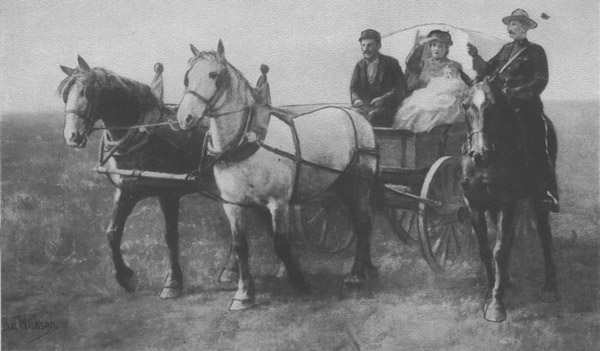
Salaberry, Colonel de. BL Comes to Kingston to solicit office of provincial aide-de-camp, 172; La Fontaine's opposition to appointment, 173.
Salaries, Civil. S In Upper Canada, 177.
Salmon Falls. L Hamlet, destruction of, 229. F Massacre of, 251.
Salmon River. L La Barre's expedition encamps at, 184.
Salt. S Production of, in Upper Canada, 115.
Samos. WM Battery at, captured, 182.
Sandwich. A town in Essex County, Ontario; first settled in 1750 by the soldiers of a disbanded French regiment. It was subsequently named after the town of Sandwich, in Kent, England. Index: Bk Military fort, 59; occupied by United States general, Hull, 209, 213; evacuated by Americans, 248. BL Early municipal government of, 298. Bib.: Lovell, Gazetteer of Canada.
Sangster, Charles (1822-1893). Born in Kingston. For some time in public service; engaged in newspaper work at Amherstburg and Kingston; for many years prior to his death employed in the civil service at Ottawa. Bib.: Works: The St. Lawrence and the Saguenay and other Poems; Hesperus and other Poems and Lyrics. For biog., see Morgan, Cel. Can.; MacMurchy, Canadian Literature.
Sangster, J. H. R On staff of Ontario Normal School, 174.
San Juan Boundary. Dispute arose between the United States and Great Britain out of a difference of opinion as to the meaning of the phrase "middle of the channel which separates the continent from Vancouver Island" in the treaty of 1846, and by which the rightful possession of San Juan and other islands in the vicinity for years remained unsettled. A compromise was made in 1859, both governments jointly occupying San Juan with troops. Finally, by the Washington Treaty of 1871, the question was referred to the arbitration of the German emperor, who decided in favour of the United States. Index: Md Brought up under Washington Treaty, 166; dispute caused by vague terms of Oregon Treaty, 178-179; submitted to arbitration of German emperor, 179; Macdonald on, 179-180; decision in favour of United States, 180-181. Bib.: Hertslet, Treaties and Conventions.
Sanstein. Ch Clerk, brings news of amalgamation of de Monts and de Caën Companies, 138.
Saskatchewan. Organized as a provisional district in 1882. It then extended from long. 111° 20' W. to the Manitoba boundary and Lake Winnipeg, and from the northern boundary of the district of Assiniboia, to the southern boundary of Athabaska. The province of Saskatchewan, created in 1905, extends from long. 110° on the west to the Manitoba boundary on the east, extended north to lat. 60°, which forms the northern boundary of the new province. The capital of the province is Regina, former capital of the North-West Territories. See also North-West Territories. Bib.: Lovell, Gazetteer of Canada.
Saskatchewan Rebellion. See Riel Rebellion, 1885.
Saskatchewan River. Ultimate source is at the head waters of the Bow River, about lat. 51° 40', in the heart of the Rocky Mountains. After a course of 1205 miles, it flows into Lake Winnipeg, finally discharging its waters by the Nelson into Hudson Bay. The length of the South Saskatchewan to its junction with the North Saskatchewan at the Forks is 865 miles; and of the North Saskatchewan, which rises in the watershed range of the Rocky Mountains, near the source of the Athabaska, is 760 miles. La Vérendrye reached the river, then known as the Pasquia, or Poskoyac, in 1748, and built Fort Bourbon on the shores of Cedar Lake. He ascended the river to the Forks, a few miles below which he built Fort Poskoyac. In 1751 a party of French explorers ascended one of the branches to the mountains, where they built Fort La Jonquière. Anthony Hendry reached the Saskatchewan from Hudson Bay in 1754, and descended the river from the upper waters of the Red Deer, to the Pas. Many trading posts were afterwards built at different points on the two branches, both by the North West Company and the Hudson's Bay Company. Bib.: White, Atlas of Canada; Tyrrell, Report on Northern Alberta (Geol. Survey, 1886); Burpee, Search for the Western Sea; Hind, Canadian Red River and Assiniboine and Saskatchewan Expeditions.
Saskatchewan, University of. Act passed establishing the university, 1907. Board of Governors decided to fix location of university at Saskatoon, 1909.
Sault-au-Matelot. Dr Arnold's attack on barrier repulsed, 129.
Sault St. Louis. Ch Called after young man named Louis drowned there, 69; centre of fur trade for some years, 120. L Converted Iroquois settled at, 9, 74.
Sault Ste. Marie. The county seat of Chippewa County, Michigan, on the St. Mary's River. In 1641 the Jesuit fathers Raymbault and Jogues founded a mission on its site, and in 1662 Marquette established the first permanent settlement there. On the opposite side of the river is its Canadian namesake, a port of entry of the Algoma district, Ontario. Index: L Mission established at, 11.
Saumarez, Sir Thomas. Bk His letter to Brock from Halifax, 223.
Saunders, Sir Charles (1713-1775). Born in Scotland. Entered the navy in 1727, becoming lieutenant in 1734. In 1739-1740 served under Lord Anson. Stationed in home waters in 1745, and on Oct. 14, 1747, took part in Hawke's victory over the French. In 1750 elected member of Parliament for Plymouth. In 1752 commodore and commander-in-chief on the Newfoundland station; in 1755 comptroller of the navy; and in 1756, rear admiral. In 1759 Pitt appointed him commander-in-chief of the fleet which co-operated with Wolfe in the siege of Quebec, with the rank of vice-admiral of the blue, and his operations in the St. Lawrence largely contributed to the success of the British arms. In 1760 commander-in-chief in the Mediterranean; in 1761 created K.B.; in 1765 a lord of the Admiralty; in 1766 first lord; and in 1770 reached the rank of admiral. Index: WM Appointed to naval command of expedition against Quebec, 75; sails for Louisbourg, and puts in at Halifax, 75; his fleet detained at Louisbourg, 78; takes soundings of Traverse Channel, 90; joins in attack on French left at Montmorency, 136; orders burning of two stranded transports, 142; makes feint opposite Beauport, 164, 174; Wolfe's bequest to, 175; advances vessels in front of Lower Town, 231. Bib.: Dict. Nat. Biog.; Doughty, Siege of Quebec; Wood, Logs of the Conquest of Canada and The Fight for Canada; Bradley, The Fight with France.
Saunders, John (1754-1834). Born in Virginia. Joined the royal forces and served throughout the War of Independence. Went to England; studied law and called to the bar. In 1790 appointed judge of the Supreme Court of New Brunswick, and a member of the Council; from 1822 to 1834 chief-justice of the province. Index: W Chief justice, 74; dies, 1834, 74. Bib.: Hannay, History of New Brunswick.
Saunders, John Simcoe (1795-1878). Born in Fredericton, New Brunswick. Went to England; educated at Oxford University. Called to the bar of Nova Scotia, 1819, and to that of Lower Canada, 1820. Surveyor-general of New Brunswick, 1840, and provincial secretary, 1845. Appointed to the Legislative Council, of which he became Speaker, 1866; also senior justice of the Court of Common Pleas. Index: W Advocate-general, New Brunswick, 34; Partelow succeeds as provincial secretary, 116. Bib.: The Law of Pleading and Evidence in Civil Actions. For biog., see Morgan, Annual Register, 1878; Hannay, History of New Brunswick.
Sauvage. WM Frigate in which Lévis embarked at Brest, 12.
Savage, Thomas (1608-1682). Went to Massachusetts in 1635 with Sir Harry Vane, and the following year elected a freeman of Boston. In 1638 helped to found the settlement of Rhode Island. Served in the Indian wars, 1675. Index: F Third in command in Phipps's expedition, 281. Bib.: Dict. Nat. Biog.
Savignon. Ch Name given to young Algonquian taken as hostage for Nicolas Marsolet, 63.
Scalping. WM Forbidden by Wolfe except in case of Indians, or Canadians dressed as Indians, 102; declared by Vaudreuil to be necessary, 102, 108; by Indians on the side of French, 141; by Wolfe's rangers, 150.
Schank, John (1740-1823). Born in Scotland. Entered the navy, 1758. Commanded the Canso in the St. Lawrence, 1766. Placed in charge of the naval establishment at St. John's; succeeded in launching several small war vessels on Lake Champlain. Subsequently had charge of the marine depots at Quebec and at Detroit; and in 1777 employed under Burgoyne in the construction of floating bridges. Index: Hd Superintends building of gunboats, 125; his letter to Carleton, 159; marriage of, 236-237; his evidence in Du Calvet matter, 288, 289; sails for England with Haldimand, 209, 313. Bib.: Dict. Nat. Biog.