Part 5 — FOLK-TALES AND SONGS
Reading edition
This is a tale of the old days before deer and other animals became so different one from the other. The sambhur and the hanuman monkey became sworn friends. In those days the sambhur had a long tail, while the hanuman monkey had no tail at all. One day the hanuman monkey asked the sambhur for his tail and said, “Friend, I want to put on your tail and see how it becomes me. Please lend it to me.” Then the sambhur said, “Put on my tail, friend, and see how it becomes you,” and gave him his tail. But the hanuman monkey, as soon as he had put on the sambhur’s tail, climbed away up into a tree. Then the sambhur said, “Come down, friend, and give me back my tail,” but the hanuman monkey would not. Then the sambhur, wondering how he should make himself a tail, pulled out his own liver and made a tail of it and put it on. Men say that that is why even nowadays sambhur tail is so good and tastes like liver to eat.
The Wild Boar and the Tiger.
Apfuho and the Old Woman.
Apfuho and the Tiger.
How the Villagers tried in vain to put an end to Apfuho.
The villagers, meaning to put an end to Apfuho, took him with them down to a big pond. Then when they got to the water they all began swinging out over the pool on a creeper swing. They made Apfuho use the swing last and went away and left him, thinking he would fall off into the middle of the pond and be drowned. Apfuho kept swinging and swinging and could hardly hold on any longer, when he espied a man and a woman wearing fine ornaments and leading a mithan by a rope. He saw that they were an eloping couple and called out to them, “Who are you? There is a beautiful breeze here which makes swinging very pleasant. Take off your ornaments and put them on the ground and tie up the mithan. Then pull me in with a hooked stick and come and have a swing yourselves.” So they did as Apfuho told them, and took their ornaments off and put them down and pulled Apfuho in with a forked stick, and both began to swing.
Now a blind old woman was stumbling along, feeling her way by the water’s edge. Apfuho put an old worn dao in front of her, and when she found it as she groped she said, “Well, if a person like me can find this, people with no infirmities will get a lot.” Then Apfuho went up to her and said, “Now, old woman, you go in too. What are you doing on the edge?” and with these words he caught her and threw her into the middle of the pond so that she was drowned.
The audience always appreciates a play upon words such as occurs in the story of Apfuho and the Old Woman. All Nagas love a pun. A good one is immortal. Ao women—a most pugnacious section of the human race—pun on the names of their adversaries most elaborately. In some Lhota stories practically the whole point depends on a pun. The following is an example.
The Old Man and His Dogs.
The types of story described so far have all been more or less humorous. Some tales, however, teach a definite moral lesson; for example, the following.
The Story of the Two Brothers.
There were once two brothers. The elder was poor, but the younger was very rich. The younger brother ignored the elder and kept all his care and affection for his friend. One day the younger brother said to his friend, “My friend, to-day we will go and pick and eat red berries.” So saying they went. The younger brother climbed the tree, and while he was picking and eating the berries smeared himself all over with the red juice. Then he called out, “Friend, friend, I am falling,” and tumbled out of the tree. His friend climbed down and looked at him as he lay on the ground and said, “You are no relation of mine. I shall not look after you. I will go and tell your brother and get him to come.” With these words he went away without attending to him at all. But his brother came and saw him, and looking at him said, “My brother, forgetful one, when you were alive you scorned and neglected me and kept all your love and affection for your friends.” With these words he picked him up to carry him, but the younger brother said, “Brother, there is nothing the matter with me,” and got up and himself carried his elder brother home. Thereafter the friends were friends no more, but the two brothers loved one another. That is why men say that there is nothing in life equal to the love of one’s own relations.
The Widow and the Boys of the Morung.
Stories of the Water Spirit (Tchhüpfu) are common, and usually describe a visit paid by someone to his lair in a deep pool, as in the following.
The Boy and the Water Spirit.
One day a boy went down to the Doyang to fish. When he did not return home in the evening his parents became very anxious, and in the morning his father took some men down to search for him; but he was nowhere to be found. Then his father was sad at heart and went wandering alone along the Doyang, determined to find at least the dead body of his son. As he went he saw a hair on the ground, and picked it up, thinking it belonged to his son. But it was so long that he only picked up one end of it, and walked on winding it round and round his finger. He went on and on until he had passed eight bends of the river, so long was the hair. At last he came to a Water Spirit, for the hair was one of the Water Spirit’s which he had forgotten to wind round his head. Then the Water Spirit cried out, “Let me go,” but the man replied, “You have seized my son and taken him to your home in the water. I will not let you go till you bring him out and give him back to me.” Then the Water Spirit said, “Let me go and I will bring your son and leave him here. If you do not believe me you may make me swear the most solemn oath known to men.” At this the man let him go, and the Spirit gave him a gift of friendship, dried fish and fresh fish and fish paste, and said, “In the morning I will bring your son out of the water and leave him here. Come at the time when men go to their fields and you will find him.”
Obedient to the words of the Spirit the man came in the morning at the time when men go to their fields, and there sure enough was his son on the bank. The tale he told his father was this: “I saw a big fish in the water, and dived in and caught hold of it. It dragged me into a hole under the rocks in the pool, where there was no water. There on the dry sand was a hearth made of three human skulls. It was the lair of the Water Spirit.” The Water Spirit had not hurt the boy, but had brought him out and left him on the bank, as he had promised to his father. So the father found his son safe by the side of the water and they both went back home. The tale is remembered to this day.
Otherwise tales of supernatural beings are comparatively rare. The story of Sityingo and Ngazo, two jungle godlings, will serve as a sample.
The Story of Sityingo and Ngazo.
Stories of human beings being turned into birds or beasts are not uncommon. The following are examples.
How Men became Catfish.
A man took a company of children down to his fields to work. When they had worked all morning and it was time for the midday meal they asked him to give them their rice. But the owner of the field and his family said it was not yet time and would not give them any rice. Then the children said they were going to bathe and all went off, and said, “They would not give us our rice in time, so we will become catfish.” With these words they turned into catfish, calling out, “We are catfish, we are catfish.” The owner of the field called out, “Come along, I will give you your rice,” but the children replied, “You would not give it us before. Now we have forgotten about men’s food. We will not come,” and swam away in the form of catfish. It is because these children were wearing dao-holders when they were turned into fish that catfish always have a mark on them like a dao-holder—so men say.
How Men were turned into Gibbons.
The Story of the Kithang Clan.
Tales valued for their intrinsic merit as good stories of adventure are very numerous, some of them being of considerable length. Examples are the following.
The Story of Lichao and His Daughter.
Once upon a time wild pigs damaged a man’s crops very badly, so he went down to hunt them, and wounded one with his spear. This he tracked and tracked till he came to the house of Lichao, the old man guardian of wild pigs. There he found two maidens feeding the pig he had wounded. They asked him what he had come for, but he was afraid to tell the truth and say that he was tracking a wild pig that he had wounded, so he replied, “Hearing that there were two beautiful maidens at your house I came to see, hoping that I might take one as my wife.” Then they told him to come another day, so he departed.
A few days later Lichao said, “If you can catch and tie up one of my pigs alone I will let you take my daughter and go,” and with these words gave him a length of unsplit cane. Then the man fell to thinking how he could catch one of the pigs, for they were wild pigs; and his wife said to him, “If you cannot catch a pig my father will devour you.” At last he caught a pig, and his wife beat the cane on the ground to fray it and gave it to him. Thus holding the pig with one hand he pulled off strips of cane with the other and bound the pig fast. Then Lichao let him take his daughter and go.
So the girl came to her husband’s house. But there she could get no human flesh to eat, and soon became so weak and thin that she could not work. One day her husband said to her, “Why are you so weak and thin?” To which his wife replied, “I am thin and weak because I cannot get the food which my parents used to give me.” Then when her husband asked what her parents used to give her to eat she replied, “I will send you to fetch a parcel of meat wrapped in leaves from my parents’ house. But bring it straight here. Do not open it and look to see what is inside.” So he went, and his wife’s parents gave him some pieces of human flesh wrapped up in leaves. This he brought straight home to his wife without opening the leaves to look to see what was inside, and when she ate it it made her as plump and strong as ever. But in a day or two, because she could get no more human flesh to eat, she again became so thin and weak that she could not work. Then she spoke to her husband again and told him to go and fetch some more meat from her parents’ house. Now her husband was determined to open the bundle and see what kind of meat it was that made his wife get well again when she was so thin and weak that she could not work. But Lichao sent a little bird to go back with him so that he should not open the parcel of human flesh on the way. When the man fingered the parcel which Lichao had given him, having it in his heart to open it, the little bird said to him, “If you open it I shall tell my father; if you open it I shall tell my father.” So he did not open it and look inside. But when he had given the parcel of meat to his wife he went and hid and watched quietly to see what kind of meat her father had given him to bring. Now it was nothing but human fingers tied up in leaves that her father had given him to bring. And his wife undid the leaves and roasted the fingers lightly in the fire and ate them one after another. Now when he saw this her husband was much troubled and said, “What meat have your parents sent you? What meat is that you are eating?” But she said, “Nay, I will not tell you. You will only be troubled at heart and filled with fear.” But he said, “I shall not be afraid. Tell me.” Then his wife said, “I shall turn into a tiger. When I go about the house showing my fangs and roaring you must slip a basket over me. If you cannot slip a basket over me I shall devour even you.” With these words she turned into a tiger, and her husband tried to cover her with a basket but could not, so she caught and ate him. That is the end of the story.
The Girl who Married a Tiger.
A woman one day went down to her field to fetch some vegetables. She saw a fine gourd there and was just going to pick it, when a tiger saw her and said, “That is my gourd. Why were you going to pick it? I shall kill you.” With these words he caught her, but the woman, who was about to become a mother, said, “Do not kill me, and I will give you my baby when it is born,” so the tiger let her go. In due time a daughter was born to the woman. When the tiger heard of this he kept asking the woman if her child was born yet, till at last she told the tiger that it had been born. Soon the tiger asked her if her daughter was strong enough to fetch firewood and water yet, and whether she was old enough to be married. But the woman kept putting him off by saying that her daughter was not yet old enough to carry wood and water and was too young to marry; till at last she saw that she must keep the bargain she had made, and told the tiger that the girl was old enough to work as his wife. But as she sat weaving a cloth for her daughter to wear on her wedding-day she was overcome with grief when she thought how her child would surely be killed and eaten by the tiger, and her tears fell fast on the cloth she was making. Her husband, too, was sad as he worked at a basket he was making for his daughter to carry when she went to her husband’s house, and his tears fell fast on the basket. When the girl saw this she said, “Why are you crying, mother?” and her mother answered, “I poked myself in the eye with my bobbin.” To her father, too, the girl said, “Why are you crying, father?” And her father replied, “I poked myself in the eye with a slip of bamboo.” Then when the day came her parents gave her in marriage to the tiger.
Then the tiger set out to search for his wife and asked everyone he met whether they had seen her pass. All replied that they had not seen her, till at last he came to the sangalia creeper, who said she had just gone by that way. Then he chased and chased her till he came up with her at dusk at the door of her parents’ house. The woman cried out, “Mother, come out of the inner room and open the door for me.” But her mother replied, “Who is that? I have no daughter. My daughter disappeared long ago,” and would not come out and open the door. Then the woman said again, “I am your own daughter, mother, whom years ago, when I was little, you hit on the head with the pigs’ food ladle. Do you not know me now?” With these words she began to squeeze through the little opening by the door left for the dogs, but the tiger seized her legs while her mother seized her head and shoulders. And they pulled and pulled till she was torn in two and the tiger was left with her lower half and her mother with the upper half. Then the tiger took his half to his house and kept watch over it with a whisk so that not a single fly should settle on it, and buried it. And he wept, saying, “O my wife, when you were alive I loved you so much that I was careful always to give you good meat to eat as relish with your rice. You never had to eat leaves and such-like poor fare.” But her mother said, “Why do you weep so? We have torn her in half. Now we will cook and eat her.” And she cooked a little of the flesh from the upper half of the girl and offered it to the tiger, who refused it, saying, “How can I eat the flesh of the mother of my daughter?” But at last he ate it. Then he said, “Human flesh is good,” and went and dug up the portion he had buried and ate that too. That is how the tiger came to eat human flesh, and that is why to this day tigers sometimes kill and devour men.
Lankongrhoni and the Villagers.
In the days of our ancestors there lived a woman called Lankongrhoni. She had a son who was very handsome. His name was Arilao. All the girls admired him only and wished to marry him. They cared nothing for the other men. So all the men of the village planned to kill him treacherously. They agreed that on any day when they should all go down to the river to poison fish, whoever failed to come was to be fined a big pig. Two or three days later they went down. Then Arilao’s mother said to him, “Son, do not go.” But he said, “Do you want us to lose our big pig, mother?” and went. And the men felled a tree on the river bank and hewed a trough out of it and said, “Let every man lie in the trough in turn and see if he looks a fine man.” So they each lay down in turn, but as each man lay in the trough the others kept repeating, “You don’t look nice, you don’t look nice.” At last they said, “Let Arilao lie down,” and made him get into the trough, and calling out, “Arilao looks nice; we are pounding up Arilao, we are pounding up Arilao,” they pounded him up with the fish poison. Now Arilao had a friend, and he was very sad because Arilao had been killed that day, and waited weeping further down stream. Soon the finger-nail of his friend Arilao came floating down and lodged against him. Then he said, “Is this all there is left of my friend?” and with these words lifted the nail off the water, and wrapping it in a leaf slipped it into his belt. The villagers made a fine haul of fish, but Arilao’s friend was so sad that he did not trouble to catch a single one. When the villagers trooped off up towards the village he hung back to the last.
Now the villagers knew nothing of what had happened. But a crow went from field to field and hopped about in front of the workers dressed in a skirt like a little girl, and said, “Arilao’s mother has utterly destroyed the children of the village.” Then the villagers said, “What does it mean to-day, a crow behaving like that? Surely something has happened,” and so saying they all went off home. And when they saw that all their children had been burnt up, each said to his neighbour, “This is your fault, this is your fault,” and they fell upon each other and killed each other so that they all died. But two orphans, a brother and sister, were frightened when they saw this and climbed up into a fowl-house and hid. Afterwards, all the villagers being dead, there were none for them to marry, so they became husband and wife, and from these two, even from their fingers and toes, were born all the men there are in the world. This is one of the stories which men tell.
A few stories like the following are found which purport to give the origin of some common saying.
The Woman with a Caterpillar for a Husband.
A man and his wife lived together. Now at night the husband was a man, but in the day he turned into a hairy caterpillar. His wife did not know this. One night before she went to sleep she said, “To-morrow I am going to gather some leaves to eat.” Early in the morning her husband left the house first and turned into a caterpillar and nipped off the leaves and waited at the place. Then the woman came and at the sight of the leaves exclaimed, “Strange, a caterpillar has nipped off the leaves. I will take them and go.” So saying she took the leaves and went. But that night when they were in bed she said to her husband, “To-day I found that a caterpillar had nipped off the leaves I went to gather.” Then her husband said, “It was I.” At these words she was greatly troubled, and when he was asleep she gently pushed and pushed her husband till he fell off the bed into the fire and was burnt. After that the woman swallowed caterpillar hairs with her food, whenever she ate, and coughed and coughed till she died. Therefore nowadays if anyone coughs much people say, “You should not burn a caterpillar.”
The forces of Nature form the subjects of several folk-tales, as the two following stories show.
The Sun and the Moon.
The Wagtail and the Owlet.
Finally, there is the story of the hero Ramphan and his dao. According to one tradition Ramphan is supposed to have lived when the Lhotas and Rengmas were still one tribe, and some Rengmas from Themokedima once even came to Akuk and claimed the dao, which is still preserved there as an heirloom. It is a long, thin piece of iron about two feet long and three inches broad. The spike of the haft is long and evidently protruded through the wooden haft, which probably existed once. It is rarely shown to strangers, and never to Southern Lhotas, on the ground that they approach Akuk from the direction of the Land of the Dead. The story given below is that told by the present possessors of the dao, and places the scene of the exploit at Longcham, an abandoned site on Wokha Hill, whence the Lhotas are supposed to have spread into the country now occupied by them.
The Story of Ramphan.
One day when Mangtsilo was weaving outside her house, Ramphan’s slaves began to spin their tops near by. They made Mangtsilo’s brothers join in, and drew them on and on till they came close to her house. Then one of the brothers recognized his sister Mangtsilo, and went and told his parents that he had seen a woman exactly like his sister. But his parents said, “Your sister was lost long ago. Her very bones have rotted away by now. How could you have seen her?” But he said again and again that he had seen a woman exactly like his sister, so that at last his parents went to see and found that it was indeed Mangtsilo. Then they demanded her marriage price from Ramphan, but Ramphan said, “First give me the marriage feast and then I will give you the marriage price.” So her father said, “What can I do? Make and give me only a bamboo spoon and a bamboo rice-stirrer.” So Ramphan made and gave him only a bamboo spoon and a rice-stirrer. That is why Ramphan and Mangtsilo only had one son and one daughter born to them.
SONGS
Not only have the Lhotas a number of traditional songs, but they are also experts at making up topical songs about any events of local interest. The singing is unaccompanied either by instrumental music or dancing. The following is given as an example of a traditional song. It is sung by men lopping the branches off trees when clearing jungle for new jhums. The Lhota version with a free prose translation is given, as no verse translation would give any idea of the swing of the song. It runs as follows:—
Ana echangcho locho
Sena hambong eshonile.
Ana echangcho locho
Reching hambong eshonile.
Ana echangcho locho
Yizem hambong eshonile.
Ana echangcho locho
Süng chomani yingkale.
Zükitacho yakpowo echilato,
Zükitacho yakwoina elhyu.
The interpretation of this song is as follows:—
On the tree that I am cutting
May a cock minivet perch.
On the tree that I am cutting
May a cock hornbill perch.
On the tree that I am cutting
May a cock king-crow perch.
On the tree that I am cutting
May taro and vegetables grow.
The “madhu” is his who climbs to the top,
The “madhu” grows at the top of the tree.
The music of this song will serve as a specimen of Lhota harmony. I am indebted to Mrs. Hutton for the notation.
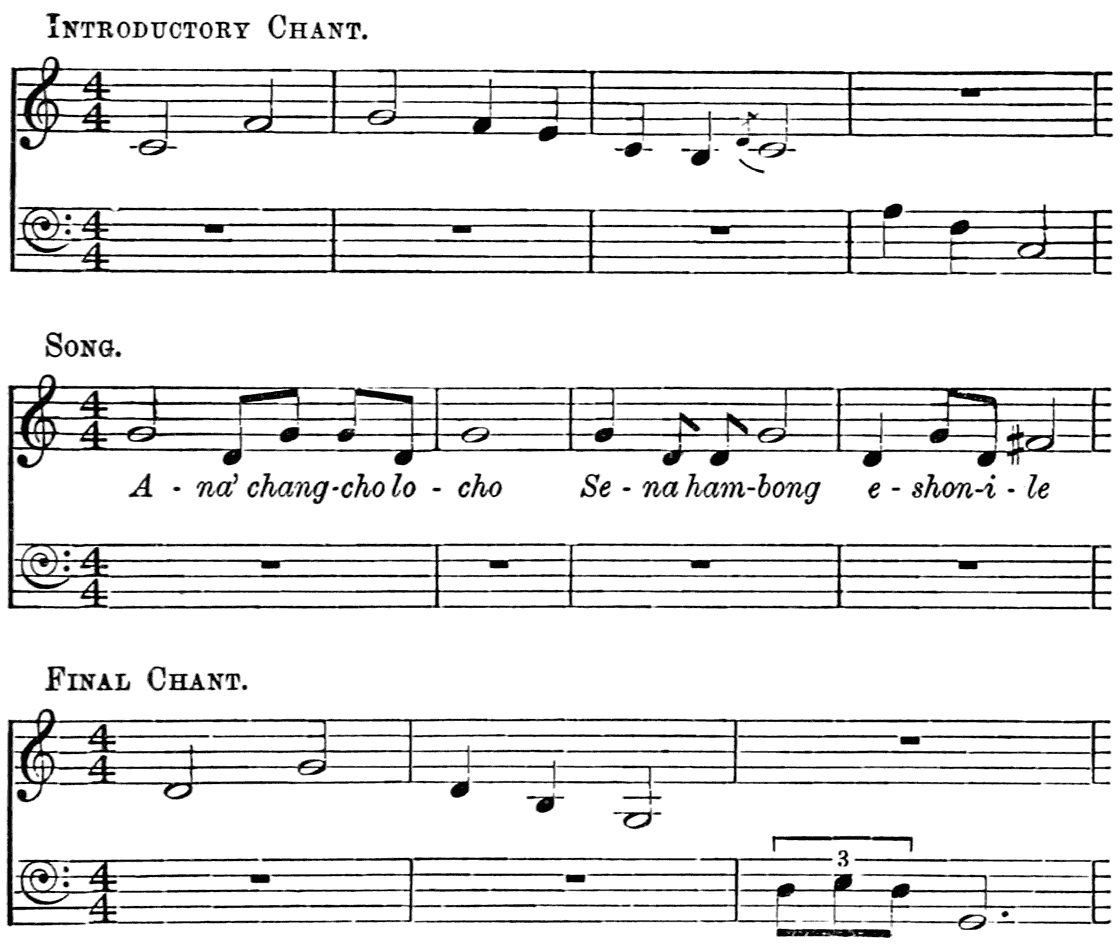
The introductory and final chants precede and follow each verse and are sung on the syllable a.
Another traditional song is the following lullaby sung by a widow to her child:—
Ole iyi le he-e,
O iyi e he-e,
O kakao ntitscona chitata chonchiato?
O iyi e he-e,
O zükitacho niyuhungcho chonchiato?
O iyi e he-e,
O zükitacho khencheng soko niyutokoka.
Chitata tichonchia,
O kakao.
Ole iyi le he-e,
O iyi e he-e,
O ango o-o,
O ntitscona chitata chonchiato o?
O iyi e he-e,
O ntena chitata chonchiaka a.
O iyi e he-e,
O kiyonipo etchhi tyengro ekamochina.
O iyi e he-e,
O elaniki shiato nichamkao maka.
O chitata tichonchia a,
O iyi e he-e.
This may be translated as follows, omitting the meaningless chant of Ole iyi le he-e, etc.:—
“My little one, why are you crying so much?
Is it because you want a drink of ‘madhu’ that you are crying?
I will give you well-kept ‘madhu’ to drink.
Do not cry so much.
O my little one,
O my child,
Why are you crying so much?
Even if you cry like this
Your father, who has become a young brave among the dead,
Cannot come back and call you and take you in his arms.
O do not cry so much.”
Songs composed to celebrate some particular event are meaningless to anyone who does not know the full details of the circumstances to which they relate. An interlined and much expanded translation will help to explain the following specimen. It tells of the various people who were concerned in the founding of the new village of Japfu from Mekula, a migration which greatly annoyed those who remained in the old village.
Ho holo iye hele,
Ho holo iye hele,
Ho yanthan yanra Pithango.
(Ho for Pithango plotting to found the new village of Japfu.)
Ho holo iye hele,
Ho holo iye hele,
Ho yangen yanra Renowo.
(Ho for Renowo of the old village plotting to stop them going.)
Ho holo iye hele,
Ho holo iye hele,
Ho chapha Tsirenthang.
(Ho for Tsirenthang as fat as a carrying basket.)
Ho holo iye hele,
Ho holo iye hele,
Ho oyam phanka Zaremo.
(Ho for Zaremo, who went because he could never say No.)
Ho holo iye hele,
Ho holo iye hele,
Ho maorale Konchiyo ho esonlanicho.
(Ho for Konchiyo, the old man, burrowing into the scheme like a beetle in straw.)
Ho hati lishomo kamiki.
Ho holo iye hele,
Ho holo iye hele,
Ho Japfu lantyulo ho epyu kalamo?
(Will you creep on all-fours up to Japfu on the height?)
Ho holo iye hele,
Ho holo iye hele,
Ho nthang tera Rishamo.
(Ho for Rishamo as handsome in the eyes of Rensali as a red flower for the ear.)
Ho holo iye hele,
Ho holo iye hele,
Ho panka tera ’Nseno.
(Ho for ’Nseno, no longer young, like a withered flower for the ear that looks best at a distance.)
Ho holo iye hele,
Ho holo iye hele,
Ho okap echü Rensali.
(Ho for Rensali who keeps her love for Rishamo so carefully hidden.)
Ho holo iye hele,
Ho holo iye hele,
Ho woro kurri Yanchano.
(Ho for Yanchano as bald as a chicken.)
Ho holo iye hele,
Ho holo iye hele,
Ho juzü kurri ’Nrio, penching chenpen ’Nrio.
(Ho for ’Nrio with ugly curled hair like a buffalo’s forehead, ’Nrio as black as pounded oil-seed.)
Ho holo iye hele,
Ho holo iye hele,
Ho Kikung loroe Tsensolo.
(Ho for Tsensolo, fair woman of the Kikung clan.)
Ho holo iye hele,
Ho holo iye hele,
Ho Kithang tyengro Mangsamo.
(Ho for Mangsamo, buck of the Kithang clan, who stole Tsensolo from her husband.)
Ho holo iye hele,
Ho holo iye hele,
Ho yantsowotsenle ho woro nungratoksi.
(What did it matter if you paid a fine? The money, not Tsensolo, had the pain of parting from you.)
Ho senka tehrru nikhioalo, sithesiyu nikhioato?
(You are barren and useless as a wife. Did he take you to make of you a post for his house or rafters perhaps?)
Ho holo iye hele,
Ho holo iye hele,
Ho ntithana nirhanchoato ho yanaloio?
(Why did he marry you, woman?)
Ho holo iye hele,
Ho holo iye hele.
The recruiting of the Lhotas for the Naga Labour Corps, and their service in France and return have been celebrated in song at Pangti. A free translation of the song runs as follows.
O Hutton Sahib, young man of a foreign race,
What is that letter which has come for you from abroad?
O Hutton Sahib, young man of a foreign race,
The letter you got so quickly
Is it to call us to go to the German War?
Look how in every village
The bucks plan each with his friend to go.
Oh, we will go to the German War.
Let not a word of the letter fall fruitless.
We men of the Mountains, we the bucks
Have routed the enemies of the Sahib.
Let us return quickly, us the braves of the Mountains.
Let our women-folk at home hear the news,
Let them hear that we have routed the enemies of the Sahib.
We braves of the Mountains are coming back.
Let our women-folk at home hear the news.
Let them meet us with drinks of “madhu.”
Bid them come and meet us on the road.
They have given us money as countless as the grains of ash on the hearth
But he who gives thought to it,
Only he will keep his money.