Part 3 — LAWS AND CUSTOMS
Reading edition
Exogamy—Polity and Village Organization—Property—Inheritance—Adoption—Settlement of Disputes—Oaths—Friendships—War and Head-hunting—Slavery—Position of Women.
The Lhota tribe may fairly be said to have an exogamous system which is in the process of breaking down. There are three phratries divided into clans (chibo) which are in some cases further split up into kindreds (mhitso, lit. “tail”). Strictly speaking a man ought to take his wife from a phratry other than his own. On this Lhota opinion is quite clear. On the other hand, marriage between members of different clans is allowed everywhere and is especially common among the Southern Lhotas, though it is viewed with a certain amount of disapproval by the conservative members of the tribe. In some villages, again, chiefly among the Southern Lhotas, marriage between members of different kindreds of the same clan is permitted. The reason for these innovations—for innovations of the last three or four generations they are believed to be—is that a man’s choice of a wife is limited, for he is almost forced by circumstances to take one from his own village, or at any rate from a neighbouring village. A man in search of a bride naturally thinks first of marriageable girls whom he knows of near home. The parents of a girl, too, usually much prefer that she should marry a man in their own village, sometimes because they are fond of her, but more often because they want her to come in and give a helping hand in the house or look after them when they are ill. The Lhota marriage-price system is another potent factor in reducing a man’s field of choice. The bridegroom naturally does not want to go and work for a father-in-law in a distant village where he will have to live among strangers, with no chance of keeping an eye on his own fields and those of his parents. The money part of the marriage price too is always paid in instalments and never in a lump sum, for a father fears that were he to take a lump sum he would be regarded as selling his daughter, as indeed he is to all intents and purposes. It is therefore convenient to have a son-in-law close at hand, where his memory can be conveniently jogged when instalments get overdue.
The following are the phratries and clans of the tribe, the clans which are regarded by Lhotas as having an extraneous origin being marked with an asterisk:—
Phratry. Clan.
Tompyaktserre. Kikung.
Ovung.*
Tsangsükikung.*
Pathong.
Chami.
Worore.*
Chongyichami.*
Tsoboi.
Kuwang.
Izumontserre. Nguli.
Sempinguli.*
Sityingonguli.*
Mozoi.*
Rangpang.*
Shetri.
Humtsoi.
Kithang.
Mipongsandre. Muri.
Othui.
Eni.*
Thangwe Eni.*
Lapung.
Chorothui.*
Ezong.
Tsangle.
Yanthang.*
Moyoyanthang.*
The original clans of the Izumontserre phratry are Nguli, Shetri and Humtsoi, descended from and named after three brothers. The Sempinguli clan is only found in a few villages such as Pangti, Lungla, Yemkha and Lungithang, and is said to be descended from Sema fugitives who attached themselves to the Nguli clan. The Sityingongnuli form another small clan reputed to be descended from a “jungle man” caught in a snare. They have the reputation of being expert snarers. The Mozoi clan is said to be descended from another “jungle man” caught by some members of the Nguli clan who were “poisoning” a river for fish. The Rangpang clan in turn is believed to be descended from a slave or orphan brought up by one of the Mozoi clan, and is often called Mozoirangpang. The origin of the Kithang clan is obscure. One tradition classes them as Izumontserre and another as Tompyaktserre. They take wives from all clans but their own nowadays, and have no tradition that any phratry was ever forbidden to them.
The number of clans which tradition says sprang from “jungle men” (orakyon) is remarkable. These “jungle men,” as the Lhota word literally means, are said to have been like Nagas to look at. They are generally heard of in stories as being found hiding in trees or stealing from traps. Possibly they represent aboriginal inhabitants encountered by Nagas at some period of their migrations.
The Lhota table of relationships is given herewith in the form suggested by Professor Rivers.
Relationships.
Father. opo. Son. otsotyungo.
Mother. oyo. Daughter. otsolovo.
Elder brother (M.S.) (W.S.). ota. Younger brother (M.S.). onyuro.

Elder sister (M.S.) (W.S.). ota. Younger sister (M.S.). (W.S.). oyilo. onyiro.
Father’s elder brother. oporamo. Younger brother (W.S.). opye.
Father’s younger brother. oporo (all Lhotas) or oponunghowo (Northern Lhotas). Brother’s son (M.S.). otsotyungo.
Father’s elder brother’s wife. oyo or oyoramo. Brother’s daughter (M.S.). otsolovo.
Father’s younger brother’s wife. oyo or oyonunghowo, or oyoramo (if she be older than speaker’s mother). Husband’s brother’s son. otsotyungo.
Father’s brother’s son. ota (if older than speaker). Husband’s brother’s daughter. otsolovo.
onyuro (if younger than speaker). Brother’s son (W.S.). ongo.
Father’s brother’s daughter. ota (if older than speaker). Brother’s daughter (W.S.). oka.
oyilo (if younger than speaker).
Father’s elder sister. onnoramo (Northern Lhotas).
onno (Southern Lhotas).
Father’s younger sister. onnoro or onnonunghowo (Northern Lhotas).
onno (Southern Lhotas).
Father’s elder sister’s husband. omoramo (if of clan of speaker’s mother). Wife’s brother’s son. orrho (if brother’s wife of same clan as speaker).
onung (if not of clan of speaker’s mother). onung (if brother’s wife not of speaker’s clan).
Father’s younger sister’s husband. omonunghowo (if of clan of speaker’s mother). Wife’s brother’s daughter. orrhovo (if brother’s wife of same clan as speaker).
onung (if not of clan of speaker’s mother). orrham (if brother’s wife not of speaker’s clan).
Father’s sister’s son. orrho.
Father’s sister’s daughter. orrhovo. Sister’s son (M.S.). orrho.
Mother’s brother. omo. Sister’s daughter (M.S.). orrhovo.
Mother’s brother’s wife. ongi (unless of same clan as speaker, when whatever term blood relationship required would be used. Northern Lhotas). Husband’s sister’s child. ongo (m.) and oka (f.).
onno (Southern Lhotas).
Mother’s brother’s son. omo.
Mother’s brother’s daughter. oyonunghowo.
Mother’s elder sister. oyoramo. Sister’s son (W.S.). otsotyungo.
Mother’s younger sister. oyonunghowo. Sister’s daughter (W.S.). otsolovo.
Mother’s sister’s husband. oporamo (if older than speaker’s father). Wife’s sister’s son. otsotyungo.
oporo (if younger than speaker’s father). Wife’s sister’s daughter. otsolovo.
Mother’s sister’s son. ota (if older than speaker).
ongo (if younger than speaker).
Mother’s sister’s daughter. ota (if older than speaker).
oka (if younger than speaker).
Father’s father. omotsü. Son’s son (M.S.). (W.S.). orrhe.
Father’s mother. otyo (Northern Lhotas). Son’s daughter (M.S.). (W.S.). orrhevo
otsü (Southern Lhotas).
Mother’s father. omotsü. Daughter’s son (M.S.). (W.S.). orrhe.
Mother’s mother. otyo (Northern Lhotas). Daughter’s daughter (M.S.). (W.S.). orrhevo.
otsü (Southern Lhotas).
Husband. orapfu. Wife.
Wife’s father. omo. Daughter’s husband. (M.S.). (W.S.). eng. omyako.
Wife’s mother. ongi (Northern Lhotas).
onno (Southern Lhotas).
Husband’s father. omo. Son’s wife (M.S.). omi (Northern Lhotas).
orrhovo (Southern Lhotas).
Husband’s mother. ongi (Northern Lhotas). Son’s wife (W.S.). oka.
onno (Southern Lhotas).
Wife’s elder brother. onung. Sister’s husband (M.S.). onung.
Wife’s younger brother. onung nunghowo. Sister’s husband (W.S.). orrhang.
Wife’s elder sister. orrhamm eramo.
Wife’s younger sister. orrhamm nunghowo.
Husband’s brother. orrhang. Brother’s wife (M.S.). omi.
Husband’s sister. onung. Brother’s wife (W.S.). onung.
Wife’s sister’s husband. ozi (if not of speaker’s clan).
oporo or ota (if of speaker’s clan).
Husband’s brother’s wife. ota (if older than speaker).
oka (if younger than speaker).
oyeni (if of same age as speaker).
Son’s wife’s parents (M.S.). omo (m.) and ota or oka (f.).
(W.S.). oporo, oporamo, ota or ongo (m.) according to age, and onung (f.).
Sister’s daughter’s husband (M.S.). ota or ongo according to age.
(W.S.). omyako.
In ordinary conversation the general ongo, boy, and oka, lass, are used instead of the formal terms otsotyungo and otsolovo. In the case of a woman speaking of her brother’s child ongo and oka are invariably used instead of otsotyungo and otsolovo in order to avoid any suggestion of marital relations with her brother. The terms orapfu and eng are rarely used in address, or when a man or woman is speaking of his or her own wife or husband. Instead, okikhamo (m.) and okikhamm (f.), meaning “house-mate,” are substituted.
Polity and Village Organization.
Property.
Cattle, houses and so on are the property of the individual, but land can be held either by the village, a “morung,” a clan, or an individual. The land close to a village is usually waste land and common property, as are the rights of “poisoning” in certain pools. Every “morung” owns land which is the property of the “morung” as a whole and not of any individuals in it. It is worked by the boys of the “morung” and the produce used to buy meat for ceremonies such as the rebuilding of the “morung.” Boys when they get married and leave the “morung” have to pay a small fine of meat to their late companions as compensation for the loss of labour. A very large proportion of the land in the Lhota country is clan land, which is held in common by all members of that particular clan in the village. A man who leaves a village loses all right to clan land in the village, a far better system than the Sema system by which a man claims, though usually in vain, ancestral rights in clan land in a village in which his great-great-grandfather was the last member of the family to live. Every year the members of the clan in a Lhota village meet and apportion out the land which each is to cut that year, the senior men getting the bigger share. Strangely enough this delicate operation never seems to result in a quarrel. Strictly speaking a man may not sell land which he has inherited. When direct heirs fail the land becomes clan land. Were this to go on indefinitely the whole of the land in a village would in time become clan land, and no one would ever be able to buy or sell land. To prevent this from time to time, when the amount of common land becomes unwieldy, the clan meets and divides it up among the members, who thus each become private owners of a portion of it. The process then begins again. Heirlooms such as the ancient daos and spears which the Lhota so prizes are held in trust by the senior member of the clan in the village, provided he has done all the social “gennas.” To alienate them would bring disaster on the whole clan.
Inheritance.
Adoption.
Though so common among Changs and Semas, adoption is practically unknown among the Lhotas. One reason is that there are very few people poor enough to be willing to be adopted, and another that while among the Semas and Changs an adopted man and his descendants become practically the serfs of their adopter, among the Lhotas the chances of material gain for the adopter are few. Adoption of a girl seems to be unknown. There are generally relations of some kind ready to bring her up and get her marriage price. But boys are very occasionally adopted. Supposing A adopts B, he becomes to all intents and purposes A’s son, and enters A’s clan, though he can never marry a woman from the clan out of which he was adopted. A has to find a wife for B and pay his marriage price, yet if B has a son, the son inherits B’s property, A only inheriting if B has no sons. There is no ceremony of adoption.
Settlement of Disputes.
When a quarrel arises between two villages, messengers are sent to fix a day, and if both sides so agree the elders of the respective villages meet on the path half-way between the two villages and settle the matter, exchanging drinks of “madhu” and eating together. If the responsibility for the quarrel can be fixed on any individual he is fined, and the fine either divided among the elders of both villages, or given to the village against which the wrong was done. In the old days villages such as Okotso and the Ao village of Nankam were in a chronic state of war. It would occasionally happen that Okotso decided to cut their fields which lay towards Nankam in the same year as Nankam decided to cut their fields towards Okotso. Obviously cultivation would be impossible for either side unless a peace of some kind were patched up. The elders of both villages would feast together on the boundary, and an armistice would be agreed upon to remain in force till those fields were finally reaped, when the game of war would go on as before. All preliminary negotiations between villages actually at war were carried on by ambassadors (lantsalanpeng), of which there were two in each village. These had a permanent safe-conduct, and it was believed that to kill one would bring dire misfortune on the slayer and his village. The same custom exists among Aos, Changs and Phoms.
Oaths.
The oath is held in high regard among the Lhotas as it is among the Angamis. A man who is accused of an offence on suspicion may clear himself by taking an oath. The commonest form is for a man to bite a tiger or leopard’s tooth and to swear that if he did such and such a thing may a tiger or leopard kill him. The formula used is the same in all cases, excepting, of course, that whatever offence the man is accused of is inserted. For instance a man accused of adultery would swear—
Ana I itsongi your wife with nsopi: have not committed adultery; osi ana but I itsongi your wife with sopi committing adultery lina if am in the habit of, mharrki by a tiger a-rhamtoksi me allowing to be bitten yantaroki all the village men sena bamboo shavings mi-hm fire-stick penphia using a-mungitokle. for me let them keep emung.
In other words, may he be killed “apotia” by a tiger and the whole village purify themselves with fire and keep emung for him. A few hairs from the swearer’s head, with a little earth, are often bitten instead of the tooth. In cases where the accusation is of stealing thread or some such thing, a skein of thread being said by one side to be stolen, and by the other side to be his own, a little of the thread is put with the hair and the earth. A very solemn oath which entails a day’s emung for the village is that on a leaf of the mingetung. The heaviest of all is on a bonne bouche consisting of a little earth from the place used by the boys of the “morung” as a latrine, a piece of wood from the house of a man who has died “apotia,” a little earth from a grave and a few hairs from the swearer’s head. This oath is very rarely taken, and is thought to involve certain death for the swearer if taken falsely. Land disputes are occasionally decided on oath, which is invariably sworn on a little soil from the land in dispute. Whichever side will take the oath gets the land. It is probably never knowingly taken falsely, as all Lhotas firmly believe that whoever swears this oath falsely will die before he can reap a harvest from the land he has dishonestly gained. An ancient oath, which is only remembered by old men, was taken on the huge boulder known as Deolung. Each side in turn held an egg and swore by Deolung that their story was true. Whoever went mad first lost! The custom was abandoned, it is said, “because it was such a terrible oath.” The idea of making both sides swear and then awaiting results resembles the Ao custom, by which both sides take the same oath, and the decision goes to the party which suffers no loss of any kind within thirty days, a system by which the party who is in all probability guilty does, curiously enough, generally lose. A curious instance came to my notice. The oath was taken in Ungma on the spot specially associated with the deity of the wind. When the ceremony began a gale blew up, so suddenly as to attract my attention in my garden three miles away. Out of a village of six hundred houses thatch was only blown from the roof of the houses of two men, and those were the two principals on one side in the case. The blowing of thatch from a man’s roof if he has taken an oath is looked upon by Aos as a sure sign of false swearing. This story is true and other equally remarkable instances are known to the writer.
Friendships.
Formal friendships are of great importance. Two men become friends (okam) by exchanging gifts, consisting of half a pig, and a spear or dao or some such present, a piece of iron invariably forming part of the gift. It is usual for the sons of “friends” to become friends in turn. A man will often possess friends of this kind belonging to different villages, and frequently to a different tribe. When travelling a man will stay in his okam’s house in each village he reaches. He in turn will entertain any of his okams who come to his village. A man may not kill his okam even if he belongs to a hostile village. Should he happen to kill him in battle with a spear thrown at a venture he will not take his head. Even if no gifts be exchanged, two men of the same name regard one another as okams. I have known a man go out of his way to entertain a stranger whom he had never met before because he bore the same name as his dead son.
War and Head-hunting.
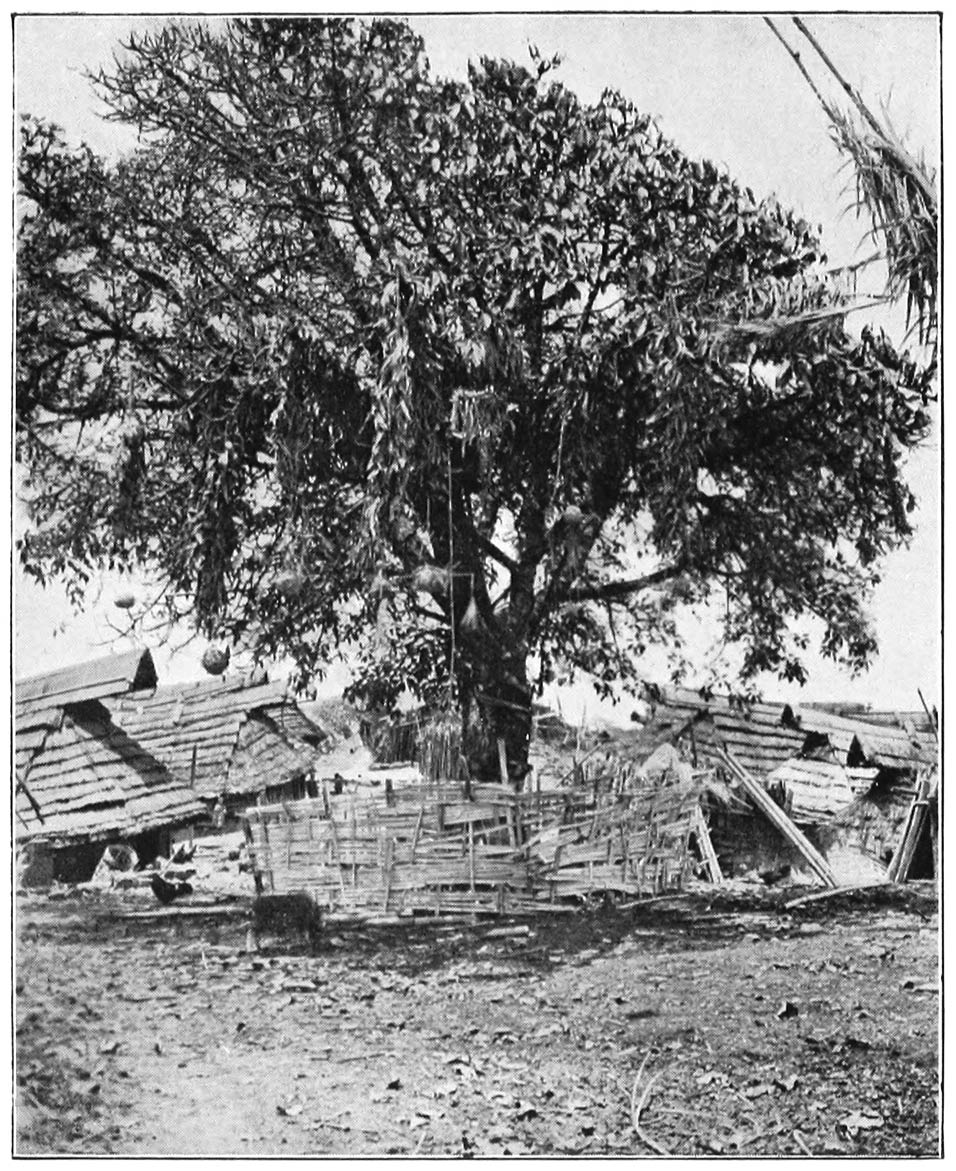
Mingetung
Showing bamboo balls containing pieces of enemies’ heads and fence set up at the oyantsoa “genna.”
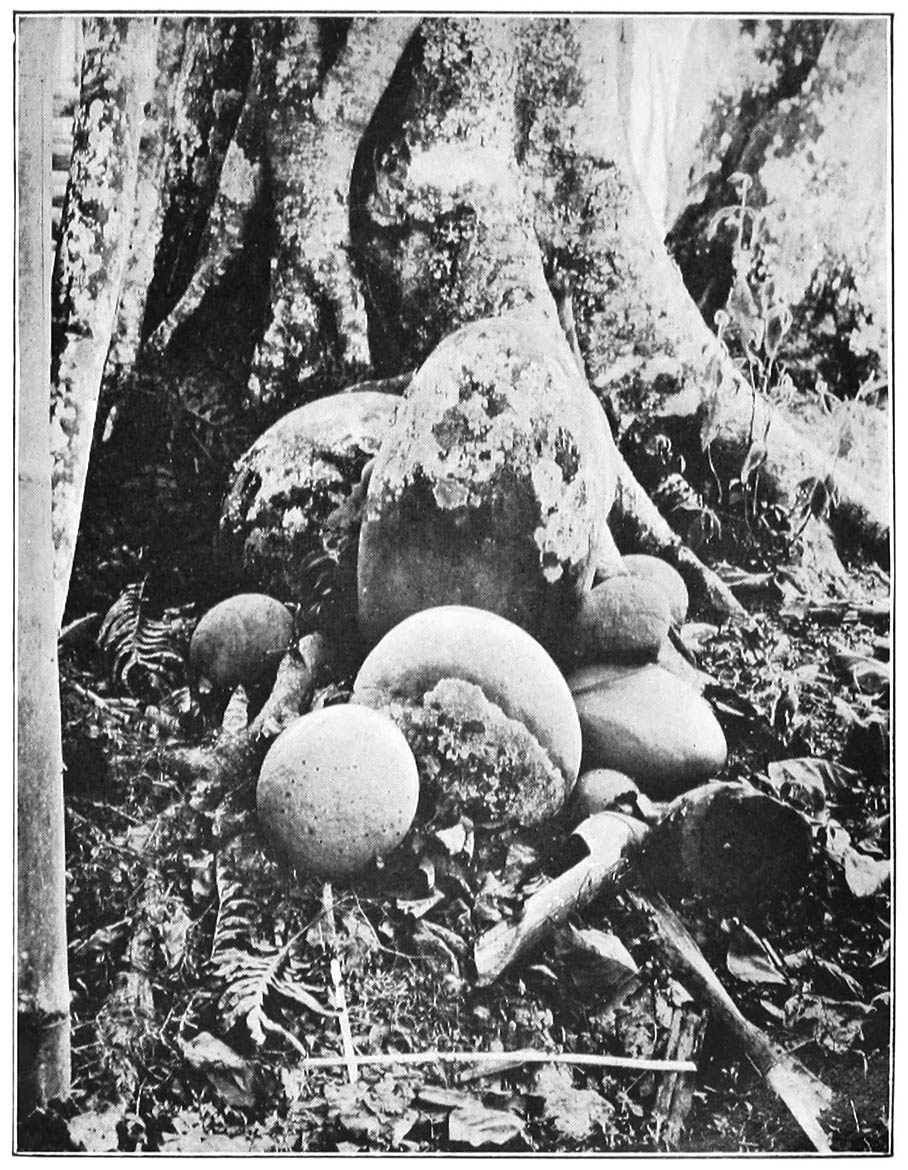
[To face p. 108.
Village Oha at the foot of Mingetung
They have just been lifted and counted at the oyantsoa “genna.”
On the sixth day after the heads had been hung up the Ramo “genna” took place. On the fifth day everyone who had taken a head or jabbed a corpse killed a small chicken and hung it up with some boiled rice and “madhu” rice wrapped in a leaf from the roof of his house in the mpongki on the left side as you go in. He then cleaned his dao and took the omens by pouring the contents of a small “chunga” of “madhu” on the ground and splitting the “chunga.” Then he wrapped the two halves in a leaf, and opening the leaf suddenly let them fall to the ground. If one side fell one way up and the other the other, it meant that the omen was good and it would not be long before he did the head-taking ceremony again. If both halves fell the same way up no successful raid would be made in the near future. He then hid the pieces of split “chunga” in the roof of his house. Next day all the men in the village put on full dress and went round in procession singing from the Puthi’s house to that of every man who had taken or jabbed a head six days before. Vats of “madhu” and great wooden dishes of pork were standing ready outside each house, and everyone ate and drank as much as they could, which was doubtless a good deal. In the evening the little chickens and the bundles of “madhu” and rice were taken down and left in the Puthi’s house. He did not eat them himself, but gave them to old people.
It was most important that every Lhota should either take a head or at least touch an enemy’s corpse, for unless he had done so he could not put on the ornaments of a warrior: hornbill tail feathers in his bearskin wig, boar’s tush necklace, red-fringed gauntlets, red dao-belt, and dark blue lengta with red lines. One hornbill tail feather could be worn for each head-taking ceremony, but a man rarely wore more than six or eight at the outside, however many times he had performed the ceremony.
Slavery.
In common with their neighbours, Lhotas used to keep slaves (’ndri). A thief could be sold by the man whose property he had stolen if he could not return it, or a debtor could be sold by his creditors. The Aos were great slave-holders and were always ready to trade in slaves with the Lhotas. There is an old freed slave woman now in Nankam who was sold by Okotso. The usual price was two or three cows. Masters had the power of life and death, but slaves seem generally to have been treated more or less as members of the family, and for the purposes of marriage were regarded as members of their master’s clan. It was thus forbidden for a man to have immoral relations with his female slave. He would find a husband for her and take her marriage price. Her children were then free and regarded as ordinary Lhotas. If, however, a Lhota girl was arranged as a wife for a slave-man the children of the marriage were in turn slaves and had no right of inheritance whatever.
The Position of Women.
Were it to be suggested to a Lhota that he should go and consult his wife about something he would reply with a look of utter scorn: “What does a woman know about such things?” Nevertheless he would very likely not only ask his wife’s advice when he got home, but take it into the bargain. A Lhota’s wife is by no means a slave or chattel, but a very real companion. Her duties are nevertheless sharply defined. She must cook for her husband, look after the children, make the clothes for the family, and carry up firewood and water. Her husband will help her with a load if need be, and in the fields they work side by side. You never see, as you do in Konyak country, the young men idling all day in the shade in the village while their wives are toiling and digging in the sun. When guests are present it is the wife who sees that all have enough “madhu,” but as a rule she takes little part in the conversation. Girls are often married when young, and almost invariably without being consulted in the matter. The result is that divorces, in which it is the wife who refuses to stay with her husband, are pretty frequent. Often for the slightest of causes, or even for no ascertainable reason at all, a woman simply refuses to live with her husband. She will shed floods of tears over her own supposed grievances and pay not the slightest attention to his earnest entreaties. It is comparatively rare for a man to divorce his wife without very good cause, partly because he will not get his marriage price back if he does. Among the Aos, on the other hand, where there is no marriage price, a man will divorce his wife in the most heartless manner when he gets tired of her. One much-respected Ao acquaintance of the writer’s has up to date divorced nine successive wives because they presented him either with no children at all or with daughters instead of sons. Very rarely indeed does a case occur of a Lhota treating his wife cruelly. Were a husband to beat her in the traditional Whitechapel style she would leave him at once, and her relations would extract a fine.