Part 4 — RELIGION
Reading edition
Religion—Deities and Spirits—The Soul and Life after Death—Magic—Religious Officials—Public Ceremonies—Individual Ceremonies—Ceremonies for Illness—Social “gennas”—Birth—Marriage—Divorce—Death—Miscellaneous Beliefs.
The religion of the Lhota is of that type which is vaguely termed Animism. He believes in no Supreme Being who rewards the good and punishes the evil. The deities to whom he sacrifices are some of them neutral, if kept in a good temper with the proper offerings, and some of them definitely malicious. Yet he is very far indeed from being devil-ridden and haunted with ghostly fears. He cheerfully carries out what he conceives to be his religious duties and meets his end like a man when the time comes.
Beliefs concerning the Soul and the Life after Death. The Lhota usually regards himself as having two distinct souls called respectively omon and mongyi. The omon, which is visible in the form of the man’s shadow and shows its good sense by disappearing into him when the sky is cloudy and rain threatens, leaves the man some time before death in cases of serious illness. It may just wander about, in which case it can often be induced by the proper ceremonies to return, or it may go straight along the Road of the Dead to the next world, in which case the man dies.
Religion and Magic. The religion of the Lhota teaches no moral code. The blessings it offers him are material, not spiritual. Yet many, many Lhotas lead clean, straight, honest lives and are ever ready to help a lame dog over a stile. It is true that virtue in this world is vaguely believed to be rewarded with happiness in the next, but this belief weighs little with a Naga, who rarely turns his thoughts to what is in store for him after he dies. Whatever it be which causes so many Lhotas to lead virtuous lives it is not their religion. His religion presents itself to a Lhota as a series of ceremonies and observances laid down by custom, any one of which it would be dangerous to omit. Mingled with this idea is the belief in the to the Lhota self-evident maxim that like produces like. If children squirt water from their mouths rain will fall. To pretend that you are carrying a heavy load of rice up to the village will ensure good crops! And so on in every department of life.
Religious Officials.
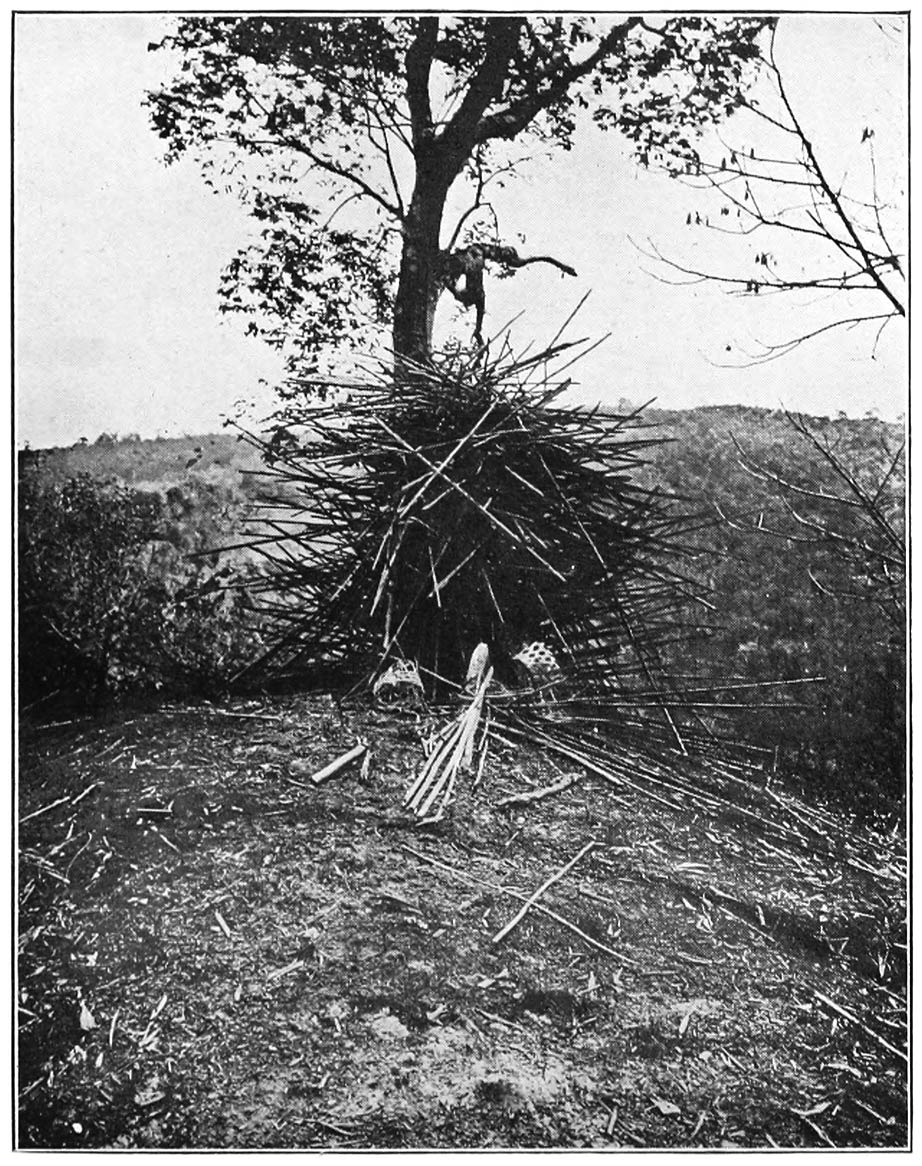
An Opya bristling with bamboo spears thrown at it at the Oyantsoa “genna”
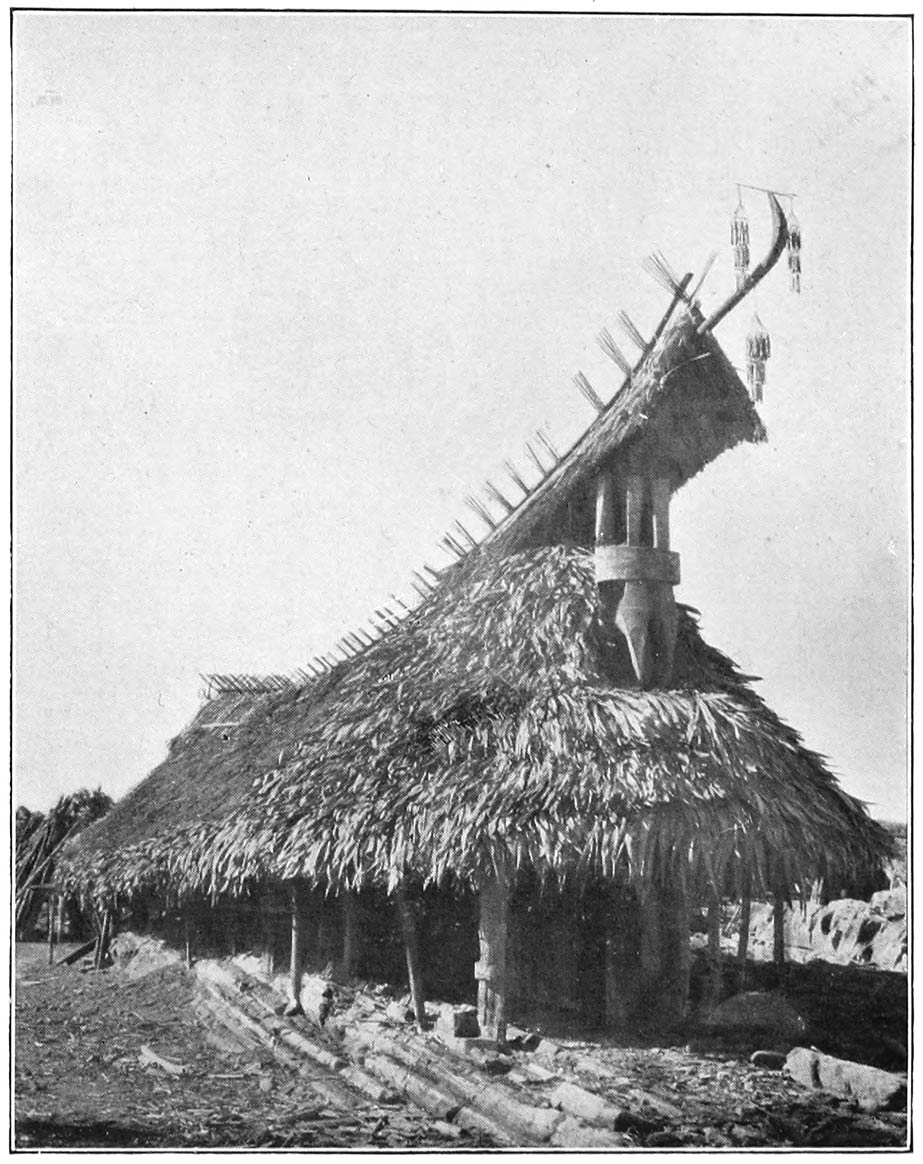
Photo by J. H. Hutton.] [To face p. 123
Morung (Champo) at Pangti
After the oyantsoa “genna” and before the fields are cut for the next year’s cultivation, some villages perform a ceremony called Pyotsoja in honour of Tchhüpfu, the godling of rivers. On the appointed day the Puthi sets out from the village early in the morning, accompanied by all the grown-up men of the community. A bird-hunt is organized, and when one has been caught alive all go down to the Doyang. On the bank the Puthi kills a hen and lays out ten scraps of its flesh on his up-stream hand for Tchhüpfu and nine scraps on his down-stream hand. A miniature raft of bamboos is made, on which are put an egg, a little cotton wool and the live bird tied by the leg. The raft is then allowed to float down-stream. If it upsets it is a bad omen and it is believed that someone will be drowned during the term of office of the Puthi. A little poison is then pounded into the stream and the Puthi gets into the water and flounders about like a stupefied fish. His Yenga plunges in and seizes him and calls out, “I have caught such and such a fish! No, it is such and such a fish! No it is not; it is such and such a fish,” and so on, calling out the names of different kinds of fish. Of the fish killed the first is offered to Tchhüpfu as the chicken was, and the rest are divided up among those present.
Oyantsoa is followed by the ceremony of “calling the Rangsi” (Rangsitsa), which takes place when the rice has begun to sprout, before the season of thunderstorms sets in, for the thunder would prevent the Rangsis from hearing the voices of those calling them. The Puthi kills a big pig in his house, and taking a bamboo mat, some of the boar’s meat, an egg, a fowl and a little rice goes with the whole village a short way down the path up which the first Lhota settlers came to found the village. The chicken is killed and the omens taken and the egg and meat laid out on the ground exactly as in the Amungkam and Rangsikam ceremonies. The Puthi then spreads the mat in the ground and sprinkles a little unhusked rice over it. Then beginning with Honohoyanto, Kisiyo and Dilungcham he calls out the name of every Lhota village, both extinct and existing, and summons its Rangsi to come and give rice to his village. Meanwhile the whole village, every man, woman and child having brought a rice basket, sets the baskets on the ground and beckons to the Rangsis who are supposed to be trooping up in obedience to the summons. The baskets are held as if someone were pouring rice into them and then covered quickly with a cloth. All go home in single file with much grunting, as if they were carrying heavy loads, the Puthi bringing up the rear. Arrived at the village everyone carefully pours the imaginary rice out of his basket into his rice house. Among the Northern Lhotas the young men of the village on the day before this “genna” make a point of trying to steal water from some other village’s supply to put into their own. If they are caught they must submit to a good hiding.
The Yenga. The assistant of the Puthi, who accompanies him at all ceremonies and carries his load, is called Yenga. He must be an old man who has done no social “gennas” and is appointed for life. In villages where there are two Puthis each has his Yenga. He receives a share of the meat at all “gennas” and one small basket of rice from every house in the village once a year. In cases where the only or both Puthis are ill the Yenga may perform ceremonies as if he were Puthi.
Minor Religious Officials. The post next in importance to that of Puthi is that of Wokchung (“pig-killer”), of which there are usually two in a village, though in big villages such as Tsingaki there are two for each clan. A Wokchung may carry a phui spear as the Puthi does. His duty is to kill animals at private sacrifices. Below the Wokchungs are two ’Nchuko (“hearth-bringers”), who bring the small stones with which miniature hearths are made at social “gennas.” Next below are two Sorhung (“meat-dividers”), who divide up the meat at all sacrifices and settle all disputes as to the respective shares. No one may act as Wokchung, ’Nchuko, or Sorhung unless he has performed all social “gennas” and dragged a stone. There is nothing to prevent the offices of Puthi, Wokchung, ’Nchuko and Sorhung being combined in the same person.
Public Ceremonies.
Besides the ceremonies intimately connected with agriculture which have already been described, there are certain other public ceremonies of a more general character. The year officially opens with the Pikuchak “genna,” but before that is performed the omens for the whole village are taken at a ceremony called Sirosi.
The Sirosi ceremony. The procedure at Pangti, to take an instance, is as follows. The men of the village all assemble in front of the senior Puthi’s house, the boys of each champo bringing meat in new baskets and “chungas” of “madhu.” The two Puthis in full dress lead the way a short distance down the path to Okotso, each holding a “chunga” of “madhu” in his right hand. A short distance beyond the village fence they sit down and together say the dranda, praying that their enemies may make peace and come and eat with them, that tigers may not kill their cattle nor hawks their chickens, and that the village may flourish and grow big. This prayer is offered facing away from the village, and at the end of it each Puthi pours a little “madhu” on the ground. Some meat and “madhu” are distributed, and all go up to the village again and a short way down the path to Are, where the same ritual takes place. On the Are path, just below the place where the prayers are said, is a small clump of big trees growing close together. Between their stems is the traditional spot at which omens are taken at Sirosi. The prayer ended all the boys rush down the hill shouting, and hurl bamboo spears at the trees. Then all go down and scrape the earth clean at the proper spot. Here each Puthi sets up an egg on end, asking that the good or evil fortune of the coming year may be revealed, and takes the omens by cutting chips from a green twig and watching how they fall. The future is really believed to be revealed by the kinds of insects which are caught near the egg, and all sit and watch while the boys hunt industriously in the grass. Locusts mean that sambhur hunting will be good (for they have big legs). Stick insects are interpreted as showing that many men will take new wives, but will have no children by them. Small white insects show that the crops will be poor, and so on. When a few insects have been caught, and their significance has been expounded by the Puthis and old men, all go home.
The Pikuchak ceremony. The Pikuchak “genna” marks the beginning of the agricultural year. The Northern Lhotas do it before clearing the jungle on their fields, and the Southern Lhotas after. In any case it must be done before the rice is sown. The Puthi announces the day on which the ceremony is to be, and every champo buys meat, and each champo in turn the cock which is to be sacrificed. On the night before the “genna” sexual intercourse is forbidden. On the day all the men of the village assemble at the place where the opya is set up. In front of the opya the Puthi sets up a miniature opya, and in front of that again puts an egg on the ground with a leaf on each side. On the leaf to his right he puts ten little bits of pork and ten little bits of ginger, and on that to his left nine little bits of each. He then recites the dranda, holding the cock in his left hand, and a dao in his right. This dao belongs to the youth who caught the cock the night before, the champo whose turn it is to provide the cock having selected some days before a youth whose duty it is to go to the house of the seller of the cock and catch it on the evening before it is sacrificed. This youth must abstain from all intercourse with the opposite sex from the time he is chosen to the end of the ceremony. The dranda being ended the Puthi cuts the cock’s throat, takes the omens from its entrails and ties it on to the miniature opya. The old men sit down and eat some of the meat which the boys from the champos have bought and all go back to the village with much chanting. Parties of boys walk singing six times round each champo. The rest of the day is given up to feasting. Next day is kept as an emung and no one goes to the fields, but a party, consisting of boys and one or two old men, go out on a mock head-taking raid. First they go to the opya, where one of the old men sets up a miniature opya and makes the same offerings of an egg, meat and ginger as were made the day before. Then the party goes into the jungle and throws spears at trees and shouts as if engaged with the enemy. Then all return to their champos, in some villages openly, in other villages by roundabout paths and in dead silence. Finally after sitting in the champo for a little, as they would after a raid, all go to their houses. It is believed that this mock raid ensures good crops and hunting and a high birth-rate for the village.
The Rangendri ceremony. After Pikuchak, but before the crops are sown, a “genna” called Rangendri is performed, at which imitation heads are hung on the mingetung. The Puthi collects rice and with it buys a pig which he kills outside his house. Going outside the village fence he lays thirty tiny pieces of the flesh on each of two leaves and prays that inasmuch as the warriors of the village are following the customs of their forefathers, good fortune may come to all. Then a few men of standing make globular bamboo baskets, such as are used for fingers, ears, bits of scalp and other trophies of Naga warfare, and hang them up on the mingetung. These are spoken of as “heads,” and each man who hangs one up sacrifices a fowl and feasts the village as if he had really taken and hung up an enemy’s head. The performance of this “genna” does not permit a man to wear any of the ornaments of a warrior, but entitles him to have one representation of a head put on his grave for each time he does it.
Ceremonies for Rain.
The rainfall in the Naga Hills is usually adequate. Nevertheless various rain-compelling ceremonies are practised, most of them of a very simple nature. The usual one resembles that in vogue among the Semas. A gibbon’s head and a small dead tserü fish, with its mouth kept open by a piece of stick, are pegged down to the bottom of the nearest stream. When enough rain has fallen the gibbon’s head is taken out, the fish being left in the water to rot. Another common method is to dig a little tunnel and pour in water at one end and let it run out at the other. In Akuk a stick is rattled about to imitate the sound of rain in the hole to which Deolung tied up his mithan, water being poured in meanwhile. Sometimes children go about with “chungas” of water and spray it from their mouths over passers-by and each other. Niroyo, Wokha and their neighbours fell a tree across the path leading from the village to the Road of the Dead. All then go home holding leaves over their heads and saying that it is raining. To increase the flow of the village spring in times of drought someone goes down at night to the Doyang, and leaving an offering of four little bundles of meat and an egg on the bank, brings up a little water in a “chunga” and pours it into the village supply.
Individual Ceremonies.
The Potsokam ceremony. Many of the ceremonies performed by individuals, such as those connected with agriculture, have been described under their respective headings. Three main classes may, however, be considered here, namely, those performed regularly for the general welfare of the household, those which are connected with illness, and those social “gennas” on which the status of the individual Lhota depends.
A “genna” called Potsokam (“present to the Potsos”) is performed every year, or oftener in case of sickness. The regular time for it is just before the new “jhums” are cut. The master of the house kills a small pig of either sex inside the house. He then mixes “madhu” and a few blades of rice which have sprung up in his granary among the damp grain, and ties them in a leaf which he affixes to one of the centre-posts of the house. Then of the pig which has been killed he cooks sixty small pieces, which he wraps up in a yutso leaf and holds up near the centre-post, with the prayer that there may be no sickness or misfortune in the house. The bundle is then put in the basket or “chunga” in which the day’s supply of rice is kept. Then two leaves containing six pieces of meat each and two leaves containing four pieces of meat each are prepared for the dreamer (hahang) whom the performer of the rite patronizes. The dreamer must come and fetch them himself in the evening. When he goes out the door is shut hurriedly after him lest the good genius of the house (okisityingo) should escape. None of the flesh of the pig may be eaten that night, during which the husband must sleep apart from his wife. In the morning the dreamer comes to report what visions he has had and counts the pieces of meat in the rice bin. If the full number is found and the leaf is wet with congealed moisture all is well. A reduction in the number of pieces foretells evil. It is regarded as particularly fortunate if a little rice is found mixed with the meat. This is regarded as a gift from the dead and ensures good crops. Anyone may see the sacrifice of the pig, but were anyone to steal and eat a piece of meat his mouth would become deformed.
The Epuetha ceremony. The story goes that the evil spirit Khyuham, when shut up in a hole in the earth by Rankhanda, exacted a promise that he should be appeased by a yearly sacrifice. In fulfilment of this the Lhota householder, year by year just before the Thruven “genna,” kills a small boar in his house and puts into a carrying basket twenty-three little pieces of the meat, a handful of rice husks, an egg, a handful of boiled rice and a “chunga” of “pita madhu.” The ceremony is performed in the lhurhui room, by an old man who has done no “gennas,” called in for the purpose. Holding a “chunga” of “saka madhu” in his hand he prays for the welfare of the household, and after spilling a little on the ground drinks. He then pounds up some ginger, the usual magical disinfectant, in a leaf and pours a little “pita madhu” over it. While he is doing this members of the family scrape all their daos and spears one against the other. Then the old man, addressing Khyuham, says, “We have given you all the things in this house. Do not harm anyone,” and as he speaks sprinkles a little of the ginger and “pita madhu” about the room, laying what is left in a leaf at the foot of the main post of the house, that is to say the post between the lhurhui and the mpongki. This done he takes up a brand from the hearth and the carrying basket containing the twenty-three pieces of pork and other things, and goes out of the house, calling on all evil spirits to follow him. As he goes the household throw after him ashes and burning brands, another powerful type of magical disinfectant, and shutting the door quickly keep it closed for a few minutes. The old man goes into the jungle just outside the village fence and there lights a small fire and spills a little “pita madhu” on the ground. Setting the egg up on end he puts on each side of it a little heap of rice husks on a leaf, six little sticks, six little pieces of ginger, and six scraps of meat. The “chunga” which held the “pita madhu” is by this time empty. This he splits with his dao and watches how the two halves fall. If both fall inside up or outside up the omen is good, but if one falls one way and one the other it is bad. The two halves are then laid on either side of the egg, and the old man having eaten the rest of the rice and meat goes straight to his house. He must not enter the house where the ceremony was performed again that evening. In the morning he goes back to return the carrying basket and receives a small handful of rice as his fee.
Ceremonies for Illness.
A Lhota when sick usually attributes his illness to the malice of an evil spirit (tsandhramo), who has either introduced some foreign matter, such as hair or a little stone, into his body or has caused his soul (omon) to desert him at a certain place. In any case a ratsen has to be called in, who can see and “extract” any foreign body which may be the cause of the trouble, or can say at what spot his soul left him and is likely to be lurking. To enable the man to regain his soul a soul-caller (montsai) is required, who must be an old man who has done no social “gennas.” If it is on his own land that the man’s soul has left him a dog must be sacrificed. The montsai and the sick man, if he be well enough, go down to the spot indicated by the ratsen. If the sick man be too ill, as is often the case, a near relation goes, who may be either a man or a woman among the Southern Lhotas, but must be a man among the Northern Lhotas. On arrival at the spot the montsai lights a fire, and killing the dog by knocking it on the head, singes it and cuts it up. On his right the montsai puts ten pieces of meat and ten pieces of ginger on two leaves, and nine pieces of meat and nine pieces of ginger on two leaves on his left. The paws, ears and nose are cooked in a pot which has been specially brought for the purpose, and left there in the pot. The rest of the meat is the montsai’s perquisite. He goes back to the village, repeatedly calling the sick man’s soul by the man’s name to follow him.
When the ratsen says that it was at some place in the jungle or on the village path that the patient’s soul left him and is being kept away by a tsandhramo, an interesting ceremony with a scapegoat chicken is performed. The montsai and a relation of the patient go to the spot where the soul is said to be, taking with them a carrying basket containing two “chungas” of “madhu,” sixty pieces of plantain stem blackened with soot, twelve pieces of burnt wood, sixty little bits of pork, a small chicken, a cowrie, some ginger, some taro, some heads of a species of wild mint called rarakham, which is believed to be an infallible antidote against evil spirits, and a burning brand. Throughout the ceremony the patient’s relation is a mere spectator. Assuming that the “genna” is being performed on a path, as is usually the case, for the patient was probably travelling along a path when the tsandhramo took possession of his soul, the montsai places equal portions of the ginger, rarakham, meat, plantain stalk, burnt wood and taro on either side of the path. This he does sitting facing away from the village to which the patient belongs. He pours the “madhu” from the smaller of the two “chungas” onto the ground, and lays the empty “chunga” down with its base towards the village. The carrying basket is split in half, and half put on either side of the path. The montsai now drinks the contents of the large “chunga,” and splitting it with his dao lays his dao on the ground with the blade away from him. Then six times if the patient is a man, or five times if she is a woman, he drops the two halves of the split “chunga” together onto his dao, asking each time, “Will he live or die?” If both halves come to rest on the same side of the dao the illness will be a long one. If one falls on one side and one on the other the patient will either die or get well soon. Next having tied the chicken’s wings together over its back and fastened a cowrie onto its leg, he tosses it up and catches it six times for a man and five times for a woman, and undoing its wings lets it go into the jungle. He then takes his spear and jabs the butt into the ground a number of times, in order that the tsandhramo may think that a large number of men have come to call back the sick man’s soul and so be more ready to let it go. Finally, he calls out the name of the patient eight times, and says, “O so and so. We have let a chicken go for you. Come back, come back.” On his way back to the village he must keep on calling the sick man by name, and on arrival at the patient’s house he says, “I have called so and so. Has he come?” and one of the inmates will answer, “He has come.” The montsai’s fee for this ceremony is a small basket of rice. This account is of the ceremony as performed by the Northern Lhotas. The only difference the Southern Lhotas make is that instead of sixty pieces of pork they take down either a crab or a jungle rat or squirrel, which they laboriously divide up into sixty tiny pieces. The reason for this is that they regard it as essential that a whole animal, however small, should be offered. This employment of a scapegoat chicken is common to Lhotas, Aos, Semas, Changs and probably most Naga tribes.
If a man be only slightly indisposed on his return from a journey the ratsen will tell him that a tsandhramo is detaining his soul at such and such a place on the path along which he came—always a spot conveniently near the village—and that an offering of eggs is all that is required. The sick man will then either go with a montsai or alone to the place. There the montsai, or the patient if he goes alone, puts on either side of the path a big leaf and an egg, and on the leaf taro, ginger, boiled rice, burnt wood and cotton, chilies, or whatever he may have been carrying when his soul was enticed away. He then goes home, calling his soul in the ordinary way. The cheapness of this method of regaining his soul appeals to the Lhota, who performs the ceremony on the least provocation. In cases of long illness more persuasion is required to induce the soul to return. A meal is prepared in the house, great care being taken that no stranger touches it, and put wrapped up in leaves in a carrying basket with a new cloth and the patient’s ornaments. This is taken to the montsai’s house, who that night meets the patient’s soul in his dreams and tries to persuade it to return by pointing out that food and new clothes and ornaments are all ready for it if only it will come back. If it cannot be persuaded to return by these inducements the patient is doomed.
A person suffering from intermittent fever or some similar slight ailment gets rid of it as follows. He gets up from his seat in his house and puts any bits of rubbish, such as sticks or leaves, into an old carrying-basket. Taking up this load he says aloud, “I am going out to get some things.” Having reached the outskirts of the village he hangs his load on a bush and says, “Watch this; I am coming back very soon.” He then leaves the load with the illness watching it, as he thinks, and returns to his house by another path. Semas practise a similar custom for ophthalmia.
The Social “Gennas.”
The First Social “Genna.” Like all social “gennas” the first one, Wozütana, is usually performed in the cold weather when there is a certain amount of leisure from work in the fields. It is a very simple affair which is often performed by a man before marriage. He invites all the men of his clan in the village who have done Wozütana, and kills a bull of any colour behind the house. This is divided up among the guests and much “madhu” handed round. Little presents of meat, too, would ordinarily be sent to fellow-clansmen in neighbouring villages. Next day the man who has done the “genna” must not give a drink of “madhu” to a man of another village. The head of the bull sacrificed on this occasion is not kept. The man who performs this “genna” is entitled to wear the cloth called phangdrap.
The Second Social “Genna.” The second social “genna,” Shishang, or, as the Southern Lhotas call it, Wozüyua, is a much more elaborate business and is usually not performed till after marriage. A big pig and a bull of any colour are bought and “madhu” is prepared and kept in the middle room. From the time the “madhu” is made till the end of the “genna” the man doing the “genna” must not eat meat from the kill of a tiger or leopard or other animal. When all is ready he calls a Wokchung to his house, gives him a “chunga” of “rohi madhu” and formally announces to him that he proposes to do the Shishang “genna.” The Wokchung thereupon offers a prayer for the performer’s welfare, and after pouring a little of the “madhu” on to the floor drinks the rest and departs. Then the husbands of women of the sacrificer’s clan go into the jungle and fields and bring yutso leaves and plantain leaves for cups for the next day’s ceremony. Next day the same men kill the pig and the bull in front of the performer’s house, the bull by cutting the skin over the heart and then pushing a sharpened stick home, and the pig with a blow of a stick on the back of the head. In “the good old days” before the Hills were administered the bull was beaten to death as slowly as possible—“great fun,” as old men often say with a sigh. The two Wokchungs and two ’Nchukos are in attendance, and the latter lay out six small pebbles in the form of miniature hearths in the mpongki, a piece of ceremonial for which the Lhotas can give no reason. The meat is then all divided up, and the Wokchungs and ’Nchukos first go into the house and cook and eat a little of the meat. Then the guests go in and feast. For this day they are mostly the husbands of women of the sacrificer’s clan, with a sprinkling of blood relations and senior men. At night, after much singing of songs in which good wishes for the sacrificer are expressed, the guests disperse and the ’Nchukos throw away the six small pebbles. Next day about midday two small pigs provided by the sacrificer are speared by the Wokchungs outside the house. The hindquarters of one are the perquisite of the parents of the sacrificer’s wife. The rest of the meat is eaten in the evening, when all men of the sacrificer’s clan in the village who have done the Shishang “genna” collect round a fire outside his house and sing and drink his “madhu.” The Wokchungs and ’Nchukos each hold a cock and sing songs in which the good fortune of the sacrificer is desired. The cocks are then killed and the meat divided among the guests. The rest of the evening and most of the night is given up to singing and drinking, the old men especially getting happier and happier and more and more boastful of the deeds of their youth.
The Third Social “Genna.” The third social “genna” is called Etha. Nowadays the tendency is to combine it with the fourth social “genna” at which a mithan is killed, or even omit it altogether. The procedure is much the same as that of the Shishang “genna,” except that Humtso, Chami, Kikung, Pathong and Nguli clans claim that they alone have the right to sacrifice a bull, other clans being content with pigs. The performance of this “genna” confers the right of wearing the cloth called ethasü.
After Etha and all subsequent social “gennas” a ceremony called osoni-woala is performed at the granary of the man who has done the sacrifice. The two Wokchungs sacrifice two pigs outside the granary, and kill two fowls by knocking their heads against the door. The meat is then divided up and the fowls’ feathers are tied to bamboos outside the granary as a sign that the ceremony has been performed there.
The Fourth Social “Genna.” The fourth social “genna” is that at which a mithan is killed (Tsirotsoala). The man who proposes to perform this “genna” tells the two Wokchungs of his intention. The Wokchungs tell the husbands of married women born in the sacrificer’s clan, and they (the husbands) in turn give public notice in the village and are called Wothang (“announcers”). Rice is pounded, with much singing, and “madhu” prepared. On the day of the sacrifice the mithan, which must be a bull without blemish, is tied up in front of the sacrificer’s house, with its horns decked with rezüyo leaves. It is given a drink of water and allowed to lick salt out of the hand of the sacrificer’s wife. The Wokchung touches it on the head with a stick and recites dranda. It is thrown, and a spear thrust into its heart by an old man, not necessarily of the sacrificer’s clan, who at once runs away while all present pelt him with lumps of earth. After the mithan is dead its nose is pierced by the Wokchung and a string of kuro bark passed through and tied to a post in front of the house. The man performing the “genna” then takes his dao in his left hand and draws it across the flanks and neck of the animal as if he were cutting up the meat. He then cuts the string and walks widdershins round the mithan up to the door of his house, which he enters after washing his hands and his dao. The meat is divided up as follows: the chest to the clan of the performer of the sacrifice, the hindquarters to his wife’s clan, the fore-legs to the husbands of women of his clan (echantyoi), the meat of the head to the Wothangs, the tongue to the man who helped to buy the mithan, and the lower part of the stomach to the old man who killed it. The performer must on no account eat any of this meat. Probably he will avoid mithan meat altogether for a year, in case an enemy should give him some of his own mithan to eat. The skull and horns must be kept in the “morung” till the sacrificer has dragged a stone, when he is allowed to put them up in his house.
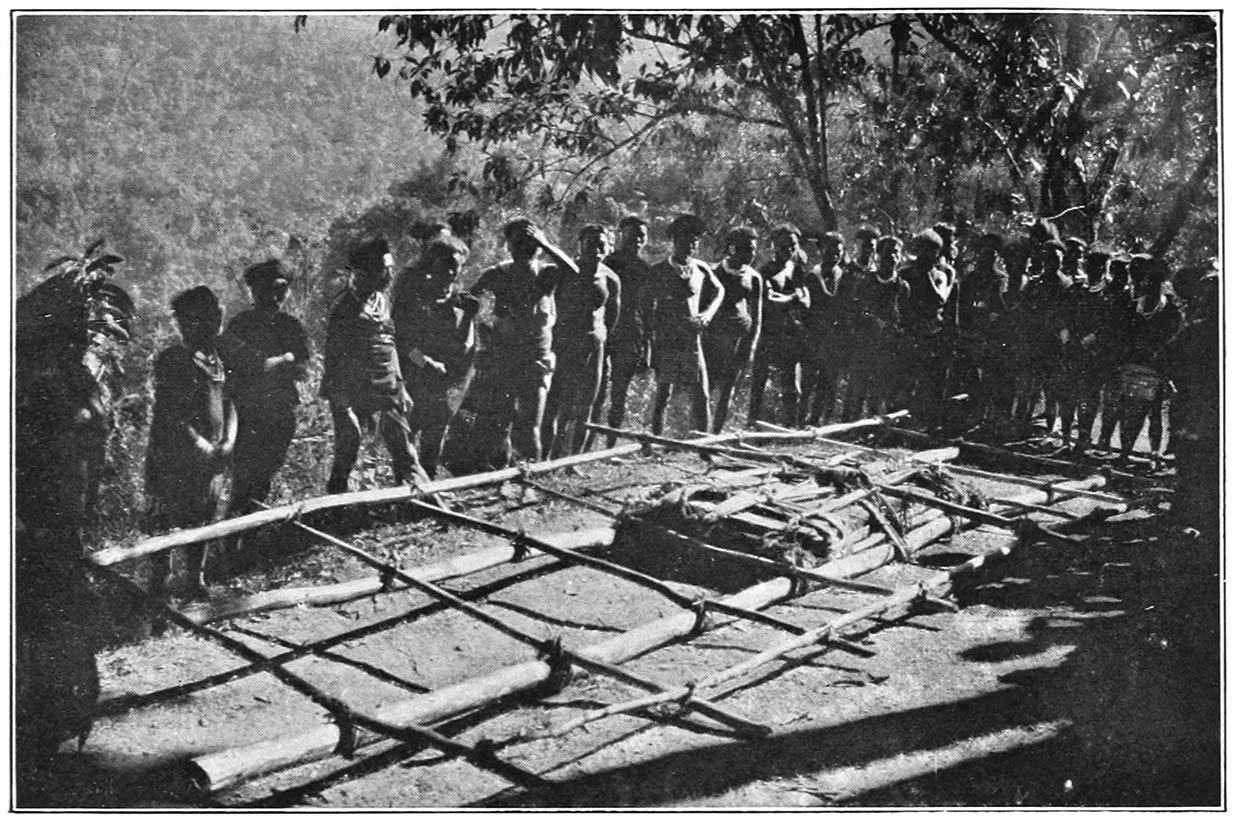
Photo by J. H. Hutton.]
“Genna” stone tied on to a bamboo frame-work ready to be carried up to the village for the stone-dragging ceremony
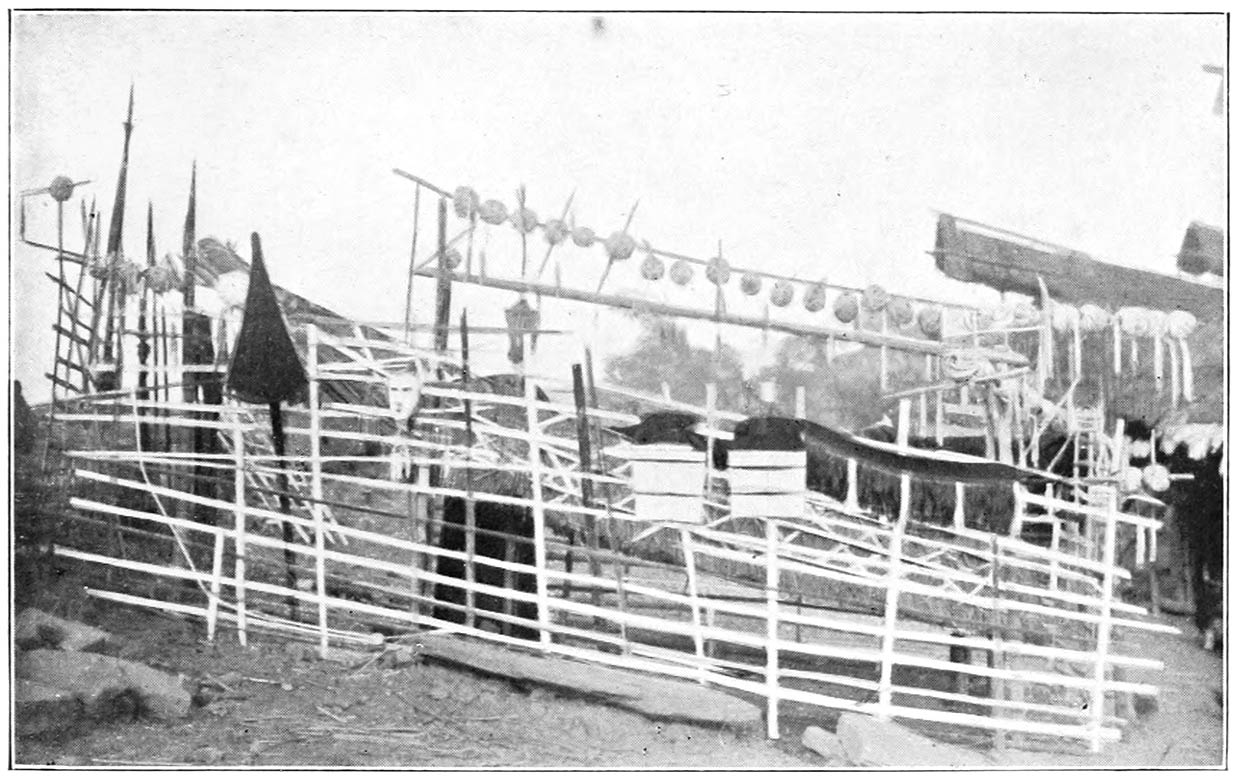
Photo by J. H. Hutton.] [To face p. 142.
Grave of a warrior decorated with his ornaments and a tally of the heads he has taken (Northern Lhotas)
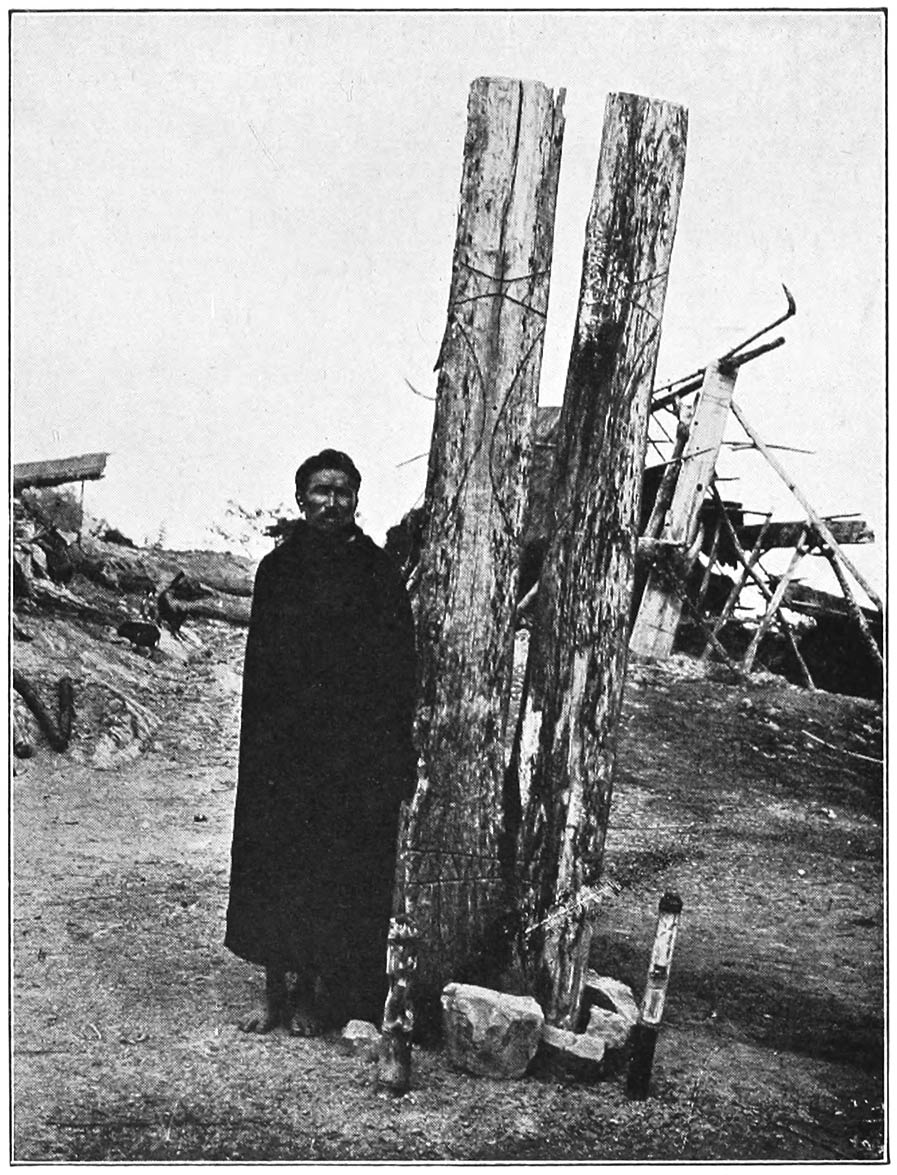
Forked post (Tsongzü) at Yekhum, put up instead of a “genna” stone
[To face p. 144.
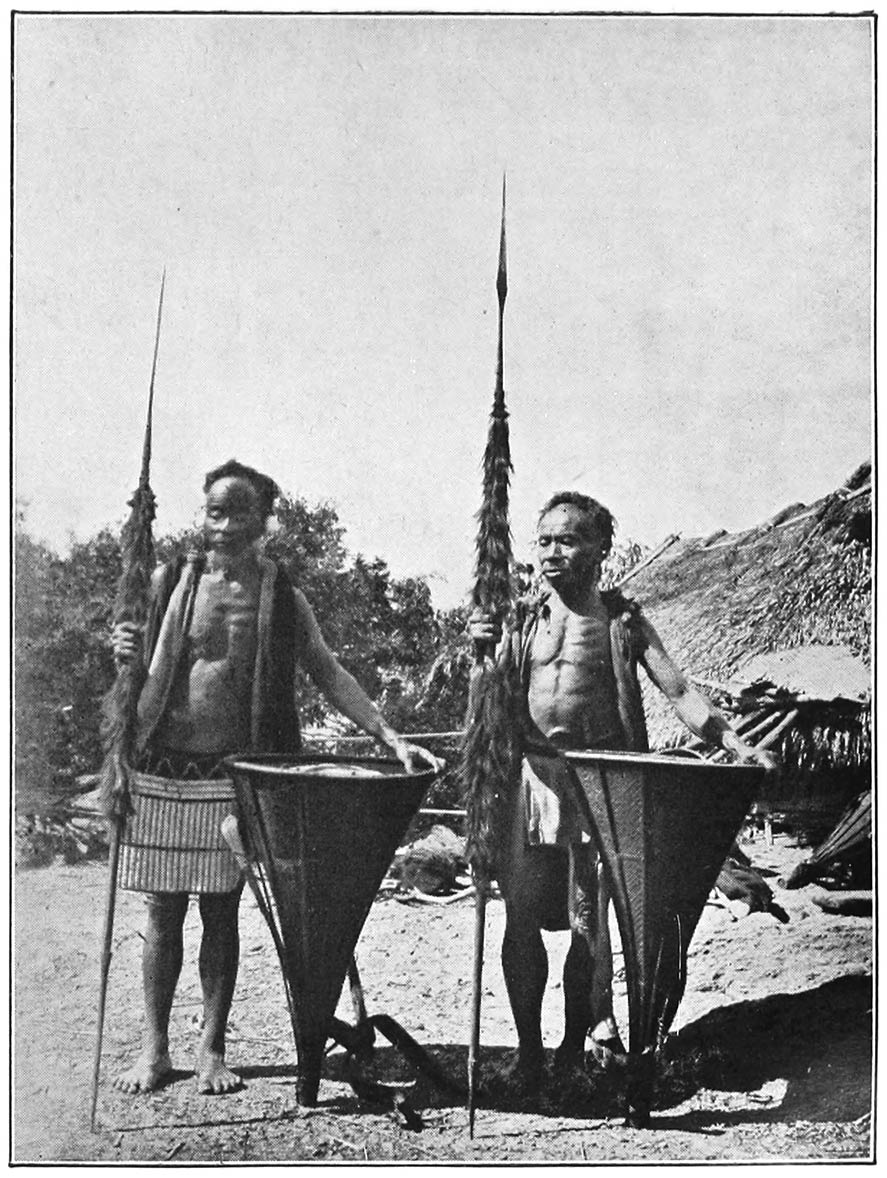
The two Puthis of Akuk collecting rice for the Tuku ceremony
Both are carrying phuis.
Birth.
Boys are suckled for three years as a rule and girls for two, but a little “grown-ups’ ” food is given from a very early age. Bat’s-flesh soup is considered to be a good tonic for a child whom its mother cannot suckle properly for any reason. Within about a month of birth the child is given its first taste of meat. If possible bulbul is given, because this bird twitters so much that by eating it a child will soon learn how to talk. Substitutes are a small fish called ngolelop, or a species of cuckoo called liyosangsü, which is said to be able to imitate the call of all birds and animals.
As soon as the mother is well enough to take the child out of the house she cuts off a little of its hair and either throws it away or wraps it in a leaf and keeps it. The heads of little boys are shaved except for a little piece on the crown, which is gradually allowed to increase until by the time he can run about his coiffure is like that of a grown man. Little girls have the whole of their heads shaved till they begin to wear a skirt, which is generally when they are five or six years old. It is then allowed to grow, beginning in the spring, “so that it grows with the jungle,” as one informant expressed it to the writer.
Marriage.
Girls usually marry between the ages of fourteen and eighteen, and boys between seventeen and twenty-two. The ceremonies are intricate and differ in the northern and southern sections of the tribe. Among the Northern Lhotas the customary procedure is as follows. A man having decided that he wishes to marry a certain girl, he tells his parents, and either his mother or some elderly female relation goes and sounds the girl’s parents. If they are agreeable she goes again with a “chunga” of “rohi madhu,” which they drink, but by so doing do not bind themselves to give their daughter in marriage. The marriage-price is then discussed and settled by the two families, and the bridegroom gives the girl a rain-shield (phūchyo), a small carrying-basket (eyingkhangdro) and a dao handle.
Three or four days later the ceremonies are completed by the Ponyiratsen (“man-and-wife-magicians”). After a drink of “rohi madhu” the couple go into the jungle alone and bring up a load of yutso leaves and sixty-four small bamboo “chungas” in eight equal bundles. All are cut on the slant except two in different bundles, which are cut with a level rim and are called tsungta. In each “chunga” of the two bundles containing tsungta are put eight pieces of shambuk pith and eight pieces of shamburi pith. When this has been brought the two Ponyiratsen are called to the house. They are two old women, wives or widows of men whom the bridegroom calls aporamo, and who have dragged a stone. These are given a full “chunga” of “rohi” to drink and proceed to tie up little scraps of pork in yutso leaves. They make four parcels each containing four scraps of meat, four each containing six, four each containing eight, four each containing ten, and finally two each containing thirty. These little parcels they put in a basket with a “chunga” of “rohi.” Then each throttles a cock and watches the position of its legs when it dies. If the right leg is down and the left up the husband will die first. If the right is up and the left down the wife will die first. If the legs are crossed the couple will quarrel. The excreta and entrails are also examined in the usual way. The husband then singes the cocks and cuts each in half slantwise, so that the head is in one half and the vent in the other. He puts yutso leaves on the ground on his right and left, and puts the halves of two different cocks on each. These are wrapped in leaves and put in the load with the pork and “madhu.” Then all wash their hands and the Ponyiratsen put eight narrow strips of plantain leaf over each ear of the bride and bridegroom, who sit down in front of them, the husband to the right and the wife to the left. The elder of the Ponyiratsen next takes a small basket and puts into it a pair of pewter bracelets and waves it in front of the couple, while she mumbles a prayer that they may be happy and have many children. Only women know the right prayer, which is mumbled purposely in order to prevent the husband hearing it properly. The prayer finishes with “hohoho” said eight times, the other Ponyiratsen keeping count aloud. From the house the old women go to the Ponyiratsentung (“Ponyiratsen tree”) belonging to the “khel,” taking with them the basket containing the parcels of pork and chicken and the “madhu,” and four bundles of bamboo “chungas,” eight yutso leaves without blemish, an egg, and two garments which have been worn by the husband and wife respectively. The old women are supposed to lead away with them all evil spirits. It is therefore considered very unlucky to meet them and their devilish train on their way. When they leave the kithandro the wife shuts the door quickly behind them in order to keep out evil spirits and keep in good. Arrived at the tree the elder Ponyiratsen divides the “chungas” into two equal heaps and puts the egg between them, with a parcel containing thirty pieces of meat on each side. They then go to the younger Ponyiratsen’s house, and having divided up the rest of the meat there the elder one goes home. That night the couple for whom the ceremony is being done must sleep apart.
Next day the Ponyiratsen come again and take the omens in the same way, except that two hens are used instead of two cocks. After swinging the basket containing the bracelets and mumbling the charm, the elder Ponyiratsen lays a bamboo mat on the ground outside the door on the side farthest away from the Road of the Dead. By the mat she lays the two worn garments which she took the day before, the husband’s to the right and the wife’s to the left. She sits at the right end of the mat, facing her assistant Ponyiratsen, who sits at the left end, and rolls an egg along the mat. Omens are drawn from the direction in which the pointed end lies when it comes to rest. If it points towards a hostile village the husband will get heads, if towards the plains money, if towards the house rice. It is a very bad omen if it points towards the Road of the Dead. The assistant Ponyiratsen rolls the egg back and the process is repeated eight times. A sickle is then slid along the mat eight times and omens are taken from the direction of its point, just as they were taken from the direction of the pointed end of the egg. When this is finished the elder Ponyiratsen shakes the two cloths eight times each to get rid of any evil there may be in them and returns them to their owners, and as she picks up the mat, gives it a flick and sends the egg, which is still lying on it, as far as possible in the direction opposite to that of the Road of the Dead, saying as she does so, “I am throwing away all evil fortune and poverty.” She then shakes the mat eight times, and both the Ponyiratsen go to their own houses. The wife rolls up the mat and stands it on end inside the door between the mpongki and the lhurhui. The couple must sleep apart that night, and the mat must not be removed before cockcrow next morning. This ceremony of the Ponyiratsen is regarded by Lhotas as a sort of initiation into married life. It is only performed for each individual once in his life. For example, were a bachelor to marry a widow it would be performed for him. Were a married man to take a spinster as a second wife it would be performed for her. But were a married man to take a widow it would not be performed at all.
Among the Southern Lhotas there are certain differences of detail. The first ambassador is usually an old man of the bridegroom’s clan. If the girl’s parents drink the offered “madhu” negotiations are considered to have begun. Later the old man brings a present of meat and “madhu” and says, “This is so-and-so’s meat and ‘madhu.’ Will you eat and drink it?” If the girl’s parents say, “Yes,” the couple are regarded as engaged, and the man will help in his future father-in-law’s fields and make himself generally useful, though he sleeps with his parents till after tsoyuta. For that ceremony the bridegroom prepares “madhu” and kills and cuts up a pig, and goes to the girl’s father’s house accompanied either by an old man of his clan and an old woman of the girl’s clan or vice versa. The old woman enters the house first, followed by the old man, the bridegroom bringing up the rear. The girl’s parents offer “madhu” to the old man and woman, drinking in turn some of the “madhu” which has been brought. It is not mixed as among the Northern Lhotas. The engaged couple sit on the bed in the lhurhui, the man to the right and the woman to the left. The old man and woman sit opposite to them, each holding a leaf containing six pieces of the pork they have brought, and all four swing their arms backwards and forwards, while the old man and woman say, “Live long and have many children.” The lantsoa ceremony is performed as among the Northern Lhotas. For the halam ceremony a few details are different. The bride and bridegroom are accompanied to the kithandro, not by two women, but by an old man of the bridegroom’s clan and the wife of a man of his clan. The bridegroom does not wave his spear round the hearth, but carries six pieces of meat and six bobbins of thread, while his wife carries five pieces of meat and five bobbins of thread, which the old man takes from the bridegroom’s hand, and the old woman from the bride’s hand. There is no Hantsen as among the Northern Lhotas.
The money which is paid by the husband for his wife is known collectively as oman (marriage-price), but is divided into a number of items. The first payment of all is known as chüka, and is paid not to the girl’s parents, but to her mother’s father or mother’s brother. The amount is Re. 1. This is paid as soon as tsoyuta has taken place. The second item is nzuiman (Rs. 8 to Rs. 10), paid to the girl’s parents as the cost of bringing her up. Thirdly comes nvaman (Rs. 10), the price of not working in his father-in-law’s house. The fourth payment is kitsoman (Rs. 2), the price of not building his father-in-law’s house. The third and fourth items are of course only paid in cases where the bridegroom prefers to pay compensation rather than work in his father-in-law’s house. The fifth item is halamman, the cost of the pork given to the father-in-law at the halam ceremony. The sixth is tsangchüman (Rs. 2), paid in cases where the bridegroom does not distribute wood to members of his father-in-law’s clan. The seventh is sontsoman (four annas), paid if the bridegroom does not build a granary for his father-in-law. The eighth is tsoroman (Re. 1), the price of the bride’s breasts, and the ninth lentamoman (Re. 1), price of intimacy with the bride. Men with land usually let the girl’s parents cut one field once. If not, a tenth payment of one rupee or two rupees is made instead. The eleventh item is otyai-etsoman (the price of feeding the bride’s brothers), the marriage-price proper. This is shared by the girl’s father and brothers. It amounts to about two hundred and fifty baskets of rice, or thirty rupees if paid in cash. The rice or money is paid in instalments, often at long intervals. The result is that it is by no means uncommon to find a son paying off the last instalment of his old widowed mother’s marriage-price. Should a woman die without children her husband makes a final payment varying from two rupees to five rupees, called etchhiman (“price of death”). Once they have received etchhiman the girl’s parents can claim no further instalments of otyai-etsoman. If the woman dies leaving children a payment of one or two rupees, called mingishi, is made to her parents or their heirs, who can in this case claim any of the otyai-etsoman which may be outstanding.
Divorce.
There is no ceremony connected with divorce as there is among the Aos, and the proceedings are not protracted, the wife generally settling the matter by running away to the house either of her parents or some admirer. In that case all that remains to be done is to discuss the return of the marriage-price. Sometimes the girl’s parents return the full amount of the marriage-price which they have received up to date, plus a fine of ten rupees, and sometimes, in cases where the marriage-price has already been divided up and spent, it is arranged that the aggrieved husband shall recover the marriage-price from whoever marries his runaway wife. In cases where the woman runs off with another man the co-respondent has to pay the husband the full amount of the marriage-price, plus compensation amounting to fifty or a hundred rupees. It is very rarely that a man simply turns his wife out. If he does so he cannot recover his marriage-price and has to pay her parents or their heirs a fine of ten rupees. He naturally, therefore, puts up with a good deal from his wife, sooner than lose his marriage-price. Among the Aos the divorced wife can claim a share of the household store of grain. Among the Lhotas she can only claim the thread and chickens she brought with her at her marriage or their equivalent, together with the clothes she wears and all the thread there may be in the house. Any ornaments given her by her husband must be returned to him.
Death Ceremonies.
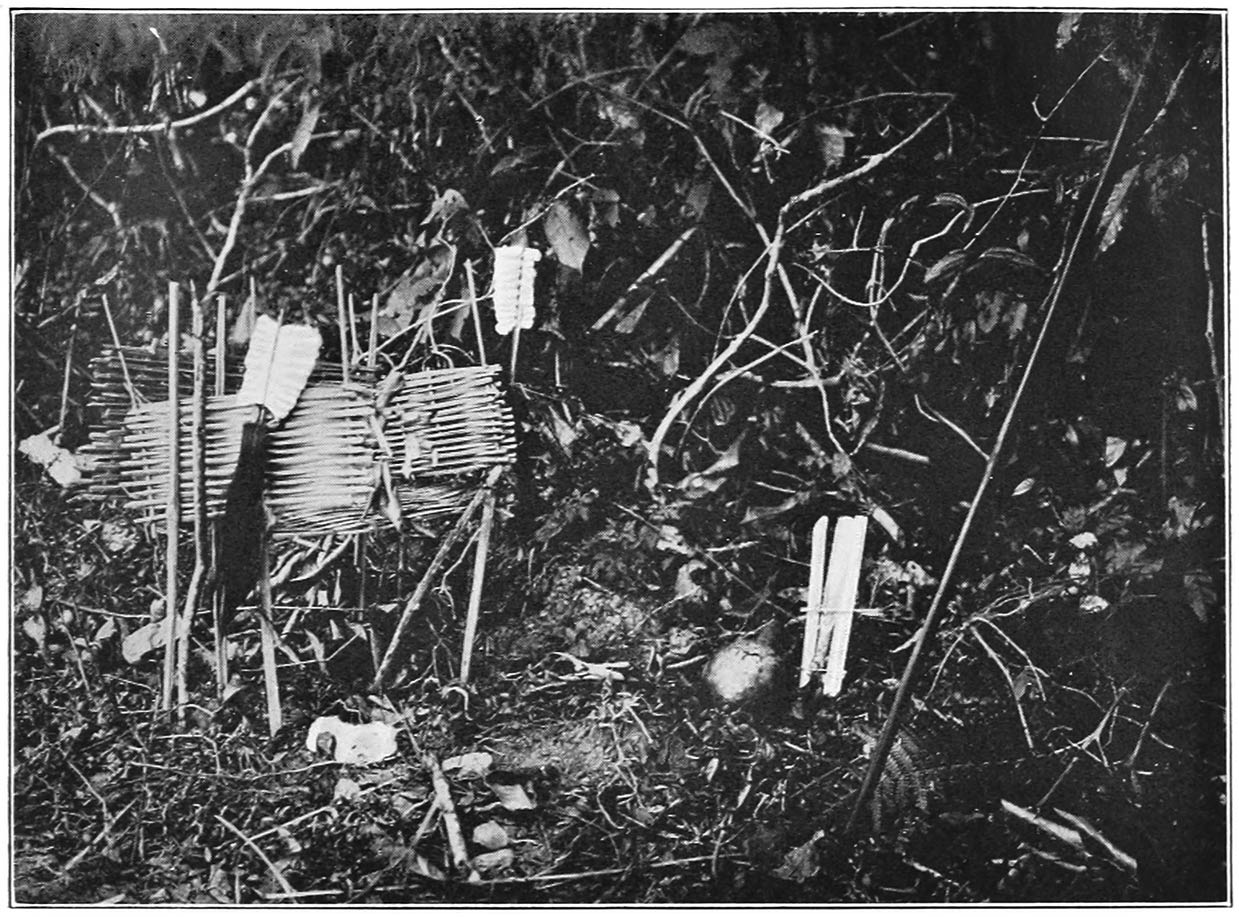
Eno
Showing wool for ears, and a gourd of “madhu” and a “chunga” to the right.
[To face p. 160.
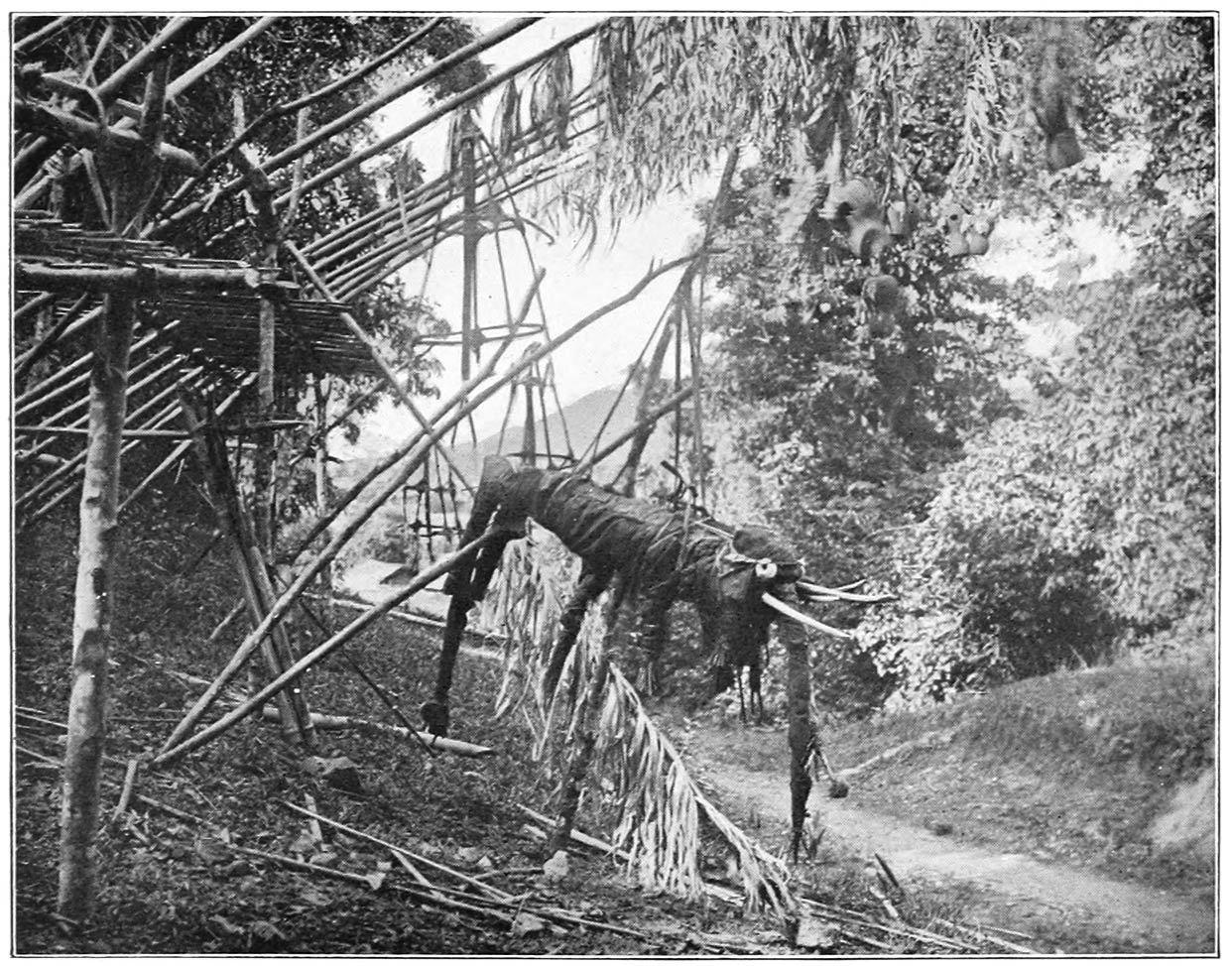
Nritangpeng of a man who has killed an elephant
Miscellaneous Beliefs.
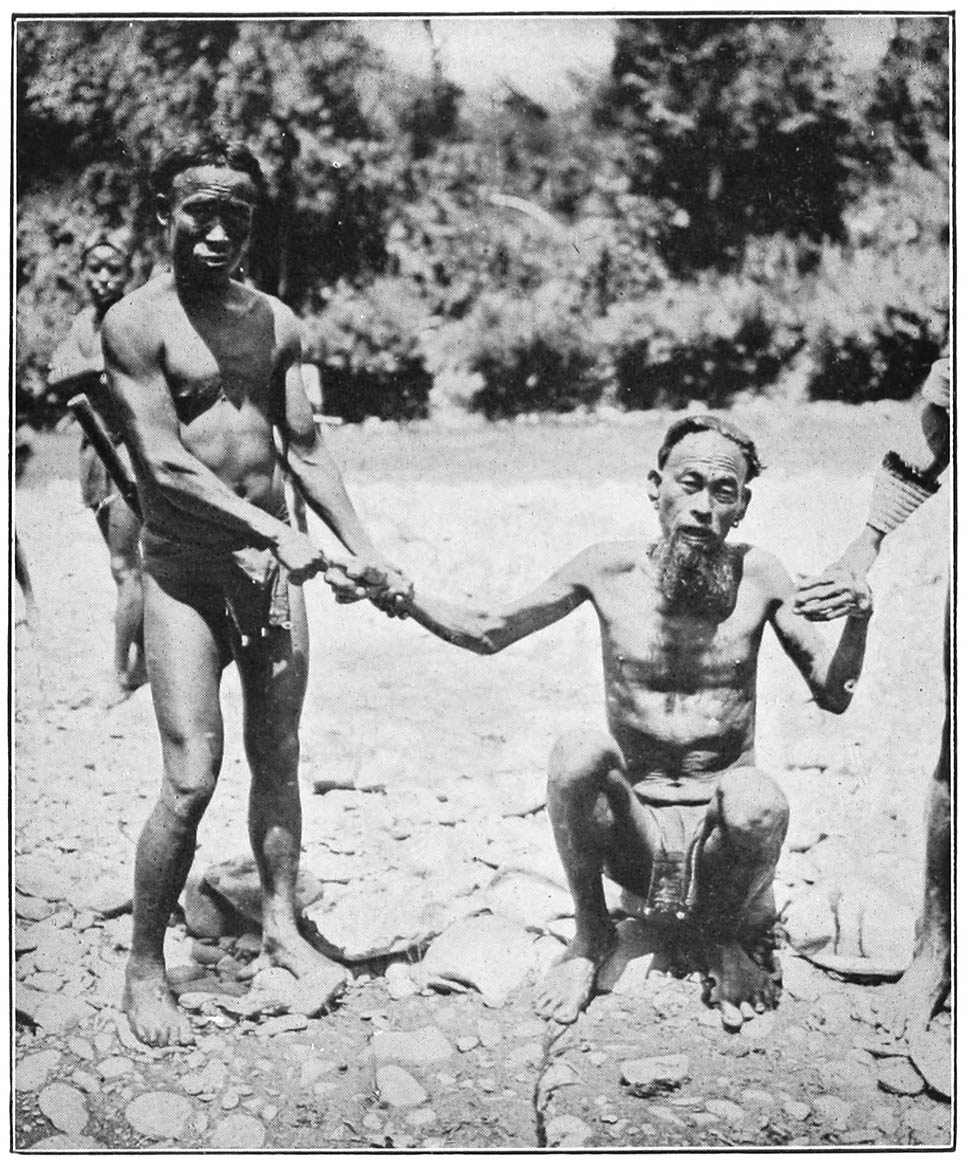
A Medicine Man (Ratsen) in a fit
He required two men to restrain him.
[To face p. 164.
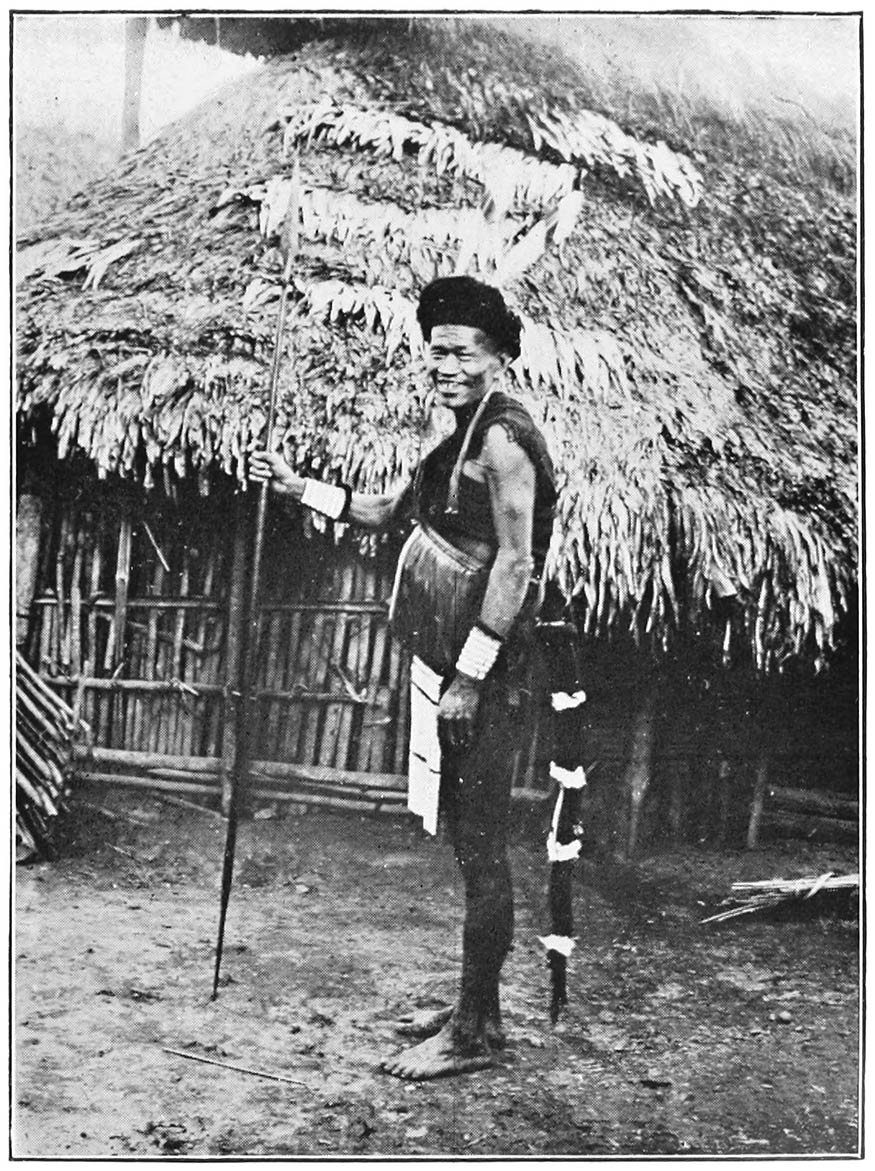
A Dancer at the rebuilding of a Morung
He has put on an imitation tiger’s tail as a joke.
In addition to the ordinary food taboos a ratsen is forbidden to eat bamboo rats, frogs, or king-crows. They are supposed to be able to foretell the future by gazing into “madhu,” or water held in a leaf, but their chief occupation in life is to “extract” foreign bodies from the persons of sick people. This is always done inside a house where the bad light makes sleight of hand easy. The patient is rubbed with a leaf, usually a wild lemon leaf, upon which the ratsen repeatedly spits. Finally he will show the patient a small pebble or a bit of leaf or hair, which he says was causing all the trouble by lodging in the body. In cases of laboured breathing the ratsen says that there is a hole in the lungs. He then by sleight of hand makes a leaf seem to disappear into the patient’s chest, and after a few minutes extracts it and announces that the hole is now stopped up. Coughs are usually cured by pretending to extract a lump of hair from the throat. Usually the foreign body which is extracted is simply thrown away anywhere, but in cases of rheumatism, which is regarded as in some way especially connected with lightning, the ratsen “extracts” bits of wood from the patient’s joints and throws them away near a tree which has been struck by lightning. Into the trunk of the tree he sticks a piece of iron, which he leaves there, and throws down one or two eggs as an offering. Often the ratsen will say that the illness is due not to the presence of a foreign body, but to the capture of the patient’s soul by an evil spirit. He will then announce the whereabouts of the evil spirit in question, and the appropriate ceremonies must be performed. These have been described under the section on private ceremonies.
Charms. Love potions are commonest in the villages near the plains. I remember a youthful widow of Sanis who was so indiscreet as to get engaged to two men in two different villages at the same time. When the tangle was brought to me to unravel she said she really had only meant to get engaged to one, but the other one had rubbed a love charm on her neck—at least she thought that was what he must have done, though she had not actually noticed him do so.
Many dreams are regarded as symbolical. For example, dream water = real crops, so that a vision of a deep pool means a good harvest, but a dry nullah means a lean year. Similarly, dream jungle roots = real meat, so that to dream of digging and finding many roots means that large presents of meat will be received, but unsuccessful digging means small presents. Again, dream fire = real children. A fire which burns up well when the dreamer lights it means a big family, but a fire that goes out foretells deaths in the home. To see an earthquake or one’s own teeth falling out is regarded as particularly unlucky and forebodes the certain death either of the dreamer or of one of his family. Anything red, such as a red spear or red goat’s-hair, represents man’s blood and means that someone will get hurt.