INTRODUCTION
Reading edition
When I made over charge of the Mokokchung Subdivision of the Naga Hills to Mr. Mills in November 1917, I urged him to study in particular the Lhota tribe with a view to writing a monograph on them. The reason why I selected the Lhotas was that it appeared to me that they, more than any other tribe in the Naga Hills District, were beginning to lose their distinctive features and were in danger of early denationalization between the upper and the nether mill-stones of Christianity, as taught by the American Baptist Mission, and Hinduism, as practised by the Nepali settler or by the Assamese who are the neighbours of the Lhota on the plains side. It was already a very rare thing to see a Lhota in ceremonial dress, and it was a, to me, unpleasantly common thing to have Lhota ceremonies and the officials of the Lhota hierarchy spoken of in spurious terms of Hinduism. The Baptist Mission, with its headquarters at “Impur” in the Ao country, was at work in the north, and one of the first disputes I had to deal with when I went to Mokokchung in 1913 was a complaint from the village of Pangti that a missionary had been initiating his converts by immersing them in the village spring, to which the village elders objected both on sanitary and religious (or, if you will, superstitious) grounds on the lines of Tennyson’s Churchwarden when he complained of the Baptists—
“They wesh’d their sins i’ my pond, an’ I doubts they poison’d the cow.”
The Hindu tendency was most noticeable in the south, and it was at Kohima that one of my Lhota interpreters, by his office the natural guardian and exponent of tribal customs, came to me to ask for leave, as his village was about to perform the “Lakshmi puja,” by which he meant the Rangsikam.
I am happy in thinking that not only have Mr. Mills’ efforts in investigating the customs and beliefs of the Lhota tribe succeeded in putting them on record while there was yet time, but they have also incidentally contributed not a little to revivify their observance. For there is no question but that they had begun to lose their hold. The prohibition of head-hunting alone was bound to act in that direction. In one small and decaying village (Lisio) Mr. Mills found that there had been no Puthi, and therefore presumably no communal ceremonies, for twenty years. There is now a Puthi and the ceremonial life of the village has acquired fresh vigour, and I have some hopes that the decay that had set in may be thereby staved off, for it cannot contribute to healthy life to be deprived entirely of all public and communal ceremonies, and to revive them may do good. Again, at Okotso, when I first knew it, about a third of the village had turned Christian: the remainder, having observed that no immediate disaster seemed to follow the forsaking of ancestral customs, but being in no wise desirous to take up the burden of the angel of the Church of Impur, who looks with disapproval on tobacco and the national dress and insists on total prohibition as regards fermented liquor, had lapsed into a spiritual limbo in which they observed no religious customs at all. The “morungs” had fallen into decay and the young men would not take the trouble to renew them; the village ceremonies, if observed at all, were observed in the most perfunctory manner, and the community as a whole took neither part nor interest, giving at best an apathetic conformity not perhaps entirely unparalleled in modern Britain. How far it is due to Mr. Mills’ interest in Lhota custom I do not know, but the non-Christian population of Okotso has certainly reformed, rebuilt its “morungs,” and re-instituted the Oyantsoa in its fullness.
The hill country in which the Lhota lives is a very beautiful one indeed. I am sitting on the banks of the Dayang as I write, and if the Abana and Pharpar, the rivers of Damascus, are one whit as lovely as the Dayang and the Chebi, then verily had Naaman the right of it. But the Lhota himself has not been fortunate in his critics. From Lieut. Bigge, the first to make his acquaintance, in 1841, down to even Col. Woods, whose acquaintance with the Lhota ended in 1912, he has been stigmatized as surly, sullen, or sulky. Yet it is most undeserved. Absurdly sensitive to ridicule, and, partly no doubt for that reason, extremely reticent, he is not near so readily moved to hilarity as his neighbour the Sema, or even the Angami. Dour he is, and very canny; hardly could even Mr. Punch’s Aberdonian better him in the virtue (or is it “vice”?) of thrift. If the Sema among Naga tribes be likened to the Irishman (I think the comparison is Mr. Mills’ originally), then the Lhota is the Scot among them. He is far from inhospitable and I think he has been misjudged, because his critics, while having more than the casual acquaintance which is predisposed to be attracted by the manly hill man, and having discovered that he is not so delightful a person as one would like to believe, have never penetrated to the real intimacy which would have ended in a very mutual esteem. Possibly too they may have judged him in some cases from the point of view from which La Fontaine writes of his cat,
“Cet animal est très méchant;
Quand on l’attaque il se défend!”
and it must be admitted that the Naga, suspicious of strangers as he is, is a little apt to defend himself before he has been attacked at all. However that may be, I can state without reserve that Mr. Mills, during the three and a half years in which he has had to decide their disputes and deal with the Lhotas in various ways, has fully gained their confidence—without it this book could not have been written—and has doubtless found them, as I have myself, very pleasant companions, particularly on the river or in the jungle or after dangerous game.
The Lhota occupies to some extent a midway position among Naga tribes between the cultures typical of the north and of the south, and is particularly interesting as retaining very clear indications of the composite origin of the tribe. The main body are perhaps of the same origin as the Sangtams, and hence from the south, perhaps from the Chindwin valley in Burma to which the Southern Sangtams trace their origin. Thence there are traditions of Lhota sojourners at Kezakenoma (Keshur) and at Kohima in the present Angami country, and at Themoketsa and the extinct village of the hero Pembvo in the Rengma country. Indeed it is now no longer quite clear whether this chief was a Lhota or a Rengma, and whether he protected against the pursuing Angamis the rearguard of the Lhotas crossing the Dayang northwards, or that of the Rengmas migrating westwards to the Mikir Hills, but the Lhotas of the neighbouring villages jealously preserve his memory and all that touches him, while Chankerhomo, who is associated with him in legend and who slew in one day thirty Angami warriors of Phekekrima, only to be eventually captured and tortured to death by them, was undoubtedly a Lhota and the site of his execution is still shown. Indubitably the Lhotas have been subject to the influence of the same cultures as the Angamis, and it may be seen in their practice of the erection of monoliths on the performance of certain ceremonies, in the practice of burial and in the manner of taking omens, which both Angami and Lhota do by dropping chips cut from a reed instead of by the fire-stick like other Naga tribes. Like that of the Angamis too is the Lhota social organization into three phratries, though it is conceivable that in both tribes the use of the word apfu for mother, as in one phratry, is of southern or eastern origin and the use of azo or oyo by the others is of the western immigration from the plains of Assam, where ayo is still the Assamese word for ‘mother.’ The Rengmas, however, very like the Lhotas in many respects, and having a similar dual system, seem to have migrated generally from east to west, the bulk of the Rengma tribe having moved from the Naga Hills westward across the Dhansiri valley to the Mikir Hills only a hundred years ago.
Alongside the traces of immigration from the south we have the clear tradition among the Lhotas of an origin from the Himalayas and the plains of Assam, and the use of the cross-bow, the tradition of the tsonak and the strictly preserved yanthang “daos” alike connect the Lhota with the north bank of the Brahmaputra, or with the Singphos.
In the remaining pages of the Introduction I have endeavoured to give a general idea of the composition of the Naga tribes with a view to a better appreciation of the position among them of the Lhota tribe itself, and of the significance of many points in Mr. Mills’ account of that tribe.
There is evidence to support a contention that traces of all these race movements are to be found in the culture and composition of the tribes now occupying the Naga Hills and known collectively as “Nagas.”
From the north-east or east, as has been mentioned, some of the Konyaks derive their origin. The Kalyo-Kengyu tribe, with perhaps Singpho affinities, trace their origin to the north in so far as can be ascertained from the two or three villages on the Ti-Ho river with which we are at present in contact. The Sangtam claim to a south-eastern origin has been mentioned. The Northern Sangtams merely point to the south, but the Southern Sangtams derive their origin from the Chindwin valley to the south-east of them, and have a vague tradition that their tribe has become separated into two parts of which one went apparently west, while remnants are believed to exist in the Chindwin valley still. It seems likely that the part of the tribe that went westwards may be represented to-day in the Lhota tribe, who have a similar if more definite tradition about the splitting of their tribe into two parts, of which one stayed behind at the time of migration. The Tamans, again, located round Tamanthi in the Chindwin valley were at one time located in the hills to the east of them and returned to the valley, leaving some of their fellow-tribesmen behind in the hills, and might possibly be connected with those same Southern Sangtams. In any case they trace their origin to China across the Irawadi valley, and the descendants of part of their tribe are presumably still somewhere represented among the Naga tribes.
Of tribes with a southern origin, the Angami is the principal if not the only representative, though here again we find strong indications of a mixed origin. To their present site they came from the south-east, having come into their present country from the Tangkhul country to the south of them, but unmistakable traces of terraced cultivation have been found far to the south in the Lushai Hills, and it is possible that the immigrants, who brought in this method of agriculture so peculiarly the attribute of the Angami and, though in a less perfect form, of their Tangkhul neighbours, came from further south still. While a spirit in the sky is regarded by Angamis as the ancestress of them all, one legend of their origin, a legend apparently of the Kepepfüma division of the tribe, derives the Memi Angamis from the daughter of a local god at Mekrima (Maikel) impregnated by a cloud that came out of the south, and while a common Angami tradition points to a village, in the Tangkhul country, known to them as Piwhema, as the remotest place known to have been a fount of the Angami tribe, a commoner legend still traces the two divisions of the Angami tribe, the Kepezoma and the Kepepfüma, to two brothers who emerged from the bowels of the earth at Mekrima just as the ancestors of the Ao tribe emerged at “Six-Stones” on Chongliemdi Hill. In Kohima itself, however, the biggest Angami village, one important clan, the Puchatsuma, came from the west like the Khoiraos, while another clan claims to have come from the south-west where the present country of the Kacha Nagas is. Part of the Chang tribe again claims an origin from the south, though part admits to a common origin with the Aos from Chongliemdi, perhaps due to the Ao blood incorporated with the Changs in the course of their extension westwards. They would seem also to have Konyak, Kachin, or Singpho affinities in some respects. But the Changs have a very clear and definite tradition of a complete change in their language, habits, dress and everything else having taken place a few generations ago.
Cephalic indices, as far as data are available, suggest a connection between Aos, Manipuris and the Ahoms and perhaps some other sub-Himalayan tribes of Assam, which might be due to a common infusion of Tai blood.
To the north-east or east of the tribes already mentioned in this connection the Kalyo-Kengyu tribe, or part of that tribe, practises what I can only describe as “desiccation” of the dead. This custom of theirs has probably not before been placed on record. The dead are smoked in their houses for two months over a fire and then the smoke-dried body is retained as it is in a wooden coffin like a lidless box with a mat or bit of thatch to cover it, either inside the house or just outside the mat-work walling and immediately under the eaves at the point nearest to the hearth. Here it is kept until the next sowing, when on an appointed day all those who have died since last year’s sowing are brought out, their withered bodies broken up, and their bones picked out and counted by a number of persons of both sexes, not fewer than a fixed minimum, slightly less for a woman than a man. The bones of each corpse are placed in an earthen pot and put at the back of the family granary, where they remain untouched till they dissolve into dust or till the granary rots and falls on them, while the broken bits of body together with the coffin and its appurtenances are thrown away into the jungle, preferably over a steep place near the edge of the village.
The use of terraced cultivation forms a very marked point of distinction between Naga tribes. The various branches of the Angami tribe practise it in its most elaborate form, followed closely by some Khoirao and Kacha Naga (Nzemi) villages very strongly dominated by Angami culture, and followed in a quite appreciably less elaborate way by Naked Rengmas, Tangkhuls and Maram Nagas. Other tribes do not use irrigated terraces at all, if we except the Semas, among whom it has been deliberately introduced by Government, and who still only practise this form of cultivation in a very small degree, save in a few villages who have adopted Angami culture in general. At the same time, even among the Angamis, the Chakroma villages have no terraces. It may be noted that the Angami system of terraces produces physical features exactly like the system of the Bontoc Igorot in the Philippines.
Linguistic considerations are notoriously dangerous in their application to ethnography, but even here it is impossible to pass over without remark the very decided cleavage between the vocabularies and numerals of the languages classified by Sir George Grierson as Western and Central Naga, and the vocabularies and numerals of the Konyaks and Changs to the north-east, though the Aos have words characteristic of both groups. This north-eastern group seems in fact to approach quite appreciably nearer to the Kuki and Bodo languages of the southern tribes than to the languages of the Central Naga tribes in between the two.
Emphasis has sometimes been laid upon an affection for old sites, or an aversion to migration, as characteristic of Nagas, distinguishing them from the migratory Kuki, who, like the Hill Kachari, moves his village by preference, whereas the Naga only moves his under compulsion. This, however, as has already been pointed out, cannot by any means be applied to all tribes at present designated Naga.
A perhaps trivial point is the belief that neglect of washing causes illness, and the concomitant habit of personal cleanliness which is so much more marked in the Angami tribe than among its neighbours to the north, though the Lhota seems to have it in a greater degree than the Rengma, Sema, or Ao; the Angami dwelling, on the other hand, is frequently filthy as compared to those of the other tribes mentioned, principally owing to his habit of keeping his cattle in the front room.
I therefore conclude that in most if not all Naga tribes traces are to be found of the Mon-Khmêr and Bodo races, the Tai race, and a fourth race of southern origin akin to some of the inhabitants of the Philippines and Borneo and other parts of Indonesia.
For the history of this corner of the earth is yet to be written, and, if ever it is done, it is to studies such as Mr. Mills has given us that future investigators will turn, for the tribes themselves will have vanished past all recognition. Has not the very mingetung of Phiro hidden its grim fruit in the folds of its own bark, lest the village forget that the days of the head-hunter are gone? Education and Litigation, doubtful apparitions, are usurping his place; the old beliefs wither under the shrivelling touch of Civilization, and the voice of the Missionary is heard in the land. The axe is laid to the root of Igdrasil; the Jötunn are climbing into Asgerd.
J. H. H.
Khoro, April, 1921.
The Lhota Nagas
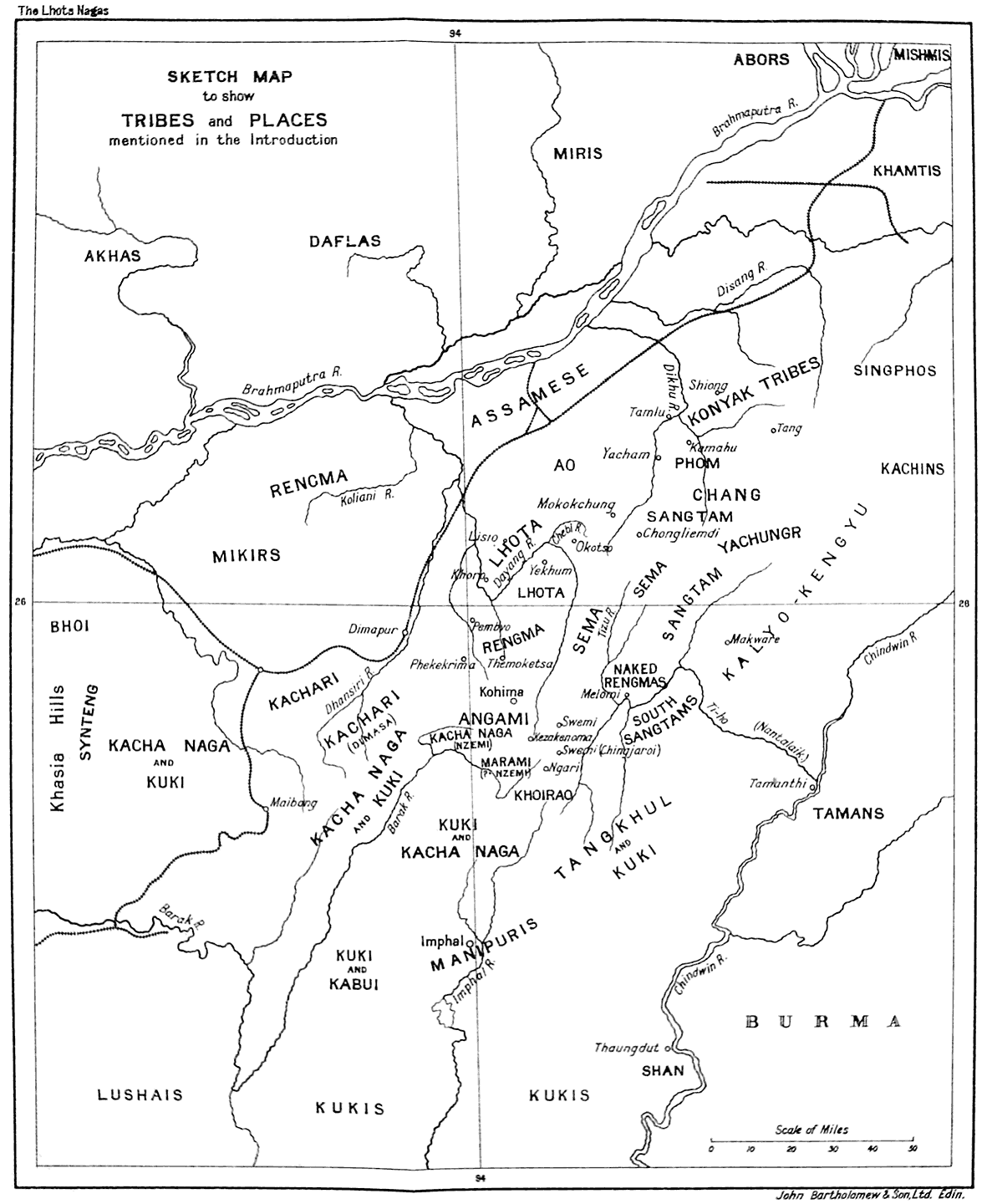
John Bartholomew & Son, Ltd. Edin.
SKETCH MAP to show TRIBES and PLACES mentioned in the Introduction