Part 2 — DOMESTIC LIFE
Reading edition
The Village—The “Morung”—The Head-Tree—The House—The Contents—Manufactures—Trade—Loans—Agriculture and the Ceremonies connected with it—Live-stock—Hunting—Fishing—Food—Drink—Medicine—Drugs—Games—Music.
Position and defences. With the exception of those situated on spurs running down from the great mass of Wokha Hill, a Lhota village is invariably built on the very top of a ridge. The two essentials of a site are that it must be easily defensible from a Naga point of view, and near a spring. Unlike the Sema, the Lhota rarely calls a village after its founder. An almost unique example is Mangya, which is said to have been founded by Mangyasang. More usually some peculiarity of the site, or incident connected with the village, gives it its name. Seleku is so called because many flying squirrels (selek) were found when the site was cleared. Niroyo is the place of a plant with red berries called niro. Lungsa (olung = stone, osa = platform) is so called from a flat-topped rock near the eastern entrance of the village. Okotso is said to mean the place where the pigs of Pangti were eaten by tigers (woko = pig, tso = eat). Villages captured by the Lhotas from the Aos, such as Yimbang, Akuk, Mekula, still retain their Ao names only slightly corrupted. Often a village retains the name of its parent village, with Yanthamo (“new village”) added, e.g. Are Yanthamo. To defend his village the Lhota used neither masonry walls like the Angami, nor hedges of living cane like the Konyak. The outer defence was a ditch cut across the ridge in a conveniently narrow place. The bottom and edge of this were studded with “panjis,” and it was crossed by a rough-hewn plank which was taken up at night, or in case of attack. The inner defence was a stout fence of sticks and bamboos, also bristling with “panjis.” This was carried right round the village except in places where the steepness of the ground gave adequate protection of itself. The door was of bamboo, studded with “panjis.” A few sticks are still stuck up along the line of the old fence every year at the Pikuchak “genna,” and whenever the village performs the Oyantsoa “genna.” Huge trees stand at the entrance to most Lhota villages. These were preserved to form a wind-screen for the village and to provide convenient look-out posts for sentries. War between Lhota villages was rare, and a powerful village surrounded by friends would regard defences as unnecessary. Similarly nowadays Tuensang, the most powerful village of the Changs, has no village fence. It is situated in the middle of a circle of friendly Chang villages. The warriors of Tuensang emerge from the circle to smite their foes, and then retire behind their friends again. Woe betide the friend who is so remiss as to let a party of avenging enemies into the circle.
A Lhota village is as a rule built along a ridge and has a main entrance at either end, with smaller paths running down to the fields from the sides of the village, and may contain anything from a dozen to 350 houses. The entrance to the World of the Dead being on Wokha Hill, the spirits of the dead must leave the village in that direction. The path leading towards Wokha Hill is accordingly known as etchhilan (“dead man’s road”). It is a curious sight, flanked with offerings to the dead (sochipen) and bamboo erections (nritangpeng) showing the prowess in war and hunting of those recently deceased.
Communication. From village to village there are narrow permanent paths along which men can only go in single file. As far as possible they keep along the very top of the ranges, for in the old days to use a path running under the shoulder of a hill would have been to risk having a spear thrown at you from above. Where the rock is soft sandstone, as it is near Tsori, toe-holes are cut in very steep ascents. Where the rock is hard a notched pole helps the traveller up the bad places. Small streams and ditches are bridged either by a single big tree or half a dozen stout poles laid side by side. Across broader streams, such as the Chebi, cane bridges are constructed. Long pieces of cane are stretched across from convenient trees on either bank. Between these a V-shaped cradle of cane is constructed, on which are laid long bamboos to form a foot-way. Long cane tie-ropes up and down stream prevent the bridge from swinging. The far-seeing Lhota often plants young trees of a suitable kind near the bridge-head trees to provide substitutes in case the old trees are washed away or die.
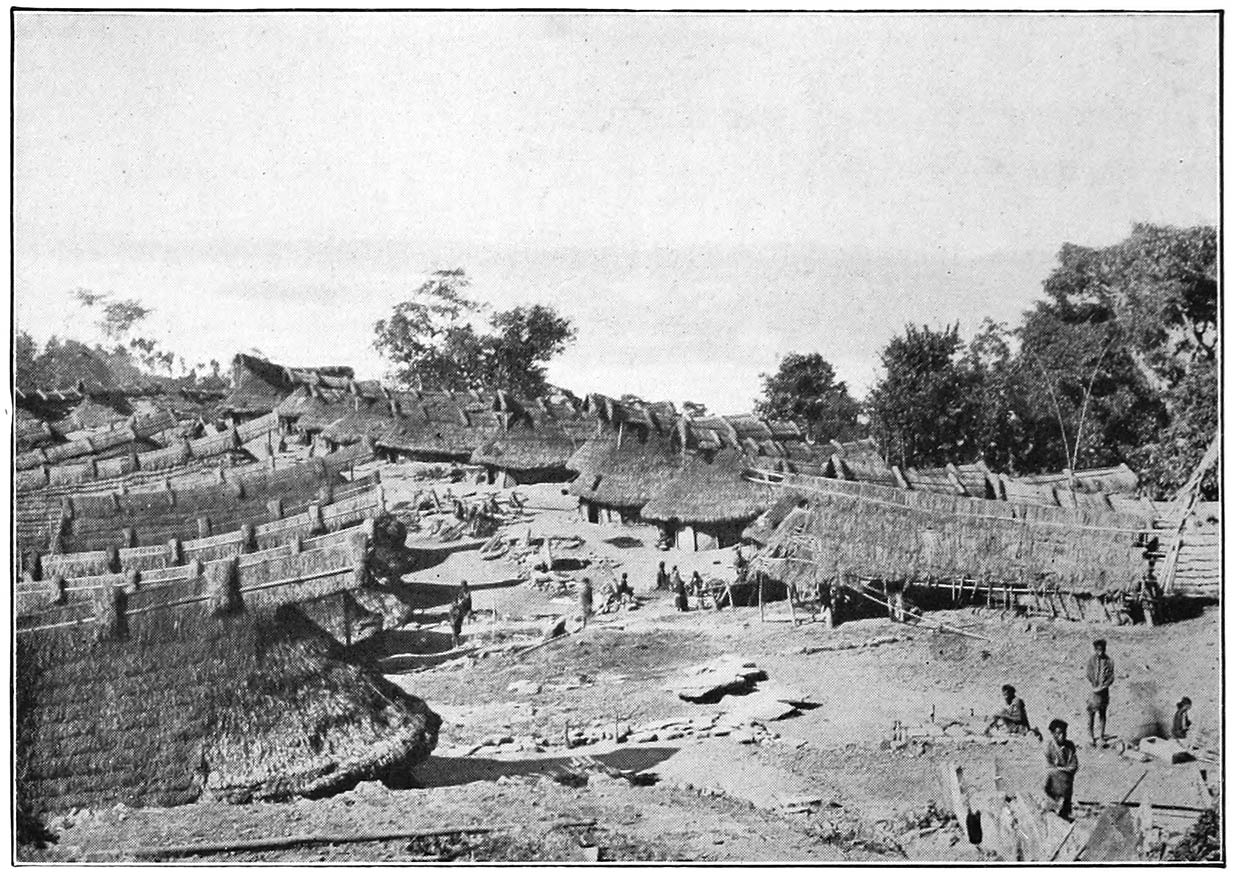
A Lhota Village—Humtso
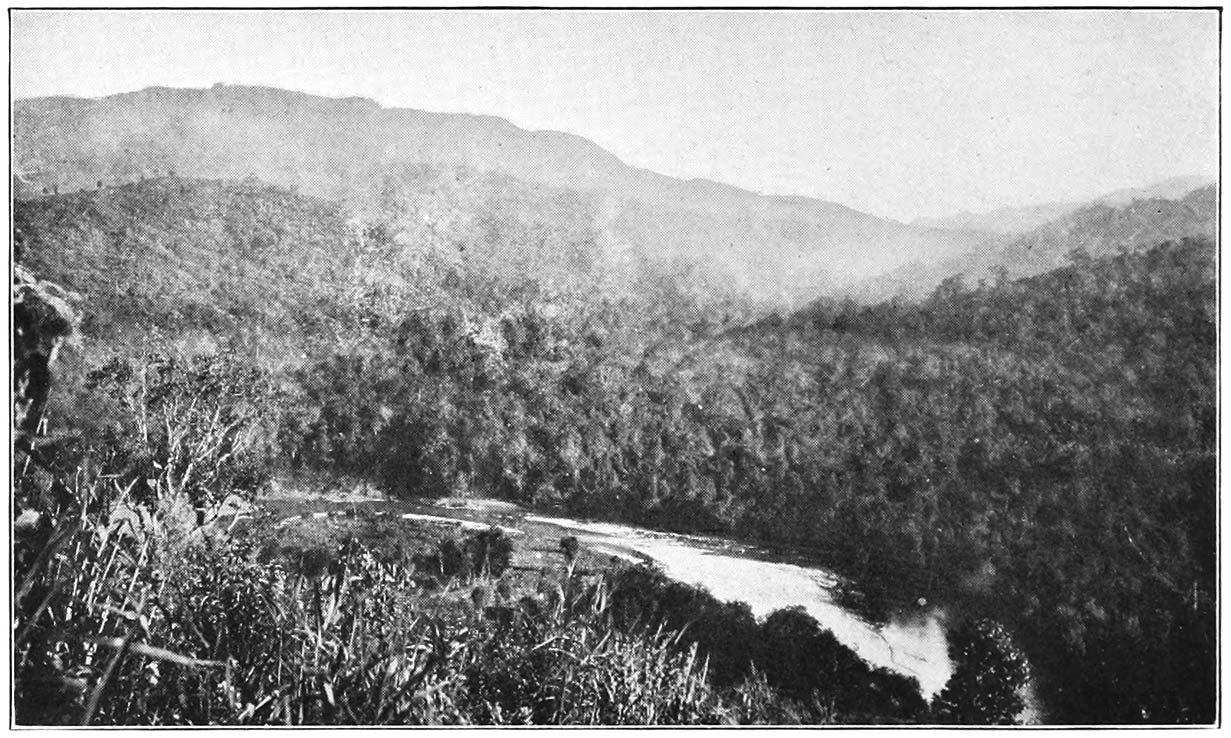
Photo by J. H. Hutton.] [To face p. 23.
The Doyang River from below Changsü.
The village. A village usually consists of one long street with a line of houses on each side facing inwards. In the middle of the street are the “genna” stones standing opposite the houses of their owners. The somewhat limited space is further crowded with old fallen “genna” stones, graves and stacks of firewood. The villages are swarming with pigs, dogs and cattle, and the state of the street in wet weather can be better imagined than described, though some attempt is made to keep the actual doorways of the houses clean by scraping away the filth with shovels (mirothenga) made of the shoulder-blades of cattle or mithan. Sanitary arrangements are non-existent. Pigs and dogs do the necessary scavenging in the jungle surrounding the village. In every village one piece of jungle is strictly reserved for men and another for women. Not all villages consist of one long street. At places such as Yekhum, where the ground slopes awkwardly, the houses are built according to the lie of the land and are in broken lines. Similarly at Pangti, which is on a fairly broad, level site, there are several rather badly defined streets and the houses face in all directions.
Unlike the Angamis, the Lhotas do not keep their rice in their houses but in little thatched granaries (osung) of bamboo which are raised on posts above the ground and stand in neat little groups just outside the village. By this arrangement the food supply is generally saved even if the village be burnt. It is absolutely forbidden to spread clothes to dry on the roof of a granary. To do so would cause all the rice to go bad.
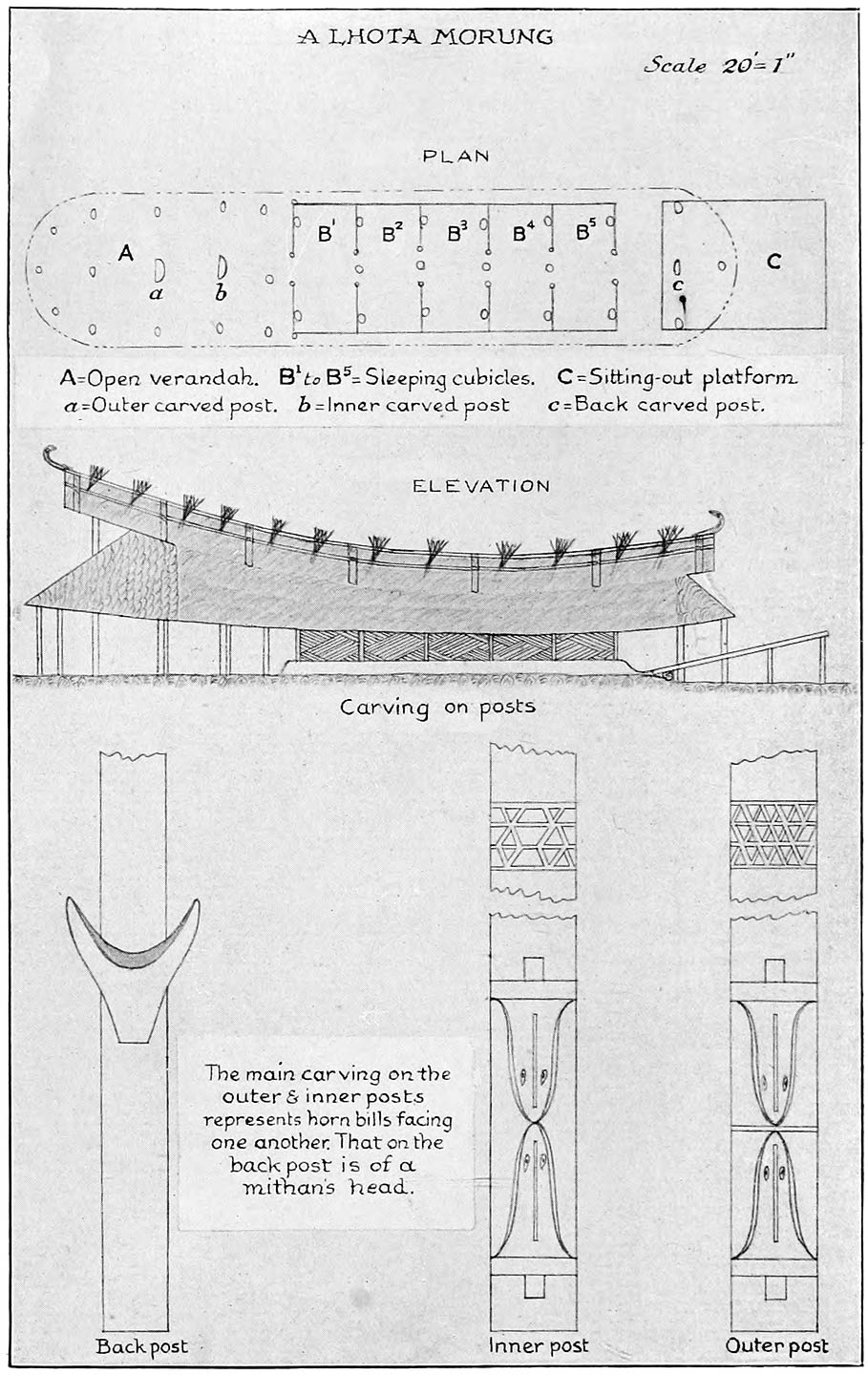
[To face p. 25
A LHOTA MORUNG
The interior of a champo is not attractive. It is dark, dirty, smoky, stuffy and full of fleas. Yet a Lhota talks of his happy champo-days much as an Englishman talks of his schooldays. The floor is sometimes levelled earth and sometimes a bamboo platform raised about two feet above the ground on posts. The walls are of bamboo. There is a door at each end and a passage about two feet wide down the middle, in which fires are lit on cold nights, the smoke finding its way out as best it can in the absence of chimneys or windows. Where the floor is of bamboo four logs are laid down to form a square, the interior of which is filled in with earth rammed firmly down. On this the fire is made. On either side of the passage are cubicles with bamboo partitions, along the sides of which are sleeping benches of rough-hewn planks, or bamboo “machans.”
Water supply. Springs issuing from the side of the hill below the village supply Lhotas with their water. Sometimes it is drawn from a muddy pool of unappetizing greenish water, but often there is a good flow into a basin dammed up with rough masonry. Small fish have been put into the Niroyo basin, and are carefully preserved in order that they may keep the water clear of scum. At almost all springs there is a small dam, and over it a low fence so that women who draw water stand below and not in the supply from which they draw. Unlike the Ao, the Lhota does not fancy water after the village have washed their feet in it. When the path from the fields does not happen to pass near a stream, water is often led to it in bamboo pipes from a long distance in order that men coming up after the day’s work may have a drink and a wash.
The Lhota House.
Description. A Lhota house varies in size from the wretched hovel of some old widow to the house of a rich man which may measure thirty feet long by eighteen feet broad—a limit far exceeded, however, by Aos, Semas and Angamis. To build a fine house as a show of wealth a Lhota would regard as great waste of money, and a Lhota likes to waste nothing. The walls are of bamboo and the roof of thatch (lishu) or palm-leaf (oko, Levistonia assamica). The front of all but the poorest houses is semicircular, with a door in the middle of the semicircle. The roof of the front semicircular room (mpongki) slopes up to the roof of the main building like the roof of the semicircular apse of a church. The upper roof-tree of the main building is carried forward over the roof of the mpongki with a slight upward slope, and is decorated with a little mock roof of thatch forming a sort of flying gable. In the middle of the mpongki is a bamboo post, which is carried through the roof of the apse to meet the projecting roof-tree of the main building. The interior of a Lhota house strikes a stranger as very cramped and uncomfortable. Unless one is very careful one bumps one’s head at every step. There is none of the spaciousness which one notices in the house of a rich Sema or Ao. Where the ground is suitable and bamboos are plentiful there is a machan (khantsung) for sitting out at the back. Sometimes the whole floor of the house is simply levelled earth, as in a Sema or Angami house. More usually, however, a step made of a short, thick log leads up from the mpongki to the doorway of the main building, the floor of which is raised above the ground on short posts and made of stout bamboo matting on a framework of whole bamboos, the matting in turn being covered with a layer of beaten earth to keep the draught from coming up from below. The floor of the sitting-out platform at the back is of bamboo without any covering of earth. The pattern of the floor of this platform varies according to whether the owner of the house has or has not dragged a stone. In the former case a mat of split bamboos interlaced in a simple chequer pattern is laid over a foundation of whole bamboos laid at right angles to the back wall of the house. In the latter case the place of the mat is taken by split bamboos laid at right angles to the bamboo foundation.
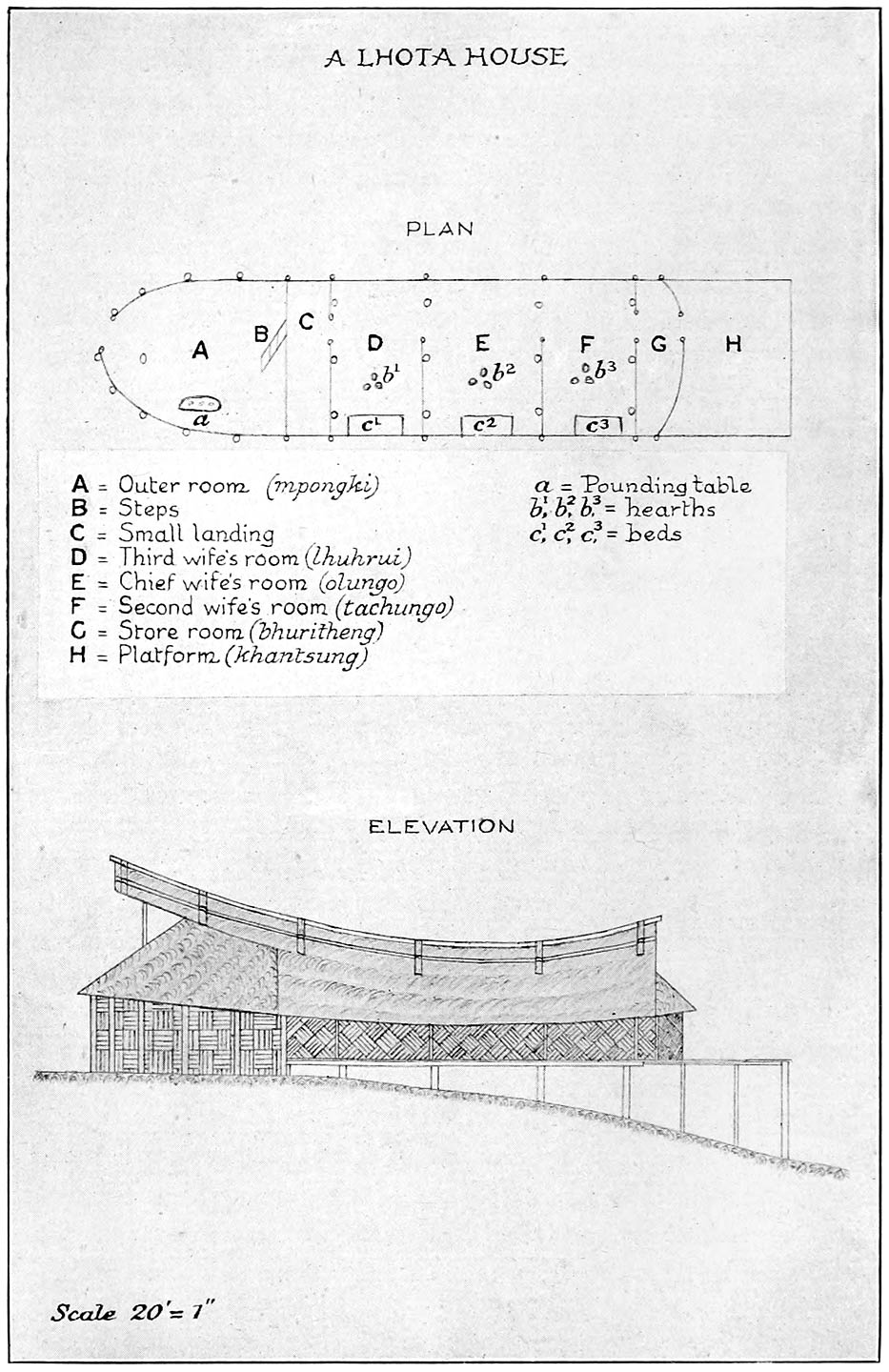
[To face p. 31.
A LHOTA HOUSE
In a Lhota household each wife has a separate sleeping cubicle with a fireplace (nchü) in the middle. A well-to-do Lhota usually possesses three wives. The main building of his house therefore contains three sleeping cubicles and a little store-room (bhuritheng) at the back. The cubicle nearest the mpongki is called lhuhrui and is occupied by the third wife. The middle one is called olungo and is the abode of the chief wife. The back cubicle is called tachungo and is used by the second wife. Daughters sleep with their mother or, if she is dead, with the step-mother they like best. Servants, if there be any, or a bridegroom working for his bride in his father-in-law’s house sleep in the mpongki, either on mats on the floor or on the pounding bench. Guests sleep on mats on the floor of the store-room or in one of the cubicles.
A step up from the mpongki and a door close to the wall (usually the right-hand wall) lead into a narrow passage running the whole length of the house onto the platform at the back. On the left, assuming the passage to be on the right of the house, are the cubicles, the partitions of which stretch about two-thirds across the house, and up to the beams (khokang), the partitions between the mpongki and the first cubicle, and between the store-room and the sitting-out platform, going right up to the roof. The roof is supported on centre-posts (tirhupu), a bamboo one being placed in the middle of the mpongki, and a roughly-squared wooden one at each partition, and corner-posts (okinge) at the corners of the main building. Small posts in the walls help to support rafters (khirong). There is no chimney and the smoke finds its way out as best it can. The cubicles are lighted only by their fires.
Construction. When a Lhota builds a house he sets about it as follows. After the harvest is in he chooses a site and touches the ground with his hand. Then he goes off to a dreamer (hahang), of whom there are two or three in every village, with a small present of food, and asks him to dream that night and tell him in the morning if the site will be a lucky one. Dreams of springs, gourds, cucumbers, leaves, daos and spears, among other things, are good. To dream of digging, hair dyed scarlet and black thread forebodes death. If the dreamer has a vision of frogs, crabs, or tortoises the man who builds a house on the site which is being tested will be ill. If the dreamer reports visions of good omen (and he generally does, for a seer of evil dreams does not keep his clients long) the builder of the house calls his friends and relations together and work is begun. The positions of the corner-posts are first marked out, the length and breadth and diagonals being carefully measured. These posts are then put in, and after them the centre-posts and side-posts of the walls. If the house is to have a raised bamboo floor this is now made. Long bamboos or poles are then laid along the top of the side-posts of the walls, which are notched to receive them, and tied in position with yhandra bark. This bark is taken from the tree in long strips and dried in the sun for some days. The strips are twisted and wetted when required for use. On the top of the skeleton wall thus made are laid and tied bamboo cross-beams in pairs, each pair enclosing one of the wooden centre-posts, to which it is firmly tied. There is no cross-beam across the mpongki. The tops of the wooden centre-posts are then notched and a bamboo roof-tree (mhongki) is put in place. This stretches out far in front of the main building. At its junction with the centre-post standing between the mpongki and the first cubicle it is broken half through and carefully bent down, for the projecting end of it will eventually form the centre rafter of the semicircular roof of the mpongki. The rafters (khirong) are then put on. To enable them to be tied they must necessarily project and form a series of forks along the top of the roof-tree. On these forks is laid another roof-tree, which is not bent down like the first, but projects right out above the mpongki and is supported by the bamboo centre-post. Further to strengthen the rafters and prevent them lifting in a high wind, two other roof-trees are placed in position in the side forks on either side of the main roof-trees. These side roof-trees project beyond the main building and are bent down like the under one to form rafters for the mpongki. Partitions inside the house are now built and purlins (sütesüyo) are put on, all being so bent as to form purlins for the mpongki. The bottom pair of purlins are so made that the projecting ends can be bent to meet and be tied. This gives the outline of the semicircular apse of the mpongki. Posts are put in to which the bottom pair of purlins are tied in position. The projecting ends of roof-trees and other purlins are then brought down and tied to it, and the framework of the house is complete. Chequer pattern bamboo walls are quickly put up and the thatching is begun. Sections of thatching about six feet long are prepared as follows by men on the ground, and handed up to men on the roof, who put them in position. Thatch is carefully bent double over a thin bamboo about six feet long, care being taken to see that it forms a fringe without gaps. Then to keep the thatch in place two more bamboos of the same size and length are placed on either side of it about five inches below the first bamboo. These are firmly tied together through the thatch with strips of bamboo. With palm leaves the top bamboo is omitted, a fringe of overlapping palm leaves being held in place by the two thin bamboos, one on either side. These fringes are then tied on to the rafters and purlins, beginning at the eaves and working upwards so that each fringe overlaps the one below it. Finally, thatch is doubled over the upper roof-tree and fastened down with two long bamboo wind-ties. This last layer of thatch extends to the end of the upper roof-tree, forming a sort of flying gable where it projects over the mpongki. Light bamboo doors are then made. These are not attached to the door-posts in any way and can be lifted and laid aside. Two crossed bamboos are attached to the door by a loop of bark string and jammed behind the door-posts to keep it in place. A man who has dragged a stone more than once can decorate his roof with crossed bamboos representing mithan horns, but this is considered rather a snobbish display of wealth and the privilege is rarely taken advantage of. In some Southern Lhota villages the Puthis’ houses have the roof decorated with crossed bamboos of which the ends are split and splayed apart. This is a conventional representation of human hands, and the right to have the roofs of their houses ornamented in this way was formerly confined to men who had succeeded in bringing the fingers or toes of an enemy home from a raid. Rich Aos decorate their roofs in a similar way.
Before such a house can be occupied lurking evil spirits must of course be dealt with. For this the oldest of the men who helped to build the house is called in to act as tsandhramo epang (“driver away of evil spirits”). Having mixed ginger and “rohi madhu” in a new “chunga,” he sprinkles the inside of the house with the concoction and says, “We are going to stay here. You go away.” He then throws away the “chunga,” which must never be used for anything else. The old man then marks out the places for the hearth-stones, which the owner places in position. The owner then either lights a fire with a fire-stick or fetches fire from another house—any house will do. Matches are never used by Lhotas for ceremonial fire-making. A meal is now cooked and partaken of by the owner and his household and friends and the old man, who then takes the omens. He holds in his hands a small chicken called kichakro, which each member of the household touches with his or her left hand. This he strangles and disembowels, taking the omens from the entrails. After which he cuts it up and, holding eight pieces of meat in each hand, takes his seat with the male members of the household on his right and the female members on his left, and swings his hands backwards and forwards four times with an underhand bowling action, counting the number of swings aloud. The chicken is the old man’s fee, and he takes it away, returning in the morning to report whether he has had dreams of good or evil omen. A man may not act as tsandhramo epang for more than one household on the same day. The only restriction placed on occupants of a new house is one forbidding them to allow men from another village to enter the house till the earth which has been put on the bamboo floor is dry. A house of which the floor is mother earth may be entered by strangers as soon as the above ceremony has been performed.
The contents of the house. In the front room of the Lhota house are kept heavy articles, such as the pounding table (tsampo), liquor vat (ochen), and pigs’ feeding trough (wokochakpfu), the last being merely a log split in two and roughly hollowed. The pounding table is hewn from one piece of wood. In the top, which is slightly concave, one, two or three holes about six inches in diameter are burnt. In these the rice is pounded with heavy poles—an arduous occupation at which the daughters of the house spend a good deal of their time. The liquor vat consists of a log hollowed out from one end. Trees for this are carefully chosen, but a very large proportion of vats split or spring a leak before they are finished. On the wall of the front room are hung the feet of game which the owner of the house has killed. Spears are always kept stuck in the ground in front of the big wooden post. Along the sides of the inner cubicles are the small plank beds of the household. According to Lhota ideas a single thickness of cloth spread on the bed makes quite a soft enough mattress. Round the fire are little wooden stools about six inches high cut from one piece of wood. Floor space being limited in a Lhota house, most things are kept on rough bamboo shelves (theka) fixed to the beams of the house. Here are kept bundles of salt wrapped in leaves, cooking pots, baskets of yeast, traps, carrying baskets, and a thousand and one things. For cooking rice and meat Naga-made earthen pots are generally used, but for heating “madhu” shallow iron pots from the plains are popular. In them the brew can be stirred easily and without risk of an upset. Lhota houses contain very few drinking cups. Villages on the Sema border obtain bamboo cups from their neighbours, and nowadays cheap German enamel and aluminium ware are often used. But the true Lhota cup is a folded plantain leaf. It is really an astonishing sight to watch one’s hostess fold a piece of plantain leaf into a cup with one hand, while she talks hard to one guest and pours out “madhu” for another, either from a gourd or, more commonly, an old beer bottle. The usual type of dish is a shallow wooden one, with no legs, called opyi, many of which are made in Lungsa. Some households also use a wooden dish on a raised stand, rather like a dessert dish, called pyikhyu. In the bamboo matting of the walls are stuck daos, bamboo spoons and many odds and ends. The hollow bamboos in which water is carried up from the spring are kept leaning against the walls. Over the fire is suspended a bamboo platform about five feet square. This prevents sparks flying up to the roof and also serves as a convenient place on which to dry meat, and keep such pots and spoons and things as are in continual use. The little store-room at the back is comparatively free from smoke and in it ceremonial ornaments and spare cloths are hung.
Manufactures.
Spinning. Spinning, like dyeing and weaving, is performed entirely by women, and every Lhota woman is expected to weave the cloths of her husband and family. The thread is spun as follows. Home-grown cotton—the Lhotas are great cotton-growers—is cleaned of its seeds by being rolled on a flat stone with a small stick, used like a rolling-pin. This cleaning is a tedious process which generally falls to the lot of the old widows of the village, who eke out a scanty livelihood thereby. The cleaned cotton after being fluffed out by being flicked with the string of an instrument (loko) like a miniature bow is then gently rolled between the hands into “sausages” about nine inches long, after which it is ready to be spun into thread. The Lhota spindle (humtsi) is a very primitive affair and is similar to that of the Aos, Semas and Angamis. It consists of a thin penholder-shaped stick of hard wood about eight inches long, tapering to a fine point at the top, and about the thickness of a pencil at the thickest point near the bottom. Just above the thickest point is fixed a whorl made of soft black stone. This is made by rubbing on other stones till it is flat and round a piece of the soft stone used for the purpose. To make the hole in the middle a man holds it between his toes and twiddles a spear on it between his hands till the iron butt of the spear goes through. For spinning the tip of the spindle is wetted with the tongue. The spindle is then spun clock-wise with the right hand against the outside of the right thigh, the base of the spindle being kept in bounds by a conveniently cup-shaped piece of broken pottery covered with a bit of rag. The “sausage” of cotton is held in the left hand, and the end of it laid against the wetted tip of the spindle till it catches and the thread (oying) begins to form. When about a yard has been spun it is unwound from the tip of the spindle and rewound just above the stone whorl. The spindle is then worked as before, the cotton being held in the left hand, and thread accumulates above the whorl till the spindle becomes full, when it is wound off onto a wooden frame (kukung), shaped like a double T, and another spindleful is begun, and so on till the kukung is full. The thread is next hardened by being steeped for about five minutes in hot rice-water, after which the skeins (yingsak) are strung on a stick (phutsi) to dry. It is forbidden for a man to eat the boiled rice from which this rice-water has been taken. When the thread is required for weaving it is wound into a ball (yingtso), the woman who is sitting winding keeping the skein stretched round her knees.
Dyeing. Three colours, red, dark blue and light blue, are used by the Lhotas. Red thread is generally bought either from a shop or from an Ao village, for red dyeing is considered a risky occupation likely to bring on dysentery, and therefore only suitable for old women, who are of no value to the community. The industry, however, is carried on in a few Lhota villages, such as Changsü and Okotso. To make red dye the root of Rubia sikkimensis (karung) is pounded up, and another leaf (’ntawo) is pounded and added. The mixture is then boiled with water, and the thread put in while the water is boiling. The pot is then lifted off the fire and allowed to stand for three days, when the thread is taken out and dried.
Dark blue dye is made from the leaves of Strobilanthes flaccidi-folius (tchemo), pounded up and boiled with water. The thread is steeped in the mixture for half an hour and is then dried. This gives a colour like navy blue. To make light blue the leaves which have been already boiled and used for making dark blue dye are drained and dried and kept for a year. They are then broken up fine and mixed with cold water and the white ash of burnt bark, and put to stand till next day, when the thread is put in and left there for a day, or for two days if the dye is weak. It is then taken out and dried.
Dyeing is exclusively performed by women, who when they are so occupied must refrain from sexual intercourse and must not eat beef, goat’s flesh, dog’s flesh, dried fish, or that horrible vegetable known in Naga-Assamese as “stinking dal” (nyingtyingtsing), in fact any food with a strong smell. If any man were to dye a piece of thread he would never again have any luck in fishing or hunting. No one but the dyer must look on while thread is being dyed or the colour will be patchy and bad.
Weaving. Like the Semas and Aos, the Lhotas use a simple single-heddle tension loom (tsirochunglung) which is set up and operated as follows. A beam (tsikam) of bamboo about three feet long is securely fastened to the wall of the house or any other suitable firm support in a horizontal position and at a height of about two feet from the ground. On this are slipped two loops (tsisü) of bark string, in which is put the other bar (ncho) of the loom. The loops are set at a distance apart equal to the breadth of the piece of cloth to be woven. The lower bar (ncho) is notched at either end, to enable the weaving belt (ephi) to be attached to it. This belt is of woven cane or bamboo and is worn by the operator in the small of her back. By it, as she sits in front of the loom, she can keep the necessary tension on the warp. Both the beams being in position and a strain having been taken on the tsisü, each tsisü is crossed by the lower string being pulled up and the upper down and a thin stick of bamboo (yingyi) is put in position. This is naturally held firmly in place by the downward pressure of the lower strings and the upward pressure of the upper. Then, working towards the weaver, the lease-rod (chunglung) is put in close to the yingyi without crossing the strings. Below the lease-rod the sword (tsitam) is inserted, the strings being crossed as in the case of the yingyi. The twine which is to form the heddle-loops (ena) is now tied loosely onto the left end of the sword and laid along it. This twine is sometimes thick cotton thread and is sometimes made from the twisted bark of a creeper called enazü (Pineraria Thungbergiana). Two balls of thread are then taken and their loose ends twisted together and joined. One ball is held in the lap of the weaver while the other is passed over the ncho, under the tsitam and the ena which is lying along it, over the chunglung and under and then round over and under the yingyi and then over the tsikam, from whence it is brought straight back to the weaver under the loom. The second ball is then passed under the ncho and over the ena and under the tsitam and chunglung, and under and back over and under the yingyi and over the tsikam, and is brought back to the weaver under the loom. The process is repeated till all the warp (elomo) has been set. The result is that the ena forms a series of heddle-loops and the yingyi (the object of which is to shorten the upper side of the shed made by the lease-rod) is entirely encircled by each warp. Unless the loom be a very small one the weaver cannot reach the tsikam. She therefore generally has an assistant, who can be a man, to pass the warp thread over and under the tsikam. The two ends of the warp thread, when all has been set are turned back across the warp and woven into the material. The shuttle (yingshü), which is simply a thin piece of bamboo, is filled from the ball by being spun against the right thigh. This process and that of setting the warp are the only two in which a man may take part. Before weaving can begin the tsitam, a flat piece of hard wood, is turned on edge and the heddle (natyung) is slipped in alongside it so as to take up the heddle-loops formed by the ena. The tsitam is then removed. The object of substituting the sword for the heddle while the warp is being set is to ensure big enough heddle-loops. The tsisü are then removed, and the lease-rod is moved down close to the heddle thus giving the warp enough strain to keep the latter in place. In weaving the shuttle is shot backwards and forwards by hand, the heddle being raised every alternate pick. To increase the shed the sword is put in for each pick and turned edgeways. For the check pattern so common in women’s body-cloths both warp and weft (mpyo) are changed. For ornamentation little bits of red wool or yellow thread bought from a shop are worked in by hand as the weaving progresses, the warp being manipulated with a porcupine quill. Ordinarily the first weft-element passes alternately over and under a single warp-element, the second passing over those under which the first passed. A variety of pattern is that in which a single weft element passes alternately under and over pairs of warp elements. Another variety is that in which a single weft element passes under and over alternate pairs of warp elements and is returned under those under which it passed before, giving a pattern of interwoven pairs of warp and weft elements. Four pieces of cloth about one foot broad by five feet long go to make an ordinary man’s cloth. These strips are sewn together along their long sides. The Lhota needle (otyam) is simply a piece of bamboo sharpened at one end. To the head is attached by wax a piece of thread about two inches long known as otyam emhi (“needle-tail”) onto which the thread used for sewing is twisted. The broad stripes of light blue seen in so many Lhota cloths are invariably separate strips, sewn between two of the main strips of the cloth. A woman in the old days was forbidden to weave while her husband was absent on a raid, as it might cause him to trip over creepers in the jungle and fall into the hands of the enemy.
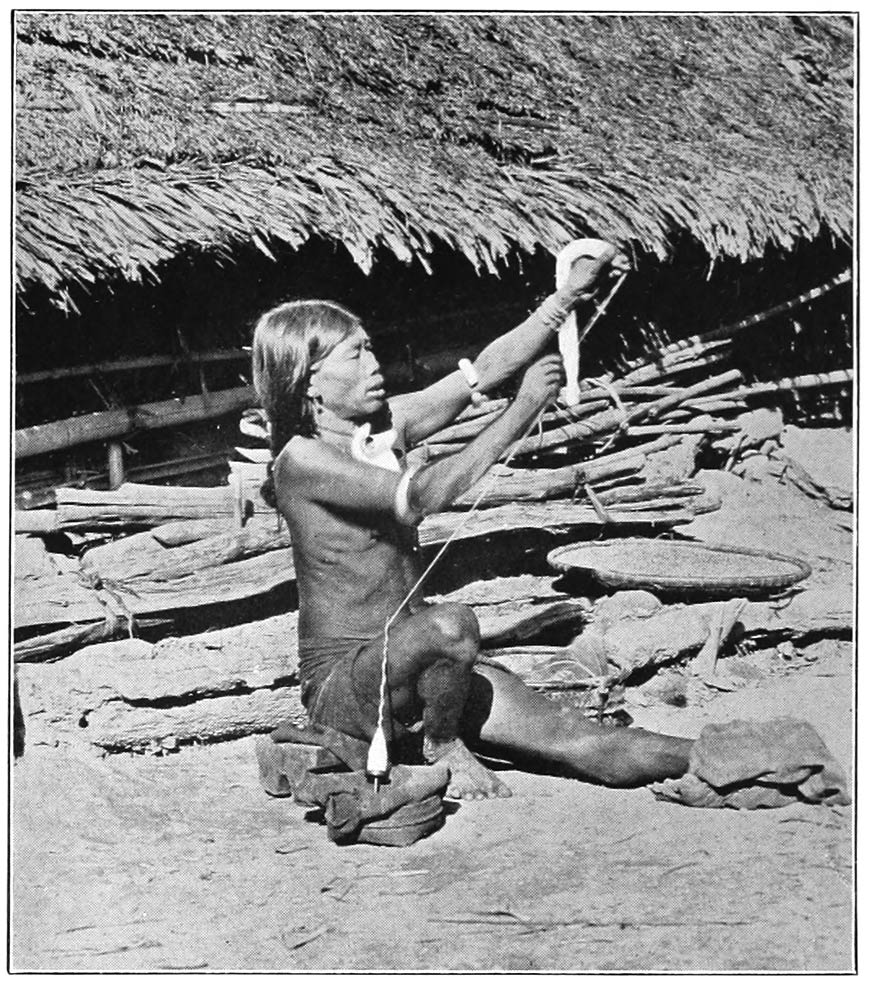
Photo by Mr. Butler.]
Spinning
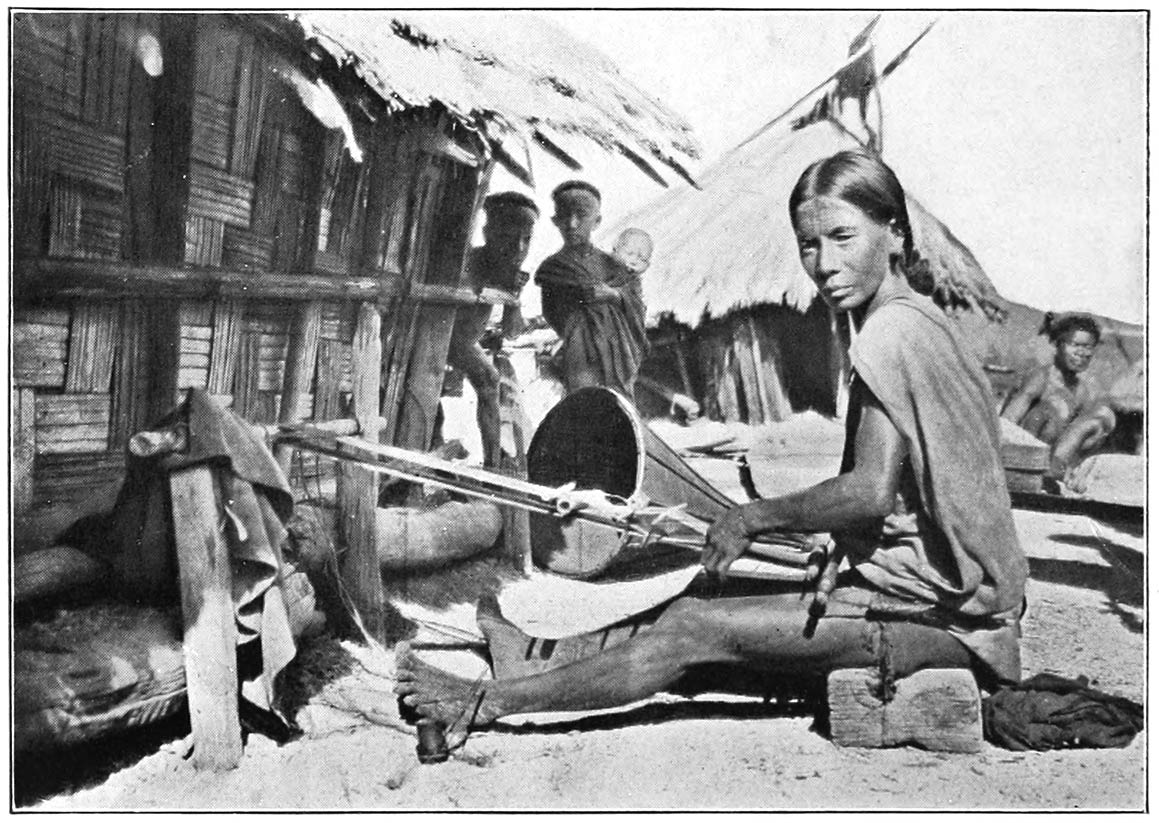
Photo by Mr. Butler.] [To face p. 39.
Weaving
Pottery. Though foreign articles are being used more and more Lhotas still make most of their own pots. They are round, and slightly contracted at the top, with a curved rim by which they can be lifted off the fire. The only ornamentation used is a string pattern which is applied by patting the pot while still wet with a flat piece of wood covered with coarse string binding (khuzü). The clay is obtained from the banks of small streams. Two kinds are used, grey (linyikcho), which is the best, and red (linyocho), which is not so good. Only women can make pots, but the industry is not restricted to old women. The clay is broken up and kneaded on a stone with a little water. After being left over-night it is again moistened and kneaded. A round base is first made by hand. A wall of clay is built onto this and kneaded well onto the base with the left hand, the wall being supported on the outside by a small stick (phutamphen) held in the right hand. The pot is then shaped with the left hand and stick, and put to dry in the sun while other pots are being made.
After the pots have been dried in the house for three or four days a rough platform of wood is built on the ground outside the village. On this the pots are laid upside down and twigs and rubbish and rice straw piled on them and fired. In this kiln the pots are left till next morning, when they must be taken away before dawn. Certain precautions have to be observed. The woman making the pots must refrain from sexual intercourse, and must not eat any strong-smelling food, such as beef, goat’s flesh, dog’s flesh, dried fish or “stinking dal,” while she is so engaged, for to eat these things would cause the pots to “ring” badly. Anyone may watch the clay being kneaded, but no one must look on while the pot is being shaped, and only those helping the woman by carrying the pots or collecting fuel may be present at the burning. Were a man to see the pots being fired they would all crack. Nor must any dog come near, for should so much as a single hair of a dog touch a pot before it is finished the pot would have a hole at that very place.
So impregnated with misfortune is the whole trade of the blacksmith that no house is ever built on the site of an old forge, though the forge is allowed to be built inside the village. To bring a piece of dross from a forge into a house would cause all the inmates to fall ill. With this in mind a woman in Yemkha in 1919 left a piece of dross as a parting present when she ran away from her husband.
Basket-work. Living in a land where cane and bamboo are plentiful Lhotas are naturally expert basket-makers. Every man can make his own household baskets, but the manufacture of difficult things such as cane helmets (kiven) is generally left to experts. No woman is allowed to do any basket-work of any kind. For rough baskets strips of fresh bamboo are used. Cane is far more valuable and is reserved for articles which are meant to last a long time. It is left to season before being used. For rough work a chequer pattern is generally used, but for shields (otsung), cane helmets, and grain baskets a twill pattern is used. A pretty cross-warped pattern with wefts parallel to each other and passing over and under the same alternate warps is used for the outside of rain-shields (phuchyo), giving an open-work effect rather like the cane seat of a bedroom chair.
Wood-work. Rough planks are hacked out with a dao, a most wasteful method, as the whole thickness of a tree has to go to make each plank. Wooden dishes are cut out of single pieces of wood with an adze (ophü). They are then dried in the rough and rubbed smooth with stones and a curious rough-surfaced leaf called phukirongti (Clerodendrum serratum). Small “madhu” vats and very occasionally wooden shields are made in the same way. The posts of “morungs” (champo) are carved in relief with conventional representations of hornbills and mithan heads. The work is done with the dao and is as a rule very rough—far inferior to the carvings of Semas and Angamis, who in turn are much behind the Konyaks.
Nets. Nets like big landing-nets are made out of twisted strips of bark from the erhingya tree. They are fitted onto a circular frame to which a long handle is attached, and are used to land the stupefied fish which come to the top when a river is “poisoned.” They are made by men, never by women. The maker must remain chaste the previous night.
Beads. Among the few indigenous beads of the Naga Hills are the little black beads (eshe) made from the seeds of a species of wild plantain (sheyu) by the Lhotas. The industry is confined to women and exists chiefly among the Southern Lhotas. The seeds are tough, and both ends of each seed have to be laboriously chewed off. They are astringent, and “bead chewing” becomes a perfect habit with some women. The seeds are then pierced with a bamboo needle and strung, and the strings rolled on a flat stone till the beads become cylindrical and a good polish has been obtained. They are used for necklaces and look exceedingly well against a brown skin.
Hides. No process of tanning is known. Skins which are required for shields or any other purpose are merely cleaned and dried in the sun.
Loans.
The rate of interest on loans varies according to the nature of the thing lent. That on money is usually 50 per cent. simple interest, running for two years only. The interest on rice is four baskets a year for every six baskets borrowed. The interest has to be paid year by year till the principal has been returned. A debt of seed paddy must be paid before all other debts. The highest rate of interest is demanded for salt, for which 100 per cent. per annum compound interest has to be paid. The result is that loans of salt are promptly repaid.
Agriculture.
The jungle is left till March to dry, when it is all burnt on the same day. The man who is to start the fire is selected by cutting little chips from a piece of stick and watching how they fall—the ordinary Lhota way of taking omens. The man chosen first makes fire with a fire-stick and sets the dry jungle alight. Then everyone joins in and lights a long line of fire which sweeps uphill till it dies out in the green, uncut jungle at the top. Next day is emung. After that work begins in earnest. Stones and half-burnt logs are collected and little barriers (oliecho) are built along the hillsides to prevent the earth being washed away. Sometimes, as at Mangya, rough stone terrace walls are built. The fields are then dug over with a single-handed digger (chukchü), a small triangular iron blade fitted like an adze onto a bamboo handle. This preliminary hoeing is omitted by most Northern Lhota villages, who merely clear the land of rubbish before sowing. The fields which have already carried a crop the year before are now weeded, and the weeds gathered into heaps with a small bamboo rake (keya) and burnt.
The Motharatsen ceremony. Among the Southern Lhotas a yearly ceremony called Motharatsen is performed by the Puthi and Yenga only when the crop is about half grown to prevent it being damaged by a small white grub (ora). On a certain day of which he has given previous notice the Puthi collects unhusked rice from the whole village and with some of it buys a pig. This he kills on the day of the ceremony, and going outside the village lays ten pieces of meat and ten pieces of ginger (osing) on crossed yutso leaves to his right, and nine pieces of meat and ginger on crossed yutso leaves to his left. The next day is emung. Though the Northern Lhotas still keep the emung the ceremony has fallen into abeyance among them. But the Southern Lhotas firmly believe in its efficacy. In 1918 the people of Yanthămo attributed the failure of their crops to the fact that a stranger from another village had entered the house of their Puthi after he had collected the subscription of rice and before he had performed the ceremony.
The Amungkam ceremony. When the rice comes into the ear ceremonies are again performed to ensure a good crop. The first ceremony is called Amungkam, and is performed by the Puthi and Yenga at the spot (amungkampen) a little way outside the village at which it was performed when the village was founded. The Puthi kills and cooks a little boar at his own house and goes with his Yenga to the amungkampen, taking with him a new cooking-pot, some of the boar’s meat, a small live pig, a hen, an egg, a fire-stick and some yutso leaves. The Puthi’s wife may accompany him, but the Yenga’s wife must stay behind. The Puthi makes a fire with the fire-stick, and near it lays out four bamboo twigs in the form of a square, in the middle of which he sets up the egg on end, flanked on either side with forty-two small pieces of meat on crossed yutso leaves. He then spears the live pig, praying to Rangsi, the deity of the crops, that they may be good. The pig is singed over the fire and cut up, the stomach and entrails being cooked in the new pot and eaten by the Puthi. The rest of the meat is divided up, one piece for every man in the village who has dragged a stone. The Puthi then strangles the chicken between the finger and thumb of his right hand and watches how the excreta fall as it struggles. If they are dry there will not be much rain and the crops will ripen well. If they are watery, storms will cause the crops to rot. The entrails are next taken out and examined. If they are full the crop will be good; if they are empty it will be poor. These are pushed back into the chicken, which is placed on the ground by the egg. The Puthi builds a little fence round the offering and hangs up the fire-stick on it, the pot being turned upside down and left on the ground. He then goes home and calls his friends to his house to drink “madhu” and partake of the pig he killed before leaving home. To each guest he offers a piece of pork and asks if he intends to do the Rangsikam ceremony, which is voluntary. To accept the pork means that the answer is in the affirmative. To refuse it means that the answer is in the negative. Early on the morning of the next day, which is emung, the villagers go and see if a wild cat or other animal has taken away the chicken which had been left at amungkampen. For it to be taken away forbodes ill for the village.
The Rangsikam ceremony. In Akuk no one may do the Rangsikam ceremony till after the Lanvung “genna,” but in other villages it may be done either before or after. The ceremony, which is also known as Likam, is performed as follows. The master of the house having slept apart from his wife the night before and eaten apart from her in the morning, though she may cook his food, kills a pig, and taking the cooked meat, “madhu,” boiled rice, a live hen and a new pot, goes down to his field-house—a shed built by each man in his fields where he can shelter from the rain or eat his mid-day meal with his wife and family. Having made a fire with a fire-stick inside the house he holds the hen by the wings with his right hand and walks round the outside of the house, swinging the hen and calling out the names of all the different varieties of rice he knows, whether he has sown them or not, and asking Rangsi to give him a good crop of them. He then strangles the chicken and takes the omens exactly as the Puthi does in the Amungkam ceremony. It is worth noting that this is the only occasion on which anything is killed in the field-house. Otherwise it is forbidden to bring raw meat of any kind into a field-house, or kill anything or have sexual intercourse in it. This is why the approaches to field-houses near paths are often “panjied” as a gentle reminder to passers-by that they must not run in to shelter from the rain if they are carrying raw meat. To resume, the hen is plucked, and cooked in the new pot. It is not eaten by the sacrificer, but is taken back to the village and given to an old man of his clan. The entrails are put in the pot, which is covered with a leaf and buried up to the rim behind the field-house. The little bamboo basket in which the hen was brought is stuck all over with its feathers and put, together with the fire-stick, beside the pot. All then wash their hands and the proceedings end with a meal from the provisions brought down. From the time when the preparation of the “madhu” for this ceremony is begun till the ceremony is over, sexual intercourse is forbidden and no member of the household must touch a corpse, meat from a tiger’s kill or the flesh of cattle, dogs or goats. On the day of the ceremony no man from another village may enter the house before the family go down to the field-house.
Protection of crops. While the crop is ripening the owner is kept busy protecting it from the ravages of beasts and birds. Little look-outs (zengki) are built in the trees, well out of the reach of an elephant’s trunk. Wild animals are driven away by shouting or clapping two pieces of bamboo together, or blowing a bamboo trumpet (phupphu), or by building a big fire and feeding it with bamboos, which go off with a loud bang as each section is burst by the expanding hot air inside it. There is no hedge between field and field, but a rough fence is built round the whole block of village cultivation in order to keep out deer and cattle. In the old days low gaps were left in the fence here and there. Any deer which gave way to temptation and jumped through one of these gaps found itself impaled on “panjis.” Monkeys are most destructive and difficult to get rid of. One plan is to catch a small monkey, pierce its ears and ornament them with large lumps of cotton-wool. It is then let go and tries to rejoin the troop, who promptly turn tail at the sight of this strange apparition. The more the troop runs away the harder the little monkey tries to catch them, and the harder it tries to catch them, the faster they go. To drive away birds pieces of bamboo leaf-sheaf, sometimes cut into the rough outline of a hovering hawk, are tied from the end of a string to a pole and put to flutter in the breeze.
Orung-na ranga ranga phang (orungu, asking, asking remain). Lhetyak-na tyaka tyaka phang (lhetyak, sweeping, sweeping remain). Sangsu-na sangsu lithana, sangsu lithana oro tamtam chudechia (sangsu, sangsu, changing, changing with sangsu, coming in a stream pour out).
This is said to mean—for the words are not clearly understood by the Lhotas themselves: “Orungu leaves pray the Rangsi continually to give me a good crop; lhetyak leaves sweep the grain into my field-house, and sangsu leaves come one after the other and pour rice in a stream from your loads into my field-house.” The man then re-enters the house and sprinkles the floor with “madhu” from his gourd while he repeats the following words:—
“Satung “Fish-trap rampeng hunter’s Rangsi deity, tchhüchi water-side rhempi wanderer’s Rangsi, deity, lipphu hillside liteng company’s Rangsi, deity, tsatso hurt rüku wounded men’s mpito all Rangsi deities rencheli” come out of hiding.”
In other words he prays to all Rangsis belonging to men who are busy fishing or snaring birds by the pools or are hurt (i.e. all men who do no cultivation and so have no need of Rangsis), together will all the Rangsis of the hillside to come and help him. The “madhu” is then sprinkled along the threshold from end to end and the ceremony is at an end and reaping begins. At midday the owner and his helpers come back to the field house for a meal. The owner first undoes the pig’s head and puts salt on it. This can be eaten only by him and old people. If he happens to have an oha (luck-stone) in his house, no one but he can eat the pig’s head, or they will have a bad cough.
All that remains now is to carry up the grain as fast as possible. If the fields are a long way from the village, small temporary granaries (echengrangki) are built half-way in which the crop can be stored till the field-house, where wild pig and elephants are likely to do most damage, has been emptied. The grain is carried up in baskets (otyak), and every man, woman and child in the village helps, going down to the fields with torches in their hands long before dawn and coming up with the last load long after sunset. When the harvest is safely in each man goes down and rolls up the mats in his field-house, and takes them home, uttering as he does so a prayer to Phuri Rangsi (Mister Rangsi) to be favourable to him next year. Ahead of him lie a few weeks of well-earned rest till the time comes to cut the jungle for the next year’s crop.
Varieties of rice. Many varieties of rice, both white and red-grained, are sown by the Lhotas. For example, the principal kinds in Okotso are as follows:—White, amorü (very coarse), otsi emhuho (coarse), laza (medium), motiro (fine), wochio (with black husk), tambaktsok (with red husk): Red, oriepyo (coarse), kamtiya (fine), santungo (fine), moyo (fine), changkiu (fine), and mhumyandhro (very fine). No variety is used exclusively either for eating or for “madhu,” but the best kinds for “madhu” are santungo, otsi emhuho, oriepyo, kamtiya and moyo.
Other crops. Besides rice there are a number of subsidiary crops, generally sown along the edges of the fields or in patches among the rice. Maize (tsunghundhro) is sown along the boundaries of the fields, or among the chilies, never in large patches, which would only attract bears. Millet (Setaria italica, Lhota teni) is not an important crop as it is among the Semas and Changs, though a good deal is grown by some of the villages high up on the slopes of Wokha Hill. It is sown about February and cut about July. Giant millet (Sorghum vulgare, Lhota lichophuk) is sown mostly along the boundaries of fields, the time being about the same as that of millet. Job’s tears (omung) is also sown along the edges of fields at the same time as the rice and ripens about ten days or a fortnight later. Of taro (Colocasia antiquorum, Lhota mani) there are several varieties, the principal being tsampang (large, reddish root), vakhundro (small root) and loro (a very large root). This is generally planted along the little soil-barriers (oliecho) and scattered among the rice, but sometimes a patch of ground is devoted exclusively to it. Chilies (machi) are sown both in the garden patches and on low rich land at the bottom of the fields. The sowing takes place in March, and the plants begin to bear in July. It is a biennial, and in the second year begins to produce pods in May. If left for a third year there will be a few pods, but they are small and shrivelled. Cotton (khungko), after rice, is the most important Lhota crop. Sufficient is grown for home consumption and for a considerable export trade. It is sown in March on sunny slopes from which light jungle has been cleared, preferably with a rather gritty soil, and is ready for plucking in October. Whole fields are devoted exclusively to it, but it is an annual and is never sown twice running on the same ground. Several varieties of lentil (orho) are grown, all climbers. It is sown in March at the base of the trees left standing about the fields and plucked in October. “Stinking dal” (limcham or nyingtyingsing) only grows to the height of French beans. Whole fields are often given up to it, and it is often sown in rotation after cotton in February or March, and is ready about November. When the rice is sown, lufas (longchungo) are sown at the foot of trees in the field. The green gourd-like fruit is eaten in October, and in January the dry fruit is plucked, the stiff fibrous interior being used to clean pots, etc. Big and small gourds (shammo and zükhe) are grown for their hard shells, which are used as bottles. They are sown along the edges of fields in March and are ripe in October. A very insipid variety of water-melon (hmeliti) is sown scattered about among the rice and is ready from July on. Several varieties of thick, short cucumber (lishakti) are sown at the same time as the rice and ripen from July to November. Black sesame (Sesamum indicum, Lhota penching) and white oil seed (Perilla ocimoides, Lhota pentsü) are sown in March along the boundaries of the fields, the crop being ready in October or November. In cold villages whole fields of pentsü are grown. Tobacco (mukuyo) is extensively grown both in garden plots and in corners of fields set apart for it, as well as along the boundaries and scattered about among the rice. It is sown in March, and gives a continual crop of leaves from August on. Indigo (Strobilanthes flaccidifolius, Lhota tchemo) is grown to a certain extent in garden plots, but chiefly in damp, shady places in the jungle. Cuttings are put in in May and June, and are full grown by August of the next year. It is forbidden for men to touch this plant. The only garden vegetable grown is mustard (hangi), the leaves of which are eaten. A kind of giant taro (taktsü) is grown in gardens occasionally for its leaves, which are used to line the baskets in which “madhu” rice is set to stand. No part of the plant is ever eaten.
Flowers. The Lhota likes to have flowers handy to put in his ears, and grows a few varieties in his little garden. The chief kinds are wild canna (lentala), wild cock’s-comb (thropentera), marigold (yantantera), a small purple flower (kambentera), a pale yellow flower (narisen), and a red flower (echamtera).
Live-stock.
Hunting.
Monkeys such as Pithecus brahma (otham) and Macacus assamensis (kirango) are shot with the crossbow (olo) and arrows, but a tailless ground-monkey (Macacus arctoides, Lhota mitham) is driven with great success, the day’s bag sometimes totalling thirty or forty. A troop which takes up its abode in a jungly gully flanked by cultivated fields is doomed. All the men of the village surround the jungle, and a tunnel (vaksap) is built of interlaced jungle and brushwood at the lower end, like a duck-decoy tunnel on a small scale. The monkeys are driven from the upper end, and keeping to the ground enter the tunnel. Finding no exit at the lower end they completely lose their heads and cling to one another and whimper till they are killed.
Fishing.
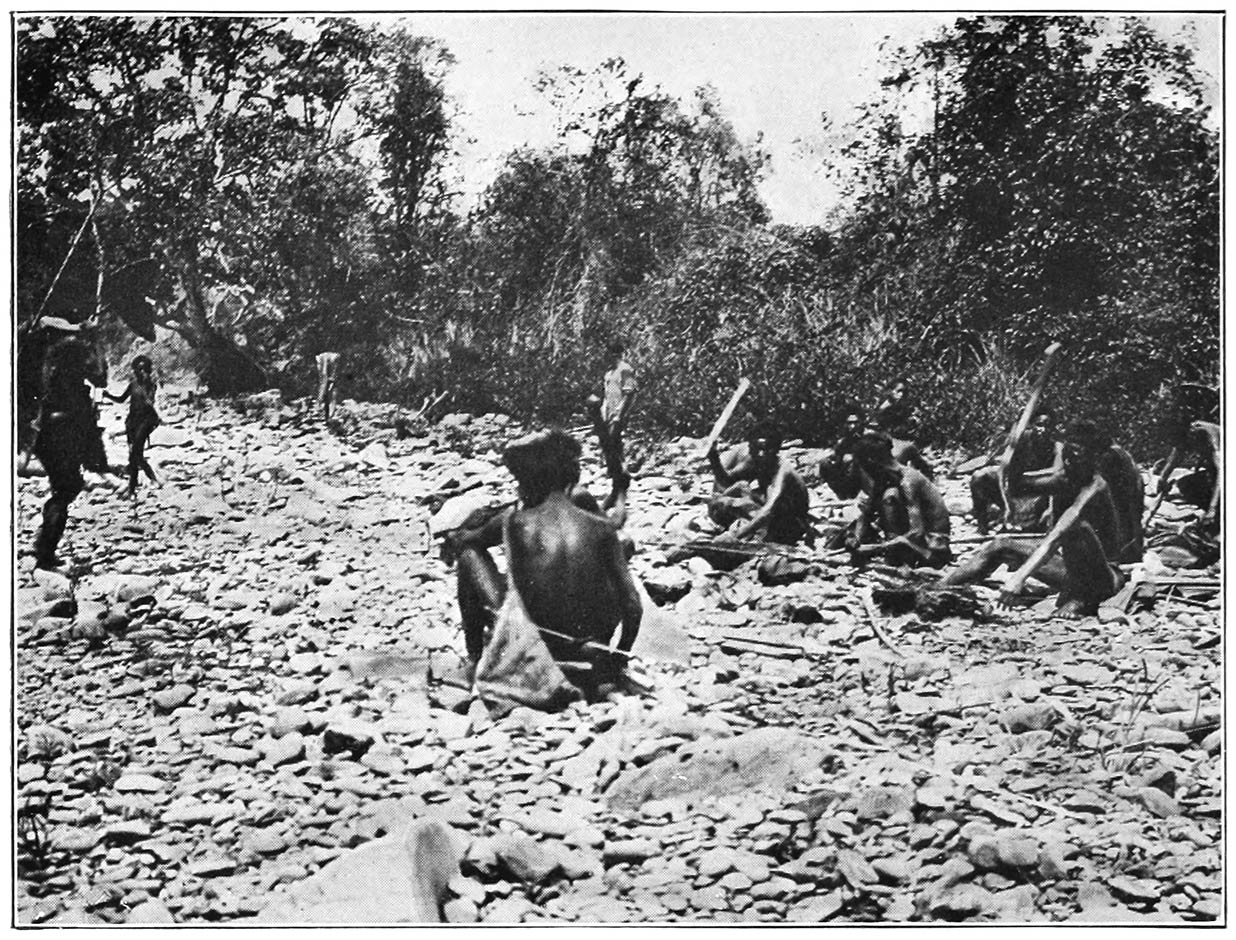
Fishing
Pounding the “poison” creeper on the bank.
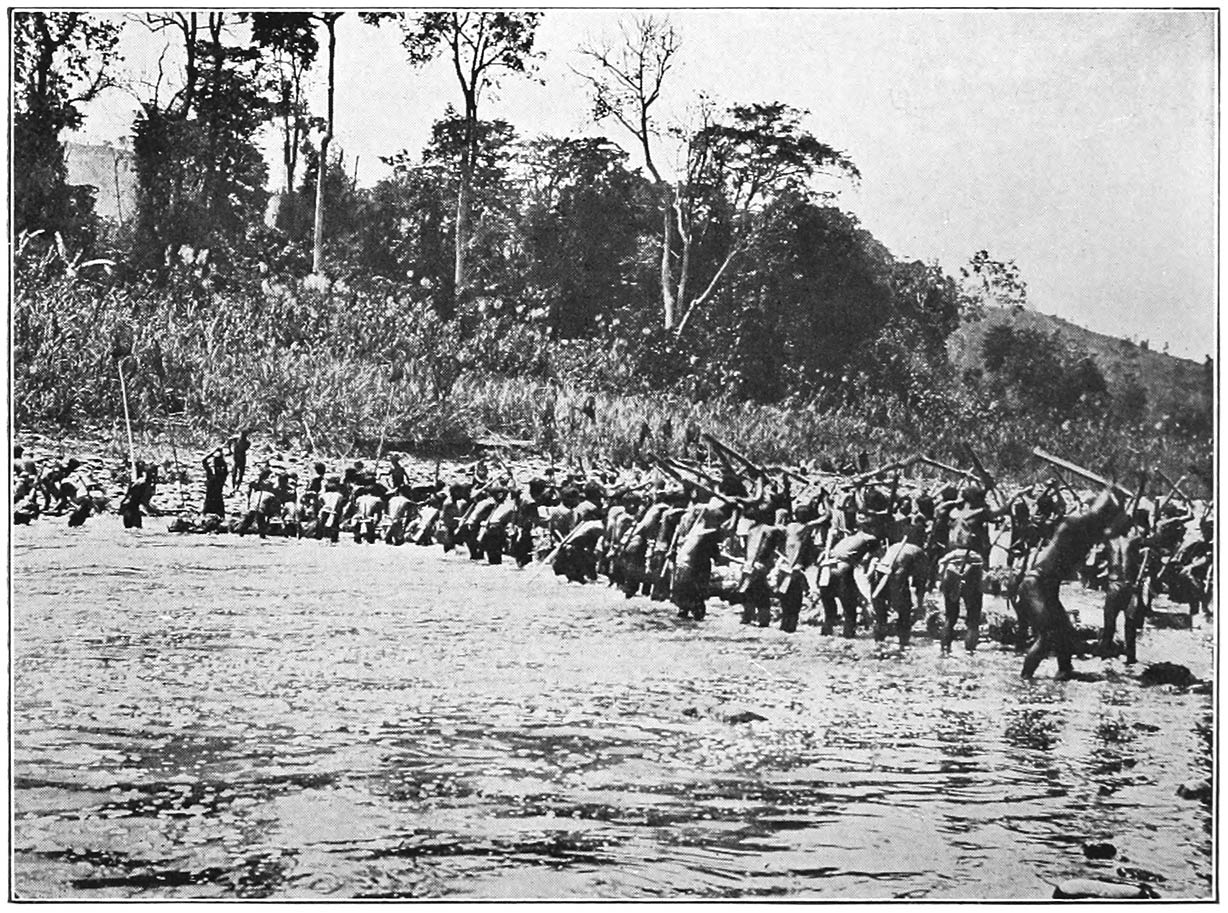
[To face p. 71.
Fishing
Pounding the “poison” into the water.
Food.
Rice is invariably cooked separately from the meat or whatever is to be eaten with it. Meat and vegetables are boiled together with a lavish allowance of chilies and salt. Practically all food is boiled, though maize is roasted and eaten cold and plantains are roasted in their skins. A very favourite relish is bamboo pickle (dhrüchong) made of the hearts of young bamboo shoots pounded up with water and then dried, and boiled again when required. Though the Lhota prefers his food fresh he will eat both meat and fish which is pretty far gone. The flesh, entrails, blood and skin of an animal are eaten—in fact, practically everything except the hair. The men who went to France with the Naga Labour Corps thought our method of cleaning an animal and throwing away the offal most wasteful. Meat is stored by cutting it into small pieces and smoking it over the fire. In this way it will keep for a year.
Drink.
To deprive a Lhota of his “madhu” (soko) would be like depriving a British workman of both his beer and tea. The Lhota only drinks water if he can get nothing else. He drinks “madhu” both at meals and between meals. It is made as follows. Rice is boiled in the ordinary way and spread on a mat to cool. A cake of yeast (vamhe) is then broken up and well mixed with it, and the rice put to ferment in a basket lined with leaves. Next day the liquor begins to run off and is collected in a bamboo “chunga.” This is zutsü (Assamese “rohi”), the most potent form of “madhu.” When new it is the colour of rather greenish water. If kept it will remain good for five or six months, gradually increasing in strength and turning a pale sherry colour. It is this form of “madhu” which is always offered to guests of importance. In some villages of the Northern Lhotas the rice is not put into a basket to ferment, but into a vat, a hollow section of bamboo being placed upright in it to collect the zutsü, which is allowed to drain off for three days. The fermented rice from which the zutsü has been drained off is put into a “madhu-sieve” (cham) and hot or sometimes cold water is poured on to it. It is well kneaded, and the resulting brew is chemcho (Assamese “saka madhu”), the usual Lhota drink, and is of about the potency of light beer. Sometimes, especially among the Southern Lhotas, millet, giant millet or Job’s tears, or a mixture of maize and rice, is used instead of rice for making “madhu.” The yeast is made as follows. Rice is ground into flour and wetted and kneaded into dough. To this a little old yeast is added, and either the water from crushed phyushako bark, or from the crushed leaves of yimerhe or shingwo. The dough with this added is again well kneaded and divided into cakes about the size of penny buns. These dry of themselves and remain good for six or seven months.
The mild form of rice beer called in Assamese “pita madhu,” which is so popular among the Angamis, is hardly made by the Lhotas except at harvest. A little unhusked rice is kept damp until it sprouts, and is then dried. Husked rice is ground into flour and put into a vat with hot water. Next day when it has become cold the dried sprouted rice is ground up and mixed with a little yeast and added to the water. This ferments and is ready for drinking next day. It is drunk diluted with water and is called etha soko.
Medicine.
Illness is generally ascribed to evil spirits (tsandhramo) or the wandering of the patient’s soul (omon), who accordingly calls in a medicine man (ratsen) to extract from his body the bit of earth or wood or hair which the evil spirit put there, or causes a ceremony to be performed to call back his soul. A few medicines are, however, known. Fat pork is eaten as an aperient. For an emetic, chicken dung and rat dung are whipped up with water and the mixture is drunk—probably as effective an emetic as any known to science. For diarrhœa the remedies are roasted goat’s hoof or the gall of either cow or pig. For stomach-ache and intestinal worms an infusion of the bark of nshitong (Stereospernum chelonoides) is drunk. For indigestion and stomach troubles in general a little of the dried upper stomach of the porcupine is ground up and taken mixed with water, or a poultice of wild lemon leaves (tsoshü) or the crushed leaves of Maesa indica (tsandhrammozü, lit. “devil’s medicine”) is put over the affected part. For a cough the green pentagonal-shaped berries of the yenkuti tree are chewed, or a berry called riko is ground up and taken with “rohi madhu.” The yenkuti berry is also used as a tonic for weak children. Bat’s flesh is another tonic for children whose mothers cannot suckle them properly. For headache the leaf of the kizu tree (Bischoffia javanica) is laid on the forehead. For wounds the commonest remedy is a poultice of the ground-up bark of young shoots of the nungnung tree (Callicarpa arborea roxb., fam. Verbenaceæ). This has the effect of stopping bleeding. The mashed-up leaves of the pontengcho tree have the same effect. A bush called temphak (Rhus semialata) provides two medicines. The juice of the berries is a cure for stomach-ache, and a cooling lotion for use in cases of chicken pox and smallpox is prepared from the pounded leaves. The gall of the python is said to cure fever and intestinal troubles. A lotion made from Taraktogenos kurzii (hmhmti) bark is used to disinfect wounds. If maggots get into a wound in an animal a mash of pounded giant woodlouse (sharhi) is applied. Soot (live) is applied for skin diseases. For burns the ash of the leaves of the woropentung tree is applied. For dog-bite a whisker of the dog which bit the man is singed and put on the wound. Another example of the “hair of the dog” is the practice of drinking very hot “rohi madhu” as a remedy for drunkenness. To bring a boil to a head a little yeast (vamhe) is damped and rubbed over it. When ready it is lanced with a sharp splinter of bamboo. To get rid of warts a black-and-yellow beetle called potso tsiro (“god’s mithan”) is crushed on them. This causes them to fester and disappear. Goître is not common except in Are. When it occurs it is regarded as being due to drinking water from a spring near which plants with bulbous roots grow. The only known remedy is to run a red-hot umbrella wire through the goître, but this heroic measure is rarely employed. Most sufferers prefer the disease to the cure. For soreness of the eyes the leaves of the mongsentung are crushed up and held to the face so that the fumes reach the eye. For a sprain of any kind the great remedy is to draw blood. In the case of slight sprains the affected place is scratched and made to bleed and a leech put on to suck. For more serious sprains or contusions the swelling is cupped. The instrument used is a serow horn. The base is smoothed down so that it will lie closely against the skin, and a small hole is bored near the tip of the horn, round which a thin, slightly withered leaf is wrapped. The skin is pricked with a splinter of bamboo and the horn being placed in position the blood is sucked up into it by the hole near the top. The thin leaf allows the air to be sucked from the interior of the horn, but acts as an efficient valve when the operator stops to take breath. This method of cupping is used for sprains, bruises and dropsy, in fact in any case where it is desired to reduce a swelling. In cases of snake-bite the limb affected is first tightly bound above the bite. An infusion of the bark of a tree called nungatsung is rubbed on the legs as a protection against leech-bites.
Drugs.
Home-grown tobacco is cured by drying the leaves in the sun for three or four days. They are then stamped and rolled with the feet and again dried. The result is a coarse-smoking tobacco, very hot to the tongue and difficult to keep alight. Hence the popularity of cheap cigarettes among boys nowadays. The short pipe (tsintsanmukukhu) is simply a short section of bamboo with a small bamboo tube stuck in the side of it, a few lines being sometimes scratched on the bowl by way of ornamentation. The big pipe (murimukukhu) is a more elaborate affair, with a bowl cut out of soft black stone and set in a wooden base forming one piece with the stem, which is bored with a hot iron and ends in a small bamboo mouth-piece. From the bowl a small bamboo tube some four inches long runs down through the wooden base into a section of bamboo about five inches long. This is detachable and is kept full of water when the pipe is in action. All the smoke is drawn through the water, which becomes nothing but very dirty diluted nicotine. This foul liquid is carefully kept and sipped now and again as a pick-me-up. If he does not take his big pipe with him when he goes down to his fields a man will often take a little gourd of this stuff. Though they are in such close touch with the plains, opium eating is unknown in Lhota villages, a great contrast with the Aos and Konyaks. Betel nut is chewed with “pan” and lime in the villages near the plains. Lime used to be made locally from the ground-up shells of freshwater snails, but is now bought in the plains.
Games.
Wrestling and running are not much indulged in, but both high jump (untsongeyen) and long jump (eyenda) are popular. For the former the competitors run straight at the jump and clear it with their feet together, the “scissor” style of jumping being unknown. A good jumper can clear a reed the height of his own chin. For the long jump a flat stone is put in position to take off from, and the mark which counts is that made by the jumper’s feet in landing, whether he falls backwards or not. For the “jump-and-kick” (nshü) the jumper makes a standing jump and while in the air kicks with both feet together at some mark such as a leaf stuck on the end of an upright spear. It is quite common for a man to be able to kick a mark as high above his head as he can reach with his hand. A variety of this (choanshü) is one in which the jumper takes a standing jump from one leg and kicks the mark with the foot from which he jumped—a most difficult feat. Putting the weight (olungeyen) is done either with one hand in the English manner or with both hands from above the head.
Tops (phiro) shaped like double cones are made of hard wood. The string is wound round one cone and the end held in the fingers. The top is then thrown either underhand or overhand and the string jerked back while it is still in the air. The object is to knock over someone else’s top which is already spinning. Tops are spun at and just after sowing time. The Changs attach some special significance to top-spinning. All indulge in the sport at and just after sowing, but a man who spins a top at any other time is fined by his fellow-villagers. Lhotas inflict no fine, but the custom is that tops should be spun only at the time mentioned. Another game, if game it can be called, is a competition to see who can eat most fat pork and salt. Toys are unknown, though little boys carry miniature bamboo spears in imitation of their fathers, and little girls carry sticks or stones wrapped in a cloth on their backs as mother carries the baby. Notches are often cut on the edges of the beds in the champo, and little boys play a game (ekhirandhapen) in which they say, “bom, bom,” as they touch each notch, beginning at the end of the line, the object being to see how far you can get without taking a fresh breath.
Music.
Besides songs, of which some account has been given in the section on language, the operations of reaping, threshing and carrying up the crop are accompanied by simple wordless chants. Only the proper chant which tradition sanctions may be sung. Were a man to use the wrong one, the reaping chant while threshing, for instance, the listening spirits of the fields (Rangsi) would be displeased and refuse him their blessings.
Daily Life.
The family get up before dawn, the wife being the first to blow up the fire, set the pot on to boil and open the door. After a meal all go down to the fields, taking with them “madhu,” cold rice and some cooked meat or vegetables. This the family eat while they take a short rest in the middle of the day in the field-house. The evening meal is eaten when they come back from the fields. After that it is soon time for bed. When the harvest is in there is less work, and men go away on short trading tours, or make up hunting parties, while the women stay at home and weave and gossip.