Part 1 — GENERAL
Reading edition
Introductory—Origin and Migrations—Appearance—Dress—Ornaments—Weapons—Character.
Origin and Migration.
Appearance.
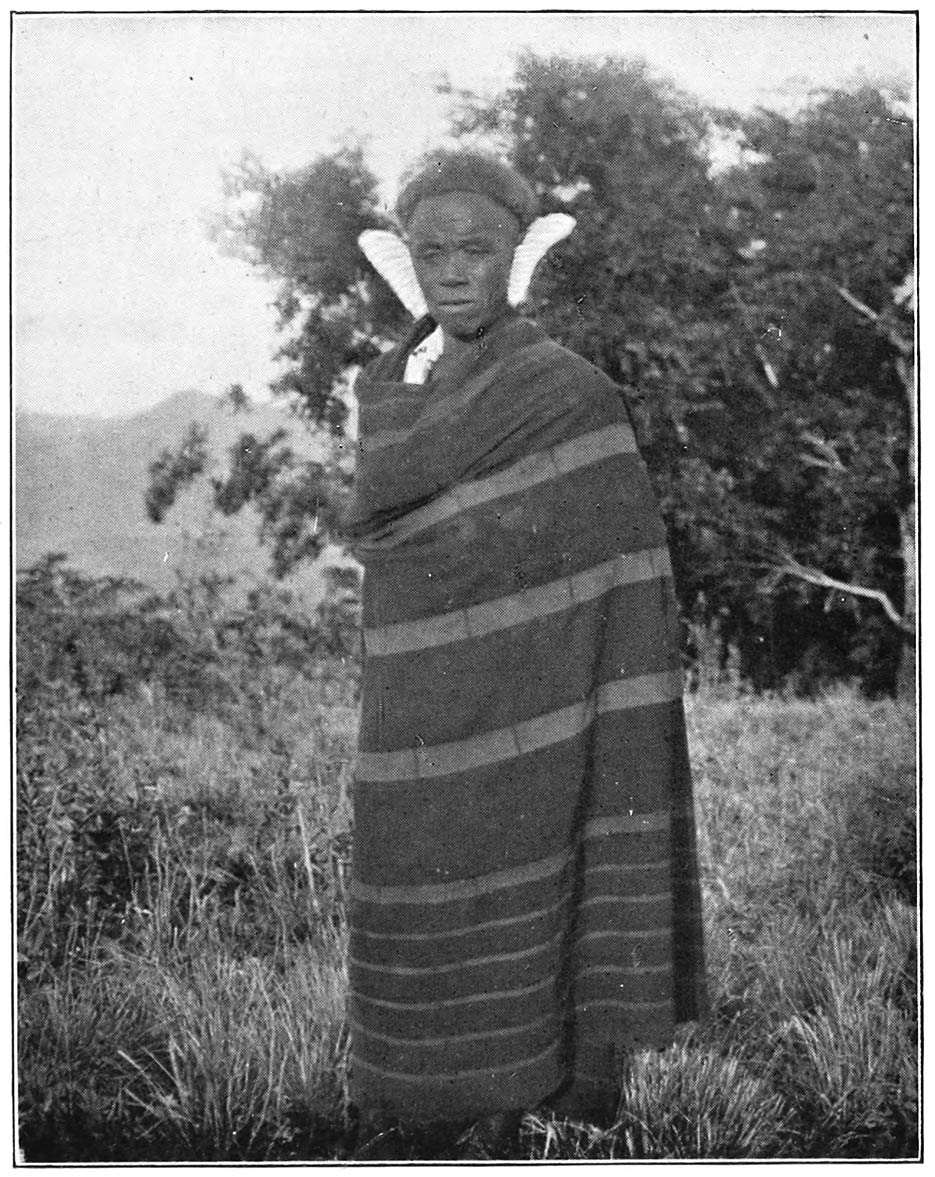
An elderly man of Lungitang wearing Lungpensü and big ear-pads
[To face p. 7.
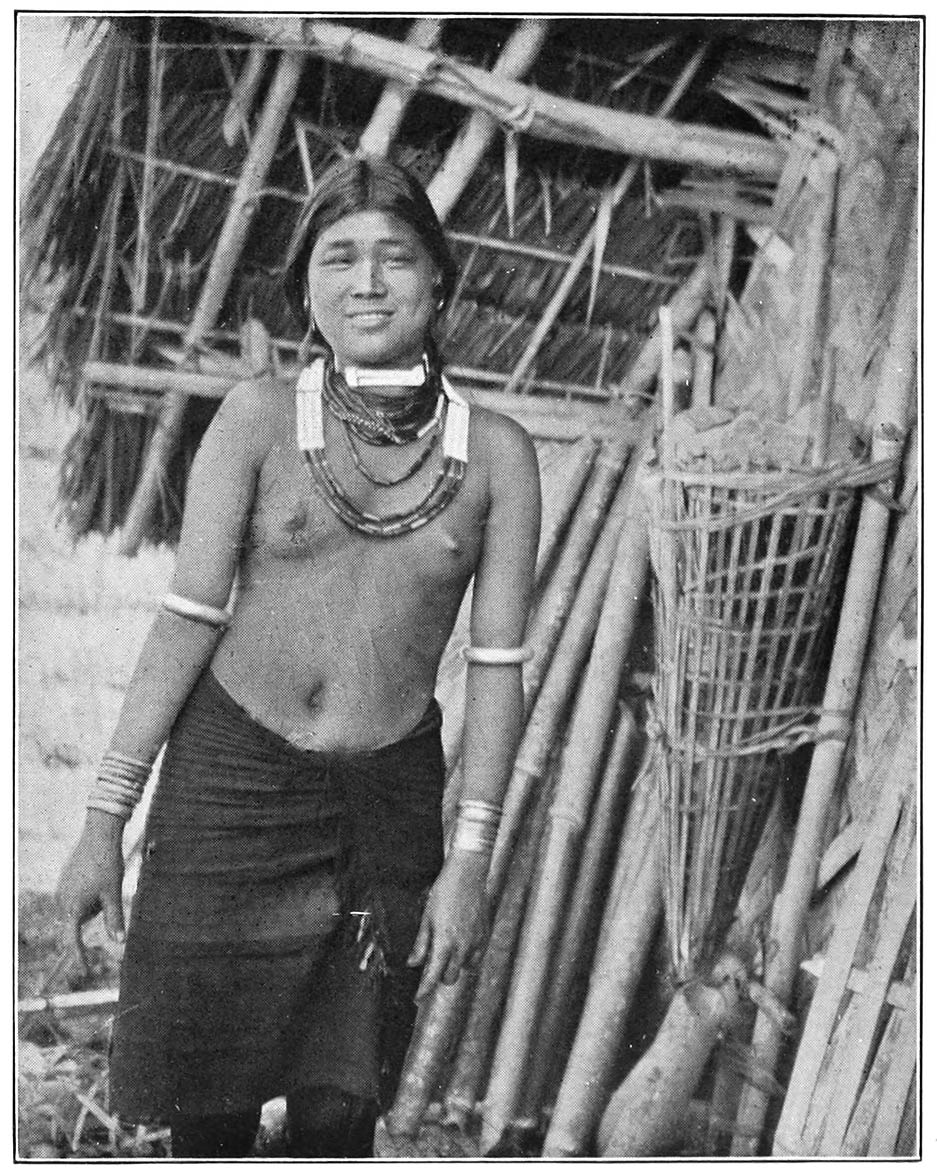
Young married woman (of Okotso)
Circumcision is not practised and neither sex is tattooed.
Dress.
Clothes. The one garment never discarded by a man in public is the rive, commonly spoken of in Naga-Assamese as “lengta.” This consists of a long narrow piece of stout cloth ending in a broad flap. In putting it on the narrow piece is wound once round the waist so that it joins at the back and forms a belt. It is then brought through between the legs from the back, and up through the belt, the broad flap being allowed to hang down in front. The result is a garment which is both serviceable and entirely decent. The flap is either white or dark blue, with horizontal red stripes, broad among the Northern Lhotas and narrow among the Southern. In the old days a dark blue rive could only be worn by a man who had done the head-taking “genna,” but this distinction is being rapidly dropped. A boy’s first garment, assumed without any ceremonies when about seven or eight years old, is the flap of one of his father’s discarded “lengtas” hung from a bit of string tied round his waist. The skirt (sürham) worn by the women is about twenty-two inches deep. It is bound tightly round the waist and the overlapping top corner tucked in in front of the left hip. The edge which shows is often ornamented with iridescent beetle wings or bits of yellow orchid stalk. Among the Northern Lhotas the sürham is of dark blue cloth with narrow horizontal red stripes in threes, and a band of paler blue embroidered with red three inches broad running round the middle of the cloth. The skirts worn by Southern women have no red stripes, and the pale blue band is broader and nearer the top of the cloth. When about five or six years old a little girl puts on her first skirt (khondrosü). This is about ten inches deep, white with a dark blue border and a little red embroidery in the middle.
When working in the fields, or in the hot weather even when lounging about at home, a man usually wears nothing but his “lengta.” When visiting his friends, however, or to sit about in the shade, or for a journey he always wears a body-cloth measuring about four feet by five feet. Usually such a cloth is simply wrapped round the body under the right armpit and over the left shoulder. But for any occupation such as hunting, where both arms must be left free, and whenever a cloth is worn at any “genna,” it is tied on to the body as follows: The cloth is flung over the back, and the two top corners are brought round, one under the left arm and the other over the right shoulder, and tied across the chest. The two bottom corners are then brought up outside the cloth which is hanging over the back, and crossed and tied on the chest, one passing over the left shoulder and the other under the right arm.
Drawing by Miss E. Paterson.] [To face p. 10.
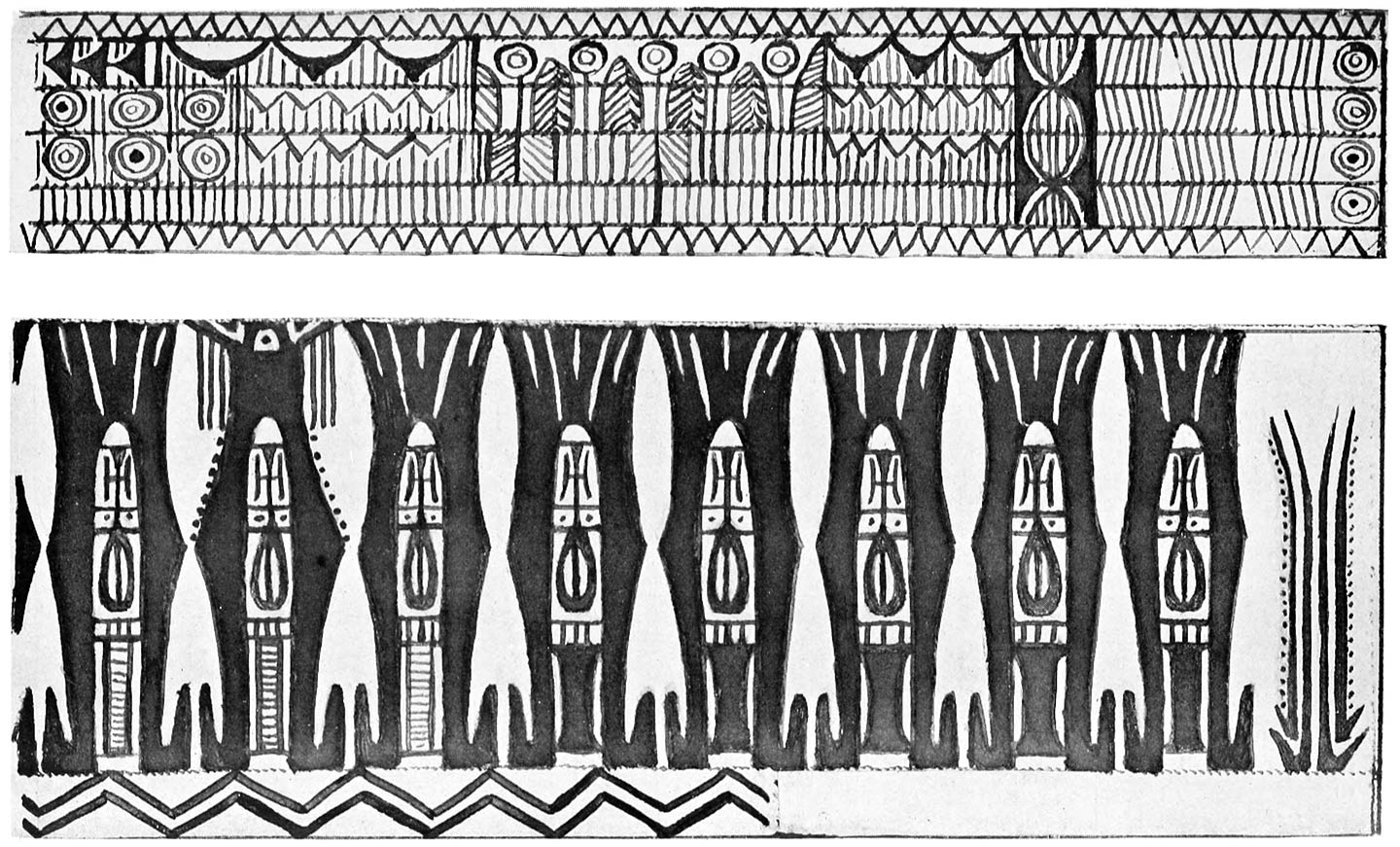
Ornamentation of Median Band of Rükhusü.
Top, Northern Lhotas. Bottom, Southern Lhotas. The former contains combination of mithan and human heads, and the latter represents a row of warriors in full dress.
Like the men, the women usually leave the upper part of the body bare, though filthy waistcoats are nowadays commonly worn by both men and women in villages near the plains. When body-cloths are worn by women they are either flung loosely round the body so that the top outer corner lies over the left shoulder, or bound tightly under the armpits. Among the Northern Lhotas an unmarried girl usually wears a plain dark blue cloth (muksü). On the night of her marriage, however, when she goes to her husband’s house, she puts on a very pretty cloth called loroesü, dark blue, with big squares of narrow white and red lines, giving a sort of tartan effect. When her husband has dragged a stone she may exchange her loroesü either for a lungpensü, which is almost exactly similar to his, or for a charaksü, a cloth closely resembling loroesü, but with the tartan squares outlined with much broader red lines. Among the Southern Lhotas unmarried women and wives of men who have not yet dragged a stone wear a cloth called süpang, dark blue, with a broad light blue horizontal band near the top. When her husband has dragged a stone a woman wears a lungpensü.
In wet weather men and women wear slung on their backs light rain-shields (phuchyo) made of broad leaves carefully arranged between two layers of basket work, and strengthened by an edging of thin split bamboo.
Ornaments.
The commonest form of necklace is one composed of four or five strings of black beads made from the seeds of the wild plantain (eshe). Sometimes they are worn loosely round the neck, and sometimes are in the form of a tight necklet, the rows being kept in place by narrow pierced conch-shell supports. These supports are sometimes bought from Angamis and sometimes prepared by the Lhotas themselves, with the aid of a primitive but effective pump-drill, with a point made from a piece of an old umbrella stay. To do the head-taking “genna” entitles a man to wear a neck ornament of one or two pairs of wild boar’s tushes (soho), with their bases bound with red cane, and fastened with a square conch-shell button with a cornelian bead in the middle.
The women’s ornaments are few and simple, and the magnificent strings of cornelian beads worn by Ao and Sema women are rarely seen among the Lhotas. In the lobe of the ear is some simple little ornament such as a bunch of the crest feathers of the kalij pheasant bound round with red wool or yellow orchid stalk. Round the neck the usual plantain seed necklace is worn, sometimes with a big conch-shell pendant (lakup) in front. Above each elbow is a thick round pewter armlet (tiwo), and on each wrist four or five small flat brass bracelets (rambam). The armlets and bracelets are bought ready-made from the plains.
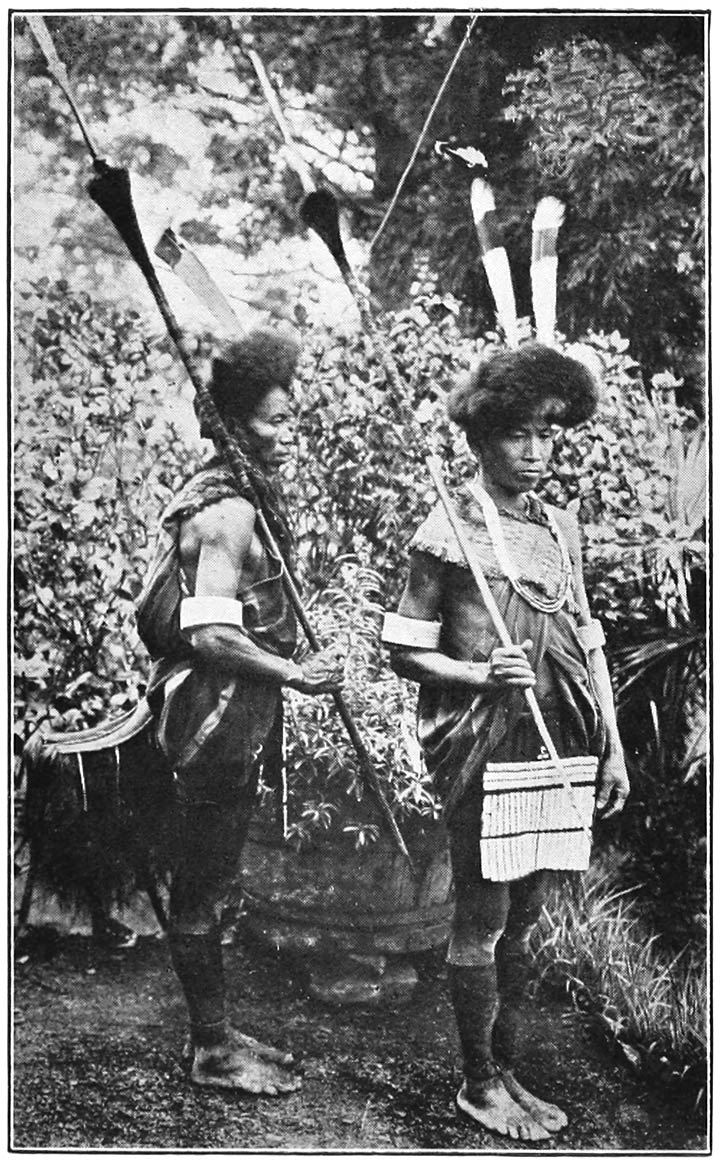
Photo by J. H. Hutton.]
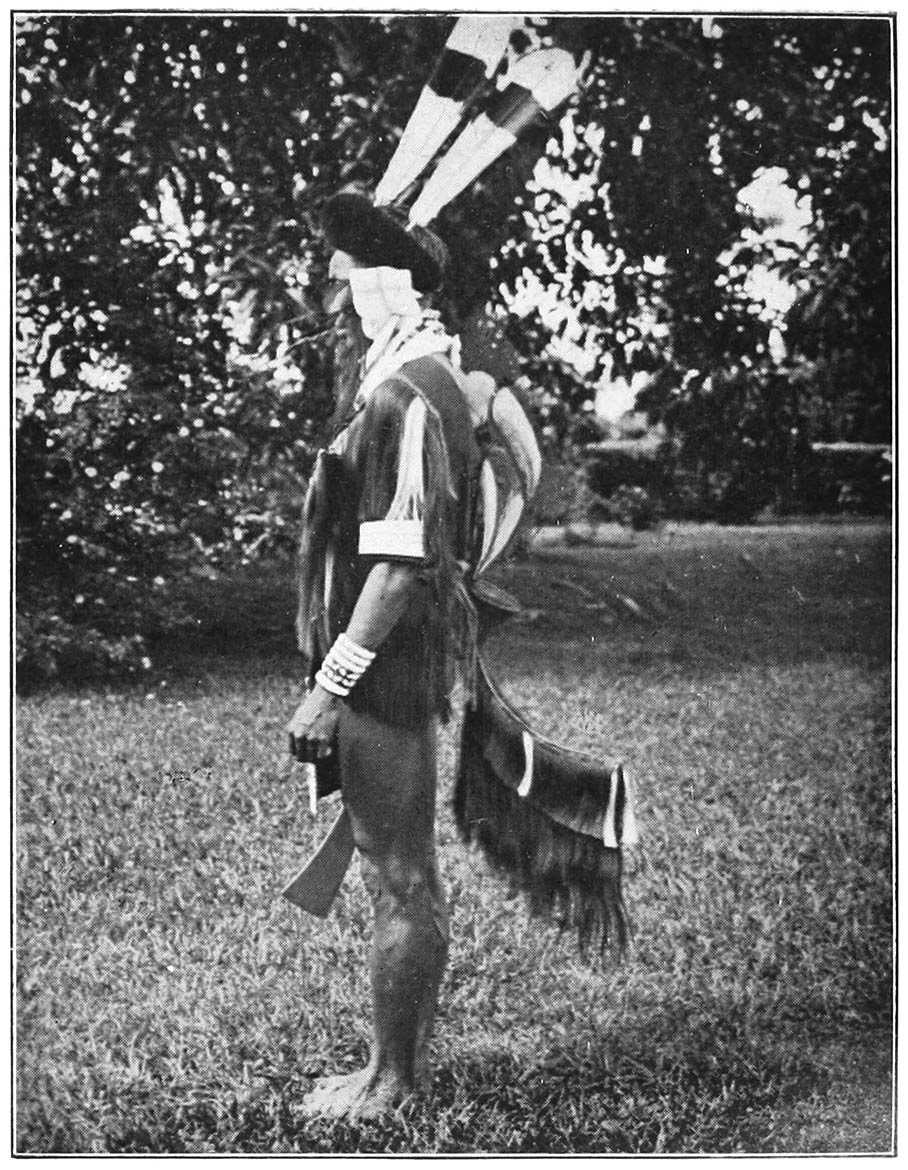
Southern Lhotas in Full Dress
Both are wearing leggings and gibbon hair wigs, and the one on the left is wearing a double tail.
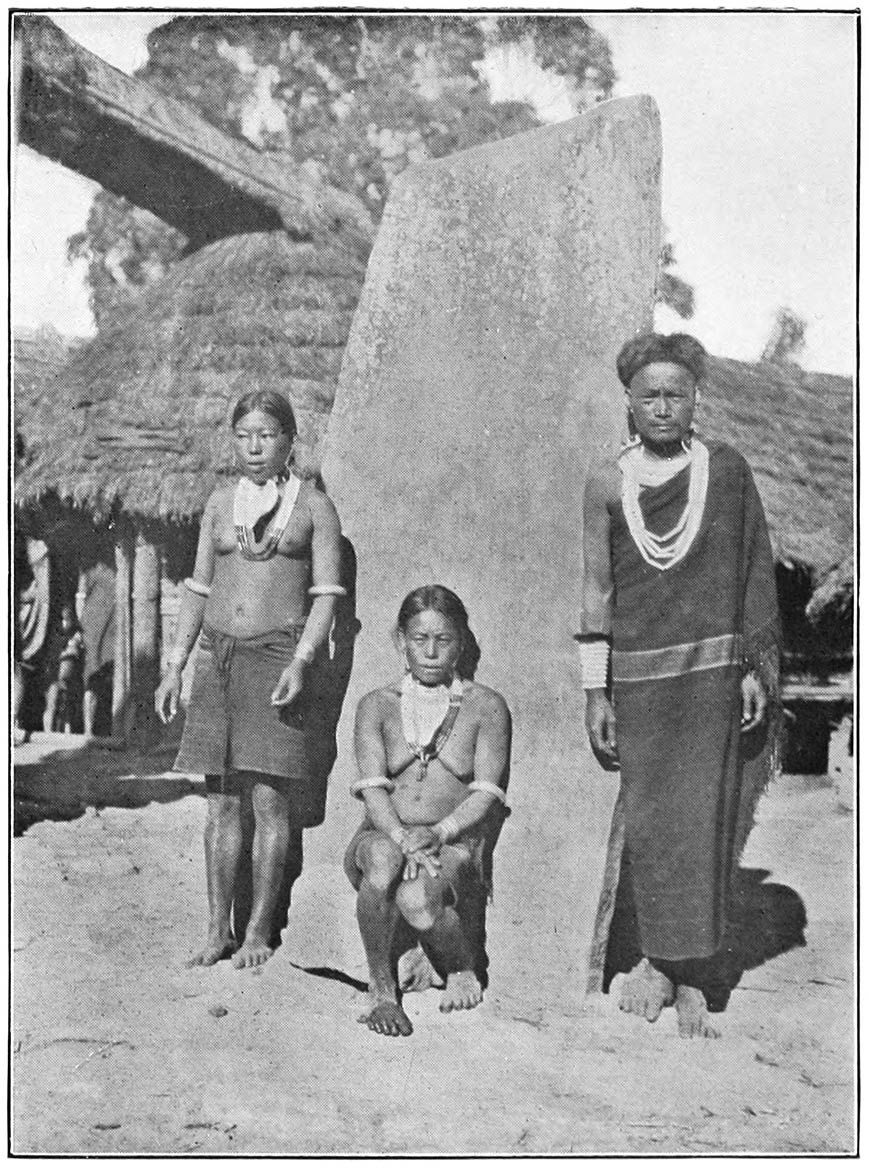
Photo by J. H. Hutton.] [To face p. 13.
Chamimo of Pangti
A Northern Lhota with his two wives standing by the stone he has dragged. He is wearing the cloth called rükhusü.
[To face p. 14
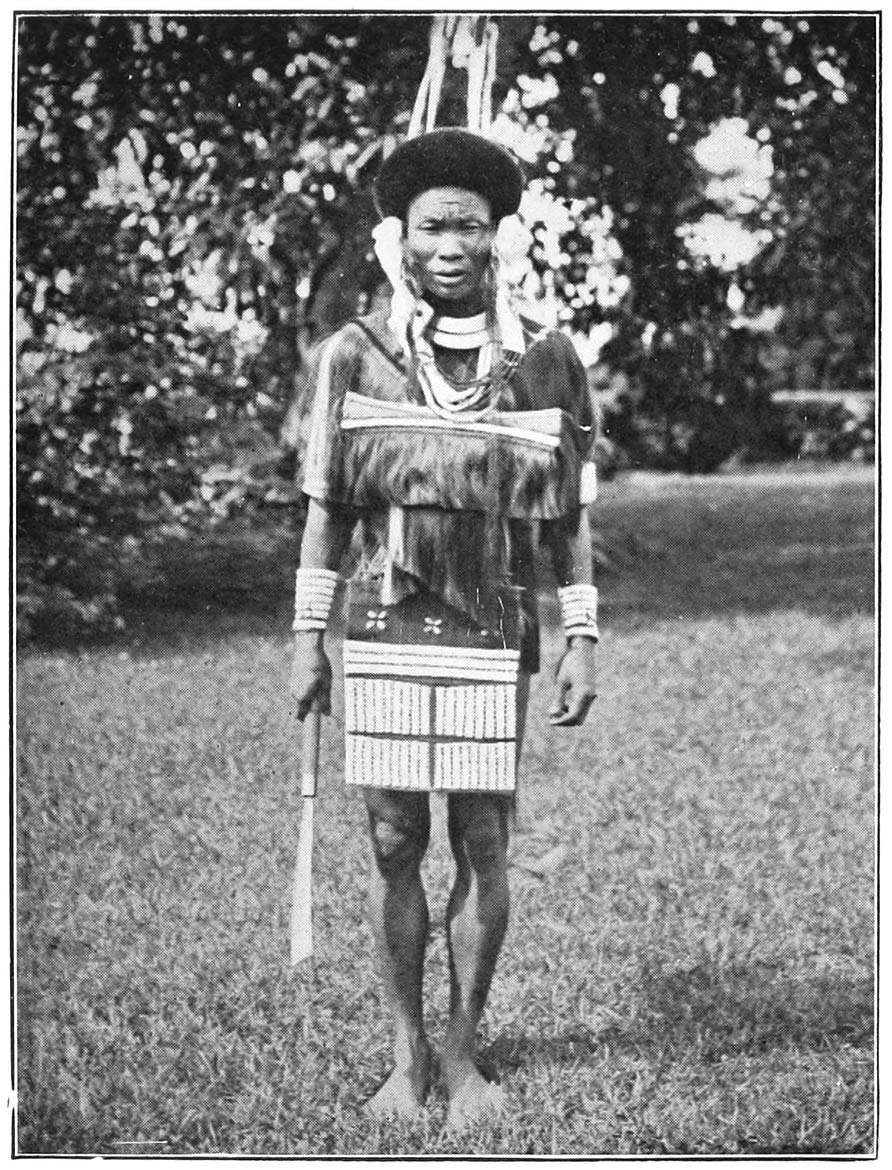
A Lhota Warrior in Full Dress
(Ranchamo of Seleku)
Weapons.
Easily first in importance is the dao (lepok), which is used for every variety of purpose. With it a Lhota can slay his enemy or cut up a chicken, fell a forest tree or pare down the finest strip of cane, dig a hole for a post or cut a thorn out of his foot. Villages near the plains usually buy their daos from Assamese smiths. These weapons consist of a straight-edged blade about twelve inches long, and four inches broad at the top, narrowing down to an inch or less at the haft, which is fitted into a bamboo handle tightly bound round with cane. Like all Naga daos the blade is ground on one side only, so that a perpendicular stake can only be cut by a downward blow from the right or upward blow from the left. The daos made by the Northern Lhotas are practically identical with those bought from the Assamese. Those made by the Southern Lhotas are far heavier weapons. The blade is about twelve inches long. At the top it is five inches broad, narrowing down to one and a half inches at the haft. Both edge and back are slightly curved and the junction of the edge and top is prolonged into a small beak.
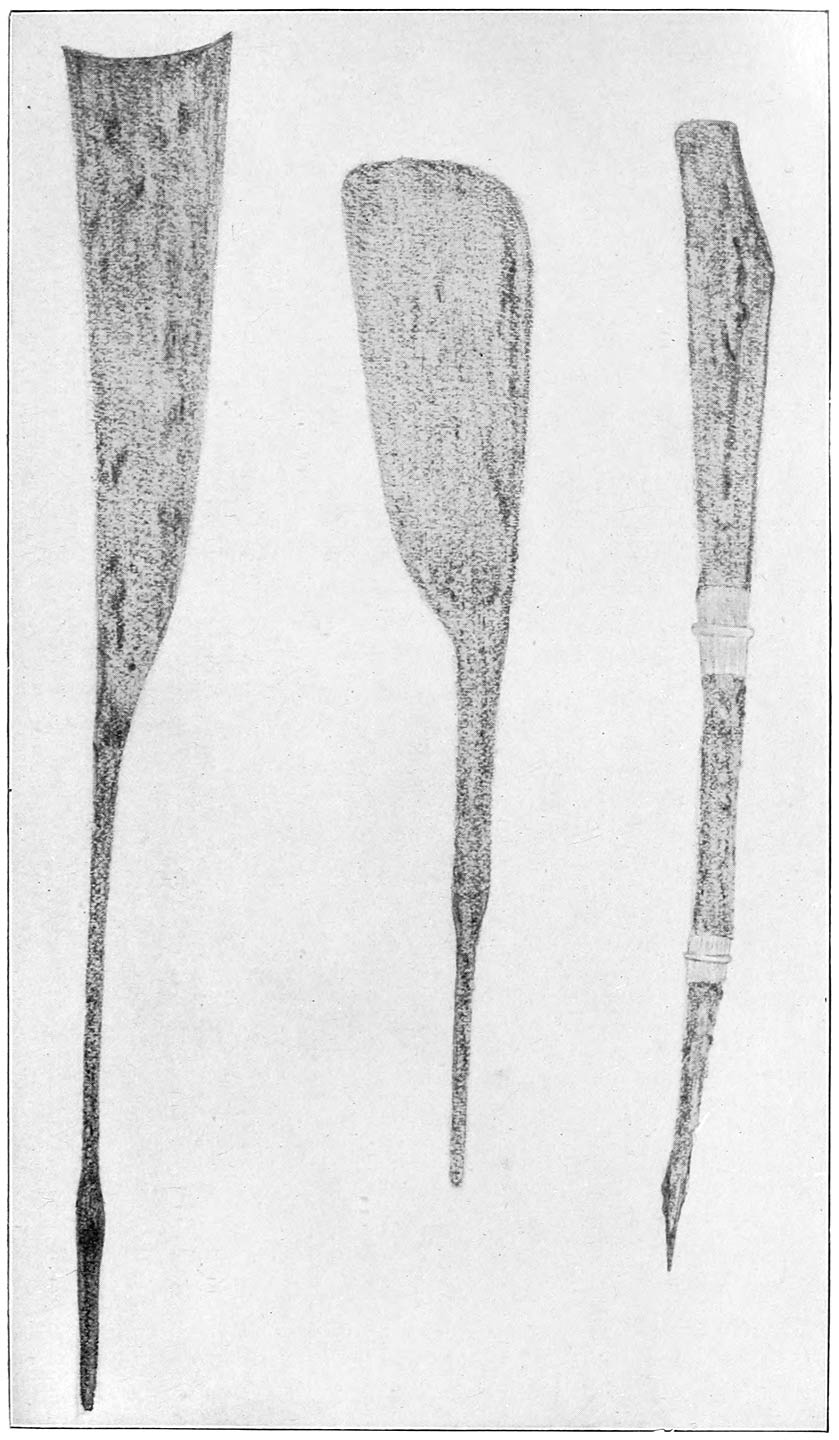
Drawing by J. H. Hutton.] [To face p. 16.
Types of obsolete daos (Yanthang)
Next in importance is the spear (otso), which is always thrown, and never used for thrusting, the extreme effective range being about thirty yards. The length of the whole weapon is usually about six feet or rather more. The favourite wood for the shaft is “nahor” (mesna ferrea), but palm and other woods are also used. The shaft is tightly fitted into a socket in the head without binding of any kind, and terminates in a sharp, socketed butt. No counterpoise is used. Occasionally spears are made of one piece of iron—head, shaft and butt. These are especially useful in tiger hunting, where the animal is liable to bite off the shaft of any spear that wounds him. Among the Northern Lhotas the blades are usually of the elongated lozenge type. They are both bought from the Aos and made locally. The Southern Lhotas usually buy Rengma-made blades of the Angami type, which are leaf-shaped with two short flanges at right-angles to the mid-rib. The average length of the blade is about ten inches, but on some ceremonial spears they may be seen up to two feet in length. A big blade with long barbs such as Angamis sometimes carry (noringtso) is occasionally used in Moilang and the neighbouring villages. There are several kinds of decorated shaft. That of the ceremonial spear (phui) carried by religious officials, such as the Puthi and Wokchungs, is covered throughout almost the whole of its length with long black goat’s hair. The doing of the head-taking “genna” entitles a man to carry a spear the shaft of which is ornamented with scarlet goat’s hair, bound on with string and then clipped short till it resembles very coarse velvet. If he has also been in at the death of a tiger there will be one or two narrow bands of black hair inserted in the scarlet. None of these red shafts are of Lhota manufacture. The northern section of the tribe buy theirs from the Aos, who in turn get them from the Changs. One type, called kamang, is only covered with red pile for about a foot of its length from the top. In the other type (chovemo) a space for the hand separates two long pieces of pile, the bottom one of which terminates in a deep fringe of red hair. The Rengmas supply the Southern Lhotas with their red shafts. One type, called tandhro, resembles kamang; another type is very like chovemo, but has no fringe and is called rophutung.
The cross-bow (olo) is still used for shooting birds and monkeys. The stock, made of hard wood, is about twenty-seven inches long, with a groove to keep the arrow in place. When strung the string, which is of twisted tchhütsang bark, catches in a piece of notched bone inserted in the stock near the butt. Underneath is a trigger, which on being pulled tips the string forward and releases it. The bow itself, which is about five feet long and tapered off at the ends, is usually made of bamboo. To be strung the bow has to be held on the ground with the foot with the stock pointing upwards, and the string pulled up to the notch with both hands. An arrow (lotsi) is then placed in the groove. The arrows are merely pointed slips of bamboo about a foot and a half long, with a little bit of “hair-brush palm” (shawo) or bamboo leaf-sheath fixed in a slit at the end as a feather. They are carried in a small bamboo quiver (lotsiphu). The weapon is amazingly effective up to about eighty yards. Poison is never used.
In the old days shields (otsung) were always carried in war and are still used at tiger and leopard hunts. Usually they are of strong bamboo twilled pattern matting, but hide shields (tsungkuk) are also used. Sometimes a piece of buffalo skin is simply cut to the right shape and dried in the sun, and sometimes a piece of bear skin is stretched over a bamboo matting foundation. Shields are of two types. Those of the Northern Lhotas are about four and a half feet long and twenty inches broad, with a rounded top and parallel sides. Those of the Southern Lhotas are of about the same length, but have a square top and are only some fourteen inches across at the bottom, broadening out to twenty inches at the top. In battle shields were always carried held well away from the body, for though they were not tough enough to turn a spear thrown directly at them, they would check any spear which pierced them sufficiently to prevent it reaching the body.
Stout cane war-helmets (kiven), about six inches high in the crown, are still worn by the Southern Lhotas as a protection for the head at tiger hunts, and also at dances, when they are often ornamented with serow horns. Among the Northern Lhotas only a very few now exist, and these, gorgeously ornamented, are only worn by Puthis and very senior warriors at the dance connected with the building of a new “morung.” They are covered with a coarse cloth made of scarlet dog’s hair, with long strings of the same material hanging down behind. On the covering are sown pairs of boar’s tushes, each pair forming a circle, while two long flat pieces of wild mithan horn, shaved down to the thickness of cardboard, fixed one on each side complete the effect.
Character.
Children as they grow up and marry leave their old parents to fend for themselves in what seems to us rather a heartless way, but at a pinch they are usually ready to help to support them. In this the Lhota stands midway between the Konyak, who regards it as one of his chief duties in life to live with and help his aged parents, and the Ao, who usually never thinks of supporting his old father or mother, and even if he does so turns him out at last to end his days in a miserable little hut, “lest he should defile the house by dying in it.” Towards animals the Lhota, like all Nagas, adopts a curiously inconsistent attitude. At times he will punish them cruelly as if expecting them to understand the difference between right and wrong. For instance, I heard of a Lhota who climbed a tree after a badly wounded monkey. The monkey clutched his hair, so he tore it loose and cut its hands off while it was still alive—“as a punishment,” he said. At other times animals are treated as if they were incapable of feeling pain. Frogs are often kept overnight with their legs broken to prevent their getting away, and old men look back with regret to the good old days when mithan at a sacrifice were beaten to death with sticks and the valuable hair of goats and dogs was plucked from the living animals. A remarkable trait in the Lhota character, wherein they differ from all other Nagas with whom I am acquainted, is the extraordinary readiness with which they commit suicide. Often the reason is trivial in the extreme. I have known a man hang himself because the elders of his village fined him fifteen rupees—a sum he could well afford to pay. Usually, however, a love affair is the cause, and cases of lovers, who for some reason cannot marry, taking poison together are common. Little though he knows or cares of the details of the life hereafter, the Lhota never doubts that there is such a life, and lovers die professing their sure faith that they will be united beyond the grave.