THOUGHTS AND MAXIMS.
Reading edition
Alas! how we are changed as we progress through the world! That breast becomes arid which once was open to every impression of the tender passion. The rattle of the dice-box beats out of the head the rattle of the quiver of Cupid; and the shuffling of the cards renders the rustling of his wings inaudible. The necessity of looking after a tablecloth supersedes that of looking after a petticoat; and we more willingly make an assignation with a mutton-chop than with an angel in female form. The bonds of love are exchanged for those of the conveyancer; bills take the place of billets; and we do not protest, but are protested against, by a three-and-sixpenny notary. Such are the melancholy effects of age.
⁂
There are few objects on which men differ so much as in regard to blue-stockings. I believe that the majority of literary men look upon them as entirely useless. Yet a little reflection will serve us to show the unphilosophical nature of this opinion. There seems, indeed, to be a system of exclusive appropriation in literature, as well as in law, which cannot be too severely reprobated. A critic of the present day cannot hear a young woman make a harmless observation on poetry or politics without starting; which start, I am inclined to think, proceeds from affectation, considering how often he must have heard the same remark made on former occasions. Ought the female sex to be debarred from speaking nonsense on literary matters any more than the men? I think not. Even supposing that such privilege was not originally conferred by a law of Nature, they have certainly acquired right to it by the long prescription. Besides, if commonplace remarks were not daily and nightly rendered more commonplace by continual repetition, even a man of original mind might run the hazard of occasionally so far forgetting himself and his subject as to record an idea which, upon more mature deliberation, might be found to be no idea at all. This, I contend, is prevented by the judicious interference of the fair sex.
⁂
Don’t marry any woman hastily at Brighton or Brussels without knowing who she is, and where she lived before she came there. And whenever you get a reference upon this or any other subject, always be sure and get another reference about the person referred to.
⁂
Don’t marry any woman under twenty; she is not come to her wickedness before that time; nor any woman who has a red nose at any age; because people make observations as you go along the street. “A cast of the eye”—as the lady casts it upon you—may pass muster under some circumstances; and I have even known those who thought it desirable; but absolute squinting is a monopoly of vision which ought not to be tolerated.
⁂
Don’t on any account marry a “lively” young lady; that is, in other words, a “romp”; that is, in other words, a woman who has been hauled about by half your acquaintance.
⁂
On the very day after your marriage, whenever you do marry, take one precaution. Be cursed with no more troubles for life than you have bargained for. Call the roll of all your wife’s even speaking acquaintance; and strike out every soul that you have—or fancy you ought to have—or fancy you ever shall have—a glimpse of dislike to. Upon this point be merciless. Your wife won’t hesitate—a hundred to one—between a husband and a gossip; and if she does, don’t you. Be particularly sharp upon the list of women; of course, men—you would frankly kick any one from Pall Mall to Pimlico who presumed only to recollect ever having seen her. And don’t be manœuvred out of what you mean by cards or morning calls, or any notion of what people call “good breeding.” ... Never dispute with her where the question is of no importance; nor, where it is of the least consequence, let any earthly consideration ever once induce you to give way.
⁂
Few pieces of cant are more common than that which consists in re-echoing the old and ridiculous cry of “variety is charming,” “toujours perdrix,” etc., etc., etc. I deny the fact. I want no variety. Let things be really good, and I, for one, am in no danger of wearying of them. For example, to rise every day about half after nine—eat a couple of eggs and muffins, and drink some cups of genuine sound, clear coffee—then to smoke a cigar or so—read the Chronicle—skim a few volumes of some first-rate new novel, or perhaps pen a libel or two in a slight sketchy vein—then to take a bowl of strong, rich, invigorating soup—then to get on horseback, and ride seven or eight miles, paying a visit to some amiable, well-bred, accomplished young lady, in the course of it, and chattering away an hour with her,
“Sporting with Amaryllis in the shade, Or with the tangles of Neœra’s hair,”
as Milton expresses it—then to take a hot-bath, and dress—then to sit down to a plain substantial dinner, in company with a select party of real good, honest, jolly Tories—and to spend the rest of the evening with them over a pitcher of cool Chateau-Margout, singing, laughing, speechifying, blending wit and wisdom, and winding up the whole with a devil, and a tumbler or two of hot rum-punch. This, repeated day after day, week after week, month after month, and year after year, may perhaps appear, to some people, a picture pregnant with ideas of the most sickening and disgusting monotony. Not so with me, however. I am a plain man. I could lead this dull course of uniform, unvaried existence for the whole period of the Millennium. Indeed, I mean to do so.
⁂
When a man is drunk, it is no matter upon what he has got drunk.
⁂
In whatever country one is, one should choose the dishes of the country. Every really national dish is good—at least, I never yet met with one that did not gratify my appetite. The Turkish pilaws are most excellent—but the so-called French cookery of Pera is execrable. In like manner, roast beef with Yorkshire pudding is always a prime feast in England, while John Bull’s Fricandeaux soufflées, etc., are decidedly anathema. What a horror, again, is a Bifsteck of the Palais Royal! On the same principle—(for all the fine arts follow exactly the same principles)—on the same principle it is, that while Principal Robertson, Dugald Stewart, Dr. Thomas Brown, and all the other would-be English writers of Scotland, have long since been voted tame, insipid, and tasteless diet, the real haggis-bag of a Robert Burns keeps, and must always keep, its place.
⁂
The next best thing to a really good woman is a really good-natured one. The next worst thing to a really bad man (in other words, a knave) is a really good-natured man (in other words, a fool).
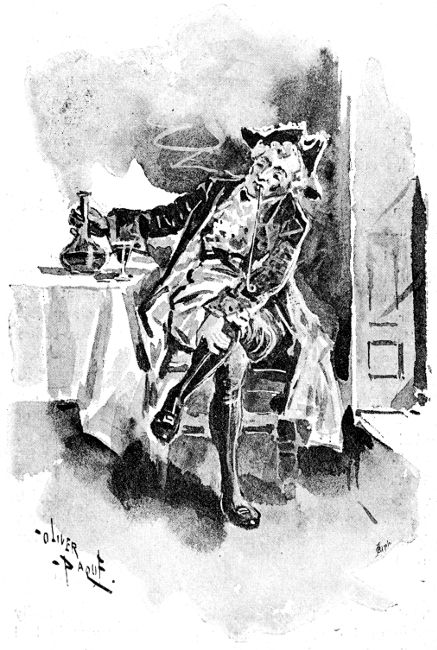
“WINDING UP THE WHOLE WITH A DEVIL, AND A TUMBLER OR TWO OF HOT RUM-PUNCH.”
A married woman commonly falls in love with a man as unlike her husband as is possible—but a widow very often marries a man extremely resembling the defunct. The reason is obvious.
⁂
If you meet with a pleasant fellow in a stage-coach, dine and get drunk with him, and, still holding him to be a pleasant fellow, hear from his own lips at parting that he is a Whig—do not change your opinion of the man. Depend on it, he is quizzing you.
⁂
The safety of women consists in one circumstance—men do not possess at the same time the knowledge of thirty-five and the blood of seventeen.
⁂
If prudes were as pure as they would have us believe, they would not rail so bitterly as they do. We do not thoroughly hate that which we do not thoroughly understand.
⁂
Few idiots are entitled to claver on the same form with the bibliomaniacs; but, indeed, to be a collector of anything, and to be an ass, are pretty nearly equivalent phrases in the language of all rational men. No one collects anything of which he really makes use. Who ever suspected Lord Spencer, or his factotum, little Dibdin, of reading? The old Quaker at York, who has a museum of the ropes at which eminent criminals have dangled, has no intention to make an airy and tassel-like termination of his own terrestrial career—for that would be quite out of character with a man of his brims. In like manner, it is now well known that the three thousand three hundred and thirty-three young ladies who figure on the books of the Seraglio have a very idle life of it, and that, in point of fact, the Grand Seignior is a highly respectable man. The people that collect pictures, also, are, generally speaking, such folk as Sir John Leicester, the late Angerstein, and the like of that. The only two things that I have any pleasure in collecting are bottles of excellent wine and boxes of excellent cigars—articles, of the first of which I flatter myself I know rather more than Lord Eldon does of pictures; and of the latter whereof I make rather more use than old Mustapha can be supposed to do of his 3333 knick-knacks in petticoats—or rather, I beg their ladyships’ pardon, in trousers.
⁂
As to the beautiful material adaptation of cold rum and cold water, that is beyond all praise, and indeed forms a theme of never-ceasing admiration, being one of Nature’s most exquisite achievements. Sturm has omitted it, but I intend to make a supplement to his Reflections when I get a little leisure.
William Maginn, LL.D.