RACKRENTERS ON THE STUMP.
Reading edition
A REMARKABLE DEMONSTRATION.
The first public meeting held under the auspices of the newly-formed Irish landlord organisation was held on Thursday last, in a field close by the charming residence of W. L. Cromwellian Freebooter, Esq., J.P., and is considered by all who took part in it to have been a great success. The Government gave the heartiest co-operation to the project; they undertook to supply the audience; they sent an engineer from the Royal Barracks, Dublin, to select a strategic site for the meeting, and to superintend the erection of the platform; and they offered any amount of artillery that might be considered requisite to give an imposing appearance to the assembly, and to inspire a feeling of confidence in the breasts of those who were to take part in it. All the police stations within a radius of thirty miles were ordered to send in contingents to form the body of the meeting, and a number of military pensioners were also directed to proceed to the spot and exert themselves in cheering the speakers. When the meeting was fully constituted it was calculated that there could hardly have been less than two hundred and fifty persons on the grounds.
At about one o’clock P.M. the carriages containing the noble lords and gentlemen who were to occupy the platform began to arrive at Freebooter Hall, where they set down the ladies of the party, who were to figure in the grand ball which was to be held there that evening. At 1.30 the noblemen and gentlemen proceeded to the scene of the meeting, and took their places on the platform, amidst the plaudits of the constabulary, which were again renewed in obedience to signals given by the sub-inspectors. The view from the platform, which was situated on a rising ground, was particularly fine. Some years ago a number of peasant homes and three considerable villages existed on the property; but Mr. Freebooter, being of opinion that they spoiled the prospect and tended to favour overpopulation in the country, had the people all evicted and their houses levelled to the ground. The wisdom and the good taste he had shown in this matter were highly praised by their lordships as they made their way up the carpeted steps leading to the platform, and took their seats on the chairs and sofas which had been placed there for their accommodation. The meeting having presented arms, it was moved by the Hon. Frederick Augustus Mightyswell, and seconded by George Famous Grabber, Esq., that the most noble the Marquis of Squanderall do take the chair.
The noble marquis said—My lords and gentlemen, I may say I thank you for having called me—that is, for the honour you have done me in having called me to have the honour of presiding over this, I may say, important meeting. (Cheers.) I have come over from London—I may say across the Channel—to have the honour of attending this meeting, because we all know these tenant fellows have been allowed to have this sort of thing too long to themselves. (Hear, hear, and cheers.) There have been, I may say, hundreds of these meetings, at which the fellows say they want to get their rents reduced, that their crops were short, that they must keep their families from starving, and all that sort of rot. How can we help it if their crops were short? (Hear, hear.) How can we help it if they have families to support? (Cheers.) The idiots talk about our rents being three or four times more than Griffith’s valuation; if that be so, I may say, more shame for the fellow Griffith, whoever he was. (Groans for Griffith.) Are we to be robbed because Griffith was an ass? (Cheers.) My lords and gentlemen, I shall not detain you longer—(cries of “Go on” from several sub-inspectors)—but will call upon, I may say, my eloquent friend, Lord Deliverus, who will propose the first resolution. (Loud and long-continued cheering from the constabulary.)
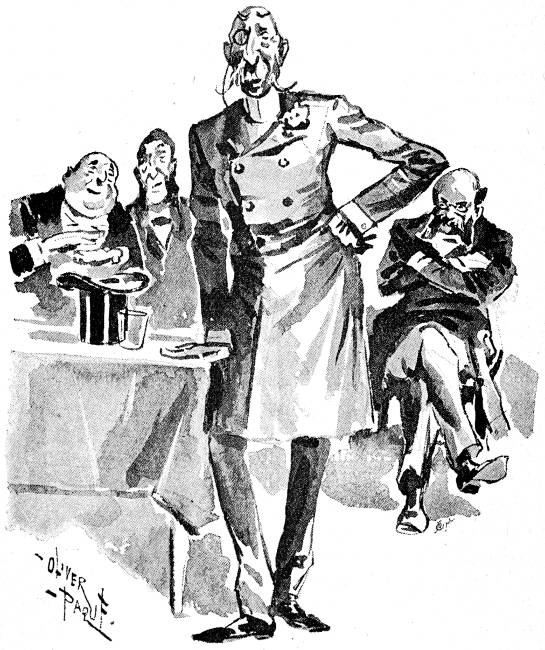
“MY ELOQUENT FRIEND, LORD DELIVERUS.”
Lord Deliverus—My dear Squanderall, my good friends, and other persons, you know I am not accustomed to this sort of thing, but I have been asked to propose the following resolution:—
“That we regret to notice that the unbounded prosperity which is being enjoyed by the small farmers and the labouring classes of Ireland is having a very bad effect on them, leading them into all sorts of extravagance, and producing among them an insolent and rebellious spirit, and that in the interest of morality and public safety we consider it absolutely necessary that the rents of the country shall be increased by about 100 per cent.”
Now, my friends, this is a resolution which must waken a sympathetic echo in the bosom of every rightly-constituted gentleman of property. Do we not all know, have we not all seen, the lamentable changes that have taken place in this country? Twenty years ago not half the population indulged in the luxury of shoes and stockings, and the labouring classes never thought of wearing waistcoats; now, most of them take care to provide themselves with these things. Where do they get the money to buy them but out of our rents? (True, true.) Twenty years ago they were satisfied if they could get a few potatoes to live upon each day, and a very good, wholesome, simple food they were for such people. (Hear, hear.) But latterly some bad instructors have got amongst them, and now the blackguards will not be contented unless they have rashers two or three times a week. (Oh, oh.) Where do they get the money for these rashers? (Voices—“Out of our rents.”) Yes, my friends, out of our rents. They rob us to supply themselves with delicacies of this kind. Eight or ten years ago we could bring up the fellows to vote for us; now they do as they like. (Groans.) And now the fellows say we must give them a reduction of their rents! (A voice—“Give them an ounce of lead.”) The rascals say they won’t starve. (Oh, oh, and groans.) They say they will feed themselves first, and then consider if they have anything to spare for us. (Shrieks and groans on the platform—Colonel Hardup faints.) They say the life of any one among them is just as precious as the life of any one of us. (Expressions of horror on all sides—Lord Tomnoddy looks unutterably disgusted, changes colour, puts his hand on his stomach, and retires hastily to the back of the platform.) My friends, I need not tell you that the Government is bound to put them down at any cost. (Tremendous cheering.) Just think what would result from any considerable reduction of our incomes; why, most of us might have to remain in this wretched country, for we would be ashamed to return in reduced circumstances to London and Paris; we should have fewer horses, fewer yachts, fewer servants, less champagne, less Italian opera, no rouge et noir—think, my friends, of the number of charming establishments from London to Vienna that would feel the shock. (Sobs and moans on the platform.) Would life be worth living under such circumstances? (No, no.) No, my lords and gentlemen, it would not; and therefore we are entitled to call upon the Government to interfere promptly and with a strong hand to stop the spread of those subversive theories that are now being taught to the lower classes in this country. (Great applause.)
A. D. Shoneen, Esq., J.P., came forward to second the resolution. He said—My lords and gentlemen, I feel that I need not add a word, even if I were able to do so, to the beautiful, the eloquent, the argumentative, the thrilling oration you have just heard from the estimable Lord Deliverus. I will not attempt to describe that magnificent performance in the language it deserves, for the task would far transcend my humble capacity. But I do think that this country should feel grateful—every country should feel grateful—the human race should feel grateful—to his lordship for the invaluable contribution he has made to the sum of our political philosophy in that address. I own I am moved almost to tears when I consider that the people whose conduct has excited such righteous indignation in the breast of his lordship, and so affected the epigastric region of that most amiable young nobleman, Viscount Tomnoddy—are my countrymen. I blush to make the confession, I am so overcome by my feelings that I am unable to do more than briefly second the resolution, which has been proposed to you in words that deserve to live for ever, and that mankind will not willingly let die. (The resolution was passed unanimously.)
Major Bearhead came forward to propose the next resolution, which was in the following terms:—“That, from the unlawful, rebellious, and revolutionary spirit which is now abroad, we deem it essential that a suspension of the Habeas Corpus Act shall at once be effected, that martial law shall be proclaimed in all disturbed districts, that all land agitators shall be at once arrested, and all tenant-right books, pamphlets, and newspapers shall be confiscated and suppressed.”
The gallant Major said—My lords and gentlemen, ahem! you may talk of resolutions, but this is the resolution that is wanted. Ahem! by the soul of Julius Cæsar, it is only such spirited measures that will ever settle this confounded Irish trouble. Ahem! the fellows want reductions—by the boots of the immortal Wellington, I would reduce them with grape and canister; that’s the reduction I would give them! Thunder and lightning—ahem! thunder and lightning! to think that these agitating fellows have been going about the country these twelve months, and not one of them shot, sabred, or hanged yet! Two or three fellows were put under a sort of sham arrest, and I am told they are to be tried; trial be damned, I say. Ahem! a drum-head court-martial is the sort of trial for them. No fear they would ever trouble the country afterwards. Let the Horse-Guards only send me word, “Bearhead, you settle with these people,” and see how soon I’d do it. (Cheers.) By all the bombshells in Britain, I’d have the country as quiet as a churchyard in two months. That is enough for me to say—ahem! (Great cheering.)
The Hon. Charles Edward Algernon Featherhead, in seconding the resolution, said—My lords, ladies, and gentlemen—oh, I really forgot that the ladies are not present, which I take to be a dooced pity, for, as the poet says, “Their smiles would make a summer”—oh, yes, I have it—“where darkness else would be.” (Applause.) I can’t say I know much about these blooming agricultural matters, for on my word of honour I always looked on them as a low, vulgar sort of thing, and all my set of fellows do just the same; but my old governor wished me to come here and take part in the proceedings, and I have a little reason for wishing to humour him just now. But, as I was saying, I don’t see how any sort of fun can go on if we are not to get money from these farming fellows. It may be very true that oats were not worth digging this season, and that potatoes were very short in the straw and very light in the ear; but then, on the other hand, was there not a plentiful supply of cucumbers? (Cheers.) We hear a great deal about American importations, but it seems to me that’s the jolliest part of the whole thing, because surely the farming fellows can’t want to eat the American food and the Irish food both together. Let them eat the Yankee stuff, and then sell the Irish and give us the money, and there’s the whole thing settled handsomely. It’s their confounded stupidity that prevents them seeing this plain and simple way of satisfying themselves and us. For, as the poet says, “Is there a heart that never loved?”—no, that’s not it—“When the wine-cup is circling before us”—no, I forget what the poet said, but no matter: I beg to say that I highly approve of the toast which has just been proposed. (The resolution was carried unanimously.)
Sir Nathaniel H. Castlehack wished to offer a few remarks before the close of the meeting. It appeared to him that the tone of some of the speakers had not shown quite as much confidence in the Government as in his opinion they deserved. I do not think (said the speaker) that the arrests which have been referred to were at all intended to be a flash in the pan, for I have reason to know that at this moment the jury panels are being carefully looked after by the authorities—(good, good)—and I think I may say to the gallant major who has just preceded me, and whose zeal for the public cause we all must recognise and admire, that if he will only exercise to some extent the virtue of patience, and allow things to take their regular course, he will probably ere long have the opportunity which he desires for again distinguishing himself and rendering the State some service.... Don’t be afraid, my friends; rely with confidence on the Government; they will give to this unreasonable and turbulent people everything but what they want.
A scene of immense enthusiasm followed these remarks. The gentlemen on the platform embraced each other; the band of the 33rd Dragoons struck up “God save the Queen,” and the constabulary fired a feu de joie. The meeting was then put through some evolutions, which they performed in brilliant style, after which they broke into sections and marched off to their different stations. Their lordships and the gentry then proceeded to their carriages, and drove off to Freebooter Hall. They expressed themselves highly pleased with the results of the demonstration, and stated that similar meetings would soon be held in various parts of the country.
T. D. Sullivan (1827).