JACK LOFTY.
Reading edition
Scene—Croaker’s House.
Present—Mrs. Croaker and Lofty.
Enter Lofty, speaking to his servant.
Lofty. And if the Venetian ambassador, or that teasing creature, the marquis, should call, I am not at home. D— me, I’ll be a pack-horse to none of them. My dear madam, I have just snatched a moment—and if the expresses to his Grace be ready, let them be sent off; they’re of importance. Madam, I ask a thousand pardons.
Mrs. C. Sir, this honour——
Lofty. And, Dubardieu, if the person calls about the commission, let him know that it is made out. As for Lord Cumbercout’s stale request, it can keep cold; you understand me. Madam, I ask ten thousand pardons. And, Dubardieu, if the man comes from the Cornish borough, you must do him—you must do him, I say. Madam, I ask you ten thousand pardons—and if the Russian ambassador calls—but he will scarce call to-day, I believe. And now, madam, I have just got time to express my happiness in having the honour of being permitted to profess myself your most obedient humble servant.
Mrs. C. Sir, the happiness and honour are all mine; and yet, I am only robbing the public while I detain you.
Lofty. Sink the public, madam, when the fair are to be attended. Ah! could all my hours be so charmingly devoted! Thus it is eternally: solicited for places here; teased for pensions there; and courted everywhere. I know you pity me.
Mrs. C. Excuse me, sir. “Toils of empires, pleasures are,” as Waller says——
Lofty. Waller, Waller! Is he of the house?
Mrs. C. The modern poet of that name, sir.
Lofty. Oh, a modern! We men of business despise the moderns; and as for the ancients, we have no time to read them. Poetry is a pretty thing enough for our wives and daughters; but not for us. Why, now, here I stand, that know nothing of books; and yet, I believe, upon a land-carriage fishery, a stamp act, or a jaghire, I can talk my two hours without feeling the want of them.
Mrs. C. The world is no stranger to Mr. Lofty’s eminence in every capacity.
Lofty. I am nothing, nothing, nothing in the world; a mere obscure gentleman. To be sure, indeed, one or two of the present ministers are pleased to represent me as a formidable man. I know they are pleased to bespatter me at all their little dirty levees; yet, upon my soul, I don’t know what they see in me to treat me so! Measures, not men, have always been my mark; and I vow, by all that’s honourable, my resentment has never done the men, as mere men, any manner of harm; that is, as mere men.
Mrs. C. What importance! and yet, what modesty!
Lofty. Oh, if you talk of modesty, madam, there, I own, I am accessible to praise; modesty is my foible. It was so the Duke of Brentford used to say of me, “I love Jack Lofty,” he used to say; “no man has a finer knowledge of things, quite a man of information, and when he speaks upon his legs, by the lord, he’s prodigious! He scouts them. And yet all men have their faults,—too much modesty is his,” says his Grace.
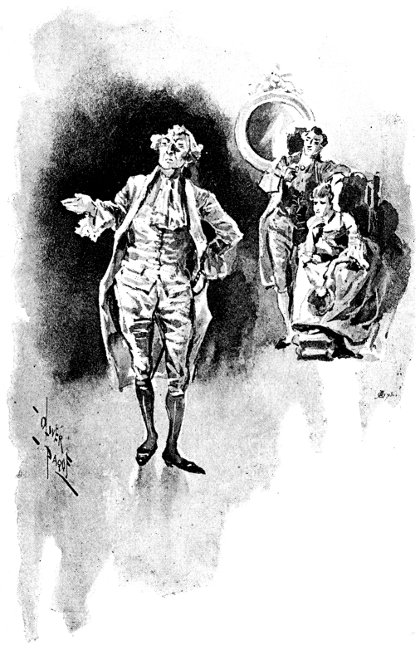
“I CAN TALK MY TWO HOURS WITHOUT FEELING THE WANT OF THEM.”
Mrs. C. And yet, I dare say, you don’t want assurance when you come to solicit for your friends.
Lofty. Oh, there, indeed, I’m in bronze! Apropos, I have just been mentioning Miss Richland’s case to a certain personage; we must name no names. When I ask, I am not to be put off, madam. No, no; I take my friend by the button: a fine girl, sir; great justice in her case. A friend of mine. Borough interest. Business must be done, Mr. Secretary. I say, Mr. Secretary, her business must be done, sir. That’s my way, madam.
Mrs. C. Bless me! You said all this to the Secretary of State, did you?
Lofty. I did not say the Secretary, did I? Well, curse it! since you have found me out, I will not deny it. It was to the Secretary.
Mrs. C. This was going to the fountain-head at once; not applying to the understrappers, as Mr. Honeywood would have had us.
Lofty. Honeywood! he, he! He was, indeed, a fine solicitor. I suppose you have heard what has just happened to him?
Mrs. C. Poor, dear man! no accident, I hope.
Lofty. Undone, madam, that’s all. His creditors have taken him into custody. A prisoner in his own house.
Mrs. C. A prisoner in his own house? How! I am quite unhappy for him.
Lofty. Why, so am I. This man, to be sure, was immensely good-natured; but, then, I could never find that he had anything in him.
Mrs. C. His manner, to be sure, was excessive harmless; some, indeed, thought it a little dull. For my part, I always concealed my opinion.
Lofty. It can’t be concealed, madam, the man was dull; dull as the last new comedy. A poor, impracticable creature! I tried once or twice to know if he was fit for business; but he had scarce talents to be groom-porter to an orange-barrow.
Mrs. C. How differently does Miss Richland think of him; for, I believe, with all his faults, she loves him.
Lofty. Loves him! Does she? You should cure her of that, by all means. Let me see, what if she were sent to him this instant, in his present doleful situation? My life for it, that works her cure. Distress is a perfect antidote to love. Suppose we join her in the next room? Miss Richland is a fine girl, has a fine fortune, and must not be thrown away. Upon my honour, madam, I have a regard for Miss Richland; and rather than she should be thrown away, I should think it no indignity to marry her myself.
[Exeunt.
Scene—Young Honeywood’s House.
Present—Sir William Honeywood and Miss Richland.
Sir W. Do not make any apologies, madam. I only find myself unable to repay the obligation. And yet, I have been trying my interest of late to serve you. Having learned, madam, that you had some demands upon Government, I have, though unasked, been your solicitor there.
Miss R. Sir, I am infinitely obliged to your intentions; but my guardian has employed another gentleman, who assures of success.
Sir W. Who? The important little man that visits here? Trust me, madam, he’s quite contemptible among men in power, and utterly unable to serve you. Mr. Lofty’s promises are much better known to people of fashion than his person, I assure you.
Miss R. How have we been deceived! As sure as can be, here he comes.
Sir W. Does he? Remember, I am to continue unknown; my return to England has not as yet been made public. With what impudence he enters!
Enter Lofty.
Lofty. Let the chariot—let my chariot drive off; I’ll visit his Grace’s in a chair. Miss Richland here before me! Punctual, as usual, to the calls of humanity. I am very sorry, madam, things of this kind should happen, especially to a man I have shown everywhere, and carried amongst us as a particular acquaintance.
Miss R. I find, sir, you have the art of making the misfortunes of others your own.
Lofty. My dear madam, what can a private man like me do? One man can’t do everything—and, then, I do so much in this way every day. Let me see: something considerable might be done for him by subscription; it could not fail if I carried the list. I’ll undertake to set down a brace of dukes, two dozen lords, and half the lower house, at my own peril.
Sir W. And, after all, it is more than probable, sir, he might reject the offer of such powerful patronage
Lofty. Then, madam, what can we do? You know, I never make promises. In truth, I once or twice tried to do something with him in the way of business; but, as I often told his uncle, Sir William Honeywood, the man was utterly impracticable.
Sir W. His uncle! Then that gentleman, I suppose, is a particular friend of yours?
Lofty. Meaning me, sir? Yes, madam; as I often said, “My dear Sir William, you are sensible I would do anything, as far as my poor interest goes, to serve your family;” but what can be done? There’s no procuring first-rate places for ninth-rate abilities.
Miss R. I have heard of Sir William Honeywood; he’s abroad in employment; he confided in your judgment, I suppose.
Lofty. Why, yes, madam; I believe Sir William had some reason to confide in my judgment; one little reason, perhaps.
Miss R. Pray, sir, what was it?
Lofty. Why, madam—but let it go no further; it was I procured him his place.
Sir W. Did you, sir?
Lofty. Either you or I, sir.
Miss R. This, Mr. Lofty, was very kind, indeed.
Lofty. I did love him; to be sure, he had some amusing qualities; no man was fitter to be toast-master to a club, or had a better head.
Miss R. A better head?
Lofty. Ay, at a bottle. To be sure, he was as dull as a choice spirit; but hang it, he was grateful—very grateful; and gratitude hides a multitude of faults.
Sir W. He might have reason, perhaps. His place is pretty considerable, I am told.
Lofty. A trifle, a mere trifle among us men of business. The truth is, he wanted dignity to fill up a greater.
Sir W. Dignity of person, do you mean, sir? I am told he is much about my size and figure, sir.
Lofty. Ay; tall enough for a marching regiment, but then he wanted a something; a consequence of form; a kind of a—I believe the lady perceives my meaning.
Miss R. Oh, perfectly; you courtiers can do anything, I see.
Lofty. My dear madam, all this is but a mere exchange; we do greater things for one another every day. Why as thus, now, let me suppose you the First Lord of the Treasury, you have an employment in you that I want; I have a place in me that you want; do me here, do you there; interest of both sides, few words, flat, done and done, and it’s over.
Sir W. A thought strikes me. (Aside.) Now you mention Sir William Honeywood, madam, and as he seems, sir, an acquaintance of yours, you’ll be glad to hear he’s arrived from Italy; I had it from a friend who knows him as well as he does me, and you may depend on my information.
Lofty. The devil he is. (Aside.)
Sir W. He is certainly returned; and as this gentleman is a friend of yours, you can be of signal service to us, by introducing me to him; there are some papers relative to your affairs that require despatch and his inspection.
Miss R. This gentleman, Mr. Lofty, is a person employed in my affairs; I know you will serve us.
Lofty. My dear madam, I live but to serve you. Sir William shall even wait upon him, if you think proper to command it.
Sir W. That would be quite unnecessary.
Lofty. Well, we must introduce you, then. Call upon me—let me see—ay, in two days.
Sir W. Now, or the opportunity will be lost for ever.
Lofty. Well, if it must be now, now let it be. But, d—n it, that’s unfortunate; my Lord Grig’s cursed Pensacola business comes on this very hour, and I’m engaged to attend—another time——
Sir W. A short letter to Sir William will do.
Lofty. You shall have it; yet, in my opinion, a letter is a very bad way of going to work; face to face, that’s my way.
Sir W. The letter, sir, will do quite as well.
Lofty. Zounds, sir! do you pretend to direct me—direct me in the business of office? Do you know me, sir? Who am I?
Miss R. Dear Mr. Lofty, this request is not so much his as mine; if my commands—but you despise my power.
Lofty. Sweet creature! your commands could even control a debate at midnight; to a power so constitutional, I am all obedience and tranquillity. He shall have a letter; where is my secretary, Dubardieu? And yet, I protest, I don’t like this way of doing business. I think if I spoke first to Sir William—— But you will have it so.
[Exit with Miss R.
Scene—An Inn.
Present—Sir William Honeywood, his nephew, Croaker, Lofty, and Miss Richland.
Enter Lofty.
Lofty. Is the coast clear? None but friends. I have followed you here with a trifling piece of intelligence; but it goes no further, things are not yet ripe for a discovery. I have spirits working at a certain board; your affair at the Treasury will be done in less than—a thousand years. Mum!
Miss R. Sooner, sir, I should hope.
Lofty. Why, yes, I believe it may, if it falls into proper hands, that know where to push and where to parry; that know how the land lies.
Miss R. It is fallen into yours.
Lofty. Well, to keep you no longer in suspense, your thing is done. It is done, I say; that’s all I have just had assurances from Lord Neverout that the claim has been examined and found admissible. Quietus is the word, madam.
Miss R. But how? his lordship has been at Newmarket these ten days.
Lofty. Indeed! then Sir Gilbert Goose must have been most d—y mistaken. I had it of him.
Miss R. He? Why, Sir Gilbert and his family have been in the country this month.
Lofty. This month? It must certainly be so. Sir Gilbert’s letter did come to me from Newmarket, so that he must have met his lordship there; and so it came about. I have his letter about me; I’ll read it to you. (Taking out a large bundle.) That’s from Paoli of Corsica, that from the Marquis of Squilachi. Have you a mind to see a letter from Count Poniatowski, now King of Poland? Honest Pon—— (Searching.) Oh, sir, what, are you here too? I’ll tell you what, honest friend, if you have not absolutely delivered my letter to Sir William Honeywood, you may return it. The thing will do without him.
Sir W. Sir, I have delivered it, and must inform you, it was received with the most mortifying contempt.
Croa. Contempt! Mr. Lofty, what can that mean?
Lofty. Let him go on, let him go on, I say. You’ll find it come to something directly.
Sir W. Yes, sir, I believe you’ll be amazed; after waiting some time in the ante-chamber, after being surveyed with insolent curiosity by the passing servants, I was at last assured that Sir William Honeywood knew no such person, and I must certainly have been imposed upon.
Lofty. Good; let me die, very good. Ha, ha, ha!
Croa. Now, for my life, I can’t find out half the goodness of it.
Lofty. You can’t? Ha, ha!
Croa. No, for the soul of me; I think it was as confounded a bad answer as ever was sent from one private gentleman to another.
Lofty. And so you can’t find out the force of the message? Why, I was in the house at that very time. Ha, ha! It was I that sent that very answer to my own letter. Ha, ha!
Croa. Indeed! How?—why?
Lofty. In one word, things between Sir William and me must be behind the curtain. A party has many eyes. He sides with Lord Buzzard, I side with Sir Gilbert Goose. So that unriddles the mystery.
Croa. And so it does, indeed, and all my suspicions are over.
Lofty. Your suspicions! What, then, you have been suspecting, you have been suspecting, have you? Mr. Croaker, you and I were friends, we are friends no longer.
Croa. As I hope for your favour, I did not mean to offend. It escaped me. Don’t be discomposed.
Lofty. Zounds, sir! but I am discomposed, and will be discomposed. To be treated thus! Who am I? Was it for this I have been dreaded both by ins and outs? Have I been libelled in the Gazetteer and praised in the St. James’s? Have I been chaired at Wildman’s, and a speaker at Merchant Tailors’ Hall? Have I had my hand to addresses, and my head in the print-shops, and talk to me of suspects!
Croa. My dear sir, be pacified. What can you have but asking pardon?
Lofty. Sis, I will not be pacified! Suspects! Who am I? To be used thus, have I paid court to men in favour to serve my friends, the Lords of the Treasury, Sir William Honeywood, and the rest of the gang, and talk to me of suspects! Who am I, I say—who am I?
Sir W. Since, sir, you’re so pressing for an answer, I’ll tell you who you are. A gentleman, as well acquainted with politics as with men in power; as well acquainted with persons of fashion as with modesty; with the Lords of the Treasury as with truth; and with all, as you are with Sir William Honeywood. I am Sir William Honeywood.
[Discovers his ensigns of the Bath.
Croa. Sir William Honeywood!
Hon. Astonishment! my uncle![Aside.
Lofty. So, then, my confounded genius has been all this time only leading me up to the garret, in order to fling me out of the window.
Croa. What, Mr. Importance, and are these your works? Suspect you! You who have been dreaded by the ins and outs. You who have had your hand to addresses, and your head stuck up in print-shops. If you were served right, you should have your head stuck up in the pillory.
Lofty. Ay, stick it where you will; for, by the lord, it cuts but a very poor figure where it sticks at present.
Oliver Goldsmith (1728–1774).