PADDY FRET, THE PRIEST’S BOY.
Reading edition
“Sorra a one of me’ll get married,” remarked Paddy Fret, as he was furbishing up the priest’s stirrups one beautiful Saturday morning, in the little kitchen at the rear of the chapel-house. “Sure, if I don’t, you will; and there’ll be a great palin’ of bells at the weddin’. We’ll all turn out to see you—the whole of the foolish vargins rowled into wan.”
Mrs. Galvin, who was at the moment occupied in turning the white side of a slab of toast to the fire, turned round to her tormentor, no small degree of acerbity wrinkling up her face.
“Mind your work, and keep a civil tongue in your impty head,” she exclaimed petulantly. “There was many a fine lump of a boy would marry me in my time, if I only took the throuble to wink a comether[24] at him. There was min in them times, not sprahauns[25] like you.”
“You’re burnin’ the toast, an’ goin’ to make snuff of Father Maher’s break’ast,” interrupted Paddy. “At the rate you’re goin’ on, you’ll bile the eggs that hard that you’ll kill his riverence, and be thried for murdher. And, upon my soukins, the hangman will have a nate job with you.”
“You’d slip thro’ the rope, you flax-hank,” was the answer. “Wait till I put my two eyes on Katty Tyrrell, and, troth, I’ll put your nose out o’ joint, or my name isn’t Mary Galvin. You goin’ coortin’! The Lord save and guide us! As if any wan would dhrame of taking a switch for a husband—a crathur like you, only fit to beat an ould coat with!”
“Don’t lose your timper, Mrs. Galvin,” said Paddy, whose inextinguishable love of fun gleamed out of his black eyes, and flashed from his dazzlingly white and regular teeth. “God is good; all the ould fools isn’t dead yet, and there’s a chance of your not dying without some unforchinate gandher saying the Rosary in thanks for his redimption.”
Mrs. Galvin made no reply. She placed the toast in the rack in silence; but that silence was ominous. Next, she removed the teapot, cosy and all, from the fireside, and placed all on a tray, which she bore off with a sort of conscious yet sullen dignity, to the pretty parlour, where Father Maher, after his hard mountain ride, waited breakfast.
“I’ll never spake to Paddy Fret again, your riverence,” she said, when everything had been arranged, and it was her turn to quit the room.
The priest, like the majority of his Irish brethren—God bless them!—had a ready appreciation of a joke. He paused in the task of shelling an egg, and inquired with all possible gravity, “What is the matter now, Mrs. Galvin?”
“Sure, your riverence, my heart is bruk with the goin’s on of Paddy Fret. From mornin’ till night he’s never done makin’ faces at me, an’ sayin’ as how no wan in Croagh would think of throwin’ a stick at me. Ah! then, I can tell you, Father Michael, I squez the heart’s blood out of many as fine a man, in my time, as iver bid the divil good night, savin’ your riverence.”
“You are in the autumn of your beauty yet, Mary,” said the priest, “handsome is that handsome does, you know.”
“Thank you kindly, Father Maher. But that boy’ll be the death o’ me. And then,” putting her sharp knuckles on the table’s edge, and bending over to her master, in deep confidence, “I know for sartin that he’s runnin’ after half the girls in the parish.”
Father Maher looked grave at this disclosure.
“Of course they keep running away from him—don’t they, Mary? Why, we’ve got an Adonis in the house.”
“The Lord forbid I’d say that of him, sir,” remarked Mrs. Galvin, whose acquaintance with Hellenic myths was rather hazy. “Bad as he is, he hasn’t come to that yet.”
“I am glad to hear you say as much,” said the priest, as he poured out a cup of tea, and proceeded to butter the toast. “Never fear, Mary, I’ll have an eye on that fellow.”
The door closed, shutting out the housekeeper, and Father Maher’s face relaxed into a broad smile. He rested the local paper against the toast-rack, and laughed cautiously from time to time, as he ran down its columns of barren contents. Neither Paddy nor Mrs. Galvin had the faintest idea of the amusement their daily quarrels afforded him, or of the gusto with which he used to describe them at the dinner-tables to which he was occasionally invited.
Having burnished the irons and cleansed the leathers until they shone again, Paddy Fret mounted to his bedroom, over the stable, and proceeded to array himself with unusual care. His toilet completed, he surveyed himself in the cracked triangle of looking-glass imbedded in the mortar of the wall, and the result of the scrutiny satisfied him that there was not a gayer or handsomer young fellow in the whole parish of Croagh. So, in love with himself and part of the world, he stole cautiously down the rickety step-ladder, and gliding like a snake between the over-bowering laurels which flanked the chapel-house, emerged on the high road.
“I’m afeerd, Paddy, that my father will never listen to a good word for you,” said pretty Katty Tyrrell, as the priest’s boy took a stool beside her before the blazing peat fire, burning on the stoveless hearth. “He’s a grave man, wanst he takes a notion into his head.”
“All ould min has got notions,” said Paddy, “but they dhrop off with their hairs. Lave him to me, and if I don’t convart him, call me a souper. Sure, if he wants a son-in-law to be a comfort in his ould age he couldn’t meet with a finer boy than meself.”
“Mrs. Galvin says,” continued Katty, “that it would be a morchial sin to throw me and my two hundherd pounds away on the likes o’ you. ‘A good-for-nothin’ bosthoon,’[26] says she, ‘that I wouldn’t graize the wheel of a barrow with.’”
“She wouldn’t graize a great many wheels, at any rate,” replied Paddy. “The truth is, Katty dear, the poor woman is out of her sivin sinses, and all for the want of a gintleman to make a lady of her, as I’m goin’ to make wan o’ you.”
The splendour of the promise bewildered Miss Tyrrell. She could only rest her elbows on her knees, hide her face in her hands, and cry, “Oh, Paddy!”
“Yes, me jewel,” continued the subtle suitor, “I’m poor to-day, perhaps, but there’s noble blood coursin’ thro’ my veins. Go up to the top of Knock-meil-Down some fine mornin’, and look down all around you. There isn’t a square fut o’ grass in all you see that didn’t wanst belong to my ancisthors. In the time of Cahul Mohr wan o’ my grandfathers had tin thousand min and a hundherd thousand sheep at his command, not to spake of ships at say and forthresses and palaces on land.”
“Arrah, how did you get robbed, Paddy?” said Katty.
“Well, you see, my dear, they were a hard-dhrinkin’ lot at the time I’m spakin’ of. The landed property wint into the Incumbered Estates Coort, and was sould for a song; the forthresses were changed into Martello towers, and the army took shippin’ for France, but they were wracked somewhere in the South Says, where they all swam ashore and turned New Zealandhers.”
Katty was profoundly interested by this historical sketch of the Fret family, which Paddy rolled out without hitch or pause—indispensable elements of veracity in a spoken narrative. She allowed her lover to hold her hand, and fancied she was a princess.
As they sat in this delightful abstraction—the ecstasy known to the moderns as “spooning”—they were startled by the sound of wheels in the farmyard, and Katty, with one swift glance at the window, exclaimed in the wildest anguish, “Oh, Paddy, Paddy, what’ll become o’ me? Here’s my father and mother come back from market already.”
“Take it aisy, darlint,” replied Mr. Fret. “Can’t I hide in the bedroom beyant?”
“Not for all the world!” said Katty, in terror. “Oh, dear! oh, dear!”
“Thin stick me in the pot and put the lid over me,” was Mr. Fret’s next happy suggestion.
Katty glanced in agony round the kitchen, and suddenly a great hope filled her to the lips. Over the fireplace was a rude platform—common to Irish farmhouses—on which saddles, harness, empty sacks, old ropes, boots, and sometimes wool, were stored away indiscriminately.
“Up there—up with you,” she cried, placing a chair for him to ascend.
Paddy lost no time in mounting, and having stretched himself at full length, his terrified sweetheart piled the litter over him until he was completely hidden from view.
The hiding was scarce effected when Andy Tyrrell, old Mrs. Tyrrell, and Mrs. Galvin made their appearance. They each drew stools round the fire, in order to enjoy the blaze, which was most welcome after their inclement ride.
“Are you yit mopin’ over that blackguard, Paddy Fret, ma colleen?” asked the priest’s housekeeper. “’Tis a bad bargain you’d make o’ the same daltheen,[27] honey.”
Katty, profoundly concerned in the mending of a stocking, pretended not to hear the inquiry.
“She’s gettin’ sense, Mary,” said Mrs. Tyrrell. “Boys’ll be boys, and girls’ll be girls, till the geese crows like cocks.”
“I tould the vagabone at the last fair,” remarked the old man, “that if ever I caught him within an ass’s roar o’ this doore I’d put him into the thrashin’ machine, and make chaff of his ugly bones. Bad luck to his impidence, the aulaun,[28] to come lookin’ afther my daughter.”
A bottle of whisky was now produced, and Katty busied herself in providing glasses for the party. Mrs. Galvin at first declined to “touch a dhrop, it bein’ too airly,” but once persuaded to hallow the seductive fluid with her chaste lips, it was wonderful how soon she got reconciled to potation after potation, till her inquisitive eyes began to twinkle oddly in the firelight.
“What the divil is the matther with the creel?” (the platform above alluded to) asked old Tyrrell. “’Tis groanin’ as if it had the lumbago.”
“The wind, my dear man, ’tis the wind,” replied Mrs. Galvin.
“Faith, I think ’tis enchanted it is,” observed the lady of the house. “Look how it keeps rockin’ and shakin’, as if there was a throubled sowl in it.”
“The wind, ma’am—’tis I know what it is, alanna,[29] to my cost,” said the housekeeper; “’tis only the wind.”
Katty’s heart went pit-a-pat during this conference. She knew that the “creel” was not the firmest of structures, and she shivered at the bare idea of Paddy making a turn which might send it to pieces.
Again the whisky went round, mollifying the hard lines of Mrs. Galvin’s unromantic countenance. Old Tyrrell, meanwhile, kept a steady eye on the “creel,” which had relapsed by this time into its normal immobility.
“Have a dhrop, Katty,” he said, handing his daughter his glass.
The girl, who knew the consequence of disobeying his slightest command, touched the rim of the vessel with her lips, and returned it with a grateful “Thank you, father.” At the same time on lifting her eyes to the “creel” she saw Paddy’s face peering out at her, and was honoured with one of the finest winks that gentleman was capable of.
“Well, here’s long life to all of us, and may we be no worse off this day twelvemonth,” said the old man, as he replenished the ladies’ glasses, and then set about draining his own. “Give me your hand, Mrs. Galvin. There isn’t a finer nor a better woman in——”
The sentence was never finished, for whilst he was speaking the “creel” gave way, and Paddy Fret, followed by the miscellaneous lumber which had concealed him, tumbled into the middle of the astonished party. The women shrieked and ran, whilst poor Katty, overcome by the terror of the situation, fainted into a chair.
Paddy rose to his feet, unabashed and confident. “Wasn’t that a grand fright I gave ye all?” he asked, with superb indifference.
Tyrrell, pale as death, and trembling in every limb, went to a corner, took up a gun, and pointed the muzzle at the intruder’s head. “Swear,” he hoarsely exclaimed, “you’ll make an honest woman of my daughter before another week, or I’ll blow the roof off your skull.”
“I’ll spare you all the throuble,” said Paddy; “send for Father Maher and I’ll marry her this minit, if you like. Will you have Paddy Fret for your husband, Katty?” he asked, taking the hands of the now conscious girl.
The whisky was finished, and on the following Sunday Father Maher united Paddy Fret and Katty Tyrrell, in the little chapel of Croagh. Mrs. Galvin danced bravely at the wedding, and was heard, more than once, to whisper that “only for her ’twould never be a match.”
John Francis O’Donnell (1837–1874).
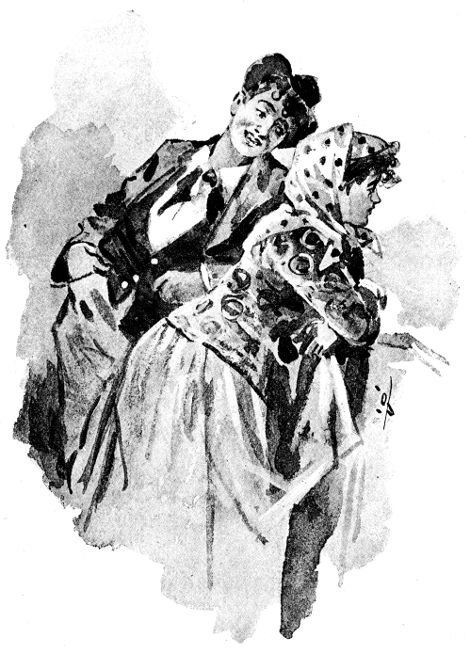
“‘THAT’S THE TRUTH,’ SAYS O’SHANAHAN DHU.”