THE LOQUACIOUS BARBER.
Reading edition
He had scarcely taken his seat before the toilet, when a soft tap at the door, and the sound of a small squeaking voice, announced the arrival of the hair-cutter. On looking round him, Hardress beheld a small, thin-faced, red-haired little man, with a tailor’s shears dangling from his finger, bowing and smiling with a timid and conciliating air. In an evil hour for his patience, Hardress consented that he should commence operations.
“The piatez were very airly this year, sir,” he modestly began, after he had wrapped a check apron about the neck of Hardress, and made the other necessary arrangements.
“Very early, indeed. You needn’t cut so fast.”
“Very airly, sir—the white-eyes especially. Them white-eyes are fine piatez. For the first four months I wouldn’t ax a better piatie than a white-eye, with a bit o’ bacon, if one had it; but after that the meal goes out of ’em, and they gets wet and bad. The cups arn’t so good in the beginnin’ o’ the saison, but they hould better. Turn your head more to the light, sir, if you plase. The cups, indeed, are a fine substantial, lasting piatie. There’s great nutriment in’em for poor people, that would have nothin’ else with them but themselves, or a grain o’ salt. There’s no piatie that eats better, when you have nothin’ but a bit o’ the little one (as they say) to eat with a bit o’ the big. No piatie that eats so sweet with point.”
“With point?” Hardress repeated, a little amused by this fluent discussion of the poor hair-cutter upon the varieties of a dish which, from his childhood, had formed almost his only article of nutriment, and on which he expatiated with as much cognoscence and satisfaction as a fashionable gourmand might do on the culinary productions of Eustache Ude. “What is point?”
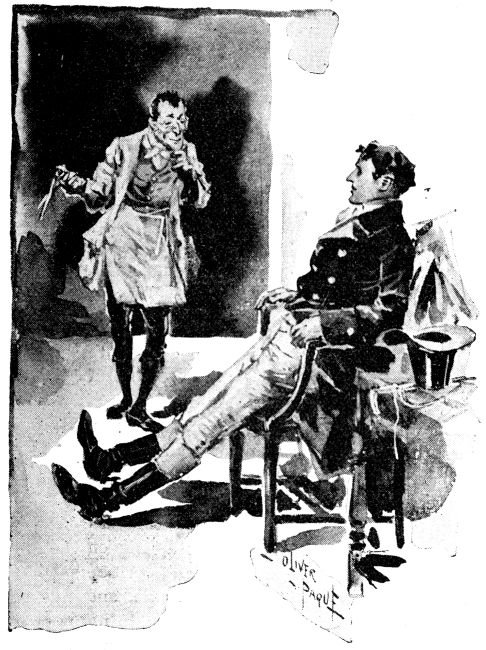
“ON LOOKING ROUND HIM, HARDRESS BEHELD A SMALL, THIN-FACED, RED-HAIRED LITTLE MAN.”
“Don’t you know what that is, sir? I’ll tell you in a minute. A joke that them that has nothin’ to do, an’ plenty to eat, make upon the poor people that has nothin’ to eat, and plenty to do. That is, when there’s dry piatez on the table, and enough of hungry people about it, and the family would have, maybe, only one bit o’ bacon hanging up above their heads, they’d peel a piatie first, and then they’d point it up at the bacon, and they’d fancy that it would have the taste o’ the mait when they’d be aitin’ it after. That’s what they call point, sir. A cheap sort o’ diet it is (Lord help us!) that’s plenty enough among the poor people in this country. A great plan for making a small bit o’ pork go a long way in a large family.”
“Indeed it is but a slender sort of food. Those scissors you have are dreadful ones.”
“Terrible, sir. I sent my own over to the forge before I left home, to have an eye put in it; only for that, I’d be smarter a deal. Slender food it is, indeed. There’s a deal o’ poor people here in Ireland, sir, that are run so hard at times, that the wind of a bit o’ mait is as good to ’em as the mait itself to them that would be used to it. The piatez are everythin’; the kitchen[14] little or nothin’. But there’s a sort o’ piatez (I don’t know did your honour ever taste ’em) that’s gettin’ greatly in vogue now among ’em, an’ is killin’ half the country,—the white piatez, a piatie that has great produce, an’ requires but little manure, and will grow in very poor land; but has no more strength nor nourishment in it than if you had boiled a handful o’ sawdust and made gruel of it, or put a bit of a deal board between your teeth and thought to make a breakfast of it. The black bulls themselves are better; indeed, the black bulls are a deal a better piatie than they’re thought. When you’d peel ’em, they look as black as indigo, an’ you’d have no mind to ’em at all; but I declare they’re very sweet in the mouth, an’ very strengthenin’. The English reds are a nate piatie, too; and the apple piatie (I don’t know what made ’em be given up), an’ the kidney (though delicate o’ rearing); but give me the cups for all, that will hould the meal in ’em to the last, and won’t require any inthricket tillage. Let a man have a middling-sized pit o’ cups again the winter, a small caish[15] to pay his rent, an’ a handful o’ turf behind the doore, an’ he can defy the world.”
“You know as much, I think,” said Hardress, “of farming as of hair-cutting.”
“Oyeh, if I had nothin’ to depend upon but what heads comes across me this way, sir, I’d be in a poor way enough. But I have a little spot o’ ground besides.”
“And a good taste for the produce.”
“’Twas kind father for me to have that same. Did you ever hear tell, sir, of what they call limestone broth?”
“Never.”
“’Twas my father first made it. I’ll tell you the story, sir, if you’ll turn your head this way a minute.”
Hardress had no choice but to listen.
“My father went once upon a time about the country, in the idle season, seeing would he make a penny at all by cutting hair, or setting razhurs and penknives, or any other job that would fall in his way. Well an’ good—he was one day walking alone in the mountains of Kerry, without a hai’p’ny in his pocket (for though he travelled a-foot, it cost him more than he earned), an’ knowing there was but little love for a county Limerick man in the place where he was, on being half perished with the hunger, an’ evening drawing nigh, he didn’t know well what to do with himself till morning. Very good—he went along the wild road; an’ if he did, he soon sees a farmhouse at a little distance o’ one side—a snug-looking place, with the smoke curling up out of the chimney, an’ all tokens of good living inside. Well, some people would live where a fox would starve. What do you think did my father do? He wouldn’t beg (a thing one of our people never done yet, thank heaven!) an’ he hadn’t the money to buy a thing, so what does he do? He takes up a couple o’ the big limestones that were lying on the road in his two hands, an’ away with him to the house. ‘Lord save all here!’ says he, walkin’ in the doore. ‘And you kindly,’ says they. ‘I’m come to you,’ says he, this way, looking at the two limestones, ‘to know would you let me make a little limestone broth over your fire, until I’ll make my dinner?’ ‘Limestone broth!’ says they to him again; ‘what’s that, aroo?’ ‘Broth made o’ limestone,’ says he; ‘what else?’ ‘We never heard of such a thing,’ says they. ‘Why, then, you may hear it now,’ says he, ‘an’ see it also, if you’ll gi’ me a pot an’ a couple o’ quarts o’ soft water.’ ‘You can have it an’ welcome,’ says they. So they put down the pot an’ the water, an’ my father went over an’ tuk a chair hard by the pleasant fire for himself, an’ put down his two limestones to boil, and kep stirrin’ them round like stirabout. Very good—well, by-an’-by, when the wather began to boil—‘’Tis thickening finely,’ says my father; ‘now if it had a grain o’ salt at all, ’twould be a great improvement to it’ ‘Raich down the salt-box, Nell,’ says the man o’ the house to his wife. So she did. ‘Oh, that’s the very thing, just,’ says my father, shaking some of it into the pot. So he stirred it again awhile, looking as sober as a minister. By-an’-by, he takes the spoon he had stirring it, an’ tastes it ‘It is very good now,’ says he, ‘although it wants something yet.’ ‘What is it?’ says they. ‘Oyeh, wisha nothing,’ says he; ‘maybe ’tis only fancy o’ me.’ ‘If it’s anything we can give you,’ says they, ‘you’re welcome to it’ ‘’Tis very good as it is,’ says he; ‘but when I’m at home, I find it gives it a fine flavour just to boil a little knuckle o’ bacon, or mutton trotters, or anything that way along with it.’ ‘Raich hether that bone o’ sheep’s head we had at dinner yesterday, Nell,’ says the man o’ the house. ‘Oyeh, don’t mind it,’ says my father; ‘let it be as it is.’ ‘Sure if it improves it, you may as well,’ says they. ‘Baithershin!’[16] says my father, putting it down. So after boiling it a good piece longer, ‘’Tis as fine limestone broth,’ says he, ‘as ever was tasted; an’ if a man had a few piatez,’ says he, looking at a pot of ’em that was smokin’ in the chimney-corner, ‘he couldn’t desire a better dinner.’ They gave him the piatez, and he made a good dinner of themselves an’ the broth, not forgetting the bone, which he polished equal to chaney before he let it go. The people themselves tasted it, an’ thought it as good as any mutton broth in the world.”
Gerald Griffin (1803–1840).