GIVING CREDIT.
Reading edition
In due time it was determined that Peter, as he understood poteen, should open a shebeen-house. The moment this resolution was made, the wife kept coaxing him until he took a small house at the cross-roads before alluded to, where, in the course of a short time, he was established, if not in his line, yet in a mode of life approximating to it as nearly as the inclination of Ellish would permit. The cabin which they occupied had a kitchen in the middle, and a room at each end of it, in one of which was their own humble chaff bed, with its blue quilted drugget cover; in the other stood a couple of small tables, some stools, a short form, and one chair, being a present from his father-in-law. These constituted Peter’s whole establishment, so far as it defied the gauger. To this we must add a five-gallon keg of spirits hid in the garden and a roll of smuggled tobacco. From the former he bottled, overnight, as much as was usually drunk the following day; and from the tobacco, which was also kept underground, he cut, with the same caution, as much as to-morrow’s exigencies might require. This he kept in his coat-pocket, a place where the gauger would never think of searching for it, divided into halfpenny and pennyworths, ounces, or half-ounces, according as it might be required; and, as he had it without duty, the liberal spirit in which he dealt it out to his neighbours soon brought him a large increase of custom.
Peter’s wife was an excellent manager, and he himself a pleasant, good-humoured man, full of whim and inoffensive mirth. His powers of amusement were of a high order, considering his station in life and his want of education. These qualities contributed, in a great degree, to bring both the young and the old to his house during the long winter nights, in order to hear the fine racy humour with which he related his frequent adventures and battles with excisemen. In the summer evenings he usually engaged a piper or fiddler, and had a dance, a contrivance by which he not only rendered himself popular, but increased his business.
In this mode of life the greatest source of anxiety to Peter and Ellish was the difficulty of not offending their friends by refusing to give them credit. Many plans were, with great skill and forethought, devised to obviate this evil; but all failed. A short board was first procured, on which they got written with chalk—
“No credit giv’n—barrin’ a thrifle to Pether’s friends.”
Before a week passed after this intimation, the number of “Pether’s friends” increased so rapidly that neither he nor Ellish knew the half of them. Every scamp in the parish was hand and glove with him: the drinking tribe, particularly, became desperately attached to him and Ellish. Peter was naturally kind-hearted, and found that his firmest resolutions too often gave way before the open flattery with which he was assailed. He then changed his hand, and left Ellish to bear the brunt of their blarney. Whenever any person or persons were seen approaching the house, Peter, if he had reason to expect an attack upon his indulgence, prepared himself for a retreat. He kept his eye to the window, and if they turned from the direct line of the road, he immediately slipped into bed, and lay close, in order to escape them. In the meantime they enter.
“God save all here! Ellish, agra machree, how are you?”
“God save you kindly! Faix, I’m middlin’, I thank you, Condy; how is yourself, an’ all at home?”
“Devil a heartier, barrin’ my father, that’s touched wid a loss of appetite afther his meals—ha, ha, ha!”
“Musha, the dickens be an you, Condy, but you’re your father’s son, anyway; the best company in Europe is the same man. Throth, whether you’re jokin’ or not, I’d be sarry to hear of anything to his disadvantage, dacent man. Boys, won’t yees go down to the other room?”
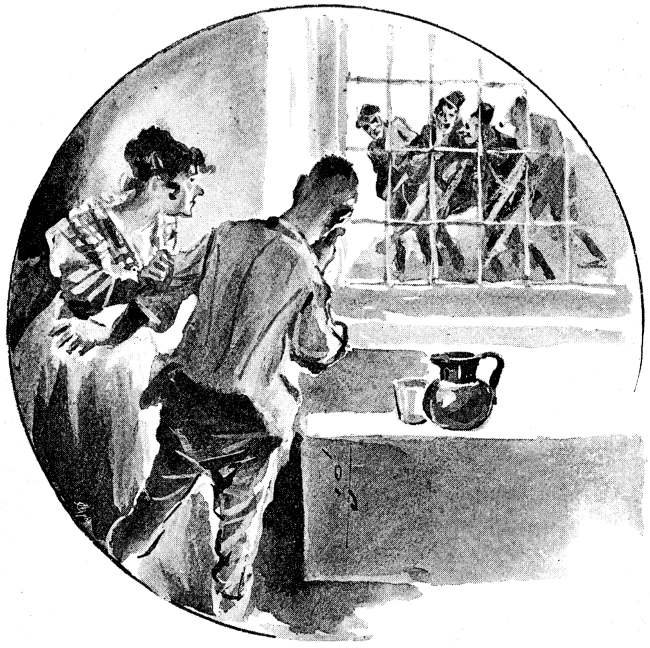
“HE KEPT HIS EYE TO THE WINDOW, AND IF THEY TURNED FROM THE DIRECT LINE OF THE ROAD, HE SLIPPED INTO BED.”
“Go way wid yees, boys, till I spake to Ellish here about the affairs o’ the nation. Why, Ellish, you stand the cut all to pieces. By the contints o’ the book, you do; Pether doesn’t stand it half so well. How is he, the thief?”
“Throth, he’s not well to-day, in regard of a smotherin’ about the heart he tuck this morning, afther his breakfast. He jist laid himself on the bed a while, to see if it would go off of him—God be praised for all his marcies!”
“Thin, upon my solevation, I’m sorry to hear it, and so will all at home, for there’s not in the parish we’re sittin’ in a couple that our family has a greater regard an’ friendship for than him an’ yourself. Faix, my modher, no longer ago than Friday night last, argued down Bartle Meegan’s throath that you and Biddy Martin war the two portliest weemen that comes into the chapel. God forgive myself, I was near quarrellin’ wid Bartle, on the head of it, bekase I tuck my modher’s part, as I had good right to do.”
“Thrath, I’m thankful to you both, Condy, for your kindness.”
“Oh, the sarra taste o’ kindness was in it all, Ellish, ’twas only the thruth; an’ as long as I live I’ll stand up for that.”
“Arrah, how is your aunt down at Carntall?”
“Indeed, thin, but middlin’, not gettin’ her health: she’ll soon give the crow a puddin’, anyway; thin, Ellish, you thief, I’m in for the yallow boys. Do you know thim that came in wid me?”
“Why, thin, I can’t say I do. Who are they, Condy?”
“Why, one o’ thim’s a bachelor to my sisther Norah, a very dacent boy, indeed—him wid the frieze jock upon him, an’ the buckskin breeches. The other three’s from Teenabraighera beyant. They’re related to my brother-in-law, Mick Dillon, by his first wife’s brother-in-law’s uncle. They’re come to this neighbourhood till the ’Sizes, bad luck to them, goes over; for, you see, they’re in a little throuble.”
“The Lord grant them safe out of it, poor boys!”
“I brought them up here to treat them, poor fellows; an’ Ellish, avourneen, you must credit me for whatsomever we may have. The thruth is, you see, that when we left home none of us had any notion of dhrinkin’, or I’d a put a something in my pocket, so that I’m taken at an average.—Bud-an’-age—how is little Dan? Sowl, Ellish, that goor-soon, when he grows up, will be a credit to you. I don’t think there’s a finer child in Europe of his age, so there isn’t.”
“Indeed, he’s a good child, Condy. But, Condy, avick, about givin’ credit:—by thim five crasses, if I could give score to any boy in the parish, it ud be to yourself. It was only last night that I made a promise against doin’ sich a thing for man or mortual. We’re a’most broken an’ harrish’d out o’ house an’ home by it; an’ what’s more, Condy, we intend to give up the business. The landlord’s at us every day for his rint, an’ we owe for the two last kegs we got, but hasn’t a rap to meet aither o’ thim; an’ enough due to us if we could get it together: an’ whisper, Condy, atween ourselves, that’s what ails Pether, although he doesn’t wish to let an to any one about it.”
“Well, but you know I’m safe, Ellish?”
“I know you are, avourneen, as the bank itself; an’ should have what you want wid a heart an’ a half, only for the promise I made an my two knees last night aginst givin’ credit to man or woman. Why the dickens didn’t you come yistherday?”
“Didn’t I tell you, woman alive, that it was by accident, an’ that I wished to sarve the house, that we came at all. Come, come, Ellish; don’t disgrace me afore my sisther’s bachelor an’ the sthrange boys that’s to the fore. By this staff in my hand, I wouldn’t for the best cow in our byre be put to the blush afore thim; an’ besides, there’s a cleeveenship atween your family an’ ours.”
“Condy, avourneen, say no more: if you were fed from the same breast wid me, I couldn’t, nor wouldn’t break my promise. I wouldn’t have the sin of it an me for the wealth o’ the three kingdoms.”
“Bedad, you’re a quare woman; an’ only that my regard for you is great entirely, we would be two, Ellish; but I know you’re dacent still.”
He then left her, and joined his friends in the little room that was appropriated for drinking, where, with a great deal of mirth, he related the failure of the plan they had formed for outwitting Peter and Ellish.
“Boys,” said he, “she’s too many for us! St. Pether himself wouldn’t make a hand of her. Faix, she’s a cute one. I palavered her at the rate of a hunt, an’ she ped me back in my own coin, wid dacent intherest—but no whisky!—Now to take a rise out o’ Pether. Jist sit where yees are, till I come back.”
He then left them enjoying the intended “spree,” and went back to Ellish.
“Well, I’m sure, Ellish, if any one had tuck their book oath that you’d refuse my father’s son sich a thrifle, I wouldn’t believe them. It’s not wid Pether’s knowledge you do it, I’ll be bound. But bad as you thrated us, sure we must see how the poor fellow is, at any rate.”
As he spoke, and before Ellish had time to prevent him, he pressed into the room where Peter lay.
“Why, tare alive, Pether, is it in bed you are, at this hour o’ the day?”
“Eh? What’s that—who’s that? Oh!”
“Why, thin, the sarra lie undher you, is that the way wid you?”
“Oh!—oh! Eh? Is that Condy?”
“All that’s to the fore of him. What’s asthray wid you, man alive?”
“Throth, Condy, I don’t know rightly. I went out, wantin’ my coat, about a week ago, an’ got cowld in the small o’ the back: I’ve a pain in it ever since. Be sittin’.”
“Is your heart safe? You have no smotherin’ or anything upon it?”
“Why, thin, thank goodness, no; it’s all about my back an’ my hinches.”
“Divil a thing it is but a complaint they call an alloverness ails you, you shkaimer o’ the world wide. ’Tis the oil o’ the hazel, or a rubbin’ down wid an oak towel, you want. Get up, I say, or, by this an’ by that, I’ll flail you widin an inch o’ your life.”
“Is it beside yourself you are, Condy?”
“No, no, faix; I’ve found you out: Ellish is afther tellin’ me that it was a smotherin’ on the heart; but it’s a pain in the small o’ the back wid yourself. Oh, you born desaver! Get up, I say agin, afore I take the stick to you!”
“Why, thin, all sorts o’ fortune to you, Condy—ha, ha, ha!—but you’re the sarra’s pet, for there’s no escapin’ you. What was that I hard atween you an’ Ellish?” said Peter, getting up.
“The sarra matther to you. If you behave yourself, we may let you into the wrong side o’ the sacret afore you die. Go an’ get us a pint o’ what you know,” replied Condy, as he and Peter entered the kitchen.
“Ellish,” said Peter, “I suppose you must give it to thim. Give it—give it, avourneen. Now, Condy, whin’ll you pay me for this?”
“Never fret yourself about that; you’ll be ped. Honour bright, as the black said whin he stole the boots.”
“Now, Pether,” said the wife, “sure it’s no use axin me to give it, afther the promise I made last night. Give it yourself; for me, I’ll have no hand in sich things, good or bad. I hope we’ll soon get out of it altogether, for myself’s sick an’ sore of it, dear knows!”
Peter accordingly furnished them with the liquor, and got a promise that Condy would certainly pay him at mass on the following Sunday, which was only three days distant. The fun of the boys was exuberant at Condy’s success: they drank, and laughed, and sang, until pint after pint followed in rapid succession.
Every additional inroad upon the keg brought a fresh groan from Ellish; and even Peter himself began to look blank as their potations deepened. When the night was far advanced they departed, after having first overwhelmed Ellish with professions of the warmest friendship, promising that in future she exclusively should reap whatever benefit was to be derived from their patronage.
In the meantime Condy forgot to perform his promise. The next Sunday passed, but Peter was not paid, nor was his clever debtor seen at mass, or in the vicinity of the shebeen-house, for many a month afterwards—an instance of ingratitude which mortified his creditor extremely. The latter, who felt that it was a take in, resolved to cut short all hopes of obtaining credit from them in future. In about a week after the foregoing hoax he got up a board, presenting a more vigorous refusal of score than the former. His friends, who were more in number than he could possibly have imagined, on this occasion were altogether wiped out of the exception. The notice ran to the following effect:—
“Notice to the Public, and to Pether Connell’s friends in particular—Divil resave the morsel of credit will be got or given in this house, while there is stick or stone of it together, barrin’ them that axes it has the ready money.
“Pether x Connell, his mark.
“Ellish x Connell, her mark.”
William Carleton (1794–1869).