THE BORROWER.
Reading edition
Richmore. You may keep the letter.
Young Wou’d-be. But why would you trust it with me? You know I can’t keep a secret that has any scandal in ’t.
Rich. For that reason I communicate it. I know thou art a perfect Gazette, and will spread the news all over the town; for you must understand that I am now besieging another, and I would have the fame of my conquest upon the wing, that the town may surrender the sooner.
Y. W. But if the report of your cruelty goes along with that of your valour, you’ll find no garrison of any strength will open their gates to you.
Rich. No, no; women are cowards, terror prevails upon them more than clemency; my best pretence to my success with the fair is my using them ill; ’tis turning their own guns upon them, and I have always found it the most successful battery to assail one reputation by sacrificing another.
Y. W. I could love thee for thy mischief, did I not envy thee for thy success in it.
Rich. You never attempt a woman of figure.
Y. W. How can I? This confounded hump of mine is such a burden to my back that it presses me down here in the dirt and diseases of Covent Garden, the low suburbs of pleasure. Curst fortune! I am a younger brother, and yet cruelly deprived of my birthright, a handsome person; seven thousand a year, in a direct line, would have straightened my back to some purpose. But I look, in my present circumstances, like a branch of another kind, grafted only upon the stock which makes me look so crooked.
Rich. Come, come, ’tis no misfortune, your father is so as well as you.
Y. W. Then why should not I be a lord as well as he? Had I the same title to the deformity I could bear it.
Rich. But how does my lord bear the absence of your twin-brother?
Y. W. My twin-brother? Ay, ’twas his crowding me that spoiled my shape, and his coming half-an-hour before me that ruined my fortune. My father expelled me from his house some two years ago, because I would have persuaded him that my twin-brother was a bastard. He gave me my portion, which was about fifteen hundred pounds, and I have spent two thousand of it already. As for my brother, he don’t care a farthing for me.
Rich. Why so, pray?
Y. W. A very odd reason—because I hate him.
Rich. How should he know that?
Y. W. Because he thinks it reasonable it should be so.
Rich. But did your actions ever express any malice to him?
Y. W. Yes; I would fain have kept him company; but being aware of my kindness, he went abroad. He has travelled these five years, and I am told is a grave, sober fellow, and in danger of living a great while; all my hope is, that when he gets into his honour and estate the nobility will soon kill him by drinking him up to his dignity. But come, Frank, I have but two eyesores in the world, a brother before me and a hump behind me, and thou art still laying them in my way; let us assume an argument of less severity. Can’st thou lend me a brace of hundred pounds?
Rich. What would you do with them?
Y. W. Do with them? There’s a question indeed. Do you think I would eat them?
Rich. Yes, o’ my troth would you, and drink them together. Look ’e, Mr. Wou’d-be, whilst you kept well with your father, I could have ventured to have lent you five guineas. But as the case stands, I can assure you I have lately paid off my sister’s fortune, and——
Y. W. Sir, this put-off looks like an affront, when you know I don’t use to take such things.
Rich. Sir, your demand is rather an affront, when you know I don’t use to give such things.
Y. W. Sir, I’ll pawn my honour.
Rich. That’s mortgaged already for more than it is worth; you had better pawn your sword there, ’twill bring you forty shillings.
Y. W. ’Sdeath, sir——[Takes his sword off the table.
Rich. Hold, Mr. Wou’dbe—suppose I put an end to your misfortunes all at once.
Y. W. How, sir?
Rich. Why, go to a magistrate and swear you would have robbed me of two hundred pounds. Look ’e, sir, you have been often told that your extravagance would some time or other be the ruin of you; and it will go a great way in your indictment to have turned the pad upon your friend.
Y. W. This usage is the height of ingratitude from you, in whose company I have spent my fortune.
Rich. I’m therefore a witness that it was very ill spent. Why would you keep company, be at equal expenses with me, that have fifty times your estate? What was gallantry in me was prodigality in you; mine was my health, because I could pay for it; yours a disease, because you could not.
Y. W. And is this all I must expect from our friendship?
Rich. Friendship! Sir, there can be no such thing without an equality.
Y. W. That is, there can be no such thing when there is occasion for ’t.
Rich. Right, sir—our friendship was over a bottle only; and whilst you can pay your club of friendship, I’m that way your humble servant; but when once you come borrowing, I’m this way—your humble servant.[Exit.
Y. W. Rich, big, proud, arrogant villain! I have been twice his second, thrice sick of the same love, and thrice cured by the same physic, and now he drops me for a trifle—that an honest fellow in his cups should be such a rogue when he is sober! The narrow-hearted rascal has been drinking coffee this morning. Well, thou dear solitary half-crown, adieu! Here, Jack, take this, pay for a bottle of wine, and bid Balderdash bring it himself. [Exit Servant.] How melancholy are my poor breeches; not one chink! Thou art a villainous hand, for thou hast picked my pocket. This vintner now has all the marks of an honest fellow, a broad face, a copious look, a strutting belly, and a jolly mien. I have brought him above three pounds a night for these two years successively. The rogue has money, I’m sure, if he would but lend it.
Enter Balderdash, with a bottle and glass.
Oh, Mr. Balderdash, good-morrow.
Bald. Noble Mr. Wou’dbe, I’m your most humble servant. I have brought you a whetting-glass, the best Old Hock in Europe; I know ’tis your drink in a morning.
Y. W. I’ll pledge you, Mr. Balderdash.
Bald. Your health, sir.[Drinks.
Y. W. Pray, Mr. Balderdash, tell me one thing, but first sit down; now tell me plainly what you think of me?
Bald. Think of you, sir? I think that you are the honestest, noblest gentleman that ever drank a glass of wine, and the best customer that ever came into my house.
Y. W. And do you really think as you speak?
Bald. May this wine be my poison, sir, if I don’t speak from the bottom of my heart.[Drinks.
Y. W. And how much money do you think I have spent in your house?
Bald. Why, truly, sir, by a moderate computation I do believe that I have handled of your money the best part of five hundred pounds within these two years.
Y. W. Very well! And do you think that you lie under any obligation for the trade I have promoted to your advantage?
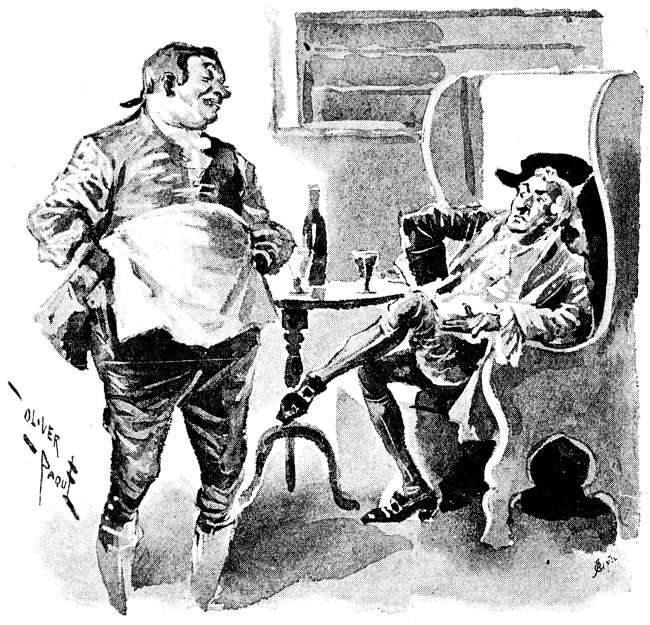
“I THINK THAT YOU ARE THE HONESTEST, NOBLEST GENTLEMAN THAT EVER DRANK A GLASS OF WINE.”
Bald. Yes, sir; and if I can serve you in any respect, pray command me to the utmost of my ability.
Y. W. Well! thanks to my stars, there is still some honesty in wine. Mr. Balderdash, I embrace you and your kindness; I am at present a little low in cash, and must beg you to lend me a hundred pieces.
Bald. Why, truly, Mr. Wou’dbe, I was afraid it would come to this; I have had it in my head several times to caution you upon your expenses, but you were so very genteel in my house, and your liberality became you so very well, that I was unwilling to say anything that might check your disposition; but truly, sir, I can forbear no longer to tell you that you have been a little too extravagant.
Y. W. But since you reaped the benefit of my extravagance, you will, I hope, consider my necessity.
Bald. Consider your necessity! I do, with all my heart; and must tell you, moreover, that I will be no longer accessory to it: I desire you, sir, to frequent my house no more.
Y. W. How, sir?
Bald. I say, sir, that I have an honour for my good lord your father, and will not suffer his son to run into any inconvenience. Sir, I shall order my drawers not to serve you with a drop of wine. Would you have me connive at a gentleman’s destruction?
Y. W. But methinks, sir, that a person of your nice conscience should have cautioned me before.
Bald. Alas! sir, it was none of my business. Would you have me be saucy to a gentleman that was my best customer? Lack-a-day, sir, had you money to hold it out still, I had been hanged rather than be rude to you. But truly, sir, when a man is ruined, ’tis but the duty of a Christian to tell him of it.
Y. W. Will you lend me money, sir?
Bald. Will you pay me this bill, sir?
Y. W. Lend me the hundred pound, and I’ll pay the bill.
Bald. Pay me the bill, and I will—not lend you the hundred pound, sir. But pray consider with yourself, now, sir; would not you think me an errant coxcomb to trust a person with money that has always been so extravagant under my eye? whose profuseness I have seen, I have felt, I have handled? Have not I known you, sir, throw away ten pounds a-night upon a covey of pit-partridges and a setting-dog? Sir, you have made my house an ill house; my very chairs will bear you no longer. In short, sir, I desire you to frequent the “Crown” no more, sir.
Y. W. Thou sophisticated ton of iniquity, have I fattened your carcass and swelled your bags with my vital blood? Have I made you my companion to be thus saucy to me? But now I will keep you at your distance.
[Kicks him.
Ser. Welcome, sir![Kicks him.
Y. W. Well said, Jack.[Kicks him again.
Ser. Very welcome, sir! I hope we shall have your company another time. Welcome, sir![He is kicked off.
Y. W. Pray wait on him downstairs, and give him a welcome at the door too. (Exit Servant.) This is the punishment of hell; the very devil that tempted me to sin, now upbraids me with the crime. I have villainously murdered my fortune, and now its ghost, in the lank shape of poverty, haunts me. Is there no charm to conjure down the fiend?
George Farquhar.