PHASE VIII TRENCH WARFARE AND “PEACEFUL PENETRATION” AT LENS—DEAN’S V.C. May-September 1918
Reading edition
On April 10 Brig.-Gen. R. W. Morgan, D.S.O., inspected the Battalion on parade. He afterwards addressed the Battalion, and congratulated very warmly all who had taken part in the recent operations.
At St. Blimont we were reinforced by a draft of 222 and the return of 160 who had been on leave to England. The Battalion was finally made up to a strength of 850 rifles.
The work of reorganisation of companies was taken in hand immediately and completed by April 12. The remainder of the month was devoted to intensive training. The instruction of new section commanders and the training of a large number of new Lewis gunners was actively carried out. During the month our Lewis guns were increased to twenty-four, including four for anti-aircraft work.
The Battalion was fortunate in its drafts. About 40 per cent. were men who had had previous experience in the field; the remainder were men of the A4 class from England—about nineteen years of age and very keen.
197On April 17 the Battalion moved to Ourton, near Pernes, where the Division was in General Headquarters reserve and ready to move at six hours’ notice. Every third day the Canadian School Training Ground at Pernes was at our disposal, where there was an excellent 20-target rifle range, bayonet fighting courses, and drill grounds. At Ourton we made two rifle ranges, and much valuable musketry training was done.
A large draft of officers joined us at Ourton, including Capt. H. S. Brown from a six months’ tour of duty at home. Capt. Brown became 2nd-in-command, and the Battalion organisation at this time was as follows:
Commanding Officer, Lieut.-Col. H. J. Wenyon, D.S.O.
2nd-in-Command, Capt. H. S. Brown.
Adjutant, Capt. R. P. Baker.
Transport Officer, Capt. J. N. Arnaud.
Quartermaster, Capt. J. R. Wood.
Company Commanders:
A Company, Capt. J. H. Selfe.
B Company, Capt. R. G. Rogers.
C Company, Capt. S. G. Thompson.
D Company, Capt. F. Proctor.
There was very little time for pure recreation now, but we got a holiday one Saturday, and Capt. Brown organised a very successful athletic sports meeting held on April 27. There was some very good running, one feature being the winning of the 100 yards officers’ race by Gen. Morgan. The meeting did a lot of good, as the men were in danger of getting a little “stale” 198with the pressure of continuous training. The events in which mules participated caused considerable amusement.
A Brigade rifle meeting was held at Pernes on April 29. On the total points scored for shooting the Battalion was first, and on the points scored for field work, particularly section commanders’ control, the Battalion was also very easily first. This was a very satisfactory feature, and was a direct result of very hard work by the officers and N.C.O.s during the previous weeks. Of the total prize money of about 550 francs, the Battalion took 385 francs.
On this day we heard rumours of a move to the line, the region of Lens being hinted at as our probable destination. On April 30 representatives were sent to reconnoitre the line in front of Lens—the very front, as it happened, on which the Battalion was fighting a year before when the enemy withdrew after the battle for Vimy Ridge.
On May 1 we found ourselves in old familiar spots—Sains-en-Gohelle, where we stopped for tea, Bully-Grenay, and Maroc, where we spent the night in cellars. At dusk on the 2nd we moved up the Fosse 11 road, along which the Battalion had fought its way in April 1917, into Cité St. Pierre, where we took over from the Canadian Cameron Highlanders, and became battalion in support. The 72nd Brigade took over the St. Emilie Sector. This had been a thickly populated mining district, and the trenches wound about through the ruins of old 199houses and under roads. The whole district was a mass of demolished houses, brick rubble, and debris of every description.
The front line ran just short of the northwestern outskirts of Lens. Two main roads, the Lens-Bethune and the Lens-La Bassee roads cut through our trenches and joined in the city just behind the enemy’s line. All our trenches here were old German lines captured a year before. There was a lot of the enemy’s concrete work everywhere, chiefly in the shape of reinforced cellars and houses and forward observation posts. One of these observation posts formed the inter-battalion boundary in the front line.
No Man’s Land on the right was a tangled mass of ruins of every description: broken houses, old demolished mine buildings, wire entanglements, the whole churned up by shells in a remarkable way. On the left there were not so many buildings in front, and No Man’s Land was old grass land, with here and there an isolated ruined house. On the left within our lines was the Canteen Tunnel, an elaborate underground work with about fourteen entrances, stretching from the support line, Douglas Trench, up to the front line, Chicory Trench, where an exit could be made into Mason’s House, an old ruin just in front of our parapet. This tunnel was always more trouble than it was worth. All the entrances had to be guarded, and it became later the favourite hunting-ground of Hun raiding parties.
200The fact that this had been once a flourishing and thickly populated district made it the most desolate-looking sector we were ever in, and yet one of the most interesting. It offered neverending opportunities for exploration. Searching for good places for Lewis gun or rifle posts, cellars worth reinforcing as shelter for the men against bombardments, salving and building—all became sports which were developed to a high degree. Small wonder was it that this was the sector we shall always remember for its defence schemes, changing nearly every tour and baffling overwrought company commanders by their intricacies. At the end of our stay here, any company commander who could tell where every one of his sections was, and where they would be in case of attack, was established as a Pelmanist of no mean order.
The 72nd Brigade front at the outset was held by two battalions, with one battalion in support, but this was changed almost at once to one battalion in the line distributed in depth, one battalion in support at Cité St. Pierre, and one battalion in reserve at Bully-Grenay.
We started with three days at Cité St. Pierre. Battalion Headquarters was in a dug-out under a ruined house known as Hodson’s House, and everyone in the Battalion had pretty good billets in the cellars of the ruined houses. During these three days we were reconnoitring the left battalion front which we were to take over.
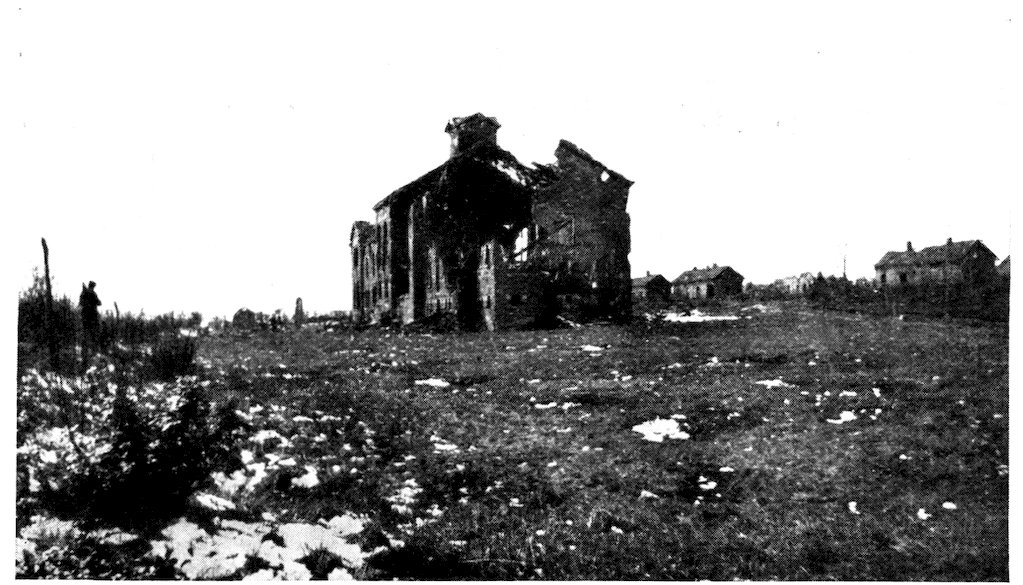
CITÉ ST. PIERRE—THE OPERA HOUSE.
On the 5th we moved up after dark and relieved the 1st Battalion North Staffordshire Regiment. B and D Companies were in the front line, A Company in support, and C in reserve. Battalion Headquarters was well forward in a dug-out in Counter Alley, the main communication trench. The enemy was quiet, and we settled down at once to learn the new front. On the 8th we got alarming news from a prisoner captured on another front. Lens was to be the next jumping-off place for a big enemy offensive. He was to attack in force on the night of the 9th/10th on the front from Lens—Robecq. His bombardment was to commence at 10.30 p.m., and his attack, with twenty-two divisions, was to be launched at about 3 o’clock in the morning. May 8 and 9, therefore, we spent in fortifying our positions as much as possible. By the afternoon of the 9th all possible preparations were completed. Gen. Morgan came round our front during the afternoon. Every man was in his appointed place, and we settled down to a weary wait for the Hun to start. There was no “wind up” in the trenches. We felt we could do no more than we had done.
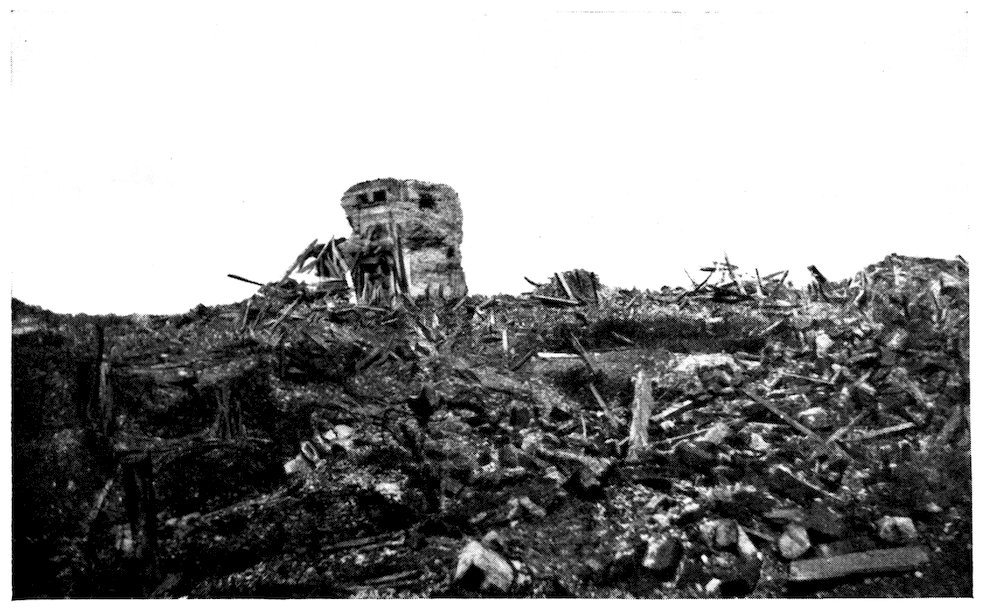
OLD GERMAN CONCRETE OBSERVATION POST IN OUR FRONT LINE OPPOSITE LENS. In foreground—“No man’s land.”
201The great offensive did not take place. Why, we never found out, but we did learn that everything was in fact ready for a big attack on our front at this time. We waited patiently for 10.30 to come. After that we waited all night, and for several more nights, but nothing extraordinary happened at all.
On May 12 the Divisional front was rearranged, and was henceforth held by three brigades in the line.
202The 1st North Staffordshire Regiment took over part of our line on the right and the 1st Royal Fusiliers (17th Brigade) relieved the rest of us.
On the night 13th/14th we moved out into reserve at Bully-Grenay. A Company were at Cité Calonne, about two kilometres away. The billets at Bully and Calonne were by no means clean or comfortable, and we commenced the work of cleaning up, building, and repairing in every direction.
On the 16th we moved up again to Cité St. Pierre in support. Two companies had battle positions in the red line, our main forward battle position here, and two companies were in brigade support to be used for counter-attack or reinforcement where necessary on the Brigade front.
During this tour at St. Pierre, Maj. Brown organised a raid on the enemy’s trenches opposite Conductor Trench. The Lens front at this time was famous for gas, and at Cité St. Pierre we concentrated on gas-proofing the cellars and making them more comfortable. The Hun used mustard and sneezing gas on the forward and battery areas, and we indulged in retaliation in the way of projector attacks, gas-cloud attacks, and a certain amount of gas shelling. On the 22nd we moved up to the front line. The dispositions were now two companies forward in the outpost zone, and two companies back in the intermediate or Blue Line. On the night of May 24/25 A Company carried out the raid in conjunction with gas-projector attacks. This 203was the first occasion on which a raid had been attempted in conjunction with a projector attack. In view of the uncertainty as to the enemy’s intentions here at this time, it was essential that prisoners should be taken, and we were very warmly congratulated on the capture of three very useful Huns in this raid. The following is the official account, sent in by Lieut.-Col. Wenyon at the time:
“The raid on the enemy trenches east of Conductor Sap took place last night.
“The whole party was assembled in the sap and in correct order by 10.50 p.m., and the end of the tape secured ready to move out.
“The party left the assembly position on commencement of the barrage at 10.54, and moved on a compass bearing of 153°. At 10.56 the gas-projector attack took place. A number of the cylinders fell in No Man’s Land among the raiders, and, although they probably contained smoke only, they had a suffocating effect on the men, and the whole party got badly disorganised. 2nd Lieut. Treacher reached the enemy’s wire with one or two men only. He found that it was possible to get through the enemy wire, but, as he was practically alone, he decided to come back.
“The party was back in our trenches at 11.13 p.m.
“I did not hear of the situation till 11.20, as the telephone wires forward of advanced Battalion Headquarters had been cut.
“At 11.25 Maj. Brown came to advanced 204Headquarters and reported that the raiders had failed to enter the enemy trenches and were back in our line. The artillery barrage had been stopped.
“I decided that the raid should be done again with half the party at 2 a.m., when another gas-projector attack was due.
“A new barrage was arranged for 2 a.m., to remain on the enemy front line for one minute, then lift on to his support line. I saw the officers of the raiding party, and the Officer Commanding 6-inch Newton Battery. The men of the raiding party had been sent back to their posts in our trenches, and collecting them took a long time.
“Major Brown, with a runner, went out at about 1.40 from the assembly position and laid the tape to a point within thirty yards of the enemy wire. On his return he found 2nd Lieut. Wallis and 2nd Lieut. Piggott with one section ready in the assembly position.
“The projector attack which had been put forward ten minutes, and took place at 1.50, called forth some retaliation on our front line and hampered the assembly considerably.
“The party proceeded at once down the tape, and successfully got through the loose wire and entered the enemy’s trenches. No opposition was encountered in entering the trench, and only one machine gun from the left was firing while the party was crossing No Man’s Land—and that very wildly and without effect. On entering the trench, 2nd Lieut. Piggott worked to the left 205with four men, and 2nd Lieut. Wallis to the right with the remainder of the party. Maj. Brown and a runner took up a position at the point of entry as Raid Headquarters. As 2nd Lieut. Wallis started down the trench with his party, two of the enemy appeared round a traverse. They were at once fired on, and 2nd Lieut. Wallis threw a bomb into the next fire bay. The Huns gave a loud yell, and retired at the double, followed by 2nd Lieut. Wallis and his party. About forty yards down the trench 2nd Lieut. Wallis came to a dug-out entrance. He called down, but got no response; he then threw a Mills bomb down, and, following shrieks from the bottom of the steps, one man emerged. No signs of anyone else being inside could be found, so, after doing as much damage as possible to the dug-out and throwing more bombs down, 2nd Lieut. Wallis returned with the prisoner to the point of entry.
“2nd Lieut. Piggott had meantime worked down about fifty yards to the left, and was having trouble at a dug-out with some fractious Boches. Hearing the noise, Maj. Brown sent his runner to investigate and assist. On arriving at the dug-out entrance, 2nd Lieut. Piggott had shouted down, and some guttural response had been given, but no inclination to come up. He then fired his revolver through the gas curtains, which were down, and the gas curtains were then raised. A Hun appeared on the steps, and was evidently inquiring what was the matter. 2nd Lieut. Piggott then threatened him with his revolver. 206The Hun emitted a piercing shriek, and came forward with his hands up. Another Boche came to the bottom of the steps, and was extracted in a similar fashion. No more response could be got from this dug-out, although Mills bombs were thrown down. 2nd Lieut. Piggott then returned with his prisoners to the point of entry; 2nd Lieut. Wallis fired the green light—the signal for withdrawal. The whole party then returned to our line. They had been in the enemy trenches twelve minutes. No trouble from enemy machine guns or rifle fire was experienced while the party was crossing No Man’s Land. Maj. Brown and 2nd Lieut. Wallis got back most of the tape from No Man’s Land when they returned.
“The party which entered the enemy trench consisted of the following: Maj. H. S. Brown, 2nd Lieut. G. A. E. Wallis, 2nd Lieut. D. T. Piggott, L.-Cpl. Warford, Pte. Baker, Pte. Tilby, Pte. Smyth, Pte. Bonney, Pte. Harcin, Pte. Bowes.”
The following decorations were awarded for the raid:
The Military Cross
Maj. H. S. Brown, 2nd Lieut. G. A. E. Wallis, 2nd Lieut. D. T. Piggott.
The Military Medal
L.-Cpl. H. G. Warford, Pte. J. Baker, Pte. E. Bowes.
207Battalion Headquarters was now in the old Mine Offices near the Red Line, and just off the Bethune road, known as Cameron Castle. On the night 28th/29th we were relieved and returned to Bully-Grenay. On May 29 a terrible tragedy occurred. In the course of a football match the Hun dropped two bombs among the players, and we had terrible losses. Regt.-Sergt.-Maj. Rankin, Sergt.-Drummer Goldsbury, and Pte. Lloyd (Battalion runner) were men who in their own spheres it would be difficult to equal. Rankin had been in every fight. He had won the D.C.M. on the Somme, and two days after his death the news of the award of a bar to his D.C.M. for his matchless bravery on the March retreat was announced. It would be difficult to say how much the Battalion owed to the energy and devotion of its senior warrant officer. Sergt. Goldsbury had worked our drums up to a wonderful pitch of perfection. He was a ceaseless worker—his energy and cheerfulness were a byword in the Battalion. A splendid fellow in every way. Young Lloyd had been a runner for a long time. On the Somme, through the Ypres fighting of 1917, at Hargicourt, and right through the March retreat he had been one of the bravest of the brave at all times. Nothing was too hard or too dangerous for him to take on. He was always so cheerful and absolutely reliable. Two signallers were also killed. It was indeed a cruel fate that these men after facing death a thousand times should be killed at a football match far away from the fight. There were 208very few dry eyes at the Bully cemetery when we buried these brave men the next day.
June was on the whole a quiet month. Two deserters gave themselves up to C Company, and the enemy attempted two or three raids on our trenches unsuccessfully.
The month of June 1918 is chiefly remembered for the extraordinary epidemic of influenza which swept through the British Army—and it is believed in a worse form through the German Army. We lost temporarily during the month upwards of 300 officers and men through this scourge. For about ten days the Battalion was commanded by Maj. Esdaile of the Queens, when the Commanding Officer was on leave and 2nd-in-Command down with ’flu.
On the night of June 12/13 a party of B Company, under 2nd Lieut. Michie and 2nd Lieut. Binney, got into the enemy’s trenches with the assistance of a Bangalore torpedo. The following is the report on the patrol:
“A fighting patrol of two officers and two sections entered the enemy trenches last night.
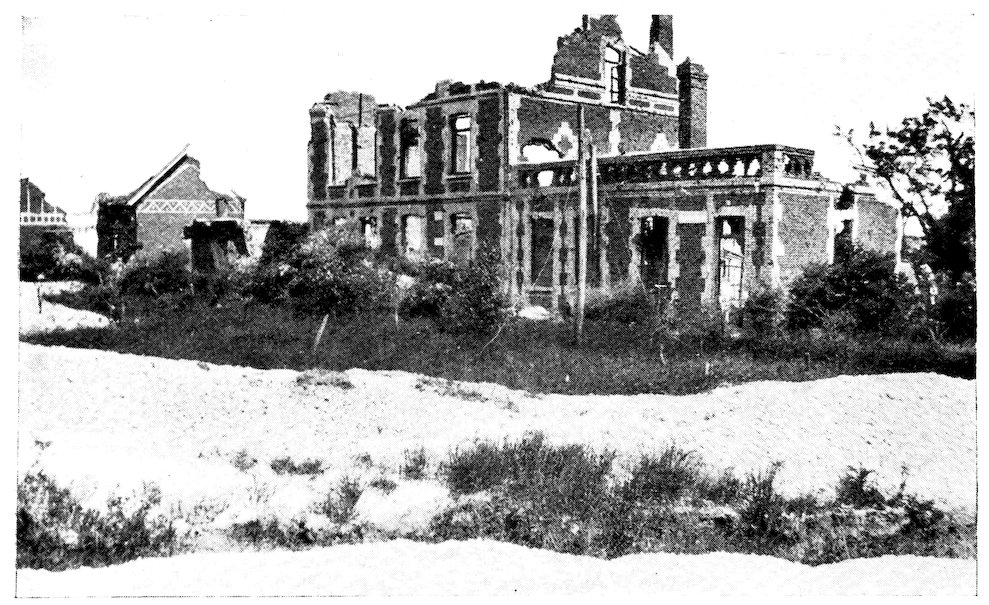
HODSON’S HOUSE. Support Battalion Headquarters.
“The tape-laying party (2nd Lieut. Michie and two other ranks) left our trench at 11 p.m. Proceeding beyond our wire by Conductor Sap, an enemy patrol of about sixteen was seen advancing on Mason’s House. Our trenches were being trench mortared at the time. Our raiding party was temporarily got into position to repel this raid, and our two officers went forward again into No Man’s Land to reconnoitre. On being approached, the enemy dispersed and made his way hurriedly to his own line. The enemy was using gas in trench mortars. After this, 2nd Lieut. Michie went out and laid the tape successfully, from Conductor Sap to the enemy wire. A covering party (with Lewis guns) was then placed in position in No Man’s Land, and the two sections and the Bangalore torpedo party advanced to the end of the tape on the enemy’s wire. The torpedo was exploded successfully at 1.10 a.m., and 2nd Lieut. Binney led half the party through the gap into the enemy’s trenches.
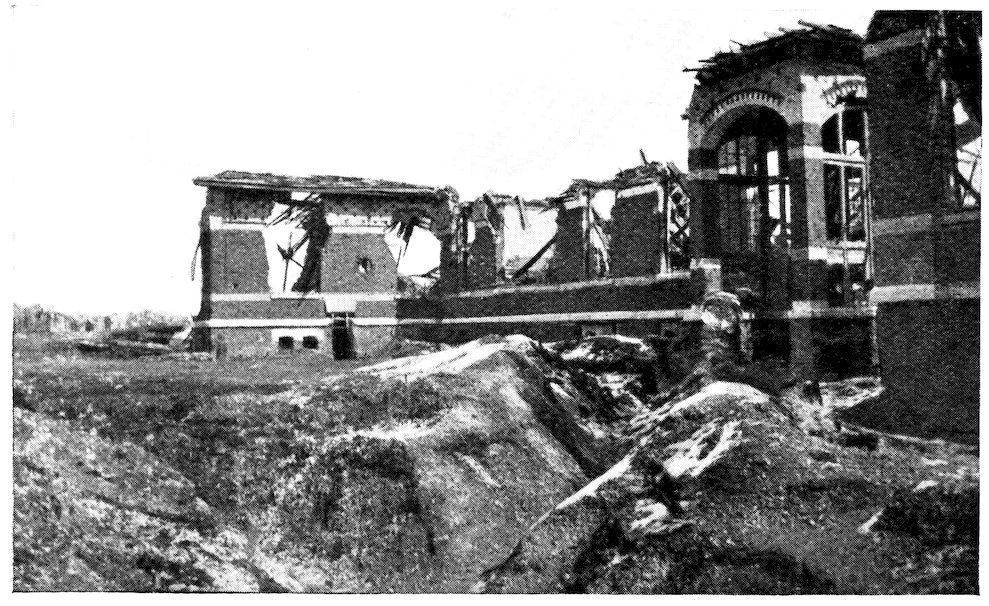
CAMERON CASTLE. Front line Battalion Headquarters.
209“Immediately the Bangalore torpedo exploded the enemy put up two green lights, and within a few seconds he opened up with trench mortars on No Man’s Land and his own wire. Several trench mortars fell almost in the gap made by the torpedo and divided our patrol into two parts, inflicting two casualties on the rear section. 2nd Lieut. Binney, with the leading section, remained in the enemy trenches for some minutes and thoroughly investigated it.
“The trench still looks quite new, but is only about three feet deep, and there are no dug-outs in this vicinity. About 1.25 a.m. the order was given to return to our lines. This was done successfully without further casualties, although trench mortars were bursting freely in No Man’s Land. From the speed and accuracy with which the enemy’s barrage was brought down it would appear that the exact locality of the raid had been discovered. Probably the tape-laying and Bangalore parties had been spotted. 2nd Lieuts. Michie and Binney both did good work.”
210By the end of June, profiting from the experience in the recent German offensive, the principle of depth in the holding of the line was taken up thoroughly. This necessitated a further change in the defence scheme. By this time we were getting a little accustomed to the constant changes. In general terms the line was held now by one company only in the outpost zone, and three companies back in the main forward battle positions known as the Black Line, about 1,500 yards behind the front line. The object of this arrangement was that the large majority of the garrison should be beyond the range of the enemy’s trench-mortar fire, which he had used in the opening stages of his offensive on so many fronts during the spring and early summer with annihilatory effect.
Battalion Headquarters was moved from Cameron Castle to some new dug-outs on high ground in Cité St. Pierre behind the Black Line.
On one memorable occasion, when we were in the front line, a practice “stand to” was ordered by Brigade. Gen. Morgan came up, and had gone round the Left Black Line company’s front, when the enemy elected to put down a thick gas bombardment of the Black Line area. The inspection was abandoned, and the General and his party started to grope their way back in gas-masks. Each communication trench which was tried seemed to be a particular mark for the enemy’s guns. Finally, by a very circuitous route, the party arrived at St. Pierre Church. Here all seemed quiet, but as soon as the General 211and the Brigade Major started to climb the hill to Morgan Mansion, Brigade Headquarters, gas shells began to follow them again, and continued in their tracks all the way home, the final insult being a perfectly good shell which landed at the entrance to their dug-out just as they were going to enter. In retrospect it looks to have been a very amusing evening. At the time it had its comic moments, but not many.
During July everyone was very busy. When we were out of the line we were training hard. Several days were spent at the training-ground at Marqueffles Farm, where there was a good rifle range, and where we had opportunities to practise with tanks and contact aeroplanes. When in support, large parties were out every day making concrete Lewis-gun and rifle posts in the Blue Line, where the support platoons of the outpost company had their battle positions.
In the front line we were patrolling with exceptional vigour, keeping touch with the enemy in every way possible. Several times we encountered the enemy in No Man’s Land and drove him off, and he on his part made one or two attempts to get into our lines without success.
On July 20 the Corps Commander, Sir Aylmer Hunter-Weston, visited us and went round the Black Line. The enemy honoured the day with a very heavy bombardment of the area round Counter Alley from which our gas projectors were usually released. The inspection of the Black Line was a vigorous affair; few who took 212part in the race will ever forget it. The distinguished general kept up his habitual pace of six miles per hour without turning a hair, and by the end of the afternoon his staff and following were stretched over at least a mile of trench. Many of them had succumbed into one or other of our Company Headquarters for liquid refreshment very early in the contest. Of twenty starters in the Marathon, only four were in sight when the favourite flashed past the post at Battalion Headquarters at 5.30 p.m.
The reader will have taken for granted on reading the name of our Corps Commander, that in addition to the other strenuous work of these days, activity with the whitewash brush and other fly-proof devices was to be seen on all sides at all times.
On July 21 the first performance of the new Brigade Concert Party, “The Dragonflies,” took place. It had been in the rehearsal stage for a long time, but the results fully justified the care which had been given to it. The Party continued to entertain us until long after the Armistice.
The Divisional artillery had a forward section of guns at the Opera House in St. Pierre at this time, and the enemy carried out several protracted shoots on the Opera House area. He never succeeded in hitting the guns, but parts of the village were very unpleasant at times. On the night of August 4/5, Battalion Headquarters was shelled heavily with high-explosive and sneezing gas, direct hits being obtained on the mess and Commanding Officer’s dug-out. On 213August 5 a particularly heavy shoot on the Opera House made a nasty mess of that part of the village. Lieut. Walker, an R.E. officer, who had done a lot of work with the Battalion, was killed. In the front line patrolling activity was very great, and the enemy was given no chance in No Man’s Land. Only on one or two occasions was the enemy encountered, and he invariably made off immediately he saw any of our men.
On August 8 the officers beat the rest of the Battalion at cricket by 120-odd to 60-odd, Col. Wenyon being top scorer with some 60 runs to his credit. This was by way of revenge, as on the previous tour at Bully the other ranks had been successful by 110–102. On the 13th we played the Sherwood Foresters, and were rather badly beaten.
On August 9 the Divisional Horse Show took place. We took second prize in transport turn-out, and “Diana,” the veteran C Company mount, won second prize in the officers’ chargers competition.
A few weeks later in the Corps Commanders’ Transport Cup Competition, when the entire transport of all units were inspected for efficiency and turn out, we were placed first in the Division.
Our Transport Section was justly proud of this result, and it was a well-merited reward for the splendid work of Capt. Arnaud, Sergt. Shepherd, and all ranks of the Transport Section.
It has been difficult in these notes to mention the work of our Transport from month to month, 214but this has not been because it did not deserve mention. Everyone intimately acquainted with the Battalion would agree that the work of the Transport Section was always one of the great features of our life. Capt. Arnaud joined the Battalion on the Somme in 1916, and remained Transport Officer till the end of the war. He was associated first with Sergt. Wood, M.S.M., and later with Sergt. Shepherd, M.S.M. The whole section pulled together magnificently, and their loyalty to the Battalion was always most marked. During the very difficult days in the Salient in 1917, throughout the winter at Hargicourt in 1917 and 1918, and at Lens during the summer of 1918, the men in the line had ample reason for thankfulness to Capt. Arnaud and his splendid section. But the greatest work was during the retreat in March and April 1918, and during the final advance from Cambrai in October and November 1918. During both these times of trial everyone was fed and supplied every day; and during the March retreat especially, the fight the Battalion was able to put up day after day was only made possible by the indefatigable zeal of our Transport Section so gallantly led by Capt. Arnaud. By hook or by crook he succeeded every day in getting hot meals up to the men who were fighting, and supplies of ammunition were rushed up at a moment’s notice wherever they were needed.
The Military Cross awarded to Capt. Arnaud and the M.S.M.s awarded to Sergt. Shepherd and Cpl. Verrall were among the very best earned 215rewards gained during the whole history of the Battalion.
During August the Hun commenced to shell Fosse 10, where up to that time the Transport and Quartermaster Stores had spent a very peaceful summer. It had previously been subject to night bombing raids, and a few long-range shells every now and then, but at the end of August he was shelling there daily and making things very unpleasant. On the 23rd he got a direct hit on the Quartermaster’s Mess, and on the 24th the Transport moved, followed on the 28th by the Quartermaster’s Stores, to Aix-Noulette. Unfortunately the Hun then turned his attention to Aix-Noulette, and it became nearly as uncomfortable as Fosse 10.
Some time before this, during one of the bombing raids on Fosse 10, we lost Regt.-Quartermaster-Sergt. Ifould, who was most unluckily hit by a splinter, which came through his window. He had succeeded Regt.-Quartermaster-Sergt. Dadd in the previous summer, after being Coy.-Quartermaster-Sergt. of B Company for a long period. He was very popular, and was a most valuable warrant officer, and we were all very sorry to hear of his departure to England. Coy.-Sergt.-Maj. W. Dunk, D.C.M., was his successor.
Bully-Grenay was also getting quite uncomfortable, and was frequently either bombed or shelled, mostly at night.
On the 27th, when we were at Bully, we suddenly had orders to go into the line to the right of our Brigade front for one night. The 216front was being rearranged, and the 73rd Brigade was moving round to take over from the left brigade of the 20th Division in front of Lievin. The enemy shelled Lievin heavily at night with mustard gas, and the reserve company had a few casualties. We returned to Bully the following night.
On the 29th a special performance of the Brigade Concert Party was held in aid of our Regimental Prisoners of War Fund, the proceeds of which, 903 francs, were duly sent to the Depot.
On the 30th a most successful Sergeants’ Mess Concert was held, with Regt.-Sergt.-Maj. Greenaway in the chair, to celebrate the close of the Battalion’s 3rd year in France.
Towards the end of August there was a distinct feeling that if anyone was going to do a push at Lens, it would not be the Boche. On September 1 the system of “peaceful” penetration commenced. 2nd Lieut. R. N. Killick, with a platoon of C Company, pushed forward at about 3 o’clock in the afternoon into the ruined streets of Lens. This small party were the first British troops to enter Lens, and once there they established positions for D Company, who relieved C Company at night, to take up and hold.
We had a busy time from now onwards. Although our line had been advanced only a few hundred yards, it was decided that working parties could show themselves in hitherto forbidden places by day. With a view to a possible advance, all work was concentrated on the clearing of the two main roads in Lens, the making of 217forward tracks, and the formation of large forward dumps of ammunition and rations.
The enemy strangely enough left these huge working parties almost unmolested, and in a very few days we had the strange sight of almost perfect pavé roads running practically into the front line, and men employed in the open in all directions in broad daylight.
In the front posts which we had taken, things were not so quiet. The enemy would put down heavy bombardments on to place after place each day. On September 3 he attacked the East Surrey posts at the junction of Claud and Canary Trenches on our left, captured two days before, and recaptured them. In rendering assistance in this fight, one of our officers, 2nd Lieut. F. Carville, M.C., was badly wounded. We remained in the front line until September 12, during which time inter-company reliefs took place each forty-eight hours. A great deal of work had been done, and we handed over a new organised front line to the 9th East Surrey Regiment.
Our six days in reserve at Bully were busy ones. On the 15th the whole Battalion attended a tank demonstration at Marqueffles. On the 16th we carried out a battalion tactical exercise in the form of an advanced guard march to Marqueffles and an attack in open country. Field guns, machine guns, and Stokes mortars co-operated.
On the 18th we moved into the line again in relief of the 9th East Surrey Regiment. The 218map references of the forward posts taken over did not agree with the actual posts held, and after a few quiet days and some nights of active patrolling it was decided to put this right. On the night of the 23rd/24th, a party of C Company retook the enemy’s post at the junction of Canary and Claud Trenches, which post had been disputed several times during the past weeks. Up to now it had never been held for more than a few hours, and it was now our turn to have a shot at taking and keeping it. The full account of the events of the night, and the first attempt of the enemy to recapture the post on the morning of the 24th, are as follows:
When the position at the junction of Canary and Claud had been captured, consolidation was carried on vigorously all night, and by 6.30 a.m. considerable improvement had been made in the positions. At about 6.40 a.m. the enemy started to shell our old front line and communication trenches heavily with 5·9s, and shortly afterwards the officers in this area, 2nd Lieut. Davis and 2nd Lieut. Beynes, who were at the time engaged in establishing a fresh post to connect up Mason’s House with our new position, heard heavy bombing from the direction of the latter. A party of the enemy, about forty strong, had entered the post from the north-east, one lot coming straight down Canary and another entering Claud at its junction with Twisted Alley. The post was occupied, and one N.C.O. and five men were captured. 2nd Lieuts. Trenchard-Davis and Beynes at once organised a counter-raid. 219A bombardment with rifle grenades was commenced from a position in Canary, and the two officers each led a party along either side of the trench, ejected the enemy, and reoccupied the post. The Huns retreated hurriedly up Canary and over the open, and were followed with Lewis-gun fire from the recaptured post and Counter Sap. One German was killed just beyond the post, and it seems probable that several other casualties were inflicted on the enemy in his disorderly retirement. L.-Cpl. Binks and one of the men who had been captured were left, with a wounded Hun, in the charge of another Hun. When the attention of the latter was attracted by the commencement of our counter-raid, L.-Cpl. Binks relieved him of his rifle and brought in his escort and the wounded Hun as his prisoners.
The position was completely restored by 7.30 a.m. Our casualties were four men missing and two slightly wounded, and the enemy is known to have lost one killed and two prisoners and probably lost many more.
2nd Lieut. Trenchard-Davis and 2nd Lieut. Beynes acted with great resource and courage in organising and carrying out the counter-raid, and L.-Cpl. Binks showed great presence of mind and determination in turning the tables on his captors.
On the evening of September 24 a platoon of D Company relieved the C Company garrison in Canary Trench. The D Company platoon, No. 16, was under the command of Lieut. D. J. 220Dean. Most of the men in the platoon were young soldiers, as yet almost untried in the real rowdy-dow of a fight. As they took up their posts in that battered trench, none of them knew that in the next two days they were going to write the most glorious page in the history of their Battalion. They were heavily attacked almost immediately they had taken over the post, and for two days and two nights after this they were constantly attacked by overwhelming numbers, and with all the fury of shelling and trench mortaring which a resolute and exasperated enemy could summon to his command.
When No. 16 Platoon took over the post at 9 p.m. on September 24, it still required a great deal of consolidation, and the trench was very shallow. Within ten minutes of the arrival of the new platoon, the enemy made his second attempt that day to recapture the post. Covered mainly by machine-gun fire, the enemy advanced over the open from the north-east, but were driven off by Lewis-gun and rifle fire from the post. Lieut. Dean was in the most exposed positions, and moved about in the heavy machine-gun fire with absolute fearlessness. Immediately this attack had been dealt with, feverish work was put in to deepen the trench and improve the blocks in Canary and Claud. The enemy kept up a heavy machine-gun fire on the post, from which the trench, in most places only two feet deep, offered very little cover.
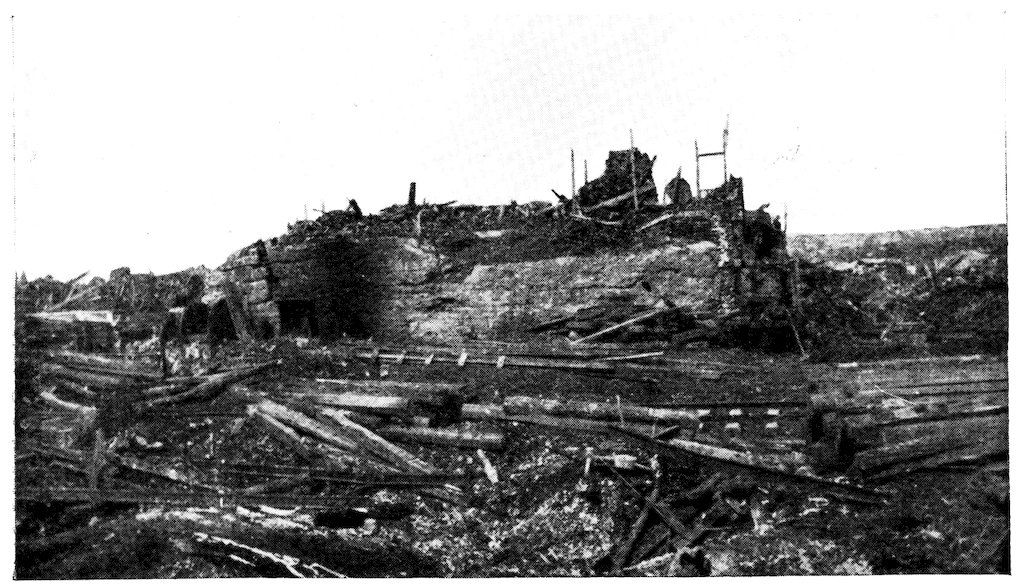
CONCRETE PILL BOX. Our First Platoon Headquarters in Lens.
Just after midnight another attempt was made by the enemy. Two men were wounded, and the enemy got so close to the post that it was in great danger. Lieut. Dean, however, led his men forward, and the enemy, surprised by this bold move, were driven off.
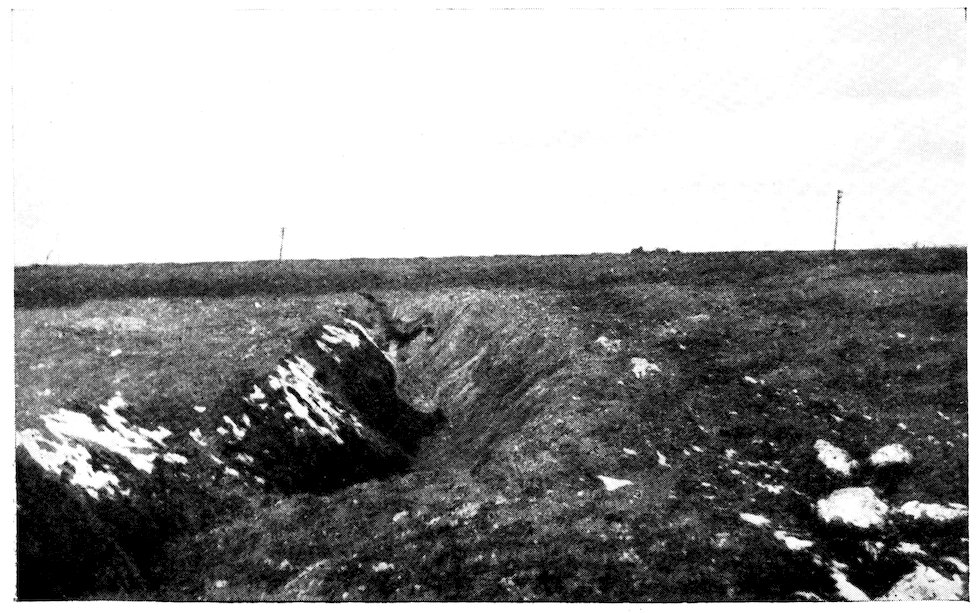
DEAN’S POST.
221Again it was a case of digging for their lives, and by the time the dawn arrived both officer and men were nearly exhausted, but they were not to be allowed to rest. At 6 a.m. they were subjected to a third and very resolute attack by the enemy. A barrage of heavy shells was put down behind the post to cut off all communication, and the post itself was severely trench mortared. Lieut. Dean at once got his men into position, harassed the enemy approach down Canary with rifle grenades, and brought withering rifle fire to bear on them as they advanced over the open. One of the enemy was killed as he was entering the post down Canary Trench, and several casualties were inflicted on them as they retired in disorder. Regardless of danger, Lieut. Dean followed the retreating enemy over the open, but was driven back by rifle and machine-gun fire before he could secure any prisoners. For hours after this, enemy parties could be seen moving about their trenches. At first it was thought that they were coming up for a fresh attack, but there appears little doubt that actually they were engaged in removing casualties.
Throughout the 25th and the night 25th/26th Lieut. Dean and his men gave themselves no rest, but pressed on with the work of consolidation in face of great enemy opposition, and by dawn on 222the 26th the position had been very greatly strengthened. The garrison of the post was then relieved by two fresh sections of the same platoon, and Lieut. Dean remained in command.
At 10.15 a.m. on the 26th the enemy commenced to shell the post and its vicinity with 5·9-inch howitzers, and also put a very heavy barrage on all communications behind. Dean at once got his men into their fire positions, and a fresh attack by the enemy was beaten off with loss. When this attack was over, Dean went to visit his other posts, and during this time the enemy recommenced shelling with the greatest intensity, and obtained several direct hits on the post itself. In view of the casualties, the sergeant in charge decided to withdraw temporarily, and got the men back to a position some fifty yards from the actual post. The enemy immediately followed up his barrage and occupied the post, showing great resolution. Lieut. Dean grasped the situation at once. He collected his two sections, and led them with the utmost gallantry across the open, and the whole thing was done with such speed and determination that the enemy did not wait for the bayonet, but evacuated the post in the greatest disorder, suffering many casualties from our fire. This counter-attack was greatly assisted by the platoon on the right in Cinnabar Trench. Immediately 2nd Lieut. Cambrook saw Lieut. Dean preparing to counter-attack, he collected two of his own sections and led them under heavy fire over the open with a view to taking the enemy in the flank and cutting off his retreat. 223He had reached a point on the flank of the enemy post before he was severely wounded in the chest, but his work was then done, as the enemy, seeing himself attacked from two sides, had already vacated the post. Lieut. Cambrook’s quick decision and fearless leadership were of the greatest value, and were rewarded with the Military Cross, but unfortunately he died of his wounds a few days later, and never heard of his honour. His sergeant, Sergt. Alderman, remained with him until the post was captured, and then most gallantly carried him back over the open, and was rewarded with the Military Medal.
This was the last of the enemy’s six attempts to retake the post in just over forty-eight hours, and five of the attacks had been withstood by Lieut. Dean and No. 16 Platoon of D Company. During the next night two dead Boches were brought in from the vicinity of the post, and groanings during the day testified to other enemy casualties. In addition, scattered round the post sufficient rifles and equipment were found to provide for a whole platoon, giving further evidence of extensive enemy casualties and of the completeness of his demoralisation. It should be mentioned that during the first bombardment on the morning of the 26th the enemy hit and exploded two heavy mobile charges, which had been brought up for the raid to be carried out in the afternoon. This explosion severely shook Lieut. Dean, who was very close at the time, and his subsequent work in organising 224and carrying out the counter-attack is all the more remarkable.
To sum up the work of Lieut. Dean, we give the closing paragraphs of his official recommendation for the Victoria Cross:
“During these two days Lieut. Dean worked unceasingly and with utter contempt for danger in an exceedingly difficult situation. His garrison was suffering casualties continually, but he himself bore a charmed life.
“Five times in this period he was attacked (three times very heavily) by a resolute enemy, and each time the attacks were thrown back.
“Throughout he inspired all his men with his own contempt for danger, and in consequence they all fought with the greatest bravery, though most of them were very young soldiers with little experience.
“He set an example of personal gallantry, initiative, splendid leadership, and devotion to duty of the very highest order.”
The battered remnants of No. 16 Platoon came back on the night of September 26. Even then they were reluctant to leave the post in other hands.
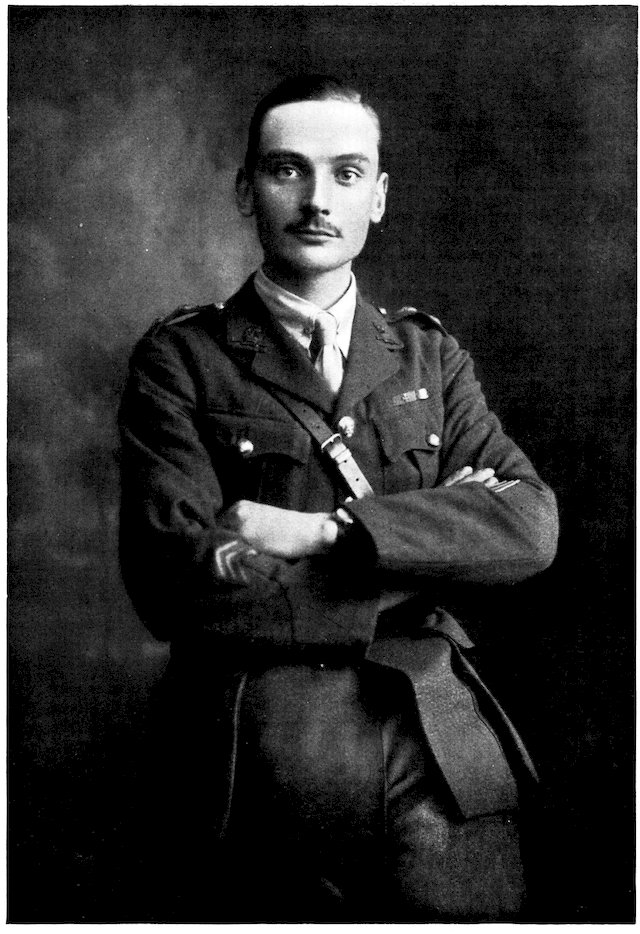
Photo by] [Wykeham Studios Ltd., London. LIEUTENANT D. J. DEAN, V.C.
The immortal defence of Dean’s Post was talked of from one end of England to the other when the announcement was made that the King had awarded the Victoria Cross to Lieut. Donald John Dean. The Battalion heard the news of the award in December in a little Belgian village, after all fighting was over. The news was telephoned through to us when the whole 225Battalion was in the village school at a Battalion concert. Such a scene of tumult and enthusiasm as greeted the announcement is impossible to describe. The events of those September days were still fresh in our minds, and a few of Dean’s platoon were still with us. Every man in the Battalion during those frenzied moments of cheering took Dean to his heart, and felt that he was the man who would stand at the head of the Battalion for all time. Dean himself was, of course, not there. He was only just past the critical stage following the severe wounds he sustained during October.
The official recognition of the work of No. 16 Platoon was expressed by the awards of the D.C.M. to Sergt. Skipper, and the M.M. to Cpl. Eversfield, L.-Cpl. Goodwin, and Pte. Yates.
After the second day of Dean’s defence it was obviously desirable to push the enemy away from the posts which always threatened ours. A daylight raid on the enemy post at the junction of Cinnabar and Claud was, therefore, planned for the afternoon of September 26.
The raid was led by 2nd Lieut. R. N. Killick, D.C.M., and 2nd Lieut. C. Trenchard-Davis with the utmost gallantry.
The following official account of the raid was written at the time:
“The raid on the enemy trench at the junction of Cinnabar and Claud took place this afternoon. The right party entered the enemy trench at the junction with Claud and the left party went over the open towards Cuthbert. 2nd Lieut. Davis, 226leading the left party, saw one of the enemy manipulating a machine gun just north of the junction of Cinnabar and Cuthbert; he appeared to be putting in a new belt. 2nd Lieut. Killick, seeing the danger the left party were in, rushed the post and shot the German dead just as he was starting to fire. Immediately afterwards 2nd Lieut. Killick was hit in the head and leg by a light trench mortar or rifle grenade.
“2nd Lieut. Davis led his party 50 to 60 yards up Cuthbert. No enemy and no dug-outs were seen. He then returned, and proceeded up Cinnabar about 100 yards. At the point where the machine gunner was killed he found a two-entrance deep dug-out.
“Several steel helmets and overcoats were hanging at the entrance. 2nd Lieut. Davis shouted down, but there was no response. He then threw in two Mills bombs, after which there appeared to be a disturbance downstairs. He shouted again to the men to come up, but there was no response. The R.E.’s and carrying party with the mobile charges were then called up and the charges successfully exploded at the bottom of the stairways. 2nd Lieut. Davis inspected both entrances before leaving. The whole dug-out appeared to have collapsed, and both entrances were effectually sealed. There is no doubt that there were inmates in the dug-out, and that they were irretrievably buried there.
“As his task was finished, 2nd Lieut. Davis ordered the party to return. They brought 227back the body (which was that of an officer) and the machine gun (light) complete.
“Our casualties were 2nd Lieut. Killick and one other rank wounded. Before the raid commenced, two men of the trench garrison were killed and three wounded by enemy trench mortars.”
Both 2nd Lieut. Killick and 2nd Lieut. Davis were awarded the Military Cross.
The following special Battalion Order was issued:
8th Service Battalion Royal West Kent Regiment
In-the-Field, September 27, 1918
SPECIAL BATTALION ORDER
During the past few days the Battalion has passed through experiences which have tested the soldier-like qualities of all ranks to the utmost degree.
You have stood the test in the finest possible way, and the fact that our line still remains intact and stronger than ever, and that very heavy casualties have been inflicted on a brave and resolute enemy, redounds very greatly to the credit of all concerned.
I wish to mention the magnificent defence put up by D Company during two days of very great stress and difficulty.
Five times a determined enemy, supported 228by all means at his disposal, has attempted to drive in our post, and five times he has been thrown back with heavy losses.
I also wish to mention the very excellent work done by all ranks of C Company: first in capturing the positions from the enemy which we now hold; secondly, for re-establishing our post when a strong attack by the enemy had temporarily driven it in; and lastly, for the very gallant manner in which the successful raid was carried out by them in co-operation with D Company on the afternoon of September 26.
All the companies have done a tremendous amount of work in consolidating the new positions and in daring patrol work.
A and B Companies on the right have been subjected to the trial of heavy shelling in their posts on several occasions. I know that the Officers Commanding and all ranks of A and B Companies will be the first to join me in congratulating D and C Companies for their magnificent work.
With the certain knowledge that soldier-like qualities of the highest order exist throughout all the companies, we can look forward confidently to the future. Whatever tasks lie in front of you will be carried out to the utmost of your powers.
The fine work of the past few days is worthy of the very best traditions of our magnificent regiment, and the Queen’s Own will always be proud of the officers, N.C.O.s, and men, many of whom have laid down their lives, who have 229done such sterling work during this week of stress.
H. J. Wenyon, Lieut.-Col.,
Commanding 8th Service Battalion
Royal West Kent Regiment.
Battalion Headquarters,
September 27, 1918.
On the right company front during these days the enemy artillery fire had been very heavy, particularly in the vicinity of a post known as the Zeppelin. This was in the ruins of some dilapidated factory, the twisted iron of which stood up very much in the shape of the framework of a large airship.
On the night of the 27th/28th, after shelling this neighbourhood heavily for twenty minutes with 5·9’s, the enemy attempted to raid the post on the right of the Zeppelin. The post was held by B Company, and when the shelling started, about midnight, 2nd Lieut. C. P. H. Manley, who was the platoon commander, got his men into a dug-out for shelter. Immediately the artillery fire lifted, 2nd Lieut. Manley got the men into position, and seeing a party of the enemy at very close quarters, he got the Lewis gun into action himself, while the men used their rifles. Immediately after this, bombs and rifle fire came from the north, and 2nd Lieut. Manley saw another party of the enemy approaching him from that flank. He at once moved his post a few yards further south to a point from which he could command both raiding parties. From this point 230he brought rifle and Lewis-gun fire to bear on the enemy, who, after throwing one sulphur bomb into the now unoccupied dug-out, scattered and withdrew in considerable disorder. Just at this minute 2nd Lieut. Manley was badly wounded in the neck, but the enemy, who were in much greater strength than our post, had already been defeated. On searching the ground afterwards, one German rifle and five mobile charges were discovered near the post, and it is believed casualties were inflicted on the enemy, but the night was very dark and nothing definite could be seen. The men supported 2nd Lieut. Manley splendidly, and the next post also joined in with rifle fire during the enemy’s retirement.
2nd Lieut. Manley handled the position with great resource, and by his quick grasp of the situation and fearless leadership undoubtedly frustrated a very dangerous attempt to capture his post. He was awarded the Military Cross, but never heard of his honour, as he died of wounds six days after the raid. Very quiet in his manner, he was a most excellent officer, and was very popular. His death was a great loss to his company, and to the Battalion.
It was at about this time that we lost the services of our Adjutant, Capt. R. P. Baker, M.C. He seems to have developed some form of blood poisoning, and had to go into hospital. We all expected him back in a week or two, but it was more serious than we supposed, and he never rejoined the Battalion. He came out as a Platoon Commander after the Battle of the 231Somme, assumed the duties of adjutant in November 1916, and held the appointment for over eighteen months. A general officer once called him “a b—— half-baked civilian,” because their views on some point did not quite agree, and Baker declined to alter his to suit the general’s but it was in reality a very erroneous estimation of his military qualities. He was a good disciplinarian and a hard worker, and, unlike some adjutants, did not confine his activities when in the line to an office in a safe dug-out. His chief hobby was salvage. He was awarded the Military Cross in 1918 for consistently able and gallant work over a long period. 2nd Lieut. C. F. C. Mackaskie, who had been acting as assistant-adjutant, took over the duties of adjutant.
We had just previously said good-bye to our Padre, who was promoted to be senior chaplain to the Naval Division. Rev. G. D. Barlow-Poole joined the Battalion at Blackdown Camp just before we sailed for France, and he remained with us for three years. He was not exclusively our own property, as he was also padre to the East Surreys, but he always took a very keen interest in all phases of the life of our Battalion, and his departure was keenly felt by all ranks. He was indefatigable in his work for the comfort and welfare of the troops, and was very popular, which is perhaps the criterion by which a padre’s work can be best judged. He was frequently to be found wandering about the front line, and performed most gallant service throughout the 232March Retreat, for which he was awarded the Military Cross.
From the 27th onwards the enemy commenced to blow up his dug-outs. He had finally given up all idea of ejecting us from our advanced positions, and he could see that we intended to advance still further. Such a clear instance of the enemy being defeated utterly in a straight fight is difficult to imagine, and it was all done by the matchless gallantry of a mere handful of men. Our whole Division was on the point of being relieved, but before we left Lens for the last time at the end of September, it was obvious that the enemy was preparing rapidly for a retirement all along this front. His shelling at close range ceased entirely, and the destruction of his defences on all sides went on continually.
On the night of September 29/30 we were relieved by the 2/24th London Regiment, who had just arrived from Palestine.
It was a dog-tired but triumphant Battalion that marched down the old Fosse 11 road to Bully-Grenay that night.
We expected, correctly, that we should soon be in the fight again, assisting in the hunt of a retreating enemy further south. All this would be new to us, yet we looked forward with confidence to anything that might come along. The Battalion had been tried in the fire for a full month, and in a perfect inferno for a week. It had come out tempered and steeled.
THE LENS AREA
[Click on map for high resolution image.]
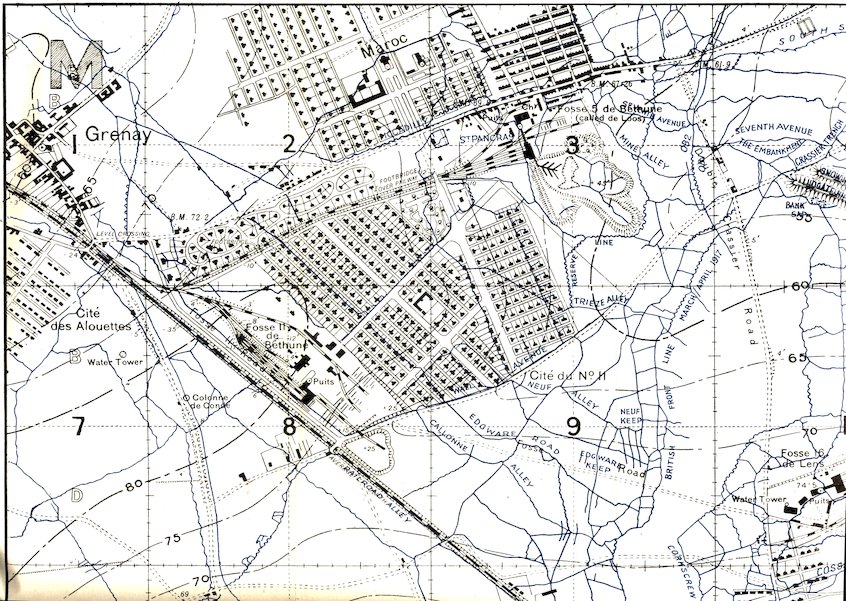
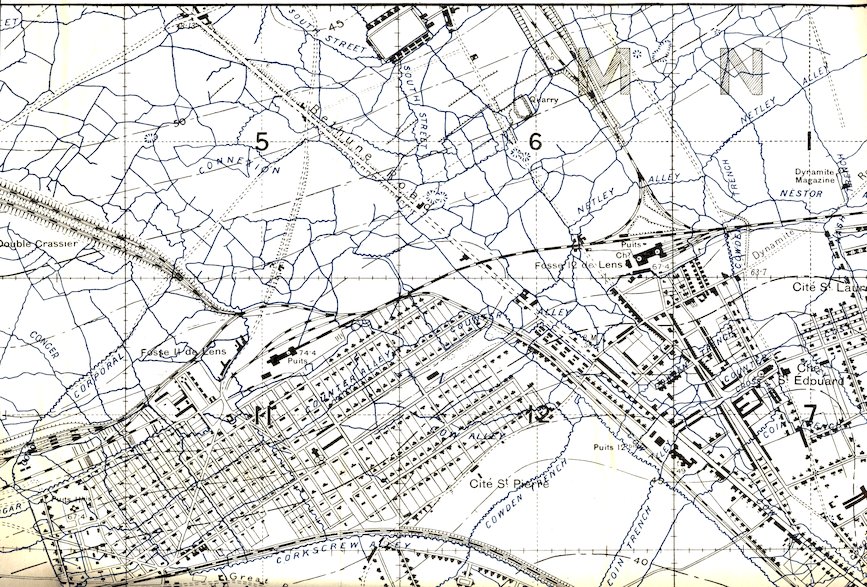
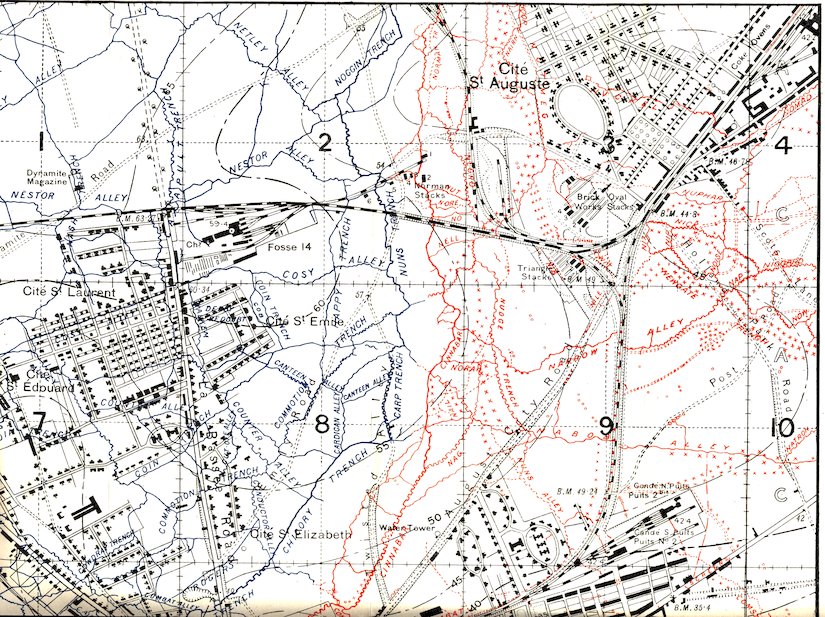
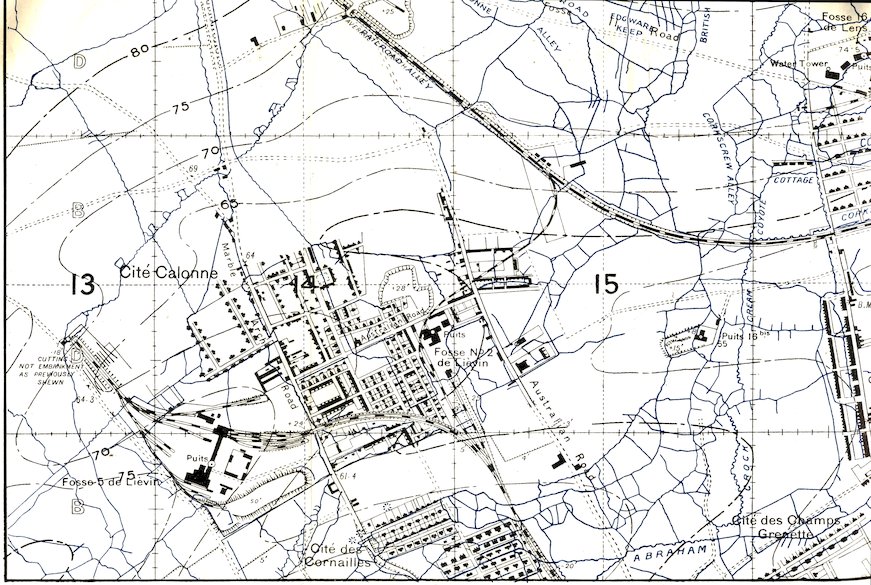
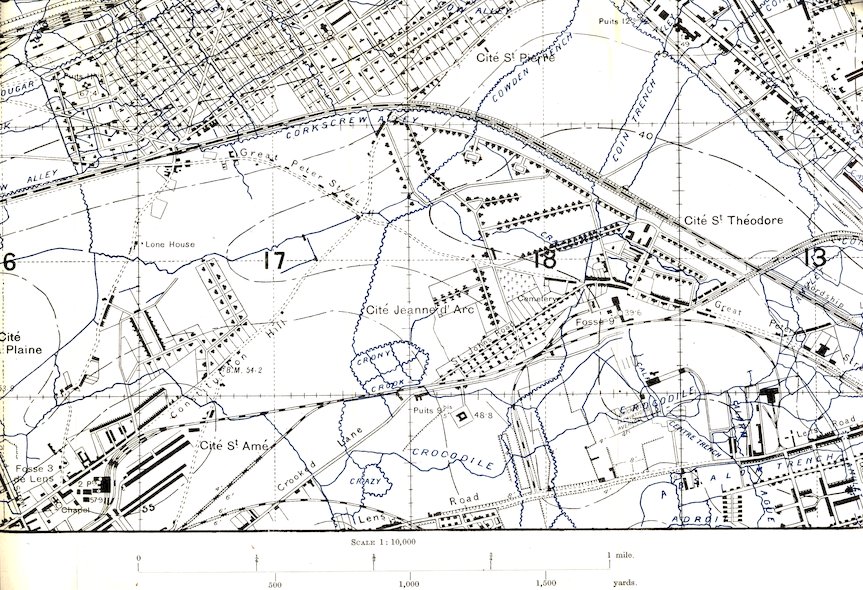
To illustrate Phase IV and VIII.
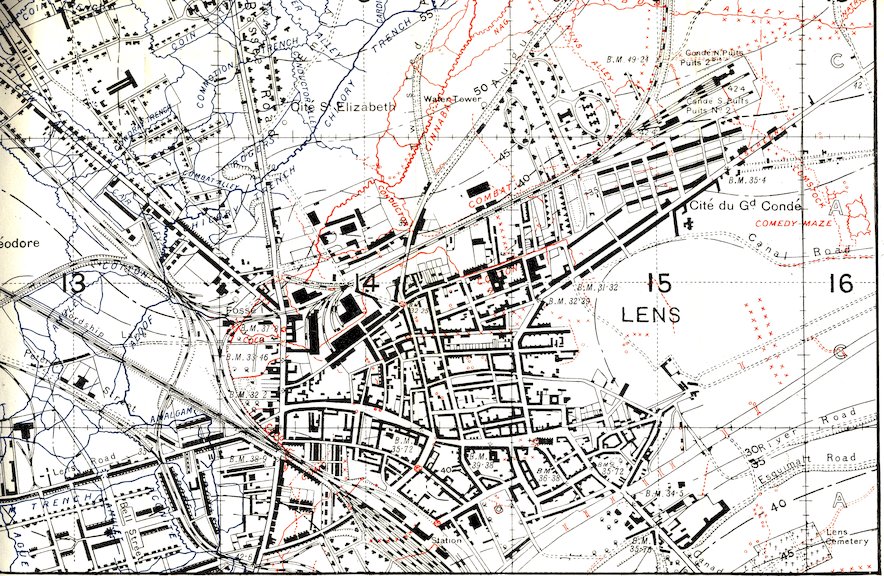
[Reproduced by permission of the Geographical Section, General Staff.
From Bully-Grenay we went in buses to 233Coupigny. The next morning we entrained at Hersin, and arrived that night at Sus-St.-Leger, a small village near Doullens, for a few days’ rest and preparation for the final phase of the war.
234