PHASE VI TRENCH WARFARE IN THE DEVASTATED AREA AT HARGICOURT September 1917–March 1918
Reading edition
For a troop train journey, the one from Caestre was quite good, and we arrived at the desolate and demolished station of Miraumont in Picardy about 11 p.m., and marched to camps at Beaulencourt, just outside Bapaume. By no means all the roads in this neighbourhood were as yet repaired, and we had to make a long detour, marching in all eleven miles when the actual distance was only seven. We stayed here a few days, and many of the Battalion took the opportunity of visiting the old scenes at Guillemont and Delville Wood. We heard indefinite reports of the front at Hargicourt, which we were soon to take over. There had just been a battle there to straighten our line by taking the Cologne Ridge. The attack had been successful, and the front was said to be still noisy and unpleasant.
On September 25 we moved to camp at Haut Allaines, near Péronne. From here, on the 26th, parties went up to reconnoitre the positions at Hargicourt. On the 27th we moved by motor-bus to Roisel for the night, and on the night of 28th/29th the Battalion relieved the 9th Northumberland 134Fusiliers (34th Division) as support battalion.
Our Battalion Headquarters were at Cote Wood, and the Battalion was disposed in trenches running up hill and down dale in the region of Cote Wood and Fervaque Farm. The weather was beautiful, all was quiet, and we had an opportunity of reconnoitring the front line thoroughly. The whole Division was in the line here, the 17th Brigade on the right, 72nd Brigade in the centre, and the 73rd Brigade on the left.
We were to share the left subsection of the centre section with the 9th East Surrey Regiment. The 8th Queen’s Regiment and the 1st North Staffordshire Regiment worked the right subsection. Our front section consisted of a front line—tumbling to pieces—called Railway Trench on the right, and Pond Trench and Bait Trench on the left, a support line just being dug about 200 yards behind, and reserve positions with Battalion Headquarters in a chalk quarry, known as The Egg, just outside the ruined villages of Hargicourt and Villeret. There were good communication trenches, Club Trench and Onion Lane.
From the front line at Bait Trench we had a splendid view of the Hindenburg line and the village of Bellicourt. The ground sloped down steeply from this part of our positions, and we could see almost the whole of the valley called Buckshot Ravine, across which the Hindenburg front line and switches in front of Bellicourt had been dug. The country behind our lines was undulating and splendidly open. All villages 135had been totally destroyed by the enemy on his retirement in the spring.
The position of the support battalion at Cote Wood was quite comfortable. Protected from view, the trenches were well dug on the reverse slope of a ridge.
Our transport lines and Quartermaster Stores were established some four miles back in an orchard and paddock close to an old destroyed sugar factory, known as Montigny Farm. There was a rest camp here for the battalion out of the line in Divisional Reserve. From time to time our quarters when in Divisional Reserve were changed. We started at Montigny, later we used the ruined village of Hancourt, and last we were very comfortably quartered at Vendelles. Great improvements were made in the accommodation by the 24th Division during its long stay in this region.
The weather was fine when we arrived at Cote Wood, and we immediately took advantage of this to set our house in order for the winter. We were up working at full strength on the communication trenches to start with. By strenuous efforts, before the weather broke, we succeeded in getting our front and support lines and communication trenches into a state which would hold up in the winter. In the support line we started making deep dug-outs on our own, and Capt. Proctor and 2nd Lieut. Holliday did great work in this direction. Everywhere was a scene of strenuous activity. Fortunately the Boche interfered very little with us during this period, 136and later on, when things livened up considerably, we reaped the benefit in the shape of dry trenches and comparative safety. Half-way through the winter we side-slipped to the left a bit, taking over a piece of trench from some other people who had not seen fit to take advantage of the dry spell in October. This piece of trench—Fish Lane locality—caused us more trouble than the whole of the rest of our line together. Down at Montigny Farm there was a lot of work for the transport and Quartermaster’s Stores personnel. When they got there they found just a few huts and no covered standings for horses at all. Material for building was very difficult to obtain by indenting on the R.E.’s, and there was nothing for it but to “find” the stuff for building if we were going to make men and horses comfortable for the winter. Capt. Arnaud moved in a mysterious way his wonders to perform at Montigny. G.S. wagons and limbers used to creep out of the camp during the evening. No one knew where they were going or when they returned. But a growing dump of corrugated iron, timber, and bricks and some feverish activity in the building world might have given some clue to any one good at putting two and two together. By the importunity of our asking we finally got half an Adrian hut supplied, and made out of it a really splendid Quartermaster’s Stores.
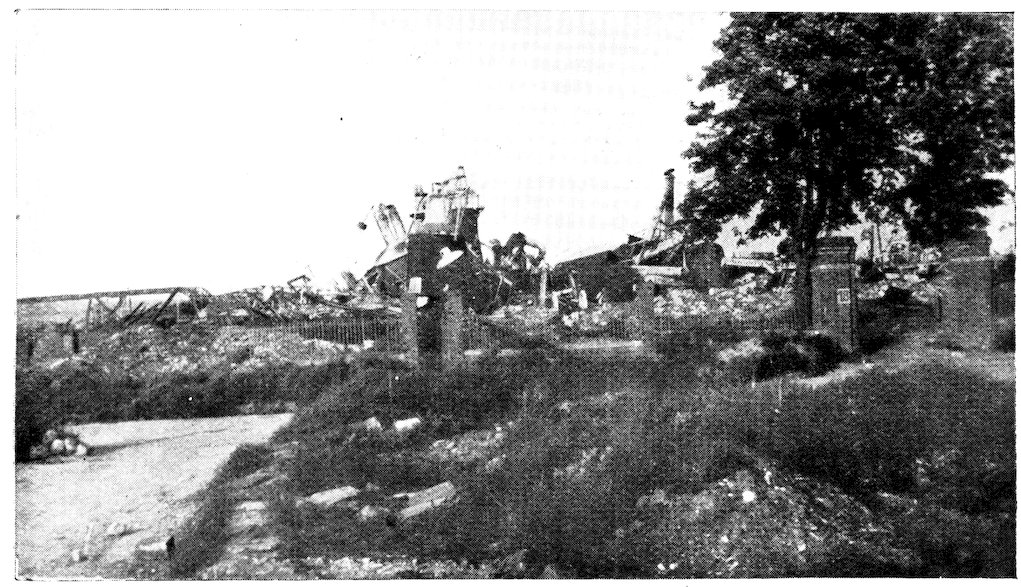
MONTIGNY FARM. The Sugar Refinery.
The N.C.O.s and men built their own shacks. Some of them were comical enough to look at, but they were pretty sound inside. Capt. Arnaud’s transport lines were a triumph. He made really splendid covered standings for all the animals, brick walls, wooden stalls, brick floor, corrugated iron roof—all without an inch of material supplied by the R.E.’s. Montigny was visited by some of the Battalion in April 1919, and most of these splendid covered standings were still there.
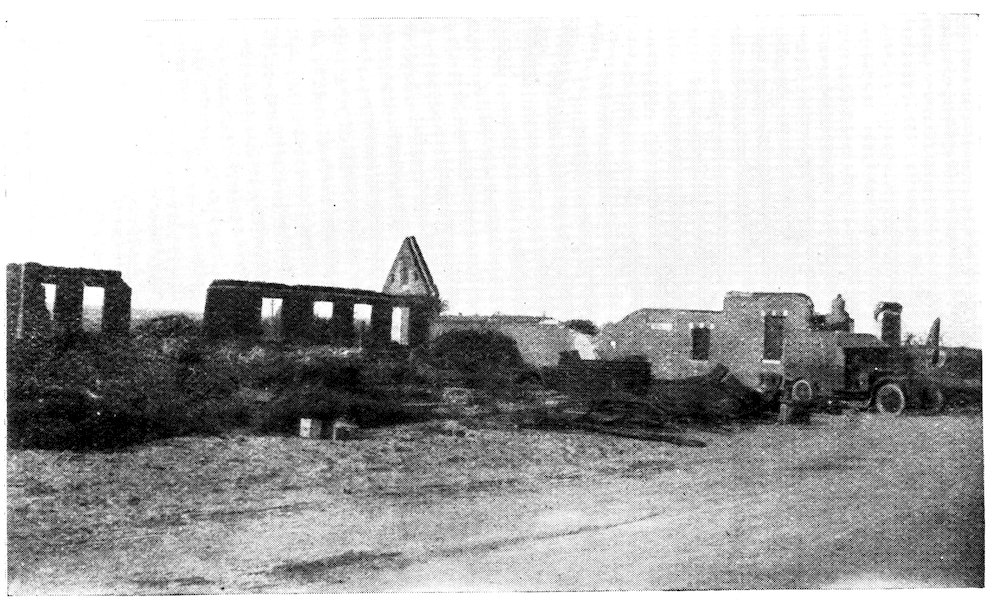
VENDELLES. Occupied by the Reserve Battalion.
137In the line we had six-day tours and daylight reliefs. There was no very great excitement while we were getting to know the line. The enemy was, on the whole, very quiet, and seemed quite reconciled to the loss of his bit of high ground at Cologne Farm. On October 17 we side-slipped northwards, and took over the extra bit of line previously referred to. At the same time we had to give up our Battalion Headquarters at The Egg, where we had just constructed a new mess, a deep dug-out, and many shelters, and where we were getting comfortably settled. Was it not ever thus? We only moved about 500 yards to the railway embankment, where there were a few shelters known as the Leicester Lounge. By the railway there was the remains of an old engine, popularly known as the “Leave Train.” We started building hard again here, and made good quarters, which we were fortunate enough to retain for the remainder of the winter. On the 22nd we moved back to Vendelles for six days, our first tour in Divisional Reserve.
The Battalion was housed in big Adrian huts, in rather a dilapidated condition. The village, of course, was totally destroyed.
138There was very little in the way of amusement for anyone in this devastated country. Cinema shows, canteens, and concert huts were an urgent necessity, and the building of these was being taken up by the Division most energetically.
November 1917 was a month of changing fortunes, alarms, rumours, orders, and counterorders.
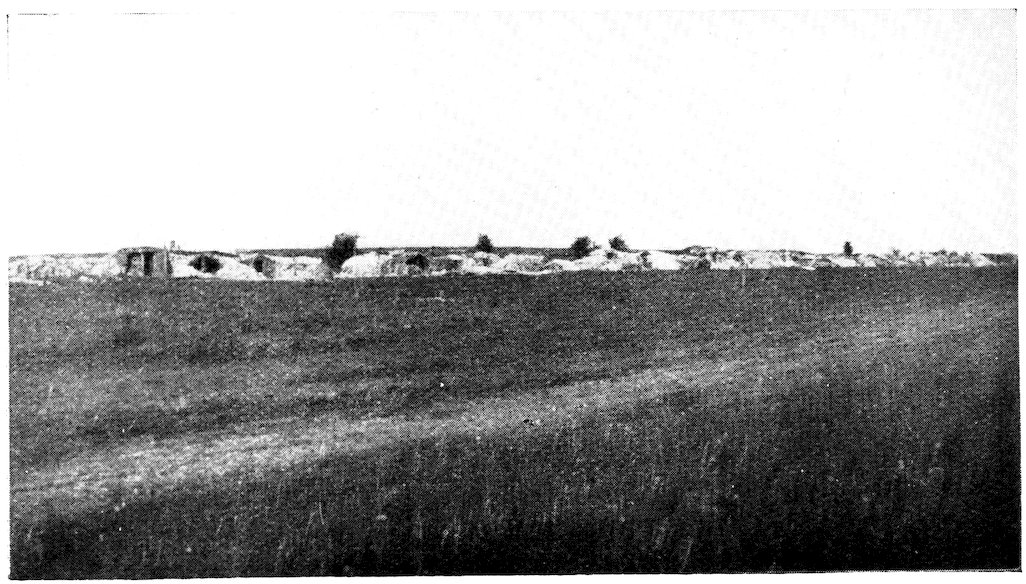
THE COTE WOOD POSITIONS. Occupied by the Battalion in support.
On November 3 Lieut.-Col. J. C. Parker proceeded to England for a six months’ tour of duty, and, as events turned out, this concluded his appointment, held for over two years, as our Battalion Commander. Col. Parker joined us from the 6th Battalion at the time of chaos just after Loos. His work in the muddy trenches at The Bluff, Canal Bank, and St. Eloi in October and November 1915 will never be forgotten. During the months at Ypres in 1916 the Colonel was really very ill, but he stuck it out then and right through the summer, until he was carried away at Fricourt with a very severe attack of malaria and trench fever. During the Ypres fighting of 1917 he was again very ill and very weak, but he refused to admit that anything was wrong. In the autumn of 1917 he had to go down for an operation, and when he returned in November he still looked so ill that the Brigade Commander insisted on his having a rest. And so in a quiet manner he left the Battalion which he had worked for with infinite bravery, and which he had loved so well for two long and arduous years. Col. Parker had led the Battalion successfully through very many of its most difficult experiences. All those who were intimately associated with him in his work knew and will always remember the great things he did for the 8th Battalion Royal West Kent Regiment.
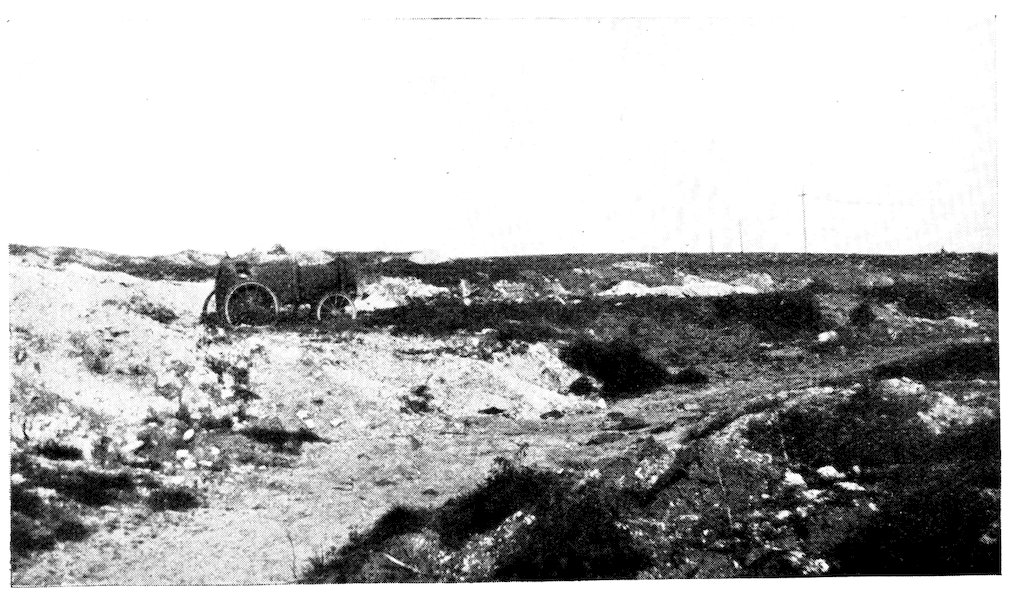
“LEICESTER LOUNGE.” Front line Battalion Headquarters, showing the “Leave Train.”
139In the absence of Maj. Whitty, Maj. Wenyon took over command temporarily, when Col. Parker left us.
During the winter we concentrated on work on and in front of the front line. Organised wiring on an extensive scale was taken up, and we started digging a new trench in front of Pond Trench in order to cut off the awkward and water-logged Fish Lane positions recently taken over. On November 20 the 9th East Surreys did a raid in the early morning. Demonstrations and raids were taking place all along the front that morning in conjunction with the great surprise attack on Cambrai. In the afternoon we relieved the East Surreys in the front line, and every night we kept the closest possible touch with the enemy by continuous patrolling on a large scale, in order to find out if he was showing any signs of retiring opposite us as a result of Cambrai.
In the early hours of November 26, Lieut. H. J. Dunn, the Battalion Intelligence Officer, was shot dead when he was out with a party digging our new advanced trench. It was really too bright a moonlight night to go out in such an exposed position, but, knowing how urgent the work was, Dunn went out with two men to see if he could possibly get the party out to their work 140in safety. He was shot through the head almost immediately. Dunn was a splendid fellow. He took the most devoted interest in his work, first as Platoon Commander at Hulluch, and later until his death as Battalion Intelligence Officer. In this capacity he was to be seen at all hours of the day and night wandering round in the front line with compasses, field glasses, map cases, sniping rifles, and every modern device for accurately surveying and killing unwary Huns. He was a very talented musician, and withal he was such a cheery, lovable man. When he went, everyone in the Battalion felt he had lost a great personal friend. He was buried at Hargicourt cemetery in the afternoon. Major Whitty rejoined the Battalion, and took over command that day, and his first duty was to attend Dunn’s funeral.
The position of Battalion Intelligence Officer was taken over by Lieut. G. S. Bowen, of A Company. To take over and carry on Dunn’s work was no easy job, but Bowen tackled the job well, and he was still I.O. when the Armistice was signed.
The Division was to have been relieved at the end of November, but on the 30th the counter-attack at Cambrai took place, the relief was cancelled, and it looked as though we might be in action with the Hun at any minute. One battalion of our Brigade was hurriedly sent out to Ronssoy to protect our flank in the direction of Epèhy, and for a few hours the situation was decidedly obscure. Things blew over later, and 141on December 1 we relieved the East Surreys again in the front line, resuming normal trench life. Things were beginning to wake up a bit, however, and the discussion of detailed defence schemes—which was later in other sectors to become the mania of the higher command—started to take prominence.
During December the newly dug support line was strongly wired. Gas projector attacks by the Special Company R.E. took place on a biggish scale. On December 8 2nd Lieut. Carville and 2nd Lieut. Holliday made a great effort to get through the enemy wire with a small party. They blew up the wire to a depth of fifteen feet with a Bangalore torpedo, but there was another fifteen feet to blow. Holliday was nearly blown up himself in setting off the torpedo. They struggled hard to get through, but the Hun had been very good with his wiring here, and after getting their clothes very badly torn, the party had to come back. After a spell at Vendelles again, when most of the Battalion were out daily on road making at Jeancourt, we were back in the line again on the 14th. 2nd Lieut. Holliday was wounded on the 16th when out with a wiring party.
A spell of very cold weather set in, thick snow alternated with hard frost for nearly a month. About this time the Division held the line with two brigades, and one brigade was out.
On December 21 we were relieved by the 8th Buffs, 17th Brigade, and moved out to Hancourt. Here Christmas Day was spent. The accommodation 142at Hancourt was not the best in the world, but each company had its Christmas dinner, and the whole Battalion had a happy but quiet Christmas. On the 26th Lieut.-Col. N. I. Whitty, D.S.O., was suddenly ordered to proceed to England to take over command of one of the newly formed Divisional Machine-gun Battalions. When he returned to France a few weeks later he was posted to our Division, and we often saw him, and frequently did stunts together in which he assisted us with his guns.
He had been with us for two years. He was 2nd-in-Command under Col. Parker, and he commanded the Battalion for about seven months when Col. Parker was away. His energy while he was in command of the Battalion was tremendous. At all times of the day and night he was up inspecting the work in the trenches, planning and building dug-outs, organising artillery shoots and raids, salving material, opening canteens in the trenches, and a hundred-and-one other things. He was a great worker for the 8th Battalion. His direct forceful way of speaking and acting appealed very strongly to everyone. The Battalion owes a very great deal to the work of Col. Whitty.
He was awarded the D.S.O. in 1917, in recognition of his splendid work on the Somme, and in the command of the Battalion at Hulluch during the winter of 1916–17.
About this time our medical officer, Captain G. A. McLarty, left us. He is one who will always be remembered in the life of our Battalion. 143Joining us at Wulverghem in March 1916, almost his first experience was the bombardment of Tea Farm. On this occasion he worked magnificently amongst the shells until the last wounded man was got away. Under fire he was always splendid. His great work on the Somme in 1916 and in the Ypres fighting of 1917 has been described elsewhere. Long afterwards he was awarded the D.S.O. for his consistently gallant and thorough work, but particularly for his superhuman efforts at Guillemont and Delville Wood. There was no more popular visitor at any of the company messes. He knew every officer, N.C.O., and man in the Battalion individually, and he was the friend of them all.
Major H. J. Wenyon took over command of the Battalion on the departure of Col. Whitty, and Capt. R. P. Baker, the adjutant, acted as 2nd-in-Command temporarily, 2nd Lieut. J. B. Cryer taking over the duties of adjutant.
In December, Brig.-Gen. W. F. Sweny, D.S.O., the popular commander of the 72nd Brigade, left for six months’ duty in England, much to the regret of everyone in the Brigade. Brig.-Gen. R. W. Morgan, D.S.O., South Staffordshire Regiment, took over command, and remained with the Brigade until the end of the war. The early months of 1918 were marked by increased activity in the trenches, hard training, and digging of trenches in reserve battle zones, and a largely increased leave allotment. The last of these was popular, but there is some doubt about the others.
On January 1 the Battalion was inspected by 144Gen. Morgan at Hancourt, and on the 2nd we moved to Vendelles. The system of holding the forward positions in depth was beginning to be adopted, and when we took over the line on January 5 from the 2nd Leinsters, we had one company only (B) in the front line, two in support, and one in reserve at “L.10 A.” This was the map reference of the ration dump where the forward light railway started. Our transport used to come up to this spot each day.
The frost held until the 10th, and was so hard that no digging was possible, so instead we concentrated on carrying up enormous quantities of R.E. material to cope with the inevitable collapse of the trenches when the thaw should come.
In the war-diary for January 11 there appears a note: “Our trench mortars conducted a shoot on Ruby Wood.” A word might be said about this wonderful wood. It was in the enemy front line a little on our left, and consisted of a number of straggling tall trees. Some said there were six—some seven. Some ingenious people used to report that the number changed from day to day. The Divisional Pioneer Battalion sent us up a serious message one day that they had distinctly seen one tree added to the number. Knowing the habits of the pioneer mess, we could only conclude they were gifted once more with second or double sight. Every tree in the wood was at one time or another accused of being artificial, made of tempered steel, and containing a battalion of Boche snipers and observers. The universal opinion of those in front was that it was just an ordinary battered old copse, and the Hun hated it as much as we were supposed to do. It was visited in 1919 with a view of photographing it and finally settling how many trees there were, but the wood had completely disappeared.
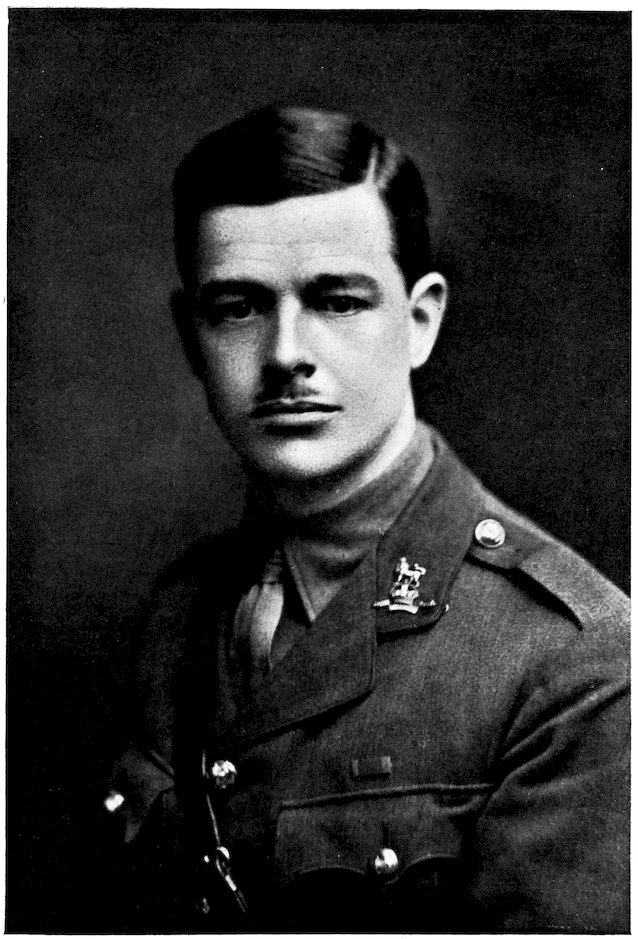
Photo by] [Thomas Fall, London. LIEUT.-COL. H. J. WENYON, D.S.O. Commanding the Battalion December 1917–June 1919.
145The thaw set in on the 11th, and the trenches began to tumble in a bit. Till the 13th we worked in every way with pumps and mud scoops to get things better, and certainly improved the trenches a lot. They were at least passable, and you could not get drowned in them when we handed over again to the Buffs on the 13th. We moved to camp at Montigny Farm.
Just before we came out it was decided that we would try a raid on a section of the Hun trench known by us as “Herbert’s Post” next time up. Herbert was our name for the sentry they used to post there, or rather for the successive sentries, because we shot several of him. They never found out that we could see him from the chest upwards from a forward post of ours a little to the right, and with a telescopic rifle at 300 you could not miss.
D Company were to carry out the raid, and 2nd Lieuts. Carville, Crighton, and Janaway were to take part. While we were out of the line until the end of the month every man in the Battalion was out on working parties day or night. D Company were digging practice trenches for their raid, and later practising it. Other work was concentrated on the forward 146area, digging and wiring the intermediate (or Brown) line, various switch lines and defensive works and digging in the Bolsover Tunnel, a recent discovery of old underground works near Templeux. There were very few men available for work round the camp, but the few there were tarred and reroofed the huts, put in some stoves, and carried out many minor improvements.
On the 20th we had a practice stand-to in Hargicourt Trench. We were, of course, in the 5th Army at this time, and the activity on all sides was part of the strenuous efforts to form some sort of defensive positions in the enormous and threatened front held by Gen. Gough.
About this time the reorganisation of infantry brigades took place, and the 8th Battalion, The Queen’s Regiment, left the 72nd Infantry Brigade and joined the 17th.
On the 28th there was a bombing raid on Montigny Camp. One bomb hit the new Theatre, “Daly’s Theatre,” where the Divisional Party had been giving a highly successful pantomime, “Aladdin,” for some weeks. Several of the performers were hit, and three of our men were wounded.
On the 30th we moved up to the line again in relief of the 2nd Leinsters. The enemy was getting more alert in the front, and was beginning to snipe and to use his light trench mortars quite a lot. On the night of February 3rd/4th, D Company raided the enemy trenches. It was a silent raid, and gaps in the enemy wire had been cut previously by the 6-inch Newtons. The 147following is the official account of the raid, sent in at the time by Lieut.-Col. Wenyon:
“The raid on the enemy position at Herbert’s Post was carried out last night.
“The assembling of the parties in No Man’s Land was carried out in good order as arranged, and the circumstances seeming to be favourable, the Commander of each party took all his men to forward assembly positions on the enemy wire within a few yards of the Gaps. This was completed by the Right Party at 9.55 p.m., and by the Left Party at about 10.5 p.m.
“The Control Post had proceeded to its position, and Advanced Battalion Headquarters was in touch with 2nd Lieut. Janaway by telephone from 9 p.m. until about 11.10 p.m.
“At 9.55 p.m. 2nd Lieut. Carville led his party into the enemy trench. The wire had been perfectly cut, and the entry was made without difficulty. The party then proceeded along the trench northwards and reached a point where an enemy post is normally held. This was found to be unoccupied, and the party proceeded again towards a suspected dug-out. At this moment loud shouting was heard, and a large party of the enemy appeared on the high bank which forms the parados of the trench at this point. Our men were very heavily bombed from this bank, and further reinforcements in large numbers came up. One of the enemy, either officer or warrant officer, dropped into the front line and made off north. 2nd Lieut. Carville at once pursued him and fired four revolver shots into 148him at close range. 2nd Lieut. Carville did not consider it possible to search this man, as by this time the enemy party had been considerably reinforced, his party was hopelessly outnumbered and in great danger of being cut off.
“It was impossible to scale the parados, and the order was given for our party to throw all remaining bombs and return to their assembly positions in No Man’s Land. One of the enemy stood up to throw a bomb, and was shot by 2nd Lieut. Carville.
“By this time 2nd Lieut. Carville had been twice wounded, but he succeeded in getting his party back to shell-holes outside the enemy wire. From here he ordered the party to return to our trenches in small parties, and finally returned himself at 10.45 p.m. The casualties in this party were several, but not serious. Unfortunately a trench mortar fell among a party of six entering our trenches in Curtain Lane and killed or wounded them all.
“The Left Party entered the enemy trenches at about 10.10 p.m., and the two blocking parties proceeded to their posts. Two of the enemy retreated down the communication trench, and were fired at by the blocking party.
“2nd Lieut. Crighton led his party to the ‘T’ head. This was found to be unoccupied, but very fully stocked with bombs. The alarm was given by two men running northwards behind the trench shouting ‘English.’ From the ‘T’ head our party made for the enemy trench, and just as they were entering it, 2nd 149Lieut. Crighton was shot. Men appeared to come out of about four dug-out entrances behind the trench, as four patches of light could be seen, and there was a good deal of shouting. A word like ‘Mull’ was passed down from mouth to mouth, and our party was heavily bombed from the parados.
“Sergt. Vanner had taken command of the party, and all available bombs were thrown. The blocking parties co-operated. Sergt. Vanner then went to the blocking parties and gave the order to return through the enemy wire. He and Sergt. Allen stayed behind and attempted to get 2nd Lieut Crighton’s body away. They succeeded in dragging him some fifteen yards towards the ‘T’ head, but they were seen and fired at by several rifles from about fifteen yards away. Another effort was made to move the body, but Sergt. Vanner was then heavily bombed as well as fired at. They could not get the body any further. Sergt. Allen was hit slightly.
“Outside the enemy wire two of our party were wounded. Sergt. Vanner and Sergt. Allen succeeded in getting them back to Bait Trench. They were all reported in at 11 p.m.
“2nd Lieut. Janaway was still at the Control Post. He succeeded in gaining touch with the Left Party, and kept me fully informed by telephone of their movements. He made four attempts to gain touch with the Right Party, but was prevented by heavy volleys of bombs and darts which were put down by the enemy in front of his own wire. The enemy was continually 150bombing his wire just in front of the Control Post, but 2nd Lieut. Janaway and the sapper detailed for the work succeeded in exploding one Bangalore Torpedo in the wire.
“After this the enemy trench mortared the Control Post, very severely wounded one of the stretcher-bearers in 2nd Lieut. Janaway’s party, and buried 2nd Lieut. Janaway. I then ordered 2nd Lieut. Janaway to return. With the help of Cpl. Andrews the wounded man got in with very great difficulty. 2nd Lieut. Janaway finally returned to our line at 12 midnight, having been at his post in very difficult circumstances, constantly being bombed and later trench mortared for three hours. His work in keeping touch with the Left Party and keeping me informed of what was happening was of the greatest value.
“It was quite impossible for either attacking party to get in touch with the enemy, and in both cases our party was considerably outnumbered. As far as possible, in the case of each of these parties, as well as at the Control Post, the plans made were carried out.
“The return to our trenches was carried out in orderly fashion. The total casualties in the raiding party and the trench garrison were:
“One officer and five other ranks killed.
“One officer and twelve other ranks wounded.
“Also two of the sappers attached were wounded. A large proportion of these casualties were caused through enemy trench mortars falling in one of the posts in our trenches and 151among the party of six men previously mentioned.
“Communication back and forward worked most excellently throughout. The wire out to 2nd Lieut. Janaway fortunately held until after the return of the Left Party.”
It turned out that 2nd Lieut. Crighton was not killed, as he was subsequently reported wounded and prisoner of war.
The following decorations were awarded for this raid: 2nd Lieut. Carville and 2nd Lieut. Janaway, the M.C.; Cpl. Andrews, Bar to the D.C.M.; Sergt. Vanner, D.C.M.; and Sergt. Allen, M.M.
On the 5th we extended our Battalion front southwards. After a tour out at Hancourt, where the whole Battalion was working all the time on digging the Green Line (some five miles behind the front positions), and a tour up at Cote Wood, where we relieved Indian troops (the Sialkot Dismounted Cavalry Brigade), who had recently come up into the sector, we took over the Right Subsector from the 1st North Staffordshire Regiment. This was new ground.
Most of the front—which was a wide one—was held by isolated posts; there were no continuous trenches. We had an uneventful tour here. Battalion Headquarters were back again at our old friend The Egg—still very comfortable.
On the 22nd we were relieved and moved to Vendelles. A battalion mess had been built on quite luxurious lines there. Mess room, anteroom, officers’ cubicles and bathroom were all 152complete. The whole place was made in a large Adrian hut, and had been very generously furnished out of the Divisional funds. News reached us here that we had finished our long spell in the Hargicourt Trenches, and we were going out for a rest. A draft of sixty-seven joined us at Vendelles during this tour there.
On the 27th we were relieved at Vendelles by the 2nd/7th Manchester Regiment (66th Division), and we had a most cordial handing and taking over. We marched away at 10 a.m., with the drums at our head blazing away at the tune of “Good-bye-ee, Good-bye-ee.” We little knew how soon we were to be back in the district. The Battalion entrained at Roisel at noon, detrained at Villers Bretonneux, and marched to La Neuville near Corbie, where we were greeted by a deluge of rain. A large draft of 108 joined us on Roisel Station that morning.
We all had very pleasant memories of the Hargicourt Sector. Five months in the same district was a long time, and there was probably no place among our travels up and down the line which we had taken possession of and made our home quite so much as this one.
When we had settled down, we had some good times behind the line. Trips to Amiens were arranged fairly frequently, and the Division really assisted greatly in organising concerts and shows. The inauguration of the 72nd Brigade Concert Party, “The P.B.I.,” came about at Vendelles in November, and started most successfully. Among the enormous working parties 153when we were out of the line there was little time for organised sport, but we had a few good football matches.
Even as we marched away from Vendelles that morning there was a feeling in the air that something was going to happen. We were indeed on the eve of tremendous events.
154